Shared posts

08 Oct 16:22

9 August (1933): John Steinbeck to Carl Wilhelmson

by Staff

steinbeck_greenJohn Steinbeck, caring for his aging father and awaiting the publication of his second novel, To the Unknown God, writes wistfully to his former classmate and roommate Carl Wilhelmson on the pleasure of work and his taste for the metaphysical.

Salinas
August 9, 1933

Dear Carl:

This loss of contact has been curious. I hope that now it is over. Enclosed is a letter I wrote to you a long time ago and never had your address to send it.

This condition goes on, one of slow disintegration. It will not last a great time more, I think. For a long time I could not work, but now I have developed calluses and have gone back to work. It seems heartless when I think of it all. You are much more complex than I am. I work because I know it gives me pleasure to work. It is a simple as that and I don’t require any other reasons. I am losing a sense of self to a marked degree and that is a pleasant thing. A couple of years ago I realized that I was not the material of which great artists are made and that I was rather glad I wasn’t. And since then I have been happier simply to do the work and to take the reward at the end of every day that is given for a day of honest work. I grow less complicated all the time and that is a joy to me. The forces that used to tug in various directions have all started to pull in one. I have a book to write. I think about it for a while and then I write it. There is nothing more. When it is done I have little interest in it. By the time one comes out I am usually tied up in another.

I don’t think you will like my late work. It leaves realism farther and farther behind. I never had much ability for nor faith nor belief in realism. It is just a form of fantasy as nearly as I could figure. Boileau was a wiser man that Mencken. The festered characters of Faulkner are not very interesting to me unless their festers are heroic. This may be silly but it is what I am. There are streams in man more profound and dark and strong than the libido of Freud. Jung’s libido is closer but still inadequate. I take pleasure in my structures but I don’t think them very important except in the doing.

Tillie died you know and now we have another dog named Joddi. An Irish terrier and beauty. We like him. He is one of the toughest dogs I have ever seen although only a little over six months old.

Your preoccupation with old age would be shocked out of you by seeing what I see every half hour all day, true age, true decay that is age. A human body that was all dead except for a tiny flickering light that comes on and then seems to go out and then flickers on again. Our life has been uprooted of course, but that doesn’t matter if I can find my escape in work.

I have a book coming out in a couple of months. I don’t think I would read it if I were you. It might shock you to see the direction I have taken. Always prone to the metaphysical I have headed more and more in that direction.

I have to go to the office now and write a few figures in a ledger. Then I will come home and to my afternoon’s work. I’ll write again in a little while. And let me hear from you again old man.

affectionately,

john


 From Steinbeck: A Life in Letters. Edited by Elaine Steinbeck and Robert Wallsten. New York: Viking, 1975.


FURTHER READING:

Read a selection of John Steinbeck’s comments on writing, compiled  here by the Paris Review.

Listen to an NPR broadcast about Steinbeck’s last published writing—his reports from the front lines of the Vietnam war—here.

08 Oct 16:22

12 August (1930): Ernest Hemingway to Maxwell Perkins

by Staff

hemingway_full_orangeWriting with characteristic bluntness to his editor Maxwell Perkins, Ernest Hemingway pauses work on his nonfiction book about bullfighting, Death in the Afternoon, to deal with matters related to Scribner’s 1930 reprint of his first story collection, In Our Time.

[Nordquist Ranch, Wyoming]
[12 August 1930]

Dear Max:

Have gone over the I.O.T. also the Up in Michigan. I’ve rewritten it to try and keep it from being libelous but to do so takes all its character away. It clearly refers to two people in a given town, both of them still alive, still living there and easily identified. If I take the town away it loses veracity. But I can leave out enough of the first part to eliminate libel. However I know you will not publish it with the last part entire and if any of that is cut out there is no story…

What I would suggest is that you get Edmund Wilson, if he is willing, to write an introduction to the In Our Time. He is, of all critics or people, the one who has understood best what I am working at and I know an introduction by him would be of much value to the book as you are getting it out now. As I understand it you are getting it out somewhat as a new book i.e. you want new material from me and it is not fair to do this without explanation since it is not new but my first and earliest book. I’ll be damned if I will write a preface but Wilson, if he would, could write what it would need as an introduction. If he wouldn’t care to it would be better to have none…

Please let me know what you think of this.

I know I am not going in for putting out books because there should be something from me on the Scribners list. The In Our Time is, I really believe, a hell of a good book—the stories, when I read them now, are as good as ever—and worth anyone’s two dollars but I am not going to jazz it up with anything of another period and try to make it sell as a new book…What it needs—the In Our Time—is a good introduction. What you are doing is making it really available for the first time to the people who have read the other books. I am too busy, too disinterested, too proud or too stupid or whatever you want to call it to write one for it…

However we had better figure out a formula to put in the front about no living persons which will absolutely prevent libel as there are three people who might, if they were in desperate enough straits and the book sufficiently prominent, try a libel action. The reason most of the book seems so true is because most of it is true and I had no skill then, nor have much now, at changing names and circumstances. Regret this very much.

Am going well on the new book [Death in the Afternoon]. Have something over 40,000 words done. Have worked well 6 days of every week since got here. Have 6 more cases of beer good for 6 more chapters. If I put in an expense account on this bull fight book it would be something for the accounting Dept to study.

The checks came and your letter with them. Thanks ever so much—also for the telegram about G. and D. jacket. I hated like hell to bother you about that—you have enough to worry about without Grossett and Dunlop. I’m so sorry to hear bad news of [F.] Scott [Fitzgerald]. Please let me know what you hear and let me know anything you think of that I can do. I’d go over [to France] if you think it would do any good.

Best to you always. Please if I speak rudely in letters never take it personally. I’m working damned hard and a letter about some bloody problem or other is only a damned interruption and curse. Don’t let me get on your nerves. We’ll have a good time in March at Tortugas!

Yours always

Ernest


From Ernest Hemingway Selected Letters 1917-1961Edited by Carlos Baker. New York: Charles Scribner’s Sons, 1981. 948 pp.


FURTHER READING:

As Hemingway requested, Edmund Wilson did write the introduction to In Our Time. To read excerpts from his 1939 essay “Ernest Hemingway” as well as other critics’ perspectives, click here.

For the New York Times’ 1932 review of Death in the Afternoon, click here.

08 Oct 16:21

Five Questions with NOT VOGUE

by Staff

notvogue_gr

The American Reader asked five questions of Steve Oklyn, the shadowy cult-figure behind the digital manifesto, NOT VOGUE. The latter is an act of resistance that takes the form of a gnomic-visual scroll. Each entry pairs image to aphoristic fragment; what results is a kind of deranged children’s book about power, desire, and control. But what is the narrative of this tale, and who are its protagonists? NOT VOGUE de-protagonizes fashion’s major and minor players, recasting them as the wolves they are—and the implications of this recasting are as electric as they are unnerving. In the following answers, Mr. Oklyn meditates on these wolves-in-silk-gowns, the forest they roam, and the individual’s role as the hunted.
                                                                                     —Uzoamaka Maduka

Uzoamaka Maduka: You have said that the fashion industry, as it manifests itself today, is a system of mediocracy, and have also referred to that scene as a swirl of emptiness. I wonder if you could elaborate on how absence can architect itself into a structure, and whether it is possible for a system built of nothing to collapse.

Steve Oklyn: Absence of meaning and absence of purpose are the dominant building blocks of the global consumer network. The luxury spectacle conglomerates such as LVMH, KERING and RICHEMONT have specifically engineered absence (nonexistence) as a key component of their general theories of consumerism and behavioral command and control. The feeling of emptiness in both the spectacle and the consumer is the central ordering mechanism for safeguarding the fashion-industrial-media complex’s operation, survival and continued growth. This command-and-control network of propaganda creates a feeling of emptiness in the consumer, and subsequently drives him or her to needlessly consume again and again in order to make that emptiness go away (which of course it never does). The scenario moves way beyond a simple metaphor of chemical addiction, operating in accordance with a much deeper pathology based on social acceptance (as opposed to drug addiction, which is based on social exclusion). The basic paradigm has shifted from the idea that the architecture of reality requires a foundation and a purpose to the exact opposite, where the systems that are organized to manage us are programmed to mean nothing. That nothingness is the exchangeable currency governing us all.


UM: You have written that fashion is the ally of power, whereas revolution is the response to power. Many people consider fashion to be quite unimportant, a sort of vain pastime—in their dismissal of fashion, is also a dismissal of fashion’s ability to shore up cultural and political power systems. You seem to disagree with such an appraisal, and even to see such a dismissal as dangerously naive. Could you elaborate on the relationship of fashion to power? And what do you think we risk by not understanding that relationship?

SO: Fashion is the primary visual system of signs and signals that telegraph one’s relation to and position in the social hierarchy. From President Obama’s blue tie to Karl Lagerfeld’s black gloves (and to be honest, all of the LBDs in between), centuries of neural coding and behavioral programming are at work. Fashion is a global political organization without any need to worry about voter’s rights. The owners of the brand conglomerates are the rulers and legislators of their global kingdom. They directly control the entire process from on high. They have the key designers under contract, and they have the major magazines under their control via a steady stream of advertising, marketing and promotional initiatives. They sponsor the continuous rounds of fashion weeks (the central source of the spectacle of fashion), as well as the models, photographers, stylists, creative directors, art directors, and celebrities needed as props and cons for their campaigns and products. Every public relations firm in the sector is ultimately controlled by LVMH, KERING and RICHEMONT. There are, of course, other players and propagandists, such as the recent wave of apologists and promoters who operate under the moniker of “bloggers.” Simply put, fashion is the largest, best-funded and best-scripted NGO in existence—and one that’s not above using politicians as instruments for social command and control (Anna Wintour to President Barack Obama to First Lady Michelle Obama, not to mention the attendant barrage of media about a US ambassadorship). FASHION IS THE ALLY OF POWER. REVOLUTION IS THE RESPONSE TO POWER. The risk is already apparent: WHEN A CULTURAL REVOLUTION IS DRAINED OF MEANING, IT BECOMES FASHION. Welcome to our world of misrepresentation and controlled misdirection (“It ain’t hard to tell / I’m the new Jean Michel”). Freedom of expression is now freedom to script viruses of social authority. An example from Kanye West: “What’s GUCCI, my nigga? / What’s LOUIS, my killa? / What’s drugs, my deala? / What’s that jacket, MARGIELA?”


UM: I first heard of “fashionism” from you. Did you coin this term? To what does it refer? Is it related to what you call the “fashion-industrial-complex”?

SO: FASHIONISM is a term used to denote the fashion-industrial-media complex. I did not coin the term, but I believe that I am the first to have given it prominence when critiquing the fashion system. If one wanted to be more aggressive, one could use the terms FASHISM and FASHIST. However, those spellings get too political in my estimation—and are not appropriate for open critique and feedback. 


UM: You have written that fashion is “the administration of fear.” This is very intriguing. Would you expand on this?

SO: FASHION: THE ADMINISTRATION OF FEAR is a philosophical remix. The phrase “administration of fear” comes from the title of a Paul Virilio book. Fear has become an environment, an everyday landscape. Since I view the globalized fashion conglomerates as political institutions governing every aspect of the world population’s selfhood, it seemed appropriate to apply Virilio’s thinking to the way that fashion manufactures fear on a deeply personal (and possibly subconscious) level. The fashion system generates massive waves of anxiety to ensure domination, with its most insistent message being: “Buy our products or live in perpetual fear of societal imbalance and exclusion.”


UM: Why do you maintain anonymity? How and why is your anonymity required by your project?

SO: Anonymity is necessary on several levels. Given the current societal objective of 100% visibility (social media), it seemed strategically more purposeful to communicate a message in a manner running counter to that prescribed methodology. NOT VOGUE is not a product. It is a position. It is a process. It is a procedure. Its main objective is to disrupt the fashion system. It is structured as a monologue. There is no feedback loop—no Facebook, no Twitter, no Instagram. No comment platform whatsoever. It is hermetically authored, and hermetically structured. Steve Oklyn has no interest in being promoted by the project. The project is the point of the project. The fact that we’re not selling anything ensures a certain longevity. Having the authors (Steve Oklyn, Stanley Blade and Mark Even) be non-social entities maintains the project’s message of COUNTERCULTURE VS OVER-THE-COUNTER CULTURE (OPPOSE DISRUPT DISAPPEAR).

 
Steve Oklyn
August 10, 2013
Lauenen, CH
 
08 Oct 16:21

Inventing the Helicopter

by The British Pathé Archive

Helicopters have matured from unsteady, erratic machines that struggled to lift the pilots off the ground, into stylish contraptions with exceptional flying capabilities. Pathé recorded some of these early trials in which inventors desperately tried to get their machines to get off the ground.

View our NEW GALLERY here.

PERSEVERANCE_REWARDED_330_29_33


Tagged: aviation, British Pathe, flight, Helicopters, History, invention
08 Oct 16:20

Ice

by Blaine Brownell

Formed out of Reynolds Polymer Technology’s R-Cast Acrylic product line, the texture of the Ice is completely randomized without any repetitive patterns. This randomization ensures that the acrylic Ice more closely resembles real ice, particularly with light refractions off the surface.

R-Cast Ice is ideal for use within the hospitality and entertainment markets. Each sheet of Ice is unique, formable, bondable, available to cut to any size or shape, and can have a striking impact with special lighting effects.

By using a variety of different translucencies and hundreds colors that are available—as well as the creative use of lighting—innumerable effects can be realized with R-Cast Ice. Available in half-inch and one-inch thicknesses, R-Cast Ice is available in sheets as large as 4’ x 8’, which can be fabricated or formed into a variety of shapes for custom projects.

Contact: Reynolds Polymer Technology, Inc., Grand Junction, CO, USA.
Find more information in Transmaterial 3.

08 Oct 16:20

19 August (1942): Jean Grenier to Albert Camus

by Staff

grenier_blueIn a letter to his former student Albert Camus, Jean Grenier is optimistic about the state of literature.

Sisteron, August 19 [1942]

Are you still in Aïn el-Turk? A rather bourgeois beach: you can see a restaurant on the beach with wooden bathing huts. The sunset side is more beautiful and you should be able to go to the Andalouses by following the coast. I have always liked the Andalouses very much.

Have you read Aragon’s Le Crève-Coeur? The beautiful pages inspired by the defeat.

You will be receiving the issue of Comoedia that has published Arland’s article. You are being “launched” by Gallimard and that’s all for the best, as the review had been reluctant until now. Why? The wind is shifting and there is wisdom in waiting for the right opportunity. A. Rousseaux judges all books from a moral and religious, if not patriotic, viewpoint. What he says is not wrong, but in the end his criteria seem to me infinitely too narrow. What would he have written about L’Immoraliste and so many others? He could not appreciate that mixture of despair and passion which is at the very core of L’Etranger’s cynicism.

Send me your article on Guitton. Parain is going to publish his big thesis on language—it’s most interesting—Louis Guilloux and Marc Bernard have published very successful childhood recollections. Like mushrooms after the rain, I see good books coming out everywhere. My colleague from Lille, Gandillac, is publishing Oeuvres de Nicolas de Cues, Blanzat an analytical novel, and Bachelard very amusing books about water and fire under the pretext of philosophy.

In Lille I have a colleague who is in very good health and travels from Lille to Paris every week with two pneumothoraxes. He leads a very normal life. For the moment you just need to take a lot of precautions. In Paris no opening at Gallimard for now, but that may change this winter.

I am not going to speak about life in Lille, there would be too much to say and I would not be able to say enough. But I endured it better than I would have thought, while two years ago, and even last year, I fell victim to an inexplicable depression that prevented me from working and resting. The circumstances I was in were much better, yet the “events,” as we modestly call them now, took their toll on me at that time. And I must say that the moral atmosphere of Paris and Lille is very oppressive this year (even for someone who is in good health).

Let me know how you are doing.

Yours.

J.G.

Jean Wahl was able to leave for America, so was Rachel Bespaloff.


FURTHER READING:

Read a newly translated “mimodrame” by Albert Camus, published in the New Yorker here.


08 Oct 15:41

Crime Does Not Pay

by Greg Ross

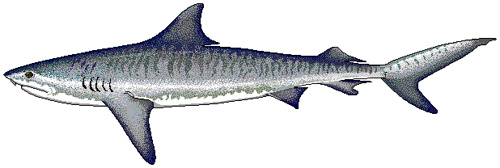
http://commons.wikimedia.org/wiki/Image:Tiger_shark.png

In 1799, the English cutter Sparrow intercepted the brig Nancy in the Caribbean. The area was forbidden to American ships, but the Nancy’s captain, Thomas Briggs, produced papers claiming she was owned by a Dutchman. Suspecting a smuggler but lacking evidence, the Sparrow’s captain sent Briggs to Jamaica to have his case heard by the vice-admiralty.

Two days later, another English ship, the Ferret, caught a large shark near the coast of Haiti. In its belly were the papers of the American ship Nancy — which Briggs had thrown overboard before getting false Dutch papers in Curaçao.

The “shark papers” were produced in court, and the Nancy and her cargo were confiscated.

08 Oct 15:41

Last Words

by Greg Ross

http://commons.wikimedia.org/wiki/File:GoldenGateBridge1.jpg

Suicide notes left by people jumping from the Golden Gate Bridge, gathered by Marc Etkind for Or Not to Be: A Collection of Suicide Notes, 1997:

“This is where I get off.” — Harold W., the first suicide, three months after the bridge opened, 1937

“Absolutely no reason except I have a toothache.” — 49-year-old John Thomas D.

“I am sorry … I want to keep dad company.” — 24-year-old Charles G. Jr., whose father had jumped four days earlier

“Do not notify my mother. She has a heart condition.” — Steven H., the 500th person to jump

“Why do they leave this so easy for suicide? Barbed wires would save a lot of lives.” — A 72-year-old man

“I and my daughter have committed suicide.” — A man who jumped with his 5-year-old daughter

“Loved Ones: My nerves are shot. Please forgive me. Chris” — A member of the San Francisco board of supervisors. This was a fake — he turned up a year later selling Bibles in Houston.

One person leapt with $36 in his mouth. “What he meant by this gesture is open to interpretation.”

“Obvious reasons for the bridge’s popularity are that it is easy and effective,” Etkind writes, “but there must be something more, for many suicides travel over the equally effective and accessible Oakland Bridge just to jump off the Golden Gate.”

08 Oct 10:43

Two Tides

Eleanor Catton

An extract from Man Booker Longlisted Eleanor Catton's first appearance in Granta.

The harbour at Mana was a converted mudflat, tightly elbowed and unlovely at any tide but high. I had never been there when the tide was high. The birds were shags mostly. The fish were small. Low water showed the scabbed height of the yellow mooring posts, and the thick curded foam that shivered under the wharves, and the dirty bathtub ring on the rocks on the far side of the bay. The waves left a crust of sea lice and refuse and weed.

The marina was tucked into the crook of the elbow, facing back towards the shore. To make the hairpin journey from the shallow flats to open sea was dangerous, and so a central trench had been excavated in the seabed to create a channel deep enough for yachts to travel safely, even on the ugliest of tides.

‘Bad luck to have a woman on board,’ Craig said as I stepped down into the cockpit and took the tiller in my hand. ‘That’s the oldest in the book. But I’ll tell you something else. There are grown men on this marina, educated men, who will never leave an anchor on a Friday. Grown men. Never leave on a Friday. It isn’t just a quirk for them – something runs deeper. And you know the reason why?’

I did: he’d told me this twice already, the first time at the yacht club with a gale wind thrashing at the door and the second time in the conical dry space beneath a fir tree on the Plimmerton domain, passing the last cigarette back and forth between us with our fingers cupped tight to keep it burning.

‘No,’ I said. I smiled at him. ‘What’s the reason?’

Vendredi is French, that’s Friday. Right? That’s a word from way back when. And Vendredi means ruled by Venus. Right? And Venus is the ruler of women. And women are bad luck at sea. Right?’ Craig sucked in the wind through his teeth. ‘So never leave on a Friday.’

‘Would you?’ I said. ‘Would you leave on a Friday?’

Craig thought for a moment.

‘Say if the conditions were perfect,’ I said. ‘Say if the Strait was like glass.’

‘Depends on the journey,’ he said at last. ‘If it was a day trip I would. But if it was some voyage – some huge beginning – I’d think twice. You don’t want a curse on that.’

The limit was five knots inside the marina, impossibly slow. Even the speedboats seemed to drift. Once they passed the five-knot post you heard the grinding click and then the roar. The vessels ghosted by, passing close enough to whisper. I saw a seasick dog on a cabin roof and a charcoal smoker pouring steam and a scalloping basket hung like a flag from a boatswain’s chair. It was still morning.

We left Mana with our faces turned back towards the harbour, watching the leading lights that showed the safe passage out of the bay. The leading lights comprised three colossal lengths of sewer pipe, diverging in three spokes and set into the hillside against the scrub. The central pipe was aligned with the excavated channel down the middle of the harbour, so if you were sailing safely you would be able to look cleanly up the length of the pipe and see the white light at the far end. If you strayed from your course you would no longer be looking down the unobstructed length of this middle pipe, and so the white light would disappear. Too far port and you would come into alignment with the left-hand pipe, which showed the warning red light; too far starboard and you would be aligned with the right-hand pipe, which showed a warning green.

There were two sets of leading lights in the harbour. The first was to guide you out of the marina and past the moored yachts, all shelved and slotted into the skeletal docks like a vast nautical library. Once these leading lights diminished in the distance and the light became difficult to see, you looked around to find the next set, fixed at an obtuse angle to the first and mounted on the shore above the motorway. The leading lights fascinated me. I drove the tiller to the right and left just to see over my shoulder the warning flash of green and then of red, leaping out from the hillside like a private flare.

Craig was smoking a cigarette and the ash was whipping off the butt and shredding whitely in the wind. The mainsail was up, but tightly reefed, and we hadn’t yet switched off the diesel. He called the horsepower ‘not quite enough to make a herd’ and the description amused him so much that he had said it more than once, with minor variations. His foot was cocked, pinning a Primus stove upright against the hatch cover so it didn’t fall and gutter as we bucked and rolled. The pale flame was invisible in the brightness of the day but I could see that the water in the billy was beading and ready to boil.

I was standing braced against the sides of the cockpit, half-turned and holding the tiller arm behind my back. ‘Like backing a trailer,’ Craig said. ‘Just push the opposite to where you want to go.’ I was not strong and my hand seemed to shiver on the tiller arm, the stout taper of teak wound around its length with a tight coil of waxed rope bleached grey by the salt and the sun. My awkwardness showed in the bunching lather of our wake. Craig’s helming always left a crisp and minted streak; it conveyed a sense of purpose, a resolve. My wake was full of doubt. I looked back over my shoulder at the white spearhead stamp of our passing and watched the spume get sucked downward into the blue.

Craig flicked the end of his cigarette into the sea.

‘That’s what’s missing,’ I said. ‘A dog.’

‘You never met Snifter,’ Craig said. ‘Hell of a dog. He got so crook in the end, his skin just hung down. Kidneys. I cried. Could hardly see. That was a shit of a year. My dad died that year, and a bunch of other shitty stuff.The boys said goodbye and I said I wanted to take him to the vet myself, in the truck, just him and me. But I took him out to our Foxton plot instead and we walked into the trees and I told him to sit, and I shot him. I bloody shot him. God, I cried that day. I cried. Could hardly see. That was a shit of a year. My dad died that year, and a bunch of other shitty stuff. Never found it in me to get another dog in place of Snifter. Buried him myself, under the trees.’

I’d seen the grave on his land at Foxton. There was a pine cross driven into the earth and a piece of aluminium was stapled to the upright spar like a plaque. With a shaky engraving tool Craig had written LOOK OUT, LOOK OUT, THERE’S A TERRIER ABOUT! and underneath, SNIFTER MCNICHOL and a pair of dates. I’d come across it on my own, ducking off to take a piss behind a blackberry while Craig lopped Christmas trees with pruning shears and dragged them by their stump ends to make a pile. My hands were sticky from the sap. Later we sat on collapsible chairs on the Foxton drag and drank a case of beer and sold the trees for ten dollars, five for the ugly ones.

I thought about him sobbing as he dug the slender grave.

‘Christ, I loved that dog,’ Craig said. ‘It’s stupid. It’s stupid. Hell of a dog.’

He reached down and pinched out the Primus flame. With one hand wrapped in a gutting glove he picked up the billy and poured out the hot water into two plastic mugs jammed tight between a cleat and the steel frame of the windshield. He was alert to the pitch and roll of the boat and he poured in steady, deliberate gulps. Nothing spilled. He tipped in coffee grains and milk and used the saw blade of his pocketknife to stir.

‘It’s bloody primitive,’ he said as he passed the mug to me. ‘Bloody primitive, savage really. The milk – I steal those creamers, anywhere I can. I can’t offer – savage really. Acid in your mouth.’

He was embarrassed. I said, ‘It’s exactly right. It’s great.’ My hair was whipped across my face from the wind.

‘It’s bloody primitive,’ he said, scowling now, and then backed swiftly down the narrow hatch into the saloon. I heard him sliding the panels behind the engine where his tools were stowed. The tiller leaped against my hand and I flexed my arm to hold her firm. I listened to him rummage and over the noise I said, more loudly, ‘It’s exactly what I feel like.’

Craig was nervous when he showed me the marina for the first time. I think I’d expected something charming and toothsome, some old glamour gone to seed, but his boat was capable and wifely and broad.

The causeway between the berths had a central grip of chicken wire stapled flat to the planking and it was ridged every metre with a strip of dowelling that made our handcart ring out sharply as we walked. Sea Lady, Gracie, Taranui, Stoke. Craig pointed and said, ‘Wanker – wanker – he’s an alright bloke but the boat’s just for show – wanker’Craig pointed and said, ‘Wanker – wanker – he’s an alright bloke but the boat’s just for show – wanker – that boat’s been all around the world, would you believe it – she’s just changed hands, haven’t met the new owner – he’s a wanker – look at that, isn’t she a beauty? – see this one? That’s the boat I’d want if I downgraded to a sloop. Precision, she’s a piece of work. Owner’s a right prick though. And here,’ as we finally stopped, third from the end, beside the Autumn Mist.

She slotted snug between a pair of gin palaces, shining white bridge-deckers with tinted glass and squared-off cabins that sat high and proud in the water and bobbed brightly in the crosswind. The Autumn Mist didn’t bob. There was a weight to her, a low-slung gravity, a guarded economy of pitch and roll that seemed quietly to undermine the jouncing of the boats on either side. She was mute-coloured and scabbed with rust, trimmed with sky blue and antifouled with grey. I saw the new wind vane, mounted above the dented gutting tray at the stern, but the clean whiteness of the fin threw the rest of the boat into poor relief. Her sail covers were patched and tatted and fringed with loose threads. The gaskets hung slack. The cockpit windshield was coming apart from its steel framing. There was a dinghy strapped upside down on the bow and the triple bones of its keel showed darkly silver where a thousand landings had worn the paint away.

I thought about dogs that come to resemble their owners and turned to Craig with the tease already in my mouth, but I was startled to see that he was looking downright anxious. He had turned red and he was flapping his hand strangely, turning his wrist over and over.

‘What do you make of it?’ he said.

I put my hand up to shield the sun. ‘Didn’t you say once? Man can only have one mistress. Didn’t you say that?’

‘That’s the truth.’ He looked pleased, and ceased his flapping. After a moment he said, ‘Meet the mistress,’ and we stood in silence and bucked on our heels against the wind.

‘I’m looking for scratches on the hatch,’ I said.

‘Don’t say that when we get to Furneaux.’

‘Too soon, you reckon.’

‘All the boys in the yard been calling me Scott, or Mr Watson.’

‘Yeah.’

‘That keel’s an inch thick and she’s been to Tonga and back.’

‘Yeah.’

‘The name is from “Puff the Magic Dragon”. Silly really.’

‘Lived by the sea...’

Craig said, ‘I know she needs a paint job.’

‘Sorry,’ I said, repenting. ‘I shouldn’t have said about the scratches.’

‘But antifoul is a fuck of a business. It’s best to find some shallow bay, somewhere that gives you a big margin between the tides, low and high. Got to pop her on blocks and then paint like mad until the tide comes back. Or you can pay for the crane and lift, but you’d be looking at five hundred just for the privilege.’

‘She’s lovely, Craig,’ I said. ‘Really she is.’

‘I been thinking, a dragon on the wind vane,’ he said. ‘Some cheeky dragon with a spade on the end of his tail. I reckon I might like that. Always in my head I called that dinghy Puff.’

He leaned out over the water to grab the stainless braid of the shroud and haul the vessel closer to the marina where we stood. For a second she didn’t move. Craig’s biceps stood out on his arm. Then the great weight rolled towards us, against the grain of her keel, and slowly the gap of water between the marina and the boat narrowed and then closed. The low side of the deck touched the buffered planking with a thud.

‘Jen – my wife,’ Craig said suddenly, as I stepped over the braided rail on to the Autumn Mist and felt the slow dip as she rolled under my weight, ‘she’d be white-knuckled. Any time I tried to take her – she’d sit and clamp. White-knuckled. It’s the way she always was.’

He stepped past me on to the cabin roof to unlock the deadbolt on the hatch and the blond wool of his forearm touched my hand. I was disgusted at myself suddenly and I said, ‘But the badminton, and cycling, and the half-marathon. It isn’t like – I mean, she’s got the things she loves.’

Craig’s keyring was a plastic buoy, to keep his keys afloat if they ever fell in.

‘My marriage,’ he said. ‘You wouldn’t – you don’t – Francie – it’s just —’ and then he shook his head and rattled his keys and breathed hard through his nose and said, ‘Cunt-struck. I was cunt-struck when I married her. That’s all.’

I watched a gannet make a free-fall dive. Craig reappeared, holding a spherical compass that rolled around like a weighted eyeball in his palm. I watched as he climbed one-handed out of the hatch and fitted the compass into a socket in the centre of the boom. It was about the size of an infant skull, heavy and wet-looking, and it sat just low enough to show the phosphorous degrees that spun around its equator beneath the glass. The red needle swung and hovered in its lolling underwater way.

‘You got to have a compass above board,’ he said as he dropped back into the cockpit and unwedged his coffee mug from beneath the windshield sill. ‘If you got a steel hull you got to mount it up above. Makes the needle go funny below.’

We were flanking Mana Island now. I watched the red needle pitch back and forth and tried to hold her at twenty degrees. The northern fingers of the Sounds were still pale and fogged and flattened by the distance. I saw now that the surface of the sea had a pattern to it, a weave, and I could feel it through my arm and the arches of my feet as a push or a pull. The wind gusts showed a long way off before they struck; they approached like a little burnished patch of silver where the water was disturbed. You could predict exactly the moment when the flat hand of the wind would strike your face.

I said, ‘How long would they have lasted, the bodies of those kids? If he pitched them over and weighed them down.’

They had made an arrest for the murders, Hope and Smart. We saw it on the news. There were fingernail scratches on the inside cover of the hatch, and a slender female hair on a swab in the saloon. The evidence was small. But the man was sour and dirty and he had a bad family like a killer ought. It was too awful. The worst thing was that no one knew – no one knew the method of the kill.The story was he’d pitched them over, both of them, somewhere deep. He might have raped the girl. What were we doing that night, we all asked – that New Year’s Eve, a few dark hours past the midnight toll, while somewhere north of Picton two lovers were stabbed, or brained, or strangled, while the boats all around them trembled back and forth on some dark sheet of oily calm? Lovers. It was too awful. The worst thing was that no one knew – no one knew the method of the kill.

Craig said, ‘They’d disappear. Flesh like that. Fish would eat them away in days, maybe a week. If he weighed them down all right. They’d disappear.’

Scott Watson’s boat was called the Blade.

I said, ‘The temptation would be to cover them in plastic. That’s what I would want to do. Isn’t that stupid? To want to preserve the bodies somehow. Like an instinct. To make them keep.’

Craig laughed and shot me a sly look. We didn’t speak again for a long time. I finished my coffee and switched hands on the tiller and rolled my shoulder joint to feel it click. The cockpit floor was choked with empties, and mismatched sea boots, and the roped saltwater bucket, and a pair of life jackets that showed a fine spray of mould against the yellow. All of it shifted back and forth.

I watched him. Craig was short, five four. His hair had been reddish once but it was sandy now, white at the temples and the sides of his beard. He had a white scar above his left eye and a thick pink scar running down his left forearm like a vein. His hands were big. He was stocky and barrelled but his legs were slender and his calves were fine. I watched him watch the ocean and saw how his weathered squint had left the crinkles of his crow’s feet untanned, so when his expression softened you could see two pale stars at the outer corners of his eyes. The tawny skin on the back of his neck was creased three times.

The first time I went to sea was as a child, when the replica of the Endeavour came to circumnavigate New Zealand and retrace Cook’s voyage from the north. I sailed out to meet the great square-bellied ship in a restored yacht belonging to a friend of my father’s. Lionel was a giant wrathful man who cursed at his children and ridiculed his wife, but from time to time he would lay his hands upon his boat with such a private, secret tenderness it was as if he believed himself to be alone on board.

Lionel kept the Indigo like a thoroughbred mare. A poor knot would turn him purple with fury. He screamed across the water at any vessel that flouted maritime law, and blacklisted any sailor who jammed the radio channels with ordinary talk. He would flare with a scarlet contempt if you said rear instead of aft or back instead of stern. He let nobody in the steering house when the Indigo was at sea, and he called for complete silence whenever he drove her glossy hips in or out of her marina berth, in case his concentration broke. We tucked ourselves against the mast on the aft cabin between his children and his wife and we tried to touch nothing, but he called us lubbers anyway. There was a brass plaque above the freshwater pump that read THE CAPTAIN’S WORD IS LAW.

Craig was generous with the Autumn Mist. He showed me every part of her. He watched while I fumbled with the tiller or dipped my hand down into the streaky black damp of the bilges or traced the fuel line to understand why the ignition wouldn’t catch. He let me make the radio calls to the coastguard watch. He taught me to rope off the mooring line around the forward block and showed me how to cross the rope neatly over the top of the block so the knot could unravel with a single blow of an axe.

He said, ‘Imagine if the boom clocked my temple and I went out cold. You have to know everything.’

When the Endeavour docked at Lyttelton we went aboard and marvelled at the five-foot ceilings and the swarming hammocks clustered tight and the giddy drop of the overboard latrines. They served limes. We touched the flayed catgut fingers of the cat-o’-nine-tails and learned how a single lash could shred a man. The crew were dressed in period costumes, rough linen for the seamen and covered buttons for the captain’s men. Lionel hung back with his hands in his pockets and looked up the length of her mast. He said, ‘Square-bottomed, now, and ship-rigged. Nothing much to look at. But what a life.’

The kauri shelves above the swabs in the Autumn Mist’s saloon were stuffed with faded thriller novels and food for the week ahead. In the morning before we left Mana I went below to stow my duffel bag in the V-shaped cabin underneath the bow and I saw that Craig had stuffed a box of Cadbury’s chocolates into the stow hole beside the anchor chain. The box had been stowed so roughly: it was dented and a corner of the cellophane was pierced.

To read the rest of Two Tides, go to Granta 106: New Fiction Special.

Image by Paxson Woelber

08 Oct 10:43

The Best Hotel

Sonia Faleiro

Jharkhand has a smooth, wide highway, but like many parts of the state, parts of the highway have no power. To compensate, drivers switch on their high beams. They honk urgently. Trucks and buses make a sport of overtaking each other, so there are often two enormous vehicles hurtling towards you, one directly in your lane.

We were in the smallest car on the road. It didn’t even have working lights, but this fact, instead of humbling our driver, prodded him to a maniac competitiveness. He hunched over the steering wheel and slammed on the gas. ‘I do this all the time,’ he cried. ‘It’s my job!’

After an hour or so, the traffic faded. But for the moon, we would have been steeped in darkness. It gleamed clear as a torch on the road, illuminating the forest on either side, revealing pathways and ponds. It was a moment of unexpected beauty and I was grateful for it.

Then Ramesh rolled up his window. ‘Watch for Naxalites,’ he warned.

In Jharkhand, we watched constantly for Naxalites. The leftist extremists planted bombs on buses, trains and bridges, but they also struck in the dark, robbing and killing people before melting into the nearby forests or mountains. To be in ‘Naxalite territory’, as we were now, was to be ready for ambush. If that happened I was to step up with my media credentials, making clear I was worth keeping alive.

What would Ramesh do?

‘I will hug my comrades and invite them to dinner in my home,’ said the innocent.

So we rolled up the windows, switched off the radio and accelerated, speeding down the highway. We willed the border to come. But what we saw ahead could not be blamed on the Naxalites.

Traffic had backed up, and the dozens of buses and trucks that had raced past us now stalled, deflated. Drivers, all of them men, strolled up and down the highway, shadowy figures grasping cigarettes and cellphones. They passed on the news – there had been an accident. The police and an ambulance had only just arrived.

We parked behind everyone else, and our driver turned to me. ‘You wait here,’ he said. ‘I’ll go look.’

Ramesh agreed. ‘Wait inside the car until we know what’s happening.’

They were afraid for me, and their fear was not unfounded. Women were a reliable target around here, even when it wasn’t dark and chaotic with men. But I could not afford to be a captive of their fears, or to succumb to mine. If I did, I would retreat, if not from this place, and this pursuit, then some other. If I did, the men might not win, but I would definitely lose.

So we got out of the car together and started walking to the head of the traffic jam, past the buses and trucks, the accumulations of fractious, fidgety men, the women seemingly secure but still vulnerable behind rolled-up windows. We walked for fifteen minutes.

A policeman said the driver of the motorcycle, in overtaking a bus, had flown into the face of an oncoming truck. The driver was thrown off the motorcycle, and there he was – a misshapen heap, broken but still breathing. He was no more than a teenager. When the truck hit he flew, but the young man sitting behind him was plucked off the bike and dragged along, in the opposite direction. No one got the truck’s number plate, or even knew where it was now. But several of us could see the young man.

‘Look,’ said someone. ‘A finger!’

A policeman pounced on it and stuck it in a garbage bag.

With the help of bystanders, using their cellphones for light, the police then gathered up the body parts they could see – a hand, a leg, some unidentifiable bits – and eventually, at the base of a tree down the road, the young man’s severed head.

The family members arrived. There were six of them, and they stepped out of their white Maruti van in order of gender. First came the men, and they went straight to the driver of the motorcycle. Then came the women, in salwar kameezes and saris, high heels and glass bangles, and they were still, as though they had expended all their energy in that single step from van to road. If they spoke, or even wept, I didn’t hear them – several of the truck drivers had got tired of waiting and they pounded their horns like bullies.

A family member walked over. ‘They had gone to buy mithai,’ he said, with a bewildered expression. ‘So many guests had come, but there were no sweets to feed them.’

Images by Sonia Faleiro

From ‘The Best Hotel’ by Sonia Faleiro; the full story can be found in Granta 124: Travel. You can now buy the issue or subscribe and receive four issues a year of the best new writing.

04 Aug 11:29

The New Land of Jihad

by Sebastian Rotella
syria-civil-war

MADRID — Rachid Wahbi came to Syria from a Spanish slum, rushing toward death.

And he didn’t plan to die alone.

Facing a camera hours before the end, the bearded, 33-year-old cabdriver wore a black headdress and a black flak vest and held an AK-47 rifle. He spoke in hesitant classical Arabic with a north Moroccan accent. He said he had studied his target and, God willing, his action would end in triumph. He wished the glory of martyrdom for his fellow fighters in the al-Nusrah Front, al Qaeda’s Syrian branch.

When the cameraman asked about his mother, the Spaniard became emotional.

“I want to thank my mother because she inspired me,” Wahbi said, according to a translation by the Spanish national police. “Mother, you must be happy because God will reward you.”

The al-Nusrah propaganda video shows Wahbi disguised in the helmet and uniform of a Syrian soldier as he hugs a comrade and climbs into a truck packed with explosives. The truck bears down on an army outpost. An explosion thunders. A column of smoke, seen from multiple camera angles, climbs toward the sky.

Wahbi killed 130 people in that suicide bombing on the al-Nairab military base in northern Syria on June 1 of last year, according to Spanish authorities. And the numbers get grimmer.

Five holy warriors from Spain have died in Syria, three in bombings that killed another 100 people, police say. Last month, Spanish police stormed the hillside ghetto where Wahbi lived in Ceuta, a Spanish territory in North Africa, and arrested a ring of extremists who are charged with sending as many as 50 fighters to Syria. Indicating a threat much closer to home, the accused leader had previously been acquitted of plotting attacks on targets in Spain with a group linked to al Qaeda and a former Guantanamo inmate.

“The global jihad has prioritized the Syrian conflict as its principal front,” said a top Spanish intelligence official who requested anonymity because of the continuing investigation. “And it has directed its subsidiaries to move combatants to the zone. What worries us is that this experience could serve as preparation, as training to return to European countries and carry out attacks at home.”

The U.S. has committed $250 million in non-lethal assistance to the rebels and $815 million in humanitarian aid to those affected by the conflict. In areas of Syria under rebel control, the U.S. attempts to shore up the democratic opposition by helping local governments deliver security and other essential services.

Hundreds of Europeans and thousands of other Sunni Muslim foreign fighters have made Syria the new land of jihad. The migration complicates an already delicate calculus in Washington and in European capitals that are aiding the fractious rebel coalition in Syria. European security chiefs see the flow of extremists to and from Syria as their top terrorist threat. It also raises concerns that European militants radicalized by or returning from the Syrian conflict could strike U.S. targets overseas or travel across the Atlantic.

“Imagine this: Between 2001 and 2010, we identified 50 jihadists who went from France to Afghanistan,” said a senior French counterterror official who also requested anonymity. “Surely there were more, but we identified 50. With Syria, in one year, we have already identified 135. It has been very fast and strong.”

The statistics are even stronger in adjoining Belgium, one-sixth the size of France. Between 100 and 300 jihadis have journeyed from Belgium’s extremist enclaves to Syria, according to a veteran Belgian counterterror official. Other significant fighting contingents represent Britain, Denmark, the Netherlands, Canada, Central Asia, Libya, Tunisia, and Saudi Arabia. The senior French official estimated the total number of Europeans to be at least 400. Others say it could be double that, but counterterror officials warn that precise numbers are difficult to establish.

The foreign fighter phenomenon in Syria “is one of the things that most worries a number of European government agencies,” Italian Defense Minister Mario Mauro said in an interview. “But this is also within the reactive capacity of a system built by democracies, therefore based not on preventive arrests but on monitoring and intelligence activity to prevent situations like this from degenerating.”

The total number of the rebel forces—Syrians and foreigners, full-time and occasional fighters—is thought to be in the tens of thousands. Estimates range from above 60,000 to below 100,000, based on interviews with U.S. and European officials and experts.

A recent private report examines the role of Sunni foreign fighters who have converged from across the Muslim world to battle the regime of Bashir Assad and his powerful Shiite allies, Hezbollah and Iran. Foreign fighters account for up to 10 percent of the rebels in the data sample examined by the study, which relies on sources including online obituaries of militants and social networks and is titled “Convoy of Martyrs in the Levant.”

Released last month by Flashpoint Partners, a New York security contracting firm, and the Washington Institute for Near East Policy, a think tank that tends to align with Israeli views, the report compares the conflict to previous arenas that attracted extremists: Afghanistan, Pakistan, Iraq, Yemen.

“At the very least, the current war in Syria can be considered the third-largest foreign mujahideen mobilization since the early 1980s—falling short only of Afghanistan in the 1980s and Iraq during the last decade,” the study concludes. “[T]he mobilization has been stunningly rapid—what took six years to build in Iraq at the height of the U.S. occupation may have accumulated inside Syria in less than half that time.”

Syria is familiar turf that once served as a hub for militants en route to fight in Iraq. It is closer and more accessible to Europe than other jihadi destinations: Militants travel by air or land to Turkey, where smugglers sneak them across the border. There is little interference by authorities in Turkey, a major sponsor of the Syrian rebels.

Despite the ferocity of the civil war, Syrian cities offer better living conditions to foreign volunteers than al Qaeda’s remote compounds in Pakistan or the impoverished wastes where Islamists operate in Somalia and Mali. The ever-improving technology of the Internet and mobile phones allow combatants to trumpet their exploits and remain in close communication with comrades back home.

“There are guys who regularly update their Facebook pages from Syria,” said Claudio Galzerano, the chief of the international terrorism unit of the Italian police in Rome.

Moreover, the cause enjoys unique popularity. Many Sunnis and non-Muslims alike regard it as a crusade to overthrow a brutal dictator who uses chemical weapons to slaughter his people. The Obama administration and European governments support the Syrian opposition and the Supreme Military Command, which encompasses the Free Syrian Army and other relatively moderate groups. The Convoy of Martyrs study describes “Arab Spring-motivated, pro-democratic revolutionary fervor” that pushes foreign volunteers to join the Free Syrian Army, rather than extremist rebel units.

Nonetheless, secular idealists are a minority among the foreign fighters, according to European counterterror officials. The octopus-like embrace of anti-Western, al Qaeda-connected networks in Europe and the Muslim world—sometimes led by the same chiefs as in past conflicts—has shifted to Syria. Many foreign recruits join al-Nusrah or the Islamic State of Iraq, al Qaeda allies that field some of the toughest fighters. These Sunni Islamist groups clash with other rebel factions and argue among themselves about whether to widen their jihad beyond the borders of Syria, according to counterterror officials.

European police fear that well-trained, battle-hardened veterans will return from Syria and, on their own or acting on orders from terrorist bosses, decide to continue the war. Western leaders say they are taking pains to prevent stepped-up aid to the Syrian opposition from reinforcing the extremists. When the European Union ended an arms embargo to the rebels in May, reluctance about that decision resulted partly from concerns that the weapons would end up in the wrong hands.

“There is a risk, and how,” said Stefano Dambruoso, an Italian parliamentary deputy who is a former top anti-terror prosecutor. “In a situation that is out of control like the one in Syria, it is really very dangerous. Italy supported maintaining the embargo because really we don’t know who we are dealing with. The rebels are still not clearly identifiable.”

Dambruoso knows the treacherous turf. Based in Milan in the early 2000s, he led prosecutions of al Qaeda operatives involved in plots in Europe and linked to the assassination of Ahmed Shah Massoud, a legendary anti-Taliban commander in Afghanistan, just two days before the 9/11 attacks on New York.

Several cases in Italy involved the Tunisian Combatant Group, part of al Qaeda’s terrorist coalition. Some Italian cells sent recruits via Syria to join the insurgency in Iraq. Key operatives were arrested by Italian police and then deported to prisons in Tunisia, sometimes after serving time in Italy.

After the Tunisian revolution ended in 2011, however, a new government in Tunis released convicted terrorists and allowed them to create a radical Islamic party, Ansar al Sharia. It is led by Seifallah Ben Hassine, who is a founder of the Tunisian Combatant Group and a former ally of Osama bin Laden, according to European and U.N. counterterror officials and documents. His party has been recruiting and deploying holy warriors to the Syrian front from camps in the south of Tunisia, according to European investigators.

Tunisians account for 16 percent of foreign fighters in Syria, the second-largest group there, according to the data sample in the Convoy of Martyrs Study.

“This is one of our top concerns,” said Galzerano, the Italian police commander. “They are sending a lot of Tunisians to Syria. Everyone is welcomed by the rebels, including those who have little skills or experience.”

Syria holds another attraction for aspiring holy warriors: It serves as a refuge from law enforcement. Some Europeans in Syria are seen as active threats to their homelands. An illustrative case began last September when someone threw a hand grenade at a kosher grocery store in a suburb north of Paris, wounding one person. Traces of DNA on the grenade led French investigators to a known Islamic radical and revealed a dangerous network operating in three cities.

When a police tactical team raided the Strasbourg apartment of the suspected leader, a Muslim convert of French-Caribbean descent, he opened fire and died in the ensuing shootout, authorities said. Police made a dozen arrests and discovered a garaged stockpile of explosives, including pressure-cooker bombs like those used in the Boston Marathon attack.

“We learned they were planning a campaign of attacks, including car bombs,” said the senior French counterterror official. “They wanted to launch the attacks, then flee to Syria and fight there. Three of them were able to escape to Syria.”

The three suspects who fled the French manhunt joined the al-Nusrah front. One has been badly wounded in combat against the Syrian military, according to the French counterterror official.

Western investigators track the communications and travels of foreign fighters because of their proven capacity for violence and potential contact with al Qaeda and its affiliates, who hate the West as much as they hate Assad, investigators say.

“We hear threatening rhetoric in the intercepts,” a European police commander said.

The presence of a minority of hardcore Islamic terrorists in the insurgency poses a conundrum when it comes to Western intervention. One school of thought urges restraint in order to avoid creating a monster comparable to the U.S.-backed Islamists who fought the Soviets in Afghanistan in the 1980s and then morphed into al Qaeda. Others, in contrast, believe the West could influence the Syrian rebel movement by doing more.

A former CIA counterterror chief leans in the latter direction. Author Charles (Sam) Faddis served in South Asia and the Middle East, where he led clandestine CIA operations in Iraq that preceded the U.S. invasion in 2003. He communicates periodically with leaders of the Free Syrian Army and thinks the Western support is “too little, too late.”

“I’m the first guy who parts company with the neo-cons (neo-conservative Republicans in Washington) who think we should get involved everywhere,” Faddis said. “I’m against putting American troops in there, and I’m against a no-fly zone. But our approach has been short-sighted.”

There is a real threat of a blowback against the West even from a relatively small number of trained, combat-hardened veterans of the conflict, Faddis said. But he criticizes the Obama administration for not having moved quickly to provide arms and intelligence to the Free Syrian Army.

“You were going to have extremists flocking in there anyway,” he said. “Now you’ve increased their influence. Their power has been enhanced by our not getting involved in a more significant way. We need to get on the ground, map the terrain, figure out who we can work with.”

Last month, President Obama authorized providing small arms and training to Syrian rebels to augment non-lethal aid that they already receive. The U.S. government is working hard to support the pro-democracy forces and thwart al-Nusrah, which the U.S. designated as a terrorist group last year, and other extremist groups, State Department officials say.

“We remain deeply concerned by the violent extremism there,” said a State Department official who requested anonymity because he is not authorized to speak publicly. “We distinguish between those in the opposition seeking a moderate, democratic Syria and those who are trying to hijack it. We make clear with the armed opposition leaders who don’t espouse these [extremist] ideals the importance of isolating the extremists, so it doesn’t take root in the future Syria they are trying to fight for.”

The U.S. has committed $250 million in non-lethal assistance to the rebels and $815 million in humanitarian aid to those affected by the conflict, according to a State Department fact sheet. In areas of Syria under rebel control, the U.S. attempts to shore up the democratic opposition by helping local governments deliver security and other essential services, providing material such as trucks, communications equipment, and computers. U.S. officials put the recipients through a vetting process intended to prevent aid from going to the extremists, the State Department official said.

“It’s important that the vetting is in place precisely because there are groups like al-Nusrah trying to intercept things,” the official said. “Sometimes there’s a delay as a result.”

In Europe, authorities have a hard time identifying and prosecuting suspected jihadis for terrorist activity when they return from Syria. Some known extremists insist they fought in the Free Syrian Army, which they indignantly point out has the backing of President Obama, French President François Hollande, and others. Judges are more skeptical of the prosecutions than they were with defendants returning from Afghanistan or Iraq, counterterror officials say.

Courts in Europe often struggle to find enough evidence to lock up Islamic extremists if their alleged crimes center on ideological activity or combat in foreign countries.

Raphael Gendron is an example. In late 2008, Italian police arrested Gendron, a Frenchman residing in Belgium, and Bassam Ayachi, a Syrian-Belgian imam, in a camping vehicle coming off a ferry from Greece in Bari, a city at the heel of the Italian boot. Police discovered five illegal immigrants and a trove of jihadi propaganda in the vehicle.

In 2006, Gendron had been convicted of a charge of inciting hate and violence against Jews with Internet propaganda in Belgium. Ayachi had performed the marriage in Brussels of the Tunisian suicide bomber who later killed Massoud in Afghanistan, investigators say. Both had longtime ties to networks that had been implicated in terror plots and had sent jihadis to Bosnia, Afghanistan, Pakistan, and Iraq, according to investigators and Italian court documents.

An Italian court convicted the duo of acting as recruiters and operatives for al Qaeda, but an appellate panel freed them last year. Soon Gendron went to Syria to join a rebel battalion commanded by Ayachi’s son, a veteran of the Belgian military, according to Belgian investigators. In April, the 37-year-old Gendron died in combat near Homs, Syria.

Most suspects in past al Qaeda-related terrorist plots against the West traveled first to jihadi combat theaters, and many were European or spent time in Europe. The combat zones and training venues of Pakistan and Afghanistan generated a stream of militants intent on striking the West—from the September 11 hijackers to the failed Times Square bomber in 2010.

Fears of massive blowback against Western nations from Iraq did not materialize, however. The Iraqi conflict certainly played a role in radicalization. But some European jihadis who returned from Iraq told investigators that, despite their eagerness to fight in a war zone, they would not commit violence against civilians at home.

The background of foreign volunteers determines the reception they get from Syrian extremist groups, investigators say.

“We see a little of everything in the profile of the recruits,” the top Spanish intelligence official said. “There are people who are clearly with al Qaeda, or are associates of its subsidiaries. Then there are people who have no connection with anything. Solitary actors inspired to go to there and fight.”

Militants with useful skills, such as medical professionals or computer experts, are kept out of combat and given support roles. Men with military experience deploy in front-line units.

Those with little to offer quickly become human bombs.

Wahbi, the Spanish suicide attacker, died soon after his arrival in Syria. He had no criminal record. Also known as Rachid Mohamed, he had supported his wife and children driving a white Mercedes taxi in Ceuta, one of two Spanish cities on the Moroccan coast. His predominantly Muslim neighborhood, known as El Principe, resembles a Brazilian favela or a North African casbah: The slum sprawls over a canyon near the Moroccan border and serves as a fortress for organized crime and Islamic extremism.

In 2006, 300 Spanish police officers raided El Principe, a show of force planned for the rough topography and hostility to law enforcement. Police rounded up 11 suspects accused of belonging to an al Qaeda-linked group that allegedly plotted to attack a military base and a fairground in Ceuta and discussed joining the jihad in Iraq or Afghanistan. The suspects included an accused ideologue known as “Marquitos” and two brothers of a Spaniard once imprisoned in the U.S. base at Guantanamo Bay, Cuba.

However, the prosecution ran into problems with turning intelligence into evidence and presenting the testimony of two protected witnesses. The trial ended last year in acquittals. There were cries in the media and Muslim community that innocent men had been railroaded.

Spanish prosecutors now have filed an indictment alleging that the accused ideologue never relinquished his command role in Ceuta’s Islamic underworld. After war broke out in Syria in 2011, Marquitos allegedly recruited men from Ceuta and neighboring Morocco to join the new jihad, according to Spanish intelligence officials.

The taxi driver and two friends were among the first recruits. They departed in April of last year, flying via Malaga and Madrid to Istanbul, where smugglers helped them enter Syria and join al-Nusrah.

“They were in Syria very few days,” Wahbi’s widow, Sanaa, told El País newspaper last year. “Maybe not even a week. During the trip, which lasted a month and a half, he communicated with us by Messenger (Internet chat). They were in Turkey quite a while because it seems they couldn’t reach Damascus. When they arrived in Syria he called us, but he didn’t give us details of what he was doing.”

Wahbi’s attack stands out as one of the war’s deadliest. Police say the ring in Ceuta sent at least 20 and up to 50 recruits along the same route or via Morocco. The sophisticated operation paid for travel and provided funds to widows and children of fallen fighters. Police are still trying to determine if the financing came from the criminal activity such as the drug trade, according to Spanish intelligence officials.

On June 21, authorities launched another raid on El Principe. Four hundred officers of the police and Guardia Civil participated, backed by a helicopter hovering over the densely populated canyon. Police once again arrested Marquitos, now 39, and seven accused accomplices. They are awaiting trial.

Police believe the clandestine flow to Syria continues from European hotbeds of extremism.

“There are two categories,” said a Spanish intelligence official who requested anonymity because of the continuing investigation. “Those who go intending to die quickly in a suicide attack. And there are those who want to participate in an act of jihad, taking a great risk because they are going to acquire contacts, training, and experience. They want to fight, survive, and return. Those are the ones who worry us the most.”


This post originally appeared on ProPublica, a Pacific Standard partner site.

11 Jul 09:11

Lecture Notes

by Greg Ross

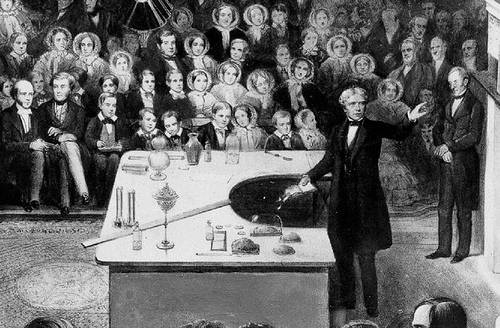
http://commons.wikimedia.org/wiki/File:Faraday_Michael_Christmas_lecture_detail.jpg

“While I am describing to you how Nature works, you won’t understand why Nature works that way. But you see, nobody understands that.” — Richard Feynman

“I am no poet, but if you think for yourselves, as I proceed, the facts will form a poem in your minds.” — Michael Faraday

“Now, this case is not very interesting,” said Bell Labs mathematician Peter Winkler during a lecture at Rutgers. “But the reason why it’s not interesting is really interesting, so let me tell you about it.”

Ernest Rutherford addressed the Royal Institution in 1904:

I came into the room, which was half dark, and presently spotted Lord Kelvin in the audience and realised that I was in for trouble at the last part of the speech dealing with the age of the Earth, where my views conflicted with his. To my relief Kelvin fell fast asleep, but as I came to the important point, I saw the old bird sit up, open an eye, and cock a baleful glance at me. Then a sudden inspiration came and I said Lord Kelvin had limited the age of the Earth, provided no new source was discovered. That prophetic utterance referred to what we are now considering tonight, radium! Behold! the old boy beamed upon me.

When Antonie van Leeuwenhoek declined to teach his new methods in microbiology, Leibniz worried that they might be lost. Leeuwenhoek replied, “The professors and students of the University of Leyden were long ago dazzled by my discoveries. They hired three lens grinders to come to teach the students, but what came of it? Nothing, so far as I can judge, for almost all of the courses they teach there are for the purpose of getting money through knowledge or for gaining the respect of the world by showing people how learned you are, and these things have nothing to do with discovering the things that are buried from our eyes.”

11 Jul 09:10

On Time

by Greg Ross

In Max Beerbohm’s 1916 short story “Enoch Soames,” an unsuccessful poet sells his soul to the devil for the chance to travel 100 years into the future to see how time has favored his work.

Under the agreement, Soames is transported to the Reading Room of the British Museum at 2:10 p.m. on June 3, 1997. He searches for references to his work but finds himself mentioned only once, as an “imaginary character” in a story by Max Beerbohm, and is whisked off to hell.

But, Beerbohm writes, “You realize that the reading-room into which Soames was projected by the devil was in all respects precisely as it will be on the afternoon of June 3, 1997. You realize, therefore, that on that afternoon, when it comes round, there the selfsame crowd will be, and there Soames will be, punctually. … The fact that people are going to stare at him and follow him around and seem afraid of him, can be explained only on the hypothesis that they will somehow have been prepared for his ghostly visitation.”

On June 3, 1997, about a dozen onlookers collected in the Reading Room of the British Museum to see what would happen. To their surprise, at precisely 2:10 p.m. a man matching Soames’ description — “a stooping, shambling person, rather tall, very pale, with longish and brownish hair” — appeared and began to search catalogs and speak with the librarians. Dejected, he finally disappeared among the stacks.

Among the onlookers was Teller, of the magician duo Penn & Teller.

11 Jul 09:06

Guys and Dolls

by Greg Ross

‘The other day,’ said a man passenger, ‘I saw a woman in an omnibus open a satchel and take out a purse, close the satchel and open the purse, take out a penny and close the purse, open the satchel and put in the purse. Then she gave the penny to the conductor and took a halfpenny in exchange. Then she opened the satchel and took out the purse, closed the satchel and opened the purse, put in the halfpenny and closed the purse, opened the satchel and put in the purse, closed the satchel and locked both ends. Then she felt to see if her back hair was all right, and it was all right, and she was all right. That was a woman.’

The Windsor Magazine, November 1907

It is necessary for technical reasons that these warheads be stored upside down; that is, with the top at the bottom and the bottom at the top. In order that there may be no doubt as to which is the bottom and which is the top, it will be seen to that the bottom of each warhead immediately be labelled with the word TOP.

– British Admiralty, quoted in Applied Optics, January 1968

09 Jul 10:42

The Oberlin–Wellington Rescue

by Greg Ross

On Sept. 13, 1858, ex-slave John Price was accosted on the streets of Oberlin, Ohio, by a U.S. marshal, who took him to nearby Wellington, hoping to return him to Kentucky as a fugitive. Ohio was a free state, but the federal government had committed to helping slaveholders retrieve their runaway slaves.

When word of Price’s abduction spread, a large crowd of Oberlin townspeople surrounded the marshal’s hotel and demanded his release, eventually breaking in to return him to Oberlin. Thirty-seven of the rescuers were indicted, including black abolitionist Charles Langston, who made this impassioned speech at his trial:

But I stand up here to say, that if for doing what I did on that day at Wellington, I am to go to jail six months, and pay a fine of a thousand dollars, according to the Fugitive Slave Law, and such is the protection the laws of this country afford me, I must take upon my self the responsibility of self-protection; and when I come to be claimed by some perjured wretch as his slave, I shall never be taken into slavery. And as in that trying hour I would have others do to me, as I would call upon my friends to help me; as I would call upon you, your Honor, to help me; as I would call upon you [to the district attorney], to help me; and upon you [to Judge George Bliss], and upon you [to his counsel], so help me GOD! I stand here to say that I will do all I can, for any man thus seized and help, though the inevitable penalty of six months’ imprisonment and one thousand dollars’ fine for each offense hangs over me! We have a common humanity. You would do so; your manhood would require it; and no matter what the laws might be, you would honor yourself for doing it; your friends would honor you for doing it; your children to all generations would honor you for doing it; and every good and honest man would say, you had done right!

This was met with “great and prolonged applause, in spite of the efforts of the Court and the Marshal.” Langston was convicted but given a reduced sentence of 20 days. His eloquence was hereditary, apparently — his grandson was Langston Hughes.

09 Jul 10:36

Kids Today

by Greg Ross

I am astonished at the foolish music written in these times. It is false and wrong and no longer does anyone pay attention to what our beloved old masters wrote about composition. It certainly must be a remarkably elevated art when a pile of consonances are thrown together any which way.

I remain faithful to the pure old composition and pure rules. I have often walked out of the church since I could no longer listen to that mountain yodeling. I hope this worthless modern coinage will fall into disuse and that new coins will be forged according to the fine old stamp and standard.

– Samuel Scheidt, to Heinrich Baryphonus, Jan. 26, 1651

23 Jun 05:07

Fair Enough

by Greg Ross

http://commons.wikimedia.org/wiki/File:Monkey-typing.jpg

Apocryphal but entertaining: During one of Norbert Wiener’s talks on cybernetics, a student raised an esoteric point.

Wiener said, “Why, that’s as improbable as a bunch of monkeys having typed out the Encyclopaedia Britannica.”

The student said brightly, “But that’s happened once, anyway.”

23 Jun 05:05

Best-Laid Plans

by Greg Ross

Launched in November 1981, the Soviet Union’s Venera 14 probe carried a spring-loaded arm to test the soil of Venus.

The craft journeyed for four lonely months to reach its destination, descended safely through the hostile atmosphere, and landed securely on the surface.

The spring-loaded arm plunged downward — into a camera lens cap, which had just fallen there.

(Thanks, Merv.)

15 Jun 01:44

World of Wonders

by Greg Ross

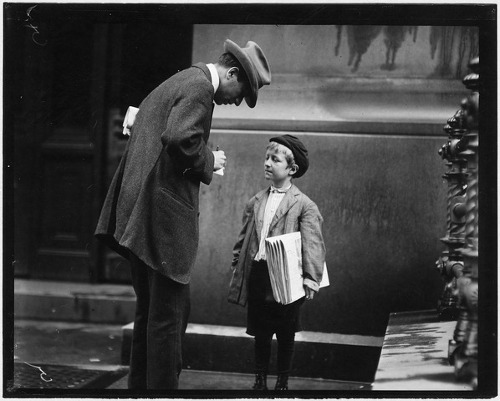
http://commons.wikimedia.org/wiki/File:Michael_Mc_Nelis,_8_years_old,_a_newsboy._This_boy_has_just_recovered_from_his_second_attack_of_pneumonia._Was_found..._-_NARA_-_523323.tif

It is the one great weakness of journalism as a picture of our modern existence, that it must be a picture made up entirely of exceptions. We announce on flaring posters that a man has fallen off a scaffolding. We do not announce on flaring posters that a man has not fallen off a scaffolding. Yet this latter fact is fundamentally more exciting, as indicating that that moving tower of terror and mystery, a man, is still abroad upon the earth. That the man has not fallen off a scaffolding is really more sensational; and it is also some thousand times more common. But journalism cannot reasonably be expected thus to insist upon the permanent miracles. Busy editors cannot be expected to put on their posters, ‘Mr. Wilkinson Still Safe,’ or ‘Mr. Jones, of Worthing, Not Dead Yet.’ They cannot announce the happiness of mankind at all. They cannot describe all the forks that are not stolen, or all the marriages that are not judiciously dissolved. Hence the complex picture they give of life is of necessity fallacious; they can only represent what is unusual. However democratic they may be, they are only concerned with the minority.

– G.K. Chesterton, The Ball and the Cross, 1909

15 Jun 01:43

Unquote

by Greg Ross

“There are two things to aim at in life: first, to get what you want; and, after that, to enjoy it. Only the wisest of mankind achieve the second.” — Logan Pearsall Smith

15 Jun 01:14

No Hands

by Greg Ross

https://www.google.com/patents/US755209

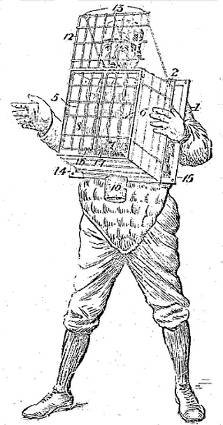
Illinois inventor James E. Bennett offered this contraption in 1904 to enable baseball catchers to intercept the ball without using their hands. The ball passes through the wire frame and hits a cushion at the rear of the box, then drops into a pocket from which the player can retrieve it.

It was not well received. The Cincinnati Enquirer said the box resembled “a cage built for a homesick bear or a dyspeptic hyena.”

Further, as Dan Gutman points out in his 1995 collection of baseball inventions, Banana Bats & Ding-Dong Balls, a catcher does more than catch pitches. “On a high pop, presumably, the catcher would have to run to the spot where he judged the ball was going to land, then lie on the ground face up and wait for it to hit him in the stomach.” At least his hands will be free.

15 Jun 01:14

Great Minds

by Greg Ross

boullee newton cenotaph

In 1784, French architect Étienne-Louis Boullée proposed building an enormous cenotaph for Isaac Newton, a cypress-fringed globe 500 feet high. The physicist’s sarcophagus would rest on a raised catafalque at the bottom of the sphere; by day light would enter through holes pierced in the globe, simulating starlight, and at night a lamp hung in the center would represent the sun.

“I want to situate Newton in the sky,” Boullée wrote. “Sublime mind! Vast and profound genius! Divine being! Newton! Accept the homage of my weak talents. … O Newton! … I conceive the idea of surrounding thee with thy discovery, and thus, somehow, surrounding thee with thyself.”

As far as I can tell, this is unrelated to Thomas Steele’s proposal to enshrine Newton’s house under a stone globe, which came 41 years later. Apparently Newton just inspired globes.

15 Jun 01:13

Lost in Translation

by Greg Ross

Pedro Carolino thought he was doing the world a favor in 1883 when he published English As She Is Spoke, ostensibly a Portuguese-English phrasebook. The trouble is that Carolino didn’t speak English — apparently he had taken an existing Portuguese-French phrasebook and mechanically translated the French to English using a dictionary, assuming that this would produce proper English. It didn’t:

It must to get in the corn.
He burns one’s self the brains.
He not tooks so near.
He make to weep the room.
I should eat a piece of some thing.
I took off him of perplexity.
I dead myself in envy to see her.
The sun glisten?
The thunderbolt is falling down.
Whole to agree one’s perfectly.
Yours parents does exist yet?

A dialogue with a bookseller:

What is there in new’s litterature?
Little or almost nothing, it not appears any thing of note.
And yet one imprint many deal.
That is true; but what it is imprinted. Some news papers, pamphlets, and others ephemiral pieces: here is.
But why, you and another book seller, you does not to imprint some good works?
There is a reason for that, it is that you canot to sell its. The actual-liking of the public is depraved they does not read who for to amuse one’s self ant but to instruct one’s.
But the letter’s men who cultivate the arts and the sciences they can’t to pass without the books.
A little learneds are happies enough for to may to satisfy their fancies on the literature.

An anecdote:

One eyed was laied against a man which had good eyes that he saw better than him. The party was accepted. “I had gain, over said the one eyed; why I see you two eyes, and you not look me who one.”

Proverbs:

The walls have hearsay.
Nothing some money, nothing of Swiss.
He has a good beak.
The dress don’t make the monk.
They shurt him the doar in the face.
Every where the stones are hards. [true enough]
Burn the politeness.
To live in a small cleanness point.
To craunch the marmoset.

Mark Twain wrote, “In this world of uncertainties, there is, at any rate, one thing which may be pretty confidently set down as a certainty: and that is, that this celebrated little phrase-book will never die while the English language lasts. … Whatsoever is perfect in its kind, in literature, is imperishable: nobody can add to the absurdity of this book, nobody can imitate it successfully, nobody can hope to produce its fellow; it is perfect, it must and will stand alone: its immortality is secure.”

14 Jun 10:54

Desperate Measures

by Greg Ross

http://commons.wikimedia.org/wiki/File:Grand_Coulee_Dam_no_forebay.jpg

Shortly after the completion of Washington’s Grand Coulee Dam in 1942, engineers faced a difficult challenge: how to feed a cable through a 24-inch drain, two-thirds filled with grout, that wound 500 feet through the galleries inside the huge concrete structure.

The workers were stumped at first, but they hit on a novel solution. “An alley cat, raised on scraps from the construction men’s lunch pails, was summoned and one end of the 500-foot string was tied onto his tail,” reported the Spokane Daily Chronicle. “He was placed inside the drain, and an air hose was turned on to ‘encourage’ him to go forward.

“The feline scampered through the drain and was caught emerging at the other end, where he was freed. From then on it was a simple matter to tie a rope onto the string and then the cable and draw it through the drain.”

Physicist R.W. Wood had hit on the same technique 30 years earlier.

14 Jun 10:45

Red and Black

by Greg Ross

Jokes from the Soviet Union, from University of Louisville historian Bruce Adams’ 2005 collection Tiny Revolutions in Russia:

A man is walking along the road wearing only one boot. ‘Did you lose a boot?’ a passerby asks sympathetically. ‘No, I found one,’ the man answers happily.

What is it that doesn’t knock, growl or scratch the floor?
A machine made in the USSR for knocking, growling, and scratching the floor.

It is the middle of the night. There is a knock at the door. Everyone leaps out of bed. Papa goes shakily to the door. ‘It’s all right,’ he says, coming back. ‘The building’s on fire.’

A shopper asks a food store clerk, ‘Are you all out of meat again?’ ‘No, they’re out of meat in the store across the way. Here we’re out of fish.’

Why doesn’t the Soviet Union send people to the Moon?
They are afraid they won’t come back.

A man fell asleep on a bus. When someone stepped on his foot, he woke with a start and applauded. ‘What are you doing, citizen?’ ‘I was dreaming I was at a meeting.’

‘What is the difference between Pravda [Truth] and Izvestia [The News]?’
‘There is no truth in The News, and no news in the Truth.’

“In the Soviet Army,” said Stalin, “it takes more courage to retreat than advance.”

14 Jun 10:43

oldloves: Bill Murray on Gilda Radner: “Gilda got married and...


oldloves:

Bill Murray on Gilda Radner:

“Gilda got married and went away. None of us saw her anymore. There was one good thing: Laraine had a party one night, a great party at her house. And I ended up being the disk jockey. She just had forty-fives, and not that many, so you really had to work the music end of it. There was a collection of like the funniest people in the world at this party. Somehow Sam Kinison sticks in my brain. The whole Monty Python group was there, most of us from the show, a lot of other funny people, and Gilda. Gilda showed up and she’d already had cancer and gone into remission and then had it again, I guess. Anyway she was slim. We hadn’t seen her in a long time. And she started doing, “I’ve got to go,” and she was just going to leave, and I was like, “Going to leave?” It felt like she was going to really leave forever.

So we started carrying her around, in a way that we could only do with her. We carried her up and down the stairs, around the house, repeatedly, for a long time, until I was exhausted. Then Danny did it for a while. Then I did it again. We just kept carrying her; we did it in teams. We kept carrying her around, but like upside down, every which way—over your shoulder and under your arm, carrying her like luggage. And that went on for more than an hour—maybe an hour and a half—just carrying her around and saying, “She’s leaving! This could be it! Now come on, this could be the last time we see her. Gilda’s leaving, and remember that she was very sick—hello?”

We worked all aspects of it, but it started with just, “She’s leaving, I don’t know if you’ve said good-bye to her.” And we said good-bye to the same people ten, twenty times, you know. 

And because these people were really funny, every person we’d drag her up to would just do like five minutes on her, with Gilda upside down in this sort of tortured position, which she absolutely loved. She was laughing so hard we could have lost her right then and there.

It was just one of the best parties I’ve ever been to in my life. I’ll always remember it. It was the last time I saw her.”

- from Live from New York: an Uncensored History of Saturday Night Live

11 Jun 19:21

Plant Food

by Greg Ross

man-eating tree

Exploring a tabooed piece of land on Mindanao, Mississippian planter W.C. Bryant discovered a 35-foot tree surrounded by bones and the smell of carrion. He was entering the circle to examine a skull when his guide suddenly pinioned his arms and pulled him backward “with the strength of a maniac.” Bryant followed the man’s gaze and saw that “the tree was reaching for him”:

The whole thing had changed shape and was horribly alive and alert. The dull, heavy leaves had sprung from their compact formation and were coming at him from all directions, advancing on the ends of long vine-like stems which stretched across like the necks of innumerable geese and, now that the old man had stopped his screaming, the air was full of hissing sounds.

The leaves did not move straight at their target, but with a graceful, side-to-side sway, like a cobra about to strike. From the far side, the distant leaves were peeping and swaying on their journey around the trunk and even the tree top was bending down to join in the attack. The bending of the trunk was spasmodic and accompanied by sharp cracks.

The effect of this advancing and swaying mass of green objects was hypnotic, like the charm movements of a snake. Bryant could not move, though the nearest leaf was within an inch of his face. He could see that it was armed with sharp spines on which a liquid was forming. He saw the heavy leaf curve like a green-mittened hand, and as it brushed his eyebrows in passing he got the smell of it — the same animal smell that hung in the surrounding air. Another instant and the thing would have had his eyes in its sticky, prickly grasp, but either his weakness or the brown man’s strength threw them both on their backs.

The charm was broken. They crawled out of the circle of death and lay panting in the grass while the malignant plant, cracking and hissing, yearned and stretched and thrashed to get at them.

That’s from “Escaped From the Embrace of the Man-Eating Tree,” in the American Weekly, Jan. 4, 1925. Interestingly, naturalist Williard Clute tracked down the author and published a followup in American Botanist that April:

“The author of this tale, having been questioned, replies under date of January 8, 1925, that ‘the tree is there and in the main the account is true. The circle at the foot of the tree was about 80 maybe 100 feet in diameter. The tree looked nothing like the drawings [in the paper]. It was round as a smoke stack — the trunk, I mean, and dark gray or ash-color. The whole tree was symmetrical and the tree and ground under it, was very inviting to a storm-beset or sun-depressed traveller. The clucking and hissing was, I judged, from a gluey consistency of, or on, the leaves. My impression was that if it reached me, it would fasten and hold me, thus it had done to apes, birds, and animals.’” Stay out of the Philippines, I guess.

11 Jun 19:18

Text Hexes

by Greg Ross

http://www.sxc.hu/photo/451312

Books were so precious in the Middle Ages that monks invoked curses against any who might steal them:

This book belongs to S. Maximin at his monastery of Micy, which abbat Peter caused to be written, and with his own labour corrected and punctuated, and on Holy Thursday dedicated to God and S. Maximin on the altar of S. Stephen, with this imprecation that he who should take it away from thence by what device soever, with the intention of not restoring it, should incur damnation with the traitor Judas, with Annas, Caiaphas, and Pilate. Amen.

Should anyone by craft or any device whatever abstract this book from this place may his soul suffer, in retribution for what he has done, and may his name be erased from the book of the living and not be recorded among the Blessed.

This book belongs to S. Alban. May whosoever steals it from him or destroys its title be anathema. Amen.

May whoever destroys this title, or by gift or sale or loan or exchange or theft or by any other device knowingly alienates this book from the aforesaid Christ Church, incur in this life the malediction of Jesus Christ and of the most glorious Virgin His Mother, and of Blessed Thomas, Martyr. Should however it please Christ, who is patron of Christ Church, may his soul be saved in the Day of Judgment.

These are from The Care of Books, by John Willis Clark, 1901. Happily, in 1212 a council met at Paris to decree that “We forbid those who belong to a religious Order, to formulate any vow against lending their books to those who are in need of them; seeing that to lend is enumerated among the principal works of mercy. … From the present date no book is to be retained under pain of incurring a curse, and we declare all such curses to be of no effect.”

11 Jun 14:42

Fortifications

by Sadie Stein

Book-House-600

“[T]o read was precisely to enter another world, which was not the reader’s own, and come back refreshed, ready to bear with equanimity the injustices and frustrations of this one. Reading was balm, amusement―not incitement.” —Susan Sontag, The Volcano Lover: A Romance


11 Jun 14:40

The Yanomamö and the Origins of Male Honor

by Brett & Kate McKay

yano header

In 1964, anthropologist Napoleon Chagnon arrived in an almost entirely unexplored region of the Amazon Basin to spend a year studying the Yanomamö: one of the last large, isolated, and virtually uncontacted tribes in the world.

Over the next 35 years, Chagnon returned to this area on the border between Venezuela and Brazil 25 times and lived among this primitive people for a total of 5 years. He spent his time there intimately and exhaustively detailing the lives of 25,000 Yanomamö who lived in 250 separate villages in a way nearly unchanged from how humans existed for tens of thousands of years before the modern era. His education in anthropology had not prepared him for what he would observe. While he had been taught that tribal peoples were mostly peaceful, Chagnon found that war was a nearly constant state of affairs for the Yanomamö that shaped every aspect of their lives and culture. While his textbooks and professors had said that when tribes did fight, the battles were rooted in conflicts over material resources, Chagnon found that the Yanomamö’s wars were almost entirely over women. And while Chagnon had believed that all tribal peoples were highly egalitarian, he found that Yanomamö men were in fact very concerned about status and that there were several ways for a man to elevate himself above his village peers.

yano chagnon 3

Napoleon Chagnon and a Yanomamö tribesman

Chagnon describes these revelations and the controversy they caused in the anthropological world in his recent book, Noble Savages. While every tribe around the world and throughout history has had their own distinct culture, what Chagnon observed about the Yanomamö are traits that have been recorded in many other primitive peoples as well, and what I found most interesting about this quite fascinating book is the way many of his observations related to the tenets of honor we discussed in our series on the subject last year. (Quick review: classical honor is defined as a reputation worthy of respect and admiration.) In that series, we talked about the way the code of honor for men has evolved, from bravery and physical prowess to virtue and character, while its basic mechanisms for achievement and enforcement have remained the same. By taking a look at how honor operated among the Yanomamö, we can discover specific examples of some of the principles which we previously described in the abstract, as well as a possible explanation of how and why the basic masculine code of honor-as-courage developed in the first place. At the same time, it causes us to reflect on how this primitive code of honor still echoes faintly in the present. For while the lives of tribes like the Yanomamö can seem light years away from our own, in the long sweep of history, men lived like them far longer than they have lived like us; the many centuries the world has experienced modern civilization is really a blink of an eye in the grand scheme of things. So how did men live and earn honor in, as Jared Diamond would put it, “the world until yesterday?”

A State of War

YanomamoWarParty100

Chagnon’s first big surprise when he arrived among the Yanomamö was that the tribe existed in a state of chronic war — their lives were overhung with the “ubiquity of terror.” Chagnon’s education in anthropology had largely presented him with an image of primitive tribesmen as Roussean “noble savages” – communal, peace-loving people who were one with nature and each other. Warfare, his fellow anthropologists argued, was largely the product of capitalist exploitation and colonization, and tribes had experienced very little conflict until disrupted by contact with industrialized nations. This academic image would collide sharply with what Chagnon found in the field. “While it is also true that tribesmen spend many happy hours hunting, fishing, gathering, and telling wonderful stories and myths around the campfire,” Chagnon writes, “one of the most salient features of their social environment is the threat of attack from neighbors.”

yanoboys2

This fear of attack was not an unfounded worry; early morning raids by neighboring villages happened with some frequency and the results were often fatal. Through his meticulous research and data-keeping, Chagnon found that in 1988, “two-thirds of all living Yanomamö over the age of forty [had] lost one or more close genetic kinsman—a father, brother, husband, or son—to violence.” In comparison, around one-sixth of Britons lost a member of their immediate family in the famously bloody Great War. This of course means that the percentage of Yanomamö men who had killed another was also quite high; Chagnon discovered that 45% of these tribesmen had slain at least one other man.

Chagnon argues that other anthropologists had underestimated the violent nature of tribal cultures because their fieldwork had been done with tribes that had already changed their way of life due to contact with outsiders; there were very few uncontacted, “demographically intact” tribes left to study at the time – places “where populations of tribesmen were still growing by reproducing offspring faster than people were dying and were fighting with each other in complete independence of nation states that surrounded them.”

From his fieldwork, and looking at the history of other tribes around the world, Chagnon theorized that war, far from being the product of capitalist exploitation and colonization was in fact the true “state of nature.” He concluded that 1) “maximizing political and personal security was the overwhelming driving force in human social and cultural evolution,” and 2) “warfare has been the most important single force shaping the evolution of political society in our species.”

Fighting Over Women

If Chagnon was surprised to find that the Yanomamö were not the peace-loving noble savages he had expected, he was equally surprised to learn the cause of their constant conflict.

Chagnon’s education in anthropology had stressed that primitive peoples only went to war over material resources – land, food, oil, water, wealth, etc. – just like industrialized nations did. What Chagnon discovered in the field was the Yanomamö did indeed fight over a scarce resource, but it was one his contemporaries completely dismissed: women.

Chagnon argues that the Yanomamö were driven by a biological desire to pass on their genes just as other animals were, and that their conflicts were almost entirely rooted in reproductive competition. “The tokens of wealth that we civilized people covet are largely irrelevant to success and survival in the tribal world and were irrelevant during most of human history,” Chagnon writes. “But women have always been the most valuable single resource that men fight for and defend.”

yano father 2

Yet the Yanomamö’s desire to obtain a woman with which to sire progeny was not simply a biological imperative, but also related to the third surprise to come out of Chagnon’s fieldwork: the tribesmen’s desire for status and honor.

Because primitive tribes didn’t have much in the way of material wealth, Chagnon’s fellow anthropologists believed that their cultures were very egalitarian in nature. Which is to say, the only status differentiators were thought to come down to “automatic” designations rooted in sex or age; older people had higher status than younger folks, and men had higher status than women, but there was nothing individuals could do to elevate themselves above their peers in order to attain “vertical honor.”

In contrast, Chagnon found some Yanomamö men were more prominent and given more deference than others. These men attained a greater degree of honor in several ways. First, the men with the most kin and the largest patrilineage enjoyed higher status, and Chagnon observed “that the political leaders in all Yanomamö villages almost always have the largest number of genetic relatives within the group.” They were also at an advantage when it came to perpetuating this higher status; the more male relatives a young man had, the easier it was for him to successfully find a wife. A young man’s father and older male relatives would help him find a spouse, and other men in the village preferred to give their daughters in marriage to those who came from prominent lineages anyway. This, Chagnon argues, is in fact the main function of patrilineages: “What these Yanomamö descent groups control and defend are reproductive rights in nubile females and the male kin who give these women to you and take them from you.”

The Yanomamö, like most tribes in history, practiced polygamy (more accurately polygyny – only men could have multiple spouses), and every Yanomamö man hoped to have multiple wives. Yet this privilege was largely reserved for men of higher status. The problem with polygyny, of course, is that if some guys have six wives other guys will have none. Polygyny created a scarcity in women, which is why females – the key to reproductive success – became the one resource worth fighting over. A group of men from one village might raid another village to bring back some of their women; Chagnon found that 20% of the women in the villages he studied had been abducted from other villages. These raids could then set off a cycle of retaliatory violence; if the original raiding party killed someone during their abduction mission, men from the raided village would plan a counterattack to even the score. Back and forth it would go, creating the aforementioned conditions of constant “war” and fear of attack.

From his observations of the pervasiveness of female-rooted conflict, Chagnon theorized that “if we viewed the human ability to harness, control, and prudently deploy violence for reproductive advantage, we could consider this skill the most important of all strategic resources,” and that need to regulate the deployment of this resource is what gave birth to social as well as political rules and laws. He summarizes his conclusions thusly:

“Regardless of their marital status, most Yanomamö men are trying to copulate with available women most of the time, but are constrained from doing so by the rules of incest and the intervention of some other man with proprietary interests in the same women. This is why there is so much club fighting and why villages split into two or more groups so easily. Conflicts over the possession of nubile females have probably been the main reason for fights and killings throughout most of human history: the original human societal rules emerged, in all probability, to regulate male access to females and prevent the social chaos attendant on fighting over women. Males in this persistent kind of social environment sought the help of other related males—brothers, sons, cousins, uncles, nephews—and formed male coalitions to pursue their selfish reproductive goals as well as to minimize lethal conflicts within their own groups.”

Courage and Fierceness

At last we come to answering the question of how the most basic form of the male honor code came to revolve around prowess and courage. Here Chagnon’s observations are especially interesting, and we will make ample use of them.

The Yanomamö were interested both in maintaining the honorable reputation of their village as a whole, and as individual men within it.

Village-Wide Honor

As the Yanomamö lived in constant fear of an attack and the abduction of their women by a neighboring village, it was crucially important that not only were the men of each village prepared to fend off such an attack, but that the village as a whole had the kind of reputation that made other villages think twice about even attempting a raid. The maintenance of honor was thus a group project; each individual man in a village, if he wished to earn “horizontal honor,” had to do his part to project and demonstrate courage and fierceness (“The Fierce People” was a “phrase the Yanomamö themselves frequently used to emphasize their valor, braveness, and willingness to act aggressively on their own behalf.”) If individual men didn’t pull their weight, and evinced fear and timidity instead, this showed weakness, damaged the village’s reputation for strength, and essentially invited attack. Chagnon explains further:

“Let me emphasize the Yanomamö view that when members of a group acquire a reputation of timidity and cowardice, their neighbors take ruthless advantage of them, push them around, insult them publicly, and take their women. Thus it is strategically important to react decisively to any affront, no matter how trivial. If a group is small, the men try to make up for their numerical disadvantage by acting as if the group is bigger, nastier, more ferocious, and ready to fight on a moment’s notice. Feigning to be “larger than life” is a deception that is widespread in the animal world but is usually a characteristic displayed by individual combatants. The Yanomamö, however, engage in this masquerade as members of social groups. I often deliberately avoided visiting small villages because they were predictably very aggressive and unpleasant to be around in order to compensate for their actual military weaknesses.”

As Chagnon notes, since reputation-maintenance is so important, villages are quick to address any perceived insults as to their manliness, strength, and courage from other villages. Because they don’t want such “offensive rumors” spreading around, “they are immediately addressed by a ‘we’ll show you’ melee.” The Yanomamö have varying degrees of these honor-defending contests that correspond to the seriousness of the insult received.

If one village feels that another has been unfairly spreading gossip about their timidity and weakness, but the insults have not been too serious in nature, the two villages will agree to resolve the issue with a good-natured fight, often when one is visiting the other for a feast. These free-for-alls consist of the men slapping (using a closed fist is considered unfair) each other’s sides, pulling each other’s hair, and wrestling in the mud and dirt. The younger men participate while the older men circle around, waving their axes and machetes, yelling instructions to the fighters, and keeping the skirmish from developing into a more serious fight. The young men hurt each other, but generally avoid causing severe injuries, and after about 40 minutes the fight breaks up. Nobody is declared the winner but the intention of the melee is fulfilled:

The whole purpose of the fight just seems to be to set the record straight as far as rumors of cowardice or unwillingness to fight. When the young fighters regain their breath and composure, they quietly and unceremoniously get to their feet, go outside the shabono to clean up and wash their bodies, maybe even take a leisurely swim in the nearby creek. There seem to be no obvious hard feelings afterward and the more ceremonial events like eating, trading, chanting, and dancing proceed as though the fight had never happened. But they have now sized up each other and are better informed regarding just how far they can push or intimidate each other in the future without triggering an unanticipated and more serious reaction. And they usually learn the possible costs of spreading false rumors about people who are feasting with them.”

If a village feels it has been more seriously insulted, they may challenge the rumor-generating village to a more formal chest-pounding or side-slapping duel. In the former contest, two men face off. One agrees to take the first blows and offers his chest to his opponent as he gazes manfully into the distance. His opponent winds up like a baseball pitcher and delivers several powerful overhand blows to his pectoral muscles. The men then switch roles, and the guy who just got beaten can now deliver the same number of blows to his opponent’s chest. The goal is to bear the blows as stoically as possible and make your opponent cry “uncle” first. A side-slapping duel works much the same way, with the two fighters squatting and kneeling and brutally slapping each other “on the flanks between the rib cage and the pelvis, with an open hand.” In both kinds of duels, the fighters become deeply bruised and sore, and injuries to one’s internal organs can occur; lung tissue is damaged and kidneys tenderized. Occasionally duelists do die from their injuries, but the contests are designed to be a nonlethal means to address honor-impinging insults.

In response to the most serious kinds of slander, as well as things like tobacco and food theft or another man trying to seduce or abduct one’s wife, a club fight becomes the appropriate means of redress. Like in the aforementioned duels, two men square off, and one delivers the first blow — arcing the end of his club all the way from the ground, through the air, and square on top of his opponent’s head. The recipient of the wallop is tasked with bearing the blow stoically, and attempts to remain motionless while leaning on his own club for support. Now the recipient of the first blow, often with “large chunks of their scalp bashed loose, flapping up and down on their crania,” gets to deliver one in turn to his opponent. Club fighting matches start with two duelists, but may progress into all out melees where numerous men grab their clubs and start swinging them at each other with abandon.

Club fighting scars

Scars from club fighting.

“Many accomplished and persistent club fighters have scalps that are crisscrossed with as many as a dozen huge, protuberant, lumpy scars two or three inches long after their scalps are healed,” Chagnon observed. And they’re proud of these scars:

“Men with numerous club-fighting scars like these are not bashful about displaying them prominently. They shave the tops of their heads in a tonsure and then rub red pigment into their numerous deep scars, to exaggerate them. Such a man, if he lowers his face and head to you, is usually not showing deference: he is conspicuously advertising his fierceness.”

Despite that fact that death was sometimes the result of these different degrees of duels and melees, “none of the fighting…is intentionally lethal,” Chagnon explains, and should rather be classified as “deliberately sublethal ‘alternatives’ to warfare.” Just like the “affairs of honor” and “rough and tumbles” engaged in by men of the 19th century, the fights were not specifically designed to kill, but were a means for a man, or a group of men, to show they were unafraid to fight and bleed in order to maintain their honorable reputation.

Individual Honor

yano man

While individual Yanomamö men had a stake in maintaining their village’s reputation for courage and fierceness and thus minimizing the chance of being attacked, it was not an entirely altruistic effort.

First, protecting one’s relatives and their chances for finding a wife indirectly helped a man’s chances of passing on his own genes even if he himself didn’t have children, as Chagnon writes in explaining the “kin selection” theory:

“since related individuals share genes with each other, an individual could get copies of his or her genes into the next generation by favoring close kinsmen and not reproducing sexually at all. For example, individuals share on average half (50 percent) of their genes with their siblings, they share one-fourth (25 percent) with their half-siblings, an eighth (12.5 percent) with their full cousins, etc. Thus if they engage in certain kinds of “favors” that enhance a full cousin’s reproductive success, then, to the extent that those favors enabled that kinsman to find a mate and produce offspring, their favoring of that kinsman helped them to get some of their own genes into the next generation. As one theoretical geneticist, J. B. S. Haldane, is rumored to have said: ‘I’d lay down my life for eight cousins. . . .’ That’s because eight cousins would carry, on average, 100 percent of the genes that the person who laid down his life carried.”

More directly, a Yanomamö man’s level of courage and physical prowess during melees and battle could enhance or diminish his individual status within a village; those who showed timidity were “branded a coward, an accusation that tends to remain forever in the memories of others,” while fighting with fierceness usually led to an “increased ability to sway public opinion and public action.”

The male desire for honor was so strong that tribesmen would seek to demonstrate their fierceness even as they were dying; the idea of honor being more precious than life was not minted in the modern age. Even if a Yanomamö man knew he would not live to enjoy the benefits that displaying fierceness would bring, his legacy and the memory of his manliness was worth protecting right down to his dying breath, as Chagnon vividly illustrates:

“Valiant leaders like Ruwahiwä sometimes sustain what are apparently—or even certainly—lethal blows to their heads from heavy axes, but still rise, stagger forward, and somehow are able to keep on their feet despite being mortally wounded. My own Yanomamö informants, who were also eyewitnesses to Ruwahiwä’s death, described the first ax blow to his head as a fatal blow from which no man could possibly recover…Yet Ruwahiwä managed to stand up and fall down several times—all the while being shot multiple times with arrows to his face, neck, stomach, and chest. Many years later, one headman I knew—Matowä—was killed shortly after I arrived, as described earlier. He probably also sustained as many lethal arrow wounds as Ruwahiwä, but defiantly stood his ground and cursed his assailants until he could no longer stand. He, too, never acknowledged the pain—nor the terror of knowing that his wounds were fatal—but stoically taunted his assailants with defiant declarations of his valor and fearlessness until he fell, dead, from his many wounds. He died with many six-foot arrows stuck helter-skelter through or into his neck, chest, and stomach. One of my informants, who was part of the raiding party that killed him, told me in whispers that this valiant warrior Matowä bragged about his valor and ferocity even as the raiders continued to shoot arrow after arrow into his body.”

The clearest way to demonstrate one’s fierceness and the surest route to greater honor within a Yanomamö village, outside the size of one’s lineage, was earning the title of unokai – a man who has killed another man. Since “not all men were willing to endure the risks and expose themselves to the dangers that Yanomamö unokais did,” Chagnon explains, “unokais held a special, earned, and respected status that only some men achieved.”

The higher status of unokais is reflected in their greater success in attaining wives; Chagnon found that unokais had 2.5 times more wives and 3 times as many offspring as non-unokais.

Unokais received such honor (and enjoyed the benefits incumbent upon their status) because of the way their personal reputation enhanced a whole village’s reputation as one not to be messed with:

“Unokais are both respected and somewhat feared because they have demonstrated a willingness to kill people and are likely to kill again. In a political context, the military credibility and strength of a village can be measured by how many unokais it contains—with the caveat that village size is extremely important as well. But, if two equal-sized villages are compared, the one with the largest number of able-bodied unokais will be the stronger, the more feared, and the more formidable opponent.”

Chagnon’s observations of how unokais behave compared to men who have not killed is quite interesting, as is his theory that a man’s willingness to kill is ultimately what leads to his power, and from that power, laws and states:

“Many men acquire a reputation for being waiteri, fierce. But someone who is an unokai has demonstrated his willingness to inflict lethal harm on an opponent and to actually behave in an ultimately fierce manner. Publicly and socially, such men can be extremely placid and calm in their outward demeanor, and even very pleasant and charming. By contrast, many men who are not unokais seem to be compelled to behave in such way as to imply that they are killers of men. Such men can be very obnoxious and unpleasant in their public lives—ordering people around, intimidating them, threatening to hit them with their machetes or axes, even threatening to kill them. But if an unokai threatens to strike or to kill someone, he usually means what he says. When an unokai gives an order to some man in the village, that man had better do what is asked of him. That is how power, authority, and coercive force by leaders emerges, adds to, and goes beyond the kind of solidarity and cohesion that inheres in the lesser cohesiveness associated with kinship amity. This is the quality that leads ultimately to the power behind law: the odiousness of sanctions. Without law, political states cannot exist.”

Conclusion

This is not a post where there is a clear and immediate takeaway, but one which seeks to provide some hopefully interesting background information on some of the possible origins of masculine culture and honor. My own belief about manliness is that it involves both the harnessing of primal urges and the discipline to sometimes overcome those urges in pursuit of greater development and virtue. But in order to strike that balance in either direction you have to first understand what kinds of primal behaviors might have been ingrained in your psyche over thousands of years of human history. I think Chagnon’s observations provide a fascinating look at how and why the basic code of masculine honor, as defined by stoic courage, originally developed. And as I mentioned at the start, what stuck out to me is that the lives of Yanomamö men, while incredibly far removed from that of us moderns, still have faint echoes today. Learning about the Yanomamö gave me a dozen random insights that I feel relate to the state of modern men, but as each could be its own mini-post and this article is already quite lenghty, why don’t you share with me what stuck out to you?


________________

Source:

Noble Savages: My Life Among Two Dangerous Tribes — the Yanomamo and the Anthropologists by Napoleon Chagnon