President-elect Donald Trump has announced he’s closing his foundation, but that doesn’t put an end to the tangle of potential conflicts of interest he will drag with him into the oval office. To name just a few examples, Trump runs a vineyard that awaits foreign-worker visas—documents doled out by a department he will soon oversee. He is currently trying to build a Trump-branded office building in Buenos Aires, something the journalist Jorge Lanata said Trump discussed with Argentine president Mauricio Macri during his first phone call with him as president-elect. (Both Macri and Trump have denied this discussion.) Trump even told the New York Times in late November that his “brand is certainly a hotter brand than it was before.”
Trump’s complicated network of business ties worry ethics watchdogs, who say it should not even be possible for an American president to be swayed by the prospect of personal riches. “He might decide to go softly on a foreign government because he knows he has assets there,” said Lisa Gilbert, director of the Congress Watch division at Public Citizen. “He can’t even have that in the back of his mind. The American economy has to outweigh any personal financial benefits.”
Trump, meanwhile, has maintained that he won’t be bothered by the conflicts, telling the Times first, that “the president can’t have a conflict of interest,” then that “the president of the United States is allowed to have whatever conflicts he wants.”
“In theory,” he suggested to the paper’s writers and editors, “I could run my business perfectly and then run the country perfectly.”
The reason critics doubt Trump’s assertion—that he’s somehow above the lure of profit—is that years of research show even small kickbacks can change well-meaning individuals’ behavior. We know this from studies on another group of wealthy, confident individuals who must daily grapple with both moral and economic matters: Doctors.
Studies have repeatedly shown that receiving gifts or money from a pharmaceutical company makes doctors biased toward that company. A comprehensive review in 2010 found that exposure to information from pharmaceutical companies almost always influenced doctors to increase their prescribing of the drugs the companies were promoting, even when those drugs were less appropriate for the patient. In a study published this month in the journal Social Science & Medicine, Yale professor Marissa King found that in states that banned gifts to doctors from pharmaceutical companies, doctors were less likely to prescribe costly new medications that had few advantages over cheaper, generic alternatives.
“Pharmaceutical representatives are likable people, and we like doing things to please people that we like,” says Peter Mansfield, an Australian physician who founded the promotion-awareness group HealthySkepticism.org and co-authored the 2010 review paper.
Partly in response to findings like these, some states and organizations have cracked down on pharmaceutical swag in recent years. Still, doctors aren’t free of conflicts of interest, since drug companies still fund continuing medical education programs and seek out consulting relationships with physicians, according to Genevieve Pham-Kanter, an assistant professor at Drexel University who has researched conflicts of interest.
Even cheap gifts can create a feeling of indebtedness, playing into our human desire to reciprocate. Branded pens or tchotchkes “make the brand name more easily retrievable from memory and cognitively ease the path for doctors to prescribe more of that particular brand,” Pham-Kanter said. Medical students given a Lipitor clipboard were more likely to prefer it over a generic cholesterol drug.
As Mansfield explains, “if you do something after getting a big gift, you can tell yourself you did that because of the gift. If you did something because of a small gift, your understanding is that you did it because you believed the person.”
Trump’s assertion that he will be able to separate his personal interest from the greater good is also not uncommon—and generally, false. “People have a ‘bias blind spot,’” says King, the Yale professor, “and are more likely to see bias in others than in themselves.”
In a 1992 study, doctors were treated to all-inclusive trips to seminars held at luxury resorts on the West Coast, Florida, and the Caribbean by makers of an antibiotic and heart drug. When interviewed by the study authors, almost all the doctors said there’s no way they would be influenced by the vacations. But the doctors’ use of both drugs shot up after they returned home. Similarly, medical residents were much more likely to think other doctors are influenced by swag and pharma-rep lunches than they themselves would be.
“We pick up an infection of bias,” Mansfield said, but “we get offended if someone says we might be carrying a bias.”
In fact, people who are more confident about their ability to resist influence tend to make decisions more quickly, Mansfield said, and that process “can be influenced by gifts and other triggers for short-cut decision-making.”
So will Trump fall into the same trap that doctors have? Pham-Kanter believes he might, since unlike physicians, politicians have no board certification or formal professional guild that governs their ethical code. “On the other hand, politicians may very well become inured to or savvy about attempts to influence them and therefore be less amenable to influence,” she added.
But Mansfield thinks Trump’s no different from a psychiatrist scribbling with a Vyvanse pen. “To the extent that Trump is human, he’ll be influenced by conflicts of interest,” Mansfield said. “Perhaps even more so if he sees them as being small and if he’s genuinely confident he won’t be influenced.”
Trump has previously said he would put his children in charge of his businesses, but that would hardly be a true blind trust, since his children would likely discuss the businesses with their father. (So far, they’ve been some of his closest advisers.) Ideally, in Public Citizens’ view, Trump’s assets would be placed in the hands of impartial overseers who would sell them off, one by one.
Trump has so far postponed a press conference at which he was expected to announce how he would handle his conflicts of interest. If he doesn’t divest, even if he does manage to build a mental wall between his personal interests and those of the nation, the public will have no way of knowing. And as Gilbert sees it, that might be a problem in itself. As president, she says, “you should be free of the whisper of impropriety. It’s not that it might enrich him, it’s that people will think that it could. It’s an appearance of corruption that we’ve been above, as the United States.”
Yale history professor Timothy Snyder took to Facebook to share some lessons from 20th century about how to protect our liberal democracy from fascism and authoritarianism. Snyder has given his permission to republish the list, so I’ve reproduced it in its entirety here in case something happens to the original.
Americans are no wiser than the Europeans who saw democracy yield to fascism, Nazism, or communism. Our one advantage is that we might learn from their experience. Now is a good time to do so. Here are twenty lessons from the twentieth century, adapted to the circumstances of today.
1. Do not obey in advance. Much of the power of authoritarianism is freely given. In times like these, individuals think ahead about what a more repressive government will want, and then start to do it without being asked. You’ve already done this, haven’t you? Stop. Anticipatory obedience teaches authorities what is possible and accelerates unfreedom.
2. Defend an institution. Follow the courts or the media, or a court or a newspaper. Do not speak of “our institutions” unless you are making them yours by acting on their behalf. Institutions don’t protect themselves. They go down like dominoes unless each is defended from the beginning.
3. Recall professional ethics. When the leaders of state set a negative example, professional commitments to just practice become much more important. It is hard to break a rule-of-law state without lawyers, and it is hard to have show trials without judges.
4. When listening to politicians, distinguish certain words. Look out for the expansive use of “terrorism” and “extremism.” Be alive to the fatal notions of “exception” and “emergency.” Be angry about the treacherous use of patriotic vocabulary.
5. Be calm when the unthinkable arrives. When the terrorist attack comes, remember that all authoritarians at all times either await or plan such events in order to consolidate power. Think of the Reichstag fire. The sudden disaster that requires the end of the balance of power, the end of opposition parties, and so on, is the oldest trick in the Hitlerian book. Don’t fall for it.
6. Be kind to our language. Avoid pronouncing the phrases everyone else does. Think up your own way of speaking, even if only to convey that thing you think everyone is saying. (Don’t use the internet before bed. Charge your gadgets away from your bedroom, and read.) What to read? Perhaps “The Power of the Powerless” by V’aclav Havel, 1984 by George Orwell, The Captive Mind by Czeslaw Milosz, The Rebel by Albert Camus, The Origins of Totalitarianism by Hannah Arendt, or Nothing is True and Everything is Possible by Peter Pomerantsev.
7. Stand out. Someone has to. It is easy, in words and deeds, to follow along. It can feel strange to do or say something different. But without that unease, there is no freedom. And the moment you set an example, the spell of the status quo is broken, and others will follow.
8. Believe in truth. To abandon facts is to abandon freedom. If nothing is true, then no one can criticize power, because there is no basis upon which to do so. If nothing is true, then all is spectacle. The biggest wallet pays for the most blinding lights.
9. Investigate. Figure things out for yourself. Spend more time with long articles. Subsidize investigative journalism by subscribing to print media. Realize that some of what is on your screen is there to harm you. Bookmark PropOrNot or other sites that investigate foreign propaganda pushes.
10. Practice corporeal politics. Power wants your body softening in your chair and your emotions dissipating on the screen. Get outside. Put your body in unfamiliar places with unfamiliar people. Make new friends and march with them.
11. Make eye contact and small talk. This is not just polite. It is a way to stay in touch with your surroundings, break down unnecessary social barriers, and come to understand whom you should and should not trust. If we enter a culture of denunciation, you will want to know the psychological landscape of your daily life.
12. Take responsibility for the face of the world. Notice the swastikas and the other signs of hate. Do not look away and do not get used to them. Remove them yourself and set an example for others to do so.
13. Hinder the one-party state. The parties that took over states were once something else. They exploited a historical moment to make political life impossible for their rivals. Vote in local and state elections while you can.
14. Give regularly to good causes, if you can. Pick a charity and set up autopay. Then you will know that you have made a free choice that is supporting civil society helping others doing something good.
15. Establish a private life. Nastier rulers will use what they know about you to push you around. Scrub your computer of malware. Remember that email is skywriting. Consider using alternative forms of the internet, or simply using it less. Have personal exchanges in person. For the same reason, resolve any legal trouble. Authoritarianism works as a blackmail state, looking for the hook on which to hang you. Try not to have too many hooks.
16. Learn from others in other countries. Keep up your friendships abroad, or make new friends abroad. The present difficulties here are an element of a general trend. And no country is going to find a solution by itself. Make sure you and your family have passports.
17. Watch out for the paramilitaries. When the men with guns who have always claimed to be against the system start wearing uniforms and marching around with torches and pictures of a Leader, the end is nigh. When the pro-Leader paramilitary and the official police and military intermingle, the game is over.
18. Be reflective if you must be armed. If you carry a weapon in public service, God bless you and keep you. But know that evils of the past involved policemen and soldiers finding themselves, one day, doing irregular things. Be ready to say no. (If you do not know what this means, contact the United States Holocaust Memorial Museum and ask about training in professional ethics.)
19. Be as courageous as you can. If none of us is prepared to die for freedom, then all of us will die in unfreedom.
20. Be a patriot. The incoming president is not. Set a good example of what America means for the generations to come. They will need it.
A great thought-provoking list. “Corporeal politics”…I like that phrase. And I’ve seen many references to Hannah Arendt’s The Origins of Totalitarianism in recent weeks.
After Stephanie Muldberg’s 13-year-old son Eric died of Ewing’s sarcoma in 2004, she was lost in a sea of grief. Her days were long, unstructured, monotonous. She barely left her New Jersey home. When she did leave, she planned her routes carefully to avoid driving past the hospital, just a few miles away, where Eric had been treated during the 16 months of his illness, or the fields where he had played baseball. Grocery shopping was a minefield, because it was painful to contemplate buying Eric’s favorite foods without him. To enjoy anything when he could not felt wrong. And Muldberg never thought she would be able to return to the temple where he had celebrated his bar mitzvah—and where his funeral was held.
Looking back, she describes herself as not knowing how to grieve after Eric died. “I didn’t know what to do, how to act in front of people—what I needed to do privately, who I could reach out to. I was fearful of making people more emotional, too emotional, and having to comfort them,” she tells me, by Skype. “I didn’t know how to talk about what I was thinking.” Muldberg’s long, dark hair is pulled back and she’s wearing a white T-shirt. One of the things she says is that she thought if she stopped grieving, her memories of Eric would fade, and she’d lose her connection to her son for ever.
The passage of time often seems the only remedy for grief, but time didn’t help Muldberg. In the years following Eric’s death, she says, she felt consumed by grief. Then a family physician heard a talk by Columbia University psychiatrist Katherine Shear about treating chronic and unremitting grief and thought Shear might be able to help her.
Four years after Eric died, Muldberg arrived at the New York State Psychiatric Institute in Manhattan, for her first meeting with Shear. She answered Shear’s questions with as few words as possible. It was as if she were barely present in the small, windowless room. Her face was drawn and clouded; she sat crumpled in her chair, arms crossed tightly around her, as if the weight of her loss made it impossible to sit up straight. It felt to her as if Eric had died just the day before. Shear diagnosed Muldberg with complicated grief, the unusually intense and persistent form of grief she has been researching and treating for almost 20 years.
Grief, by definition, is the deep, wrenching sorrow of loss. The initial intense anguish, what Shear calls acute grief, usually abates with time. Shear says that complicated grief is more chronic and more emotionally intense than more typical courses through grief, and it stays at acute levels for longer. Women are more vulnerable to complicated grief than men. It often follows particularly difficult losses that test a person’s emotional and social resources, and where the mourner was deeply attached to the person they are grieving. Researchers estimate complicated grief affects approximately 2 to 3 per cent of the population worldwide. It affects 10 to 20 per cent of people after the death of a spouse or romantic partner, or when the death of a loved one is sudden or violent, and it is even more common among parents who have lost a child. Clinicians are just beginning to acknowledge how debilitating this form of grief can be. But it can be treated.
(Mitch Blunt / Mosaic)
* * *
I first learned about complicated grief while riding the subway in Boston, where I read an advertisement recruiting participants for a study at the Massachusetts General Hospital, which I later discovered was related to Shear’s research. By then, I’d been a widow for about a decade. I was 33 when my husband died and it was fast—just six weeks from when he was diagnosed with pancreatic cancer. My grief had a different kind of complication: I was pregnant, and our son was born seven months after his father’s death. By the time I read that subway ad, he was in elementary school, and I was holding my own. I gradually went back to work. Single parenting was overwhelming, but it kept me focused on what was right in front of me. Having a young child is filled with small pleasures and motherhood enlarged my sense of community. I fell in love again. But it still felt like I walked with a limp, and that limp was grief.
Often, I felt that the course of my grief—as it slowed or accelerated—wasn’t within my control. Sometimes I’d buckle, and wait it out. Sometimes I’d push back. Somehow, I knew it was going to take as long as it took. There wasn’t anything to do about it except live. Freud, writing in Mourning and Melancholia, one of the first psychological essays on grief, saw it this way, too: “Although mourning involves grave departures from the normal attitude of life, it never occurs to us to regard it as a pathological condition and to refer it to a medical treatment. We rely on its being overcome after a certain lapse of time, and we look upon any interference with it as useless or even harmful.” That’s how it went for me.
(Mitch Blunt / Mosaic)
I’d be the first to say that my path through grief has been intellectual. I’ve spent years contemplating what grief is. That subway ad made me wonder: Was my grief a disease? To be diagnosed with an illness is to seek—or wish for—a cure. But conceiving of grief as a disease with a cure raises questions about what is normal—and abnormal—about an experience that is universal. Is grief a condition that modern psychology, with its list of symptoms and disorders and an ample medicine cabinet, should treat, as if it were an illness rather than an essential part of being human?
A little more than a year ago I began sitting in on clinical training workshops at Columbia’s Center for Complicated Grief, which Shear directs. The first workshop was both a challenge and a relief. It was strangely comforting to be in the company of so many people—grief counsellors, social workers, and therapists—who spent their time thinking about what it meant to grieve. It would be almost another year until I called Stephanie Muldberg to see if she’d be willing to talk at length about what her treatment was like.
Sometimes I can feel in our conversations how deliberately she chooses her words. She is, she tells me, a very private person. At times her desire to talk about her experience of complicated grief feels in tension with her natural inclination to be more self-contained. “I think the problem is people don’t talk about grief, and I want to normalize the fact that people can talk about it, and make it easier, and not so taboo,” she tells me.
* * *
For something so fundamental to being human, there’s still a great deal we don’t know about the grieving process. It wasn’t until the 20th century that psychologists and psychiatrists claimed expertise over our emotions, including grief. The conventional wisdom about grieving is that it’s something to be worked through in a series of stages. Lingering on any stage too long, or not completing them within a certain window of time, might be dysfunctional. Clinicians disagree about how long is too long to grieve, about whether the grieving person should wait for her grief to shift on its own or do something to initiate that process, and about what to do, and what it means, if grief is slow or stalled.
The idea of grief as something we need to actively work through started with Freud. John Bean, a psychoanalyst who has trained extensively with Shear and worked with her to treat patients in her research studies, explains to me that because Freud believed we have a limited supply of psychological energy, he viewed the central emotional “task of grieving” to be separating ourselves emotionally from the person who died so that we can regain that energy and direct it elsewhere. Freud thought this would take time and effort and it would hurt. His theory of “grief work” persists, often in tandem with newer theories of grief.
If grief is work, then Elisabeth Kübler-Ross provided the directions for how to do it. Kübler-Ross first proposed the five-stage model in 1969 as a way to understand the psychology of the dying, and it quickly became a popular way to understand bereavement. Today, those stages—denial, anger, bargaining, depression and, finally, acceptance—are practically folklore.
But it turns out grief doesn’t work this way. In the past several decades, more rigorous empirical research in psychology has challenged the most widely held myths about loss and grief.
When George Bonanno, professor of clinical psychology at Columbia University’s Teachers College, researched the paths people take through grief, he discovered there’s more variation to how we grieve than psychologists thought. His office, in a massive gothic brick building in New York City’s Morningside Heights, is crammed with books and lined with Chinese sculptures. On a rainy afternoon he outlines the three common paths he identified. Some people, whom he terms “resilient,” begin to rebound from loss in a matter of weeks. Others adapt more gradually, following a “recovery” path. The intensity of those first days, weeks and months of mourning subsides. They “slowly pick up the pieces and begin putting their lives back together,” typically a year or two after losing someone close to them. People with complicated grief, like Muldberg, struggle to recover. Their grief becomes what Bonanno calls “chronic,” staying at a high level of intensity for years.
One school of thought that has influenced Shear is called the dual-process model: grief is stressful, so we alternate between confronting the emotional pain of our loss and setting it aside. Even grieving people, research has shown, have moments of positive emotion in their lives. Hope returns gradually. If the stage model maps a single, clear path through grief, then the dual-process model could be seen as a charting a wave pattern through grief.
It’s now an axiom of grief counselling that there’s no one right way to grieve. That seems like a good thing, but it’s also a problem. If everyone grieves differently, and there’s no single theory of how grief works, then who’s to say that someone like Muldberg isn’t making her way through grief in her own way, on her own clock? Even though it was clear to her and to those around her that, four years after her son’s death, she was still suffering, bereavement researchers don’t agree about how to explain why her grief was so prolonged—or what to do about it.
* * *
Shear, who is in her early 70s, is the warmest shrink you’ll ever meet. Everything about her conveys equanimity, especially the way she can sit with the stories of patients whose grief is unrelenting.
It wasn’t always that way. “At the beginning,” she tells me, she was “afraid to sit in the room with someone who was really intensely grieving because I was still a little bit uneasy with death and dying, but also because it makes you feel so helpless—because you feel like there’s nothing you can do.” The grieving person, she says, “feels like the only thing that’s going to help” is bringing back the person they are grieving—“and you agree.”
“Grief is not one thing,” Shear says. “When it’s new, it crowds out everything else, including even people and things that are actually very important to us. It stomps out our sense of ourselves, too, and our feelings of competence. We think of grief as the great disconnector, but over time, it usually settles down and finds its own place in our lives. It lets us live in a meaningful way again. It lets us have some happiness again.”
Two weeks later, I’m jammed into a hard plastic desk in an overheated university classroom listening as Shear, who is a professor of psychiatry at Columbia’s School of Social Work, explains the underlying principle of her work, which is that “grief is a form of love.”
She quotes me C.S. Lewis’s A Grief Observed to explain what she means: “Bereavement is an integral and universal part of our experience of love. It is not the truncation of the process but one of its phases; not the interruption of the dance, but the next figure.” This is called an attachment approach to grief. It’s shared by many grief researchers and counsellors, and it can be traced back to the British psychiatrist John Bowlby. Attachment is what gives our lives security and meaning. When an attachment is severed by death, Shear says, grief is the response to the lost attachment. Peel back the psychological theory, and what you’ll find is something that anyone who has experienced grief knows intuitively: “Nature is so exact, it hurts exactly as much as it is worth, so in a way one relishes the pain, I think. If it didn’t matter, it wouldn’t matter,” writes the novelist Julian Barnes in Levels of Life, his extended essay on grief following the death of his wife.
Shear explains that it’s our close bonds to those dearest to us that also help us want to care for other people and confidently explore the world. These attachments are woven into our neurobiology. The longing and yearning of acute grief, and the feeling of unreality that comes with it, she says, are symptoms of just how much grief short-circuits our bio-behavioral wiring.
Shear agrees with Bonanno that over time most grieving people integrate their loss into their lives. But people with chronic grief face some complicating factors. Complicated grievers tend to be women. They are often excellent carers but not so good at taking care of themselves or accepting help. Often, their emotional reserves of self-compassion and self-motivation have been drained. Shear says that “we don’t grieve well alone,” but frequently people with complicated grief become isolated because their grief has remained at high levels for so long; the people around them may feel that they “should have gotten over it by now.”
Shear believes that adapting to grief and loss is “a normal, natural process,” she says. “We’re not talking about grief itself being abnormal. We’re talking about an impedance in some problem of adaptation.” Think of it this way: Her therapy jump-starts a stalled process, the way a defibrillator restarts a stopped heart.
* * *
Shear’s office, with its striped beige wallpaper and mahogany furniture, is so spotless it would feel like a hotel room it if weren’t for the picture of her grandson as a chub-cheeked toddler on her panoramic Apple monitor. It’s a sticky day in July, and she’s telling me how she came to study and treat grief.
In the 1990s, Shear was researching anxiety and panic disorders at the Western Pennsylvania Psychiatric Institute and Clinic when she became involved with research on depression and anxiety in elderly people. One of the common triggers for depression in the elderly is the death of a spouse, and the team she was working with identified a cluster of symptoms in depressed patients that weren’t depression. They expressed deep yearning, were often driven to distraction by thoughts of their deceased spouse, and had great difficulty accepting death, to the point that persistent, acute grief became a risk to their physical and mental health.
To differentiate grief-related symptoms from depression and anxiety, Shear worked with a research team that included psychiatric epidemiologist Holly Prigerson. It was Prigerson who, in 1995, had published a questionnaire that identified complicated grief as a specific syndrome and could accurately assess its symptoms. Shear has relied on it as a diagnostic and assessment tool in her research ever since. Shear and her colleagues also used it to design a new treatment, complicated-grief therapy. Prigerson, who now holds an endowed professorship at Weill Cornell Medicine in New York City, and directs Cornell’s Center for Research on End-of-Life Care, continues to work on the epidemiology of prolonged grief.
* * *
In their first meeting, Shear asked Stephanie Muldberg to keep a daily grief diary, recording and rating her highest and lowest levels of grief. Muldberg kept this diary for the duration of the therapy. Every day for almost half a year she was paying such close attention to her grief that it became inscribed in her daily life. Not that her grief wasn’t already a pronounced everyday presence, but now, with Shear’s help, she was facing it head-on rather than avoiding it. The diary was one of several techniques Shear used to help Muldberg look her grief in the eye.
Muldberg says that the grief diary helped her pay attention to herself in a way she hadn’t been able to do in the four years after Eric’s death. Using the diary, she began to see that she had some happy moments interspersed with some low times of grief. “There were always going to be hard times during the day for me, but I wasn’t only focusing on the hard times, I was starting to learn how to move forward.”
Complicated grief therapy (CGT) takes place over 16 sessions, structured, Shear says, by techniques adapted from approaches used to treat anxiety disorders, including cognitive behavioral therapy, a well-researched approach to psychotherapy, and exposure therapy, used to treat avoidance and fear in anxiety disorders. The structure itself is part of the therapy, she says, because structure is reassuring to people who are feeling intense emotions.
Shear has been testing CGT since the mid 1990s. In 2001, she and her colleagues published a small pilot study that showed promising results. Since then, they have published several randomized controlled studies supported by the National Institute of Mental Health, demonstrating that CGT helps patients who have complicated grief to reduce their symptoms better than conventional supportive grief-focused psychotherapy. Shear is a pioneer, but she’s not an outlier. Currently a group therapy version of CGT is being studied at the University of Utah. Researchers in the Netherlands and Germany are also exploring variations on cognitive behavioral therapy and exposure therapy to treat traumatic and prolonged grief. And a recent study in Wales confirms one of Shear’s main findings, which is that the techniques in her treatment are more effective together than separately.
* * *
A few sessions into her treatment, Shear asked Muldberg to do something she had never done, which was to tell the story of the day Eric died. It’s a technique Shear adapted from prolonged exposure therapy that she calls “imaginal revisiting.” At first, Muldberg says, she was apprehensive because she wasn’t sure if she could remember what had happened. Over the course of three weekly sessions, Muldberg told the story of Eric’s death, rating her levels of emotional distress as she did. The purpose of this technique is to “help people connect with the reality of the death in the presence of a supportive person who is bearing witness to it,” Shear explains. “We want to keep grief center stage,” she says. “If you do let yourself go there, paradoxically your mind finds a way to ace that reality and to reflect on it.”
(Mitch Blunt / Mosaic)
Then, as with the grief diary, Muldberg had “homework”: listening to a tape of herself telling the story every day between sessions. At first, this was distressing, but she gradually learned how to manage her emotions, recognizing, she tells me, that she wasn’t going to forget Eric. The intensity of her feelings began to lessen, so that by about halfway through the therapy she began to feel better.
Muldberg admits she was sometimes skeptical of what Shear was asking her to do, and she says sometimes she pushed back. Part of CGT includes psychoeducation, in which the therapist explains to the patient the premise and purpose of the therapy. Shear’s explanations, Muldberg says, helped her understand that “there was a reason I was feeling this way.” She describes Shear’s approach as “I don’t want to push you but we’re going to figure out ways that you can accomplish these things, feel good about them, and do them.”
A few weeks after Muldberg started revisiting the story of Eric’s death, she worked with Shear to make a list of the places and activities she had been avoiding since he died, and gradually started trying to face them. Shear calls this “situational revisiting,” a form of prolonged exposure therapy. “We do this to provide people with an opportunity to confront the reality of the loss and actually understand its consequences, because being there without the person is going to be different than being there with the person. We want people to start to reflect on that,” she tells me.
For Muldberg, many of things she had avoided were the everyday parts of being a mother, such as going to the grocery store, but she says, “I didn’t realize how much harder avoidance was than doing some of these things.” Together with Shear, she broke down tasks, such as driving past the baseball field where Eric had played, into smaller steps until she could do them again.
* * *
Sitting in that classroom listening to Shear explain these exercises makes my chest tighten until my heart aches. I can’t imagine doing them myself, let alone how anyone with complicated grief could withstand them. It seems like a wrenching exercise in repeatedly tearing a scab off a wound.
When I ask Shear about this she acknowledges that her approaches are counter-intuitive because they “ask people to go toward their grief.” She tells me it’s by specifying their grief that people with complicated grief become unstuck, as they learn to shift back and forth between the pain of grief and restoring their lives. Shear is more interested in having patients engage with the therapy techniques than she is with getting them to reach a certain point. To her workshop audience, she puts it this way: “We do not try to lower grief intensity. I’m just trying to turn the Titanic one degree.”
In one of my conversations with Muldberg, I remark that CGT seems counter-intuitive, almost confrontational, and that these exercises seem extremely emotionally demanding. She is quick to correct me. Therapy was challenging, she says, but it came as a great relief to finally feel understood and have the support to face Eric’s death. “When I started to do things, I started to feel better,” she tells me.
For Shear, “feeling better” is a sign that our natural adaptive abilities are kicking in, allowing a person who is suffering from complicated grief to begin the emotional learning process that ultimately helps grief subside. This also creates an opening for the person to begin to reimagine their life after a devastating loss.
At the same time that Shear was helping Muldberg come to terms with the reality of Eric’s death, she was also helping her begin to envision the future. Part of losing someone very close, Shear says, is that we lose our sense of identity. Part of grieving is regaining it.
In another CGT exercise, the therapist asks a scripted question: “If someone could wave a magic wand and your grief was at a manageable level, what would you want for yourself? What would you be doing?” Someone with complicated grief can’t imagine a future without the person they’ve lost, or without the unrelenting, intense grief that’s taken up residence in their life. It’s a future-oriented question for someone who has lost sight of the future. Just asking the question, Shear says, can activate our innate exploratory system and spark hope.
One way to think of the therapist’s role in CGT is that she’s teaching her patient what grief is. “Loss is a learning process. The problem is, it’s unwanted information,” says therapist Bonnie Gorscak, one of Shear’s long-time collaborators and a clinical supervisor at the Center for Complicated Grief. Learning from loss, Gorscak says, means being able to “stand in a different place and look at grief,” to approach the pain it causes, experience it, and have some respite from it. It’s a counter-intuitive approach for therapists, too. Sitting with someone with complicated grief, Gorscak says, “is some of the worst pain I’ve ever sat with.”
* * *
CGT is challenging, but it works. Still, Shear’s therapy has sparked controversy, starting with the very idea that there is a form of grief so severe and debilitating that it meets the definition of a mental illness.
In recent years, Shear and a group of colleagues have advocated for a grief disorder to be included in the Diagnostic and Statistical Manual (DSM), psychology’s diagnostic bible, because they believe complicated grief is a clear-cut, diagnosable syndrome, separate from depression, anxiety or post-traumatic stress disorder. (Shear and Prigerson, once collaborators, now disagree about the best way to diagnose complicated grief, but they agree it should be viewed as a mental disorder.) Without sanction by a DSM diagnosis, psychotherapy in the U.S. is not covered by health insurance. Without insurance reimbursement, CGT is out of most people’s reach. In 2013 the DSM-5 listed Persistent Complex Bereavement Disorder as a “condition for further study,” calling for more research on the issue.
The major issue therapists have with complicated grief is that they believe it pathologizes a fundamental human experience. Leeat Granek, a health psychologist at Israel’s Ben-Gurion University, is concerned that including a grief disorder in the DSM could narrow the spectrum of acceptable ways to grieve and create a narrative that would distort the ways people understand their own grief. She believes that this would lead to “a lot of shame and embarrassment for the mourner because the expectations around grief are no longer realistic.”
Donna Schuurman, senior director of advocacy and training at Portland’s Dougy Center, which supports grieving children and families, questions the idea of a grief disorder. She rejects the use of terms such as “complicated,” “debilitating” or “persistent” to describe grief reactions and as the basis for constructing a diagnosable syndrome. Schuurman agrees that “grieving people may have chronic issues or chronic problems related to what has happened after someone dies,” but says that “often those issues were already there before the death,” and that “chronic issues ought not to be framed as mental disorders of grief.”
“Medicalizing or pathologizing the experience of someone who is having difficulty after a death does not do justice to the full social and cultural context in which he or she is grieving,” she writes. “Grief is not a medical disease, it is a human response to loss. Many people who are experiencing severe challenges after a loss are doing so because the social expectations around them are not supporting them.”
Instead of labelling complications of grief as symptoms that define a disorder, Schuurman says she would focus on the experiences and behaviors that were contributing to any “serious challenges” a grieving person was facing. “We can label it depression, drug or alcohol abuse, etc., as any good therapist should do,” and “try to look at underlying issues, and not just symptoms, to be of help,” she explains. Good professional help, she believes, “could take a variety of forms and theoretical backgrounds.”
New scientific research on grief, Shear’s among it, is challenging some of the foundational premises of grief counselling as it has been practiced, often in community settings. As George Bonanno discovered, there are several common trajectories through grief, meaning that there are some commonalities among grieving people as they adapt to loss. Still, Shear says, “each experience of grief is unique, just as each love experience is unique.” CGT, she says, “helps people find their pathway to adapting to loss.”
* * *
(Mitch Blunt / Mosaic)
One way to answer the question of whether or not grief is a disease is to ask if the treatment provides a cure. Stephanie Muldberg describes her grief as “a wound that wasn’t healing,” but CGT isn’t a cure the way antibiotics cure an infection. Grief doesn’t end, it just changes form. Muldberg says CGT taught her how to live with grief as part of her life. She still carries her grief for Eric with her, but she is also back in the world. She travels with her husband and daughter. She volunteers for the Valerie Fund, an organization that supports families of children with cancer and blood disorders, and that helped Eric and their family when he was sick.
* * *
I ask Shear when her fear of sitting with intensely grieving people had subsided. “Well,” she says, “there’s this entire field of study called terror management.” I was expecting her to tell me about her feelings but she answers by telling me how research explicated them—exactly what she’s done in designing a therapy for complicated grief. I look up terror management: it’s the theory that in order to deal with the fear of our own mortality, we find ways to find meaning and value in our lives—like helping people. In that sense, what Shear has done with CGT is to create a form of evidence-based compassion. It’s compensation, perhaps, for the existential helplessness of the therapist, but it also compensates for many of our communal failures helping people grieve. We are too busy, too secular, too scared to deal with grief. It’s hard for Western culture—American culture in particular—to sit with something that can’t be fixed.
* * *
The more I thought back over my conversations with Stephanie Muldberg, the more I thought about how her therapy with Shear helped her put Eric’s death in context of her life story. The idea that a story needs a beginning, middle, and end goes back to Aristotle. People with complicated grief can’t see the arc of their own stories. They can’t get to what classic plot theory calls denouement—resolution. Most of us, when faced with a loss, find a way of putting what happened into the form of a story: this is what happened, this is who I was, this is what the person who died meant to me, and this is who I am now. But people who have complicated grief can’t do this.
Grief is a problem of narrative. A story, in order to be told, needs a narrator with a point of view who offers a perspective on what happened. But you can’t narrate if you don’t know who you are. Many of Shear’s therapy techniques are about learning to narrate in the face of great pain and devastating losses. Start with the grief diary, which records the emotional story of your everyday life. Follow that by imaginal revisiting, akin to a wide-angle shot in cinema, which helps organize a story arc amidst intense emotion.
Plotting out the story restores the narrator and the narrative. Then, you can begin to imagine a new story, a new plot for yourself. It’s not a choice between grief or living, remembering or forgetting, the way Muldberg once worried it was. The book of life is a multi-volume set. A sequel can only start when the first volume is brought to a close and when the narrator knows she’s going to be all right.
The year is 1946. World War II has come to an end. And now membership in the Ku Klux Klan starts to rise again. Enter Stetson Kennedy, a human rights activist, who manages to infiltrate the KKK and then finds out an ingenious way to take them down. He contacts the producers ofthe popularAdventures ofSuperman radio show, and pitches them on a new storyline: Superman meets and defeats the KKK. Needing a new enemy to vanquish, the producers greenlight the idea.
The 16-episode series, “The Clan of the Fiery Cross,” aired in June, 1946 and effectively chipped away at the Klan’s mystique, gradually revealing their secret codewords and rituals. Listen to the episodes above. And take heart in knowing this: According to Stephen J. Dubner and Steven Levitt, the authors of Freakonomics, The Clan of the Fiery Cross was “the greatest single contributor to the weakening of the Ku Klux Klan.” Mocked and trivialized, the Klan’s numbers went back on the decline.
If Trump’s administration indulges in the racism, sexism and religious and other bigotries that Trump and his people have already promised to engage in, we can assume it’s because his voters are just fine with that racism, sexism and religious and other bigotries — even if they claim to have voted for him for other reasons entirely. After all, Trump didn’t hide these things about himself, or try to sneak these plans in by a side door. They were in full view this entire time. If you vote for a bigot who has bigoted plans, you need to be aware of what that says about you, and your complicity in those plans.
I also last night tweeted this:
This just in: supporters of a racist presidential candidate upset and offended to be called out on their racism. Get used to it, folks.
And wouldn’t you know, because of both, I’ve gotten comments and emails and tweets from people upset that I pointed out that voting for a public racist with clear racist policies means that one is abetting racism. I assume that they know for sure that they’re not racist, and wouldn’t be racist, so being accused of racism stings. They didn’t vote for racism! They voted to make America great again!
Well, so, okay. Let me give you an analogy here.
Let’s say you want HBO. So you go to your local cable provider to get HBO and the only way they’ll let you get HBO is to sign up for a premium channel package, which includes HBO but also includes Cinemax. Now, maybe you don’t want Cinemax, and you don’t care about Cinemax, and maybe never personally plan to ever watch Cinemax, but the deal is: If you want HBO, you have to sign on to Cinemax too. You have to be a Cinemax subscriber to get HBO. And you go ahead and sign up for the premium channel package.
Pop quiz: In this scenario, did you just subscribe to Cinemax?
And you may say, no, I subscribed to HBO, but I couldn’t get it without Cinemax. I’m an HBO subscriber, not a Cinemax subscriber.
And then someone points out to you, well, in point of fact, you are a Cinemax subscriber, look, there it is on your TV channel guide. Some of the money you pay in for your premium channel package goes to Cinemax and funds its plans and strategies.
And you say, but I never watch Cinemax or ever plan to.
And they say, okay, but you still subscribe to it, and you knew that in order to get HBO you had to get Cinemax, and you signed on anyway. You’re a Cinemax subscriber whether you ever watch it or not.
And you say, well, look, I really wanted HBO.
And they say, sure, enough that you were fine with accepting Cinemax to get it. Just don’t pretend you’re not currently subscribing to Cinemax, too. You clearly are. Look, it’s right there on your cable bill. You’re a Cinemax subscriber.
Now, to bring that analogy back to the point at hand. This election, you had two major Presidential providers. One offered you the Stronger Together plan, and the other offered you the Make America Great Again plan. You chose the Make America Great Again plan. The thing is, the Make America Great Again has in its package active, institutionalized racism (also active, institutionalized sexism. And as it happens, active, institutionalized homophobia). And you know it does, because the people who bundled up the Make America Great Again package not only told you it was there, they made it one of the plan’s big selling points.
And you voted for it anyway.
So did you vote for racism?
You sure did.
And you say, but I’m not racist, and I would never treat people in a racist fashion, and I don’t like being called out as having done a racist thing.
And others say to you, okay, but you knew that when you signed up for the Make America Great Again plan that active, institutionalized racism was part of the package. Your vote supports racism. By voting, you endorsed a racist plan.
And you say, but I didn’t want that part. I wanted the other parts.
And others say to you, that’s fine, but you knew that to get the other parts, you had to sign on for the racism, too. And evidently you were okay with that.
And you say, no I’m not, I hate racism.
And others say to you, but apparently you like these other things more than you hate racism, because you agreed to the racism in order to get these other things.
And you say, well, the Stronger Together plan had horrible things in it too.
And others say to you, yes, and you didn’t vote for that, you voted for this. Which has racism in it. You voted for racism.
And you say, stop saying that.
And the others ask, why.
I’ve written before on how people can benefit from racism and other forms of discrimination without actively and intentionally discriminating against others, and if you have the time I recommend reading the piece. Lots of people benefit from an institutionalized system of bigotry, etc (including me) without being a bigot themselves, i.e., going out of their way to keep other people down. That’s the nature of a bigoted system so endemic that you don’t even notice it’s there for the same reason the proverbial fish doesn’t notice the water.
I think you can very easily make the argument that a lot people who voted for Trump are not and would not actively be racist to another person in their day-to-day lives. I live among Trump voters, and the ones I live among are lovely and kind and perfect neighbors. They are what nearly anyone would describe as good people, me included. As are, I think, the majority of the people who voted for Trump.
But the fact remains that in voting for Trump, they voted for racism: It was right there in the package deal, front and center, and hard to miss. They voted for it anyway. And you may argue that voting for racism as part of a larger package deal does not a racist make, and I wouldn’t necessarily disagree, as far as what people do to others in their personal and day to day lives. But voting for racism will make personal, day-to-day life harder for the targets of that racism. Two days after the election, we’re already seeing that.
It’s perfectly fine to point out to people who voted for racism, that indeed, this is what they voted for. And also that if owning up to the fact that they voted for racism is uncomfortable for them, they should take a moment to think about how bad it is for the targets of that racism, and how bad it has yet to get.
For the Trump voters, Trump’s racism may have been just part of the package deal, the Cinemax they had accept to get the HBO. For those who are the target of that racism (and sexism, and homophobia), however, it’s not Cinemax. It’s their lives. Day to day, and every day. And they’re all too aware of what Trump voters signed up for, to get what they wanted.
Social jet lag was described by chronobiologists (those who study the brain’s time-keeping mechanisms) at University of Munich in 2006 as “misalignment of biological and social time.”
That could mean, for example, that when the world is saying it’s time for bed, you’re not tired. When the world is saying it’s time for work, you’re sure you need more sleep. A growing number of experts believe that this phenomenon is real, common, and beyond our control—and that the health consequences are serious.
Among them is Judith Owens, a Harvard faculty neurologist and director of the Center for Pediatric Sleep Disorders at Boston Children’s Hospital. She believes that morning people need to do more to recognize and respect the biology of non-morning people—who may simply not be built to operate on traditional schedules.
This week in the medical journal Pediatrics, Owens and colleagues found that even among people who sleep the same number of hours, there are behavioral, emotional, and cognitive differences between people who are “night owls” and people who are “morning larks.” This is what she and some sleep experts have lately begun calling a person’s chronotype: the idea that people are “programmed” or “wired” to sleep later or earlier in any 24-hour period.
But society does not always abide, insisting that people simply go to sleep earlier, and that as long as you get seven hours of sleep or so, you should be fine.
“If your sleep patterns are misaligned with your internal circadian rhythms,” Owens told me, “then that’s going to have a more important impact on self-regulation than how much sleep you actually get at night.”
In the latest research, her team studied high-school and middle-school students in Fairfax County, in Virginia, where the first bell rang at 7:20 a.m. The researchers compared thousands of students, some who were morning people and some who were night people. The results showed that even when everyone got the same amount of sleep, “self-regulation” was worse among night people.
Self-regulation is a psychological construct that comes up a lot in health research. Its absence has been associated with a host of negative outcomes, like substance abuse and depression. Owens explained to me that there are three types of self-regulation: emotional, cognitive, and behavioral. In each of these domains, a person can have stability and control (or at least a sense of control). All three can be lost or improved throughout life, but they’re largely shaped by our environments and behaviors during younger years.
Her takeaway: “It’s not just how much you sleep, it’s when you sleep.”
The research shows a correlation between chronotype and self-regulation, so which element might be causing the other—if the two are indeed related—can’t be said. But taken together with other research on night people and morning people, chronotypes do seem to have serious implications for health and wellbeing—in that they influence our standing in societies. Mismatches with people and systems around us can influence educational attainment and, thus, financial and social stability. So in a world that tends to reward and praise morning people, Owens is interested in mitigating systems that discriminate against people of the night.
For example, as NPR’s Morning Edition reported on Wednesday on this research, a 17-year-old named Zachary Lane has four alarm clocks and still “regularly gets detention for being tardy.” Even when he does make it to school on time, he’s groggy. “I feel kind of like I’m lagging behind myself,” he said. “I don't feel totally there.”
That sounds like a serious sleep disorder. Four alarm clocks is too many. Owens says that kids like Lane suffer as a result of a system they can’t control. Academic difficulty can set off a cascade of low confidence, further lack of self-regulation, health problems, and on and on. All from something that wasn’t the night child’s fault to begin with.
“These kids simply cannot fall asleep much before 11:00 at night,” she told me. “That’s the way their circadian rhythms are wired. They need eight to 10 hours of sleep. So, you can do the math.”
(I can and did. I asked her how the night teens in her study were getting as much sleep as the morning teens if the school started at 7:20. She said, “We controlled for all these variables.”)
The point, Owens emphasizes is that many kids “are biologically programmed to wake up around 8:00 or 9:00. By that point, they’ve been in school for two hours. That’s where this brings up the issue of school start times.”
In 2014, she was the lead author of a statement by the American Academy of Pediatrics that implored high schools and middle schools to start no earlier than 8:30.
“Part of the reason behind that was to make sure kids get enough sleep,” she told me. “But it was also to align their school schedules with their biological rhythms.”
So these research findings support her mission nicely.
Since that recommendation, many schools have pushed back their start time. She travels the country giving talks about this: “This isn’t just about school performance; it’s about the health of our kids.”
I don’t know which most parents care about most. But this point, why wouldn’t all schools just change their start times?
“Oh!” she said with a gasp. “There are myriad reasons! Honestly, the biggest one is sports. Practice will be delayed. If you’re playing a team from another district with an earlier start time, that gets screwed up. Some teachers have second jobs and need to get out there. And people like the status quo. Change is hard.”
I told Owens I was on the swim team in high school. We had two practices a day, and the first started at 5:30 in the morning. I said I wonder if I would be smarter now if I hadn’t done that.
She withheld judgment. “It’s crazy.”
After Owens completed the research in Virginia, she was involved in getting the school system to change its start time—which is now 8:10. She’s in the process of studying how that change is going.
But what if I’m a parent with a child whose school starts early, I asked her, and this kid seems to be a night child, what can I do besides lobby the school to adapt to my night child?
At this point, she said that chronotypes are at least somewhat malleable, a sort of Hobbesian understanding of our agency in sleep. She recommends keeping kids off screens when bedtime is nearing. She also recommends not letting your teenager sleep in on weekends. (A super easy and fun thing for a parent.) “That has been shown to delay their circadian rhythms even further,” she said, creating social jet lag.
In his book Internal Time: Chronotypes, Social Jet Lag, and Why You're So Tired, chronobiologist Till Roenneberg painted a more daunting picture. He posited evolutionary explanations for modern chronotypes, like that morning people had an advantage in agrarian societies. He went on to tie chronotypes to why birth rates vary with time of year, and even why older men often marry younger women.
Even for someone who doesn’t believe in free will, this often starts to feel too deterministic for me. No doubt there are chronotypes, and the construct is useful to consider. But I’m not sure that chronotypes are inescapable. I’m not convinced that going to sleep earlier or later than the people around you is the result of some innate neurological destiny, some ordained truth about your body’s relationship to sunrise and sunset.
When you go to sleep (and when you wake up) relative to the people around you seems to be a result of myriad lifestyle decisions and environmental factors. When New Yorkers move to Hong Kong, for example, they don’t live forever nocturnally. If the effect of daylight is the basis of the cycle, then explain seasonality. Sunset in New York is four hours earlier in December than it is in July, but we still go to sleep around the same time. Seeing one’s chronotype as a complex network of factors, many of which are malleable, seems to me more intellectually valid and more empowering.
There’s also hope in noting that the final element of Owens’s study was this: Students who described themselves as “sleepy” at school but weren’t actually sleep-deprived ended up scoring just as poorly on self-regulation as people who were actually sleep deprived. Writing oneself off as “not a morning person” could be a self-fulfilling prophecy.
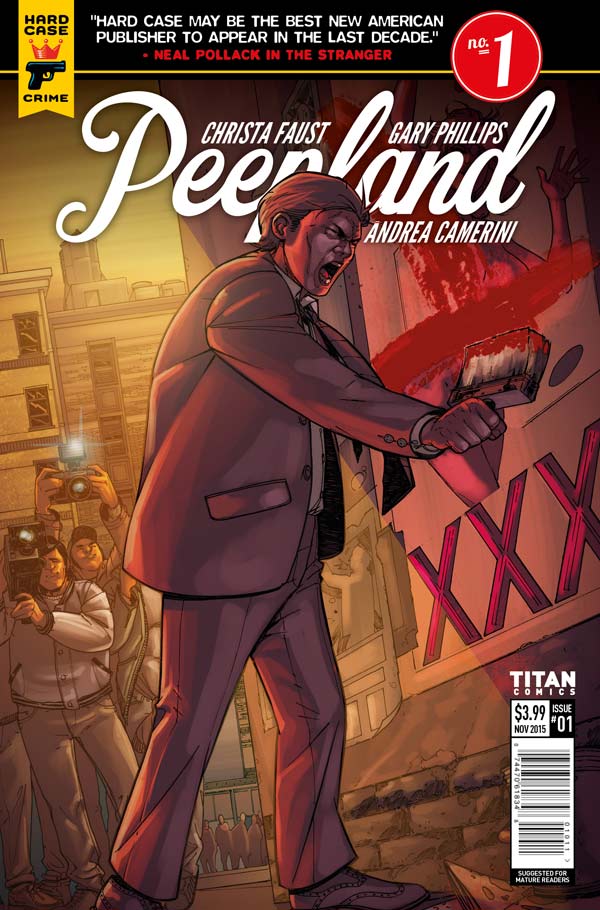
Have you heard aboutHard Case Crime’s plans to publish comic books? The company, known for its throwback pulp and noir novels – and great cover art – is to release the first issues of Peepland and Triggerman in October. Both look brilliant and both will impress anyone who loves American classic crime fiction. Triggerman offers a 1930s gangster vibe, and Peepland is set in the neo-noir world of punk-era New York. Peepland is written by Christa Faust, an author who has first hand experience of the sex club scene in New York, and Gary Phillips, an LA hardboiled crime author who’s also got plenty of comic writing experience under his belt. The art, meanwhile, is done by Andrea Camerini and there will be all sorts of alternate covers for you to look out for. To find out more about Peepland and how it was created, we decided to have a chat with Christa and Gary, and this is what they said…
How did the Peepland project come about? Christina Faust: I’d had this idea on the back burner for years. I had worked in the Times Square peep booths back in the late 80s and wanted to set a crime series in that place and time because I’d never seen that world portrayed in a way that accurately reflected my own experience. I’m primarily a novelist, but I knew this was a story that needed to be told in a visual medium, and comics seemed like the most accessible option. Gary and I have been friends for some time and so he was the first person I thought of to help make that happen.
Gary Phillips: I’m very pleased that Christa asked me in on Peepland. I’m a native of Los Angeles but have watched many 80s crime films set in New York City such as Ms 45, Fear City and the Pope of Greenwich Village. So having a hand in the production of this miniseries has been my way to pay homage to those films. Too, Christa and I are both prose crime fiction writers and strong believers in having tangible copies of books – the heft and smell of the ink on paper, you can’t beat that.
And what do you think crime fiction lovers will love about Peepland? CF: I think because Gary and I are both voracious crime fiction readers as well as writers, we are telling the kind of story that we like to read. A complex, gray-shaded story in which there are no clear-cut heroes, just ordinary janes and joes trying (and often failing) to make it in a sleazy and ruthless, urban world where the odds are stacked against them
GP: We’ve got a compelling set of diverse characters who for the most part are just trying to get along in the harsh circumstances they find themselves in when our story opens. Some of them have sins from their past they can’t escape But crime fiction works best when it’s about what does a person who doesn’t have Special Ops training or is a master of kung fu, what happens when that woman or man is put under pressure, how do they react, what do they do to get out from under?
Tell us about the main characters to look out for, and what they’re up against? CF: Well, all of the characters are based on real people I met while working in the peep booths. The central main character Roxy Bell is definitely semi-autobiographical, a scrappy, jaded, teenage tomboy trying to figure out her own slippery sexual identity while making a living in the ultra-feminine world of adult performers. The theme of blossoming sexual identity is a strong thread through many Peepland characters, including a single mother test-driving her first same-sex relationship and a baby butch driven by the need to prove her fledgling masculinity on the wrong side of the law. We also include our own versions of some infamous real life characters on the NYC porno scene like Al Goldstein and Ugly George.
GP: There’s also two real life incidents that shadow some of the characters in the story as well, the infamous Central Park Five case in which five young men were railroaded into prison for a crime they didn’t commit, and a particular headline grabbing incident back then of a preppy type and a young woman who died during supposed rough sex. These incidents are not shoehorned whole into the storyline, but re-imagined in the context of Peepland.
And what is the setting like? Why did you choose this setting?
CF: The vintage Times Square setting is like one of the main characters itself, and this story simply couldn’t be told anywhere else. It was a unique time and place that has since been tragically replaced by a generic Disney-fied shopping mall for tourists, but I grew up there, just a few blocks west on 45th Street and 9th Avenue. Times Square was like my third parent, or maybe more like a wild, promiscuous and badly behaved older sibling. It’s in my blood. As sleazy and gritty and dangerous as it was, it was home and I will always love it, warts and all. This series is my love letter to the place that shaped me and made me the person I am today.
Christa, I’ve read you have a fascination with the punk scene and 80s neo noir. Gary, you are a guy who writes hardboiled crime. Tell me more about what you think each of you bring to the table for Peepland, what interests each of you about the project, and what your ambitions are for it?
CF: I wouldn’t say I have a fascination with 80s neo noir, so much as I came of age in New York City during that time and wanted to share my own real life experience with people who were too young to remember. And because, like Gary, I’m also a hardboiled crime writer, that’s the kind of story that I naturally gravitate towards. As far as the punk scene, I was never cool enough to be part of any music scene growing up, but I watched it all from the outside and snuck into all kinds of shows whenever I was able. There is something unique and fascinating to me about that nihilistic, they’re-gonna-drop-the-bomb-any-day-so-fuck-it attitude of Reagan-era punk and hardcore and that makes it feel so right for Peepland.
GP: Again, I think we both understand that crime fiction is about pushing the characters against the wall and seeing what they do. Some dig deep and find within themselves a raw kind of bravery they didn’t know they had. Others might fold and still others might be the clever ones, the ruthless ones who pretend to do one thing but are plotting, laying out in their mind their next 10 steps and could be you find yourself as their fall guy or gal. In comics and prose the characters live and die on the page and we the writers put on their skin, live in their head and do our best to show them flaws and all. That sometimes they like us seek redemption or other times, seek gain… and what if those currents are running in the same person? What then?
What’s it like working together?
CF: I had this bare bones concept going in, and then the two of us sat down together over coffee and donuts and hashed out a more detailed outline. When it came to the execution of the script, it was more of a tag team deal where each one of us would take a turn in the ring and then tag the other in. But I have to be real here and admit that I never could have done this without Gary. I’d never written a comic script before and working with him on Peepland was like a fast-forward master class that threw my ass right in the deep end. I like to say that he’s the wily veteran while I’m the mouthy rookie and together, I think we added up to more than the sum of our parts.
GP: Having never worked together before, it was surprising to me how we managed to stay in sync and hammer out the story. Knock wood and all that for our possible future endeavors.
Who are the artists and how do you feel they’ve captured your story visually? CF: I’ll start by saying that interior artist Andrea Camerini is a goddam saint for putting up with my helicopter parenting, control-freak nitpicking and 80s G-string fascism. I will also say that he has knocked it out the park, particularly with his gritty realistic vintage NYC street scenes. Because the setting was so important to me, and because it’s a real place where I grew up, I wasn’t going to be satisfied with stylised, generic approximations. I wanted the real thing, and he delivered.
GP: Comics is a visual medium. The covers, and we have a very cool line-up of variants, and the sequentials have to grab the potential reader right off the bat. Too, bear in mind Andrea is as much a storyteller in this effort as me and Christa are. The goal is to be as seamless as possible so that the reader can be absorbed into the arena that is Peepland.
It’s pretty lurid stuff. For you what’s the right amount of sex and violence in a comic and how are you handling the subject matter in Peepland?
CF: Well, for me, the sex in this story wasn’t just thrown in there to titillate and shock the reader. It’s an integral and even boring part of the daily grind for women like me who have worked in the adult entertainment business. We didn’t show full on hardcore in our depiction of sex work and other sexual situations, because even though that was certainly part of our real daily lives back then, I feel it would have distracted from the story. Everyone already knows what human anatomy looks like and how it functions, but not everyone knows how we were able to sneak extra tips using a folded piece of paper or how that job made us feel. Those are the kind of realistic details I wanted to focus on. Also, whenever people ask me about how much sex or violence is appropriate in any form of art, I always say if it can be cut out without affecting the story, it should be. If you cut the sex and violence out of Peepland, you have no story.
What other projects have each of you got planned that we should look out for?
CF: I’ve been working on the third and final book in the Angel Dare series from Hard Case Crime for way too long now, so if it doesn’t kill me and I ever actually finish it, you’ll have that to look out for. It’s called The Get Off and it’s set in the world of rodeo bullfighters, the guys who protect the riders from their bulls after they’ve been bucked off.
GP: I’ve got my first ever Sherlock Holmes story in Echoes of Sherlock Holmes, have a solo miniseries I wrote from DC Comics, Vigilante: Southland, a street level, crime fiction infused costumed hero tale, and in keeping with the retro theme, co-edited 44 Caliber Funk anthology.
What each of you would pick as your all-time favourite classic crime novels?
CF: So hard to pick just one, but I’m gonna go with my first. Dig That Crazy Grave by Richard Prather.
GP: Red Harvest by Dashiell Hammett.
Issue 1 of Peepland goes on sale on 12 October and you can pre-order your first three issues digitally below. Classics in September 2016 is sponsored by Bloomsbury Reader.
This week, the first annual BevCon brought brewers, distillers, sommeliers, bartenders, and other beverage pros from all over the country to Charleston, South Carolina, to discuss everything from cider varieties to glassware to tea-brewing techniques. It was an industry-only conference, but we asked attendees and presenters to share some knowledge with the rest of us: Which cocktail, we inquired, should every Southerner know how to make? Of course, the experts have strong opinions. Here are five of the most recommended cocktails.
Old-Fashioned
“To me, it is the Southern drink. A great one only takes three ingredients that most folks already have on hand, and it never goes out of style.” —Brooks Reitz, founder, Jack Rudy Cocktail Co., Charleston, South Carolina (Get the recipe)
Mint Julep
“I want the mint julep to live on in good versions that honor it. Don't make it taste like cough syrup, and don't jazz it up. Use a silver cup—and take care of it. Use homegrown mint. It's a ritual drink, and I love ritual. Life needs more ritual.” —Kathleen Purvis, food editor, The Charlotte Observer(Get the recipe)
Sazerac
“In its hometown of New Orleans, the Sazerac never fell off the map even in the dark days of fill-in-the-blank-tinis, cosmos, etc. Short, strong, and about as classy as it gets, it transports you to New Orleans no matter where you order it or make it.” —Sara Camp Milam, managing editor, Southern Foodways Alliance, Oxford, Mississippi (Get the recipe)
Michelada
“It’s tempting to go with the original Southern cocktail—the Sazerac. I like mine with rye. But for a beery twist, I vote for a Michelada. Take a base recipe and modify it as you see fit with hot sauce, citrus, or other flavors. Then add your favorite lager, pilsner, or cream ale.” —Sean Lilly Wilson, founder, Fullsteam Brewery, Durham, North Carolina (Get the recipe)
The original Star Trek TV series took to the airwaves nearly 5o years ago–on September 8, 1966. Poor ratings meant that the show didn’t last very long (only three years). But everything changed once the show went into syndication. It achieved cult status. And a franchise was born. The original Star Trek has now spawned five additional tv series, 13 feature films, and a number of fan-made sequels.
Director Hirokazu Kore-eda‘s 1999 film Afterlife tasks its recently deceased characters with choosing a single memory to take with them, as they move into the great unknown.
The subjects of “On Memory,” above, are all very much alive, but they too, have great cause to sift through a lifetime’s worth of memories. All have been diagnosed with Alzheimer’s disease. They range in age from 48 to 70. Two have been living with their diagnoses for six years. The baby of the group received hers just last year.
Those who have no personal connection to Alzheimer’s are likely to have a clearer picture of the disease’s advanced stage than its early presentation. A few minutes with Myriam Marquez, Lon Cole, Frances Smersh, Irene Japha, Nancy Johnson, and Bob Wellington should remedy that.
All six are able to recall and describe the significant events of their youth. At the interviewer’s request, they reflect on the pain of losing beloved parents and the pleasure of first kisses. Their powers of sensory recall bring back their earliest memories, including what the weather was like that day.
The recent past? Much hazier. At present, these individuals’ mild cognitive impairment resemble benign age-related memory slips quite closely. Their diagnoses are what lends urgency to their answers. The prospect of forgetting children and spouse’s names is very real to them.
Knowledge of the interviewees’ diagnoses can’t but help sharpen viewers’ eyes for distinct facial expressions, speech patterns, and individual temperaments. They share a common diagnosis, but for now, there’s no difficulty distinguishing between the six unique personalities, each informed by a wealth of experience.
Is it too early to vacation plan for next summer? Because this summer sucks.
Scorching summer temps call for one thing: Liquid refreshment, preferably both the immersible and imbibable kinds. A good cocktail is easy to come by, but not everyone can drive to the beach over a weekend and be back in time for work Monday morning. Most Southerners can, however, get to a lake, like one of these—all within a short drive from major Southern metros.
Lewis Smith Lake, Alabama
Fed by rivers and streams from nearby Bankhead National Forest, Smith Lake—a quick jaunt from Birmingham, Huntsville, and Nashville—is one of the cleanest lakes in the country. It’s cooler than most, too, thanks to depths of nearly three hundred feet in places. Anglers won’t find a better spot to cast a line; nearby Cullman is the future home of the Bass Fishing Hall of Fame for good reason. Sandstone cliffs that ring its 642 miles of shoreline make excellent jumping off points. And there are boat rentals aplenty.
Spend the night: If you want someone else to do the cooking and cleaning, check out Smith Lake Bed & Breakfast. You’ll also find dozens of home rentals listed on VRBO and other home-share websites.
Lake Ouachita, Arkansas
Covering more than 40,000 acres, Lake Ouachita, nestled in the arboreal solitude of the surrounding Ouachita National Forest, is popular with sailboat enthusiasts because of its vast ocean-like stretches of open water. The pristine lake also consistently ranks among the country’s top ten largemouth bass fishing destinations. And on summer evenings, park rangers lead guided kayak tours at sunset.
Spend the night: Houseboats are a favorite way for folks from nearby Little Rock and Hot Springs to spend the weekend on Ouachita; rentals are available from companies like Wake Zone. But if you’re up for something a little (okay, a lot) more rustic, pitch your tent on one of the lake’s uninhabited islands. There are more than a hundred of them.
Courtesy of Arkansas State Park
Lake Rabun, Georgia
There’s only one marina (Hall’s Boathouse), which just recently began renting boats (still: be sure to check availability before you go), and the closest grocery store is thirty minutes away. The quiet rural appeal makes it hard to believe that Atlanta is only a two-hour drive from this North Georgia hideout set amid the Chattahoochee National Forest. And it’s considerably more low-key than its neighbor to the north, Lake Burton. If you make it to Rabun for the holiday weekend, check out the Fourth of July Wooden Boat Parade—the area is home to one of the country’s largest inland concentrations of classic wooden boats.
Spend the night: VRBO rentals are available, but you really can’t do better than the twenties-era Lake Rabun Hotel. Its locust-log decks and balconies offer views of the surrounding Blue Ridge Mountains.
Photo by David McClister
Lake Summit, North Carolina
A forty-five minute drive from Asheville, North Carolina, and Greenville, South Carolina, this small semi-private mountain lake—just 290 acres—is big on charm. Old-school wooden boathouses dot the lake’s ten miles of shoreline and there are rope swings for summertime thrill seekers. A particularly wet season means the lake is nearly at full pond. If you need a day off the water, nearby Hendersonville and Saluda maintain quaint downtowns worth exploring.
Spend the night: You’ll find multiple B&Bs in Hendersonville and Saluda. To stay on the water, check VRBO and local listings.
Lake Buchanan, Texas
After years of extremely dry conditions, Lake Buchanan (pronounced BUCK-han-an by locals)—the largest but least populated of the Highland Lakes in the Texas Hill Country northwest of Austin—is just inches from being completely full once again. Tall granite cliffs line the eastern shore, but if you head west you’ll find pebbled beaches perfect for lounging and swimming.
Spend the night: In the heart of a 940-acre preserve, lies Canyon of the Eagles eco-resort and nature park, named for the bald eagles that winter here. Designed by San Antonio’s prestigious Lake/Flato architecture firm and owned by the Lower Colorado River Authority, the pet-friendly property includes sixty-four guest rooms, miles of walking trials, boat and kayak rentals, and an on-site restaurant serving three meals a day.
Photograph courtesy of Canyon of the Eagles
Land Between the Lakes, Kentucky/Tennessee
This 170,000-acre inland peninsula just and hour and a half northwest of Nashville is sandwiched between Kentucky Lake and Lake Barkley, which were formed when the Tennessee Valley Authority impounded the Cumberland and Tennessee Rivers to help control flooding in the early 1960s. Fishing is the big draw, but recreational boats are also available for rent—and you'll have access to twenty different boat landings on LBL if you want to trailer your own. Off the water, LBL offers hiking, biking, horseback riding, hunting, and picnicking (all for free). Visit the Elk and Bison Prairie at sunset for a glimpse of wildlife.
Spend the night: There are a multitude of cabins and campsites in the park. Don’t want to rough it? Not a problem. You'll find are more than a dozen resorts on the lake and plenty of home rentals, too.
Frank Zappa was always frank. You gotta give him that.
Speaking with Village Voice journalist Howard Smith in 1971, Zappa talked candidly about the tastes, opinions, and beliefs of most Americans, whether they apply to music or politics or anything else. “You have a nation of people who are waiting for the next big thing to happen.” “I see a lot of changes. But I think they’re all temporary things and any change for the good is always subject to cancellation upon the arrival of the next fad. And the same thing with any change for the worst.”
Maybe it’s like this everywhere. But it’s particularly so in America says Zappa:
I think that’s a reasonable way to look at it because [the U.S.] doesn’t have any real sort of values, you know? And a fad provides you with a temporary occupation for your imagination. Really, [America] doesn’t have any real culture. It doesn’t have any real art. It doesn’t have any real anything. It’s just got fads and a gross national product and a lot of inflation.
It’s not a flattering portrait of the States. But know this. Zappa didn’t see himself being above it all: “I’m an American. I was born here. I automatically got entered in a membership in the club.” Yeah, Frank could be frank.
Follow Open Culture on Facebook and Twitter and share intelligent media with your friends. Or better yet, sign up for our daily email and get a daily dose of Open Culture in your inbox. And if you want to make sure that our posts definitely appear in your Facebook newsfeed, just follow these simple steps.
Dan Gelbart, a Vancouver-based electrical engineer, helped create a company called Creo, which Kodak bought in 2005 for roughly $1 billion. If you read Gelbart’s short autobiography here, you can learn about the arc of his career: About how, during his early years, he started working for a tech company that produced high-speed film recorders. And about how Gelbart told the company that he could build a better film recorder, at a cheaper price. And he could do it in the basement of his home. He explains:
After a crash course in optics, I changed the design [of the recorder], but surprisingly managed to deliver a shippable prototype in 12 months with only one person working with me. I had a small metalworking workshop at home, many of the machines home-built, and this allowed me to fabricate most of the parts for the prototype myself.
I now have a wonderful CNC machine shop at home, but I don’t have the boundless enthusiasm of those days. However, I still build all my prototypes myself, finding it to be faster than sending out drawings and waiting for parts.
Above, you can watch what Gelbart calls “A Short Course on How to Build Stuff,” a series of 18 videos designed for students and scientists who want to build prototypes very quickly, using machines that are easy to master. Writes Make magazine, the “series begins by demonstrating how to use and modify his favorite shop tools, and reveals all kinds of enlightening shortcuts that make complicated assemblies trivial to produce. There is a true art to uncomplicating things, a rarity for some engineers.”
Love Aesop Rock. Was so excited for the new album, but with the video? Even better!
In this increasingly atomized world of music, how does one get a new record release noticed above the hum of the internet? If you’re Beyoncé, you just drop the whole thing unannounced and watch the media play catch up. If you’re not Beyoncé you might consider rapper Aesop Rock’s tactic.
This week, the wordsmithiest of hip hop artists and animator Rob Shaw released a shot-by-shot remake of Stanley Kubrick’s The Shining, created with miniatures and made with what looks like spare change as a budget. All of which plays as background video to a full stream of The Impossible Kid, Aesop Rock’s seventh album and his first in four years.
Rob Shaw created the hipster rats skits for Portlandia as well as videos for They Might Be Giants and previous Aesop Rock tracks, but this Shining remake is something else. First you notice the gleeful cheapness of the production, but then as Aesop Rock’s rap lyrics flow over the visuals, memory starts to fill in the gaps of the images. Shaw’s handiwork is literally in the video: we can see his hand in the bathtub scene, or his body’s shadow as he moves the wooden Jack Torrance down the Overlook’s halls. And the tiny camera replicates the film’s Steadicam shots well, creating a work that is like a delirium of the actual movie.
Now, does this have anything to do with The Impossible Kid, really? Well, the rapper did go to live in a Portland barn after divorce and the death of a friend, and instead of writing “All Work and No Play…” over and over wrote this album, and nobody got hurt. Either way, by the time you’ve finished watching you’ll have heard the album, and that’s just one way to play the new music game.
Ted Mills is a freelance writer on the arts who currently hosts the artist interview-based FunkZone Podcast. You can also follow him on Twitter at @tedmills, read his other arts writing at tedmills.com and/or watch his films here.
FYI: Early last week, Colin Marshall gave you a heads up that Studio Ghibli, the animation studio behind Hayao Miyazaki’s My Neighbor Totoro, Princess Mononoke, and Spirited Away, was preparing to release an open source version of the animation software used to create its films. This weekend, the software–called OpenToonz–officially became available for download. And we can now tell you where to find it. OpenToonz is available on Github, in versions made for both Window and OSX. This link will jump you straight to the download area.
If you make anything great with it, please share it with us.
Follow Open Culture on Facebook and Twitter and share intelligent media with your friends. Or better yet, sign up for our daily email and get a daily dose of Open Culture in your inbox. And if you want to make sure that our posts definitely appear in your Facebook newsfeed, just follow these simple steps.
“If you remember the sixties,” goes the famous and variously attributed quotation, “you weren’t really there.” And, psychological after-effects of first-hand exposure to that era aside, increasingly many of us weren’t born anywhere near in time to take part.
Those of us from the wrong place or the wrong time have had to draw what understanding of the sixties we could from that much-mythologized period’s music and movies, as well as the cloudy reflections of those who lived through it (or claimed to). But now we can get a much more direct sense through the complete digital archives of Oz, sometimes called the most controversial magazine of the sixties.
In The Guardian, Chitra Ramaswamy describes the London magazine as “the icon – and the enfant terrible – of the underground press. Produced in a basement flat off Notting Hill Gate, Oz was soon renowned for psychedelic covers by pop artist Martin Sharp, cartoons by Robert Crumb, radical feminist manifestos by Germaine Greer, and anything else that would send the establishment apoplectic. By August 1971, it had been the subject of the longest obscenity trial in British history. It doesn’t get more 60s than that.” Even its print run, which began in 1967 and ended in 1973, perfectly brackets the period people really talk about when they talk about the sixties.
The online archive has gone up at the web site of the University of Wollongong, who two years ago put up a similar digital collection of all the issues of Oz‘s eponymous satirical predecessor produced in Sydney. “Please be advised,” notes the front page, “this collection has been made available due to its historical and research importance. It contains explicit language and images that reflect attitudes of the era in which the material was originally published, and that some viewers may find confronting.” And while Oz today wouldn’t likely get into the kind of deep and high-profile legal trouble it did back then — in addition to the famous 1971 trial for the London version, the Sydney one got hit with two obscenity charges during the previous decade — the sheer transgressive zeal on display all over the magazine’s pages in its heyday still impresses.
“Fifty years later, it’s important as a capsule of the times, but also as a work of art,” says Michael Organ, a library manager at the university, in the Guardian article. “Oz is a record of the cultural revolution. Many of the issues it raised, such as the environment, sexuality and drug use, are no longer contentious. In fact, they have now become mainstream.”
All this goes for the deliberately provocative editorial content — the stuff some viewers may find “confronting” — as well as the incidental content: ads for novels by Henry Miller and Jean Genet, “dates computer matched to your personality and tastes,” a machine promising “a hot line to infinity/journey through the incredible landscapes of your mind/kaleidoscopic moving changing image on which your mind projects its own changing/stun yourself & astonish friends,” and the “liquid luxury” of the Aquarius Water Bed. It does not, indeed, get more sixties than that. Enter the Oz archive here.
I’m standing by this ice cream trough, which is maybe 20 feet long, narrow and silver- just like a gutter one might put on a house. But this gutter is lined with aluminum foil and filled with many scoops of every imaginable flavor ice cream, sprinkles and whipped cream. It’s a little girl’s birthday party and all the toddlers are hoovering ice cream like they are getting paid to do it.
My daughter, Clementine, is power-eating and not spilling a drop on her dress, which makes me wonder why her plain steamed broccoli always seems to end up in her lap or on the floor.
Suddenly, A Lovely Girl wafts over to me. Slender, pale, with wisps of golden hair that tease her beautiful young face. She appears to be eight but exudes the world-weariness of a fourteen year old.
I smile at her then resume watching my 13-month-old pack in as much ice cream as she can, with suspicious glee, as if someone might someone yell, “Hey, stop eating ice cream outta my gutter!” The too-wise child studies me with huge expensive blue eyes.
“Why did you have to adopt her?”
Even though I kind of wobble, I love how abrupt kids are. They suffer no tedious propriety. No chit-chatty wind-up. No, “Hi, I’m Lulu and I’m curious about this child you are acting like a parent to.”
Of course, explaining my withered uterus, or telling her to visit ThisOldMom.com doesn’t feel like appropriate ice cream trough party chatter, so I smile too hard like a grown up does at cumbersome children that don’t belong to her.
“Well… I couldn’t have a baby of my own, and I wanted to be a mother, so I adopted her.”
The Lovely Girl forges on, like Megyn Kelly digging beneath rehearsed talking points.
“Why didn’t her real mother want her?”
I blanch, looking protectively at Clementine, who is deep within Sugarland Express, unaware she is being discussed, and unavailable for questions at the present time. And my mind coughs.
What’s my pat, polite party story about what drives a woman to give her baby up for adoption? I have my story for grown ups, but not for children, and especially not in front of my own child. I think hard and fast. I don’t realize how California I have become, but when I open my mouth, I am so The (slightly stammering) Center-for-Non-Violent-Parenting.
“Well, I’m her mother, but her first mother or, birth mother, loved her very much and, and, and wasn’t able to take care of her, so she made the very difficult decision to give her up for adoption. That’s how much she loved her. And we met and liked each other and she gave her, uh, our baby to me and I’m raising her as my very own child. She is my child. And so I’m raising her.”
Nervously reaching for a spoon and inhaling melted ice cream despite my lactose intolerance, I force a smile at the miniature Nancy Grace eying my happily oblivious daughter.
Suddenly, no doubt thanks to the sugar pinging my brain, I question The Lovely Girl before she can re-question me.
“How old are you?”
“Seven.”
“Do you know any adopted kids?”
And from there we have an actual conversation. About her school friends who are adopted and of different races and what that’s like for her and for her friends and how kind of cool it all really is. There are no mussings of hair or awkward fake hugs. I don’t even get Lovely Girl’s name or meet her parents before she wafts off like a Mini Boden model called to set.
So, it doesn’t qualify at all as a teachable moment for anyone except me. Right now my daughter beams at me with the purity that sees no difference between us. But that will change. And it’s coming soon. And it will probably happen because of something someone else says to her. Which is kind of sucky.
But forewarned is forearmed. I think that’s the saying. So I go home, call an adoption specialist therapist, join PACT: An Adoption Alliance and start educating myself for my future. And for Clementine’s.
__
Kathleen Dennehy teaches creative writing and poetry to at-risk and foster kids in Los Angeles. As a freelance writer, she has written for Disney, Universal Studios, The Los Angeles Times, Sit n’ Spin, Note To Self, and is a freelance ghostwriter. She also created ThisOldMom.com – a site devoted to the new wave of older moms. Her favorite job is being the later–in-life White mom of a fierce and fabulous Black girl. Her adoption specialist therapist is the wonderful Jeanette Yoffe, Yoffe Therapy | Celia Center, foster care and adoption support.
Scientists have discovered that various brands of table salt sold in China contain a range of plastic pollution, which might make food unsafe.
The highest proportion of plastic was found in sea salt, according to a paper from researchers at Shanghai’s East China Normal University. But even salt from salt mines, briny lakes, and wells contained significant amounts.
“Microplastics are a particular threat to organisms due to their small size and their capacity to absorb persistent organic pollutants,” said the report, led by Shi Huahong of the university’s Institute of Estuarine and Coastal Research and peer-reviewed in Environmental Science and Technology.
Shi and his colleagues discovered between 550 and 681 microplastic particles per kilogram of table salt that originated from the ocean, 43 to 364 per kilogram in lake salts, and 7 to 204 per kilogram in rock or well salts. Here is a rather gruesome photograph of their findings:
Environmental Science and Technology
Although the oceans close to China appear to be a “hotspot” for microplastic pollutants, it is unlikely Chinese table salt is the only salt that is contaminated with plastics.
“Plastics have become such a ubiquitous contaminant, I doubt it matters whether you look for plastic in sea salt on Chinese or American supermarket shelves,” Sherri Mason, an environmental science researcher at the State University of New York Fredonia told Scientific American. “I’d like to see some ‘me-too’ studies,” she added.
People who follow World Health Organization guidelines on salt intake (most in the U.S. consume much more) would consume around 1,000 microparticles of salt annually, Shi estimates. It’s not yet clear what kind of damage such consumption could mean for humans—if it causes any damage at all. Regarding the impact of microplastics on human health, Richard Thompson, a professor of marine science and engineering at England’s Plymouth University, told the Environmental Health Perspectives journal that “there are more questions than answers.”
And indeed, other foods from the sea, such as shellfish, also contain microplastics, but people concerned about plastic intake can just stop eating those foods. The prevalence and necessity of salt in our diets makes cutting out those microplastics much harder.
David Hogue isn’t sure that he should tell me his name. He sits in a back office in the shelter where he has lived for the past 18 months, hands folded neatly in his lap. It isn’t that he doesn’t want to talk. He tells me about how he’s had trouble finding work. He tells […]
When Susan Rosalsky was hired as an English instructor at SUNY Orange last year, she was elated. After several years of unemployment, she and her husband, Michael Trost, had been eating through their savings and 401Ks. Better yet, the job came with good health insurance through New York’s Empire Plan and United Healthcare. Rosalsky signed herself, Trost, and their daughter up for the plan.
“I thought we were out of [hot] water,” she said.
And they were—until this past March. One morning the couple was out walking their dog when Trost began feeling short of breath. “Just take me to the ER,” Rosalsky recalls him saying.
Trost and Rosalsky live in Dingmans Ferry, on the easternmost edge of Pennsylvania. There was an emergency room in the nearby town of Milford, but Rosalsky didn’t think they were in-network there. Another option was a nearby urgent-care center, but it was across the border in New Jersey, where Rosalsky wasn’t sure she was covered. She opted for Bon Secours Community Hospital in Port Jervis, New York—the state where the couple’s insurance plan was based. When they arrived, the couple says they were told their insurance would indeed be accepted.
Bon Secours admitted Trost, and, after performing an echocardiogram, deduced that he had a failed mitral valve and would require surgery. He was taken by ambulance to a different hospital, Good Samaritan in Suffern, New York. Rosalsky says Trost asked there, too, whether his insurance would be accepted and was told it would.
On April 1, Trost’s heart was operated on by Arthur Ng, a cardiac surgeon with an independent surgery group based in Hackensack, New Jersey. Trost was in the hospital for a week before going home to recover.
Within weeks, the couple began receiving the types of bills you’d expect from this type of experience: A few hundred for a hospitalist, a few hundred more for a urologist. Insurance pitched in, and Rosalsky wrote checks for the rest.
But the biggest bill was eye-popping: $32,845 for Ng’s services. United Healthcare offered to pay just $4,000 of that total.
Rosalsky provided a copy of the bill to The Atlantic, but Ng’s office did not return requests for comment.
The couple had encountered what’s known as a “balance bill”: The term for a situation in which an entire hospital stay or procedure is covered by insurance, but one of the specialists involved is out-of-network and bills the patient separately.
“Mike's life was in jeopardy,” Rosalsky said. “There was little time to think rationally. It would never have occurred to us to ask every individual, ‘Are you in my network?’"
Not all surprise medical bills are balance bills. However, nearly one-third of privately insured people have received a surprise medical bill in which their insurer paid less than they expected, according to a nationwide survey of more than 2,000 people conducted by the Consumer Reports National Research Center earlier this year. Balance bills for hospital visits sometimes occur when the doctor sends the patient a second, separate bill, on top of the one from the hospital.
Surprise bills might be likelier to occur in situations like Trost’s, where the patient lives in one state, is covered by a plan in a different state, and is treated by a provider based in a third state. About 5.2 million people commute to a different state for work, according to the Census Bureau.
“In the New York City metro area for example, there are hundreds of thousands of people who commute across the ‘tri-state’ area of New York, New Jersey and Connecticut,” said Chuck Bell, program director for Consumers Union, the policy and advocacy arm of Consumer Reports. “Ultimately, the varying state laws and regulations can be extremely confusing for consumers.”
Balance billing may become more common for all Americans as insurers narrow their networks, according to Sandy Ahn, a research fellow at Georgetown University's Health Policy Institute.
Rosalsky appealed Ng’s bill with her insurance, but the plan denied her appeal in a letter, which she also provided to The Atlantic. Rosalsky began “freaking out” and “panicking,” she said. She searched online for information and discovered that New York had recently passed a law that prohibits balance billing.
“I thought, ‘Holy shit, does this apply to us?’"
But then she took a closer look at her insurance-denial letter: “Please be advised that the New York State Surprise Bill Act is for New York State residents,” it read.
She was, once again, crestfallen: Dingman’s Ferry is just a 30-minute drive from New York. But it is not, alas, in New York. She was worried they were going to tear through their savings again just as they were getting back on their feet. “The money I had just put aside for a new car, that's going to go to the doctor,” she thought. “The money for household repairs, that's going to the doctor.” She called her bank to ask about getting another mortgage on the house.
She also called the office of Pennsylvania Senator Bob Casey. Casey’s office routed her to the New York Department of Financial Services.
They told her she was protected by the New York law. Where she lives, they said, is inconsequential.
In an email statement, a spokesperson for the Department of Financial Services said the New York law applies to state residents, doctors who practice in New York, and health plans based in New York. The agency said that out-of-network providers who bill patients for the balance of their services must provide a special claim form so the patient can contest the bill. (Rosalsky said Ng’s bill didn’t come with such a form, possibly because he’s based in New Jersey). Insurers’ explanations of benefits must also include information about the New York state law. It’s possible that the date the law went into effect had something to do with Trost’s denial—it was March 31, the day before his surgery.
“After reviewing Mr. Trost’s [sic] information ... he does meet the requirement for protection under the new law. We will address the surprise bill with the physician as outlined under the law,” United Healthcare’s public-relations director, Maria Gordon Shydlo, told me via email.
Just a few weeks ago, the couple received another letter from the insurance company, this time saying they owe nothing.
Rosalsky is relieved, but the ordeal has been nonetheless puzzling: Ng’s office accepted much less from United Healthcare than Ng had originally billed Trost.It’s like when “you go into a store, and you see markdowns at the end of the season—and they're still making money on that,” Rosalsky said. “What's the real value? Nobody knows.”
New York’s law requires providers to tell patients whether they participate with their insurance—but not necessarily when they’re called in to treat a patient in a hospital. Another question is why the denial letter implied that the couple wasn’t protected by the law because they didn’t live in New York. Bell, with the Consumer’s Union, said that in the 13 states that prohibit this type of balance billing, the restrictions are usually based on the state in which the insurance plan is located.
Still, it’s murky: “In some states, the laws or regulations may apply to health facilities and/or providers rather than insurance companies,” he said. “But generally speaking, protections against surprise medical bills are inadequate in most states. Consumers receive surprise out-of-network bills for a myriad of reasons—inadequate networks, lack of disclosure and information about provider status, excessive charges by providers and facilities, and unclear reimbursement practices for out-of-network care. But unfortunately, many of these practices are currently permitted in many states.”
So what should people—other than New Yorkers—do if they’re confronted with a surprise medical bill?
Experts say you shouldn’t pay it right away, but you shouldn’t wait to act either. If a provider takes the bill to collections, it could ding your credit.
First, Ahn says, call your insurance company and ask them if they can pay the rest of the bill. If they refuse, call your state’s Department of Insurance. (Consumer’s Union has a tool for finding the correct contact information in each state.)
In the worst cases, you might have to contact a lawyer, Ahn says. Patients who can’t afford lawyers may need to be their own advocates. If either the insurance company or the provider won’t back down, Bell said, you might start sending certified letters in order to get their attention, “especially if the clock is ticking and the bill may be referred to collections.”
As Rosalsky learned, it can be a hassle. But it beats paying a cardiologist $30,000 that you don’t have.
My version of this is: when I was young and thought time was unlimited, I finished every book I began. Now that I feel the pressure of time acutely, I will abandon a book the second it comes apart, be that the 10th page or the 300th. Too much other good stuff to waste time on crap.
Her genre-defying fiction, from the mail-art chapbook The Childlike Life of the Black Tarantula to incendiary novels like Blood and Guts in High Schooland Empire of the Senseless, were ways to think against every repression, to overturn the worlds—and words—of parents, gender, the academy, rationality, the traditional novel.
Let us remember Kathy Acker, whose unrelenting passion for living came through in her dying, as captured in a recent essay over at Hazlitt.
American libraries have always been a place for ideas and the exchange of knowledge. In recent years, libraries have invested in computers and other new technologies. One of those popular technologies has been 3-D printers. Now, libraries with those tools are operating at the forefront of modern manufacturing techniques. Pacific Standard takes a look at how 3-D printers are changing libraries, and a future where the institutions are the center of manufacturing.
“You can’t have Bach, Beethoven, and Mozart as your favorite composers,” said conductor and San Francisco Symphony music director Michael Tilson Thomas. “They simply define what music is!” True enough, though it doesn’t seem to have stopped anyone from, when asked to name their classical music of choice, unhesitatingly respond with the names of Bach, Beethoven, or Mozart — and Mozart most often. So why does the man who composed, among other works, the Piano Concerto No. 24 in C minor, the Symphony No. 40 in G minor, and Don Giovanni still command such instinctive allegiance nearly 225 years after his death?
“Mozart did not come from nowhere,” writes New Yorker music critic Alex Ross. “He was the product of a society that was avid for music on every level, that believed in the possibility of an all-encompassing musical genius. The society we live in now believes otherwise; we divide music into subcultures and subgenres, we separate classical music from popular music, we locate genius in the past.” But as past geniuses go, we’ve picked a good one in Mozart to carry forward with us into our technological age: the kind of age where you can listen to an 18th-century composer’s collected works with the simple click of a mouse.
The simple click of a mouse, that is, onto this Spotify playlist of the complete Chronological Mozart, brought to you by the same folks who put together the playlists we’ve previously featured of 68 hours of Shakespeare and the classical music in Stanley Kubrick’s films. (If you don’t yet have the free software needed to listen, download it here.) A few tracks have vanished since the playlist’s creation (such are the vicissitudes of Spotify) but it still offers about 127 hours of the (mostly) complete works of Wolfgang Amadeus Mozart, the aforementioned famous pieces and well beyond. Listen and you’ll not only understand why Mozart defines what music is, but — apologies to Michael Tilson Thomas — why you, too, should number him among your favorites.
Members of Baltimore indie bands Future Islands, Lower Dens, Celebration, The Bridge, and Mt. Royal got together with Believe in Music at the Living Classrooms Foundation and WTMD to help local middle school students give voice to their experience of this year’s riots. The project took lyrics and melodies written by individual students and combined them into a single track, yielding an incredibly sweet and pretty catchy song about what it means to have pride in your city. Watch the song’s video after the jump, and read more about the project and the nonprofit behind it.
The writing life ain’t cheap. Longtime Rumpus friend and contributor Antonia Crane has declared this the “Summer of Love: Stop Stripping, Start Writing” and she can’t make it happen without us. Help her raise the money to attend Bread Loaf and Byrdcliffe Art Colony this summer, and score some pretty cool perks in the process (naked VIP manuscript review, anyone?).
My compulsion to write does not occlude the uselessness of filling pages with words. I know that what I do is pointless, one more message in a bottle in a moment when everyone else around me is also casting messages adrift.
In an essay for Gorse, Fernando Sdrigotti writes about how the act of writing is pointless and masturbatory, using an idea from Borges’s “The Library of Babel”, that of “ordered totality,” as a jumping-off point for calling writers “either optimistic or seriously stupid.” Inflammatory, yes, but the piece begs conversation with its closing thought: “Writing is useless and impossible to justify in a reasonable way.”
Sarah Hepola is the personal essays editor at Salon. Her writing has appeared in the New York Times, The New Republic, Slate, Glamour, the Guardian, and The Morning News, where she has been a contributor for more than a decade. She lives in Dallas. Blackout is her first book. She began editing my work at Salon three years ago and I’ve learned much from her incisive edits of my writing. Along the way, I’ve become a huge fan of her writing and her generous way. I received an early copy of her first book, a memoir titled Blackout, and read it quickly over a couple of days, and then started reading it all over again—crowing about it all the while on social media. Sarah’s generosity extends to her writing—she lets us all the way in to her life, holds it close for us to see and in doing so illuminates ours. She is equally generous in this interview where we talk about so many things—including her memoir, fear, sex, writing and the cool kids.
***
The Rumpus: Your memoir, Blackout, is stunning. There are so many ways to structure a memoir—you chose to create a scaffolding out of the times you couldn’t remember, your blackouts, and the result is magnificent. Can you tell me about that choice?
Sarah Hepola: Blackouts were the scariest part of my drinking, and those episodes brought home my lack of control. If you love drinking like I did, then you scramble to make any potential problems seem all right. “I’m fine, you guys, I’ve got this,” but the blackouts were the splintered plank of wood across the face that said: No, you’re not fine.
It pains me slightly that I didn’t come up with the idea of focusing on blackouts by myself. That was suggested to me by a very smart woman in the publishing industry who read a few early pages and suggested the angle. Once she said it, my hands started shaking, because I knew the idea was so right. Blackouts had ruled my life, and I knew very little about them, which in itself is a good metaphor for a troubled drinker’s blind spots. By the way, I’m still amazed that a woman I barely knew read 20 pages of my story, and placed her finger on the entire through-line not only to my book but also to my drinking life. I kept learning those lessons while I was working on this book, though. I could not do it alone. There were so many times when other people reflected back to me the story I was trying to tell.
Rumpus: You talk about the power of blackouts. The shame and fear they caused in you after the fact. You wrote, “The nights I can’t remember are the nights I can never forget.”
Hepola: It’s a uniquely lacerating punishment to not know what you’ve done. Because it means you could have done anything. I didn’t sleep well when I drank, so I often woke up at 5am, and I would lie in bed for hours torturing myself with what might have happened. “What might have happened” is a list you can build until the stars fall out of the sky. It didn’t help that my past experience taught me my behavior in blackouts could be bizarre. Exhibitionist, aggressive, cruel. I didn’t even have the dignity of assuring myself, “I would never do that,” because I did quite a few things in a blackout that I would normally never do.
So yes, the shock of not knowing is unforgettable. Where am I? What the hell happened? But that sentence has a double meaning for me. Because I was prone to relapse and magical thinking, it’s also a call to awareness. Never forget your own story.
Rumpus: I admire that you wrote about gender, about being a woman alcoholic, throughout the book. That you didn’t carve that out and address it in one chapter, as if gender is something that is separate, other.
Hepola: It’s funny, because I did not think of myself as a “woman drinker.” I would have bristled at those words, the way I bristle at “woman writer,” because drinking is an equal-opportunity pursuit, and unlike many of my other passions—musical theater, or romantic comedies, or anything covered in pink glitter—it wasn’t tainted with the “girlie” brush, so people couldn’t make fun of me for it. I drank a great deal with men, who make for trusty and non-judgmental bar buddies, and when I sat down to write, it didn’t occur to me that I was writing a book about the experience of being female, or my relationships with women, or why drinking is so appealing to us. But the material kept pointing me in that direction.
Also, I was quite influenced by Caroline Knapp’s Drinking: A Love Story, which is a brilliant book about being a woman alcoholic. And I was attending women’s-only recovery meetings, and I was noticing all the ways women spoke differently about their drinking than men, and I was reflecting, probably for the first time in life, on why drinking had been so seductive to me as a female of the species: Body image issues, fear of not being hot enough or sexually liberated enough, fear of being too shy or sensitive or timid with my opinions, a terrible envy of other women. A lot of female stuff. But no gender has a monopoly on those emotions. I’ve heard from a lot of men who related to those things, just like when I read Bill Wilson’s story in the Big Book, and I think: Oh yeah, me too.
Rumpus: Saturday editor here at The Rumpus Arielle Bernstein and I were talking about your book and she raised this question: How does the female alcoholic memoir compare to the male alcoholic memoir?
Hepola: Just for fun, let’s compare two classics of the genre, A Drinking Life by Pete Hamill and Knapp’s book. Hamill’s memoir captures the culture around him: The thrill of daily journalism, the brotherhood of the bar, the excess of post-war America. Knapp’s book captures the world inside of her: A complicated bond with her father, a brilliant psychologist, and the two romantic loves she is torn between. So maybe, to paint in broad strokes, men might be more concerned with status and career, and women might be more concerned with family and relationships.
Female drinkers tend to write more about regret around sex, as in: Why did I sleep with that person? Men tend to write more about regret around violence, as in: Why did I hit/yell at/assault that person? The Night of the Gun by David Carr is a junkie memoir (as opposed to an alcohol memoir), but it’s a profound examination of his long, troubled history of violence. Drunkard is a memoir by a Chicago Sun-Times columnist named Neil Steinberg, in which he writes about hitting his wife. This dynamic reminds me of that old line about drinkers I quote in my book: Men wind up in jail cells, women wind up in random beds.
I want to make an unrelated observation that every addiction memoir I have mentioned thus far, including my own, was written by a journalist.
Rumpus: You write openly about sex, about random sex and sex you don’t remember and sex in and out of relationships, and gorgeously moving sex and awful sex and scary sex and joyful sex. Any unique challenges to that writing?
Hepola: Sex is an attention-grabbing topic, but a divisive one. You’re going to make some readers squirm, especially if their name is “Mom” or “Dad,” so I don’t tread lightly into that territory. We live in a sex-saturated culture, where the loudest messages about sex are usually the phoniest, and it’s exciting to dismantle the cliches. But writing about sex can too easily turn into a performance, just like having sex, and the more you show off, the less interesting your writing will be. You have to shuck the ego. You have to stop trying to suck in your stomach. The crackle of sex comes from the unexpected, the ways the body moves out of sync with the mind. It also comes from vulnerability, from something real being at stake.
That idea—that something real was at stake when I had sex—was one I discovered all over again after I quit drinking. I had honestly forgotten, because I’d numbed myself out so much to the singular experience of being naked in bed with another human. When I got sober, I couldn’t believe how much sex scared me. I’d spent years at that point, hooking up with random guys, making out with strangers. Who cared? None of it mattered. Without the alcohol, though, I was like a 12-year-old nearly peeing herself with fright during her first slow dance. In my story, it was important to show the reader that drunken, performative version of sex, where you make all the right noises and feel nothing, because later I needed to make the long passage to the other side—where you feel everything and might not even make a sound.
Rumpus: When you write about getting sober, you say, “Sobriety wasn’t the boring part. Sobriety was the plot twist.” Tell us more about that.
Hepola: My attitude when I was drinking was: Drinkers are cool, and non-drinkers are uncool. Uptight, lame, probably warped by fundamental religious beliefs that left them judging me for my martini. Having that cool card brought tremendous relief, because I had grown up without it, and drinking was like battle armor on a tender heart. I wanted to be a drinker till I died.
When I quit, I felt exiled from the kingdom of the Cool Kids. My life was boring now. Nobody would want to date me, or hang around with me. Sobriety felt like a dead end.
But with time I could see that my drinking had been the dead end. I want to be careful here, because I don’t think there’s anything wrong with hanging out at the bar with friends. It’s an amazing way to bond and I remember those years with great fondness. The way I drank, though, I was stuck in re-runs. The same conversations, the same mistakes, the same promises made and broken.
Sobriety was a chance for something different. It was scary, because it required change, and I had to give up a lot of my defenses, including my need to be cool. This still bothers me, by the way — I can actually feel my value sink with certain people when they find out I don’t drink. But much of the second half of the book is about reinvention. We all have to walk through a lonely valley at some point — after a breakup, after a job loss, after the loss of a parent — and the idea I wanted to convey was that you will come out the other side. There is a quote from the memoir Invisible, by Hugues de Montalembert (about an artist who loses his eye sight), that I have taped up in my house: “To despair of life is to not know what life can bring you.”
What strikes me these days is that I drank to be different, to be courageous, to experience life to its utmost—and that describes the way I see sober people now.
Rumpus: You write in detail about your loving, evolving, strong, imperfect 20-year friendship with your friend Anna. I loved the nuance you brought to that writing. Sometimes it seems that women’s friendships are either idealized or cliché in memoirs, or overly sentimental. You avoid that and let a clear portrait emerge.
Hepola: That means a lot to me, because I wrestled with that material quite a bit. I agree that female friendships are idealized, and it bugs the holy hell out of me. At the same time, I have never connected to the stories about female friendships as toxic and conniving. I don’t think I’ve ever had a “frenemy.” I just know that my relationships with women are fraught with disappointments and tiny betrayals and miraculous moments of connection, the same as my relationships with men.
In the friendship you mention, I think I was mislead by those sentimental portraits of sisterhood. I had this college-age notion of: Men may come and go, but we’re together forever! Well, she has a husband and a daughter, and they’re not going anywhere, so how exactly is that going to work? I needed to stop demanding that I remain a number-one priority. I’m still a little embarrassed by how much that hurt to accept.
I thought so much about my female friends when I was writing the book. Nearly all of them drank with me, but most of them didn’t develop a drinking problem like I did, and I wanted to write something that spoke to their lives, too. I wanted to talk about the deeper issues of how to find your voice in the world, or the complications of intimacy, or envy, or performance. All those issues we’ve talked about together, through the years. Some of my favorite nights of drinking were the nights we did nothing but sit in one place for hours, having a conversation so deep we didn’t notice the sun in the corner of the window. We still have those conversations together, although it’s getting much harder for me to stay up past midnight.
Rumpus: I think of Blackout as a call to compassion, a call to forgiveness, a call to understanding, a call to examine our own lives. Not that you wrote it with an agenda to your storytelling, but it certainly inspired those feelings in me.
Hepola: Everything you just said is what sobriety was for me. It was a call to compassion, because I was forced to lock eyes with all these strangers lugging the same heavy load across the sand. It was a call to forgiveness, because I had to forgive myself—not just for how I’d been when I was drinking but for the very act of being myself. It sounds cliched, but I had just never liked myself much, or accepted my own limitations, and by the time I quit drinking, I was radioactive with self-hatred. I had been given so much, and I had run it into the ground. The more I could forgive myself, though, the more I could forgive other people, many of whom I had placed on pedestals from which they were destined to fall. I had to get everything back into perspective: I’m not the greatest, or the worst. Where is my place in the middle?
I certainly felt called to examine my own life, because I needed to figure out: Why did I dislike myself so much? Could I ever change that? I’ve never thought about this before, but if I had to choose a mantra for the first years of my sobriety it might be: Pay attention. Listen to people. Listen to yourself. Notice the details, the slant of the light, this moment right here, this connection right now. I tried to pay attention when I was drinking, too—I’ve tried to pay attention all my life—but so much of drinking feeds the opposite impulse. Tune out. Escape. Block out.
Rumpus: Shame. Lately in my own writing and in the little bit of teaching I do I’ve been talking a lot about killing shame, saying, “Let’s kill shame, shall we?” I feel like Blackout is part of that same ethos. Part of a saying, from some of us, “Here is my story, I am letting go of the shame, as much as I can.” The antidote, I think, to gotcha culture and our own fear. Tell me your thoughts about the relationship between your book and shame and your thoughts on the idea of killing that wretched beast.
Hepola: Shame is definitely having a moment. It’s funny, because I used to associate that word with sex. But in my corner of the Internet, there’s very little shame in admitting your sexual proclivities. All the shaming is around not being a good PERSON: You’re a racist, or a sexist, hypocrite, or a bad mother, or a misogynist.
Shame does serve a social value, because it keeps people in line. People will change ignorant behavior if they think they might lose esteem. A world without shame might be its own dystopia, everyone just acting according to their wants and desires. But this current environment has gotten out of hand. There’s so much whistle-blowing. I think even the whistle blowers are sick of it.
It’s always going to be a fight to tell the truth about your life, though, because truth never falls neatly along political or culturally acceptable lines. All writing is a risk-reward calculation. When you tell the truth about yourself, you risk that others will misunderstand, or judge you, or simply not care—but you can be rewarded by a very special connection with people who do understand, who feel relieved by what you wrote, and who care immensely.
Rumpus: You discuss your evolving relationship with feminism in Blackout and claim it as yours, important, fundamental. I would describe your memoir as a memoir with a feminist sensibility. You?
Hepola: Absolutely. I used to have such an allergy to that word. Much like “sober,” I thought it meant something joyless, and the opposite has proven true. Of course, there’s an ongoing debate about what feminism means, and every time it comes up, no one seems to agree to the terms. Is my feminism the right feminism, and who gets to decide that? I don’t know. But in the long arc of history, I believe feminism is the struggle to be the hero of your own life. My story is definitely about that.
Rumpus: Who are some of the writers who have been influential to you as a writer?
Hepola: Stephen King was the writer who made me want to be a writer. I was a well-behaved, quiet kid, but I was also a closet adrenaline junkie—stealing beer from my parents, reading horror stories. I loved freaking myself out, and I devoured all the early classics: Carrie, The Shining, Pet Sematary, It. The book that probably influenced my writing more than any other, though, is Different Seasons, in particular a story called “The Body,” which is the basis for the movie Stand By Me. It’s one of his more autobiographical works, about a young boy in Maine who wants to be a writer, and even now when I read it, I can spot phrases and flourishes that I have unconsciously used for years. King also ended his novels with a letter to his readers, which are basically personal essays, and he has a very appealing first-person voice. Funny, self-deprecating, full of wonder. I was stunned when I read On Writing and discovered he had a drinking problem. No way: You too?
Rumpus: What work by other writers do you feel you carried with you into writing Blackout?
Hepola: I’ve talked about Caroline Knapp already, and she was a big influence. Another was Cheryl Strayed’s “Dear Sugar” columns, which began on this site, so I definitely want to mention her. I was early in sobriety when I first found those columns—which seemed to drift along the Internet, like messages in a bottle—and I was electrified. Her voice was so warm and real and absolving. I wanted the second half of my book to have that feel—a hand reaching through the darkness to take yours.
Rumpus: You’ve been my editor and I know you to be generous, abundant in your assistance. One piece of advice I give to writers—at every stage—is “be generous.” How do we foster that in other writers, in the literary community? Should we be fostering that?
Hepola: “Be generous” sounds like good advice for human beings. I would suggest fostering it anywhere we could, and it comes from the tools we talked about earlier: Compassion, understanding, empathy. I know there’s longstanding wisdom that great writers are assholes, and I have no doubt some of them are, but I’ve met many writers I admire, and a common trait among them is a big heart.
“Be generous” extends to the self, too—I’m one of those perfectionistic writers who can’t forgive herself for a comma splice, and it’s like, hey, put down the hammer and stop bashing yourself in the face. You’ll get a lot more work done.
I have a different piece of advice for writers. “Be rigorous.” I think we need both. I think we have to hold ourselves to higher standards, push ourselves to write better material, and then we need to extend generosity and support to the people alongside us. It sounds like those are contradictory acts, but they work in concert. Intellectual and emotional rigor is a kind of generosity with your work—you are giving the writing the most stable foundation possible.
Rumpus: What are you reading now? What’s coming out soon that we should know about?
Hepola: I’ve been reading The Empathy Exams, which is exactly as good as the hype promised. Maybe even better. I’m excited about Jami Attenberg’s Saint Mazie, which is about an eccentric movie theater owner on the Lower East Side and sounds like one of those cool books about the evolution of New York’s soul. My friend Jordan Harper has his first collection of crime fiction short stories, Love and Other Wounds, coming out in July. He’s morbidly obsessed in a way that I completely understand. My childhood fascination with horror turned into an adult fascination with true crime.
Rumpus: What are you working on now?
Hepola: I wrote a personal essay on Salon about this ex-boyfriend I couldn’t get over—actually, he was a homicide detective, speaking of my true crime fascination—and a commenter wrote: “What is Sarah Hepola’s relationship with her dad?” I was like: That is a really good question. It sparked me to think about a larger collection of essays about my relationships with men—wanting to be like men, or wanting to be loved by men, or trying to live without them— and I want to call it “Crying in Restaurants,” which is the name of a Nerve series I did years ago and a phrase which continues to provide a decent window into my emotional life. That’s me: All dressed up at the dinner table with mascara smears and a wad of wet napkin in my hand.
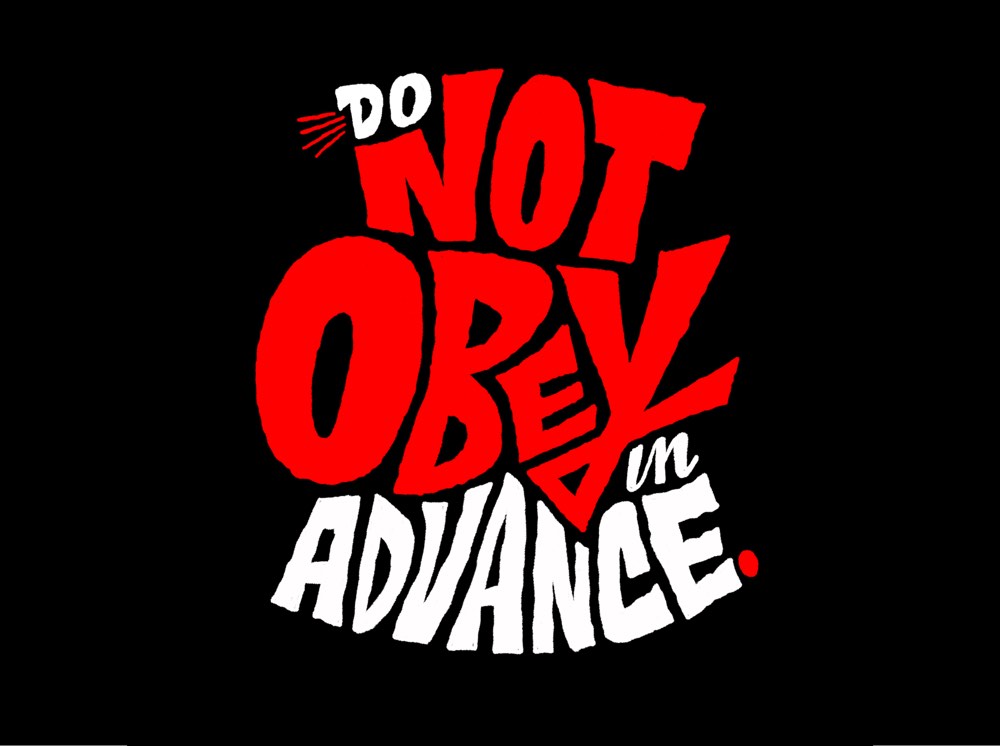







 How did the Peepland project come about?
 CF: Well, all of the characters are based on real people I met while working in the peep booths. The central main character Roxy Bell is definitely semi-autobiographical, a scrappy, jaded, teenage tomboy trying to figure out her own slippery sexual identity while making a living in the ultra-feminine world of adult performers. The theme of blossoming sexual identity is a strong thread through many Peepland characters, including a single mother test-driving her first same-sex relationship and a baby butch driven by the need to prove her fledgling masculinity on the wrong side of the law. We also include our own versions of some infamous real life characters on the NYC porno scene like Al Goldstein and Ugly George.
 GP: Again, I think we both understand that crime fiction is about pushing the characters against the wall and seeing what they do. Some dig deep and find within themselves a raw kind of bravery they didn’t know they had. Others might fold and still others might be the clever ones, the ruthless ones who pretend to do one thing but are plotting, laying out in their mind their next 10 steps and could be you find yourself as their fall guy or gal. In comics and prose the characters live and die on the page and we the writers put on their skin, live in their head and do our best to show them flaws and all. That sometimes they like us seek redemption or other times, seek gain… and what if those currents are running in the same person? What then?