Shared posts

02 May 02:19

Case Closed on Pappygate? Not So Fast...

by rreed
Bgarland

Scoundrels!

The sheriff always thought it was an inside job. In 2013, when the Buffalo Trace distillery reported that sixty-five cases of Pappy Van Winkle whiskey had disappeared from a secure area, it seemed likely that the perpetrators had access to the supply. Until recently, authorities couldn’t prove it. Then yesterday, a grand jury indicted a group of nine people in conjunction with the thefts. The likely ringleader, Gilbert “Toby” Curtsinger, is indeed a twenty-six-year veteran of Buffalo Trace, where he worked on the loading dock. (Another one of the accused worked at the Wild Turkey distillery, which suffered similar losses.) Here are five more things you should know about the latest developments in the biggest bourbon theft in recent history.


Photographs by Joe Pugliese

1. It all started with softball.
Not only did Curtsinger meet at least some of his eight alleged co-conspirators while playing in a recreational softball league, but his statewide connections in the sport also helped them unload bottles and barrels of stolen whiskey. “Most of this stuff was sold through softball,” Franklin County sheriff Pat Melton says. “They played teams all over the state, and they made friends who would distribute.” 

2. It’s been going on since 2008.
It’s possible that the thieves made a fatal mistake when they went after those cases of Pappy Van Winkle in 2013. According to authorities, they had probably begun to dip into the stores of Buffalo Trace and Wild Turkey five years before. By gradually lifting product from crowded warehouses, they had mostly escaped attention until word broke that hundreds of bottles of the really good stuff were missing. Pappy Van Winkle is already rare enough to attract feverish bids from collectors, and news of a threat to the national supply launched hundreds of headlines and an in-depth investigation. 

3. The accused thieves were peddling more than one kind of juice.
Earlier this year, the sheriff’s office received two tips about Curtsinger and his associates. One tipster dished on the barrels of whiskey stashed in Curtsinger’s backyard, and the other fingered him as a dealer in anabolic steroids, ordered in bulk from overseas. Police found both when they searched his property.

4. Most of the whiskey recovered will be destroyed.
Although plenty of bourbon lovers have already called the attorney general’s office to ask if they can help dispose of the contraband, very little of it will ever see the inside of a rocks glass. While officials hope the distilleries affected will be able to reclaim unopened bottles, there’s no telling what the thieves might have done to the thousands of dollars of high-dollar whiskey stashed in barrels and glass jars—state law mandates that it be poured out. (We already know that a stolen barrel of seventeen-year-old Eagle Rare was dosed with artificial caramel flavoring, a fact that could make the most hardened whiskey snob shed a few boozy tears.)

5. More arrests could be ahead.
Stolen whiskey is now sitting in liquor cabinets all over the state. The police are looking for it, and encouraging anyone in possession to contact them immediately. “I think we’ve just found the tip of the iceberg,” Melton says. “Those who have come forward are not going to face charges, but those who have not and are found will.”


Shared: 
73
20 Mar 13:35

Google Puts Online 10,000 Works of Street Art from Across the Globe

by Ayun Halliday
Bgarland

Finally! A use for Google!

circling

Circling Birdies by Cheko, Granada Spain

Since last we wrote, Google Street Art has doubled its online archive by adding some 5,000 images, bringing the tally to 10,000, with coordinates pinpointing exact locations on all five continents (though as of this writing, things are a bit thin on the ground in Africa). Given the temporal realities of outdoor, guerrilla art, pilgrims may arrive to find a blank canvas where graffiti once flourished. (RIP New York City’s 5 Pointz, the “Institute of Higher Burning.”)

A major aim of the project is virtual preservation. As with performance art, documentation is key. Not all of the work can be attributed, but click on an image to see what is known. Guided tours to neighborhoods rich with street art allow armchair travelers to experience the work, and interviews with the artists dispel any number of stereotypes.

Cultural institutions like Turkey’s Pera Museum and Hong Kong’s Art Research Institute, and street art projects based in such hubs as Rome, Paris, Sydney, and Bangkok, have pulled together official collections of photos and videos, but you can play curator too.

It’s easy to add images to a collection of your own making that can be shared with the public at large or saved for private inspiration. Careful, you could lose hours…it’s like Pinterest for people who gravitate toward spray paint and rubbish strewn vacant lots over gingham wrapped Mason jars.

It’s been a long and brutal winter here on the east coast, so for my first foray, I prowled for Signs of Spring. One of my first hits was “Circling Birdies” by Cheko, above. Located in Granada, Spain, it’s one of the existing works Google has turned into a GIF with some light, logical animation.

Behold a bit of what typing “flower,” “baby animals,” “plants,” and “trees” into a search box can yield! You can enter Google Street Art here.

Child With Windmill

Artist: Walter Kershaw
London UK

Thrashbird

Artists: Thrashbird and Renee Gagnon
Los Angeles, California.

Baby Chick

Artist: unknown
Rochester, NY

Screen Shot 2015-03-19 at 11.07.58 PM

Icy and Sot
Rochester NY

Freedom Fighter

Artist: Kristy Sandoval
Los Angeles, CA

Natureza Viva

Artists: Regg and Violant
Alfragide Portugal

Beetle

Artist: Klit
Alfragide, Portugal
A giant colorful beetle tries to fly between the ceiling and the floor of this parking lot. His wings seem filled with flower petals. So, the “Living Nature” project brought a set of huge insects that carry a note of living spirit to the space.

Deep Blue

Artist: Rai Cruz
Manila, Philippines

Nagel
Artist: Christiaan Nagel
London, England

Untitled Rome
Artist: Lady Aiko
Rome, Italy

Parsa

Artist: Andrew Kentish
Nepal

Related Content:

Tour the World’s Street Art with Google Street Art

Obey the Giant: Short Film Presents the True Story of Shepard Fairey’s First Act of Street Art

Big Bang Big Boom: Graffiti Stop-Motion Animation Creatively Depicts the Evolution of Life

Ayun Halliday is an author, illustrator, and Chief Primatologist of the East Village Inky zine. Follow her @AyunHalliday

Google Puts Online 10,000 Works of Street Art from Across the Globe is a post from: Open Culture. Follow us on Facebook, Twitter, and Google Plus, or get our Daily Email. And don't miss our big collections of Free Online Courses, Free Online Movies, Free eBooksFree Audio Books, Free Foreign Language Lessons, and MOOCs.

The post Google Puts Online 10,000 Works of Street Art from Across the Globe appeared first on Open Culture.

08 Dec 21:36

How Witnessing Violence Affects a Child, and How to Help

by By Anne Machalinski
Bgarland

A nice reminder of the impact of violence on children, including the emotional violence of bullying.

While schools and pop culture have started to address bullying among children and in schools, I hope that awareness of the impact of bullying in the home can have will become part of the dialogue. I can think of numerous parents I know that have a partner who routinely and consistently bullies them, or treats them with scorn or disdain, or talks to them as if they are less than. These same parents would never want their children to accept such behavior from a bully at school, but accept such behavior directed towards themselves by their partner. WTF?!?

In addition to eroding the respect that children may have for the bullied parent, it sends the message that SOME bullying is ok (possibly creating some bullying behavior in the children in the process, I would think). Thoughts, Gentle Readers?

Sixty percent of children in the United States are exposed to violence, crime or abuse on an annual basis, according to a Department of Justice report. When I was attacked last year, my son became one of them.
28 Nov 22:34

Crash Course Big History: John Green Teaches Life, the Universe & Everything

by Colin Marshall
Bgarland

Amber?

http://www.youtube.com/watch?v=tq6be-CZJ3w

If you don’t understand big history, you’ll never understand small history. That idea hasn’t yet attained aphorism status, but maybe we can get it there. Last month, we featured a free, Bill Gates-funded short course on 13.8 billion years of “Big History”. Back in 2012, we featured well-known online educator (and now even better-known young adult novelist) John Green’s Crash Course on World History. Now these worlds, or rather these histories of the world, have collided in the form of  Crash Course Big History, a web series “in which John Green, Hank Green, and Emily Graslie teach you about, well, everything.” In true fashion of the biggest possible history, the Crash Course crew begins at the beginning — the real beginning, the Big Bang, which the first fifteen-minute episode gets into above.

http://www.youtube.com/watch?v=Fi30zjQhtWY

“Mr. Green! Mr. Green!” exclaims Green at himself, momentarily taking on his signature secondary pushy-student persona. “That’s not history, that’s science.” Returning to his cool-professor persona, Green lays it out for himself: “Academics often describe history as, like, all stuff that’s happened since we started writing things down, but they only start there because that’s where we have the best information. The advent of writing was a huge deal, obviously, but as a start date for history, it’s totally arbitrary. It’s just a line we drew in the sand and said, ‘Okay, history begins now!'” In order to push that line as far back as possible, history must fuse with science, allowing the study of the past to best incorporate and contextualize all it can about (and students of Green had to know he would quote Douglas Adams on this) “Life, the Universe, and Everything.”

http://www.youtube.com/watch?v=By6CkTN4wkI

Seven episodes in and underway right now, Crash Course Big History has gone on to cover not just the universe, but the sun and the Earth, the emergence of life, the epic of evolution, and how that process produced humans. Having arrived at the appearance of Homo sapiens, Green and company cover, in the freshly released seventh episode, the process of “humanity conquering the Earth. Or at least moving from Africa into the rest of the Earth,” going on to reach “a critical mass of innovators” and develop “collective learning.” And amid the grand sweep of planetary movement, evolution, and mass migration, we continue to find new ways to collectively learn all the time — of which the Crash Courses represent only one particularly entertaining variety.

You can watch future Crash Course Big History videos by following this playlist on Youtube. It’s also worth mentioning that Bill Gates has helped fund these Crash Course videos, just as he has helped fund the larger Big History Project mentioned in our previous post.

Related Content:

Take Big History: A Free Short Course on 13.8 Billion Years of History, Funded by Bill Gates

A Crash Course in World History

The History of the World in 46 Lectures From Columbia University

Free Download of The History Manifesto: Historians New Call for Big-Picture Thinking

Download 78 Free Online History Courses: From Ancient Greece to The Modern World

Colin Marshall hosts and produces Notebook on Cities and Culture and writes essays on cities, language, Asia, and men’s style. He’s at work on a book about Los Angeles, A Los Angeles Primer. Follow him on Twitter at @colinmarshall or on Facebook.

Crash Course Big History: John Green Teaches Life, the Universe & Everything is a post from: Open Culture. Follow us on Facebook, Twitter, and Google Plus, or get our Daily Email. And don't miss our big collections of Free Online Courses, Free Online Movies, Free eBooksFree Audio Books, Free Foreign Language Lessons, and MOOCs.

The post Crash Course Big History: John Green Teaches Life, the Universe & Everything appeared first on Open Culture.

26 Nov 12:37

Building Chicken Coops For Dummies / Backyard Chickens

by mark
Bgarland

Bawk bawk.

Here are a couple of chickeny resources for the wanna-be chicken keeper:

Building Chicken Coops For Dummies
Like all of the For Dummies books, this takes an arcane art and breaks it down into simple, clearly-explained steps. It presents the basics of constructing a simple structure, and adapts them to rearing chickens. It also presents detailed plans and instructions for five different coops of varying complexity. Using this book, I was able to build a safe, moveable, attractive coop for my three chickens, with only a moderate amount of swearing. It was the first structure I’ve ever built all by myself, and I’m inordinately, excessively proud of it. More importantly, the chooks have lived in it for almost two years now, and I haven’t lost one yet.

Backyard Chickens
Chickens are social animals, and so are their owners. BackyardChickens is a website devoted to chicken keeping. It’s my go-to site when I have a chicken question. It’s helped me plan a coop, select breeds, build a cheap and comfortable brooder, ease health concerns, and understand my chickens’ behavior. Also, it’s fun to read other people’s adventures with chickens. I’ve been using the site ever since I started dreaming chickeny dreams, and it’s been a very helpful resource. Though I’ve been using the site for a couple of years, I’ve only recently joined as a member. Chicken books are helpful, but sometimes you just need some hands-on advice.

-- Amy Thomson

Sample Excerpts:

Building Chicken Coops For Dummies:

Screen Shot 2014-10-27 at 1.24.12 PM

Screen Shot 2014-10-27 at 1.24.43 PM

Backyard Chickens:

hutch1

*

Understanding the yolk sack
Growth of a chick begins in the small fertilized area at the top of the yolk. A network of blood vessels begins to develop spreading from the embryo out over the yolk. The yolk sac is attached to the chick’s navel and the chick draws nourishment from it, producing an enzyme that changes the yolk material so that it can be used as a food by the developing embryo. As the chick hatches any remaining unused yolk is drawn into the chick’s abdomen or “navel”. It will supply nourishment for the chicks first few days after hatching.

22 Nov 02:11

Emancipation from Irony: On ‘The Best American Comics 2014′

by Paul Morton

cover

1.
“Comics Not Just For Kids Anymore, Reports 85,000th Mainstream News Story,” The Onion announced on July 10, 2012. There’s truth there, but only so much. Critics in The New York Times Book Review, Slate, NPR and The New Yorker now appraise individual comics without questioning the value of the medium as a whole. The cliché still appears in outlets whose editors should know better, but it’s unlikely The Onion could tell the same joke in another 10 years.

The best way to kill a debate is to avoid acknowledging it and comics artists are as guilty as anyone else of prolonging the argument. In 2004, I attended a talk by Art Spiegelman on his September 11 book. He explained his layout methods in detail. It was a good discussion. He also kept defending the right of comics artists to sit at the adults’ table. That was irritating. In 2006, Houghton Mifflin added comics to its Best American series list. Alison Bechdel, the guest editor of the 2011 edition, was ambivalent about working in a “newly legitimized art form.” The problem is generational. Younger comics writers and artists tend not to defend the seriousness of their vocation. If they inhabit the margins of culture, they know there’s nothing intrinsic to the medium that places them there.

covercoverScott McCloud, the guest editor of the 2014 edition of Best American Comics, — the series editor is now Bill Kartalopoulos — is famous for improving the debate. In the early ’90s, McCloud wrote Understanding Comics, a comic book about comic books that explained how the medium reinvents time and space and imagines realities that can’t be adapted to other media. Reinventing Comics, which was published in 2000, was a prescient analysis of how the Internet and the digital world would affect comics readers and creators. He can be as defensive as Spiegelman, but he’s also a smarter interpreter. Like the earliest political philosophers, McCloud points out the obvious and makes it sound profound only because no one before him wrote the obvious down.

The Best American Comics 2014 reads as a sequel to McCloud’s theoretical studies. Previous guest editors instructed readers to thumb through the anthologies and choose work that interests them most just as they would browse the shelves in a comics shop. McCloud asks that you read his anthology in order, cover-to-cover, and that you treat it as a critical narrative. He divides his book into discrete sections, presenting a taxonomy of genres. The book is an argument on the state of comics in the second decade of the 21th century.

2.
What makes a great comic great? McCloud summarizes the criteria:

Is the story built around quiet everyday events or autobiography? Check. Does it have a dark satiric undercurrent? Check. Does our protagonist have a low opinion of him/herself? Check. Is there a complete absence of anything that might remotely remind you of a superhero comic? Check.

coverHe’s being facetious, but the gatekeepers, those who honor what Ted Rall once told me was “the Fantagraphics crowd,” seem to always honor comics that follow at least one of these criteria. Many of the comics McCloud selected from an enormous pile Kartalopoulos gave him follow at least one of the first three and pretty much all of them follow the fourth. (McCloud wanted but was unable to include Matt Fraction’s Hawkeye comics.)

“Great Comics” are not the same as “Great Fiction” or “Great Non-Fiction.” Any New York Times critic would have savaged the sentimentality in Craig Thompson’s Blankets if it came packaged in a prose novel. Bechdel needs her images to sell her wit; in a comic the famous “Bechdel Test” is astute, but the average male reader would roll his eyes if he first encountered her theory in one of the online essays it spawned. A great comic does not have to be sentimental nor simple, but sentimentality and simplicity are not problems for comics.

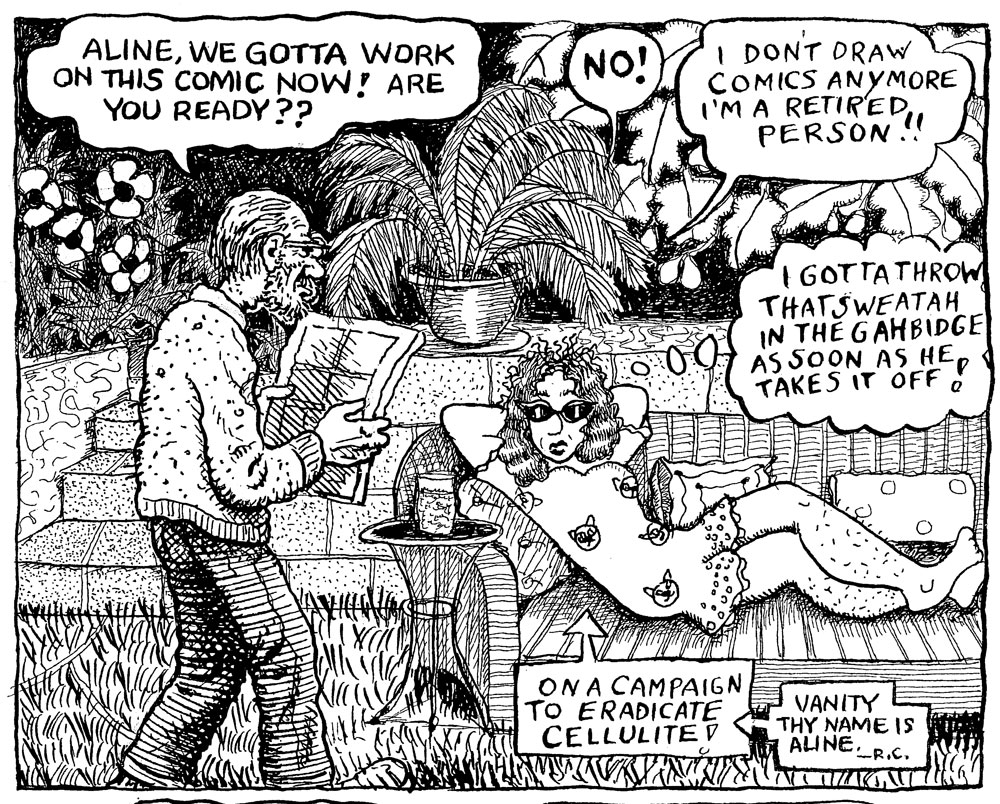
“High Road to the Shmuck Seat” by Aline Kominsky-Crumb and Robert Crumb from Best American Comics 2014 edited by Bill Kartalopoulos. Originally appeared in Viewotron #2. Copyright (c) 2013. Used by permission of Houghton Mifflin Harcourt Publishing Company. All rights reserved.

coverThat much is obvious in the opening section of McCloud’s anthology, dedicated to the recent work of old masters. In “High Road to the Schmuck Seat,” R. Crumb portrays himself as a happily married aging pervert and not as a raging Mickey Sabbath. His grotesque line drawing, which he’s used throughout his career to express an unrelenting sexual anxiety, now obscures a sweet loving heart. In Charles Burns’s The Hive, teenagers bond over anatomical drawings. Burns’s cleanly-drawn entrails sit comfortably next to his old-before-their-time adolescents. It’s a touching scene. Call it dark sentimentality.

“Drama” (excerpt) by Raina Telgemeier from Best American Comics 2014 edited by Bill Kartalopoulos. Originally appeared in Drama. Copyright (c) 2012. Used by permission of Houghton Mifflin Harcourt Publishing Company. All rights reserved.

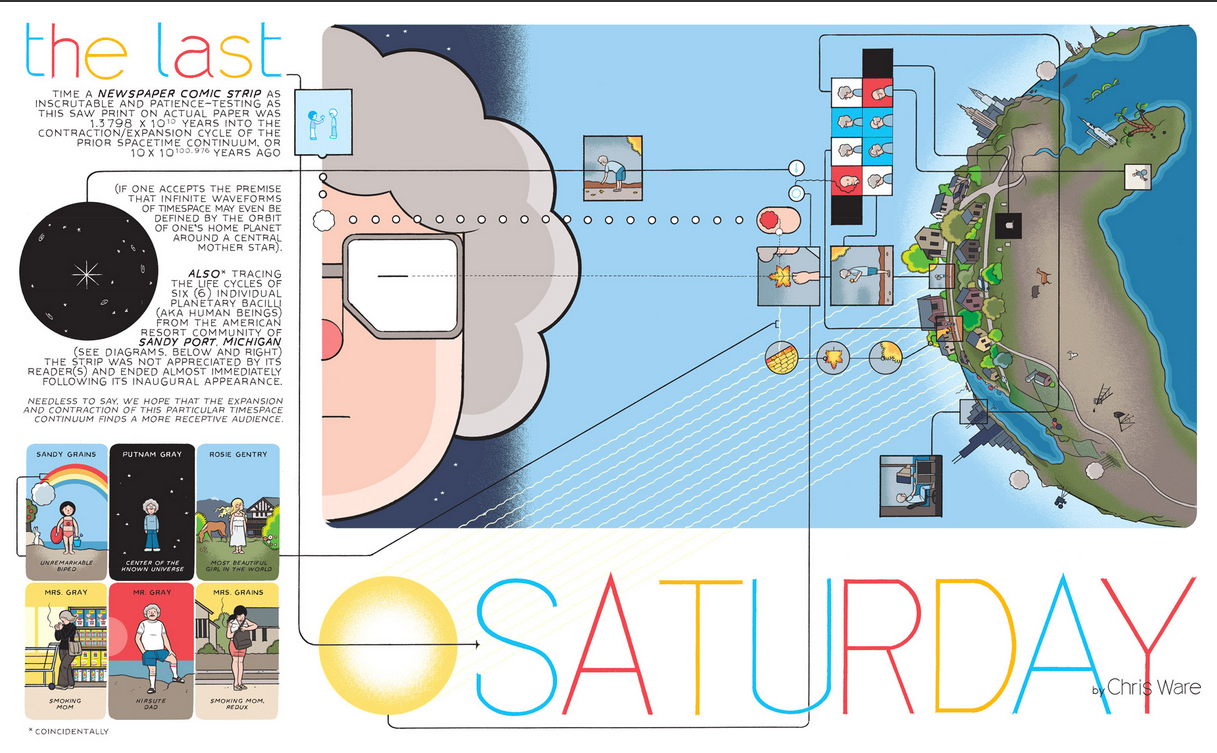
covercovercover“Dark sentimentality.” I put the phrase in a Google search and out came a list of indie rock reviews. Take from that what you will, but it’s the dominant mood in the anthology and it bleeds from one comic to the next and one section to the next, from adventure comics to family memoirs. “Raising Readers,” a section dedicated to children’s comics, contains excerpts from two devastating depictions of childhood loneliness, Raina Telgemeier’s Drama and Fanny Britt and Isabelle Arsenault’s Jane, the Fox and Me. The excerpt from Drama ends with a full-page panel of an empty playground. A small-scale strip from Chris Ware’s Building Stories, which McCloud names as the best book of the year, serves as a grim counterpoint with its depiction of a mother discovering the pain of solitude as her child grows older and more independent. Ware and Raina Telgemeier understand the eerie power of bold block colors and negative space. They make clichés sublime. They make small emotions huge.

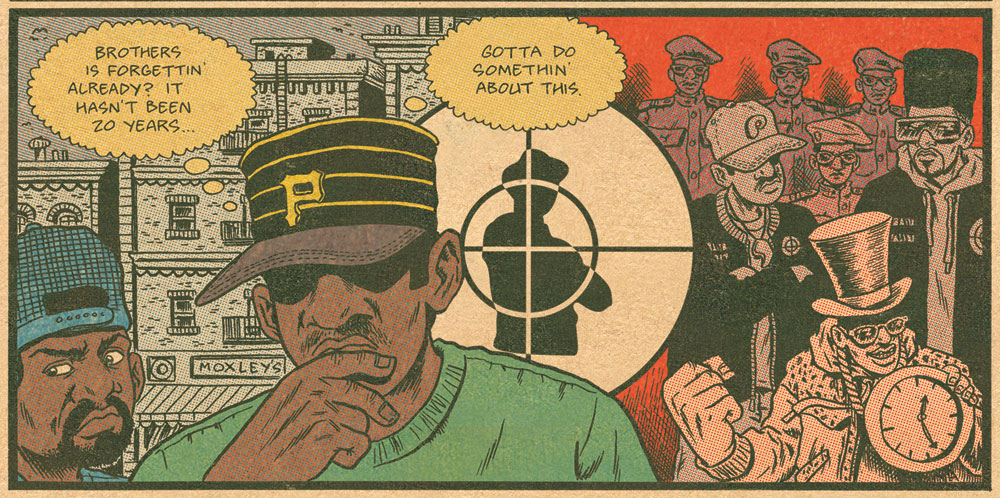
Hip Hop Family Tree” (excerpt) by Ed Piskor from Best American Comics 2014 edited by Bill Kartalopoulos. Originally appeared in Hip Hop Family Tree. Copyright (c) 2013. Used by permission of Houghton Mifflin Harcourt Publishing Company. All rights reserved.

covercoverYou may not have to adjust your mood from one comic to the next or one section to the next, but you do have to adjust your eye. The “Testimonials” section includes excerpts from two histories of American music, Frank M. Young and David Lasky’s wonderful The Carter Family: Don’t Forget This Song and Ed Piskor’s Hip Hop Family Tree. Both books are infused with melancholic nostalgia in as much as modern country and hip hop no longer express the joy of emerging subcultures. They are staid institutions. And Lasky and Piskor explore that nostalgia by employing the grammar of vintage comics. Lasky borrows from early 20th-century comics strips. His stars achieve iconic status thanks to his careful, simple lines. The panels follow a clear linear trajectory, like the steady beat of a country song. Hip Hop Family Tree is a campy re-rendering of a 1980s de-saturated comic. The motive for each comic is the same, but like the subjects they depict, they belong to separate realms.

McCloud asks his readers to notice the ways the comics in his anthology talk to each other. They do talk to each other, but they spend more time talking to themselves. With the exception of the work of Gilbert and Jaime Hernandez, not a single character from one comic here could find a home in another. Everyone owns the particularities of their sadness.

3.
covercoverIn Reinventing Comics, McCloud admitted that no one has written the War and Peace of comics. In the 14 years since, we may have come closer with Fun Home and Julio’s Day. The Japanese may have come even closer, but the truth is comics, at least American comics, don’t need a Tolstoy any more than country music or hip hop needs a Beethoven.

Allie Brosh’s Hyperbole and a Half, the most widely read comic in this collection, could only have come from someone robbed of worldly ambitions. Her crudely-drawn webcomic describes the wreckage of mental illness, outwardly describing exactly how a depressive feels herself and the world around her. Her style is primitive and humorous and according to McCloud “rewire[s] a million ideas of what ‘good’ comics look like.” She’s writing postcards from the abyss and she’s giving her audience fleeting moments of comfort. And that should be enough. Question: Why does “Great Non-Fiction” about depression produce a William Styron, but “great” comics about depression produce an Allie Brosh? Why do we accept dark sentimentality from our comics but not from our novels?

The modern novel is made up of words printed in a uniform font, but the comic is made up of drawings, clearly the work of another human being, the closest thing our culture still has to handwritten letters. Reading a comic, like reading a novel, is a private experience, but the texture of the thin paper of a comic is far more powerful than that of the pages of a novel, thanks to the presence of the communicator’s human hand. Even a computer drawing that you read on a laptop is connected to an organic body, in the sense that you can acknowledge the presence of a human hand on a mouse or a digital pen. When you read a comic, you are accepting a direct message from one singular honest soul. Your hand touches theirs. That soul can be strange. That soul can be sick. And it can also be oh-so earnest…

The comic book emancipates adults from irony.

18 Nov 00:25

Check Out 'The Harvard Crimson's Comedy Issue

by Megh Wright
by Megh Wright

harvardcrimsonHarvard's daily newspaper The Crimson published a new comedy-centric issue of its weekly magazine Fifteen Minutes dedicated to the university's long history with humor, and it's full of great insight from Harvard grads like Spy magazine co-founder Kurt Andersen, former Simpsons showrunner Mike Reiss, television writer/producer Nell Scovell, comedian/author Baratunde Thurston, Office alum B.J. Novak, and more. Here's an excerpt from Mike Reiss's essay "Harvard Comedy (and Other Oxymorons)":

Back in the '70s, Harvard Comedy was considered an oxymoron. Like jumbo shrimp. Or Fox News. (For you legacies, an oxymoron is a contradiction in terms. [For you double legacies, a contradiction is… oh, forget it. You'd never understand.]) Today, many people think that Harvard must be one hilarious place. You and I know better. In fact, a recent poll in the Boston Globe ranked schools in terms of fun and social life. Harvard came in fourth…from the bottom. And my reaction was, “Really? That high?"

Check out the rest over at The Crimson's website.

0 Comments
17 Nov 14:57

Pizza-Stuffed Spaghetti Squash

by keepinitkind
Bgarland

Kellygo?

Sometimes recipes don’t need a lot of words preceding them. Sometimes they don’t need a backstory. Sometimes said recipe is the most interesting/revolutionary thing to happen to this food blogger recently and she can’t think of anything to talk about that would even compare in interestingness to said recipe. All that needs to be said [...]

The post Pizza-Stuffed Spaghetti Squash appeared first on Keepin' It Kind.

11 Nov 01:26

A Politician Applies For a Job at McDonald's, by Ben Godar

by Brian Boone, Editor

politicianI am here to announce my application for the position of line cook at this McDonald’s location. You don’t know me, so let me take a moment to introduce myself. There are a few things that set me apart from the other candidates hovering in the lobby and sipping complimentary fountain drinks.

First and foremost, I am a fast food outsider. I did not graduate from McDonald’s University. I have never set foot in one of these places, or any fast food restaurant for that matter. What that means is, I won’t just come in here and accept business-as-usual. I will ask questions. Why do we need to empty the grease trap? How does the cash register work? What is the maximum holding time for a pan of chicken patties?

What I bring to the table is a common-sense, home cook’s approach to making hamburgers. We don’t need some corporate manual and volumes of market research to tell us how to cook a Big Mac. All we need is a hot griddle and old-fashioned American know-how. Also, we will eventually need a bun and toppings, but you see where I’m going with this.

It’s important to remember where we came from. The hamburger has been a cornerstone of this great nation for generations. Our forefathers had a simple but powerful vision: A cooked beef patty served on a bun. We’ve lost sight of that.

Our grandparents didn’t need fancy timers and thermometers to tell them when their food was cooked. They didn’t worry about egghead concepts like maximum customer waiting time or salmonella. That was a simpler time, and I believe we can still go back to that simple time.

I am ready to roll up my sleeves, put on a hairnet and non-skid shoes, and get to work. I will stand up for my convictions and not be swayed by any crew leader or assistant manager.

Some of my opponents don’t see things the way I do. They’ve spent years in the fast food beltway, a revolving door from Burger King to Wendy’s, with brief stops in community college and/or prison. They call this “experience.” I call it just more of the same. Those are the people who got us to where we are now: At a small table between the ice machine and the cardboard boxes that need to be run out to the dumpster.

I have no intention of becoming one of these McDonald’s lifers. If you hire me, I will serve my time, but mark my words: When my shift ends, you won’t find me in the back room, hobnobbing with dishwashers and dining room staff. I will head back home to cook my own meals, or possibly, on occasion, stop by the Chipotle over by the new Target.

There’s so much to be done, and I’m ready to get to work. But I can’t do it without your support. That’s why I’m asking you to hire me as your new weekday line cook, except Thursdays when I’ve got this other thing and also I need next week off.

Ben Godar is a writer and filmmaker. When nobody will give him money to do that, he tries to be funny on Twitter.

The Humor Section features a piece of original humor writing each week. To submit your work for consideration, send it here.

0 Comments
07 Nov 18:22

This Week In Web Videos: '10 Hours of Walking in NYC as a Jew'

by Luke Kelly-Clyne
by Luke Kelly-Clyne


Scott Rogowsky is no stranger to the e-pages of our fine site. Just look here and here if you don't believe me. And today, this column features Scott an unprecedented third time…but why? One cynical answer may be because Scott and I have the same alma mater. (That's not the reason, though any humorous person from Johns Hopkins is a rarity who should be celebrated repeatedly.) No, the real fact of the matter is: Scott is one of the best I've seen at capitalizing on current events to create low-budget videos that get press. What impresses me most about Scott is not just that he's funny, it's his ability to find a unique take on issues he knows are top of mind for media outlets. That vision, paired with his DIY prowess and tenacity on the old QWERTY, has made him a repeated "viral" talking point and a role model for all those newbies wondering how they should splash onto the comedy scene. Well done, Scott. Well done yet again.

Luke is a writer for CollegeHumor and a watcher of many web videos. Send him yours @LKellyClyne.

0 Comments
04 Nov 19:49

Celebrate The Day of the Dead with The Classic Skeleton Art of José Guadalupe Posada

by Mike Springer
Bgarland

Kelly?

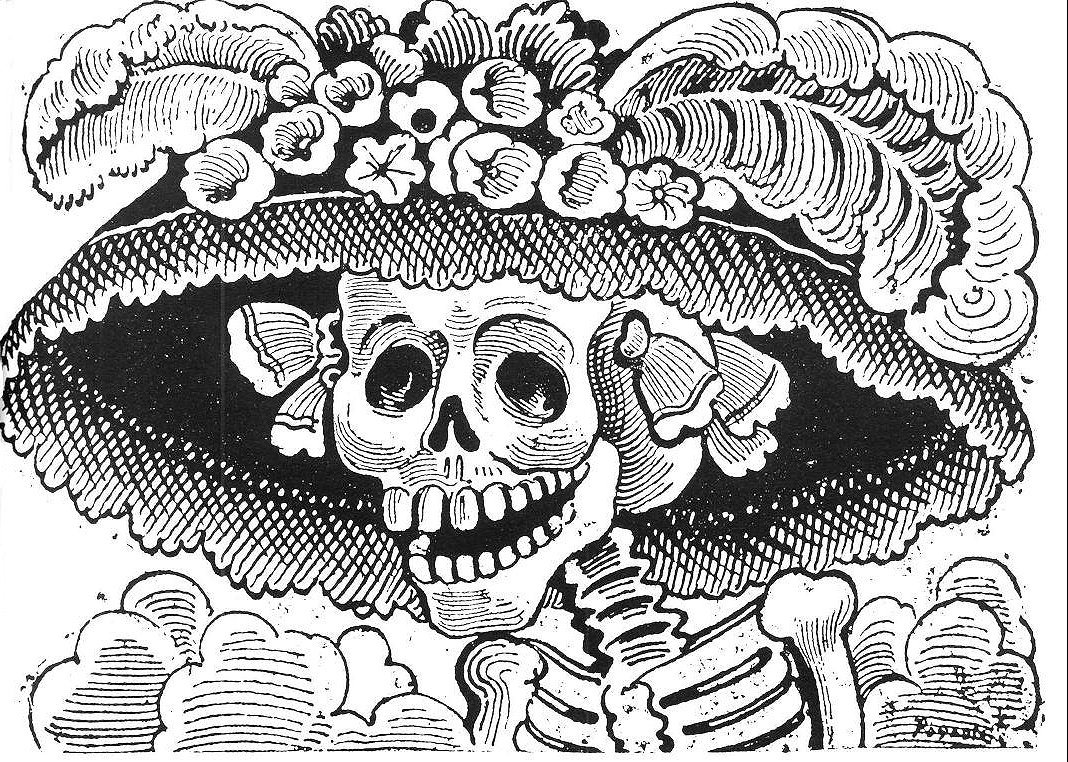
Posada Calavera Catrina

In Mexico on November 2, mortality is approached with music and laughter.

“On the Day of the Dead, when the spirits come back to us,” explains the Dr. Vigil character in the 1984 film of Malcolm Lowry’s Under the Volcano, “the road from heaven must be made easy, and not slippery with tears.”

The souls of the dead are welcomed back with offerings of food and drink. Skulls and frolicking skeletons, often dressed in full costume, are depicted on alters, food and elsewhere — a playful reminder that all of us, despite our vanities, will one day turn to dust.

The origins of the Day of the Dead and its basic motifs can be traced back 3000 years, to the Aztecs, but the satirical skeletons of its present-day iconography bear the strong influence of one man who died 101 years ago: the printmaker and draughtsman José Guadalupe Posada.

Posada was an obscure newspaper illustrator when he settled in Mexico City in 1888 and began working for a company that published graphic flyers designed to bring the news of the day to a largely illiterate public. Posada’s engravings soon caught on.

“Long drawn to the sensational,” writes Jesse Cordes Selbin at the Henry Ransom Center, “Posada’s interest centered on such fantastic and unsavory aspects of life as murders, robberies, bullfights, political scandals, and illicit love affairs. While his political work alternately satirized President Porfirio Díaz and lauded the populist revolutionary leaders Emiliano Zapata and Francisco Madero, for the most part his prints successfully struck the fine line between hard-hitting and light-hearted, resonating widely throughout Mexico.”

Calavera-Huertista--C.1910

Despite their humble purpose, Posada’s engravings were a major influence on the development of 20th century Mexican art. Octavio Paz described his technique as “a minimum of lines and a maximum of expression.” In his introduction to Mexico: Splendors of Thirty Centuries, Paz writes, “By birthright Posada belongs to a manner that has left its stamp on the twentieth century: Expressionism. Unlike the majority of Expressionist artists, however, Posada never took himself too seriously.”

Others, however, did. The muralists who flourished in post-revolutionary Mexico revered Posada. Diego Rivera and José Clemente Orozco, in particular, praised him as an inspirational figure. In his autobiography, Orozco writes:

Posada used to work in full view, behind the shop windows, and on my way to school and back, four times a day, I would stop and spend a few enchanted minutes in watching him, and sometimes I even ventured to enter the shop and snatch up a bit of the metal shavings that fell from the minimum-coated metal plate as the master’s graver passed over it. This was the push that first set my imagination in motion and impelled me to cover paper with my earliest little figures; this was my awakening to the existence of the art of painting.

The most influential of Posada’s works were his Calaveras, meaning “skulls,” or, by extension, “skeletons.” Perhaps the most famous work from the series is Calavera Catrina (above), a zinc etching completed in about 1910. It depicts a woman of the social class known as the Catrins (from a Spanish word meaning “over-elegant”), a group who denied their Maya heritage and thought of themselves only as European.

In 1947 Diego Rivera paid homage to Posada by placing him at the center of his panoramic Dream of a Sunday Afternoon in the Alameda Central with a full-length version of the Calavera Catrina on his arm, while Rivera himself, depicted as a young boy, stands on the other side holding her bony hand. For more of Posada’s Calaveras, scroll down.

The Folk Dance Beyond the Grave:

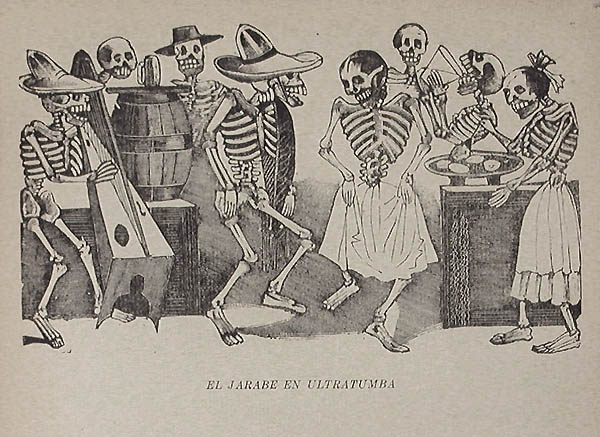
Posada Folk Dance Beyond Grave

Another zinc etching from around 1910, El Jarabe en ultratumba (“The Folk Dance Beyond the Grave”) depicts a merry group of skeletons eating, drinking, making music and dancing the traditional jarabe. The reproduction is from the posthumous 1930 monograph Las Obras de José Guadalupe Posada, Grabador Mexicano.

Calavera from Oaxaca:

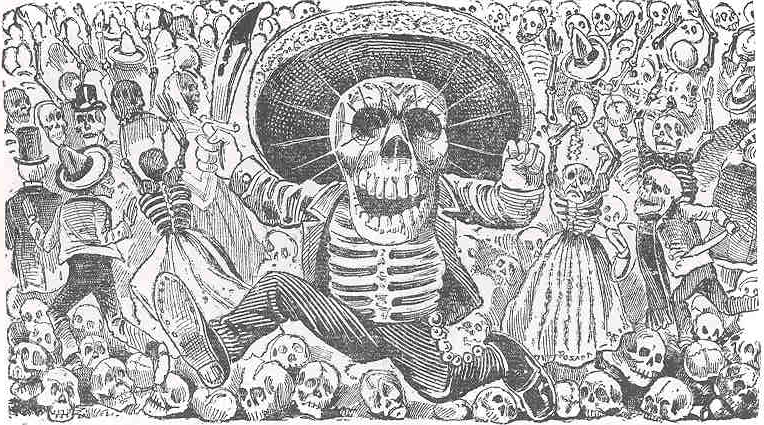
Posada Calavera Oaxaquena

Calavera Oaxaqueña (“Calavera from Oaxaca”) was first published on a broadside in 1910. It shows a proud-looking skeleton dressed as a charro, running past a crowd of skeletons with a blood-stained knife in his hand.

Calavera of Don Quixote:

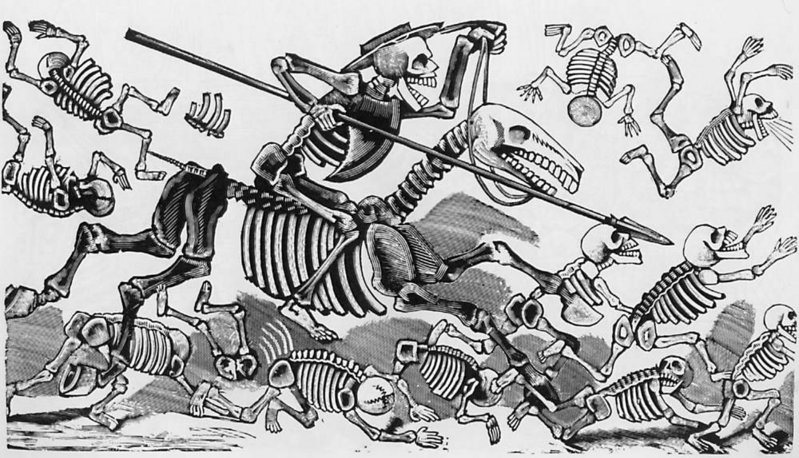
Posada Calavera Don Quixote

In this etching made sometime between 1910 and Posada’s death in 1913, Don Quixote rides into battle wearing an upside-down barber’s basin he imagines to be the legendary helmet of Mambrino, a solid-gold relic said to make its wearer invulnerable. He vanquishes every foe. “This is the calavera of Don Quixote,” says the caption on the original broadside publication, “the first-class one, the matchless one, the gigantic one.”

Click on the images above to view them in a larger format. You can view more prints by Posada at MoMA and The Public Domain Review.

Related Content:

Charles & Ray Eames’ Short Film on the Mexican Day of the Dead (1957)

Frida Kahlo and Diego Rivera Visit Leon Trotsky in Mexico, 1938

Speaking in Whistles: The Whistled Language of Oaxaca, Mexico

Celebrate The Day of the Dead with The Classic Skeleton Art of José Guadalupe Posada is a post from: Open Culture. Follow us on Facebook, Twitter, and Google Plus, or get our Daily Email. And don't miss our big collections of Free Online Courses, Free Online Movies, Free eBooksFree Audio Books, Free Foreign Language Lessons, and MOOCs.

The post Celebrate The Day of the Dead with The Classic Skeleton Art of José Guadalupe Posada appeared first on Open Culture.

03 Nov 03:04

washingtonpost: Winner. Ruth Baby Ginsburg


washingtonpost:

Winner.

Ruth Baby Ginsburg

27 Oct 16:47

The Best Nurses for Ebola: Robots?

by Megan Garber
Bgarland

"And then twelve of them got Ebola," Purfield recalled. "And one survived."

"Because," Dynes added, "they couldn't just watch a baby sitting alone in a box."

Michelle Dynes and Anne Purfield, two CDC epidemiologists, recently returned to the U.S. from Sierra Leone, where they had been responding to the county's Ebola outbreak. They told the story of a baby whose mother had died of the disease, and who had been placed, for the safety of hospital workers, in a box. The precaution ended up being futile. When nurses saw the baby—motherless, isolated, untouched—they couldn't resist cuddling and caring for the helpless little human.

"And then twelve of them got Ebola," Purfield recalled. "And one survived."

"Because," Dynes added, "they couldn't just watch a baby sitting alone in a box."

Ebola is a cruel disease in many ways, but one of the worst is that it preys on the very things that help make us who we are, as a species: our need for community. Our impulse for love. Our inability to see a baby, abandoned, and not reach out. Ebola preys on human bodies, by way of human souls.

From a technological standpoint, the best way to combat all of this is for the healthy to distance themselves from the stricken. And the most obvious way to do that is to remove human interaction from the equation. And the most obvious way to do that may involve removing humans themselves from the equation—at least when it comes to the care of the sick.

On November 7, scientists will convene at universities across the country to consider the role that autonomous machines might play in combating the Ebola crisis. Telepresence robots, Computer World reports, could theoretically do some of the healthcare work that suit-wearing humans currently do—including the delivery of food and medicine to the sick, the decontamination of equipment, and the burial of the dead. Robots could also act as interpreters between patients and doctors. They could also provide interactive checklists—the same types that aircraft pilots rely on for take-off and landing procedures—to medical workers who are putting on and removing safety equipment. (Dressing for Ebola caregiving is currently a 30-step process.)

The brainstorming sessions—November 7's version will be only the first of a planned series—are taking place, The New York Times notes, with the assistance of the White House Office of Science and Technology Policy. They will include not just academic researchers and commercial roboticists, but also healthcare workers and relief workers. They will be held in four separate locations: the University of California, Berkeley; Texas A&M University; the Worcester Polytechnic Institute in Massachusetts; and in Washington. (They will also be simulcast.)

"The workshop is for us to shut up and listen to them and take what we hear them say and use it," Robin Murphy, a professor of computer science and engineering at Texas A&M and the director of the Center for Robot-Assisted Search and Rescue, told Computer World. "They'll talk about what they need and then we can talk about what we can offer … What can we do in the next few months and then what do we need to do in the longer term? What should we have five years from now?"

Epidemiology has always had a need for objects that keep human bodies—which offer, on top of everything else, warm, wet homes for microbes—separate from each other. Latex gloves. Surgical masks. Infrared thermometers, capable of taking temperature without the need for touch. But Ebola, contagious only through direct contact, brings a new kind of urgency to that need. The tools that will help to fight it will involve a kind of industrialized distance—human contact, without human touch.

Which is not to say that the tools will be easily built. The scientists involved in the robotic strategy sessions face a significant challenge. Autonomous machines have long been used in medicine for targeted purposes like surgery; they have also been used as human stand-ins when it comes to targeted tasks—disarming bombs, for example—in the world at large. But artificial intelligence is still nascent, as a field and an industry; the dexterity that we humans take for granted—of our minds, of our eyes, of our arms and legs and fingers—is notoriously difficult to translate to mechanized computer programs. "As was the case in Fukushima, the Ebola crisis in Africa has revealed a significant gap between robot capabilities and what is needed in the realm of disaster relief and humanitarian assistance,” Gill Pratt, a roboticist at DARPA, told the Times. “We have a moral obligation to try and select, adapt and apply available technology where it can help, but we must also appreciate the difficulty of the problem."

This article was originally published at http://www.theatlantic.com/health/archive/2014/10/the-best-nurses-for-ebola-patients-might-be-robots/381884/


27 Oct 12:57

Turn Your Princess-Obsessed Toddler Into a Feminist in Eight Easy Steps

by By Devorah Blachor
Bgarland

"Ask your toddler to imagine what might have been different if the dwarfs had been female instead of male, and instead of a tiny cottage in the Wood, if Snow White had stumbled upon Wellesley College."

Imposing a Women's Studies Curriculum on your Disney Princess. Someday she'll thank you!
27 Oct 12:34

Cage Fighting Literature: Kerry Howley’s Thrown

by Nina MacLaughlin
Bgarland

Return of Sunday Dinner Book Club?

cover


Sometimes subject matter is secondary. John McPhee, for example, can write about long-haul trucking or lacrosse, subjects I’ve got no interest in, and I’ll read each word and marvel at how he’s able to make the topics so compelling, rich, and human. Kerry Howley’s subject matter, in her potent and consuming debut Thrown, falls into the same disinterest bin as trucking and lax, but she brings such vigor and aliveness, such seductive use of detail and tension, that it’s impossible not to lose oneself in the bloody, funny, brutal, balletic world of mixed martial arts. In other words, I don’t care about cage fighting, ultimate fighting, MMA; Kerry Howley made me care.

Bored and disillusioned at an academic conference on phenomenology, Howley, an essayist who’s written for the Paris Review, the New York Times Magazine, the Atlantic, and a graduate of the University of Iowa’s non-fiction program, wanders off for a break from the blowhards. She happens upon a sign that announces the Midwest Cage Championship, and takes a seat in the crowd. She’d never seen a fight before, and is taken in immediately, the blood and spectacle in righteous opposition to the chatter about Husserlian intentionality she’d just fled and academic ivory-towerdom in general. “It was as if someone had oil-slicked my synapses,” she writes, “such that thoughts could whip and whistle their way across the mind without the friction I’d come to experience as thought itself.” This first fight, witnessed by accident, is a path-changer, and Thrown is the account of Howley inserting herself into the lives of two cage fighters. Sean is an aging jab-eater, a fighter looking at his last chances who moves “like a fat man on hot coals”; Erik is a rising star, tall and lean, “a slippery-fast blossoming prodigy.” Howley gains her place as a “spacetaker,” a step up from a groupie, part of a fighter’s inner posse, with access to most aspects of their living, from the size of their burritos and videogame habits to fraternal feuds, possible parenthood, forehead sutures, and months and months of training for minutes of combat in the octagon.

She gets close to Sean and Erik both and masterfully builds tension in the lead-ups to fights–not only will they or won’t they or how well will they do, but will she still be welcomed into the fray. Howley is aware of the fragility of her role, how tenuous the position of spacetaker is–a trusted member of the group can be snubbed at any moment. It’s necessarily a physical book, and there’s sex between some lines: “I lay in bed at night picturing Erik thrown back in the swell, all his perfect plenitude, the pressure of his abundance, the way it would overbrim its boundaries at some unknown date and time. I could only wait, the energy all gathered and damned up in my limbs, for the moment of release I knew to be coming.” These fights for her are orgasm, are ecstasy.

What Howley finds during the first fight she stumbles on, and what she chases afterwards is exactly that experience of ecstasy, and she places the sport, and herself as a spectator, in a long tradition of ecstatic spectacle. The Lotus Eaters, the frenzied maenads, spirit questers on peyote. To experience this sort of ecstasy is to be removed from oneself, to be stripped of the body’s tired reminders of hunger, thirst, need. “The categories of sight and sound no longer applied,” Howley writes, “for a mind in the throes of ecstasy had expanded outward, beyond these rough tools of perception, to greet the universe without the interference of anything so frail as an eye or an ear.”

covercoverSo it’s not just the drama of busted elbows, landed punches, and split brows, though Howley’s descriptions of bodies in fight are memorable; something much greater is at stake. There’s epic poetry in the cadence of her sentences, a Homeric sort of rhythm: “When the man in charge ran out of fighters he’d ask the fighters to fight again, and Sean always said yes. He never lost an amateur fight, not once. Thirty times he fought this way.” Howley signals with the elevated language, and with references to Schopenhauer and Nietzsche, that what we’re dealing with here is not just two dudes kicking the shit out of each other on a mat, but something on the level of war and wandering of the Iliad and the Odyssey, and perhaps even more elevated than that.

It’s a brushing up against the eternal, the infinite, and it’s antithetical to paying bills on time, desk jobs, and high fiber cereal. One of the most striking aspects of the book, and one I found most compelling, is Howley’s disdain for conventional middle-class life. I suspect some will find it offputting when she writes: “I would not fraternize with the healthy-minded; better to leave them to their prenatal yoga, their gluten-free diets, their dull if long lives of quietest self-preserving conformism.” Or “Should I ever decide to spawn a nuclear family and enjoy their dull companionship between bouts of desk-ridden drudgery–to live, that is, in what Sartre called “Bad Faith–I shall return with all due haste to [my hometown]. But until then, I resist the temptation, lest the comfort and simplicity of a conformist life suck me back into its maw.” The fights and her fighters serve as antidote to the “entangling mundanities of the ordinary world.” There’s an electricity here, a welcome and unexpected fervency in opposition to the widespread messages we get regarding rest, weddings, carbohydrates.

We’re all of us looking for people to justify and reinforce our own choices (which is why some no doubt will feel scoffed at by Howley), and she justifies hers with a quote from Nietzsche: “A preference for questionable and terrifying things is a symptom of strength.” One’s left wondering what pulls Howley in those directions. Early in the book, she makes short and offhand mention of a fact about her parents which I had to read three times to make sure I understood, and it raised questions the answers to which could only be guessed at. What we know: Howley seeks to flee the self and the battles serve as an expressway to that end. But if fighting is a fleeing, so is storytelling: “All narrators are fiction,” Howley writes.

The book is about fighting, yes, about an extreme sport and some of the men involved, who maybe aren’t, after all, Odysseus or Hector, but possessing of a more earthbound sort of humanity and heroism. It’s about the the strong pull of home, the powerful binds of blood, and the press, everpresent, of time. In what we seek, Howley shows us what we fear. We flee ourselves–in fights, in sex, in the light hitting the trees in the late afternoon, in the bottom of a third glass of wine–to find something else, to escape time and entangling mundanities, in an effort, ultimately, to avoid the experience of being alone.

26 Oct 00:59

The Mysterious Polio-Like Disease Affecting American Kids

by Dan Hurley
Bgarland

You know what I really need? More shit to be anxious about.

COLUMBUS, Ohio—More than 100 cases of a polio-like syndrome causing full or partial paralysis of the arms or legs have been seen in children across the United States in recent months, according to doctors attending the annual meeting of the Child Neurology Society.

Symptoms have ranged from mild weakness in a single arm to complete paralysis of arms, legs, and even the muscles controlling the lungs, leading in some cases to a need for surgery to insert a breathing tube, doctors said.

The outbreak, which appears to be larger and more widespread than what has largely been previously reported by medical and news organizations, has neurologists and the Centers for Disease Control and Prevention scrambling to find out what is causing these cases and how best to treat it.

“We don’t know how to treat it, and we don’t know how to prevent it,” said Keith Van Haren, a child neurologist at Stanford University School of Medicine. “It actually looks just like polio, but that term really freaks out the public-health people.”

Instead, neurologists are now calling it acute flaccid myelitis: acute because it occurs suddenly, and flaccid because the affected limb or limbs become markedly weak. Myelitis is an inflammation of the gray matter—the nerve cells—in the spinal cord, showing up as a bright spot on an MRI.

Officially, the CDC reported on Thursday that it has confirmed 51 cases of the polio-like syndrome in 19 states, all of them occurring since August 1. But on Wednesday evening, when the moderator of the special session asked the 250 or so child neurologists in attendance how many had seen a recent case, about one-third raised their hands. Dozens kept their hands up when asked if they had seen two, three, five or more.

“That’s pretty remarkable,” said James J. Sejvar, the neuroepidemiologist at the CDC who is tracking the outbreak, in a telephone interview from Atlanta. “I would concur with the folks in attendance that the true number of cases is larger than the 51 we have identified so far. There are probably in reality over a hundred cases nationwide. How much more is difficult to say.”

Some of the children have had mild to moderate recovery of strength, doctors at the meeting said. But asked whether they had seen a complete recovery in any of their patients, only two of the doctors at the meeting raised their hands.

The moderator, Max Wiznitzer, a child neurologist at Case Western Reserve University School of Medicine in Cleveland, said that he and other neurologists are working closely with the CDC to put together treatment guidelines.

But, he said, “The bottom line is that right now we don’t have an effective treatment.”

Some doctors at the meeting said they fear the number of cases could be much higher than 100.

“I was on a conference call a few weeks ago with about 50 doctors from medical centers across North America,” Van Haren said. “Every center had seen cases. That puts the numbers real high, real fast.”

Neurologists suspect the current outbreak to be a rare but grim effect of the far larger epidemic of enterovirus 68 infections that occurred across North America this summer. That link, however, has yet to be proved. Even so, as cases of severe respiratory illnesses associated with the virus have waned with the advent of colder weather, so too have the cases of acute flaccid myelitis.

Since August, 13 cases have been seen in Colorado, according to Teri L. Schreiner, a pediatric neurologist at Children’s Hospital in Denver. Clusters of cases have also been reported by neurologists in Missouri, Alabama, New York, Michigan, and Massachusetts.

When asked by Wiznitzer how many doctors had seen as many as 10 cases in recent months, Brenda Banwell, chief of neurology at Children’s Hospital of Philadelphia (CHOP), raised her hand. At the CDC, Sejvar said, “It definitely appears that CHOP is seeing a large number of children with this presentation.”

Mark Gorman, a child neurologist at Boston Children’s Hospital, said he has seen six cases there since August 1.

“I’ve heard from colleagues in the region who have seen other patients,” he said by telephone.

While most of the doctors attending the conference said they had rarely, if ever, seen anything like the recent cases of paralysis, Gorman said he had seen a similar condition affect five children, back in 2008.

Whether more cases will be seen across the country next year, was the subject of debate.

“I hope to God it doesn’t come back,” Van Haren said. “It’s hard to imagine it will leave completely. But people thought West Nile virus would wreak havoc in North America, and it really didn’t. Viruses change over time. Sometimes they change for the better, and sometimes for the worse. It’s possible that’s what happened with enterovirus 68.”

Speaking from his office in Maryland at the National Institute of Neurological Disorders and Stroke, Avindra Nath, chief of the neurological infections section, said that medical groups needs to prepare for the worst while hoping for the best.

“With viral infections, things can become virulent very quickly and spread very quickly,” Nath said. “Some kind of preparation is worthy of consideration.”

Both the CDC and the Child Neurology Society are hard at work tracking the outbreak and developing treatment guidelines, Wiznitzer said. But he and others stressed that the public should understand that the condition so far remains exceedingly rare, particularly compared to the polio epidemics of the 1950s and before.

“This is nothing like that,” he said. “There were tens of thousands of cases of paralysis with the polio virus epidemic.”

Even so, the neurologists gathered here described children whose sudden paralysis bears an eerie resemblance to polio, with some able to breathe only with the help of a ventilator.

“These can be heartbreaking cases,” Van Haren said.

The CDC is asking doctors who suspect that they have seen a case to report it to their state health department using a form available online.

This article was originally published at http://www.theatlantic.com/health/archive/2014/10/the-mysterious-polio-like-disease-affecting-american-kids/381869/


24 Oct 21:31

Material Objects

by Benjamin Breen

Lessons from Rare Book School.

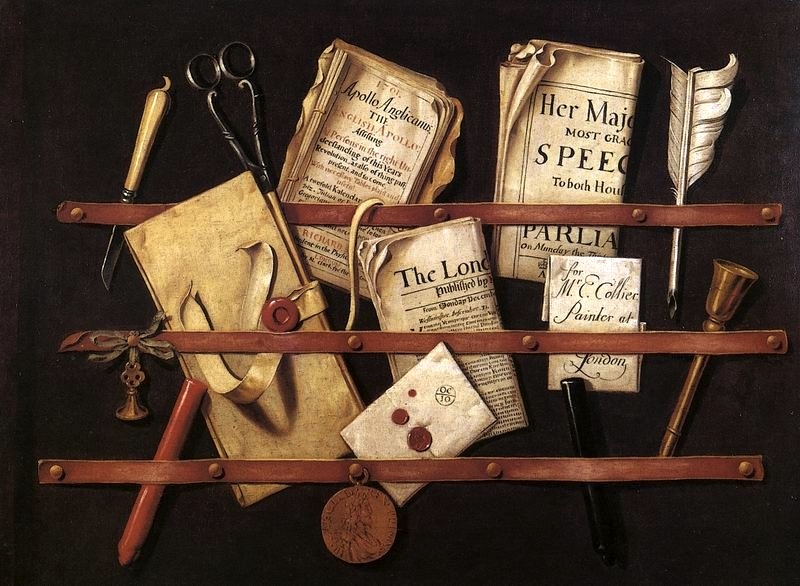
Edward Collier, Trompe l'Oeil of Newspapers, Letters and Writing Implements on a Wooden Board, 1699.

Four stories underneath the stately Georgian campus of the University of Virginia, I was with a group of rare-book experts scrutinizing a five-hundred-year-old Italian woodcut of two chubby infants. They framed a capital letter L. One, with a look of insouciant concentration, was thrusting his butt over the downslope of the L to defecate on it.

“The woodcut accompanies Andreas Vesalius’s discourse on the muscles of excretion,” Roger Gaskell, a rare-book dealer based in Cambridgeshire, told the group. It turns out that Vesalius, the Renaissance physician remembered today as the father of modern anatomy, had an intensely strained relationship with his publishers. “This initial letter differs from the others in the book—despite the fact that the printing house had a perfectly good L already cut,” Gaskell said. “So I rather suspect this shitting putti was a message to his publisher.”

Over a coffee break, the members of Gaskell’s seminar mingled with three others led by such luminaries as Mark Dimunation, the chief of the rare-book division at the Library of Congress. They were gathered in a warren of windowless basement rooms for an annual rite of passage in the world of antiquarian texts: Rare Book School.

The classes marked the penultimate week of a summer-long series of intensive courses that delve into every aspect of books as material objects. The school’s leader, Michael F. Suarez, S.J., a charismatic Jesuit and professor of book history, has been cultivating a new field that he calls “critical bibliography.” Precisely what those words meant was a subject for debate among the participants (“The study of the physical characteristics of books and the process of bookmaking” is the definition the Society of American Archivists gives) but they all agreed that Suarez was a force to be reckoned with. It’s like a cult was a commonly heard phrase at the School. As one participant put it, “Finally, I found a cult I want to be a part of!”

Over drinks at the student bars lining the approach to Thomas Jefferson’s Rotunda, seminar participants traded book-nerd credentials. “My friend cut out all the endnotes from Infinite Jest and made them into footnotes by gluing them onto the bottoms of the pages,” confided Courtney Roby, an assistant professor of classics at Cornell who studies Greco-Roman technology. Aaron Pratt, an excitable Yale English Ph.D. student and rare-book dealer, was enthusing about the merits of another form of collectible media. Pratt owns more than a thousand VHS tapes—“mainly low-budget horror films between 1979 and 1983”—and was still feeling the afterglow of a recent triumph. “I finally convinced the Sterling Memorial Library to start buying up first editions of early VHS tapes.”

The Portuguese have an untranslatable word for the ineffable nostalgia of something that has passed away and perhaps never was: saudade. At Rare Book School, saudade for the world of print was in the air. But the presiding emotion was joy, shaded with a kind of reverence. The next afternoon, Gaskell’s class marveled over a unique copy of the Encyclopédie in which Diderot had handwritten his own line edits. A UVA curator speculated that the gold-edged volume, recovered from the Nazis by American GIs during World War II, may have been Diderot’s presentation copy to Catherine the Great, but no one was sure. It was an historical epic in miniature, a mystery bound up between gilt leather covers.

Also in tow at Rare Book School was Lee Powell, a video reporter from the Washington Post with a thoughtful mien. He said he’d been hired by the Post the year before, part of a shift away from traditional print and toward video reporting engineered by his new boss, Amazon’s Jeff Bezos. Powell watched the proceedings with a look of quiet attentiveness, a camera perched on his shoulder. It was his final hour of shooting, and he was trying to construct a narrative of the film-to-be in his head. “I like to structure it with a beginning, middle, and end,” he said. “But I haven’t figured this one out yet. It often comes to me when I’m in the car, driving back from an assignment.” When I pressed him about his final shot, he hesitated and gave a wry smile. “I’m thinking about ending it with a closing book.”

“What a glut of books!” Richard Burton complained in 1621: “We are oppressed with them, our eyes ache with reading, our fingers with turning.” What will be lost, though—what new oppressions will come—when we stop turning pages and start swiping sapphire? Rare Book School, at least, isn’t going anywhere—they’re currently offering fellowships to train a new vanguard of critical bibliographers, starting next summer.

11427209524_d790dd4e29_z

Andreas Vesalius’s L.

Benjamin Breen is a Ph.D. candidate in history at the University of Texas at Austin and the editor-in-chief of The Appendix, a new journal of narrative and experimental history. His writings have appeared in Aeon, The Atlantic, The Public Domain Review, and The Journal of Early Modern History. He is currently writing a book on the origins of the global drug trade and is on Twitter.

23 Oct 01:08

Higgs Boson

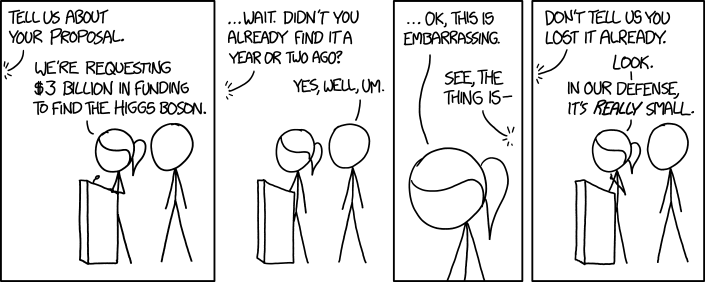
'Can't you just use the LHC you already built to find it again?' 'We MAY have disassembled it to build a death ray.' 'Just one, though.' 'Nothing you should worry about.' 'The death isn't even very serious.'
22 Oct 01:56

Aparna Nancherla to Audience Members Who Record Shows: "Don't Be a Jerk"

by Megh Wright
by Megh Wright

nancherlaComedian and current host of weekly New York standup show Whiplash Aparna Nancherla wrote an interesting blog post today about last night's show, which featured a surprise performance by Chris Rock that quickly turned sour after several audience members started recording his set on their cell phones. Similarly, Hannibal Buress has been making headlines this week over a six-month-old bit he performed in Philadelphia last week calling Bill Cosby a rapist, which would've never made the news had it not been for an audience member recording the joke then uploading it to the internet. Unlike Buress, however, Rock's appearance at Whiplash last night didn't go viral; Nancherla says he ended up leaving "barely over a minute or two after he got there" thanks to the cell phone addicts in the audience. Here's an excerpt from Nancherla's blog post:
Comedy is a rather unique performance art form in that even in its creation, it relies on testing it in front of an audience. Not everything will work, but there has to be an implicit agreement to be there and be present for it. Trying to record things on your phone is a part of the time we live in. Some of us are so mindlessly on our devices all day that you might not even consciously realize how much space they take up in your lives. Nobody experiences anything anymore just for the sake of experiencing it. You know what’s cool about live performance? You were there for it. You got to hear something that was just meant for you. Not for hits or views or clicks. And artists make their living by their ideas. To take them and then get to decide what you want to do with them is unfair and a straight-up violation of another person. And that’s the thing. Chris Rock is a person.

Nancherla ends by advising audience members to "respect art" and "try experiencing a moment without sucking the soul out of it. You can always gasp write about it later and what it meant to you or faint tell it in person to friends so they can relive your experience of it." More solid advice: "Don't be a jerk." The whole post is well worth the read over on Nancherla's blog.

0 Comments
18 Oct 01:53

IAI Academy Now Offers Free Courses: From “The Meaning of Life” to “A Brief Guide to Everything”

by Dan Colman

iai academy

This month, The Institute of Art and Ideas (IAI), an organization committed to fostering “a progressive and vibrant intellectual culture in the UK,” launched IAI Academy — a new online educational platform that features courses in philosophy, science and politics. The initial lineup includes 12 courses covering everything from theoretical physics, the meaning of life, the future of feminism, the often vexed relationship between science and religion, and more.

IAI Academy offers its courses for free. But, like other course providers, they charge a nominal fee (right now about $25) if you would like a Verified Certificate when you’ve successfully completed a course. Here’s the initial lineup:

  • A Brief Guide to Everything – Web Video – John Ellis, King’s College London, CBE 
  • The Meaning of Life – Web Video – Steve Fuller, University of Warwick
  • New Adventures in Spacetime – Web Video – Eleanor Knox, King’s College London
  • Minds, Morality and Agency – Web Video – Mark Rowlands, University of Miami
  • Nine Myths About Schizophrenia – Web Video – Richard Bentall, University of Liverpool
  • The History of Fear – Web Video – Frank Furedi, University of Kent
  • Physics: What We Still Don’t Know – Web Video – David Tong, Cambridge
  • Science vs. Religion – Web Video – Mark Vernon, Journalist/Philosopher
  • Sexuality and Power – Web Video – Veronique Mottier, University of Lausanne
  • The Infinite Quest – Web Video – Peter Cameron, Queen Mary University of London.
  • End of Equality – Web Video – Beatrix Campbell – Writer/Activist
  • Rethinking Feminism – Web Video – Finn Mackay – Feminist Activist & Researcher

For more evergreen courses that you can download and enjoy whenever you want, don’t miss our collection, 1000 Free Online Courses from Top Universities.

For MOOCs being provided in real-time, see our list of MOOCs from Great Universities.

Related Content:

Take First-Class Philosophy Courses Anywhere with Free Oxford Podcasts

Download 100 Free Philosophy Courses and Start Living the Examined Life

IAI Academy Now Offers Free Courses: From “The Meaning of Life” to “A Brief Guide to Everything” is a post from: Open Culture. Follow us on Facebook, Twitter, and Google Plus, or get our Daily Email. And don't miss our big collections of Free Online Courses, Free Online Movies, Free eBooksFree Audio Books, Free Foreign Language Lessons, and MOOCs.

The post IAI Academy Now Offers Free Courses: From “The Meaning of Life” to “A Brief Guide to Everything” appeared first on Open Culture.

11 Oct 01:36

Nuance Wine Finer

by mark

This is my girlfriend’s cool tool — not sure how long she’s had it but I’ve been using hers for a couple months. It’s a multipurpose wine tool. It fits snugly down inside the neck of a wine bottle (never had it pop out), allowing you to pour without drips. At the same time, it’s aerating and filtering the wine. It also comes with a stopper for when you’re finished pouring.

We did a taste test with friends at Thanksgiving. Uncorked a bottle of red, poured a glass, then put the wine finer in and poured a glass. The difference in taste was amazing. I’m sure there are people out there who have the patience and forethought to uncork and decant their reds ahead of time, but I’m not one of them.

I love that this thing fits down inside the neck of the bottle and then acts as a stopper – not some separate aerating device that you have to go get each time you want to pour a glass. And since it’s acting as the stopper, you don’t have to deal with cleaning it until you’re finished with the bottle.

-- Mary Lindsey

Nuance Wine Finer with Flat Top
$21

Available from Amazon

06 Oct 11:28

1797 Temperance Thermometer Measures the Moral & Physical Impact of Your Drinking Habits

by Ayun Halliday
Bgarland

Uh oh.....

temperance2

Question for the drinkers out there:

Does strong beer taken in moderate quantities at mealtimes make you cheerful?

Yeah, me too!

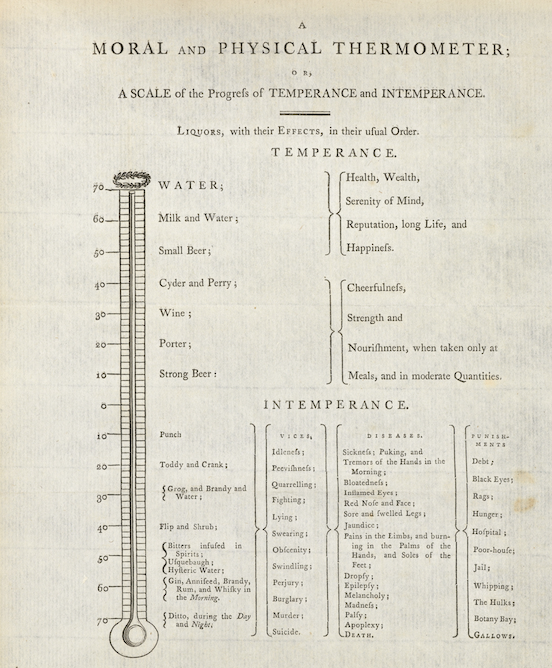
That gives us a temperature of 10 according to 18th-century physician John Coakley Lettsom’s “moral and physical thermometer,” one of his Hints Designed to Promote Beneficence, Temperance, and Medical Science (1797).

It’s nothing to be ashamed of—anything above zero constitutes a passing score. The founder of the Medical Society of London, Lettsom was a proponent of true temperance, not total abstinence. According to his rubric, a “small beer” has all the virtues of milk and water.

Dip below a zero, though, and you’re in for a bumpy night.

Punch is apparently the gateway to such demon influences as flip, shrub, whiskey and rum. Gosh. You may as well just skip the punch and go straight for the hard stuff, if, as in Lettsom’s view, they all end in the same vices and diseases.

Puking and Tremors of the Hands in the Morning?

Yes, on occasion.

Peevishness, Idleness, and Obscenity?

Yep, that too.

Murder, Madness, and Death?

Mercifully, no. At least not yet.

While not entirely free of stigma, alcoholism is now something many view through the lens of AA, a problem best remedied through a system of personal accountability shored up by a network of nonjudgmental, sympathetic support.

Back in Lettsom’s day, when an alcoholic hit rock bottom, it was assumed he or she would stay there, a task made easier when the wages of this particular sin included the poor house, a one way ticket to the Botany Bay penal colony, and the gallows.

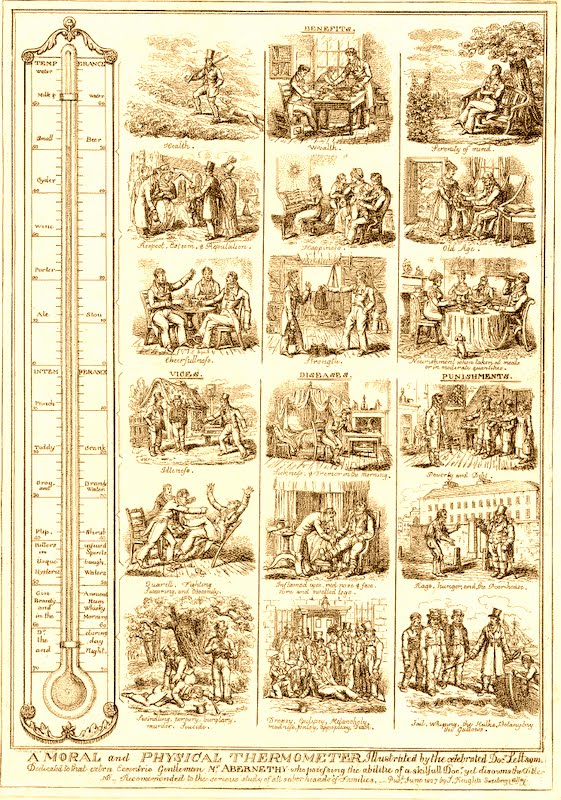
Such looming consequences are easily laughed off when you’ve had a snoot, which may be why Lettsom also published the illustrated version of his thermometer below. A picture is worth a thousand words, particularly when depicting the pre-Dickensian misery that awaits the drunkard and his family.

Termometro morall

via Rebecca Onion and Slate

Related Content:

George Washington’s 110 Rules for Civility and Decent Behavior

Thomas Jefferson’s Handwritten Vanilla Ice Cream Recipe

“The Vertue of the COFFEE Drink”: An Ad for London’s First Cafe Printed Circa 1652

Ayun Halliday is an author, homeschooler, and Chief Primatologist of the East Village Inky zine. Follow her @AyunHalliday

1797 Temperance Thermometer Measures the Moral & Physical Impact of Your Drinking Habits is a post from: Open Culture. Follow us on Facebook, Twitter, and Google Plus, or get our Daily Email. And don't miss our big collections of Free Online Courses, Free Online Movies, Free eBooksFree Audio Books, Free Foreign Language Lessons, and MOOCs.

The post 1797 Temperance Thermometer Measures the Moral & Physical Impact of Your Drinking Habits appeared first on Open Culture.

24 Sep 01:54

What If? Serious Scientific Answers to Absurd Hypothetical Questions

by Shane Parrish

xkcd-title

Randall Munroe, creator of xkcd, has written a book: What If?: Serious Scientific Answers to Absurd Hypothetical Questions

Here are a few questions, which I loved, that are sure to spark your curiosity and imagination.

What would happen if you tried to hit a baseball pitched at 90 percent the speed of light?

xkcd-baseball 1

The answer turns out to be “a lot of things ,” and they all happen very quickly, and it doesn’t end well for the batter (or the pitcher). I sat down with some physics books, a Nolan Ryan action figure, and a bunch of videotapes of nuclear tests and tried to sort it all out. What follows is my best guess at a nanosecond-by-nanosecond portrait.

The ball would be going so fast that everything else would be practically stationary. Even the molecules in the air would stand still. Air molecules would vibrate back and forth at a few hundred miles per hour, but the ball would be moving through them at 600 million miles per hour. This means that as far as the ball is concerned, they would just be hanging there, frozen.

The ideas of aerodynamics wouldn’t apply here. Normally, air would flow around anything moving through it. But the air molecules in front of this ball wouldn’t have time to be jostled out of the way. The ball would smack into them so hard that the atoms in the air molecules would actually fuse with the atoms in the ball’s surface. Each collision would release a burst of gamma rays and scattered particles.

xkcd-baseball 2

These gamma rays and debris would expand outward in a bubble centered on the pitcher’s mound. They would start to tear apart the molecules in the air, ripping the electrons from the nuclei and turning the air in the stadium into an expanding bubble of incandescent plasma. The wall of this bubble would approach the batter at about the speed of light— only slightly ahead of the ball itself.

The constant fusion at the front of the ball would push back on it, slowing it down, as if the ball were a rocket flying tail-first while firing its engines. Unfortunately, the ball would be going so fast that even the tremendous force from this ongoing thermonuclear explosion would barely slow it down at all. It would, however, start to eat away at the surface, blasting tiny fragments of the ball in all directions. These fragments would be going so fast that when they hit air molecules, they would trigger two or three more rounds of fusion.

After about 70 nanoseconds the ball would arrive at home plate. The batter wouldn’t even have seen the pitcher let go of the ball, since the light carrying that information would arrive at about the same time the ball would. Collisions with the air would have eaten the ball away almost completely, and it would now be a bullet-shaped cloud of expanding plasma (mainly carbon, oxygen, hydrogen, and nitrogen) ramming into the air and triggering more fusion as it went. The shell of x-rays would hit the batter first, and a handful of nanoseconds later the debris cloud would hit.

When it would reach home plate, the center of the cloud would still be moving at an appreciable fraction of the speed of light. It would hit the bat first, but then the batter, plate, and catcher would all be scooped up and carried backward through the backstop as they disintegrated. The shell of x-rays and superheated plasma would expand outward and upward, swallowing the backstop, both teams, the stands, and the surrounding neighborhood— all in the first microsecond.

Suppose you’re watching from a hilltop outside the city. The first thing you would see would be a blinding light, far outshining the sun. This would gradually fade over the course of a few seconds, and a growing fireball would rise into a mushroom cloud. Then, with a great roar, the blast wave would arrive, tearing up trees and shredding houses.

Everything within roughly a mile of the park would be leveled, and a firestorm would engulf the surrounding city. The baseball diamond, now a sizable crater, would be centered a few hundred feet behind the former location of the backstop.

xkcd-baseball3

Major League Baseball Rule 6.08( b) suggests that in this situation, the batter would be considered “hit by pitch,” and would be eligible to advance to first base.

***

What would happen if everyone on Earth stood as close to each other as they could and jumped, everyone landing on the ground at the same instant?

This is one the most popular questions submitted through my website. It’s been examined before, including by ScienceBlogs and The Straight Dope. They cover the kinematics pretty well. However, they don’t tell the whole story.

Let’s take a closer look.

At the start of the scenario, the entire Earth’s population has been magically transported together into one place.

xkcd-prejump

This crowd takes up an area the size of Rhode Island. But there’s no reason to use the vague phrase “an area the size of Rhode Island.” This is our scenario; we can be specific. They’re actually in Rhode Island.

At the stroke of noon, everyone jumps.

xkcd-jumping

As discussed elsewhere, it doesn’t really affect the planet. Earth outweighs us by a factor of over ten trillion. On average, we humans can vertically jump maybe half a meter on a good day. Even if the Earth were rigid and responded instantly, it would be pushed down by less than an atom’s width.

Next, everyone falls back to the ground.

Technically, this delivers a lot of energy into the Earth, but it’s spread out over a large enough area that it doesn’t do much more than leave footprints in a lot of gardens. A slight pulse of pressure spreads through the North American continental crust and dissipates with little effect. The sound of all those feet hitting the ground creates a loud, drawn-out roar lasting many seconds.

Eventually, the air grows quiet.

Seconds pass. Everyone looks around. There are a lot of uncomfortable glances. Someone coughs.

A cell phone comes out of a pocket. Within seconds, the rest of the world’s five billion phones follow. All of them —even those compatible with the region’s towers— are displaying some version of “NO SIGNAL.” The cell networks have all collapsed under the unprecedented load. Outside Rhode Island, abandoned machinery begins grinding to a halt.

The T. F. Green Airport in Warwick, Rhode Island, handles a few thousand passengers a day. Assuming they got things organized (including sending out scouting missions to retrieve fuel), they could run at 500 percent capacity for years without making a dent in the crowd.

The addition of all the nearby airports doesn’t change the equation much. Nor does the region’s light rail system. Crowds climb on board container ships in the deep-water port of Providence, but stocking sufficient food and water for a long sea voyage proves a challenge.

Rhode Island’s half-million cars are commandeered. Moments later, I-95, I-195, and I-295 become the sites of the largest traffic jam in the history of the planet. Most of the cars are engulfed by the crowds, but a lucky few get out and begin wandering the abandoned road network.

Some make it past New York or Boston before running out of fuel. Since the electricity is probably not on at this point, rather than find a working gas pump, it’s easier to just abandon the car and steal a new one. Who can stop you? All the cops are in Rhode Island.

The edge of the crowd spreads outward into southern Massachusetts and Connecticut. Any two people who meet are unlikely to have a language in common, and almost nobody knows the area. The state becomes a chaotic patchwork of coalescing and collapsing social hierarchies. Violence is common. Everybody is hungry and thirsty. Grocery stores are emptied. Fresh water is hard to come by and there’s no efficient system for distributing it.

Within weeks, Rhode Island is a graveyard of billions.

The survivors spread out across the face of the world and struggle to build a new civilization atop the pristine ruins of the old. Our species staggers on, but our population has been greatly reduced. Earth’s orbit is completely unaffected— it spins along exactly as it did before our species-wide jump.

But at least now we know.

What If?: Serious Scientific Answers to Absurd Hypothetical Questions is sure to spark your imagination and reignite your creativity.


Brought to you by: CURIOSITY: A curiously unconventional ad agency that helps you stand out in today’s crowded world.

24 Sep 01:26

First Listen: Sons of Bill's 'Love and Logic'

by rreed

They’re called the Sons of Bill, because that’s what they are: Abe, James, and Sam Wilson, the three sons of William Wilson, a Professor Emeritus of Literature and Theology at the University of Virginia. The Charlottesville, Virginia-based band, made up of the Wilson brothers, Seth Green, and Todd Wellons, formed in 2005, but started getting national and international attention with their 2012 album, Sirens


Left to right: Todd Wellons, Sam Wilson, James Wilson, Seth Green, and Abe Wilson. (Photograph by Scott Simontacchi)

Guitarist and vocalist James Wilson (who also teaches a class on Faulkner when he’s not on tour with his brothers) once told me that if there’s one thing that holds true throughout their wide ranging discography, it’s Bill: their early musical history consists mostly of their father and his guitar, playing them all the old songs he thought were worth singing. There was no stereo in their house. "We could all tell at a young age how much songs meant to him. Looking back on it, there was a lot of Mississippi John Hurt, Louvin Brothers, Hank Williams, Townes Van Zandt, and traditional songs and hymns as well, but in our eyes they were all my dad's songs and we didn't figure out who wrote them until much later. Though we all got into various forms of rock and roll in our teenage years, my dad's take on what makes a song beautiful, tragic, or hopeful stuck with us."

If pressed, you’d call Sons of Bill an Americana band, but they don’t mind wandering across genre. They’ve spent their time uptempo in past albums. Their latest effort Love and Logic (available September 30) is a more reflective, somber record than they’ve ever made before. The influence of producer Ken Coomer is evident here, and you’ll hear shades of both Wilco and Uncle Tupelo. It's soulful roots rock grounded in the mountain and church music of their youth. Love and Logic is music as big and old as the Blue Ridge Mountains.

Even still, there’s a simplicity to the band’s songwriting that’s as strong here as it’s ever been— somehow self-aware without caving in to the easy temptation of self-mockery. “I wanna go fishin’,” they say in the surprisingly deep “Fishing Song.” It’s a sentiment no less true for being the punch line to countless country tunes over even more decades. They believe with equal conviction that the world is a vexing, place, and that just maybe, fishing is actually the answer.

The band is currently on tour with dates scheduled across the South through the end of the year. Love and Logic goes on sale Tuesday, September 30, but you have a first listen now with G&G’s exclusive stream of the album.

The album is available for pre-order now. CD and vinyl from Amazon and digital download from iTunes.

18 Sep 12:43

The Last Saturday: A New Graphic Novel by Chris Ware Now Being Serialized at The Guardian (Free)

by Dan Colman

ware graphic novelThought you might like a heads up that The Guardian has started publishing on its web site The Last Saturday, “a brand new graphic novella by the award-winning cartoonist Chris Ware, tracing the lives of six individuals from Sandy Port, Michigan.” It will be published in weekly episodes, with a new installment appearing on this page every Saturday.  The innovative comic book artist, known for his graphic novels Jimmy Corrigan, the Smartest Kid on Earth and Building Stories, will be getting some good support from the Guardian Interactive team, which should make it quite the visual experience.

via Kottke

Related Content:

Read Ulysses Seen, A Graphic Novel Adaptation of James Joyce’s Classic

Greek Myth Comix Presents Homer’s Iliad & Odyssey Using Stick-Man Drawings

The History of Economics & Economic Theory Explained with Comics, Starting with Adam Smith

Download 15,000+ Free Golden Age Comics from the Digital Comic Museum

The Last Saturday: A New Graphic Novel by Chris Ware Now Being Serialized at The Guardian (Free) is a post from: Open Culture. Follow us on Facebook, Twitter, and Google Plus, or get our Daily Email. And don't miss our big collections of Free Online Courses, Free Online Movies, Free eBooksFree Audio Books, Free Foreign Language Lessons, and MOOCs.

The post The Last Saturday: A New Graphic Novel by Chris Ware Now Being Serialized at The Guardian (Free) appeared first on Open Culture.

17 Sep 21:08

Check Out Old Clips of Louis C.K., Mitch Hedberg, Chris Rock, and More on the Just For Laughs YouTube Channel

by Megh Wright
Bgarland

A real treasure trove.

by Megh Wright

If you're a fan of watching old clips of standups honing their craft live onstage, the new Just For Laughs YouTube channel is for you. The Montreal comedy festival recently teamed up with Maker Studios to launch the channel this afternoon, which so far features standup clips from Bill Hicks, Louis C.K., Tracy Morgan, Bill Burr, Chris Rock, Jon Stewart, Dave Chappelle, and Mitch Hedberg. According to Variety, a total of "over 500 hours of JFL content" will be released in increments of three each week and eventually include content from current festivals. Check out a 1998 performance from Mitch Hedberg above, then click through to watch the rest:


0 Comments
02 Sep 16:59

The Conch Republic Seeks Literary Job Applicants

by Nick Moran
Bgarland

OK. I want this job.

A true genius is someone who’s talented and accomplished enough to work in the publishing/literary crucible of New York City, but who’s also smart enough to know that working in New York City is nothing compared to working in Key West, Florida. That’s right: the Key West Literary Seminar is hiring.

30 Aug 10:21

Download for Free 2.6 Million Images from Books Published Over Last 500 Years on Flickr

by Dan Colman

flickr archive globe

Thanks to Kalev Leetaru, a Yahoo! Fellow in Residence at Georgetown University, you can now head over to a new collection at Flickr and search through an archive of 2.6 million public domain images, all extracted from books, magazines and newspapers published over a 500 year period. Eventually this archive will grow to 14.6 million images.

This new Flickr archive accomplishes something quite important. While other projects (e.g., Google Books) have digitized books and focused on text — on printed words – this project concentrates on images. Leetaru told the BBC, “For all these years all the libraries have been digitizing their books, but they have been putting them up as PDFs or text searchable works.”  “They have been focusing on the books as a collection of words. This inverts that.”

flicker reo speedwagon

The Flickr project draws on 600 million pages that were originally scanned by the Internet Archive. And it uses special software to extract images from those pages, plus the text that surrounds the images. I arrived at the image above when I searched for “automobile.” The page associated with the image tells me that the image comes from an old edition of the iconic American newspaper, The Saturday Evening Post. A related link puts the image in context, allowing me to see that we’re dealing with a 1920 ad for an REO Speedwagon. Now you know the origin of the band’s name!

venice flickr

I should probably add a note about how to search through the archive, because it’s not entirely obvious. From the home page of the archive, you can do a keyword search. As you’re filling in the keyword, Flickr will autopopulate the box with the words “Internet Archive Book Images’ Photostream.” Make sure you click on those autopopulated words, or else your search results will include images from other parts of Flickr.

Or here’s an easier approach: simply go to this interior page and conduct a search. It should yield results from the book image archive, and nothing more.

In case you’re wondering, all images can be downloaded for free. They’re all public domain.

More information about the new Flickr project can be found at the Internet Archive.

In the relateds below, you can find other great image archives that recently went online.

flicker gall

via the BBC and Peter Kaufman

Related Content:

Folger Shakespeare Library Puts 80,000 Images of Literary Art Online, and They’re All Free to Use

The Metropolitan Museum of Art Puts 400,000 High-Res Images Online & Makes Them Free to Use

New York Public Library Puts 20,000 Hi-Res Maps Online & Makes Them Free to Download and Use

The British Library Puts 1,000,000 Images into the Public Domain, Making Them Free to Reuse & Remix

The Rijksmuseum Puts 125,000 Dutch Masterpieces Online, and Lets You Remix Its Art

Where to Find Free Art Images & Books from Great Museums, and Free Books from University Presses

Download for Free 2.6 Million Images from Books Published Over Last 500 Years on Flickr is a post from: Open Culture. Follow us on Facebook, Twitter, and Google Plus, or get our Daily Email. And don't miss our big collections of Free Online Courses, Free Online Movies, Free eBooksFree Audio Books, Free Foreign Language Lessons, and MOOCs.

The post Download for Free 2.6 Million Images from Books Published Over Last 500 Years on Flickr appeared first on Open Culture.

25 Aug 15:06

Maria Bamford Candidly Explains Her Mental Health Struggles on 'Modern Comedian'

by Megh Wright
Bgarland

Love her.

by Megh Wright

Scott Moran released a new episode of his documentary series Modern Comedian today focusing on standup Maria Bamford, who opens up at length about her struggles with bipolar disorder and the time she had to check herself into a psychiatric ward. It's a powerful, fantastic episode that's well worth the watch, from Bamford's walkthrough of her favorite website CrazyMeds.us to several mentions of her love for Diet Coke. (via The Comedy Bureau)

0 Comments
23 Aug 00:05

Dr. WHO infographic for novices

by Booktrib

DR. WHO infographic for novices

About the artist:Risa Rodil

Risa (ree-sah) Rodil is a 21 y/o designer, illustrator and nerdfighter and she fangirls over a lot of things. Her type of art revolves around brightly colored typography and retro illustrations.

Click here to check out her fabulous work on tumbler.

Click here to go straight to her Dr. Who merchandise.

doctor-who-the-eleven-doctors_2000x13111

The world’s most popular TV show asks: Who’s your Doctor?

companions 270

Doctor Who Cheat Sheet:
WHO are the Companions?