Shared posts

01 Aug 04:39

It’s the Season for Fruit, and Also for Writing About Cutting Fruit as an Act of Love

by Jenny G. Zhang
Six sliced peach halves on a wooden cutting board with a knife. Sliced peaches. | Photo: Mike/Flickr

Cut Fruit Summer is in full swing

If there’s any truth to the conventional wisdom that three is a trend, then I must hereby declare this the season for writing about cutting up fruit as an act of love, a.k.a. “cut fruit summer.”

This is based on three data points. First came an essay titled “A Bowl of Cut Fruits Is How Asian Moms Say: I Love You” in Taste back in April, a prelude to the thick of “cut fruit summer” that we now find ourselves in. Then came the beautifully written “How the simple art of cutting fruit can be an act of love” in the Washington Post, published on July 25. A few days later, Bon Appetit’s Healthyish unveiled its own take, “If I’m Cutting Fresh Fruit for Dessert, I Probably Love You,” complete with a photo of mouthwateringly red strawberries and an intriguing suggestion of fruit seasoned with chaat masala.

Now allow me to outline the basics of “cut fruit summer,” as extrapolated from that seemingly relatable experience of being handed a bowl of carefully sliced fruit by family members who leave the words “I love you” unspoken in favor of more tangible actions:

1. Next time your parents hand you an apple that’s not pre-sliced, you’ll know exactly how they feel about you.

2. The longer it takes to prepare and present a fruit, the more love and care it’s infused with. Blueberries dumped straight from a carton into your waiting mouth? Negligible love. Whole coconuts that require a toolbox to get at the sweet flesh inside? Overflowing love!

3. Candid verbal endearments are overrated. Life would be so much easier if we could express all manners of emotion through the proffering of different foods — for example, beets to communicate hatred, potatoes for sensual desire.

4. No pie, no cake, no cookies for a sweet treat, only fruit!!!

5. The worst part about growing up and leaving home is no longer having someone to cut fruit for you. Now I have to rely on the grocery store and its aisles of pre-packaged, pre-cut pineapples for any semblance of affection in my solitary existence.

With all three cut fruit essays coming out in roughly the same three-month period — one of warmer weather, longer days, and sun-ripened fruits — it’s almost like food writing’s own version of the “wife guy” news cycle (only without the pressing timeliness of a nascent internet cultural phenomenon coming into its own). Perhaps that speaks to the universality of the cut fruit story, and the desire to see more of the personal experiences that shape our relationships with food and with loved ones reflected in the broader media. Maybe it’s confirmation that we’re all just telling the same stories over and over; like a perfect fruit salad, it’s the shades of variation that make each meaningful, even among the familiar emotional beats.

Or perhaps it’s evidence that there really is something in the air this summer, a honeyed scent tinged by lush fruit and a ripe longing for home wafting on the breeze. The season may be fleeting, but cut fruit summer is forever.

31 Jul 14:28

Sandoval to Headline Silver Spring Jazz Festival

by Mike Diegel

Grammy-award winning trumpeter Arturo Sandoval will headline the 16th annual Silver Spring Jazz Festival, according to an announcement from the Silver Spring Arts & Entertainment District.

The free festival, which was threatened with cancellation earlier this year, will take place from 3-10 p.m. Saturday, Aug. 24 on Veterans Plaza.

The event was moved this year from its usual September date in order to create an end-of-summer celebration prior to the school year starting, according to organizers.

Sandoval, a native of Artemisa, Cuba (near Havana), is a protégé of jazz legend Dizzy Gillespiewho is credited with bringing Latin influences to jazz.

Sandoval has won 10 Grammys and six Billboard awards. He also won an Emmy for his compositions that accompanied an HBO movie based on his life, “For Love or Country,” which starred Andy Garcia. He has recorded with a number of other artists, including Woody Herman, Josh Groban, Tony Bennett, Stan Getz, Frank Sinatra, Paul Anka, Rod Stewart, Justin Timberlake and Alicia Keys.

Sandoval is a renowned composer of movie soundtracks and classical music, and also plays flugelhorn and piano. He was awarded a Presidential Medal of Freedom in 2013 by President Barack Obama.

This year’s festival will include two stages and performances by festival cofounder Marcus Johnson, The Eric Byrd Trio, Paul Carr and The Real Jazz Ambassadors, and others. A full lineup and schedule will be released on the festival’s website in the near future.

Photo via Montgomery County’s website.

The post Sandoval to Headline Silver Spring Jazz Festival appeared first on Source of the Spring.

30 Jul 18:50

County Fair Season Around the DC Area

by Linda @ KidFriendly DC


Where do you get carnival rides and games, farm animals, the junk food gamut, live entertainment, pony rides, piglet races, and wares for sale all in once place? Down at the County Fair. The season for them runs from early August through mid-September, and you can get the lowdown on this year’s events around the area below. Happy Fairin’!

Fairfax County 4-H Fair and Carnival
What: Four days of festivities include livestock and dog demos, 4-H exhibits, fair food, carnival rides, games, vendors, live entertainment, and more.
When: August 1-4, see website for daily hours.
Where: Frying Pan Farm Park | 2709 West Ox Road, Herndon, VA
Cost: Tickets are $1 each or 24 for $20 (most ride are 3-5 tickets). Unlimited Ride Wristbands for Thursday or Friday are available for $25 — purchase by August 1.

Howard County Fair
What: The 74th annual fair begins this coming weekend, and you have through next Saturday to enjoy rides, magic shows, musical entertainment in the evenings, pig races and pony rides, the Kids & Critters barn, Demolition Derby, a pro rodeo, and more. Most of the rides cost extra, and packages are available, so be sure to check out the website to see what’s available if you plan to go.
When: August 3-10, 8am – 11pm daily, though activity times vary, so be sure to check schedules.
Where: 2210 Fairground Road | West Friendship, MD
Cost: Admission is $5-7/age 10+, $3/seniors, free/under 10. Rides and games are extra.

Montgomery County Fair
What: This fair is a family fave. (You can get a glimpse of one of our experiences there and read a review from a few years ago), so trust me when I say that there is so much to do, you have to see the schedule on the website for yourself to get the full scope. Highlights include lots of 4-H exhibits and demos, including opportunities to visit with some of the animals; animal races, pony rides, a KidZone with interactive games and activities, tons of carnival and kiddie rides, arts & crafts, monster trucks and a demolition derby, and much more.
When: August 9-17, times vary by day so check the schedule for specifics.
Where: Montgomery County Fairgrounds | 501 Perry Parkway, Gaithersburg, MD.
Cost: Admission is $12/advance $15/at gate for age 12+, free/11 & under. Tickets for rides cost extra. A one-day all-u-can-ride carnival wristband is available for $25. And note that parking is $10 at the fairgrounds, but FREE parking and shuttle bus service are available from Lakeforest Mall, located at Lost Knife Rd. and Odenhal Ave.

Prince William County Fair
What: Virginia’s largest annual county fair includes 4-H exhibits, rides, contests (think pie eating and water balloon tossing), animal shows, craft demos, the Children’s Barn, Kid’s Zone, live performances, and more. Note that August 9 is Kid’s Friday when all admissions are $6. And there are other special days with all kinds of promos, so be sure to check the schedule for details.
When: August 9-17, Hours vary by day, so check the daily schedules.
Where: Prince William County Fairgrounds | 10624 Dumfries, Manassas, VA.
Cost: Admission is $12/age 14-59, $6/seniors and age 5-13, free/4 & under. Be sure to look for daily specials, too!

Arlington County Fair
What: We’ve been and have had a great time. It’s big enough for a fun-filled day, but not so huge that it’s overwhelming, and you feel rushed to get to everything. There are carnival rides for everyone from toddlers to adults, and the kids especially loved the pony rides and piglet races. You can also check out competitive exhibits, enjoy live entertainment, cheer on a variety of racing animals, view outdoor movies, and take little ones to the Kids’ Court for moon bouncing, face painting, and more. And new this year: A beer garden and goat yoga!
When: August 14-18, hours vary by day, so check the schedule for specifics.
Where: Thomas Jefferson Community Center | 3501 Second St., Arlington, VA. Get parking/shuttle information here.
Cost: Admission is free. Buy tickets to use for rides and other activities: $1/ticket, $20/24 tickets, $40/48 tickets.

Prince George’s County Fair
What: A variety of entertainment and attractions for all ages — 4-H exhibits magic and dance shows, pig and duck races, a horse pull competition, a chain saw artist, a K-9 show, and much more.
When: September 5-8, hours vary by day.
Where: Showplace Arena | Upper Marlboro, MD.
Cost: Admission is $6/age 12+, $5/age 6-11, free/5 & under. Rides and games are extra.

Anne Arundel County Fair
What: Carnival rides and games, animal exhibits, monster trucks, pony rides, garden tractor pulls, pig races, pie eating contests, a talent show, live music and much more
When: September 11-15, check the website for hours.
Where: Anne Arundel County Fairgrounds | 1450 General’s Highway, Crownsville, MD
Cost: Admission is $10/age 9+,free/8 & under. Rides and games cost extra.

24 Jul 14:33

This is the reading of the Mueller Report you need while you watch Robert Mueller’s Congressional testimony.

by Jonny Diamond

Who knows what #resistance hopes will be dashed by Robert Mueller’s testimony in front of Congress today, but if you want a great and thorough precis of the Mueller Report (volumes one and two), please read Mark Greif’s fantastic narrative summary over at n+1. Greif has always been one of our finest readers and critics, and he deserves a Presidential Medal of Freedom for skating bravely across the frozen swamp of the special counsel’s prose.

And goddamn. Amidst all the hateful misogyny, racism, greed, and ugliness of the Trump Administration it still comes as a breathless shock to see how clearly treasonous the whole fucking thing was. See below for importantly depressing highlights from Greif’s piece (though you should really, really go and read the whole thing).

The implications are clear enough to rivet all opponents of Trump’s presidency.  Robert Mueller, a Republican lawman, with the most conservative temperament and following the most conservative legal reasoning, concludes that President Trump cannot be proven innocent of crimes of obstruction of justice.

[…]

The remarkable result of Volume I is to confirm that two and a half years of investigative reporting was correct: the Kremlin contacts with the Trump campaign were real and substantive, and they fit in at key junctures with the Russian attack on the election.

[…]

An interesting side effect of reading the report is to feel that anyone who claims to have understood its arguments, purposes, and consequences within twenty-four or forty-eight hours of encountering it is likely untrustworthy.

[…]

If the whole thing had been an FBI sting operation, in which the “Russian agents” were fictitious, participation in the manner uncovered in the report would have led to prison.

[…]

The volume of disinformation intensified near the end of the campaign, thanks to a “botnet” run by the Kremlin: “50,258 automated accounts connected to the Russian government, which tweeted more than a million times in the ten weeks before the election.”

[…]

Even after Trump knew Manafort was under investigation by the FBI, he remained in contact with the White House, including, seemingly, to coordinate obstruction of the Mueller investigation and to keep in touch about promised pardons.

[…]

The Department of Homeland Security later confirmed that the GRU had attacked twenty-one states, and in some cases gained access to voter rolls and registration data. According to the Mueller report, “The GRU continued to target these victims through the elections in November 2016.”

[…]

The commonsense term, though not the Constitutional standard, is “treason,” so we might as well say it. The Trump campaign moved on treason, took a risk on treason, in much the way Trump has moved on “deals,” legal and illegal, his whole life long.

23 Jul 19:39

Should We Employ Our Own Kids? (and How Much to Pay Them)

by Mr. Money Mustache


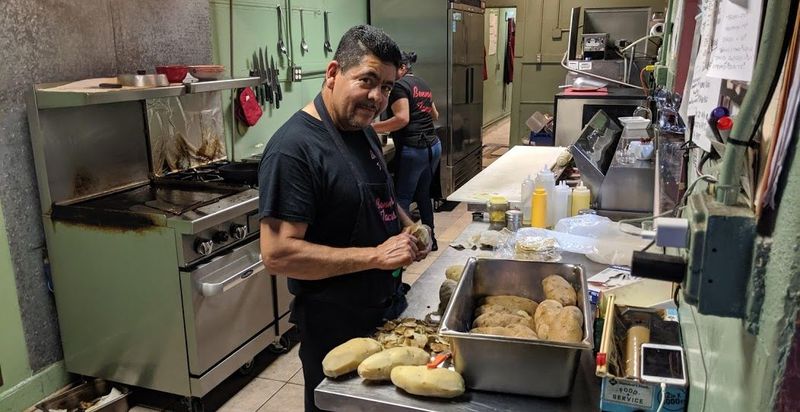
My Brother Wax Mannequin, training the next generation of workforce last summer.

Way back in 2015, I had a nine year old boy. Even back then, I could see him showing some early flashes of adulthood and maturity, and it got me wondering about his future as it relates to money and freedom.

So I wrote a post called What I’m Teaching My Son About Money, which shared some ideas about how we can raise our next generation of kids to be happy masters of money rather than the stressed-out slaves that most people (even those with high incomes) are today. And now, four years later, some of my predictions and questions from that article are starting to come true, and I’m wondering what to do about it.

To me, the biggest question is this:

Where is the balance between giving your kids a helpful boost, and “helping” them so much that you distort their view of the world and create a generation of Whining Complainypants Adults?

Opinions on this subject can vary widely, and in fact even you and I might have rather different views. But hopefully we can at least agree that the whole thing sits on a spectrum, and that even that spectrum itself is slippery because every child and every upbringing is unique.

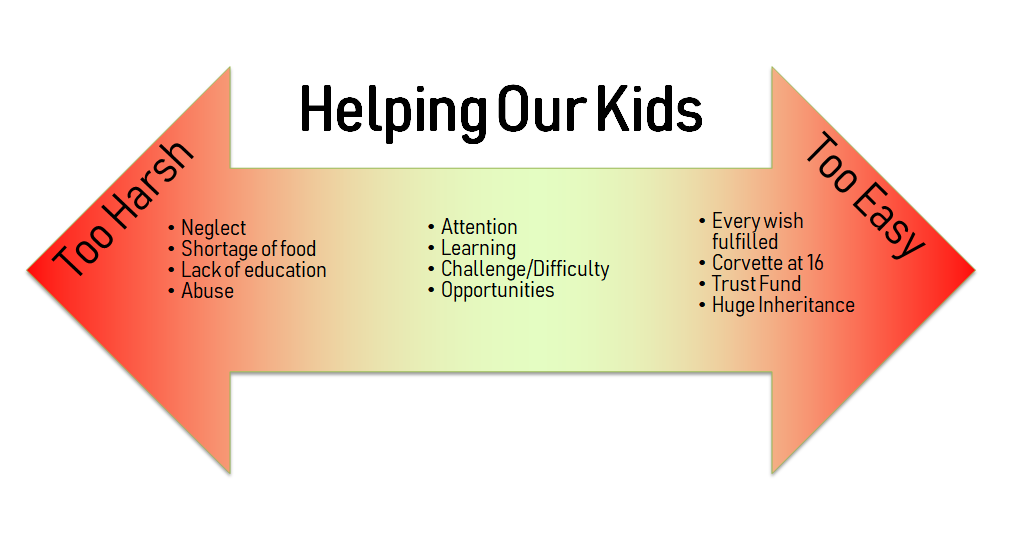
So let’s get onto the same page with an attractive and scientific-looking diagram.

Almost any parent would agree that the left side of the spectrum is a bad place for kids to be born. Because it affects not just their childhoods, but their entire lives. So we strive to provide a life that is further to the right, keeping our kids fueled with food, love, and opportunities.

But as with all human pursuits, we have a tendency to go too far and get into the “Too Easy” end of the spectrum. We may be smothering our kids with too much “help”, or perhaps compensating for being so busy with our fancypants careers that we don’t have much time to spend with them.

While this all feels like common sense, there’s also some biology behind it. Babies and young kids who experience a harsh environment during this critical part of development will tend to grow up more optimized for survival and street smarts, with lower levels of trust and a harder time blending in with a peaceful society*.

And on the more fortunate side of the divide, children raised in peace and security will optimize more for “book smarts” intelligence as well as being more trusting and less prone to violence. The entire apparatus of our brain will end up wired differently, based on the experiences we have in early childhood.

The problem for wealthy people is that the human brain is not wired to stop at “enough”, because enough has not been a big part of our shared history.

So we tend to overdo it when creating a comfortable life for our own kids, often justifying it with this exact sentence:

“We work hard, so we can give our kids some of the opportunities and the nice things that we didn’t have in our own childhood.”

It sounds noble and honorable on the surface, but be careful, because we can ratchet that same justification up far beyond any reasonable lifestyles without realizing we are just stoking our own egos or compensating for our own fears (and perhaps battling our peers/competitors in the Who’s-the-Best-Parent Competition on Facebook).

And then these kids respond by developing in a different way that can have its own downsides. Not understanding what it means to be poor. A lack of life’s most valuable skill – the skill of efficiency, optimization and reducing waste. And even a lack of life satisfaction and balance in later adulthood, because of a focus on easy consumption rather than the joy of creation.

So with such a slippery slope and those two pointy arrowheads to navigate, what’s the ideal strategy for us parents?

I don’t have all the answers, but one idea I have been interested in for years seems to have a lot of advantages: Hiring your children to work in your own small business.

Just think about it. You get to do all of these things and more:

  • help your kids earn their own money
  • teach them the value of hard work
  • have more excuses to spend time together solving problems – maybe even as they grow into adults
  • potentially cut the family’s total tax bill by transferring income from the high tax bracket of the parents, to the low (or zero) bracket of the kids.

Of course, there are also a few traps to watch out for in running a family business:

  • the job you give them might be better (or worse) than what they could get elsewhere, leading to a distorted view of what it really means to work for a living
  • if you don’t get along particularly well, tying your fates together even closer in a company will magnify any problems in your relationship
  • your kids might miss out on other, broader life experiences they could have had out there in the real world (like my own formative jobs in the gas stations and convenience stores of my small town, which are still the source of stories and laughs to this day.)

Still, the potential benefits clearly outweigh the risks to me, so the idea remains an exciting one in my mind.

Little MM and the Budding YouTube Project

I have been dabbling with this with my own son for several years – he helped me with the arduous task of mailing out over 1200 MMM T-shirts a few years ago and occasionally helps his mother in her soap production enterprises. His earnings have typically been on a per-shirt or per-soap basis

But things really took a step up this past January when he talked me into dusting off the neglected MMM YouTube Channel and actually starting to produce some shows together. Because we started with the good luck of a partially established audience and we have put some real effort into it (13 episodes over these first six months), it has taken off a little bit and we now have over 27,000 subscribers and the channel has earned about $1600 in YouTube ad revenue so far.

As a fun incentive, I offered at the beginning to pay him a flat (low) fee for editing and producing each episode, then split the income from this venture equally beyond that. So now, the little dude has made $800 on top of his base fees for the work.

If this continues, it could grow into a real income, which is quite exciting but also brings up some interesting tax questions. After all, right now he is a dependent for tax purposes, which means at least one of his parents get a tax deduction for raising him. But if he earns his own money, he might rise out of this dependence and even start owing taxes on his own. So is it worth it?

Hey, Let’s Ask my Accountant!

Outsourcing my taxes to someone younger and more enthusiastic about it than me has worked wonders.

To get better advice, I decided to run this by my own business and personal tax accountant, Chris Care who runs his own firm called Care CPA. We talked over the ideas of family businesses and employing a child in greater detail.

In summary, the results are better than I expected, which explains why people are so keen to hire their children.

Here’s my brief Q&A with him. Thanks for your help Chris!

MMM – So the first question is, what are the basic rules about employing one’s own child in a family business. My first instinct is that it sounds smart, because you are shifting income from parents in a potentially high tax bracket, to kids in a low tax bracket. So overall as a family, your tax bill falls.

But Is it a good idea? How old do they have to be? Any things to watch out for?

Chris Care: The biggest thing to watch out for is making sure the children are old enough to actually work. A lot of business owners want to pay their 1-year-old $15,000 a year for “modeling” by putting their picture on the company website. To me, this is a stretch.

You also want to make sure you’re paying them in accordance with the tasks they’re doing. If they are 12 years old and filing paperwork for you, or cleaning your office, or other administrative tasks, you probably can’t justify paying them $50 an hour. You should make sure there is a clear job description, and keep an accurate record of the number of hours worked and the tasks performed, just like any other employee does at their job

MMM –  What is the current child tax credit amount, and how would it phase out if he started making his own money? And does this scale up and down with the parents income as well?

Chris Care – Currently, the child tax credit is up to $2,000 per child, with up to $1,400 being refundable if the credit exceeds your tax amount.

In general, as long as you can claim the child as a dependent, and your income is below $400k if married filing jointly ($200k otherwise), you can claim the child tax credit no matter how much money your child makes. Above this income, the child tax credit phases out, but it is still not related to the child’s own income.

MMM –  Oh wow, I didn’t realize that. And at what level would he need to start incurring his own income taxes? And as an employer, would I be on the hook for stuff like quarterly tax payments, unemployment insurance, worker compensation, and so on? Could he be more like a contractor and avoid these complexities?

Chris Care – It’s unlikely you could classify your own son as a contractor. The IRS used to have a 20-factor test, but recently they have been narrowing and cracking down on this issue – more details here: Behavior, Financial, and Type of Relationship

Aside from that, you’d have to handle things in the standard employee way:

  •  tax withholding from every paycheck, submitted to the government as part of a standard payroll process. (MMM Note – even I have to do this as an employee of my own LLC, I use a provider called ADP and am evaluating a newer one called Gusto).
  • quarterly payroll taxes for social security and medicare
  • State unemployment insurance if applicable in your state
  • FUTA (A form of Federal Unemployment Tax)

Just like any other taxpayer, the child will need to file a federal tax return if their earned income is above the standard deduction ($12,000 for 2018, and $12,200 for 2019). Note that state filing thresholds are often much lower than federal thresholds – check with your own accountant!

MMM –  If a kid is living at home with no expenses, he might be wise to put as much of this into retirement accounts and otherwise defer taxes. If my company offered an employee 401k plan, could he put away the full $19,000 per year, or is there an even better option? Maybe his own tax-deferred college savings plan?

Chris Care – As with any other employee, the child can participate in the company’s retirement plan, as long as the plan is written to allow minors to participate. The contribution limits will depend on the type of retirement plan. In your example of a 401k, the child could defer the full employee amount ($19,000 in 2019) as long as wages were at least that amount. He would also get the employer match if your company established one.

College savings plans are an option, though whether or not he can open his own would be a question for your specific provider. Financial service firms tend to get a little hesitant opening accounts for minors. You could always open one, and he could contribute to it.

MMM Summary: Wow, this is much better than I had even hoped. In rough terms terms, it sounds like if I can pay my son $30k from my company’s income, I might save about $10k in marginal income taxes, while his resulting tax bill would be quite minimal.

Thus, it makes sense for me to start paying him as a real employee, rather than just paying all the taxes at my own marginal rate and keeping it in our own family spreadsheet, as I do now. 

Chris Care – Yes, there are some good opportunities for tax optimization by hiring kids.

In general, if you can justifiably pay your child a wage from the family business, it is an excellent way to lower the family’s tax burden, and give them a massive boost in retirement savings (since 401k contributions add up way faster than IRA contributions).

Also, by owning the business, you can administer your own 401k plan – which means you don’t have to wonder if your employer’s plan will allow for a mega backdoor Roth, since you can design it that way! Just keep in mind, that 401k plan is for all employees, so any attributes you establish for family members would also be there for non-family members that you may hire.

Another optimization: if you were a sole proprietorship, or a partnership where both partners are parents of the child being employed, the child’s wages would not even be subject to SS/Medicare taxes.

This means you could pay them the $12,000 standard deduction plus $19,000 401k deferral, with zero income tax, zero SS/Medicare taxes, and zero Federal Unemployment tax. They may still be subject to state income tax and state unemployment tax, but those would be relatively minor.

You can essentially shove $31k into a zero tax situation, from potentially a ~35% situation.
This means it may be worth operating the youtube channel as a separate company, and employing your son as a real employee…

MMM – hmmm, lots to consider! For now, YouTube is still only a few hundred bucks per month so we are not there yet. But it sounds like little MM’s future is bright, as long as he remains motivated to work hard and be creative and keep producing.

Which is a good general philosophy for any of us: keep some good hard work as part of every day, whether you’re ten or one hundred years old. Doing good work and producing good things tends to lead to a good life.


A Few More Thoughts and Disclaimers from Mr. Care:

  • In all of these answers, I have assumed the child is a true employee, where he receives a regular paycheck and a W-2 at the end of the year, and the company is a C Corp or S Corp.
  • As with all tax planning, tax credits, and personal situations, there are exceptions and limitations. So we’ve made some broad assumptions to answer these questions. For me to post an exhaustive list of these would take an entire blog post of its own. Always check with your tax professional, or make sure you understand the IRS guidance.
  • generational wealth / inequality / dynasties / buffett
  • effective altruism

A Final Thought from MMM:

If all this sounds like wishful thinking to you because you don’t own your own business yet, I strongly encourage to start one! For the great majority of early retirees, having a small entrepreneurial pursuit is both a reassuring security blanket and a fascinating and fun way to explore life after the cubicles and commuting stage is over. The Joy Of Self Employment.


* This one of many interesting and sometimes untintuitive insights I got into Human nature when reading the rather excellent book Sapiens.


19 Jul 17:21

Scroll Through App EatOkra to Find Black-Owned Restaurants in D.C.

"We really focus on a lot of smaller, mom-and-pop restaurants that don’t get enough attention or exposure."
18 Jul 18:28

Panda Express Wants to Get America Hooked on Sichuan-Spiced Hot Chicken Strips

by Greg Morabito

The chain announces this new product with a shockingly delightful music video

Mall food court legend Panda Express is rolling out a new dish that combines two very 2019 national food fixations: Sichuan spice and Nashville-style hot chicken. To announce the arrival of these crispy snacks, the Chinese-American chain filmed a colorful video featuring customers line dining to a Mandarin version of Billy Ray Cyrus’s “Achy Breaky Heart,” spicy chicken strips in hand. This song proves that Summer 2019 has room for at least one more trap country banger.

 Panda Express

Starting today, Panda Express locations across the country are offering these chicken breast strips, which are doused in a Sichuan-laced oil and dusted with a “proprietary spice blend” after they leave the frier. The strips come three to an order, and customers can ask for more spice if they like. Eater LA editor Matthew Kang got a preview taste of these last week and reports that they are indeed “very good.”

Over the last decade, Sichuan food has become wildly popular throughout China as well as in many American cities like New York, where it has eclipsed Cantonese as the city’s favorite genre of Chinese cuisine. The popularity of hot chicken, a delicacy born and bred in Nashville, has also proliferated in recent years, with the dish landing on menus at buzzy restaurants across the country as well as at KFC. The Sichuan hot chicken strips are an example of Chinese-American fusion from the country’s most popular and accessible purveyor of Chinese-American cuisine. And to hammer home the idea that Panda Express is bringing Sichuan spices to America — or perhaps more accurately, American malls and suburbs — the company introduced a mobile game where the goal is to guide an anthropomorphized pepper named Pep-Pep from the Sichuan province of China to America by swiping right.

This notion of Panda Express bringing Sichuan peppercorns to the USA is kind of silly, especially considering the popularity of Sichuan cuisine in urban areas across the country. But the chain is probably correct in assuming that at some of the chain’s 2,000 plus locations, Panda Express will be the only restaurant in town cooking with these spices.

The Sichuan hot chicken strips are now available nationwide through the end of the summer, but if they are popular — a safe bet, considering American’s deep, profound love of spicy chicken — don’t be surprised if they land on the permanent menu at some point in the near future.

All Chain Restaurant Coverage [E]

18 Jul 18:24

Richard Russo: On the Moral Power of Regret

by Richard Russo

Back in the late 1970s, not long after I started teaching, I began having this dream where I’m heading off to a class and at the end of an impossibly long corridor I see a group of students exiting a classroom. Somehow, I know they’re mine. A note on the door when I arrive informs me that my class has been moved to another building, so I set off again. When I reach the new destination, another note awaits; my venue has again been changed. This happens over and over, until finally, exhausted, I wake up. The dream’s meaning couldn’t be more obvious—I’m literally unable to reach my students. Its genesis is also clear: Despite trying hard to be a good teacher, I knew I had a lot to learn.

Though it’s been decades since I’ve had a regular teaching gig, I still begin each fall semester with the same dream, though its meaning appears to have subtly shifted. Whereas before it was born of self-doubt, it now feels simply autumnal—that is, tinged with melancholy and regret. In truth, though I’ve missed teaching, I wasn’t temperamentally well suited to academic life and was very happy to leave it when the opportunity arose. Even when the writing life feels solitary and lonely, I can easily cheer myself up by reflecting on all English Department meetings I haven’t had to attend. But I know, too, that by the time I finally quit teaching I’d gotten better at it, which may be why the dream now feels almost accusatory, as if I’ve abandoned my post. Had I continued to find time for them, my students might’ve benefitted. I’ve cheated them.

I have another recurring dream, this one more specific and disturbing. It involves the house on Helwig Street in Gloversville, New York, where I spent the first 18 years of my life. My maternal grandparents lived in the first floor flat, my mother and I above them on the second. After going off to the University of Arizona in 1967, I returned to the house on Helwig Street for many summers to live with my grandparents and work road construction with my father. By then grandfather was ill, so I did things around the house (painting, yard work, putting on and taking off storm windows). My mother was living out West at the time, trying desperately to carve out a life of her own, though in due course she returned home and moved back into the upstairs flat.

By then my grandfather had died, and my grandmother was living on his meager pension and social security. Mom found work as a bookkeeper and for a while managed to keep her head above water, but eventually she had to move in with my grandmother so the upstairs flat could be rented for what little it would bring. By this time I was married and had a family of my own, and though I continued to visit Helwig Street whenever I could, it wasn’t often enough to be of much help, and over time the house fell into disrepair, its porches sagging, its paint peeling, the roof badly in need of repair. When costly upkeep became too much for them, we found an apartment for my mother near where we were living, and my grandmother, by now in her mid-eighties, moved in next door to my mother’s sister. The Helwig Street house was sold for what little it would bring in a declining mill town whose long suit was houses just like it.

In my recurring Helwig Street dream I’m always visiting, never living there. My grandfather has died, but my grandmother is still alive and sharing the downstairs flat with my mother, just as they’d done in real life. Given this time frame, my wife and daughters should be with me, but in the dream I’m always alone. Right from the start I’m anxious and acutely aware of all that needed doing in the house, the kinds of repairs I used to handle, upkeep that is now beyond my mother and grandmother. It’s pouring rain outside, and when the lights go out it falls to me grab a flashlight and go up into the attic where the ancient fuse box is located. I climb the dark back stairs to the second floor, and then up the narrower one to the attic. When I turn on the flashlight, its beam immediately locates the hole in the roof through which rain is pouring. I find the carboard box that contains the spare fuses, but when I open the metal utility box under the eaves I see that the panel is streaming water. Even in the dream I’m aware that to touch any of the fuses would be to invite electrocution, but I also know that it’s my job to restore the lights. When my wet fingers touch the first fuse, I start awake, my fingers tingling with imagined electric current.

The rational, waking part of my brain assures me that I’d be not just useless on the border but actually in the way. It counsels that I’m doing what I was put on this earth to do.

Scary though the scenario is, my fright quickly morphs into a profound sorrow that is completely at odds with reality. Since it was ours, the Helwig Street house has had two owners, one of whom, according to my aunt, spent considerable money on repairs. The house is probably in better shape now than it’s been since my grandfather was alive. But, of course, none of this matters. What does matter is that in my dream, I have allowed my grandfather’s house, the safe harbor of my childhood, to fall into ruin. He bought the place when my parents’ marriage was falling apart because he knew she and I would need a place to live, and this is how I’ve repaid him. Because of me, what should’ve been a refuge to my grandmother in her old age and my mother when she had nowhere else to go, is now a deathtrap. The fact that the dream doesn’t, as I said, square with literal reality is little comfort.

To my dreaming self, a house represents a failed moral obligation, and not, I’m certain, just to my family. I’ve also failed my neighbors. You see, Helwig Street was a lower middle-class enclave of first wave immigrants—Italian, Irish, Polish—assimilators who identified first as Americans, working stiffs who signed up in droves to fight in Europe and the Pacific, and who came home convinced that, having been victorious in their must-win war, America and all Americans would henceforth prosper. Their chances, they believed, were awfully good. While I tell myself that I’ve spent most of my career writing about these very folks, it could also be said that I left Helwig Street behind as soon as I could, just as I later would the academy. As a writer I’ve worked hard, won a prize, became affluent, made sure that my family was safe and provided for, but I neglected the house on Helwig Street, and now it has a hole in the roof and the rain is pouring in.

People who do unspeakable things are often haunted by them for the rest of their lives. The rest of us, it seems to me, are more likely to be haunted by what we’ve left undone—the opportunities for generosity we’ve ignored, the times we’ve used the fact that we were busy to look the other way, other times when we were just plain selfish. Even if we’ve lived reasonably well, we’re doomed to wonder if we’ve lived best.

The last two years I spent working on Chances Are…—which is in many ways a meditation on regret—I also spent wondering if I should’ve been on the Southern border, helping to relieve the unimaginable suffering of people who want nothing more than the freedom and security that people who lived on Helwig Street—my grandfather among them, a man who never once abandoned his post—willingly risked their lives to ensure. The rational, waking part of my brain assures me that I’d be not just useless on the border but actually in the way. It counsels that I’m doing what I was put on this earth to do. The more intuitive, subconscious part, however, seems hard at work on a different narrative, one that openly questions my motives, even doubts my honor. This, I suspect, though unpleasant, is exactly as it should be, for where is it written that we who are blessed should rest easy when so much hard work remains to do be done?

18 Jul 18:00

Behold a new literary festival in Virginia’s Shenandoah Valley!

by Bethanne Patrick

With robust programming already this year, 1455 (previously Virginia Center for Literary Arts, or VCLA) continues to establish the Shenandoah Valley as a hotbed of creativity and community. After the success of 1455’s monthly Author Series at Handley Library and a number of workshops at both Long Branch and the Barns of Rose Hill, Founding Director Sean Murphy knew this was the time to put together a multi-day event focused on writers and writing: The 1455 Summer Literary Festival, a celebration of ideas and community. All programs are open to the public and free to attend. The festival will culminate with a featured reading, cocktail reception and dinner (ticketed event).

The festival will take place July 18 to 20 in downtown Winchester, VA. The primary programming will occur at the Bright Box located on the historic walking mall, with other events at Winchester Brew Works, the Winchester Book Gallery, and Shenandoah University. The programs boast a diverse array of talent, including best-selling authors, local and award-winning writers, as well as authors whose first books were published in 2019. Media outlets represented include Time Magazine, The Washington Post, Reuters, and NPR. Highlights of this year’s participants include Angie Kim, Louis Bayard, Karen E. Bender, Julia Phillips, Jeanne McCulloch, E. Ethelbert Miller, and John Lingan.

The festival will feature more than 50 participants, ranging from best-selling fiction and non-fiction authors, journalists, professors, as well as local artisans and leaders from the political, business, and academic fields. Several of the panels will feature faculty from local universities, including George Mason University, Marymount University, Hollins University, and Shenandoah University. The interactive panels include genres ranging from literary fiction, poetry, suspense fiction, journalism, international fiction, and children’s literature. 1455 will also be holding a Teen Poetry contest co-sponsored by Winchester’s Handley Regional Library. A $500 grand prize will be awarded to the winning poet, who will have the opportunity to read their work in a ceremony at Winchester Book Gallery. Register here.

17 Jul 20:49

Navigating the Dark Web of American Racism

by Alexandra Minna Stern

In the summer of 2016, I was online doing some research on early 20th-century eugenics and immigration restriction when I stumbled across the centenary edition of Madison Grant’s The Passing of the Great Race. It was about one month after Donald Trump had won the Republican primary, and the prospect that someone who had called Mexicans “rapists,” pushed “birtherism,” and demanded a “massive border wall” would become the next president of the United States seemed remote, if not impossible. As a scholar interested in the intersections of racial and reproductive politics, I was acutely aware of the history of white nationalism in America. I had studied and taught about organizations, old and new, such as the Immigration Restriction League, the Ku Klux Klan, and American Renaissance.

Now eugenics was rearing its bigoted head in a celebratory reissue of a racist classic brought out by Ostara Publications. This press was founded in 1999 to disseminate Arthur Kemp’s March of the Titans: The Complete History of the White Race, its “flagship work,” which appeared in its fourth edition in 2011. This massive text, which seems geared to homeschoolers, proposes that “a civilization ‘rises and falls’ by its racial homogeneity and nothing else. As long as it maintains its racial homogeneity, it will last—if it loses its racial homogeneity, and changes its racial makeup, it will ‘fall’ or be replaced by a new culture.” A little more online digging revealed that Ostara, with its commitment to “Eurocentric history,” is one of a handful of publishing ventures that produces on-demand books with titles that scream Islamophobia and white supremacy, and glorify Western civilization. According to its website, Ostara is named after the Old High German goddess of spring, “Ēostre,” who represents the “rebirth and fertility of ancient Europe”—a trope redolent of “blood and soil” nationalism.

Ostara easily fit the profile of a publisher that would make The Passing of the Great Race newly available to its readers. The first edition of this tendentious book aimed to rank “European races in history” as groups according to physical, mental, and personality traits, and proposed three European races—Teutonics or Nordics, Alpines, and Mediterraneans—anointing the first as the most advanced and comely. Beyond racist taxonomy, however, it sounded off eugenic warnings: of the degenerate immigrant masses, of impending white race suicide, and of the disharmonies of miscegenation. Alongside a plethora of early 20th-century tracts about the biological inferiority of every racial and ethnic group save Northern Europeans, The Passing of the Great Race served as fodder for the 1924 Johnson-Reed Immigration Act, which set racial quotas on immigrants based on nationality. This legislation hardened existing bans on Asian immigrants, placed strict limits on arrivals from Southern and Eastern Europe, and facilitated the formation of the US Border Patrol.

On the back cover of the centenary edition, Ostara praises The Passing of the Great Race as a “sweeping and classic study of racial anthropology and history” that stands as a “call to American whites to counter the dangers both from non-white and non-north Western European immigration.” Today white nationalists are updating this Eurocentric and xenophobic script. Indeed, Richard Spencer, who coined the term “alt-right,” is an adherent of Madison Grant. In a lengthy essay, “Madison Grant and the American Nation,” Spencer admires another one of Grant’s books, The Conquest of a Continent, published in 1933, calling it a “great history” and a “grand vision of bio-cultural struggle and evolution, in which demography comes alive.”

The Conquest of a Continent recounts the story of how America became a “Nordic country” through a combination of “individualism, Protestantism, uprightness, and the pioneer spirit.” Unlike The Passing of the Great Race, which Theodore Roosevelt called a “capital book” and had a large following, Conquest was panned by reviewers, who by the mid-1930s were looking askance at such unbridled racism. Now, more than eight decades later, Spencer wants to rescue Grant’s later work, lamenting what he views as the unfair dismissal of the book as blunderheaded eugenic thinking associated with the Third Reich. He commends Grant’s entire corpus as a guiding compass for assessing racial degeneration in 21st-century America and a masterful model of how to deploy science to promote white nationalism.

Was the alt-right simply old wine in new bottles, the latest incarnation of American eugenics, racism, and anti-egalitarianism?

As it turns out, the rehabilitation of American eugenicists is a pastime of the alt-right. Four years earlier, in 2012, Palingenesis Press, based in the UK, published an edition (now out of print) of The Passing of the Great Race, with a forward written by Jared Taylor, the head of American Renaissance, an organization focused on so-called “race realism” and an entrenched pillar of white nationalism. Grant and his contemporary Lothrop Stoddard, author of The Rising Tide of Color Against White World Supremacy (1920), are enduring darlings of the alt-right. The highbrow white nationalist webzine Counter-Currents Publishing (which also has a book-publishing arm) annually commemorates Grant’s birthday, lauding his multipronged white advocacy. In the words of Counter-Currents, Grant was an “American aristocrat and pioneering advocate of white racial preservationism, immigration restriction, eugenics, anti-miscegenation laws, and the conservation of wildlife and wilderness.”

Counter-Currents praises Grant as an exemplary environmentalist who, alongside Stanford University’s first president, David Starr Jordan, and Sacramento philanthropist Charles M. Goethe, were “race realists and eugenicists.” Counter-Currents also memorializes Stoddard’s birthday, extolling the virtues of his racist study of the Haitian revolution and his more widely known The Revolt Against Civilization (1922). Although Counter-Currents concedes that some of Stoddard’s ideas seem trite today, it emphasizes the contemporary relevance of his contention that a “nation’s breeding policy is at least as essential a factor in geopolitical strategy as trade policy or defense.”

Like many Americans, I was disconcerted and spooked by the alt-right’s breakthrough into politics, media, and culture. Now it was surfacing in my research. I recognized its catchphrases, such as “white genocide,” and its recycling of stereotypes about people of color, crime rates, and IQ scores. Struck by both the familiarity and the strangeness of the alt-right, I decided to bear witness to it in real time.

Was the alt-right simply old wine in new bottles, the latest incarnation of American eugenics, racism, and anti-egalitarianism? Was it something novel, with the potential to reshape politics and discourse, abetted by a sympathetic Republican presidential administration, an upsurge in national populism, and a context of simmering “white rage”? Could the alt-right appeal to younger generations of white Americans, who might be swayed by anxieties over demographic despair and tantalizing visions of racially homogenous homelands? What were the cultural and political implications of the circulation of the alt-right lexicon—as terms such as “ethnostate,” “human biodiversity,” “cuckservative,” and “snowflake” entered the American vocabulary?

To answer these questions, I began to spend hours and hours online, taking deep dives in an ever-expanding sea of URLs, exploring sites such as Counter-Currents, Radix Journal, and that of Ostara Publications. Some of these sites had been actively posting without interruption for years, others distributing on-demand books and offering occasional posts, and some were moribund webzines with archived content. In order to mine the intellectual bedrock of the alt-right, I set out to read and analyze its quasi-scholarly work as a formidable form of knowledge production in an era of rising authoritarianism and ultranationalism across the globe.

I began to amass my archive, concentrating on long-form essays, like Spencer’s article on Madison Grant, as well as monographs, anthologies, and manifestos published by alt-right publishing enterprises such as Counter-Currents, American Renaissance, and the Budapest-based Arktos. Although unlikely to ever survive academic peer review, this sizable body of literature strategically adheres to scholarly conventions, reflecting the graduate training of a good many of the alt-right mandarins.

The alt-righters agreed that to have any modicum of success they would have to cultivate a fresh image and shed the Nazi insignias and KKK white hoods associated with white supremacy.

I knew that to unearth this history of the present, I also needed to get under—to excavate—the alt-right memes and tropes that had erupted online. Thus, I delved into virtual communities on Reddit, 4chan, and 8chan; visited the long-standing white nationalist message board Stormfront; read thousands of comments on YouTube and Twitter; and knocked around in the dark corners of the ugly, unmoderated virtual realms of Gab and BitChute. This unwieldy collection of sources—most born digital—constitutes the archive for my book. Drawing from this unconventional archive, I wrote in tandem with the alt-right’s crescendo before and after Trump’s 2016 victory, its dispersal in the wake of Charlottesville in 2017, and its subsequent attempts to reassemble and normalize.

Due to the ongoing if inconsistent wave of deplatforming of some white nationalists, like Jared Taylor, and alt-light conspiracy pushers, such as Alex Jones, some of the content that I accessed online has been blocked, removed, or suspended. Scattered fragments can be plumbed from the depths of the Wayback Machine, an internet archive that has captured digital materials since 1996. This makes the screenshots I captured, and the video and audio content I transcribed, crucial and evanescent evidence of the alt-right’s recent history.

The term “alt-right” dates to 2008, when paleoconservative Paul Gottfried, an emeritus professor of humanities at Elizabethtown College, used “alternative right” in a lecture to the H. L. Mencken Society. Since the 1990s, paleoconservatives, mostly affiliated with right-wing politician and pundit Patrick Buchanan, had roared about their abhorrence of liberals and distinguished themselves sharply from neoconservatives; a good many made up the right flank of libertarian Ron Paul’s 2008 presidential campaign. After this electoral effort fizzled out, this contingent was eager for a political alternative outside the partisan mainstream. Gottfried channeled this yearning in his speech, declaring “we are part of an attempt to put together an independent intellectual right, one that exists without movement establishment funding and one that our opponents would be delighted not to have to deal with.” Soon after, Spencer, then an editor at Taki’s Magazine, cleverly shortened Gottfried’s talk title, “The Decline and Rise of the Alternative Right,” to “alt-right.”

Over the next few years, a motley crew of disaffected libertarians, paleoconservatives, racialists of varying stripes (white separatists, supremacists, nationalists, and ethnonationalists), men’s rights activists and misogynists (like MGTOW—Men Going Their Own Way), neo-reactionaries, anti-Semites, and xenophobes with conspicuous animus against Latina/os and Muslims gravitated to the alt-right mantle, finding common cause in the fledgling movement’s rejection of establishment conservatism and its antipathy toward feminism and multiculturalism. A notably decentralized movement, the alt-right was decidedly white, male, and aggrieved. Its key figures feuded about many things, but almost to a man, the alt-righters agreed that to have any modicum of success they would have to cultivate a fresh image and shed the Nazi insignias and KKK white hoods associated with white supremacy. As the popular vlogger RamZPaul (Paul Ramsey) explained in early 2016, the alt-right “was fundamentally identity politics for our people without the neo-nazi [sic] baggage.”

The accelerant for the alt-right was the internet. It is impossible to grasp the alt-right prairie fire leading up to the 2016 election without taking stock of the pitched volume of activity that unfolded in chat rooms, message boards, and tweet storms in those months. Most notoriously, Pepe the Frog, once an anthropomorphized frat boy depicted hanging with his video-playing buddies in the “Boy’s Life” comics, became corrupted in the digital corridors of 4chan and 8chan, claimed by Trump supporters, and later identified by the Anti-Defamation League as a hate symbol. The alt-right was introduced on the national electoral stage in Reno, Nevada, in August 2016. At a campaign event, the Democratic Party presidential nominee Hillary Clinton decried the latest incarnation of the “vast right-wing conspiracy” she had assailed two decades earlier.

After providing examples of fake news, racist remarks, and conspiracy theories emanating from the “dark reaches of the internet,” Clinton asserted, “These are race-baiting ideas, anti-Muslim and anti-immigrant ideas, anti-woman––all key tenets making up an emerging racist ideology known as the ‘Alt-Right.’” She was absolutely correct, although in hindsight, this speech, along with her subsequent “basket of deplorables” jab, ended up galvanizing the Trumpian trollers and tweeters who took to the public square of the internet to amplify the alt-right’s raucous, mischievous, and vicious memes and messages.

Trump emboldened this amorphous online army further. And once he won the election, the alt-right gloated on a triumphant high. Even if the new commander in chief was not as extreme as many alt-righters would have liked, they heralded him as “a step towards this new normal” of white nationalism and the ineluctable demise of liberal America. One proclaimed that Trump “may just unlock the future we have all been striving for.” And Spencer celebrated Trump’s win as, “at its root, a victory of identity politics.” This high was deflated partially by the post-election “Hailgate” episode, when about two hundred attendees at a meeting held at the Virginia-based white nationalist think tank, the National Policy Institute, led by Spencer, raised their arms and shouted, “Hail Trump, hail our people, hail victory!”

While this spectacle, caught on video and spread with viral speed, might have sent shivers down the spines of most Americans, many on the alt-right shrugged it off as another ironic jest that “normies” just could not grasp. If Hailgate caused troublesome “optics” for the alt-right, the events that transpired at the August 2017 Unite the Right rally in Charlottesville, Virginia, punctured the bubble. “C-ville” was a disaster that shattered a coalescing critical mass of white nationalists and tarnished the alt-right label. It also proved that as the visibility of the alt-right increased, its ability to control its image decreased. The alt-right easily could succumb to its loudest, angriest, neo-Nazi denominator.

Identity Evropa, rebranded in 2019 as the American Identity Movement, reports it is adding chapters and members at a fast clip.

Today the alt-right is in an uncharted phase, facing media scrutiny, legal prosecution, and negative press, exacerbated by its penchant for eating its own, internecine backstabbing, and testosterone-charged power plays. Alt-righters themselves complain about the movement’s tendency to “purity spiral,” or insist on increasingly absolutist positions, usually related to the Jewish Question (JQ) or the Women Question (WQ), which induces paranoia and ideological claustrophobia. To a great extent, the fall-out from Charlottesville has forced a return to the alt-right’s initial form of decentralization. At the same time, many sympathizers have become wary of the moniker “alt-right” and are now trying out labels such as “dissident right,” “affirmative right,” “ethnonationalist,” and “identitarian,” or simply opting for “nationalist.”

“Alt-right,” however, has become a household term, used in media coverage and accepted, if begrudgingly, by nationalists on both sides of the Atlantic. Moreover, the prefix “alt” connects the term to a family of movements in Europe, such as Alternative for Germany and Alternative for Sweden, to which the alt-right is allied. There have been shake-ups in the alt-right pantheon too. Once atop his Hailgate high horse, Spencer has been sidelined and often is disparaged by prominent alt-righters and ideological allies. For example, in summer 2018 Gottfried roasted Spencer, saying that he “went off the deep end” trying to “become some kind of a guru to a white nationalist right which had no way of succeeding as an alternative to anything.”

Spencer’s demotion bodes well for the future of the alt-right. Without him sucking all the air out of the room, the alt-right landscape is being populated by a growing cast of minor actors and activists who produce media content every day and are making efforts to build a white nationalist community in real life (IRL). Identity Evropa, rebranded in 2019 as the American Identity Movement, reports it is adding chapters and members at a fast clip. The movement also has spread its international wings, forging and deepening ties with nationalist and identitarian groups across Europe. At the ethnonationalist Scandza Forum in September 2018 in Copenhagen, the American and European speakers were sanguine about the future, noting an uptick in interest of people “waiting for a way forward” and reminding the audience that “the problems that are driving people towards us” are “not going away anytime soon.”

On the five-hour Yule web TV marathon broadcasted by the alt-right channel Red Ice in December 2018, white nationalists voiced similar sentiments. During his cameo, James Edwards, host of the popular syndicated radio show Political Cesspool, exuded optimism, stating even though white nationalists in America might have to suffer a bit more, “our best days are ahead of us” and “tribalism is ascendant.” The regrouping of the alt-right is not happening in isolation, and it benefits from a political and media environment hospitable to its message. Conservative media hosts like Tucker Carlson of Fox News parrot the alt-right’s rhetoric, and Trump tweets white nationalist tropes. Paradoxically, the intense criticism of the alt-right has encouraged the circulation of its icons and slogans. Alt-right ideas that previously lurked in the shadows of the unspeakable have migrated into everyday discourse, becoming imaginable and utterable.

_________________________________________

Excerpted from Proud Boys and the White Ethnostate: How the Alt-Right is Warping the American Imagination by Alexandra Minna Stern, (Beacon Press, 2019). Reprinted with permission by Beacon Press.

09 Jul 20:40

Lesley Nneka Arimah has won the 2019 Caine Prize—read her prizewinning story, “Skinned.”

by Emily Temple
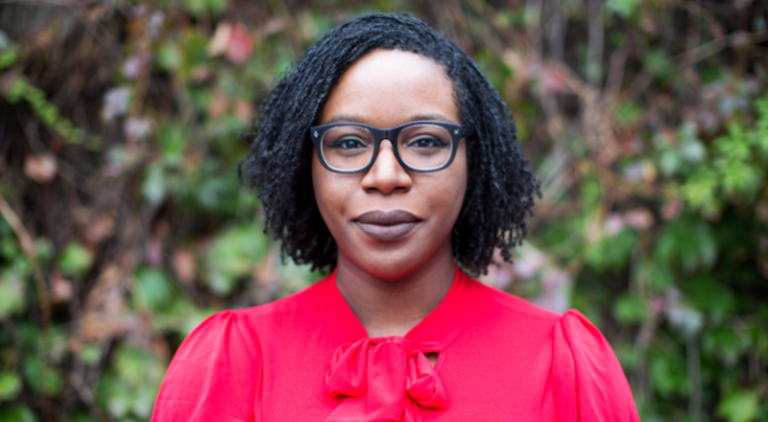
Lesley Nneka Arimah

Nigerian writer Lesley Nneka Arimah, author of What It Means When a Man Falls from the Sky, has won the massively prestigious 2019 Caine Prize for African Writing for her short story “Skinned,” which was originally published in McSweeney’s Quarterly Concern in 2018.

Dr. Peter Kimani, Chair of Judges, announced Arimah as the winner of the £10,000 prize on Monday night, describing her story this way: “The winner of this year’s Caine Prize for African Writing is a unique retake of women’s struggle for inclusion in a society regulated by rituals. Lesley Nneka Arimah’s “Skinned” defamiliarizes the familiar to topple social hierarchies, challenge traditions and envision new possibilities for women of the world. Using a sprightly diction, she invents a dystopian universe inhabited by unforgettable characters where friendship is tested, innocence is lost, and readers gain a new understanding of life.”

The Caine Prize aims “to bring African writing to a wider audience” and “to connect readers with African writers through a series of public events, as well as helping emerging writers in Africa to enter the world of mainstream publishing through the annual Caine Prize writers’ workshop, which takes place in a different African country each year.”

Read Arimah’s prize-winning story here — or listen to an audio version here.

09 Jul 12:47

Grow Young

by swissmiss

“It takes a long time to grow young.”
— Pablo Picasso

09 Jul 12:01

How many books should you bring on your summer vacation?

by Jonny Diamond
Bgarland

"Pro-tip: pack a bunch of shorter novels, the easier to lay across your face as you fake sleep."

This is a question as timeless as it is vexing, particularly if your work life is book-adjacent. Book critic extraordinaire Kate Tuttle claims to have finally pulled it off, citing a 6-to-5 books-to-days ratio (to the shock and admiration of her followers on Twitter). There are, of course, many variables to consider, starting with the type of holiday you’re planning; for our purposes today, we’ll consider:

A) The all-inclusive poolside retreat, with family
B) The encoupled tour of large and important cities
C) The solo hike/bike through vistas beautiful and majestic.

The all-inclusive poolside retreat, with family.
This is a dangerous one, and you’d be well-served to overpack. Even if you love your family very much, the sybaritic poolside/beachside vacation can quickly turn from sun-filled leisure to stress-sodden nightmare—the combination of headphones and book can provide at least some small barrier to the incessant needling of your nearest and formerly dearest.

Pro-tip: pack a bunch of shorter novels, the easier to lay across your face as you fake sleep. Suggested ratio: 12 books for 5 days.

The encoupled tour of large and important cities.
So, let’s assume you’re in love, or some approximation of love. When you’re not having sex on beds strewn with weird-shaped pillows you’ll probably be having a lot of Before Sunrise-esque conversations as you wander assorted strasses and allees. HOWEVER. You never know when you might run into a bad case of food poisoning or a rain-soaked weekend in Ghent. I love to read fiction set in whichever city/country I’m heading to (Under the Volcano in Oaxaca was… a journey) but it’s important you not overpack on this front, as too many books sends the wrong message to your partner.

Pro tip: though you might be tempted to pack no books, and leave your reading in the hands of fate/used expat bookstores, you might end up with Leon Uris or Snow Falling in Cedars. So don’t do that. Suggested ratio: 5 books for 5 days.

The solo hike/bike through vistas beautiful and majestic.
Congratulations for finally taking this long-dreamed of journey into the wild (and into your own head); while you’re there (your head), you’ll definitely want to have some company. And while you might be tempted to bring along one of those weighty classics you’ve never gotten around to reading, DON’T DO THAT. You don’t want plot and you don’t want weight. You want poetry and aphorism, the kind of fragmentary writing that helps open up your own sense of the world, that helps you to see. And seriously, you don’t want a lot of weight, so it’s good to have two or three slim-but-deep volumes you can dip in and out of, and return to as needed.

Pro tip: bring along a slim journal of your own; as you find the words of others warming up your own observational muscles, you might just want to start writing down your deep thoughts. Suggested ratio: 2 books (plus notebook) for 5 days.

06 Jul 17:33

Enjoy This Chinese Trap Banger About Dumplings

by Jenny G. Zhang

Nitemrkt’s “Bag That Bao” is irresistibly catchy

A Chinese trap song about dumplings is perhaps not a combination of words you thought you would come across today, but let me assure you, it’s exactly what you need. “Bag That Bao” is an irresistibly catchy new track by Nitemrkt, a music group with roots in Beijing and Los Angeles that describes its musical genre as “laserwave 808 asian trap futurism.”

“Bag that bao,” or “包一包” in Chinese, is a spin on “let’s get this bread,” along the same lines as “yeet this wheat,” “obtain this grain,” and other carb-related euphemisms for earning money. Fittingly, the song’s lyrics — delivered in nearly equal parts English and Mandarin — use bao as both imagery and metaphor for staying on the grind, accumulating wealth, moving on up in the world. Bao is what they eat, but it’s also what slews of Chinese immigrants have built their livelihoods on, washing dishes and cooking in restaurants. It’s a song, in Nitemrkt’s words, “saluting the culture, confidence, and hustle”:

I’m steaming the bao then I’m baggin’ it

I might pop up at your residence, yeah

Rockin’ Off-White on my a-p-ron

We do delivery caterin’

...bring it right to you

Skin so thin I can see right through you

At the night market, burnin’ midnight oil

Slap so hot it came wrapped in foil

Pull up / Lambo / trunk like / Dumbo

Hot pot / water / look like / gumbo

Used to / struggle / now we only order combo

The music video sticks to similar themes, translating bao-as-object and bao-as-symbolism into a “heist film” about getting away with Louis Vuitton-embossed bags filled with bao. There are shengjian bao, barbecue pork-stuffed steamed bao, thin-skinned soup dumplings, carb cousins like sesame balls and sweet breads. It’s an earworm of a track, thumping with a strong bass, but also a craving-inducing visual feast that nods at the pleasure of stuffing one’s face in Chinatown, reveling in a bounty that tastes of home.

25 Jun 00:59

Eimear McBride sold a new novel and it sounds amazing.

by Emily Temple

Attention all fans of Irish writers, Joycean texts, and weird language crazies: Publishers Marketplace has reported that Eimear McBride, author of A Girl is a Half-formed Thing and The Lesser Bohemians, has sold a new novel to FSG entitled Strange Hotel. According to the listing, it is “about a woman who occupies a series of hotel rooms around the world—each of which reflects back some aspect of herself—as we discover what has or might transpire in these rooms, the rules of engagement between her and the men she sometimes meets, and the outlines of the absence she is trying to forget.” And we only have to wait until February 2020. In the meantime, read an excerpt from her debut here and get excited.

24 Jun 20:18

Elvis Costello’s List of 500 Albums That Will Improve Your Life

by Colin Marshall

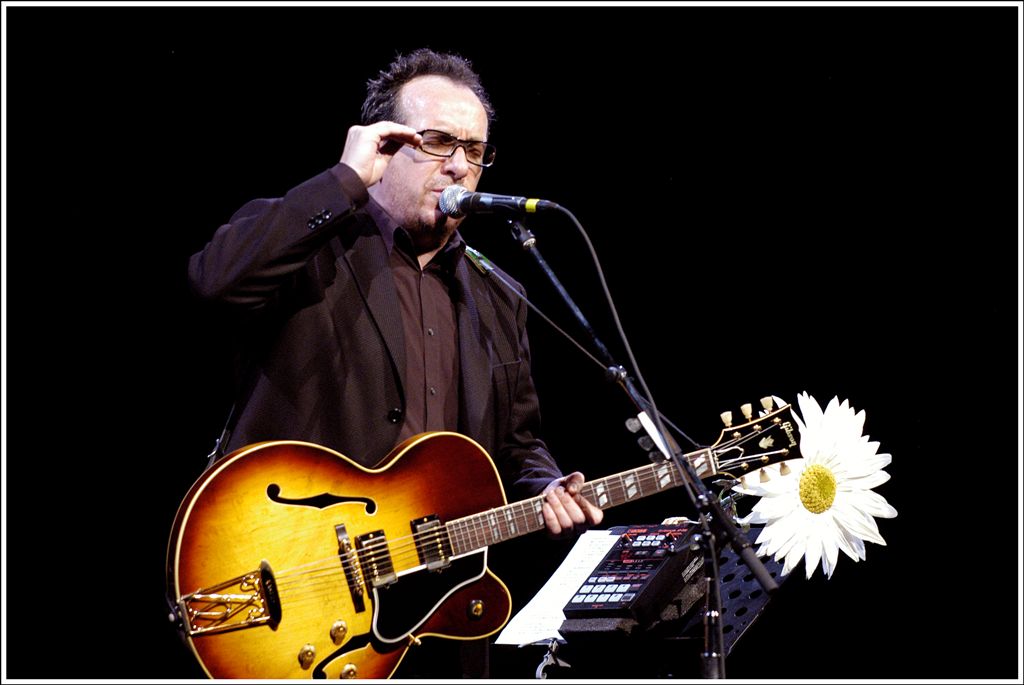
Photo by Victor Diaz Lamich, via Wikimedia Commons

Ask a few friends to draw up sufficiently long lists of their favorite albums, and chances are that more than one of them will include Elvis Costello. But today we have for you a list of 500 essential albums that includes no Elvis Costello records at all — not least because it was put together by Elvis Costello. "Here are 500 albums that can only improve your life," he writes in his introduction to the list, originally published in Vanity Fair. "Many will be quite familiar, others less so." Costello found it impossible "to choose just one title by Miles Davis, the Beatles, Joni Mitchell, Dylan, Mingus, etc.," but he also made room for less well-known musical names such as David Ackles, perhaps the greatest unheralded American songwriter of the late 60s."

Costello adds that "you may have to go out of your way" to locate some of the albums he has chosen, but he made this list in 2000, long before the internet brought even the most obscure selections within a few keystrokes' reach with streaming services like Spotify--on which a fan has even made the playlist of Costello's 500 albums below.

And when Costello writes about having mostly excluded "the hit records of today," he means hit records by the likes of "Marilyn, Puffy, Korn, Eddie Money — sorry, Kid Rock — Limp Bizkit, Ricky, Britney, Backstreet Boys, etc." But when he declares "500 albums you need," described only with a highlighted track or two ("When in doubt, play Track 4—it is usually the one you want"), all remain enriching listens today. The list begins as follows:

  • ABBA: Abba Gold (1992), “Knowing Me, Knowing You.”
  • DAVID ACKLES: The Road to Cairo (1968), “Down River” Subway to the Country (1969), “That’s No Reason to Cry.”
  • CANNONBALL ADDERLEY: The Best of Cannonball Adderley (1968), “Mercy, Mercy, Mercy.”
  • AMY ALLISON: The Maudlin Years (1996), “The Whiskey Makes You Sweeter.”
  • MOSE ALLISON: The Best of Mose Allison (1970), “Your Mind Is on Vacation.”
  • ALMAMEGRETTA: Lingo (1998), “Gramigna.”
  • LOUIS ARMSTRONG: The Complete Hot Five and Hot Seven Recordings (2000), “Wild Man Blues,” “Tight Like This.”
  • FRED ASTAIRE: The Astaire Story (1952), “They Can’t Take That Away from Me.”

How many music collections, let alone lists of essential records, would put all those names together? And a few hundred albums later, the bottom of Costello's alphabetically organized list proves equally diverse and culturally credible:

  • RICHARD WAGNER: Tristan and Isolde (conductor: Wilhelm Furtwangler; 1952); Der Ring des Nibelungen (conductor: George Solti; 1983).
  • PORTER WAGONER AND DOLLY PARTON: The Right Combination: Burning the Midnight Oil (1972), “Her and the Car and the Mobile Home.”
  • TOM WAITS: Swordfishtrombones (1983), “16 Shells from a Thirty-Ought-Six,” “In the Neighborhood” Rain Dogs (1985), “Jockey Full of Bourbon,” “Time” Frank’s Wild Years (1987), “Innocent When You Dream,” “Hang on St. Christopher” Bone Machine (1992), “A Little Rain,” “I Don’t Wanna Grow Up” Mule Variations (1999), “Take It with Me,” “Georgia Rae,” “Filipino Box-Spring Hog.”
  • SCOTT WALKER: Tilt (1995), “Farmer in the City.”
  • DIONNE WARWICK: The Windows of the World (1968), “Walk Little Dolly.”
  • MUDDY WATERS: More Real Folk Blues (1967), “Too Young to Know.”
  • DOC WATSON: The Essential Doc Watson (1973), “Tom Dooley.”
  • ANTON WEBERN: Complete Works (conductor: Pierre Boulez; 2000).
  • KURT WEILL: O Moon of Alabama (1994), Lotte Lenya, “Wie lange noch?”
  • KENNY WHEELER with LEE KONITZ, BILL FRISELL and DAVE HOLLAND: Angel Song (1997).
  • THE WHO: My Generation (1965), “The Kids Are Alright” Meaty, Beaty, Big and Bouncy (1971), “Substitute.”
  • HANK WILLIAMS: 40 Greatest Hits (1978), “I’m So Lonesome I Could Cry,” “I’ll Never Get out of This World Alive.”
  • LUCINDA WILLIAMS: Car Wheels on a Gravel Road (1998), “Drunken Angel.”
  • SONNY BOY WILLIAMSON: The Best of Sonny Boy Williamson (1986), “Your Funeral and My Trial,” “Help Me.”
  • JESSE WINCHESTER: Jesse Winchester (1970), “Quiet About It,” “Black Dog,” “Payday.”
  • WINGS: Band on the Run (1973), “Let Me Roll It.”
  • HUGO WOLF: Lieder (soloist: Dietrich Fischer-Dieskau; 2000), “Alles Endet, Was Entstehet.”
  • BOBBY WOMACK: The Best of Bobby Womack (1992), “Harry Hippie.”
  • STEVIE WONDER: Talking Book (1972), “I Believe (When I Fall in Love It Will Be Forever)” Innervisions (1973), “Living for the City” Fulfillingness’ First Finale (1974), “You Haven’t Done Nothin’.”
  • BETTY WRIGHT: The Best of Betty Wright (1992), “Clean Up Woman,” “The Baby Sitter,” “The Secretary.”
  • ROBERT WYATT: Mid-Eighties (1993), “Te Recuerdo Amanda.”
  • LESTER YOUNG: Ultimate Lester Young (1998), “The Man I Love.”
  • NEIL YOUNG: Everybody Knows This Is Nowhere (1969), “Down by the River” After the Goldrush (1970), “Birds” Time Fades Away (1973), “Don’t Be Denied” On the Beach (1974), “Ambulance Blues” Freedom (1989), “The Ways of Love” Ragged Glory (1990), “Fuckin’ Up.”
  • ZAMBALLARANA: Zamballarana (1997), “Ventu.”

Zamballarana, for the many who won't recognize the name, is a band from the Corsican village of Pigna whose music, according to one description, combines "archaic male polyphony with elements of jazz, oriental and latin music as well as the innovative way of playing traditional Corsican instruments such as the 16-string Cetrea, the drum Colombu and the flute Pivana." That counts as just one of the unexpected listening experiences awaiting those who fire up their favorite music-streaming service and work their way through Costello's list of 500 essential albums. It may also inspire them to determine their own essential albums, an activity Costello endorses as musically salutary: "Making this list made me listen all over again."


via Far Out Magazine

Related Content:

Hear the 10 Best Albums of the 1960s as Selected by Hunter S. Thompson

Lou Reed Creates a List of the 10 Best Records of All Time

Tom Waits Makes a List of His Top 20 Favorite Albums of All Time

Elvis Costello Sings “Penny Lane” for Sir Paul McCartney

The Stunt That Got Elvis Costello Banned From Saturday Night Live (1977)

Songs by David Bowie, Elvis Costello, Talking Heads & More Re-Imagined as Pulp Fiction Book Covers

Based in Seoul, Colin Marshall writes and broadcasts on cities, language, and culture. His projects include the book The Stateless City: a Walk through 21st-Century Los Angeles and the video series The City in Cinema. Follow him on Twitter at @colinmarshall, on Facebook, or on Instagram.

Elvis Costello’s List of 500 Albums That Will Improve Your Life is a post from: Open Culture. Follow us on Facebook, Twitter, and Google Plus, or get our Daily Email. And don't miss our big collections of Free Online Courses, Free Online Movies, Free eBooksFree Audio Books, Free Foreign Language Lessons, and MOOCs.

24 Jun 17:52

Thousands of people have signed a petition to cancel Neil Gaiman’s Good Omens

by Emily Temple
Bgarland

They sent it to Netflix. Next petition to the Pope, asking him to rein in the UUs!

As of this writing, 20,056 people, presumably Christians, have signed a petition asking Netflix to cancel the “blasphemous” television show Good Omens. The petition complains that the show, which is based on Neil Gaiman and Terry Pratchett’s thoroughly beloved novel of the same title, “portrays the agents of Good and Evil as fighters in an arbitrary struggle devoid of meaning and truth. This series presents devils and Satanists as normal and even good, where they merely have a different way of being, and mocks God’s wisdom in the following ways:

• An angel and demon are good friends, and are meant to be earth’s ambassadors for Good and Evil respectively.

• This pair tries to stop the coming of the Antichrist because they are comfortable and like the earth so much.

• God is voiced by a woman.

• The Antichrist, who will oppose the Kingdom of God, is portrayed as a normal kid that has special powers and a mission to destroy the world which he doesn’t really want to do.

• There are groups of Satanic “nuns” that are chosen to raise the Antichrist.

• The four riders of the Apocalypse, God’s means of punishing sinful earth, are portrayed as a group of bikers.

In the end, this is a denial of Good and Evil: morality and natural law do not exist, just humanitarianism and an ultimately useless creed. This is another step to make Satanism appear normal, light and acceptable. We must show our rejection. Please sign our petition, telling Netflix that we will not stand silent as they destroy the barriers of horror we still have for evil.

Which would all be bad enough (from what I’ve heard, God is totally a woman), except that—well, dears, the show is on Amazon Prime, so Netflix really can’t do anything about it, even if they wanted to. “This is so beautiful,” Gaiman tweeted. “Promise me you won’t tell them?”

[h/t The Guardian]

21 Jun 13:32

This Is the Book Series on Famous Asian Americans I Wish I’d Had as a Kid

by Cathy Erway
Bgarland

My friend Ai-Ling is super dope and well-deserving of more attention!

An alternate tale of Cinderella has haunted me since childhood. A picture book in rich pastels, it told the story of a poor servant girl with a nasty step-family, named Yeh-Shen, who lived “In the dim past, even before the Ch’in and the Han dynasties” in China. This folklore can be traced back in writing to the T’ang Dynasty (618-907 A.D.), and shares remarkable similarities with that of Cinderella—she goes to a ball, loses a slipper, and is found by a prince by virtue of her small feet. But the oldest European version of Cinderella dates back only to 1634. “Cinderella seems to have made her way to Europe from Asia,” reads a note on the dedication page to Yeh-Shen: A Cinderella Story From China. The book was written by Ai-Ling Louie and illustrated by Ed Young, and it was first published by Philomel Books, a division of Putnam, in 1982.

Like the legend of Yeh-Shen, Ai-Ling Louie’s career has lived in the shadows of children’s book publishing. As an Asian American author who came of age during the ‘60s, her trials and tribulations are a sharp contrast to the creative careers of many Asian American artists working today. A graduate of Sarah Lawrence College (where she and Vera Wang were the only Chinese Americans in their class of ’71), and Wheelock College, Louie aimed to write children’s books about successful, modern-day Asian Americans, but no publishers were interested. Louie switched gears to publish the legend of Yeh-Shen, but remained determined to see her passion project through. Between 2012 and 2018, she ultimately self-published the series under her own Dragoneagle Press. It includes biographies on Vera Wang, Yo-Yo Ma and his sister Yeoh-Cheng Ma, astronaut Kalpana Chawla, and most recently, U.S. Congresswoman Patsy Mink.

When Electric Literature asked Twitter followers to share the first book they’d read by an Asian American author during APA heritage month, I realized my answer was Louie’s Yeh-Shen. I then was thrilled to discover her more recent biographies for children—books I wish I’d had growing up. I talked to Louie about her struggle to put the series into the world, why she felt it was valuable, and what it was like to be an Asian American author during her time.   


Cathy Erway: Were there many other Asian Americans in your school environment? And did this have an effect on you or your work?

Ai-Ling Louie: I’d like to start a little farther back than college and show how immigration laws affect the lives of real people. I was one of the few Chinese American children born in the U.S. in the 1940’s. Immigration laws discriminated against us, keeping immigration from China to 150 persons a year, while those from Great Britain, Ireland, and Germany numbered over 104,000.

In 1954 when I was a kindergartener in a public school on Long Island in New York, I, alone, integrated my school as the only non-white in the entire building. The name-calling and insulting gestures and shunning I received were a shock to me. It was a good thing I came from a strong family, who told me I was to hold my head up and to use my wits to find a way around any obstacle.

Even if we celebrate the few who make it, we must not forget the many whose lives are stunted or whose minds are embittered by their treatment.

When discriminatory immigration laws are written and prejudice against one race or another is acceptable, I find there are many who suffer and only a few lucky ones who find a way to thrive. Even if we celebrate the few who make it, we must not forget the many whose lives are stunted or whose minds are embittered by their treatment.

I saw all around me the perception that Chinese girls are pretty and docile and Chinese boys are weak and unassertive. It warped my generation, and I still see these stereotypes around me. My family and I talk about them all the time. We see how it has negatively affected many of our Chinese American cousins, nieces and nephews. I set out to try to change these perceptions.

CE: What made you decide to share the story of Yeh-Shen as an illustrated book for children?

ALL: I wanted to write stories about Asians in America, but the ones I submitted to publishers were not being accepted. I decided to try to break in to publishing with a folk tale that my grandmother knew, Yeh-Shen. Sure enough, it was quickly accepted. I thought I could write my Asian-American stories after “Yeh-Shen” was published.

CE: How did you publish your series of Asian American biographies for children?

ALL: I spent many frustrating years trying to get a second book published. Finally, I realized I was going to have to find a way around this obstacle. I started my own publishing company, Dragoneagle Press, in 2007. My brother, Jonathan Louie, a graphic designer, is my partner. Children and teachers were clamoring for biographies of Asian Americans. May was designated as Asian American History Month. Libraries needed attractive books for their May displays. I decided to write a series, “Amazing Asian Americans.” It was my hope that someday the big publishers would pick up my series and distribute it across America.

CE: How do you decide on the subjects for these biographies? And are you working on any new additions to the series now?

ALL: When I got to Sarah Lawrence College, Vera Wang and I were the only Chinese-Americans in our class. She was the best-dressed, affluent daughter from one of the top private schools. I was the girl on scholarship, who had needed tutoring in French class. After graduation, I watched her career rise and rise and rise.

I spent many frustrating years trying to get a second book published. Finally, I realized I was going to have to find a way around this obstacle.

When I was a librarian in New Jersey in the 2000’s, I saw that the state had a large population of South Asian Americans, mostly from India. I learned that South Asian Americans were the U.S.’s latest and largest Asian immigrant group come to the United States. There wasn’t a single biography of a South Asian American on the children’s bookshelf. I knew there was a U.S. astronaut, who was originally from India, Kalpana Chawla. So, I set out to write a book about her.

Patsy Mink was the first congresswoman of color and the co-author of an important law, Title IX, which changed education and women’s lives in a big way. Yet Americans didn’t seem to know who she was, or why she was important. I found out her papers, 2,000 boxes of them, were stored at the Library of Congress in Washington, D.C. and open to the public. I spent three summers at the Library, doing research, a job I find exciting.

I am not working on any new books for the series. I am happy that I accomplished what I set out to do.

CE: Why did you feel that this series was an important addition to children’s books?

ALL: After 1965, I saw the next generation of Chinese Americans come to the U.S. The new Hart-Cellar Law let more Asian Americans, African Americans, Hispanic Americans, come to this country and to bring in their families, their sisters and brothers, to reunite families. There were more young students of color in public school classes. As an elementary school teacher and then a children’s librarian, I was getting to see children from China, India, Brazil and Egypt, all in the same school. There were many students who looked like me but came from Vietnam, Korea or the Philippines. And so, I began to see myself as an Asian American rather than just a Chinese American. These Asian American children needed books in their libraries that showed children like them. They needed to see a future for themselves as American citizens, capable of contributing to the country. Indeed, all Americans needed to see Asian Americans and other non-whites as full Americans. American publishers were slow to see this and change. The few books they were publishing were full of stereotypes. I knew I could do better.

The post This Is the Book Series on Famous Asian Americans I Wish I’d Had as a Kid appeared first on Electric Literature.

19 Jun 18:36

Food Pantries Modeled After Little Free Libraries Are Popping Up Around the World

by Brenna Houck

The Little Free Pantry removes barriers presented by traditional food pantries

For more than a decade people have been erecting community book exchanges called Little Free Libraries around the world. The colorful cabinets, which often look like giant bird houses, are typically filled with used books donated by people living in the area. But an organization based out of Arkansas known as Little Free Pantry has taken the idea to a new level by turning the cabinets into small, neighborhood food pantries, the Washington Post reports.

Just like a Little Free Library, the makeshift food pantries are filled by members of the community with supplies such as canned soup, canned tuna, and pasta. People who are food insecure can then take what they need from the cabinet. Roughly 40 million people in the U.S. live in a household that’s considered food insecure, according to the US Department of Agriculture’s 2017 report on food security, while nearly 10 million people fall into the category of low food security — meaning that they ration their food intake and rely on food pantries in emergencies.

While Little Free Pantries aren’t a replacement for traditional food pantries, they do play an important role for people in short-term distress. As the organization’s website points out, some food pantries have barriers to entry such as applications for use and set hours of operation; in contrast, the Little Free Pantries are available round-the-clock and don’t require that users supply any personal information. They also reduce feelings of stigma associated with visiting a food pantry.

Since opening the first Little Free Pantry in Fayetteville, Arkansas, in May 2016, more than 600 cabinets have popped up around the U.S. and around the world. The organization, founded by Jessica McClard, provides the information on how to set up and build a Little Free Pantry. They typically cost a few hundred dollars to start. People are then encouraged to stock non-perishable food items as well as toiletries and school supplies.

Americans tend to only think about donating food around the holidays or in times of crisis, but these neighborhood pantries could also serve as a year-round reminder that people always need something to eat.

Little Free Pantries Are Like Little Free Libraries — But With Food [WaPo]
Little Free Pantry Website [Official]

19 Jun 17:25

How to Argue With Kindness and Care: 4 Rules from Philosopher Daniel Dennett

by Josh Jones
Bgarland

Dan Dennett's book Consciousness Explained still blows my mind 26 years after it was published. His style of thinking, explaining, and arguing is instructive.

Photo by Mathias Schindler, via Wikimedia Commons

Drawn from Aristotle and his Roman and Medieval interpreters, the “classical trivium”—a division of thought and writing into Logic, Grammar, and Rhetoric—assumes at least three things: that it matters how we arrive at our ideas, it matters how we express them, and it matters how we treat the people with whom we interact, even, and especially, those with whom we disagree. The word rhetoric has taken on the connotation of empty, false, or flattering speech. But it originally meant something closer to kindness.

We might note that this pedagogy comes from a logocentric tradition, one that privileges writing over oral communication. But while it ignores physical niceties like gesture, posture, and personal space, we can still incorporate its lessons into spoken conversation—that is, if we’re interested in having constructive dialogue, in being heard, finding agreement, and learning something new. If we want to lob shots into the abyss and hear hundreds of voices echo back, well… this requires no special consideration.

The subject of sound rhetoric—with its subsets of ethical and emotional sensitivity—has been taken up by philosophers over hundreds of years, from medieval theologians to the staunchly atheist philosopher of consciousness Daniel Dennett. In his book Intuition Pumps and Other Tools for Thinking, Dennett summarizes the central rhetorical principle of charity, calling it “Rapoport’s Rules” after an elaboration by social psychologist and game theorist Anatol Rapoport.

Like their classical predecessors, these rules directly tie careful, generous listening to sound argumentation. We cannot say we have understood an argument unless we’ve actually heard its nuances, can summarize it for others, and can grant its merits and concede it strengths. Only then, writes Dennett, are we equipped to compose a “successful critical commentary” of another’s position. Dennett outlines the process in four steps:

  1. Attempt to re-express your target's position so clearly, vividly and fairly that your target says: "Thanks, I wish I'd thought of putting it that way."
  2. List any points of agreement (especially if they are not matters of general or widespread agreement).
  3. Mention anything you have learned from your target.
  4. Only then are you permitted to say so much as a word of rebuttal or criticism.

Here we have a strategy that pays dividends, if undertaken in the right spirit. By showing that we understand an opponent’s positions “as well as they do,” writes Dennett, and that we can participate in a shared ethos by finding points of agreement, we have earned the respect of a “receptive audience.” Alienating people will end an argument before it even begins, when they turn their backs and walk away rather than subject themselves to obtuseness and abuse.

Additionally, making every effort to understand an opposing position will only help us better consider and present our own case, if it doesn’t succeed in changing our minds (though that danger is always there). These are remedies for better social cohesion and less shouty polarization, for deploying "the artillery of our righteousness from behind the comfortable shield of the keyboard,” as Maria Popova writes at Brain Pickings, “which is really a menace of reacting rather than responding.”

Yelling, or typing, into the void, rather than engaging in substantive, respectful discussion is also a terrible waste of our time—a distraction from much worthier pursuits. We can and should, argues Dennett, Rapoport, and philosophers over the centuries, seek out positions we disagree with. In seeking out and trying to understand their best possible versions, we stand to gain new knowledge and widen our appreciation.

As Dennett puts it, “when you want to criticize a field, a genre, a discipline, an art form… don’t waste your time and ours hooting at the crap! Go after the good stuff or leave it alone.” In “going after the good stuff,” we might find that it’s better, or at least different, than we thought, and that we're wiser for having taken the time to learn it, even if only to point out why we think it mostly wrong.

via Brain Pickings/Boing Boing

Related Content:

Daniel Dennett Presents Seven Tools For Critical Thinking

Oxford’s Free Course Critical Reasoning For Beginners Will Teach You to Think Like a Philosopher

Monty Python’s “Argument Clinic” Sketch Reenacted by Two Vintage Voice Synthesizers (One Is Stephen Hawking’s Voice)

Josh Jones is a writer and musician based in Durham, NC. Follow him at @jdmagness

How to Argue With Kindness and Care: 4 Rules from Philosopher Daniel Dennett is a post from: Open Culture. Follow us on Facebook, Twitter, and Google Plus, or get our Daily Email. And don't miss our big collections of Free Online Courses, Free Online Movies, Free eBooksFree Audio Books, Free Foreign Language Lessons, and MOOCs.

17 Jun 23:31

XO Mazemen: Mix It Up With a Broth-less Ramen

by Sho Spaeth

Mazemen is a soup-less variety of ramen. This version, made with XO sauce, comes together in about five minutes. Read More
17 Jun 23:28

Homespun: The Small Museum of Folk Art

by Jeremy James George

The Small Museum of Folk Art is a boxy, enigmatic museum that displays local and regional artists in the semi-rural town of Pittsboro, North Carolina. The museum lies two blocks east of the roundabout on East St and two blocks past the old Chatham County Courthouse, now the Historical Museum, which anchors the roundabout. According to executive director Dave Clark, the museum tells a simple story simply—a story of community and communication, a story of local and Southern traditions.

The Small Museum came about by chance, the result of a serendipitous gift. Before the museum existed, Clark and his wife, Lisa Piper, themselves Minnesota transplants, moved to Pittsboro as proprietors of a café and an B&B on the same acreage. Eventually the two were introduced by a mutual friend to botany professor, curator, and folk art collector Dr. Jim Massey, who has said he collected folk art because it “has a kind of industry” indicative of “people absolutely driven to make art.” Dr. Massy felt his collection needed to be seen and that it wasn’t sufficiently visible, especially in the long run, at his lily farm Haywood Gardens in Moncure. So the three met and, grounded in the stipulation that the 400-plus piece collection not be broken up, Clark and Piper agreed to add a museum to their property, building, in effect, an homage to the irrepressible need of everyday folks to make and create.

There is no settled idea of what “Folk Art” is. The Small Museum itself features an eclectic array of folk art by Howard Finster, Butch Anthony, Vollis Simpson, Grandma Mozelle, Big Chief, Sam “The Dot Man” McMillan, Clyde Jones (a regular at the café), Miz Thang, Jimmy Lee Sudduth, and many others.  Rooted in colonial American artisanry and handicraft, it is now essentially a synonym for Outsider Art. Holger Cahill, acting director of the Museum of Modern Art in 1932, referred to it as “art of the common people.” It is also connected to Art Brut (“raw art”), a mid-20th century European avant-garde art movement lead by the French artist Jean Dubuffet that favored spontaneous, crudely finished, yet assured composition.

Folk artists are often self-taught. The work is often visionary or biblically inspired. In many pieces, the use of found or salvaged material adds to a rough finish, one result being a sense of spontaneity and improvisation. Both the artists and the art works are usually peripheral relative to the art market, which only exacerbates the perception of folk art as a “craft” rather than a “fine art.” And, according to Clark, folk art is about connection, especially where it’s associated “with people who have trouble communicating in traditional forms…Some can’t use a phone or drive a car but they articulate what they want through art.” The works are thus intensely personal. They are intentional and inspired, as if responding to some innate urgency in the artist, like a declaration of what it means to be alive and human.

Full of mirth and defiance to the established art world, the entire property exhibits an overwhelming deference to made things and makers, and a sense of boundarylessness. For example, a monumental Kokopelli-like steel Cinderella sweeps the garden, a vinyl Elvis is tacked to the side of an outbuilding, the café walls become an improvised gallery, and the door of the museum is hand-painted with a pastoral garden, inviting all visitors inside. Inside the museum the artworks, switched up a few times a year, are densely displayed, and, without attendant didactics, are largely left to speak for themselves.

The efficacy of showpieces like Jimmy Lee Sudduth’s Matisse-like dog painted with his own “sweet mud” concoction, Randy Tysinger’s memory jugs, or Grandma Mozelle’s bucolic painting “Friends Gathering Flowers at the Mounds” is their captured responsivity to environment. Similarly, Butch Anthony’s untitled multi-media assemblage mounted on wood, is an extraordinary work, and beyond categories--equal parts papier collé, relief sculpture, and portrait/death mask. The ground is a pastiche of images cut from printed matter (map, fashion ads, medical textbook, dictionary page, the word “Bronco”) and glued to the board. The raised elements include an Alabama license plate and a mask-like face made from a torch-cut shovel. Anthony’s work, like the others featured in the museum, takes the South and its things and repurposes them, somehow doing what needs to be done. In the process, these artists exalt the mundane and make us aware of the arresting possibilities present in our everyday lives.

13 Jun 17:23

A Joyously Spectacular Life

by swissmiss

“If all you did was just looked for things to appreciate, you would live a joyously spectacular life.”
― Esther Abraham Hicks

11 Jun 16:24

Crispy Vegan Smashed Potatoes with Chimichurri

by Richa

Crispy Vegan Smashed Potatoes with Chimichurri. These Smashed potatoes are baked to a crisp and served with fresh homemade parsley chimichurri. Vegan Glutenfree Nutfree Soyfree Recipe Jump to Recipe

Vegan Smashed Potatoes with Chimichurri Sauce on a Grey Baking sheet

Crispy from the outside and buttery inside is how all potatoes should be! These crispy smashed potatoes make a great side with a meal. Serve these right out of the oven with dressings such as chimichurri or pesto or just some garlic.

I use yukon gold or white potatoes. They get pressure cooked (saucepan instructions are also listed), then smashed and baked. These smashed potatoes are best served fresh. If planning to make ahead, then preboil, smash and refrigerate and bake when needed.

You can use various flavors and toppings with these smashed potatoes other than chimichurri, a simple basil pesto, some minced garlic and black pepper, vegan parm and garlic, tahini sauce, spices such as chili blend or cajun. Baby Potatoes work best here. But you can use regular size as well. Just slice into quarters and smash and bake!

Continue reading: Crispy Vegan Smashed Potatoes with Chimichurri

The post Crispy Vegan Smashed Potatoes with Chimichurri appeared first on Vegan Richa.

09 Jun 14:18

You Should Flip Your Next Pot Pie Upside-Down 

by James Park
Bgarland

My solution to this is to only eat Kelly's pot pies, which are perfect in every way.

Traditional pie design is not conducive to a good pie:crust ratio. This trick solves that

Pie — whether it’s a shepherd’s pie, filled with meaty goodness and topped with creamy mashed potatoes, or a zesty lemon meringue pie with bright lemon curd filling and fluffy meringue topping — can never do me wrong. But in the world of perfect pies, a frozen chicken pot pie, a circular, hand-held one with a flaky crust made from “scratch,” as the colorful label claims, always sparks joy. It could be the nostalgic memories of heating up that signature green Marie Callender’s chicken pot pie as an after-school snack. Or it could be my tendency to look for the ultimate hack for maximizing the pleasure of eating that chicken pot pie. The best move? Flip it upside down.

Let’s dissect this approach. There are two problems with personal-sized pies. First, most frozen savory pot pies are circular, and sit on an aluminum shell. It can be annoying to cut the pie with your fork while it’s still in nested the aluminum: Instead of slicing it, you end up scooping it with your fork, creating an uneven ratio of crust to filling. Sometimes, the crust gets mushed into the filling instead of providing its sandwich-like protection.

This unfair filling-to-crust ratio leads to the second problem: the bite’s texture. When the filling overpowers the crust, it’s overly wet. If you’re getting just the crust on the bottom, it can be quite dry. The perfect bite happens when the creamy, savory filling is sandwiched between top and bottom crust.

Flipping the pie upside down solves all those problems. Once it’s out of the aluminum shell, the pie’s bottom crust becomes the top crust, making a flan-like shape. (Yes, you might need a plate instead of eating it right out of the aluminum pan, but have some respect for yourself, even if you’re having a frozen pot pie. You deserve it.) Now that it’s on your plate, you can actually slice the pie as if you are cutting through a slice of cake with the side of your fork. By doing so, you get the ideal filling-to-crust ratio for every bite. This pro pie move maximizes the joy of buttery, flaky dough complemented with savory filling; you’re enjoying the best part in the most harmonious way.

It’s unclear whether this flip-the-pie move will work on other shapes of pies. I haven’t personally tried this strategy for sweet pies, such as apple or pumpkin pies, but it should be applicable as long as the filling, whether it’s savory or sweet, is between two layers of crust. So, next time, when you pop that frozen pot pie in the microwave for a lazy snack or a square meal, treat yourself by feeling all the pleasure of crust-to-filling ratio by flipping it. Just don’t flip the plate.

P.S. Not like you need an excuse, but if you want to incorporate pie into every meal of the day, you should go ahead and eat pie for breakfast.

05 Jun 14:22

10 Comics to Read While You Smash the Patriarchy

by A.E. Osworth

Comics have always been great for illustrating a fight—they are both serial and cinematic, giving us plenty of time to follow a hero on their adventures and plenty of gorgeous visual art to hold our interests. The folks who make comics are always using these formal strengths to punch something—from white nationalists to zombies.  The good news: in addition to all those other punchable targets, we’re currently in an era where writers and artists’ heroes punch the patriarchy, in life and art. The bad news is, we’re all tired. And if you are as exhausted as I am, I have a proposition for you. Sometimes you have to do the fighting, sure, but sometimes you can also put on a pot of tea and immerse yourself in comic books about fictional characters delivering a knock-out, super-hero-style kick to systems of oppression. If you’re mad as hell and in the mood for some eye candy, here are ten comic book titles for a weekend of lounging and whispering pow to yourself as you live vicariously through the characters in these comics while pumping yourself up to fight another day. All the comics listed are about women and nonbinary folks kicking ass, because sometimes you just gotta rage.

Lumberjanes

Lumberjanes is about a camp in the woods for hardcore girls, both cis and trans, and nonbinary kids too, who battle supernatural creatures and expectations of femininity. Originally developed by Noelle Stevenson, Grace Ellis, Brooklyn Allen, and Shannon Watters, this comic has everything—a group of five rad pals, holy kittens (no seriously, holy kittens. Kittens that are holy. Kittens with an aura of holy-ness), three-eyed foxes. These scouts often fight authority figures that seek to control their lives and define who they are. It’s kid-friendly to boot, and because it’s been running for years, there are plenty of collected volumes.

Nimona

If you like Noelle Stevenson’s writing in Lumberjanes, you may also want to pick up Nimona, her webcomic-turned-graphic-novel about a spitfire young shapeshifter and her villainous mentor. These two charming outlaws and their exploits against the crown beg the questions: If someone is the ruler of a nation or a blonde-haired pretty-boy knight, does that automatically mean they are the good guy? What role does toxic masculinity play in competition? And, what if the “supervillains” are actually on the right side of the moral quandary? War is waged against a controlling authority, one that seeks to control the body of a young woman and discards a disabled person—a punch-worthy government indeed! Will the villains stop the heroes in time? Also a kid-friendly pick, Nimona was nominated for the National Book Award in 2015 and is good, complex storytelling that can be enjoyed across age groups.

Kim Reaper

Kim is a full-time student and a part-time grim reaper, and Becka has a crush on her. Written and drawn by Sarah Graley, Kim kicks ass with her ripped sleeves, undercut, and sense of justice as she butts heads with the oft-traditionalist Board of Grim Reapers, who punish Kim for her ambition as a reaper, and enact revenge on her using—you guessed it!—the life and body of her new friend-crush-person Becka. Fudge those guys! This comic may be appropriate for some younger readers, as long as they’re cool with punching zombies.

Goddess Mode

Written by Zoë Quinn with Robbi Rodriguez and Rico Renzi rocking the art, Goddess Mode is perfect if you’d like to dismantle some capitalism along with your patriarchy. We follow Cass, a punkish and poverty-stricken employee of the reigning technology company as she’s assigned to check in on a rich person after a mysterious computer glitch endangers the lives of many. As Cass rails against the ruling class  with trash-powered spells and the coding knowledge to replace all her served ads with cat videos, Goddess Mode crosses the streams of two genres: cyberpunk and magical girl. This comic is absolutely not appropriate for young readers as it’s got harsh language and some gory violence.

Paper Girls

If you’re a fan of Stranger Things but would have liked to follow a group of girls instead, Paper Girls written by Brian K. Vaughn, illustrated by Cliff Chiang and Matt Wilson, might be for you. Follow Erin, Mac, Tiffany, and KJ as they set out to deliver newspapers early in the morning after Halloween, November 1st, 1988. Some Very Strange Things happen and, well, let’s just say that readers don’t stick to that date (you bet we’re going to time travel!) for very long as these teens battle masked monsters and the powers that be in the form of an agency that keeps tight control on the timeline and what events are “allowed” to happen. Also, dinosaurs. This comic is very much not appropriate for young readers (much disturbing death!).

Bitch Planet

“Mother Earth, we used to say, before we understood. Before we came to know the heavens, to live here and to feel her warm embrace. Space is the mother who receives us, you see? Earth is the father. And your father…has cast you out.” Welcome to a prison planet full of women who have been jailed for being “non-compliant.” Due to the patriarchal structure of this (futuristic) world, that can mean…pretty much anything, to no one’s surprise. “Trespasses,” “gluttony,” “pride.” The corporate-government is entirely run by people who support the patriarchal status quo. A true ensemble cast written by Kelly Sue DeConnick and drawn by Valentine de Landro, this title is perfect if you’re feeling caged and would like to read about a real revolution. Bitch Planet features tons of different kinds of women with all sorts of body types coming together in community…to absolutely crush the oppressive ruling body. Please don’t ever read this to a child, it is very violent and there’s a lot of nakedness.

Moonstruck

Enter a perfectly normal coffee shop with cushy seats, great espresso and the warm welcome of a friendly staff—which happens to consist of a queer werewolf named Julie and a nonbinary centaur named Chet. This is the world of Moonstruck, written by Grace Ellis and drawn by Shae Beagle. Julie often has negative feelings about being a werewolf and tries to hide it, even though other folks tell her there’s nothing wrong with her just as she is. But when an outside force tries to dictate what “perfectly normal” actually means, and enforce it upon the bodies of myriad fantasy creatures, things take a turn. Follow our heroes as they navigate villains and crushes and cryptic prophecies from the barista witch behind the bar. This is kid-friendly and is especially good if you’re looking for gender nonconforming representation and loads of diverse bodies.

Heavy Vinyl

Let’s head back to the eighties for a teen girl fight club. Heavy Vinyl (formerly Hi-Fi Fight Club), written by Carly Usdin and illustrated by Nina Vakueva, follows Chris as she gets hired by her favorite record store. She thinks all she’ll have to deal with are misogynist customers and a crush on her super cute co-worker, Maggie, but the staff’s collective favorite singer, a front-woman for super cool band Stegosaur, disappears the night before the big show. Chris is inducted into that secret rock and roll band of vigilante detectives to find their singer and dole out some justice. Adults and teens would find this title most interesting.

Joyride

“Earth sucks, steal a spaceship.” That’s the tagline for Joyride, written by Jackson Lanzing and Collin Kelly and drawn by Marcus To. This band of three unlikely teenagers is standing up to the World Government Alliance, which is keeping anyone from leaving Earth and quashing all resistance to their rules with violence. Rather than join the state-trained groups of militarized children, Uma Akkolyte and her two friends decide to take off after they receive a distress signal from outside SafeSky, the protective shell around the planet. This series is complete, so if you’d like something you can read from start to finish, you can get all three volumes and read everything in one shot. Because of the violence, check the content first before you read to any kids in your life.

Safe Sex (forthcoming)

Not a lot is known about this title so far because it’s going to be released later this year, but Safe Sex by Tina Horn, drawn by Mike Dowling, promises to be a big queer masterpiece about freedom fighters in a world where sex and pleasure are surveilled and regulated. Head to your local comic book shop and ask to put it on your pull list, because Horn plans to pack a punch with her merry band of sex rebels. This one? Definitely not for kids.

Bonus webcomic: Cosmoknights

Written and illustrated by Hannah Templer, Cosmoknights just launched earlier this year. Because it’s beginning as a webcomic (updated Tuesdays and Fridays), I included it as a bonus (though the graphic novel will publish in Fall 2019). The tagline is “For this ragtag band of space gays, liberation means beating the patriarchy at its own game.” And based on the first chapter, Templer is beginning the story with a runaway princess fleeing an arranged marriage and saving herself with the help of a friend. It’s also absolutely gorgeous. (And it’s free.)

The post 10 Comics to Read While You Smash the Patriarchy appeared first on Electric Literature.

03 Jun 18:32

Qualifiers

[20 minutes later] ", hi."
29 May 16:02

“Brooklynization” my ass

by Katherine Webb-Hehn

This essay is for all my Brooklynized Bama buddies.

This is for the uneducated, uncivilized, backwards boogers who traveled North and returned down South born again as enlightened consumerists.

This is for the Southerners whose only exposure to culture were the skits at Bible Camp—you know, before that eye opening spring break or first semester of college or whatever in New York City or Los Angeles or fill-in-the-blank Better Place when (finally! praise God!) you were turned on to Real Culture.

In other words, this essay is for the fantasy land, make-believe Southerners of Ginia Bellafante’s imagination.

Recently, the New York Times published a column by Ginia Bellafante titled “Abortion and the Future of the New South.” In it, she somehow manages a remarkable trifecta of ignorance. She slanders Southerners and glorifies gentrification while neglecting the very real horror of restrictive abortion laws on those of us who will remain here regardless, who have roots here, who have family members who need tending to or communities we’re invested in, or simply have a love of this place and its nothing-to-do-with-Brooklyn culture.

The article appeared in response to a string of abortion laws passed in the South and midwest, including the most restrictive law in my home state of Alabama. Twenty-five white men in the legislature passed a bill banning all abortions without exclusions for rape or incest. A white woman, Gov. Kay Ivey, who happens to be the second woman elected to the office, signed the bill, which happened to be written by a white woman, into law.

She slanders Southerners and glorifies gentrification while neglecting the very real horror of restrictive abortion laws on those of us who will remain here.

There is so much to unpack there: how these lawmakers used women’s bodies to pander politically to the most extreme among us; how white women assisted in and approved this move; how restricting abortion is not statistically likely to reduce abortions; how lawmakers blatantly ignored measures that are likely to reduce abortions, including well-researched and documented efforts to bolster reproductive health education and expand resources; and how at least a few of these Alabama lawmakers have admitted the move was simply a political dog-and-pony show that will ultimately amount to Alabama taxpayers losing millions to legal fees. The American Civil Liberties Union and Planned Parenthood have already filed a lawsuit against the state.

My best bud, a mother of a four who works in reproductive health, texted me the day the law passed to say that she needed to get to the woods. What she meant was: I need a reminder that this place is beautiful.

Southerners, mostly those of us with a uterus, are furious. We’re heartbroken and tired. We don't agree with this ban. What we don’t need right now is outsider condescension or dimwitted reactions. In the past few weeks, Southern women have asked you to reconsider the foolishness of a boycott or travel ban, which would only harm our people, not politicians. They’ve asked men to join in the resistance to these laws. And they’ve asked you to donate to on-the-ground organizations like Yellowhammer Fund and Planned Parenthood Southeast.

Swear on my granny’s grave, we’re aware of how shitty this all is.

One small terror of being an American is that we’re supposed to smile and thank God for our Democracy, forgiving the atrocities carried out by our government in comparison to evils elsewhere in the world. Nowhere is that tension felt more deeply than in the South, where the political system is stacked against so, so many of the people who are bound to this region by a devotion outsiders misunderstand and misrepresent (as if we’re all blindly committed to the white patriarchy).

In Alabama, for instance, our absurd constitution ensures centralized power in Montgomery with the state legislature, which regularly passes preemptive or reactionary measures to local municipalities and their attempts at progressive policies. They’re attempting to block Birmingham’s minimum wage hike. They’re attempting to prevent cities from removing Confederate statues. Both of these measures are currently tied up in lawsuits.

Meanwhile, we’re contending with the ridiculous distractions of outsider perceptions and influence.

If by “Northern urban values” Bellanfante means the industrialization of this region by way of extracting resources with racist labor policies, then yes, that is the definition of New South.

Bellafante claims the South stands to hemorrhage its onslaught of recent outsider residents because of abortion restrictions. That may very well be true, though I doubt it, because the South—surprise!—has more to offer than a reasonable cost of living. Our laws have always been excessively regressive. We know that. You know that. This knowledge hasn’t stopped people from moving here. The South has many of the fastest growing counties in the U.S. It’s home to the largest population of LGBT folks. And while we still have block-to-block, town-to-town racial segregation, the South is not a monolith of white folks like many other places in the U.S.

All of these folks make the South’s culture much more beautiful and complicated than Bellafante’s suggestion that our cities have been “Brooklynized by way of a progressive social culture and a tweaked fidelity to some of the South’s more marketable traditions.”

Though plenty of companies might find ways to monetize glossy versions of the South, as Ballafante suggests, let me go ahead and say our traditions are not for sale.

On May 20, for instance, thousands of Alabamians marched through Birmingham, Huntsville, Montgomery, and Mobile to protest the abortion ban. My guess is Bellafante would say my fellow Alabamians picked that up from Brooklyn, too, instead of carrying on the tradition of civil resistance that began in the South’s Black communities.

The piece opens with Bellafante’s cousin in New Orleans, who upon hearing about the state’s abortion restrictions, said, “You really forget you’re in the Deep South here.” This cousin is on to something: There absolutely is a rural-urban divide in politics, but that divide exists across the U.S.—even in New York.

And the thing is, New Orleans is the “Deep South.” So is Dallas, Birmingham, Nashville, Atlanta, Charlotte, and yes, Miami—the cities that, according to Bellafante, were uninhabitable until they traded their own complex histories for strip mall versions of Brooklyn. If you’re going to other the South, you don’t get to cherry-pick what constitutes the South and Southerners. You don’t get to rewrite our history either, like this paragraph chock-full of bullshit:

'The New South' was a term conceived in the aftermath of the Civil War to suggest a set of aspirations of some southern elites who hoped to rebuild a backward and devastated place into a world better aligned with Northern urban values.

If by “Northern urban values” Bellanfante means the industrialization of this region by way of extracting resources with racist labor policies, then yes, that is the definition of New South.

Industrialization hinged on Northern investment, which allowed New York financiers to profit wildly from subjecting Southern Blacks and poor whites to horrendous labor conditions. That’s the relationship between North and South—one of extraction. Wealth in the North exists today because of these conditions. Meanwhile, the South continues to suffer. We see it in all those nationally ranked quality of life measures where we’re consistently the worst— from our poor birth outcomes to our early deaths. Then the North mocks and frowns upon our suffering, pouring salt in the wound.

Are those the “Northern urban values” we so desperately seek to mimic?

Here’s another doozy:

It is this understanding of the modern Southern city — that you could nurture the addictions you had cultivated somewhere else — that has allowed places like Birmingham to grow into budding technology centers and to lure the bright and the driven.

I don’t even know what she’s talking about here, “nurture the addictions you had cultivated elsewhere.” If it’s the shallow, mindless consumption of popular trends, we call that good old-fashioned Capitalism. As for real addiction, I can’t speak for the whole South, but I got mine honestly—through a genetic disposition and mild childhood traumas. When I smoked my first cigarette at 12 in a treehouse in northern Alabama, I can assure you, Brooklyn had nothing to do with it.

Let’s do one more:

In the last 15 years or so, I have made no fewer than 50 trips to Birmingham, Ala., where my husband’s family lives, each time marveling at how much more exquisitely it meets a particular set of consumerist and architectural fantasies — the book shops, the midcentury modern furniture stores, the retooled industrial spaces, the gyms that are indistinguishable from the ones in TriBeCa, the soaring leaded windows, the restaurants now nationally known and the new ones always coming up.

I’ve lived in Birmingham for a decade. My family has been here seven generations. I can confirm our historic buildings and their leaded windows  are not modern Brooklyn knock-offs. (My ironworker papaw apprenticed under men who dug the earth for the city’s first skyscraper. They swore they never hit solid ground thanks to an underwater spring.) All but one of our bookstores are as old as I am. The newest is owned by my dear friend, a brilliant and kind man who lived in the woods while attending theology school and lost many of his teeth after years of refusing to brush. So Brooklyn! His shop, by the way, is also a very successful café in a space where a Starbucks flopped. And, of course, gay men in my family were shopping for mid-century modern furniture long before the trend made it to box stores.

When I finished reading Bellafante’s piece, my first reaction was to wonder who her husband’s family was. At the very least, maybe we could make sure she got the bad potato salad at the next reunion.

When outsiders condescend to the South, they often do it as Bellafante does—in total ignorance.

I considered sending a response directly to the New York Times, but it makes a lot more sense for my indignation to be here in the pages of Scalawag where a group of Southerners—mostly queer women of color—are countering false narratives about this place.

Bellafante’s perspective isn’t unusual, of course. When outsiders condescend to the South, they often do it as Bellafante does—in total ignorance. Here’s what I mean: Bellafante ends her article as she began—talking to a New Yorker, Allison Gourlay, who moved to New Orleans last year. She says she was urged to stay, because New Orleans was “on the cusp of something.”

She said, “When you meet all these young people moving here who are so passionate and intelligent and changing the rules and making the city what it is, it is so inspiring. But it really worries me that it could no longer be that place.”

Making. The. City. What. It. Is.

I’m not exaggerating when I say I gasped.

I hollered for my husband, who I first kissed awkwardly in New Orleans, who took me to her streets to heal after a long illness, who grew up in southern Mississippi where people cherish this gem of a city as if she’s the aunt we always hope we’ll grow up to be. New Orleans may not be our home, but we love many of the people who come from her magnificence.

I re-read the entire piece aloud while our toddler mimicked our exasperation, rolling his eyes and huffing. And I don’t think we were being dramatic.

All of this matters because New Orleans has always been home to a culture that is unique and worthy—no matter who thinks she’s “on the cusp.” This matters because New Orleans was the site of an American tragedy where “belonging” is so crucial. The very people who made New Orleans what she is—mostly Black Southerners— continue to be displaced after Hurricane Katrina, when they were left to perish or prevented from returning to their beloved home.

This matters because many of the hip dishes you’re serving in Brooklyn restaurants were first cooked by slaves and sharecroppers.

This matters because Miami is a multicultural city where artists flock—in the Deep South.

This matters because Huntsville, Alabama is home to American rocket science, and because Birmingham has more to offer than what’s trendy. All of our other cities contribute way more than consumable trends.

This matters because our rural communities feed people, and our working class communities sacrifice so that our industries might thrive.

This matters because many of the hip dishes you’re serving in Brooklyn restaurants were first cooked by slaves and sharecroppers.

This matters because culture has no hierarchy despite the elitists who co-opt traditions and rank them by marketability.

I lied earlier.

This essay isn’t for my fellow Southerners, unless you’re foolish enough to buy into this kind of backwards thinking. This is for all the folks like Bellafante who think the South is simply a place to indulge in their privilege cheaply.

We’ve had enough of your condescending entitlement, thanks.

If you have an inkling of solidarity with those of us here working against oppressive laws, then by all means, put your precious Northern money to good use by supporting the organizations doing the work on the ground in the South.


** Correction: An earlier version of this article referred to Kay Ivey as the first woman to be elected governor of Alabama. Lurleen Burns Wallace was actually the first woman to serve the in office in 1967—Ivey is the second.

24 May 18:59

My Mind

by swissmiss

This made me giggle.

22 May 15:19

5 Reasons a Writer Should Move to Baltimore

by Danielle Evans
baltimore

I.
You Have to Trust a City That Can Make “Ain’t it Hard Just to Live?” Sound Beautiful

I came to Baltimore almost a year ago, happily, but with half a lifetime’s worth of suspicion: I grew up in and outside of D.C., where our nearest neighbor city was sometimes the butt of dismissive jokes, where you know how Baltimore people are could be considered sufficient explanation for someone’s odd behavior. Before I had ever been to the city, my mother had read me Countee Cullen’s poem “Baltimore,” and though part of the point of the poem and most of the reason my mother was reading it to me was that the poem’s inciting incident—a child being called nigger by a stranger—could and did happen everywhere, as I got older and read Baltimore news, it seemed not incidental that the poem had been set in Baltimore, a city with a deep, structured, and intentional racial divide.

Though I made it to the city as one of the last seven people in the US who had never seen an episode of The Wire, I knew there was no shortage of pop culture that painted Baltimore as bleak. I made a “Baltimore” playlist to push myself through the last days of packing up my house and found that, aside from the occasional peppy disruption of the Hairspray soundtrack and Elizabeth Cotten’s wordless but fond-feeling ode, the city’s musical representation made it out to be a place that had depressed or eluded Bobby Bare, Randy Newman, Nina Simone, Adam Duritz, Mal Blum, and Audra McDonald. But the persistence of Baltimore as singularly heartbreaking in the art people make about it—including The Wire, which I did finally get around to watching—is its own kind of argument for writing in the city. It takes a place that can make you love it to break your heart, and sometimes it takes finding the words for a specific kind of heartbreak to know what you were trying to say.


II.
There are Gorgeous and Cozy Spaces to Write

If you’re not looking for heartbreak, the good news is that Baltimore also has plenty of straight-up beauty. The city is full of writing spaces where you can be visually and intellectually sustained but also be unbothered. I lived for months across the street from the Peabody Library, purportedly the inspiration for the library in the animated Beauty and the Beast. From Tuesday through Saturday, it’s free and open to the public, spectacularly gorgeous, quiet, and full of old books. Occasionally, parents wanting to photograph their college students with a scenic backdrop or couples viewing the space as a potential wedding venue wander in and have to communicate in whispers or charades, which is both sweeter and more likely to give me a stray observation worthy of the page than the interviews and awkward first dates that tend to distract me when I try to write in coffee shops. If you prefer to do your writing in a coffee shop, though, I recommend one of the city’s bookstore adjacent choices: Bird in Hand and Red Emma’s both have cafés where you can caffeinate and also eat, read, buy books, and occasionally catch events. If you’re not tied to your laptop, Baltimore also has multiple free art museums, including the Baltimore Museum of Art, where you can park yourself with a notebook and have a writing day punctuated by visual inspiration.


III.
It’s Full of Readings and Literary Events

Perhaps the best evidence that Baltimore is a writer-friendly city is how many writers come to town. Baltimore has a few remaining big booksellers and a lot of well-loved independent bookstores—along with Red Emma’s and Bird in Hand, there’s Bird in Hand’s sister store The Ivy and Atomic Books. The city is also home to a dozen universities, all with visiting speakers or reading series. The Pratt Library and City Lit Project bring writers to town year round, and the Baltimore Book Festival happens annually along the waterfront, bringing both marquee and emerging writers to town for a multi-day event. In the past year, readers who have visited include Colson Whitehead, Lorrie Moore, Claudia Rankine, Roxane Gay, Tressie McMillan Cottom, Lauren Groff, Natasha Trethewey, Laura Van Den Berg, Eugenia Kim, Tayari Jones, and Jorie Graham. If you made it to one of our Writing Seminars readings at Johns Hopkins, you got to hear gorgeous words and also walk away with a limited-run screenprinted broadside for each writer.

For all of the gratifying institutional support of literary culture, there’s also a lot of informal literary culture—it’s the kind of city where living-room salons have loyal audiences, and some of the best readings I’ve heard since I got here have been in those salons. The busy visiting writers calendar is only a small part of Baltimore’s arts scene, which also includes thriving local theatre, music, and a visual arts community that include both world class museums and an active makers culture.

A few months ago, I waited in a long line for half an hour on a snow day, only to discover I was person 205 hoping to hear a string quartet play a free concert, themed around songs with secrets, at The Peabody. “Are these people famous?” asked someone in line behind me. “They’re Baltimore famous,” said the friend they’d come with. Along with a few other stragglers, I waited long enough to be invited in once the crowd was settled, and watched a man in the standing room only audience hoist his small daughter onto his shoulders to see over the heads of hundreds of people as the string quartet played an adaptation of “Swing Low Sweet Chariot.” It felt good to be in a city where so many people wanted to be in that room.


IV.
Baltimore Won’t Let You Lie to Yourself About This Country

You maybe knew that we weren’t done with heartbreak. The inequality in Baltimore is stark and unavoidable. When you’re new in a city as a black person, every black person even a few years older than you has familial advice for you, and when you work for a major institution in a city, you can tell a lot about the institution’s relationship to the city by whether, when you tell them where you work, those older black people say “Look at you!” or “Are they treating you okay up there?”

Though I do find myself well-treated, I am also not ignorant of the history that makes the second reaction so much more common than the first. Baltimore has a long history of segregation, redlining, and division, and it’s not hard to trace that to problems visible in the city today: crime, bad policing, abandoned buildings, whole abandoned blocks, abandoned people, children asked to live around all of that and attend schools that sometimes lack heat in the winter and air conditioning in the summer. But Baltimore is a city that history and policy built, and to live where you don’t have to see it, or see how much is lost with race and class stratification, is only to know less about the country.

Faced with this reality, Baltimore has developed a thriving, and often successful, culture of activism. If you’re new to the city, there are a lot of opportunities to listen to and learn from the people already doing the work. If you want to know more about the history of the specific space of Baltimore, Stacia Brown’s radio program The Rise of Charm City does an amazing job of giving both intimate human stories and broad context. The recently relaunched Baltimore Beat is working to cover the city and maintain an active independent journalism culture. There are arts-specific opportunities for volunteering and advocacy, including Writers in Baltimore Schools, where volunteer writers can hear Baltimore teenagers speak for themselves and help them make space in the world for their work.


V.
If You Need Water, There’s Water. If You Need a Break, There’s The Whole Eastern Seaboard

When I was living far away and said I missed the East Coast, sometimes I meant I missed racial diversity and seasoned food, and sometimes I meant I missed being close to family, and sometimes I meant I missed Amtrak and the ocean. Baltimore is not quite beachfront, but the harbor makes good viewing on the days when you just need to see water, and while as a vegetarian, Baltimore’s famed crab culture is lost on me, I am charmed by both the Chesapeake Bay and the local seasoning named for it. (Pro tip: if you too arrive in Baltimore as a vegetarian feeling left out by the reverence for crab cakes, you can find good veggie versions at the restaurant in the BMA, and at a local vegan soul food place.)

But if being close to the ocean is not enough, the good thing about being in Baltimore is that you can easily get to the beach, or pretty much anywhere along the Atlantic. Writers are famously restless, and Baltimore is within a short distance of so much: the Maryland and Delaware beaches are an easy day trip, and both the Eastern Seaboard and every major city on the East Coast are accessible by a bus or train ride. It’s nice to be able to hop on a train and be in New York for an event. It’s also nice to know I can hop back on a train and be just about three hours away from a city I’m already always anxious to come home to.