Shared posts

21 May 21:19

In Search of Knowledge

by swissmiss

“We are, finally, all wanderers in search of knowledge. Most of us hold the dream of becoming something better than we are, something larger, richer, in some way more important to the world and ourselves. Too often, the way taken is the wrong way, with too much emphasis on what we want to have, rather than what we wish to become.”
— Louis L’Amour

(via Farnamstreet)

20 May 14:07

As of Today, the Last Physical Object Used as a Standard of Measurement is No More

by Cutter Wood
Bgarland

Le Grand K est mort! Vive Le K!

grand k

Today, May 20th, 2019, a cylinder of platinum-iridium alloy will be removed from a vault in the Pavillon de Breteuil in Saint-Cloud, France, just outside Paris, and relocated to a museum, officially “retired” in the terminology of metrologists, becoming the last object in human history to serve as a physical standard of measurement, or as metrologists tellingly describe such an object, an “artifact.”

This cylinder of dense metal, not much larger than a golf ball and colloquially known as “Le Grand K” or “the international prototype kilogram” or only “the IPK,” was created along with a few dozen sister cylinders at the end of the 19th century to act as the definition of the kilogram. It has been kept under three nested bell jars in an underground vault at the International Bureau of Weights and Measures in Saint-Cloud, accessible only with three separately controlled keys, while six of its sisters have been kept for reference as temoins, or witnesses. The IPK has been removed occasionally and cleaned with a chamois soaked in ethanol and ether before being steamed in distilled water, but otherwise it is merely left to rest. Of those few dozen cylinders originally made, the remaining prototypes were distributed to each of the world’s metrological powers, the signatories of the 1875 Treaty of the Metre—among which the United States numbers itself—and for the past 100 or so years these kilograms, kept and cleaned under similar conditions, have provided the citizens of each nation with their own approximation of the kilogram.

At intervals throughout the 20th century, the cylinders have been returned to France by representatives of each country and brought together for comparison to ensure a uniformity of standards. The specific alloy of platinum and iridium was chosen for the stability of its composition—its density, its peculiar resistance to corrosion and oxidation, its tremendous hardness—to which end it served its purpose admirably, but over the course of 100 years, the masses of these nearly identical kilograms have slowly and minutely and mysteriously begun to diverge from one another—to drift, as the metrologists say. Specifically, though no one has been able to deduce the underlying mechanism, the prototypes as a whole appear to be steadily gaining millionths of a gram of mass in relation to the IPK, or rather more likely, the IPK is losing mass in relation to its fellow cylinders (though no one can say the IPK is losing mass because to do so would be a kind of metrological apostasy; the mass of the IPK cannot change).

Had some enterprising anarchist or clumsy technician succeeded in damaging the IPK, the world order wouldn’t have known what a kilogram was.

As these cylinders have been the standards by which all other masses are measured, and as their continued divergence would cause greater and greater uncertainty in the world of measurement, at a meeting of the General Conference of Weights and Measures a few years ago, it was decided that some alternative method must be devised to measure mass, and so, on May 20th of this year, the kilogram will join the second and the meter and the other four base standards of measurement in being defined not by any terrestrial object or astronomical phenomenon but by what is known as a fundamental physical constant, which is to say one of the quantum properties of atoms themselves. In this case, it will be defined by the number known as Planck’s constant, the amount by which a photon’s frequency must be multiplied to equal its energy, or numerically, 6.626010150 × 10⁻³⁴ kg⋅m2/s, though speaking technically, as one must when discussing these matters in much detail, a kilogram will henceforth be defined not so much by a thing at all as by a strictly agreed upon process of determining Planck’s constant using a sophisticated piece of machinery known as a Kibble balance. 

For metrologists, there are multiple reasons to rejoice at this moment in history, as they did with both cheers and champagne this past November after unanimously voting to officially retire their metal cylinders, and considering the far-reaching impact of that vote, even those of us without Kibble balances should take some note of the bases for this metrological joie de vivre.

The first and most evident cause for elation is that the retirement of Le Grand K eliminates the dubious practice of relying on physical objects, which are subject to all sorts of worldly damage and decay. Not only is it troublesome that the kilograms have been drifting away from one another, but as one metrologist noted, since the IPK is a kilogram by its very definition, if it were dropped, it would still be a kilogram, but every other unit of measure on earth would be incorrect. Had some enterprising anarchist or clumsy technician succeeded in damaging the IPK, the world order wouldn’t have known what a kilogram was. And though it’s easy for a layperson to think a kilogram is a kilogram is a kilogram, to metrologists and to the realms of science and industry that depend on them, the precise definition of the kilogram is paramount to the continued existence of our world as we know it.

The work of the scientists at NIST, the metrological arm of the United States government, for instance, is fundamental to everything from food safety and nutrition (when Ragu creates a new sauce, it sends the jar to NIST to establish the nutritional information) to the shipping industry (if you are wondering how much a cruise ship weighs, NIST calibrates the scales) to pharmaceuticals (if Merck wants to develop a biological drug, they go to NIST) to cellular phones (the time on your phone right now is provided via radio broadcasts from a NIST lab in the mountains of Colorado), among countless others. It is not for no reason that NIST’s headquarters are located in a largely underground campus in suburban Maryland, or that it has stored its own prototype kilogram several stories beneath the surface of the earth.

With the French Revolution, scientists found their opportunity to enact in the realm of science the same sort of radical redefinition that was being enacted in French society.

The second reason metrologists were cheering is that now, for the first time, not only can no one blow up, steal, scratch, or breathe on the kilogram, no one can even own it. As Chris Oates, Division Chief of Time and Frequency at NIST, describes it, “any person anywhere on earth could make use of these quantities now without access to a physical artifact, anyone in the universe, in principle.” If the first reason was one of practicality, the second forms the theoretical or perhaps spiritual basis for their joy, because the original dream of precise standards of measurement, long before anyone could grasp exactly what the fulfillment of this dream would entail, was a specifically democratic dream, and to really begin to understand the peculiar momentousness of the kilogram’s retirement, you have to understand that dream. 

It began with the meter. At the end of the 18th century, different nations and localities each lived by their own units of measure (in France, famously, it was estimated at the time that there were more than 250,000 different measures), and these variations made for acute difficulties when, for instance, trying to replicate an experiment in Berlin that had originally been performed in Amsterdam, or when trying to sell a certain volume of Spanish sherry on the French market. So, deriving from the Enlightenment ideals of order and reason, the idea arose for a unit of length, decimal-based for ease of calculation, and so that it should be truly universal, derived from the very circumference of the earth itself. With the birth of the French Revolution, scientists found their opportunity to enact in the realm of science the same sort of radical redefinition that was being enacted in French society at large, and the Academy of Science decided to finally give the world its own rational and egalitarian measure.

Leaving Paris in 1792 in specially customized carriages, two astronomers, Jean Baptiste Joseph Delambre and Pierre François André Méchain, set off to measure as precisely as humanly possible that arc of the planet’s meridian running from a belfry in Dunkirk, a city at the extreme north of France, to Montjuic Castle in Barcelona. What was originally planned as a two-year mission became a seven-year ordeal, spanning all the turmoil of warring factions in the years after the revolution. The governmental organization that sponsored this journey went through convulsions, the work of Méchain and Delambre was hampered by war and civil unrest, Méchain was driven nearly mad by the imprecision of his calculations (“Who knows what oversensitive is,” as Maxwell says, “considering all there is to be sensitive to”), and when at last they returned to present their findings, they were received not by a democratically-elected representative democracy but by Napoleon Bonaparte.

And yet they succeeded, producing a definition of a standard meter, from which would be derived the unit of volume, the liter, and the unit of mass, the kilogram, and creating standards, as the Marquis de Condorcet said, “for all people, for all time.” Notably, despite Méchain’s misgivings, they were also remarkably precise. Their commission had been to produce a meter that measured 1/10,000,000th of the earth’s meridian, and based on satellite measurements today, we know that they were off by a mere 2,000 meters, meaning that they produced a meter with an error of only a little more than the width of a human hair.

It’s notable here that precision offers us quite different information from accuracy, and that sometimes precision is far more important.

Which all brings us to the final reason the metrologists were cheering, and that’s because the retirement of the kilogram this May sets us once and for all on the path to ever higher degrees of precision. A measurement can hardly be called a standard, after all, if it is not precise.

For those who haven’t recently looked back through their metrology textbooks, it might be helpful here to run through a quick primer on what exactly we mean when speak of precision in the scientific sense, how it relates to accuracy, and how the two concepts essentially differ. The most common analogy when explaining precision is that of a game of darts. Accuracy, as one would expect, is the ability to hit the bull’s eye. Precision, however, is the ability to hit any spot repeatedly. So, three darts that land close to one another at the dart board’s edge are said to be precise but not accurate, while three darts hitting the bull’s are said to be both accurate and precise. Notably, then, we see that precision necessarily involves consistency and repeatability. In terms of measuring a mass, we are precise if we get the same measurement again and again for the same mass, and our degree of precision is defined by our ability to replicate that measurement at smaller and smaller scales. It’s notable, as well, here that precision offers us quite different information from accuracy, and that sometimes precision is far more important.

For scientists generally, and metrologists specifically, precision is the be-all end-all. Precise measurements not only allow us to measure ever smaller quantities, ever fainter signals, ever softer forces, they underlie the entire project of science. If science is about making falsifiable hypotheses, as the philosopher Karl Popper proposed, precise measurements allow for the replication of experiments necessary to corroborate or falsify an idea. Just as importantly, precision is part of what allows a scientist to distinguish a signal from mere noise. Any experiment involves an interaction of forces or quantities, but generally speaking a scientist seeks to control the effect of certain of these variables so that the impact of others can be calculated. The degree to which the variables not being tested influence an experiment is what scientists call noise, and this noise obscures the signal of the variables being tested. So one of the primary goals in an experiment is to fix as many of these variables as rigidly as possible. The more precisely each variable can be measured, the better it can be controlled. Precision, in other words, allows scientists to divide the truth from everything else—precision is to the scientist as the gill is to the fish—and the entire progress of the scientific enterprise can in many ways be seen as a march toward ever greater degrees of precision.

As vital as precision standards are for science, however, they are perhaps even more vital for the world outside the laboratory, despite the nearly complete ignorance of the general populace.

This clock not only measures the passage of time more precisely than any other device on earth, it is so precise that it can actually measure the effect of gravity on a second.

Our ignorance of the degree to which our lives very literally rely on extreme precision—the understandable inability, in other words, of human beings to grasp the minuscule and gargantuan scales probed by contemporary precision devices—is maybe best illustrated by the tendency of those describing the work of these instruments to attempt to familiarize it to lay readers by placing it metaphorically on the human scale. The most ubiquitous and ever-ready analogy here, of course, is to describe the precision of these measurements in terms of the width of a human hair. So we know that the LIGO interferometer in Washington State, designed to measure the actual stretching of the fabric of spacetime, can measure the distance to the nearest star to the width of a human hair, while CERN’s Infinity machine can measure with a precision about 300 times smaller than the width of a human hair, the microshutters on the James Webb Space Telescope are the width of a human hair, etc., etc., etc. However, such hirsute analogs themselves perhaps best illustrate our inability to grasp the sensitivity of these instruments since, while to a human being all hairs seem of relatively similar thickness, to a machine like the LIGO detector, the variation in caliber of human hairs would be monumental.

Although operating largely unseen, NIST and the corollary metrological organizations of other nations, as the arbiters of all precise measurement standards, exist at a sort of mountaintop of precision. To give a single example of the sort of precision regularly achieved at NIST, they have recently created a clock based upon a lattice of ytterbium atoms—symbol Yb, atomic number 70, a soft silvery metal which, along with yttrium, terbium, and erbium, was first discovered in Ytterby, Sweden; this clock not only measures the passage of time more precisely than any other device on earth, it is so precise that it can actually measure the effect of gravity on a second.

The scientists at NIST calibrate scales that calibrate other scales that calibrate other scales and so on, and with each calibration a certain amount of imprecision finds its way into the calculation, until by the time you purchase a countertop scale at Bed, Bath and Beyond, you are vast orders of magnitude below the sorts of precision regularly achieved at NIST. And though the measurement of a mass to the millionth of a gram seems of little relevance to the baker doling out 500 grams of all-purpose flour, the entire sweep of the increasingly interdependent world economy is captured in that cascade of decreasing precision that begins with NIST and ends at a kitchen countertop.

By syncing generators and maintaining the power supply at a steady 60 Hz, these precise measurements make possible the electrical grids that provide energy across the world. They allow for the manufacture of industrial and commercial machinery, from jet turbines to cell phone components, at almost inconceivable levels of detail, and they underpin the fantastically minute measurements of the pharmaceutical industry. Perhaps most salient to today’s inhabitants of planet earth, they make possible the ever-increasing power of computers. They allow for the bundled transmission of information flowing seamlessly over fiber optic cables, ensuring that the ones and zeros in an email to your boss aren’t confused with the ones and zeros in your neighbor’s Fortnite stream. They coordinate the transmissions to stationary satellites far above the surface of the earth that allow your phone to place you on a map of the planet within an area of a few meters. And they make all of this computational power possible, by allowing for the placement of millions of transistors on a single square millimeter of silicon. 

A precision world is a computer world, and these upwelling forces of automation and artificial intelligence have gone hand-in-hand with increasing disparities in wealth.

And so, seen more broadly, the redefinition of the kilogram, like the redefinition of the second and meter before it, is momentous because it promises to pull the entire scientific community further orders of magnitude into territories of precision not yet grasped by humankind, and to drag the rest of society with it.

It seems strange then, though maybe not entirely surprising, that the ultimate realization of this democratic and literally globalist ideal should come at a time when the very fundament of democracy seems to be shifting underneath us. Britain, led by politicians who derided the very idea of scientific expertise, and under some poorly conceived notion of self-determination has decided to abandon the European Union despite the undeniable impact on its society and economy.

The United States has elected an isolationist leader who regularly threatens to leave NATO, who demonizes people seeking the rights of liberty and self-representation in the United States, and who politicizes science itself. France is roiled by the protests of The Yellow Vests, and countless other member countries of that 1875 Treaty of the Metre—Venezuela is one—have a stunningly uncertain political future. It seems that science has realized its greatest unifying dream just as the centrifugal forces of unreason and economic inequality and tribalism are flinging the world apart.    

Possibly, as economists and talk show hosts have noted, it has something to do with the fact that, in a society where precision reigns, the essential nature of labor has changed. Humans no longer make their own cars, they no longer solve their own equations, they no longer select their own mates. A precision world is a computer world—only computers can drill a hole to within a few micrometers, only computers can divide a second into millionths, only computers can tell the difference between 1 kilogram and 1.00000001 kilograms—and these upwelling forces of automation and artificial intelligence have gone hand-in-hand with increasing disparities in wealth.

If the world’s surface were apportioned as its wealth currently is, North America, South America, Europe, Africa, and Asia would belong to 10 percent of the population, while 64 percent of humanity would be confined to an area one third the size of Australia. And, of course, this is only the beginning of these shifts, as was made evident at the most recent summit in Davos, where CEOs spoke avidly of the potential for automation. As Mohit Joshi of Infosys noted, companies are now looking to replace not 10 or 15 percent of their workforces with computers in the coming years but upwards of 90 percent.

Another possibility is that it has something to do with the increasingly globalist world that precision makes possible. Jobs drift where they are cheapest, and there’s a good chance an MRI taken in Des Moines today will be read by a technician in Hyderabad. Certainly the anti-immigrant rhetoric of populists in the United States and England seems to have its basis in a concern that foreign nationals are taking the jobs of native-born citizens.

“I’d like to believe, though I have no grounds to believe, that this rational scientific world can, in the end, provide a route forward to a more stable society.”

Whatever its derivation, the question now, on the eve of the kilogram’s retirement, is whether the dream can survive its fulfillment. And perhaps the retirement of the final physical standard of measure, the final standard that could be held in the hand or kept on a mantle or in any way appreciated without the interposition of computers and machinery and equations, perhaps this event also offers us the opportunity to consider where exactly it is we are going. “I’d like to believe, though I have no grounds to believe, that this rational scientific world can, in the end, provide a route forward to a more stable society,” says Oates.

With that hope for a more rational and stable society in mind, it might be instructive to return to the period following the French revolution when the dream of precise standards of measure was born, and to recall that after seven years of painstaking work by Delambre and Méchain, the general populace of France, finding the new standards of measure of little use to their lives or their local economies, wholeheartedly rejected them in favor of the ad hoc and imprecise systems of measure they’d long used. Perhaps it’s worth recalling the many billions who have not yet found their existences greatly improved by the cause of scientific reason, for whom a hundred dollars is as faraway as the eruption of gold detected by LIGO in the constellation Hydra.

Or perhaps, as we consider the understandable resentments of those left behind by these scientific achievements, it would be helpful to recall September 4, 1792, in the earliest days of Delambre’s mission when his party was detained near Lagny. Night had begun to settle over the countryside, and the astronomer and his assistants, having completed the day’s measurements, were packing equipment into their carriage when a local militia arrived. As factions warred within the country, and the Prussians advanced from the north, anyone seeming to support the aristocracy was seen as suspicious, and these soigne travelers presented an alarming sight. The militia demanded Delambre’s papers and asked about the nature of his instruments and his purposes in looking toward the Prussian front. Delambre tried to explain that he was on an important scientific mission, that his work was for the good of the country and had been commissioned at the highest levels of the government, but the militia was unconvinced. The party was escorted through the driving rain and muddy fields and detained at a local inn. As Delambre wrote later to a friend, there was little he could do. “They were armed, and we had only reason. The parties were not equal.”

17 May 13:09

Don’t Use My Family For Your True Crime Stories - What it's like to watch true crime as the relative of a murder victim.

by Lilly Dancyger

This summer, my cousin Sabina would have turned 30 years old. Instead, it will mark nine years since she was murdered. Though it’s been almost a decade, I’ve just very recently started writing about her, and her death. It always felt too raw, too sacred to pull apart for story fodder—even if I’m the one doing the telling. The thought of someone who didn’t even know her using the horrible, violent way she was taken from my family as “material” is unfathomable to me. This is what I think about when I try to watch or listen to true crime.

I understand the appeal of true crime, and why it’s having such a heyday right now. I devour scripted crime procedurals. I love Law & Order. (Like, have seen every episode of every franchise several times, fall asleep to it at night, and used to have the theme song as a ring tone when that was a thing people did.) And I love all the less-than-Law & Order crime procedurals, too: CSI, NCIS, Criminal Minds. I understand that there’s something fascinating and soothing about unravelling a who-done-it, and I can get wrapped up in a crime story like anyone else. But it’s completely different when the stories are fiction. Even when Law & Order episodes are based on real cases, names and details are changed enough that it’s still fantasy; there are no photos of real people’s real loved ones who were ripped away from them by real murderers. No families sitting at home, shuddering with rage and horror as their greatest trauma is repackaged into a titillating narrative for you to consume with dinner.

When Sabina was raped and murdered steps from the front door of her Philadelphia apartment in June of 2010, it was a big news story. She was a beautiful 20-year-old girl with a bright smile, killed in a brutal and apparently random attack in a gentrifying neighborhood. She wasn’t white—she was half Filipino and had golden-brown skin and big almond eyes—but her Irish last name threw people off and put her in the category of Murdered White Girl, which we all know is America’s favorite kind of story to follow. Sabina’s smiling face was on TV every night while police searched for her killer.

I was in college at the time, studying journalism, so when reporters called my aunt’s house while the whole family was hunkered down there drinking and crying and wandering aimlessly from room to room, someone often handed the phone to me. I knew how to talk to reporters, they figured; I would know what they wanted and be able to get them off the phone quickly and make them leave us alone.

I sat on the front porch of my aunt’s house in a Philly suburb one afternoon that June, in a vintage rocking chair, staring up at the golden summer sunlight filtering through bright leaves, holding a glass of whiskey that I wasn’t even really drinking—I’d just gotten used to always having one in my hand that week. I pressed the phone to my ear as an earnest young woman on the other end asked, “Can you tell me how your family is doing?”

I knew she wanted me to say “we’re devastated” or “our lives will never be the same” or some such pat statement that would pull at readers’ heartstrings when she wrote an article about Sabina’s murder, to show the human side of this horrible thing that had happened. I knew what she wanted me to say, and why, but I was still confused by her question, like she had asked “what time is orange?” I asked her to repeat herself. I couldn’t wrap my head around condensing the thick, broiling grief that filled the house behind me into a soundbite.

I pictured thousands of people around Philadelphia picking up a paper the next morning, seeing that same picture of Sabina’s smiling face that had started to feel less and less connected to her and more like an emblem of tragedy. They’d read the words, “’We don’t know what to do with ourselves,’ Sabina’s cousin told reporters” and say “how awful” before moving on with their days. The idea of it made me sick. It made me viscerally, inexplicably angry to think of her death and our pain being a passing blip in strangers’ mornings—and that was just for a news story, not even a docu-series set to dramatic music.

Nobody has tried to make entertainment out of Sabina’s story, but if they did, I would burn their podcast studio to the ground.

Nobody has tried to make entertainment out of Sabina’s story, but if they did, I would burn their podcast studio to the ground. I would call them every night at 3 a.m, and then again at 5, and when they started turning their phone off I would show up and ring the doorbell. I would dig up their most embarrassing secrets and use them as blackmail. I would do whatever I had to do to get them to give up on the project. It would be intolerable to me—physically intolerable like the way a body can’t tolerate rotten oysters—for someone to splash Sabina’s last moments and the horror of her death onto a TV screen, or to narrate it between advertisements for Casper mattresses.

Sabina’s murder was a defining event in my life, which is why I have finally given myself some tentative and restrained permission to write about her. I’m finally letting myself write about what happened because I want to write about the games we played together as kids and the secrets we whispered to each other through dark rooms when we were just becoming teenagers and not sure we were doing it right. I want to write about the life she was just starting to live when she was killed—recording music and modeling and so thoroughly enjoying life on her own after a sheltered childhood. I want to write about the life she should be living now. And I want to write about the giant hole her loss has left in my family; how losing her changed the way I think about the world, about being a woman, about loving my friends. How Sabina was the baby of the family, and without her here, none of the rest of our relationships to each other quite make sense.

I don’t want to write about her killer; I don’t want to focus on him, like so many true crime stories tend to. He’s in prison now, and he will be for the rest of his life. That’s the only thing about him that matters to me. And that’s the difference: I’ve started to write about Sabina, and what it was like to lose her in such a horrific way. But true crime stories rarely focus on the victims or their families. They focus on the killers. They elevate these people, the very worst among us, to minor celebrities as if their life stories are more important than the ones they cut short. As if understanding why they did what they did will make it any better. As if they’re fascinating.

Some critics and viewers pointed this out after the recent series about Ted Bundy aired on Netflix; that romanticizing serial killers is truly twisted and perverse, but not in a fun provocative way. That if we’re going to talk about those murders, we should be talking about the women who were murdered and stop using them as plot devices to glorify evil men. That seems pretty obvious to me. But most of those same critics didn’t apply that same logic to the smaller stories; the individual killings that have been fodder for shows like Forensic Files for years, that you just know journalists and TV producers are out searching for right now, wondering if they might hit on the next Serial.

I’ve tried to watch or listen to a few of the most raved-about true crime shows, tried to think of them like any other cop show I enjoy, but I just can’t do it. Even in the more high-brow, journalistic true crime series like Making a Murderer, I couldn’t focus on the outrage I was supposed to feel at the criminal justice system or how the Avery family was treated—all I could think about was how the murdered woman, Teresa Halbach, was treated as a plot device in a man’s story. I had to Google her name just now. Everyone remembers Steven Avery, but what about Teresa? Whether Steven Avery killed her or not, I couldn’t imagine being Teresa’s mom or cousin or friend, watching this show all about someone who was accused of killing her, with her dead body only in the story as an inciting incident. If he was wrongfully accused, that might be even worse to watch as her family—her murder going unsolved and forgotten in the background of someone else’s story.

I don’t begrudge true crime fans their shows. I’m not here to tell you you’re a bad person if you enjoy these stories. But I wish that the audiences and creators of these shows would give a little extra thought to how the dead woman (because it’s almost always a woman) at the heart of the story is treated in the telling. Is she treated like a human being who had more life left to live, with people who loved her, who will never be the same because of her loss? Or is she reduced to a gory crime scene photo and a plot point in a story about a man who doesn’t deserve anyone’s fascination?

The idea of someone not only turning Sabina’s story into entertainment, but doing so without even focusing on her, instead telling the story of the monster who took her from us as if he were the important person in the horrible story they share, makes me feel physically ill. My heart is racing right now as I write this, just thinking about it. And knowing how I would react if it were my family’s story, I can think of nothing but how the families must feel when I see other murders turned into entertainment.

10 May 12:54

How America Became the ‘Red Meat Republic’

by Jamison Pfeifer
Bgarland

I'm surprised to be looking forward to reading this book.

“America made modern beef at the same time that beef made America modern,” writes Joshua Specht in the introduction of Red Meat Republic: A Hoof-to-Table History of How Beef Changed America. Beginning with the development of cattle ranching in the Great Plains and the western United States—a development contingent upon the removal of thousands of Native American communities—Red Meat Republic describes the emergence of what he calls the “cattle-beef complex” in the latter half of the 19th Century. The book details beef’s rise as commodity, from the importance of the open range and technological advancements like refrigerated railcars to the rise of meatpackers as powerful market players.

For Specht, a historian of 19th-Century America currently based at Monash University in Melbourne, Australia, Red Meat Republic grew out of his doctoral dissertation at Harvard—as well as out of a realization that a lot of the food writing he admired—Michael Pollan’s Omnivore’s Dilemma, for instance—wasn’t all that historical. “I don’t mean that as a dig,” he says, “but it seemed like there was room to look more in-depth at the history of industrial beef.”

So, Specht started looking through 19th-Century sources to tell the story of how “between 1870 and 1900, western cattle markets evolved from a series of regional centers into an integrated national system.” The result is a detailed look at the development of a national system built around beef that touches on persistent questions about the limits of consumer politics and debates over centralization versus localism.

Civil Eats spoke with Specht about the book, the lack of competition among meat producers, and what the origins of industry can tell us about our food politics today.

You write about how the idea of the open range transformed the ecological possibilities of the Great Plains. How did that happen?

There was this idea of this vast, empty land waiting to be populated with cattle. That’s basically a myth. There were obviously [Native Americans] living there and there were also bison. In order to have the land that the entire American beef industry is predicated on actually required a process of dispossession and near-extinction of the bison.

In your book, you write about the aftermath of the Mexican-American War and the eventual movement of tribes such as the Kiowa, Comanche, and Plains Apache into reservations. Why was the reservation system so important to the development of cattle ranching?

Ninety-five percent of western lands were acquired through the dispossession of American Indian land and the creation of reservations. The ranchers, indirectly, along with the U.S. military, directly engaged in a process of eliminating the means of subsistence of Native Americans by killing off the bison. Once they were confined to reservations, they didn’t have good ways to support themselves. The land was bad, there wasn’t enough of it, and their traditional ways of supporting themselves were gone, so they needed handouts of food. Often that was beef from cattle that were now grazing on land that once belonged to them. Reservations became a major outlet for cattle for ranchers, and often they got their lowest quality animals. Ranchers also got lucrative contracts to distribute cattle to reservations.

You describe beef as the paradigmatic business for the rise of agribusiness. How so?

In the late 19th Century, there was a basic tension between the unpredictability of nature—to oversimplify a bit—and the needs of business and capital. That tension led to a lot of crises, and in response the industry developed a model where the highly capitalized and valuable parts of the industry were the food processors that then relied on relatively small-scale suppliers in the form of farmers and ranchers. That allowed the food processors and meatpackers to offload the risk and capture profits in a reliable way. This model—which was pioneered in the 1880s—was repeated and intensified throughout the 20th Century.

You also explore how the democratization of beef, where beef could be part of every American’s diet, also meant that a person’s class began to correspond to which part of the animal they consumed. What did you learn?

Part of what I wanted to show is how we can debate the benefits of more expensive kinds of organic foods, but we have to be aware that not everybody can actually afford those. If we’re not pairing better quality, organic foods with a system that changes how everyone can afford food, then we have to be aware of the class implications. If I’m continuing to eat my steak, even if it’s produced more sustainably, I’m still contributing to the idea that to be successful is to consume beef. The book is trying to push [the idea] that all these questions of politics are tied up in our food decisions.

Your book describes two specific reforms in the early 20th Century, the Federal Meat Inspection Act (1906), and the Packers and Stockyards Act (1921). The former addressed sanitation and the latter attempted to break up the beef trust, right?

The Federal Meat Inspection Act of 1906 was a major victory from a consumer health/sanitation perspective, but one of the ironies I note in the book is that from the perspective of consumer politics, success in sanitation short-circuited consumer awareness of, and mobilization about, the system’s broader iniquities, such as labor exploitation, environmental degradation, and animal abuse.

The Packers and Stockyards Act of 1921 protected a certain kind of competition in meatpacking, but sought to ensure competition between the few very large firms that remained as of 1921. This legitimized the national/beef industry [or beef-industrial complex], as a natural state of affairs and it helped solidify a system that I argue was never inevitable—one in which centralized food processors dominated over relatively weak ranchers and retail butchers. Basically it stopped the big meatpackers from [consolidating further for a period of time], but it didn’t punish them for it, or try to turn back the clock. It closed the barn door after the animals had already left.

You argue that this federal regulation created a baseline for what was acceptable in the industry, correct?

Yeah. It’s the same story I tell about slaughterhouse labor. Initially, there weren’t unions in meatpacking, though there were attempts. By the time [workers] did form unions, it was a great development, but at the same time unions secured a picture of the industry that was already highly exploitative, unfortunately.

The national system that developed during this time, from roughly 1865 to 1906, seemed not so different from the one we have today, where meatpackers ran on immigrant labor and big corporations wielded a lot of power. Is that a fair claim to make?

For sure. Back then, workers in the slaughterhouse were poorly paid and were recent immigrants. The only difference is that they were from Central and Eastern Europe [as opposed to Latin America, as they are today]. But all the dynamics are the same. The other thing I should stress is that a national market emerged historically in specific places like Chicago, Texas, and the cattle towns of Kansas. Today, the beef industry exists in specific parts of the country but it’s bigger than any one of them and that’s partly how it’s so powerful.

You discuss Philip Danforth Amour, the meatpacking industrialist, and his view that the history of beef production was just a history of technology. Could you talk about this narrative and how it preempts criticism of the industry?

That argument was used by Philip Danforth Armour when he testified to the United States Senate in the very late 1880s and it was taken up by the first great historian of the meatpacking industry, Rudolph Alexander Clemen. He argues that the story of beef is simply a history of technological achievement through advancements like railroads and refrigerated railcars. The problem with this narrative is it doesn’t explain who benefits from this system and who bears its costs, which is a story of political struggle. My book is an attempt to retell a story, which is not wrong but incomplete—to reassert the politics.

What else does the origins of this industry tell us about the current state of food politics?

The history of beef helps us think about food politics in the United States today. One of the implicit insights of my book is that addressing the inequities of the food system today will raise the cost of beef. The entire system has been organized to minimize costs, so any change is going to make beef more expensive.

This speaks to the limits of consumerist politics, which is very good at addressing issues like cost and sanitation that affect us, the consumers, directly. But the only way to change the system equitably will involve a long-term shift over the place of beef in people’s diets. It also requires pairing environmental justice with social or redistributive justice. In order to fairly address the inequities within the beef industry, we need to make everyone able to afford better-produced food. I view that as kind of a call to coalition building in terms of food politics.

But beef production is also expanding globally at an incredible rate. Looking at the moments of origin can also help us think about places like Brazil, where beef production is really taking off [resulting both in the displacement of indigenous people and the deforestation of the Amazon]. Some of the dynamics I see in the early stage of my story are currently unfolding in the contemporary world.

The biggest beef processor in the world now is JBS, a Brazilian company, which has bought up some of the American companies over the past 30 years. The U.S. is a meaningful beef exporter, but similar production systems are being set up elsewhere around the world. The same story that says to be successful in America is to eat beef means it’s successful in a poorer economy to eat beef. Meat consumption remains a marker of American lifestyle and success. Even if I’m consuming a far more sustainable steak, I’m still contributing to the idea that to be successful means to consume beef.

The post How America Became the ‘Red Meat Republic’ appeared first on Civil Eats.

10 May 12:53

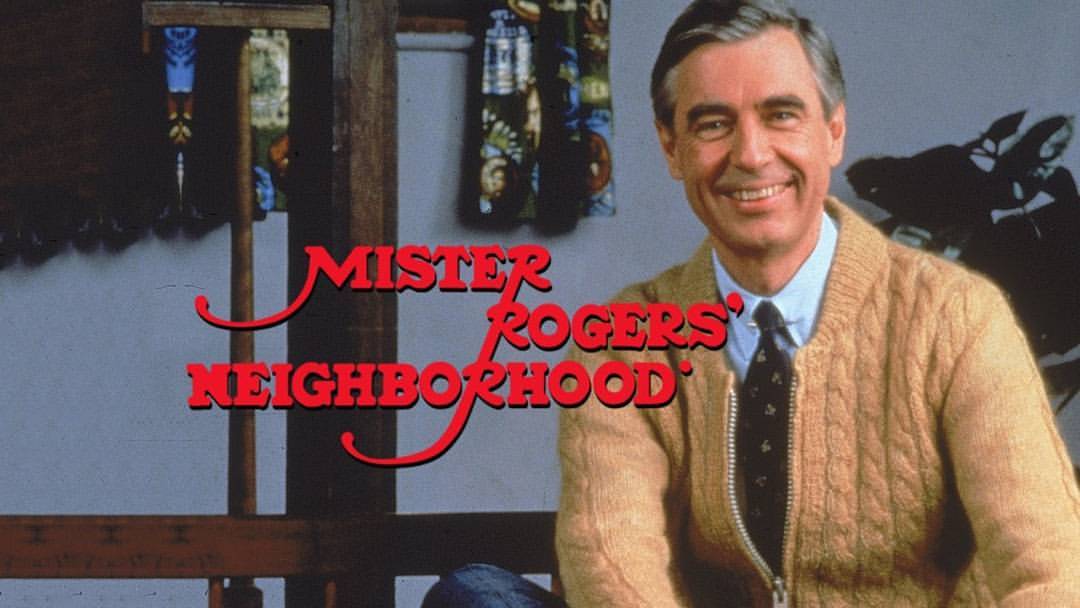
Mr. Rogers’ Nine Rules for Speaking to Children (1977)

by Josh Jones
Bgarland

Rogers wanted us to know, says Greenwald, "that the inner life of children was deadly serious to them," and thus deserving of care and recognition.

The maxim “children need rules” does not necessarily describe either a right-wing position or a leftist one; either a political or a religious idea. Ideally, it points to observable facts about the biology of developing brains and psychology of developing personalities. It means creating structures that respect kids’ intellectual capacities and support their physical and emotional growth. Substituting "structure" for rules suggests even more strongly that the “rules” are mainly requirements for adults, those who build and maintain the world in which kids live.

Grown-ups must, to the best of their abilities, try and understand what children need at their stage of development, and try to meet those needs. When Susan Sontag’s son David was 7 years old, for example, the writer and filmmaker made a list of ten rules for herself to follow, touching on concerns about his self-concept, relationship with his father, individual preferences, and need for routine. Her first rule serves as a general heading for the prescriptions in the other nine: “Be consistent.”


Sontag’s rules only emerged from her journals after her death. She did not turn them into public parenting tips. But nearly ten years after she wrote them, a man appeared on television who seemed to embody their exactitude and simplicity. From the very beginning in 1968, Fred Rogers insisted that his show be built on strict rules. “There were no accidents on Mr. Rogers’ Neighborhood,” says former producer Arthur Greenwald. Or as Maxwell King, author of a recent biography on Rogers, writes at The Atlantic:

He insisted that every word, whether spoken by a person or a puppet, be scrutinized closely, because he knew that children—the preschool-age boys and girls who made up the core of his audience—tend to hear things literally…. He took great pains not to mislead or confuse children, and his team of writers joked that his on-air manner of speaking amounted to a distinct language they called “Freddish.”

In addition to his consistency, almost to the point of self-parody, Rogers made sure to always be absolutely crystal clear in his speech. He understood that young kids do not understand metaphors, mostly because they haven’t learned the commonly agreed-upon meanings. Preschool-age children also have trouble understanding the same uses of words in different contexts. In one segment on the show, for example, a nurse says to a child wearing a blood-pressure cuff, “I’m going to blow this up.”

Rogers had the crew redub the line with “’I’m going to puff this up with some air.’ ’Blow up’ might sound like there’s an explosion,” Greenwald remembers, “and he didn’t want kids to cover their ears and miss what would happen next.” In another example, Rogers wrote a song called “You Can Never Go Down the Drain,” to assuage a common fear that very young children have. There is a certain logic to the thinking. Drains take things away, why not them?

Rogers “was extraordinarily good at imagining where children’s minds might go,” writes King, explaining to them, for example, that an ophthalmologist could not look into his mind and see his thoughts. His care with language so amused and awed the show’s creative team that in 1977, Greenwald and writer Barry Head created an illustrated satirical manual called “Let’s Talk About Freddish.” Anyone who’s seen the documentary Won’t You Be My Neighbor? knows Rogers could take a good-natured joke at his expense, likely including the imaginative reconstruction of his methods below.

  1. “State the idea you wish to express as clearly as possible, and in terms preschoolers can understand.” Example: It is dangerous to play in the street.
  2. “Rephrase in a positive manner,” as in It is good to play where it is safe.
  3. “Rephrase the idea, bearing in mind that preschoolers cannot yet make subtle distinctions and need to be redirected to authorities they trust.” As in, “Ask your parents where it is safe to play.”
  4. “Rephrase your idea to eliminate all elements that could be considered prescriptive, directive, or instructive.” In the example, that’d mean getting rid of “ask”: Your parents will tell you where it is safe to play.
  5. “Rephrase any element that suggests certainty.” That’d be “will”: Your parents can tell you where it is safe to play.
  6. “Rephrase your idea to eliminate any element that may not apply to all children.” Not all children know their parents, so: Your favorite grown-ups can tell you where it is safe to play.
  7. “Add a simple motivational idea that gives preschoolers a reason to follow your advice.” Perhaps: Your favorite grown-ups can tell you where it is safe to play. It is good to listen to them.
  8. “Rephrase your new statement, repeating the first step.” “Good” represents a value judgment, so: Your favorite grown-ups can tell you where it is safe to play. It is important to try to listen to them.
  9. “Rephrase your idea a ?nal time, relating it to some phase of development a preschooler can understand.” Maybe: Your favorite grown-ups can tell you where it is safe to play. It is important to try to listen to them, and listening is an important part of growing.

His crew respected him so much that even their parodies serve as slightly exaggerated tributes to his concerns. Rogers adapted his philosophical guidelines from the top psychologists and child-development experts of the time. The 9 Rules (or maybe 9 Stages) of “Freddish” above, as imagined by Greenwald and Head, reflect their work. Maybe implied in the joke is that his meticulous procedure, considering the possible effects of every word, would be impossible to emulate outside of his scripted encounters with children, prepped for by hours of conversation with child-development specialist Margaret McFarland.

Such is the kind of experience parents, teachers, and other caretakers never have. But Rogers understood and acknowledged the unique power and privilege of his role, more so than most every other children’s TV programmer. He made sure to get it right, as best he could, each time, not only so that kids could better take in the information, but so the grown-ups in their lives could make themselves better understood. Rogers wanted us to know, says Greenwald, "that the inner life of children was deadly serious to them," and thus deserving of care and recognition.

via Mental Floss

Related Content:

Watch a Marathon Streaming of All 856 Episodes of Mister Rogers Neighborhood, and the Moving Trailer for the New Documentary, Won’t You Be My Neighbor?

Mister Rogers Accepts a Lifetime Achievement Award, and Helps You Thank Everyone Who Has Made a Difference in Your Life

When Fred Rogers and Francois Clemmons Broke Down Race Barriers on a Historic Episode of Mister Rogers’ Neighborhood (1969)

Josh Jones is a writer and musician based in Durham, NC. Follow him at @jdmagness

Mr. Rogers’ Nine Rules for Speaking to Children (1977) is a post from: Open Culture. Follow us on Facebook, Twitter, and Google Plus, or get our Daily Email. And don't miss our big collections of Free Online Courses, Free Online Movies, Free eBooksFree Audio Books, Free Foreign Language Lessons, and MOOCs.

10 May 06:25

William Faulkner’s Grudging, Misogynistic Fan Letter to Anita Loos

by Emily Temple
Bgarland

tl;dr William Faulkner is a f@#ing pig.

In 1925, when Anita Loos (born on this day in 1889) published Gentlemen Prefer Blondes: The Intimate Diary of a Professional Lady, it was an instant best-seller—in fact, in 1926, it was the second-best-selling book of the entire year (unlike, say, The Great Gatsby, also published in 1925). It was also a critical darling, drawing appreciation from some of the best minds of the time. Edith Wharton called it “the Great American Novel (at last!).” Aldous Huxley wrote Loos a bashful note—”I have no excuse for writing to you . . . except that I was enraptured by the book”—expressing his admiration and asking to meet her. Even William Faulkner wrote to her after reading the novel, though his praise was decidedly mixed:

I have just read the Blonde book, Bill’s copy. So I galloped out and got myself one. Please accept my envious congratulations on Dorothy—the way you did her through the (intelligence?) of that elegant moron of a cornflower. Only you have played a rotten trick on your admiring public. How many of them, do you think, will ever know that Dorothy really has something, that the dancing man, le gigolo, was really somebody? My God, it’s charming—best hoax since Witter Binner’s Spectral School in verse—most of them will be completely unmoved—even your rather clumsy gags won’t get them—and the others will only find it slight and humorous. The Andersons even mentioned Ring Lardner in talking to me about it. But perhaps that was what you were after, and you have builded better than you knew: I am still rather Victorian in my prejudices regarding the intelligence of women, despite Elinor Wylie and Willa Cather and all the balance of them. But I wish I had thought of Dorothy first.

There’s a lot to unpack in there. First, Faulkner offers his “envious congratulations” of the character of Dorothy, as portrayed through the eyes of narrator Lorelei Lee. Then he congratulates himself for getting the joke, as he expects Loos’s “admiring public” does not. Then he works in a little insult, supposedly directed towards the Other Readers but also subtly directed towards Loos: “most of them will be completely unmoved—even your rather clumsy gags won’t get them—and the others will only find it slight and humorous.” Clumsy gags, eh? And a lack of skill in communicating with the audience to boot. Then he supposes she probably didn’t even know what she was doing—”you have builded better than you knew”—and admits, as if it’s somehow her fault, that he doesn’t think women are as intelligent as men, despite all the evidence. Cool! I do have to say that I’m struck by the elegance with which he snakes back and forth here, but I’m even more struck by the willful self-deception. At least he knows enough to be jealous.

07 May 19:17

When Will Americans Learn to Love Chicken Salt?

by Amelia McGuinness

Sprinkling this essential Australian seasoning on your fries is a fast-pass to flavor country

This post originally appeared in the May 6, 2019 edition of The Move, a place for Eater’s editors to reveal their recommendations and pro dining tips — sometimes thoughtful, sometimes weird, but always someone’s go-to move. Subscribe now.


When going out to eat, there are a few questions diners are used to hearing: fried or scrambled? Spicy or mild? Rare or well done? Chicken salt or plain salt? If that last one was confusing to you, you’re probably not Australian. Because at any self-respecting fish and chips or chicken shop (there’s basically one on every corner) in the sunburnt country, you’re going to be asked this question. And if you reply “plain,” well, then, you’re wrong.

While Americans like to smother their fries in ketchup or that bright-orange tangy slop they call mustard, we Australians know that the only way to fry ecstasy is through the life-changing condiment of chicken salt, a umami flavoring with onion and garlic and a little bit of paprika or turmeric. Despite the name, there’s usually no chicken in it (yes, vegans, you can eat it). If you licked your finger and dipped it in a little pot of chicken salt, you’d appreciate the flavor on its own. But it’s the combination of that savory, garlicky, oniony, highlighter-yellow powder atop a shatteringly crisp, steaming hot fat fry that really brings the flavor out of the potato. A fry on its own is sad. With ketchup or mustard, it’s drowning. But sprinkle on a little chicken salt, and a fry’s flavor is not only enhanced, but perfected: My move is to always sprinkle chicken salt on fast-food fries.

For me, the desire for chicken salt on fries is fueled, in part, by nostalgia. Chicken salt is a day at the beach, when you’re exhausted by the sun and splashing about in the ocean and you need to get some hot chips from the corner store to refuel. It’s 3 p.m. on a Friday afternoon, when the school bell has rung and it’s time to go get a feed with your mates. It’s the Sunday evening when Mum and Dad can’t be bothered cooking and instead run to the nearest corner store for a rotisserie chicken and chips.

But practically speaking, chicken salt can take any fry from bland, soggy potato to heavenly bite. Luckily, there are so many Australians living in the U.S. now that the condiment is readily available to order online. Once you have it, carry it with you like you would your phone. Next time you’re fiending for some fries, grab yourself some Shake Shack (the waffle fries are the crispiest, IMO), sprinkle it generously, and join the chicken salt enlightenment. (And don’t stop there — put it on your chicken! On your tacos! Even on your popcorn!) But at the very least, give your fries the flavor they deserve.

07 May 11:50

Venerable Female Artists, Musicians & Authors Give Advice to the Young: Patti Smith, Laurie Anderson & More

by Ayun Halliday

To the Louisiana Channel and the Louisiana Museum of Modern Art, on behalf of mature women everywhere: Thank you. You have excellent taste.

We’ve weathered invisibility and Mom jeans jokes, as representatives from our demographic are judged more harshly in categories that never seem to apply to their male counterparts in politics and the performing arts.

You’ll find plenty of celebrated male artists contributing advice to emerging artists in the Louisiana Project’s video series, but the Guerilla Girls will be gratified to see how robustly represented these working women are.


Nothing beats authority conferred by decades of professional experience.

And while young women are sure to be inspired by these venerable interviewees, let’s not sell anyone short.

We may have assembled a playlist titled Women Artists’ Advice to the Young (watch it from front to back at the bottom of the post), but let’s agree that their advice is good for emerging artists of all genders.

Author, poet, and Godmother of Punk Patti Smith (born 1946) serves up her version of to thine own self be true.

Avant-garde composer and musician Laurie Anderson (born 1947) counsels against the sort of narrow self-definition that discourages artistic exploration. Be loose, like a goose.

Author Herbjørg Wassmo (born 1942) wants young artists to prepare for the inevitable days of low motivation and self-doubt by resolving to work regardless.

Other notables include filmmaker Shirin Neshat (born 1957), author Lydia Davis (born 1947), artist Joyce Pensato (born 1941), and performance artist Marina Abramovi? (born 1946).

The oldest interviewee in the collection, artist Yayoi Kusama (born 1929), refuses to saddle up and come up with any teacherly  advice, but could certainly be considered a walking example of what it means to be “living as an artist with a wish to create a beautiful world with human love.”

Enjoy the full playlist here:

Related Content:

Toni Morrison Dispenses Sound Writing Advice: Tips You Can Apply to Your Own Work

74 Essential Books for Your Personal Library: A List Curated by Female Creatives

A Space of Their Own, a New Online Database, Will Feature Works by 600+ Overlooked Female Artists from the 15th-19th Centuries

Ayun Halliday is an author, illustrator, theater maker and Chief Primatologist of the East Village Inkyzine.  Join her in New York City May 13 for the next installment of her book-based variety show, Necromancers of the Public Domain. Follow her@AyunHalliday.

Venerable Female Artists, Musicians & Authors Give Advice to the Young: Patti Smith, Laurie Anderson & More is a post from: Open Culture. Follow us on Facebook, Twitter, and Google Plus, or get our Daily Email. And don't miss our big collections of Free Online Courses, Free Online Movies, Free eBooksFree Audio Books, Free Foreign Language Lessons, and MOOCs.

07 May 11:47

What Is Performance Art?: We Explain It with Video Introductions and Classic Performances

by Josh Jones

If you asked me to define performance art, I’d probably stumble into a couple of clichés—you know it when you see it, you kind of have to be there, etc. Such vague criteria could mean virtually any event can be called performance art, and maybe it can. But the precedents set in the art world over the course of the 20th century narrow things a bit. PBS’s The Art Assignment primer above tells us that performance art is “a term used to describe art in which the body is the medium or live action is in some way involved.”

Still, this is mighty broad, encompassing all theater, dance, musical, and ritual performance throughout human history. And that's kind of the point. Performance art is sometimes seen as an intrusion of a foreign body into the art world.


But the history above implies that the real anomaly is the recent tendency to think of art primarily as a static visual medium that excludes the body. The term “performance art” only took on meaning when it had an antagonist to rebel against. Some of those early rebels included the Italian Futurists, who staged noise concerts and chaotic theater pieces to shake things up.

Dada, Bauhaus, Antonin Artaud’s Theater of Cruelty, the work of John Cage, Merce Cunningham, ambitious Japanese performance pieces, action painting, happenings, Fluxus…. In just its first half, The Art Assignment video covers the key movements using performance to confuse, amuse, offend, and challenge audiences. In the 60s and 70s, performance art became more explicitly political, and more directly confrontational. It also became far more dangerous for the artist.

In Yoko Ono’s 1965 Cut Piece, for example, the artist sits motionless and expressionless on stage, as audience members are invited to come up one by one, pick up a pair of scissors, and cut away any part of her clothing that they wanted. Most participants were well-behaved, but one man made menacing gestures with the scissors before cutting away his piece.

Other artists have gone much further—performing death-defying stunts and real acts of ritual or symbolic violence on themselves. (Watch Chris Burden get shot for the sake of art below.) Performance artists “wanted to make art that could not easily be bought or sold,” says the narrator of the short introduction from the Tate, further up. “The term performance came to define art that had a live element and was witnessed by an audience.”

Although we have hours of footage documenting performance art pieces throughout the 20th and 21st centuries, we really do have to be there, because as part of the audience, we are part of the piece. In some way, if you’ve never participated in performance art, you’ve also never really seen it.

This vagary might bring us back to the question that inevitably arose when performance was no longer avant-garde: “What isn’t performance?” The adjective “performative” covers broader territory, naming aspects, for example, of photography, film, sculpture, or other media that simulate or stimulate action without actually being live performance themselves.

But we should not get lost in abstractions when talking about a type of art—or a way of doing art—that relies on the utmost specificity: the irreducible concreteness of moments never to be repeated again. This is the nature of work from the most well-known performance artists, among them Marina Abramovi?—who ended up performing her famous “The Artist is Present” in a profound, unexpected reunion with her former partner Ulay in 2010 (further up).

German artist Joseph Beuys tested his audiences’ resolve in absurdist actions like 1965’s How to Explain Pictures to a Dead Hare, in which the artist literally walks around a gallery with a dead rabbit, his head covered in honey and gold foil, whispering to the animal's corpse while doing a sort of tortured dance. The audience watched this through the windows of the gallery for three hours. Then they were let in to watch Beuys hold the dead hare with his back to them. Not only do we get but a tiny fraction of the performance, less than a minute in the clip above, but we also see it in a way we never could have if we were there.

A less discussed, but critical, aspect of performance art is the staging. The blocking and choreography of live performance pieces not only induce effects in the audience—discomfort, anger, anxiety, disgust, or sheer bewilderment—but are also, in a sense, the very material of the piece. Performance pieces aim to shock and confound expectations—they are never coy about it. But to see them only as outlandish ploys for attention or elaborate pranks, though they can be both, is to lose sight of how they go about upsetting or otherwise moving people.

Jennifer Hartley’s Last Supper uses highly expressive, theatrical movement in a piece designed, the artist herself writes, as “a discussion on opulence and the giving of oneself as an act of auto cannibalism.” If we take a cue from this description about how we might experience the performance, we could ask, what is the vocabulary of this discussion? What are its key phrases and recurring themes, enacted through the movements of the artist's body? Or would we even know them if we saw them? Can we recognize and appreciate art that doesn’t look the way we are taught art is supposed to look?

Related Content:

Marina Abramovi? and Ulay’s Adventurous 1970s Performance Art Pieces

Performance Artist Marina Abramovi? Describes Her “Really Good Plan” to Lose Her Virginity

Watch Chris Burden Get Shot for the Sake of Art (1971)

Josh Jones is a writer and musician based in Durham, NC. Follow him at @jdmagness

What Is Performance Art?: We Explain It with Video Introductions and Classic Performances is a post from: Open Culture. Follow us on Facebook, Twitter, and Google Plus, or get our Daily Email. And don't miss our big collections of Free Online Courses, Free Online Movies, Free eBooksFree Audio Books, Free Foreign Language Lessons, and MOOCs.

27 Apr 20:28

Here Is the Full List of 2019 James Beard Foundation Media Award Winners

by Hillary Dixler Canavan

Congratulations to all the winners

Tonight the James Beard Foundation announced its Media Awards winners for 2019. Formerly known as the Book, Broadcast, and Journalism Awards, the ceremony in New York City honored work created in 2018 across these same categories.

The memory of Jonathan Gold and Anthony Bourdain loomed over the awards, the first since the deaths of both food world legends last summer. Gold, the only food writer to win a Pulitzer, was celebrated with a tribute by Ruth Reichl as she introduced the first-ever Jonathan Gold Local Voice award, which went to Nola.com’s Brett Anderson. Gold was also honored with a posthumous Craig Claiborne Distinguished Restaurant Review Award for his reviews at the LA Times. Bourdain’s show CNN show Parts Unknown, which had two nominations this year, won for visual and technical excellence; accepting the award, the Parts Unknown team thanked Bourdain, the show’s “misfit-in-chief.”

Also in the broadcast categories, David Chang took home a medal for outstanding reporting for his work for NBC covering the Olympics; Salt Fat Acid Heat won for television program (on location); Pati’s Mexican Table won for television program (in studio or fixed location), and Marcus Samuelsson won for outstanding personality.

In the books category, tonight’s festivities saw wins for Chicken and Charcoal by Yard Bird’s Matt Abergel in the restaurant and professional category, Between Harlem and Heaven by Eater Young Gun JJ Johnson (‘14) and Alexander Smalls in the American category, and Cocktail Codex was named book of the year.

Restaurant and chef awards categories will be announced from at the James Beard Awards gala in Chicago on Monday, May 6.

2019 James Beard Foundation Media Awards Winners

2019 James Beard Foundation Book Awards

For books published in English in 2018.

American

Between Harlem and Heaven: Afro-Asian-American Cooking for Big Nights, Weeknights, and Every Day
JJ Johnson and Alexander Smalls
(Flatiron Books)

Baking and Desserts

SUQAR: Desserts & Sweets from the Modern Middle East
Greg Malouf and Lucy Malouf
(Hardie Grant Books)

Beverage

Wine Folly
Madeline Puckette and Justin Hammack
(Avery)

General

Milk Street: Tuesday Nights
Christopher Kimball
(Little, Brown and Company)

Health and Special Diets

Eat a Little Better
Sam Kass
(Clarkson Potter)

International

Feast: Food of the Islamic World
Anissa Helou
(Ecco)

Photography

Tokyo New Wave
Andrea Fazzari
(Ten Speed Press)

Reference, History, and Scholarship

Canned: The Rise and Fall of Consumer Confidence in the American Food Industry
Anna Zeide
(University of California Press)

Restaurant and Professional

Chicken and Charcoal: Yakitori, Yardbird, Hong Kong
Matt Abergel
(Phaidon Press)

Single Subject

Goat: Cooking and Eating
James Whetlor
(Quadrille Publishing)

Vegetable-Focused Cooking

Saladish
Ilene Rosen
(Artisan Books)

Writing

Buttermilk Graffiti: A Chef’s Journey to Discover America’s New Melting-Pot Cuisine
Edward Lee
(Artisan Books)

Book of the Year Award: Cocktail Codex

Cookbook Hall of Fame inductee: Jessica B. Harris

2019 James Beard Foundation Broadcast Media Awards

For radio, television broadcasts, podcasts, webcasts, and documentaries appearing in 2018.

Documentary

Modified
Airs on: Film festivals and Vimeo

Online Video, Fixed Location and/or Instructional

MasterClass – Dominique Ansel Teaches French Pastry Fundamentals
Airs on: MasterClass

Online Video, on Location

First We Feast’s Food Skills – Mozzarella Kings of New York
Airs on: YouTube

Outstanding Personality

Marcus Samuelsson, No Passport Required
Airs on: PBS

Outstanding Reporting

Deep Dive and Food for Thought, 2018 Pyeong Chang Winter Olympics
Reporter: David Chang
Airs on: NBC, NBCSN

Podcast

Copper & Heat – Be a Girl
Airs on: Copper & Heat, iTunes, Spotify, and Stitcher

Radio Show

The Food Chain – Raw Grief and Widowed
Airs on: BBC World Service

Special (on TV or Online)

Spencer’s BIG Holiday
Airs on: Gusto

Television Program, in Studio or Fixed Location

Pati’s Mexican Table – Tijuana: Stories from the Border
Airs on: WETA Washington; Distributed Nationally by American Public Television

Television Program, on Location

Salt Fat Acid Heat – Salt
Airs on: Netflix

Visual and Technical Excellence

Anthony Bourdain: Explore Parts Unknown, Yuki Aizawa, Sarah Hagey, Nathalie Karouni, Kate Kunath and August Thurmer
Airs on: CNN, Explore Parts Unknown, Roads & Kingdoms

2019 James Beard Foundation Journalism Awards

For articles published in English in 2018.

Columns

What We Talk About When We Talk About American Food: “The Pickled Cucumbers That Survived the 1980s AIDS Epidemic”; “A Second Look at the Tuna Sandwich’s All-American History”; and “Freedom and Borscht for Ukrainian-Jewish Émigrés
Mari Uyehara
Taste

Craig Claiborne Distinguished Restaurant Review Award

Counter Intelligence: “The Hearth & Hound, April Bloomfield’s New Los Angeles Restaurant, Is Nothing Like a Gastropub”; “There’s Crocodile and Hog Stomach, but Jonathan Gold Is All About the Crusty Rice at Nature Pagoda”; and “At Middle Eastern Restaurants, It All Starts with Hummus. Jonathan Gold says Bavel’s Is Magnificent
Jonathan Gold
Los Angeles Times

Dining and Travel

Many Chinas, Many Tables
Jonathan Kauffman and Team
San Francisco Chronicle

Feature Reporting

A Kingdom from Dust
Mark Arax
The California Sunday Magazine

Food Coverage in a General Interest Publication

New York Magazine
Robin Raisfeld, Rob Patronite, Maggie Bullock, and the Staff of New York Magazine

Foodways

A Hunger for Tomatoes
Shane Mitchell
The Bitter Southerner

Health and Wellness

Clean Label’s Dirty Little Secret
Nadia Berenstein
The New Food Economy

Home Cooking

The Subtle Thrills of Cold Chicken Salad
Cathy Erway
Taste

Innovative Storytelling

In Search of Water-Boiled Fish
Angie Wang
Eater

Investigative Reporting

A Killing Season
Boyce Upholt
The New Republic

Jonathan Gold Local Voice Award

Yes Indeed, Lord: Queen’s Cuisine, Where Everything Comes from the Heart”; “Top 10 New Orleans Restaurants for 2019”; and “Sexual Harassment Allegations Preceded Sucré Co-Founder Tariq Hanna’s Departure
Brett Anderson
Nola.com | The Times-Picayune

M.F.K. Fisher Distinguished Writing Award

What is Northern Food?
Steve Hoffman
Artful Living

Personal Essay, Long Form

I Made the Pizza Cinnamon Rolls from Mario Batali’s Sexual Misconduct Apology Letter
Geraldine DeRuiter
Everywhereist.com

Personal Essay, Short Form

I’m a Chef with Terminal Cancer. This Is What I’m Doing with the Time I Have Left
Fatima Ali
Bon Appétit

Profile

The Short and Brilliant Life of Ernest Matthew Mickler
Michael Adno
The Bitter Southerner

Wine, Spirits, and Other Beverages

“‘Welch’s Grape Jelly with Alcohol’: How Trump’s Horrific Wine Became the Ultimate Metaphor for His Presidency
Corby Kummer
Vanity Fair

Publication of the Year: New York Times food section

Disclosure: Some Vox Media staff members are part of the voting body for the James Beard Foundation Awards.

All James Beard Awards Coverage [E]

27 Apr 02:49

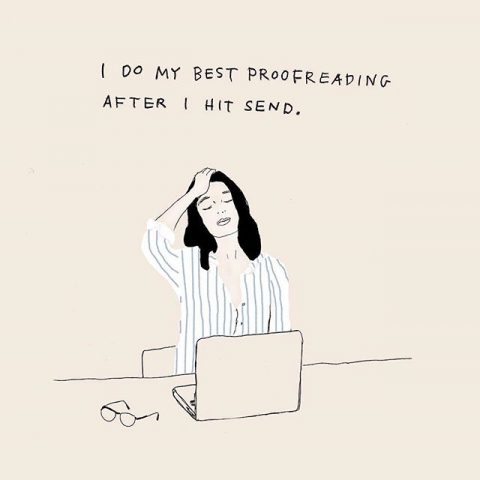
I Feel This:

by swissmiss

This made me laugh. And nod my head.

26 Apr 11:54

Announcing the 2019 Edgar Award Winners - Celebrating the Year's Best from the Mystery Writers of America

by CrimeReads

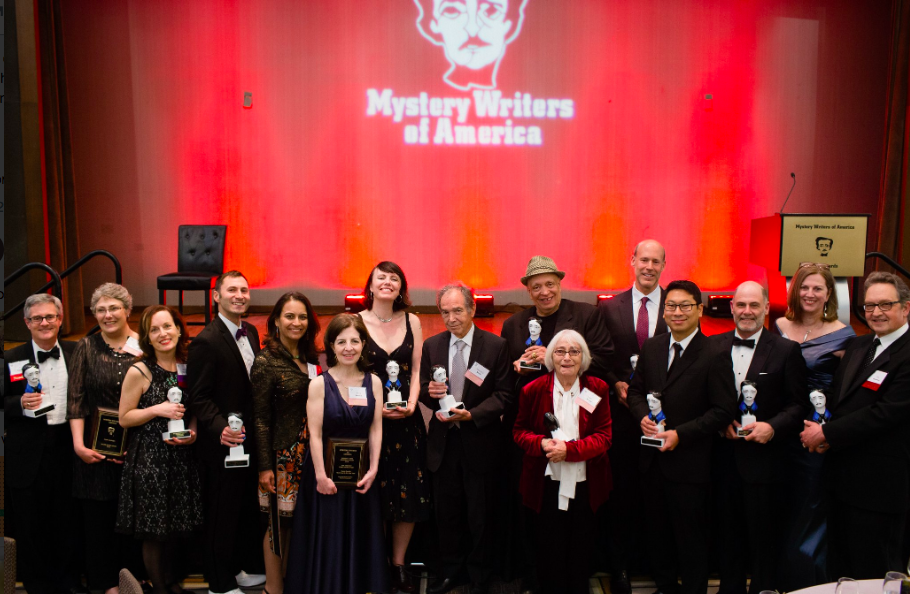
Tonight, the Mystery Writers of America announced the winners of the 2019 Edgar Awards, honoring the very best of the crime and mystery world at a ceremony in midtown Manhattan. This year’s gathering was the 73rd Annual Gala Banquet, with festivities hosted by the MWA and emceed by the one-and-only, incoming MWA President, Meg Gardiner. Past Edgar winners include Margaret Millar, Raymond Chandler, John le Carré, Robert B. Parker, Elmore Leonard, Patricia Highsmith, and many more of the legendary authors working in the field. In recent years, top prizes were taken home by Attica Locke, Noah Hawley, and Lori Roy.

Throughout the week, we’ve been discussing the biggest issues facing the crime and mystery community today as part of our “The State of the Mystery” roundtable: Part I and Part II. Now, we’re celebrating all the 2019 winners and nominees. Congratulations to the authors on their deserving work. Readers, if you don’t have their books and stories already, here’s a reminder: get to it!

The winners of the 2019 Edgar Awards.

__________________________________

BEST NOVEL

__________________________________

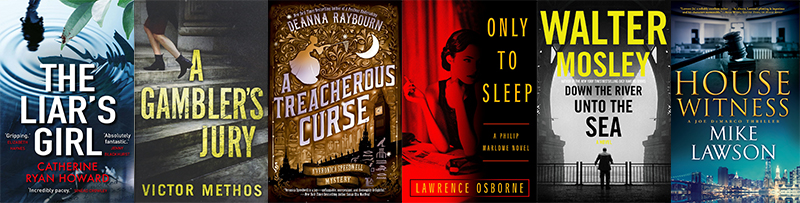
The Liar’s Girl by Catherine Ryan Howard (Blackstone Publishing)
House Witness by Mike Lawson (Grove Atlantic – Atlantic Monthly Press)
A Gambler’s Jury by Victor Methos (Amazon Publishing – Thomas & Mercer)
Down the River Unto the Sea by Walter Mosley (Hachette Book Group – Mulholland)
Only to Sleep by Lawrence Osborne (Penguin Random House – Hogarth)
A Treacherous Curse by Deanna Raybourn (Penguin Random House – Berkley)

WINNER: Down the River Unto the Sea by Walter Mosley (Hachette Book Group – Mulholland)

__________________________________

BEST FIRST NOVEL BY AN AMERICAN AUTHOR

__________________________________

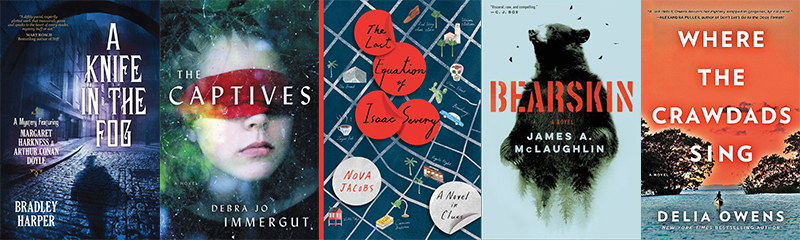
A Knife in the Fog by Bradley Harper (Seventh Street Books)
The Captives by Debra Jo Immergut (HarperCollins Publishers – Ecco)
The Last Equation of Isaac Severy by Nova Jacobs (Simon & Schuster – Touchstone)
Bearskin by James A. McLaughlin (HarperCollins Publishers – Ecco)
Where the Crawdads Sing by Delia Owens (Penguin Random House – G.P. Putnam’s Sons)

WINNER: Bearskin by James A. McLaughlin (HarperCollins Publishers – Ecco)

Read James A. McLaughlin on exploring the mysteries of the natural world.

Read Nova Jacobs on mysteries fueled by codes and puzzles

Read Debra Jo Immergut on literary novels that are actually thrillers in disguise.

Article continues after advertisement

__________________________________

BEST PAPERBACK ORIGINAL

__________________________________

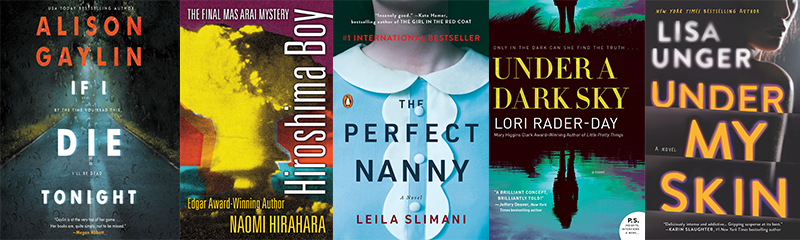
If I Die Tonight by Alison Gaylin (HarperCollins Publishers – William Morrow)
Hiroshima Boy by Naomi Hirahara (Prospect Park Books)
Under a Dark Sky by Lori Rader-Day (HarperCollins Publishers – William Morrow)
The Perfect Nanny by Leila Slimani (Penguin Random House – Penguin Books)
Under My Skin by Lisa Unger (Harlequin – Park Row Books)

WINNER: If I Die Tonight by Alison Gaylin (HarperCollins Publishers – William Morrow)

Read Naomi Hirahara on the joys and sorrows of finishing a series.

Read Lori Rader-Day on the thriving Midwestern crime fiction scene.

Alison Gaylin talks with Lisa Levy about crime fiction in the social media era.

Lisa Unger on five books in her life. 

__________________________________

BEST FACT CRIME

__________________________________

Tinderbox: The Untold Story of the Up Stairs Lounge Fire and the Rise of Gay Liberation by Robert W. Fieseler (W.W. Norton & Company – Liveright)
Sex Money Murder: A Story of Crack, Blood, and Betrayal by Jonathan Green (W.W. Norton & Company)
The Last Wild Men of Borneo: A True Story of Death and Treasure by Carl Hoffman (HarperCollins Publishers – William Morrow)
The Feather Thief: Beauty, Obsession, and the Natural History Heist of the Century by Kirk Wallace Johnson (Penguin Random House – Viking)
I’ll Be Gone in the Dark: One Woman’s Obsessive Search for the Golden State Killer by Michelle McNamara (HarperCollins Publishers – Harper)
The Good Mothers: The True Story of the Women Who Took on the World’s Most Powerful Mafia by Alex Perry (HarperCollins Publishers – William Morrow)

WINNER: Tinderbox: The Untold Story of the Up Stairs Lounge Fire and the Rise of Gay Liberation by Robert W. Fieseler (W.W. Norton & Company – Liveright)

Read Alex Perry on books essential to understanding modern-day organized crime.

Read Robert W. Fieseler on the hours leading up to the Up Stairs Lounge Fire.

Read Kirk Wallace Johnson on the world’s finest bird collection, lost to blackmail.

Read an excerpt from Robert W. Fieseler’s Tinderbox on the immediate aftermath of the Upstairs Lounge Fire

__________________________________

BEST CRITICAL/BIOGRAPHICAL

__________________________________

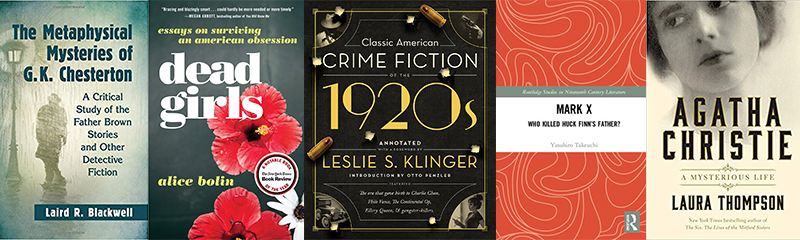
The Metaphysical Mysteries of G.K. Chesterton: A Critical Study of the Father Brown Stories and Other Detective Fiction by Laird R. Blackwell (McFarland Publishing)
Dead Girls: Essays on Surviving an American Obsession by Alice Bolin (HarperCollins Publishers – William Morrow Paperbacks)
Classic American Crime Fiction of the 1920s by Leslie S. Klinger (Pegasus Books)
Mark X: Who Killed Huck Finn’s Father? by Yasuhiro Takeuchi (Taylor & Francis – Routledge)
Agatha Christie: A Mysterious Life by Laura Thompson (Pegasus Books)

WINNER: Classic American Crime Fiction of the 1920s by Leslie S. Klinger (Pegasus Books)

Read Alice Bolin on obsession, identity, and desire

Read Leslie S. Klinger on the birth of American detective fiction.

Read Laura Thompson on the deeply human puzzles of Agatha Christie.

__________________________________

BEST SHORT STORY

__________________________________

“Rabid – A Mike Bowditch Short Story” by Paul Doiron (Minotaur Books)
“Paranoid Enough for Two” – The Honorable Traitors by John Lutz (Kensington Publishing)
“Ancient and Modern” – Bloody Scotland by Val McDermid (Pegasus Books)
“English 398: Fiction Workshop” – Ellery Queen Mystery Magazine by Art Taylor (Dell Magazines)
“The Sleep Tight Motel” – Dark Corners Collection by Lisa Unger (Amazon Publishing)

WINNER: “English 398: Fiction Workshop” – Ellery Queen Mystery Magazine by Art Taylor (Dell Magazines)

__________________________________

BEST JUVENILE

__________________________________

Denis Ever After by Tony Abbott (HarperCollins Children’s Books – Katherine Tegen Books)
Zap! by Martha Freeman (Simon & Schuster – Paula Wiseman Books)
Ra the Mighty: Cat Detective by A.B. Greenfield (Holiday House)
Winterhouse by Ben Guterson (Christy Ottaviano Books – Henry Holt BFYR)
Otherwood by Pete Hautman (Candlewick Press)
Charlie & Frog: A Mystery by Karen Kane (Disney Publishing Worldwide – Disney Hyperion)
Zora & Me: The Cursed Ground by T.R. Simon (Candlewick Press)

WINNER: Otherwood by Pete Hautman (Candlewick Press)

__________________________________

BEST YOUNG ADULT

__________________________________

Contagion by Erin Bowman (HarperCollins Children’s Books – HarperCollins)
Blink by Sasha Dawn (Lerner Publishing Group – Carolrhoda Lab)
After the Fire by Will Hill (Sourcebooks – Sourcebooks Fire)
A Room Away From the Wolves by Nova Ren Suma (Algonquin Young Readers)
Sadie by Courtney Summers (Wednesday Books)

WINNER: Sadie by Courtney Summers (Wednesday Books)

Article continues after advertisement

__________________________________

BEST TELEVISION EPISODE TELEPLAY

__________________________________

“The Box” – Brooklyn Nine-Nine, Teleplay by Luke Del Tredici (NBC/Universal TV)
“Season 2, Episode 1” – Jack Irish, Teleplay by Andrew Knight (Acorn TV)
“Episode 1” – Mystery Road, Teleplay by Michaeley O’Brien (Acorn TV)
“My Aim is True” – Blue Bloods, Teleplay by Kevin Wade (CBS Eye Productions)
“The One That Holds Everything” – The Romanoffs, Teleplay by Matthew Weiner & Donald Joh (Amazon Prime Video)

WINNER: “The One That Holds Everything” – The Romanoffs, Teleplay by Matthew Weiner & Donald Joh (Amazon Prime Video)

__________________________________

ROBERT L. FISH MEMORIAL AWARD

__________________________________

“How Does He Die This Time?” – Ellery Queen Mystery Magazine by Nancy Novick (Dell Magazines)

__________________________________

THE SIMON & SCHUSTER MARY HIGGINS CLARK AWARD

__________________________________

A Death of No Importance by Mariah Fredericks (Minotaur Books)
A Lady’s Guide to Etiquette and Murder by Dianne Freeman (Kensington Publishing)
Bone on Bone by Julia Keller (Minotaur Books)
The Widows of Malabar Hill by Sujata Massey (Soho Press)
A Borrowing of Bones by Paula Munier (Minotaur Books)

WINNER: The Widows of Malabar Hill by Sujata Massey (Soho Press)

__________________________________

SUE GRAFTON MEMORIAL AWARD

__________________________________

Perish by Lisa Black (Kensington)
Shell Game by Sara Paretsky (HarperCollins – William Morrow)
City of Secrets by Victoria Thompson (Penguin Random House – Berkley)
A Forgotten Place by Charles Todd (HarperCollins – William Morrow)
To Die But Once by Jacqueline Winspear (HarperCollins – Harper)

WINNER: Shell Game by Sara Paretsky (HarperCollins – William Morrow)

__________________________________

SPECIAL AWARDS

__________________________________

The 2019 Grand Master Award: Martin Cruz Smith

Raven Award: Marilyn Stasio

Ellery Queen Award: Linda Landrigan

25 Apr 18:56

Deborah Landau, Writing Poems For an Unsafe World

by Fran Bigman

On July 14, 2016, Deborah Landau, the poet and director of NYU’s Creative Writing Program, was on a boat in the middle of the Seine, celebrating NYU’s Writers in Paris program with a hundred students and a cluster of writers, including Zadie Smith, Geoff Dyer, and Robin Coste Lewis. Landau had made it a tradition to celebrate this annual gathering by renting a bateau-mouche, that classic Parisian tourist boat, every July 14th—Bastille Day—so students and faculty could enjoy river views of the fireworks. That particular night, the weather was clear, and the Eiffel Tower was lit up in turquoise and purple. Everyone was drinking champagne, the real kind.

Then, people’s phones started to buzz with news of an incident in Nice. Little was known, at first—someone had fired a gun into a crowd of people gathered to watch the fireworks, and then the gunman got into a truck and drove into the crowd. It seemed to be, Twitter and texts and Facebook all started to say, a terrorist attack. Looking up, Landau and her faculty and students could see a fire right behind the Eiffel Tower. Maybe, they started to think, whatever was happening in Nice was also happening in Paris. Conflicting reports poured in over social media.

Landau and the faculty tried to act reassuring among the students but gathered out-of-sight in tight, panicked knots to talk about what to do. One writer, who shall remain nameless, jumped off the boat as it sailed along near the landing. Landau was ultimately given a choice by the boat’s captain: did she want to stay out on the river, or bring everyone back to land? How was she supposed to know where they would be safest? “It was one of the scariest times of my life,” Landau tells me, and she has spent a lifetime imagining scary things. “I think about it all the time… When the mushroom cloud rises over Midtown, what are we going to do? We’re going to be walking across the Brooklyn Bridge, with our skin falling off, and where do you go and how do you keep your kids safe? You know, or on the subway and a dirty bomb goes off…”
Writers by the Seine.

Over the past 15 years, Deborah Landau has become one of America’s most compelling poets on the body, capturing its pleasures and its vulnerabilities—and their uncomfortable coexistence—in long, linked lyric sequences. Although her work has appeared in The New Yorker, The Paris Review, and The New York Times, and she won a Guggenheim Fellowship to finish Soft Targets, Landau, no fan of the limelight, may be less well-known as a poet than as the director of one of the country’s most successful creative writing programs. Since she arrived at NYU in 2007, Landau has turned a narrow, cozy townhouse on West 10th Street, the program’s home base, into a hothouse of literary talent. It’s known as the Lillian Vernon Creative Writers House after the entrepreneur, née Lilli Menasche, who came to the US in 1937 as a German-Jewish refugee and founded a purse empire with the money she received for her wedding; her financial support enabled the program to move into this building around the same time Landau started as director.

Students have classes in the house and hang out in the lounge, where there are frequent readings. Two dogs, Oscar the dachshund and Nico the Pomeranian, scurry underfoot. NYU’s program is inclusive and intimate and community-oriented, with just 24 students in each year of both the Fiction MFA and Poetry MFA classes. They take just two classes at a time: workshops and craft class. Many are taught in the evenings so those who work full-time can attend. This fall, NYU will launch a Creative Nonfiction MFA for the first time, with 12 students.

Landau has drawn together an enormously talented cadre of writers to teach in the program, including Zadie Smith, Jonathan Safran Foer, Anne Carson, Joyce Carol Oates, Nathan Englander, Terrance Hayes, Meghan O’Rourke, and Jeffrey Eugenides. Some, like Smith and Foer, find the house so cozy that they have written some of their books there. The program has produced, in recent years, prize-winning writers like Robin Coste Lewis, Ocean Vuong, Ada Limón, Solmaz Sharif, Javier Zamora, Morgan Parker, and Aracelis Girmay—and that’s just in poetry. NYU, Lewis told me, is a “poetry Hogwarts.” Recent and forthcoming fiction debuts from alums include Isabella Hammad’s just-published The Parisian, a saga of 20th-century Palestine; Ocean Vuong’s June novel, On Earth We’re Briefly Gorgeous, a Vietnamese-American family story, and Parker’s YA novel Who Put This Song On?, coming out in September, about a black teenage girl making her way in a mostly-white suburb.

Writing about the female body, as Landau has been doing, often gets shorter shrift than it warrants.

And as she has spent years nurturing the talent of others, Landau’s own work has been opened up by these encounters. She summarizes her life to me as: “Waking up, writing poems, reading poems, talking to people about poems, and then also taking care of all the students and the faculty—it’s all of a piece.” During her time as director, she has published two books of poetry: The Last Usable Hour (2011) and The Uses of the Body (2015). Her debut collection, Orchidelirium, came out in 2004. Her new collection, Soft Targets, is coming out on April 30. Each new book has garnered more praise than the last—The Uses of the Body was named one of “12 Favorite Poetry Books of 2015” by The New Yorker and one of the “16 Best Poetry Books of 2015” by BuzzFeed.

Writing about the female body, though, as Landau has been doing, often gets shorter shrift than it warrants. “It’s way easier to get up and read about the attacks on Paris or climate change than to read poems about nursing or pregnancy or sex,” Landau told me. Now that she is taking on “big” contemporary topics like terrorism and climate change in Soft Targets, is Landau finally about to get the attention she deserves? She is steeped in the subtle politics of desire and domesticity and gender; can she retain that level of nuance when she takes on issues that are often flattened out into black and white, us and them?

The book’s opening lines suggest yes:

When it comes to this fleshed neck
even a finger could do it

even a sharp stick,
a blunt blow, a fall—

my jugular
there’s a soft target

and night is a soft target
all of us within it

Osama shot dead
in his pajamas

Landau started writing poems about terrorism after the spate of attacks in Paris starting in January 2015: first after the attack on the magazine Charlie Hebdo and the murder of Jews at a supermarket, then, that November, suicide bombs at a soccer match and the point-blank shooting of people at the Bataclan theatre and nearby cafés.

These are poems for a world in which there is no safety.

Landau finished these poems, which make up Soft Targets, after the attack on Bastille Day 2016, in an intense 12-day burst—not her usual working method. These are poems for a world in which there is no safety. It opens with Landau’s fears for herself, familiar fears. But then the poem rushes outward—we, the innocent, are soft targets, but even bin Laden was a soft target to his attackers. The poems in Soft Targets keep sweeping outward, dizzyingly, from the intimacy of Landau and her “you” to the entire city to the entire world. Another of the book’s early poems follows this same trajectory:

I’m a soft target, you’re a soft target
and the city has a hundred hundred thousand softs;

the pervious skin, the softness of the face
the wrist inners, the hips, the lips, the tongue,

the global body,
its infinite permutable softnesses—

*

Landau has always written about the vulnerabilities of the body, often with an erotic charge. In Orchidelirium, she writes of her early days with the man who is now her husband: “Your legs unfold around me—right thigh where the skin ripped once, / that jagged scar a seam.” The Last Usable Hour continues to mix darkness and desire, and The Uses of the Body wins readers with its frankness about the experience of living in a female body. At a recent event at the Bowery Poetry Club, before reading from her new book, Landau gave a sense of her past work by reading a bit of a poem from The Uses of the Body:

One summer there was no girl left in me.
It gradually became clear.
It suddenly became.
In the pool, I was more heavy than light.
Pockmarked and flabby in a floppy hat.
What will my body be
when parked all night in the earth?

What is new, though, in Soft Targets is that sudden opening-out, not only of the scope of the poems, from I to you to a city to the world, but also of theme. Her previous work was about private vulnerabilities; Soft Targets is about the fragility of every body in a world of terrorism and climate change and simple, slow human mortality. It’s true that there has already been some opening-out in Landau’s work. For most of Orchidelirium, she told me, she was depicting her experiences, telling the reader, “here, watch the movie of my life” in short, stand-alone poems. Toward the end of that first book, though, she found her real form: the linked lyric sequence. The forms and the concerns of her poems grew in complexity at the same time. Maybe, she tells me, “depicting became harder to do as the story became bigger,” in particular after 9/11. The first long linked poem in her first book, the poem “Manhattan Fragments, 2001-2002,” which ends the book, talks about that day elliptically: the closest it comes in a poem of 184 lines is the two lines “the eye looks southward / expecting something solid in the sky.”

Landau reading at Shakespeare and Co.

That Tuesday morning, September 11, Landau told me, she was pregnant with her second child and dropping her three-year-old son off at nursery school downtown; they were on a bus and people started screaming, and they saw a plane hit the tower. Scenes of disaster, both remembered and imagined, run through her head, but she isn’t a narrative poet who retells a story. “I am not a depicter, not any more. I’m never writing about something,” she tells me, “I’m always writing out of something—or into something.”

That “something” has often been the frailties of the body, but in Landau’s past work that frailty has registered as a personal experience. 9/11, for example, brings back Landau’s grief over her mother’s early death from cancer at the age of 54, when Landau was not yet 30, and how in its aftermath sex felt different. But in Soft Targets, the grief, mortality, fear, and desire that thread through Landau’s work play out on a much larger scale. When talking about this new outward turn, Landau quotes poet Wallace Stevens’s idea of poetry as “a violence from within that protects us from a violence without. It is the imagination pressing back against the pressure of reality.” She never thought she would write such overtly political poems, she says, but the pressure of reality is just too much.

This pressure causes us to retreat into simplistic framings of “us versus them.” Landau, though, refuses to train her fear on any particular target. When she writes, at the beginning of the book, “and night is a soft target / all of us within it / Osama shot dead / in his pajamas,” the “us” here could mean total innocents, the intended victims of these savage attacks. But it could also mean “us” in a much wider sense, an “us” connected by a shared vulnerability.

The second poem in Soft Targets contains lines that are echoed on its last page: “O you who want to slaughter us, / we’ll be dead soon enough, what’s the rush— / and this our only world.” The tension in this “we”—we, the victims, or we, all of humanity?—animates the whole book. When I asked Landau about this line, she mockingly imitated herself trying to reason with a terrorist. “I promise you,” she said, “you don’t need to shoot me now, I’m going to be dead whether or not you shoot me in a café or not, so why don’t we make a better world while we’re here?” This hopefulness could seem facile in the work of a different poet—I am a skeptic about hopefulness—but here, here it feels earned because Landau is unflinching, not self-protective. In my twenties, I wasn’t sure how one could be hopeful while still being intelligent. In Landau’s poems, I think I begin to see the possibility of a way.

The early poems in Soft Targets are full of people fractured from each other by both fear and indifference. “The streets filled with refugees,” Landau writes, “and the French stepped over them / en route to patisseries, cafés.” One of her biggest problems, she tells me, is grappling with how one can feel happy when horrible things are happening to other people—and when they are going to happen to you, too. The end of the book is an appeal to recognized human frailty: it moves beyond terrorism to take in Landau’s mammogram, her mother’s illness, and the universality of death, no longer strictly afflicted by the terrorists on the terrorized, but on all of us by time: “Mama was a target in her transplant bed.”

*

In many stories of illness, the sufferer falls sick all of a sudden, and illness is experienced as a radical break with their previous life. Recently, there have been stories, like Porochista Khakpour’s 2018 memoir Sick, in which the writer, who found life as an Iranian immigrant in America difficult, never felt safe or invulnerable, never even felt not-sick. Landau, too, seems to have never felt a feeling of safety into which danger breaks. She grew up knowing that most of the people in her family photos had been killed in the Holocaust. Her mother’s mother, only 19, had seen where things are going and she insisted that her family leave, and they did, settling in Michigan, where Landau grew up as a third-generation survivor of the Holocaust.

Landau writes about this family history for the first time in Soft Targets, starting a section about her grandmother with the lines:

Frankfurt, 1938, Oma was a soft target
got her soft the fuck out of there

smuggled out her egg purse to become us
and so it ended and so it didn’t end

Adding to this sense of threat, when Landau was only six, her mother—a University of Michigan philosophy professor with whom Landau was very close—was diagnosed with the lymphoma that would kill her more than 20 years later. When her mother gave her a copy of Anne Sexton’s 1969 collection Love Poems—“a totally inappropriate gift for a 13-year-old,” Landau laughs—she realized she loved writing poetry. But she did not see how it could be a career. Her professor mother and nephrologist father pushed her to achieve; as a child, she had to practice the violin for an hour every day, which she hated. But Landau also pushed herself; she started dance before she was even in kindergarten, and she was in a professional modern dance company before she even graduated high school.

In college, at Stanford, Landau felt she should study physics or chemistry or computer science, or, at the softest, philosophy—being an English major, she worried, wouldn’t impress her parents. But English drew her in anyway, and after college, she moved to New York City to do a Masters in English at Columbia—and to dance. She then did a PhD in English at Brown—her focus, even then, was the frailty of the human body, and she wrote her thesis about AIDS in contemporary American poetry. Even during her PhD, she continued to perform with dance companies in New York. Becoming an English professor seemed a practical goal, one of which her parents could even approve, but Landau still hoped for a future in dance. Then one day, when she was 26, Landau fell and injured herself, and that was the end of her career in dance.

By that point, Landau had gotten married to an entertainment lawyer and was adjuncting at various NYC universities but growing tired of academic jargon. She started sitting in on poetry workshops and writing more of her own work, including “an embarrassing and graphic” poem entitled “Oral Sex,” the first she ever sent out and the first to be accepted—but which, luckily for her now, she says, never got published. But that acceptance gave her confidence, and her intense need to express herself, which had once found an outlet in dance, started to emerge in her poetry.

As Landau’s work opened out, so did her own life, as her circle of responsibility widened. In Orchidelirium, she is a young woman in the city, teaching poetry, falling in love, and then a newlywed in love who still, sometimes, desires other men. Then she has children, two sons close together, and, six years ago, an unexpected third child, a daughter (“Such a reckless act, to pop out a human / with the jaws of the world set to kill”). In 2007, she applied for a job as director of the NYU Creative Writing program. Imagine going for an interview and meeting, for the first time, a writer you’ve loved since childhood. That happened to Landau: the poet Sharon Olds, one of the program’s co-founders, was one of her interviewers. And Landau got the job.

“She has the tone of an outlaw, which is thrilling, a woman outlaw drinking gin and talking about sexuality.”

Landau inherited a thriving program, but it has gotten much bigger and better-funded under her watch, with more events and international programs. For one, Landau respects people’s time: for one, there are no meetings. Teachers just teach. “You put Zadie Smith on a million committees, that’s just a waste of her talents, right?” Landau tells me. Her willingness to consider other perspectives and ability to withhold judgment enable her to head up a democratic, creative writing center where different teaching methods and writing styles and genres coexist. “I want it to be like a dinner table,” Landau told me, “with raucous energy, everyone interrupting—everyone on each other’s side even though everyone’s so different.”

I sit in on a workshop of Jonathan Safran Foer’s in which we discuss one woman’s novel about an addict and swing into the ethics of representing addiction. “If you’re saying that almost everybody relapses,” Foer asks, “is it a disservice to highlight the exception?” Other discussions are more on-the-ground: in Meghan O’Rourke’s poetry class, we discuss how a student’s use of gerunds introduces a slipperiness of language that works well for the poem thematically. Olds does not offer criticism for the first month of the workshop, opting for description instead. In her class, “Art of the Book,” Landau has students read new and early work to expand their ideas of what poems can do, talk to the poets who visit, and write works in response.

Just as there is no one way of teaching, there is no “house style.” Instead, everyone talks about helping everyone else sound more like themselves. Landau tells me that when the admitted students visited in mid-March, one asked, “‘Do we accommodate different aesthetics?’ And I said, pointing around the room, well look, there’s Sharon and there’s Eileen Myles and also Anne Carson teaches here and also Terrance Hayes.”

With Landau at its center, the program seems to be able to do the hard work of holding together heart and head. “She’s just so smart about poetry,” Olds muses, “and it’s never a cold intelligence, always warm and alive… she is never a sentimentalizer, and her wit and irony doesn’t ever diminish anyone… She has the tone of an outlaw, which is thrilling, a woman outlaw drinking gin and talking about sexuality.”

Lewis tells me, it’s as if “the heart had a brain.” “Her intelligence is exacting,” she says, “and yet she offers it so tenderly. As women, we’re so conditioned to police our own thoughts… She was like, it’s okay to be intelligent in your poems.” Lewis adds, “I always think of Deb as like a spy or a traitor in her poems, because it’s so easy to project onto women writers and especially white blonde women writers who are nice and generous and kind like Deb. My own projections and my own racism and internalized sexism mean you don’t expect for her work to be so incredibly truth-telling about all the neurotic ways in which we fuck each other over.”

Olds describes Landau as a chronicler of now: “With Deborah, I’m right in the present moment. I’m not being pushed towards the future any faster than I naturally move, nor am I being held in the past.”

This mix of wit and sensuality pushes Landau’s work forward on the page. When Landau told me that she walks around New York reading her poetry out loud to herself to see how it sounds while pretending to be speaking into her phone so passers-by don’t think she’s babbling, I was not surprised. When she told me that she streamlines her work by imagining “the most critical, scariest person I can think of reading my poems”—a real person, but she would not tell me who—I was not surprised.

*

To celebrate the publication of Soft Targets, Jonathan Safran Foer held a party at his elegant but comfortable house. The taps in his downstairs bathroom were shaped like small birds. It was a clear night at the beginning of spring. We drank Negroni and Aperol Spritz and talked about hydrangeas and Japan and dance and astrology and psychoanalysis. We talked about the recording of books for the blind. Sharon Olds told me she once recorded audiobooks for blind Catholic girls and, concerned they would never learn about sex otherwise, slipped in a few Philip Roths. It was a delightful party, and now Landau was being asked to read poems about terrorism and climate change and death. “It’ll be such a buzzkill,” she protests.

Her reading from Soft Targets is about terror attacks and illness and environmental doom and the end of America and the end of the world. Ever mindful of the feelings of others, though, Landau ends her reading on a note of hope, the same way she ends her book. She reads us its closing lines:

O you who want to slaughter us, we’ll be dead soon enough what’s the rush
and this our only world.
Now bring me a souvenir from the desecrated city,
something tender, something that might bloom.


The preceding is from the Freeman’s channel at Literary Hub, which features excerpts from the print editions of Freeman’s, along with supplementary writing from contributors past, present and future. The latest issue of Freeman’s, a special edition gathered around the theme of power, featuring work by Margaret Atwood, Elif Shafak, Eula Biss, Aleksandar Hemon and Aminatta Forna, among others, is available now.

24 Apr 17:53

montgomery county is finally talking about its segregated schools. but can we fix them?

by Dan Reed
Montgomery County’s public schools are growing, and they’re also growing more segregated by race and class, which is hurting student performance across the board. As the county struggles to address these issues, a debate is raging about who belongs in our community, and who gets to benefit from its resources.

Students, parents, teachers, and community members filled the cafeteria at Walter Johnson High School in Bethesda for last night's boundary study meeting. Photo by Mike H, all other photos by the author.
In January, the Montgomery County Board of Education hired a consultant to look at the catchment areas for each of the county’s 200-plus schools with a focus on diversity. Like the District, Montgomery County Public Schools hasn't done a county-wide boundary study in decades, due to resistance from parents who don't want their kids' school to change. (This often has to do with the relationship between school reputation and property values.) As a result, the Board of Education redraws boundaries rarely, like when a new school opens.

With the boundaries largely stuck in place, the majority of the county’s minority and low-income students have become clustered in East County and the Upcounty, while schools in the wealthier west side of the county remain predominantly white. Schools where enrollment is rising sit next to schools with hundreds of empty seats.

To avoid redistricting students to a "less desirable" school, MCPS has planned multi-million-dollar additions at Whitman and Bethesda-Chevy Chase high schools. Meanwhile, a few miles away at Springbrook High School, which has nearly four hundred empty seats, MCPS is taking away teachers because there aren’t enough students.


Whitman High School
Whitman High School in Bethesda, which has almost no black or low-income students, will get a $24.5 million addition.
Segregation makes MCPS as a whole worse

As education researcher (and former MCPS parent) Rick Kahlenberg notes, segregated schools actually cost the public more to fix all of the other problems it creates. For instance, the county has limited construction funding, but we’re building new classrooms when (at least in some cases) we have empty space that we could use.

Segregation also exacerbates the county’s persistent achievement gap, or disparity in academic performance between black, Latinx, or lower-income students and their white, Asian, or higher-income counterparts. When wealthier families concentrate their resources in a handful of schools away from everyone else, that puts increasing pressure on the school system to provide for students with greater needs elsewhere—and we can see that in the school system's declining graduation rate, or falling test scores. Students also benefit from exposure to people different from them, reducing the likelihood of this recent nonsense at Churchill High School in Potomac.

After years of denying that segregation was even happening, school officials now acknowledge that it's harming student performance. "When you ask people what the best school district in the state is, everyone says Montgomery County, but looking at the data, that hasn’t been true for a while," MCPS spokesperson Derek Turner told Bethesda Beat.

People are mad

Montgomery County Public Schools is holding four community meetings this month to discuss *the idea* of redrawing boundaries, and some parents have come out in force against it, claiming that MCPS will bus "kids to under-resourced schools all the way across the county." A few parents have said some pretty awful things about minority and low-income students in order to defend their property values. From Bethesda Beat:
  • “They won’t be able to keep up and they won’t study."
  • "White families are being punished for 'working hard and doing well and choosing to live in a certain community.'"
  • "It’s not our fault those children don’t have opportunities. You can’t put that burden on us.”
I attended the last of the four meetings last night, at Walter Johnson High School in Bethesda, and had a pretty pleasant and civil conversation, which I'm grateful for. But what we're heard echoes the county's attempt last year to open up its gifted and talented programs to more students of color, which got a lot of resistance and resulted in a federal complaint against MCPS. This time, however, the school system has pushed back against this language: Superintendent Jack Smith recently asked parents to "talk about students respectfully."

But it's high school students, by and large, who have led the fight for redistricting, as they have in the past for the achievement gap. Student member of the Board of Education Ananya Tadikonda originally proposed the boundary study, and a group called MoCo Students For Change has been active both online and at community meetings. At a recent student-organized meeting on the boundary study, one vowed to "make the adults understand" the harm that a segregated, unequal school system is causing.

To deal with school crowding, Montgomery County will try to stop people from moving here

Meanwhile, starting in July, the county will stop approving new homes in a large swath of the county, including Takoma Park, Silver Spring inside the Beltway, Wheaton, Bethesda, North Bethesda, and parts of Olney. It’s called a “moratorium,” which the county has to impose if a school’s enrollment is greater than the number of students officials say the school can hold.

The affected school catchments—James Hubert Blake, Albert Einstein, and Walter Johnson high schools—will join Montgomery Blair High School, Northwood High School, and Ashburton Elementary School, whose catchments went into moratorium last summer. The areas affected include the small handful of Montgomery County communities that are actually growing, such as urbanizing areas near the Red Line and close-in areas with sought-after schools where home prices are rising.

School Bus at North Bethesda Market
A school bus stops outside an apartment building in White Flint, one of the areas where new homes will be banned due to rising enrollment.

For years, both the Montgomery County Planning Department and MCPS itself have said that, according to student addresses and tax records, most new students are coming from turnover in existing homes—that is, older people selling their homes to young families, not new construction.

County executive Marc Elrich rejects this data, as well as some parents who echo the dog-whistle comments parents have made at the boundary study meetings. One parent in North Bethesda told WAMU’s Ally Schweitzer that she supports the moratorium because students in “those rentals or condos or whatever they were” were filling up her child’s school.

Typically, the county lifts a moratorium by finding more school capacity, usually by scraping together the money for a new building or addition that would be built in the next several years. In practice, this means the school system simply shuffles construction projects around the queue, meaning that schools with significant needs can wait for years while other schools move ahead.

The other way a moratorium can end is by redrawing boundaries, so that another school can absorb the increase in students. Thus, the county’s boundary study could help end the moratorium, while addressing segregation in both our schools and our neighborhoods.

We have the facts and we’re [not] voting yes

I grew up attending Montgomery County Public Schools, and one thing that was constantly drilled into my head was that we have the best schools in the country, and thus everything here is the way it's supposed to be. As a person of color, I saw firsthand how toxic this message was: If you're not keeping up, it can only be your fault.

We live in one of the most affluent, prosperous places that has ever existed in human civilization, and but we use this mindset to deny access to anyone perceived as "not keeping up": Who gets to live in their community, who gets to use a public street, who gets to attend a public school, and which schools get resources. And that's reflected in the county's practices of not redrawing boundaries, and not allowing new homes near “good” schools when they get too “full.”

However, these policies simply make our schools worse for everyone—more crowded, more unprepared to educate all students, and more of a burden on taxpayers—which only encourages wealthy families to further hoard their resources and scapegoat less fortunate families who work just as hard, if not harder, to build a life here.

We know that students from low-income backgrounds perform well in socioeconomically diverse schools, because the biggest study done on that topic happened right here in Montgomery County. We know that students from middle- and high-income families do well in diverse schools, while benefitting from the crucial exposure to people with different life experiences.

And we know we have the tools to make this happen, among them redrawing school boundaries, and getting rid of the moratorium, which doesn’t actually address the problem it’s meant to solve. Can we rise to the occasion and be the progressive community we claim to be? Or are we going to uphold a status quo in which only a wealthy few benefit from all our community has to offer?
08 Apr 18:29

Bright Lights, Big City, New Bookstore

by Matt Grant

The first thing you notice as you walk into Brooklyn’s brand new Center for Fiction, which opened in February, is the bookstore. 1,800 square feet of floor-to-ceiling windows, all stacked to the brim with works of fiction, along with a café for wine, coffee, tea, and a quick bite while surrounded by books.

Benjamin Rybeck is a bookseller from Houston who moved to Brooklyn be a part of the new Center. “I came into bookselling a little bit by surprise, which I feel like a lot of people do,” he says. “It has a way of just kind of sucking you in.” Originally from Maine, Rybeck lived received an MFA in Creative Writing and taught Creative Writing in Tucson, Arizona before settling in Houston in 2014. “I happened to wonder into Brazos Bookstore there one day, and they were looking for some help.”

Since he didn’t know anyone in Houston and was looking for a community, Rybeck found one at Brazos. “I sort of just fell into the store,” he says. He started working part-time, helping with events as the Events Coordinator and Marketing Director. “Before I did that, I had no idea there was an industry as large as bookselling,” he says. “Bookstores were always just little shops on the corner to me, and I had no idea of the scope of them and the power that they have.”

When the general manager moved on a few years later, Rybeck took over as manager. “It’s a real crash course in how bookstores work when you’re just kind of thrown in and you’re learning on your feet a little bit, but I can’t imagine any other way to do it,” he says. 

My boss there, Jeremy Ellis, was a great mentor to me, and when he left the store, I was honored to follow his lead and take the general manager position. Still, as much as someone can show you about bookselling, you don’t really know what you’re doing until you’re doing it. It’s like that with most things, probably. The nature of small business is that they often set their own path—there’s no one way to do something. So I just found myself diving into the business and learning so much—often on the fly—about inventory, marketing, events, buying, financials, HR, you name it.

While at Brazos, Rybeck started hearing rumors of the new Center for Fiction being built. “The prospect of it excited me, because I’ve always been a fiction reader myself,” he says. In Houston, Rybeck helped Brazos maintain a major focus on independent presses, translated literature, and debut authors. “I’ve personally always had a real affection for debut writers, emerging writers, young writers—because I think there’s a lot of exciting work being done there,” he says. “The Center’s commitment to supporting the careers of writers, and finding young writers and promoting them, and also shining a spotlight on books you might necessarily find other places in presses you might not necessarily find other places, it just felt very exciting to me as a place to be.”

“It might seem like an obvious thing to say, but you’re in the heart of publishing here.”

“I feel lucky to have landed here,” he adds. 

Rybeck didn’t get a lot of downtime to explore all Brooklyn has to offer before the work began. “I hit the ground here in New York January 5th and had a day to unpack, and then January 7th was my first day here,” he says.

His second day, the first giant order of books come in. “I think that the bookstore in the course of that month was based in four different locations in the center,” Rybeck says, laughing. “We just kept moving into rooms and unpacking books and then storing them, and then moving somewhere else and unpacking and then storing them.”

It’s nice to be at the Center now, with a great team in place, and a wonderful executive director in Noreen, who really has a vision for the space and wants to create something grand and beautiful. And of course the Center has a long, rich history—but is still eager to evolve. It’s an exciting time, and it allows for me to focus squarely on the retail and merchandising sides of the bookstore—my favorite parts!

With the move came some significant changes. “It might seem like an obvious thing to say, but you’re in the heart of publishing here,” he says. “If you’re selling books in Minneapolis, then your local publishers that you might support are Graywolf and Coffeehouse. If you’re selling books in New York, your local publishers are Penguin Random House.”

There are more means of access and more ways to stay connected to the bookselling community as well. “Houston had some wonderful bookstores, but there weren’t that many. New York of course, there’s wonderful bookstores everywhere.” Another big difference is the access and visibility that bookstores in a walking city enjoy. “We’ve been open for five days now in our soft opening phase, and we’ve had people in all the time, and they are finding out about us just because they’re walking by.”

In Houston, you have to create a destination store and do a lot to get people to come to you. And here people are just streaming by. Rybeck doesn’t think that having only fiction is limiting.

“The amount of stories that you see across novels—you can go anywhere with fiction. Fiction is often just as rooted in the real as nonfiction.” He indicates the table behind him. “As a fiction reader, just buying stuff on that table, I can travel from Germany in the 1940s to contemporary Nigeria to New York apartments in the 1960s. You really are a time traveler when you’re a fiction reader. I don’t think a focus on fiction is limiting at all. I’m always shocked to see the expansiveness of the genre and what is offered when you look at all the fiction that is coming out at one point in time.”

Writing’s not easy. That’s why we need places like the Center for Fiction.

In the building, Rybeck is a particular fan of the Writer’s Studio. “I can’t wait to see that room filled with writers working on the books that then in a few years will be out and will be down here in the store. There’s such a rich history of the center supporting young writers and providing them with a space to do their work.”

As far as the bookstore, Rybeck is trying to go with the same feeling he gets from any bookstore. “Any bookstore that I go into, I want to see the stacks, I want to see what’s up front, because that’s where the personality is really going to be. And one of the things that I love about this bookstore is, it is packed with books and it still feels spacious. You can just sort of explore this floorplan.”

Rybeck says every day he goes into the store he likes to wander between two large tables that sit out in the middle of the store. One boasts new paperbacks and the other new hardcovers. “It’s just beautiful to come in and see a world of fiction in front you—fiction at a glance, fiction at a snapshot of the present moment of fiction. I think one of my favorite things to do when I come in here is just walk through those tables, and look at the books on either side of me, and see that scope of what literature is at the moment.”

At Brazos, Rybeck says he always thought about what brings people to independent bookstores. “It’s not like walking into an Apple store, or buying a widget for your phone or something like that. Sometimes customers come in and they know what they’re looking for, because they read about the new Valerie Louis Ellen book or the new Thomas Mallon book or whatever, and they’re just excited to be part of that conservation. But I’ve always found that just as often, customers are coming into a bookstore because they don’t know what they’re looking for. And they don’t know what they’re going to find. And that is an exciting way to engage with literature.” At the CFF’s bookstore, Rybeck says any fiction lover can look forward to a selection of fiction that will feel like a dream for anyone who reads fiction or loves reading fiction.

As a writer, Rybeck says his experience has given him a deep respect for the process of book making, from concept to final product. “You look around at all of these books that are in this store right now, or in any store, and you see people’s time and people’s energy and people’s emotional investment. And all of these books were the most important thing in the world to the writers who were working on them.”

Because of this, Rybeck sees bookselling as a humbling profession. “You’re honoring that work. You are putting it up front for people to look at and people to see and people to buy, and you’re like the last step in the writer’s process to finally get that work out there.”

“I have a deep respect for that, in part because I know how hard it is. Writing’s not easy. That’s why we need places like the Center for Fiction, that have resources and help writers from the earliest possible stages. It really is tracking the entire process of what it means to be a writer, and creating resources every step of the way.”

08 Apr 18:25

How Did Conspiracy Theories Come to Dominate American Culture?

by Thomas Milan Konda
conspiracies

Americans see hoaxes and plots everywhere: from climate change to immunizations to almost anything having to do with Hillary Clinton. But why? Is the constant stream of conspiracy theories a side effect of social media? Are conspiracy theories a product of the increasing polarization of politics? Or have they always been around and for some reason we just notice them more now?

We can start to answer the last question: in their modern form, they have been around for at least two hundred years. The United States was less than ten years old when New England religious leaders sounded the alarm about the Illuminati’s plans to destroy the republic. And this was only the beginning.

In 1831, the Anti-Masonic Party held the first national political convention. Perhaps predictably, speeches there were peppered with conspiratorial rhetoric about Freemasonry. Before inventing the telegraph, Samuel Morse gained fame by warning that the Austrian emperor had orchestrated a conspiracy to undermine the world’s greatest Protestant republic by flooding America with Catholics. By the end of the 19th century, free-silver populists were portraying their economic plight as the result of a British (and often Jewish) banker conspiracy.

By the end of World War I, conspiracy theories began to have more staying power. The lasting menace of Bolshevism-socialism-Communism contributed to a certain constancy of conspiratorial thinking. At the same time, the idea of the “International Jew” (largely the creation of the fraudulent Protocols of the Learned Elders of Zion) gave rise to a series of antisemitic conspiracy theories that have still not run their course. America’s turn toward international involvement powered conspiracy theories from isolationists and “America Firsters.” The growing presence of the federal government—Wilsonian progressivism, FDR’s New Deal, Lyndon Johnson’s Great Society—fueled another array of conspiracy theories: federal support of civil rights was said to be part of a conspiracy against the white race; federal reorganization schemes were said to be part of the conspiracy to destroy the states. And, of course, the Kennedy and King assassinations contributed their share of conspiracy theories.

But the term “conspiracy theory” has been so poorly defined and so loosely used as to become useless, if not actually misleading.

So, yes, there have been conspiracy theories all along. But there is also something new that has transformed the conspiratorial landscape: conspiracism—a mental framework, a belief system, a worldview that leads people to look for conspiracies, to anticipate them, to link them together into a grander overarching conspiracy. Conspiracism has been building for some time, and by now it appears to have emerged as the belief system of the 21st century. Its adherents range from people who are beside themselves with conspiratorial rage, such as radio-show host Alex Jones, down to everyday people who are reluctant to have their children immunized because they accept vaguely conspiracist claims about vaccines. While many analysts believe that social media have accelerated conspiracism’s growth, the reason for its prominence is still an open question.

*

Problems of Definition

Conspiracists—that is to say, those whose belief system is conspiracism —have a predilection, perhaps even the need, to see conspiracies behind events, and not just major events such as the Kennedy assassination or the 9/11 attacks, when doubt and suspicion are widespread. Conspiracists consistently find conspiracies where others do not. For example, the creation of non-binding recommendations for sustainable growth at the 1992 Rio Earth Summit was a thoroughly routine event, but many conspiracists view what they call Agenda 21 as the work of “global Communism,” or part of an evil plot to “have 90 percent of the world’s population murdered by abortion and aborting life by disease, famine, wars, wrecking of the economy, industry, technology, giving vaccines and medicines which give a slow death.”

Even more prosaically, while the introduction of bar codes in 1974 barely qualifies as an event, religious conspiracists continue to warn that “those black lines on every product you buy!” signal a satanic conspiracy. There need not even be an event to inspire conspiracist thinking. The contrails of jet aircraft crisscrossed the skies for decades as a nonevent before conspiracists began to claim that they were really “chemtrails” secretly laced with “pathogens, chemicals, and fungi” by the government to poison or stupefy the citizenry.

In 1965, historian Richard Hofstadter wrote that the “distinguishing thing about the paranoid style is not that its exponents see conspiracies here and there in history, but that they regard a ‘vast’ or ‘gigantic’ conspiracy as the motive force in historical events.” It may not be necessary to go quite this far. People can compartmentalize their thinking and hold conflicting ideas associated with different belief systems. Nevertheless, conspiracism as a belief system is generally very broad and influences its adherents’ thinking across many subjects.

Conspiracism is also distinctive as a belief system for two reasons. First, it is inherently negative. Conspiracists fear and oppose the conspiracies they envision, because those conspiracies are invariably aimed at destroying their way of life. Hence, the struggle against the unending stream of Illuminati, Zionists, forces of Satan (or Lucifer), mind controllers, and the global elite ensconced in its many secret societies. Second, conspiracism as a belief system lends itself to obsessiveness. Conspiracists seem much more aware of their belief system than most people are, leading them to consciously apply it to events on a daily basis.

The manifestation of conspiracism is, of course, the conspiracy theory. In principle, the idea of conspiracy theory seems straightforward, and most people think that they would recognize one without difficulty. But the term “conspiracy theory” has been so poorly defined and so loosely used as to become useless, if not actually misleading. Some research has confounded conspiratorial beliefs with beliefs that are merely unconventional or about offbeat topics such as the prophecies of Nostradamus or the curse of Tutankhamen.

Worse, people have been counted as adherents of conspiracy theories on the basis of their views about normal historical incidents such as John Brown’s raid on Harper’s Ferry or the charges that Anita Hill and “others” brought against Clarence Thomas during his Supreme Court confirmation hearings. An early study of conspiracism among African Americans in the South concluded that they had “a surprisingly strong belief in most conspiracy theories involving government. Over 85% of respondents agreed or strongly agreed that African Americans are harassed by police because of their race and that the criminal justice system is not fair to Blacks.”

Using such commonplace observations about racism in society as evidence for conspiracist thinking can only undermine research. More recently, a much noted 2013 survey conflated non-conspiratorial questions about politics with ones about space aliens, Bigfoot, and whether Paul McCartney died in the 1960s.

Using such commonplace observations about racism in society as evidence for conspiracist thinking can only undermine research.

In the last few years, some researchers have criticized loose or misleading definitions of conspiracy theory and made serious efforts to come up with good measures of conspiracy ideation. Such academic and professional efforts have not filtered into the popular press or the internet, however, and the 2016 presidential campaign brought about a resurgence of the problem. A story about Republican complaints over the possibility of the Federal Elections Commission’s opening the presidential debates to third party candidates was headlined as a “GOP conspiracy.” A sermon about religious persecution given by presidential hopeful Ben Carson to a congregation of his fellow Seventh Day Adventists was depicted as his “Satanic Sabbath persecution conspiracy.” AlterNet created “The Definitive Donald Trump Conspiracy Guide,” a messy list of 58 simple accusations (e.g., that Bill Ayers had ghostwritten Obama’s memoir), speculations (Trump’s 2012 musing about Obama’s strategy for reelection: “Looks like he’ll have to start a major war or conflict to win. Don’t put it past him.”), and random claims (27–35 percent of Muslims “would go to war” with the United States). That Trump believes these things may be important, but lumping them all together under a conspiracy theory heading only clouds the issue.

*

Conspiracism Rebounds

Conspiracism is about 100 years old. The Protocols of the Learned Elders of Zion began to be circulated outside Russia during the Bolshevik Revolution, and very shortly thereafter Nesta Webster published her first conspiratorial books. Over the decades, conspiracism evolved and branched out into different versions, from the secret government/hidden hand to mind-controlling psychopolitics to shape-shifting human-reptilian hybrids posing as our political leaders. During the last few years, conspiracism has become so embedded in the popular mind that the once-menacing Illuminati has become a punchline. Websites filled with photographs of celebrities making triangular hand gestures or of crackpots with photoshopped tinfoil hats define the weird end of conspiracy theory for most people. The more serious side of conspiracism in the 21st century was first defined by the 9/11 attacks and the obsessive “truther” conspiracism that followed them. By the time that burst of conspiracism faded, the election of Barack Obama brought the racist right-wing conspiracism that lurked beneath the surface to prominence in American politics.

In keeping with the improvisational nature of modern conspiracy theorizing, other ideas have been merged with the standard new world order conspiracy

Despite the panoply of different conspiracy theories that arose between Nesta Webster and 9/11, none has wholly disappeared. In part, this is because the technologies of social media have made it easy to rekindle and spread any conspiracy theory. The dominant strand of conspiracism—the continuum from secret government to hidden hand to one-worlder to new world order—continues to be widely propagated, with perhaps an infinite number of subtle variations. Texe Marrs, for example, promotes a basic Zionist conspiracy with roots in the Kabbalah. Herbert G. Dorsey III recycled Webster’s thesis with particular emphasis on the Knights Templar. Miguel Bruno Duarte’s “shadow government” is primarily the work of the Illuminati, with Communist and Freemasonic support.

Deanna Spingola focuses solely on the Rothschilds. David Allen Rivera provides an apocalyptic end-times interpretation. And Doc Marquis offers an occult version in which the Protocols were created by the Illuminati to discredit the Jews while the Illuminati establish Satan as “their Masonic Christ.” There are many more.

There is hardly a topic that contemporary conspiracists have allowed to disappear. Ellen McClay devoted her 2008 talk at the National Conference on Private Property Rights to the rise of UNESCO. Fundamentalist David Stewart, in his attack on evolution, brings back the specter of G. Brock Chisholm, Canadian psychiatrist and head of the World Health Organization until 1953. Conspiracy theorist Jennifer Lake was still fighting the polio vaccine conspiracy in 2008; Charlotte Iserbyt extolled the merits of the 1953 Reece Committee hearings on philanthropic foundations in a 2011 Alex Jones interview. Long-time John Birch Society member Alan Stang explained once again that Franklin Roosevelt “arranged” the attack on Pearl Harbor. And Glenn Beck generated some blowback by promoting Elizabeth Dilling’s 1934 Red Network as well as the works of the intensely antisemitic Eustace Mullins.

In keeping with the improvisational nature of modern conspiracy theorizing, other ideas have been merged with the standard new world order conspiracy. Jüri Lina interprets the Illuminati’s overthrow of czarist Russia within an astrological framework, while David Allen Rivera’s two-and-a-half-hour PowerPoint presentation explains his apocalyptic conspiracy using the movie The Matrix, and P. D. Stuart explains how the American Revolution turned the United States into “a Jesuit enclave.” Alex Christopher’s “ultimate ‘Unseen Hand’” behind the Illuminati turns out to be the railroad industry, a fact Christopher learned from a man who had actually “participated in the organizational plans for the ‘New World Order.’”

For Christopher Jon Bjerknes, the entire Zionist conspiracy centers on Albert Einstein. Conspiracists from across the decades have been cited and their ideas recycled. Charlotte Iserbyt “suspects” that she owns the only surviving copy of the American Historical Association’s 1934 Report of the Commission on Social Studies, which lays out the “plan for a Socialist America.” (She does not.) Both Miguel Duarte and David Rivera bring back the same misinterpretation of Carroll Quigley’s work that led Quigley to sue right-wing conspiracists in the 1960s. And Jüri Lina buys Major General Count Cherep-Spiridovich’s claim that German chancellor Bismarck was aware of the Jewish hidden hand conspiracy to assassinate Lincoln and tried to thwart it.

Other conspiracies have survived as well, although some now have seemingly few followers. Conspiracy theories having to do with health, medicine, and nutrition held their own or even gathered momentum in the early years of the century. Conspiratorial ideas about HIV/AIDS, for example, showed no sign of fading away, and every subsequent epidemic, right up to the Zika virus, has generated suspicions ranging from Big Pharma’s profiting on death to new world order population control. Similarly, the conspiracism that led to widespread suspicion of vaccines (primarily measles, mumps, and rubella vaccination, but with spillover effects) continues to have a great many casual adherents. Other health threats have had their ups and downs. The conspiratorial end of the opposition to genetically modified foods seems to be holding its own. The view that chemtrails exist and are part of the plan to kill off or stupefy millions of people is riding high at present. But the cancer threat posed by electromagnetic fields near power lines and even fear of the mind-controlling High Frequency Active Auroral Research Program (HAARP) have faded considerably.

__________________________________

Reprinted with permission from Conspiracies of Conspiracies: How Delusions Have Overrun America, by Thomas Milan Konda, published by the University of Chicago Press. Copyright © 2019 by the University of Chicago Press. All rights reserved.

08 Apr 18:22

The Farmworkers Who Pick Your Halo Mandarins Just Organized a Massive Labor Strike

by Sam Ribakoff

The sun is setting on the east side of Bakersfield, California, as Salvador Calsadillas sits down with his cousins and their kids for a dinner of caldo de mantarraya, a hearty stingray and tomato stew, a specialty of the coastal regions of the Mexican state of Sonora. Calsadillas and his family are from Oaxaca, further south in Mexico, but like many others, they moved to Bakersfield looking for work.

Bakersfield is the entryway to California’s 450-mile-long Central Valley, the site of a sprawling $50 billion a year agriculture network that produces more than one-third of the country’s vegetables and two-thirds of our nuts and fruits. Calsadillas and his family are farmworkers—essential parts of that huge commercial network, although their pay and working conditions don’t reflect how central they are to the industry.

Calsadillas and the three other adults around the table worked for The Wonderful Company, one of the largest agriculture businesses in the entire state, if not the country. The privately held company grows, harvests, packages, and bottles an array of products through a number of subsidiary companies, including Wonderful Halo mandarin oranges, Sweet Scarletts grapefruits, Wonderful almonds and pistachios, Fiji Water, POM Wonderful pomegranate juice, and Landmark wines.

The company, which recorded a profit of $4.2 billion last year, frequently touts its philanthropic ventures, social responsibility, and investment in “ the communities where our employees live and work.” These include nutritional programs designed to keep the workers in some of their operations healthy and charter schools with a curriculum co-designed by one of the company’s owners.

Those owners, Stuart and Lynda Resnick, say they’ve spent $50 to $80 million on philanthropic efforts (not all of it in Central California), and tout themselves as progressive Democrats, but critics have alleged that their philanthropy in the Central Valley only started after a 2011 article about the living conditions of Wonderful farmworkers in the town of Lost Hills ran in Earth Island Journal. (The Wonderful Company declined to comment for this article.)

“[They are] truly the top 1 percent wrapped in a green veneer, in a veneer of social justice,” is how Barbara Barrigan-Parrilla of Restore the Delta described Wonderful to Mother Jones. “If they truly cared about a sustainable California and farmworkers within their own community, then how things are structured and how they are done by the Wonderful Company would be much different,” she added.

On January 11, 2019, the company announced, through its contractor field supervisors, that it would reduce farmworkers’ pay by 12 percent. In response, about 1,800 nonunionized farmworkers, the majority of whom were undocumented, spontaneously walked out of Wonderful’s citrus fields outside of Bakersfield. The workers, including the men and women sitting around Calsadilla’s dinner table, joined what became one of the largest non-unionized, undocumented labor strikes in recent history, and one of the largest farmworker strikes since the heyday of the United Farm Workers (UFW) in the 1960s and ‘70s.

Wonderful Company workers striking. (Photo courtesy of Alerta Campesino U.S.A.)

Wonderful Company workers striking. (Photo courtesy of Alerta Campesino U.S.A.)

Through four days of protests at the edge of the fields, the workers—with assistance from UFW—not only won their wage rate back from one of the largest and most profitable corporations in the country. They’ve also begun to expose a predatory and mostly under-the-radar farm labor contractor system, and they’re part of a larger effort to revitalize and empower workers in the food system.

A Pay Cut and a Walkout

Calsadillas is in his early 30’s, but his peach-fuzz mustache, snapback hat embroidered with the California state flag, and frequent bright smiles make him seem like a carefree teenager, not a man who has worked one of the most dangerous and backbreaking jobs around for years.

“I’ve worked in warehouses, construction, and other jobs, but none of them have been as difficult as farm work,” he says. “We are the ones who provide the fruits and vegetables to grocery stores, restaurants, homes, and all sorts of places. A lot of people don’t think of that. They’re in their own world.”

The strike centered around the workers that pick Wonderful’s mandarin oranges. The fruit’s mascot—the product of a $100 million advertising campaign launched in 2014—is a beaming animated clementine with a glowing, golden halo which appears in grocery stores in pastel blue crates suggesting that they fall effortlessly into the hands of eager farmers. But Salvador knows first-hand that the harvest is far from that.

He describes climbing a ladder to the tops of tall, flimsy trees to gather fruit, a task made more dangerous during the winter, when strong gusts of cold wind rush through the valley. The final straw came when his supervisors announced early on the morning of January 11 that the rate their pay would drop from $53 to $47 per bin of fruit, which take about four hours to fill.

“’Excuse me, but this is a joke,’” Alan Estrella Garcia, another farmworker who was in the Halos fields the day of the announcement, recalls thinking. “The moment they found out about the new rate, everyone got upset and left. We united and began to ask for a fair wage.”

About 1,800 workers walked out of the fields that day, protesting and posting pictures and videos to social media sites. In one video, Salvador and other protesters, flanked by posters and flags, announce their solidarity with the United Teachers Los Angeles (UTLA) teachers union strike that was taking place that same week in Los Angeles.

“They [were] given more students per classroom; it’s like getting a decrease in salary. We felt connected to them since we were going through similar struggles at the same time,” Salvador explained.

UFW flags are prominently displayed in the video, and some of the striking workers had been involved in UFW actions in response to other companies, but neither Halos nor any other Wonderful subsidiary had any ongoing unionization efforts. When the strikers walked out of the fields that day, multiple people contacted the UFW for support, in hopes of protecting themselves against foremen and supervisors who threatened to call the U.S. Immigration and Customs Enforcement agency (ICE), to deport undocumented strikers.

“So many of us have families,” says Garcia. “If [we] are not documented and suddenly ICE shows up, what happens to [our] kids? I was worried, but my feelings of discontent were greater than my fears and worries. That is why I joined my coworkers.”

The union ended up providing temporary protection for the workers. Salvador says he believes that the contractors and the company afforded them more respect in the process once they knew that the UFW was on their side. The union also helped with outreach and contacted local media about the strike.

(Photo courtesy of UFW)

(Photo courtesy of UFW)

The farmworkers union, co-founded by César Chávez, Dolores Huerta, Larry Itliong, and Philip Vera Cruz, has won access to clean drinking water, bathrooms, health care, and wage increases for thousands of farmworkers since the 1960s. But for years in its beginning had an often uneasy relationship with undocumented immigrant laborers.

José Z. Calderón, professor emeritus of sociology and Chicanx/Latinx studies at Pitzer College, is a former organizer for the union. He says that there were instances when the union attempted to reach out to undocumented farmworkers in the 1960s and 70s, but that the union originally considered undocumented farnworkers as “scabs”—laborers who were “being used by the federal government, the growers, and these middle men,” to break UFW strikes by being brought in to work in the fields while UFW members held the picket lines. But he adds that the union’s approach has evolved.

Eventually, says Calderón, the UFW began to organize undocumented laborers as they became the majority of the farm labor workforce, especially in the wake of the Immigration Reform and Control Act of 1986. He adds, “the union is doing everything possible to make no distinction between resident and immigrant workers now, and they’re still organizing in pockets throughout the state, institutionalizing those changes that people take for granted.”

Using Contractors to Dodge Accountability

The Halo processing and packaging plant outside of Delano, the town where both Wonderful and the UFW started, is one of the biggest plants in the world, processing over 19 million fruits a day.

In December 2018, a month before the strike, Wonderful announced that it planned to raise the minimum wage for direct-hire workers to $15 an hour, which came just a month before California’s historic law requiring farmworkers be paid overtime began to go into effect. But Calsadillas doesn’t work directly for Wonderful, nor does anybody else he was sharing dinner with; they all work for a third-party labor contractor employed by Wonderful.

(Photo courtesy of UFW)

(Photo courtesy of UFW)

“The company doesn’t hire people directly; they hire contractors, and the contractors are in charge of hiring the farmworkers,” Calsadillas says. “If somebody gets hurt, the company does not want to be associated with that; [it] wants to protect its image and brand.”

Big farms can choose from a plethora of contractors to supply them with laborers and as a result, the companies don’t have to provide the workers with benefits. They pay them an average of 44 percent of what direct hires make, and generally stay one step removed from the working conditions and lives of those laborers who work on their farms—not unlike the way Lyft and Uber contract with their drivers. Sixty-five percent of the farmworkers in Bakersfield and the surrounding Kern County are contract workers, the largest concentration of contract farm laborers in the state.

“That is the strategy of these large corporations: to use third-party labor contractors and to carry out injustices while they carry on making masses and masses of funds,” says Calderón.

Armando Elenes, the secretary treasurer of the UFW, who’s been involved with multiple farm worker unionization efforts stresses that, under California law, the companies that hire the contractors are still legally responsible for the laborers, making Wonderful responsible for the wage decrease. “Growers started hiring from contractors to protect themselves from liability, but now some of them are saying, ‘But wait, I’m still liable.’”

Inspiring Other Workers

After four days of protesting and withholding their labor, the Wonderful strikers won their original bin rate back. Some workers, like Calsadillas, changed their contractors, and some left Halos completely, but most chose to stay.

Now that it’s over, the workers, and the UFW, are considering staging a vote to unionize. In the meantime, Elenes has set them up with a law firm to try and win more concessions from the company, including getting Wonderful to trim the mandarin trees down, and to provide the workers with tools so they don’t have to buy and clean their own.

Although joining the UFW brings with it the possibility of health care benefits, pensions, sick time, and other benefits, many of the Wonderful farmworkers have yet to join the union. UFW’s field organizers are relying on the Wonderful workers to organize more of their workforce, and then vote themselves on whether or not they want to unionize with the UFW. Even so, Elenes says he still sees the strike as a win for organized labor. “It inspires other workers [to think], ‘They took action? Maybe I can, too.’” he says. “A strike almost happened [recently] at Grimmway, the Nike of carrots, and it was inspired by the Wonderful strike.”

Back in the duplex, I ask Calsadillas about how he feels about the Wonderful strike. “Above all, we feel good,” he says, “because we made them recognize that without us, they are nothing.”

Suzette Aguirre, MPH, provided translation assistance with this article.

Top photo: Fruit pickers protest in the Wonderful Company’s orchards. (Photo courtesy of UFW)

This article was updated to correct the name of the co-owner of The Wonderful Company, Stewart Resnick.

The post The Farmworkers Who Pick Your Halo Mandarins Just Organized a Massive Labor Strike appeared first on Civil Eats.

05 Apr 17:56

Home Taping Is Killing Music: When the Music Industry Waged War on the Cassette Tape in the 1980s, and Punk Bands Fought Back

by Ted Mills

The first time I saw the infamous Skullcassette-and-Bones logo was on holiday in the UK and purchased the very un-punky Chariots of Fire soundtrack. It was on the inner sleeve. “Home Taping Is Killing Music” it proclaimed. It was? I asked myself. “And it’s illegal” a subhead added. It is? I also asked myself. (Ironically, this was a few months before I came into possession of my first combination turntable-cassette deck.)

Ten years and racks and racks of homemade cassette dubs on my shelves later, music seemed to be doing very well. (Later, by going digital, the music industry killed itself, and I had absolutely nothing to do with it.)

British record collectors will no doubt remember this campaign that started in 1981, another business-backed "moral" panic. And funnily enough it had nothing to do with dubbing vinyl.

Instead, the British Phonographic Industry (BPI) were taking aim at people who were recording songs off the radio instead of purchasing records. With the rise of the cassette tape in popularity, the BPI saw pounds and pence leaving their pockets.

Now, figuring out lost profits from home taping could be a fools’ errand, but let’s focus on the “illegal” part. Technically, this is true. Radio stations pay licensing fees to play music, so a consumer taping that song off the radio is infringing on the song’s copyright. Britain has very different “fair use” laws than America. In addition, digital radio and a clearer signals have complicated matters over the years.

In practice, however, the whole thing was bunkum. Radio recordings are historic. Mixtapes are culture. I have my tapes of John Peel’s BBC shows, which I recorded for the music. Now, I listen to them for Peel’s intros and outros.

Seriously, the Napalm Death Peel Sessions *only* make sense with his commentary. Whoever taped this is an unknown legend:

The post-punk crowd knew the campaign was bunkum too. Malcolm McLaren, always the provocateur, released Bow Wow Wow’s cassette-only-single C-30 C-60 C-90 Go with a blank B-side that urged consumers to record their own music. EMI quickly dropped the band.

The Dead Kennedys also repeated the black b-side gimmick with In God We Trust, Inc. (I would be interested in anybody who picks up a copy used of either to see what *is* on the b-side).

And then there were the parodies. The metal group Venom used “Home Taping Is Killing Music; So Are Venom” on an album; Peter Principle offered “Home Taping Is Making Music”: Billy Bragg kept it Marxist: “Capitalism is killing music - pay no more than £4.99 for this record”. For the industry, music was the product; for the regular folks, music was communication, it was art, it was a language.

The campaign never did much damage. Attempts to levy a tax on blank cassettes didn’t get traction in the UK. And BPI’s director general John Deacon was frustrated that record companies didn’t want to splash the Jolly Roger on inner sleeves. The logo lives on, however, as part of torrent site Pirate Bay's sails:

Just after the hysteria died down, compact discs began their rise, planting the seeds for the digital revolution, the mp3, file sharing, and now streaming.

(Wait, is it possible to record internet streams? Why, yes.)

If you have any stories about how you helped “kill music” by recording your favorite DJs, confess your crimes in the comments.

Related Content:

2,000+ Cassettes from the Allen Ginsberg Audio Collection Now Streaming Online

Listen to Audio Arts: The 1970s Tape Cassette Arts Magazine Featuring Andy Warhol, Marcel Duchamp & Many Others

Conserve the Sound, an Online Museum Preserves the Sounds of Past Technologies–from Typewriters, Electric Shavers and Cassette Recorders, to Cameras & Classic Nintendo

Ted Mills is a freelance writer on the arts who currently hosts the artist interview-based FunkZone Podcast and is the producer of KCRW's Curious Coast. You can also follow him on Twitter at @tedmills, read his other arts writing at tedmills.com and/or watch his films here.

Home Taping Is Killing Music: When the Music Industry Waged War on the Cassette Tape in the 1980s, and Punk Bands Fought Back is a post from: Open Culture. Follow us on Facebook, Twitter, and Google Plus, or get our Daily Email. And don't miss our big collections of Free Online Courses, Free Online Movies, Free eBooksFree Audio Books, Free Foreign Language Lessons, and MOOCs.

04 Apr 14:50

James Baldwin: ‘I Can’t Accept Western Values Because They Don’t Accept Me’

by Robert Penn Warren

This interview was conducted on April 27, 1964. It first appeared in Robert Penn Warren’s 1965 book, Who Speaks for the Negro?

*

Robert Penn Warren: In what sense, Mr. James Baldwin, do you think the Negro revolution is a revolution?

James Baldwin: Well that’s a tough one to answer because I’m not always sure that the word “revolution” is the right word. I myself use it because I don’t know of any other. It’s not as simple as a revolution of one class against another, for example. It is not as clear-cut as the Algerian revolution against the French. It is a very peculiar revolution because, in order to succeed at all, it has to have as its aim the reestablishment of the Union. And a great, radical shift in American mores, in the American way of life. Not only does it apply to the Negro, obviously, but it applies to every citizen in the country. This is a very tall order and desperately dangerous, but inevitable in my view because of the nature of the American Negro’s relationship to the rest of the country, of all these generations, and the attitudes the country’s had toward him, which always was, but now has become overtly and concretely, intolerable.

RPW: You say different from a revolution like the Algerian, which means a liquidation of a regime.

JB: That’s right. But it doesn’t apply here at all. Because this is for Negroes to liberate themselves and their children from the economic and social sanctions imposed on them because they were slaves here. Now if Washington DC, had the energy to break the power of people like Senator James Eastland and Senator Richard Russell, so the Negroes began to vote in the South, we would make a large step forward. It seems to me that the South is ruled still by an oligarchy, which rules for its own benefit, and not only oppresses Negroes and murders them but imprisons and victimizes the bulk of the white population.

RPW: You said once in print that the Southern mob does not represent the will of the Southern majority.

JB: I still feel that. It’s mobs that fill the street. Unless one’s prepared to say that the South is populated entirely by monsters, which I’m not. Those mobs that fill the street are a reflection of the terror that everybody feels, at least on the lowest level. And those mobs that fill the street have been used by the American economy for generations to keep the Negro in its place. In fact, they have done the Americans’—North and South, by the way—dirty work for him. And they’ve always been encouraged to do it. No one has ever even given him any hint that it was wrong. And of course they are now completely bewildered. And can only react in one way, which is through violence. The same way that an Alabama sheriff, facing a Negro student, knows he’s in danger. Doesn’t know what the danger is and all he can do is beat him over the head or cattleprod him. He doesn’t know what else to do.

RPW: All revolutions of the ordinary, historical type have depended on the driving force of hope and the driving force of hate. Now, when this is directed against a regime to be liquidated, it’s one thing; when it’s inside of a system, which must be reordered but not destroyed, then the hope/hate ratio might change. I think how the hate is accommodated in this revolution.

JB: The American Negro has had to accommodate a vast amount of hatred since he’s been here. And that was a terrible school to go through. I myself am accused of hating all white people and saying that all Negroes do. I, myself, don’t feel that so much as I feel a bitterness. You can despise white people. You may even have given moments when you want to kill them. But here it’s your brothers and your sisters, whether or not they know that they are your brothers and your sisters. And that complicates it. It complicates it so much that I can’t quite see my way through this.

As for the hope, that is fuzzy too. Hope for what? You know, the best people involved in this revolution certainly don’t hope to become what the bulk of Americans have become. So the hope, then, has to be to create a new nation under intolerable circumstances and in very little time and against the resistance of most of the country.

All the American institutions and all the American values, public and private, will have to change.

RPW: You mean the hope is not to simply move into white middle-class values? Is that it?

JB: Well even if that were the hope—it isn’t as a matter of fact— it would not be possible. In order to accommodate me, in order to overcome so many centuries of cruelty and bad faith and genocide and fear, all the American institutions and all the American values, public and private, will have to change. The Democratic Party will have to become a different party, for example.

RPW: How do you envisage the result of this movement, if successful? What kind of a world do you envisage?

JB: I envisage a world which is almost impossible to imagine in this country. A world in which race would count for nothing. In which Americans grow up enough to recognize that I don’t threaten them. Part of the problem here has nothing to do with race at all. It has to do with ignorance and it has to do with the culture of youth.

Warren asks Baldwin about the origins of growing racial pride among some African Americans.

JB: For the first time in American history, the American black man has not been at the mercy of the American white man’s image of him. This is because of Africa. For the first time, the West was forced to deal with Africans on a level of power. And that image of the shiftless darkie was shattered. Kids, people had another image to turn to, which released them. It’s very romantic for an American Negro to think of himself as an African. But it’s necessary in the re-creation of his morale.

RPW: In the matter discussed a while ago by W.E.B. Du Bois, and many other people since, of the split in the psyche of the American Negro—you have written something about it along this line—the tendency to identify with the African culture or African mystique, or the mystique noir, or even the American Negro culture as opposed to American white culture. The tendency to pull in that direction as opposed to the tendency to accept the Western, European-American white tradition, as another pull. Do you feel this is real for yourself?

JB: How do I answer that? It was very hard for me to accept Western European values because they didn’t accept me. Any Negro born in this country spends a great deal of time trying to be accepted, trying to find a way to operate within the culture and not to be made to suffer so much by it, but nothing you do works. No matter how many showers you take, no matter what you do. These Western values absolutely resist and reject you. So that, inevitably, you turn away from them or you reexamine them. Because it is something that slaves knew and the masters haven’t found it out yet; the slaves who adopted that bloody cross knew the masters could not be Christians because Christians couldn’t have treated them that way. This rejection has been at the very heart of the American Negro psyche from the beginning.

Warren asks Baldwin about the attraction to Africa that an increasing number of black people had expressed, and whether he shared in that feeling.

JB: Which Africa would you be thinking of? Are you thinking of Senegal or are you thinking of Freetown? And if you are thinking of any of these places, what do you know about them? What is there that you can use? What is there that you can contribute to? These are very grave questions. I don’t think that the void is absolute or that no bridge can be made. But we’ve been away from Africa for four hundred years and no power in heaven will allow me to find my way back.

Warren observes that some young, black voter registration activists from the North admired the purity of expression of semi-literate, Southern black farm workers.

JB: I would really agree with that. I’ve seen some extraordinary people just coming out of some enormous darkness. And there is something indescribably moving and direct and heroic about those people. And that’s where the hope, in my mind, lies. Much more than in someone like me who was much more corrupted by the psychotic society in which we live.

I have the feeling that the difference between the Southern white sharecropper and a black one is in the nature of their relationship to their own pain.

RPW: This impulse is a very common one in many different circumstances though. You will find many white people romanticize some simpler form of life—the white hunter in the far west, or the American Indian or even the Negro.

JB: Or the worker.

RPW: Or the worker. This is an impulse of many people who feel we live in a complicated world, which they don’t quite accept, don’t want to accept, and turn to some simpler form of reality.

JB: I’m not so sure it’s simpler, though. I’m not convinced that some of those old ladies and old men I talk to down South—I know they aren’t simple. They are far from simple. And the emotional and psychological makeup which has allowed them to endure so long is something of a mystery to me. They are no more simple, for example, than Medgar Evers was simple. There was something very rustic about him, and direct, but obviously he was far from a simple man. My own father, who was certainly something like those people, was very far from being a simple man.

Warren asks about the possibility of political solidarity between black and white sharecroppers in the South.

JB: I have the feeling that the difference between the Southern white sharecropper and a black one is in the nature of their relationship to their own pain. And I think that the white Southern sharecropper, in a general way in any case, would have a much harder time using his pain, using his sorrow, putting himself in touch with it and using it to survive, than a black one. And there’s a level of melancholy, and even tragedy in Negro experience, which is simply denied in white experience. I think this makes a very great difference in authority, a difference in growth, a difference in possibility. The Negro is not forbidden, as all white Southerners are, to assess his own beginnings. He may find it impossible or dangerous or fatal to do so. But a white Southerner suffers from the fact that his childhood, his early youth, when his relationship to black people is very different than it becomes later, is sealed off from him and he can never go back, he can never dig it up, on pain of destruction, nearly. This creates his torment and his paralysis.

RPW: Some Negroes in Mississippi and Alabama hold out hope for this understanding, for the rapprochement between the Southern poor whites, the sharecropper type, the laborer, and the poor Negro.

JB: Well I don’t see much hope for it because, in the first place, the labor situation is too complex and too shaky. All workers in this country are in terrible trouble. Not enough jobs. And the jobs that exist are all vanishing. And this does not make for good relations between workers, as we all know.

Warren asks if the leadership of the civil rights movement has become more centralized or less effective.

JB: For the first time in the history of this struggle, the poor Negro has hit the streets, really. And it has changed the nature of the struggle completely. Pressure is being brought to bear by the people in the streets, especially by the poor and by the young, so that movement leaders are always in a position of having to assess, very carefully, their tactics. If the people feel betrayed, you’ve lowered their morale and then opened the door on a holocaust. I think that the Negro in America has reached a point of despair and disaffection. People talk about certain techniques being used that are destroying the goodwill of white people. But nobody gives a damn any longer about the goodwill of people who have never done anything to help you or to save you. Their ill will can hardly do more harm than their goodwill. And this is a very significant despair.

RPW: Yet you want to avoid a holocaust?

JB: Oh, indeed. We want to avoid a holocaust. But, you see, that’s not simply in the hands of Negro leaders. That’s in the hands of the entire country. If you have people up in the United States Senate filibustering about whether or not you are human, then obviously you are going to have a reaction in the streets.

So the primary responsibility would be to convey to the people, whom one sort of helplessly represents, that they are not helpless.

RPW: Do you follow the line of thought that Dr. Kenneth Clark takes that Dr. King’s nonviolent method in the South has some merit but is inapplicable in the North?

JB: Yes. I’m afraid I’m forced to agree with that. Negroes in the South still go to church, some of them. And Negroes in the South, which is much more important, still have something resembling a family around which you can build a great deal. But the Northern Negro family has been fragmented for the last thirty years, if not longer. And once you haven’t got a family, then you have another kind of despair, another kind of demoralization, and Martin King can’t reach those people.

RPW: But he doesn’t know he can’t reach them?

JB: Martin does know it. He can’t abandon them, either. And it’s not that his influence is absolutely negligible. No, he is still a national leader and an international figure.

RPW: He can pack a hall in Bridgeport.

JB: Well, he can pack a hall in Bridgeport but it depends on what you are packing the hall with. The boys in the poolroom stay in the poolroom. And it’s more important to reach them and do something about their morale. I’m not blaming Martin for this; it’s not his fault at all. But to reach them is really very difficult. Malcolm X can reach them. Those kids are not Christians, and it’s very hard to blame them for not being Christians, since there are so few in this Christian country.

The differences between the North and the South were really evident when the chips were down. They had different techniques of castrating you in the South than they had in the North, but the fact of the castration remained exactly the same, and that was the intention in both places. And, furthermore, it is impossible to be separate but equal. Because if you are equal then why must you be separate? It’s that doctrine which has created almost all of the Negro’s despair and also the country’s despair. So I think that the instinct to destroy that doctrine is quite sound.

RPW: Separate but equal?

JB: Yes, that’s right. It’s really an attack on the white man’s assumption that he knows more about you than you do, that he knows what’s best for you, and that he can keep you in your place for your own good and also for his own profit.

RPW: What is the responsibility of a Negro, as you read it, to establish equality or justice? As you see, some of the white man’s responsibilities are glaringly apparent. What responsibilities does a Negro have?

JB: One has to take upon oneself a very hard responsibility, and it is something you do with the young people. It has to do with a sense of their identity, a sense of their possible achievements, a sense of themselves. For this, one has to take upon oneself the necessity of trying to be an example to them, to prove something by your existence. Part of the problem of being a Negro in this country is that one has been beaten so long, and been helpless so long, one tends to think of oneself as being helpless. So the primary responsibility would be to convey to the people, whom one sort of helplessly represents, that they are not helpless. And that if they are not helpless, then they must try to be responsible, and to create a leadership out of these boys and girls in the streets, which indeed is happening. I think it’s our responsibility, as their elders, to bear witness to them and to take risks with them. Because if they don’t trust their elders then we’re in trouble.

RPW: Well, I’m going to ask a question now that probably has no answer. How many Negroes read your books?

JB: (laughs) Well it’s an impossible question to answer. But I do know this, that my brother, who lives in Harlem, says that whores and junkies and people like that steal the books and sell them in bars. There have been a lot of hot things sold in Harlem bars but I’ve never heard of hot books being sold in Harlem bars before. So I gather that means something.

__________________________________

Excerpted from Free All Along: The Robert Penn Warren Civil Rights Interviews. Used with permission of The New Press. Copyright © 2019 by Stephen Drury Smith and Catherine Ellis. 

03 Apr 16:45

The French Satirist Who Brought Anarchy Into Art

by Edward Gauvin
GEBE_COVER

There is an Henri Cartier-Bresson photo of a fivesome from above and behind—all of them rather bon vivant, not to say portly—on the sloping banks of the Marne. Around them in the grass, on newspapers and a rumpled blanket, lie the ruins of a picnic, even as one fellow in a Borsalino and suspenders pours himself another glass of red. Leisure comes off the image in waves, like warm summer air.

In the late 1930s, when he took the picture, Cartier-Bresson was coming off Surrealism’s influence into a decade of political engagement that would see him working for the communist press. Between 1936 and 1938, he produced a series of photos that caught citizens of the Parisian region celebrating the simple joys afforded by the first paid vacations: one of the great political victories of the Entre-deux-guerres, that short-lived interwar period during which modern France’s mythical reputation for the good life was largely forged, much of it thanks to the even shorter-lived Front Populaire (a coalition of the Communist, Radical, and Socialist parties with the Workers’ International), which with the Matignon Agreements in 1936 secured such complementary legal fundamentals as the right to strike, the right to unionize, and the 40-hour work week.

Simple joys, our common human right to them, and the playful, even surreal shifts of perception that might bring them closer, would become presiding themes in the work of Georges Blondeaux. In 1936, he was seven, the only child of working-class parents in a suburb of Paris. Just over decade later, he joined the SNCF, France’s national rail service, as a draftsman and design technician, and a decade after that, the first single-panel editorial cartoons signed jaggedly but inimitably “Gébé” (the French pronunciation of Blondeaux’s initials, “G.B.”) began to appear: first in the SNCF’s house organ, La vie du rail (Life on the Rails), back from its wartime hiatus, and then in periodicals from the mainstream (Paris-Match, Le Journal du dimanche) to the fringe (Radar, Bizarre).

But it was not until 1960 that Gébé went “off” the rails, quitting his industrial job and fully embracing his calling as an industrious anarchist. In the years to come, he was to exercise his gift for whimsy and satire, absurd yet urgently humane, in everything from cartoons to prose fiction, radio plays to photo-novels, movies to song lyrics. He claimed to love 19th-century Russian literature, American science fiction, and Scandinavian theater. He penned a hit song for Yves Montand that manages to link political assassinations, Czech phenomenologist Jan Patočka, and clubbing baby seals. “The true anarchist,” wrote Pacôme Thiellement in a posthumous appreciation, “does not make: comics, literature, paintings, music, or cinema. The true anarchist makes anarchy in comics, literature, paintings, music, or cinema.”

In 1953, Guy Debord had spray-painted his famous “Never work” on the banks of the Seine. To hear Gébé himself tell it, he woke up one fine spring morning toward the end of the same decade and said, “No! Today I stop selling, at a three-hour round trip from here, eight hours of my life on a daily basis.” By the next year, he had joined the crack squad whose creation would change the face not just of satire but journalistic freedom in France: the infamous Hara-Kiri. In its motto, taken from an outraged reader’s letter, the magazine inspired by Harvey Kurtzman’s MAD proudly branded itself “stupid and mean.” Its early roster was a Who’s Who of scathing French humor: founders François Cavanna and Georges Bernier (a.k.a. “Professeur Choron”), Fred, Reiser, Roland Topor, Cabu, Willem, Wolinski, Lob, Delfeil de Ton.

To Hara-Kiri, Gébé contributed cartoons, prose faux-reportages, and sketches for photos later staged with live models as color covers. “What that fellow was able to convey in his spare, deadpan lines!” the excitable Cavanna crowed in his memoirs. “His brain hummed away by itself in its own little corner like a superannuated yet highly subtle machine whose gears had been lovingly oiled.” The more mordant Choron claims that the draftsman’s exactitude could always be detected in his style.

But for Gébé, such tight-winding was the springboard to greater heights of lunacy—locating, like Bergson, comedy in the machine gone haywire. Rigor of art and argument lent his humor its off-kilter power, the sense of madness bristling in the schematics. When the Hara-Kiri weekly was shut down a scant decade later for mocking the death of General de Gaulle, its successor Charlie Hebdo sprang up almost immediately, while the Hara-Kiri monthly marched on with Gébé as editor-in-chief.

Hara-Kiri, if not central to the May ’68 protests, had a definite hand in goosing a prudish France into a more permissive media era. Gébé and several Charlie comrades began branching out, publishing in the long-running comics revue Pilote (home of Astérix and Valérian), as well as the short-lived, incendiary rag L’Enragé. But, riding the high of post-’68 enthusiasm, Gébé was preparing his own call for change, markedly more fanciful than his fellows’. Could his categorical “No!” be extended to all humanity? “Stop everything. Think. It’s a good thing!” became the cheery motto of his daffy utopian comic strip L’AN 01 (Year 01), which frst appeared in October 1970 in the pages of Politique Hebdo. “There was,” he wrote in a later afterword on its origins, “the idea, bracing as salt air, of vacationers who, having spent their sojourn reflecting, were firmly resolved not to go back to things as they were. And the jubilation I felt welling up, steadily overflowing into everything.”

What is it with French revolutions and rebooting the calendar? With L’AN 01, Gébé went from being the cog that quit the machine to impishly tossing grit in the gears, a wrench in the works. What he proposed was both modest and radical, literal and metaphorical: “a step to the side.” What would happen if we all took a step sideways? Lines would no longer match up with windows, rifles would fall down for lack of recruits, laborers would no longer be at their places on assembly lines, and at the bar, “you’d have to sip from your neighbor’s cup: no harm done!” Such implacable extrapolations of consequence along the lines of whimsy were a signature move, practiced derailments (déraillement) akin to Situationist subversions (détournement).

If, as a thought experiment in utopia, L’AN 01 seems overstuffed, well, “you need a lot utopia of to start with,” Gébé advised, “because it cooks down.” The book brims with suggestions too outlandish to be taken literally (except when acted out by readers) backed by intentions too serious to be taken as anything but (except when meant in jest). Its population lives on noodles, and its department stores have become museums, but its stakes are the life and death of society and the soul. In his repudiation of violence, his refusal to choose between “the weapons of production” and “the weapons of revolt,” his faith in sovereign imagination (“Imagination calls us only to imagine”), and his pursuit of joy as the only true awakening, Gébé recalls Raoul Vaneigem, the hero of whose 1967 classic The Revolution of Everyday Life (the poetry to Guy Debord’s theory) was “the man of survival . . . ground up in the machinery of hierarchical power. . . the man of absolute refusal.”

Rigor of art and argument lent Gébé’s humor its off-kilter power, the sense of madness bristling in the schematics.

Over the course of the next three years, L’AN 01 would become a transmedia event avant la lettre, a collective film in which Gébé invited people across France to freely participate, supplying prompts for scenes in his comics pages for Charlie Hebdo. The eventual result—a real movie, including sequences directed by Jacques Doillon and Alain Resnais, and featuring over 300 actors, from Coluche and Miou-Miou to the Hara-Kiri staff and the first film appearance of Gérard Depardieu—was a minor hit. The L’AN 01 strips were collected in book form by Hara-Kiri’s parent Les Éditions du Square, which also published Gébé’s cartoons and photo-novels.

We all know what happened next. The oil crisis. The Cold War came back. The 1970s became the ’80s, even in France. In 1981, the government shuttered its Ministry of the Quality of Life, founded less than a decade earlier. Les Éditions du Square folded, taking Charlie Hebdo and Hara-Kiri with it. The intermittent Zéro, a magazine from the pre-Hara-Kiri days of Cavanna and Choron, was resurrected with Gébé as editor-in-chief, lasting a mere year. Gébé turned to writing prose novels. But before that, he gave us one slim, disillusioned volume composed from a pained rage at the imminence of global immolation, the dystopian Letter to Survivors. True humor is never far from suicidal.

American science fiction is hard science, European science fiction is hard humanities; so goes the stereotype. And in keeping, Letter is short on how-to, long on how-did-it-ever-come-to-this? If L’AN 01 was a Whole Earth grab bag of poetic tactics to awaken the imagination, in Letter to Survivors it was as if a disillusioned Stewart Brand had put out a special follow-up issue wholly devoted to fallout shelter living. Instead of gung-ho can-do and helpful tips, Letter serves up mockeries of advertisement and fragments of familiar genres. Gébé gives us a series of vignettes nested in a post-apocalyptic postman’s narration.

In his short fiction, Gébé was fond of parodying popular genres, from mystery to pastoral to fairy tale. Here, we find a torpid story of love and detection by the seaside, a bucolic idyll of Sunday walks and country cafés, a magic lantern show: time-honored settings likely to stir in readers memories of family outings and childhood holidays. Each strays further back in time, seeming to follow the specious narrative of nostalgia, wherein the good old days are made to glow gold through the alchemy of longing. While L’AN 01 exhorted us to leave our jobs for the natural state of leisure, in Letter such opportunities are severely curtailed; these evocations are but reminders of loss. The past is a trap, and the present a wasteland.

The postman’s inscrutable goggle eyes and filter snout visually echo Gébé’s early breakout character, the inhuman prankster Berck (a homophone of beurk, the French for ick or blech), a dwarfish, potbellied, errant, and imperturbable id of simple desires who eats fresh fish and flowers. Both Berck and the postman are equal-opportunity offenders (though the postman is unionized) with a bit of Renoir’s Boudu about them, reminding us through wile and casual havoc of our best instincts, bringing a new meaning to the words “masked hero.” The postman’s mission is to introduce a grain of sand into the oyster of the bunker, grit enough to agitate. Through him, Gébé means to awaken us to indignation, to the intolerability of our circumstances, the extent of our passive and successive amputations. Though the worst has not yet happened, so many of us live as if it were at once impossible and inevitable, in a state of willful ignorance and spiritual resignation.

Witness the mother’s alcoholic disintegration, hitting rock bottom in a bomb shelter. A few deft lines are enough to render her bitterness, and yet her pinched face recalls more than any other family member’s the abstract visage (geometrical and hardly idealized) that is arrested by the dual smells near the gazebo in the fondly remembered town square. By the defeat of our hopes and dreams, we have been driven underground already, but Gébé wants to get us back to a place where, out of rage, we might begin to dream again. “We’ll be waiting for them right outside their five-star bomb shelters,” the trapped mother of Gébé’s nuclear family vows. “They’ll expect to get butchered but all we’ll do is spit at their feet.”

By 1992, Philippe Val had resurrected Charlie Hebdo, and Gébé was brought on as managing editor. The revolution, back in fashion, spent the decade resting on its laurels and canonizing its survivors. Shortly before his death in 2004, the pivotal indie comics publisher L’Association began reprinting Gébé’s greatest hits, and a decade later came a retrospective exhibit. But the genial anarchist and cartoonist’s cartoonist, who by temperament shunned the limelight, remained a name for those in the know, never quite achieving the renown of his more overtly political comrades like Wolinski or Cabu—often to the surprise of the same. At the news that critic Jean-Charles Vidal had proclaimed him a genius, Gébé is said to have exclaimed, “Merde! Don’t let it get around, or they’ll can me!”

Over 35 years after its initial publication, this letter from one era of staring down the missile silo has reached another, none the wiser. Armageddon, nuclear and non-, is timely again and its aftermath more popular than ever, if also smacking faintly of nostalgia, an almost nihilistic longing for the prophesied doomsday that never came to pass. It is hard to tell real panic from the retro-post-apocalyptic. It has been almost midnight for such a long time.

__________________________________

From the introduction to Letters to Survivors. Translation and introduction copyright © 2018 by Edward Gauvin; Images copyright @ Gébé and L’Association. Rights arranged through Nicolas Grivel Agency.

01 Apr 13:35

How to Cuss Like No One’s Listening

by Katherine Dunn
swearing

As readers, we may get hazy on the plot details of a book we enjoyed. But an intriguing character is something else. We like spending time with such characters. When the story ends, we miss them. And we remember them.

Of course, a character’s vocabulary and sentence structure is a crucial part of his identity. These tell us not just who he is but who he wants to be. Vocabulary is a flag signaling his attitudes toward himself and everything and everyone around him. And the way he cusses is particularly revealing. This is his identity in a pinch. It can be a little pinch—spilled milk or a flat tire—or it can be a big pinch: a lost job, a broken leg, a gun to his head. How he reacts to small and large irritants, to minor and intense pain, to a spectrum of perceived injuries and threads, can peel back the social veneer. It might reveal at least a glimpse of his core identity.

As writers, it’s our job to understand a character well enough to recognize how he’ll respond to various degrees of irritation. Part of that response is the way he talks about it, including the way he cusses. So let’s just look at some of the practical elements of cussing.

First, what do we use cussing for?

Some wise guy once said, “We swear about what we care about.” And in general, cussing does express emotion.

We sometimes cuss to vent emotion, including shock, anger, pain, despair, discouragement, resentment, or confusion, but also positive emotions such as awe, reverence, joy, or pleasant surprise.

Often we cuss simply to insult the other party. In the movie City Slickers, Jack Palance tells Billy Crystal, “I’ve shit bigger men than you.” And we might, for a moment, believe that about Jack Palance. Of course, this construction is as much a boast as an insult.

If your character is not such an imposing figure or isn’t busy boosting his own image, he could express his disdain with a variation on this theme. He might deflect the bragging element by changing the source, as in:

Goldfish shit bigger men than you.

Or you can use the structure but change both the source and the topic, as in:

House flies shit better designs than this.

The basic structural concept here is, “this vile, contemptible thing is better than what you can offer.”

Of course, there’s always the friendly, or semi-friendly, insult (these need to be structured clearly to prevent confusion for your reader). For example, a recurring character in John Sandford’s crime novels is a detective named Virgil Flowers. His colleagues often refer to him as Virgil “Fucking” Flowers, or “that fucking Flowers.” At first I thought this meant the other men didn’t like him. I read two books before I realized it was an expression of envious, if slightly grudging, admiration.

One way to get around the overuse of fuck, is to use it as an intensifier.

Though perhaps the most common reason to cuss is to shock, to grab attention, in order to convey urgency or severity.

The language needs to be brief and sharp for urgency—the attraction of the sadly overused fuckfuck you, or fuck off works in terms of brevity as well as an aggressive attack tone. It’s perfect for a stung response. However, finding a less hackneyed way to accomplish this is a challenge.

Overuse of any word decimates its power. During WWI, fuck became a military norm. The linguists of the time wrote that the word no longer signified anything except as a warning that a noun is on its way. For a sergeant to shout, “Get your fucking rifles” was routine. To express urgency, the sergeant had to not cuss. If he said, “Get your rifles,” his men jumped to it.

One way to get around the overuse of fuck, is to use it as an intensifier. That is, as a substitute for very or really, etc., as in, I’m fucking cold, or, It was fucking big.

Or you might try a portmanteau intensifier, such as fan-fucking-tastic, which as been around since the 1920s. Catastro-fuck is a word that I heard not long ago on The Daily Show.

Beyond the intensifier is the filler. You can use fuck to enhance or complete a lingual rhythm or to set up a particular negative tone of discontent, bitterness, boredom, etc. As in, I’m just waiting on the fucking corner.

Or you can use a cuss word as a substitute for an ordinary word. For instance, My shit was squared away, but his shit was all over the place.

However you go about cussing in your prose, one of the most important considerations is to avoid monotony. You might argue that monotonous swearing is realistic when you are depicting certain individuals or social strata. But real doesn’t work if it’s not readable. And that’s true of nonfiction as much as fiction.

If you’ve got a monotonous cusser on your hands, don’t spend a lot of time quoting her. One option is to describe a person’s vocabulary tics early on, but edit her dialogue after that for clarity and juice.

As always, there are exceptions to this rule. I’ve included a passage from Trainspotting by Irvine Welsh, a writer who flatly and successfully defies this notion of no monotony. Welsh used phonetic spelling of a Scots accent with street slang and curses mixed in. At first it’s hard to read, and it’s not consistent, but we learn it. The cuss words become routine. The taboo power is drained. It’s simply the narrator’s language:

Aw, ah sais, Ah wanted the radge tae jist fuck off ootay ma visage, tae go oan his ain, n jist leave us wi Jean-Claude. Oan the other hand, ah’d be getting sick before long, and if that cunt went n scored, he’d haud oot oan us. They call um Sick Boy, no because he’s eywis sick wi junk withdrawal, but because he’s just one sick cunt.

*

So, yes, use cussing to insult, threaten, condemn. It’s also possible to use expletives as humor. The two have a lot in common, humor and cussing. Both are useful ventors of emotion—skewed reactions to stress stimuli. Cussing is often, however, grimly serious. It can be a precursor of escalating violence, or an accompaniment to the same, a kind of soundtrack. But often it is a substitute for violence. Some humor is shocking and offensive, and some cussing is funny.

When it comes to using foul language, be specific. Calvin Trillin urges us to never say car if we can say Pontiac. The same goes for cussing.

Make your cussing specific to the target, whether that’s a person, an object, or a situation. A sailor once explained it to me this way: “He’s never just a motherfucker. He’s a conniving, bald-headed motherfucker. Or a snot-sucking bastard. Or a whining, toothless cocksucker.

For longer phrasings, experiment with alliteration for musicality and ease of flow, as in, You slimy, pissing scum sack.

As an exercise, you can create your own variations on established themes or constructions. Back to the Jack Palance example, pick an appealing insult or curse and figure out its basic structure. Then build your own versions with as many variations as possible to make fresh and engaging images and phrases.

The structure, Well, I’ll be . . . is fun to work with, for instance. It probably started out as I’ll be damned, but it lends itself to many directions and emotions. You can go a hard-nosed route with, I’ll be fucked to bloody hell, or the hayseed yokel route with I’ll be cow-kicked by a June bug. But you can take it anywhere else you care to go, too.

Here’s another example. A character in Trevanian’s novel, Shibumi, swears by the testicles of various Biblical figures. He says: By the vaporous balls of the Holy Ghost. And, By the four balls of Jesus, Mary, and Joseph.

Trevanian does this with wit and doesn’t get tedious.

Adapting that concept, you could expand the selection of body parts and maybe, because I have a weakness for it, throw in a lot of alliteration. By Blendina’s bounteous boobies, or By Peter’s perforated pecker.

You can make it more specific and personally offensive with something like, By the syphilitic psychopath that spawned you. It’s always satisfying to cast aspersions on one’s enemy’s parentage.

For fresh imagery, shock and humor, one of the best tools is the unexpected juxtaposition. The potential for this is staggering. Cock garage, cunt muffin, and ass hat all seem fairly popular these days. But there’s a lot of room to maneuver in the realm of unexpected juxtaposition.

Discover a style all your own.

And give your characters your own style.

Some like to insert a reptile into everything, lizard fucker, shit-sucking snake, turtle turd, etc. One writer likes to put “Mc” in front of words: McAssery, McShitty, McMoron, etc. Other writers rely on a strict verb-adjective-adverb-noun structure every time. Fuck the fuckity fucking fucker.

Experimentation is the key.

__________________________________

From On Cussing. Reprinted with permission of Tin House Books. Copyright © 2019 by The Estate of Katherine Dunn

01 Apr 00:32

How to Delete Books from Your Kindle Cloud

by Ashley Holstrom

FRIENDS, did you know you can delete books from your Kindle Cloud? I just found out the other day and it has changed. my. life.

I knew all about deleting books from my device, which is fine and dandy, but do you remember when Kindle was shiny and new, and we all downloaded every single book that was free? Sometimes even duplicates because WHO CARES when the cloud is endless?

And then I entered the book world and got tons of samples and digital advance reader copies of books and, whew, my Kindle cloud was out of control. I needed help. I poked around my Amazon account to see if there was anything I could do. It turns out, I could. Deleting books from the Kindle cloud feels like the book world’s biggest secret.

How to delete books from the Kindle cloud

Log in to Amazon and under Account and Lists, go to Your Content and Devices.

From this magical page, you can view all the documents on your Kindle cloud: books, documents (I’ve found that most digital ARCs land here), audiobooks, magazines, and newspapers. You can sort by title, author, or date, and get deleting. But deleting is final, so be careful!

I went from about 300 books to 140, and it feels so good. I really didn’t need three different ebook editions of A Christmas Carol, and that’s okay.

I also sorted my books into a bunch of different collections, so it’s easier to sift by publication year, genre, and whether or not I own it.

Please tell me: How many books are on your Kindle right now?

01 Apr 00:32

The WD Interview: Author N.K. Jemisin on Creating New Worlds and Playing with Imagination

by Jera Brown

N.K. Jemisin wants to be a “storyteller of a writer.” It’s an ambition she claims not to have mastered, but many who have lost themselves in Jemisin’s tales of captive gods and stone eaters are sure to disagree.

N.K. Jemisin

Through her three epic fantasy series (the Inheritance trilogy, the Dreamblood duology and the Broken Earth trilogy) as well as dozens of short stories and a novella, Jemisin has become known as a master world creator, each world brought to life through their detailed histories and unique mythology. And even though Jemisin’s stories are set in universes where magic is commonplace, Jemisin’s writing feels pressingly relevant to our own world. Her stories are based on flawed power structures and deeply held prejudices with devastating consequences, but they’re also filled with diverse characters and hopeful futures. Jemisin’s latest book is How Long ‘til Black Future Month. The short story collection, published in November 2018, imagines futures for people of color like herself.

Storytelling is not just about the tales themselves, but also the connection between the storyteller and their audience. Outside of her work, Jemisin cultivates a bond with her readers through means such as her writing groups and outspoken activism in the fantasy and science fiction communities. This bond has paid off. In 2016, Jemisin quit her day job to focus on writing full-time with the generous support of her fans through the Patreon platform.

Among Jemisin’s accolades, her debut novel, The Hundred Thousand Kingdoms, was short-listed for the James Tiptree Jr. Award, earned the Sense of Gender Award from the Japanese Association for Gender, Fantasy and Science Fiction, and a Locus Award for Best First Novel. In 2018, when The Stone Sky (the final book in Jemisin’s Broken Earth trilogy) won the Best Novel Hugo award, Jemisin became the first author to win three Hugo Best Novel awards in a row. The novel also earned a Nebula Award for Best Novel and a Locus award for Best Fantasy Novel.

Jemisin spoke to WD about her relationship to her readers and how she creates other worlds.

You were able to move into writing full time thanks to the support of your fans via Patreon. Can you tell us about making that decision?

It was not my decision 100 percent. I liked my day job [as a career counselor and academic advisor], and I really didn’t want to give the job up. But at the time, my mother was ill and deteriorating. And my writing career had become more than full time. The Fifth Season came out and sold like gangbusters, which is great. But it meant that I immediately started getting a deluge of interview requests, and when you have a nine-to-five job, you can only do interviews between 5:30 and seven, and you’ve got to eat somewhere in there, and write on top of that.

Some things had started to give, and the things that had started to give were my health and my sanity. It was to the point where the only reason I hadn’t quit already was because I was afraid of the finances of the writer’s life, because I had done that before. Back at the beginning of my career, I had taken about a year-and-a-half off after I got the contract for the Inheritance trilogy. I discovered that I did not function well not having structure, not having people to interact with other than family, not having a purpose or sense of fulfillment. Because the thing about my day job was helping real people in real time and working with marginalized kids.

So given the stress that I was under, either I was going to break or I had to do something. That was when I decided to try Patreon.

Don’t miss N.K. Jemisin’s opening keynote at the Writer’s Digest Annual Conference, August 23-25, 2019! Register now.

What was that experience like?

Honestly, I didn’t think it was going to work. There were some popular authors and artists who were making a great deal of money through Patreon, but I was just a midlist author. At the time, the Dreamblood series was the only thing that I had the royalty statement for, and I knew the sales of the last book of the series were not fantastic. So I was like, If I do this, am I going to end up on the street? That was the fear. I launched it on a Friday afternoon around 5:00 thinking nobody’s going to pay any attention and by the end of the weekend, it was fully funded, and I was quitting my job.

Terror was the feeling that I had beforehand going into it and shock afterward. I still am making more than my initial goal of $3,000 a month, which was just enough to cover my rent and health insurance (at least before Trump, that was enough to cover my health insurance).

What advice do you have for other writers considering pursuing fan-based funding?

First and foremost, you do have to be a known person. I’ve seen friends who were writers that didn’t have any books out attempting it, and it doesn’t usually go well. The sense that I get from the people who contribute to my Patreon is that they do so out of a sense of personal relationship. They’ve read my books, and they feel like they know me on some level. And, to a degree, they do, because I put a lot of myself into my books.

They want to contribute to the writer that they’ve seen already and make sure that that writer produces more work. It’s not just an altruistic thing on their part; it’s a desire for more of the same.

How to Crowdfund Your Writing With Patreon

So if you are a writer who’s got some stuff out there and feel like you’ve built even a small audience, then it can be useful for you. You’re not necessarily going to get rent and insurance money, but you are very likely going to get enough to cover a few utility bills. Even just $200 a month can make difference because everybody’s living paycheck to paycheck. People should just manage their expectations going into it.

Make sure your story doesn’t get too detailed. When you’re explaining to people what you need, you don’t want them to start, like, trying to work out your budget for you. I’ve seen mostly women feeling uncomfortable asking about money and so they literally delineate every single line of what they would spend XYZ on, and because they are working in a patriarchal environment, men jump in and start nitpicking how they’re spending the money. When you go and look at men’s Patreon [profiles], they’re not offering you their life story. They’re literally saying, “I need X for Y,” and that’s all you need to say.

What do your supporters expect in return?

You owe your readers whatever you’ve promised them. Once a month, I post an original vignette or a short story based on the world of the books that I’ve written so far. But you do have to deliver on that.

Now the readers can be reasonable about it; when I tell my readers I am deep in deadline hell and can’t produce the thing that I told them I was going to try and produce for a while, for example.

The people I’ve seen have trouble with it are the ones that are not able to deliver on anything, and people will vote with their dollars for that.

In the introduction to your newest book, How Long ‘til Black Future Month, you explained that you write “proof of concept” stories to “test drive potential novel worlds.” Once the concept seems viable, where do you go from there?

If you read “Stone Hunger,” [from How Long ‘til Black Future Month ] and then read the Broken Earth series, you would see where I did not like the way that “Stone Hunger” depicted the magical form orogeny. In that short story, it was very “sense specific.” The character thought of everything in terms of the taste of food, and that wasn’t going to work, because I wanted it to be effectively a science that had gone wrong.

Once I finish the proof-of-concept story and have sent it to people and have seen how they react to it, then I decide from there what I need to change or refine in order to make the world-building work for a novel. What that usually means is that I simply start writing. I start doing test chapters to see what voices work best. I tried many voices with the Broken Earth until the second person thing just kind of clicked and seemed like the right voice, and that’s a purely instinctual thing.

And, as I went forward, I realized that the concept of the magic from the short story wasn’t going work, but the rest of the world was fine.

You took a year off of novel writing to focus on short stories. The process improved your longer fiction by teaching you about the “quick hook and the deep character” and by giving you “space to experiment with unusual plots and story forms.” How did you learn to trust whether your experimental forms were working?

Nearly all of the short stories [in How Long ‘til Black Future Month] were run through one writing group or another. I didn’t do a lot of experimental stuff to begin with, because I didn’t know what the hell I was doing, and because I didn’t even really know how to read experimental stuff at first. That was partly what that year was about. One of the magazines that I read during that year was Strange Horizons, for example, which does a lot of wide-ranging styles, everything from the very didactic to slipstream or interstitial, and a lot of new weird stuff. So that helped me learn how to read it, and then I finally felt more willing to try and write it.

Did any of your beta readers for your novels come out of your writing group?

There are a couple of people in the writing group who … I know their writing styles; I trust their critiquing styles, and they have the time, so they’re willing to be beta readers for me. There’s my editor and my agent, of course, and a couple of other people that I’ve run it past.

This latest book, for example, is set in New York. So I guess they’re effectively sensitivity readers because I am not originally from New York. I lived in New York for a good chunk of my life, but there are aspects of growing up here that I don’t get. For example, there’s a character in the story who used to be a rapper back in the ‘80s, and now she has grown up to be a City Council woman. I spent my summers in New York in the ‘80s, but my formative musical years were spent down in New Orleans, which has a completely different music style. It was bounce music versus B-boy hip-hop, which has a completely different structure. So when I try to put in lyrics what this character is throwing, then my musical education is wrong for that, so I found some friends who did have that experience.

Do you consider that a sensitivity reading?

Sensitivity reads are supposed to be about protecting marginalized people, so in that sense, they are not. However, I do think of things like the vagaries and the details and the specificities of black culture as being part of protecting marginalized people. So in that sense it is. Talking about musical forms doesn’t necessarily seem like a protective thing, except that there is a nasty tendency in American society to homogenize black music. All hip-hop is just hip-hop: it all sounds the same; it’s all misogynistic; it’s all gangsta rap. That’s never been the case. And I, of all people, cannot contribute to that flattening and simplifying of the details and nuances of my culture.

I’m actually going to be meeting with a friend of mine who grew up in Staten Island to talk about the white ethnic cultures of Staten Island which are relevant to understanding this character. Yeah these are white people, but there are layers and power dynamics within each race. For example, Staten Island has the largest population of Italian Americans in a metropolitan area—I think they’re counting Staten Island as its own little city. There’s also a substantial Irish American population, and they historically haven’t gotten along. So it’s important to note that and to understand what that means.

It’s also important to also sift the myths from the reality. A lot of New Yorkers think of Staten Island as a place where NYPD cops go to retire. The mythology that I’ve heard within New York, for example, is that you don’t go to Staten Island, because it’s full of old bad cops, and that’s not actually true. The majority of retired or active cops live in [Queens and] Brooklyn. This is part of the stuff that I needed to understand about the city that is nuanced.

I think of these as sensitivity reads because they are acknowledging the layers and the subtleties of how power dynamics work in American society. They are protecting some groups, and they are simply accurately depicting other groups. I think that’s all important.

In your blog and when you speak publicly, you frequently mention your readers.

Well, we’re storytellers. Storytellers work with an audience. That’s normal, isn’t it?

I’d hope so. I do think that many writers seem to go off into their own world and are less interested in that dialogue and more interested in just presenting something.

Well, that’s their personal choice, and not everybody feels comfortable with it. I get it. To me though, I’ve always wanted to be a storyteller. When I was a teenager, I used to babysit kids, and I would tell them stories to entertain them. I’ve traveled to lots of different places in the world. I’ve seen storytellers, and I’ve always admired the hell out of them. It’s a different art form from writing. It is an art form that I have nowhere near mastered, but I try to be a storyteller of a writer and to me that’s what it’s supposed to be. But everyone’s mileage varies, I guess.

The Problem with Sensitivity Readers Isn’t What You Think It Is

I think a lot of writers take the stance that they’re not going to interpret their own work for their readers. But in your blog, you frequently answer reader’s questions about your books and characters. Do you consciously think about when you want to get across an author-correct interpretation and when you want to allow for mystery?

I don’t think of those things as author interpretation, because all I’m ever doing in those segments is, to me, summarizing stuff that’s written in the books. I get a lot of questions from people that are How did this person do this thing? And I’m like, “Well, in chapter blah, blah blah, they said they were going to do this thing that way.” One thing I’ve noticed is that people tend to not read accurately. People read fast these days, so they don’t catch all the details, and I tend to write in a lot of detail.

I also think in terms of, “Look, this is what I had in my head. If it didn’t come across, then tell me if I did it wrong.” For me as a writer, I need that feedback. Especially since I don’t run my novels through a critique group. I need feedback from somewhere in order to improve as a writer.

You told The Guardian that The Killing Moon, your first novel which landed you an agent, did not initially sell because “a fantasy novel set in something other than medieval Europe featuring an almost entirely black cast, is considered risky.” Is this still a problem in the publishing industry?

We’re now seeing quite a few novels set in places other than the medieval Europe and a few featuring an entirely black cast like Tomi Adeyemi’s Children of Blood and Bone, and Marlon James is coming out with a fantasy [that’s being described as] an African Game of Thrones. I don’t think that that’s a new thing—there have been such books before. For example, the Imaro series by Charles Saunders is considered to be the first black fantasy written back in the ‘70s, and since then we’ve had David Anthony Durham doing something like this set in a vaguely African fantasy setting. What’s changed is that before there was a tendency to kind of treat it as a Highlander: There could be only one at any given time. That was the black writer of the moment or black fantasy or black science fiction of the moment. I’m still hearing from other writers that approach a particular publisher, and the publisher is like, “Well, we’ve already got a black fantasy for the year.” That attitude is still pervasive throughout American society.

The Broken Earth series has sold TV film rights, and one of the studios that we approached about being interested in buying those rights replied with, “No, sorry, we’ve already got one black fantasy, and we’re already working on that.” That attitude still exists all over the place.

Publishing is now willing to allow 10 maybe, but you can tell that there’s still a lot of exceptionalism going on because you don’t yet see a lot of mediocre, crappy black fantasies. When we start to see more mediocre stuff by marginalized writers writing in non-European setting, then we will have arrived. It’s not when the best can get published, it’s when the mediocre could get published.

In your acceptance speech for your latest Hugo Award, you explain, As this genre finally, however grudgingly, acknowledges that the dreams of the marginalized matter, and that all of us have a future, so will the world.” Do you believe that speculative fiction has the power to change society?

I didn’t used to think so, and then I started to realize, first off that I was underestimating it, and then second of all that other people had already done that calculation and were using it for evil. It sounds kind of corny, but I started to realize it when right-wingers tried to take over fandom. When you started trying to take over every bit of media, and you suddenly see Nazis in video games and comic books trying their damnedest to squish out people who are different from young, straight, white boys, and harassing and trying to dox them, there’s a reason for that.

I don’t necessarily think it’s a one-for-one relationship. I don’t think that I’ll write a book and it’ll change the world. But I do tend to think that the things we are capable of imagining and believing are our future are influenced by all of the media that we consume.

Growing up, I had a really hard time imagining a future for myself and for other black people because when you looked at science fiction, you did not see black people in the future. There had been some kind of unspoken apocalypse that wiped us all out, and Asians, and everybody else too. Certainly that’s not what the creators of those works intended to convey, but that was what their work did convey by their exclusion.

People often point out—and I don’t know how true this is—but one of the reasons that America became comfortable enough with the idea of a black man and the presidency to elect Obama was because, in TV and film, presidents had been black for quite some time. So we pursue in reality the things that we’re capable of imagining, and those of us who are in industries or fields that play with imagination have a responsibility to depict futures that are for everyone. And I think that if we can manage to start doing that, then it makes it easier for people in the present day who are trying to influence policy to say, “Look, this is just like in Star Trek, we can do blah, blah, blah.”

Is there anything else you’d like to convey to other writers?

The industry is changing in some good ways. It’s still got a lot of the old blind spots, and it’s still struggling to fully embrace futures and mythologies other than what it’s familiar with, and that’s not entirely surprising. Business has always been reactive rather than proactive. Artists may sometimes have to go outside of traditional channels in order to get our vision is realized, but I do like the fact that more people now have the ability to get their work out there.

People encouraged you to self-publish after The Killing Moon didn’t find a publisher, but you wanted the book to be in libraries … Is the only channel other than traditional press self-publishing?

There’s small press publishing, but small press publishing also doesn’t get you in the library. But you decide on the publishing method that satisfies what it is that you want. A lot of people simply want to make the maximum amount of money possible. For them self-publishing is perfect because they can control how much they spend on production and marketing. And there’s no nobody else kind of like taking chunks out of that profit. They’re willing to pay in time for that flexibility. I am not willing to pay in time. Time is my most precious resource, not money.


The post The WD Interview: Author N.K. Jemisin on Creating New Worlds and Playing with Imagination appeared first on WritersDigest.com.

23 Mar 00:11

The Quest to Acquire the Oldest, Most Expensive Book on the Planet

by Margaret Leslie Davis
gutenberg

A wooden box containing one of the most valuable books in the world arrives in Los Angeles on October 14, 1950, with little more fanfare—or security—than a Sears catalog. Code-named “the commode,” it was flown from London via regular parcel post, and while it is being delivered locally by Tice and Lynch, a high-end customs broker and shipping company, its agents have no idea what they are carrying and take no special precautions.

The widow of one of the wealthiest men in America, Estelle Betzold Doheny is among a handful of women who collect rare books, and she has amassed one of the most spectacular libraries in the West. Acquisition of the Gutenberg Bible, universally acknowledged as the most important of all printed books, will push her into the ranks of the greatest book collectors of the era. Its arrival is the culmination of a 40-year hunt, and she treasures the moment as much as the treasure.

Estelle’s pursuit of a Gutenberg began in 1911, when she was a wasp-waisted, dark-haired beauty, half of a firebrand couple reshaping the American West with a fortune built from oil. Now 75, she is a soft, matronly figure with waves of gray hair. The auspicious occasion brings a flash of youth to her face, and she is all smiles. But she resists the impulse to rip into the box, leaving it untouched overnight so she can open it with appropriate ceremony the next day.

Estelle has invited one of her confidants, Robert Oliver Schad, the curator of rare books at the Henry E. Huntington Library, to see her purchase, and at noon he arrives with his wife, Frances, and their 18-year-old son, Jasper. Estelle’s secretary, Lucille Miller, escorts the family through the mansion’s Great Hall to the library, and with a sweep of her hand invites the group to sit at the oblong wood table in the center. The Book Room, as Estelle affectionately calls it, is finished in rich redwood and had been her husband’s billiard parlor. Its walls had once featured paintings related to Edward Doheny’s petroleum empire, murals commissioned by the onetime prospector who drilled some of the biggest gushers in the history of oil. Today the room is lined with custom-built shelves for Estelle’s beloved books—her own personal empire, worth as much as Edward’s oil.

Her collection began almost as a lark, sparked by popular lists of books that everyone should own, but now contains nearly 10,000 exceedingly rare volumes available only to the fabulously wealthy and culturally ambitious—gilded illuminated manuscripts glowing with saints and mythical creatures; medieval encyclopedias; and the earliest examples of Western printing, 135 incunabula—books printed before the year 1501. Such seminal works of Western culture as Cicero’s De officiis and Saint Thomas Aquinas’s Summa Theologica rub shoulders with a sumptuous 1477 copy of The Canterbury Tales. This is the million-dollar company the Gutenberg Bible will keep on its shelf.

The two-by-three-foot crate waits at the center of the table, spotlighted by a bronze-and-glass billiard lamp. When Estelle enters the room, accompanied by her companion and nurse, Rose Kelly, the group stands silent. Lucille takes out a pair of scissors and passes it around. Estelle, dressed for the occasion in a pale blue printed silk dress, a gem-studded comb at her right temple, wants everyone to take part, so each person makes a cut in the knotted cord that winds the package.

It’s an emotional occasion for Lucille, too, a slim, long-limbed woman with center-parted, brown hair that curls up around her cheeks. Never without a pencil tucked behind her ear, she has a subdued beauty that’s easy to miss, a pale, symmetrical face hidden behind her glasses. Lucille has been Estelle’s steady partner in the quest for the Gutenberg, party to every promise, hope, and near miss for nearly 20 years. She almost allows herself to smile as she pulls away the box’s coverings and lifts the lid, but then she sees the shabby mess inside. “I could hardly believe my eyes,” she said later. “It just looked like a bundle of old tattered, torn papers. It was the most carelessly wrapped thing I ever saw.” The precious book has been enclosed without padding, wrapped in thin cardboard and then in dark corrugated paper tied with a heavy cord. Lucille mentally chastises the customs officials in New York who had opened the parcel for inspection and then shoved it back in the box “any old way, and tied a string or two here or there and along it came.”

The price of the book when it left the printer’s workshop was believed to be about thirty florins, equivalent to a clerk’s wages for three years.

But as she lifts it out of the last of the wrappings, the Bible appears to be fine. For an expert like Robert Schad, there is no mistaking the original 15th-century binding of age-darkened brown calfskin stretched over heavy wood boards. The copy now in Estelle Doheny’s possession is the first issue of the first edition of the first book printed with movable metal type, in near-pristine condition, its pages fresh and clean. The lozenge and floweret patterns stamped into the leather cover are still sharp and firm to the touch. Five raised metal bosses protect the covers, one ornament in the center and one set in an inch from each of the four corners. Two broken leather-edge clasps are the only reminders that this book, which has presented the Living Word for nearly five centuries, has been opened and closed often enough to wear down the heavy straps.

Lucille moves close to her employer, standing on her left and tucking her arm under the spine of the heavy book so that Mrs. Doheny can more easily examine it. Estelle reaches out to touch the fine old leather and slowly lifts the cover and opens the enormous volume. With her gold-framed glasses perched on the edge of her nose, she glides her right hand softly over the edges of the book’s rippling leaves, taking special care not to touch the print. As she turns the crackling pages one by one, she is overcome with quiet joy. Her pursuit of this object of Western invention had begun long ago, during happier days, before her husband was embroiled in scandal. She feels the smoothness of the heavy rag paper under her fingers and strains to focus her gaze on the black Gothic letters, but the Latin text is lost in a cloudy blur and she can’t make out the printed lines. A hemorrhage in one eye and glaucoma in the other have left Estelle almost completely blind at the age of 75.

Still, she knows well what she possesses, and just to be in its presence would be stirring to anyone who understands its significance. The European advancement of printing with movable metal type transformed every aspect of human civilization, and Johann Gutenberg’s execution of the work set a standard that few would match.

As Estelle runs her hands over the book, Schad, a poised man of medium build who’s dressed today in a black suit and tie with a crisp white shirt, points out a few of the qualities that make it unique. Every Gutenberg Bible is somewhat different from every other because while Gutenberg’s workshop printed the pages of each massive volume, the printers left it to the purchaser to have them bound and decorated. Guided by the owner’s taste and budget, a whole team of artisans might step in to customize the book—illuminators would be hired to paint the highly pictorial ornamental letters, and specialists known as rubricators added chapter titles and headings separate from the text.

The first owner of this Bible had not scrimped on ornamentation. The volume is filled with elaborate, richly colored illuminations and enlarged capital letters. In the upper left corner of the first page, a large capital letter F is painted in bright green and gold with ornaments of green leafy vines and tiny, bell-shaped flowers that trace the outer margin. The intricate foliage sweeps down the page and across the bottom, where in the far right corner the artist added a white-bellied blue bird with a bright yellow beak.

Such imagery stands in delicate contrast to the enduring richness of Gutenberg’s type. Jet-black and lustrous, the ink shimmers as if the pages were just recently printed, a quality that was long one of the great mysteries of Gutenberg’s art, a hallmark of the Bibles he printed in Mainz, Germany, before August 15, 1456.

Most scholars believe that Gutenberg produced about 180 copies, and among these, most likely 150 were printed on paper and 30 on animal skin known as vellum. The price of the book when it left the printer’s workshop was believed to be about thirty florins, equivalent to a clerk’s wages for three years. The vellum versions were priced higher, since they were more labor-intensive and expensive to produce—a single copy required the skin of 170 calves.

Estelle’s copy is one of the 45 known to exist in 1950. They’re in various conditions, scattered around the world in private libraries and museums: 12 in America, 11 in Germany, 9 in Great Britain, 4 in France, 2 in Italy, 2 in Spain, and 1 each in Austria, Denmark, Poland, Portugal, and Switzerland. Fewer than half have all their original pages, a pre-condition of being designated “perfect.”

Hers is perhaps the most beautiful of the surviving paper copies. Despite its age, this volume lacks no pages and has no serious damage. Designated as Number 45 in a definitive list compiled by Hungarian book authority Ilona Hubay, this Bible has clearly received special care through the centuries, or at least supremely benign neglect.

Thanks to a strong US dollar and the recent devaluation of the British pound sterling, she has managed to secure one of Western civilization’s great artifacts at a bargain price.

Gutenberg’s printed pages were usually bound in two volumes, and nearly half of the known copies are considered “incomplete” because the second volume has been lost. That is the case with Number 45, which contains the Old Testament from Genesis through the Psalms. But it is one of the few to retain its original binding, created in Mainz contemporaneously with its printing. The calfskin cover is decorated in a distinctive pattern of impressions. A lattice motif of small diamonds, known by bookmen as a “lozenge diaper,” surrounds six different stamps: an eagle, a trefoil, a eur-de-lis, and a seven-pointed star. Those details, and the cover as a whole, are in exceptional condition.

Lucille steps aside so that Schad can gently steady the 15-pound volume for Estelle. Of all the bookmen who have come and gone during her decades of zealous acquisitions, none have meant more to her than Robert O. Schad, a trusted adviser in her quest, who for the past twenty years has hand-selected the items purchased to strengthen the magnificent “collection of collections” at the Huntington Library. Like Estelle, he is completely self-taught, educated through decades of direct contact with the world’s most important books and the famous dealers who trade them. He has always treated her with respect, and always welcomed her questions, no matter how unsophisticated.

Schad signals his son to pick up the Kodak Duaflex twin-lens camera they’ve brought. Jasper rapidly snaps a half-dozen photographs, covering the bulb with a white handkerchief to protect Mrs. Doheny’s sensitive eyes. In one frame, Estelle holds the Bible, gazing down at its pages. As far as Schad knows, this is only the second time a Gutenberg Bible and its owner have been photographed together.

The day has become “boiling hot,” and the party retires to the mansion’s Pompeian Room. Beneath a twenty-four-foot-wide Favrile glass dome ceiling attributed to Louis Comfort Tiffany, the group fetes the Gutenberg Bible’s arrival with a luncheon whose menu Lucille saves for the ages: jellied consommé madrilene with crackers and relishes; fried chicken with hominy and hot biscuits; mixed-green salad and a platter of fresh peaches, pears, and persimmons; and a dessert of cream puffs and cookies, with tea served in glasses chilled with an abundance of ice.

According to Lucille’s daybook, the luncheon ends promptly at 2:30 pm, when she returns to the Book Room to put the Bible back in its shipping box, preserving the tattered wrapping. As she tucks it away, she notices a stiff white card that reads simply: “Customs Officer: Please handle with GREAT CARE and repack in same manner. Thank you.” Below the handwritten note is printed, “With the COMPLIMENTS OF MAGGS BROS. LTD.”

“I am keeping the book,” Estelle hurriedly writes Ernest Maggs, one of London’s revered book dealers, early the following morning. She dispatches a check for 25,000 pounds sterling, the equivalent then of $70,093.

It is a check that she is delighted to sign. Thanks to a strong US dollar and the recent devaluation of the British pound sterling, she has managed to secure one of Western civilization’s great artifacts at a bargain price. With payment tendered, Estelle Betzold Doheny becomes the first and only woman to purchase a Gutenberg Bible as a private collector. Her deep need to own this holy book not only reflects her faith as a devout Catholic but also reveals her shrewd mind for the bottom line.

She tells Lucille she has never felt richer or more content. The book is a panacea for the deep personal losses she has faced, and, she believes, it is a gift from God. It not only lifts her heart, it changes her very image of herself.

__________________________________

From The Lost Gutenberg by Margaret Leslie Davis, published by TarcherPerigee, an imprint of Penguin Publishing Group, a division of Penguin Random House LLC. Copyright © 2019 by Margaret Leslie Davis.

22 Mar 04:08

Canada is becoming a tech hub. Thanks, Donald Trump!

by Rani Molla
Canada welcomes high-skill immigrants with a shorter visa process and relatively open arms.

US companies are moving tech jobs to Canada rather than deal with Trump’s immigration policies. 

US companies are going to keep hiring foreign tech workers, even as the Trump administration makes doing so more difficult. For a number of US companies that means expanding their operations in Canada, where hiring foreign nationals is much easier.

Demand for international workers remained high this year, according to a new Envoy Global survey of more than 400 US hiring professionals, who represent big and small US companies and have all had experience hiring foreign employees.

Some 80 percent of employers expect their foreign worker headcount to either increase or stay the same in 2019, according to Envoy, which helps US companies navigate immigration laws.

That tracks with US government immigration data, which shows a growing number of applicants for high-skilled tech visas, known as H-1Bs, despite stricter policies toward immigration. H-1B recipients are all backed by US companies that say they are in need of specialized labor that isn’t readily available in the US — which, in practice, includes a lot of tech workers.

Major US tech companies, including Google, Facebook, and Amazon, have all been advocating for quicker and more generous high-skilled immigration policies. To do so they’ve increased lobbying spending on immigration.

Canadian Prime Minister Justin Trudeau standing at a podium in front of an Amazon banner and a crowd of people while announcing a new tech hub in Vancouver. Jeff Vinnick/Getty Images
Canadian Prime Minister Justin Trudeau announced a new Amazon Vancouver office on April 30, 2018.

CompeteAmerica, a pro-immigration coalition of employers whose members include Amazon, Google, and Microsoft, wrote to Homeland Security last fall saying that Trump’s immigration policies were bad for business and their employees.

Business Roundtable, an association of top US CEOs that includes Amazon’s Jeff Bezos, Apple’s Tim Cook, and IBM’s Ginni Rometty, expressed a similar sentiment in a letter to Homeland Security last year.

“Due to a shortage of green cards for workers, many employees find themselves stuck in an immigration process lasting more than a decade. These employees must repeatedly renew their temporary work visas during this lengthy and difficult process,” the group wrote in August. “Out of fairness to these employees — and to avoid unnecessary costs and complications for American businesses — the US government should not change the rules in the middle of the process.”

So far, these efforts haven’t accomplished much.

Recent immigration data shows the US is issuing fewer total visas to these types of workers than in previous years. This is a result of an executive order Trump issued in 2017 to review the H-1B process and make good on his pledge to “Hire American.”

It’s also made the whole process of sourcing these workers much more difficult, which in turn makes the hiring process more expensive. Some 60 percent of applications required additional paperwork in the last quarter of 2018, twice as much as two years earlier.

For the most part, the reason US companies are hiring international tech labor is because there aren’t enough skilled Americans to do that work.

This is a systemic problem that has its roots in a lack of pertinent science, or STEM, education. Indeed, the number of STEM job openings outpaces the number of unemployed STEM workers, according to a report by the New American Economy, a bipartisan business coalition launched by Michael Bloomberg and Rupert Murdoch. The organization found that 23 percent of all STEM workers in the US are immigrants.

Our loss is Canada’s gain

To get the tech talent they need, US companies are hiring outside the US, with Canada being a common choice.

Sixty-three percent of employers surveyed in the Envoy study are increasing their presence in Canada, either by sending more workers there or by hiring foreign nationals there, according to the Envoy survey. More than half of those did both. Another 65 percent of hiring professionals said Canada’s immigration policies are more favorable to US employers than US policies.

Of those surveyed, 38 percent are thinking about expanding to Canada, while 21 percent already have at least one office there.

And Canada has become a more obvious choice for foreign nationals in the first place.

Kollol Das, a former electronic engineer and gaming startup founder from India who now specializes in machine learning, was offered two high-skilled tech jobs last fall, one based in New York and one based in Toronto.

He immediately chose the latter.

The H-1B process in the US could have taken six months or longer, while the entire process in Canada — from being offered the position to moving to Toronto — took him less than two months. The visa portion of the process took about a week.

“The fact that the whole process is so long made it so that I didn’t even think further ahead,” said Das, who is currently a research lead at Sensibill, a Toronto-based financial services company that uses big data. Had the immigration process been the same? “Then I might have looked more at the kind of role I’d have in each place.”

Canada has weathered similar high-tech worker shortages to the US, but its response has been to welcome immigrants with relatively open arms. Its immigration minister announced last year that Canada would increase the number of immigrants it accepts each year by 40,000, for a total 350,000 in 2021.

Its Global Skills Strategy program — Canada’s equivalent to the H-1B — expedites the immigration process for high-skilled workers to just two weeks or less. Last year, the program brought in more than 12,000 workers, approving 95 percent of applicants. A quarter of those came from India and another quarter came from the US.

Such policies have been a boon for Canadian tech companies.

“I was a serial entrepreneur and I spent most of my career watching a brain drain from Canada,” said Yung Wu, the CEO of MaRS Discovery District, a tech-innovation hub based in Toronto that includes 1,300 entrepreneurial ventures. “This is the first time in my career I’ve seen a brain gain.”

As a result, Wu said MaRS companies saw a more than A 100 percent increase in jobs created in 2017 compared to 2016 — and a nearly 200 percent increase in revenue, for cumulative sales of $3.1 billion. “There’s a really strong correlation between talent and innovation,” Wu said.

Perhaps it’s not surprising, then, that Canada has become a major tech hub. Toronto ranked No. 4 last year on CBRE’s tech talent list. That put it just behind San Francisco, Seattle, and Washington, DC, as a top location for tech workers. It also created more new jobs than those top three cities combined.

Another Canadian city, Ottawa, saw the fastest percentage growth in tech employment of any city in the US or Canada.

CBRE, a real estate firm, does this annual report precisely because the location of tech talent dictates so much of the economy — including where companies locate their offices and invest capital.

Immigrants are an integral part of that talent.

“Immigrants create jobs; they don’t take away jobs,” Wu said. “America’s loss right now is Canada’s gain.”

18 Mar 21:45

Watch: What It Takes to Farm 10,000 Oysters a Week in Freezing Temperatures

by Eater Video

This Scarborough, Maine, farm doesn’t stop harvesting just because it’s winter

Oyster farming does not stop after summer ends, so farmers across the Northeast are going out in winter temperatures and icy waters to farm for the prized bivalve. In Scarborough, Maine, the team at Nonesuch Oysters picks up 10,000 oysters each week — reportedly between half a million and 1 million every year — and is inevitably working for hours on a boat on all the sunny-yet-freezing days in Maine.

I’m joining the team for a shift on the Scarborough River in this episode of How to Make It, which includes founding farmer and Nonesuch owner Abigail Carroll who, as a big believer in letting the oysters flourish in their environments, is happy to show me the ropes. The experience really showed me how sensitive oysters are to their environments; how the same species can produce two totally different oysters (Nonesuch’s namesake oyster and its Abigail Pearl oyster) just by virtue of how and where it spends its second year growing; and what Carroll means when she says Nonesuch’s version of a Belon oyster tastes of metal.

Follow Eater on YouTube for more videos | Like Eater on Facebook to never miss a video

17 Mar 13:21

Charlie Jane Anders On The City in the Middle of the Night

by Emily Wenstrom
Bgarland

"...what it would be like to have the day and the night be places instead of times."

Charlie Jane Anders—Nebula Award-winner and Hugo Award-winner, among other recognitions, and founding editor-in-chief of io9—released her second novel this month.

Following a trail of over 100 short stories and a multitude of essays in a multitude of top tier publications including Asimov’s Science Fiction, Mother Jones, Tor.com, Wired Magazine, and ZYZZYVA, not to mention a highly acclaimed and bestselling debut novel All the Birds in the Sky.

The City in the Middle of the Night takes a turn from Anders’ debut to deliver a heavy and elaborate tale of the tidally locked planet of January, where day and night are not times but places. The story revolves around four women whose lives entangle in complicated ways.

The City in the Middle of the Night is based on the premise of a tidally locked planet. What should readers know about tidally locked planets as foundational knowledge?

I’m super obsessed with tidally locked planets. I got obsessed with them several years ago when I was working on io9, because we did a lot of science coverage on that site. They’re really common in our galaxy, people have said maybe three quarters of the stars in our galaxy, at least, are probably red dwarfs, and any planet close enough to that star to be warm enough for humans to live on is going to be tidally locked.

So there’s a really high likelihood that we might end up—if we do ever manage to get out of our solar system and colonize another planet, which is a huge if, to be honest—there’s a huge likelihood that it will be tidally locked.

But a tidally locked planet is one where—it’s the same as the way our moon is with us—one side always faces the sun. It’s orbiting around the sun, but as it orbits it rotates at the same period. One side is always facing the sun, so there’s a day side and a night side, and the night side never gets any light, and the day side is constantly bathed in light.

As an author, I became obsessed with this idea of permanent darkness and permanent light, and what it would be like to have the day and the night be places instead of times.

I’m obsessed with the idea of people living between two extremes.

Part of what I was trying to imagine was, what it would be like to live in a place like that, where right over there is this never-ending darkness that goes on for forever, basically, and the idea that you just live with that nearby all the time, and you don’t ever see the sky change. I tried to imagine that, and what I ended up with after two years of just writing random stuff, was a really extreme environment, and people who are really extreme in response to that environment. And that was where the story came from. Part of it was just trying to imagine what it would do to you, to live with that.

Another theme that runs throughout the novel is language, and in particular, its limitations. It starts with a translator’s note talking about how they tried to fit the story into the English language.

My editor Miriam Weinberg came up with the term “Peak English,” because I had “modern English,” because I feel like that’s like English as spoken now, or like late 20th century maybe. But she was like, “How about ‘Peak English’?” Because that implies that there was a point at which English reached the zenith of its importance, and I like the idea that at some point even beyond the timeline of this book, there’s humans—humans and human-adjacent people—living on places like space stations and planets all over the place, and everybody speaks different languages, but we can all read English because there’s so much stuff written in English that survived.

So it’s like Latin in the Middle Ages where no one—well, some people could speak Latin—but a lot of people could read Latin. Or classical Chinese in some parts of Asia.

The Translator’s Note is partly a way of getting around having weird names for things that would be unusual, because I thought if you actually were reading the transliterated names, the creatures and the technologies and devices and everything, it would be distracting versus just being like, “it’s a cat, it’s a bison, it’s a leopard, it’s a crocodile.”

It was such a fun recurring thing in the novel, because you start thinking “crocodile” and then it comes out with its tentacles, and you’re reminded, wow, this is not a crocodile. This is something really fascinating and beautiful, and super dangerous and it is totally not a crocodile.

But it does reinforce, over and over again, this limitation of language, and of experience.

And I love that de-familiarization and I love the opposite of the way that. Vonnegut, for example, will be like, “the United States was a country that used to exist in the global bond”—he’ll explain the United States of America to you in a couple of sentences as if you’ve never heard of it. And it’s sort of the opposite of that because it’s saying this is familiar, but it isn’t.

Sophie, in particular, struggles throughout a lot of the book with talking. She doesn’t want to spend a lot of time talking. But language is so limited to her that she doesn’t even see much point in it a lot of the time.

I had gotten bored always writing protagonists who are outspoken, and rush into every situation and start talking—the thing that every action movie or every inspiring hero’s tale where the hero at some point stands up and gives a speech, and everyone is is just like, “yay!”

I wanted to try to write a protagonist who wasn’t like that, who was shy, who was withdrawn, who didn’t talk to people and never really felt comfortable with them—but was still super heroic and still takes charge in her own way, and her choices still drive the story completely. And that was something I was super passionate about trying to do because I thought, I’ve seen that other protagonist the kind of like, give a rousing speech protagonist, and I’ve written that protagonist a lot. And so I was like, you know, it’s interesting to try something different.

In general with this book, I was trying a lot of ways to do stuff that I hadn’t done before, because I want to keep it fresh for myself and hopefully for my readers.

There’s so much incredibly rich history behind the different cultures. And along with that, there’s a tie specifically to what we remember and what we forget, or choose to forget.

I hate it when you have a future setting where humans are on a different planet, or in a different place, and it’s a blank slate—like, oh yeah, you know there is all this stuff back on Earth, but we’ve left it behind. There’s only cheesy references back to like 20th century stuff or whatever, like they still have Mickey Mouse icons everywhere or something.

I wanted people to have a sense of history, but not have it be like the history we know now, to have to it be history that hasn’t happened yet. And I wanted to think about what people brought with them to this other planet.

I wanted there to be a believable sense of cultural background, and not just have people who are all the same except for maybe their skin color is mentioned in passing or whatever. A lot of it does come down to the weight of history, and how history never really goes away.

And so I spent way too much time coming up with this huge history.

What about the ankur-banter, or jinx, concept—where did this concept come from?

It just came out organically. As I was writing, I was like sliding in all these references to different cultural concepts in Argelo that people from Xiosphant would find confusing—and there’s always gonna be some of those; whenever you go to another culture there’s going to be concepts that are really culturally specific, like schadenfreude, or whatever.

I liked playing with that mystery, and then I suddenly came up with this idea of what it could actually mean and how it could shift this relationship between Sophie and Mouth in a different direction, and suddenly put them in this different relationship to each other and make them kind of bound together in a different way, which I thought was really fun.

I have so many influences that I’m wearing on my sleeve in this book; I’m just coming out and admitting that I’m influenced by these people and I’m stealing from them as much as I can. Vonnegut has this whole thing in, I think it was Cat’s Cradle, I can’t remember, where there’s like this weird philosophy of bokononism and one of these things is, people who are entangled who never meet, or something. But I read it like when I was super young, and that’s stayed with me. So I think I was cribbing from Vonnegut a tiny bit, but also this idea that you have somebody who is bad luck for you, unless you make peace with them, or that you have to figure out how to live with them, and I thought that was really fun.

You have published over a hundred short stories in your writing career, and the first was published in 1999—so it’s been a 20-year span.

That’s a little scary to contemplate. But no, I’ve been writing fiction for a very long time. Six Months, Three Days appeared in 2011 or something, so it took probably about a dozen years for me to really start getting on the map as a fiction writer.
And it was really funny, after Six Months, Three Days came out and started getting nominated for awards, people would come up to me like, “I didn’t know you wrote fiction” and I’d be like, “I’ve been trying really hard.” And it was sad but it was also really gratifying that people were finally aware that I wrote fiction.

When it comes to art, I always think you are what you eat. So do you read a lot of short stories? What would you recommend to readers who wanted to read more short stories (besides your own work, of course)?

I haven’t read a lot of short stories lately, and I really want to change that. These days, I get up, I eat my breakfast and I read the news, and basically get sucked into a despair spiral for an hour or so, reading about what’s going on.

I love short stories, and I feel like they’re often where a lot of the most interesting stuff is happening.

It’s really true that there is where the most experimental stuff is often done because there’s less risk, and if you read a short story you didn’t like, it’s not as upsetting or annoying as if you actually went out and bought a book and didn’t like it.

And right now I feel—I don’t know if it’s the golden age, but it’s definitely an amazing time to read these short stories, because there’s so many online publications.

Even just 10 years ago—there were a bunch 10 years ago—but now I feel like it’s really proliferated, and there’s so many great places like Tor.com or Uncanny Magazine, Lightspeed, Clarkesworld, Strange Horizons, and a bunch of literary publications online as well.

And not only that, but there’s a lot of great anthologies. I feel like it’s a really good time for anthologies, like John Joseph Adams is releasing a bunch lately. I have a story in a new one called A People’s Future of the United States, and I really want to read the rest of that book because I hear that the other stories in that book are incredible, and it’s got a lot of my favorite authors in one book.
There’s a lot of really great anthologies dealing with political themes and what future we can have, and resistance and war and fighting back, and People’s Future is a really good one.

I’ve seen mentions of a young adult trilogy that you’re working on. What can you tell us about it?

I’m super excited about it. It’s very fun and silly and goofy. There’s lots of humor. It’s more cute, and it’s about people coming together and creating an unconventional family, and being there for each other. It’s much lighter and happier than The City of the Middle of the Night—which, actually, I was working on them together, simultaneously for a while.
It was nice to go back and forth, but I’m really happy to be doing something like that now, because I really feel like a lot of us need that escapism and fun. It’s kind of a space opera. It’s got a little bit of a Guardians of the Galaxy, Star Trek, Star Wars feeling.

It’s about a teenage girl who finds out that she is connected to this galactic war that’s been going on, and this fight for justice, and so she goes into space with this group of other teenagers from Earth, from all over the planet, to help fight for justice. I came up with super, ridiculous complicated universe building for it. There’s a dozen different alien species that I have come up with, a whole bunch of really awesome, fun stuff.

One of the main characters is a transgender girl from Brazil, and so I’ve been Skyping a lot with a trans woman in Brazil, and she’s my sensitivity reader, or one of them.

It’s been really really neat. I’m super excited. I have a feeling it’ll be out sometime in 2020.

15 Mar 01:18

Charlie Jane Anders Recommends 5 Books That Aren’t By Men

by Electric Literature

The author of “The City in the Middle of the Night” is here to help you read more women

A s the co-founder of sci-fi and fantasy website io9—not to mention a Hugo and Nebula Award–winning author—Charlie Jane Anders knows her stuff when it comes to genre fiction. But for her Read More Women picks, the author of The City in the Middle of the Night is showing her range. Her list of recommended books by non-male authors ranges from magical alternate histories to feminist friendship epics to literary fiction from Nobel laureate.

Read More Women is Electric Literature’s series, presented in collaboration with MCD Books, in which we feature prominent authors, of any gender, recommending their favorite books by women and non-binary writers. Twice a month, you’ll hear about the five non-male authors who most delight, inspire, and influence your favorite writers.

The Golden Notebook by Doris Lessing

All of Doris Lessing’s work is a huge touchstone for me, and I borrow from her shamelessly in my own writing. The Golden Notebook is the first book of hers I ever read, when I was a teenager, and it stuck with me, and it’s probably the best introduction to her work. Her sentences are so gorgeous and she had an amazing knack for capturing small details of interpersonal relations and people’s foibles with just a few well-chosen words. She’s indispensable.

Girls Burn Brighter by Shobha Rao

This book rocked my world when I read it last year. The story of two girls in a small town in India who form a unique bond and then are separated by thousands of miles, this book kept me turning pages and obsessing about Poornima and Savitha. Rao doesn’t hold back on showing the brutality and misery of the global exploitation of poor women, but there are also moments of tenderness and joy throughout this epic but personal story.

Unquenchable Fire by Rachel Pollack

Rachel Pollack is a unique visionary talent, and this bizarre story set in an alternate America full of prophets and visions will stick with you. I’ve never read a book quite like this one, although it reminds me a bit of David Foster Wallace and Daniel Ortberg. In a world full of mysticism and weird miracles, an inexplicable pregnancy turns out to be the strangest and most surprising event of all. The texture of Pollack’s world is amazing and full of brilliance.

Trail of Lightning by Rebecca Roanhorse

This is another book that feels totally unique. A fantasy novel set in a post-apocalyptic world, this book follows a monster-fighter living in a Reservation that’s one of the few places left standing. The combination of a fallen United States and figures from Indigenous American folklore is so fresh and fascinating, and this book is both thrilling and astounding.

The Gilded Wolves by Roshni Chokshi

I just recently read this book and was blown away. Chokshi creates a gang of thieves in a Gilded Age Paris with magic, and throws them into a story of politics and ancient evil and battles against impossible odds. But it’s the relationships and chemistry among the main characters that will keep you following Chokshi’s characters through to the end.

Read More Women is presented in collaboration with MCD Books.


Charlie Jane Anders Recommends 5 Books That Aren’t By Men was originally published in Electric Literature on Medium, where people are continuing the conversation by highlighting and responding to this story.

15 Mar 01:14

They’re Small. They’re Spore-y. They’re Yeast. And They Will Change Our World

by Sarah Musgrave
Only a fraction of the world’s yeast species have been discovered. The ones still out there could revolutionize health care, green energy, and beer
13 Mar 12:55

65 Easy Vegan Recipes for Beginners

by Richa

65 Easy Vegan Recipes for Beginners! Easy 1 Pot Meals, soups, stir fries, curries, burgers, pizza, Tacos, breakfast and dessert to get you started on your journey. Glutenfree Soyfree Nutfree options

65 Easy Vegan Recipes for Beginners! Easy 1 Pot Meals, soups, stir fries, curries, burgers, pizza, breakfast and dessert to get you started on your journey. Glutenfree Soyfree Nutfree options #vegan #easyveganrecipes #bestveganrecipes #veganricha

Transitioning into and maintaining a vegan diet can have its challenges in the beginning. It can get overwhelming at times to replace some loved meals, try new ingredients, flavors and textures. Here are a few choice recipes from the blog to help you out! Many are 1 Bowl, 30 Minute easy recipes, some longer depending on your cooking experience. There are quick Pastas, Veggie bakes, Soups, Curries, Stir fries, noodles, Bowls, there are Burgers, tacos, pizza. Also breakfast- sweet and savory, and some desserts to please everyone. There’s something for everyone, many different flavors, cooking styles, ingredients, options. 

Lets keep those plans we made in Jan to eat well rolling along. Do let me know in the comments about which recipes you found easy and accessible. Looking for something specific, check my Recipe index. Also check out my cookbooks for even more options and inspiration(available everywhere in the world and often also in libraries). 

Continue reading: 65 Easy Vegan Recipes for Beginners

The post 65 Easy Vegan Recipes for Beginners appeared first on Vegan Richa.