Shared posts

02 Jun 02:02

Hot Air Rework Station

by mark

I’ve wanted one of these hot air rework stations for a long time and lucky for me my wife and kids got me one last Christmas. I love this tool and it’s a joy to use.

A hot air tool allows you to flow solder over a large area so you can do things like pull multi pin connectors and circuit chips off a board – something that is extremely difficult to do with a traditional soldering iron. With this unit I was able to remove multiple circuit chips and connectors off an old computer motherboard in minutes without damaging any of the parts or the board. A hot air tool also allows you to solder tricky little surface mount components when building your own boards. Sometimes SMT components will have leads positioned underneath the chip, which makes them pretty much impossible to solder onto a board with a traditional soldering iron – with this rework station it’s a piece of cake. Having a hot air station also makes quick work of heat shrink on connectors and wire splices.

This station has a readout for the temp and the temp and airflow are adjustable. It heats up really fast and has an auto cool down cycle after you turn it off. I was also surprised by how quiet it is – I expected it to be a fair bit louder and it only gets loud when you have the air turned all the way up. The handle is a nice size and it stays very cool. There are a lot of these stations on the market and they range from around $60 on up to well over $1000- I don’t know what the high end stations offer but they must be pretty spectacular given how well this thing works. At a little over $100 it’s an absolute bargain and I highly recommend it. If you’ve ever soldered a chip or connector in backwards or you’re trying to salvage parts from another board, this is the tool for you. Every electronics bench should have one.

-- Jerome Kelty

Hot-air Rework Station – 303D ($115)

29 Jun 07:46

06.28.2014

Cyanide and Happiness, a daily webcomic

Copy this into your blog, website, etc.
<a href="http://explosm.net/comics/3602/"><img alt="Cyanide and Happiness, a daily webcomic" src="http://www.flashasylum.com/db/files/Comics/Rob/batman3ex.png" border=0></a><br />Cyanide & Happiness @ <a href="http://explosm.net">Explosm.net</a>

...or into a forum
[URL="http://explosm.net/comics/3602/"]
[IMG]http://www.flashasylum.com/db/files/Comics/Rob/batman3ex.png[/IMG][/URL]
Cyanide & Happiness @ [URL="http://explosm.net/"]Explosm.net[/URL]
<—- Share this comic!

29 Jun 23:09

The crypto-currency ecosystem

by Andreas Antonopoulos

Just like the IP protocol, bitcoin is the culmination of several important advancements, all combining to form a paradigm-changing innovation. The Internet Protocol was not just an arrangement of headers and payload. It also represented the triumph of packet-switching, layered protocols and distributed routing algorithms — four or five critical innovations, combined in a single implementation that changed the world. Bitcoin is a combination of several innovations, arranged in a novel way: a peer-to-peer network, a proof-of-work algorithm, a distributed timestamped accounting ledger and an elliptic-curve cryptography and key infrastructure. Each of these parts is novel on its own, but the combination and specific arrangement was revolutionary for its time and is beginning to show up in more innovations outside bitcoin itself.

Take a look around bitcoin and you will quickly notice that these four parts are being mashed up in even more novel ways. There’s an ecosystem of innovation boiling around the bitcoin proof-of-concept implementation, in the form of alt-coins, meta-coins and blockchain-riders.

An alt-coin is the term used to describe a crypto-currency that shares the core building blocks of bitcoin, but differs in some of the particulars. Probably the best example of such an alt-coin is Litecoin, which is described as “silver to bitcoin’s gold.” Litecoin uses the same basic construct: blockchain, p2p network, proof-of-work algorithm and crypto, with a few important differences. Instead of a computationally-intensive proof-of-work algorithm like bitcoin’s SHA256, Litecoin uses a memory-or-computation algorithm, called scrypt. This makes it less appealing to ASIC optimization than bitcoin and therefore easier to “mine” with consumer computers. Litecoin also tweaks several of the design parameters of bitcoin, speeding up transaction processing and increasing the maximum currency-issuance ceiling from 21 million coins to 84 million. As the name suggests, Litecoin is a lighter version of bitcoin.

Litecoin is only one of dozens or perhaps hundreds of alt-coins. Each addresses a slightly different audience, solves a different “problem” or simply tries to improve on the basic bitcoin algorithm and design. All these alt-coins take the basic building blocks and re-combine them in slightly different arrangements, then compete in the small early-adopter marketplace for attention. What’s really exciting is that this ecosystem is a hotbed of innovation and experimentation. Best yet, the ecosystem is subject to evolution-like fitness function resulting in splintering, re-convergence, and birth and death of currencies at a frantic pace.

It is difficult to define a clear taxonomy of crypto-currencies, but in the family of the distributed blockchain, we find three broad sub-categories: alt-coins, meta-coins and para-chains.

Alt-coins are currency implementations that are forked from bitcoin and differ in the implementation fundamentals. They use their own blockchain ledger, their own P2P network. Some also use a different mining algorithm to secure the network. Examples include Litecoin, Terracoin, Devcoin and PPcoin.

Meta-coins are currency implementations that use the bitcoin blockchain itself but encode their own metadata within novel transaction semantics. The prime example of a meta-coin is Zerocoin, which implements strong transactional anonymity, unlike bitcoin’s weak pseudonymity. Another is Bitnotar, a distributed notary that encodes “proof of document existence” in the blockchain with special transactions.

Para-chains are implementations of the distributed blockchain but which encode non-currency, non-payment data. These may exist as completely separate chains or be mined together with bitcoin using merged-mining via a Merkle-Tree Root included in bitcoin’s blocks. Examples include Bitmessage (anonymous encrypted messages), Namecoin (distributed name registry) and Chronobit (distributed merged-mining notary and attestation).

We’ve seen this evolutionary process before in the technology of peer-to-peer networks. The first “generation” of P2P was centralized and clunky. The “fitness function” was sharing large files, and Napster quickly grew to fill that ecological niche successfully. Once smashed by incumbents, Napster’s demise led to a change in the fitness function: distributed and survivable P2P networks started emerging. As each one was attacked and destroyed, the successors adapted and optimized to become more evasive, less easy to squash, more efficient and more distributed. It’s arguable that today’s P2P networks have evolved to the point of becoming more or less unstoppable and have dominated dozens of niche network ecologies.

The alt-coins in the bitcoin ecosystem are currently exploiting niches where bitcoin is not a perfect fit. Some are more “transactional,” some reward developers, others offer demurrage instead of deflation. If bitcoin stumbles or is directly attacked, the ecosystem will change its fitness function to fill the gap. If bitcoin’s weaknesses are shown to be in the exchanges, in detection and monitoring, in centralization, then those will be the fitness function to solve. The alt-coins will surge in to fill the new ecological niche left open by bitcoin’s retreat, becoming more stealthy, more distributed, more untraceable and more efficient in response. Bitcoin is an expression of a viral networking pattern that will survive bitcoin.

Where bitcoin pioneered four new technologies, proving that a distributed currency could work at scale, it has now spawned a growing ecosystem of rapid innovation that is re-combining these core inventions. The distributed blockchain, consensus through proof-of-work/stake, and P2P networking will continue to evolve and astound us long after crypto-currencies become accepted and mainstream.

16 Jun 22:05

Лйфхак дня

16 Jun 17:55

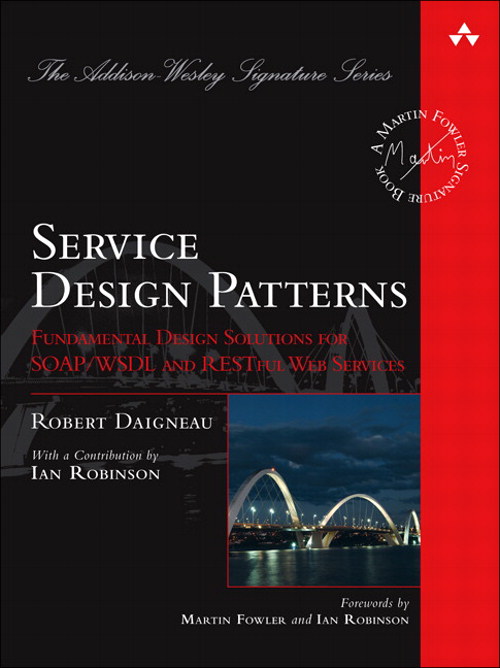
New series book - Service Design Patterns

Addison-Wesley has published a new book in my Signature Series. It’s by Robert Daigneau and it’s called Service Design Patterns. It’s a topic that’s already had too many books on it, but I added this one to the series because I think Robert has done a particularly good job of collecting together the best advice on the topic and organizing it into a useful handbook. This is the book that I think ought to become the standard book on the topic.

26 May 09:07

How do you estimate on an Agile project?

If you’re interested in techniques for estimation, you should take a look at this pdf ebook. It contains half-a-dozen essays on estimating in agile projects, drawn from our experiences with a wide range of clients. We explain approaches based on story points and on story counting, which should give you a good overview for you to explore an approach that will work for you.

18 May 11:06

I fucking wish

by donniedemeijer
02 May 19:38

On-the-go furniture for on-the-go People

by Alasdair Allan
Arara NômadeHarking back to the era of steam trunks the Arara Nomade is nomadic furniture: a trunk that turns into a shelves, drawers and hanging space. Designed for easy assembly and disassembly, no screws, glue or tools are required to put in together, or to take it apart at the end of your trip.

Read the full article on MAKE

02 May 19:33

DIP in the Wild

The Dependency Inversion Principle (DIP) was coined by (Uncle) Bob Martin several years ago. It’s a useful principle to help organize the dependencies in your system. Here Brett Schuchert shows how this principle works in practice to simplify designs with a couple of real world examples from his recent ThoughtWorks projects.

25 Apr 12:38

HAPLESS HARE T - Men's Casual- TWIN SIX - Alternative Cycling Apparel

by allanpeters
15 Apr 07:06

Boring People

by mark

People who say they are bored are boring people. Interesting people can intertain themselves anywhere. Boring people have to be entertained by others. – Roger Knapp

12 Apr 23:55

B-B-B-Bobby Digital

by sortehane
12 Apr 10:23

Got Livestock? Feed Them Hydroponically Homegrown Barley Sprouts

by Laura Cochrane
11-27-12-barley-fodder-007If you raise animals that graze, you'll want to check this out.: There's a post on Paca Pride Guest Ranch's blog explaining how to turn 5lbs of barley grain into 25lbs of fresh, live sprouts in a very small hydroponic footprint.

Read the full article on MAKE

11 Apr 00:22

cdto

cdto:

Fast mini application that opens a Terminal.app window cd’d to the front most finder window. This app is intended to placed in the finder window’s toolbar.

05 Apr 14:19

LogoPond - Identity Inspiration -

by fbarral
28 Mar 03:06

Lime Pickle Lime

by Aki and Alex

LimePickleLime

We seasoned a fresh lime with powdered lime pickle from Cultured Pickle Shop. It made sense. The combination became the most complex lime we have ever experienced.

Years Past

March 22, 2012

March 22, 2011

March 22, 2010

March 22, 2009

March 22, 2008

March 22, 2007

March 22, 2006

March 22, 2005


20 Mar 02:55

1Keyboard

1Keyboard:

1Keyboard is a virtual bluetooth keyboard application for OS X. Turn your Mac into a Bluetooth keyboard that works with all of your devices, comfortably type on your iPhone, iPad, Apple TV or game console.

20 Mar 02:21

A MADE IN AMERICA STORY – SINCE 1905 | J.W. HULME CO.

*

*

From the desk of Contributing Editor, Eli M. Getson–

The term “luxury brand” gets thrown around a lot today, and as someone in the branding business, I can attest that every brand secretly covets this moniker as a way to charge more for products and services around the world and dupe the masses into even more consumption.  Yet, somewhere along the way, I think we lost sight of what true luxury is and we bought into a lot of superficial hype about what constitutes luxury.

In the last few years, when ostentatious displays of wealth became a sorry substitute for understated class, it became harder and harder to sift through all the junk.  A luxury in its purest form, so the thought goes, is not a necessity; it just makes life more fun to live and delights you in small ways.  I think I derive pleasure from certain things because I like that they are well made, have a story behind them, and most importantly are not out there for mass consumption– I get a small thrill knowing that not everyone has it.  You can call it small batch, artisanal, or limited edition– all would apply.

I like the term “Heirloom Brand” — the idea that true luxury is something you can pass on to the next generation and have it be as relevant as when it was first purchased.  With that in mind, I recently interviewed Jen Guarino, one of the principals of the bag maker J.W. Hulme, a 105 year old institution in St. Paul, Minnesota where they have forgotten more about the making of the best quality canvas and leather bags then most of us will ever know.

*

The J.W. Hulme Classic Oxford Field Messenger (washed)

*

I’m curious about something, why with a rough economy and a consumer who rationalizes every penny, why would you get into this business?

Yeah, I know, you can start any kind of business but when my partner and I found JW Hulme it was so solid, so real, so true– it was just the right fit.  When we first saw the factory we were stunned by the level of skill these artisans have– you just can’t find this type of history or knowledge in people anymore.  We recognized this as a huge asset and bought it in 2003.  Prior to that JW Hulme was a 100 year old manufacturing company sitting on its heritage– dating back to WWI.  We just recognized a diamond in the rough.

Incredible, so you saying this company that makes some of the finest bags in the world was just sitting up in St. Paul and no one knew about it?

The history of the brand, I guess like all great American brands, was that of a manufacturer.  The Hulme Brothers started their business making tents for the War department during WWI and WWII.  After the Second World War ended, they made awnings for Minneapolis society and began to make gear bags for Minnesota sportsmen.  The company really served as a manufacturer for brands like Orvis and the (now defunct) Gokey.  We had all the craftsmanship under our roof, we just chose to celebrate it as uniquely our own.

*

The J.W. Hulme Classic Field Oxford Briefcase (washed)

*

How has the business changed?

The business was 80% wholesale, really a third party manufacturer.  Today we are 80% direct to consumer and 20% wholesale to retailers.  We are really tight with our consumers, short of our artisans, they are our greatest source of inspiration.  We developed our Sporting Originals line from customer feedback.  People would bring us their old Gokey bags and beg us to repair them.  Every bag had a story beyond just something they used in the field.  We replace their old bags– we just make them better then they remember.  We use the same high quality canvas, leather, and webbing.  The biggest difference today– we use real brass hardware, the originals were plated.   These bags are heirlooms, they are priced to be that way, but we are not making a mass produced product.  We are making a unique product that can be passed from father to son.  The product has a history of getting better with use; we just like to think we made it a little better for today’s consumer.

What kind of materials do you use?

We source as much as possible from the U.S.  All of our leathers are from U.S. tanneries (Horween anyone!), we are a big believer in American tanneries.  The leathers we use are beautiful and they get more beautiful with age.   The patina they develop is amazing.  We use all brass hardware.  Our canvas is made in the U.S. which is virtually unheard of today.  We use the best Maring canvas in the world.  We use materials that speak to quality and durability.  Combine this with an artisan who hand makes each bag and you have something unique, and ruggedly beautiful.

*

Not just “Made in America, J.W. Hulme also supports American tanneries– using them exclusively.

*

How are you training the next generation of artisans?

We bring in master tailors, so there is a tremendous knowledge of sewing and construction– we have an apprentice system, the same system small manufacturers have used since the Renaissance.  The apprentices learn from a master, so the knowledge is always getting passed on.  One of our masters in an Inuit Alaskan, who learned to sew on seal skins, she teaches a lot of our sewers.  Our environment is different than a standard factory, we don’t measure on quantity of output, we measure on quality of output.  There is an incredible exchange of information and learning.  We are not really a factory; we are more of an artist’s workshop.

I always ask this: What inspires the design?

Amazingly our archive is largely intact, so we really mine this and just tweak some of the original designs and update them for today.  A lot of our inspiration comes from our customers– people call us constantly and describe a bag they had that they can’t replace and it sparks an idea for something new.  The rest come from old films, vintage photos of travel, British Ghurkas, stuff like that.  I really get inspired by the movies of the ’40s & ’50s.  Remember, pre-plane travel your luggage was supposed to be rugged and elegant and last for a long trip.  Travel was not nearly as convenient and people usually travelled for multiple weeks at a time– plus grand tours were a big deal then.  I always get excited by old photos of Hollywood stars getting off a plane or train with all of their great luggage, dressed to the nines for their studio photo.  It was a more formal era.  I love the fact they we are bringing this to a younger audience and that this “old school” glamour and class is making a comeback.  In today’s world you see the same five luggage brands all over.  True luxury is having an extremely unique, beautiful piece that withstands fashion and is immune to trends.  It is something that you hand down.  This is really our passion at JW Hulme.  This is truly a labor of love.

*

The J.W. Hulme Classic Field Duffle (washed)

*


20 Mar 02:21

Create your own CG holograms

cgh_cube_recon_rocking.gif

This interesting tutorial delves into a couple of different techniques for making holograms using your computer. There's even an associated java program that can help you through the process

Creating a hologram is both fun and educational. There are quite a few good sites for learning about holography or purchasing supplies. As an alternative to the photochemistry and vibration-free settings involved with regular holography, this program allows you to create a transmission hologram using just a computer, a laser-printer, and an overhead transparency. This hologram will behave like one created using a laser and can be projected or viewed with a point source.

[Thanks, Chipwich!]

Read the Full Story » | More on MAKE » | Comments » | Read more articles in Imaging | Digg this!
20 Mar 02:21

Laser + drop of water = microbial movie theatre

micro1.jpg

According to the hacker-proprietor of Teravolt.org, shining a 250 mW green laser through a hanging drop of scummy plant water produces a kind of "laser microscope" that will project shadows of all the little microflora on the wall so you can watch them flitter about with the naked eye. The embedded video is nothing short of amazing. I felt just like that cat.

Anybody out there ever tried this with a blue or violet laser? Is the resolution any better?

More:

Read the Full Story » | More on MAKE » | Comments » | Read more articles in Biology | Digg this!
20 Mar 02:21

How-To: Leather tooling punches from common nails

Leather-tooling-punches-01.jpg

Instructables user cbm104 attributes this cool trick to a leather-working book published in the '60s, the title of which he does not remember. If anybody knows the reference, I'm sure he'd be glad for a heads-up. Or just leave a comment here and I'll pass it along.

More:

Read the Full Story » | More on MAKE » | Comments » | Read more articles in Crafts | Digg this!
20 Mar 02:20

Print-and-fold vertical sundial generator

sundial-normal.jpg

Neat! This website has a Google maps object that lets you select a particular wall of a particular building on the face of the Earth, and then generates a custom sundial accurate for that latitude and longitude that you can print, cut, fold, and attach. Haven't tried it yet, so I can't vouch, but a cool idea in any case. [via Hacked Gadgets]

More:

Read the Full Story » | More on MAKE » | Comments » | Read more articles in Paper Crafts | Digg this!
20 Mar 02:16

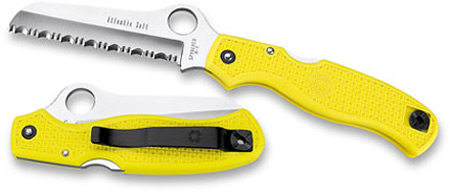
Spyderco Atlantic Salt

I work on a tugboat where a sharp knife is important. Rusting is also an issue. I have had my Atlantic Salt model number FRN-C89YL for two years. This knife has not shown any sign of rusting yet. I just bought my second one due to losing the first one.

The H1 stainless steel is amazing. I love this tool.

-- John Brown

[H1 stainless steel replaces the carbon in normal steel with non-rusting nitrogen. The outsized hole in this knife blade is useful for gloved hands, and it features a nonslip grip. --Bruce Sterling]

Spyderco Atlantic Salt Serrated Folding Knife
FRN-C89YL
$68

Manufactured by Spyderco

Available from Amazon

Related Entries:
Dexter-Russell Fillet Knives Derma-Safe Folding Utility Knife Tosagata Hocho 6-inch Santoku Knife

20 Mar 02:15

Gorilla Gripper

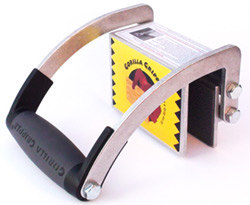
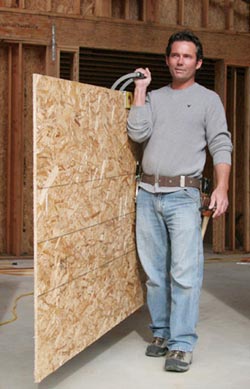
I have the Stanley Panel Carry, previously reviewed on Cool Tools, but greatly prefer the Gorilla Gripper, which works with panel widths from 3/8 to 1 1/8 inch. It is about six times more expensive, but it works significantly better for moving large panels.

The Stanley tool goes under the bottom edge of the sheet. This can be awkward if it’s heavy material, such as plywood, and seems more likely to result in damaged corners. Using the Stanley holder, I had to bend my back at an awkward angle to pick up the sheet -- the length from the tray (where the bottom edge of the sheet rests) to the handle is too short. The Gorilla Gripper lifts from the top of the panel, so there’s less need to bend before lifting, and I can keep my back straight. Also, with the Gorilla Gripper it's easier to adjust your balance, since you don't have the friction of the material moving the tool from side to side.

gorilla-gripper2sm.jpg

-- D.A.

[Video of the Gorilla Gripper in use here. -- ES]

Gorilla Gripper
$46
Manufactured by Landon Innovations

Available from Amazon

Related Entries:
Forearm Forklift Moving Heavy Things Built By Hand

20 Mar 02:14

Goold Macbeth on BBC4


Yesterday I watched the television adaptation of Rupert Goold's Macbeth (BBC4, 12th December, 2010, with Sir Patrick Stewart and Kate Fleetwood in the lead roles - see TV blog). This ran to good reviews from its original at Chichester Festival Theatre, via the West End, to Broadway. Filmed in the subterranean rooms and tunnels of Welbeck Abbey 1, it takes the play into an Eastern European warzone, with explicit resonances between Macbeth and Stalin (alluding, for instance, to the episode when Stalin forced the portly Kruschev to dance the strenuous gopak - "When Stalin says, 'Dance!', a wise man dances") . The witches become malign nurses involved in necromancy (the wounded soldier at the beginning of the play becomes their victim); the moving of Birnam wood becomes soldiers in ghillie suit camouflage.

It was superb: watch it if you haven't already. As Simon Horsford's preview in the Telegraph says:

It is the perfect riposte to cynics who argue that Shakespeare’s plays demand the intimacy of a theatre

and I've taken this view for a long time. Much as I appreciate that many people enjoy theatre, I find cinema and television a superior medium for Shakespeare. This may not apply to small and intimate productions where the audience is, effectively, inside the action, but I really can't see how sitting in a large auditorium watching from one (often distant) viewpoint can compare to the director's tightly-managed control of every nuance of the experience - viewpoint, sound, visual effects and location - that film and TV offer.

If you have access to BBC iPlayer content, Macbeth is available until 9.59pm on Sunday, 19 December.  US readers I think can watch it at PBS Video.

1. The home of the 5th Duke of Portland, whose subterranean obsession inspired Mick Jackson's novel The Underground Man.

- Ray
20 Mar 02:14

Homebaked Cheese Crackers

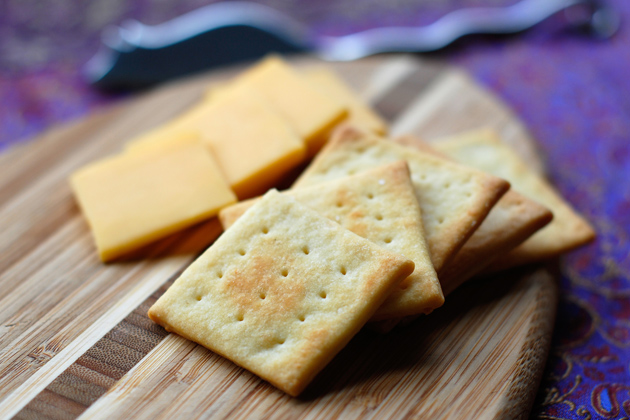
It’s always a wonder to me that more home bakers don’t make their own crackers. As long as you stick to a few basics and keep an eagle eye on them while they’re baking, crackers are surprisingly easy to make. This recipe yields crunchy cheddar cheese crackers that are sure to be a hit at your next games night or holiday party. But be forewarned: they’re so tasty they might never make it out of your kitchen!

Homebaked Cheese Crackers


Makes 8 dozen or more crackers

2 cups of bread flour (best) or all-purpose flour

2 teaspoons sugar

1 teaspoon table salt

¾ teaspoon baking soda

3 Tablespoons canola oil

3 Tablespoons shortening (I use Spectrum non-hydrogenated)

4 ounces sharp cheddar cheese, coarsely shredded

½ cup cold water

Extra flour for bench work

Salt for topping

2 or 3 heavy cookie sheets, 11” x 17”


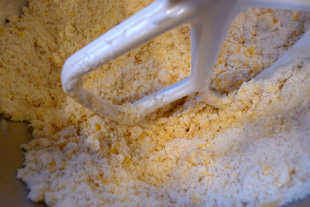
Make the dough: In the bowl of a stand mixer, combine flour, sugar, salt and baking soda. Using the flat beater on low speed, mix in the oil and shortening until there are no pieces larger than the size of a pea, about 1 minute. Add the shredded cheese and beat for about 2 minutes, until the cheese is broken down into small bits. Now add the water and beat for about 30 seconds, until all the dough sticks in a mass on the beater.

Cracker mix with cheddar cheese

Knead and let rest: On a clean unfloured surface, knead the dough vigorously for 5 minutes, by which time all of the cheese will be incorporated into the dough (a few flecks here and there are okay). The dough should be smooth and pliable.

Put the dough on a counter, cover with the mixing bowl and let rest for 30 minutes before continuing.

Set a rack in the middle of your oven and preheat to 425°.

Roll out and pan the dough: Cut dough into three equal pieces. On a lightly floured surface, roll one piece into a rough rectangle 10” x 15”. To achieve this, you may have to roll the dough, let it rest and roll again. You want a sheet of dough that is about 1/16” thick. Some irregularity is inevitable; don’t worry about it. Use a small amount of flour as necessary to prevent sticking.

Gently pick the finished rectangle of dough off of the counter and spread it onto an ungreased cookie sheet.

Cut and prick: Using a pizza cutter or pasta roller, cut the sheet of dough into 1½” squares. The uneven edges of the dough can either be made into crazy shapes or cut off to be used in the dough the next time. Your choice.

Cracker dough after kneading

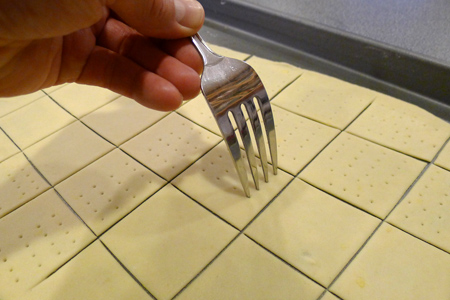
Make holes in the dough with a serving fork as shown in the photo. This will keep the centers from puffing up.

Sprinkle cut crackers lightly with salt before baking.

Bake, turn and cool: (Be sure to see Baking Notes below) Bake crackers at 425° for 5 minutes, turn over and bake for a further 3 minutes. If some of your thinner crackers are cooked sooner, pull them out before they overcook. Otherwise, remove to a rack when the crackers are light brown and let cool for 10 minutes or more.

Repeat last three steps with each piece of dough.

Serve these tasty crackers with hummus, cream cheese or your favorite dip and then watch them disappear!


Baking Notes: Crackers are so darned thin that baking them magnifies the differences between individual ovens. This is where it’s essential that you know your oven. For example, my gas oven cooks hotter around the outside, so when I turn them I rotate the outer crackers to the middle. 

Please use the times above as a guideline. Even a minute too long can overcook these crackers. If you err on the undercooked side, put cooled crackers in a single layer on a cooling rack and return to a 300° oven for 10 minutes.

Pricking holes in the cheese crackers before baking

20 Mar 02:14

BBC Backstage the ebook retrospective

Its been an amazing five years but finally the servers are powering down on the backstage.bbc.co.uk (to be official) project.The legacy of backstage will live on, but what better way to end the project but to launch a ebook which tells some of the stories of how the project started way back in 2004.

We commisioned Suw Charman-Anderson to create the eBook retrospective of the whole project, quite a challenge as you can imagine. But she's done a excellent job with help from editor Jim McClennan and designer Nicola Rowlands. Its an fantastic piece of work I think you will agree.It also serves as a very fitting tribute to the endless efforts of the many staff, friends, hackers, developers, designers, critics, etc, etc of the project over the last half decade.

There is plenty of background information in the ebook including those playground servers, the amazing array of prototypes and some real interesting points about the nature hacking... maybe someone should update wikipedia with some of the information?

Ladies and Gentlemen, I'm really happy to present the Backstage Ebook:Hacking the BBC, a backstage retrospective. From us to you, for making backstage what it became.

Download in [PDF] [print ready PDF] [EPUB] [MOBI] [RTF]

(The Amazon Kindle will read MOBI files, the Apple iPad makes great work of the PDF, while most others readers will accept epub. If you're in any doubt try the PDF on which is full colour or the RTF which is just the content.)

The cover of the BBC Backstage ebook.

You can also read more on the Guardian's PDA blog,  the BBC R&D blog (which will be the place to find out what happens post backstage), the BBC internet blog and of course my own personal blog.

I think its safe to say the ebook is licenced under a Creative Commons BY-NC-SA licence. So please do share it and tells us what bits you loved or hated. In actual fact, tells us what bits you loved or hated generally about the whole project. We really value your feedback and of course everything you all did to make backstage your place to influence the BBC as a whole.

thank's for all the tags

.... end line :)

20 Mar 02:13

Community News: Ian Barber's Slides from ThinkVitamin "Deployment Tactics" Posted

While not specifically about deploying PHP applications, Ian Barber's talk at the recent ThinkVitamin Code Management and Deployment Conference is packed full of good tips you can use in your web application deployment. He talks about everything from version control strategies, continuous integration, remote releases, package management, hotfixes and one of the most difficult things to do - rollback.

Still deploying sites and updates manually via FTP? This session will cover a number of automated deployment methods, best practice workflow for updating sites and fixing bugs, along with how to use staging servers, deploying to multiple machines, zips tars & scripts, packaged releases hotfixes, database changes, rollbacks and more.

There's tons of technologies mentioned, so you'd be better off going through his slides and taking your own notes. Unfortunately, a recording of the session isn't currently publicly available, but the slides are an excellent resource for those currently looking to better their overall deployment process.

20 Mar 02:13

Google Webmaster Central Channel

Webmaster details. Stuff you want to know if you run a website. Not the designer HTML look and feel stuff. Just the day-to-day practicalities of how Google does stuff. Their virtual monopoly ensures you need to know their interpretation of this, or fall by the wayside.

20 Mar 02:12

No-Nonsense Beginner Hydroponics Tutorials

Our pal Jared Bouck, whose light sculpture project appeared in MAKE Volume 24, has just posted a trifecta of simple, low-cost hydroponics tutorials for beginners like me. There’s a general-purpose single-plant bucket drip system with a sight tube, a CFL grow light cluster, and a simple deep-water culture system. [Thanks, Jared!]

More: