 Kat Chow, "Make It So: Sir Patrick Stewart Moos In Udder Accents", NPR Code Switch ("Frontiers of Race, Culture and Ethnicity") 12/30/2013:
Cow-d it really be? Have our ears herd this correctly? (Sorry, I can't help myself.)
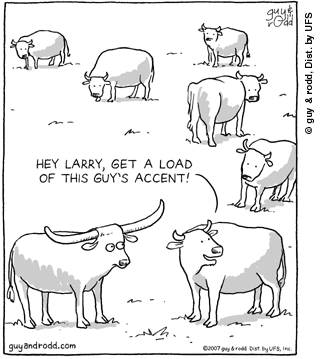
Patrick Stewart — ahem, Sir Patrick Stewart — mooed up a storm on the podcast, How To Do Everything, impersonating cows from various regions. You might even say Stewart was code-switching.
A listener who says she moos with "kind of an American, Nevadan accent" posed the question: Just how would a person moo in a British accent? (And, by the way, it's true: cows do moo in regional accents.)
The cited BBC story ("Cows also 'have regional accents': Cows have regional accents like humans, language specialists have suggested", 8/23/2006) was a great public-relations triumph for the cheese industry, and a lovely example of the dangers of talking to journalists. For details, see "Oh, the moos you can moo", 8/23/2006; "Where are moo from?", 8/24/2006; "It's always silly season in the (BBC) science section", 8/26/2006.
But this time around, the How to Do Everything podcast ("Cow to Moo Everything", 12/27/2013) treats us to the bovine vocalizations of Sir Patrick Stewart. It all starts with this question from a listener:
I was wondering if you could find out how do cows moo- well how was- how would a person moo in a British accent?
This leads immediately to the following exchange:
Q: I think the place to start would be, how do you moo?
A: I moo with an American, kind of Nevadan accent, going "moo".
After some further inquiries, the HTDE team contacts Sir Patrick Stewart by telephone, and he gives a suitably judicious response:
It's not a straightforward simple answer.
Unlike probably many other countries, where a cow's moo is a cow's moo,
in England, you understand, we are dominated by class,
by social status, and by location.
Sir Patrick continues in this mock-sociolinguistic vein, imitating the "very conservative" moo of an Oxfordshire cow, from David Cameron's constituency:
And the socio-culturally contrastive moo of a cow from Yorkshire:
He also tells us that because his wife is also from Nevada, he has "some experience of Nevada cattle", and so he gives his impression of a Nevada cow:
Sir Patrick's wife and the original caller are apparently from different Nevadan bovilinguistic strata.
Anyhow, the rest of the podcast will treat you to a Cockney cow, and the "very refined, very sophisticated" sort of moo produced by a cow who went to "the cow equivalent of Eton or Harrow".
One of the comments on the podcast is from Suze, a real expert, who reminds us that individual identity and physiological state are also important variables:
That was superb!!! I'm a relief milker (and a musician) so I've always been interested in sound. I always moo along with "my girls" and it's truly fascinating to hear their individuality. Too bad they didn't ask him to imitate the moo of a cow ready for the bull! hahahahaha THAT'S a great one! Loved this show!!!
Karl Marx told us that
Hegel bemerkte irgendwo, daß alle großen weltgeschichtlichen Tatsachen und Personen sich sozusagen zweimal ereignen. Er hat vergessen, hinzuzufügen: das eine Mal als Tragödie, das andere Mal als Farce.
Hegel remarks somewhere that all great world-historic facts and personages occur twice, so to speak. He forgot to add: the first time as tragedy, the second time as farce.
In this case, we're talking about great cheese-industry PR stunts rather than great world-historic facts. And so the first time was farce, while the second time was Star Trek's Captain Jean-Luc Picard pretending to imitate class and regional variation in the vocalizations of cattle.
Update — in partial response to Sili's appeal below, here's the spectrogram of an actual cow, in the form of a sample moo from SoundBible.com — "Sound of a large cow mooing in a pasture", recorded by Mike Koenig:
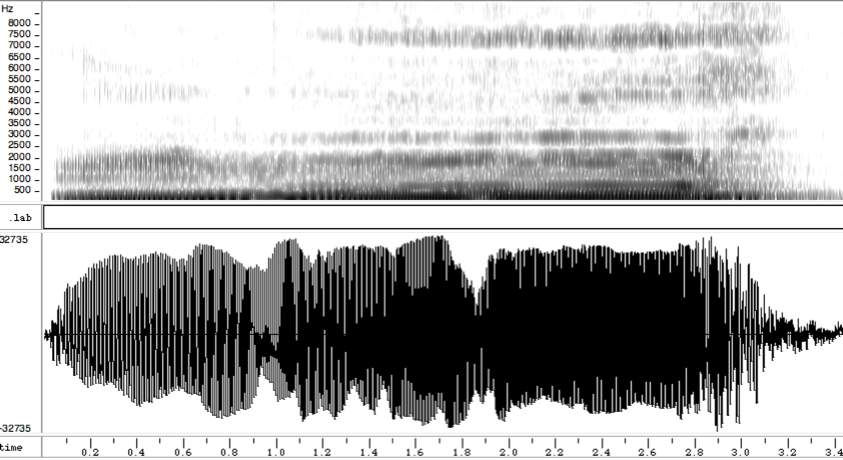
The sound:
Your browser does not support the audio element.
Sili asked:
Aren't there linguists of dairy stock who know how to do formant analysis?
My sister's in dairy, but I have no clue how to collect or analyse vocalisations.
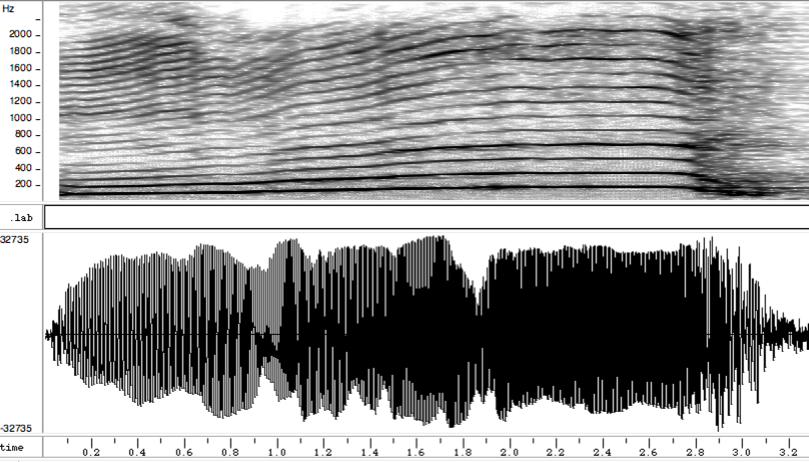
Here's a narrow-band spectrogram, which gives a better picture of the laryngeal source:
And here's a spectral section, from 2.315 to 2.416 of the file above, with an order-20 LPC spectrum superimposed on the FFT spectrum.
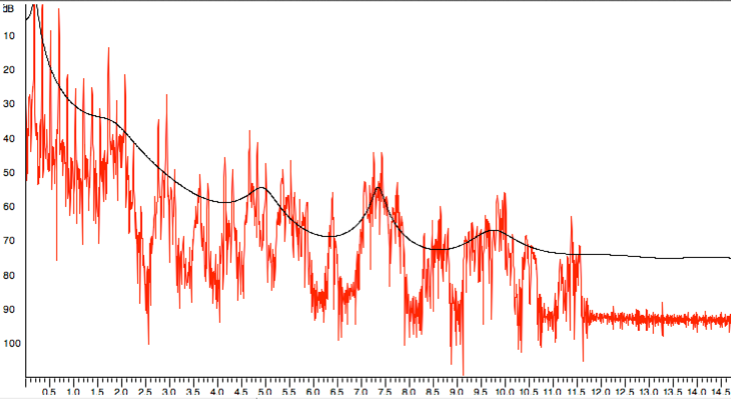
As this suggests, a formant analysis is probably not mainly what is needed. The breed, individual, attitudinal, and physiological differences of interest are likely to show up to some extent in spectral resonances and anti-resonances, but perhaps even more in pitch and amplitude contours, in the bovine equivalent of voice quality, and so on.
Could there be regional or herd-specific variations as well? Sure. Is there any evidence about this? No. But I'm open to inquiries from the dairy industry — I've always wanted an opportunity to use in real life one of my favorite punch lines: "Consider a perfectly spherical cow, radiating milk isotropically…"
Update #2 — I should note that there is some literature on cattle vocalizations, though not (as far as I have determined) on geographical or cultural variation. For example, Jon M. Watts and Joseph M. Stookey, "Effects of restraint and branding on rates and acoustic parameters of vocalization in beef cattle", Applied Animal Behaviour Science 1999, showed that branding makes calves vocalize more, louder, and with a higher pitch:
More branded than non-branded animals vocalized (58/95 compared with 7/94, P<0.0001). Branded animals showed a greater frequency range in the fundamental, or lowest harmonic, of the audiospectrogram, (68.04 Hz±5.33 compared with 28 Hz±8.74, P<0.05), a higher maximum frequency (186.66 Hz±5.19 compared with 141.6 Hz±6.6, P<0.01). and a higher peak sound level (P<0.05).
And P.C. Schön et al., "Altered Vocalization Rate During the Estrous Cycle in Dairy Cattle", Journal of Dairy Science 2007, shows that cows moo in a breathier way near their "estrous climax":
It is known that the calls of female mammals can contain information about reproductive status. It is also suspected that the vocalizations of cattle contain information about age, sex, dominance status, and stage in the estrous cycle. In the present study, a methodology for the continuous automatic recording of vocalization of heifers during the periestrous period is presented. It was shown in 10 tethered heifers that the estrous climax results in an increase in vocalization rate. [...] We also found 2 different structures in the vocalization of heifers. The harmonic structure showed regular frequency bands, whereas the nonharmonic structure was noisy. The hypothesis that the disharmonic structure increases near the estrous climax was confirmed.




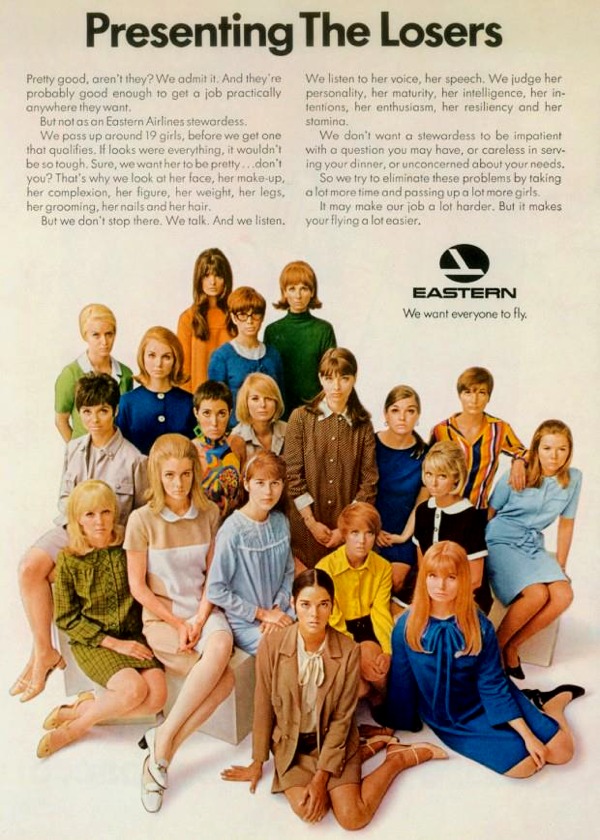 Most of the vintage ads in this Collectors Weekly round-up were designed to shame women into buying a product that would make them more attractive to their mate. The Mad Man-era ad above was designed to assure Eastern Airlines passengers that they wouldn't be served by "loser" stewardesses.