Shared posts

27 Mar 04:59

Welcome to the world of the $6 bus ride to work, $7 juice not included

by Emily Badger
Matthew Connor

fuck rich people forever

Leap Transit

Leap

The new venture-backed private transportation service Leap began offering rides in San Francisco last week in a swanky shuttle meant to feel "more like a living room than a bus." A ride with the service, which costs $6 one-way or $5 in bulk, comes with WiFi, USB ports, a laptop bar and locally made pressed juices (for sale on board, that is).

Most of the passengers on-board at first appeared to be skeptical journalists. Private mass transit is a touchy topic in San Francisco, where many fear the tech industry is creating parallel amenities — private campuses, private transportation, private cafeterias — where tech workers don't have to bump into the masses. With this latest twist, Leap and a few other startups, are offering up-scale rides to anyone in the public with a smartphone, although the intended clientele here still seems to lean toward tech. Leap so far is running one route that collects and drops off commuters around a hub of tech offices downtown.

Services like this, though, raise some broader issues that are not particularly unique to San Francisco, nor to the tension the tech industry has created there. Public transit is ripe for disruption — that's why investors are backing these ideas. If you were to look around any city and try to identify a problem in need of lucrative new solutions that emerging technology might provide, the dreaded commute is an obvious one. Public transit can be inefficient, unpredictable, slow, crowded, or on its worse days downright broken. Transit needs a shakeup.

But as private providers increasingly offer what looks like a first-class alternative, the risk isn't that companies like Leap will eventually replace public transit; it's that they'll turn it into even more of a ride of last resort used primarily by the poor. If Leap is successful — and it's entirely likely it won't be, because a transit system is incredibly costly to operate — San Francisco and other cities could wind up with one public bus system for all the people who need a $2 ride, and one private bus system for the people who want to sip a $7 iced coffee on the way.

This would siphon needed fares from transit systems. But it could also sap public willingness to invest in them. The answer isn't that higher-income riders should have to use poor public transit because lower-income riders do, too. It's that we should throw innovation at the problem of public transit itself, not simply at the promise that some people could afford a work-around.

In other parts of the world, we already know what this might look like.


26 Mar 14:34

One Direction fans: The mayor of Boston feels your pain

by adamg
Matthew Connor

lol @ "One Republic"

Marty Walsh held a Twitter chat yesterday, and answered one of the more pressing issues of the day:

.@choll12 We are all devastated about Zayn Malik but we must soldier on #ASKMJW

— Mayor Marty Walsh (@marty_walsh) March 25, 2015

Oh, and look: Somebody has started an online petition to rename the Zakim Bridge the Leonard P. Zayn Malik Bridge.

25 Mar 16:25

Son Lux: New Album, New Song

by Robin Hilton
Matthew Connor

!!!!!!!!!!!!!!!!!!!!!!!!

Son Lux: New Album, New Song

Audio is not available in your region.

Son Lux (left to right): Ian Chang, Ryan Lott, Rafiq Bhatia

Son Lux (left to right): Ian Chang, Ryan Lott, Rafiq Bhatia

Courtesy of the artist

Son Lux, the brain child of beat wizard Ryan Lott, is back as an official trio, with a new album and a new song. The album is called Bones and was co-written and recorded by Lott with drummer Ian Chang and guitarist Rafiq Bhatia.

The first single from the album, "Change Is Everything," is vintage Son Lux, with a startling mix of chopped up rhythms and sonic curiosities set against lyrics that are both grand and minimal.

Bones is due out June 23 on Glassnote Records. That's the artwork below.

Artwork for the Son Lux album Bones.

Artwork for the Son Lux album Bones.

Copyright 2015 NPR. To see more, visit http://www.npr.org/.
20 Mar 03:54

Newswire: It Follows is getting a wide release, won’t hit VOD early

by Sam Barsanti
Matthew Connor

CHANGE OF PLANS Y'ALL. I'm glad I'm not missing the chance to see this in theaters. It's playing at the Common, and will hopefully be there all week. We're leaving town tomorrow but maybe next Thursday I can finally? Oh my god when do I get to see it WHEN

For the last few months, director Jennifer Kent’s The Babadook has been the go-to horror movie for people who want to see something that proves there’s still life in the horror genre beyond endless Saw and Paranormal Activity sequels. As great as The Babadook is, though, everybody has seen it by now, thanks to it skipping a wide theatrical release in favor of an early dump onto VOD services. Babadook is old hat now. It’s passé. Plus, there’s a new Babadook in town: David Robert Mitchell’s It Follows, which The A.V. Club posted a glowing review of last week.

According to Bloody Disgusting, some rumors began circulating recently (on Bloody Disgusting, as a matter of fact) that It Follows would take the same path as The Babadook and jump to VOD platforms as quick as it could, but that turned out to be wrong ...

17 Mar 20:56

Newswire: StubHub to start screwing consumers over on movie tickets, too

by Alex McCown

In recent years, the online ticket reseller StubHub has become the place to go for overpriced, consumer-gouging access to concerts, sporting events, and other live entertainment. And because there’s nothing the average American likes more than paying too much for things, consumers will no doubt be thrilled to learn that movie tickets—one of the last bastions of affordable, populist nights out for people across America—will soon be subject to the same business model. Variety reports that StubHub is planning to move into the movie ticket realm, along with theme park admissions, museum access, and other diverse forms of public entertainment.

Whereas sites like MovieTickets.com and Fandango have traditionally cornered the market on online ticket sales for films, StubHub would offer a way for theaters to offer blocks of tickets for screenings that typically don’t sell out, such as matinees or slower weekday evenings. The company ...

17 Mar 20:49

NYPD Caught Editing Wikipedia Entries About Police Brutality Victims

by Aviva Shen
nypdwiki3

CREDIT: Wikipedia Screenshot

The New York Police Department has anonymously edited and tried to delete Wikipedia pages about police brutality victims, Capital New York has discovered. Edits coming from 1 Police Plaza headquarters targeted pages for Eric Garner, Sean Bell, and Amadou Diallo.

NYPD IP addresses were used to edit the Wikipedia page on the “Death of Eric Garner,” who was killed by police chokehold and inspired massive nationwide protests in the fall. Capital New York found that the department changed “Garner raised both his arms in the air” to “Garner flailed his arms about as he spoke,” and added the sentence “Garner, who was considerably larger than any of the officers, continued to struggle with them,” among other changes.

Someone at the NYPD also tried to delete the article on Sean Bell, an unarmed man who was gunned down by officers firing 50 bullets in 2006, arguing that “no one except Al Sharpton cares anymore.” The user wrote, “The police shoot people every day, and times with a lot more than 50 bullets. This incident is more news than notable.”

The NYPD also edited entries about the police force’s stop-and-frisk policy deemed unconstitutional in 2013, as well as a number of unrelated articles, including “Four Loko,” “Sailor Moon,” and “Croissant.”

The edits and deletion attempts reflect the NYPD’s sometimes clumsy response to the increased scrutiny in the wake of controversies over stop-and-frisk, their treatment of Occupy Wall Street activists, and most recently, the crackdown on #BlackLivesMatter protesters.

The NYPD has long had a testy relationship with the press, punctuated by threats and arrests of journalists who document police misconduct. Lately, the nation’s largest police force has tried to circumvent the media to control its public image — with mixed results.

The department started writing and posting its own “good arrest” stories directly to its Facebook page last summer extolling heroic officers. In one instance highlighted by Gothamist, the NYPD reported on Facebook, “A rookie Bronx cop on a footpost this morning chased down and arrested a gun-toting 17-year-old who, moments earlier, fired four shots into another man and left him for dead on a Mount Eden street.”

The NYPD even cracked down on an artistic mural calling the police force “murderers,” even though the property owner had approved it. When the artist declined police requests to remove the mural, NYPD officers painted over it themselves.

Other efforts to improve the NYPD’s image online have backfired repeatedly. The ill-conceived hashtag #MyNYPD, on which Twitter users were invited to share positive interactions with police, was quickly dominated by stories of abuse and harassment. Yet the NYPD broached Twitter again after its officers ducked charges over Eric Garner’s death, using the hashtag #WeHearYou to promise to rebuild trust. That hashtag was soon swamped with criticism.

The post NYPD Caught Editing Wikipedia Entries About Police Brutality Victims appeared first on ThinkProgress.


17 Mar 19:00

LET THE RIGHT ONE IN: A&E Makes Plans For Drama Adaptation

Matthew Connor

lol, this can't go badly at all. I mean, I loved Teen Wolf for a minute because it is just so absurd (the first two seasons essentially consisted of well-oiled shirtless dudes slamming each other into lockers). Jeff Davis will probably amp up the queer elements of the book that didn't get explored in the film. But he also has no idea how to tell a coherent story, ever. Also I tried to watch Bates Motel and gave up after about 15 minutes. Anyway hi I'm bored today

This will draw the ire of fans around the World. According to a report over at THR's The Live Feed, U.S. television network A&E is planning a drama, adapted from the Swedish vampire coming of age film Let The Right One In.The network will be working with MTV's Teen Wolf showrunner Jeff Davis. Davis is adapting the property with actor/writer Brandon Boyce (Teen Wolf)The original Swedish film, a much more pleasant adaptation of John Ajvide Lindqvist's horror novel, was lauded and adored by critics and horror fans around the World. The story was about a young bullied boy who befriends the young girl who movies in next door. After a series of bizarre murders in their town he finds out that she is a vampire and...

[Read the whole post on twitchfilm.com...]

17 Mar 17:35

Fashion police

by scottlong1980
Matthew Connor

This is a pretty long read (as is everything Scott writes), but it is GREAT and worth your time to read every word and not just skim. Brings up so many great questions and problems with boycott politics, especially in the LGBT community. I don't buy Barilla because I don't like the idea of giving money to homophobes, but who am I really impacting? Lots to mull over here.

Accessorized at the altar: Model Bianca Balti displays devotion in the Dolce & Gabbana Fall/Winter Collection. Shot by Pierpaolo Ferrari for Tatler Russia, September 2013

Accessorized at the altar: Model Bianca Balti displays devotion in the Dolce & Gabbana Fall/Winter Collection. Shot by Pierpaolo Ferrari for Tatler Russia, September 2013

I agree; fashion is an art. But it’s a strange one. The other arts always held out promise of escape, or at least aloofness, from the ravages of time; they gesture at a world more lasting than our fragile and fugitive flesh; from a vantage mimicking eternity, they pass judgment on our inconstancy, like Rilke’s marble statue: “You must change your life.” Fashion, though, is within time and of the moment. It feeds on the awareness that what’s beautiful this spring won’t last till next season. Impermanent in essence, it inflicts the same transience on its consumers. You merit fashion mainly in those evanescent years when you are young and thin enough to be worthy. Brightness falls from the air; Prada has no patience for middle-aged weight gain. “The grand problem,” Coco Chanel said, “is to rejuvenate women.” But of course that’s impossible. Mercurial and mutable, fashion rejuvenates only itself, yearly; it leaves the women behind.

Fashion is art for an era that believes in nothing but its own acceleration. Fashion is the Sublime indexed to inflation. As the world speeds up, moreover, it comes to resemble the fashion industry, which takes over all of life in an osmosis of mimesis; a business that runs on models, becomes the model for everything. Lately this is also true of human rights.

That’s my thought on the Dolce & Gabbana furor, which is a fable for our time. You know the basics. In an interview an Italian magazine published last week, the two living labels — gay, and former lovers too — announced they don’t believe in same-sex parenthood. “The family is not a fad,” declared Gabbana. And Dolce (they still seem to finish each other’s sentences) said, “I am gay, I cannot have a child.”

You are born and you have a father and a mother. Or at least it should be so. That’s why I’m not convinced by what I call the children of chemicals, synthetic children. Wombs for rent, seeds selected from a catalog. …. Procreation must be an act of love; even psychiatrists are not prepared to deal with the effects of these experiments.

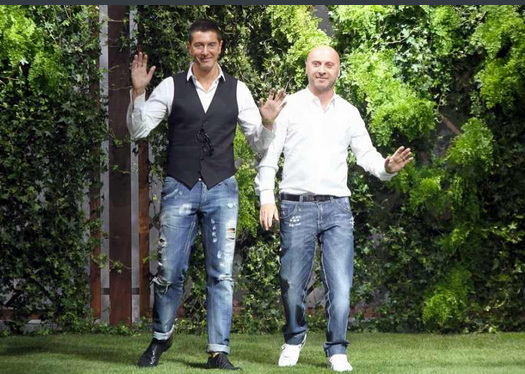
Natural: Gabbana (L) and Dolce (R) in 2001. Photo by Bend.

Natural: Gabbana (L) and Dolce (R) in 2001. Photo by Bend.

The outrage broke when Elton John took to Instagram: “How dare you refer to my beautiful children as ‘synthetic’ …. Your archaic thinking is out of step with the times, just like your fashions.” That’s a cruel cut. And: “I shall never wear Dolce and Gabbana ever again. #BoycottDolceGabbana.” D&G retaliated by calling Sir Elton a “fascist.” RIcky Martin and Victoria Beckham and other celebrities jumped in to defend him. Overnight #BoycottDolceGabbana was trending. An employee of the Peter Tatchell Foundation named Peter Tatchell called for public protest:
Screen shot 2015-03-17 at 5.16.00 AM

D&G fought back by claiming, more or less, that Twitter terrorists were trying to censor and kill them.

CAO5f-KXIAAnRL4

Comparing themselves to the dead of Charlie Hebdo tended to magnify the anger. Still, Tatchell has also recently accused his detractors of wielding Twitter to try to murder him. Maybe the pair were bidding for his sympathy.

This whole story is pregnant, by God-given or artificial means, with implications.

First, the interview was astonishingly stupid for a couple of gay businessmen who cultivate a market niche among gay men. But it wasn’t spontaneously stupid. D & G have been trying to appeal to more conservative consumers for years. The pretext for the interview, in fact, was to publicize a project the company launched in 2013: #DGFamily, inviting people to submit portraits of ancestors, spouses, kids, to an online corporate collection. “The family is our point of reference,” the project website quotes Gabbana and Dolce. (Queer families who want to protest D & G might try sending their pictures; I don’t notice any same-sex couples in the gallery.)

This touching pictorial display was about rebranding D & G as traditional, less promiscuously trendy. When Gabbana claims “the family is not a fad” — thus distinguishing it from everything they’ve made their money on — he’s invoking a timeless realm beyond the vagaries of fashion. (“There are things that must not be changed,” Dolce chimes in, sounding like an oatmeal commercial. “And one of these is the family.”) That gives the company a tinge of permanence rather than constant newness. But he’s also lying. He’s making the family a fad; it’s part of an advertising campaign. The dynamic by which the traditional becomes the fashionable, and is sold as such, is a familiar one in capitalism. Nothing is immune to commodification, no value too solemn or secure to escape subjection to the capricious humors of the market. G and D may speak of the family as a pristine cultural unit, but they treat it as a luxury D & G product. Even the line about “synthetic” or “chemical” versus “natural” children sounds like a backhanded stab at polyester. The duo may well honestly believe in the virtues of an imaginary world where superglued mother-and-father units spawn incessantly without assistance; but it’s absurd for them to pretend this is purely a “personal view.” It’s calculated outreach to a different set of consumers. Their mistake was to mouth off too much, and anger other consumers in the process.

I'll see your wink and raise you a smile: Golce, or Dabbana, dreams wistfully of a happier, simpler time

I’ll see your wink and raise you a smile: Golce, or Dabbana, dreams wistfully of a happier, simpler time

Second: People have every reason to be outraged, most especially parents who dearly wanted children, and used the “synthetic” means — assisted reproductive technologies (ART) — the designers denigrate. But since the issue for D & G is the corporate image, the most meaningful response has been from those who ricochet images back. Parents have been posting beautiful photos of kids born through in-vitro fertilization (IVF), all over social media. It’s simple and lovely and it shames Dolce & Gabbana with a minimum of effort.

Screen shot 2015-03-17 at 4.57.15 AMIs it worth more energy than that, though? Cries for boycott and demonstrations seem disproportionate to the danger. If a self-styled human rights group like Tatchell’s foundation calls a protest, they must mean a human right has been violated. How? Insulting people isn’t the same as threatening their freedoms. D & G’s offensive statements will hardly make life worse for LGBT parents or their children. The designers don’t dictate laws; they don’t deepen stigma. (Alabama, where LGBT people’s families do face profound discrimination, is very unlikely to intensify its prejudices at the beck of two Italian queers.)

A real boycott, meanwhile, is a political act. What’s the purpose here? A real boycott should have demands; and no one has suggested getting anything from D & G. A real boycott should weigh strategies and targets. Scott Wooledge, a maker of Internet memes who chases all the big gay Twitter storms, had this dialogue with a skeptic yesterday; it suggests a paucity of thought and purpose.
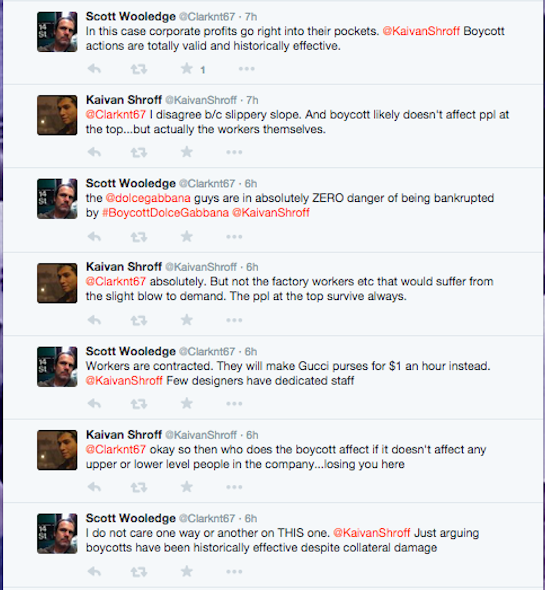
Screen shot 2015-03-17 at 2.01.50 AMGot that? Remember: gays are never poor, and they shouldn’t worry about the poor. The poor are interchangeable as off-the-rack clothing. They can always earn a dollar an hour somewhere, sewing purses in 14-hour shifts to buy those ugly rags they wear.

This pseudo-boycott isn’t politics. It’s celebrity dodgeball, Elton versus the Italians. In the manner of big-name grudge matches, it also attracts celebrity wannabes like Peter Tatchell, straining to scrape up leftover attention. It’s a show of muscle-flexing too, a few folks boasting, on behalf of LGBT communities they don’t particularly represent: Don’t tread on me. But beyond that, there’s no goal.

In fact, there’s one place where condemning D & G’s statements might have some political effect: back home, in Italy. Same-sex couples enjoy no legal recognition in Italy, denied both marriages and civil unions. Single people cannot adopt children — and that also bars gay people, since even same-sex partners are legally single. A 2004 law on assisted reproductive technology severely limits its use, and prohibits it for single women or couples without legal status. On the other hand, Italy’s Constitutional Court has demanded a “protective law” for same-sex couples to confer recognition short of marriage; it has also rolled back several provisions of the ART law. Parliament ignored these judgments. There’s an opportunity to use this anti-Dolce backlash to boost campaigns for tangible, feasible change in Italy.

I love you. Are those synthetic fabrics? Dolce & Gabbana ad, 2010

I love you. Are those synthetic fabrics? Dolce & Gabbana ad, 2010

But nobody outside Italy has raised this possibility. It hasn’t crossed their minds. To follow through would take the boycott-backers a bit of research — ten minutes on Google. More seriously, it would require reaching out to Italy’s LGBT movement, hearing their advice, negotiating a strategy and message. That’s the hard part; that’s politics. And it’s much more satisfying to feel you’re a solo hero, fighting the demon designers on your own, at home, Tweeting.

And here’s another point.

Remember Russia?

Elena Klimova

Elena Klimova

On March 5, a court in Murmansk, Russia, punished an organization supporting lesbian, gay, bisexual, and transgender people. It fined them 300,000 rubles (around US $5000) because the group had failed to register as a “foreign agent,” the crippling label Russian law lays down for organizations that accept external funding. This came after another court, on February 12, slapped an identical fine on an LGBT group in Archangelsk, for the same crime. On January 23, a district court in Nizhny Tagil found Elena Klimova guilty of “propaganda” for “non-traditional sexual relationships,” under the famous, repressive 2013 legislation. Klimova had founded Children 404, a web project providing psychological and social support for LGBT youth. The judge denied her a lawyer and fined her 50,000 rubles (over US $800). What’s left of Russian civil society is being ground away, activist by activist, group by group.

You haven’t heard these stories, yet you have heard about Dolce & Gabbana. A year and a half ago, LGBT Russia was big news. That was when the fresh laws against civil society and LGBT speech still went largely unenforced. Yet from L.A. to London there were boycotts of Russian vodka, protests against Russian musicians, a whole hashtag storm around the Sochi Olympics. Foreigners trekked to Red Square to raise rainbow flags; celebrities like Harvey Fierstein and Elton John lamented the plight of queer Russians with Dostoevskian prolixity and pain. That lasted six months or more. Then it stopped. The same people Tweeting about Dolce & Gabbana now are often the ones who waxed loudest about Russia then; but with prosecutions under Putin’s laws launched in earnest, they’re silent. Fierstein — whose New York Times op-ed set off the 2013 frenzy — ignored the recent trials. So has Dan Savage, who back then demanded the gays swear off Stolichnaya. So has Jamie Kirchick, who became a minor star for walking off the Swedish set of Putin’s propaganda channel RT to protest homophobia. So has New York-based Queer Nation, which led many fine demos. Peter Tatchell Tweeted once about Elena Klimova’s sentence, but passed over the others. It’s deafening indifference.
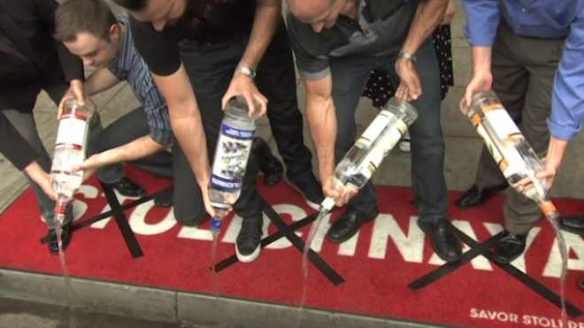
Politics is so draining: Bar-goers dump Stolichnaya at a West Hollywood protest, 2013. Photo from International Business Times

Politics is so draining: Bar-goers dump Stolichnaya at a West Hollywood protest, 2013. Photo from International Business Times

It’s not as though Russia and Putin ceased to be headline fodder in the last year. But the Internet-fed furor over Russian homophobia was never a campaign capable of the long haul. There was never any effort to build a resilient structure, ally with other movements, or recruit students or reach into unions or explore other stories of international solidarity. There was never much strategy, just publicity. There were flash-mob attacks on labels like Stoli, which doesn’t prop up the Russian economy; there were no campaigns to get governments to stop buying Russian gas and oil, which do. There was faith that Barack Obama had some magic sway over Moscow. And there was wild over-optimism that hashtags and Embassy protests would manage, in six months, to make Vladimir Putin back down. Five days into the Stoli boycott, blogger John Aravosis exulted that they’d “pressure the most important brand of all, Brand Russia and its leaders in parliament and the Kremlin, to make permanent change on this issue – if for no other reason than to simply make us all just go away.” This assumed Putin gave a damn, or regarded Russia as a “brand.” He didn’t. When the promised quick victory failed to come, virtually everyone gave up. Energy and enthusiasm and idealism infused the campaigning; sadly, they were squandered. The laws still stand. The trials are starting. The Tweeters have moved on.

Campaigns like this try to make it look easy. They obscure the truth: that politics is not quick or solitary, that solidarity is hard. The gays have a boycott almost weekly, steady as the Two Minutes’ Hate: it’s Barilla, or Mozilla, or Brunei, or something. Few such campaigns have contributed to any substantive social change. Many don’t even try. Boycotting Dolce without a declared goal isn’t pressure; it’s self-expression. As a result, they last only as long as it takes for people to get the anger out of their systems: the noble Russian campaign was a Methuselah compared to most of them. This erodes the patience real change requires. Our political attention span is barely longer than the mayfly’s lifecourse. Look up the mayfly, people. Do some research.

Meanwhile, some corporations do terrible, material harm to LGBT people, not just dissing their relationships but colluding with their torture. They go unboycotted. What about GE and BP, which recruited for the investment summit of Egypt’s head persecutor General Sisi, and are sinking millions into a dictator’s private economy? What about the Silicon Valley-based Blue Coat Systems, which sells Sisi surveillance equipment that can record every keystroke Egyptian queers type? Where are the hashtags? Where’s the outrage?

Surveillance hurts: Dolce & Gabbana ad, 2012

Surveillance hurts: Dolce & Gabbana ad, 2012

Through these priorities peer some of the disorders that afflict Western LGBT experience. A fascination with celebrity runs deep in gay men’s cultures. It’s partly founded in the persistence of the closet, the years of our lives that withered in concealment; the memory breeds envy of lives led in utter exposure, the unreserved nudity of fame, stars with skin and secrets open to the world like French doors. As a result, the purely verbal sins of celebrity designers matter more than the depredation wreaked by a little-known, torture-enabling CEO. And a British comedian’s directives outweigh anything a mere activist in Russia or Italy can say.

The gay consumer: Dolce & Gabbana ad, 2014

The gay consumer: Dolce & Gabbana ad, 2014

But there’s also the way that gays, with identities demarcated by desire, define themselves less and less as political participants, more and more as consumers. Boycotts can be useful tools to change things, but they can also feed this apathy. I wrote in 2013, and nothing’s changed: “If the gays stay apolitical, it’s because campaigns like this encourage them to think of their beliefs, values, and political actions as consumer choices.” Taking sides is picking “brands”:

Is [boycott politics] a boycott of politics, evading the responsibilities and demands that politics impose on us for an easy cyber-way out? Does our consumer power — that $800 billion gays spend annually at being gay — really make us stronger, more potent citizens? Or does it makes us less citizens, shut us into ghettos where we become what we do or do not purchase with our power? Does it foreclose more generous identities, more onerous but meaningful commitments, larger and more human solidarities?

One last fact: there’s almost no LGBT organization with any political power in North America that’s democratically run. They’re either behemoths governed by unelected boards, or the odd authoritarian one-man show. Other activists have few ways to participate except by giving money. This fosters more and more roving Lone Rangers, accountable to no one, locked outside.

You can argue the causes; but you can see the consequences. Things accelerate, and the focus goes. Human rights present themselves as immutable values, the preserve of universals in an incoherent time. Yet as abuses multiply, politics and principle — strategy and capability — play less part in deciding which rights to defend, where to concentrate concern; taste takes their place, capitulation or whim, mass gusts of emotion across computer screens like the wind bending tall grass. This month it’s Uganda; next month, Egypt. There’s no persistence; the future erodes. Conscience is the creature of fashion. You can protest Dolce and Gabbana if you like; they’ve won already. It’s their world we live in.

Get your rights abuses here: Dolce & Gabbana ad from 2007. The US National Organization for Women called it “beyond offensive, with a scene evoking a gang rape and reeking of violence against women.” But at least it's not synthetic.

Get your rights abuses here: Dolce & Gabbana ad from 2007. The US National Organization for Women called it “beyond offensive, with a scene evoking a gang rape and reeking of violence against women.” But at least it’s not synthetic.


16 Mar 16:34

Map: The strange things people Google in every state

by Ana Swanson

What strange goods and services is your state researching on Google? Apparently California has been looking into the price of facelifts, tummy tucks, swimming pools and marriage licenses, while Oklahoma is curious about the cost of breast lifts, liposuction, gas and daycare, according to Fixr.com, a cost-estimating website.

Fixr created the map below with Google Autocomplete, typing “How much does * cost in Sacramento, California?” into Google for each state or state capital, and then marking down the most commonly searched-for good or service.

Screen Shot 2015-03-16 at 11.20.38 AM

Some of the searches are somewhat disturbing, including sex, drugs and lots of plastic surgery. Others are delightfully innocent, like Alaska’s search for the price of a gallon of milk and Vermont’s search for the cost of a cord of wood.

More stories from Know More, Wonkblog's social media site: 

- A data genius computes the ultimate American road trip

- Map: The salary you need to buy a home in 27 cities

- What if America's zip codes were one big game of connect-the-dots?


15 Mar 22:37

BEFORE I WAKE: Do Not Fall Asleep When Watching The Trailer For Latest From OCULUS' Mike Flanagan

Matthew Connor

Loved Oculus, loved Absentia, ready for more from this dude.

Mike Flanagan's latest film, Before I Wake, was originally under the guise of Somnia. But now it has a better title and today a trailer was released via the film's Twitter account. Just click on the play button below and have a look![https://twitter.com/beforeiwakefilm/status/576418822682386433]Flanagan loves going back to some of the same imagery he has used in his previous films, I am specifically talking about the absence of eyes replaced by pitch blackness. Flanagan has done creepy really well and Before I Wake looks to deliver the same good tension and scares. In this intense and heart pounding supernatural thriller, Jessie (Kate Bosworth) and Mark (Thomas Jane) decide to take in a sweet and loving 8-year-old boy, Cody. Unbeknownst to them, Cody is terrified of falling asleep....

[Read the whole post on twitchfilm.com...]

14 Mar 08:08

Saying yes to a $1,357 dress: What Americans spent on weddings in 2014

by Ana Swanson
Matthew Connor

$31,213!!

“For richer or for poorer,” the traditional wedding vow goes. But when it comes to hosting the wedding itself, having a bigger bank account at your disposal certainly helps.

A new survey of 16,000 brides by XO Group, which owns wedding website TheKnot.com, found that the average cost of a wedding excluding a honeymoon was $31,213 in 2014, a five-year high. When adjusted for inflation, that spending is not quite equal to pre-recession highs, but it is getting close.

Screen Shot 2015-03-13 at 11.06.11 AM

Since the financial crisis, poor job prospects and rising debt burdens have discouraged many Millennials from getting married. By 2012, the share of never-married adults in the U.S. had reached historic highs, according to a survey by the Pew Research Center.

Now, higher spending on weddings is likely a sign that the American economy and consumer confidence are strengthening. XO Group’s survey found that spending on almost all wedding categories increased in 2014, including the venue, photographer, band or DJ, wedding dress, and catering. Couples are particularly spending more on elements like catering, musicians, cake and cocktail hours, and less on the ceremony itself.

XO Group

XO Group

Almost half of couples (45 percent) went over budget on their wedding in 2014. About a quarter (26 percent) stayed within their budget, and 23 percent didn’t have a budget.

The survey also shows substantial regional variation in wedding costs. Manhattan is by far the most expensive place to get married, with an average cost of $76,328 in 2014, followed by Long Island at $55,327 and north/central New Jersey at $53,986. At the other end of the spectrum were Arkansas and Utah, with an average cost of only $18,031 and $15,257, respectively.

The bride's age also varied regionally: Nevada and New York City had the oldest brides, with an average age of 32, whereas in West Virginia and Kentucky the average bride was 26. Nationwide, the average bride was 29; the average groom, 31.

Who is footing this extravagant bill? According to the survey, the bride’s parents paid for 43 percent of the total cost on average, the bride and groom contributed 43 percent, and the groom’s parents contributed 12 percent. About 12 percent of couples paid for the entire wedding themselves.

Having a lavish wedding may be fun, but it is certainly not a requirement for a happy marriage. A 2014 survey of more than 3,000 married couples found a positive correlation between the amount of money spent on a wedding and the likelihood a couple would get divorced.

Randy Olson http://www.randalolson.com/2014/10/10/what-makes-for-a-stable-marriage/

Randy Olson http://www.randalolson.com/2014/10/10/what-makes-for-a-stable-marriage/

Those who spent $20,000 or more on a wedding – peanuts compared to some of the weddings mentioned in the XO survey – were 3.5 times more likely to end up divorced than counterparts who spent less than half that amount.

If you have the means, say yes to the $1,357 dress. Just remember that an expensive wedding is not the key to a happy marriage.

CL Society 198: Bride tail

Flickr user francisco_osorio (CC)


13 Mar 15:41

Boston Pride says it's marching in Sunday's St. Patrick's Day parade

by adamg
Matthew Connor

Nothing like going someplace where you are obviously not wanted and only begrudgingly accepted, right? Fuck this stupid city's St. Patrick's Day bullshit. But, uh, congratulations Boston Pride or whatever.

The LGBT group announced today:

Boston Pride, which will commemorate its 45th anniversary as an organization celebrating the LGBT community in June, has been accepted by the South Boston Allied War Veteran’s Council to march in the 114th annual South Boston St. Patrick’s Day Parade.

12 Mar 19:30

Movie Review: It Follows is a new classic of both horror and coming-of-age cinema

by A.A. Dowd
Matthew Connor

This is the kind of review that makes me worried about a Babadook-style letdown, but JEEZ I wanna see this right now. Why is it not playing anywhere in Boston?!?! Except for two nights next weekend at the Coolidge, when I'll be out of town. UGH.

It sounds like the stuff of slumber parties, a cautionary tale to be whispered by flashlight or embellished over a flickering flame: Sleep with the wrong person, as the teenage heroine of It Follows does, and the nameless thing will come for you. On the outskirts of Detroit, Jay (Maika Monroe) finds herself the target of this relentless, shape-shifting entity—a curse passed on through sex with Hugh (Jake Weary), her handsome but mysterious new squeeze. As he explains, only the afflicted can see the specter, which will sometimes take the form of someone she knows. It will follow her, persistently but always at a walk, until she either falls into its clutches or passes the burden to a new sexual partner. “Never go anywhere with only one exit,” Hugh warns.

There’s a primal, ingenious simplicity to that setup, one that writer-director David Robert Mitchell mines for one enormous ...

12 Mar 18:00

All Songs At 15: Björk Plays DJ

by Robin Hilton

All Songs At 15: Björk Plays DJ

Every Thursday this year we're celebrating All Songs Considered's 15th birthday with personal memories and highlights from the show's decade and a half online and on the air. If you have a story about the show you'd like to share, drop us an email: allsongs@npr.org.

Bjork
Inez & Vinoodh Matin/ILC

Back in the early summer of 2009, Björk released a sprawling box set of music called Voltaïc. It was a surprising retrospective of her work up to that point in part because it included live-to-tape recordings of songs from her previous albums Medulla, Homogenic, Post, Vespertine and Volta. The recordings were made especially for the Voltaïc collection. And five different versions of the box set were available that included a mix of other live recordings, concert footage, remixes and music videos. With the recent opening of MOMA's Björk retrospective in New York, we thought it was a good opportunity to revisit another career-spanning conversation she had with us.

Shortly after Voltaïc's release, Björk sat down for a memorable talk with All Songs Considered host Bob Boilen about her music, and to share songs by some of the artists who've inspired her over the years, including Syrian musician Omar Souleyman, the post punk duo Eyeless in Gaza, and fellow Icelandic singer Ólöf Arnalds. Björk was speaking from Iceland; Bob was at NPR in Washington, D.C.

You can hear the original interview with Björk with the link above. You can also check her full guest DJ playlist on our original 2009 post.

Copyright 2015 NPR. To see more, visit http://www.npr.org/.
11 Mar 17:08

Everyone Who Hated ‘Blurred Lines’ Vindicated

by Jessica Goldstein
Matthew Connor

I still can't get over the insanity of this ruling. As nice as it is to see Robin Thicke lose a court case on his birthday, the fact is that these two basslines are not the same, at all. A jury of laypeople decided that a song "sounds like" another song. Literally every song sounds like another song. I'm sure this will be appealed to high heaven.

blurredcourt

CREDIT: AP Photo/Sarah Bentham

Turns out the most offensive thing about “Blurred Lines” isn’t its questionable lyrics, the female (and goat) nudity in its video, or Robin Thicke’s all-around smarminess: a jury determined Tuesday that 2013’s song of summer did, in fact, copy too much Marvin Gaye’s “Got to Give it Up.” Thicke and Pharrell Williams owe Gaye’s family $7.3 million.

An L.A. jury reached this landmark decision at the end of a two-week trial, which sounded like quite the dance party: Thicke played the piano, sang, and busted some moves in his seat. According to Variety, it included presentations of “juxtaposed bass lines of the two songs in question” which, when asked about the two songs, “Williams even admitted the similarities, saying, ‘It sounds like you’re playing the same thing.’” Probably not the best thing to say in this particular situation, Pharrell!

Nona, Gaye’s daughter, wept upon hearing the verdict. After the trial, she said, “Right now, I feel free. Free from… Pharrell Williams and Robin Thicke’s chains and what they tried to keep on us and the lies that were told.”

The “Blurred Lines” legal saga started last August, when the “Blurred Lines” trio (Thicke, Pharrell, and T.I.) went to court to preemptively protect their megahit from accusations of musical plagiarism. But a U.S. District Court denied their motion; Gaye’s family went ahead and filed suit. The depositions that followed provided some of the most entertaining-yet-depressing revelations about these guys and the music industry. Thicke shares a writing credit on the song and, in interviews, would describe how “Got to Give it Up” inspired him. But in a deposition, he admitted that he’d lied: he “was high on Vicodin and alcohol” the day he showed up at the studio to record. He only took credit for the song after it attained summer smash status. He also acknowledged that he was not sober for a single interview in 2014.

In court, Pharrell testified to writing the entirety of “Blurred Lines” in one hour. The two recorded the song in a single night; T.I.’s track was added after the fact, and he emerged from from this legal battle totally unscathed.

Pharrell released a statement to USA Today in the aftermath of the verdict, via his spokesperson Amanda Silverman, saying he is “extremely disappointed in the ruling made today, which sets a horrible precedent for music and creativity going forward.” Thicke’s reputation is already pretty terrible. His most recent album, Paula, a sloppily assembled, stalker-style attempt to win back his wife, was hated by just about everyone who heard it; silver lining is, hardly anybody heard it, as it only moved 24,000 units in its first week and was deemed one of the “top flops” of 2014. But Pharrell has considerably more to lose: he’s a coach on the insanely popular The Voice, a go-to producer for musicians looking for that Midas hitmaker touch.

“Blurred Lines” was no. 1 on the Billboard charts for 10 weeks straight. Court documents reveal that the song raked in almost $16.5 million in profits; Williams and Thicke earned over $5 million apiece.

The decision is a landmark one for the music industry, where the difference between “inspiration” and “copyright infringement” can be hard to spot. And it comes on the heels of Tom Petty’s settlement with Sam Smith over similarities between Petty’s classic “I Won’t Back Down” and Smith’s Grammy-winning “Stay With Me.” Smith quietly gave Petty a co-writing credit on his ballad, and Petty released a remarkably friendly, chill statement about the whole thing: “All my years of songwriting have shown me these things can happen… A musical accident no more no less. In these times we live in this is hardly news.”

Yet in the past, Petty had been even less fazed about this sort of theft-lite: in talking to Rolling Stone about how The Strokes had lifted from “American Girl” for their hit “Last Nite,” Petty just laughed out loud; he was also fine with the similarities between “Dani California” by the Red Hot Chili Peppers and his own “Mary Jane’s Last Dance.”

But as profit margins in the music industry are shrinking — streaming and piracy are on the rise, album sales for everyone but Taylor Swift are plummeting; surely you’ve heard this song before — it appears that even the most laid back rock stars have to protect what earning opportunities they have left. Could this case lead the way for other artists to become more litigious, possibly resulting in a chilling effect on musical creativity? That’s the bad news. The good news is we probably won’t be hearing any music from Robin Thicke for quite a while.

The post Everyone Who Hated ‘Blurred Lines’ Vindicated appeared first on ThinkProgress.


05 Mar 23:22

Newswire: Substitute teacher convicted of screening The ABCs Of Death sentenced to 90 days in jail

by Katie Rife

We recently wrote about a substitute teacher in Columbus, Ohio who was convicted of a felony—four counts of disseminating matter harmful to juveniles, specifically—after showing the horror anthology film The ABCs Of Death to a series of five high-school Spanish classes.

At the time, lawyers for Sheila Kearns, the substitute in question, argued that she had no idea what the movie was about and simply showed it because she thought it was in Spanish (as three out of the 26 segments are). They also said she had her back turned to the TV and didn’t see the sex and violence unfolding on the screen. Basically, they argued that she was bad at her job. The idea that putting someone in jail for showing a commercially available movie that any of Kearns’ students could have bought on Amazon, no matter how distasteful the judge found the content of ...

05 Mar 19:40

Seattle’s smart take on how to help the poor: subsidize their transit

by Emily Badger
Matthew Connor

Seattle is sounding better and better to me every day.

Seattle's "one regional card for all" transit card. Courtesy of Flickr user Oran Viriyincy under a Creative Commons license.

Seattle's "one regional card for all" transit card. Courtesy of Flickr user Oran Viriyincy under a Creative Commons license.

Earlier this week, transit agencies in and around Seattle launched a new, two-tiered fare system: one rate for most riders in a region full of high-wage tech jobs, and another for those living on less than 200 percent of the poverty line.

The project — from the same city that last year brought us a $15 minimum wage, and a higher property tax to fund preschool for the poor — was designed to blunt rising inequality in the region, and it could aid as many as 100,000 low-income people there. Riders who qualify get a special "ORCA Lift" card for use on all of the region's transit systems that will automatically deduct $1.50 fares, as low as half of the standard rate on some services. A couple of other U.S. cities, including San Francisco, have tried something similar, but none has aspired to reach as many riders as Seattle hopes to. From the New York Times:

The distinctions start with scale and ambition: King County has about two and a half times San Francisco’s population, and in aiming for enrollment numbers San Franciscans could only dream of, it is relying on what transit experts say is the most innovative idea of all: tools honed by the Affordable Care Act. A countywide system of more than 40 health clinics, food banks, community colleges and other sites run by nonprofit groups was put together to enroll residents in health insurance, and those partners were re-enlisted in the last few weeks to start registering people for ORCA Lift.

To make matters even simpler, riders can verify their eligibility by showing that they've already qualified for other benefits like Medicaid, food stamps, or Temporary Assistance for Needy Families.

This kind of transit discount is one of the smartest subsidies any city can offer to the poor for a host of reasons. It's much cheaper — and politically more feasible — to enable the poor to commute to cheaper housing than to try to build that affordable housing in the expensive neighborhoods where many of them work. Transit is already heavily subsidized by public money, and this system directs that subsidy to the people who need it most. Improving public transit is also a tangible way to tackle unemployment among would-be workers who have a hard time keeping a job because they have a hard time getting to it.

A discount transit program is also, quite simply, a way to boost the incomes of the poor by returning more money to their pockets. If you spend as much on coffee as you do commuting every day, the difference doesn't sound like much. But it's the equivalent of a modest raise for people making minimum wage, even in Seattle.


05 Mar 18:08

Loreen’s new single is now on the world wide web

by Brad O'Mance

Loreen

‘We Got The Power’ hitmaker Loreen has finally ‘premiered’ her new single ‘Paper Light (Higher)’.

As is the way with things these days, the song is available to listen to on Spotify in specific countries only at the moment, although apparently it’s going ‘worldwide’ on March 9.

Mind you, our good friends over at Ultimate Music have popped it into a player for the world to enjoy and here that is:

Loreen will perform the song this Saturday at the halfway point of Melodifestivalen. Just as an ‘FYI’.

04 Mar 18:37

Newswire: Soundtracks to Clueless, O Brother, Pulp Fiction and more getting LP reissues

by Marah Eakin
Matthew Connor

Definitely need Clueless and Little Shop of Horrors on vinyl, obv. (The Romeo & Juliet soundtrack is already available and on my Amazon wishlist.)

More than two dozen famous film soundtracks are getting fancy LP reissues. Universal Music Enterprises plans to capitalize on both the recent vinyl resurgence and the success of niche soundtrack labels by releasing 26 individual scores and soundtracks over the first five months of 2015, including John Williams’ scores for E.T. and Jaws, Nino Rota’s meandering score for The Godfather, and the soundtracks for films like Clueless, Juice, and Pulp Fiction. A few of the albums have already been released, like the soundtrack to Spike Lee’s Do The Right Thing, which came out January 20. But others, like Howard Shore’s Silence Of The Lambs score and Alan Menken and Howard Ashman’s tunes for Little Shop Of Horrors, are due in the near future.

A full list of what’s coming when is below. All the LPs are available for pre-order via Amazon or—even better ...

26 Feb 18:21

Guy appointed to figure out how to get the T out of crisis promptly leaves for vacation in Jamaica

by adamg

But, his people assure the Globe, they have telephones down there, and it's not like the commission doesn't have an entire month to report back to the governor.

26 Feb 16:44

Majority Of Republican Primary Voters Want To Establish Christianity As A National Religion

by Ian Millhiser
cross flag

CREDIT: Shutterstock

A national poll of Republican primary voters conducted by Public Policy Polling finds that 57 percent of these voters support “establishing Christianity as the national religion.” The First Amendment to the United States Constitution provides that “Congress shall make no law respecting an establishment of religion.”

Only 30 percent of Republican voters believe that Congress should not make a law respecting an establishment of religion, according to the poll.

The same poll also finds that 74 percent of GOP primary voters have a favorable opinion of former President George W. Bush. Two-thirds (66%) do not believe in global warming, and a plurality (49%) do not believe in evolution.

The post Majority Of Republican Primary Voters Want To Establish Christianity As A National Religion appeared first on ThinkProgress.


20 Feb 23:19

Scarlett Johansson, Este Haim, Holly Miranda Debut Grimes-Inspired Supergroup The Singles

by Stereogum
Matthew Connor

eeeeeee so excited for my friends Julia & Kendra <3 <3 <3

Our Scarlett Johansson tag archive is truly fascinating, including New Order and Serge Gainsbourg covers, collaborations with everyone from the Jesus And Mary Chain to Dean Martin, and a game of charades with Drake. Here’s one more unexpected entry: The movie star has teamed with Este Haim, Holly Miranda, Kendra Morris, and Julia Haltigan to form a self-described “super-pop” group called the Singles. Here’s how Johansson described the endeavor to Rolling Stone:

Read More...


20 Feb 21:46

Governor creates commission to figure out what to do about the T

by adamg
Matthew Connor

I'm sure this will fix everything.

It's supposed to file a report by the end of March on how to get us "the 21st-century transportation that we all deserve," Baker said at a press conference. "We cannot continue to do the same thing and expect a different result."

Stephanie Pollack, transportation secretary, said the panel will also look at long-term fixes for the "structural problems that have led the T to where it is today."

Baker said that while he'll leave the heavy lifting to the commission, he will be making surprise visits to T stations and other facilities to try to get a handle on what's going on.

19 Feb 15:17

embriagarsehoy:Muson Synthesize 1978

Matthew Connor

awww i want one


embriagarsehoy:

Muson Synthesize 

1978

17 Feb 21:13

Newswire: NBC courts teens by remaking the Polish post-Communist series The Decalogue

by Alex McCown
Matthew Connor

LOL. And it's gonna be set in Boston.

TV executives are always chasing that youthful marketing demographic. Anyone young with disposable income—tweens, teens, maybe even the oldsters in the 18-24 demographic. Get the kids, the advertising dollars follow. That’s surely the reason for NBC’s latest move: Deadline reports the network has signed up to produce The Decalogue, a remake of the masterful 10-part TV series by acclaimed Polish auteur Krzysztof Kieślowski (Three Colors).

It’s a move that cannily traffics in the hot TV auteur trend, as Kieślowski—known as the Seth MacFarland of Poland’s late Soviet era—directed and co-wrote each of the ten hourlong films in the original series. Plus, each one is based on one of the Ten Commandments. That allows NBC to tap into that big-money Christian market, much as Kieślowski was trying to do with his searching meditations on the nature of morality and existence in a world just ...

17 Feb 14:52

Róisín Murphy’s announced some things about her new album

by Brad O'Mance
Matthew Connor

YES YES YES THANK YOU YES

Roisin Murphy

‘Pensiero stupendo’ hitmaker Róisín Murphy has announced some things about her third solo album, including its title, ‘Hairless Toy’, and its release date which is May 11.

There’s also some ‘cover art’ (please see above) and a list of words placed in a specific order which makes up the tracklisting.

Regarde:

  1. Gone Fishing
  2. Evil Eyes
  3. Exploitation
  4. Uninvited Guest
  5. Exile
  6. House of Glass
  7. Hairless Toys (Gotta Hurt)
  8. Unputdownable

The opening song on the album, the near six minutes of ‘Gone Fishing’, is now streaming on Pitchfork’s website, obviously.

14 Feb 18:55

Boston may need the Olympics to fix its problems — which is bad news for the rest of us

by Emily Badger
Matthew Connor

Glad to see the problems we've been facing this week are garnering some deeper national discussion around the prospect of a Boston Olympics.

The Boston skyline, courtesy of Flickr user James, under a Creative Commons license.

The Boston skyline, courtesy of Flickr user James, under a Creative Commons license.

BOSTON—The 100-year-old subway system here is creaking with age, in need of new cars, functional air conditioning, more reliable service. Battered by snowstorms, the entire "T" was paralyzed this week. The commuter rail station downtown needs an expansion, too. And housing — there this city is busting at the seams, in need of tens of thousands of new units to accommodate both new arrivals and priced-out working-class residents.

Enter, amid all of these challenges, the prospect of an Olympic Games. Last month, Boston was chosen by the U.S. Olympic Committee over Washington, San Francisco and Los Angeles to make the country's bid for the 2024 summer games. Now as the possibility that Boston might actual win them starts to sink in, the city is facing a massive debate about what those games could mean for all of its problems.

Opponents say the city can ill-afford the all-consuming distraction of playing Olympic host when Boston can quite literally not keep the subway trains running on time. The games' backers, meanwhile, counter that the one thing that could rally the city to right its infrastructure is a deadline like no other.

"This conversation causes us to put a circle around the calendar, to say 'by this date certain, we have to have certain things done,'" John Fish, the chair of the group putting together the bid, told an overflow crowd last week at the city's first public meeting on the games.

If he is right — that the city's best bet to tackle its biggest challenges lies in making this commitment to the world — that raises an awkward question for the rest of us: At a time when the U.S. can get seemingly so little built, when a majority of Americans oppose even a modest increase in the gas tax to fund basic infrastructure, when trust in government to accomplish anything is so low, do American cities need to take on an Olympic Games just to get big things done?

Never mind the old debate over whether the Olympics are ever worth the economic cost to a city. This question, which turns on our political and collective inability to invest in cities when the Olympics aren't even in the picture, is far scarier. If Boston needs the Games to make sure the subway is fixed and the rail terminal is expanded and all of that housing is built, the rest of us are in trouble.

"What happens when we awake up in 2025? Now what?" asks Chris Dempsey, one of the co-chairs of No Boston Olympics, the primary organization in the region for people who want, well, no Boston Olympics. "Now we’ve convinced ourselves we can only do things with mega-events."

At the public meeting last week, No Boston Olympics distributed black-and-white signs implying the zero-sum tradeoff it fears the games would bring:

"Better schools, no Olympic Games"

"Better housing, no Olympic Games"

"Better transit, no Olympic Games"

The room where the meeting was held, at Suffolk University Law School, was packed well beyond capacity. Residents spilled out of the door and into an overflow room. They gave out an audible gasp at the mention of beach volleyball on the Boston Common. At Q&A time, most of their queries were skeptical.

"I love the Olympics, and I love the city of Boston," one man offered. "But not together. My question is: What would it take to stop this?"

"Why do we have to wait 10 years for changes?" another man begged. "For changes that we need to make now?"

Rich Davey, a former Massachusetts state secretary of transportation who was recently named the chief executive of Boston 2024, counters that better transit and an Olympic Games aren't mutually exclusive.

"If government is incapable of doing more than one thing at a time, forget about the Olympics," he says. "I think we’re all in trouble as a general matter."

But he's also surprisingly blunt about the ability of government to accomplish some of these goals under normal circumstances, like improving the city's "threadbare" transit.

"We feel like the Olympics gives government — with all due respect, because I was there for four years — a deadline," he says. "There’s nothing like a deadline for your kid’s fourth-grade homework. And there’s nothing like a deadline to get government to build big projects."

Davey and Boston Mayor Marty Walsh have insisted that they only want the games to come to Boston if that goal aligns with the city's own future development. It's easy, though, to envision that while Boston's interests and the IOC's may align in the abstract today, they could diverge as the games grow nearer.

Dempsey worries in particular that as the deadline for the Olympics approaches in any city, civic projects inevitably fall by the wayside for Olympic priorities. International Olympic Committee officials in Brazil, he says, aren't there to check up on the progress of new public parks or transit investments that were promised to residents. They want to make sure the stadium has enough seating by the opening ceremony.

The IOC approved in December a suite of reforms designed to make the games less of a burden on host cities, following years of an arms race that has left cities in debt and saddled with infrastructure they don't ultimately reuse (and left other cities skittish about bidding for them). But critics in Boston don't trust those reforms, and they won't trust any contract that requires the city to bear financial liability for any cost overruns.

No Boston Olympics, as well as several other camps at the city and state level, are willing to put a non-binding ballot measure to voters to make that point. Most likely, such a question would ask voters if the city should host an Olympics that requires any public guarantee of money. Harvard, meanwhile, has announced that it won't help the bid fundraise, even as Boston 2024 is pitching the region's universities as a key asset to the games.

"We are sometimes called cynics," Dempsey says. "The boosters like to say we’re people who don’t think this can be done. We’d throw that label right back at the boosters. We think we can accomplish these important things without the glittery and expensive prize of the Olympics."

For anyone who believes an Olympics are necessary, that position doesn't simply reflect a cynicism about government. It's a commentary on the public, too — in Boston and beyond — which has lately been as unwilling to spend new money on infrastructure as government has been incapable of building it efficiently. All of us, not just government, Davey says, seem to rally around infrastructure only in times of opportunity or crisis, when we're presented with an Olympic Games or a political convention — or a tragic bridge collapse.

"For cities, we either have to accept this crisis-and-opportunity binary philosophy, or we need to rise up and expect more from people," Davey says. "We need to be willing to say 'you know what, I’m willing to spend 10 more cents on a gallon of gas, or I’m willing to pay a toll, or I’m willing to do a vehicle miles traveled [fee].'"

Right now, Massachusetts isn't talking about raising such money. In November, voters in the state actually opted to repeal automatic increases to the state gas tax tied to inflation. And just last week, the governor proposed $40 million in cuts to transportation spending to balance the state budget.

"Boston, I think, is taking an opportunity," Davey says, because it lives in that world of opportunity or crisis or bust. "I would hope that we don’t have to do that forever. But I think that’s the state of affairs where we are right now."


13 Feb 17:09

Snow mound for sale; owner will throw car in for free

by adamg

Marta noticed this photo this morning accompanying a for-sale ad on Craiglist: $3,500 or best offer gets the snow and the 2004 Audi Avant S4 that is allegedly buried under it in Winchester. Here's a side photo of the snow mound.

12 Feb 17:15

Photo


12 Feb 16:59

The new Official Albums Chart rules: how it all works

by Popjustice
Matthew Connor

lol'ing at all of this, especially "THE BECK/BEYONCÉ MEME CLAUSE"

Thanks to Spotify, streaming is bigger than ever in the UK.

UK-STRTEAMING-DATA

An impressive graph – and that’s just Spotify. Look how much it changes when you factor in Deezer.

UK-STRTEAMING-DATA-DEEZER

The challenge for the Official Charts is to include streaming so that the chart stays relevant – but it’s hard. When streaming data was added to the singles chart, they came up with the simple formula that 100 streams would equal one sale.

But today the Official Charts Company have made a big announcement: streaming will also now count towards the albums chart, too.

occ-album-change

There are difficulties – what if one album track is streamed a lot? What if people only listen to half an album? That sort of thing.

Fortunately, the OCC have come up with a formula to make sense of it.

Here’s how it works.

PHYSICAL SALES
This is CDs sold in Tesco and petrol stations.

PLUS

DIGITAL SALES
These come from the the strange group of people who have embraced The Future to the extent that they’ll consume music digitally, but haven’t embraced digital enough to comfortably wave goodbye to the concept of paying a fair sum for music. By 2018 this will account for eighteen people. You could argue that a digital sale should count for more than a physical sale, because paying for something intangible that you can’t sell or give to someone else shows more commitment to the music than buying a compact disc. But let’s not get bogged down in that.

PLUS

STREAMS
From next month, the Official Charts Company will look at the total plays of an album’s twelve most streamed tracks – then they’ll divide that by 1000. You might think that 1000 is a curiously round number but that is just a coincidence: this number has been arrived upon BY SCIENCE.


PLUS

THE COTTON MULTIPLIER
If a Live Lounge performance of any song on the album has given Fearne Cotton “goosebumps!!” in the last 30 days, the current sales total will be multiplied by 1.045.

PLUS

THE BECK/BEYONCÉ MEME CLAUSE
Thanks to numerous, totally logical memes floating around in the wake of this year’s Grammys, everyone knows that an album gets progressively worse with every additional performer, writer or producer. You might say that by this logic you could record the sound of yourself shitting in a yellow bucket and that the ‘song’, having been composed, produced and performed by just one person, would be intrinsically better than anything Lennon and McCartney ever knocked together. But you would be shouted down because internet memes have spoken. Anyway, based on all this, 0.08% of an album’s sales will be knocked off for every additional person involved in the album. The OCC are going to be very strict on this and as well as counting songwriters, producers and performers, they’ll also take into account A&Rs, managers, accountants, everyone who works at the record label, and the person who went and got sandwiches while the photo for the sleeve was being taken.

PLUS

HAT FACTOR
Does the artist wear a hat on the sleeve of the album? If yes, add another 8000 ‘sales’ to the tally.

EQUALS…

The grand total!

We are sure you will agree that this is an exciting new chapter for the Official Charts, and we look forward to seeing how the new rules shape the albums chart!