Shared posts

09 Feb 15:00

smarmy

by Word of the Day Editors
Matthew Connor

always a fave

Merriam-Webster's Word of the Day for February 08, 2015 is:

smarmy • \SMAR-mee\  • adjective
1 : revealing or marked by a smug, ingratiating, or false earnestness 2 : of low sleazy taste or quality

Examples:
The candidate came across as a bit smarmy during the interview.

"'No Control' has some punk-rock flair, more so in spirit than in sound. It's a little messy and smarmy and rages admirably here and there." — Joey Guerra, Houston Chronicle, November 17, 2014

Did you know?
Something smarmy will often ooze with self-satisfaction and insincerity. Much like its synonyms unctuous and slick, smarmy has a history that starts with a meaning of literal slipperiness or oiliness. The verb smarm appeared in English in the mid-19th century. Etymologists don't know where it came from, but they do know that it meant "to smear," "to gush," or sometimes "to make smooth or oily." A few decades later, the use of smarm was extended to sometimes mean "to use flattery." The adjective smarmy appeared in the early 20th century. At first meaning "insincerely flattering" or "smug," it later took on an additional meaning: "sleazy."

09 Feb 14:58

Constitutional Crisis In Alabama As State Judges Buck Federal Order On Marriage Equality

by Zack Ford
Matthew Connor

I'm weirdly unprepared for this. Of course marriage equality is an inevitability at this point, but my little backwards-ass home state? It's, like, hard to even fathom.

Marriage Equality Map 02-09-15

CREDIT: ThinkProgress

As of Monday morning, District Judge Callie V. S. Granade’s stay on marriage equality in Alabama has expired and, with the Supreme Court declining to issue its own stay, her ruling declaring the state’s ban on same-sex marriage unconstitutional is in effect. Same-sex couples are already lined up to marry at courthouses, but some may still be turned away by probate judges who refuse to abide the ruling.

Probate judges in various counties have indicated that they will in some way circumvent same-sex marriage licenses. For example, Marengo County Probate Judge Laurie Hall has said that her office will still make marriage licenses available, but she will no longer sign them for any couple. Pike County Probate Judge Wes Allen has similarly taken his office “out of the marriage licensing business altogether,” citing state law that indicates that judges “may” issue marriage licenses — but don’t have to. Clarke County Probate Judge Valerie Davis has taken the same step, while judges in Covington County and Washington County will continue to discriminate against same-sex couples per the unconstitutional state law.

If any judges were on the fence about whether to issue licenses, they may find a reason not to in the “administrative order” issued by Alabama Chief Justice Roy Moore last night. Moore, who has a history of bucking federal court orders, simply declared that probate judges do not have to abide the federal order.

This may not, however, be the best legal advice. Though the Alabama Probate Judges Association originally found reason to avoid issuing marriage licenses to same-sex couples, two follow-up orders from Granade changed the scope of her original ruling. In a separate case about a couple seeking to marry in-state as opposed to just having their out-of-state marriage recognized, she issued an injunction that bound any state officer tasked with enforcing the state’s ban. She also issued a clarification of her original ruling and, borrowing a strategy from District Judge Robert Hinkle in Florida, pointed out that even if her injunction does not require probate judges to issue licenses, the Constitution does. Thus, any probate judge who continues to violate a same-sex couple’s constitutional rights could be held legally liable with a new complaint. This would not be the first time that Alabama probate judges have ignored a federal ruling about who they should issue licenses to. The ACLU has set up a hotline that same-sex couples can call if they are refused a license, while the anti-LGBT Liberty Counsel has already announced it will defend probate judges in such cases.

At least one county probate judge will not need assistance from the Liberty Counsel. Jefferson County Probate Judge Alan King is ready to issue licenses to all couples Monday morning, so same-sex couples will begin marrying in Alabama. Freedom to Marry has a thorough list of Alabama wedding officiants prepared to solemnize same-sex weddings.

First couple enters the probate court in Birmingham. pic.twitter.com/xqUkuWmC5l

— Alan Blinder (@alanblinder) February 9, 2015

After marrying a gay couple in Birmingham, a judge asked for a picture with them. pic.twitter.com/QESkBxxvyC

— Alan Blinder (@alanblinder) February 9, 2015

The post Constitutional Crisis In Alabama As State Judges Buck Federal Order On Marriage Equality appeared first on ThinkProgress.


05 Feb 22:45

Newswire: The Guest’s Adam Wingard and Simon Barrett are prepping another horror movie

by Katie Rife
Matthew Connor

YES PLZ

After a brief detour into Terminator-esque action with The Guest, writer/director team Simon Barrett and Adam Wingard are returning the the genre that made them famous. According to The Hollywood Reporter, the duo is currently prepping a horror film called The Woods. An official plot synopsis is not yet available, but The Hollywood Reporter says the film is about “a group of college students on a camping trip who discover they are not alone,” a typical horror plot that Barrett and Wingard will presumably twist like they did the home-invasion thriller in You’re Next.

Wingard will shoot the movie this spring, and is reportedly looking to cast mostly unknown actors in order to emphasize the film’s horror elements. This puts the status of Barrett and Wingard’s proposed I Saw The Devil remake into question, but as long as the duo is putting out movies, we ...

04 Feb 19:50

Young adults are driving vaccine skepticism in the U.S.

by Christopher Ingraham
Matthew Connor

Important to share with the Millennials in your life.

Vaccine skepticism is highest among 20-somethings (photo: Washington Post).

Who are the vaccine skeptics? On the heels of the Disneyland vaccine outbreak, that's what everyone wants to know. As with just about every other major issue facing the country, the temptation is to divide it along familiar left/right political divides. It may seem natural that Republicans, who tend to be skeptical of mandates and government intrusions, would be most opposed to vaccination policies. Or that Democrats, distrustful of big businesses like pharmaceutical companies, would harbor the most skepticism.

But as it turns out, we're asking the wrong question. Public opinion polling shows that vaccination attitudes don't differ much by party affiliation. Or by income, or even education. But there is one important demographic factor: age.

vaccine_polling

Millennials -- 18 to 29-year-olds -- are about twice as likely as senior citizens (65+) to say that parents should decide whether their kids get vaccinated, rather than having it mandated by law. Republicans and independents are more likely to say this than Democrats, but here the split is not as stark.

More strikingly, 21 percent of millennials say it's likely that early childhood vaccinations are linked to autism, compared to only 3 percent of those aged 65+. There's little variation by political party on this question.

The Pew Research Center, which polled the first question, posits that "One possible reason that older groups might be more supportive of mandatory vaccinations is that many among them remember when diseases like measles were common." Having come of age in an era when measles was declared eradicated, millennials have no generational memory of time when hundreds of thousands of Americans were stricken with the disease each year. Not to mention polio, or smallpox.

Vaccines are partially a victim of their own success. They've done such a great job of wiping out deadly diseases that it's easy to become complacent. Largely liberated from having to worry about measles outbreaks, or tetanus, or polio, we're able to fret over whether vaccinations comport with an "all-natural" lifestyle. But we've forgotten that the incredible success of vaccination programs is what afforded us that luxury to begin with.

It may take more California-style outbreaks to jolt our memory.


02 Feb 16:45

The Absolute Worst (Oculus) & Best of 2014

by Ross
Matthew Connor

Sharing because Camp Blood always cracks me up, although I disagree on several things here (not The Babadook thing, suck it everyone!). I really liked Oculus! I thought Coherence was entertaining-ish but forgettable! I will never watch a romantic zombie comedy starring Aubrey Plaza fucking hell! The Sacrament was too godawful to even notice if Amy's performance was any good! COSIGN ON STARRY EYES, though, everybody should watch that. And who knew Dan Stevens was sexy, I did not.

“Beth” and its fantastic cunt Aubrey

The year in great, useless horror faggotry. GODDD, LET’S JUSSSTTT FUCKINGGGGG GETTTTT INNNTO IT! Preface: a stunning sackful of indies get the gold. (Except for ONE. The one EVERYONE loved.)

But, sadly, first… the worst.

WORST HORROR OF THE YEAR

OCULUS

GARBAGE.

  • Most frightening is its self-seriousness.
  • ALSO, A MIRRORRRRRRRR IS THE VILLAINNNNNNNNNN…..!
  • Katee Sackhoff, known beast, gives a career-humiliating performance as “Mom/Demon.”
  • Co-starring some poor children and phenomenal slug Rory Cochrane, who we actually love, but not in the Blumhouse world. Not at all. Something’s off.
  • Karen Gillan (“Doctor Who,” Guardians of the Galaxy, and most recently ABC’s most-marketed, least-watched, barely-anticipated joyous bomb “SELFIE”) is hhhhooooorrrible. And it did not feel good loathing her! Because it seems we should love her! She seems to deserve love!!!
  • But most importantly, the fillum Oculus presents an actor so inexplicably wrapped in the tightest top and jeans… a musclepup tailor-made for casting couches beachwide… Brenton Thwaites (The Giver, Maleficent). A healthy Australian. Too manufactured to be even remotely taken seriously.

Exhibit A:

(from r-l: at mirror with Gillan; at jungle with monster dicklines)

Now, on to true worthiness…

.

BEST ACTRESS

tie: SCARJO, “UNDER THE SKIN” + TILDA, “ONLY LOVERS LEFT ALIVE”

Decadent mongrels.

.

BEST HORROR OF THE YEAR

COHERENCE

Genius, unconventional, fresh, needed, all of it.


.

BEST SUPPORTING ACTRESS

SHEILA VAND, “A GIRL WALKS HOME ALONE AT NIGHT”

Superb.


.

MOST LOVABLE TRAINWRECK

ALL CHEERLEADERS DIE

If we must.


.

THE SEIMETZ AWARD FOR INSANITY

AMY SEIMETZ, “THE SACRAMENT”

Runner-up: Eva Green in Sin City 2, White Bird, and Penny Dreadful

Delirium.


.

MOST DISAPPOINTING MOVIE

THE BABADOOK

Runner-up: Stage Fright

SUCK IT EVERYONE.


.

BEST ENSEMBLE

LIFE AFTER BETH
AUBREY PLAZA + MOLLY SHANNON + ANNA KENDRICK

Runner-up: Gone Girl’s Rosamund, Wilson, Pyle, Coon, Dickens and Sela

Womyn.


.

THE SCI-FI MEDAL

THE ONE I LOVE

Irritating, fascinating.


.

BEST ACTOR

CAMERON MONAGHAN, “JAMIE MARKS IS DEAD”

Fantasmic.

.

BEST TERRIFIED OLD BAG

KIRSTEN DUNST, “TWO FACES OF JANUARY”

Highsmith would be proud (a.k.a not care).


.

THE BEEFCAKE MEDAL

AFFLECK’S BIG SHLONG, “GONE GIRL”

Runner-up: Christophe Paou, “Stranger by the Lake”

Literal jackpot. (H/T MNPP)


.

MOST SURPRISING PERFORMANCE

DAN STEVENS, “THE GUEST”

Scintillating.


.

SPECIAL MENTION: SEE THIS

“STARRY EYES,” ALEX ESSOE, AND ITS TAKEDOWN OF L.A.


.

SPECIAL MENTION: AVOID THIS PIECE OF SHIT

V/H/S: VIRAL

End 2014.

Share on FacebookShare on Facebook

28 Jan 23:41

Photo


28 Jan 22:35

Newswire: Bored, possibly depressed Johnny Depp just starts talking about chupacabras

by Sean O'Neal
Matthew Connor

Sharing this only for the phrase "Increasingly moist scarf Johnny Depp"

Increasingly moist scarf Johnny Depp has had a rough week of facing intense critical backlash, the indignity of being roundly trounced by Jennifer Lopez banging a teenager at the box office, and remembering that he starred in Mortdecai. As such, he’s entered the sort of indifferent, daydreaming malaise we all get into when your job sucks, only his job involves pretending for reporters that he’s still excited about a movie everyone clearly hates. So he just started talking about chupacabras. Fuck it, right?

“I was attacked yesterday morning by a very rarely seen or experienced animal called ‘chupacabra,’” Depp told reporters in Tokyo today, explaining why he’d been a no-show at a press conference the day before where reps had originally claimed he was ill. “I fought with it for hours. They’re very persistent, very mean. And I’m pretty sure it came into my suitcase ...

28 Jan 17:11

Congressman Says Radio Host Should Have Personally Arrested Michelle Obama’s Guest To The SOTU

by Scott Keyes
Matthew Connor

Of COURSE he's from Alabama >:|

This July 28, 2011 file photo shows Rep. Mo Brooks, R-Ala., left, on Capitol Hill in Washington.

This July 28, 2011 file photo shows Rep. Mo Brooks, R-Ala., left, on Capitol Hill in Washington.

CREDIT: AP Photo/J. Scott Applewhite

Rep. Mo Brooks (R-AL) had a lighthearted moment during a radio interview last week when he suggested to the host that he should have personally arrested a 21-year-old girl, Ana Zamora, because she is an undocumented immigrant.

Zamora, a senior at Northwood University who will soon be the first in her family to graduate from college, was brought to the United States by her parents when she was an infant. She worked on the side to help put herself through college and wants to go into real estate after she graduates.

As a beneficiary of President Obama’s Deferred Action for Childhood Arrivals (DACA) policy, which protects so-called “DREAMers” who came to the United States as children from deportation, Zamora was invited to be a guest of Michelle Obama’s at last week’s State of the Union.

But when Congressman Brooks was asked about her presence, rather than praising her accomplishments, he argued that she is a “problem” and should have been arrested.

Brooks discussed the matter with radio host Dale Jackson, who called Zamora’s presence “just an absolute slap in the face to everyone who’s ever lost a job by an illegal alien, everyone who’s ever lost a loved one to an illegal alien that shouldn’t even be here.”

Brooks responded, half-jokingly: “I was a little bit disappointed in you in that regard. You were sitting pretty close to the First Lady’s box. You could’ve walked right over and had a citizen’s arrest and taken care of that problem, right? [Laughter]”

Listen to it:

This isn’t the first time Brooks has had harsh words for immigrants. In 2011, shortly after entering Congress, Brooks assured constituents “that I have an intensity on this subject that we have to address the illegal alien issue.” He went on to say that “As your congressman on the House floor, I will do anything short of shooting them.”

And Brooks wasn’t the only House Republican to attack Zamora. Rep. Steve King (R-IA), the leading anti-immigrant voice in the House, lambasted Obama for inviting a “deportable” to the speech.

The post Congressman Says Radio Host Should Have Personally Arrested Michelle Obama’s Guest To The SOTU appeared first on ThinkProgress.


28 Jan 16:01

lvmrsmn: Marcelo Burlon County of Milan menswear f/w 2015

Matthew Connor

I really want to wear this every day.


lvmrsmn:

Marcelo Burlon County of Milan menswear f/w 2015

21 Jan 21:06

The Supreme Court’s Poised To Make It Much Easier To Deny Someone A Home Because They Are Black

by Ian Millhiser
Matthew Connor

Here's something to worry about today.

The white mob that greeted a black Philadelphia family that attempted to move into an all-white housing development in 1963. The black couple eventually fled after being pelted with rocks.

The white mob that greeted a black Philadelphia family that attempted to move into an all-white housing development in 1963. The black couple eventually fled after being pelted with rocks.

CREDIT: AP Photo

For four years, civil rights advocates have struggled to keep the Supreme Court from eliminating a key prong of federal fair housing law. This year, their luck is probably going to run out. On Wednesday, the Supreme Court will hear oral arguments in Texas Department of Housing and Community Affairs v. The Inclusive Communities Project, a case that could leave many victims of housing discrimination unable to win their case in court. Based on the justices’ unusual eagerness to hear the issue presented by Inclusive Communities, their decision is likely to end badly for civil rights.

Nearly half a century after President Lyndon Johnson signed the federal Fair Housing Act, which bans many forms of discrimination in housing, racial discrimination remains a serious problem in the housing market. A study on behalf of the Department of Housing and Urban Development determined that black and Asian homeseekers are shown or told about 15 to 19 percent fewer homes than white houseseekers, even if they have similar credit or housing interests. During the subprime lending boom, black borrowers with good credit were 3.5 times as likely as whites with similar credit scores to receive higher-interest-rate loans. Latinos were 3.1 percent times as likely to be shunted into such loans. In 2009, the Federal Reserve determined that, even when controlling for income and similar criteria, African Americans were twice as likely to be denied a loan altogether.

One reason why housing discrimination persists is that it is difficult to root out. Landlords, homeowners and banks typically do not advertise their racist motivation when they refuse to do business with someone because of their skin color. Often, people of color are simply left to wonder why they did not get to move into the home they wanted. To help uncover hidden discrimination, victims of housing discrimination may file what are known as “disparate impact” discrimination cases. In essence, these cases allow a plaintiff to prove discrimination based on statistical evidence without having to uncover a smoking gun document where the defendant says “I did this because I don’t like racial minorities.” Thus, for example, if a housing discrimination plaintiff can show that a lender’s policy led to the average minority borrower being hit with significantly more fees than similarly situated white borrowers, that can be enough to show disparate impact.

The Justice Department wielded disparate impact lawsuits to great effect against lenders accused of race discrimination. In a suit against the mortgage lender Countrywide, for example, the company agreed to pay $335 million to settle claims that it “charged higher fees and rates to more than 200,000 minority borrowers across the country than to white borrowers who posed the same credit risk.” In one year, for example, the Justice Department found that “Countrywide employees charged Hispanic applicants in Los Angeles an average of $545 more in fees for a $200,000 loan than they charged non-Hispanic white applicants with similar credit histories.” Yet, without the ability to bring a disparate impact suit, it is far less likely that the Justice Department could have prevailed in this case.

Eleven of the twelve federal appeals courts that have jurisdiction over fair housing claims have held that disparate impact suits are authorized by existing law (the twelfth, the United States Court of Appeals for the District of Columbia Circuit, has not yet considered the question). Yet, despite this consensus among federal appeals courts, the Supreme Court took a case in 2011 claiming that disparate impact housing suits are not allowed. The fact that the justices reached out to take this case when every single federal appeals court to consider the question had reached the same decision was widely viewed as a sign that the Court’s conservative bloc was eager to change the law. Future Secretary of Labor Tom Perez, who was then a senior Justice Department official, helped broker a settlement that kept the Supreme Court from deciding this first case.

In 2013, a similar settlement agreement kept the Supreme Court from deciding the issue again.

Now, however, the issue is before the justices once again. There can be little doubt, based on the Court’s repeated decisions to take up this issue, that the justices are eager to decide the case. Given the Roberts Court’s general skepticism towards civil rights claims, the future of federal fair housing law is probably going to look very bleak for victims of discrimination.

The post The Supreme Court’s Poised To Make It Much Easier To Deny Someone A Home Because They Are Black appeared first on ThinkProgress.


21 Jan 17:25

Walsh bans city employees from criticizing the Olympics

by adamg
Matthew Connor

Incredible.

The Globe reports that to aid the private organizing group's Olympic bid, he agreed to ban "city employees from criticizing Boston’s bid for the 2024 Summer Games."

20 Jan 18:13

Poll: Slim majority of Bostonians support Olympics, but most want a referendum

by adamg

WBUR polled Bostonians and people in inner suburbs, says 51% supported the idea of a 2024 Olympic here, but that 75% want a ballot question on the idea - and that a majority don't believe for a second that taxpayers won't have to bail the thing out.

Mayor Walsh has already declared: No referendum.

16 Jan 20:32

Cool Dad Syndrome Is Bipartisan

by Jessica Goldstein

John Boehner — Speaker of the House, crier in the night — released a totally inexplicable announcement this morning. Or, is it an announcement? It is basically a Buzzfeed Community post, except it’s on his official website. It is a list titled “12 Taylor Swift Gifs For You.” Again: this is a post that lives on a website ending in .gov, so, it is paid for by your tax dollars. I guess that means we are all responsible for this in some small way.

The post is a “takedown” of President Obama’s proposal for a government program to make community college tuition-free, a move that would potentially benefit millions of students.

boehner3

CREDIT: Speaker.gov, seriously, that’s where this is from

There are so many places to begin with the mockery here, but I will exercise restraint and simply point the most obvious offense: these are not even halfway-decent Taylor GIFs! Most of them are two albums old. Long curls and no bangs? What is this, 2009?

In the interest of thorough reporting, I broke a sacred rule of journalism. I read the comments. I was not disappointed.

Commentsdetail2

CREDIT: Comments at Speaker.gov, annotation by Jessica Goldstein

(For the uninitiated: Becky.)

But the curse of Old People Trying To Seem Hip With The Cultures is one that plagues both sides of the aisle. Today, the White House released this video announcing its second annual “Big Block of Cheese Day,” featuring cast members from The West Wing:

The West Wing, for all our younger readers, is a television program that went off the air almost ten years ago. Big day for dads making jokes, everybody!

The moral of the story: if you are an elected official and you’re thinking of trying to co-opt pop culture that is not intended for you, or you’re considering reviving pop culture that has not been current in a decade, just step away from the internet. The only person at the White House who looks cool at the end of the day is Malia Obama, wearing this Pro Era t-shirt.

The post Cool Dad Syndrome Is Bipartisan appeared first on ThinkProgress.


16 Jan 15:33

Newswire: UPDATED: Ohio teacher convicted of felony for showing The ABCs Of Death in class

by Katie Rife
Matthew Connor

"She also says that she had her back turned to the screen and thus didn’t see scenes like the segment where a series of men are impaled on a spike after losing a masturbation contest, which does raise the question of what exactly Kearns was doing for five consecutive class periods to miss something like that."

Substitute teachers showing movies during class so they don’t have to actually teach anything is a tradition nearly as old as “silent reading time.” But a court case currently unfolding in Columbus, Ohio asks if there is a point where a substitute stops being a glorified babysitter and starts becoming criminally negligent.

58-year-old Sheila Kearns has been charged with five felony counts of disseminating matter harmful to juveniles in relation to screening the horror anthology film The ABCs Of Death for five high school Spanish classes. Kearns’ defense attorney, Geoffrey Oglesby, argues that she didn’t know what The ABCs Of Death was about before she screened it, thought the movie was in Spanish (which it is, partially), and wouldn’t have showed it if she knew it contained graphic content. She also says that she had her back turned to the screen and thus didn’t see scenes ...

15 Jan 19:01

The NYPD slowdown can only turn out badly for the police

by Emily Badger
Matthew Connor

Interesting, although I don't think an uptick in crime would prove much of anything, other than that people are well aware of the fact that the police are protesting and are taking advantage of the situation.

Law enforcement officers stand, with some turning their backs, as New York City Mayor Bill de Blasio speaks on a monitor outside the funeral for NYPD officer Wenjian Liu in Brooklyn on January 4, 2015. (REUTERS/Shannon Stapleton)

New York police are still apparently protesting on the job. The New York Times reports this week that arrests are dramatically down across the city for the second week, as are parking and traffic tickets and criminal summonses. In the Coney Island precinct last week, police didn't issue a single parking ticket or infraction for "quality of life" crimes like public drinking. Law enforcement in the city's subway system, meanwhile, now looks nonexistent.

Police arrested three people for trying to skip out on subway fares last week. In the same week the previous year, they arrested more than 400.

The slowdown began shortly after the deaths last month of two officers, Rafael Ramos and Wenjian Liu, who were ambushed in their patrol car by a shooter citing the recent police killings of unarmed black men. Union officials have personally blamed Mayor Bill de Blasio for contributing to "anti-police" rhetoric, and rank-and-file officers have turned their backs on the mayor at funerals for both of the slain officers. The rising tension also comes at a time when the police union is in a contract dispute with the city (as many have pointed out, the slowdown is targeting revenue offenses like parking tickets that effectively cut off money to the city).

Now, two weeks into the protest, the next big question isn't whether arrests will stay down, but whether crime will rise as a result. Here is a key paragraph far down in the Times' story:

During the first week of the enforcement declines, in fact, crime went down. But in the second week, the statistics showed an uptick: Robberies rose 13.5 percent over the week, to 361 from 318 a year ago. Murders increased to 11 for the week that ended Sunday, from seven in the same week a year earlier.

That's not enough data to draw any conclusions. But if this standoff continues, any scenario — if crime rises, falls or stays flat amid a drop in enforcement — potentially bodes badly for the NYPD. Police have cut back in particular on the kinds of minor offenses targeted by the "broken windows" theory of policing (public urination and turnstile jumping are classic examples). But if crime in the city simultaneously falls, or even holds steady, the NYPD could inadvertently undermine the hotly debated theory.

"Broken windows" advocates, including NYPD Commissioner Bill Bratton, have given the idea tremendous credit for making the city safer over the last two decades, even as the practice has antagonized local communities. But if serious crime does not rise while police allow minor crimes to slide by, that would offer more evidence that such aggressive policing isn't essential to maintain public order. Through their protest, New York police officers are creating a natural experiment that could add more data to this long-standing debate.

Now, what if crime rises? That alternative scenario would look arguably even worse for the police, as it would illustrate that their union is willing to sacrifice public safety in a standoff with the mayor (Conor Friedersdorf had a good take last week on why the right in particular should be miffed by this). If police officers want to feel that their city more strongly supports them, this would be a terrible way to build up that trust.

One plausible last explanation here is that police have curtailed their activity not out of protest or to prove their value to the public, but because officers truly fear their lives are at risk following the deaths of Ramos and Liu. It's hard to make that case, though, when parking tickets are down.


14 Jan 18:35

Olympics organizers to public: You can't handle the truth

by adamg
Matthew Connor

The secrecy around all of this is truly the most aggravating part. It's almost like they know the residents of the city want no part of this, huh?

The Herald reports Boston 2024 will let reporters take a peek at their bid documents - but not make copies. The public? Yeah, right, like they're going to let just anybody see those documents, now go away.

No Boston Olympics, meanwhile, holds its first major organizing meeting at 6 p.m. today at the First Church in Boston, 55 Marlborough St.

12 Jan 18:09

Newswire: R.I.P. Anita Ekberg, star of La Dolce Vita

by Katie Rife

Anita Ekberg, the Swedish actress featured in one of cinema’s most iconic scenes—the Trevi Fountain sequence from Fellini’s La Dolce Vitahas died following a long illness. She was 83.

Ekberg was one of the most prominent sex symbols of the 1950s, parlaying her title of Miss Sweden 1950 into a career in Hollywood. Six years later, she received a Golden Globe for Most Promising Newcomer for her role in the John Wayne/Lauren Bacall film Blood Alley, but most of Ekberg’s film and TV roles focused on her natural endowments rather than her acting talent. She appeared with Bob Hope on several TV specials, in the films Paris Holiday (1958) and Call Me Bwana (1962), and on a USO tour with the comedian, who called her “the greatest thing to come out of Sweden since smorgasbord.” Ekberg accepted these “blonde bombshell” roles but found her ...

12 Jan 17:43

Hey Boston! Watch SPRING, THE BATTERY, DYS~ And THE SINS OF DRACULA At The Boston Horror Show

Matthew Connor

So this sounds fun to me.

Hello all you horror loving Bostonians! Horror film site All Things Horror will present a new eight hour horror film program they call The Boston Horror Show! It will take place at The Somerville Theater, Davis Square, in the suburb of Somerville and runs from 2pm to 10pm on January 24th!All Things Horror welcomes you to the inaugural edition of The Boston Horror Show - an eight-hour lineup of amazing new horrors, featuring SPRING (Drafthouse Films, Northeast Premiere, Co-presented with The Boston Underground Film Fest), DYS~ (Northeast Premiere), THE SINS OF DRACULA (Boston premiere), THE BATTERY (return engagement), and a block of acclaimed short films!You can take in the whole day for a measly $20. Or, if you are feeling charitable pay $10 for each movie and...

[Read the whole post on twitchfilm.com...]

12 Jan 16:51

‘SPN’ Renewed for Season 11, Moving to Wednesdays

by admin
Matthew Connor

It will never ever die :D

At the 2015 Winter TCA tour, the CW had some big news. Supernatural, along with many other shows, was renewed for the 2015-2016 season, meaning Sam and Dean will be back for season 11.


In addition, SPN is moving later this season. Starting Tuesday, March 17, iZombie will take over Tuesdays at 9pm. The following day, Wednesday, March 18, Supernatural will settle in its new home at 9pm, now following Arrow instead of The Flash.

09 Jan 17:45

Why I am not Charlie

by scottlong1980
Matthew Connor

Yes, all of this.

imagesThere is no “but” about what happened at Charlie Hebdo yesterday. Some people published some cartoons, and some other people killed them for it.  Words and pictures can be beautiful or vile, pleasing or enraging, inspiring or offensive; but they exist on a different plane from physical violence, whether you want to call that plane spirit or imagination or culture, and to meet them with violence is an offense against the spirit and imagination and culture that distinguish humans. Nothing mitigates this monstrosity. There will be time to analyze why the killers did it, time to parse their backgrounds, their ideologies, their beliefs, time for sociologists and psychologists to add to understanding. There will be explanations, and the explanations will be important, but explanations aren’t the same as excuses. Words don’t kill, they must not be met by killing, and they will not make the killers’ culpability go away.

To abhor what was done to the victims, though, is not the same as to become them. This is true on the simplest level: I cannot occupy someone else’s selfhood, share someone else’s death. This is also true on a moral level: I cannot appropriate the dangers they faced or the suffering they underwent, I cannot colonize their experience, and it is arrogant to make out that I can. It wouldn’t be necessary to say this, except the flood of hashtags and avatars and social-media posturing proclaiming #JeSuisCharlie overwhelms distinctions and elides the point. “We must all try to be Charlie, not just today but every day,” the New Yorker pontificates. What the hell does that mean? In real life, solidarity takes many forms, almost all of them hard. This kind of low-cost, risk-free, E-Z solidarity is only possible in a social-media age, where you can strike a pose and somebody sees it on their timeline for 15 seconds and then they move on and it’s forgotten except for the feeling of accomplishment it gave you. Solidarity is hard because it isn’t about imaginary identifications, it’s about struggling across the canyon of not being someone else: it’s about recognizing, for instance, that somebody died because they were different from you, in what they did or believed or were or wore, not because they were the same. If people who are feeling concrete loss or abstract shock or indignation take comfort in proclaiming a oneness that seems to fill the void, then it serves an emotional end. But these Cartesian credos on Facebook and Twitter — I am Charlie, therefore I am — shouldn’t be mistaken for political acts.

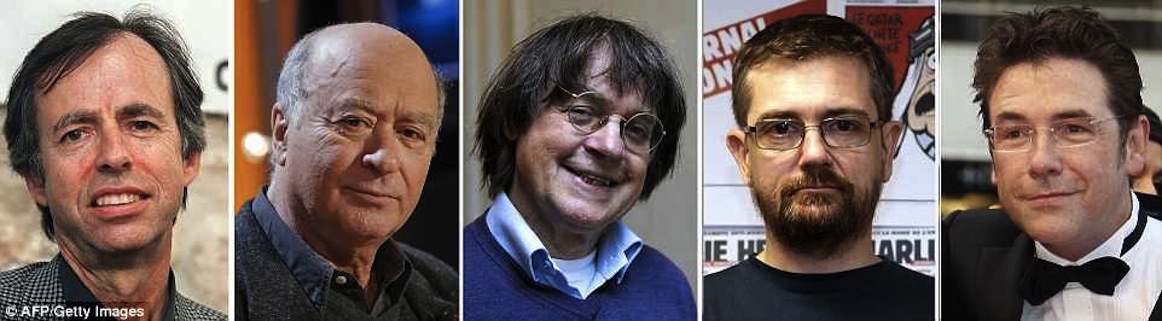
Among the dead at Charlie Hebdo:  Deputy chief editor Bernard Maris and cartoonists Georges Wolinski, Jean Cabut (aka Cabu), Stephane Charbonnier, who was also editor-in-chief, and Bernard Verlhac (aka Tignous)

Among the dead at Charlie Hebdo: Deputy chief editor Bernard Maris and cartoonists Georges Wolinski, Jean Cabut (aka Cabu), Stephane Charbonnier, who was also editor-in-chief, and Bernard Verlhac (aka Tignous)

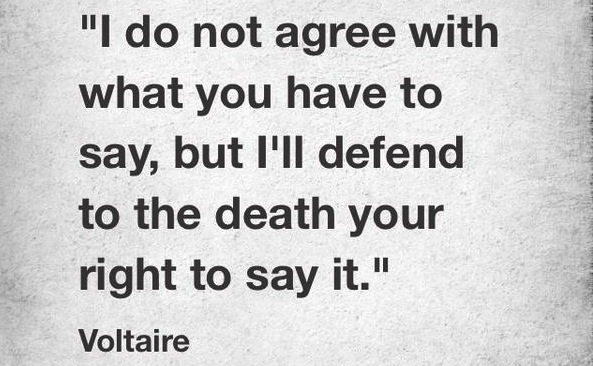
Erasing differences that actually exist seems to be the purpose here: and it’s perhaps appropriate to the Charlie cartoons, which drew their force from a considered contempt for people with the temerity to be different. For the last 36 hours, everybody’s been quoting Voltaire. The same line is all over my several timelines:

From the twitter feed of @thereaIbanksy, January 7

From the twitter feed of @thereaIbanksy, January 7

“Those 21 words circling the globe speak louder than gunfire and represent every pen being wielded by an outstretched arm,” an Australian news site says. (Never mind that Voltaire never wrote them; one of his biographers did.) But most people who mouth them don’t mean them. Instead, they’re subtly altering the Voltairean clarion cry: the message today is, I have to agree with what you say, in order to defend it. Why else the insistence that condemning the killings isn’t enough? No: we all have to endorse the cartoons, and not just that, but republish them ourselves. Thus Index on Censorship, a journal that used to oppose censorship but now is in the business of telling people what they can and cannot say, called for all newspapers to reprint the drawings: “We believe that only through solidarity – in showing that we truly defend all those who exercise their right to speak freely – can we defeat those who would use violence to silence free speech.” But is repeating you the same as defending you? And is it really “solidarity” when, instead of engaging across our differences, I just mindlessly parrot what you say?

But no, if you don’t copy the cartoons, you’re colluding with the killers, you’re a coward. Thus the right-wing Daily Caller posted a list of craven media minions of jihad who oppose free speech by not doing as they’re ordered. Punish these censors, till they say what we tell them to!

Screen shot 2015-01-09 at 12.34.32 AMIf you don’t agree with what Charlie Hebdo said, the terrorists win.

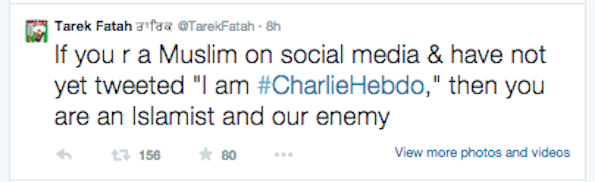
Screen shot 2015-01-09 at 12.22.15 AMYou’re not just kowtowing to terrorists with your silence. According to Tarek Fatah, a Canadian columnist with an evident fascist streak, silence is terrorism.
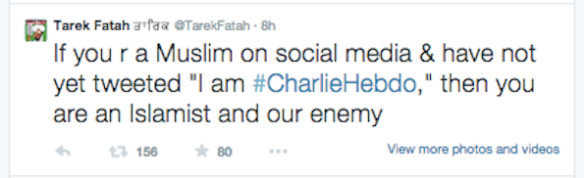
Screen shot 2015-01-08 at 11.46.59 PMOf course, any Muslim in the West would know that being called “our enemy” is a direct threat; you’ve drawn the go-to-GItmo card. But consider: This idiot thinks he is defending free speech. How? By telling people exactly what they have to say, and menacing the holdouts with treason. The Ministry of Truth has a new office in Toronto.

There’s a perfectly good reason not to republish the cartoons that has nothing to do with cowardice or caution. I refuse to post them because I think they’re racist and offensive. I can support your right to publish something, and still condemn what you publish. I can defend what you say, and still say it’s wrong — isn’t that the point of the quote (that wasn’t) from Voltaire? I can hold that governments shouldn’t imprison Holocaust deniers, but that doesn’t oblige me to deny the Holocaust myself.

It’s true, as Salman Rushdie says, that “Nobody has the right to not be offended.” You should not get to invoke the law to censor or shut down speech just because it insults you or strikes at your pet convictions. You certainly don’t get to kill because you heard something you don’t like. Yet, manhandled by these moments of mass outrage, this truism also morphs into a different kind of claim: That nobody has the right to be offended at all.

I am offended when those already oppressed in a society are deliberately insulted. I don’t want to participate. This crime in Paris does not suspend my political or ethical judgment, or persuade me that scatologically smearing a marginal minority’s identity and beliefs is a reasonable thing to do. Yet this means rejecting the only authorized reaction to the atrocity. Oddly, this peer pressure seems to gear up exclusively where Islam’s involved. When a racist bombed a chapter of a US civil rights organization this week, the media didn’t insist I give to the NAACP in solidarity. When a rabid Islamophobic rightist killed 77 Norwegians in 2011, most of them at a political party’s youth camp, I didn’t notice many #IAmNorway hashtags, or impassioned calls to join the Norwegian Labor Party. But Islam is there for us, it unites us against Islam. Only cowards or traitors turn down membership in the Charlie club.The demand to join, endorse, agree is all about crowding us into a herd where no one is permitted to cavil or condemn: an indifferent mob, where differing from one another is Thoughtcrime, while indifference to the pain of others beyond the pale is compulsory.

We’ve heard a lot about satire in the last couple of days. We’ve heard that satire shouldn’t cause offense because it’s a weapon of the weak: “Satire-writers always point out the foibles and fables of those higher up the food chain.” And we’ve heard that if the satire aims at everybody, those forays into racism, Islamophobia, and anti-Semitism can be excused away. Charlie Hebdo “has been a continual celebration of the freedom to make fun of everyone and everything….it practiced a freewheeling, dyspeptic satire without clear ideological lines.” Of course, satire that attacks any and all targets is by definition not just targeting the top of the food chain. “The law, in its majestic equality, forbids the rich as well as the poor to sleep under bridges,” Anatole France wrote; satire that wounds both the powerful and the weak does so with different effect. Saying the President of the Republic is a randy satyr is not the same as accusing nameless Muslim immigrants of bestiality. What merely annoys the one may deepen the other’s systematic oppression. To defend satire because it’s indiscriminate is to admit that it discriminates against the defenseless.
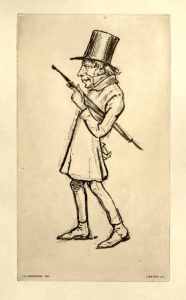
Funny little man: Contemporary caricature of Kierkegaard

Funny little man: Contemporary Danish cartoon of Kierkegaard

Kierkegaard, the greatest satirist of his century, famously recounted his dream: “I was rapt into the Seventh Heaven. There sat all the gods assembled.” They granted him one wish: “Most honorable contemporaries, I choose one thing — that I may always have the laughter on my side.” Kierkegaard knew what he meant: Children used to laugh and throw stones at him on Copenhagen streets, for his gangling gait and monkey torso. His table-turning fantasy is the truth about satire. It’s an exercise in power. It claims superiority, it aspires to win, and hence it always looms over the weak, in judgment. If it attacks the powerful, that’s because there is appetite underneath its asperity: it wants what they have. As Adorno wrote: “He who has laughter on his side has no need of proof. Historically, therefore, satire has for thousands of years, up to Voltaire’s age, preferred to side with the stronger party which could be relied on: with authority.” Irony, he added, “never entirely divested itself of its authoritarian inheritance, its unrebellious malice.”

Satire allies with the self-evident, the Idées reçues, the armory of the strong. It puts itself on the team of the juggernaut future against the endangered past, the successful opinion over the superseded one. Satire has always fed on distaste for minorities, marginal peoples, traditional or fading ways of life. Adorno said: “All satire is blind to the forces liberated by decay.”

Funny little man: Voltaire writing

Funny little man: Voltaire writing

Charlie Hebdo, the New Yorker now claims, “followed in the tradition of Voltaire.” Voltaire stands as the god of satire; any godless Frenchman with a bon mot is measured against him. Everyone remembers his diatribes against the power of the Catholic Church: Écrasez l’InfâmeBut what’s often conveniently omitted amid the adulation of his wit is how Voltaire loathed a powerless religion, the outsiders of his own era, the “medieval,” “barbaric” immigrant minority that afflicted Europe: the Jews.

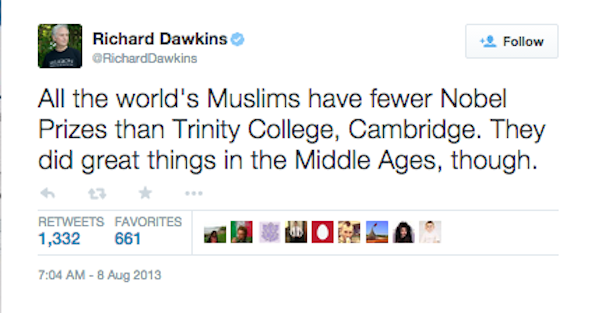
Voltaire’s anti-Semitism was comprehensive. In its contempt for the putatively “primitive,” it anticipates much that is said about Muslims in Europe and the US today. “The Jews never were natural philosophers, nor geometricians, nor astronomers,” Voltaire declared. That would do head Islamophobe Richard Dawkins proud:
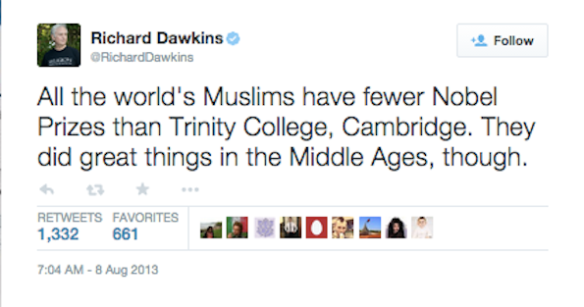
Screen shot 2015-01-09 at 3.01.25 AM

The Jews, Voltaire wrote, are “only an ignorant and barbarous people, who have long united the most sordid avarice with the most detestable superstition and the most invincible hatred for every people by whom they are tolerated and enriched.” When some American right-wing yahoo calls Muslims “goatfuckers,” you might think he’s reciting old Appalachian invective. In fact, he’s repeating Voltaire’s jokes about the Jews. “You assert that your mothers had no commerce with he-goats, nor your fathers with she-goats,” Voltaire demanded of them. “But pray, gentlemen, why are you the only people upon earth whose laws have forbidden such commerce? Would any legislator ever have thought of promulgating this extraordinary law if the offence had not been common?”
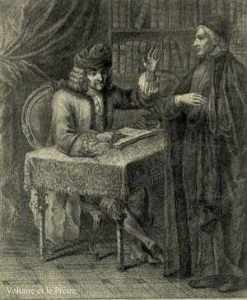
You are an infamous impostor, Father, but at least you're circumcised: Voltaire lectures to a priest

You are an infamous impostor, Father, but at least you’re circumcised: Voltaire lectures to a priest

Nobody wishes Voltaire had been killed for his slanders. If some indignant Jew or Muslim (he didn’t care for the “Mohammedans” much either) had murdered him mid-career, the whole world would lament the abomination. In his most Judeophobic passages, I can take pleasure in his scalpel phrasing — though even 250 years after, some might find this hard. Still, liking the style doesn’t mean I swallow the message. #JeSuisPasVoltaire. Most of the man’s admirers avoid or veil his anti-Semitism. They know that while his contempt amuses when directed at the potent and impervious Pope, it turns dark and sour when defaming a weak and despised community. Satire can sometimes liberate us, but it is not immune from our prejudices or untainted by our hatreds. It shouldn’t douse our critical capacities; calling something “satire” doesn’t exempt it from judgment. The superiority the satirist claims over the helpless can be both smug and sinister. Last year a former Charlie Hebdo writer, accusing the editors of indulging racism, warned that “The conviction of being a superior being, empowered to look down on ordinary mortals from on high, is the surest way to sabotage your own intellectual defenses.”

Of course, Voltaire didn’t realize that his Jewish victims were weak or powerless. Already, in the 18th century, he saw them as tentacles of a financial conspiracy; his propensity for overspending and getting hopelessly in debt to Jewish moneylenders did a great deal to shape his anti-Semitism. In the same way, Charlie Hebdo and its like never treated Muslim immigrants as individuals, but as agents of some larger force. They weren’t strivers doing the best they could in an unfriendly country, but shorthand for mass religious ignorance, or tribal terrorist fanaticism, or obscene oil wealth. Satire subsumes the human person in an inhuman generalization. The Muslim isn’t just a Muslim, but a symbol of Islam.

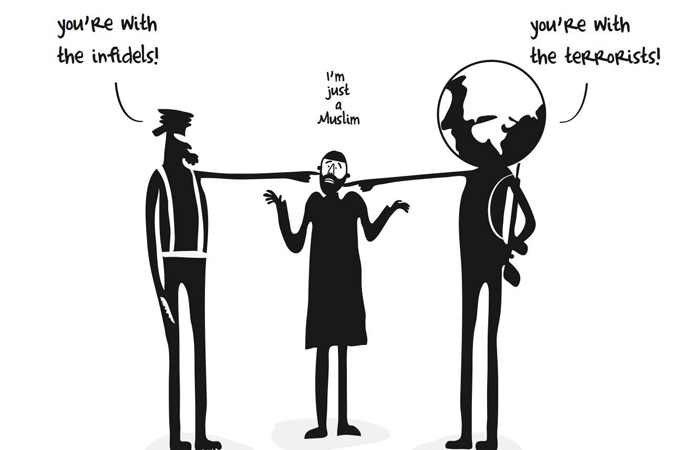
Cartoon by Sudanese artist Khalid Albaih, from Aljazeera.com

Cartoon by Sudanese artist Khalid Albaih, from Aljazeera.com

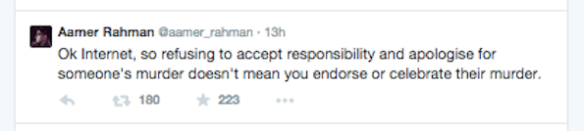
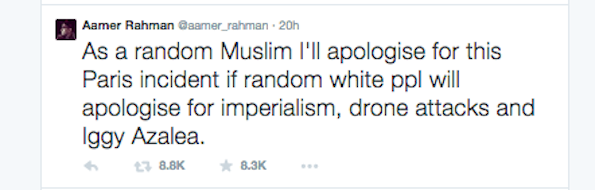
This is where political Islamists and Islamophobes unite. They cling to agglutinative ideologies; they melt people into a mass; they erase individuals’ attributes and aspirations under a totalizing vision of what identity means. A Muslim is his religion. You can hold every Muslim responsible for what any Muslim does. (And one Danish cartoonist makes all Danes guilty.) So all Muslims have to post #JeSuisCharlie obsessively as penance, or apologize for what all the other billion are up to. Yesterday Aamer Rahman, an Australian comic and social critic, tweeted:
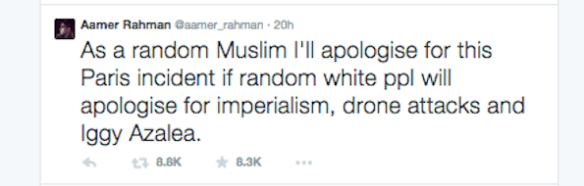
Screen shot 2015-01-09 at 12.08.33 AM

A few hours later he had to add:

Screen shot 2015-01-09 at 12.07.58 AM

This insistence on contagious responsibility, collective guilt, is the flip side of #JeSuisCharlie. It’s #VousÊtesISIS; #VousÊtesAlQaeda. Our solidarity, our ability to melt into a warm mindless oneness and feel we’re doing something, is contingent on your involuntary solidarity, your losing who you claim to be in a menacing mass. We can’t stand together here unless we imagine you together over there in enmity. The antagonists are fake but they’re entangled, inevitable. The language hardens. Geert Wilders, the racist right-wing leader in the Netherlands, said the shootings mean it’s time to “de-Islamize our country.” Nigel Farage, his counterpart in the UK, called Muslims a “fifth column, holding our passports, that hate us.” Juan Cole writes that the Charlie Hebdo attack was “a strategic strike, aiming at polarizing the French and European public” — at “sharpening the contradictions.” The knives are sharpening too, on both sides.

We lose our ability to imagine political solutions when we stop thinking critically, when we let emotional identifications sweep us into factitious substitutes for solidarity and action. We lose our ability to respond to atrocity when we start seeing people not as individuals, but as symbols. Changing avatars on social media is a pathetic distraction from changing realities in society. To combat violence you must look unflinchingly at the concrete inequities and practices that breed it. You won’t stop it with acts of self-styled courage on your computer screen that neither risk nor alter anything. To protect expression that’s endangered you have to engage with the substance of what was said, not deny it. That means attempting dialogue with those who peacefully condemn or disagree, not trying to shame them into silence. Nothing is quick, nothing is easy. No solidarity is secure. I support free speech. I oppose all censors. I abhor the killingsI mourn the dead. I am not Charlie.

If you appreciate this blog, we’d be grateful if you’d pitch in:

Donate Button with Credit Cards


09 Jan 05:11

Congress Introduces A National Abortion Ban On Its Very First Day Back

by Tara Culp-Ressler
Matthew Connor

Happy New Year.

House Speaker John Boehner of Ohio administers a re-enactment of the House oath to Rep. Trent Franks (R-AZ)

House Speaker John Boehner of Ohio administers a re-enactment of the House oath to Rep. Trent Franks (R-AZ)

CREDIT: AP Photo/Jacquelyn Martin

Republicans in Congress are wasting no time following through on the anti-abortion agenda the GOP laid out after winning significant gains in the 2014 midterm elections.

On Tuesday, the very first day of the 114th Congress, two lawmakers introduced a measure to ban abortions after 20 weeks, in direct violation of the protections afforded under Roe v. Wade. Reps. Trent Franks (R-AZ) and Marsha Blackburn (R-TN) reintroduced the Pain Capable Unborn Child Protection Act, the same legislation that successfully passed the House last year.

Sen. Lindsey Graham (R-SC) — who introduced a companion 20-week abortion ban in the Senate last year that was stalled by Democratic leadership — has already indicated that he plans to re-introduce his own measure in the next few weeks, too. Now that the Senate is GOP-controlled, Republicans are anticipating that they’ll have enough support to pass the ban in both chambers this year, helping the anti-choice community gain momentum for this particular tactic to limit reproductive rights.

“In a Republican Senate, under my leadership, we would have the kind of real debate on the issues that the American people want,” Mitch McConnell (R-KY) told the audience at the National Right to Life Conference in the fall. “For six years, the president has been isolated from this growing movement. He will be forced to listen to the cause that’s brought us all here this morning.”

These type of abortion bans are often called “fetal pain” measures because they’re based on the notion that fetuses are sentient after 20 weeks of pregnancy, assuming that an abortion procedure after that point would be painful for them. In a statement released on Tuesday, Franks referred to 20-week fetuses as “innocent and defenseless children who can not only feel pain, but who can survive outside of the womb in most cases, and who are torturously killed without even basic anesthesia.”

In fact, doctors agree that fetuses cannot survive outside the womb until about 24 to 28 weeks of pregnancy, which is considered to be the legal point of viability. At less than 21 weeks, no delivered baby has ever survived. Plus, scientific research has repeatedly confirmed that fetuses cannot feel pain until after they are viable; indeed, even the researchers who are trying to learn more about fetal pain don’t want their findings to be used to justify abortion bans.

Nonetheless, 20-week abortion bans have become increasingly popular on the state level. According to the Guttmacher Institute, which tracks reproductive rights policies, nine states currently cut off legal abortion access at 20 weeks based on the assumption that fetuses can feel pain at that point.

Abortion opponents believe that focusing on later abortions is a winning strategy because these restrictions can be construed as moderate. The right-wing Susan B. Anthony List, one of the biggest proponents of the proposed national 20-week abortion ban, calls it a “common sense” measure that is popular among the American people.

“As the 114th Congress is sworn in today, we are encouraged to see our pro-life allies wasting no time in the fight to protect the lives of the most vulnerable,” Susan B. Anthony List’s president, Marjorie Dannenfelser, said in a statement on Tuesday.

But reproductive rights groups say that “fetal pain” measures represent a politically popular way of defining a policy that can force women to carry doomed pregnancies to term. Typically, later abortions — which are very rare — occur only in very desperate situations. Sometimes, women discover serious fetal health issues that weren’t evident earlier in their pregnancy, and choose to prevent their unborn child from suffering and dying outside the womb. Other times, low-income women are forced to delay abortion until that point because it takes them that long to save up the money for it.

A 2013 poll commissioned by Planned Parenthood found that when voters learn more about those reasons why a woman may need a later procedure, they oppose 20-week abortion bans.

The post Congress Introduces A National Abortion Ban On Its Very First Day Back appeared first on ThinkProgress.


09 Jan 05:08

Oh, God: Boston picked as American Olympics entry for 2024

by adamg

The US Olympic Committee tweets the news.

07 Jan 20:15

POLL: Why do you hate Rita Ora?

by Popjustice
Matthew Connor

I’m genuinely offended that she doesn’t dress only in duffle coats, because I am my own parents

Rita ora

Loading

Why do you hate Rita Ora?

Thank you for voting
You have already voted on this poll!
Please select an option!
  • I think her success has come too easily, even though I like plenty of other artists for whom success has come just as easily
  • I think she is ugly even though I can’t articulate why
  • I’ve decided she has too much sex even though I don’t know what I’m talking about, and also am Victorian
  • I think she’s a flop even though she’s had four solo Number One singles and has an international profile
  • I’m not a fan of her music so have just decided I hate her
  • I think she’s too confident even though I like plenty of other artists who are just as confident
  • I think she only sells records because she’s a celebrity even though she had her first Number One when nobody knew who she was
  • I’m pretending to be offended that she doesn’t dress only in duffle coats
  • I’m genuinely offended that she doesn’t dress only in duffle coats, because I am my own parents
  • I’m a little bit of a misogynist
  • I don’t think she’s very clever, and all the other popstars I like have extraordinarily high IQs
  • I’m the first person to realise that ‘Ora’ rhymes with ‘Whora’ and it’s so funny that I want to tell the world
  • I just don’t think she’s that good, but I have more fun and get more retweets saying I hate her
  • I prefer a different female artist and I don’t think more than one female artist should be allowed to exist
  • Some other equally well thought through reason
07 Jan 18:17

Republican Congress Launches With Back-Door Attack On Social Security Benefits

by Alan Pyke
Matthew Connor

Wow, abortion ban, dynamic scoring in the CBO, and this. It's gonna be a really dreadful two years.

shutterstock_old elderly woman

CREDIT: Shutterstock

Republicans are starting the new Congress by attacking Social Security funding through a subtle, obscure policy measure buried in the gigantic bill that establishes parliamentary rules for the new session.

The rules measure, passed late Tuesday after other day-one business like formal swearing-in ceremonies for members were completed, escalates the threat of a significant cut to Social Security Disability Insurance (SSDI) within the next two years. The measure bans a common accounting technique that the people who manage Social Security funding have used many times in the past to prevent benefit cuts. The two funds that comprise the Social Security system have essentially borrowed from one another as necessary over the years to ensure that benefits can be paid in full each year. SSDI, which is the primary program for providing federal benefits to people unable to work due to disability, is projected to hit a shortfall in late 2016. Reallocating revenue from the much larger Social Security retirement benefits fund to SSDI would cover the shortfall, and trust fund managers have performed such reallocations 11 times since the late 1950s.

But the Republican rules package prohibits Congress from authorizing such a transfer. That will force a showdown over how to finance disability benefits sometime in the next two years, with the threat of a nearly 20 percent cut to SSDI payments looming over the debate. The measure was overshadowed in the news by a separate rules package measure that threatens to rig the legislative process in favor of trickle-down tax policy, until the beginning of this week when critics began to decry the change.

The Center on Budget and Policy Priorities called the rule an “attempt to pit retirement and disability beneficiaries against each other” that misrepresents how the two funds operate, and pointed out that the only reason SSDI is in funding trouble next year is that it got short-changed by the past two reallocations of funding between disability and retirement benefits. Sen. Elizabeth Warren (D-MA) accused the GOP of “inventing a Social Security crisis that will threaten benefits for millions & put our most vulnerable at risk.” Sen. Sherrod Brown (D-OH) called it “a dangerous new rule” that will “set the stage to cut benefits for seniors and disabled Americans,” and pointed out that reallocating funds between the accounts is so uncontroversial that President Reagan oversaw four of the 11 times it has been done in the past.

Rep. Tom Reed (R-NY), who is taking credit for engineering the rules change, has received significant campaign financing from at least one well-heeled conservative supporter of cutting Social Security. Reed has gotten over $134,000 in contributions from people tied to vulture capitalist Paul Singer’s firm Elliott Management, according to the Center for Responsive Politics. Singer is most famous for his battle to force the nation of Argentina to prioritize debt payments to Elliott Management over public expenditures for its 41 million citizens. But the generous Republican donor is also a sharp critic of American government spending and has called for cutting benefits in Social Security, Medicare, and Medicaid.

Reed told the Associated Press that his rules proposal is intended to force a reckoning over social insurance spending. “We need real reform,” he said, and “this makes that real reform that much more likely.” Leaving aside the question of what Reed means by “real reform,” and the fact that the proposed reallocation would have extended disability funding by 17 years while reducing retirement funding by just one year, the move is raising serious procedural concerns among retiree advocates.

Social Security experts Nancy Altman and Eric Kingson labeled the move “hostage-taking to force changes that the American people do not want to a vital program” in a piece for the Huffington Post. Reed’s rule means that “we could be facing a deadline, and certainly over the last couple of years ,we’ve seen Congress seemingly unable to pass bills, even with deadlines in front of them,” the American Association of Retired Persons’ David Certner told the AP.

The other political ingredient in the debate Reed and the GOP are trying to force is years of skewed media coverage of the disability insurance system. Reports that SSDI is riddled with fraud and overrun with false claims have showed up in an ideologically diverse array of news sources over the past two years, from public radio’s This American Life to CBS’ 60 Minutes to the conservative media machine. The reality is that just 41 percent of those who apply for disability benefits receive it thanks to the program’s uniquely strict eligibility rules and stringent, multi-layered application process. Among those who do clear the program’s hurdles and enroll, fraud is extremely rare. A 2011 Government Accountability Office report found an erroneous payments rate of just 0.6 percent, among the lowest of any government program, and President Bush’s Social Security Administrator estimates waste, fraud, and abuse account for less than 1 percent of SSDI spending. But the reality of the program — such as the fact that disability insurance is getting more expensive because of long-anticipated demographic shifts — has likely already been lost in the trans-partisan furor over a supposed epidemic of freeloading.

The post Republican Congress Launches With Back-Door Attack On Social Security Benefits appeared first on ThinkProgress.


06 Jan 19:46

VV Brown’s new album will be out in March, which is about two months away

by Brad O'Mance
Matthew Connor

ATTENTION. Her last album was incredible. Get it if you haven't, and then get ready. :O

VV Brown

‘The Apple (En français)’ hitmaker VV Brown has said her new album will be out in March and that the people who are interested in it should prepare themselves for a dance.

Communicating all this via the medium of Twitter, she said the following words:

Be prepared to dance for this new album. March we are coming for you! pic.twitter.com/6i7kDl5FW4

— V V Brown (@VVbrown) January 4, 2015

(Presumably she means that she’s coming in March, rather than that we should march down the street in anticipation, but you never know.)

And it didn’t end there!!

this album is gonna make you werk!

— V V Brown (@VVbrown) January 4, 2015

In summary: VV Brown’s new album, the follow-up to the excellent ‘Samson & Delilah’ will make you dance and “werk”. The end.

06 Jan 18:08

In advance of arctic cold, MBTA pre-announces delays

by adamg
Matthew Connor

Seems like a reasonable enough guess.

They don't know which lines or when, exactly, but the T is warning commuters to brace for potential delays due to tomorrow's forecast sub-zero windchills, WBZ reports.

But at least we're not alone: Chicago transit officials are also warning of potential cold-related delays.

MBTA winter-weather page.

06 Jan 15:28

Some popstars are awful

by Brad O'Mance

Sam SmithKnee length coat expert Sam Smith has said that some popstars are “just awful”, but has bravely declined to name names.

In an interview with V magazine that involved him having a chat with ‘(Krush Groove) Can’t Stop the Street’ hitmaker Chaka Khan, the illness-battling karaoke king said the following (as quoted here):

“Even when you meet them – I won’t name names – but some of these pop stars are just awful.”

Sucking up to Chaka, he added:

“And they have not even had half the success that you’ve had and yet you’re so humble and kind.”

Chaka’s response?

“Well, its people skills. Talking to a screen all day long takes the human experience out. Luckily I grew up in a time when we only had a telephone at home.”

Only a telephone! It seems hard to believe that Chaka Khan did not have anything else at all in the house, for example cupboards for her clothes. Mind you, she was probably able to knit garments as they were needed, direct from the sheep she kept in the paddock round the back of her house.

She had a field for ewe.

02 Jan 17:45

How Low Income New Yorkers Are Benefiting From The NYPD’s Work Stoppage

by Kira Lerner
Matthew Connor

"In response to growing tensions between the New York Police Department and the city, police unions encouraged officers last week to not make arrests “unless absolutely necessary,” resulting in a 66 percent drop from the same period last year." Just an incredible sentence.

From right, New York City Mayor Bill de Blasio and Police Commissioner Bill Bratton smile in conversation during a New York Police Academy graduation ceremony, Monday Dec. 29, 2014.

From right, New York City Mayor Bill de Blasio and Police Commissioner Bill Bratton smile in conversation during a New York Police Academy graduation ceremony, Monday Dec. 29, 2014.

CREDIT: AP Photo/John Minchillo

In response to growing tensions between the New York Police Department and the city, police unions encouraged officers last week to not make arrests “unless absolutely necessary,” resulting in a 66 percent drop from the same period last year. While the protests have drawn scrutiny for “squandering the department’s credibility” and leaving the city’s streets virtually unattended, they have also had the unintended effect of benefitting New York’s low income residents who are usually the target of the city’s tough-on-crime practices.

The work stoppage is a result of outrage by police officers — led by union chief Patrick Lynch — over how Mayor Bill de Blasio responded to a grand jury’s decision not to indict the police officer who killed Eric Garner, an unarmed African American man. The brutal murders of two New York city officers by a troubled man from Maryland in an apparent retaliation for the Garner killing has only inflamed tensions, leading Lynch to blame de Blasio for the killing and scores of police officers to engage in protest actions against the mayor.

The signs of tension first became apparent when some police officers turned their backs to de Blasio when he spoke in the hospital following the assassinations and then engaged in a mass back-turning when the mayor spoke at the funeral of Officer Rafael Ramos. Last week, the police went a step further and stopped arresting New Yorkers for small crimes or ticketing people for minor offenses like parking violations, carrying open containers of alcohol or public urination.

As a result of what the New York Post is calling a “virtual work stoppage,” tickets and summonses for minor offenses have plummeted by 94 percent and overall arrests have fallen 66 percent. Theoretically, the practice will strain police budgets, which rely on fines from tickets to make-up for funding shortfalls. ​

Although it’s not the intended goal of the work stoppage, the decline in arrests could save New Yorkers money. The city residents who are normally hit with tickets for minor violations tend to be low income individuals who are forced to pay up a hefty portion of their paychecks.

The city began following the broken-windows style of policing in the early 1980s, a strategy championed by NYPD Commissioner Bill Bratton which focuses on eliminating low-level crime to prevent more violent offenses in the city’s neighborhoods. But a report earlier this year by the John Jay College of Criminal Justice in Manhattan found that the NYPD’s practice of arresting more people for minor offenses since 1980 has disproportionately affected young black and Latino men.

While de Blasio and Bratton have followed through on their promise to reform the city’s stop and frisk practices and the mayor announced in November that police would stop making arrests for low-level marijuana possessions, there are still racial biases in police practices throughout the city that result in a tougher financial burden on those already struggling to make ends meet.

And New Yorkers of all income levels are also saving money on one of the most consistent ways the city can slam people with tickets— parking violations are down by 92 percent, from 14,699 to just 1,241 this year.

NYPD officers have long spoken about quotas which require them to issue a certain number of summons per month to maintain statistics showing a reduction of crime in the city’s neighborhoods. Although Bratton promised an end to arrest quotas when he took office in January, the city’s police are still operating under a quota system which is illegal under state law, according to a recent report by the Police Reform Organizing Project. The group called on Bratton and de Blasio to end the quota system in its October report, which described how police are still using the quota system, as evidenced by the number of misdemeanor arrests and the poor quality of those arrests under Bratton.

The post How Low Income New Yorkers Are Benefiting From The NYPD’s Work Stoppage appeared first on ThinkProgress.


24 Dec 16:56

Blue Lives Matter

by Ta-Nehisi Coates
Carlo Allegri/Reuters

The reactions to the murders of two New York police officers this weekend have been mostly uniform in their outrage. There was the predictable gamesmanship exhibited in some quarters, but all agree that the killing of Wenjian Liu and Rafael Ramos merits particular censure. This is understandable. The killing of police officers is not only the destruction of life but an attack on democracy itself. We do not live in a military dictatorship, and police officers are not the representatives of an autarch, nor the enforcers of law handed down by decree. The police are representatives of a state that derives its powers from the people. Thus the strong reaction we have seen to Saturday's murders is wholly expected and entirely appropriate.

For activists and protesters radicalized by the killings of Michael Brown and Eric Garner, this weekend's killing may seem to pose a great obstacle. In fact, it merely points to the monumental task in front of them. The response to Garner's death, particularly, seemed to offer some hope. But the very fact that this opening originated in the most extreme case—the on-camera choking of a man for a minor offense—points to the shaky ground on which such hope took root. It was only a matter of time before some criminal shot a police officer in New York. If that's all it takes to turn Americans away from police reform, the efforts were likely doomed from the start.

The idea of "police reform" obscures the task. Whatever one thinks of the past half-century of criminal-justice policy, it was not imposed on Americans by a repressive minority. The abuses that have followed from these policies—the sprawling carceral state, the random detention of black people, the torture of suspects—are, at the very least, byproducts of democratic will. Likely they are much more. It is often said that it is difficult to indict and convict police officers who abuse their power. It is comforting to think of these acquittals and non-indictments as contrary to American values. But it is just as likely that they reflect American values. The three most trusted institutions in America are the military, small business, and the police.

To challenge the police is to challenge the American people, and the problem with the police is not that they are fascist pigs but that we are majoritarian pigs. When the police are brutalized by people, we are outraged because we are brutalized. By the same turn, when the police brutalize people, we are forgiving because ultimately we are really just forgiving ourselves. Power, decoupled from responsibility, is what we seek. The manifestation of this desire is broad. Former Mayor Rudy Giuliani responded to the killing of Michael Brown by labeling it a "significant exception" and wondering why weren't talking about "black on black crime." Giuliani was not out on a limb. The charge of insufficient outrage over "black on black crime" has been endorsed, at varying points, by everyone from the NAACP to Washington Post columnist Eugene Robinson to Giuliani's archenemy Al Sharpton.

Implicit in this notion is that outrage over killings by the police should not be any greater than killings by ordinary criminals. But when it comes to outrage over killings of the police, the standard is different. Ismaaiyl Brinsley began his rampage by shooting his girlfriend—an act of both black-on-black crime and domestic violence. On Saturday, Officers Liu and Ramos were almost certainly joined in death by some tragic number of black people who were shot down by their neighbors in the street. The killings of Officers Liu and Ramos prompt national comment. The killings of black civilians do not. When it is convenient to award qualitative value to murder, we do so. When it isn't, we do not. We are outraged by violence done to police, because it is violence done to all of us as a society. In the same measure, we look away from violence done by the police, because the police are not the true agents of the violence. We are.

We are the ones who designed the criminogenic ghettos. We are the ones who barred black people from leaving those ghettos. We are the ones who treat black men without criminal records as though they are white men with criminal records. We are the ones who send black girls to juvenile detention homes for fighting in school. We are the masters of the American gulag, a penal system "so vast," writes sociologist Bruce Western, "as to draw entire demographic groups into the web." And we are the ones who send in police to make sure it all goes according to plan.

When defenders of the police say that cops do the work ordinary citizens are afraid of, they are correct. The criminal-justice system has been the most consistent tool for making American will manifest in black communities. The tool for exercising that will is not the proliferation of ice cream socials.  I suspect, we would like to know as little about criminal justice system as possible. I suspect we would rather the film of Eric Garner's killing not exist. Then we might comfort ourselves with the kind of vague unknowables that dogged the killing of Michael Brown. ("Did he have his hands up? Was he surrendering? Was he charging?") Garner, choked to death and repeating "I can't breathe," trapped us. But now, through a merciless act of lethal violence, an escape route has been revealed. This overstates things. To the extent that this weekend's murders obscure the legacy of Eric Garner, it will not be due to the failure of protests, nor even chance. The citizen who needs to look away generally finds a reason.

I wonder if there is some price attached to this looking away.  When the elected mayor of my city arrived at the hospital, the police officers who presumably serve at the public's leisure turned away in a display that should chill the blood of any interested citizen. The police are not the only embodiment of democratic society. And one does not have to work hard to imagine a future when the agents of our will, the agents whom we created, are in fact our masters. On that day one can expect that the tactics intended for the ghettos will enjoy wider usage.

This article was originally published at http://www.theatlantic.com/politics/archive/2014/12/blue-lives-matter-nypd-shooting/383977/


24 Dec 16:40

Police Fatally Shoot Black Teen Near Ferguson

by Alice Ollstein
Matthew Connor

"Belmar confirmed that the officer had been assigned a body camera that night, but had failed to put it on. The squad car was also equipped with a “dash cam,” which was also not turned on. Belmar said he didn’t know if this was a “conscious decision” or not, saying many officers are “not used to the technology.”" But don't worry, I'm sure Robert McColloch will get to the bottom of all this.

police - berkeley mo

CREDIT: AP Photo

At 11:15 p.m. last night, a white male officer, a six year veteran on the force, shot and killed an African American 18-year-old outside a gas station in Berkeley, Missouri—just a few miles from Ferguson—while responding to a call about a robbery. Police are still withholding the name of the young man, saying they would do so when all of his family members have been notified, but he’s been identified in the media as Antonio Martin.

In a press conference Wednesday morning, St. Louis County Police Chief Jon Belmar said Martin was armed with a 9mm pistol, which he pointed directly at the officer. Saying his office was “trying to be as transparent as we can,” Belmar released a surveillance video from the gas station that appears to show the squad car pulling in, and Martin raising a weapon. The video cuts off before the officer fatally shoots Martin, a choice Belmar said was out of consideration for his family.

The mother of the young man, Toni Martin, told ABC News that her son had been with his girlfriend at the time, and said the girlfriend reported a different version of events: “Police started messing with him, and when he tried to get up and run, they started shooting at him.”

Belmar confirmed that the officer had been assigned a body camera that night, but had failed to put it on. The squad car was also equipped with a “dash cam,” which was also not turned on. Belmar said he didn’t know if this was a “conscious decision” or not, saying many officers are “not used to the technology.”

Police are now looking for at least two witnesses who were in the parking lot at the time of the shooting.

“Our hearts go out to the decedent’s family, but bad decisions were made,” Belmar added. “This individual could have complied, he could have ran away, he could have dropped the gun. It didn’t have to end with him approaching officers with a weapon.”

He went to compare the grief Martin’s family is experiencing with that of the officer, who has been placed on administrative leave. “This is a tragedy for the police officer as well, because he will carry it with him for the rest of his life. There are no winners here, only losers.”

As when 18-year-old Michael Brown was shot and killed by police in Ferguson this summer, protests erupted at the site of last night’s shooting and lasted until dawn. Police used pepper spray on some of the demonstrators, which Belmar said was in self defense.

“We had several bricks thrown at officers and two explosives used—some sort of amalgam of fireworks,” he told reporters. “Those are felonies. It’s very disturbing.”

Belmar said he tried to talk to “young people in the area” following the protests, and reported that they asked him “Why couldn’t the officer used tazers or pepper mace instead of a firearm?”

He responded, “Well, frankly it’s unreasonable. Most of us would feel like we’re in imminent danger in that situation. I understand the emotions. Let the emotions vent. But we don’t want to see our neighborhoods torn apart once again. This is a tragedy, but we need to move past this, and perhaps get it off the street.”

The case will now go to County Prosecutor Robert McColloch, who has been widely criticized for his handling of the Michael Brown case. Among other issues, McColloch allowed a witness he knew was lying to testify before the grand jury for two days.

Said Belmar of McColloch: “It will be up to him to figure out what he wants to do with the case.”

The post Police Fatally Shoot Black Teen Near Ferguson appeared first on ThinkProgress.