Shared posts

06 Nov 13:17

Did Obama Spy on Mitt Romney?

by Alex Tabarrok

Did Obama spy on Mitt Romney? As recently as a few weeks ago if anyone had asked me that question I would have consigned them to a right (or left) wing loony bin. Today, the only loonies are those who think the question Daniel_Ellsberg_psychiatrist_filing_cabinetunreasonable. Indeed, in one sense the answer is clearly yes. Do I think Obama ordered the NSA to spy on Romney for political gain? No. Some people claim that President Obama didn’t even know about the full extent of NSA spying. Indeed, I imagine that President Obama was almost as surprised as the rest of us when he first discovered that we live in a mass surveillance state in which billions of emails, phone calls, facebook metadata and other data are being collected.

The answer is yes, however, if we mean did the NSA spy on political candidates like Mitt Romney. Did Mitt Romney ever speak with Angela Merkel, whose phone the NSA bugged, or any one of the dozens of her advisers that the NSA was also bugging? Did Romney exchange emails with Mexican President Felipe Calderon? Were any of Romney’s emails, photos, texts or other metadata hovered up by the NSA’s break-in to the Google and Yahoo communications links? Almost certainly the answer is yes.

Did the NSA use the information they gathered on Mitt Romney and other political candidates for political purposes? Probably not. Will the next president or the one after that be so virtuous so as to not use this kind of power? I have grave doubts. Men are not angels.

The Nixon administration plumbers broke into the offices of Daniel Ellsberg’s psychiatrist in order to gather information to discredit him. They busted into a single file cabinet (pictured). What a bunch of amateurs.

The NSA has broken into millions of file cabinets around the world.

Nixon resigned in disgrace. Who will pay for the NSA break-ins?

05 Nov 16:05

Seat's Taken

Cat sits on hedgehog and regrets it immediately - AnimalsBeingDicks.com

Mr. Snuggles had just about enough of a certain hedgehogs prickly disposition.

04 Nov 19:54

Thug Notes, Gangsta Speak Summaries of Classical Literature

by mikl-em

Turns out there’s a difference between being illiterate and ill literate. Sparky Sweets, PhD hosts Thug Notes a weekly series of gangsta speak dissertations on classic literary works via YouTube. Sweets delivers genuinely insightful, erudite reviews of books by the likes of Orwell, Huxley, Hawthorne, Dostoevsky, and even Tolkien. Along the way we get a kind of thesaurus of streetwise synonyms for “kill”. Murk, cap, ice… it turns out there’s a lot of murder in classic literature.

Join me as I drop some of da illest classical literature summary and analysis that yo ass ever heard. Educate yo self, son.

Dr. Sweets’ critiques touch on foils, motifs, themes, symbolism and all that. While he has major literary knowledge, he clearly brings a minor in philosophy–dropping Nietzsche quotes like they were über hot and explaining Ray Bradbury’s Fahrenheit 451 with a pertinent dose of Heidegger. Here are a few choice off-the-shelf examples:

“Thug Notes” debuted on YouTube earlier this year. The name is a play on “Cliffs Notes” the original literary summary series for lazy high school students.

Sweets, who is from LA, claims to be a legit PhD and have an agenda to deflate the exclusivity of academia. In an interview he says he wants to inspire teachers:

Sometimes you have to seize it, and I hope Thug Notes inspires teachers to explore alternative methods to really engage their students. On a larger scale, I also hope that people realise that comedy is a powerful tool for education!

It seems to be working:

We forreal just watched Thug Notes in my English class #ThugNotes

— Chase C. Coleman ? (@TrippCHunnit) October 14, 2013

Thanks Tony Campanale!

01 Nov 12:53

Take-out place goes as Alinea for Halloween

by Jason Kottke

Real Kitchen, a small Chicago eatery that mostly does take-out food, dressed up as Michelin 3-star Alinea for Halloween. Some genuine LOLs here, especially the table-side dessert to-go.

Tags: food   Halloween   Real Kitchen   restaurants   video
24 Oct 14:41

Hayek’s liberaltarian essay “”Free” Enterprise and Competitive Order”

by Tyler Cowen

I’ve been preparing a class on Hayek for MRUniversity.com, and I was struck by my reread of this essay, which was presented at the Mont Pelerin Society meeting of 1947 (it was later published in Individualism and Economic Order, pdf of the book here).

In this piece Hayek argues the following:

1. It is not enough for classical liberals to seek to limit the state, they also must outline what governments could and should do better.

2. Monetary policy should be used to limit unemployment, albeit in a rules-based framework.

3. Eminent domain is an essential function of government, especially in urban cities, and it needs to be thought through more carefully.

4. Many of the biggest dangers of monopoly stem from patent law and intellectual property protection, rather than from monopoly of the traditional “sole seller” sort.  On this issue Hayek sounds like Alex or Larry Lessig.

5. It is not enough to defend “freedom of contract” in the abstract, rather the details of the law really matter.

6. Hayek questions whether limited liability for corporations is always the right way to proceed.

7. Finally, although inheritance taxes have in the past sometimes been abused, “…inheritance taxes could, of course, be made an instrument toward greater social mobility and greater dispersion of property and, consequently, may have to be regarded as important tools of a truly liberal policy…”

You will recall that in other settings Hayek endorsed the idea of a social welfare state and also the taxation of pollution.

24 Oct 14:16

Stayaway from Layaway

by Alex Tabarrok
Joswald1

Maybe Tabarrok is drifting away from the role of "economist as dispassionate observer" a bit, but layaway does seem odd.

Layaway plans are immensely popular, a fact I find deeply puzzling much like the popularity of Justin Bieber, Snooki, and homeopathy makes me question the rationality of my fellow human beings.

The typical layaway plan requires a deposit of 10-15% of the price of the good, say a new TV. If the consumer pays the balance over the following 10-12 weeks (i.e. by Christmas) they can pickup the good. If the consumer doesn’t pay the balance they get a refund of payments made less a service fee.

Salvadanaio natalizioWalmart and Kmart advertise their layaway plans heavily. I am shocked, however, that so-called consumer advocates also have good things to say about poor people lending big corporations money:

Consumer advocates say layaway is a great way to manage a major purchase and stick to a budget, allowing consumers to spread the cost of an item over a number of payments without running up a lot of costly debt.

…”The fees, if any, are generally nominal and probably much lower than the interest you’d pay if you purchased those things with a credit card and didn’t pay off the bill for several months,” said Tod Marks, senior editor and shopping expert at Consumer Reports.

Stop the insanity! The relevant comparison is not to buying on credit but to saving. Instead of lending Walmart money, get yourself an old-fashioned piggy bank and avoid the cancellation fee and the hassle of going to the store to make the periodic payments.

Tod Marks, from Consumer Reports (!), also makes this astounding argument:

With layaway, you don’t have to worry that the store will run out of an item you want,” he said.

Are we living in the Soviet Union? Who worries about Walmart and Kmart running out of goods? Occasionally an item will be discontinued but then the replacement is usually better and/or cheaper. Similarly, layaway plans advertise that you can “lock-in” the current price. Right, and if the price goes down or you find a lower price elsewhere you are similarly locked in.

Still not convinced? In the spirit of Tabarrok’s Wager I offer Tabarrok’s Layaway Plan.

Send me $10 right away along with a message telling me what you want, when you want it and the current price. Save your money. If you save enough to buy the good at the requisite time send me a note and I will heartily congratulate you with a $10 reward. If you don’t save enough, thanks for the $10 and better luck next time. Unlike Walmart I will not guarantee the current price but Tabarrok’s Layaway Plan offers significant advantages that Walmart’s plan does not. On the day that you have saved up enough, Tabarrok’s Layaway Plan lets you buy at any store and at the lowest price that you can find! And that’s not all! Tabarrok’s Layaway Plan offers another great advantage, The Tabarrok Switch™. If you find a good that you like more than the good that you had originally planned to buy the Tabarrok Layaway Plan lets you switch to the new good!

Congratulations on choosing the Tabarrok Layaway Plan, the plan with the most options and flexibility of all layaway plans.

17 Oct 16:23

Wolverine fired from the X-Men

by Jason Kottke

Professor Xavier downsizes Wolverine for being the most useless member of the X-Men.

Reason for dismissal: "Made of metal, the substance the guy we fight the most can manipulate with his mind." (via http://stellar.io/interesting)

Tags: video   X-Men
17 Oct 16:11

The Quality Of Care Delivered To Patients Within The Same Hospital Varies By Insurance Type

by Tyler Cowen

That is the new paper by Christine S. Spencer, Darrell J. Gaskin, and Eric T. Roberts.  Let me excerpt the three most important sentences from the abstract:

We found that privately insured patients had lower risk-adjusted mortality rates than did Medicare enrollees for twelve out of fifteen quality measures examined. To a lesser extent, privately insured patients also had lower risk-adjusted mortality rates than those in other payer groups. Medicare patients appeared particularly vulnerable to receiving inferior care.

I don’t have a great deal of confidence in our ability to estimate the size of that effect, but keep that difference in mind next time someone tells you that Medicare is so much more efficient than private health insurance in this country.

09 Oct 17:29

world2

by Author

world2

An old philosophical one, summing up Stephen Law’s God of Eth argument against theodicy. Just to keep things ticking along while this storm blows over.

If you haven’t signed the petition against the LSESU, and you want to, it’s here:
http://www.change.org/en-GB/petitions/jay-stoll-lse-sabbatical-officers-apologise-for-the-blatant-attack-on-free-speech-mistreatment-of-lse-students-at-freshers-fayre

If you fancy printing yourself a “provocative” t-shirt, there are hi-res images available here:
http://t.co/UtLBXE2wow
http://t.co/Kk8GxXGR43
http://t.co/dHjXKJQkBT

Or you could just buy one from the CafePress shop.

Thanks for reading Jesus & Mo.

Flattr this for Jesus Book shop here

08 Oct 12:57

The "gourd pride movement"

by Jason Kottke
Joswald1

How do you fucking explain this?

One of McSweeney's most popular online pieces is Colin Nissan's It's Decorative Gourd Season, Motherfuckers. Its sublime opening paragraph:

I don't know about you, but I can't wait to get my hands on some fucking gourds and arrange them in a horn-shaped basket on my dining room table. That shit is going to look so seasonal. I'm about to head up to the attic right now to find that wicker fucker, dust it off, and jam it with an insanely ornate assortment of shellacked vegetables. When my guests come over it's gonna be like, BLAMMO! Check out my shellacked decorative vegetables, assholes. Guess what season it is -- fucking fall. There's a nip in the air and my house is full of mutant fucking squash.

Nissan's piece is included in a new collection and has spawned a collectable mug. Here's a McSweeney's interview with Nissan about the piece and the "the whole gourd pride movement".

McSWEENEY'S: A large part of what makes "Gourds" so funny is the language. Use of F-bombs in humor is sometimes seen as a lazy way to get a reaction from the audience, but here it just works. How do you fucking explain this?

NISSAN: Fudge if I know. It's tricky because properly placed F-bombs really do have the power to work readers up into a lather, but they also have the power to make them think you're a juvenile idiot with a terrible vocabulary. For whatever reason, the swearing worked in this case. I think part of it was the fact that despite the language, the voice in the piece was never really angry or negative, he was just incredibly excited. If he was angry, I actually think the swearing might have turned people off.

Tags: Colin Nissan   interviews
07 Oct 19:51

Will the Swiss vote in a guaranteed annual income?

by Tyler Cowen
Joswald1

Holy crap that's a lot of money. That's nearly what I make after taxes, and I don't consider myself poor at all.

Switzerland will hold a vote on whether to introduce a basic income for all adults, in a further sign of growing public activism over pay inequality since the financial crisis.

A grassroots committee is calling for all adults in Switzerland to receive an unconditional income of 2,500 Swiss francs ($2,800) per month from the state, with the aim of providing a financial safety net for the population.

Organizers submitted more than the 100,000 signatures needed to call a referendum on Friday and tipped a truckload of 8 million five-rappen coins outside the parliament building in Berne, one for each person living in Switzerland.

With that, a married couple could piece together more than 67k and simply not work, so this sum appears infeasible.  There is more information here, hat tip goes to Evan Soltas.

07 Oct 14:51

World War II in 7 minutes

by Jason Kottke

A 7-minute time lapse video of the European front line changes during World War II, from the invasion of Poland to (spoilers!) the surrender of Germany.

Surprising to me how much of the war involves no shifting front lines...the map view really emphasizes this in a way that other WWII narratives do not. (via open culture)

Tags: maps   time lapse   war   World War II
03 Oct 14:06

"Vaccines. And now my kids don't die."

by Jason Kottke

What if there were a new class of wonder drugs for children that prevented some of the worst diseases in history with very limited side effects...would you take them?

Some people don't "trust" that wacky "science" though.

What's so confounding is that many of the parents requesting exemptions for their children cite specious, disproven fears -- such as that the vaccine could cause autism -- many of which were based on a fraudulent, retracted study or fringe research published in non-peer-reviewed journals. And the rest of the country hasn't been as successful as Massachusetts in containing measles infections. Earlier this year, an intentionally unvaccinated 17-year-old from Brooklyn, New York, was infected with measles while on a trip to the United Kingdom. Because he lived in a community with a large number of other deliberately unvaccinated children, the virus quickly spread. By the time the outbreak was contained, 58 people had been infected -- making it the largest outbreak in the country in more than 15 years. Nationwide, the Centers for Disease Control and Prevention reported 159 total cases between January and August, which puts 2013 on track to record the most domestic measles infections since the disease was declared eliminated from the United States in 2000.

Declared eliminated! [Hair-tearing-out noise]

Tags: medicine   science   vaccines   video
02 Oct 19:15

Arresting the bad guys in Greece

by Tyler Cowen

Probably most of you know by now that the Greek government has moved to arrest leading members of Golden Dawn, their neo-Nazi Party, including parliamentary members and leaders of the party.  These members seem to be bad people, even by the low standards of neo-Nazi parties worldwide.

Still, it is odd to arrest the leadership the leadership of an elected political party — even a bad one — all at the same time.  At least the typical foreign sources are not completely clear on the exact nature of the “criminal gang” charges (there is a slightly more detailed summary here, and here, see also @Yiannisbab, and one reads that the charges themselves have been leaked only in part to the press).  I understand full well that this is an attempt to preserve democracy for Greece, not an attempt to eliminate it, but still the resulting situation is rather awkward.  And what if some of the key players cannot be convicted?  What kind of new elections are required?  And until conviction, what kinds of political powers, and claims to political funds, do the defendants have?  As Gideon Rachman wrote: “Mass arrests of legitimately elected politicians should always spark unease.”

From this distance, it is difficult to judge whether the right thing has been done.  In any case, when you feel you have to arrest your neo-Nazi party to limit their influence, things have gone far indeed in a very bad direction.  Some sources indicate that fifty percent of the police voted for Golden Dawn.

Addendum: Interestingly, for all of their anti-immigrant stances, the Golden Dawn party seems to have used migrants to sell products illegally on black markets as a revenue raiser.

30 Sep 14:31

September 30, 2013


About to board an airplane, so hopefully there are no typos! Thanks again to the festiblog crew!
26 Sep 20:30

Your robot anesthesiologist (the forward march of progress)

by Tyler Cowen

A new system called Sedasys, made by Johnson & Johnson, JNJ -1.31% would automate the sedation of many patients undergoing colon-cancer screenings called colonoscopies. That could take anesthesiologists out of the room, eliminating a big source of income for the doctors. More than $1 billion is spent each year sedating patients undergoing otherwise painful colonoscopies, according to a RAND Corp. study that J&J sponsored.

J&J hopes the potential savings from using Sedasys will appeal to hospitals and clinics and drive machine sales, which are set to begin early next year. Sedasys “is a great way to improve care and reduce costs,” J&J CEO Alex Gorsky said in an interview.

Anesthesiologists’ services usually cost more than the $200 to $400 generally charged by physicians performing the actual colon-cancer screenings, says health-plan CDPHP in New York state. An anesthesiologist’s involvement typically adds $600 to $2,000 to the procedure’s cost, according to a research letter published online by JAMA Internal Medicine in July.

By contrast, Sedasys would cost about $150 a procedure, according to people familiar with J&J’s pricing plans. Hospitals and clinics won’t buy the machines, instead paying a fee each time they use the device, these people say. The $150 would cover maintenance and all the costs of performing the procedure except the sedating drug used, which would add a few dollars, one of the people says.

Here is more.  As you might expect, anesthesiologists are convinced this is a bad idea.

26 Sep 13:05

New results on labor market polarization

by Tyler Cowen

The piece is by Christopher L. Smith, at the Board of Governors, and from this work we learn a few things:

1. Once we adjust for demographics, labor market polarization is a stronger effect than the raw data themselves suggest.

2. Polarization is driven both by more people leaving the middle income category and fewer people entering it.

3. The actual changes in polarization often arrive during cyclical downturns but then stick.

4. “…the share in middle-type jobs has fallen for all types of workers.” (wrt education)  The declines have been the worst for younger workers and for non-college workers.  Even for college-educated workers, the share employed in low-end jobs has risen since the early 2000s.

5. The inflow into middle-type jobs, from the previously unemployed, is declining steadily with time.

6. Unemployed, previously middle-type workers are tending to remain non-employed rather than to trend into lower-type jobs.

7. The rate at which persons in low-type or (especially) middle-type jobs transition into high-type jobs is rising over time.

8. Yet the rate at which persons in low-type jobs transition into middle-type jobs is falling over time.

9. The core trends on labor market polarization date from the mid-1980s.

Here is a summary of the research.  The paper is here.

For the pointer I thank Claudia Sahm.

24 Sep 15:45

Richard Feynman explains rubber bands

by Jason Kottke

I had no idea that's how rubber bands worked. Once again, Feynman takes something that seems pretty simple and makes it both simpler and vividly complex.

(via @stevenstrogatz)

Tags: physics   Richard Feynman   science   video
23 Sep 14:17

Along America’s barbecue belt (sentences to ponder)

by Tyler Cowen

…nuclear weapons became increasingly more lethal as they became smaller and more numerous. Their growing numbers meant more near-accidents and system failures, too, as when in 1961 a B-52 crashed and burned as it neared Johnson Air Force Base outside Goldsboro, N.C., dropping a nuclear warhead that buried itself deep into the ground near the intersection of two state highways without exploding. As far as anyone knows, it’s still there.

That is from Arthur Herman, reviewing Eric Schlosser’s Command and Control.

13 Sep 05:44

Shakespeare with its original pronounciation

by Jason Kottke

Speaking of inexpensive time travel, listen as David and Ben Crystal perform selections from Shakespeare in the original accent, as it would have been heard at the Globe in the early 1600s.

(via @KBAndersen)

Tags: Ben Crystal   David Crystal   language   theater   video   William Shakespeare
10 Sep 14:06

Angus and Thomas More

by noreply@blogger.com (Mungowitz)
Angus makes a fair point.  If the President is going to pledge war, perhaps we should have protested then. 

Well, I made a mistake then, because I thought the international community would respond.   And that was the "we" in question.  So, I'm protesting now, because the "we" can't be the U.S., acting alone.  And the reason is law.  From my good friend Chris Nelson, at Arizona, the suggestion that we check out "A Man for All Seasons," and the rule of law.

Just so you have the program, and know the players:  Assad is the devil here.  And Obama is considering cutting down the law to get at him... So, for Hutter, the scene from "A Man for All Seasons."

10 Sep 13:59

A dearth of investment in young workers

by Tyler Cowen

Here is my latest New York Times column, excerpt:

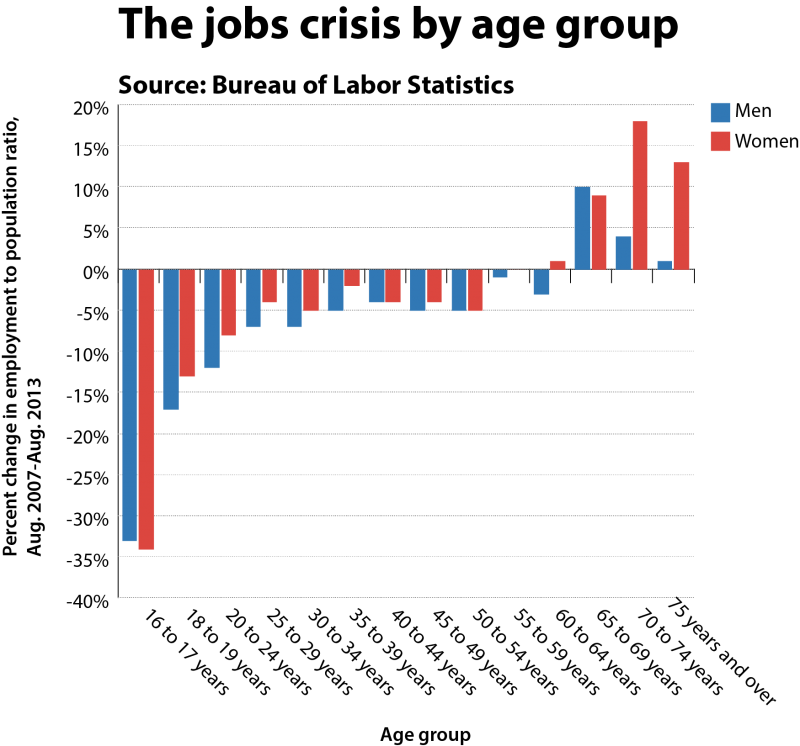
For Americans aged 16 to 24 who aren’t enrolled in school, the employment picture is grim. Only 36 percent are working full time, down 10 percentage points from 2007. Longer term, the overall labor-force participation rate for that age group has dropped 20 percentage points for men and 14 points for women since 1989.

This lack of jobs will damage the long-term careers of a big chunk of the next working generation. Not working after you finish school very often means missing out on developing the skills and habits that will serve you well later on. The current employment numbers are therefore like a telescope into the future labor market: a 23-year-old who is working part time as a dog walker, yoga instructor or retail clerk may be having fun, but perhaps will receive fewer promotions as a 47-year-old.

And:

Employers appear to be more risk-averse, more concerned about overhead costs and less willing to invest in developing young workers’ skills. And that seems true across a wide variety of sectors.

In the legal profession, for instance, there is less interest in hiring junior associates and grooming them for partner status. Colleges and universities are often more interested in hiring adjuncts than tenure-track young faculty members. And publishing houses, instead of providing a big advance upfront and investing in young authors over a series of books, now expect many writers to earn their share of a book’s revenue through royalties.

There are further relevant points in the article.  And here is an FT article about more and more young British people living at home.

Here is a compelling visual from Wonkbook:

jobs_crisis_by_age_take_2-800x746


10 Sep 13:46

Manipulating objects in photos in 3D

by Jason Kottke

This is a bit of a mindblower...this software presented at SIGGRAPH Asia lets you pluck objects out of photos and edit them as if they were in 3D.

(via stellar)

Tags: video
09 Sep 14:15

The American fertility rate is no longer declining

by Tyler Cowen

The sharp decline in the country’s fertility rate during the economic downturn has come to an end, federal data show, as an improving economy encouraged Americans to resume having babies.

The number of babies born in the United States in 2012 remained flat, the first time in five years that the number did not significantly decline, according to the National Center for Health Statistics.

The leveling off capped a 9 percent decline in the fertility rate from 2007 to 2011, a drop that demographers say began after the recession took hold and Americans started feeling less secure about their economic circumstances.

By the way, economics really does seem to be a factor in these changes:

…the only state to show a slight increase in fertility between 2008 and 2009 was North Dakota, which had one of the lowest unemployment rates in the country.

The teen birth rate is falling, which is further good news.  Here is more.

04 Sep 13:16

Ronald Coase

by Sandeep Baliga

Ronald Coase has passed away.

Coase was the last “classical” economist. His style is closer to Marshall than to Samuelson. He asked deep questions and proposed simple but deep answers without using maths. So, a certain style of doing economics passes away with him.

The work of his I am most familiar with concerns the theory of the firm: Why are some transactions mediated through markets while others take place within firms? Suppose Microsoft and Nokia have to work together to supply phones. MS can own human capital that generates software, Nokia can generate the hardware and they can exist as separate firms and trade. Or MS can produce the end software/hardware product and employ Nokia workers in an integrated firm.  Coase’s point is that if there are no transactions costs, there is property-right neutrality. Both institutions should generate the same joint surplus and it does not matter whether they are integrated or not. People often stop there and that is all they know about the “Coase Theorem”. But in fact, Coase’s second point is that property right neutrality is crazy hence there must be transactions costs and we must study these as well as the usual costs of production we normally invoke. Once we have a good understanding of transactions costs, we will understand why some transactions take place through firms and other through markets.

The downside of having a classical style is that no-one really understands what you mean. First, there was controversy about the Coase Theorem itself – was it in fact a  theorem? Coase never called it that (I think it was Stigler who coined the phrase) and Samuelson though it was wrong. But, I think by now we do believe it is a theorem and the property right neutrality obtains for transferable utility (MasColell, Whinston and Green has a simple argument).  But what are these pesky transactions costs that determine the boundary of the firm? There we have no consensus. One leading theory invokes costs of haggling ex post if two firms are not integrated (Wiliamson got the Nobel Prize for this theory). The other says there are no costs of haggling ex post and bargaining in efficient but there is a hold up problem in bargaining as surplus is split. Knowing this firms underinvest ex ante. The allocation of property rights affects the ex post division of surplus and hence this leads to a theory of optimal property rights (this theory has been developed by Oliver Hart with his co-authors Sandy Grossman and John Moore (GHM)).

The counterargument to Williamson’s theory is typically that if haggling generates transactions costs, we should see vertical integration and no outsourcing. No interior solutions! The counterargument to GHM is more esoteric. It turns out that there are contracting solutions that are consistent with typical GHM solutions and resolve the hold-up problem. In some sense, the Coase Theorem goes through in GHM models.

So what can we learn from the Nokia and MS merger? It seems they are looking for a Ballmer replacement who is working at Nokia. And there are intellectual property issues:

Mr. Ballmer said Microsoft and Nokia had not been as agile separately as they would be jointly, citing how development could be slowed down when intellectual property rights were held by two different companies.

But also from the same NYT article:

Large acquisitions are fraught with peril, especially in the technology business, where there are challenges to integrating employees from different backgrounds into a coherent whole.

First, Coase is right – there are transactions costs that destroy property right neutrality. Second, both Williamson and GHM theories are consistent with the facts. Maybe ex post efficient trades are not occurring because of haggling over MS’s and Nokia’s intellectual property. Or knowing that surplus will be extracted by the other party ex post given its monopoly power over its patents, neither firms is fully invested in the joint venture.

So, the bottom line is that Coase had some simple but deep insights and we are still working out the implications.


30 Aug 13:09

Standing between harm and others

by Tim Carmody

I played football in high school, specifically offensive line, defensive line, and linebacker. So did my older and younger brothers, and my older brother coaches linemen and defense at a high school in Michigan. I started out first in middle school and high school as a defensive specialist, which makes sense given John Madden's theory of linemen.

Madden used to say that offensive linemen were overwhelmingly big kids who grew up to be big men, who'd always been told not to pick on but to protect kids smaller than them. Defensive linemen, on the other hand, were little kids who grew up fighting with other little kids (and often bigger kids) but who grew up to be big men. That's what I was: a skinny kid who became a fat adolescent who became a big, strong teenager. (Now I'm a strong, fat writer, so that's how that turned out.)

Madden said the problem is that offensive linemen still need to be as tough and aggressive as defensive linemen, but they always hold something back. Some of this is part of the rules of football: offensive linemen literally can't do everything a defensive lineman can do to them. So what Madden would do is take a tackling dummy and let his offensive linemen beat the hell out of it. Punch it, tear it, throw it across the room, it doesn't matter. Help them get to a point where they're no longer worried about being over-aggressive.

College football reporter Spencer Hall writes:

You should know this about offensive line coaches: they are large, demanding men with Falstaffian appetites, jutting jaws, and no governors on their speech engines. They eat titanic portions. They cram their lips full of dip in film study like they are loading a mortar. They drink bottled water like parched camels, and in their leisure time would consider a suitcase of beer to be a personal carry-on item for them, and them alone. They are terrifyingly disciplined in the moment, and nap like large breed dogs when allowed.

Now, even if Madden's amateur psychobiography of linemen were true when he was coaching, it's not true any more. In the 1990s, coaches got really good at taking tall but relatively slender athletes from every position, bulking them up, and sticking them at offensive line.

In high school, we played this guy named Jon Jansen, who ended up becoming a star offensive tackle for the Washington Redskins, then coming home to Detroit and playing one year for the Lions before becoming an announcer. In high school, he weighed almost 100 pounds less than he did as a pro. He was listed then at 6'8", 230 lbs, and played tight end and middle linebacker. He was FAST. They moved him all over the field, catching touchdowns and uprooting people. It was chaos.

He went to Michigan, they redshirted him for his freshman year, and came back weighing 300 lbs and playing offensive line. Jansen told Bob Costas that he thought between 15 to 20 percent of NFL players were using illegal performance enhancing drugs, noting that the NFL didn't then test for human growth hormone. I remember when I was still in high school reading a long profile of the University of Nebraska's offensive linemen that attributed their huge gains in mass and strength to weightlifting and creatine. Draw your own conclusions about what was happening in pro and college football at the time.

This is all to say that what offensive linemen do in football is not well understood. When the NFL finally started to act on widespread concussions and the resultant uptick in chronic traumatic encephalopathy — if you never have, please read about the life and death of Dave Duerson — they focused on open-field helmet-to-helmet hits and defensive players targeting quarterbacks, running backs, and receivers (so-called "skill positions"). They ignored the constant battering that offensive linemen take, how repeated brain injury poses the greatest risk for long-term problems, how linemen are rewarded for staying on the field and playing through pain, and the ways in which they're encouraged to both be more aggressive and prioritize someone else's safety over their own.

Kurt Vonnegut said that his chief objection to life in general was that it was "too easy, when alive, to make horrible mistakes." This is what offensive line coaches live with: the notion that for every five simple circles drawn on a board, there are a nearly infinite number of possible threats looming out in the theoretical white space. Offensive plays give skill players arrows. Those arrows point down the field toward an endzone, a stopping point, a celebration. Those five simple circles stay on the board in the same place, and are on duty forever.

They are rough men in the business of protection.

Today, Hall has one of the most beautiful, thoughtful, human pieces on offensive linemen I've ever read, and which I've been quoting here throughout. It's called "The Business Of Protection," and subtitled "It Is Never, Ever About You." It's a story about Vanderbilt University's offensive line coach Herb Hand, who suffered a sudden and life-threatening brain hemorrhage waiting in line at a hotel breakfast bar on a recruiting trip. But Hand's story manages to become equally about football, fatherhood, the brain, the heart, how we defend ourselves from what's horrible in the things we love, and how we defend the people closest to us from ourselves.

When Hand had to have the impossible conversation — the one where you, with cellphone, stuck in a hospital far away from home, might have to say the last words you ever say to your children — he did what he was trained to do. He told them that he loved them, and that everything would be okay. The second part of that might not have been true at the time. The emergency room doctor certainly didn't think so, and neither did Hand. But standing between harm and others is what linemen do, even if there's little hope to be had in the face of numbers, size, and speed. There is a dot on the board, and a shield held against whatever slings and arrows lurk in the ether. It stands against harm until it cannot any longer.

Update: While I was writing this post, the NFL and 4500 former players (about one-third of the 12000 still living) reached a mediation agreement to settle a number of lawsuits over concussions for $765 million.

This figure includes legal fees, medical exams, the cost of noticing former players, and $10 million for research and education on the long-term effect of brain injuries, leaving $675 million to compensate former players who've suffered cognitive injuries (or, if dead, their families). The settlement applies only to players who've retired by the time court approves its terms. Current players will need a separate agreement to be compensated for existing and future injuries, and the NFL admits no liability.

As Buzzfeed sportswriter Erik Malinowski notes on Twitter: "Holy crap, what a bargain... ESPN pays $1.9 billion *every year* for Monday Night Football. 4,500 ex-players will get 40% of that (once) for decades of head trauma."

Tags: brain   football   Herb Hand   matter   Spencer Hall   sports
28 Aug 13:25

The Gloria Incident

reluctant_skeptic
27 Aug 17:10

The Value of a CEO

by Alex Tabarrok

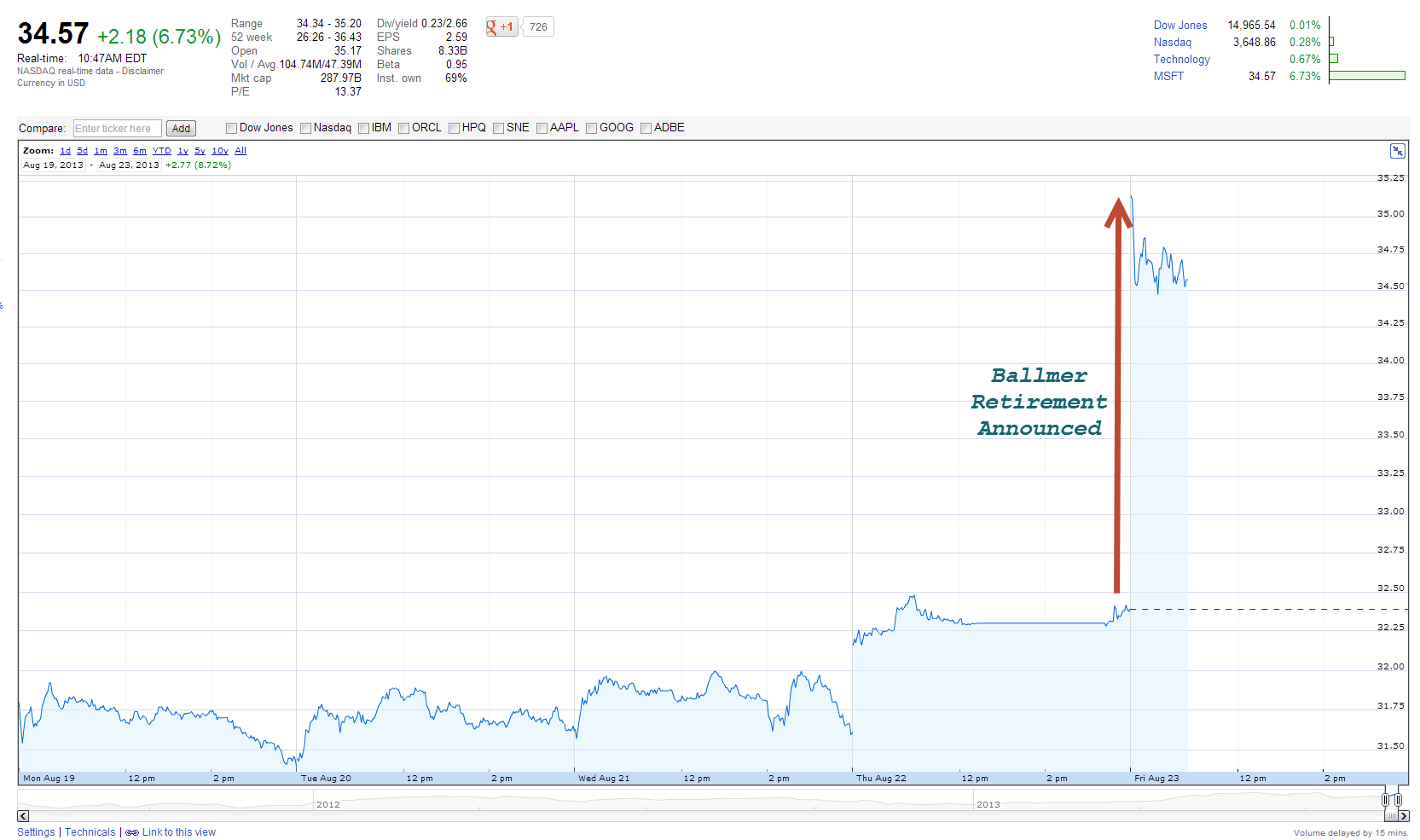
Steven Ballmer announced today that he would retire. Microsoft stock shot up immediately by ~$2.18 or 6-7%. Given 8.33 billion shares outstanding that’s an increase in value of about $18 billion dollars. Of course that’s embarrassing for Ballmer but the lesson cuts both ways. If Ballmer’s exit and replacement with an unknown is worth $18 billion then hiring the right CEO at $27 million annually, the average annual pay for the 100 highest paid CEOs in America, looks like a bargain. Small differences are a big deal for large corporations, you know like a marginal… something or other.

Ballmer Retirement

Hat tip: Justin Wolfers.

27 Aug 16:42

I Almost Forgot My Phone

by noreply@blogger.com (Mungowitz)
(With apologies to CSN&Y, who sang "I almost cut my hair..."  And yes I know the comparison is infelicitous.  I often just leave my phone home.  But then I'm old... Hair was the symbol of revolution through connection through conformity in the late nineteen sixties.  Now phones are the symbol of conformity through connection through isolation in the early twenty tens.)

23 Aug 16:46

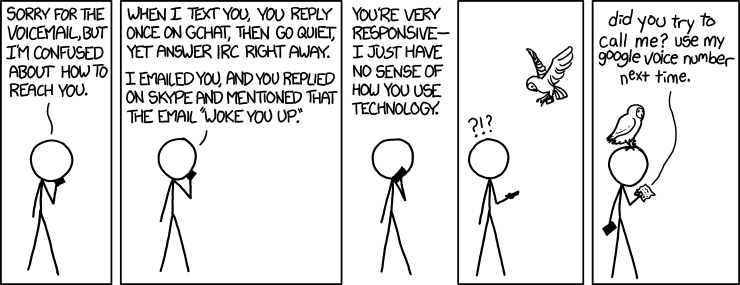
Preferred Chat System

If you call my regular number, it just goes to my pager.