 The latest survey from Public Policy Polling also contained some important information about next year's Senate race, but at least it attempted to settle a real issue. [ more › ]
 Nylonthread
Shared posts
31 May 16:25
The latest survey from Public Policy Polling also contained some important information about next year's Senate race, but at least it attempted to settle a real issue. [ more › ]


41 Percent of Virginia Residents Pronounce 'GIF' With Hard G, According to Polling Firm
by Benjamin R. Freed
The latest survey from Public Policy Polling also contained some important information about next year's Senate race, but at least it attempted to settle a real issue. [ more › ]
30 May 04:40


Tonight on NOVA: Manhunt—Boston Bombers
by Xeni Jardin
NylonthreadI would love to watch this (and need to find out where it's streaming!). :-)
For the past few weeks, I've been in Boston, hanging out at WGBH as Miles O'Brien and the PBS science program NOVA worked to put together this documentary on the science and technology inside the Boston bombing manhunt and investigation. It airs tonight, and it's pretty phnomenal. "Manhunt—Boston Bombers" premieres Wednesday, May 29th at 9PM/8c (check local listings).
Above, PBS NewsHour has a breakout piece related to the documentary: Understanding the Bombs Used at the Boston Marathon. It's a visit to the nation's most active explosives testing facility in New Mexico to learn more about how the Tsarnaev brothers made the pressure cooker bombs used at the Boston Marathon. Investigators often use the center to test theories and find new ways to defend against future attacks. Below, the PBS NOVA trailer. From the description:
At 2:50 pm on April 15, two bomb blasts turned the Boston Marathon finish line from a scene of triumph to tragedy, leaving three dead, hundreds injured, and a city gripped by heartbreak and terror. Less than five days later, the key suspects were identified and apprehended with one dead, the other in custody. How did investigators transform the chaos of the bombing into a coherent trail of clues, pointing to the accused killers? NOVA follows the manhunt step by step, examining the role modern technology—combined with old-fashioned detective work—played in cracking the case. Given hundreds of hours of surveillance and bystander videos, how did agents spot the suspects in a sea of spectators? Why couldn't facial recognition software I.D. the criminals? How much could bomb chemistry analysis, cell phone GPS, infrared imagery, and crowdsourcing reveal about the secrets behind this horrific crime? With the help of top criminal investigators and anti-terrorism experts, NOVA explores which technological innovations worked—and which didn't—and how the world of crime fighting could be transformed tomorrow.
    
|
29 May 18:29


Octopus Lamp Sculpture Made of Recycled Parts
by Kimber Streams
NylonthreadOooh! Gorgeous!

Sculptor Karl Dupere-Richer has created an octopus lamp using recycled objects like garden hoses, Christmas ornaments, and a hanging globe. More pictures of the unique lamp can be viewed at Dupere-Richer’s website.
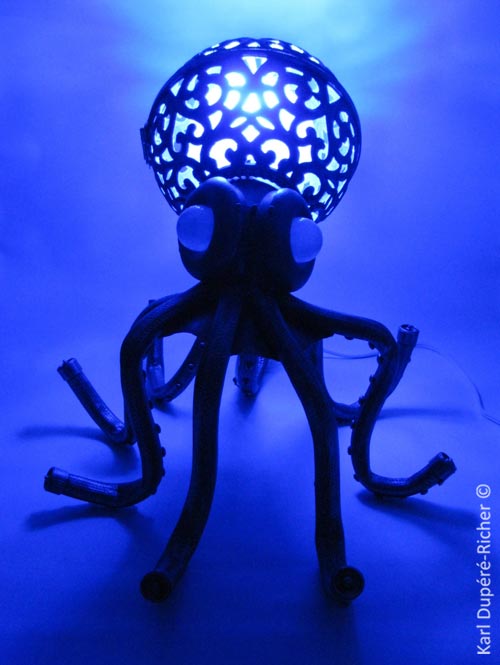
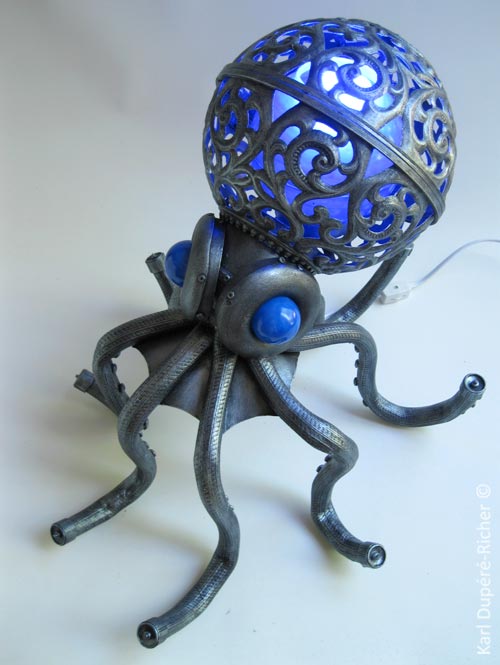
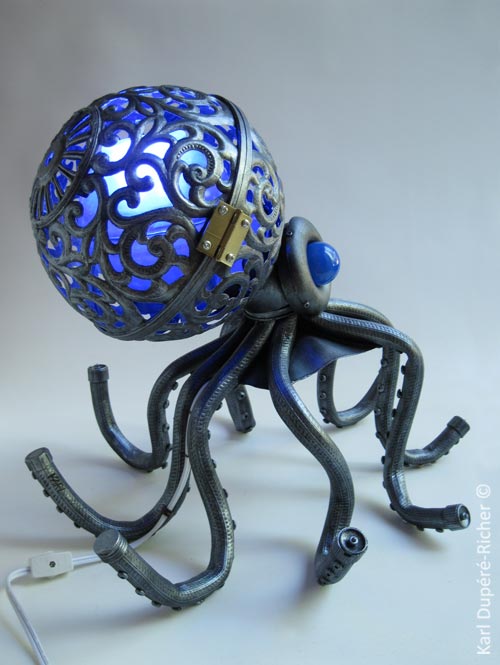
images via Karl Dupere-Richer
Christopher Lantz likes this
29 May 15:23


7 Ways to Boost Your Creativity
by behanceteam
Creativity can seem innate, but like many things, it is actually a delicate balance of nature and nurture. In other words, creative thinking can be enhanced by external forces, and isn’t necessarily reliant on “good genes” or natural ability.
Luckily, new research points the way to a variety of mental and environmental approaches that can help us improve our creative output:
1. Restrict yourself
Famously, Dr. Seuss wrote Green Eggs & Ham after betting that he couldn’t produce a story using less than 50 words. The research shows Seuss was on to something. Most people naturally take the path of “least resistance” and build off of older or existing concepts when brainstorming, which can lead to less creative ideas.
In order to put the brain in overdrive, you can mimic Dr. Seuss and place restrictions on yourself while creating, which will prevent you from falling back on past successes. If you usually write 1000-word short stories, try to create a story in under 500 words. Only use a small handful of chords in your song or colors in your design. The limiting nature of the task can bring out your most creative side.
2. Re-conceptualize the problem
Researchers have noted that creative people tend to re-conceptualize problems more often before starting a creative task. As Einstein once said “If I had an hour to solve a problem I’d spend 55 minutes thinking about the problem and five minutes thinking about solutions.” Instead of looking at the end goal of a creative project (i.e. “I need to create a memorable painting”), it’s better to re-visualize the problem from other, more meaningful, angles before starting (“What sort of painting would evoke the feeling of loneliness that we all feel after a break-up?”).
Oftentimes, the best approach is to picture the intended audience of your next creative project. What inspires them? What are they sick of hearing about? What are the problems they face but are rarely able to talk about?
3. Separate work from consumption
It has been shown that we are particularly terrible at creating when we try to combine the gathering of information and actual creation. Researchers recommend only consuming information in an “absorb state” where you are not attempting to multitask.
In essence, the absorb state is a form of “batching” that emphasizes forced consumption over output. No interrupting yourself to start working on segments of your project while you are consuming information, instead use tools such as Evernote or Pocket to remember key ideas, insights, and articles that you will apply later when creating.
4. Stay positive
Although negative moods can sometimes spur creativity, researchers have found that it is during strong positive moods that our best creative work is done. In fact, the feeling of love or even thinking about love was shown to best encourage creative thinking.
Getting yourself to a “positive place” is not as trite as it may sound—any number of mood boosters (quick exercise, envisioning the future, recalling good memories) will do the trick to influence your mood, and your creative efforts will be at their best when your attitude is positive.
5. Use counterfactual thinking
Counterfactual thinking, also known as asking, “What might have been?” has been shown to increase creativity for short periods of time. To experiment with this technique, take events that have already happened and re-imagine different outcomes, alternating between the subtractive mindset (taking elements out of the event) and the additive mindset (adding elements into the event).
A silly example of counterfactual thinking in action can be seen on The Big Bang Theory, when one of the main characters makes a game of the phenomenon, asking his roommate: “In a world where Rhinoceroses are domesticated pets, who wins the Second World War?” You, however, can apply it to more realistic scenarios, such as mapping out outcomes whenever you are doing creative problem solving, subtracting or adding “what if” elements that would have affected the outcome.
6. Daydream… after getting started
While research has shown that daydreaming can help with creativity, it is important to note that studies have revealed that daydreaming only works when you’ve already committed effort towards a project. The reason? Daydreaming can be beneficial because it allows for the incubation of ideas. But incubation is only effective when we already have information to chew on. So be sure to get started on your project before drifting off.
7. Think about others
Research has shown that this “psychological distance” is an important part of being creative. For instance, one study found that people who thought their work would be used by someone else came up with more novel ideas. Conversely, those who were told that they would be using their own creation later came up with less novel ideas.
One such test in the studies above included telling participants that their drawings would later be used by other subjects to create a story. Those who had been told this came up with much more “creative” drawings (as evaluated by a selected board). When creating, even for personal projects, think about how someone else will enjoy, use, and incorporate your creation into their lives.
—
How about you?
What do you do to put yourself in the best mindset to generate new ideas?
Nidia Ojeda, ereed and -1 others like this
29 May 15:08
 D.C. and areas nearby boast lower death rate from cardiovascular disease and diabetes than most other metropolitan areas. [ more › ]

Washington Metro Area Is Second Healthiest and Fittest Region in America, in Part Because of Mental Health
by Sarah Anne Hughes
NylonthreadGood to know? I'd like to see more of the data.
D.C. and areas nearby boast lower death rate from cardiovascular disease and diabetes than most other metropolitan areas. [ more › ]
29 May 14:36

Photos of Smartphones Replaced With Sandwiches
by Kimber Streams

Redditor lederhosenbitches has created Phones Replaced With Sandwiches, a Tumblr blog featuring hilarious, digitally manipulated photos in which smartphones have been replaced with sandwiches.


images via Phones Replaced With Sandwiches
28 May 20:17


R. Stevens of "Diesel Sweeties" webcomic designs LympheDIVA sleeves for cancer patients
by Xeni Jardin
NylonthreadWhen I was shopping for compression hose, I saw a bunch of these compression gauntlets for sale in very bright, day-glo colors. These options are even better!

Lymphedema prevention garments designed for LympheDIVAs by R. Stevens.
Like many of my fellow breast cancer patients, the treatment I received (and am still receiving) places me at high risk for a condition called lymphedema that can cause painful and permanent swelling in the arms.
To help prevent lymphedema or control the swelling if it does happen, many doctors recommend we use compression sleeves. It used to be that the only kind of sleeves available looked like big ugly bandages, but LympheDIVA, a company started by two women with breast cancer in Philadelphia, was one of the first to change that. LympheDIVA creates sleeves and gauntlets so funky and pretty, you could imagine wearing them just because they look cool. I wear their product regularly, and have found them to be pretty great.
When I put on my "Lotus Dragon" one, people think I have an actual sleeve tattoo, which cracks me up. When I first started wearing it , I tweeted that it would also be fun to see Diesel Sweeties comic creator R. Stevens, who designs fun patterns for socks, gloves, and other wearables, create some stuff for LympheDIVA. I am thrilled to learn that this happened! R. Stevens has designed four sleeve/gauntlet products for LympheDIVA, and they all look great.


Diesel Sweeties' R. Stevens, profiled in WIRED in 2008. Photo: Wired Magazine.
Founder Rachel Levin Troxell ran LympheDIVAs for some years, but died in 2008 after her cancer returned. She was 38.
At Rachel’s request, her father Dr. Howard Levin and her mother, Judy Levin took over the responsibility of running the company which their daughter helped found. In August of 2010, Rachel’s little brother, Josh Levin, joined the company and is now running it with his parents. They all hope that LympheDIVAs’ compression apparel will continue to inspire breast cancer survivors everywhere to feel as beautiful, strong and confident as Rachel was.
Josh seems like a really nice guy who is very committed to creating products that people like his sister, and me, would enjoy wearing. I love that R. Stevens has designed these wonderful new products for them, and I can't wait to slip them on the next time I have to do a long airplane flight or work out (two of the situations that can elevate risk of a lymphedema episode).
Lymphedema sucks. These LympheDIVA sleeves don't.
Thanks for making cancer patients' lives a little geekier, R. Stevens and LympheDIVAs!
For more information on lymphedema and how to cope with it, check out the National Lymphedema Network.

|
|
ereed and -1 others like this
24 May 17:43
 The decision not to make a decision led the museum's director Richard Koshalek, who first conceived of the Bubble, to resign. [ more › ]


Hirshhorn Bubble Still Not Happening, Museum Director Resigns
by Sarah Anne Hughes
NylonthreadAw, boo. I was looking forward to the Bubble.
The decision not to make a decision led the museum's director Richard Koshalek, who first conceived of the Bubble, to resign. [ more › ]
23 May 17:11
 Matthew says: "For several weeks, a fourth-grade girl was relentlessly harassing a classmate's choice of clothing. As punishment, the girl's stepmother spent about $50 at a thrift store and forced her to wear poorly-fitting and embarrassing clothing to school."


Woman forces stepdaughter to wear dowdy thrift store clothes as punishment for bullying
by Mark Frauenfelder
NylonthreadI like how well the punishment fits the crime. $50 was kinda steep for ugly clothes, though, eh?
Matthew says: "For several weeks, a fourth-grade girl was relentlessly harassing a classmate's choice of clothing. As punishment, the girl's stepmother spent about $50 at a thrift store and forced her to wear poorly-fitting and embarrassing clothing to school."|
|
23 May 13:46
Conheça a Liga da Justiça dos anos 80, de Billy Butcher
by Antonio Tadeu
NylonthreadWhat a great share, h/t Osiasjota!

O designer brazuca Billy Butcher (o mesmo que fez imagens de celebridades como se fossem o Batman), criou versões da Liga da Justiça inspiradas nos anos 80, com vários rostos de ícones do Pós-Punk e New Wave. Temos Morrisey como Superman (acima), Flash Devo, Aquaman Billy Idol, Robert Smith Elástico e por ai vai.
Se você quiser comprar uma camisa com uma dessas ilustrações (e eu acho que vão vender pacas), basta clicar aqui. Imagino qual será a próxima… Vingadores Punk Rock?


Fonte: Laughing Squid
Nylonthread and -1 others like this
22 May 19:37

Cat Beards, A Photo Meme Where People Place a Cat in Front of Their Face to Make a Furry Beard
by Justin Page
NylonthreadHeh.

Cat Beards is a purrrfect photo meme where people position their cat’s chin in front of their own face and make it look as if they have a furry beard, mouth and all. Some of the photos have been around for a few years, but the meme has only recently really taken off. You can view more photos of mutant cat beard people online at Cat-Beard.com, Know Your Meme and by searching around in the Instagram tag #CatBeard.
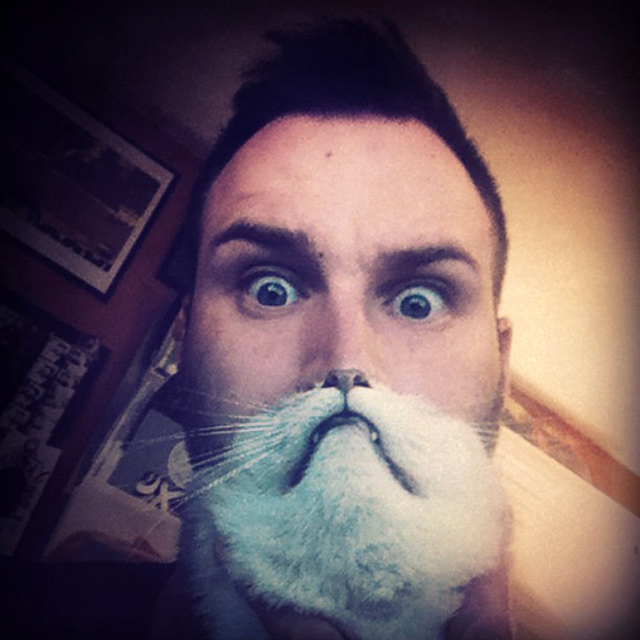
photo by Dave Rudolph

photo by Sam Chapel

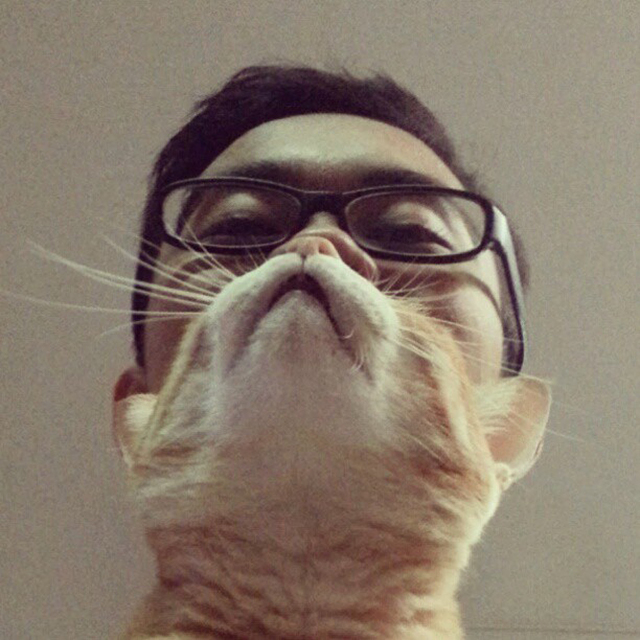
photo by Zulfadli Isa
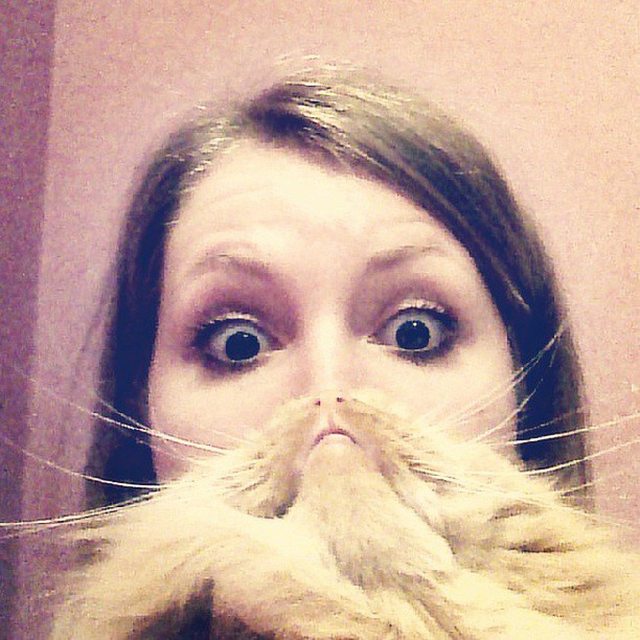
photo by Julia Budaeva

photo by Cee Please

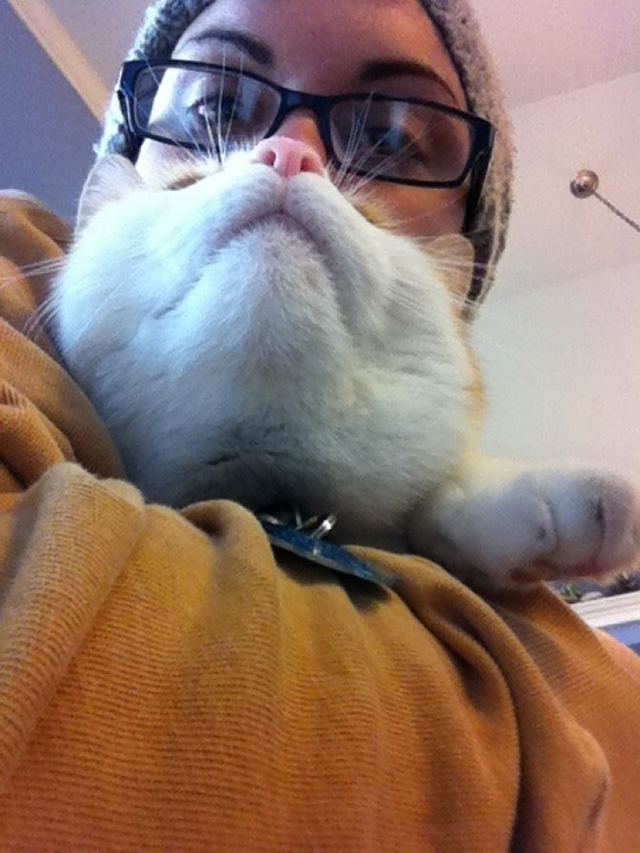
photo by Elizabeth Sevilla

photo by mr_seltzer

photo by Briana Nguyen
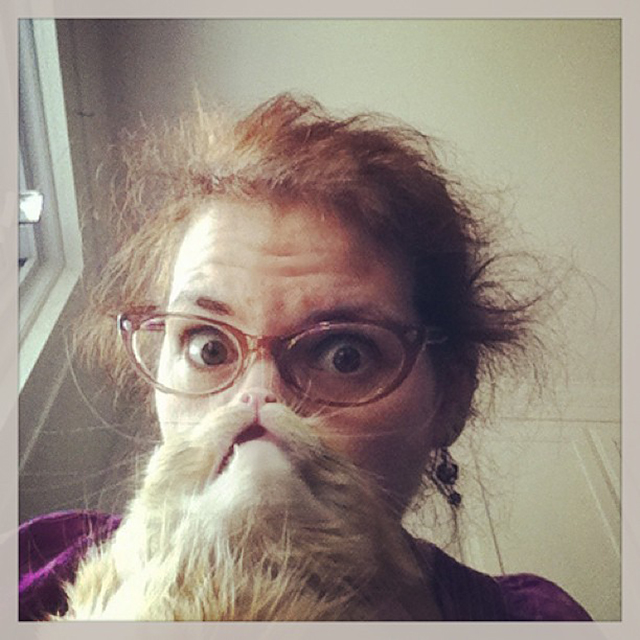
photo by Jen Hardiman

photo by bestill_foramoment
images via Cat-Beard, Catasters, My View, Not Yours. and Statigram
via The Sun
Thanks Nick Lacke!
Theasp, Karyn Wittmeyer and one other like this
22 May 15:43
laughingsquid: Japanese Barista Makes 3D Latte Art

Adam Victor Brandizzi, Osiasjota and -1 others like this
22 May 15:41

Pet Safety During Cicada Season
Dogs, cats, squirrels and birds will have a four- to six-week feast this summer as the Brood II 17-year cicadas emerge from the ground throughout the Mid-Atlantic.
Like junk food, though, too many cicadas down the gullet can cause tummy aches and other issues for pets.
The Humane Society warned in 2004 that cicadas’ exoskeletons are not digestible, so eating too many could cause constipation or vomiting. (he 17-year Brood X cicadas emerged in our region in 2004.) Animals could also choke on cicadas’ legs and wings.
The Humane Society also noted that cicadas are like little flying toys to dogs and cats -- they’re small (but not too small), they fly slowly and usually stay pretty low to the ground.
In addition, the exoskeletons of cicadas contain chitin, and some pets may have an allergic reaction. Chitin may affect some humans, too, according to Science Daily.
If your dog or cat vomits more than twice or seems particularly uncomfortable after gorging on cicadas, take him or her to the vet.
For humans, cicadas can be safe to eat in relatively limited quantities.
- See: Are Cicadas Safe to Eat? Cicada Recipes and Cooking Tips for more information.
21 May 14:41


Manage Your Day-to-Day, the New Book from 99U, Is Now On Sale!
by behanceteam
Today we’re thrilled to announce that our first book in a new 99U series, Manage Your Day-to-Day, is officially on sale! In the spirit of going behind the scenes on idea execution, I’d like to share the thinking behind how (and why) we built this book. Plus, some gorgeous detail shots of the book’s design…
Manage Your Day-to-Day is not your typical “productivity” book. Based on our 5+ years of research here at 99U, we proceeded from a handful of counter-intuitive premises about what works—and doesn’t work—for creative professionals as we crafted this book:
Premise #1 – We aren’t just managers, we’re makers.
Most books about time management or productivity are targeted at managers, not makers. But everyone who has a creative career these days is both a manager and a maker. And playing both roles presents some unique challenges.
Those of us who make creative work on a daily basis need time and space to think deeply and for extended periods of time. These are the moments when we find flow and make real, productive progress on our creative endeavors.
The challenge of this type of work is that interruptions can be highly destructive. And we now work in an era where we can easily spend our entire day ricocheting from one interruption to the next: email, texts, tweets, client requests, etc, etc.
In Manage Your Day-to-Day, we address the specific challenges that this 21st-century influx of information presents for creative professionals, and offer solutions for how to build a daily routine, maintain focus amidst a constant stream of distractions, and keep your creative mind (and work) fresh.

Premise #2 – There is no silver bullet for productivity.
If there’s one thing I’ve learned from working with and interviewing creatives for over a decade, it’s that they hate rules. Interestingly, the majority of books that purport to help us work better/faster/smarter, typically offer one single, topdown system for improving your productivity. The so-called silver bullet.
But creatives are unpredictable: We all have our own idiosyncratic work habits, clients demands, and quirks, which means that a single top-down system rarely works for us. Not to mention that we naturally resist the rules such a system imposes.
Rather than taking a one-size-fits-all approach, Manage Your Day-to-Day provides a playbook of tried-and-true best practices for producing great work. To accomplish this, we recruited 20 of the smartest creatives and researchers we knew—from Stefan Sagmeister to Seth Godin to Gretchen Rubin to Tony Schwartz to Dan Ariely—and asked them to share their road-tested insights on what helps them do great creative work. See the full contributor list here.

Premise #3 – Great design matters.
As with everything we produce at Behance and 99U, design was central to the creation of this book series. Manage Your Day-to-Day was meticulously planned—from an editorial and a design perspective—for a creative audience.
On the editorial side, the essays are concise, compulsively readable, and insightful. You can read the book cover to cover in just a few sittings, or dip into it by topic as the mood strikes you. In between each of the essays, we’ve included bite-size wisdom—in the form of beautifully typeset quotations—from creative greats ranging from Ray Bradbury to Man Ray to John Cage.
On the design side, every detail was considered by the Behance design team. Packaged in a neat 5″ x 7″ format, the book is sleek, sexy, and highly portable. From cover design to paper stock to fonts, we hand-crafted every component of the book to make it a beautiful reading experience for you.
Our hope is that Manage Your Day-to-Day will empower you to shift your mindset, recalibrate your workflow, and push more incredible ideas to completion. Here’s to doing more great creative work!
Get the book - www.amazon.com/99u


Get the book - www.amazon.com/99u
20 May 15:13


Good Writing vs. Talented Writing
by Maria Popova
“Talented writing makes things happen in the reader’s mind — vividly, forcefully — that good writing, which stops with clarity and logic, doesn’t.”
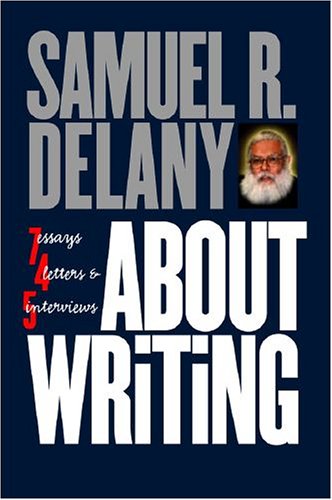 The secrets of good writing have been debated again and again and again. But “good writing” might, after all, be the wrong ideal to aim for. In About Writing: Seven Essays, Four Letters, and Five Interviews (public library), celebrated author and literary critic Samuel Delany — who, for a fascinating factlet, penned the controversial 1972 “women’s liberation” issue of Wonder Woman — synthesizes his most valuable insights from thirty-five years of teaching creative writing, a fine addition to beloved writers’ advice on writing. One of his key observations is the crucial difference between “good writing” and “talented writing,” the former being largely the product of technique (and we know from H.P. Lovecraft that “no aspiring author should content himself with a mere acquisition of technical rules”), the other a matter of linguistic and aesthetic sensitivity:
Though they have things in common, good writing and talented writing are not the same.
[…]
If you start with a confused, unclear, and badly written story, and apply the rules of good writing to it, you can probably turn it into a simple, logical, clearly written story. It will still not be a good one. The major fault of eighty-five to ninety-five percent of all fiction is that it is banal and dull.
Now old stories can always be told with new language. You can even add new characters to them; you can use them to dramatize new ideas. But eventually even the new language, characters, and ideas lose their ability to invigorate.
Either in content or in style, in subject matter or in rhetorical approach, fiction that is too much like other fiction is bad by definition. However paradoxical it sounds, good writing as a set of strictures (that is, when the writing is good and nothing more) produces most bad fiction. On one level or another, the realization of this is finally what turns most writers away from writing.
Talented writing is, however, something else. You need talent to write fiction.
Good writing is clear. Talented writing is energetic. Good writing avoids errors. Talented writing makes things happen in the reader’s mind — vividly, forcefully — that good writing, which stops with clarity and logic, doesn’t.
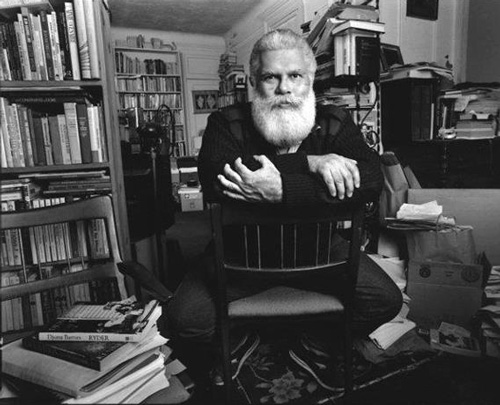
Virginia Wolf knew subtlety was the key to craftsmanship when she counseled that “we have to allow the sunken meanings to remain sunken, suggested, not stated.” “All bad writers are in love with the epic,” Hemingway admonished. The talented writer, Delany reminds us, is a master of induction, suggesting the general through the deft deployment of the specific, and in the process producing an even greater dramatic effect than the bombast of sweeping statements ever could:
The talented writer often uses specifics and avoids generalities — generalities that his or her specifics suggest. Because they are suggested, rather than stated, they may register with the reader far more forcefully than if they were articulated. Using specifics to imply generalities — whether they are general emotions we all know or ideas we have all vaguely sensed — is dramatic writing. A trickier proposition that takes just as much talent requires the writer carefully to arrange generalities for a page or five pages, followed by a specific that makes the generalities open up and take on new resonance. … Indeed, it might be called the opposite of “dramatic” writing, but it can be just as strong — if not, sometimes, stronger.
“Words have their own firmness,” Susan Sontag reflected in her diary. “Use the right word, not its second cousin,” Mark Twain famously advised, but great writing isn’t just a mere matter of concision. As E.B. White reminded us, “Writing is not an exercise in excision, it’s a journey into sound.” Delany bisociates this dual requirement for precision and eloquence, with precision and eloquence:
The talented writer often uses rhetorically interesting, musical, or lyrical phrases that are briefer than the pedestrian way of saying “the same thing.”
The talented writer can explode, as with a verbal microscope, some fleeting sensation or action, tease out insights, and describe subsensations that we all recognize, even if we have rarely considered them before; that is, he or she describes them at greater length and tells more about them than other writers.
In complex sentences with multiple clauses that relate in complex ways, the talented writer will organize those clauses in the chronological order in which the referents occur, despite the logical relation grammar imposes.
In fact, the true potency of “talented writing,” Delany suggests, lies in its ability to compress subtle yet all-consuming sensation into an enormously efficient information packet. In many ways, the talented writer possesses the same qualities Wordsworth ascribed to the poet when he described him as someone “endowed with more lively sensibility, more enthusiasm and tenderness, who has a greater knowledge of human nature, and a more comprehensive soul, than are supposed to be common among mankind.” Delany concludes:
Talented writing tends to contain more information, sentence for sentence, clause for clause, than merely good writing. … It also employs rhetorical parallels and differences. . . . It pays attention to the sounds and rhythms of its sentences. . . . Much of the information it proffers is implied. … These are among the things that indicate talent.
About Writing: Seven Essays, Four Letters, and Five Interviews goes on to explore such facets of the craft as character and plot development, the intricacies of “pure storytelling,” and how to manage creative doubt.
Donating = Loving
Bringing you (ad-free) Brain Pickings takes hundreds of hours each month. If you find any joy and stimulation here, please consider becoming a Supporting Member with a recurring monthly donation of your choosing, between a cup of tea and a good dinner:
| ♥ $7 / month♥ $3 / month♥ $10 / month♥ $25 / month |

You can also become a one-time patron with a single donation in any amount:
 Brain Pickings has a free weekly newsletter. It comes out on Sundays and offers the week’s best articles. Here’s what to expect. Like? Sign up.
Brain Pickings takes 450+ hours a month to curate and edit across the different platforms, and remains banner-free. If it brings you any joy and inspiration, please consider a modest donation – it lets me know I'm doing something right.

18 May 18:18


Brave director slams Disney's sexy Merida makeover
by Rob Beschizza
NylonthreadMerida the character (as written) was so not about this crap.

Paul Liberatore in The Marin Independent Journal:
Marin filmmaker Brenda Chapman, who won an Oscar for writing and co-directing the animated feature "Brave," blasted Disney's sexy makeover of her movie's feisty heroine, Merida, as "a blatantly sexist marketing move based on money." ... "I think it's atrocious what they have done to Merida ... When little girls say they like it because it's more sparkly, that's all fine and good but, subconsciously, they are soaking in the sexy 'come-hither' look and the skinny aspect of the new version. It's horrible!"
It's really blistering, bridge-burning stuff, and I salute her for it: "I forget that Disney's goal is to make money without concern for integrity."
Previously: Disney gives Brave princess a body makeover 
|
|
Andreidignart, Aleispani likes this
15 May 11:49

The Cocktail Chart of Film & Literature by Pop Chart Lab
by Justin Page
NylonthreadAwesome!
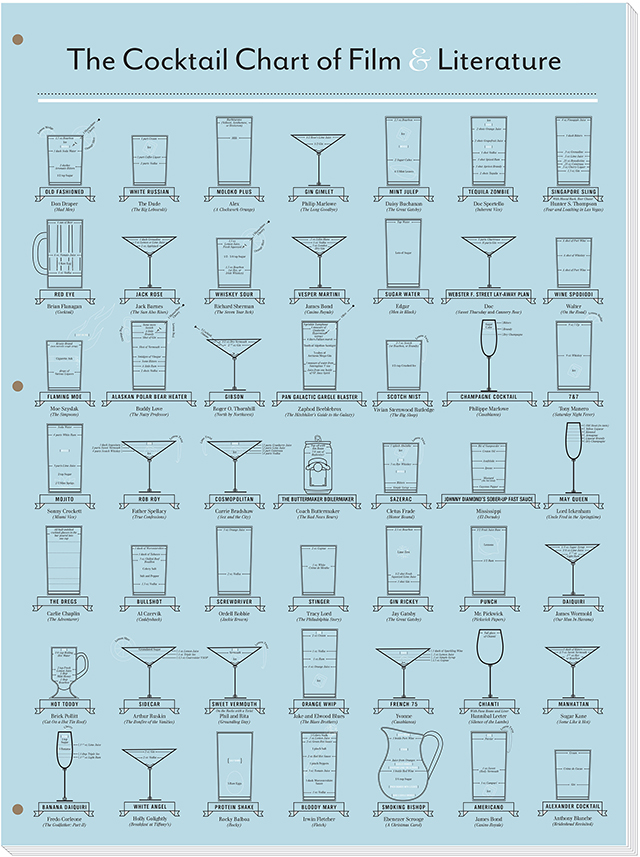
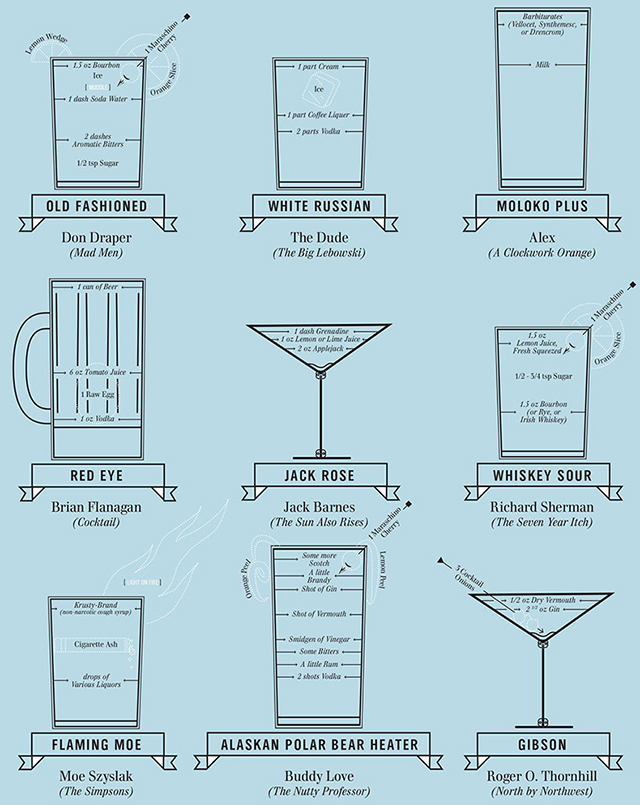
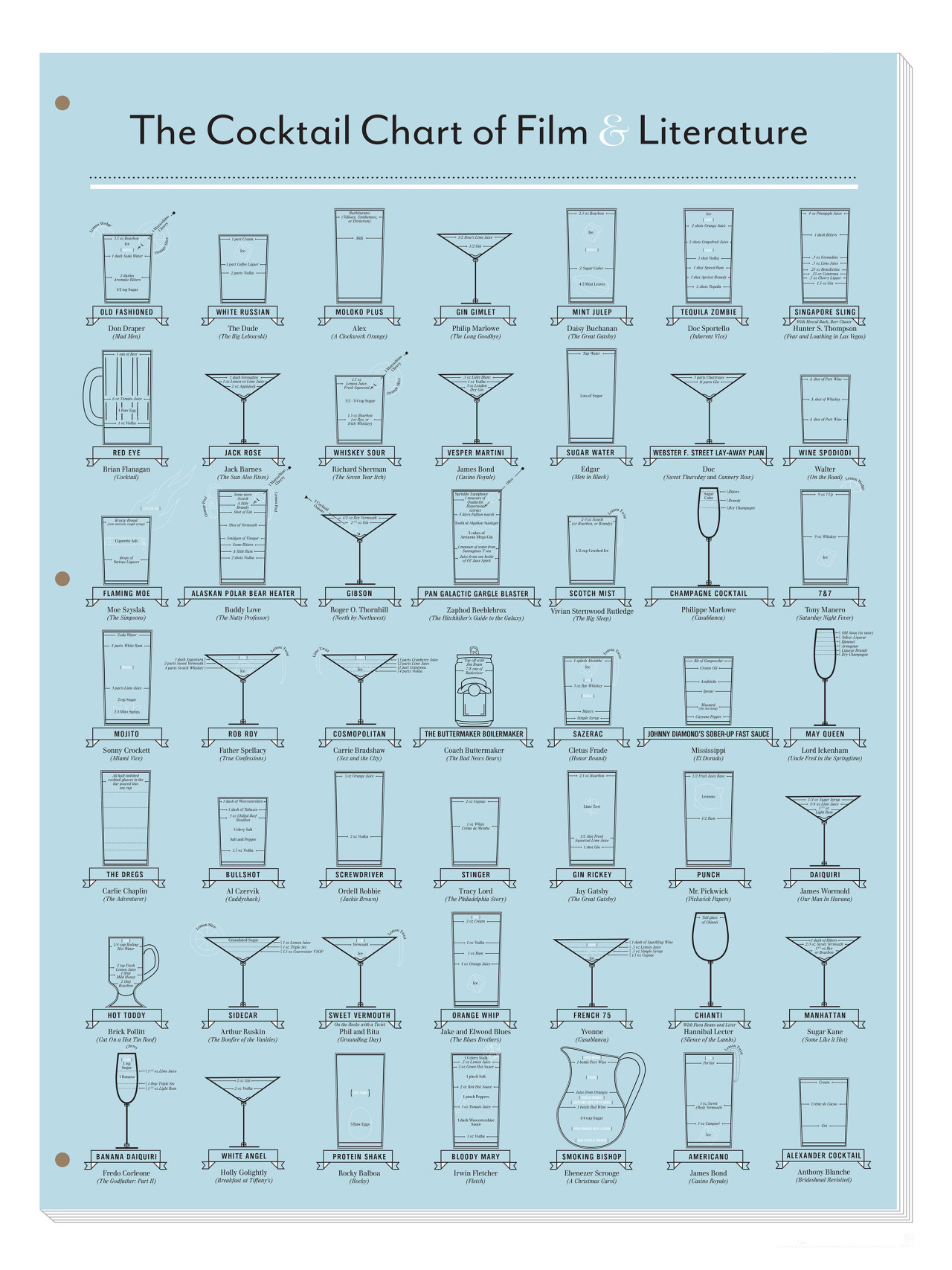
“The Cocktail Chart of Film & Literature” is a “catalog of 49 drinks culled from great works of film and literature” (here is a larger image). The chart was created by Pop Chart Lab and prints are available to purchase online.
Don Draper’s Old Fashioned, The Dude’s White Russian, Hunter S. Thompson’s Singapore Sling, Daisy Buchanan’s Mint Julep, and more.
submitted via Laughing Squid Tips
14 May 23:08

Make Good Art: Neil Gaiman’s Advice on the Creative Life, Adapted by Design Legend Chip Kidd
by Maria Popova
NylonthreadDon’t freeze, don’t stop, don’t worry that it isn’t good enough, or it isn’t perfect, whatever it is: art, or love, or work or family or life.
“Make New Mistakes. Make glorious, amazing mistakes. Make mistakes nobody’s ever made before.”
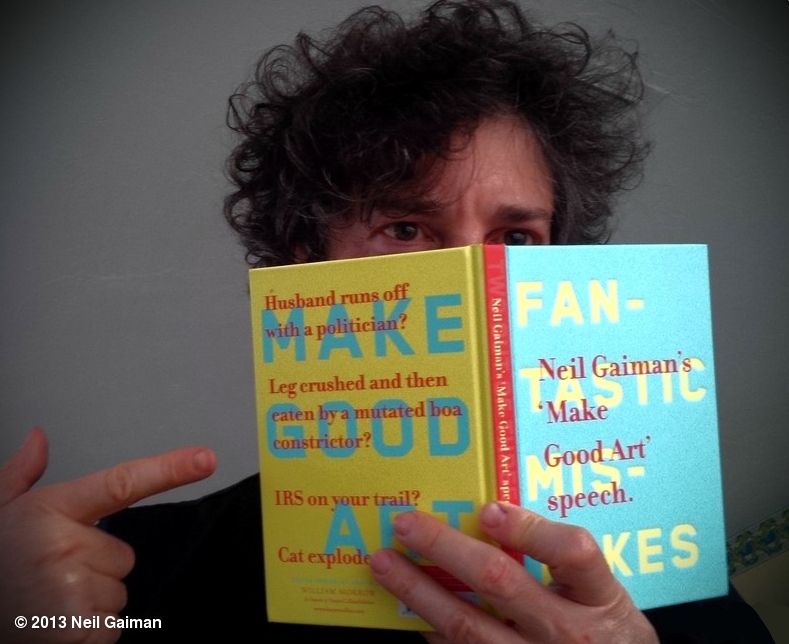
 Commencement season is upon us and, after Greil Marcus’s soul-stirring speech on the essence of art at the 2013 School of Visual Arts graduation ceremony, here comes an exceptional adaptation of one of the best commencement addresses ever delivered: In May of 2012, beloved author Neil Gaiman stood up in front of the graduating class at Philadelphia’s University of the Arts and dispensed some timeless advice on the creative life; now, his talk comes to life as a slim but potent book titled Make Good Art (public library).
Best of all, it’s designed by none other than the inimitable Chip Kidd, who has spent the past fifteen years shaping the voice of contemporary cover design with his prolific and consistently stellar output, ranging from bestsellers like cartoonist Chris Ware’s sublime Building Stories and neurologist Oliver Sacks’s The Mind’s Eye to lesser-known gems like The Paris Review‘s Women Writers at Work and The Letter Q, that wonderful anthology of queer writers’ letters to their younger selves. (Fittingly, Kidd also designed the book adaptation of Ann Patchett’s 2006 commencement address.)


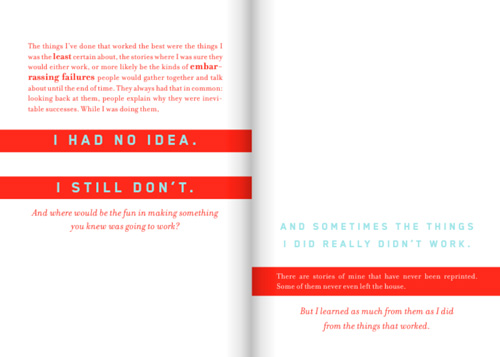
When things get tough, this is what you should do: Make good art. I’m serious. Husband runs off with a politician — make good art. Leg crushed and then eaten by a mutated boa constrictor — make good art. IRS on your trail — make good art. Cat exploded — make good art. Someone on the Internet thinks what you’re doing is stupid or evil or it’s all been done before — make good art. Probably things will work out somehow, eventually time will take the sting away, and that doesn’t even matter. Do what only you can do best: Make good art. Make it on the bad days, make it on the good days, too.


A wise woman once said, “If you are not making mistakes, you’re not taking enough risks.” Gaiman articulates the same sentiment with his own brand of exquisite eloquence:
I hope that in this year to come, you make mistakes.
Because if you are making mistakes, then you are making new things, trying new things, learning, living, pushing yourself, changing yourself, changing your world. You’re doing things you’ve never done before, and more importantly, you’re Doing Something.
So that’s my wish for you, and all of us, and my wish for myself. Make New Mistakes. Make glorious, amazing mistakes. Make mistakes nobody’s ever made before. Don’t freeze, don’t stop, don’t worry that it isn’t good enough, or it isn’t perfect, whatever it is: art, or love, or work or family or life.
Whatever it is you’re scared of doing, Do it.
Make your mistakes, next year and forever.
Revisit the talk in its original delivery below, and reabsorb its eight indispensable lessons:
Complement Make Good Art with more remarkable wisdom for the precipice of adulthood from David Foster Wallace, Jacqueline Novogratz, Ellen DeGeneres, Aaron Sorkin, Barack Obama, Ray Bradbury, J. K. Rowling, Steve Jobs, Robert Krulwich, Meryl Streep, and Jeff Bezos.
Donating = Loving
Bringing you (ad-free) Brain Pickings takes hundreds of hours each month. If you find any joy and stimulation here, please consider becoming a Supporting Member with a recurring monthly donation of your choosing, between a cup of tea and a good dinner:
| ♥ $7 / month♥ $3 / month♥ $10 / month♥ $25 / month |
You can also become a one-time patron with a single donation in any amount:
Brain Pickings has a free weekly newsletter. It comes out on Sundays and offers the week’s best articles. Here’s what to expect. Like? Sign up.
Brain Pickings takes 450+ hours a month to curate and edit across the different platforms, and remains banner-free. If it brings you any joy and inspiration, please consider a modest donation – it lets me know I'm doing something right.
ereed, Kelly.loija and -1 others like this
14 May 19:52
 The Smithsonian's Arthur M. Sackler Gallery will launch a crowdfunding effort later this month to support "Yoga: The Art of Transformation," an exhibition that explores the goals of the ancient activity. [ more › ]


Smithsonian's Sackler Gallery to Crowdfund Yoga Exhibition
by Sarah Anne Hughes
Nylonthreadereed? Yoga!
The Smithsonian's Arthur M. Sackler Gallery will launch a crowdfunding effort later this month to support "Yoga: The Art of Transformation," an exhibition that explores the goals of the ancient activity. [ more › ]
13 May 20:16

Marvel’s Agents of S.H.I.E.L.D., A Television Series Set in ‘The Avengers’ Universe
by Kimber Streams
It’s not just Spy vs. Spy anymore.
The first promo trailer and teaser for Marvel’s Agents of S.H.I.E.L.D., a television series set in The Avengers universe focused on the members of the fictional S.H.I.E.L.D. agency. The Joss Whedon-helmed series has been picked up by ABC, and will star Clark Gregg as Agent Phil Coulson, a character that appeared to have died in the 2012 Avengers film. The show is “coming soon” to ABC, but the network has yet to release a specific date for when the first episode will air.
via Deadline
13 May 19:27

Astronaut Chris Hadfield Performs David Bowie’s ‘Space Oddity’ Aboard the International Space Station
by Kimber Streams
NylonthreadGave me goosebumps... I imagine this astronaut has been waiting his whole life to try this. Heartfelt and sweet.
Canadian astronaut Chris Hadfield performs an acoustic cover of “Space Oddity” by David Bowie aboard the International Space Station.
Bgarland likes this
13 May 13:52

Depressed Felines Reflect on Their Miserable Lives in Ze Frank’s ‘Sad Cat Diary’
by Justin Page
“Dear Diary, my food dish is now only half full. It is obvious that I will soon starve to death.”
In “Sad Cat Diary,” a sorrow-filled video by Ze Frank, a collection of depressed cats reflect on various miserable events that took place in their lives. Ze Frank found inspiration for this video from a post made by Mark Duffy on BuzzFeed titled, The Best of “First-World Cat Problems”.
music by Kevin MacLeod – “Plaint“
ereed likes this
10 May 15:21

The Music Box, A Working Music Box Made Out of a Massive Soil Compactor Machine
by EDW Lynch
NylonthreadKinetic sculpture!

For his 2012 kinetic sculpture “The Music Box,” artist Dave Cole converted a 22,000 pound soil compactor machine into a massive music box that plays the “Star Spangled Banner.” Though Cole stripped most of the weight out of the compactor to make the sculpture more manageable, it still weighs in at 2,000 pounds. The sculpture was commissioned by the Cleveland Institute of Art.

photos by Carly Gaebe
via designboom
07 May 13:21
Too much homework and trying to be the squeaky wheel.
by noreply@blogger.com (Nylonthread String)
NylonthreadI got a reply, paraphrasing: homework shouldn't take more than one hour and Rosie needs to be more organized. Seriously??? That's 5.5 minutes per assignment, and she had 4 tests to study for!
My family is feeling overwhelmed by the incredible amount of work being sent home with the kids, particularly my 10-year-old, by their elementary school teachers. I'm stressed out and I know my kids are too — my family isn't the only one affected, either. Read this psychologist's article about homework and elementary-school-aged children to see what the experts think about over-assigning work. In the spirit of being the squeaky wheel and letting the administration know how I feel, I just sent this letter to my daughter's school principal and vice principal.
Here is the assignments list:
Had we attempted to complete the work for each of these assignments, it would have been over 5 hours of work. As it was last night, we didn't get to 2, 6, 8, or 11. Those will have to wait till tonight!
Beside Rosie's workload, I had to cancel two planned adult activities that required my participation last night so I could help her. Monkey did all the cooking and kitchen cleanup so I could devote my time to her. I'm sure Dash could feel the tension!
"Dear Principal and VP,
Rosie, a fourth grader in Mrs. M's class came home with 11 separate homework assignments last night. I spent 3 hours working with her to get them done before 9 p.m. at which point she was exhausted and crying, then worked on unfinished work for another 45 minutes this morning before SACC. She was not able to complete all the assignments (listed below) — this was easily 5 hours of work. What are the real expectations here?
After the bus drops her off from school at 4:15, she has 1 hour to work on her homework before dinner; dinner is about 45 minutes, then most days (except Tuesdays and Fridays) she has a one-hour out-of-the-home activity. She gets back around 7:15, then I go through her work with her from that point until bedtime at 8 p.m. I'm allotting approximately 1.5 hours for homework in her day, but this schedule as is doesn't allow for any playtime after school with friends or daily chores. If the homework extends beyond 1.5 hours, she misses sleep, or it may cut into her activities. Is this appropriate at 10 years old? I don't agree and neither does her pediatrician.
Rosie was ordered by her pediatrician to get at least 60 minutes of "sweaty activity" in each day due to being overweight, and this is not possible for her if she is spending all of her time after school completing work or missing recess to complete assignments. For example, last week, I was emailed by Mrs. M that Rosie had not completed an assignment, and that she was being kept in at recess (which might be her only source of activity on a given day) to finish the work. I appreciate that the issue was brought to my attention, but I am not okay with Rosie missing recess time.
I'm not meaning at all to demonize any of the 4th grade teachers, just to bring awareness that the collective weight of the workload sent home with my daughter is not appropriate. I've spoken with other parents at WWES who agree that the amount of work their children is given has forced them to go on "lockdown" during the week, where children are not allowed playdates, activities (for parents either!!), or stress-relieving television/games during the week just so they can keep afloat with the homework. Where does the creative play, socialization, and alone time that is so important to children this age fit in?
I can't balance it all and I'm asking for your help.
Thank you,
Nylon"
Here is the assignments list:
- Read for 20 minutes (daily, ongoing)
- Study for Caesar's English quiz
- Finish 5 illustrations in word study notebook (leftover classwork)
- Complete practice math sheet (new assignment)
- Study for quiz on customary lengths
- Go over and correct answers on geometry test (requiring parental sign-off)
- Study for physics force and motion test
- Study for Race 2 quiz
- Go over and correct answers on Race 1 quiz (requiring parental sign-off)
- Continue working on VA Heroes project, writing details for accomplishments (ongoing, large project with written, visual and oral components, due 5/10)
- Practice cello for 15-30 minutes. (daily, ongoing)
Had we attempted to complete the work for each of these assignments, it would have been over 5 hours of work. As it was last night, we didn't get to 2, 6, 8, or 11. Those will have to wait till tonight!
Beside Rosie's workload, I had to cancel two planned adult activities that required my participation last night so I could help her. Monkey did all the cooking and kitchen cleanup so I could devote my time to her. I'm sure Dash could feel the tension!
04 May 01:15

Colonists Resorted to Cannibalism During Starving Time
by Kris Bordessa
NylonthreadRosie's class has been studying Jamestown this year (took a trip there in the fall), so I sent a link to the Smithsonianmag.com article to her teacher. Is cannibalism teachable to 4th graders? I'm betting not so much...
Archaeological dig at Jamestown via Flickr user sarahstierch under CC:2.0
In researching my book, Great Colonial America Projects You Can Build Yourself, I discovered some surprising facts. Benjamin Franklin, for instance, loved to take what he called “air baths.” That’s right, he sat around in the buff. A more gruesome bit of information related to the Jamestown settlers who suffered through the winter of 1609, also known as “the starving time.” Drought, hostile relations with the Native Americans, and a lost supply ship created a dire situation as the colonists were forced to feed upon their animals, vermin, shoe leather, and–word had it–each other.
In 2012, says Smithsonian.com, archaeologists at the Jamestown site uncovered the remains of an English girl, roughly 14 years in age, showing the first physical evidence of cannibalism.
“We found a deposit of refuse that contained butchered horse and dog bones. That was only done in times of extreme hunger. As we excavated, we found human teeth and then a partial human skull,” says [lead archaeologist William] Kelso.
While the forensics team can tell us more than we probably want to know about this particular situation, it’s likely that other questions will go unanswered. Who was this girl? Which of the settlers actually resorted to cannibalism? Were there other victims, and were they murdered or did they die as a result of their harsh circumstances?
Archaeologists continue to excavate and anticipate finding more remains, each with its own story to tell.
The post Colonists Resorted to Cannibalism During Starving Time appeared first on GeekMom.
01 May 13:24
iheartchaos: Thank you, Colbert
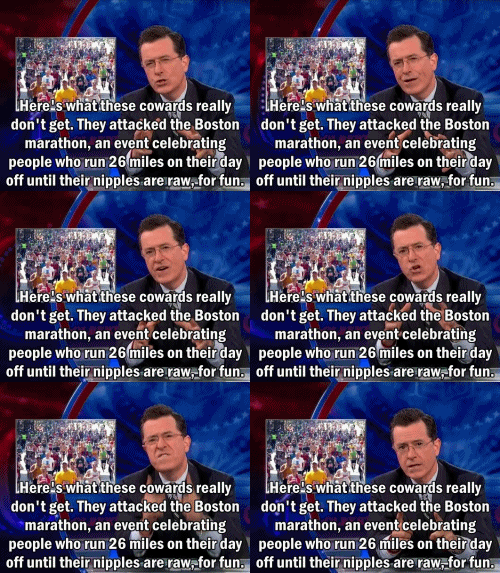
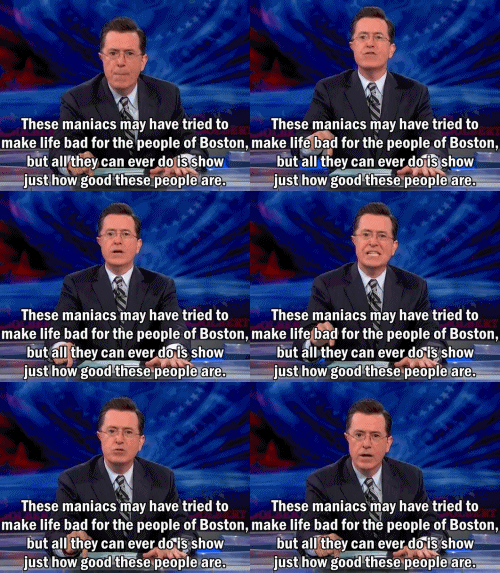
NylonthreadI loved this clip -- the GIF is just as awesome.






Nylonthread and -1 others like this
01 May 13:20
the little 5 year old girl I babysit
Nylonthread"Fabulous!" h/t Osiasjota
me: What you do think about the princess marrying another princess?
her: Instead of the prince?
me: Instead of the prince
her: So her daughter would have two mommies?
me: Yes
her: two princess mommies...
me:
her:
me:
her: fabulous
her: Instead of the prince?
me: Instead of the prince
her: So her daughter would have two mommies?
me: Yes
her: two princess mommies...
me:
her:
me:
her: fabulous
28 Apr 15:29



The Insider’s Guide: Cherry Blossom Bliss
by Max Meltzer
NylonthreadI had never heard of Kenwood in Bethesda nor its cherry trees! You?
All photos by the author
There are a handful of great places to seek out Washington’s cherry blossoms but my favorite by far is Kenwood. The neighborhood, just around the corner from downtown Bethesda, is the insider’s paradise for a stroll through the flowers. I’d reckon that a visit on a spring day like the one I took this week could fill any hardened urbanite with suburban dreams.
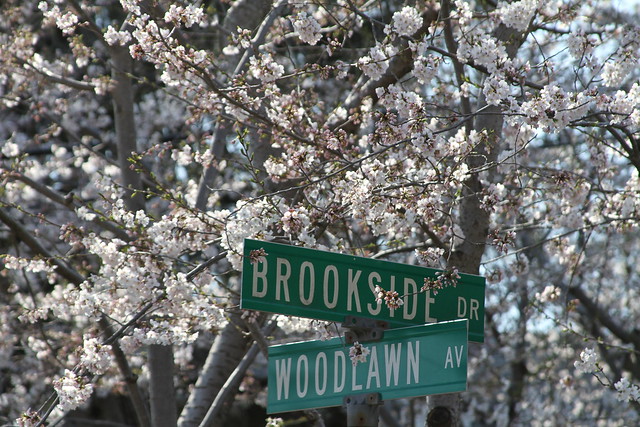
Every year, a few days after their more famous siblings at the Tidal Basin start to show off, Kenwood’s cherry blossoms explode into life. With only three hundred some odd homes the densely packed twelve hundred Yoshino cherry trees blanket the neighborhood in stunning fashion. Weekend days during peak bloom can generate a crowd, but it’s nothing compared to the tidal basin’s overwhelming swell, and this is one of the best reasons to go to Kenwood. I think the place is also aesthetically more spectacular. The cherry trees in Kenwood are inescapable and encompassing, lining nearly every street and dotting nearly every front yard. They blanket the place in color, and in the neighborhood’s most magical spots the branches on each side of the road meet above your head forming tunnels of pink and white.

I used to visit almost every year with my family and friends and it was great getting the chance to go back. I swung by twice this year, once when the blossoms were initially predicted to be in bloom, and again yesterday when they actually came out. Seeing the difference a week’s time made was an experience of its own.
During my first trip on a cold and windy day with the buds still tightly closed, I found the neighborhood almost deserted. A week later, with temperatures in the 80′s and the blossoms approaching their maximum brilliance, the place was reborn. There were bikers and runners, families and couples, grandparents and grandchildren. There were manicured dogs looking like they had just come from Westminster, and lemonade stands staffed by angelic but hard bargaining six year olds. The enviable custom homes, pretty on any day of the year, took on entirely new levels of desirability. Out of their depth homebuyers slobbering over for sale signs were a common sight.
If you want to take in one of Washington’s most unforgettable displays of natural beauty, Kenwood is a great choice. Bring a bike, a blanket, a friend, a girlfriend, a dog, a camera, all of the above, or none of them, and try to make it by this weekend. If you do, I’d venture to guess you’ll be back next year.
Mini Transportation Guide:
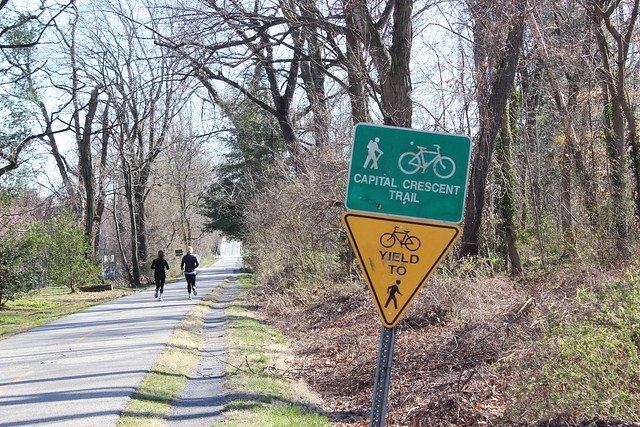
By Metro: The fantastic Capital Crescent trail (which stretched from the Georgetown waterfront to Silver Spring) runs right across Kenwood’s doorstep, crossing the entrance to the neighborhood at Dorset Avenue and Little Falls Parkway. Take the red line to the Bethesda station, and then enter the Capital Crescent trail on Bethesda Avenue next to the Ourisman Honda dealership. The walk from the metro to the neighborhood entrance is a do-able mile and a half.
By Bike or Foot: If you’re feeling more adventurous and looking for a workout, you can pick up the Capital Crescent trail at its terminal point right under the Whitehurst Freeway in Georgetown, and bike or run along a scenic 6 mile route staying on the Crescent trail the entire way.
By Car: If you’re suffering from the effects of “last Friday night” and have a car, the drive from DC to Kenwood should take between 20 and 40 minutes depending on how northwest you start. Turn into the neighborhood from Little Falls Parkway, River Road, or Bradley Boulevard. This year, I was surprised to notice official “No Parking” signs on many of the streets, but after a little exploring I found a stretch of road that didn’t have the signs on Kenwood Avenue just west of the Brookside Drive circle. While walking around the neighborhood, I noticed a few more bits of pavement where neighborhood residents seemed to be welcoming vehicle encumbered visitors.
 First visit, before the buds had bloomed…
 One week later…

 A kind welcome…






23 Apr 17:17


How to Store and Care for Fine Cheese
by Stephanie Stiavetti
Nylonthread"Please, for the love of god, don't freeze your cheese, ok?"

[Photograph: @sstiavetti]
It's happened again. You've spent $50 at your local cheese counter, and now you've got more cheese than a human being can possibly consume in a week. How are you going to store all this cheese? Will it go bad if you don't eat it right away?
Wrapping Cheese
The good news is that many cheeses can last up to a few weeks in the refrigerator as long as they are stored properly. The goal is to let the cheese breathe while keeping it from drying out, so your best bet is to wrap it in a finely porous material, such as cheese paper, parchment paper, or breathable plastic wrap made especially for cheese. These wrappings control the amount of moisture around the surface of the cheese while still allowing oxygen to move in and out of the packaging. All of these factors make for a substantially longer lifespan in your fridge.
By itself, regular plastic wrap does not allow breathability and should not be used to wrap cheese. Cheese is a living, breathing thing, and without proper oxygen, it will suffocate. In a pinch you can use aluminum foil, but if you're a regular cheese shopper, it might be worth it to invest in some specially designed cheese paper.
That said, wrapping your cheese tightly in parchment paper and then wrapping it loosely in plastic wrap is a great way to store it. The parchment helps keep the cheese from drying out, while the loose coating of plastic holds in some moisture, allowing airflow in and around the cheese. You can also reuse the paper that your cheesemonger used.
Storage for longer than a week: It's good practice to change the wrapping occasionally to prevent errant mold and bacteria growth. Cheese likes to kept clean, just like everyone else.
Blue Cheese
Blue cheese is a little different, given that special molds are added to the curds to give them their signature spicy bite. These molds have their own special needs. If you're storing a blue variety, feel free to wrap it in aluminum foil; in fact, you might have noticed that some of the blue cheeses you buy come wrapped in foil already.
A Cheese Oasis
It's a good idea to keep cheese in your crisper (the drawer in your refrigerator made to store vegetables). These little drawers are actually somewhat climate-controlled to keep your veggies fresher for longer, and they perform the same function when it comes to keeping cheese.
Most hard, aged cheeses will last up to a month when kept properly, and softer semi-firm cheeses can last up for two to three weeks if conditions are ideal. If you notice a few spots of fuzzy mold growing on your cheese, don't panic. Remember that cheese is fermented with a series of molds and bacterias, so if you notice a little patch of extra mold here or there, it's perfectly safe to scrape it off. If the cheese has been completely overtaken by mold, well, it's probably best to toss it.
Freezing Cheese?
And, because someone always asks: Please, for the love of god, don't freeze your cheese, ok?
About the author: Stephanie Stiavetti is a writer and cookbook author in San Francisco. Her food blog, The Culinary Life, is a repository for all things comfort food related, from savory dinners to transcendental desserts. She also publishes a monthly culinary newsletter full of stories, review, and helpful tips. Stephanie's cookbook, Melt: the Art of Macaroni and Cheese, celebrates America's favorite dish by recreating it with specialty cheeses. Available for preorder now.
Augustevening likes this
23 Apr 16:24


China Mieville's turn-it-to-11 high weirdness reboot of "Dial H"
by Cory Doctorow
NylonthreadChina Mieville is a guilty pleasure of mine. I'll probably be checking this train wreck out.
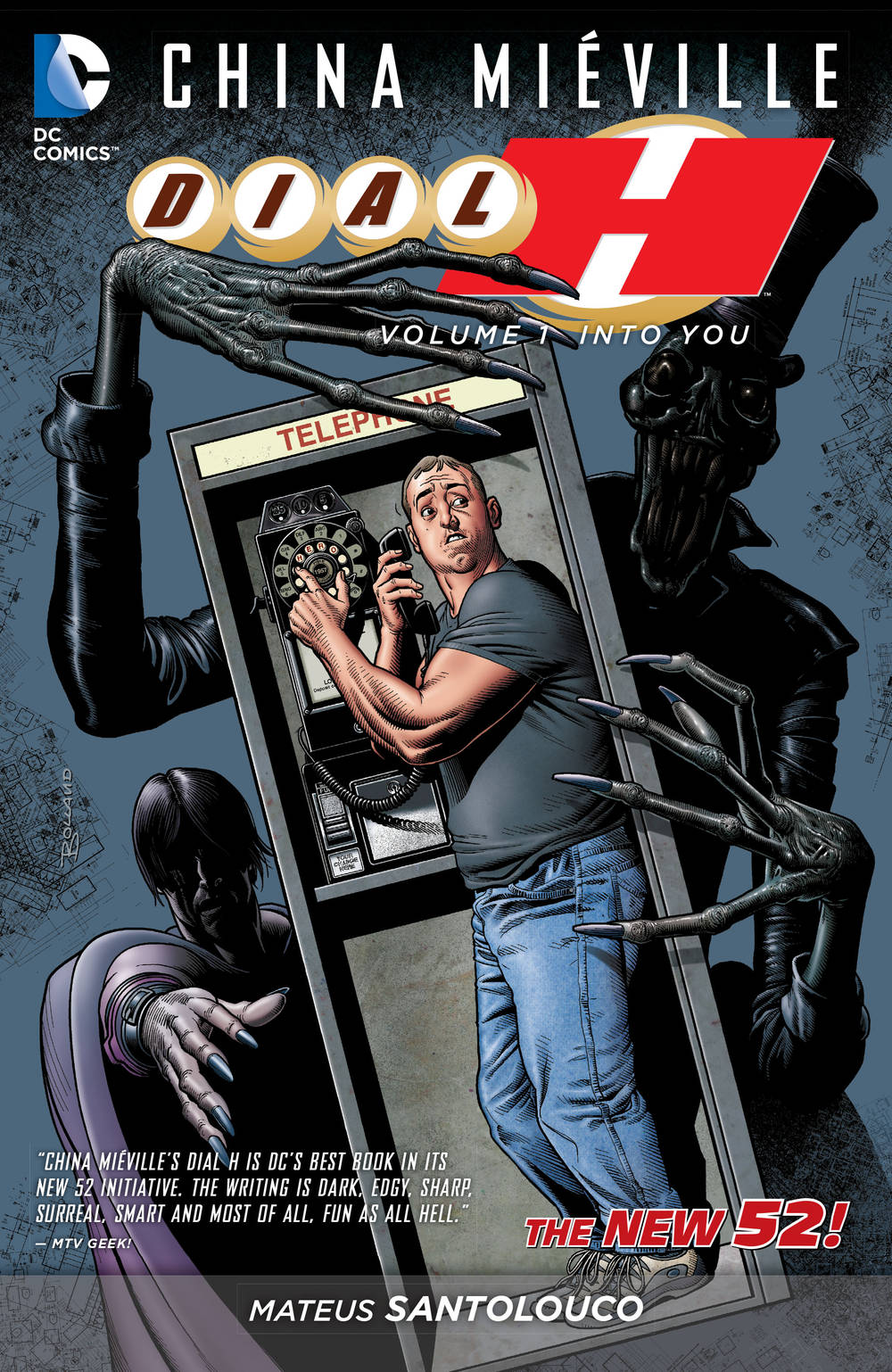
DC's "New 52" is a reboot of all its major superhero comics and several of its less-regarded ones. In the latter category is a silly Silver Age title called Dial H for Hero about a lad from Littleville, CO who can turn into a variety of randomly selected superheroes by dialling "H-E-R-O" on a weird telephone dial he found in a mystic cave.

The reboot of "Dial H for Hero" is called simply "Dial H," and is written by none other than New Weird chieftain China Mieville, whose prodigious imagination and wicked sense of humor are on fine display in the first collection of Dial H: Dial H Vol. 1: Into You. Mieville doesn't apologize for the fundamental absurdity of the premise. Instead, he turns it up to 11. And then he turns it up to 12.

In Mieville's "Dial H," the hero is a morbidly obese ex-boxer in a ruined crime-town who discovers his dial attached to the town's last working payphone. By dialling it, he becomes a series of ever-weirder heroes, from Boy Chimney (a Dickensian goblin with a top hat that stretches to infinity who can strangle his opponents on thick, choking smoke) to Control-Alt-Delete (a CRT-headed underwear pervert who can reset reality to default) to Iron Snail (a roided out action hero who drags along an enormous, slime-squirting shell). These various guises are needed to fight the strange and eldritch horror that has put the rot into Littleville, and here Mieville turns the metaphysics up to 13, with worlds within worlds, each haunted by different species of nothingness and such. It's glorious stuff, bathos at its best as the humor of the various super-guises is juxtaposed on all the ponderous, unapologetic Lovecrafting bibble-babble.

After the initial rush, the story begins exploring a series of scenarios for the dials and its many diallers through history, seeking answers to the deep, metaphysical questions raised by the existence of a telephone dial that can transform its dialler into a super-hero with a whole back-story. There are great, inspired moments here, and hints that Mieville has actually worked this all out with some seriousness, which may be the scariest thing about the whole book.

Mieville is a very funny and absurd guy, and while spots of that have shone through in his novels, they tend to be more serious. "Dial H" feels like the Mieville freak flag has been unfurled to its full glory, and is flying proudly.

|
|
Benjaminsavage and -1 others like this