Shared posts

08 Jan 15:17

This Little Girl Reacting To The Big Reveal In "Empire Strikes Back" Is All Of Us

by Ali Velez
Philip.paulsson

Pretty funny. But also.... put on a damn shirt!

“Search your feelings, you know it to be true!”

Little Anabelle just had her mind BLOWN while watching Star Wars: Episode V - The Empire Strikes Back with her dad.

youtube.com

Even if you've never seen any Star Wars movie, you are probably familiar with the name Luke Skywalker and the most famous reveal scene ever. But, just in case you have been frozen in carbonite for over 35 years...SPOILER ALERT:

Even if you've never seen any Star Wars movie, you are probably familiar with the name Luke Skywalker and the most famous reveal scene ever. But, just in case you have been frozen in carbonite for over 35 years...SPOILER ALERT:

20th Century Fox


View Entire List ›

08 Jan 14:40

People Are Convinced Tony Blair Used To Punch Hams With Bill Clinton

by Jim Waterson
Philip.paulsson

OMG These are amazing.

But just this once, fiction is stranger than truth.

Here's what you need to know: On Thursday a large batch of transcripts covering telephone calls between Tony Blair and Bill Clinton in the late 1990s went viral.

Here's what you need to know: On Thursday a large batch of transcripts covering telephone calls between Tony Blair and Bill Clinton in the late 1990s went viral.

Many aspects of them were bizarre including Clinton's repeated references to bananas, cashmere jumpers, and eating moose lips. Meanwhile, Blair comes across as a patient man putting up with his friend's strange ramblings while waiting to discuss weighty issues such as whether to bomb Serbia.

You can read BuzzFeed's round-up of the strangest phone calls here.

Clinton Presidential Library

Seizing on their weird folksy charm, the comedian Michael Spicer started producing his own fake transcripts, imagining further calls between the two men – such as this one about Clinton going bowling.

Seizing on their weird folksy charm, the comedian Michael Spicer started producing his own fake transcripts, imagining further calls between the two men – such as this one about Clinton going bowling.

Michael Spicer

He created this believable reminiscence about tuition fees.

He created this believable reminiscence about tuition fees.

Michael Spicer

And then there was this perfectly normal rant about Leeds Castle being in Kent.

And then there was this perfectly normal rant about Leeds Castle being in Kent.

Michael Spicer


View Entire List ›

08 Jan 12:03

News in Brief: Roller Coaster Designer’s Artistic Vision Sullied By Fantastic Four Tie-In

GURNEE, IL—Insisting that every ounce of integrity had been removed from his creation, roller coaster designer Jonathan Leeman told reporters Friday that Six Flags Great America’s egregious incorporation of the Fantastic Four into his ride had completely sullied his artistic vision. “I didn’t spend a year crafting each corkscrew, hammerhead turn, and dive loop of this ride to have it tarnished with a blue-and-silver color scheme and cars painted to vaguely resemble Mister Fantastic and Doctor Doom,” said Leeman, shaking his head and remarking that, had he known it was going to have a 20-foot-tall number 4 mounted to the side of it, he never would have added a 17-story lift hill. “This ride was supposed to be purely about the thrills, the choreographed push and pull of G-forces, but look at it now: a garish mishmash of steel, comic book art, and speakers that endlessly blare ...


07 Jan 19:48

How Much Do You Really Know About Alcohol?

by Remee Patel
Philip.paulsson

12/18 Weak.

Are you brainy about booze?

07 Jan 19:44

Politicians are trying to legalize 'hoverboards' in New York

by Nick Summers
Philip.paulsson

I still kinda want to try one out.

Plenty of New Yorkers will have woken up on Christmas morning and discovered a motorized two-wheeler, otherwise known as a "hoverboard," underneath their festive tree. The electric curiosities are currently illegal to ride in the city, but a small gr...
07 Jan 17:54

Google Translate dubs Russia “Mordor” and Russians “occupiers”

by Peter Bright

Google Translate has been making some rather unflattering conversions when going from Ukrainian to Russian. "Russia" became "Mordor," "Russians" became "occupiers," and Sergey Lavrov, Russia's foreign minister, became "sad little horse."

Mordor is, of course, a fictional land from JRR Tolkien's Lord of the Rings series.

Screenshots of the bad translations were captured and passed around Russian social media site VKontakte.

Read 2 remaining paragraphs | Comments

07 Jan 15:26

What goes down at a Vegas drone rodeo?

by James Trew
Philip.paulsson

LOL they have wearable drones now. It snaps to your wrist like a snap bracelet. And you can just throw it into the air and it hovers, takes a pic of you, then comes back and you catch it and slap it on your wrist!

The Mandalay Bay hotel and conference center sits toward the south end of the Las Vegas strip. Inside it, past all the smokey slot machines and brightly lit restaurants, you'll find sharks rubbing shoulders with Michael Jackson. It is the very essenc...
07 Jan 15:01

There Is Nothing Cuter Than "Star Wars: The Force Awakens" Characters As Calvin And Hobbes

by Ellie Hall

“It’s a magical universe, BB-8, ol’ buddy. Let’s go exploring!”

Artist Brian Kesinger has been posting pictures of Star Wars: The Force Awakens characters in the style of the comic Calvin and Hobbes, and the result is OUT OF THIS WORLD.

Artist Brian Kesinger has been posting pictures of Star Wars: The Force Awakens characters in the style of the comic Calvin and Hobbes, and the result is OUT OF THIS WORLD.

Brian Kensinger / Via Instagram: @briankesinger

Seriously.

Seriously.

The intrepid Spaceman Finn crash-lands on the mysterious planet of Jakku.

Brian Kesinger / Via Instagram: @briankesinger

Kesinger, a story artist for Disney Animation Studios and an artist for Marvel Comics, told BuzzFeed that he got the idea for the series while watching the scene in The Force Awakens where Rey rides her makeshift sled down a sand dune.

Kesinger, a story artist for Disney Animation Studios and an artist for Marvel Comics, told BuzzFeed that he got the idea for the series while watching the scene in The Force Awakens where Rey rides her makeshift sled down a sand dune.

Rey and BB-8 love sledding down the dunes of Jakku!

Brian Kesinger / Via Instagram: @briankesinger

"It struck me that she probably did that as a child and that's when the Calvin and Hobbes image flashed in my head," Kesinger said.


View Entire List ›

07 Jan 15:00

Netflix execs talk 'Ridiculous 6' popularity, censorship

by Richard Lawler
Philip.paulsson

So apparently Ridiculous 6 is the "most-watched movie in Netflix's history". Well woopty-doo. They don't HAVE any streaming movies anymore except for their own. And it's pretty sad that this racist, not-funny crap movie is gaining traction because the other movie streaming options are basically non-existent.

In their first Q&A session since launching a (nearly) global internet TV network, Netflix CEO Reed Hastings and content head Ted Sarandos sounded appropriately pleased with themselves. Sarandos said the recent debut of Adam Sandler's Ridiculous 6...
06 Jan 22:30

Are You The Worst Person In The World?

by Joanna Borns
Philip.paulsson

I only checked 3, and I think they're pretty legit:
1: "I have said, “Excuse me, do you have any Grey Poupon?” as a joke."
2: "I’m pretty sure I’m smarter than most people."
3: "I end all my text messages with a period."

I should probably stop doing the last one.

Cool story, bro.

Thinkstock

06 Jan 21:53

Poll: Who Do You Think Rey Actually Is?

by Ellie Hall
Philip.paulsson

So have we all seen it yet??

Is the star of Star Wars: The Force Awakens from a famous family? WARNING: This post is full of spoilers.

Disney / Lucasfilm

Disney / Lucasfilm

She's brave, strong, resourceful, and independent.

She's brave, strong, resourceful, and independent.

Disney / Lucasfilm / Via bianki-san.tumblr.com


View Entire List ›

06 Jan 21:29

Donald Trump Is Feuding With Samuel L. Jackson Regarding Golf

by Kyle Blaine
Philip.paulsson

Even my dad has personally seen Trump cheat at golf.

Jackson questioned Trump’s integrity on the golf course.

In an interview with United Airlines’ Rhapsody magazine, Samuel L. Jackson said Donald Trump cheats at golf.

In an interview with United Airlines’ Rhapsody magazine, Samuel L. Jackson said Donald Trump cheats at golf.

"But it's funny — last week or so, I actually got a bill from Trump National Golf Club. And I haven't been there in four or five years, so I had my assistant call. They said it was for membership dues. And I said, 'I'm not a member,' and they said, 'Yeah, you are — you have a member number.' Apparently he'd made me a member of one of his golf clubs, and I didn't even know it," Jackson told the magazine.

Jackson was asked who the better golfer was, to which he replied, "Oh, I am, for sure. I don't cheat."

Trump's been accused of cheating on the golf course plenty before, most notably in a detailed investigation by the Washington Post.

"When it comes to cheating, he's an 11 on a scale of one to 10," sportswriter Rick Reilly to the Post.


View Entire List ›

06 Jan 20:07

This supersized drone will fly you to work (or anywhere)

by James Trew
Philip.paulsson

Yes please!

It's happened. Someone built a quadcopter big enough to carry human cargo. The future is officially here, and it's kinda scary. Scary in the cool way though. The same company that brought us the regular-sized Ghost drone has just announced the "184"...
06 Jan 19:53

Good news: We’ve accidentally cut mercury pollution

by John Timmer
Philip.paulsson

Whoops!

(credit: US DOE)

Coal-fired plants and other human activities release mercury into the environment, where some of it ends up converted into methyl mercury, a potent neurotoxin. Because of this toxicity, the Environmental Protection Agency is currently in the process of tightening emissions rules at US power plants.

Global estimates of how much mercury we're emitting indicates that humanity is putting more of the substance into the atmosphere. But various direct measurements of the amount in the environment have been declining slowly over the past few decades. So where's the missing mercury? A new study suggests that we've cleaned it up while getting different pollutants under control.

Mercury emissions actually come in two forms. Some of it is released as neutral atoms, which are able to circulate widely in the atmosphere before being oxidized and falling to the surface. Another portion of the emissions are already oxidized and result in local contamination.

Read 7 remaining paragraphs | Comments

06 Jan 16:28

Judgment Day

Philip.paulsson

LOL Let's hope this is true.

It took a lot of booster rockets, but luckily Amazon had recently built thousands of them to bring Amazon Prime same-day delivery to the Moon colony.
06 Jan 16:20

Virtually a reality: Oculus Rift goes on sale for $599 [Updated]

by Kyle Orland
Philip.paulsson

Ooof. Too much. Especially considering you need a ~$1,000 computer to even be able to use it.

An actual product you can buy... or at least pre-order. (credit: Oculus Shop)

[Update: More details on ship date, international pricing, Oculus Ready PCs, and exclusive games are now in the below story]

After dozens of trade-show demos, two publicly available development kits, a $2 billion buyout, and nearly four years of speculation, Oculus has finally locked down the release details for the first consumer version of the Rift virtual reality headset. The $599 VR unit is now available for preorder ahead of expected shipments starting in March (though the shop page had some major loading problems right after pre-orders went live). Oculus says the headset will be available at "limited retail locations" starting in April.

[Update: Within 15 minutes of pre-orders going up, online orders were being told to expect a ship date of April. After an hour, the expected ship date was back to May. This suggests some combination of either limited initial supplies or very robust sales for the Rift.

Read 15 remaining paragraphs | Comments

05 Jan 20:41

US Army retires its first drone

by Jon Fingas
Philip.paulsson

Wow. So... drones are all the big news these days, but apparently we've been flying them since 1995!

Military drones may still seem like relatively fresh concepts, but they're officially old hat as of this month: the US Army has retired its first-ever drone, IAI's Hunter, after 20 (!) years of service. The robotic recon veteran will now see use only...
05 Jan 20:32

The Rise, Fall, And Almost Rise Of The Caviar Of Cantaloupe

by Tori Marlan

It’s been a lousy growing season for Ken Taylor’s cantaloupes. The weather has been terrible — cool and wet, when it should have been hot and dry — and the leaves on the vines are browning and riddled with small holes from fungal disease.

Standing on his 70-acre organic farm on Île Perrot, about 30 miles west of Montreal, Taylor surveys the damage through a pair of thick-framed glasses. It’s late July, and there’s not much to see. Finally he spots a tiny cantaloupe. “This is basically what it looks like, off and on, all the way down: one fruit here and there.”

Those aren’t just any fruit. They’re specimens of the Montreal melon — a large and particularly hard-to-grow cantaloupe that Taylor saved from extinction. In the late 19th and early 20th centuries, the Montreal melon was considered a delicacy. Sweet and juicy with hints of nutmeg, it has green flesh like a honeydew, but its exterior is netted, rather than smooth. According to Taylor, it’s probably Canada’s most famous heritage food.

“There wasn’t a Vancouver kiwi or a Halifax oyster,” he later said. “It was the Montreal melon!” While he acknowledges that other foods originated in Canada — the Laurentian turnip, for example — Taylor says nothing else had the melon’s renown.

“Russian caviar; champagne from Reims, France; and the Montreal melon — those were the three snob foods in the early 1900s,” Taylor says.

But when Taylor brought back the melon in the mid-'90s, hoping it could gain traction at that century’s end, too, he wasn’t motivated by nostalgia. He had something else in mind: that in a world where industrial farming has reduced us to eating a tiny fraction of the fruit and vegetable varieties we used to, genes from the past might be more important to our future than anyone realizes.

Ken Taylor is seen in his greenhouse, Nov. 4, 2015.

Arthur Gauthier for BuzzFeed News

The Montreal melon would have remained lost to history if not for a simple but gnawing question that popped into food journalist Barry Lazar’s mind in 1991. “I live on a street called Old Orchard,” he recalled, “and I started to think, Why is this street called Old Orchard?

Lazar plunged into research mode. Orchards had once thrived on the west side of Montreal, and he learned that his neighborhood, Notre-Dame-de-Grâce (NDG), had been considered “the fruit basket of Quebec.” One fruit in particular kept coming up in his research: the Montreal melon. The melons, which took a whole summer to mature, were huge, often weighing between 15 and 20 pounds, about the size of a Butterball turkey. They were either pumpkin- or football-shaped, depending on the strain, and grown mostly by two prosperous NDG farming families, the Décaries and the Gormans.

Montreal’s soil was rich in minerals, and NDG, located near four racetracks, was rich in horse manure. “We used to get big steaming loads of horse manure, dig a deep trench, and plant the melons on top,” Fred Aubin, a then-71-year-old melon farmer’s son, told the botanical magazine Seeds of Diversity in 2000.

In addition to having ample natural fertilizer, the farmland where the melon thrived occupied the western slopes of Mount Royal, all the way down to the St. Lawrence River, where there was good sun exposure and protection from harsh northwest winds.

The Montreal melon in a Burpee's catalog, 1885.

Courtesy New York Public Library

After Burpee Seeds founder Washington Atlee Burpee encountered the melons at a Montreal market in August 1880, he introduced them to the rest of North America through his popular seed catalogue. Burpee’s catalogue described the melon as “remarkably thick ... melting, and of a delicious flavor” and touted it as the “best melon we’ve ever eaten.” Burpee even offered $50 cash prizes to whoever could grow the largest melons.

As word of the Montreal melon spread, demand grew. By the early 1900s, local farmers were sending regular shipments by train to New England and New York, where upscale restaurants and hotels put them on dessert menus and sold them for up to a dollar a slice — the equivalent of about $24 today. Because the melons were so large and thin-skinned, the flesh bruised easily. A woven-basket industry sprang up to protect them during transport, and they were packed in short, fine-stemmed hay.

The city took pride in its namesake fruit, and Lazar says that one was sent every year as a gift to the British throne. The Canadian Pacific Railway offered the melon in its formal dining cars, instructing staff to serve it “on cracked ice in a bread tray,” accompanied by a finger bowl.

Montreal’s famous crop was so profitable that at least one farmer hired an armed guard to protect his fields at night. By 1907 the melons could earn the farmers a couple thousand dollars per acre each season, around $49,000 in today’s dollars. In a 1908 report, the USDA took note of the “melon of unusual excellence,” its “fancy prices,” and the fact that “even at such prices, the Canadian growers are not able to supply the American demand.”

A menu from 1914 showing the Montreal melon.

Courtesy New York Public Library

American seed companies started growing their own varieties of the melon, giving them names like Mammoth Montreal, Montreal Market, and Perfect Montreal. According to William Woys Weaver, author of Heirloom Vegetable Gardening, the Montreal melon was more widely grown in New England, Canada, and the Upper Midwest than honeydew, cantaloupes, or any other muskmelon, “not only because of its large size but because it yielded the best-flavored melons for short-season gardens.”

But the melon’s heyday wouldn’t last. Like hundreds of fruit and vegetable varieties that thrived during the early 20th century, it didn’t survive the mid-century shift to industrial agriculture. It wasn’t an easy melon. It required a fair amount of coddling: watering, syringing, ventilating, lifting with a flat stone or shingle to prevent cracking or rot, and turning every few days to ensure uniformity of shape, color, netting, and ripening.

But perhaps its biggest enemy was urban development. Between 1914 and 1930, NDG’s population increased tenfold (from 5,000 to 50,000). Residential blocks, schools, and churches were built to accommodate the growth. Cars began replacing horses on the streets, and all but one of the racetracks gave way to development. Gone was the easy access to natural fertilizer for the melon fields, and the Montreal melon, Lazar says, “required a lot of fertilizer.”

The area’s urbanization continued through the postwar period, and the farmers eventually sold their melon land to developers. The Décaries sold off a large portion of theirs as early as 1923, for $275,000.

Over the next three decades, the melon quietly disappeared. By the early 1950s, Burpee’s seed catalog no longer offered its seeds. Today, the Décarie Expressway cuts across the land where the melons once grew.

Arthur Gauthier for BuzzFeed News

When Lazar wrote about the Montreal melon for the Montreal Gazette in 1991, the melon was long gone not only from the city’s soil, but also from its collective memory.

Montreal poet and author Mark Abley, who was then a Gazette reporter, was riveted by Lazar’s discovery. “I just thought, This is amazing,” recalls Abley, who says his passions include “knowing about weird biological, zoological facts and things.” He wondered how such a popular fruit could have disappeared so completely.

Abley had researched endangered species before. He knew about a stick insect, long thought to be extinct, that had been found clinging to a rock on an island in the South Pacific; a fish that had been known only from its fossil record until 1938, when it was dredged up in the Indian Ocean by an angler; and a bird that was thought to have vanished from Bermuda shortly after British sailors arrived in the 1600s but was rediscovered in 1951 and is now the country’s national bird. “There’s even a particular name for this,” he says. “Lazarus species.”

An 1887 ad for the Montreal melon.

It occurred to Abley that someone somewhere might have stored some of the Montreal melon seeds, and if so, then perhaps the melon could make a comeback. Saving the Montreal melon from extinction might have been a long shot, but Abley figured that if anyone could do it, it was Ken Taylor.

At the time, Taylor sold organic heirloom vegetables at his farm on Saturdays. Abley had shopped there on occasion and had been struck by the variety of items on display. He remembers being particularly impressed by the Cream of Saskatchewan melon, because he’d grown up in Saskatchewan and had never heard of it. It was obvious, says Abley, that Taylor had “an unusual interest in plants.”

Taylor is a rare breed: a farmer with a Ph.D. in chemistry. At 70, he’s well over 6 feet tall, with a prominent chin and white stubble. His land looks nothing like a typical farm — no wide-open fields or neat rows of crops. It’s chaotic, shady in parts and overgrown with tall weeds and wildflowers. The crops blend into their surroundings. They’re easy to miss.

Taylor bought the first acre of what he now calls Green Barn Farm in 1973. At the time, he’d just become a professor at John Abbott College in the West Island of Montreal — a job he’d go on to hold for 35 years, teaching chemistry, winemaking, and beekeeping until his retirement in 2005. He’d grown up on a farm in southeastern Quebec, and he missed growing his own food.

The land was all swamp and scrub weed, with a few open wells on it. A dilapidated barn more than a century old sat on the property and was used by the town’s mayor as a place to store his boats. Taylor planted hundreds of fruit and nut trees, and over the years he expanded his acreage, started one of Montreal’s first CSAs, and renovated the barn house, where he and his wife, Lorraine, held the Saturday market for more than two decades.

Ken Taylor at Green Barn Farm in Montreal.

Arthur Gauthier For Buzzfeed News

Taylor raised his four children at the farm and did what he could to keep them away from fast foods or foods with corn byproducts or foods imported from countries with different regulatory standards. To satisfy their desire for sweets, he baked them hemp cookies. “They were green,” recalls his son Nick.

Taylor has described himself as someone who never “fit the mold anywhere,” and he has unconventional ideas about food production. He’s eager to share them, and sometimes does so in ways that are pithy and provocative. (“Cantaloupes have killed more people than the Afghan war!”; “Monsanto probably controls your food supply!”; “Canada is a hotbed of planet disrespect!”)

But mostly he talks very seriously — and in painstaking detail — about agricultural problems and their solutions. Nick says a typical conversation with his dad while growing up meant patiently sitting through “fun fact 9,226 about why pears grow better here.” And while he found it hard to bear for the first 18 years of his life, his father’s passion for food production and sustainability eventually rubbed off on him. He now has his master’s degree in plant science, works closely with Taylor, and plans to someday take over for him at the farm.

Though Taylor took on farming simply because he wanted to grow his own food, it has evolved into a mission. He sells seeds, seedlings, and rootstock on the Green Barn Farm website, urging growers to “protect our Canadian genetic heritage.” He also partners with a Montreal CSA, Lufa Farms, to provide items for its food baskets; offers “eco-education” through workshops and seminars; and gives “Taste-n-Talk” tours of the farm.

Arthur Gauthier for BuzzFeed News

On the farm these days you can see wandering chickens, edible flowers, a grape vineyard, a pawpaw orchard, sunflowers, and tree after tree, some 60 feet tall. Depending on the season, they bear black walnuts, chestnuts, mulberries, apricots, plums, peaches, and highbush cranberries, along with more exotic offerings like quince. A shady dirt path leads to a three-acre plot where overgrown weeds obscure rows of low-lying vine crops like squashes and melons. Items you wouldn’t expect to find in a northern climate thrive on Taylor’s land: bananas, Asian pears, pecans, sumac. “There’s really nothing we can’t grow here,” he says.

Working with perennial plants, which require minimal upkeep and don’t need to be replanted every year, he has bred and selected varieties of fruits, nuts, and berries that resist the brutal Canadian winters. And he thinks other Canadian farmers ought to be doing the same.

“Planting seeds and pounding the soil and annually preparing it and fertilizing it and watering it and fighting whatever short-term disease you may have so that you can finish everything up in three months is not a very earth-friendly or sustainable food production system,” says Taylor. “But that’s basically all we do in Canada.”

Part of the problem, according to Taylor, is that the country’s agricultural system is designed for exports, not for local markets. In 2012, Canada became the world’s fifth-largest agricultural exporter — and spent $32.3 billion bringing in agricultural and agri-food items from 190 other countries.

“We’re a country of agriculture, but we can’t feed ourselves,” Taylor says. “That’s pathetic.”

The only hope for food security, according to Taylor, is to disrupt the monoculture of modern farming through small-scale diversity. Diversity is important in farming, because planting only one crop, or one variety of a crop, leaves it vulnerable to disease. The Irish Potato Famine is a case in point. The Cavendish banana, which makes up 99% of the banana export market, is being wiped out by a fungal disease for which there’s no cure, and the industry has no other banana variety on deck.

A newsletter from 2000 advertises a Montreal melon competition.

The Westmount Historian

As a food grower, Taylor sees it as his responsibility to restore to his little section of earth the genetic diversity that’s been lost from it. “This island used to be full of all kinds of variety of nuts and berries and wild stuff,” he says. “Well, that’s all gone. We’ve now got cornfields and soy fields and people, so there’s no natural mixing and changing of the genetics.” That’s important, he says, because “if you take a population and let them inbreed, eventually none of them are very strong.”

There’s also a critical need for diversity in how food is grown, he says. While CSAs like Lufa Farms — which grows food hydroponically in rooftop greenhouses year-round — are a step in the right direction, most innovation in farming is happening elsewhere in the world, Taylor says. He points to encouraging models such as the old London Underground bomb shelters that have been converted into subterranean food farms and rely on the Earth’s natural heat, and the food hubs in Vermont that aid sustainable local-food systems.

In Canada, only 1.8% of the farms are certified organic — and that certification doesn’t even mean much to Taylor. “Organic means you can spray with sulfur and do all these other things I don’t like,” he says, “and if you don’t have enough organic feed for your chickens, you’re allowed to buy non-organic. And if your product is 90% organic, the last 10% can be anything — you can put cyanide in it!”

05 Jan 16:53

Chick-Fil-A's Only New York City Restaurant Closes After Six Violations

by Venessa Wong
Philip.paulsson

Womp womp

Andrew Renneisen / Getty Images

Just three months after opening its first stand-alone store in New York City, Chick-fil-A voluntarily closed its popular restaurant on Dec. 30 after city health inspectors cited a number of violations.

A sign on the store window indicated it planned to reopen on Monday, but the chain said in a statement on its website that the decision was made to remain closed "until we feel confident we are exceeding standards in all areas."

The company did not indicate when it would reopen.

This was the restaurant's second inspection. The first, conducted on Dec. 15, indicated problems with "hot food item not held at or above 140º F," flies, and vermin proofing. However, the New York City Department of Health and Mental Hygiene did not close the restaurant. Mandatory closures only occur when there is a public health hazard that cannot be corrected at the time of the inspection.

These were the six violations from the city's latest inspection conducted on Dec. 24. Additional details on each violation were not immediately available from the health department.

1. "Cold food item held above 41º F."

Liubov Shirokova / Getty Images

2. "Food not cooled by an approved method whereby the internal product temperature is reduced from 140º F to 70º F or less within two hours, and from 70º F to 41º F or less within four additional hours."

Hisartwork / Getty Images

3. "Filth flies or food/refuse/sewage-associated (FRSA) flies present in facility’s food and/or non-food areas."

Rob_lan / Getty Images

4. "Food not protected from potential source of contamination during storage, preparation, transportation, display or service."

Samohin / Getty Images

5. "Wiping cloths soiled or not stored in sanitizing solution."

Lsaloni / Getty Images

6. "Facility not vermin proof. Harborage or conditions conducive to attracting vermin to the premises and/or allowing vermin to exist."

Lutique / Getty Images

Additional details about each violation were not immediately available from the health department on Monday.

05 Jan 15:05

This Photo Of People Falling Over On New Year's Eve Is Being Compared To Renaissance Art

by Matthew Champion
Philip.paulsson

Perfect.

“It’s very well-weighted, like a Caravaggio.”

The scene near the Printworks venue in Manchester city centre last night.

Joel Goodman


View Entire List ›

05 Jan 15:01

The Hardest European Capital Cities Test You'll Ever Take

by Alex Finnis

Do you know the capital of every European country? It’ll start easy, but get very hard.

05 Jan 15:01

First known hacker-caused power outage signals troubling escalation

by Dan Goodin

(credit: Krzysztof Lasoń)

Highly destructive malware that infected at least three regional power authorities in Ukraine led to a power failure that left hundreds of thousands of homes without electricity last week, researchers said.

The outage left about half of the homes in the Ivano-Frankivsk region of Ukraine without electricity, Ukrainian news service TSN reported in an article posted a day after the December 23 failure. The report went on to say that the outage was the result of malware that disconnected electrical substations. On Monday, researchers from security firm iSIGHT Partners said they had obtained samples of the malicious code that infected at least three regional operators. They said the malware led to "destructive events" that in turn caused the blackout. If confirmed it would be the first known instance of someone using malware to generate a power outage.

"It's a milestone because we've definitely seen targeted destructive events against energy before—oil firms, for instance—but never the event which causes the blackout," John Hultquist, head of iSIGHT's cyber espionage intelligence practice, told Ars. "It's the major scenario we've all been concerned about for so long."

Read 7 remaining paragraphs | Comments

05 Jan 12:37

"Star Wars" With "Princess Bride" Quotes Is Somehow Perfect

by Andy Neuenschwander
Philip.paulsson

Hahah nice.

“Hello. My name is Luke Skywalker. You killed my father. Prepare to die.”

Tumblr user Winterisrambling had an amazing idea: Mix The Princess Bride quotes with Star Wars.

Tumblr user Winterisrambling had an amazing idea: Mix The Princess Bride quotes with Star Wars.

Lucasfilm

It actually works incredibly well.

It actually works incredibly well.

Lucasfilm

Perfectly, even.

Perfectly, even.

Lucasfilm

Hoth is basically the Fire Swamp, only the opposite.

Hoth is basically the Fire Swamp, only the opposite.

Lucasfilm


View Entire List ›

05 Jan 12:27

Parrot's Disco drone takes flight as a fixed-wing ultralight

by Jon Turi
The latest in Parrot's stable of drones ditches the popular quadcopter format, opting for a fixed-wing design instead. The Disco -- in keeping with Parrot's musical naming theme -- is still in the prototype stage, with pricing and release date still...
05 Jan 11:49

bushy brows says FML

by bushy brows

Today, I recently gave birth to my daughter, and my husband and I both have dark hair and bushy eyebrows. We never thought it was a problem until our daughter was born with a dark, bushy unibrow. Now I'm too nervous to take pictures of her 'cause our family and friends laugh every time they see her. FML

05 Jan 11:45

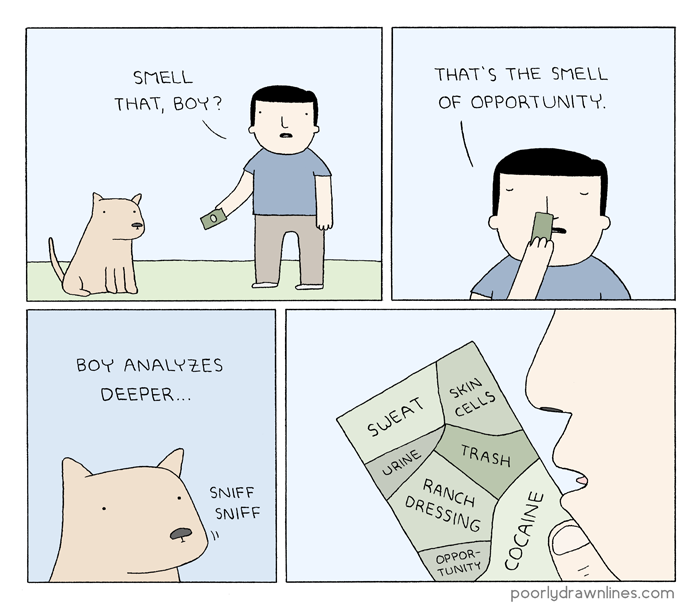
Smell That

by Reza

cash

05 Jan 03:25

George Lucas criticizes “retro” feel of new Star Wars, describes “breakup”

by Tiffany Kelly
Philip.paulsson

LOL that's probably the biggest sign that it was a good movie. Lucas hated it.

Is George Lucas having regrets about selling his Force-filled empire to Disney? He says no, but the Star Wars creator seemed slightly bitter about his space opera in an interview with Charlie Rose at the Skywalker Ranch that aired over Christmas but is just starting to make its way around the Internet. In the interview, Lucas called the first six episodes his "children" and referred to his separation from the Star Wars franchise as a "breakup."

He also didn't seem entirely pleased with the new film, Episode VII: The Force Awakens, which borrowed plot points—and brought back original characters—from his films.

“The first three movies had all kinds of issues," he told Rose. "[Disney] looked at the stories, and they said, we want to make something for the fans. I said, all I wanted to do is tell a story of what happened, it started here and went here... it’s a family soap opera, ultimately. We call it a space opera, but people don’t realize it’s actually a soap opera, and it’s all about family problems. It’s not about spaceships.”

Read 9 remaining paragraphs | Comments

05 Jan 03:23

Extremely Rare And Terrifying Giant Squid Filmed By Daring Diver

by Michelle Broder Van Dyke

The squid was “trying to entangle his tentacles around me,” the diver told CNN.

In Japan's Toyoma Bay a rare giant squid was filmed swimming in the water on Christmas Eve.

vine.co

The red-and-white squid was filmed by Diving Shop Kaiyu owner Akinobu Kimura.

"My curiosity was way bigger than fear, so I jumped into the water and go close to it," he told CNN.

He then swam with the animal as he helped guide it back to the deep ocean.

"This squid...looked lively, spurting ink and trying to entangle his tentacles around me," Kimura said.

vine.co

The squid was 12 feet long, which is about the length of a Mini Cooper.

The squid was 12 feet long, which is about the length of a Mini Cooper.

Andrew Cowie / AFP / Getty Images


View Entire List ›

05 Jan 02:34

This Kid Ate A Whole Watermelon And Became A Huge Star

by Simon Crerar
Philip.paulsson

Hahah nice.

The first Australian hero of 2016 ‪#‎watermelonboy‬.

A boy brought a watermelon to Melbourne's Big Bash cricket derby, and became an instant legend.

A boy brought a watermelon to Melbourne's Big Bash cricket derby, and became an instant legend.

Twitter: @tensporttv


View Entire List ›

04 Jan 18:21

News in Brief: America, China Trying To Spice Up Trade Relationship By Bringing Third Country Into Negotiations

WASHINGTON—Saying their current process of establishing economic pacts had become stale and predictable, high-ranking government officials from the United States and China confirmed Monday that the two nations had decided to try spicing up their trade relationship by bringing a third country into their negotiations. “We’ve been trading with each other for such a long time now that we thought introducing another partner into our talks could help shake us out of our set routine,” said U.S. trade representative Michael Froman, who noted that after several decades of bilaterally negotiating tariffs and import quotas, both countries were able to anticipate each other’s offers and counter-proposals to an extent that had drained all spontaneity from the relationship. “We realize there are risks, and there are still kinks to be worked out. For example, we’ve had our eye on a Scandinavian country for some time, while China ...