"It makes you feel like a lobster, just like, ready to be declawed."
This morning the Post has a profile of Hunt & Fish Club, the obscenely opulent new steakhouse now serving porterhouses and $50 lobsters in Times Square. What goes on inside those mirrored, marbled dining rooms, where Wall Street types rub elbows with baseball players and Mob Wives stars? What do the owners hope for their $5 million "passion project"? Here are the best lines from the Post profile, to help illuminate the matter.
"'I feel like it's more special as a woman here,' says 49-year-old Kavovit, who owns a female-friendly tool company...'As soon as you walk in, it's like, "Wow." You definitely feel like you're unique. It makes you feel like a lobster, just like, ready to be declawed.'" Whatever that means.
"'I think with hospitality in New York...one of the things that's gotten lost are the classics,' says [restaurateur Eytan] Sugarman."
With the above in mind, this place is, of course, meant to represent "'the best era of our lifetime' —the '90s."
"Sugarman, who hails the spot's 'Las Vegas service,' says he wanted Hunt & Fish to be the kind of place where Frank Sinatra, 'a friend of mine,' would hang out."
"'This is not for the people who are taking their kids for a $10 hamburger,' he says. 'It's not where the Griswolds would stop.'"
"Two weeks ago...the son of Wall Street titan Mario Gabelli was thrown out of the restaurant, shouting, 'Do you know who my father is? He runs this city!'"
"They've also stationed a shoeshine guy on the lower floor who will polish any patron's footwear for free. 'That was a good idea, right?' asks [partner] Scaramucci, fist-bumping Braff, 55. 'All these hipsters are wearing sneakers, though. I don't like that.'"
But that's not all: "[Di]ners can remove their kicks during dinner and the shine guy will 'give you your shoes back under the table.'"
When is a stunt not a stunt? Perhaps when you set up a website, take thousands of orders, process the majority, and then sell the site for $85,000
Mat Carpenter fooled us all. The 22-year-old Australian SEO expert and online marketer managed to convince the world’s media that he had set up ShipYourEnemiesGlitter.com, a website which would package up glitter in an envelope and ship it to your enemies anywhere in the world for just AU$10.
In fact, the whole thing was a stunt, Carpenter says. The joke is on us: all he actually did was set up a website, take more than 2,000 orders, ship out the majority of the packages, and then sell the site for $85,000 to a buyer who promises to fulfil the rest of the orders, as well as continue the website as a going concern.
Live-action role-playing, or larping, can be just a nice way to spend a weekend. But especially in parts of Europe, it's also an educational tool — and that doesn't necessarily make it any less cool. On February 4th, a retired German destroyer will become the site of a five-day, 80-person larp based on Ronald D. Moore's Battlestar Galactica. In Projekt Exodus, the ship will be temporarily redubbed the Hesperios, a space freighter that picks up an escape pod and is — through events unknown to us — drawn into the war between human and Cylon.
If this sounds familiar, it's because Projekt Exodus is very similar to The Monitor Celestra, a highly successful 2013 larp set on a Swedish battleship. It's also supported by a significantly older B...
bustle WROTE BEAUTIFUL SCHOLARSHIP ON THIS NOVELTY BLOG.
"When you think about it, the connection has always been there. Saved By The Bell easily exemplifies hooks’ “white supremacist capitalist patriarchy,” even on a surface reading. All of the characters are caught up in intersecting forms of systemic oppression: Kelly and Jessie have been brainwashed to believe they must choose between brains or beauty in order to maintain the non-threatening, heteronormative dynamic of their romantic relationships, and the two people of color on the show are so blinded by material gain (Lisa) and muscle definition (A.C. Slater) that they lose focus on how oppressive and racist the system they live within (Mr. Belding) actually is. Don’t even get me started on Zack, who is an unwitting patriarchal colonizer disguised in casual shrugs and a cute haircut, and Screech, who no doubt grew up to be an angry brogrammer.”
X-presion, a Madrid-based studio that provides hair styling services for the fashion and advertising industries, has developed a coloring technique for creating pixel-like patterns in hair. Examples of the technique, called xpresionpixel, can be viewed on Instagram under the hashtag #xpresionpixel.
A rescued Owl is ready to be returned to the wild after receiving expert care at New Zealand’s Wellington Zoo. Photo Credit: Wellington Zoo The young Morepork Owl was brought to the zoo in early December and cared for in…
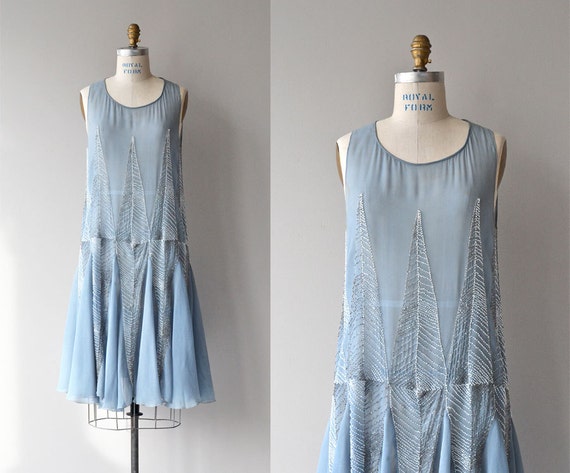
Vintage 1920s pale blue silk chiffon dress with silvery shards of beading spanning the waist and extending up the bodice and down the skirt. No closures, fits easily over the head.
✂-----Measurements
fits like: small/medium bust: 34-36" waist: up to 36" hip: up to 50" length: 42" brand/maker: n/a condition: some underarm discoloration, see last photo
✩ layaway is available for this item
To ensure a good fit, please read the sizing guide: http://www.etsy.com/shop/DearGolden/policy
➸ More vintage dresses ✩ https://www.etsy.com/shop/DearGolden?section_id=5986725&ref=shopsection_leftnav_3
➸ Visit the shop ✩ http://www.DearGolden.etsy.com _____________________
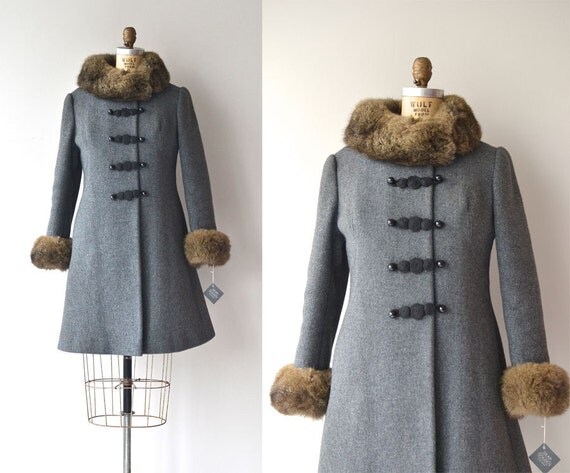
Vintage 1960s charcoal grey wool coat with black frog buttons, brown rabbit fur collar and cuffs, pockets and silk lining.
--- M E A S U R E M E N T S ---
fits like: small/medium shoulder: 16" bust: 32-36" waist: up to 32" hip: up to 40" sleeve: 23" length: 25" brand/maker: A Jackie Stuart | Junior Petite condition: excellent
➸ More vintage coats http://www.etsy.com/shop/DearGolden?section_id=5800175
➸ Visit the shop http://www.DearGolden.etsy.com _____________________
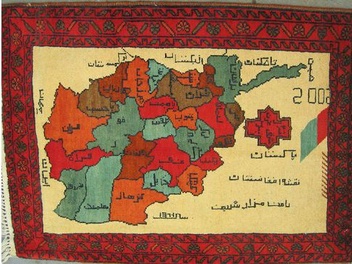
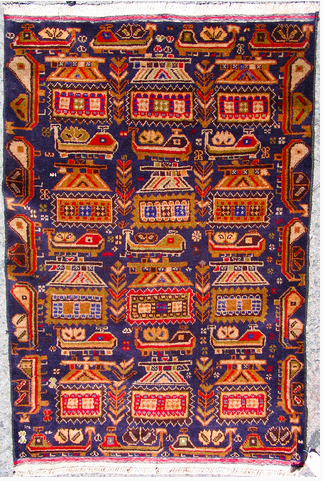
When it comes to what to depict on rugs, Afghan weavers traditionally turn to what’s most familiar. So in the 1980s, when the Mujahedeen were fighting back the Soviet occupation, some local weavers abandoned flowers and water jugs to illustrate what their days consisted of back then: war.
Kevin Sudeith/Warrug.com
Tanks, helicopters, Kalashnikovs, hand grenades, and bazookas started creeping into the centuries-old tradition, either as elements of a landscape or as icons in a pattern. “My favorite one is an old Beluch style one,” says the 49-year-old U.S. entrepreneur Kevin Sudeith. “The design dates back to the 19th century but it has two helicopters and two tanks at each end of the rug.”
Kevin Sudeith/Warrug.com
In 1996, Sudeith discovered one of the war rugs in the house of an Italian architect and decided to start collecting them. Shortly after, he was dealing them, both online and in flea markets around New York for prices ranging from a few hundreds to several thousand U.S. dollars each.
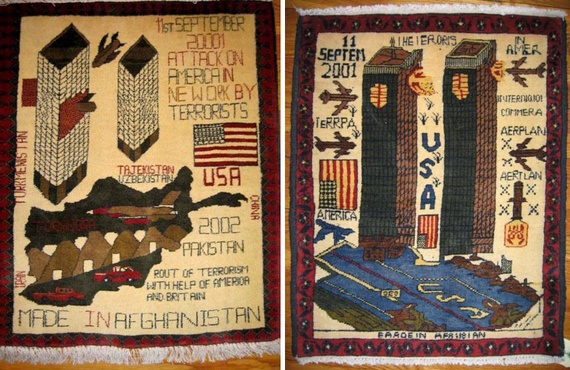
After 9/11, he thought his business was going to disappear. Surprisingly, a renewed interest in Afghanistan pushed the orders up, especially following the arrival on the market of a new set of rugs, depicting the attacks to the World Trade Center. In one of them, the misspelled caption “The teroris were nhe American” caused controversy in the U.S., as it seemed to imply that the rugs’ makers were celebrating the attack.
More rugs produced in that period featured F16 fighter jets, Abrams tanks and maps of Bora Bora, confirming that the iconography of Soviet occupation had been replaced by that of the United States military. The majority of weavers, says Sudeith, were Afghan refugees living in Pakistan who, regardless of their former careers back in Afghanistan, had become “a sort of captive labor force.”
Kevin Sudeith/Warrug.com
This may be the dark side of war rugs. Although Afghan weavers are traditionally women, Western collectors and dealers only deal with intermediaries, so it’s difficult to verify who actually makes the rugs, and under what circumstances. The U.S. Department of Labor, for example, lists those made in Afghanistan and Pakistan among the crafts that may involve child and forced labor. Sudeith himself never met the Afghan family that makes most of his rugs. “The brass ring for war rug people is to speak with weavers and hear their stories and motivations,” he confesses. “So far, it’s been impossible.”
After the Taliban was removed from Kabul, millions of Afghans were repatriated, causing a new shift in the rugs business: On one hand, most production followed the weavers back to Afghanistan; on the other hand, the rugs that had been woven in Pakistan became rare and therefore more valuable. These, says Sudeith, were the best years for business.
Kevin Sudeith/Warrug.com
Recently he has noticed that the mysterious weavers seem somehow savvier, more attuned to demands of the market. “If I write a blog post about a particular rug,” says Sudeith, “Eighteen months later contemporary, handmade versions of it will appear.”
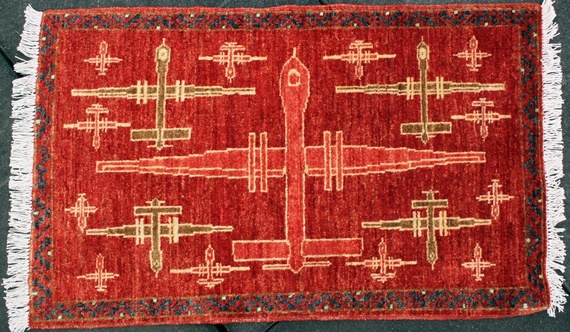
“A super subtle drone war rug. Dated 2014. Vegetable dye, super quality wool. Totally unique and timely piece.” In December 2014, Sudeith posted online images of a new set of drone-themed rugs, selling for a few hundred dollars. He calls them the product of a “collaborative process” with a family in Pakistan, based on designs that have previously emerged in the market.
Considering the ongoing program of U.S. drone strikes in Pakistan, these new patterns are likely to pick up as a popular theme among war rugs creators and their collectors. According to an October 2014 update from the U.K.-based Bureau of Investigative Journalism, more than 1,000 civilians have been killed in Pakistan by drone strikes over the past 10 years, around one-fifth of them children.
After Abraham Lincoln was assassinated in 1865, his pockets were emptied and their contents were given to his family, where they were kept for over 70 years. Later, in 1937, they were gifted to the Library of Congress by Lincoln's granddaughter. However, it wasn't until 111 years after Lincoln's death that the collection was finally revealed to the public. His personal effects now serve as relics of the past that give an intimate look into his life from the night of his assassination, attracting visitors as one of the LOC's most popular exhibits. According to exhibit, Lincoln's carry consisted of:
Golden watch fob
Gold “L” monogrammed enamel sleeve button
Leather wallet with pencil
Confederate $5 bill
Newspaper clippings
Ivory and silver pocket knife
Embroidered handkerchief
Folding eyeglasses in silver case
Gold-rimmed eyeglasses repaired with string
Pocket lens cleaner
It’s interesting to see that Lincoln’s carry actually shares several attributes with EDCs of today. Beyond his pocket knife, which is a staple in many modern American EDCs, he practices redundancy (two is one, one is none) with his pair of eyeglasses. Each pair is interesting in their own right — one folds in half for extra portability, while the other shows some DIY work as one of the arms is held secure by string. His glasses must have been essential to Lincoln, as evidenced by his protective, lined glasses cases and the fact that he used a separate lens tool as opposed to his handkerchief to keep them clean. Considering that in addition to all of his glasses-related items, he was also found with eight newspaper clippings about him in his pockets, suggesting reading was an important pastime for him. Personally, that’s one of my favorite aspects of looking at people’s EDCs — that something as seemignly ordinary as their daily items can help paint a better picture about the person carrying them.
There’s still more about this carry that makes it not so different from the ones you see submitted here. Take his wallet, for instance. The construction, attention to detail and internal organization on that wallet would be found in many products today. Besides keeping his notes, currency, and train tickets in order, he also used the wallet to stow away a small pencil. That’s definitely in tune with EDC philosophies of overcoming functional fixedness and finding versatility in the items you choose to carry. Notice the ornate materials and the personalization of his items through monogramming or embroidering in the carry. He has tools like the watch winding mechanism and glasses cleaner for proper maintenance of his essentials to keep them in their best shape, even on the go.
Just looking at these qualities of his carry, I speculate that Lincoln took great pride in his belongings… something that most of us EDCers do too. The similarities in the Lincoln collection to the EDCs we keep with us today are very telling of the meaning of the word "essential." It seems like even after 150 years, some things never change.
To learn more about this collection of artifacts, visit The Library of Congress. Thanks to our readers who sent in this tip! What’s your favorite part of Lincoln’s collection? Let us know in the comments below.
A gamergate (pronounced /ˈɡæmərˌɡeɪt/) is a reproductively viable female worker ant that is able to reproduce with mature males when the colony is lacking a queen.
This weekend marks the 100th anniversary of the birth of the inestimably important American folklorist/archivist/filmmaker/author/everything Alan Lomax. Unsurprisingly, there’s a plethora of commemorative events planned: a film marathon in Louisville, KY, a 13-hour radio marathon in Portland, a concert in London, England. And there will surely be some...
via firehose ("Yay! I don't have broadband anymore, finally")
halfEvilTech writes As part of its 2015 Broadband Progress Report, the Federal Communications Commission has voted to change the definition of broadband by raising the minimum download speeds needed from 4Mbps to 25Mbps, and the minimum upload speed from 1Mbps to 3Mbps, which effectively triples the number of US households without broadband access. Currently, 6.3 percent of US households don't have access to broadband under the previous 4Mpbs/1Mbps threshold, while another 13.1 percent don't have access to broadband under the new 25Mbps downstream threshold.
“Issues to Readers” is a film showing ten minutes of a real-time activity feed of the British Library system as patrons borrow, return, and request books. The massive quantity and widespread diversity of the titles processed in and out of the library are a tribute to the importance of libraries in general. The film was made alongside the British Library’s Living Knowledge project, which has a mission to make the library’s “intellectual heritage accessible to everyone, for research, inspiration and enjoyment.”
"I just want you to know that you don’t have to be perfect. Perfection is often the enemy of greatness. You are enough no matter where you come from." (x)
on the internet, no one knows that you're a person
Back in 2012, feminist critic Anita Sarkeesian posted a massive wall of furious, dismissive, or actively threatening YouTube comments that people had left on her proposal for a video series about female characters in games. At the time, this harassment wasn't exactly unprecedented, but it seemed bizarre and singular — how could a fairly mild video about narrative tropes draw such pure hatred? Three years later, it's become practically routine, and Sarkeesian has posted a week's worth of equally angry and depressingly similar Twitter messages.
Obviously, this is a biased statement. A more objective reporter would concede that the entire campaign against Anita Sarkeesian could be an elaborate charade, a brilliant gambit involving hundreds of paid-off vloggers, thousands of fake Twitter accounts, and collaboration at the very top levels of the FBI and various state police forces. She could even be faking the wave of people who descend on our writers every time they mention Anita Sarkeesian! But maybe, hidden behind the exhortations to "kill yourself," the explicit rape threats, and the occasional smug assertion that the whole thing is a false flag campaign, there are actual human beings.
As it turns out, some of the most direct threats come from throwaway accounts, or ones that have been suspended. But some of them are extant, long-running feeds from people who... well, it's hard to say that they have regular lives, or passions, because their timelines are mostly just racist or homophobic jokes and insults. But if you trawl deep enough, little pieces of normality peek out. And it makes everything all the more frustrating.
(Warning: unsurprisingly graphic language ahead.)
Here's a pretty mild one:
DiceTrojan has a very important mission: preserving the noble institution of internet death threats. But he also enjoyed a winter vacation, just like the rest of us.
Adensma shows up here a lot, whether he's praising games with "girl characters half naked" or expressing extremely graphic sexual assault fantasies.
But he's experienced his own share of oppression at the hands of girl gamers.
Now we're back to the intentionally non-actionable death wishes, courtesy of Johnatan Irons:
"I personally dont [sic] have any thing against her (im just a troll)," he explains. We imagine his girlfriend understands, unless she's also just a figment of his trolling.
It's hard to find anything but hatred in these timelines, some of which span years and thousands of tweets.
But sometimes you find out they had the same reaction to Gravity as you did. For once, they unabashedly, unmaliciously liked something.
Maybe we've walked by some of these people on the street? Maybe we sat a few tables over at a restaurant, while they were typing something like this?
How much of it is just an act? How much does it actually matter? How much empathy should we feel when we read something that genuinely seems like a cry for help, when the entire premise of modern-day trolling is that the internet is just a giant game of make-believe, and you're a fool to do more than point and laugh?
None of this is encouraging, especially when you know that just mentioning it puts you in the crosshairs, too. It doesn't prove that there's some hidden decency to reach or some way to impose offline consequences (I haven't looked up anything about these people's real identities, and I don't plan to.) It doesn't prove anything about what kind of person does this, because someone's web presence doesn't necessarily indicate much about their everyday lives. All it proves is that this isn't some barrage of throwaway insults in a vacuum. Given enough time, whether it's created out of deep resentment or teenage thoughtlessness or deliberate, sociopathic calculation, even the most one-dimensional troll mask can start to come alive.
'Illo cited two main reasons for the switch. The first, he said, is that “boys usually end up losing interest (in altar service) because girls generally do a better job.” The second and more important reason, Illo said, is that “altar service is intrinsically tied to the priesthood and serve as feeder programs for the seminary.”'
(RNS) The Catholic priest behind the new boys-only policy made waves at another parish when he said parishioners who voted for Barack Obama had to go to confession. The latest uproar comes amid a wider debate over whether the Catholic Church has become too “feminized.”
10. Back Bay
Boston
The Victorian Brownstones that line Commonwealth Ave. and Beacon Street don’t come cheap. And neither does the stuff you’ll find in the shops along Newbury street, where Chanel and Cartier peddle their wares to the nonstop parade of beauties who stroll the streets on any given weekend. And while Back Bay is definitely Beantown's sexiest ‘hood, if you want to stand a chance, make sure you pack your wallet. Because those ladies know exactly where Chanel and Cartier are, too.
Every once in a while, I am asked what I “make.” A hack day might require it, or a conference might ask me to describe “what I make” so it can go on my name tag.
I’m always uncomfortable with it. I’m uncomfortable with any culture that encourages you take on an entire identity, rather than to express a facet of your own identity ("maker," rather than "someone who makes things"). But I have much deeper concerns.
An identity built around making things—of being “a maker”—pervades technology culture. There’s a widespread idea that “People who make things are simply different [read: better] than those who don’t.”
I understand where the motivation for this comes from. Creators, rightly, take pride in creation. In her book The Real World of Technology, the metallurgist Ursula Franklin contrasts prescriptive technologies, where many individuals produce components of the whole (think about Adam Smith’s pin factory), with holistic technologies, where the creator controls and understands the process from start to finish. As well as teaching my own engineering courses, I’m a studio instructor for a first-year engineering course, in which our students do design and fabrication, many of them for the first time. Making things is incredibly important, especially for groups that previously haven’t had access. When I was asked by the Boston-based Science Club for Girls to write a letter to my teenaged self (as a proxy for young girls everywhere), that’s exactly what I wrote about.
But there are more significant issues, rooted in the social history of who makes things—and who doesn’t.
Walk through a museum. Look around a city. Almost all the artifacts that we value as a society were made by or at the order of men. But behind every one is an invisible infrastructure of labor—primarily caregiving, in its various aspects—that is mostly performed by women. As a teenager, I read Ayn Rand on how any work that needed to be done day after day was meaningless, and that only creating new things was a worthwhile endeavor. My response to this was to stop making my bed every day, to the distress of my mother. (While I admit the possibility of a misinterpretation, as I haven’t read Rand’s writing since I was so young that my mother oversaw my housekeeping, I have no plans to revisit it anytime soon.) The cultural primacy of making, especially in tech culture—that it is intrinsically superior to not-making, to repair, analysis, and especially caregiving—is informed by the gendered history of who made things, and in particular, who made things that were shared with the world, not merely for hearth and home.
Almost all the artifacts that we value as a society were made by the order of men.
Making is not a rebel movement, scrappy individuals going up against the system. While the shift might be from the corporate to the individual (supported, mind, by a different set of companies selling a different set of things), it mostly re-inscribes familiar values, in slightly different form: that artifacts are important, and people are not.
It’s not, of course, that there’s anything wrong with making (although it’s not all that clear that the world needs more stuff). The problem is the idea that the alternative to making is usually not doing nothing—it’s almost always doing things for and with other people, from the barista to the Facebook community moderator to the social worker to the surgeon. Describing oneself as a maker—regardless of what one actually or mostly does—is a way of accruing to oneself the gendered, capitalist benefits of being a person who makes products.
In Silicon Valley, this divide is often explicit: As Kate Losse has noted, coders get high salary, prestige, and stock options. The people who do community management—on which the success of many tech companies is based—get none of those. It’s unsurprising that coding has been folded into "making." Consider the instant gratification of seeing "hello, world" on the screen; it’s nearly the easiest possible way to "make" things, and certainly one where failure has a very low cost. Code is "making" because we've figured out how to package it up into discrete units and sell it, and because it is widely perceived to be done by men.
But you can also think about coding as eliciting a specific, desired set of behaviors from computing devices. It’s the Searle’s "Chinese room" take on the deeper, richer, messier, less reproducible, immeasurably more difficult version of this that we do with people—change their cognition, abilities, and behaviors. We call the latter "education," and it’s mostly done by underpaid, undervalued women.
When new products are made, we hear about exciting technological innovation, which are widely seen as worth paying (more) for. In contrast, policy and public discourse around caregiving—besides education, healthcare comes immediately to mind—are rarely about paying more to do better, and are instead mostly about figuring out ways to lower the cost. Consider the economics term Baumol’s cost disease: It suggests that it is somehow pathological that the time and energy taken by a string quartet to prepare for a performance—and therefore the cost—has not fallen in the same way as goods, as if somehow people and what they do should get less valuable with time. (Though, to be fair, given the trajectory of wages in the U.S. over the last few years in real terms, that seems to be exactly what is happening.)
I am not a maker. In a value system that is about creating artifacts, specifically ones you can sell, I am a less valuable human.
I am not a maker. In a framing and value system is about creating artifacts, specifically ones you can sell, I am a less valuable human. As an educator, the work I do is superficially the same, year on year. That’s because all of the actual change, the actual effects, are at the interface between me as an educator, my students, and the learning experiences I design for them. People have happily informed me that I am a maker because I use phrases like "design learning experiences," which is mistaking what I do (teaching) for what I’m actually trying to help elicit (learning). To characterize what I do as "making" is to mistake the methods—courses, workshops, editorials—for the effects. Or, worse, if you say that I "make" other people, you are diminishing their agency and role in sense-making, as if their learning is something I do to them.
In a recent newsletter, Dan Hon, content director for Code for America wrote, “But even when there’s this shift to Makers (and with all due deference to Getting Excited and Making Things), even when ‘making things’ includes intangibles now like shipped-code, there's still this stigma that feels like it attaches to those-who-don’t-make. Well, bullshit. I make stuff.” I understand this response, but I’m not going to ask people—including myself—to deform what they do so they can call themselves a "maker." Instead, I call bullshit on the stigma and the culture and values behind it that rewards making above everything else.
A quote often attributed to Gloria Steinem says: “We’ve begun to raise daughters more like sons... but few have the courage to raise our sons more like our daughters.” Maker culture, with its goal to get everyone access to the traditionally male domain of making, has focused on the first. But its success means that it further devalues the traditionally female domain of caregiving, by continuing to enforce the idea that only making things is valuable. Rather, I want to see us recognize the work of the educators, those that analyze and characterize and critique, everyone who fixes things, all the other people who do valuable work with and for others—above all, the caregivers—whose work isn’t about something you can put in a box and sell.
After California's foie gras ban was abruptly overturned a few days ago, the odds were pretty high of tensions flaring between people for and against the decision. Teams from PETA fanned out in protest, no surprise, albeit sometimes at places that didn't actually serve any fatted-duck-liver pâté, but not everybody has registered their dissent so nonviolently: Hot's Kitchen chef-owner Sean Chaney, one of the plaintiffs who successfully sued the state, says he has received at least a couple of death threats for his participation.
Two of these were posted as comments to Instagram posts (like the one pictured above), with messages like "I will find you and kill you I will stick a pipe in your god damn throat see how you like it" and "People will do this to you just wait." Chaney has, in the interim, been serving an all-foie five-course menu since lunchtime on the day of the ban, which he opposed on grounds that it wasn't the state's place to decide whether or not the practice is animal cruelty. The judge agreed, although plenty of others don't, especially not with Chaney's suggestion to upset people: "Don't buy it." The FBI is apparently taking the threats seriously enough to investigate them, and he even had to interrupt an NPR interview to answer a call from agents wanting to "suss out the credibility" of one. Asked if it's worth it, he says, "I think so, yeah. I'd do it again. I believe in the freedom of it."
WASHINGTON—Painting a stark portrait of a phenomenon that appears to be irreversible, a report published Thursday by the American Historical Association has found that the past is currently expanding at an alarming rate. The comprehensive 950-page s...
The Alabama Probate Judges Association says Friday's ruling does not open the door for the issuance of same-sex marriage licenses. Cari Searcy and Kim McKeand are the only plaintiffs in the case that was filed against Alabama Attorney General Luther Strange. The Alabama Probate Judges Association says that is a key point in the effect that this ruling has on the duties of probate judges. "Judge Granade's ruling in this case only applies to the parties in the case and has no effect on anybody that is not a named party. The probate judges were not parties in this matter," Al Agricola, attorney for the Alabama Probate Judges Association, explained. "The legal effect of this decision is to allow one person in one same-sex marriage that was performed in another state to adopt their partner's child. There is nothing in the judge's order that requires probate judges in Alabama to issue marriage licenses to same sex couples." Probate Judges are elected in all 67 counties in Alabama and are statutorily given the responsibility of issuing and recording marriage licenses.