


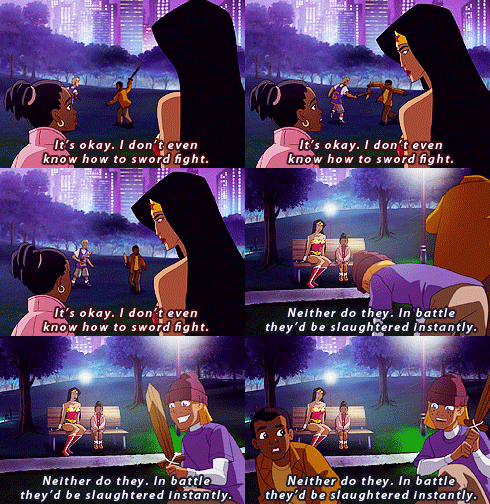




I need to reblog this when I see it.
I wish someone had taught me how to sword fight. I had two stoopid brothers who should have.
:) I only made it to bo staff. Swords are way too short.
I need to reblog this when I see it.
I wish someone had taught me how to sword fight. I had two stoopid brothers who should have.
:) I only made it to bo staff. Swords are way too short.

When’s it ok to tell a badass black man in New Orleans he’s “pretty?” When he’s a Mardi Gras Indian! In fact, they demand it. As they chant and strut their stuff, bystanders respond with “Pretty pretty, you SO pretty Big Chief!”
A former Lehigh University graduate student is suing her alma mater over a bad grade, claiming it prevented her from pursuing her preferred career, according to The Morning Call, an Allentown, Pa., newspaper. After getting a C+ that prevented her from taking a required class, 27-year-old Megan Thode is suing the university, her teacher, and the program director for $1.3 million in damages for breach of contract and sexual discrimination.
In the final year of her counseling and human-services master’s, Thode’s grade was below the B she needed to take the next course for her degree. Her teacher, Amanda Carr, gave Thode a zero in the participation portion of her grade because, by “show[ing] unprofessional behavior that included swearing in class” and “having an outburst in which she began crying,” Thode demonstrated that she was “not ready to move on.”
Keep reading this post . . .
I’ve reached out to Beam to clarify whether the alcohol is being reduced by 3%, as the email says, or three percentage points, which would be more dramatic. The footer of today’s email suggests it’s the latter, describing Maker’s Mark as a 42% ABV beverage, which is also known as 84 proof; it was previously distilled to 45% ABV, or 90 proof. That would be a 6.7% reduction in the amount of alcohol.
Russian Sledges"The character of Catalina Erantzo in the video game Uncharted Waters: New Horizons was named for and somewhat influenced by her, being a female Spanish commodore.[citation needed]"
 One suggestion we received on Twitter: “You can put it in a sweater and never drink it again.”
Gary He
One suggestion we received on Twitter: “You can put it in a sweater and never drink it again.”
Gary He
Quartz broke the news over the weekend that Maker’s Mark is reducing the alcohol in its bourbon by three percentage points, from 45% alcohol to 42%, in order to keep up with rising demand. The story ignited a small firestorm as customers criticized Maker’s and its parent company, Beam Inc., for watering down the drink.
I heard from lots of whiskey drinkers on Twitter who had follow-up questions, so I posed them today to COO Rob Samuels, who prefers his Maker’s Mark neat, and his father Bill Samuels, who ran the distillery until 2011 and drinks his bourbon in Manhattans, Old Fashioneds, and over ice. Here are highlights from the interview.
How much additional supply will be created by lowering the alcohol content in Maker’s Mark?
“Volume-wise, it’s not enormous,” Bill said. “It allows what Rob felt was an extra four years to fill the gaps that were causing us the biggest problems. The biggest ones are the bars and restaurants that have Maker’s Mark cocktails on their menus. We’re taking care of customers who have been with us for a long time.”
Is reducing the alcohol simply a matter of adding water?
Yes. Almost all bourbon brands “add water as it enters the barrel and as it leaves the barrel,” Rob said. Maker’s Mark will now just be adding just a little more.
Why not just raise the price? That’s another common solution to problems of supply and demand.
“Rob’s grandfather did not like ostentatiousness,” Bill said, referring to Bill Samuels Sr. ”It deliberately was not marketed as an image-transfer brand.” I pointed that out Maker’s Mark was once marketed under the slogan, “It tastes expensive…and is.”
Rob said that, yes, “for a period, it was a little more expensive than others,” but described Maker’s Mark as more a mid-market brand now. Jim Beam, owned by the same company, is a cheaper bourbon; Maker’s 46 is higher-end and higher proof. In that sense, lowering the proof of Maker’s Mark is diversifying the company’s selection of bourbon.
Pressed on the price issue, Rob said that distributors mostly control the pricing of Maker’s Mark but acknowledged, “Most years we’ve taken a modest price increase.” He also said the company is making investments to increase capacity.
What about other ways of increasing supply?
Bill said, “The one lever that we have had is age,” meaning that the bourbon could be aged in oak barrels for less time. But Maker’s Mark starts to taste too “grainy” when aged for less than six years, Bill said, so they couldn’t push it any further.
This question was submitted by Wired editor Ryan Tate, and I asked it word-for-word as representative of outraged customers: What will you do for a living after burning the American bourbon industry’s reputation to the ground and destroying your company?
“All we’ve asked is that folks keep an open mind until they taste,” said a somewhat chastened Rob.


Read more of this story at Slashdot.

Russian Sledgeshow did I miss this?
Metafilter member “the man of twists and turns” said: I’m going to stick this quote into every discussion of why libraries are important.
I say: Amen to that.
(via hadro)
Repeating: “I’m going to stick this quote into every discussion of why libraries are important.”
This week, the French National Assembly has been debating a bill on same-sex marriage and gay adoption. But a small scandal erupted after several lawmakers, who support gay marriage, were spotted playing Scrabble on their iPads during the parliamentary debate.
I like almost everything about working in plain text and MultiMarkdown. However, after trying to do editorial reviews in plain text, I realized there was a major problem. How do you indicate deletions, additions and comments in plain text without mangling the text or making changes laborious.
After some failed trials with Github and file diffs, I decided I needed a new markup language.1
Enter Erik Hess, my friend and part-time editor. We began a collaboration to solve our own problems. Within a couple of days of using the new markup, we realized that this was something that might have universal appeal. So it became a real project for us. CriticMarkup was born.2

CriticMarkup is not a file format or proprietary application exchange format. CriticMarkup is a basic syntax that can be used in any application. Heck, it could be used with a typewriter. It's like Markdown but for denoting editorial changes.
{++ ++}
{-- --}
{~~ ~> ~~}
{>> <<}
{{ }}{>> <<}
Here's a view of it in the context of a plain text document (colored for emphasis)
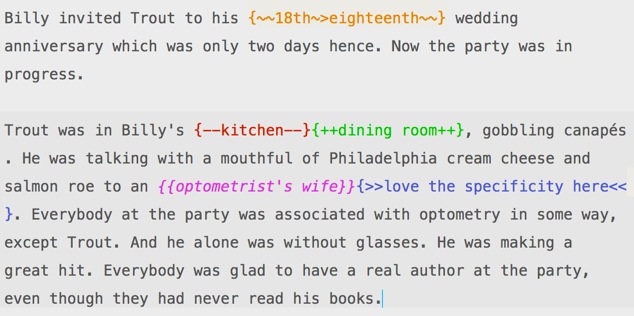
We carefully chose our syntax to avoid conflicts with MultiMarkdown, LaTeX and HTML. We wanted to be good citizens but we also want the syntax to make sense. I also, personally, think there is beauty in symmetry.
CriticMarkup has a home at criticmarkup.com.3 Easy right?
Because we actually use CM to do editorial reviews, we realize that good tools make everyone happy. So we made some. There's a Sublime Text package, which we demonstrate in the video. There's a BBEdit CLM, Keyboard Maestro macro, TextExpander snippets and system services for the Mac. Finally, there's a CLI tool that will convert a Markdown file that contains CriticMarkup into a really nice HTML document that can be used for reviewing.
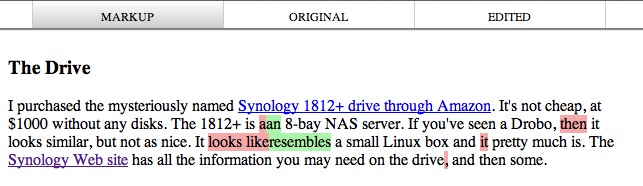
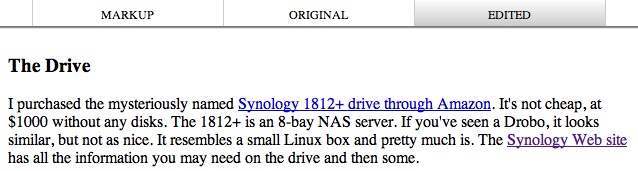
Here's what the Markup version looks like in the exported HTML document:
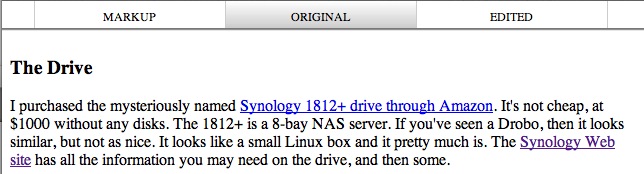
The page can also toggle between an "Original" view that hides all editorial comments:
Want to see how the article will read if you just agree with your editor? There's a view for that too:
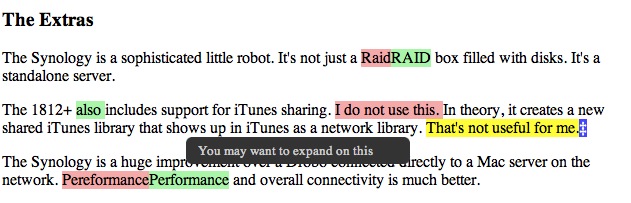
There are also nice JQuery enabled on-hover effects for editorial comments. Just hover over the double-dagger next to the highlighted text to see the editor's comments.
Of course you can also override the builtin CSS/JS with your own file.
Oh, and of course, because CM is just plain text, it also works great in Kaleidoscope.app. The text is still readable but the markup is obvious.
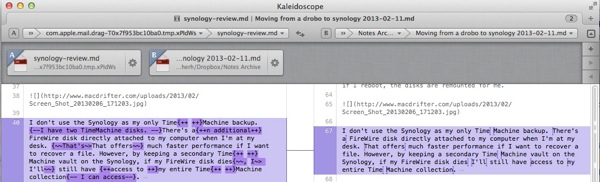
We made this for us. We think other people that are like us will find it useful too. We're considering how this syntax should evolve over time to make it useful to a broader group. There are a lot of gaps in the syntax that will be a problem for professional copy editors. We hope to reduce the number of gaps over time but we have our eye on simplicity as a top priority.
If you want to contribute feel free to drop by the Github or support discussion site.
The best way to support this idea is to make it work in cool ways. There are some great apps on the horizon that will make working with CriticMarkup even easier.
So, CriticMarkup is a thing we like and a thing we use. If you like it too, that's cool. Either way, Erik and I are pretty proud of the results.
There were many people that provided some great feedback as the project evolved. I'm very thankful that these folks exist and made time to provide feedback. They are all superheroes and kind souls.
Will Oemler
For the truly creepy and astute reader, you may have noticed a post with the CriticMarkup tag a little while ago. There's also been many bookmarks on Pinboard that I've tagged with my project nomenclature. ↩
The acronym we like is CM ↩
Isn't that site a beauty? Erik made the entire thing from scratch. He's awesome and also available for hire. ↩
Google Reader has been having some issues.
Here’s the thing: a bunch of RSS readers rely on Google Reader for syncing — but Google Reader is not a syncing service, and its APIs are undocumented and unsupported.
TechCrunch describes Google Reader as “benignly abandoned” — which, for native RSS readers that use it, is worse than actual abandonment, because broken syncing is worse than no syncing.
My friend Jake asks if Google could spin off Reader. My guess: it’s not worth their time to pursue. What they’d get for it isn’t worth the time to consider it. (And that’s before you factor in the difficulty of transferring it.)
Google has learned to focus, and they’re doing some great work. (I especially like Google Maps for iOS.)
Part of learning to focus is learning how to shut things down. Google has done well at that — but I’m surprised that Google Reader hasn’t been shut down yet. Better a clean shut-down than an ungraceful end.
Russian Sledgesmy tv does 3d and I still don't care
 Doctor Who is to be shown in 3D, it was announced this evening.
Russian Sledgesthat space is cursed
 The rumored Harvard Square restaurant called Conductor's appears to be happening. The city of Cambridge recently approved a liquor license transfer from the former Hoffa's to Conductor's, which is moving into the old Hoffa's space in the Conductor's Building on Mt. Auburn Street. [City of Cambridge (PDF)]

Classic Doctor Who TARDIS Sleeping Bag
Again, via Plaid Stallions: http://plaidstallions.blogspot.com.au/2012/03/doctor-who-pattern-book.html

Marmite ran a pretty rocking campaign in South Africa not too long ago revolving around the big idea that ‘If Mother didn’t tell you about Marmite, what else didn’t she tell you?’. These 365 other things were repackaged in Marmite’s distinctive product packaging with their labels changed, then despatched to influential bloggers. Exquisite execution on this one, with ad agency Machine (Big Wednesday) at the helm.


The post 365 things (besides Marmite) your mother didn’t tell you appeared first on Lost At E Minor: For creative people.
On Tuesday, Rand Paul will fill a space previously held only by Michele Bachmann and Herman Cain: He’ll deliver the Tea Party’s response to the State of the Union address. There’s a little tension among activists over how he was chosen, but leaders of the “leaderless movement” seem to have come to a consensus on one thing: Rand is going to kill it.
James Valvo of Americans for Prosperity, who has worked extensively with grassroots organizations opposing big government, says he thinks the choice is “fantastic.” The only area where tensions arise is around who did the choosing: The response speech is organized by the Tea Party Express, a group that some say has overstepped its bounds by claiming the authority to decide who gets to give the official response. Judson Phillips, founder of Tea Party Nation, tells NRO he’s heard some “grumbling” about Tea Party Express’s control. He adds that he doesn’t have a problem with their leadership role and hasn’t heard any complaints about their choice.
Keep reading this post . . .


Russian Sledgeswent to the oscar-nominated shorts screening at the kendall
this was my favorite
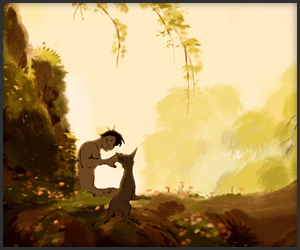
Our bet to win the 2013 Oscar for Best Animated Short, Minkyu Lee’s Adam and Dog is about the meeting of the first man and the first man’s best friend. Immerse yourself in its wonderful visuals.
Russian Sledges#nottheonion
Russian Sledgesnyrb personals autoshare
The first personal ad to appear in The New York Review of Books was published in the magazine’s July 11, 1968 issue. “WIFE WANTED,” it read. “Intelligent, beautiful, 18 to 25, broad-minded, sensitive, affectionate. For accomplished artist and exciting life. NYR box 1432.” Ever since then the Review’s personals have been a widely-followed (and much-parodied) part of the magazine. Associate Publisher Catherine Tice spoke with NPR’s Scott Simon for Weekend Edition Saturday about love sought, and found, in the pages of the Review.
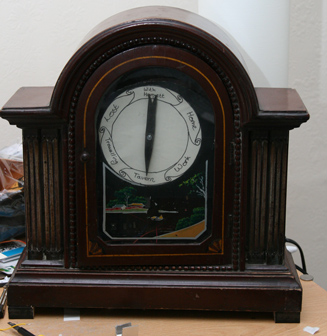
The location clock found in the Harry Potter books makes for a really fun hack. Of course there’s no magic involved, just a set of hardware to monitor your phone’s GPS and a clock face to display it.
[Alastair Barber] finished building the clock at the end of last year as a Christmas gift. The display seen above uses an old mantelpiece clock to give it a finished look. He replace the clock face with a print out of the various locations known to the system and added a servo motor to drive the single hand. His hardware choices were based on what he already had on hand and what could be acquired cheaply. The an all-in-one package combines a Raspberry Pi board with a USB broadband modem to ensure that it has a persistent network connection (we’ve seen this done using WiFi in the past). The RPi checks a cellphone’s GPS data, compares it to a list of common places, then pushes commands to the Arduino which controls the clock hand’s servo motor. It’s a roundabout way of doing things but we imagine everything will get reused when the novelty of the gift wears off.


