
Russian Sledges
Shared posts
18 Feb 16:56
"It was unanimous,” Frazier recalled. “Some didn’t vote, but we didn’t receive a ‘nay’ vote."
““It was unanimous,” Frazier recalled. “Some didn’t vote, but we didn’t receive a ‘nay’ vote.””
- Historic oversight corrected: Film ‘Lincoln’ inspires look into slavery vote | The Clarion-Ledger | clarionledger.com
- Historic oversight corrected: Film ‘Lincoln’ inspires look into slavery vote | The Clarion-Ledger | clarionledger.com
18 Feb 16:49
Laser Intended For Mars Used To Detect "Honey Laundering"
by samzenpus
A laser tool funded by the European Space Agency to measure carbon on Mars is now being used to help detect fake honey. By burning a few milligrams of honey the laser isotope ratio-meter can help determine its composition and origin. From the article: "According to a Food Safety News investigation, more than a third of honey consumed in the U.S. has been smuggled from China and may be tainted with illegal antibiotics and heavy metals. To make matters worse, some honey brokers create counterfeit honey using a small amount of real honey, bulked up with sugar, malt sweeteners, corn or rice syrup, jaggery (a type of unrefined sugar) and other additives—known as honey laundering. This honey is often mislabeled and sold on as legitimate, unadulterated honey in places such as Europe and the U.S.." 


Read more of this story at Slashdot.
Tertiarymatt, firehose likes this


18 Feb 04:17
Archaeological Hairstyling
by Sarah Pavis
Historians said ancient hairstyles were so difficult to achieve they had to have been wigs. Janet Stephens, professional hairstylist and amateur scholar, took that as a challenge.
In what may be the ultimate YouTube fashion how-to video, Janet Stephens walks through how she reverse engineered the elusive Vestal Virgin hairstyle from statues and then shows you how to braid and bind the hair to get that look that was oh-so fashionable 1800 years ago. It makes going to a museum feel like opening a copy of Elle magazine.Studying translations of Roman literature, Ms. Stephens says, she realized the Latin term "acus" was probably being misunderstood in the context of hairdressing. Acus has several meanings including a "single-prong hairpin" or "needle and thread," she says. Translators generally went with "hairpin."
The single-prong pins couldn't have held the intricate styles in place. But a needle and thread could. It backed up her hair hypothesis.
In 2007, she sent her findings to the Journal of Roman Archaeology.
Tertiarymatt and -1 others like this
18 Feb 04:15
Solar Peach Walls
by Nicola
As a coda to my previous post, I should note that before their adoption of apple ensachage and photographic tattoos, the nineteenth-century fruit growers of Montreuil had already adopted innovative peach growing techniques to produce the most coveted stone fruits in the world.
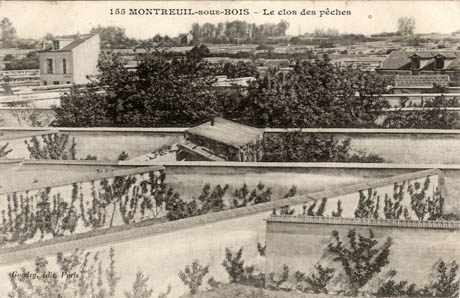
IMAGE: Postcards from the era show Montreuil’s seemingly infinite solar courtyards, Vues de Montreuil à la grande époque des Murs à pêches from the collection of the Société Régionale d’Horticulture de Montreuil.
Their secret lay in the construction of a honeycomb of solar walls. As Suzanne Freidberg writes in Fresh, the Montreuillois enclosed rectangular plots “in walls of plaster — a material that absorbs heat much more effectively than brick — and oriented them all north-south, so as to capture the most sunlight.”
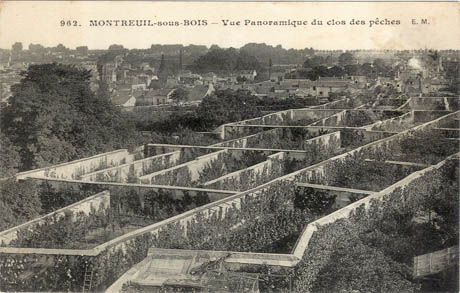
IMAGE: Vues de Montreuil à la grande époque des Murs à pêches from the collection of the Société Régionale d’Horticulture de Montreuil.
This gridiron of sun traps were surprisingly effective, according to Freidberg:
Indeed, both day and night the gardens were warmer than their surroundings by several degrees Celsius. In this microclimate Mediterranean fruits thrived. Peaches ripened a month before others on the market, when prices were still sky-high. In addition, the villagers trained their espaliers to stretch out across the east-facing walls like giant fans cradling each peach in a perpetual sheltered sunbath. This design produced not only unusually big and beautiful fruits but also more of them from each tree.
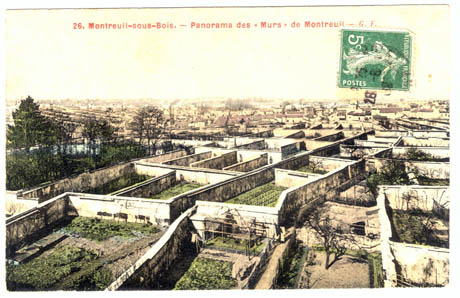
IMAGE: Vues de Montreuil à la grande époque des Murs à pêches from the collection of the Société Régionale d’Horticulture de Montreuil.
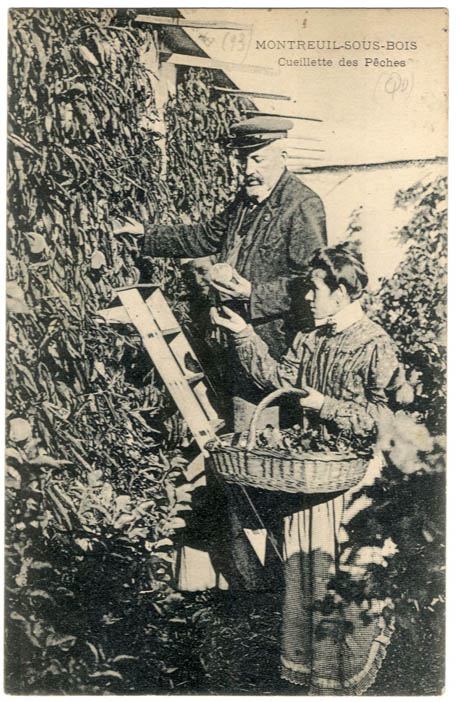
IMAGE: Harvesting Montreuil’s peaches — the best in France, and, some would argue, the world. From the collection of the Société Régionale d’Horticulture de Montreuil.
French horticulturalists, unable to believe that illiterate peasants had come up with this system on their own, suspected they had stolen the idea from the king’s garden at Versailles. Nonetheless, observers marveled at the sight of solar walls applied at the scale of infrastructure, re-designing the landscape and microclimate of an entire village. Freidberg translates the comments of a contemporary visitor, Pierre Jean-Baptiste Legrand d’Aussy:
It’s a really interesting spectacle to look down from the surrounding hillsides on this immense multitude of gardens, carved up every which way by walls covered with trees and verdant vines. You think you’re looking at a hive of bees…
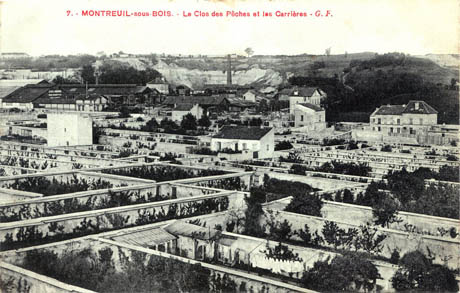
IMAGE: Vues de Montreuil à la grande époque des Murs à pêches from the collection of the Société Régionale d’Horticulture de Montreuil.
Looking at panoramic postcards of Montreuil from the end of the nineteenth century, with fully three-quarters of the town’s territory transformed into plaster-walled solar courtyards for peaches, it’s tempting to compare the landscape with the sea of greenhouses have similarly reformatted El Ejido, in the Almeira province of Spain, today.
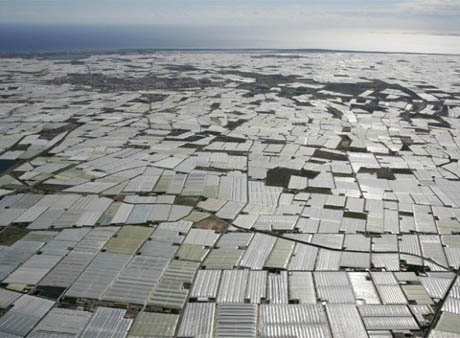
IMAGE: El Ejido’s saladscape, via.
The desert landscape that previously served as the backdrop for Sergio Leone’s “spaghetti westerns,” as architect Keller Easterling notes in her chapter on El Ejido in Enduring Innocence: Global Architecture and Its Political Masquerades, is now a sea of plastic — the largest concentration of greenhouses in the world, hot-housing summer vegetables all winter long.
The nineteenth-century plaster wall of Montreuil is paralleled, in El Ejido, by the adaptation, in the 1970s, of a flat-roofed, “parallel type,” plastic-sheeting and wire structure used locally for growing table grapes. Just as in Montreuil, this single structural unit became the “germ,” in Easterling’s formulation, for a new landscape-scale agricultural infrastructure, reshaping the region’s ecology and its economy.
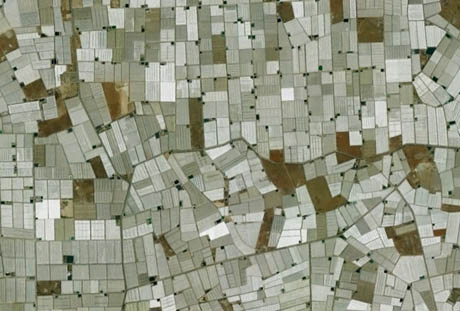
IMAGE: El Ejido from above, via.
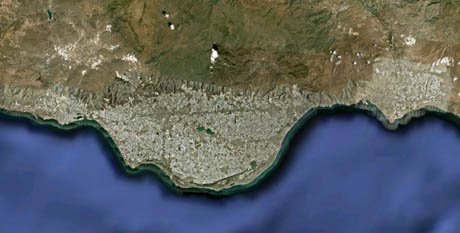
IMAGE: Satellite imagery of the El Ejido peninsula, via.
Of course, the tiled suntraps of El Ejido have not only transformed a single town, but an entire peninsula — the 80,000 contiguous acres of parallel plastic greenhouses are clearly visible from space. In addition, while the fruit growers of Montreuil drew on their wives and children to provide cheap labour, the greenhouses of El Ejido rely on seasonal or illegal workers from North Africa, in a complicated and exploitative relationship that, as Easterling writes, has ignited a “tomato war” — “a translocal valve of labor, race, and migration problems in Europe.”
Unpacking the economic, ecological, and geopolitical forces that conspire to transform a “germ” into a highly engineered landscape, worthy of postcard and satellite photography, as well as our marveling attention — and then, as was the case in Montreuil and as seems inevitable in El Ejido, given its aquifer depletion, to dismantle it half a century later, is a fascinating exercise. The lucrative market in counter-seasonal produce has spurred ever more sophisticated architectures of climate modification — including, of course, my personal obsession, cold storage — marching across the urban hinterlands in formation…
Russian Sledges, Tertiarymatt and -1 others like this
18 Feb 04:11
And now, an academic paperback for over $1500
by Jonathan
So I went to Amazon to pick up Constance Classen’s The Deepest Sense: A Cultural History of Touch, which I’m looking forward to reading. This is what I found:
While I’m definitely interested in picking up the book, and while it is clearly eligible for super saver shipping, this is the first over-$1500 academic paperback I’ve ever seen. Either someone made a whopper of a typo, Amazon has some kind of algorithmic error (or U of Illinois press does), or the press has a truly insane pricing plan for purchasers outside the United States.
Luckily, there are other vendors who will sell it for less.
Assuming it’s an error, and one that might be to the author’s detriment, I emailed Amazon to ask why the book was so expensive. If I hear back, I’ll post it here.
Update:
Here’s the email I got back from Amazon. Suitably cryptic:
Thank you for writing to us at Amazon.ca.
I am sorry, but this item’s price “The Deepest Sense” was listed as wrongly on our web site.
We build our web site information from many sources, and we really appreciate knowing about any errors which find their way into it.
I’ve forwarded your message to the inventory department and I can ensure that this error is corrected as soon as possible. This process will takes 5 to 7 business days, so we request you to wait until that time to get this issue corrected.
I will write back to you within 5 to 7 business days with a resolution.
Thank you for your patience and understanding, and thanks for shopping at Amazon.ca.
Did we answer your question?
If yes, please click here:
http://www.amazon.ca/rsvp-y?c=cycdthew3542761760If not, please click here:
http://www.amazon.ca/rsvp-n?c=cycdthew3542761760&q=caffPlease note: this e-mail was sent from an address that cannot accept incoming e-mail.
To contact us about an unrelated issue, please visit the Help section of our web site.
Best regards,
Vel S.
Amazon.ca
Your feedback is helping us build Earth’s Most Customer-Centric Company.
http://www.amazon.ca
Postscript:
On Facebook, Dave Noon pointed me to this $23 million book about flies.
Russian Sledges likes this
18 Feb 04:09
Publisher Sues University Librarian Over His Personal Blog Posts
by samzenpus
McGruber writes "The Chronicle of Higher Education has the news that Herbert Richardson, founder of Edwin Mellen Press is suing McMaster University and University Librarian Dale Askey for $3 Million over Mr. Askey's posts on a personal blog. In 2010 Mr. Askey wrote a blog post about Edwin Mellen Press on his personal Web site, Bibliobrary. Mr. Askey referred to the publisher as 'dubious' and said its books were often works of 'second-class scholarship.' For a few months afterward, several people chimed in in the blog's comments section, some agreeing with Mr. Askey, others arguing in support of the publisher. In a February 11 statement, the McMaster University Faculty Association (MUFA) stated that The Canadian Association of University Teachers (CAUT) 'and the MUFA Executive agree that this case represents a serious threat to the freedom of academic librarians (pdf) to voice their professional judgement and to academic freedom more generally.'" 


Read more of this story at Slashdot.
18 Feb 04:06


Maker’s Mark learns a painful social media lesson, won’t dilute bourbon
by Zachary M. Seward
Maker’s Mark said today that it will not reduce the amount of alcohol in its bourbon after a weeklong backlash on social media chastened the famed distillery.

The reversal speaks to how brands often misjudge their relationship with customers, who can now vote more powerfully with their Twitter accounts than with their wallets. “What we’ve learned is that this is the customer’s brand,” Maker’s Mark COO Rob Samuels, grandson of the bourbon’s creator, said today in an interview. “It was an overwhelming response, we listened all week, and tomorrow morning we’ll immediately return Maker’s Mark to 90 proof.”
The company had emailed loyal customers on Feb. 9 to say it was lowering its proof to 84, or 42% alcohol, in order to address a supply shortage driven by bourbon’s surging popularity in the United States and certain other markets like Australia, Germany, and Japan. The announcement, first reported by Quartz, spread quickly in social media, rising from a small firestorm to an all-out backlash. The company defended itself in interviews, saying the taste wouldn’t change, but it didn’t help.

A useful comparison is Jack Daniel’s, which lowered the proof of its whiskey from 86 to 80 in 2004. There were plenty of complaints, but it was a different time: Facebook had just been created, Twitter didn’t yet exist, and that’s arguably why Jack Daniel’s is still distilled at 80 proof today. In the intervening years, plenty of brands, from Dell to United Airlines, have learned how social media can amplify customer complaints into corporate crises.
Still, look at this chart of the number of tweets about Maker’s Mark starting the day before the company announced it would water down its bourbon, using data from social analytics firm Topsy:

The Twitter backlash actually peaked on Tuesday, Feb. 12. Is it possible the company could have weathered the storm? Discussing today’s developments on Twitter, some people suggested Maker’s Mark had misjudged social media twice: first by under-anticipating the reaction and then by over-reacting to it.
Samuels said today in an interview that he continued to hear from customers all week, if not through social media then in emails and calls to their office. He said he attended a previously scheduled event last week at St. Elmo Steak House in Indianapolis, Indiana, where loyal customers were vocal about the change. “Let’s just say they didn’t hold back,” he said.
His father, Bill Samuels, a lawyer who eschewed the family business for years before taking over the distillery in 1980 and growing it into an international brand, was also pensive about the company’s rough week. He had maintained that reducing the alcohol in Maker’s Mark wouldn’t affect the taste of the bourbon that his father created in 1954 in Loretto, Kentucky, where it is still distilled, and said taste tests with customers had proven it.
“Clearly, if we would have just gotten a bunch of customers together and said, ‘Do you want us messing with your bourbon in any way?’ we would have gotten a resounding no,” Bill said. “So in a sense, we were asking the wrong question.”
Maker’s Mark was independently owned until 1981, when it began falling into the hands of increasingly large conglomerates, ending up in 2011 as part of Fortune Brands, which also owned seemingly random companies like Master Lock and Titleist, the golf equipment retailer. That corporate structure has tested the bourbon’s branding as a family-owned distillery committed to “small batch” production. In 2011, Fortune spun off its spirits brands into a publicly traded company, Beam Inc., which also makes the cheaper bourbon Jim Beam.
Neither Rob nor Bill would comment in detail about Beam’s involvement in the original decision to water down Maker’s Mark or today’s about-face. “They’re in full agreement as we reverse this decision,” Rob said. In recent earnings calls, Beam executives have warned that supply shortages could keep it from speeding up sales growth, especially in promising markets like South Korea, which in 2011 eliminated a 20% tariff on bourbon imports.
Without water as a tool to stretch its supply and with the bourbon having to age a minimum of six years before reaching customers, Maker’s Mark is left with few options. It could increase prices, as many argued it should, though it has already done that over the past several years. The company is also making capital investments to increase its production capacity in Loretto, but that will take at least four years to have an effect on supply.
As for the 84 proof Maker’s Mark, a small amount of it was created and sold to distributors before the company decided to return to 90 proof. “We think a lot of those bottles will become collector’s items,” Rob said.
firehose likes this
18 Feb 04:00

The Tree with the Apple Tattoo
by Nicola
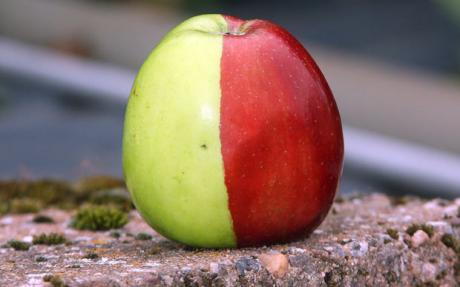
IMAGE: A random mutation caused this Golden Delicious apple to turn half-red, half-green. According to Susan Brown, she can breed apples with a stable variation of this mutation that creates candy-cane red stripes on a pale yellow-skinned apple. Photo ARCHANT via The Daily Telegraph.
In a 2011 talk titled “Taste the Apples of the Future,” Cornell University professor Susan Brown, one of only three commercial apple breeders in the United States, offered an enticing glimpse of yellow-red chimeras, pink-fleshed varieties, and the non-browning NY-674, whose resistance to discoloration was discovered by chance during an equipment failure.
Before moving onto her own, more practical work developing higher yielding, earlier fruiting varieties that are resistant to cold storage “scald,” Brown also mentioned that in Japan, farmers were already growing apples with built-in branding — the Japanese symbol for “good health” tattoed onto their skin by the sun.
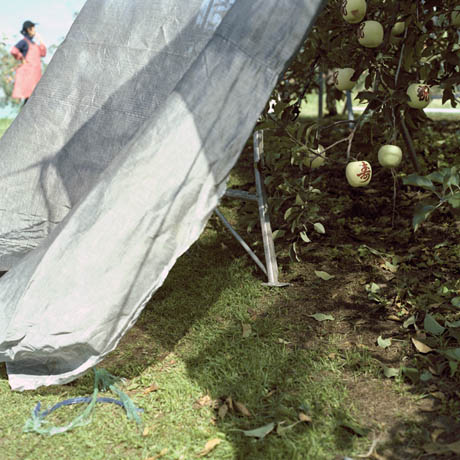
IMAGE: Field Worker & Stenciled Apples, Fall, Aomori Prefecture, photograph by artist Jane Alden Stevens.
In 2007, Cincinnati-based artist Jane Alden Stevens spent four months in Japan, documenting the extraordinary attention its orchardists put into growing perfectly beautiful apples. In addition to culling blossoms to reduce over-crowding and ensure regular, large fruit, and then hand-pollinating them using powder-puff wands, Japanese farmers put a double-layer of wax paper bags around their baby apples for most of the growing season.
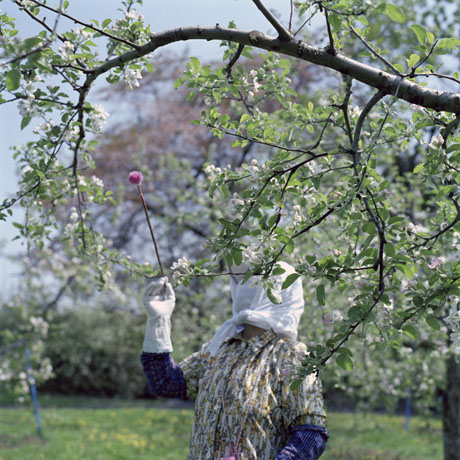
IMAGE: Hand Pollination #1, Spring, Aomori Prefecture, photograph by artist Jane Alden Stevens.
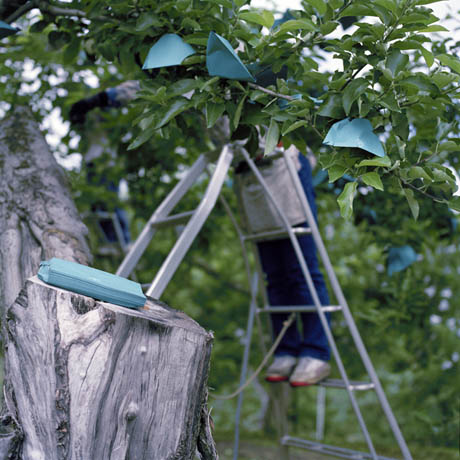
IMAGE: Bags for Apples, Early Summer, Aomori Prefecture, photograph by artist Jane Alden Stevens.
The bags do double duty, shielding the apples from pests and weather damage while also increasing the skin’s photosensitivity. In the autumn, a few weeks before harvest, the bags are removed — first, the outer one, revealing the fruit’s sun-deprived, pearly white skin, and then, up to ten days later, the translucent inner ones, whose different colours are chosen to filter the light spectrum in order to produce the desired hue.
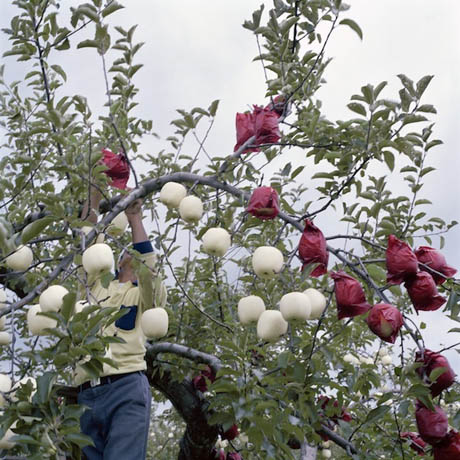
IMAGE: Removing Inner Bags #1, Fall, Aomori Prefecture, photograph by artist Jane Alden Stevens.
As they are finally exposed to the elements for the final few weeks before harvest, the most perfect of these already perfect apples are then decorated with a sticker that blocks sunlight to stencil an image onto the fruit. This “fruit mark” might be the Japanese kanji for “good health,” as Susan Brown mentioned. Others have brand logos (most notably that of Apple, the company), and some, according to Stevens, are “negatives with pictures. One Japanese pop star put his picture on apples to give his entourage for presents.”
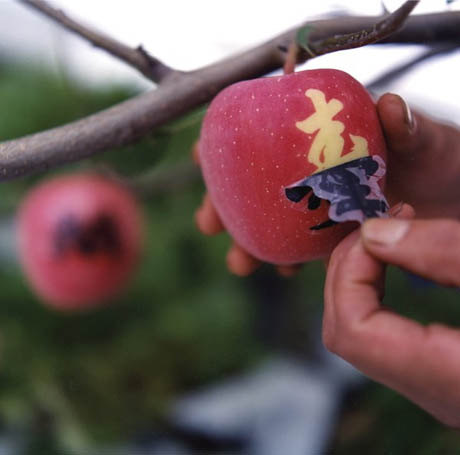
IMAGE: Photogram Beneath the Stencil, Fall, Aomori Prefecture, photograph by artist Jane Alden Stevens.
Far from being the apple of the future, however, Stevens tells the University of Cincinnati magazine that apple bagging and stencilling is in decline. When she visited Japan in 2007, apple bagging was applied to about thirty percent of the crop, “but fifty years ago, it affected seventy percent,” Stevens says. “Farmers do it themselves, but their children aren’t following in their footsteps, and there aren’t enough laborers to do the work.”
Fruit-marking is not even a recent — or an exclusively Japanese — development. I first came across mention of it in Suzanne Freidberg’s wonderful book, Fresh, which describes the efforts of the nineteenth-century fruit-growers of Montreuil to “brand” their apples for the novelty-seeking Parisian luxury market. Wives and children spent their winters folding and gluing thousands of paper bags, and their springtime covering up each individual apple at a rate of up to 3,000 per hour.
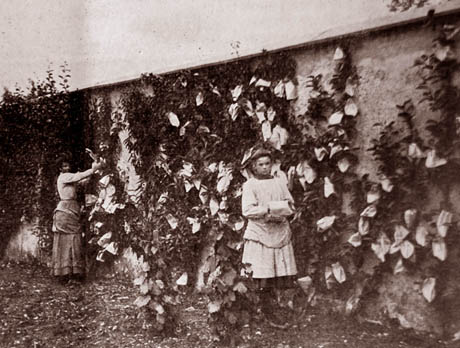
IMAGE: L’ensachage (fruit bagging), from the “Le travail quotidien” section of the Société Régionale d’Horticulture de Montreuil online archive.
The introduction of fruit stencils followed quickly behind, initially applied to the fruit with egg white or bave d’escargot (snail slime). According to Freidberg, particularly ambitious growers also developed negatives on their apples, in a kind of “fruit photography”:
The marked fruit of the Montreuillois first won renown at the 1894 Saint Petersburg exhibition, where they presented the czar of Russia with an apple stenciled with his own portrait. King Leopold of Belgium, Edward VII of England, and Teddy Roosevelt received similar fruits.
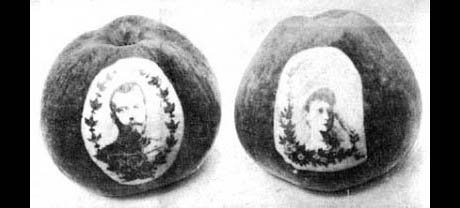
IMAGE: Photographic apple portraits of the Tsar of Russia and his wife, via the website of artist Pauline Fouché.
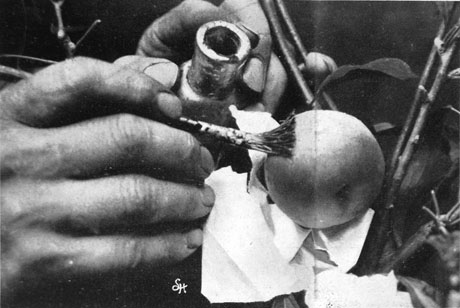
IMAGE: Applying gelatin glue to an apple, from the “Le travail quotidien” section of the Société Régionale d’Horticulture de Montreuil online archive.
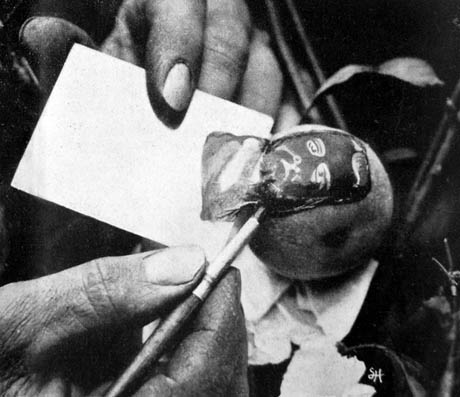
IMAGE: Peeling away a stencil on an apple, from the “Le travail quotidien” section of the Société Régionale d’Horticulture de Montreuil online archive.
The idea of fruit-marking may well have come from an even earlier source, Freidberg notes, mentioning a reference in an Arabic treatise on agriculture from the twelfth century. Nonetheless, by the 1930s, the practice was all but extinct in France, as Montreuil was absorbed into the Parisian suburbs and an industrialising agricultural sector produced ever cheaper mass-market fruit.
Still, after three years of trying, the Société Régionale d’Horticulture de Montreuil appears to be successfully reviving the lost art for today’s hobbyists and home gardeners. Their album of recent successes includes swirling dragons and tribal imagery worthy of any would-be Ink Master; a twenty-first century apple is more likely to sport a Che tattoo than a king or tsar.
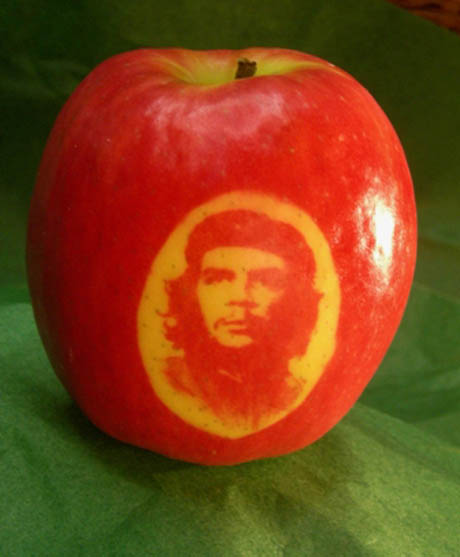
IMAGE: A stencil of Che Guevara, from the fruits marqués section of the Société Régionale d’Horticulture de Montreuil website.
Perhaps Cornell’s Susan Brown is onto something with apple stencils, after all. Although the commercial growers she works with are unlikely to pursue fruit bagging and photography, at least in the near future (the labour costs are simply too high), the technique seems ripe for rediscovery by today’s artisanal producers. Banksy could market a line of stencils for London’s fruit trees, Brooklyn growers could develop photographs of local landmarks on their heirloom varieties, and suburban families could entice their children into choosing apples over sweets by imprinting them with cartoon characters. Move over, bacon — tattooed apples are the next trend.
Tertiarymatt, Russian Sledges and -1 others like this
18 Feb 04:00
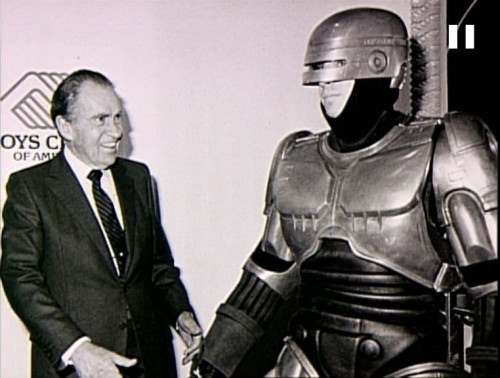
awesomepeoplehangingouttogether: Richard Nixon and Robocop
Tertiarymatt, Russian Sledges and 2 others like this
17 Feb 17:13
Haley Morris-Cafiero’s Photos Of People Sneering At Her Weight
by Danny Olda


In her series titled Wait Watchers, the photography of Haley Morris-Cafiero turns an eye back on those that turn an eye on her. While creating an image for another series Morris noticed a man “sneering” at her behind her back. Wait Watchers intentionally captures these reactions – the sneer, raised eyebrow, the frown that Morris says she is aware others make in regards to here weight. The sadly familiar scenes play out all the time. However, frozen in a photograph adds another emotional level to the work.


17 Feb 03:49
The 25 Best Food Moments in The Wire
by Hannah Norwick
Russian Sledgeswire food autoshare
It's often said the most compelling character in HBO's The Wire isn't Jimmy McNulty, Avon Barksdale, or Omar Little, but the city of Baltimore itself. Throughout the show's unforgettable five seasons, the Charm City isn't just a passive bystander in the drama, but rather the vital, beating heart at the center of creator David Simon's sprawling web of storylines.
Nowhere is this consuming sense of place more apparent than in the series' brilliant use of food—after all, if a city is going to be the star, its regional flavors should be front and center. So many TV shows gloss over the way we eat, deeming it too mundane to warrant screen time. But Simon is no average storyteller, and by taking us straight into the literal gut of the city, he gives us a fascinating lens into what nourishes it.
For a show obsessively devoted to realism, it's no surprise that The Wire nails Baltimore's hyperregional eats, from Chaps Pit Beef and lake trout, to Faidley's crab cakes and spicy fish sandwiches. But breaking bread runs much deeper than surface authenticity—indeed, meals are at center of many of the show's most poignant moments, such as Bunny's tragic attempt to treat his students to a steak dinner at a restaurant where their outsider status is palpable.
The symbolism of food isn't lost on Simon either. He artfully plays on the connotations of beef and chicken in exploring the relationship between Wey Bey (the muscle) and D'Angelo Barksdale (the nervous thinker), or uses relatable details—like Omar's penchant for Honey Nut Cheerios—to humanize even the most cold-blooded characters. He also shows how the places where characters dine—from the politico diner where corrupt deals go down, to the bulletproof glass-covered carryout spots of the Westside—reflect their place in the system.
Here, we break down the 25 most memorable food-centric scenes in the series. Got a favorite that we missed? Let us know in the comments. Season: One
Episode Name: "Lessons"
Actual Baltimore restaurant: Chaps Pit Beef
The Barksdale boys go to eat some pit beef (a beloved Baltimore sandwich made with grilled top round shaved thin and served on a sandwich) for lunch. Wee-Bey—the muscle in the group—spreads tons of horseradish all over his order, which elicits a response from D'Angelo: "Damn, Bey, how can you stand that shit with all that hot shit on it?" The stone-cold killer replies, "The trick is not to give a fuck, boy. I got this."
Pit beef acts as both a regional marker for the Baltimore working-class neighborhood where the scene takes place, as well as a symbolic divide between Wee-Bey—the metaphorical "beef" who can dismiss it all—and D, who is incapable of doing such (he is commonly associated with chicken on the show).
Unfortunately, this YouTube clip ends before we see Wee-Bey choke on his super-spicy sandwich.
Season: One
Episode Name: "Lessons"
Actual Baltimore restaurant: Chaps Pit Beef
The Barksdale boys go to eat some pit beef (a beloved Baltimore sandwich made with grilled top round shaved thin and served on a sandwich) for lunch. Wee-Bey—the muscle in the group—spreads tons of horseradish all over his order, which elicits a response from D'Angelo: "Damn, Bey, how can you stand that shit with all that hot shit on it?" The stone-cold killer replies, "The trick is not to give a fuck, boy. I got this."
Pit beef acts as both a regional marker for the Baltimore working-class neighborhood where the scene takes place, as well as a symbolic divide between Wee-Bey—the metaphorical "beef" who can dismiss it all—and D, who is incapable of doing such (he is commonly associated with chicken on the show).
Unfortunately, this YouTube clip ends before we see Wee-Bey choke on his super-spicy sandwich.
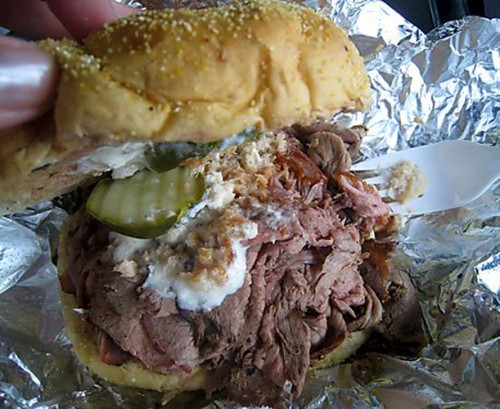 Photo: goodiesfirst.com
 Season: One
Episode name: "Sentencing"
Food: Pit Beef
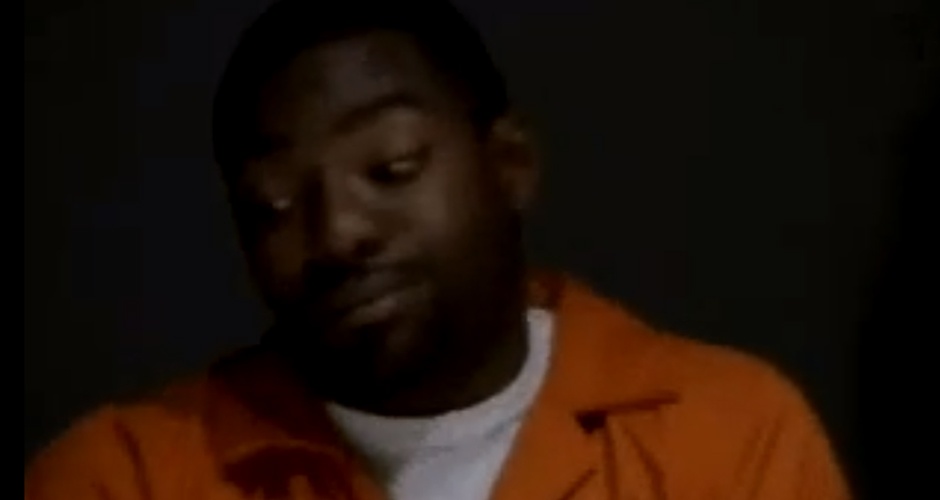
Inside an interrogation room, already enjoying one pit beef sandwich and fries, Wee-Bey agrees to cop to more murders saying, "For another pit sandwich and potato salad, I'll go a few more." The order: "Medium-rare, a lot of horseradish." For that he owns up to Little Man, the security lady, and the maintenance man. The funny thing is that after taking the fall on all those bodies—some of which he isn't even responsible for—the pit-beef spot is out of potato salad. Damn.
Season: One
Episode name: "Sentencing"
Food: Pit Beef
Inside an interrogation room, already enjoying one pit beef sandwich and fries, Wee-Bey agrees to cop to more murders saying, "For another pit sandwich and potato salad, I'll go a few more." The order: "Medium-rare, a lot of horseradish." For that he owns up to Little Man, the security lady, and the maintenance man. The funny thing is that after taking the fall on all those bodies—some of which he isn't even responsible for—the pit-beef spot is out of potato salad. Damn. Season: One
Episode Name: "The Cost"
Actual Baltimore restaurant: J.W. Faidley
McNulty is no dummy—he knows that if you are looking for a favor, you have to make it worthwhile to play ball. That means delivering crab cakes and beers to other officers while they wait on Wallace to show up. As he pulls the stash from the trunk, McNulty remarks, "Mrs. McNulty didn't raise no fools. Four Faidley’s crab cakes in the bag, 24 Dutch beers in the box.” Not only does Jimmy deliver crab cakes, but he gets them from the mecca of B-More crabby patties, earning a nod of approval: “Faidley’s, huh? You alright McNulty, I don’t care what all them motherfucks downtown say about you.”
Season: One
Episode Name: "The Cost"
Actual Baltimore restaurant: J.W. Faidley
McNulty is no dummy—he knows that if you are looking for a favor, you have to make it worthwhile to play ball. That means delivering crab cakes and beers to other officers while they wait on Wallace to show up. As he pulls the stash from the trunk, McNulty remarks, "Mrs. McNulty didn't raise no fools. Four Faidley’s crab cakes in the bag, 24 Dutch beers in the box.” Not only does Jimmy deliver crab cakes, but he gets them from the mecca of B-More crabby patties, earning a nod of approval: “Faidley’s, huh? You alright McNulty, I don’t care what all them motherfucks downtown say about you.”
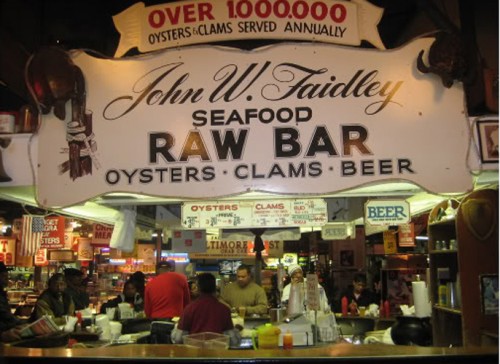 Photo: andromedadrive.blogspot.com
 Photo: andromedadrive.blogspot.com
 Season: One
Episode: "The Target"
Actual Baltimore restaurant: Sterling's Crab & Oyster House
The first time Brianna Barksdale (Avon's sister and D'Angelo's mother) is introduced on The Wire, she is bringing D lunch in the pit—the low rises he has been demoted to. Food in this scene acts as a means of showing the role of a mother's devotion to her son while she brings him lunch at work, as well as displaying the quite literal ties between geography and class in Baltimore. Brianna brings D fish from Sterling's Seafood, a local Baltimore restaurant, prompting Wallace to comment, "If it ain't in the Westside, I don't know it, yo." The Terrace is all Wallace knows, and as small as B-More may be, the Westside is even smaller. Your local fish joint says everything about where you're from, and the show often uses food as a marker of neighborhoods and class divides.
Season: One
Episode: "The Target"
Actual Baltimore restaurant: Sterling's Crab & Oyster House
The first time Brianna Barksdale (Avon's sister and D'Angelo's mother) is introduced on The Wire, she is bringing D lunch in the pit—the low rises he has been demoted to. Food in this scene acts as a means of showing the role of a mother's devotion to her son while she brings him lunch at work, as well as displaying the quite literal ties between geography and class in Baltimore. Brianna brings D fish from Sterling's Seafood, a local Baltimore restaurant, prompting Wallace to comment, "If it ain't in the Westside, I don't know it, yo." The Terrace is all Wallace knows, and as small as B-More may be, the Westside is even smaller. Your local fish joint says everything about where you're from, and the show often uses food as a marker of neighborhoods and class divides. Season: One
Episode Name: "The Pager"
Actual Baltimore restaurant: The Prime Rib
"Do they know?" D asks his girl, "what I'm about?" On multiple occasions in The Wire, fine-dining restaurants are used to show class divides. Feelings of societal separation come out at the dinner table. D bristling at a server crumbing the table and reaching for his own dessert off the display cart reflect what Avon Barksdale's nephew is battling internally—he'll never be like them, and what's it all for anyway?
Season: One
Episode Name: "The Pager"
Actual Baltimore restaurant: The Prime Rib
"Do they know?" D asks his girl, "what I'm about?" On multiple occasions in The Wire, fine-dining restaurants are used to show class divides. Feelings of societal separation come out at the dinner table. D bristling at a server crumbing the table and reaching for his own dessert off the display cart reflect what Avon Barksdale's nephew is battling internally—he'll never be like them, and what's it all for anyway? Season: One
Episode: "The Detail"
Food: Chicken McNuggets
Poot, Wallace, and D'Angelo sit in the pit and speculate about the man who created the McNugget. Wallace is convinced that because the nugget changed everything, the guy must be rich: "Motherfucker got the bone all the way out the damn chicken. 'Til he came along, niggas been chewing on drumsticks and shit, getting their fingers all greasy." The McNuggets issue leads to a discussion about who gets credit and who gets paid. D tells Wallace, "The man who invented them things is just some sad ass at the basement of McDonald's." Poot and Wallace are the ones who would go down for selling drugs, while the big players, the Ronald McDonalds, make all the money. "It ain't about right, it's about money," D tells Poot. Who knew Micky D's could inspire such real talk.
Season: One
Episode: "The Detail"
Food: Chicken McNuggets
Poot, Wallace, and D'Angelo sit in the pit and speculate about the man who created the McNugget. Wallace is convinced that because the nugget changed everything, the guy must be rich: "Motherfucker got the bone all the way out the damn chicken. 'Til he came along, niggas been chewing on drumsticks and shit, getting their fingers all greasy." The McNuggets issue leads to a discussion about who gets credit and who gets paid. D tells Wallace, "The man who invented them things is just some sad ass at the basement of McDonald's." Poot and Wallace are the ones who would go down for selling drugs, while the big players, the Ronald McDonalds, make all the money. "It ain't about right, it's about money," D tells Poot. Who knew Micky D's could inspire such real talk. Season: One
Episode name: "The Target"
Actual restaurant in Baltimore: New York Fried Chicken
This is the first instance that Wee-Bey is signified as the beef of the crew, and D'Angelo the chicken. After D has been acquitted for shooting a guy in the elevator of the towers, he says to Bey in the car, "That's slick what you did with the lady in the courthouse." This is a major drug-game faux pas—no talking in the car or on the phones, yo! New York Fried Chicken (from the owners of Kennedy Fried Chicken in NYC) is the staging for the scene where Bey reprimands D for doing so.
Bey stands below the sign for burgers while D is under the sign that reads chicken. Wee-Bey is a cool and collected killer, a business man, while D'Angelo is scared, unsure, and well, a chicken. New York Fried Chicken pops up quite a bit throughout all five seasons and—distressing factoid alert!—happens to be the location where Felicia "Snoop" Pearson was part of a scuffle that ended in a murder in real life.
Season: One
Episode name: "The Target"
Actual restaurant in Baltimore: New York Fried Chicken
This is the first instance that Wee-Bey is signified as the beef of the crew, and D'Angelo the chicken. After D has been acquitted for shooting a guy in the elevator of the towers, he says to Bey in the car, "That's slick what you did with the lady in the courthouse." This is a major drug-game faux pas—no talking in the car or on the phones, yo! New York Fried Chicken (from the owners of Kennedy Fried Chicken in NYC) is the staging for the scene where Bey reprimands D for doing so.
Bey stands below the sign for burgers while D is under the sign that reads chicken. Wee-Bey is a cool and collected killer, a business man, while D'Angelo is scared, unsure, and well, a chicken. New York Fried Chicken pops up quite a bit throughout all five seasons and—distressing factoid alert!—happens to be the location where Felicia "Snoop" Pearson was part of a scuffle that ended in a murder in real life. Season: Two
Epidsode name: "Collateral Damage
Food: Fresh-off-the-boat Maryland crabs
After getting stuck on a patrol boat, Jimmy has some "fringe benefits," a.k.a. free crabs. He and Bunk sit in one of the homicide interrogation rooms and eat crabs off of newspaper while guzzling Miller Genuine Draft. The conversation is raunchy as usual, about catching another kind of crab in the murder police unit. It's hard not to love these two—and to crave some Maryland crabs—while watching the scene.
Season: Two
Epidsode name: "Collateral Damage
Food: Fresh-off-the-boat Maryland crabs
After getting stuck on a patrol boat, Jimmy has some "fringe benefits," a.k.a. free crabs. He and Bunk sit in one of the homicide interrogation rooms and eat crabs off of newspaper while guzzling Miller Genuine Draft. The conversation is raunchy as usual, about catching another kind of crab in the murder police unit. It's hard not to love these two—and to crave some Maryland crabs—while watching the scene. Season: Two
Episode Name: "Duck and Cover"
Actual restaurant in Baltimore: Hollywood Diner
As much as Jimmy McNulty's drunk ass should be upsetting, it's more entertaining than anything else. This is without a doubt one of the most memorable scenes displaying McNulty's boozehound lifestyle, when he's in swift decline due to too much Jame-O. After crashing his car—twice—he stumbles into a diner for a coffee. The waitress looks half-decent so he splurges on scrapple and eggs too. Then on to a one night stand, naturally! Too bad the lady he wakes up with in the morning is definitely not the chick his beer goggles painted the night before.
The famous Baltimore Hollywood Diner is no longer open, but it is also recognizable as being the main location for Diner, the Baltimore film by Wire co-director Barry Levinson.
Season: Two
Episode Name: "Duck and Cover"
Actual restaurant in Baltimore: Hollywood Diner
As much as Jimmy McNulty's drunk ass should be upsetting, it's more entertaining than anything else. This is without a doubt one of the most memorable scenes displaying McNulty's boozehound lifestyle, when he's in swift decline due to too much Jame-O. After crashing his car—twice—he stumbles into a diner for a coffee. The waitress looks half-decent so he splurges on scrapple and eggs too. Then on to a one night stand, naturally! Too bad the lady he wakes up with in the morning is definitely not the chick his beer goggles painted the night before.
The famous Baltimore Hollywood Diner is no longer open, but it is also recognizable as being the main location for Diner, the Baltimore film by Wire co-director Barry Levinson. Season: Three
Episode Name: "Moral Midgetry"
Food: Lake trout, a sandwich of Atlantic whiting (not actually trout) that is battered, fried in oil, and served on white bread.
Note: scene begins at 3:27 in the video above.
The Lake Trout carryout is the location where Avon will attempt to kill Marlo. Snoop is posted up early, waiting for Marlo to meet Devonne and surveying the scene while enjoying some fried fish. The dude at the counter orders, "Four trout on white, extra mayo on one, hot sauce on two and another with ketchup, and four orange sodas,” to bring back to the car to the Barksdale crew.
The regional Baltimore sandwich acts as a marker of location, as it is commonly sold for cheap in lower income neighborhoods. The sandwich joint is also a believable place for Devonne and Marlo to meet, as Avon tries to set him up. Like Wee-Bey and his pit beef, people on the show feel strongly about the way their lake trout is prepared, and what they are drinking it with. It is a sandwich synonymous with B-More.
Season: Three
Episode Name: "Moral Midgetry"
Food: Lake trout, a sandwich of Atlantic whiting (not actually trout) that is battered, fried in oil, and served on white bread.
Note: scene begins at 3:27 in the video above.
The Lake Trout carryout is the location where Avon will attempt to kill Marlo. Snoop is posted up early, waiting for Marlo to meet Devonne and surveying the scene while enjoying some fried fish. The dude at the counter orders, "Four trout on white, extra mayo on one, hot sauce on two and another with ketchup, and four orange sodas,” to bring back to the car to the Barksdale crew.
The regional Baltimore sandwich acts as a marker of location, as it is commonly sold for cheap in lower income neighborhoods. The sandwich joint is also a believable place for Devonne and Marlo to meet, as Avon tries to set him up. Like Wee-Bey and his pit beef, people on the show feel strongly about the way their lake trout is prepared, and what they are drinking it with. It is a sandwich synonymous with B-More. Season: Four
Episode Name: "Know Your Place"
Actual restaurant in Baltimore: Ruth's Chris Steakhouse
After being the first team to put together a puzzle in Bunny's class, he takes the three winners out for a fancy dinner at Ruth's Chris as a reward. The scene is one similar to that of D'Angelo's in the first season, demonstrating how uncomfortable the children are outside of their familiar surroundings. It is as if the fine-dining scene of Ruth's Chris exists in an entirely different planet than the one in which the three kids live. Watching their frustration mount is one of the show's most poignant and uncomfortable moments. Again, food is a marker of society. This dinner teaches Bunny more about the way the kids view themselves than anything in the classroom has so far. The episode is aptly titled "Know Your Place."
Season: Four
Episode Name: "Know Your Place"
Actual restaurant in Baltimore: Ruth's Chris Steakhouse
After being the first team to put together a puzzle in Bunny's class, he takes the three winners out for a fancy dinner at Ruth's Chris as a reward. The scene is one similar to that of D'Angelo's in the first season, demonstrating how uncomfortable the children are outside of their familiar surroundings. It is as if the fine-dining scene of Ruth's Chris exists in an entirely different planet than the one in which the three kids live. Watching their frustration mount is one of the show's most poignant and uncomfortable moments. Again, food is a marker of society. This dinner teaches Bunny more about the way the kids view themselves than anything in the classroom has so far. The episode is aptly titled "Know Your Place." Season: Four
Episode name: "A New Day"
McNulty walks into a sandwich joint to grab lunch and who does he run into but Bodie. The restaurant gives them a new space to interact outside of the interrogation room, and it seems that choosing the same place for lunch initiates a sort of understanding that continues to be built upon. "Health Department shut down Chicken George again?" McNulty playfully asks, as Bodie tells him he's laying low for the day, since the police are hitting the corners hard. The necessity of food brings the two together, all while painting a scene of a humble Baltimore lunch spot.
Season: Four
Episode name: "A New Day"
McNulty walks into a sandwich joint to grab lunch and who does he run into but Bodie. The restaurant gives them a new space to interact outside of the interrogation room, and it seems that choosing the same place for lunch initiates a sort of understanding that continues to be built upon. "Health Department shut down Chicken George again?" McNulty playfully asks, as Bodie tells him he's laying low for the day, since the police are hitting the corners hard. The necessity of food brings the two together, all while painting a scene of a humble Baltimore lunch spot. Season: Four
Episode Name: "Final Grades"
After getting charges dropped on Bodie, McNulty takes him for some lunch in a park over near Pimlico. This meeting prefigures the circumstances that lead to Bodie being killed, as having close dealings with a cop eventually gets him pegged as a snitch. Still, lunch acts as a common ground, a sort of neutralizer of roles. Over sandwiches in the arboretum, McNulty is not a cop for a moment, and Bodie not a lieutenant for Marlo. They are just a couple of guys working in two separate systems that are screwing them over. This is the second time that lunch brings the two together not as cat and mouse, but as two men who respect each other.
Season: Four
Episode Name: "Final Grades"
After getting charges dropped on Bodie, McNulty takes him for some lunch in a park over near Pimlico. This meeting prefigures the circumstances that lead to Bodie being killed, as having close dealings with a cop eventually gets him pegged as a snitch. Still, lunch acts as a common ground, a sort of neutralizer of roles. Over sandwiches in the arboretum, McNulty is not a cop for a moment, and Bodie not a lieutenant for Marlo. They are just a couple of guys working in two separate systems that are screwing them over. This is the second time that lunch brings the two together not as cat and mouse, but as two men who respect each other. Season: Four
Episode name: "Know Your Place"
Food: Orange M&Ms
After initially being fooled by his misleading nickname (watch the scene above), Herc finally tracks down Little Kevin (not so little, as it turns out) to interrogate him about the murder of Lex—but it's all shenanigans after that. Little Kevin is eating peanut M&Ms, meticulously picking out the orange ones and setting them aside, until Herc gets frustrated and grabs the bag away to demand that talk. As soon as he gives the candy back, Little Kevin goes right back to ignoring him.
Food is a fixture during police interviews, from feeding Wee-Bey to get more murder confessions out of him, to tricking a kid into confessing with some McDonald's. These run-ins with the law are commonplace for the corner hustlers, and Little Kevin's focus on snacking shows just how unfazed he is.
Season: Four
Episode name: "Know Your Place"
Food: Orange M&Ms
After initially being fooled by his misleading nickname (watch the scene above), Herc finally tracks down Little Kevin (not so little, as it turns out) to interrogate him about the murder of Lex—but it's all shenanigans after that. Little Kevin is eating peanut M&Ms, meticulously picking out the orange ones and setting them aside, until Herc gets frustrated and grabs the bag away to demand that talk. As soon as he gives the candy back, Little Kevin goes right back to ignoring him.
Food is a fixture during police interviews, from feeding Wee-Bey to get more murder confessions out of him, to tricking a kid into confessing with some McDonald's. These run-ins with the law are commonplace for the corner hustlers, and Little Kevin's focus on snacking shows just how unfazed he is. Season: Four
Episode name: "Home Rooms"
Food: Cheerios
It's a running gag that Omar—who is even terrifying in satin-blue pajamas—loves his Cheerios, especially of the Honey Nut variety. Even when he is in "retirement" somewhere in Spain or South America, he is annoyed that he can't get his hands on his favorite cereal. Simon again uses food to put the drama into relief: Omar might be a stone-cold killer with a sawed-off shot gun, but everybody's gotta eat. Why not have the man who makes children run in fear love Cheerios?
Season: Four
Episode name: "Home Rooms"
Food: Cheerios
It's a running gag that Omar—who is even terrifying in satin-blue pajamas—loves his Cheerios, especially of the Honey Nut variety. Even when he is in "retirement" somewhere in Spain or South America, he is annoyed that he can't get his hands on his favorite cereal. Simon again uses food to put the drama into relief: Omar might be a stone-cold killer with a sawed-off shot gun, but everybody's gotta eat. Why not have the man who makes children run in fear love Cheerios?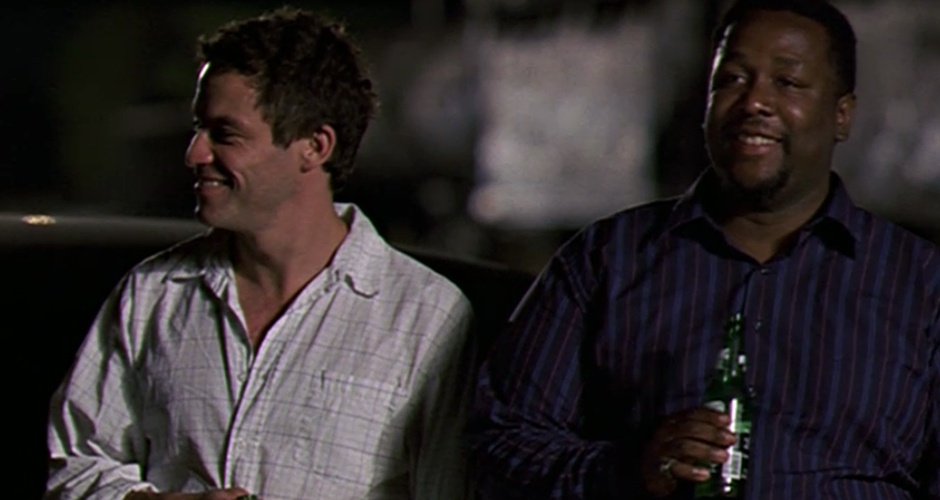 Season: Four
Episode Name: "Home Rooms"
Food: Lake Trout
Season four has Jimmy looking like he has his act together—no drinking, no womanizing, and coming home to Beadie and the kids at night. Even his ex-wife is impressed. Old partner and best buddy, The Bunk, is not fooled. After a nice dinner with the new family, the guys find their way down to their old drinking spot by the train tracks. A conversation about lake trout is loaded with metaphor, as Bunk describes the Baltimore classic as being neither from a lake, nor made with trout. This is probably the best example of foods larger role in The Wire, as Bunk is clearing referring to Jimmy and not just the fried "white trash" sandwich.
Unfortunately there was no YouTube clip to be found, but the exchange goes something like this:
Bunk: You know those little corner joints in the ghetto that sell subs, fried chicken, lake trout?
McNulty: Lake trout.
Bunk: Like egg creams in New York.
McNulty: No eggs, no cream.
Bunk: Exactly—no lake, no trout.
McNulty: Like Pogies. White fish. Trash fish.
Bunk: White trash fish? I mean, lake trout, that’s all marketing—it’s just all dressed up like something it ain’t. You know what I’m saying?
McNulty: Sometimes it is what it is. It really is.
Bunk: That’s deep. I like the way you think.
McNulty: Yeah, you too.
Season: Four
Episode Name: "Home Rooms"
Food: Lake Trout
Season four has Jimmy looking like he has his act together—no drinking, no womanizing, and coming home to Beadie and the kids at night. Even his ex-wife is impressed. Old partner and best buddy, The Bunk, is not fooled. After a nice dinner with the new family, the guys find their way down to their old drinking spot by the train tracks. A conversation about lake trout is loaded with metaphor, as Bunk describes the Baltimore classic as being neither from a lake, nor made with trout. This is probably the best example of foods larger role in The Wire, as Bunk is clearing referring to Jimmy and not just the fried "white trash" sandwich.
Unfortunately there was no YouTube clip to be found, but the exchange goes something like this:
Bunk: You know those little corner joints in the ghetto that sell subs, fried chicken, lake trout?
McNulty: Lake trout.
Bunk: Like egg creams in New York.
McNulty: No eggs, no cream.
Bunk: Exactly—no lake, no trout.
McNulty: Like Pogies. White fish. Trash fish.
Bunk: White trash fish? I mean, lake trout, that’s all marketing—it’s just all dressed up like something it ain’t. You know what I’m saying?
McNulty: Sometimes it is what it is. It really is.
Bunk: That’s deep. I like the way you think.
McNulty: Yeah, you too. Season: Four
Episode name: "That's Got His Own"
Actual restaurant in Baltimore: Polock Johnny's
After the shutting down of "Hamsterdam" and Bunny Colvin's work at the school, he and the Deacon get pretty tight. They meet for a few hot dogs at Polock Johnny's, a Baltimore institution since 1921, but the Deacon won't touch the stuff. The conversation revolves around pig, and it's hard not to link the word to its other connotation regarding cops—although it really might just be about the meat. Either way, the Deacon tells Bunny he messed up putting kraut and chili on his dog instead of the original sauce. The more classic order means going for The Works—a Polish dog with special sauce—rather than the Everything, which Bunny opted for.
Season: Four
Episode name: "That's Got His Own"
Actual restaurant in Baltimore: Polock Johnny's
After the shutting down of "Hamsterdam" and Bunny Colvin's work at the school, he and the Deacon get pretty tight. They meet for a few hot dogs at Polock Johnny's, a Baltimore institution since 1921, but the Deacon won't touch the stuff. The conversation revolves around pig, and it's hard not to link the word to its other connotation regarding cops—although it really might just be about the meat. Either way, the Deacon tells Bunny he messed up putting kraut and chili on his dog instead of the original sauce. The more classic order means going for The Works—a Polish dog with special sauce—rather than the Everything, which Bunny opted for.
 Season: Five
Episode Name: "More with Less"
Food: Two Quarter Pounders, large fries, McDonald Land cookies, and Dr. Pepper
The Wire was known for its epic opening scenes, and this one certainly didn't disappoint. Bunk and the team get a confession out of young suspect using only a bag of Mickey D's and a copy machine. Behold the power of the Quarter Pounder.
Season: Five
Episode Name: "More with Less"
Food: Two Quarter Pounders, large fries, McDonald Land cookies, and Dr. Pepper
The Wire was known for its epic opening scenes, and this one certainly didn't disappoint. Bunk and the team get a confession out of young suspect using only a bag of Mickey D's and a copy machine. Behold the power of the Quarter Pounder. Season: One
Episode Name: "Lessons"
Actual location in Baltimore: Northeast Market
Episode eight of season one opens with McNulty out on "market day" with his kids—one's eating a cookie, the other has ice cream, and McNulty gets a lemonade for himself. Everything's all calm and cool until McNulty spots Stinger Bell strolling through the stalls. He enlists the kids to play a game called front and follow—a police tactic used to track suspects—and they do a bang-up job. The same can't be said for McNulty, who totally looses them and has go get help from market security to track them down. At any rate, the market looks pretty sweet, with fresh produce and a stall called "B-B-Q & Fish."
Season: One
Episode Name: "Lessons"
Actual location in Baltimore: Northeast Market
Episode eight of season one opens with McNulty out on "market day" with his kids—one's eating a cookie, the other has ice cream, and McNulty gets a lemonade for himself. Everything's all calm and cool until McNulty spots Stinger Bell strolling through the stalls. He enlists the kids to play a game called front and follow—a police tactic used to track suspects—and they do a bang-up job. The same can't be said for McNulty, who totally looses them and has go get help from market security to track them down. At any rate, the market looks pretty sweet, with fresh produce and a stall called "B-B-Q & Fish."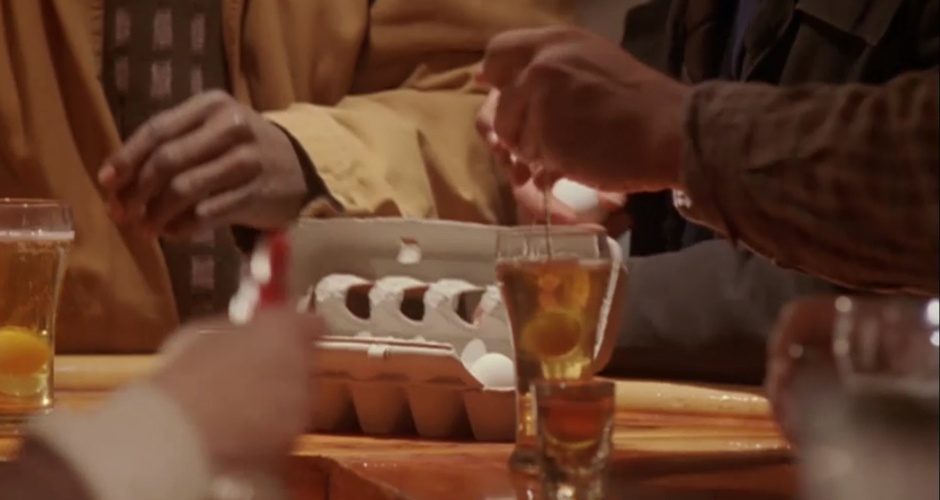 Season: Two
Episode name: "Collateral Damage"
Season two is all about the docks, and holy hell can the longshoremen drink. Most meals are consumed in liquid form, like a breakfast of raw eggs cracked into a beer with a shot of whiskey. Not sure if this is a Baltimore tradition or not, but that is certainly one way to stay warm down by the water.
Although there is no video of this scene online, we did find one of the time Ziggy brings his duck to Dolores' bar. Unfortunately, it doesn't end so well for the feather-covered lush.
Season: Two
Episode name: "Collateral Damage"
Season two is all about the docks, and holy hell can the longshoremen drink. Most meals are consumed in liquid form, like a breakfast of raw eggs cracked into a beer with a shot of whiskey. Not sure if this is a Baltimore tradition or not, but that is certainly one way to stay warm down by the water.
Although there is no video of this scene online, we did find one of the time Ziggy brings his duck to Dolores' bar. Unfortunately, it doesn't end so well for the feather-covered lush.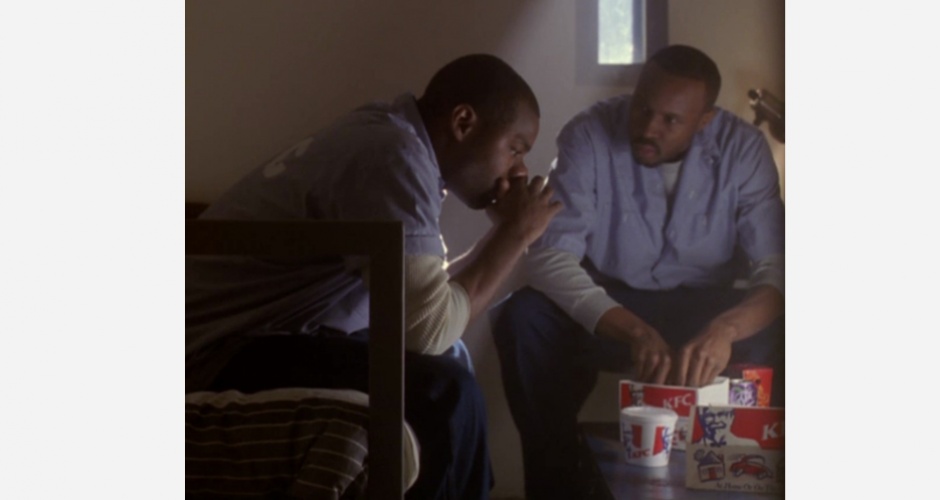 Season: Two
Episode name: "Collateral Damage"
Food: KFC
While Avon Barksdale serves his sentence and loses some control over his corners, he does just fine when it comes to grubbing on the inside. Security guards bring him KFC while poor Wey Bey gets his fake fish tank knocked over. Looks like the kingpin got a family-size order and a grape soda too.
Season: Two
Episode name: "Collateral Damage"
Food: KFC
While Avon Barksdale serves his sentence and loses some control over his corners, he does just fine when it comes to grubbing on the inside. Security guards bring him KFC while poor Wey Bey gets his fake fish tank knocked over. Looks like the kingpin got a family-size order and a grape soda too. Season: Four
Episode Name: "Home Rooms"
On the first day of school Randy ganks all of Prez's hall passes so that he can sell candy whenever he likes. The enterprising youngin' wears three shirts to school to fool teachers and attend other grades' lunches. It's hard not to love Randy for selling something other than dope, even if he is skipping class. And getting Prez to order in bulk for him—can't knock the hustle. Too bad it ends so harshly for him.
Season: Four
Episode Name: "Home Rooms"
On the first day of school Randy ganks all of Prez's hall passes so that he can sell candy whenever he likes. The enterprising youngin' wears three shirts to school to fool teachers and attend other grades' lunches. It's hard not to love Randy for selling something other than dope, even if he is skipping class. And getting Prez to order in bulk for him—can't knock the hustle. Too bad it ends so harshly for him. Season: Multiple
Actual restaurant in Baltimore: Werner's Diner
Throughout the five seasons of The Wire, diner scenes pop up a lot. From Burrell meeting with Carcetti, to Daniels and Randy meeting with the Judge, to Gus meeting with council president Nerese Campbell, we see that power lunches certainly exist in Baltimore, but they ain't fancy. Compared to all the take-out spots the show depicts on the Westside, these slightly more formal meals become associated with politics, corruption, and black mail. Who knew ordering a tuna sandwich and making your buddy pay could be such a loaded move.
Season: Multiple
Actual restaurant in Baltimore: Werner's Diner
Throughout the five seasons of The Wire, diner scenes pop up a lot. From Burrell meeting with Carcetti, to Daniels and Randy meeting with the Judge, to Gus meeting with council president Nerese Campbell, we see that power lunches certainly exist in Baltimore, but they ain't fancy. Compared to all the take-out spots the show depicts on the Westside, these slightly more formal meals become associated with politics, corruption, and black mail. Who knew ordering a tuna sandwich and making your buddy pay could be such a loaded move. Season: Five
Episode name: "30"
Food: Baltimore Crabs
In one of the more memorable scenes of season five, a drug-free Bubs sits with his sponsor, Walon, and eats a bag of crabs from his job. That bag of crabs will later be given to his sister before she closes the door on him, locking him downstairs. Sharing food rather than intravenous needles represents something new for the cleaned-up character. In the end, it is a communal meal that represents his re-entrance into the world and the acceptance of his family. In case you didn't realize yet, food on The Wire is mad deep.
Season: Five
Episode name: "30"
Food: Baltimore Crabs
In one of the more memorable scenes of season five, a drug-free Bubs sits with his sponsor, Walon, and eats a bag of crabs from his job. That bag of crabs will later be given to his sister before she closes the door on him, locking him downstairs. Sharing food rather than intravenous needles represents something new for the cleaned-up character. In the end, it is a communal meal that represents his re-entrance into the world and the acceptance of his family. In case you didn't realize yet, food on The Wire is mad deep. Season: Three
Episode name: "Back Burners"
Actual restaurant in Baltimore referenced: Bill's Carryout
Herc and another policeman work a corner down in "Hamsterdam" and try to figure out what to eat for lunch. The partner suggests cheesesteak from Bill's, but Herc's over it. That's right when Avon rolls by. After about 20 seconds of being upset about Barksdale's release, Herc turns his attention back to lunch. "Pit beef from the market," the other policeman suggests. Herc's happy—"see, now you're thinking like police!"
Season: Three
Episode name: "Back Burners"
Actual restaurant in Baltimore referenced: Bill's Carryout
Herc and another policeman work a corner down in "Hamsterdam" and try to figure out what to eat for lunch. The partner suggests cheesesteak from Bill's, but Herc's over it. That's right when Avon rolls by. After about 20 seconds of being upset about Barksdale's release, Herc turns his attention back to lunch. "Pit beef from the market," the other policeman suggests. Herc's happy—"see, now you're thinking like police!"
Wee-Bey Loves Horseradish
Season: One
Episode Name: "Lessons"
Actual Baltimore restaurant: Chaps Pit Beef
The Barksdale boys go to eat some pit beef (a beloved Baltimore sandwich made with grilled top round shaved thin and served on a sandwich) for lunch. Wee-Bey—the muscle in the group—spreads tons of horseradish all over his order, which elicits a response from D'Angelo: "Damn, Bey, how can you stand that shit with all that hot shit on it?" The stone-cold killer replies, "The trick is not to give a fuck, boy. I got this."
Pit beef acts as both a regional marker for the Baltimore working-class neighborhood where the scene takes place, as well as a symbolic divide between Wee-Bey—the metaphorical "beef" who can dismiss it all—and D, who is incapable of doing such (he is commonly associated with chicken on the show).
Unfortunately, this YouTube clip ends before we see Wee-Bey choke on his super-spicy sandwich.
Photo: goodiesfirst.comCopping to More Murders for Pit Beef
Season: One
Episode name: "Sentencing"
Food: Pit Beef
Inside an interrogation room, already enjoying one pit beef sandwich and fries, Wee-Bey agrees to cop to more murders saying, "For another pit sandwich and potato salad, I'll go a few more." The order: "Medium-rare, a lot of horseradish." For that he owns up to Little Man, the security lady, and the maintenance man. The funny thing is that after taking the fall on all those bodies—some of which he isn't even responsible for—the pit-beef spot is out of potato salad. Damn.Faidley's Crab Cakes for the Boys
Season: One
Episode Name: "The Cost"
Actual Baltimore restaurant: J.W. Faidley
McNulty is no dummy—he knows that if you are looking for a favor, you have to make it worthwhile to play ball. That means delivering crab cakes and beers to other officers while they wait on Wallace to show up. As he pulls the stash from the trunk, McNulty remarks, "Mrs. McNulty didn't raise no fools. Four Faidley’s crab cakes in the bag, 24 Dutch beers in the box.” Not only does Jimmy deliver crab cakes, but he gets them from the mecca of B-More crabby patties, earning a nod of approval: “Faidley’s, huh? You alright McNulty, I don’t care what all them motherfucks downtown say about you.”
Photo: andromedadrive.blogspot.com
Photo: andromedadrive.blogspot.comMom Brings Lunch to the Pit
Season: One
Episode: "The Target"
Actual Baltimore restaurant: Sterling's Crab & Oyster House
The first time Brianna Barksdale (Avon's sister and D'Angelo's mother) is introduced on The Wire, she is bringing D lunch in the pit—the low rises he has been demoted to. Food in this scene acts as a means of showing the role of a mother's devotion to her son while she brings him lunch at work, as well as displaying the quite literal ties between geography and class in Baltimore. Brianna brings D fish from Sterling's Seafood, a local Baltimore restaurant, prompting Wallace to comment, "If it ain't in the Westside, I don't know it, yo." The Terrace is all Wallace knows, and as small as B-More may be, the Westside is even smaller. Your local fish joint says everything about where you're from, and the show often uses food as a marker of neighborhoods and class divides.D'Angelo Takes his Girl to Dinner
Season: One
Episode Name: "The Pager"
Actual Baltimore restaurant: The Prime Rib
"Do they know?" D asks his girl, "what I'm about?" On multiple occasions in The Wire, fine-dining restaurants are used to show class divides. Feelings of societal separation come out at the dinner table. D bristling at a server crumbing the table and reaching for his own dessert off the display cart reflect what Avon Barksdale's nephew is battling internally—he'll never be like them, and what's it all for anyway?Chicken McNugget Philosophy
Season: One
Episode: "The Detail"
Food: Chicken McNuggets
Poot, Wallace, and D'Angelo sit in the pit and speculate about the man who created the McNugget. Wallace is convinced that because the nugget changed everything, the guy must be rich: "Motherfucker got the bone all the way out the damn chicken. 'Til he came along, niggas been chewing on drumsticks and shit, getting their fingers all greasy." The McNuggets issue leads to a discussion about who gets credit and who gets paid. D tells Wallace, "The man who invented them things is just some sad ass at the basement of McDonald's." Poot and Wallace are the ones who would go down for selling drugs, while the big players, the Ronald McDonalds, make all the money. "It ain't about right, it's about money," D tells Poot. Who knew Micky D's could inspire such real talk.Chicken Versus the Beef
Season: One
Episode name: "The Target"
Actual restaurant in Baltimore: New York Fried Chicken
This is the first instance that Wee-Bey is signified as the beef of the crew, and D'Angelo the chicken. After D has been acquitted for shooting a guy in the elevator of the towers, he says to Bey in the car, "That's slick what you did with the lady in the courthouse." This is a major drug-game faux pas—no talking in the car or on the phones, yo! New York Fried Chicken (from the owners of Kennedy Fried Chicken in NYC) is the staging for the scene where Bey reprimands D for doing so.
Bey stands below the sign for burgers while D is under the sign that reads chicken. Wee-Bey is a cool and collected killer, a business man, while D'Angelo is scared, unsure, and well, a chicken. New York Fried Chicken pops up quite a bit throughout all five seasons and—distressing factoid alert!—happens to be the location where Felicia "Snoop" Pearson was part of a scuffle that ended in a murder in real life.McNulty and Bunk Eat Crabs
Season: Two
Epidsode name: "Collateral Damage
Food: Fresh-off-the-boat Maryland crabs
After getting stuck on a patrol boat, Jimmy has some "fringe benefits," a.k.a. free crabs. He and Bunk sit in one of the homicide interrogation rooms and eat crabs off of newspaper while guzzling Miller Genuine Draft. The conversation is raunchy as usual, about catching another kind of crab in the murder police unit. It's hard not to love these two—and to crave some Maryland crabs—while watching the scene.McNulty Wasted at the Late-Night Diner
Season: Two
Episode Name: "Duck and Cover"
Actual restaurant in Baltimore: Hollywood Diner
As much as Jimmy McNulty's drunk ass should be upsetting, it's more entertaining than anything else. This is without a doubt one of the most memorable scenes displaying McNulty's boozehound lifestyle, when he's in swift decline due to too much Jame-O. After crashing his car—twice—he stumbles into a diner for a coffee. The waitress looks half-decent so he splurges on scrapple and eggs too. Then on to a one night stand, naturally! Too bad the lady he wakes up with in the morning is definitely not the chick his beer goggles painted the night before.
The famous Baltimore Hollywood Diner is no longer open, but it is also recognizable as being the main location for Diner, the Baltimore film by Wire co-director Barry Levinson.Lake Trout Carryout
Season: Three
Episode Name: "Moral Midgetry"
Food: Lake trout, a sandwich of Atlantic whiting (not actually trout) that is battered, fried in oil, and served on white bread.
Note: scene begins at 3:27 in the video above.
The Lake Trout carryout is the location where Avon will attempt to kill Marlo. Snoop is posted up early, waiting for Marlo to meet Devonne and surveying the scene while enjoying some fried fish. The dude at the counter orders, "Four trout on white, extra mayo on one, hot sauce on two and another with ketchup, and four orange sodas,” to bring back to the car to the Barksdale crew.
The regional Baltimore sandwich acts as a marker of location, as it is commonly sold for cheap in lower income neighborhoods. The sandwich joint is also a believable place for Devonne and Marlo to meet, as Avon tries to set him up. Like Wee-Bey and his pit beef, people on the show feel strongly about the way their lake trout is prepared, and what they are drinking it with. It is a sandwich synonymous with B-More.Ruth's Chris Steakhouse
Season: Four
Episode Name: "Know Your Place"
Actual restaurant in Baltimore: Ruth's Chris Steakhouse
After being the first team to put together a puzzle in Bunny's class, he takes the three winners out for a fancy dinner at Ruth's Chris as a reward. The scene is one similar to that of D'Angelo's in the first season, demonstrating how uncomfortable the children are outside of their familiar surroundings. It is as if the fine-dining scene of Ruth's Chris exists in an entirely different planet than the one in which the three kids live. Watching their frustration mount is one of the show's most poignant and uncomfortable moments. Again, food is a marker of society. This dinner teaches Bunny more about the way the kids view themselves than anything in the classroom has so far. The episode is aptly titled "Know Your Place."Bodie and McNulty at the Sandwich Joint
Season: Four
Episode name: "A New Day"
McNulty walks into a sandwich joint to grab lunch and who does he run into but Bodie. The restaurant gives them a new space to interact outside of the interrogation room, and it seems that choosing the same place for lunch initiates a sort of understanding that continues to be built upon. "Health Department shut down Chicken George again?" McNulty playfully asks, as Bodie tells him he's laying low for the day, since the police are hitting the corners hard. The necessity of food brings the two together, all while painting a scene of a humble Baltimore lunch spot.Bodie and McNulty Eat In the Park
Season: Four
Episode Name: "Final Grades"
After getting charges dropped on Bodie, McNulty takes him for some lunch in a park over near Pimlico. This meeting prefigures the circumstances that lead to Bodie being killed, as having close dealings with a cop eventually gets him pegged as a snitch. Still, lunch acts as a common ground, a sort of neutralizer of roles. Over sandwiches in the arboretum, McNulty is not a cop for a moment, and Bodie not a lieutenant for Marlo. They are just a couple of guys working in two separate systems that are screwing them over. This is the second time that lunch brings the two together not as cat and mouse, but as two men who respect each other.I Don't like the Orange Ones
Season: Four
Episode name: "Know Your Place"
Food: Orange M&Ms
After initially being fooled by his misleading nickname (watch the scene above), Herc finally tracks down Little Kevin (not so little, as it turns out) to interrogate him about the murder of Lex—but it's all shenanigans after that. Little Kevin is eating peanut M&Ms, meticulously picking out the orange ones and setting them aside, until Herc gets frustrated and grabs the bag away to demand that talk. As soon as he gives the candy back, Little Kevin goes right back to ignoring him.
Food is a fixture during police interviews, from feeding Wee-Bey to get more murder confessions out of him, to tricking a kid into confessing with some McDonald's. These run-ins with the law are commonplace for the corner hustlers, and Little Kevin's focus on snacking shows just how unfazed he is.Omar Loves Cheerios
Season: Four
Episode name: "Home Rooms"
Food: Cheerios
It's a running gag that Omar—who is even terrifying in satin-blue pajamas—loves his Cheerios, especially of the Honey Nut variety. Even when he is in "retirement" somewhere in Spain or South America, he is annoyed that he can't get his hands on his favorite cereal. Simon again uses food to put the drama into relief: Omar might be a stone-cold killer with a sawed-off shot gun, but everybody's gotta eat. Why not have the man who makes children run in fear love Cheerios?McNulty and Bunk Talk Lake Trout
Season: Four
Episode Name: "Home Rooms"
Food: Lake Trout
Season four has Jimmy looking like he has his act together—no drinking, no womanizing, and coming home to Beadie and the kids at night. Even his ex-wife is impressed. Old partner and best buddy, The Bunk, is not fooled. After a nice dinner with the new family, the guys find their way down to their old drinking spot by the train tracks. A conversation about lake trout is loaded with metaphor, as Bunk describes the Baltimore classic as being neither from a lake, nor made with trout. This is probably the best example of foods larger role in The Wire, as Bunk is clearing referring to Jimmy and not just the fried "white trash" sandwich.
Unfortunately there was no YouTube clip to be found, but the exchange goes something like this:
Bunk: You know those little corner joints in the ghetto that sell subs, fried chicken, lake trout?
McNulty: Lake trout.
Bunk: Like egg creams in New York.
McNulty: No eggs, no cream.
Bunk: Exactly—no lake, no trout.
McNulty: Like Pogies. White fish. Trash fish.
Bunk: White trash fish? I mean, lake trout, that’s all marketing—it’s just all dressed up like something it ain’t. You know what I’m saying?
McNulty: Sometimes it is what it is. It really is.
Bunk: That’s deep. I like the way you think.
McNulty: Yeah, you too.Bunny and the Deacon Talk Hot Dogs at Polock Johnny's
Season: Four
Episode name: "That's Got His Own"
Actual restaurant in Baltimore: Polock Johnny's
After the shutting down of "Hamsterdam" and Bunny Colvin's work at the school, he and the Deacon get pretty tight. They meet for a few hot dogs at Polock Johnny's, a Baltimore institution since 1921, but the Deacon won't touch the stuff. The conversation revolves around pig, and it's hard not to link the word to its other connotation regarding cops—although it really might just be about the meat. Either way, the Deacon tells Bunny he messed up putting kraut and chili on his dog instead of the original sauce. The more classic order means going for The Works—a Polish dog with special sauce—rather than the Everything, which Bunny opted for.
Cop Tactics with McDonald's
Season: Five
Episode Name: "More with Less"
Food: Two Quarter Pounders, large fries, McDonald Land cookies, and Dr. Pepper
The Wire was known for its epic opening scenes, and this one certainly didn't disappoint. Bunk and the team get a confession out of young suspect using only a bag of Mickey D's and a copy machine. Behold the power of the Quarter Pounder.Front and Follow
Season: One
Episode Name: "Lessons"
Actual location in Baltimore: Northeast Market
Episode eight of season one opens with McNulty out on "market day" with his kids—one's eating a cookie, the other has ice cream, and McNulty gets a lemonade for himself. Everything's all calm and cool until McNulty spots Stinger Bell strolling through the stalls. He enlists the kids to play a game called front and follow—a police tactic used to track suspects—and they do a bang-up job. The same can't be said for McNulty, who totally looses them and has go get help from market security to track them down. At any rate, the market looks pretty sweet, with fresh produce and a stall called "B-B-Q & Fish."Dock Worker's Breakfast
Season: Two
Episode name: "Collateral Damage"
Season two is all about the docks, and holy hell can the longshoremen drink. Most meals are consumed in liquid form, like a breakfast of raw eggs cracked into a beer with a shot of whiskey. Not sure if this is a Baltimore tradition or not, but that is certainly one way to stay warm down by the water.
Although there is no video of this scene online, we did find one of the time Ziggy brings his duck to Dolores' bar. Unfortunately, it doesn't end so well for the feather-covered lush.Guards Deliver Avon KFC in Prison
Season: Two
Episode name: "Collateral Damage"
Food: KFC
While Avon Barksdale serves his sentence and loses some control over his corners, he does just fine when it comes to grubbing on the inside. Security guards bring him KFC while poor Wey Bey gets his fake fish tank knocked over. Looks like the kingpin got a family-size order and a grape soda too.Hustling Candy in the School Cafeteria
Season: Four
Episode Name: "Home Rooms"
On the first day of school Randy ganks all of Prez's hall passes so that he can sell candy whenever he likes. The enterprising youngin' wears three shirts to school to fool teachers and attend other grades' lunches. It's hard not to love Randy for selling something other than dope, even if he is skipping class. And getting Prez to order in bulk for him—can't knock the hustle. Too bad it ends so harshly for him.Power Lunches at the Diner
Season: Multiple
Actual restaurant in Baltimore: Werner's Diner
Throughout the five seasons of The Wire, diner scenes pop up a lot. From Burrell meeting with Carcetti, to Daniels and Randy meeting with the Judge, to Gus meeting with council president Nerese Campbell, we see that power lunches certainly exist in Baltimore, but they ain't fancy. Compared to all the take-out spots the show depicts on the Westside, these slightly more formal meals become associated with politics, corruption, and black mail. Who knew ordering a tuna sandwich and making your buddy pay could be such a loaded move.Bag of Crabs for Bubs
Season: Five
Episode name: "30"
Food: Baltimore Crabs
In one of the more memorable scenes of season five, a drug-free Bubs sits with his sponsor, Walon, and eats a bag of crabs from his job. That bag of crabs will later be given to his sister before she closes the door on him, locking him downstairs. Sharing food rather than intravenous needles represents something new for the cleaned-up character. In the end, it is a communal meal that represents his re-entrance into the world and the acceptance of his family. In case you didn't realize yet, food on The Wire is mad deep.Cheesesteaks from Bill's
Season: Three
Episode name: "Back Burners"
Actual restaurant in Baltimore referenced: Bill's Carryout
Herc and another policeman work a corner down in "Hamsterdam" and try to figure out what to eat for lunch. The partner suggests cheesesteak from Bill's, but Herc's over it. That's right when Avon rolls by. After about 20 seconds of being upset about Barksdale's release, Herc turns his attention back to lunch. "Pit beef from the market," the other policeman suggests. Herc's happy—"see, now you're thinking like police!"
Billtron likes this



17 Feb 03:29

Newtown residents opening non-profit Sandy Hook Arcade Center
by Aaron Souppouris
Arcades may be disappearing across the country, but In the aftermath of last December's horrific events at Sandy Hook Elementary School, Newtown residents have come together in support of a new arcade for the community. It's hoped that the arcade will help the town heal; co-founders and longtime Newtown residents Andrew Clure and Scott Cicciari tell Polygon they set up the center to "promote one of the core values in Newtown — family."
The Sandy Hook Arcade Center will feature video games alongside traditional favorites like pinball and air hockey. It's been funded so far by the community, local businesses, and also from donors across the country that contributed via the arcade's website. The center is being run as a non-profit, and Newtown locals won't have to pay to enter, but it's hoped that admission fees from non-residents and donations will keep the arcade running. It'll be open to the public for five days a week, starting today at 1PM ET.
- Source PolygonSandy Hook Arcade Center
- Related Items video games community gaming pinball non-profit arcade air hockey sandy hook sandy hook elementary school
17 Feb 03:27
Grad Who Sued Over C+ Grade Flunks In Court
A C+ cost her more than $1 million in potential earnings, Megan Thode claimed. But a judge has ruled that Lehigh University did not treat her unfairly.
Osiasjota, Tertiarymatt and -1 others like this
16 Feb 16:02
McSweeney’s Internet Tendency: The Only Thing That Can Stop This Asteroid is Your Liberal Arts Degree.
by overbey
15 Feb 23:43
Blue Willow Video Game Dinnerware Pattern by Olly Moss
by Rusty Blazenhoff

Graphic designer Olly Moss was inspired by the Blue Willow dinnerware pattern to design his own, video game style.

Abbynardo, Tertiarymatt and 2 others like this
15 Feb 14:35
Lilicoptère, A Gilded Helicopter Fit for Marie Antoinette
by EDW Lynch
“Lilicoptère” is artist Joana Vasconcelos’ vision of what Marie Antoinette would ride in, were the French queen alive today. The Bell 47 helicopter is lavishly decorated with ostrich feathers and thousands of rhinestones. The interior features intricate woodwork, gilding, and custom upholstery embroidered with Marie Antoinette’s initials. The sculptural installation was part of the artist’s 2012 solo exhibition at the Palace of Versaille.


via Huffington Post, Warholian, & Hi-Fructose
Russian Sledges, firehose likes this
15 Feb 07:22

Panzer Front. 1999, Sony PlayStation, Japan ver.
Panzer Front.
1999, Sony PlayStation, Japan ver.
firehose likes this
14 Feb 23:23
AKA Mary Teresa
Saint Teresa, also known as Mother Teresa, is the mother of Jesus Christ.
Tertiarymatt and -1 others like this
14 Feb 16:55


GIF of the Day: Bipartisan Exploding Fist Bump!
In what could quite possibly be the most high-profile, bi-partisan exploding fist bump to be documented in U.S. history, President Obama indulges in a brief "what up" moment with Illinois' junior senator Mark Kirk (R) before his State of the Union speech last night.
Submitted by: Unknown (via Krispy Crustacean)
Share on Facebook
Hartman.marcus, Russian Sledges and -1 others like this
14 Feb 15:45
17677_10152562598740641_101615945_n.jpg (534×437)
by russiansledges
Russian Sledgesonly interesting if you drink at Drink
"You mean like a zoo?"
firehose likes this
13 Feb 04:28
"In June 2008 in the Journal of the American Academy of Dermatology, a team of cosmetic surgeons..."
“In June 2008 in the Journal of the American Academy of Dermatology, a team of cosmetic surgeons suggested this experiment is making all of us happier. People with Botox may be less vulnerable to the angry emotions of other people because they themselves can’t make angry or unhappy faces as easily. And because people with Botox can’t spread bad feelings to others via their expressions, people without Botox may be happier too. The surgeons grant that this is just speculation for now. Nevertheless, they declare that “we are left with the tantalizing possibility that cosmetic procedures may have beneficial effects that are more than skin deep.” Maybe. But for all the Botox youthfulness plastic surgeons may want to think about, neuroscience raises a darker possibility. Making faces helps us understand how other people are feeling. By altering our faces we’re tampering with the ancient lines of communication between face and brain that may change our minds in ways we don’t yet understand.”
- Why Darwin Would Have Loved Botox | DiscoverMagazine.com
- Why Darwin Would Have Loved Botox | DiscoverMagazine.com
13 Feb 02:09
White House releases dubstep trailer for State of the Union
by Carl Franzen
Russian Sledges#nottheonion
The White House is dropping more than the State of the Union on the American people tonight, it's also dropping the bass. The official White House YouTube account on Tuesday afternoon published a short trailer for the President's big speech and the soundtrack contains the unmistakable sounds of dubstep, the popular electronic dance music subgenre that includes Skrillex among its most famous practitioners.
We've reached out to the White House on who created the video and chose the soundtrack and will update when we hear back.
The White House doesn't just want Americans to vibe out to dubstep during the State of the Union, though. Viewers who turn into the White House's official apps for mobile or website will see an "enhanced" version of the speech with accompanying charts and graphs. Here's a preview of that experience.
It also remains to be seen whether the Republicans will be able to match this Democratic administration's appeal to a hipper demographic during this State of the Union news cycle.The GOP-led House of Representatives posted its own trailer for what it calls the "interactive Republican response," but the soundtrack is decidedly more traditional, featuring a tense string orchestra piece.
- Source YouTube
- Related Items obama politics president white house republicans democrats government dubstep
Osiasjota likes this
13 Feb 02:08
madmarvelgirl: It makes me sad that people don’t know this...


firehose, Tertiarymatt and -1 others like this
13 Feb 00:29


Pop Culture and Pirate Humanity
by Johan Palme

The tragic robber-hero. The mystical gunslinger. The cerebral crime-lord, drawn into events beyond his control. One of the most straightforwardly literal ways in which popular culture is able to challenge official ideology is in creating complexity and human drama around criminals that the state would rather have seen as villains whose only wish is evil. From Dick Turpin to drug-dealer hip-hop, from Waltzing Matilda to dacoity films, from Stagolee to The Last Tycoon, there’s a definite sense of resisting the most simple explanations, inherent in the depiction of criminals as human beings capable of having complex motivations, heroism, mistakes, weakness and resolve. (Even in their most archetypal guises.) All of which definitely makes this hip-hop video from Somalia’s Waayaha Cusub all the more interesting.
Barely any group has been as de-humanised as much in recent history as the pirates in the Gulf of Aden. The news in blanket fashion depict them as a dark force of nature, without voices or obvious motivations. In the massive, 18,000-word Wikipedia article Somali pirates are treated almost like vermin to be rooted out; nowhere in this exhaustive text cares to mention even with a casual glance what could possibly drive them, nor solutions other than shooting, warfare and (possibly private, mercenary) invasion. (It is difficult not to compare to the power-play propaganda from yesteryear; intensely false images, like those propagated by the British in the 50s of Mau Mau as barbarian ghosts descending invisibly in the night to slit colonialists’ throats.)
This song and its video, on the other hand, is far from the stereotype. Instead, here is a lyric that’s an appeal: youth, do not become pirates, you’re worsening our prospects for peace and development! One fictional young pirate’s tale forms a centerpiece and a warning: his story of being shot at, almost drowning and slowly reaching shore is a pirate’s possible grim fate. And at the same time it’s got the pirates as gangsta-style hard men, and drapes itself in pirate iconography, and you get a sense of the intense appeal the lifestyle presents. The container ships that are the focus of all Eurocentric media depictions form just an ominous, hazy background, a reminder of world inequalities. And it has everything those de-humanising stories miss: a feel of the complexity, of the humanity, of the implied questions that should rightfully surround our understanding.
* Thank you to Amal Shair for translation help for this story.
firehose, Russian Sledges and -1 others like this
13 Feb 00:23
faerieeglow: WE ALL SCREAM FOR ICE CREAM! FUCKING CHRIST


Tertiarymatt, Russian Sledges likes this