Many theater-goers are annoyed by cell phone use during films but one journalist at the Toronto International Film Festival took his response to the extreme yesterday – he called 911.
I first started hearing about the incident last night on Twitter and was instantly boggled by the actions of FirstShowing.net’s founder Alex Billington. The owner/writer was attending a press and industry screening of The Sacrament when he noticed another member of the press using their cell phone. First, he went to theater management. He tweeted, “Arguing with theater manages that tell me that cell phones are allowed in theater while guy in FRONT ROW has it on the whole time. WTF.”
While I certainly don’t appreciate the use of cell phones in theaters, everyone has their own opinion on it. However, considering this was a press screening, I personally would give leeway for taking notes on the film considering it’s hard to write in the dark. But Billington did not want this particular distraction and spoke with TIFF officials about it as well. In a string of tweets he said:
Just told by TIFF that industry have the RIGHT to blatantly use phones in the film. They will ‘take my complaints’ but nothing can be done. They also claim that I am the only one who has ever complained about cell phone use at TIFF. So it’s now a major campaign to take action. I will be starting a petition & support group for any/all TIFF press & industry who want to voice their concerns about phones being allowed.
Unfortunately, it didn’t end there. Not receiving a satisfactory response, Billington called 911 to report “potential piracy” at the theater. And that’s when an incident which would have gotten a lot of sympathy and support turned into disgusted shock. Billington even said the 911 dispatcher he spoke with laughed at him. But after admitting what he did on Twitter, both regular movie fans as well as fellow critics felt the need to tell Billington he made a huge mistake.
Personally, I’m not sure how someone couldn’t see how calling 911 for a non-emergency was anything but a big dilemma. This went on for a while.
At least here in the United States, each state has different rules for qualifying what is and isn’t misuse of the 911 system but individuals have been known to incur fines or jail time for using the number to report non-emergencies. However, Billington insisted his calling of 911 wasn’t the topic to be talked about and that cell phone use in theaters was the bigger issue. Buzzfeed reached out to Billington for a comment:
The man in the front row had his phone out pointed towards the screen for the first 10 minutes. I complained once to the theater managers, who looked and said there was no one with their phone on. I returned, and 5 minutes later he had his phone out again in front of him, pointed towards the screen. I thought I might be witnessing an act of piracy, a major crime being committed, and wished to report it to the proper authorities.
The call made was to report an act of piracy in progress, a major crime that many signs around TIFF remind people is a punishable offense. I simply requested that an officer confront and confirm that he was not pirating. Another 10 minutes later, a venue manager intercepted the report and responded claiming he was only texting, and subsequently stated he had the right to use his phone in this screening. My complaints at that time, based on their response, turned to the policy of TIFF and allowing phones to be used.
Even though theater officials and those from TIFF did not seem to think the phone user was recording anything, Billington says he assumed piracy was taking place. Coincidentally enough, someone in the comment section of the Buzzfeed story pointed to another article by Devin Faraci, which reported on Billington’s own use of cell phones to tweet during a movie theater experience back in 2009. Of course, people can change their mind about what is and isn’t acceptable over time. For his part, Billington today says he made a mistake.
Although in his initial tweets concerning discussions with staff, Billington only mentioned telling them about cell phone use and not piracy, I think many would disagree “the policy” was the bigger issue in this particular instance. In my mind, Billington did a disservice to the issue he cared about by misusing 911.
LAST year a brutal gang-rape on a bus in Delhi caused outrage in India. On September 10th the woman’s attackers were convicted of rape and murder. The case has brought new attention to violence against women in India. Unfortunately, the situation in neighbouring countries is none too bright, according to new research in the Lancet Global Health, a medical journal. More than one in ten men surveyed in six Asian countries said they had raped a woman who was not their partner—and that figure rose to nearly one in four when wives and girlfriends were included among victims. The study, part of a United Nations project, is the first to give a comprehensive tally of rape in several Asian countries. The researchers surveyed more than 10,000 men in Bangladesh, Cambodia, China, Indonesia, Papua New Guinea and Sri Lanka. The men, aged 18-49, met male interviewers. They were never asked about “rape” explicitly; instead they were asked if they had “forced a woman who was not your wife or girlfriend at the time to have sex”. The answer varied from 4% in Bangladesh to a staggering 41% in Papua New Guinea. Shockingly, more than one in seven...Continue reading
Through Yahoo and Facebook groups, parents and others advertise the unwanted children and then pass them to strangers with little or no government scrutiny.
AP Organizers in Roger Ebert's hometown announced plans Tuesday to try to raise 125,000 to build a life-size bronze statue of the late famed film critic.
When it comes to assessing fabrics, the world of #menswear has been hindered by a kind of "folk reasoning" which tends to oversimplify things in assessing quality. Let me give you a couple of examples I've observed. The first is an erroneous tendency to assess fabric quality and performance through a single variable such as hand feel. The other is the almost exclusive use of subjective opinion to assess quality and performance without any data (or very limited data).
The first tendency rests on the belief that one can discern fabric performance through hand feel or hand manipulation of fabric. A common "test" described on forums is grabbing or pinching part of the fabric and observing if wrinkling occurs. Another test I recall reading on a discussion forum thread also involved pinching a fabric and observing the ability of the pinched portion to maintain its stiffness. There are quite a few flaws in these "tests" although they are weakly related to legitimate tests for wrinkle recovery and drape.
Standardized industry tests do exist but the ones described above sadly do not qualify. If only it were that easy! In textiles, there are two governing industry bodies. The one most relevant for this discussion is ASTM (American Society for Testing and Materials). More specifically, the standard performance spec for menswear is D3780-02 aka "Standard Performance Specification for Men's and Boys' Woven Dress Suit Fabrics and Woven Sportswear Jacket, Slack and Trouser Fabrics".
I would hypothesize that men's suitings and jacketing produced by most reputable mills would pass ASTM D3780-02 in the two most common tests of textile durability - breaking strength and abrasion strength. If true, there are clear implications for #menswear. For instance, stop speculating or fixating on whether Harrisons or Lesser 11oz worsted or Drapers or Halstead mohair is more durable. I think the likely answer is that both will probably meet or exceed established quality standards. I think the more nuanced question is which fabric best meets the aesthetic requirements of your end use.
I say this because most end-users are not properly equipped or trained to test for quality or performance. But they can assess the aesthetic qualities like hand feel. Of course, the danger is that #menswear aficionados extrapolate quality and performance characteristics from the aesthetic features of a fabric.
So who is qualified and incentivized to test for textile quality and performance? That would be the industry itself, specifically internal textile quality management groups at large vertically integrated textile manufacturers or third party testing labs commonly utilized for such purposes.
The textile industry has been steadily consolidating into fewer and larger producers, which has its pros and cons. One could argue smaller mills and weavers wouldn't be able to afford the costs of quality testing and management. Either way, the industry views a performance category like durability from a minimum threshold perspective - i.e. whether its fabrics can meet the ASTM performance spec in certain areas like breaking strength or abrasion strength - rather than from a comparative perspective (i.e. does my mohair perform better than my competitor's mohair?).
Yet #menswear enthusiasts love to argue whether English mill X produces more "durable" fabric than mill Y, often with no data on hand. Therein lies the dilemma. Even without real data, this doesn't stop enthusiasts from filling pages of discussions threads with speculation based on personal experiences and anecdotes.
At best, these end-users rely on a very loose application of what is known formally as "wear testing". While it has advantages, wear testing has a key weakness - lack of comparability of results. Since every wearer will treat and use the product differently, wear testing has low precision (i.e. poor reproducibility of results in a larger sample) despite high accuracy in the individual case.
What works better is materials testing or end-use performance testing as exemplified by ASTM D3780-02. It's better because it's based on data collected under more controlled conditions. So let me present some data based on five fabrics on which I conducted breaking strength and fabric weight tests to see (a) whether the ASTM minimum threshold for strength was met (b) the fabric weighed close to the advertised weight.
As I mentioned before, strength and abrasion are the two most common tests in durability testing. The testing involves a grab test in which a sample fabric strip is held on both ends and stretched until it fails (see demonstration video below). If I had enough time, I would have conducted the standard Martindale or Taber abrasion test on my samples. I also would have had run three sets of test strips. In other words, for each fabric, I would have cut three strips each in the warp and fill direction instead of just one warp and one fill test strip for each fabric.
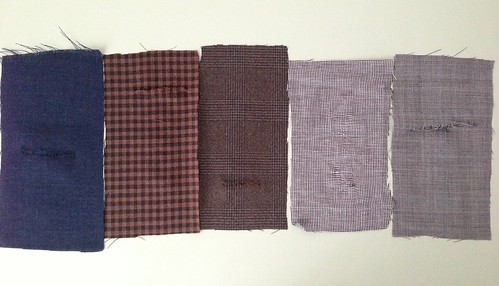
The five fabrics tested were: Zegna 15 milmil 15 moss glenplaid wool jacketing (15 micron fibers), Drapers Super 150s gunclub jacketing, Scabal Vivaldi Four Seasons Super 120s 10oz glenplaid suiting, Minnis 2-ply fresco and a (likely Italian) dogtooth linen suiting or jacketing. Below is a photo of the sample test fabrics.
So how did these fabrics do? I've ordered the results based on their breaking strength. For worsted and cotton fabrics, the ASTM D3780-02 spec establishes a tensile requirement of 40 lbf for suits and trousers and 30 lbf for jackets. All the fabrics passed the breaking strength test for suits, trousers and jackets except for one fabric (Scabal for suit/trouser use):
Test results - maximum loads in warp and fill directions (lbf) and fabric weight (per linear yard)
Minnis : 59.7 lbf, 80.5 lbf, 9.5 oz
Drapers: 67.1 lbf, 60.3 lbf, 8.2 oz
Zegna: 57.4 lbf, 55.2 lbf, 9.7 oz
Linen: 56.1 lbf, 48.8 lbf, 7.8 oz
Scabal: 61.0 lbf, 36.8 lbf, 7.5 oz
As an example, I've included a photo of the print out for the Minnis test results.
The data reveals a few interesting things (although I would of course caution against excessive generalization based on one test sample from each fabric):
The tested fabrics, which are from well-known Italian and English mills, generally met or exceeded the breaking strength for the most common applications for these fabrics (suits, trousers, jackets).
The only possible exception is the Scabal which came in just under the 40 lbf minimum at 36.8lbf in the fill direction, which is also generally the weaker direction of most fabrics. As this is a single test strip on one section of a fabric length the result is not conclusive but intriguing and suggestive. More test samples would be needed to determine if this is indeed an issue. But among other things, the Scabal length I purchased from a local fabric shop could have been a variation from their final production run as I noticed the selvedge seemed a bit unusual.
A Super 150s fabric in the right weave, finish and yarn quality (i.e. Drapers) can easily exceed the ASTM strength test for suits, jackets and trousers, even as a lightweight fabric. So much for the anti-Supers bias that many (including formerly myself) adhere to.
The top performer was the Minnis 2-ply fresco which bested the breaking standard by 49% and 101% respectively in the warp and fill direction. Clearly, the 2-ply yarns (as well as twist) play a key role in enhancing fabric strength, although they appear to be used just in the fill direction.
In terms of weight, the only advertised weights I have are for the Minnis and Scabal. The Minnis measured very close to its published weight of 280-310g. The Scabal fell a bit short of its advertised 10 oz, which, as described above, may or may not indicate a defect.
Now, in fairness to the #menswear enthusiasts, the breaking strength tests do show relative differences. However, in order to know whether those differences exist and/or matter, you would need to buy a $30,000 piece of testing equipment. I would suggest your money would be better spent on great tailors and equally great fabrics from the handful of menswear textile manufacturers left in the world. And I think we all know who they are.
Croatian ice cream makers took vanilla ice cream, dyed it blue, and named it Facebook. And they're making some serious dough off it. Would you buy "Facebook" ice cream?
The treat has been a big hit with tourists this summer, and Adili told reporters it’s been going like crazy. His Facebook ice cream apparently tastes like chewing gum and candy, but it’s not the flavor that has customers begging for more, but the name and the trademark “Facebook” logo on the sign.
I always thought the plural of “arson” was “arson.” Apparently not?
Somerville Mayor Joseph Curtatone called on the public to help with an investigation into four arsons that have struck Somerville this summer.
The mayor said, "We need your help," and he announced the city would pay a $20,000 reward to anyone who provides information that leads to any individuals who have committed the arsons. The state is also offering a $5,000 reward, making a total reward $25,000 for information about the arsons.
Matthew Green is a well-known cryptography professor, currently teaching in the computer science department of Johns Hopkins University in Baltimore. Last week, Green authored a long and interesting blog post about the recent revelations that the National Security Agency (NSA) has, among much else, subverted crypto standards. In his words, "The TL;DR ['too long; didn't read' version] is that the NSA has been doing some very bad things." And Green went on to speculate at some length about what those "bad things" were and what they might mean.
Today, Green's academic dean contacted him to ask that "all copies" of the blog post be removed from university servers. Green said that the move was not "my Dean's fault," but he did not elaborate. Were cryptology professors at Johns Hopkins not allowed to say, as Green had, things like:
I was totally unprepared for today's bombshell revelations describing the NSA's efforts to defeat encryption. Not only does the worst possible hypothetical I discussed appear to be true, but it's true on a scale I couldn't even imagine. I'm no longer the crank. I wasn't even close to cranky enough.
Was basic academic freedom on the line? Had the request even come initially from Johns Hopkins or from outside the school—perhaps someone at the NSA headquarters just up the road from Baltimore?
Football and beer go together like peas and carrots (or blue cheese and honey?), so it only makes sense to pair a great game with a great craft brew. If your local stadium isn't on the list, consider catching an away game at one of the listed locations -- and enjoy some locally brewed suds!
But in making our list, we left price aside and researched how many craft beers were on tap, and how accessible they were to the public. After all, circling the stadium for a beer can make for an exhausting beer run. Still, we know which stadiums are now on our bucket list for the craft beer lover in us — click ahead for the best NFL stadiums for craft beer.
GrindTV is reporting that Captain Peter Brown and fisherman Richard Figueiredo of The Rachel Leah pulled in a rare six-clawed lobster while lobster-fishing off the coast of Hyannis, Massachusetts. They discovered the freaky-looking four-pound lobster’s left side sported five claws and its right side had just one big normal-sized claw. According to scientists, its deformity is caused by a genetic mutation. The lobster, which has been named “Lola,” will be sent to Maine State Aquarium in Boothbay Harbor, Maine where it will be publicly displayed with other unique lobsters.
Details of a new law issued by China’s supreme court are bound to make loose talkers on Sina Weibo and other social media platforms think twice before speaking freely. The law says that any libelous posts or messages will be considered “severe” breaches of the law if they are visited or clicked on more than 5,000 times or forwarded (or “retweeted,” in Western parlance) more than 500 times. Those found guilty could face up to three years in jail, reports Reuters, citing Chinese state media.
As if that weren’t alarming enough, the threshold for being charged with this crime includes offenses as vague and subjective as “damaging the national image” and “causing adverse international effects.”
The law is the latest attempt to crack down on “black PR firms,” companies that make money from removing unflattering information from the internet. Among other things, black PR firms often target companies, spreading gossip or misinformation about them, and then approaching them for payment in exchange for removing the smear campaign. It’s a big business; as TechinAsia pointed out recently, the Sina Weibo accounts controlled by a huge black PR firm that was just busted had a total audience of 220 million followers.
As Caixin reports, since the campaign against “rumor-mongering” and “spreading false information” picked up in June, Shanghai police have opened more than 380 cases, while Henan police have investigated a whopping 463 cases, making 131 arrests. And it’s not just Sina Weibo; TechinAsia reports that police are also watching Tencent’s WeChat, which is organized mainly around private circles of friends.
But for every big black PR firm bust, authorities also seem to be ensnaring a lot of innocent users of social media.
For example, in late August, a women in Anhui province posted on Sina Weibo that 16 people died in a car accident that had just taken place, when the death toll was only 10. Local police placed her under “administrative detention” for five days as punishment for “spreading rumors.” In another case, a 20-year-old Anhui woman was imprisoned for posting the comment “I heard there was a murder in Louzhuang—is there anyone who knows what actually happened?” on a Baidu discussion board. The post, which was clicked on 1,000 times, counted as “disrupting social order” (link in Chinese).
In late August, a Weibo user stoked online discussion with a post saying that the “five heroes of Langya Mountain”—martyrs in the war against the Japanese who are a source of Communist Party pride—had actually been army deserters who oppressed the local villagers of Langya, and that the latter eventually gave them up to the Japanese. This, determined the local police, “created unhealthy social effects” (link in Chinese). Authorities arrested and held the Weibo user under administrative detention for seven days. Something similar happened with four people who “defamed” the Party mascot, Lei Feng.
The new clarifications have big implications for harmless online chatter. If the posts of an amateur historian or inquisitive citizen garner enough attention, the author could face three years in prison.
Considering that most Björk fans seem to know that she began her recording career at the ripe old age of 11, and that she was once a member of The Sugarcubes, it’s curious why more attention hasn’t been paid to KUKL, the group she was in prior to joining Sugarcubes, especially since much of the membership of the two bands overlaps.
KUKL (which means “witchcraft” in Medieval Icelandic) was a sort of Icelandic super-group, comprised of members of several noteworthy bands and formed, at first, to perform on the final episode of a radio program in August 1983. The following month, KUKL played on the same bill with Crass in Reykjavik, at a punk festival that was the largest crowd that Björk had performed in front of at that point, and made a lasting connection with Crass.
When you think of great burgers, your mind may drift to your local gastropub rather than a food truck. Portland, Maine isn't exactly food truck city, either. But things are changing on both fronts, at least when Small Axe Truck is in business. Cold smoked beef, local ingredients, and offbeat toppings take their burgers to new heights -- try it for yourself. Oh, they also have grilled cheese and homemade yogurt available.
A few weeks ago, the Small Axe Truck debuted its burger, the Smokestack Lightening ($8), and proclaimed it the best burger around. Ordinarily, I'd say that's a bold statement to make, but in this case it might well be true.
via firehose ("the only way to stop a bad guy with a gun")
George Zimmerman is being questioned by police after a domestic incident with his wife and father-in-law that may have involved a gun, according to police.
Zimmerman is being held at the home of a relative after the incident, which involved his wife, Shellie, and her father, Colin Morgan, police in Lake Mary, Fla., told ABC News. Police are investigating whether a gun found at the scene was used in the incident.
"There was some kind of a domestic, we know that with his wife and father-in-law. Apparently there were some weapons involved and threats," the deputy police chief in Lake Mary told ABC News.
Zimmerman has not been charged with any crime.
Shellie Zimmerman recently announced plans to divorce her husband, who was acquitted in July on murder charges related to the 2012 death of Florida teenager Trayvon Martin.
Her attorney told ABC News that Zimmerman pulled a knife on her today after she discovered a firearm in the house they shared. He then pulled a gun on his wife and her father after a verbal altercation, according to attorney Kelly Sims.
Love making homemade butter? You'll love making homemade cultured butter ever more -- especially since yogurt is the only culture you need!
There are butter cultures you can purchase from cheese-making suppliers, but I simply use yogurt since it is so readily available. My local dairy (Strauss) makes an excellent yogurt and this is what I used for this post. As with the cream, try to avoid an overly processed yogurt. My yogurt contains milk and yogurt culture and nothing else — no stabilizers, flavorings, or other additives.
If you're a data scientist (or similar), you'll probably be interested in the data analysis which includes some interesting observations about the usefulness - or otherwise - of Amazon reviews. If you're a Epic Fantasy Series reader, you'll be interested in the outcome of my analysis: I've decided to go ahead and read all fourteen books.
Join us for the Fifth Annual Atheist Film Festival in San Francisco on Saturday, September 14th, 2013!
The Atheist Film Festival, created in 2009, is world's first film festival dedicated to showcasing feature films, documentaries, shorts and animated cinema created especially for the secular community. Whether you're an atheist, agnostic, skeptic, secular humanist, heathen, heretic, bright or just a fan of fresh, offbeat cinema that celebrates and encourages reason, critical thinking and freedom of inquiry both inside and outside of the movie theater, the Atheist Film Festival is for you.
A festival pass is just $40 in advance/$45 at the door and gets you in to all films! Tickets to individual films are $10 in advance/$12 at the door.
Arian Foster is a terrific running back for the Houston Texans of the National Football League (American football for you Ausländers). Last week he wrote a column for Yahoo Shine! called “Six things I’ll try to teach my daughter.”
At 23, and apparently unexpectedly, he found himself a father, and feeling clueless about how to raise his new daughter Zeniah. The article compiles six life lessons he decided to impart to her.
The first five things are somewhat conventional: how to find happiness in a tough world, the value of a dollar, the importance of loving one’s work, the importance of being kind, and what qualities to look for in a man (I presume he doesn’t think she’ll be gay). Those are bromides, but worthwhile nonetheless.
But it’s advice #6 that’s the kicker:
6. The flying spaghetti monster. There are billions of people on Earth with hundreds of religions and sects that trickle off each other. I will never tell her what to believe in. I know parents are very influential on kids’ spiritual beliefs and that can be a positive or negative thing. I can give her a basic understanding of religions when she starts showing interest and asking questions. But I will remain silent otherwise. How can I make a young mind believe this is the truth for them when they don’t yet have the capacity nor the cognitive desire to delve into something like this? If she shows interest I would advise her to fully investigate a religion and see if it fits her. And if she chooses none of the above, I’ll be fine with that as well. The values I instill in her should guide her to her decision. What’s most important, I believe, is to support her decision no matter what.
People think of football players as dim-witted but valuable pieces of meat, but Foster has far more sense than 95% of his fellow Americans. This sentence alone should be engraved on the mind of every parent:
“How can I make a young mind believe this is the truth for them when they don’t yet have the capacity nor the cognitive desire to delve into something like this?”
GRANTSVILLE, Utah — Authorities say a Utah man was airlifted to the hospital over the weekend after being gored by a buffalo he owns, the third animal goring in the state in less than a month.
Tooele County Sheriff's Sgt. Ron Johnson tells The Salt Lake Tribune (http://bit.ly/1aXY6r5) the 65-year-old man was injured in his lower abdomen, buttocks and forehead.
Johnson says the man was taken to University Hospital in Salt Lake City on Saturday. An update on his condition wasn't immediately available.
Ben Marks of Collector's Weekly says, "Recently we spoke to Dan Kinem who, with Levi Peretic, has released a documentary called Adjust Your Tracking: The Untold Story of the VHS Collector. For their film, the pair interviewed more than 100 VHS collectors, many of whom are unrepentant fans of the horror genre. What they learned is that often the poor quality of the tapes, versus the hi-def clarity of digital media, is a big part of the appeal."
“Especially for movies that were direct to video or shot on video, viewing them on DVD doesn’t make a lot of sense, because they were originally intended to be viewed on VHS,” continues Kinem. “These are movies that feel too cleaned-up on DVD and Blu-ray, as if they were never meant to look that good. You can see the mistakes they made and the bad makeup and everything. Watching them on VHS is closer to the old drive-in or grindhouse theater, the way the director intended it to look.” For Kinem, Peretic, and many other VHS fans, there’s an authenticity to viewing certain movies on VHS that’s integral to the film experience, no different from the way record fans think certain albums should only be played on vinyl.
The state is activating one section of Track 61, between the convention center and the South Bay Rail Yard off the Southeast Expressway.
The plans require the state to build a 300-foot stretch of rail connecting Track 61 to the existing system, so passengers will have a seamless ride to Back Bay Station. Eventually, the state can also run a separate route from Track 61 into South Station.
The train cars, the previously mentioned diesel multiple units, are also an old concept making a fortuitous comeback. The Boston & Maine Railroad used them in the 1950s and 1960s for commuter rail; people may remember them as Budd cars. They are self-propelled trains that do not rely on locomotive engines, making them ideal for short distances and frequent stops.
Users on popular Chinese microblogging site Sina Weibo are accusing a Chinese professor of purposefully underestimating by tens of millions the number of people who died during the country's mid-century Great Famine for the benefit of the Chinese Communist Party (CCP).
The hottest search term on Weibo on September 6, 2013 was “nutritional death” (营养性死亡). The term appears in a forum post written by Sun Jingxian, a professor from Jiangsu Normal University, claiming that the 30 million estimated deaths during the Great Chinese Famine (1958-1961) is a rumor. Instead, the professor estimated that about 2.5 million “nutritional deaths” had taken place during the “three year difficult period”.
As the word “deficiency” is missing in the Chinese term “nutritional death”, its meaning can be interpreted as death caused by either deficiencies or excesses in diet. Such ambivalence has outraged many netizens who believe that Sun's intention is to cover-up the historical mistake committed by the Chinese Communist Party (CCP).
Historical photo of the rural collectives during the Great Leap Forward. Children are lining up for food. Source: Sina Weibo.
Most Chinese people believe that the Great Famine was caused by the Great Leap Forward (1958-1961), a campaign that forced rural peasants to form agricultural collectives and give up private farming. Examining the national census of 1960-1964, a team of researchers found out that the total population of China had a net reduction of 26.44 million people in a four-year time period. Between 1959 and 1960, the reduction was up to 10 million in a single year. It has been estimated that the number of deaths during the Great Famine is around 30 million.
Sun spent three years reviewing [zh] the census and claimed that the previous estimation was a result of census error due to urban-rural migration. His own estimation of “nutritional death” is about 2.5 million.
However, as the CCP has recently vowed to strengthen its ideological control and part of that campaign is to combat “rumors”, Sun's accusation that the conclusions of previous research are “rumors” has very strong political implication.
Many accuse him of using the term “nutritional death” as a euphemism with the aim of covering up the mistakes of the CCP. “BHLi book store” (@BHLi循证书馆) tried to search [zh] for an equivalent English term and found out that it referred to an opposite meaning:
老外貌似”nutritional death”通常是指”肥死” We have long known that the hot dog is a nutritional death trap full of fat, sodium and other preservatives.
It looks like the English term “nutritional death” but the meaning is “eating too much” — We have long known that the hot dog is a nutritional death trap full of fat, sodium and other preservatives.
“Owl's net” (@猫头鹰的巢穴) laughed at [zh] the misleading Chinese term:
我明白,是吃的太多撑死的
Got it. They died from eating too much!
Some believed that the choice of language is an intentional cover-up of the man-made disaster. For example, “Sunny breeze” (@旭日和风) roared [zh]:
Using the term “nutritional death” to name deaths caused by man-made famine, professor Sun's invention of the term will pin himself down to the pillar of shamelessness. Inhumane and cold-blooded intellectuals are worse than average criminals.
“Who knows Yu's happiness” (@安知渝之乐) also found [zh] the term vicious:
Nutritional death — can it be more shameless? How many people died in three years? The intention is to cover up history. Why don't you call the cultural revolution a national party?
The reason why netizens are so outraged with the term is because euphemism has played a significant role in Chinese politics. “Qinghua Qinpang” (@清华秦鹏) made [zh] a list of euphemistic Chinese terms:
Terms with Chinese characteristics: starve to death is called “nutritional death”, traitorous escape called “vacation-style medical treatment” [refers to Wang Lijun's escape to the US consulate], regression is called “negative growth”, unemployment is called “expecting a job”, not knowing is called “beneficial exploration”, servant is called “leader”, criminal is called “extreme leftist”…
I don't understand what the professor is trying to hide. Starved to death is starved to death, why replace it with “nutritional death”? Three years of research and the outcome is such a creative term. You say that the death toll is less that 2.5 million, so how many exactly? Please be accurate. And please give us the names. Some say 30 million, please also release the name of the dead.
Like many Chinese who lost family members during the Great Famine, “Meteor 74″ wanted [zh] the truth to be revealed:
The professor is so good at creating new words. I don't know how many died, but many relatives died of “nutritional death”. My four grandparents and my uncle. My parents were still kids, but my mother still remembers from time to time the day when she had to swallow earth to fill up her stomach. Most of the dead were peasants.
An updated tax rule is causing restaurants to rethink the practice of adding automatic tips to the tabs of large parties.
Starting in January, the Internal Revenue Service will begin classifying those automatic gratuities as service charges—which it treats as regular wages, subject to payroll tax withholding—instead of tips, which restaurants leave up to the employees to report as income.
The change would mean more paperwork and added costs for the restaurants—and a potential financial hit for waiters and waitresses who live on their tips but don't always report them fully.










 Ben Marks of


