Shared posts

03 Jan 13:40

Snowy Owl rumble..

by nobody@flickr.com (Earl Reinink)

Earl Reinink has added a photo to the pool:

Snowy Owl rumble..

Earlier I indicated my goal this year was to shoot as many individual Snowy Owls as possible. Pictured above #25, 26are in a rumble, soon to be joined by #27, and 28.

As I was doing a few statics on number 25, three more owls all blasted in and started a massive rumble. Crazy...

www.flickr.com/photos/earl_reinink/11542061744/in/photost...

28 Dec 18:11

Tumblr

by saripipicamasiripi
26 Dec 23:37

Amazon is making it harder to sell Bigfoot porn ebooks

by Lauren Davis
Russian Sledges

via firehose

Amazon is making it harder to sell Bigfoot porn ebooks

Erotica featuring Sasquatch, minotaurs, aliens, and boar gods may not fit everyone's tastes, but some authors have made a killing selling monster sex ebooks. But some ebook retailers, notably Amazon, have been cracking down on cryptozoological smut, making it harder for writers to sell their books to readers who are hot for Bigfoot.

Read more...


26 Dec 18:50

People once wanted to mine the air

by Esther Inglis-Arkell

People once wanted to mine the air

Say you live in an age of balloons and explosives. Perhaps, you think, it is time to start putting those two things together.

Read more...


26 Dec 18:29

The LAPD Is Waging A Bitter War Against Pedestrians

by Erin Fuchs

lapd police

Los Angeles cops have aggressively targeted jaywalkers in recent weeks — a crackdown that many LA residents see as an affront to pedestrian culture, The New York Times reports.

Cops say they're trying to maintain order amid an influx of pedestrians in downtown LA, but city residents who like to walk say the policy is unbelievably strict.

One such resident, Adam Bialik, says he stepped off a curb soon after the crossing signal started its "Don't Walk" countdown. A cop greeted him on the other side with a $197 ticket. Tickets can reportedly soar to $250, though. More from The Times:

It is not quite “Dragnet,” but the Police Department in recent weeks has issued dozens of tickets to workers, shoppers and tourists for illegally crossing the street in downtown Los Angeles. And the crackdown is raising questions about whether the authorities are taking sides with the long-dominant automobile here at the very time when a pedestrian culture is taking off, fueled by the burst of new offices, condominiums, hotels and restaurants rising in downtown Los Angeles.

Visitors from East Coast cities like New York might find the LAPD's crackdown to be a particularly rude awakening.

Jaywalking is a way of life in the Big Apple. Even outgoing Mayor Michael Bloomberg has admitted that the city's cops aren't likely to hand out tickets for jaywalking and "the public won’t stand for it” anyway, Politicker reported.

SEE ALSO: The 13 Most Commonly Broken Laws

Join the conversation about this story »


26 Dec 18:22

"Nobody tells an actor, ‘you’re playing a strong-minded man.’ We assume that men are strong-minded. A..."

“Nobody tells an actor, ‘you’re playing a strong-minded man.’ We assume that men are strong-minded. A strong-minded woman is a different animal.”

-

Meryl Streep, on being told that she often plays “strong-minded women.”

image

#god had a second child #her name is meryl streep

(via bathcrone)

26 Dec 17:36

The Fight Over the Doves

by editors
Russian Sledges

'It pained him to imagine the type one day used in books other than those he had so carefully printed and imbued with near-religious significance. But it was also a loathing of the technological change that had transformed the world during his lifetime. He abhorred mechanical industry, and only by consigning the type to the Thames, he wrote in his diary, could he guarantee it would never be used in “a press pulled otherwise than by the hand and arm of man”.'

Resurrecting a legendary typeface.

The Economist | Dec 2013
[Full Story]
26 Dec 17:21

Almost Human: The Surreal, Cyborg Future of Telemarketing

by editors
Russian Sledges

'All the audio is pre-recorded and it's triggered live in response to what a call receiver says. In some cases, a single call-center worker will run two or even three calls at the same time. The audio breaks down into two categories. The first contains the more scripted bits of salesmanship, which, in CallAssistant technology, are mapped to the number keys. The second set of sounds are the little conversational asides that help make the conversation feel more natural. Hit "L," for example, and the voice laughs. Hit the equals sign, and the voice says, "Exactly."'

“This is a story about how the future gets weird.”

[Full Story]
26 Dec 17:14

Edward Snowden, After Months of NSA Revelations, Says His Mission’s Accomplished

by editors

“Let them say what they want. It’s not about me.”

[Full Story]
26 Dec 14:04

Dreamboys: A Punk Band with Peter Capaldi and Craig Ferguson | Anglophenia | BBC America

by russiansledges
Russian Sledges

jon bernhardt is playing this on wmbr right now

After the announcement on Sunday evening that Peter Capaldi would be playing the Twelfth Doctor in Doctor Who, Chris Hardwick was quick to mention the fun fact that Capaldi once played in a punk band with fellow Scot and Late Late Show host, Craig Ferguson. The band, called Dreamboys, featured Capaldi as guitar player and lead vocalist while Ferguson played drums. Also, on bass was Temple Clark, a storyboard artist who has worked on films like Kick-Ass, The Avengers, and a couple of the films in the Harry Potter franchise.
25 Dec 21:07

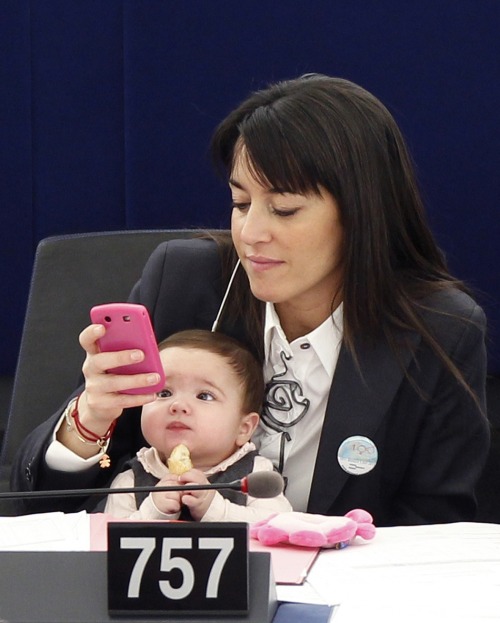
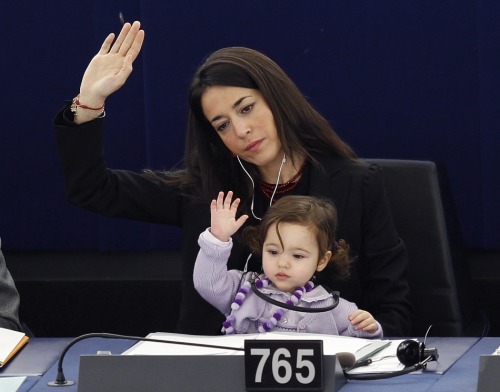
blvcknvy: Licia Ronzulli, member of the European Parliament,...

Russian Sledges

via firehose

autoreshare autoreshare


blvcknvy:

Licia Ronzulli, member of the European Parliament, has been taking her daughter Vittoria to the Parliament sessions for two years now.

25 Dec 18:07

Salt Mines Converted to Stunning Subterranean Museum

by Steph
Russian Sledges

via fillowh00se

[ By Steph in Global & Travel & Places. ]

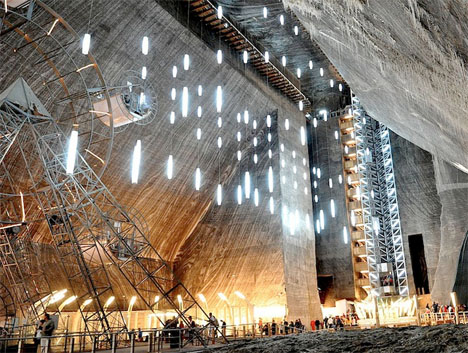
Salt Mine Subterranean Museum Romania 1

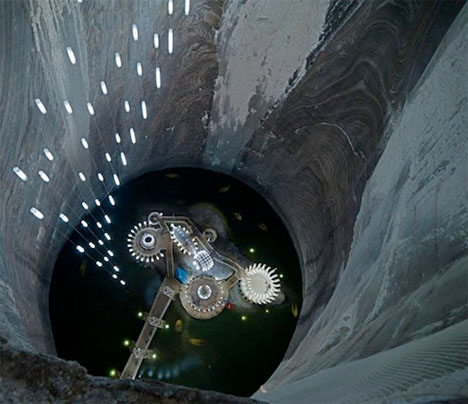
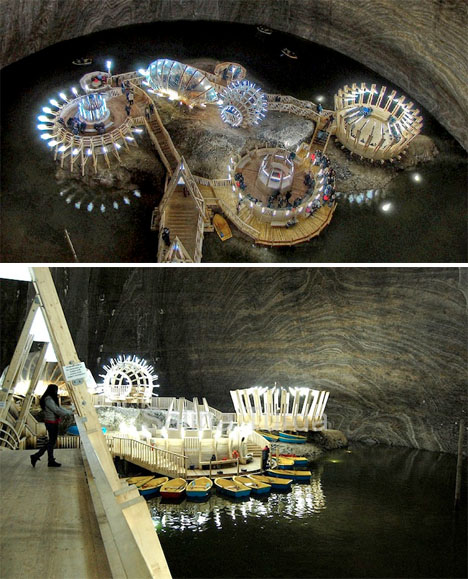
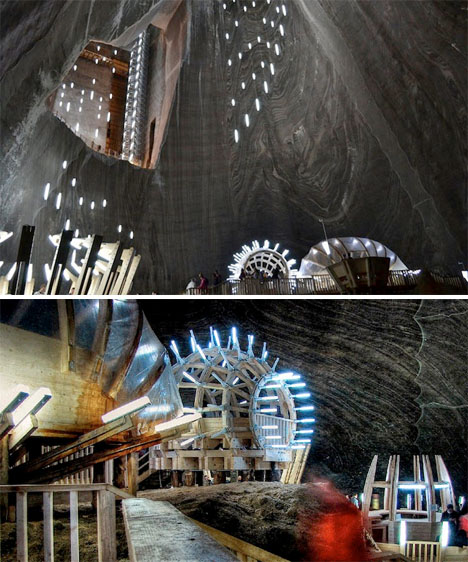
Between the eerie glowing lights, the otherworldly cavernous spaces and the long strange trip it takes to get there, this subterranean museum feels like it could be located on an alien planet. The Salina Turda Salt Mines of Romania have been converted to the world’s largest salt mining museum, but this is no dry historical tour – there’s weird wooden architecture, a playground and even a ferris wheel.

Salt Mines Subterranean Museum 2

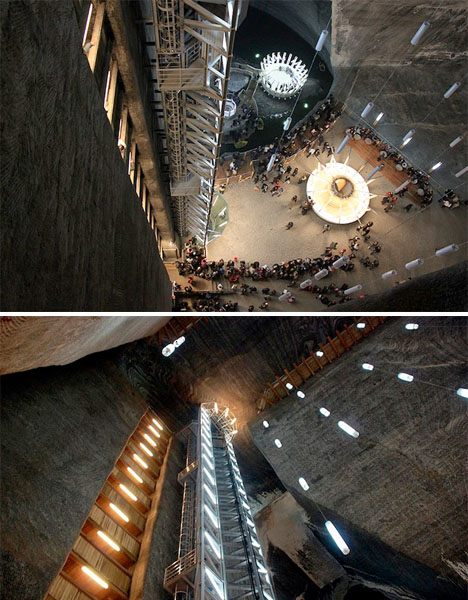
Salt Mine Subterranean Museum Romania 3

All of the LED lights sticking out of those unusual architectural shapes at the center of the museum make it quite a sight from far above, when looking down into the mine plunging 120 meters (393 feet) into the earth. Visitors take elevators to each of the three museum chambers at various depths to see the restored equipment.

Salt Mines Subterranean Museum Romania 4

The sports arena, amphitheater, mini golf course and bowling lanes are reason enough to take a trip to the mine, but the caverns themselves are the main attraction. Uplighting shows off the amazing natural patterns on the excavated walls. There’s even a small subterranean lake with boats for rent.

Salt Mine Subterranean Museum Romania 5

The mines were first excavated in the 17th century and provided a vast wealth of salt for the Romans. The interior is totally free of allergens and almost entirely devoid of bacteria, and maintains a temperature of about 52 degrees with 80% humidity.


Want More? Click for Great Related Content on WebUrbanist:

Salt Sculptures: 12 Stunning Artworks by Motoi Yamamoto

Japanese artist Motoi Yamamoto uses salt's symoblic role in Japanese culture to create amazingly complex and emotional salt sculptures and drawings. Click Here to Read More »»


Hair Today: Turkey’s Bizarre Subterranean Hair Museum

Cappadocia's cave homes have made it famous, but there is another, less well-known attraction there: a weird museum with 16,000 samples of human hair. Click Here to Read More »»


Deserted Industry: 7 Abandoned Factories, Mills and Mines

Our factories and other industrial buildings tend to outlive their primary use. What happens then? These 7 factories, mills and mines were left to crumble. Click Here to Read More »»


Share on Facebook

[ By Steph in Global & Travel & Places. ]

[ WebUrbanist | Archives | Galleries | Privacy | TOS ]


25 Dec 14:31

Antarctic expedition scientists trapped in ice

by Alok Jha

Icebreaker ships go to help MV Akademik Shokalskiy after captain issues distress call

A team of scientists and members of the public who have been retracing the footsteps of the Australasian Antarctic Expedition (AAE) of 1911 have become trapped in heavy ice a few miles from the coast of Antarctica.

Passengers aboard the ship, the MV Akademik Shokalskiy, were informed on Christmas morning that the captain had issued a distress call to the Maritime Service Authority based in Falmouth in the UK earlier in the day. Three nearby icebreaker ships have been notified of the Shokalskiy's situation and are on their way to help.

The nearest ship, the Chinese Xue Long (Snow Dragon), will take just over a day to reach the Shokalskiy's position, around 1,500 nautical miles from Hobart in Tasmania. A French ship called the Astrolabe, and sent out from the nearest Antarctic base, Dumont D'Urville, could arrive around the same time. The furthest ship, also on its way, is the Australian icebreaker, Aurora Australis.

"The ship is no danger," said Chris Turney. "We're currently in heavy ice and we need help to get out. It's frustrating – we're only two miles from open water. Everyone is well on board and morale is high. We've had a fantastic Christmas and the science programme has been continuing while we're stuck in position. The results looking really exciting. We're very fortunate the Chinese are in the area, passing relatively close by."

The Snow Dragon is a 166-metre-long icebreaker, cruising towards the Shokalskiy at 14.5 knots.

The Russian-built Shokalskiy left the port of Bluff in New Zealand on 8 December with 48 passengers and 20 crew members to follow in the footsteps of the great Antarctic explorer and scientist Douglas Mawson. Led by the climate scientist Chris Turney of the University of New South Wales, the ship has been sailing through the Southern Ocean, repeating and extending many of Mawson's wildlife and weather observations in order to build a picture of how this part of the world has changed in the past 100 years.

The expedition had already reached the fast ice off Commonwealth Bay, carrying out measurements of the Southern Ocean along the way. A small team of scientists and conservationists also reached Mawson's Huts at Cape Denison on Thursday last week, 40 miles (65km) across the ice from where the ship was anchored. The expedition was heading east on Tuesday to spend a day at the Mertz glacier when it became trapped among thick ice floes near Stillwell Island, off Cape de la Motte.

A spokeswoman for the Australian Maritime Safety Authority, which is co-ordinating the rescue, said: "It's in quite a remote part of the world. But we have everyone safe. The vessel isn't in any immediate danger."

Passengers were kept updated throughout the day about the ship's situation. When the ship is free from the ice, expected by the weekend, this modern incarnation of the AAE will continue on to the Southern Ocean and will return to Bluff via a stop on Macquarie Island to carry out a short programme of wildlife, oceanography and climate research.

"We can't wait to get to Macquarie Island," said Turney. "It was a cornerstone of the original AAE and we're keen to finish the research programme there."


theguardian.com © 2013 Guardian News and Media Limited or its affiliated companies. All rights reserved. | Use of this content is subject to our Terms & Conditions | More Feeds


25 Dec 14:30

Pope Francis and the Naked Christ

by Lee Siegel
Thirty years ago, the art scholar Leo Steinberg published a book that helps explain the Pope’s openness to gay Catholics.
25 Dec 13:59

That Sherlock Mini-Episode Is Up

by lightninglouie on Observation Deck, shared by Charlie Jane Anders to io9

Thanks, Auntie Beeb!

Read more...


25 Dec 13:38

James Carroll: A radical Pope’s first year.

by James Carroll
Russian Sledges

worth reading, especially pt. II

On most Wednesdays, the Pope gives a general audience, and this one was packed. It was a balmy October morning, and more than a hundred thousand pilgrims, tourists, and Romans had funnelled into St. Peter’s Square. It was the first of three large gatherings Pope Francis presided over . . .
25 Dec 13:30

Why does every story have to be an Earth-shattering epic?

by Genevieve Valentine
Russian Sledges

somebody wrote down my rant for me

via firehose

Why does every story have to be an Earth-shattering epic?

Lately, it seems like every story has to be massive, or nobody cares. Every Doctor Who story is about saving the entire universe. The latest Hobbit movie seemed to be trying to be a Lord of the Rings-style saga. Every action movie needs global stakes. Can we talk about our epic epidemic?

Read more...


25 Dec 12:11

Leaked Xmas-Message From Ed Snowden

by René
Russian Sledges

via snorkmaiden

Youtube Direktsnowden

Ed Snowdens geleakte Weihnachtsansprache. Sehr wahrscheinlich interessanter, als die von Mutti. Sowden hatte gestern erst in einem Interview seinen „Sieg“ bekanntgegeben. Whatever this means, hier das Transkript:

Alternative Christmas Message 2013

Hi, and Merry Christmas. I’m honored to have the chance to speak with you and your family this year.

Recently, we learned that our governments, working in concert, have created a system of worldwide mass surveillance, watching everything we do.

Great Britain’s George Orwell warned us of the danger of this kind of information. The types of collection in the book—microphones and video cameras, TVs that watch us—are nothing compared to what we have available today. We have sensors in our pockets that track us everywhere we go.

Think about what this means for the privacy of the average person. A child born today will grow up with no conception of privacy at all. They’ll never know what it means to have a private moment to themselves—an unrecorded, unanalyzed thought. And that’s a problem, because privacy matters. Privacy is what allows us to determine who we are and who we want to be.

The conversation occurring today will determine the amount of trust we can place both in the technology that surrounds us and the government that regulates it. Together, we can find a better balance. End mass surveillance. And remind the government that if it really wants to know how we feel, asking is always cheaper than spying.

For everyone out there listening, thank you, and Merry Christmas.

25 Dec 05:13

What we can learn from dialect maps

by Maggie Koerth-Baker
Russian Sledges

via GireNose

My dialect — the sound, vocabulary, and grammatical structure of the way I speak English — is most similar to the dialect spoken by people in Topeka, Kansas. That’s according to a popular survey and data visualization making the rounds on social media, and the result makes sense. I was born in Topeka and spent the first 12 years of my life there.

It’s pretty cool that a dataset can figure out that connection based solely on my answers to a series of 25 questions. Do I pronounce “caught” and “cot” the same? (Yes.) Do I think it’s acceptable to say something like, “I write exclusively about science anymore”? (Yes. Haters can hate.) Do I call carbonated beverages “soda”, “pop”, or “coke”? (I think I say “soda” sometimes and “pop” other times and I’m not sure why.)

But those questions — and our collective answers — are good for a lot more than simply performing “guess your hometown” parlor tricks. You can learn a lot about where we’re going and how we’re changing as a society. Because, here’s the thing, contrary to what you might think, the United States isn’t losing its dialects. We’re not all speaking more similarly to one another. In fact, sociolinguists say the opposite is true. Even in a world where people in Topeka, Kansas and Brooklyn, New York listen to the same music, watch the same movies, and share words instantly, the way those people talk isn’t merging into a single, consumer-culture voice.

If that fact seems surprising, it’s probably because the myth — that distinct regional and local dialects faded over the course of the 20th century and are on their way to oblivion — used to be what experts believed, too. When Bert Vaux, a linguist at Cambridge University, was working on his Ph.D., he was taught that American dialects had largely disappeared. Mass media and mass culture were creating a mass speaking voice.

Then, about 10 years ago, while working as a professor at Harvard, Vaux put together a survey. Using 122 different speech variations — some having to do with vocabulary, some with syntax, and some with pronunciation — he asked volunteers a series of 140 different questions and linked their answers to their hometowns. Finished in 2003, the Harvard Dialect Survey forms the basis of the more-recent online quizzes you’ve probably taken through Facebook and Twitter. It showed that regional variations in dialect first mapped in the early part of the 20th century still existed.

That’s a big deal because those regional dialect families actually date back to the first migrations of English-speaking immigrants into North America. The Northern dialects — which actually stretch from Boston to Eastern Minnesota — have their origins in southeastern England and Puritan settlements. Southern dialects began with immigrants for southwestern Great Britain, including Wales. The third dialect family, the Midlands, comes from a wave of immigrants originating in northern England, Ireland, and Scotland. It spread west horizontally from the Philadelphia area. My tendency to use “anymore” as a positive part of speech — I do “x” anymore — as opposed to purely using it in the negative — I don’t do “x” anymore — is part of the Midlands dialect.

Everyone knew these families once existed. Dialect surveys in the 1930s and 40s had identified them and matched them to historical immigration patterns. But nobody expected them to still exist. Turns out, Vaux told me, that’s because researchers had been associating the dialect families too heavily with colloquialisms that had dropped out of common speech — things like the phrases farmers used to call in their cows at night. That stuff really had vanished. But the dialect families remained, they were simply now united around different things — like what we call tennis shoes (or “sneakers” for some of you), or how we pronounce certain vowel sounds.
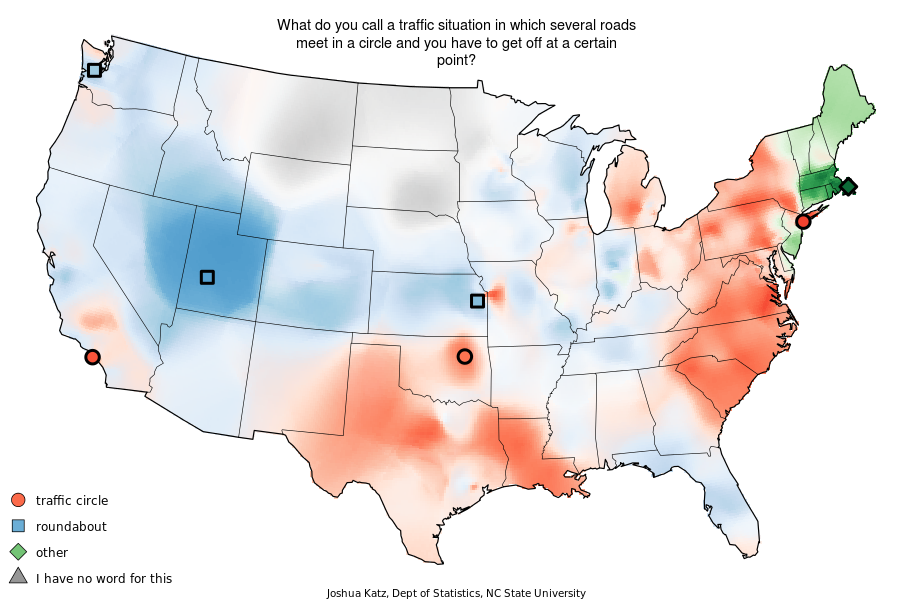
Vaux’s discovery corresponds to work done by other sociolinguists, who say that even beyond the maintenance of these classical dialect families, Americans really aren’t speaking more similarly to one another. In fact, there are actually new dialects in the process of emerging.

For instance, the West — which you can think of as pretty much everything west of the Mississippi — has long been a mishmash of dialects. It was settled much later than the rest of the United States. Its residents came from a much more diverse set of places. It never really had the kind of coherent city dialects you can hear on the East Coast, or even larger regional dialects, on the scale of states. Instead, if you look at maps like the ones produced by the Atlas of North American English, the West looks big and open and wild — characterized by language features that span half a continent. The tendency to pronounce “caught” and “cot” as though they are exactly the same (and, more importantly, to not really grok that they could be pronounced differently) is a major part of the Western voice.

But that could be changing. Over the last 20 years, some researchers have started building cases for regionalization within the vast expanse of the West. Scientists have identified the emergence of several dialects that fall under a larger Pacific Northwest English dialect family, said Walt Wolfram, a sociolinguist at North Carolina State University. Portlandian, it seems, may actually be on it’s way to becoming a thing.

Researchers say this because the way younger residents of Portland speak is becoming more distinct, and it’s different from how older residents speak. The dialect includes aspects of the larger Western dialect — including the caught/cot merger. But that used to be something only some Portlanders did, writes Portland State University linguist Jeffrey Conn. Starting with the Baby Boomers, it’s become much more the norm. Younger Portlanders are also picking up a tendency to end their declarative sentences on an upswing of the voice, making statements sound kind of like questions.

Dialects abide and new dialects form because the way we speak is a major part of how we tell the world about our identities, says William Labov, a linguist at the University of Pennsylvania and the man behind the Atlas of North American English. American English has always been unstable because our regional identities are younger and more open to change, he told me. If your parents move to a new community when you’re a child — or if you move to a new community yourself as a young adult — your dialect doesn’t stay tied to that of your parents. It changes to match your community.

Of course, that means not all dialects will last. In the game of how we speak, you win or you die. When we think that Americans are starting to all speak the same, what we’re often actually seeing is the loss of a few "famous" dialects, without taking into account the strengthening or emergence of others. Southern dialects, for instance, are leveling out, Wolfram and Labov told me. The younger they are, the less “Southern” a Southerner is likely to sound. But, at the same time, Northern dialects, especially those associated with cities surrounding the Great Lakes, are becoming more distinctive.

All of this ends up influencing what you see when you take a quiz that shows you how your dialect matches up to dialects around the country. Yes, my #1 match was the city in which I was born … but that was just a 60% match. And I was almost as strongly matched with several cities in northern California and Nevada. Places I’ve never lived and, in some cases, never been.

Why don’t I match any better to my hometown? Because dialects change with social identity. I’ve lived in a lot of other places since I was 12 and my dialect has changed along with those moves and shifts in the communities I identify with.

Why would I match so well with places I’ve never lived? Because there’s a lot of similarities in the dialects of the West overall. It’s not too surprising that my Western dialect (via Kansas) would have a decent amount in common with other Western dialects. Those similarities reflect a shared history of recent migration and a shared identity that’s only now starting to separate out into regionalisms.

More importantly, given another decade, my results could end up becoming entirely different. I could end up sounding less like my hometown dialect and more like the place I now live — Minneapolis. My hometown dialect could end up sounding more distinct than it did when I last lived there. Language is change. A single map only gives you a snapshot.


25 Dec 01:51

▶ Momus - Christmas On Earth - YouTube

by russiansledges
Russian Sledges

http://www.youtube.com/watch?v=McT5efrDK70
http://www.phespirit.info/momus/19930107.htm
http://imomus.livejournal.com/423756.html

'Christmas on Earth: Christmas is heaven for the people who are together with the ones they love, but hell for the people who aren't. The astronaut-timelord singing this is traveling away from earth at the speed of light, knowing that when he returns his friends will all be long dead, and there'll be no-one he can tell the things he's seen, even if he can the words. He's "receiving transmissions they broadcast long ago", celebrating Christmas alone, crooning sentimentally in his capsule; Bing Crosby in the role of Thomas Jerome Newton, perhaps. In this live performance of the song, filmed during my Christmas Tour of Japan in 1993, you hear the beefier version with the drumloop: [ http://www.youtube.com/watch?v=P-rKCWvfZ3s ]

'How I rate this now: "Try to remember the kind of September..." I'd really rather not, I think. But this is affecting stuff, White Christmas at the speed of light. I took the title from a performance art piece, by the way. I often work around titles. I must've thought "It's Christmas on Earth, but is it also Christmas in space?"'

25 Dec 01:46

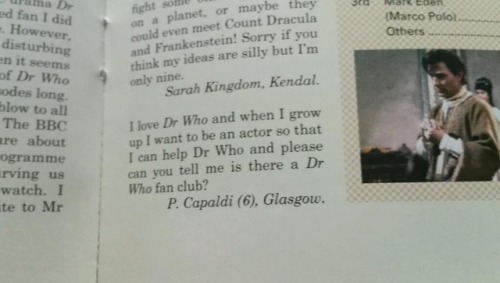
Peter Capaldi. Doctor Who Magazine 1964. [x](via 1outside)


Peter Capaldi. Doctor Who Magazine 1964. [x]
(via 1outside)

25 Dec 01:43

a little girl threatens matt with a toy weeping angel x

by aquackingduck


a little girl threatens matt with a toy weeping angel x

25 Dec 01:43

ryallsfiles: Doctor WHo by Mark Buckingham — the variant cover...

Russian Sledges

didn't mark buckingham do shade the changing man at some point? I will refrain from trying to draw some kind of connection here


ryallsfiles:

Doctor WHo by Mark Buckingham — the variant cover to our final Doctor Who comic, in stores today. Colors by Charlie Kirchoff.

25 Dec 01:42

(via A Whovian Surprise for Christmas Day!)

by ilovebender
24 Dec 21:59

Reagan's 'Welfare Queen' Was a Real Person and Her Story Is Bananas

by Hillary Crosley

Reagan's 'Welfare Queen' Was a Real Person and Her Story Is Bananas

During President Ronald Reagan's 1976 campaign trail, the actor-cum-politician made the "welfare queen" an integral part of his issue reform rhetoric and an evergreen trope that African Americans still battle. But recently, Slate's thorough reporting reveals that the "welfare queen" Reagan employed to stereotype a nation of black folks was actually one real woman named Martha Louise White (the reporter believes) who may or may not have been white, and a murderer.

Read more...


24 Dec 16:26

Mass. high court strikes down life without parole sentences for juveniles

The state’s highest court today struck down life sentences without parole for juveniles, saying that they were unconstitutional. The Massachusetts Supreme Judicial Court’s decision came after a US Supreme Court decision that struck down automatic sentences of life without parole for juveniles. The state court, noting that it had the power to accord individuals greater rights than the US Constitution, went further by also striking down discretionary sentences of life without parole.“Given the unique characteristics of juvenile offenders, they should be afforded, in appropriate circumstances, the opportunity to be considered for parole suitability,” the SJC wrote in a decision released this morning.


24 Dec 15:44

SHEEP THRILLS: We’re off to Miami this weekend to host a...

Russian Sledges

saucie I assume you were there


SHEEP THRILLS: We’re off to Miami this weekend to host a party for sheep. Hanging out with sheep is gonna be the new black in 2014 because humans, ugh, yuck. They only have one stomach!

The party is for sheep, but you’re welcome to attend. The choice is yours.

24 Dec 14:36

Stephen Malkmus & The Jicks and Momofuku Milk Bar are...


Stephen Malkmus & The Jicks and Momofuku Milk Bar are joining their forces and singing along to “Cinnamon & Lesbians,” a song off of SM+J’s new record Wig Out at Jagbags.

The Cinnamon & Lesbians ice cream will be available at one of Milk Bar’s stores in New York for a very limited time starting January 7th,  2014. More details to come!

(flyer by gary panter)

24 Dec 04:27

Sony selling off media metadata service Gracenote to Tribune group

by Josh Lowensohn
Russian Sledges

via firehose

Some five years after buying media identifying service Gracenote for $260 million, Sony is selling it off to Chicago-based media company Tribune Co. for nearly half that. The two companies today announced a $170 million deal that gives the Tribune Company's Media Services group Gracenote's technology and database of 180 million music tracks and videos. That technology is used in products like iTunes to identify music tracks from imported CDs, as well as serve up track information in online services like Spotify and Pandora.


Gracenote gets more than half a billion "look-ups" a day

Gracenote says its database gets 550 million "look-ups" for media identification every day. That task will be handled by the Tribune Media Services group if the deal is approved early next year. That service has become increasingly popular with apps that let people attempt to identify music and TV shows from their smartphones in apps like MusixMatch. It's also what powers part of Microsoft's Xbox Music service when users match tracks from their library.

Beyond music — which is what Gracenote began with in 1998 — the company has been working on technology that identifies what users are watching on TV to better target advertisements. That's of particular interest to advertisers with the rise of the DVR and second-screen watchers who tune out when ads come on.

24 Dec 00:43

UK Finally Pardons Computer Pioneer Alan Turing

by By THE ASSOCIATED PRESS
Russian Sledges

fucking finally

His code breaking prowess helped the Allies outfox the Nazis, his theories laid the foundation for the computer age, and his work on artificial intelligence still informs the debate over whether machines can think.