Russian Sledges
Shared posts
Forget Shorter Showers | Derrick Jensen | Orion Magazine
New Subway Map-Themed Game in Development: Mini Metro! This...

New Subway Map-Themed Game in Development: Mini Metro!
This looks extremely promising, especially since development on Third Rail seems to have stalled (no updates on progress since mid-last year). It’s being developed by small New Zealand-based studio, Dinosaur Polo Club (great name and logo!). Here’s the preamble from their website:
Mini Metro is a minimalist subway simulation game about designing efficient subway networks. The player must constantly redesign their line layout to meet the needs of a rapidly-growing city.
The game, currently available as a rough and ready alpha version (that’s pre-beta, folks!), currently has four maps — London, New York, Paris and one other that I haven’t identified as yet. Each map in the game looks like that of its real life equivalent, right down to the colours used to represent routes: a neat touch! That’s London seen in the mesmerising GIF above.
In short, I want to play this right now. Hurry up and take my money.
Boston Layers An old Boston T map peeks out from underneath the...

Boston Layers
An old Boston T map peeks out from underneath the broken remnants of a recent edition, somewhere along the Orange Line in May 2013. It’s interesting to see that while the two maps occupy the same physical space, their use of it is much different. The older, simpler map fills up its space with bold lines and large type, while the modern map is more geographically based and complex – with the addition of bus routes and the Silver Line – and the type on it is correspondingly smaller.
(Source: Boston Metropolitan Area Planning Council - MAPC/Flickr - Photographer: Jessie Partridge)
Stair Noir: 1925
Russian Sledgesvia multitask suicide

Catnap Community Catreach
Russian Sledges#sewing
#cats
So the fancy (and talented) Lizzy House announced a Catnap Dress Competition back in January and we were obviously psyched. But we were also super-duper busy preparing for the Quilting with a Modern Slant book launch AND our 3rd Birthday celebration. PLUS we ran out of Catnap fabric. Yes. We ran out of TWO of the Kitty Dreams colorways and couldn't get more in before the deadline. In the last couple of weeks we have sold out of other prints in the collection as well. Total bummer when you want to tell all your friends and family to make a cat dress.
In the gather here spirit we wanted to show folks that this collection is great in a variety of contexts. Because while we love dresses we also really love dress-shirts. And stuffed animals. And artists that paint princesses in Catnap dresses. And 7 year olds that are transformed into kittens when they hem their own clothes. Here's what we did. And we know the Cats of Gather Here wholeheartedly approve.

Catnap Dress Friday! Because sometimes everyone comes to work in their Catnap Dress... <PREVIEWEND>

The Zooguu Cat with Catnap Kitty Dreams in Cranberry belly and ears. Jen has been adding fabric accents to her toys and her last Dinosaur workshop featured Catnap Kitty Dreams on the sample T-Rex. Yep, that dino is the cat's meow.


Alison (sewing instructor and manager) made her Catnap Washi Dress out of Kitty Dreams in Grass with sleeves, contrast cuff and peter pan collar. Also sporting an awesome Giant Dwarf mint green starlette crown.


Carrie (of Craigie on Main and a gather here consultant) made her Catnap Cambie Dress out of Cat's Cradle in Lemon with a contrast band of Liberty of London Tana Lawn. She altered the center back of the dress with a contrast button placket which is too awesome for words.


Carla (embroidery and Kids program instructor) made her Catnap Kat Strapless Dress out of Chasing Butterflies in Wind and cotton voile. The layered skirt, boned bodice and perfect fit is definitely a winner in our book. Plus it's a "Kat" dress!


Emily (the lady we call when we need graphic design!) made her Catnap Belladone Dress out of Kitty Dreams in White with a linen/cotton skirt. Pockets are in the Catnap fabric. And those perfect peachy orange pumps...


Little E is 7 and we learned that cat dresses can transform a 7 year old into a cat. The entire hem of this dress was stitched by a sweet cat who purred, meowed, and gave kitty snuggles. Purrrrr-fect. Little E's dress is the Lily in Purrfectly Happy with shot cotton contrast.


Noah (or as he is fondly known 'round these parts, Mr. Here) made his Catnap Negroni Dress-shirt out of cotton plaid by Kokka and Kitty Dreams in Cranberry. With contrast cuffs, sleeve plackets, under-collar, and facings this shirt walks that fine line between kitsch and totally fashionable. We're voting totally fashionable. Buttons selected by Little E.


Sophie (knitting instructor and manager) made her Catnap revised Proper Attire out of Catnip in Lavender. But let's be honest, it's the Nougat sweater that gave us whiplash from taking a second look. The Nougat pattern is by Army of Knitters. Yarn is from Silver Moon Farm and Cascade 220 fingering. Gurrrrlllll, that is fierce.
.jpg)

Maggie (a gather here constant and maker of all things) made her Catnap Sarong out of Purrfectly Happy in Cranberry. This backdrop isn't photoshopped. Maggie is actually in Puerto Rico and made sure that the gather here catreach reached over the Atlantic.
Jerry (Alison's man-friend and the owner of Odd Fellows recording studio) is also wearing Purrfectly Happy in Cranberry. And yes, he took a selfie in the Harvard University public restroom. Meow.

Princess in a Catdress by Eling. Our motto for 2014 #MakersGonnaMake is because of the talented Eling who posted her fine lettering in 2013 and we begged her to allow us to co-opt it. Eling painted this pretty princess not only wearing Purrfectly Happy but also kitty slippers, a kitty crown AND carrying the cutest ginger kitten ever.


Virginia (sometimes called Ms. Here or the Crazy Cat Lady) made her Catnap Emery Dress out of Purrfectly Happy in Cranberry. As some of you know, Virginia already owns a Catnap Traveler Dress in Kitty Dreams in Grass but for the 3rd birthday party she really wanted to make another dress. Paired with some black velvet kitten flats, she's quite the cat lady.

We hope you've made awesome clothing, toys, quilts and honestly, just been inspired by the Catnap collection. Want to share your pics with us? Tag gather here in your Instagram photos! Or add them to the gather here flickr group! Plus we hope you'll hashtag #communitycatreach because that's what it's all about. Right? Let's make all the things together! Everywhere.
Overrated Drinks Wire: Thrillist quizzed bartenders around the country,...
Russian Sledgesoverbey: we are still going to smuggler's cove, even though martin cate dissed the blood & sand
also, what the fuck is up with SF and picon punch?
 Thrillist quizzed bartenders around the country, including some Boston folks, on the most overrated and underrated cocktails. Jackson Cannon (Eastern Standard, The Hawthorne), for example, finds the Manhattan overrated: "It may be heresy in the eyes of the cocktail revival intelligentsia, but I submit that the proof that this cocktail is overrated is in the fact that several of its descendants are much better drinks." [Thrillist]
[Photo: Eastern Standard/Meg Jones Wall]
Women Everywhere in Food Empires But No Head Chefs - Bloomberg
Russian Sledges#barbaralynch
The anatomy of Nautilus pompilius, by Lawrence Edmunds Griffin.


The Square
“The largest square in North Korea, the giant Kim Il Sung Square in central Pyongyang is an expansive urban space used for massive collective exercises, including mass dances, parades, and demonstrations of loyalty to the leaders of the country whose portraits watch over the space,” says Jeff Oftedahl, a member our Your Shot community.
“Everything is highly structured in North Korea—one can only go where the guides allow. On this particular day we were visiting a monument overlooking the square, which was a sight to behold. Everything is built to be impressive and to position the leadership over the people, and the people walking under the illuminated photographs really emphasized this point. I zoomed in to fill the frame with the square, showing how tiny the people truly are in comparison.”
This photo was submitted to Your Shot. Check out the new and improved website, where you can share photos, take part in assignments, lend your voice to stories, and connect with fellow photographers from around the globe.

SAT Changes Show Just How Rigged It Was To Begin With
Earlier this week, while announcing a major redesign of the SAT college admissions test coming in 2016, College Board President David Coleman publicly acknowledged something most of us have known for a long time: our use of the SAT favors privileged students.
Read More →Oil Slicks Spotted In South China Sea Thought To Be From Missing Malaysia Airlines 777
The Vietnamese government says it has spotted two large oil slicks off the southern coast of the country that are believed to be from the Malaysia Airlines 777 that disappeared from radar yesterday.
The slicks are between 6 and 9 miles long, AP reports. They are consistent with the type of slick that would be caused by jet fuel, the Vietnamese government says. Another report cites a single 12-mile long oil slick.
Several countries are now participating in the search and rescue operation for the plane, which was carrying 239 people en route from Kuala Lumpur to Beijing.
The plane's last-known position on radar was over the South China Sea. It was cruising at 35,000 feet. The plane disappeared without sending a distress call.

SEE ALSO: Malaysia Airlines 777 Disappears Over South China Sea
Join the conversation about this story »

    
|
Should I buy this yarn?
Russian Sledges"Are you a Time Lord?"
When someone asks, \"Well can\'t you just un-PDF it?\"
Russian SledgesPDFs are where information goes to die

‘300’ takes a sidetrip, in 3-D - Movies - The Boston Globe
Russian Sledgesthis is going to be terrible, but I will probably watch it
pray for me
Five things 300: Rise of an Empire gets wrong
Russian Sledgestl;dr: everything
By Paul Cartledge
Let’s be clear of one thing right from the word go: this is not in any useful sense a historical movie. It references a couple of major historical events but is not interested in ‘getting them right’. It uses historical characters but abuses them for its own dramatic, largely techno-visual ends. It wilfully commits the grossest historical blunders. This is in fact a historical fantasy-fiction movie and should be viewed and judged only as such. But in case any classroom teachers of Classical civilization or Classical history should be tempted to use it as a teaching aid: caveant magistri — let the teachers beware! Here are just five ways in which the movie is at best un-historical, at worst anti-historical.
(1) Error sets in with the very title: the ’300′ bit is a nod to Zack Snyder’s infinitely more successful 2006 movie to which this is a kind of sequel, and there is not just allusion to but bodily lifting of a couple of scenes from the predecessor. But which Empire is supposed to be on the rise here? I suppose that it’s meant to be, distantly, the ‘Athenian Empire’, but that didn’t even begin to rise until at least two years after the events the movie focuses on: the sea-battles of Artemisium and Salamis that both took place in 480 BCE.

(2) The movie gets underway with a wondrously unhistorical javelin-throw — cast by Athenian hero Themistokles (note the pseudo-authentic spelling of his name with a Greek ‘k’) on the battlefield of Marathon near Athens in 490 BCE, a cast which kills none other than Persian Great King Darius I, next to whom is standing his son and future successor Xerxes. Actually, though Darius had indeed launched the Persian expedition that came to grief at Marathon, he was not himself present there, nor was Xerxes.
Themistocles, on the other hand, was indeed present, but rather than carrying and throwing a javelin he was fighting in a dense phalanx formation and wielding a long, heavy pike armed with a fearsome iron tip made for thrusting into the Persian enemy hand-to-hand.
(3) From the Persians’ Marathon defeat, which (historically) accounts for their return revenge expedition under Xerxes, the scene shifts to the Persians’ fleet — in fact, a whole decade later. Connoisseurs of 300 will have been prepared for the digitally-enhanced, multiply-pierced and bangled Rodrigo Santo reprising his role of ‘god-king’ Xerxes. (Actually Persian king-emperors were not regarded or worshipped as gods.) Even they, though, will not necessarily have expected the Persian fleet to be under the command of a woman, and a Greek woman at that: Queen Artemisia of Halicarnassus (modern Bodrum), who is represented (in the exceedingly fetching person of Eva Green) as the equal if not superior of Xerxes himself, with her own court of fawning and thuggish male attendants, all hunks of beefcake.
Here the filmmakers are indeed drawing on a properly historical well of evidence: Artemisia — so we learn from Herodotus, her contemporary, fellow-countryman, and historian of the Graeco-Persian Wars — was indeed a Greek queen, who did fight for Xerxes and the Persians at Salamis. She did allegedly earn high praise from Xerxes as well as from Herodotus for the ‘manly’ quality of her personal bravery and her sage tactical and strategic advice.
But she was far from being admiral-in-chief of the entire Persian navy. She contributed a mere handful of warships out of the total of 600 or so, and those ships of hers could have made no decisive difference to the outcome of Salamis one way or the other.
(4) For some reason — perhaps because they were conscious of the extreme sameness of most of their material, a relentless succession of ultra-gory, stylised slayings, to the accompaniment of equally relentless drum’n'bass background thrummings — the filmmakers of this movie, unlike of 300, have felt the desire or even the need to include one rather prolonged and really quite explicit heterosexual sex-encounter. Understandably, perhaps, this is not between say Themistokles and his wife (or a slave-girl), or between Xerxes and a member of his (in historical fact, extensive) harem.
But — utterly and completely fantastically — it is between Themistokles and Artemisia in the interim between the battles of Artemisium (presented as a Greek defeat; actually it was a draw) and Salamis. Cue the baring of Eva Green’s considerable pectoral assets, cue some exceptionally violent and degrading verbal sparring, and cue virtual rape — encouraged by Artemisia at the time but later thrown back by her in Themistocles’s face as having been inadequate on the virility front.

(5) The crowning, climactic historical absurdity, however, is not the deeply unpleasant coupling between Themistokles and Artemisia, but the notion that in order for Themistocles and his Athenians to defeat the Persian fleet at Salamis they absolutely required the critical assistance of the massive Spartan navy which — echoes here of the US cavalry in countless westerns — turned up just in the nick of time, commanded by another Greek woman and indeed queen, Gorgo (widow of Leonidas, the hero of 300), again played by Lena Headey.
Actually, Sparta contributed a mere 16 warships to the united Greek fleet of some 400 ships at Salamis, and like Artemisia’s they made absolutely no difference to the outcome, which was resoundingly and incontestably an Athenian victory. The truly Spartan contribution to the overall defeat of the Persian invasion was made in very different circumstances, on land and by the heavy-infantry Spartan hoplites, at the battle of Plataea in the following summer of 479. But that is quite another story, one in which the un- or anti-historical filmmakers show not even a particle or scintilla of interest.
Paul Cartledge is the A.G. Leventis Professor of Greek Culture at the University of Cambridge and the author of After Thermopylae: the Oath of Plataea and the End of the Graeco-Persian Wars (OUP, 2013). He hastens to make clear that he was not in any way a consultant on ’300: Rise of an Empire’, as he had been, in a minor way, on ’300′.
Subscribe to the OUPblog via email or RSS.
Subscribe to only classics and archaeology articles on the OUPblog via email or RSS.
Image credit: 300: Rise of An Empire. (c) Warner Bros. via 300themovie.com
The post Five things 300: Rise of an Empire gets wrong appeared first on OUPblog.


Related Stories

Caturday felid trifecta: The mystery of “rocket cats,” Google’s nefarious cat policy, and a litter of mitten kittens
It’s a three-cat day, thanks to several readers who proffered links. The first item involves a mysterious 16th-century (c. 1530) German book by Franz Helm, an artillery expert (see articles in the Guardian and TDS). The book contains drawings of cats and birds with rocket-like jetpacks strapped to their back. The unsettling thing is that they’re not for transportation, but are apparently weapons!
Researcher Mitch Fraas gives his interpretation:
According to Fraas’s translation, Helm explained how animals could be used to deliver incendiary devices: “Create a small sack like a fire-arrow. If you would like to get at a town or castle, seek to obtain a cat from that place. And bind the sack to the back of the cat, ignite it, let it glow well and thereafter let the cat go, so it runs to the nearest castle or town, and out of fear it thinks to hide itself where it ends up in barn hay or straw it will be ignited.”
In other words, capture a cat from enemy territory, attach a bomb to its back, light the fuse, then hope it runs back home and starts a raging fire.

The manual suggests capturing cats from enemy territory and strapping bombs to them. Photograph: Matt Rourke/AP
Somebody didn’t know how to draw cats. They were all around, for crying out loud!

Franz Helm’s document also advocates strapping bombs to cats and doves ‘to set fire to a castle or city which you can’t get at otherwise’. Photograph: Matt Rourke/AP
Another poor moggie:

Apparently, though, this was an idea that was never implemented. It resembles the suggestion of U.S. Army experts during World War II, who had the idea of strapping incendiary devices to bats in Japan. Since bats roost in the eaves of highly flammable wooden Japanese homes, they could wreak havoc on a city.
***
Item 2: this nefarious corporate policy was called to my attention; here’s a screenshot:

I am, of course, protesting by refusing to ever Google anything again.
I suppose a “dog company” means that all the employees slavishly worship their bosses (and sniff their crotches).
***
Finally, EDP24 reports about a whole brood of polydactylous kittens rescued in Suffolk:
The five-month-old kittens, known as polydactyl or “mitten” cats, were discovered abandoned in a back garden before being taken to Felixstowe Blue Cross rehoming centre.
Andy Gillon, manager of the centre in Walton High Street, which takes in around 250 cats and kittens a year, said staff soon noticed that these particular felines had something extra special about them when they were brought in.
He said: “We might get the odd cat with an extra toe, but to get an entire litter of polydactyl cats is really unusual.
“Cats normally have 18 toes but all the kittens in this litter have extra digits – one even has 26 toes!”
Cats normally have five toes on their front feet and four on their rear. I’ve always wanted one with extra toes, because they’re funny-looking but don’t seem to be impeded in their walking or climbing. Wikipedia reports the variety of names given to them:
Nicknames for polydactyl cats include “conch cats“, “boxing cats“, “mitten cats“, “mitten-foot cats“, “snowshoe cats“, “thumb cats“, “six-fingered cats“, “Cardi-cats“, and “Hemingway cats“.
The “Hemingway cat” monicker comes from the fact that Ernest Hemingway had a passel of cats at his Key West home, many of them with extra toes. Their polydactylous descendants still roam the property.
I’ve also heard these mutants called “Super Scratchers.”
And it’s not that unusual to get an entire litter of extra-toed kittens if the litter size is small. Polydactyly in cats (as in most species) is inherited as a single dominant gene, which means if you get one copy of the gene, you have extra toes. (I presume that two copies produces a dead animal, but I haven’t been able to find for sure.)
That means that if one of the parents is polydactylous and the other isn’t, the chance of each of its kittens being polydactylous is ½, so the chance of all five kittens being polydactylous is ½ multiplied by itself 5 times, or 1/32 (0.03). So it will occasionally happen. In the unlikely event that both parents were polydactylous, the chances are higher.
Can you calculate what the chances would be for two such cats to produce a litter of five polydactylous cats among the surviving offspring? (Assume that having two copies of the gene kills you before birth.)
The record number of feline toes, verified by the Guinness Book of World Records, is 27 on a Canadian cat named “Tiger.” Here’s the one image I could find of him, a video:
Kitty Bloger has some nice picture of Super Scratchers, including the following. When I see the last one, I’m thinking about a macromutational leap whereby cats learn to use can openers. When that happens, they take over the world.


h/t: Dom, Diane G, Mark


Man 'Newsweek' Said Invented Bitcoin Denies Inventing Bitcoin

Today in things that make my chosen profession look bad, Dorian Satoshi Nakamoto, who Newsweek is pretty damn sure is the man behind Bitcoin, told the journalists who descended upon his house that he did not invent Bitcoin.
This morning, the cover story for Newsweek's return to print went live and it was a doozy: Leah McGrath Goodman found the mysterious man who created Bitcoin, known only as "Satoshi Nakamoto." Everyone thought that was a pseudonym, but it turns out it's his real name and he's a 64-year-old man who lives in Southern California and wants nothing to do with any of this.
But Goodman never found anything conclusively linking Nakamoto to Bitcoin; just a lot of circumstantial evidence and Nakamoto himself "tacitly acknowledging" it by telling her "I am no longer involved in that and I cannot discuss it."
Cue the journo-mob (or "Bitcoin frenzy," per the L.A. Times) outside Nakamoto's house, which Newsweek originally posted a photo of (and then took down) while Redditors fretted about the ethics of "doxxing" a man who seemed to value his privacy (and created something they liked to use).
Nakamoto eventually agreed to talk to one reporter -- with conditions.
"I'm not involved in Bitcoin. Wait a minute, I want my free lunch first. I'm going with this guy," Nakamoto said.
"This guy" was a reporter from the AP. He and Nakamoto tried to have sushi, but the media followed them to the restaurant so they went to the AP's office. Reuters said Nakamoto's movements created a "freeway car chase" as reporters continued their pursuit, sometimes tweet-insulting the guy:
#Nakamoto's brother had a description of Satoshi. Apparently, from live reports, the characterization is right.
— Joe Bel Bruno (@JoeBelBruno) March 6, 2014
(Arthur Nakamoto called his brother "an asshole.")
After a two-hour interview, AP had its big exclusive: four paragraphs in which Nakamoto denies that he created Bitcoin. So, basically what he said to all the reporters standing outside his house. I'm not sure why the AP needed two hours for that. (UPDATE: The AP filled its story out and it is now much longer -- see below.)
So, is this Nakamoto the Satoshi Nakamoto? Newsweek had better hope so: it would be a serious blow to its credibility if the just-relaunched magazine's first cover story were to fall apart. So far, Newsweek's managing editor Kira Bindrim tweeted: "We welcome the feedback and stand by the story."
That said, just because Nakamoto now denies having anything to do with Bitcoin doesn't mean he's telling the truth. We still don't know why he told Goodman he was "no longer involved" with Bitcoin.
Update, 9:30 p.m.: The AP story got a lot longer and more detailed. Nakamoto says he told Goodman that he was "no longer in engineering."
"It sounded like I was involved before with Bitcoin and looked like I'm not involved now. That's not what I meant. I want to clarify that," Nakamoto said.
He is not a native English speaker -- he was born in Japan and moved here at age 10 -- and the AP notes that his English "isn't flawless." It's possible that a language barrier could have created a misunderstanding between Nakamoto and Goodman.
Also, a user named Satoshi Nakamoto has posted in an online forum denying that he is the man in California. Before today, the user's last posts were in February 2009, when he announced that he had developed "a new e-cash system called Bitcoin." That doesn't prove anything, but it's worth noting.
Goodman told the AP that she stands by her account of her conversation with Nakamoto, and says it was clear to him that they were discussing Bitcoin.
Update, 1:09 a.m.: The AP's video of part of its interview with Nakamoto, including quite the scoff:

|
|
Coming Attractions: Trina's Team to Open Audubon in Audubon Circle Space

[Photo: Trina's Starlite Lounge/Rachel Leah Blumenthal]
The Trina's Starlite Lounge and Parlor Sports team — Beau Sturm, Jay Bellao, Josh Childs, and chef Suzi Maitland — is opening a new restaurant on a different Beacon Street. They're taking over the Audubon Circle space at 838 Beacon Street in Boston, opening a new restaurant this spring called Audubon. It will be open for lunch, dinner, and Sunday brunch. According to a press release, "the team hopes to continue the establishment's deep-rooted commitment and connection to the community." Stay tuned for more details, and keep an eye on their Twitter feed for new developments.
· All coverage of Trina's Starlite Lounge on Eater [~EBOS~]
The Last Twentieth Century Book Club: Carman, Part 2
Russian Sledgesvia overbey
By Don Jolly
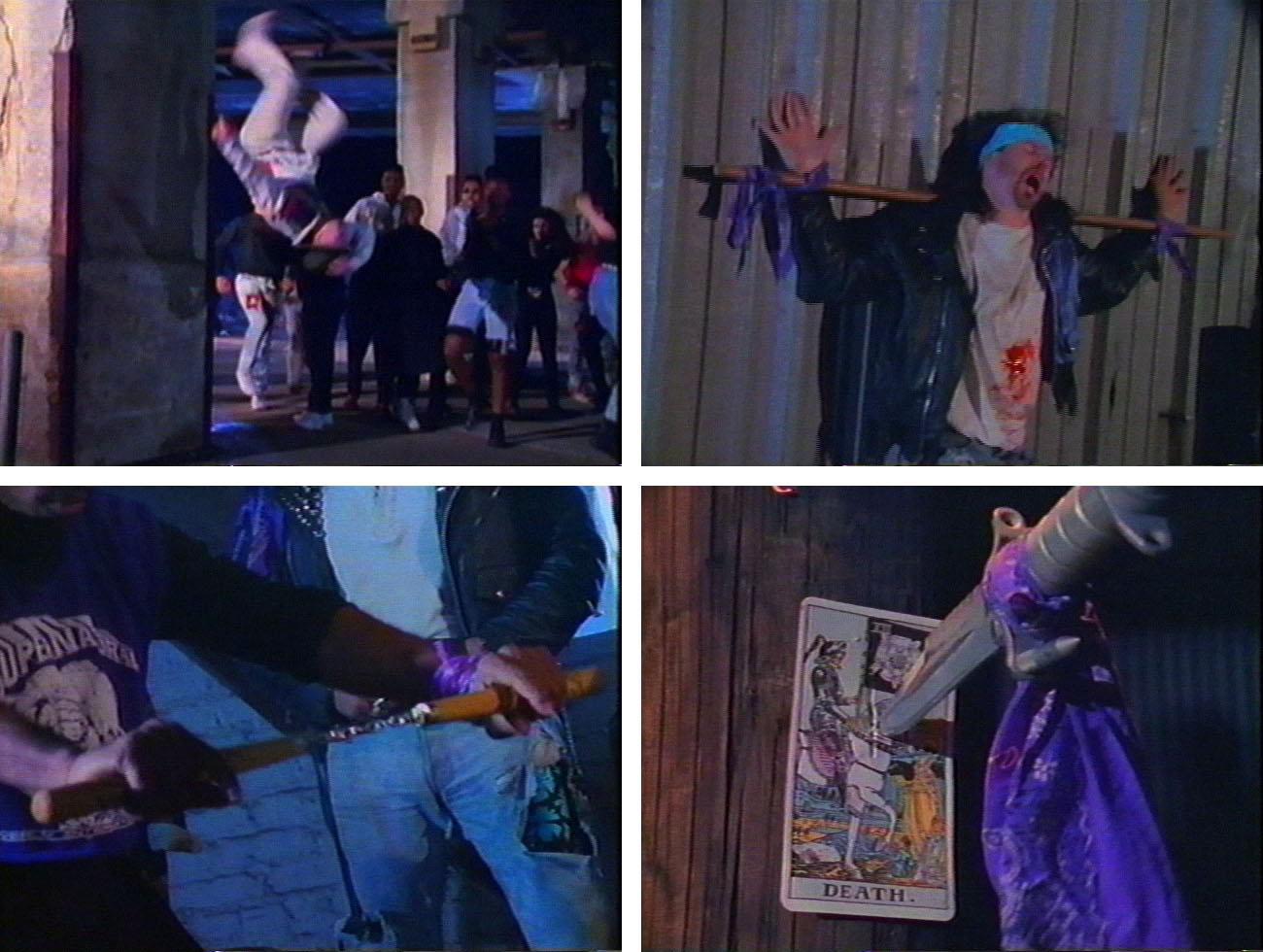
In the slickly produced, “Beat It” style video for his 1993 song “The Resurrection Rap,” the once-popular Christian contemporary muscian Carman recasts the narrative of the passion as a brawl between theologically inclined street gangs. His Jesus is white, unshaven and wears a leather jacket with a blue bandana, the signifying accessory of his “crew.” At the climax of the song an all black gang, implicitly led by the Devil, beats Jesus to death with knives, chains and nun-chucks. They toss his body in a dumpster.
The media scholar Heather Hendershot, in her 2004 volume Shaking the World for Jesus, devotes several lucid chapters to the rise and transformation of Christian Contemporary Music (C.C.M.) in the latter half of the twentieth century. Naturally, she touches on Carman — as do her subjects. “I try to avoid Carman like the plague,” one unnamed professional in the Christian music industry told Hendershot. “I think he’s a heretic… His whole thing… I think it borders on prostitution of the gospel, quite frankly.”
Last month, when I reviewed Carman’s music video collection The Standard, I concluded with a throwing up of hands. Whatever message Carman was trying to transmit had been hopelessly garbled, I said, by its medium of transmission. Interestingly, Hendershot’s correspondents in C.C.M. agree with this sentiment, albeit on theological grounds. It’s tempting to end the conversation there: Carman, whatever his final intentions, simply failed to entertain or uplift. As an artist he was, at best, a clown and, at worst, a prostitute. So, why keep talking about him?
The answer is simple, and injurious to my critical vanity. Whatever my opinion of Carman’s comprehensibility, his work has certainly communicated with its intended audience on a massive scale. When “The Resurrection Rap” was released, Carman’s donation-supported stage shows were commanding national and international audiences in excess of 50,000. Over the course of his career, he’s moved ten million albums. Billboard magazine, in 1990, named him “Contemporary Christian Artist of the Year.” What’s more, C.C.M. producer Cindy Montano, in her interview with Hendershot, noted that Carman’s work ignites a religious spark in its audience. After Carman T.V. specials, Montano said, people often call into the network “seeking salvation, wanting someone to pray with them… Carman’s videos are very effective at touching people.”


Montano was speaking of Carman’s music videos — but works such as The Standard weren’t his only releases in the VHS format. In the early 1990s, at the height of his career, the singer’s Carman began a monthly “video club,” called “Time2,” whose members received a monthly VHS dispatch featuring new music videos, tape of live C.C.M. performances, interviews on evangelical topics, ministry from Carman himself, and, as one advertisement for the series put it, “[comedy] sketches with an apparent purpose.” These tapes, running a highly-televisable thirty-minutes each, play like a gaudy, early-nineties riff on the ramshackle 1944 radio-magazine The Orson Welles Almanac, which was an attempt by Welles to merge broad comedy, serious drama and political comment into a showy half-hour capable of selling Mobil gasoline. Critics at the time were quick to point out that Welles, whatever his talents, was no Jack Benny. Carman, in turn, is no Orson Welles.
“Time2” is a mess. The comedy fails to land, the interviews play like shrill monologues and the split-second editing employed throughout makes even straightforward segments nearly incomprehensible. Where the club succeeds, however, is in the clarity of its intent. Each episode articulates a proper evangelical “response” to a relevant issue, using a variety of sequences and tones to deliver an unwavering didactic message. In so doing, I believe, the series lays bare Carman’s appeal — and the features of his work which either embarrass or inspire, depending on your point of view.
The episode “Faith with Reason,” provides a representative example. On this videotape, Carman promises to address the idea of the scientific and historical “accuracy” of the biblical text, with his position being that direct evidence — while nice — is of secondary concern. Towards this end, “Time2’s” regular “Buzz” feature is devoted to attacking the material culture of dirt-bike and dune-buggy enthusiasts, implicitly because their fanaticism is unproductively worldly. Following a performance from the C.C.M. artist Cindy Morgon, the theme is again picked up in a comedy sketch featuring two redneck caricatures sharing a porch and discussing “belief” over a deafening soundtrack of canned birdcalls. One of them “believes” only in things he can see — including wallpaper and pickles. The other, a Christian, takes these pronouncements in stride for four excruciating, mirthless minutes. In the end, afraid that its audience might miss the point, the “Time2” provides an onscreen quotation of John 20:29: “Blessed are those who have not seen and yet believed.”
The latter half of the tape is dominated by Carman. First, the musician flashily appears on “Time2‘s” Saturday Night Live-like main stage to interview an author of popular Christian apologetics, making sure to provide the requisite talk show plug.
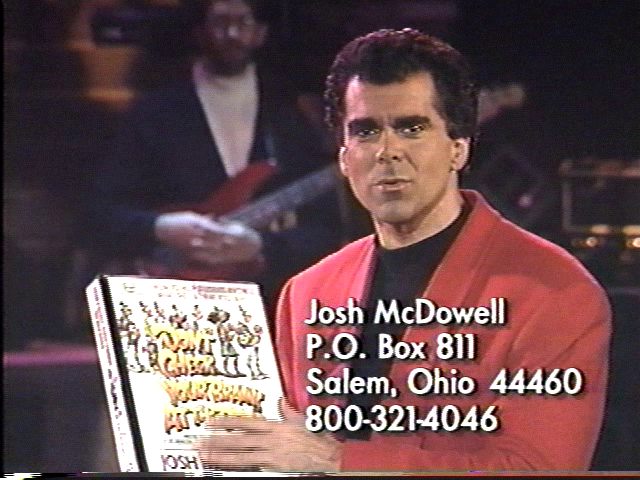
An unrelated C.C.M. video follows, preceding the climactic moment when Carman takes the stage alone to minister directly to his viewers. “Don’t follow what you hear or what you see or what you experience,” he says, over a score of weeping pianos. “Follow what’s already there in God’s revelation to mankind.” Biblical quotations are helpfully presented throughout by colorful, frame-filling graphics.
As in Carman’s music videos, a series of obvious cross-pressures are at work in “Time2.” Television is probably the most visible, given the series’ focus on dividing itself into segments of three to five minutes in length, complete with simulated commercial breaks. Along with this format comes an attempt to be entertaining in a familiar, televised way — hence “Time2‘s” eclectic mix of talk show, sketch comedy and musical performance. Often this approach muddles “Time2’s” religious message, as in the segment on desert sports from “Faith with Reason.” In this sequence, loud rock music plays over scenes of leaping dirt-bikes and sand-spitting dune-buggies, glorifying the supposedly “material” world the segment is ultimately meant to attack. The world outside of evangelical culture can be fun to look at, “Time2” acknowledges, but it is also a domain of spiritual threat.
These two stances toward the non-evangelical are played out prominently in “Time2’s” choice of episode topics.

Each month, for the most part, the club devoted its time to articulating the proper evangelical “response” to a contemporary topic of religious, social or political interest. Two of the entries I managed to track down, “A New Age” and “Psychics: The Counterfeit Connection” explicitly dismiss the spiritual claims of practitioners in non-evangelical traditions.
Psychics, Carman says, exist in an area of “profound spiritual darkness,” a zone made all the more dangerous by its omnipresence in “secular” pop-culture. Throughout this episode of “Time2,” seemingly independent artifacts such as Ouija boards, psychic hotline commercials and roleplaying games are woven into a singular demonic conspiracy bent on the seduction and death of the evangelical audience.
“A New Age,” an episode that finds similar malevolence in “Star Wars,” crystal healing, the recycling movement and “relative morality,” carries a particularly paranoid message. In one sequence of interviews, a number of evangelicals describe a conspiracy to indoctrinate children in “new age” practices through public education. Johanna Michelson, a reoccurring “Time2” expert on the occult, argues vehemently that the tainting of public education is simply the first step in a secretive plot that aims to create an irreligious one-world government, necessitating a future where “Christianity will be the enemy of the superstate.” This apocalyptic pronouncement is presented without comment or counter-argument. In “Time2,” such a scenario is the logical outcome of a culture where religious doctrines have become disturbingly fluid — one sequence, late in the episode, shows a car bumper gaining and losing political stickers over the passage of time. The effect is both humorous and chilling — in “Time2’s” conception of the world, such everyday sights are evidence for the proactive reality of evil.
This paranoid stance helps explain Carman’s engagement with popular culture as a whole. While the musician assumes the aesthetics of pop, quoting from Michael Jackson and Nirvana in his music videos and aping a variety of television forms in “Time2,” this act of assumption is predicated on the necessity of divorcing such stylistic forms from whatever “secular” content they might contain. The status of this project, even among evangelicals, is by no means uncontroversial. The Revered Jimmy Swaggart, for instance, once famously argued that using the aesthetics of rock n’ roll to convey a Christian message was like “giving a drug addict methadone.” From his point of view, the format of secular popular culture was inherently corrupt. Carman, implicitly, takes the opposite position.
While “Time2” reveals that Carman views the “secular” world as deeply threatening to evangelicals, it also proposes a cultural landscape where such threat has been expunged. When Carman quotes from “Beat It” in his “Resurrection Rap” retelling of the passion, he is actively creating a world where all the aesthetic pleasure of Jackson’s product is ideologically vacated, the resulting void neatly filled with clear evangelism. There is nothing wrong, Carman seems to say, with enjoying the look and feel of non-evangelical pop — these elements, in and of themselves, are meaningless. In a world where evangelism is the only acceptable content, Carman would be the king of pop.
Carman exists, however, on our world — and within the material subculture of evangelical film and music. Hendershot, in Shaking the World for Jesus, carefully explores the nature of this space, arguing that growths in evangelical education and affluence since the mid-twentieth century have rendered it profoundly unsettled. Even as Carman doubled down on open didacticism and a healthy paranoia towards “secular” ideology in “Time2,” his contemporaries began to push more nuanced, ambiguous and conversational approaches to faith. In the field of C.C.M., for example, the most popular artists at the turn of the last century were those whose music could “cross over,” finding airtime on such “secular” venues as the cable channels M.T.V. and V.H.1. This passage necessitates a certain amount of subtlety in regards to a musician’s evangelical message — it must be present for those who know what to look for, and invisible to the larger, non-evangelical audience the artist wishes to reach. Carman is rarely subtle, and his faith in the invisible is, ironically, never invisible itself. “Time2,” and Carman’s work as a whole, deliver an openly evangelical message with a maximum of flash and expended capitol. This, Hendershot argues, makes Carman the “most evangelical in theory and the least evangelical in practice” of any contemporary Christian musician. He preaches, exclusively, to the choir.
The antipathy towards Carman expressed by Hendershot’s contacts in the C.C.M. industry makes perfect sense in this context. For them, a certain amount of submission to the aesthetics of non-evangelical pop is seen as necessary for success — maybe even hip. Carman, on the other hand, creates a world in his videos wherein pop aesthetics are made to submit themselves, totally, to evangelism.
Last month, I spoke of the science-fictional occultism of the VHS format. “Time2,” and Carman’s works as a whole, are a perfect example. They’ve fallen to earth through a tear in space-time, a portal to another universe. In their place of origin, Carman is not “the Christian Michael Jackson,” but is, instead, a wholly novel cultural force who fulfills the role of Jackson within a fundamentally altered system of culture. In this world, everything is evangelical. Evangelical pop is simply “pop.” No submissions, substitutions or alterations are required.
VHS tapes are products of a different time, the unknown of not-quite twenty years ago. Even when they were new, such tapes were artifacts — small documents, speaking out of turn, imagining a world where the dominant cultural discourses have been displaced. To those without such imperial aims, evangelicals and non-evangelicals alike, Carman will always come off tasteless. To his core audience, his “subscribers,” however, things like “Time2” must look at least a shade millennial.
***
Don Jolly is a Texan visual artist, writer, and academic. He is currently pursuing his master’s degree in religion at NYU, with a focus on esotericism, fringe movements, and the occult. His comic strip, The Weird Observer, runs weekly in the Ampersand Review. He is also a staff writer for Obscure Sound, where he reviews pop records. Don lives alone with the Great Fear, in New York City.
AAC Honey Badger PDW - Wikipedia, the free encyclopedia
Pappy Van Winkle and BTAC bourbons and ryes......!!!!!!!
Russian Sledges#fuck #you
- Old Rip Van Winkle 10 year ...........................$225.00
- Van Winkle Reserve 12 year "lot B".................$325.00
- Van Winkle Reserve 13 year RYE...................$550.00
- Pappy Van Winkle 15 year..............................$550.00
- Pappy Van Winkle 20 year..............................$750.00
- Pappy Van Winkle 23 year............................$1,350.00
-Full set of Van Winkle.....................................$3,600.00
- George T. Stagg Bourbon...............................$275.00
- Thomas Handy Rye........................................$220.00
- Eagle Rare 17 Bourbon..................................$275.00
-William Larue Weller Bourbon.......................$300.00
-Sazerac 18 Rye................................................$300.00
Full set of BTAC.............................................$1,300.00
Rare Vintage Chinese Opera Photos Photographer Zhang Yaxin was...
Russian Sledgeshttp://lightbox.time.com/2013/06/17/zhang-yaxin-photographing-chairman-maos-model-operas/#1


Rare Vintage Chinese Opera Photos
Photographer Zhang Yaxin was one of the only people in China with access to color film during the Chinese Cultural Revolution (1966-76). Zhang was a photographer for Xinhua News Agency when he was chosen by Jiang Qing, the wife of Chairman Mao Zedong, to photograph the performances of the model operas she developed after the Communist Party leaders banned traditional Peking opera for being too bourgeois. - Via
End of the World Cinema: An Abandoned Outdoor Movie Theater in the Desert of Sinai


Somewhere on the southern tip of the Sinai Peninsula in Egypt, nestled at the foot of a desert mountain range, sits a peculiar sight that is almost completely out of place: hundreds of seats for an outdoor movie theater. Estonian photographer Kaupo Kikkas recently visited the desolate location and brought back these amazing shots of a decaying dream. He shares via his blog that the theater was built not too long ago by a man from France with considerable means. Tons of old seats and a generator were hauled in from Cairo, not to mention a giant screen that looked like the sail of a ship.
Everything was set for opening night, with one small problem. Kikkas says the locals weren’t particularly keen on the whole idea and decided to discreetly sabotage the generator. A single movie was never screened. So now it sits in the middle of a desert, a random movie theater that was never used. You can still see it on Google Maps. (via Lustik, Abandoned Geography)
6 Reasons to Imbibe at Alden & Harlow
Russian Sledgesboulevardier variant on draft, etc.
Philandering Old Man Thurston Moore Calls Jezebel 'Gender Fascism'
Russian Sledgesvia kellygo
this fucking guy


Plywood Report: Whisk & Wink & Nod
Russian Sledges"speakeasy"

[Photo: Early renderings of Wink and Nod/Facebook]
Curtis McMillan, the general manager of upcoming South End speakeasy Wink & Nod, chatted with Eater in late January, giving a few hints about the upcoming venue, which is set to open on March 15. One thing he wouldn't reveal was information about the food program. "We are talking to some people who we unfortunately can't mention yet," he said, "but let's just say that if it goes the way I want it to, it's going to be destructive in the South End. That's all I can really say at this point."
This morning, Boston.com's Restaurant Hub blog broke the news that chefs Philip Kruta and Jeremy Kean, the team behind the popular Whisk pop-up, have found a permanent home at Wink & Nod. Say hello to Whisk at Wink & Nod.
The official statement:
"Boston Nightlife Ventures is excited to announce Whisk at Wink & Nod, an unprecedented collaboration between Boston's newest craft cocktail destination and the chefs behind the ambitious, highly regarded pop-up restaurant Whisk. With this venture, Chefs Philip Kruta and Jeremy Kean are reimagining standard drinking fare with an inventive à la carte menu of New American plates and bar snacks featuring the team's signature vivid flavors and unexpected touches. Designed to complement Wink & Nod's playful takes on classic cocktails, the menu will change seasonally with the exception of select staple dishes familiar to fans of Whisk's past pop-ups. Whisk at Wink & Nod begins serving food in mid-March, when the bar opens to the public."· Roving pop-up Whisk finds a permanent home at Wink & Nod [Boston.com]
· All coverage of Wink & Nod on Eater [~EBOS~]
· All coverage of Whisk on Eater [~EBOS~]
Photo Interlude: The Abbey's Cambridge Expansion Is "Coming Soon"

[Photo: The Abbey/Facebook]
The Abbey, a restaurant and bar based in Brookline's increasingly popular Washington Square neighborhood, is expanding to the former Addis Red Sea space in Cambridge's Porter Square, as reported in November. The opening is getting closer, according to a photo on The Abbey's Facebook page. "Just completed the woodwork on the downstairs bar," reads the caption. "Abbey Cambridge coming soon!"
· The Abbey [FB]
· All coverage of The Abbey on Eater [~EBOS~]
"Repeal Beer" When Prohibition officially ended on December 5,...
Russian Sledgesvia kellygo


"Repeal Beer"
When Prohibition officially ended on December 5, 1933, booze peddlers large and small quickly did the legal thing and registered their products’ labels with the U.S. Patent Office. Here’s one aptly named product, to cash in on this “heady” time, registered with the Patent Office on March 6, 1934.
Trademark Application for Esslinger’s “Repeal Beer” Label, Case File 43336. 3/06/1934. NARA ID: 7788265
From the series: Case Files for Registered Product Labels , 1874 - 1940. Records of the Patent and Trademark Office, 1836 - 1978
(Today’s post comes via Alan Walker, an archivist in Research Services at the National Archives in College Park, Maryland.)
nudityandnerdery: hitchhikersguidetothegalaxy: pages-from-the-8...
Russian Sledgesjava (not sure if it works): http://www.douglasadams.com/creations/infocomjava.html
flash: http://www.bbc.co.uk/radio4/hitchhikers/game_nolan.shtml
via firehose


Ad for The Hitchhiker’s Guide to the Galaxy video game on pages 2 and 3 of the Oct 1985 (Issue 65) of Compute! (Vol. 7 No. 10)
You wake up with a hangover that lasts for all eternity. You have died.
As I recall, this game was pretty freaking hard. Like harder than Flappy Bird.