Shared posts

21 May 17:12

The Carrot Hack

by Nicola

Sowing seeds 460

People who sell seeds have always struggled with an inconvenient reality: Their merchandise reproduces itself.

So writes Lisa Hamilton, one of my fellow Fellows from the inaugural UC Berkeley/11th Hour Food & Farming Fellowship programme, summing up a problem that plant breeders have struggled with for generations: how to monetise the effort and ingenuity embedded in their work.

As Hamilton’s article, published in the June issue of the Virginia Quarterly Review, describes, since the passing of the Plant Patent Act of 1930, breeders have relied on intellectual property law in order to profit from the years they invest in developing a useful characteristic in a plant — an easier-to-harvest broccoli, or a lycopene-rich red carrot.

In order for seeds to become a commodity and generate a profit, there had to be a reason for people to buy them year after year. Over the course of the twentieth century, the industry devised certain solutions, including hybrid seeds and “trade-secret” protections for their breeding processes and materials. But perhaps the most effective solution is the application of intellectual-property rights, of which the utility patent is the gold standard.

Before the Plant Patent Act, plant breeders complained bitterly that the reward for their achievements was frequently obscurity and poverty, in contrast to the fortunes being reaped by mechanical inventors such as Thomas Edison and Alexander Graham Bell.

Luther Burbank, the first (and perhaps only) celebrity plant breeder, many of whose new fruit and vegetable varieties still fill our plates today, died before the Plant Patent Act was introduced, and frequently despaired over his inability to make a profit:

A man can patent a mouse trap or copyright a nasty song, but if he gives to the world a new fruit that will add millions to the value of the earth’s harvests he will be fortunate if he is rewarded by so much as having his name connected with the result…. I would hesitate to advise a young man, no matter how gifted or devoted, to adopt plant breeding as a life work until America takes some action to protest his unquestioned rights to some benefit from his achievements.

Burbank peach patent 460

IMAGE: Application for Plant Patent 15, “Peach,” filed posthumously by Luther Burbank’s widow on December 23, 1930.

But, as Hamilton explains, while the utility patent may have made plant breeding profitable enough for the multinational likes of Monsanto and Syngenta, the application of intellectual property law to nature is not without problems, from the eminently practical (it tends to constrain seed-sharing, which ultimately hinders “the very resilience of agriculture itself”) to the philosophical (can an element of the natural world, however much altered and “improved” upon by human ingenuity, really be owned by an individual?).

Her article, which you really need to read in full, looks at one renegade group of plant breeders who have banded together to launch a challenge to the prevailing model of seed IP: the Open Source Seed Initiative, which released its first open-source, un-patentable broccoli, kale, and celery seeds this past April.

ossi-meeting 460

IMAGE: A meeting of the Open Source Seed Initiative Group at the University of Minnesota in 2012, from the group’s website.

Missing from the final article, in the interests of streamlining, was one of my favourite anecdotes from Hamilton’s reporting: the carrot hack. The doctoral thesis project of Claire Luby at the University of Wisconsin, the carrot hack proceeds in the reverse direction to conventional plant breeding. As Hamilton explained to us, Luby is effectively “un-breeding” the American commercial carrot in order to free its genetic code for remixing:

The mesh bags represent the project’s first stage, for which she grew every commercially available carrot variety in the United States. There are 144 in all, ranging from the knobby French heirloom Tonda di Parigi to CrispyCut, a ten-inch long variety designed to be lathed into baby carrots.

Because carrots are biennial, they require two seasons to reproduce: during the first they grow their nutritious root, during the second they flower and produce seed. Luby is storing her harvest in the adjacent cold room, whose temperature of 41 degrees F will trick the plants into thinking they have passed through winter in two months. After Thanksgiving, for the project’s second stage, she will plant them in the greenhouse. As they flower, she will introduce ten thousand flies to cross-pollinate them en masse.

This is the opposite of what her fellow students will be doing this winter. They will mate specific pairs of plants to breed more targeted individuals. Luby will effectively un-breed her carrots, mixing their genes at random into a population that is wildly heterogeneous. The idea is to capture the entire range of genetics used in commercial carrots within a single collection. Breeders can then use that seed to produce new varieties. There’s only one catch: those new varieties can never be patented. That’s because Luby’s seed will be open source.

It’s an incredibly ingenious idea that, predictably, has not gone perfectly smoothly. In discussion with University of Wisconsin lawyers, Seminis (the largest developer of fruit and vegetable seeds in the world, purchased by Monsanto in 2005) banned Luby from using its carrot germplasm. In the end, more than a third of the original 144 carrot varieties cannot be included in the open-source mash-up due to corporate restrictions. However, Hamilton told us, there’s still hope, because many commercial carrots come from the same original stock, and thus still share DNA:

By comparing DNA markers, Luby will map out where the carrots’ genes overlap. It’s possible that the seeds she can use will contribute many genes that are also found in the seeds she can’t use.

Hamilton’s reporting on this story is an important wake-up call to those of us who have never considered how seed IP affects what we eat, both now and in the future. It’s a complicated issue, and, as a result, growing corporate control of germplasm, and its equally problematic counterpart, declining public investment in plant breeding, rarely make headlines.

But, although it’s unclear yet whether the Open Source Seed Initiative or Claire Luby’s carrot hack can provide a viable alternative model to plant patents, what is utterly fascinating about Hamilton’s article is the way it demonstrates the importance of metaphor in opening new possibilities for imagining the world, and constraining others.

myers_in_field_hamilton 460

IMAGE: Jim Myers, professor of vegetable breeding and genetics at Oregon State University, photographed in a broccoli field at the university’s research farm by Lisa Hamilton.

Seeing seeds as software, for example, inspires certain solutions (a carrot hack! Linux for lettuce!) but creates other problems (how does licensing enforcement work when the open-source genetics are not marked in any way?). Elsewhere in Hamilton’s article, breeders refer to the idea of a “national park of germplasm” — a “genetic easement” that preserves, un-patented, enough of the important DNA of, say, commercial carrot varieties, for future generations of plant breeders, growers, and eaters. This idea of the natural world as a protected commons offers, in turn, its own set of tools and limitations.

In the end, it seems that one of the more valuable contribution those of us who are concerned about seed IP could make would be the gift of a new set of metaphors, to re-imagine how we relate to the natural world we make.

20 May 21:30

The 33 best cocktail bars in the country

by russiansledges
Russian Sledges

been to/endorse:
alembic
columbia room
cure
death & co.
drink
prizefighter
scofflaw
violet hour
trick dog

haven't been but have a mild crush on bobby heugel:
anvil

going later this year:
noble experiment

overbey, did you go to leon's full service?

Over the course of many years here at Thrillist, we’ve written about cocktail bars in nearly every city across the US (and the world!), so it only made sense that we’d take that knowledge and pick out our 33 best cocktail bars in the country. We’re not aiming for the new, hot ones (though some are on here) -- just strictly the best places to get delicious cocktails -- both innovative and classic -- ideally without pretension, attitude, or crappy cocktail napkins that stick to the bottom of your glass. And -- as a bonus -- we asked our British and Canadian editors to pick their favorite cocktail bars, too, so you can enjoy boozy perfection wherever you go. As always, there will be disagreements, places we missed, and people who think I like gin too much, so voice those opinions in the comments. Or just enjoy these beautiful photos:
20 May 20:21

BREAKING: Pennsylvania's Ban On Gay Marriages Has Been OVERTURNED UPDATE: There Is NO Stay On Ruling

by Joe Jervis
Here's the full ruling.

UPDATE: Chris Geidner reports has an initial report:
“We now join the twelve federal district courts across the country which, when confronted with these inequities in their own states, have concluded that all couples deserve equal dignity in the realm of civil marriage,” Jones wrote. Although Pennsylvania has no constitutional amendment barring same-sex couples from marrying, Jones on Tuesday struck down the state’s 1996 statute banning same-sex couples from marrying and barring recognition of out-of-state marriages of same-sex couples.

In concluding, Jones wrote, “[W]e hold that Pennsylvania’s Marriage Laws violate both the Due Process and Equal Protection Clauses of the Fourteenth Amendment to the United States Constitution. Because these laws are unconstitutional, we shall enter an order permanently enjoining their enforcement. By virtue of this ruling, same-sex couples who seek to marry in Pennsylvania may do so, and already married same-sex couples will be recognized as such in the Commonwealth.”
UPDATE II: There is NO stay.
20 May 18:41

Kansan Conservatives Fight Against Free Expression

by Charles C. W. Cooke

NPR reports that academics at government-run universities in Kansas will henceforth be expected to follow state-sanctioned speech codes:

The Kansas Board of Regents gave final approval Wednesday to a strict new policy on what employees may say on social media. Critics say the policy violates both the First Amendment and academic freedom, but school officials say providing faculty with more specific guidelines will actually bolster academic freedom on campus.

The controversial policy was triggered by an equally controversial tweet posted last September by David Guth, an associate journalism professor. Reacting to a lone gunman who killed 12 people at the Washington Navy Yard in Washington, D.C., he wrote:

“The blood is on the hands of the #NRA. Next time, let it be YOUR sons and daughters.”

Guth was placed on administrative leave after an outcry from the public and state lawmakers.

Is this unconstitutional? Maybe. Were Guth an employee of a private university, this would be solely a question of morality: To wit, “Should private universities tell their staff how they may speak.” My answer to that — as usual — would be, “No.” But it wouldn’t be an issue of law.

Guth, however, is not an employee of a private university; he works for the state. And on this, the jurisprudence is now somewhat confused. Until the 1960s, the Supreme Court largely followed a principle best summed up by Oliver Wendell Holmes in 1892, that “there may be a constitutional right to talk politics, but there is no constitutional right to be a policeman.” In 1952, in Adler v Board of Education, the Court put the principle even more clearly, deciding that individuals “have a constitutional right to say and think as [they] will, but [they] have no constitutional right to work for the government.” Since that time, however, the court has dissembled a little, attempting in a host of subsequence cases to balance the right of the individual to contribute to matters of public import with the right of the employer to ensure that its services are offered to the public in an unsullied way. In all honesty, it is difficult to tell quite where Guth fits in here.

Either way, one thing is sure: This measure is an unlovely one. How is this for Orwellian language?:

school officials say providing faculty with more specific guidelines will actually bolster academic freedom on campus.

Of course. Freedom is slavery and all that.

Worse, an elected representative actually offered the “I believe in free speech but . . .” canard with a straight face:

Rep. Travis Couture-Lovelady, a member of the Kansas House of Representatives and the National Rifle Association, says he was outraged by the tweet. He supports the board of regents’ new policy to place parameters on professors.

“Look, you have freedom of speech, but you can’t go this far,” he says. “I think having a clear understanding between faculty and the board of regents on what’s acceptable and what’s not is better for everyone involved.”

Couture-Lovelady is a Republican. The governor that appointed the board that set the rules is a Republican. This is not a good look, guys.

Are we really to presume that the United States will be a better place if Kansan academics are prevented from saying in public what is on their minds in private? Are we really to presume that this policy is “better for everyone involved”? And are we really to presume that it is better for the NRA and for the Right in general if its harsher critics are punished by lawmakers for their denunciations? I rather think not. Indeed, I’m reasonably sure that the majority of conservatives simultaneously believe three things: 1) That Guth is an extremely silly man; 2) That attempting to shut him and his colleagues up constitutes government overreach; and 3) That even if it’s not illegal, it’s immoral. Are we going to stand for this?

For the past half-century or so, conservatives have built up a stellar record in the area of free expression. It is the Left that wishes to impose speech codes on college campuses and beyond. It is the Left that wishes to limit the legal bounds of free expression, introducing pernicious ideas such as “hate speech” and attempting to shut those they dislike out of the Constitution’s legal protections. It is the Left that has taken to mounting witch-hunts in order to destroy the careers of anybody who refuses to acquiesce with the zeigeist. The Right’s principled opposition to this is something of which it should be genuinely proud. Really, there’s no need to get all imperious because someone said something stupid about the NRA.

20 May 17:42

A Fearmongering Anti-RPG Comic Gets the Film Adaptation It Deserves | Underwire | WIRED

by russiansledges
Ralls wrote to Chick, asking to buy the rights to Dark Dungeons. “Dear Mr. Chick,” he wrote, “I won the lottery … I have decided that the best use of the money I won would be to film and distribute a live-action version of your tract ‘Dark Dungeons.’” To Ralls’ surprise, Chick responded—and offered the rights for free.
20 May 16:35

Photo

Russian Sledges

via firehose


20 May 16:33

A Tiny Austrian Town Has the Coolest Bus Shelters We've Ever Seen

by Jenny Xie
Russian Sledges

via saucie

Image
Adolf Bereuter

Krumbach, a scenic Austrian town with a population of 1,000, came up with a clever idea last year to try to put itself on the tourism map.

Association kultur krumbach, the village's nascent cultural organization, approached seven international architects with an unusual proposition: design a bus stop for us and we'll give you a free vacation in Krumbach. 

Every single one of them said "yes."

By summer 2013, all the designs had been submitted and construction began. The international architects — Sou Fujimoto (Japan), Wang Shu (China), Rintala Eggertsson Architects (Norway) , Ensamble Studio (Spain), Smiljan Radic (Chile), Architecten de Vylder Vinck Taillieu (Belgium), and Alexander Brodsky (Russia) — collaborated with over 200 local designers and craftsmen to erect each distinct structure. 

From Sou Fujimoto’s climbable forest of rods to Wang Shu’s camera lens-inspired project, these designs suggest that waiting for the bus can actually be kind of fun. 

In a statement, Verena Konrad, Director of Austria's Vorarlberg Architecture Institute, said this initiative was also a "successful connection of infrastructure and mobility for the rural area.” 

All seven completed bus stops were unveiled earlier this month and are now in use. Check out a map of the bus stop locations and some photos below.

A map of bus stop locations in relation to each other (screenshot via Verein kultur krumbach
Sou Fujimoto — This design offers no protection against the weather, but instead a new way to interact with the natural surroundings. (Photo by Adolf Bereuter) 
Sou Fujimoto (Yuri Palmin/Facebook
Wang Shu — The shelter’s “lens”-like opening focuses the gaze on faraway scenery.
 (Photo by Adolf Bereuter) 
Wang Shu (Yuri Palmin/Facebook
Alexander Brodsky — This bus shelter, in the form of a wooden tower, lets through birds and a breeze. (Photo by Adolf Bereuter) 
Alexander Brodsky (Yuri Palmin/Facebook
Smiljan Radic — this glass pavilion comes with a playful birdhouse. (Photo by Adolf Bereuter) 
 Smiljan Radic (Yuri Palmin/Facebook
Ensamble Studio — a space that’s both protected and open, erected from the local technique of layering untreated wood planks. (Photo by Adolf Bereuter) 
Ensamble Studio (Yuri Palmin/Facebook
Architecten De Vylder Vinck Taillieu — a geometric abstraction of a triangular form, inspired by angled roads in the area. (Photo by Adolf Bereuter) 
Architecten De Vylder Vinck Taillieu (Yuri Palmin/Facebook
Rintala Eggertsson Architects — This bus shelter doubles as a spectator stand for the tennis courts nearby.  (Yuri Palmin/Facebook
Rintala Eggertsson Architects (Yuri Palmin/Facebook


20 May 16:32

Unrelated to the blog: I vacationed in Maine almost every summer...

Russian Sledges

via firehose

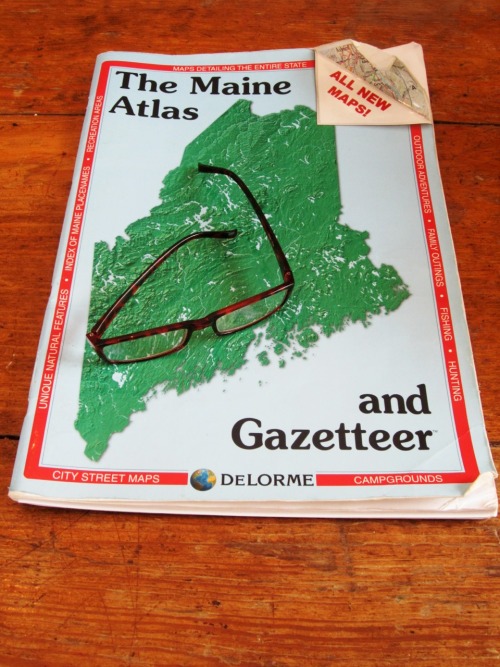
this lived in my parents' car

probably still does


Unrelated to the blog: I vacationed in Maine almost every summer as a child and we’d stop at the DeLorme headquarters on the drive up.  Scanning an atlas just like this was how I fell in love with maps.

20 May 15:58

Thunderbird Energetica

by russiansledges
Russian Sledges

shared to appall

Cherry Walnut Crunch•Cacao Hemp Walnut•Cashew Fig Carrot•Almond Cookie Pow Pow•Sweet Lemon Rain Dance•Hyper Hawaiian Crunch•Superseed Spirit•Hazelnut Heart•Pecan Persistence
20 May 12:16

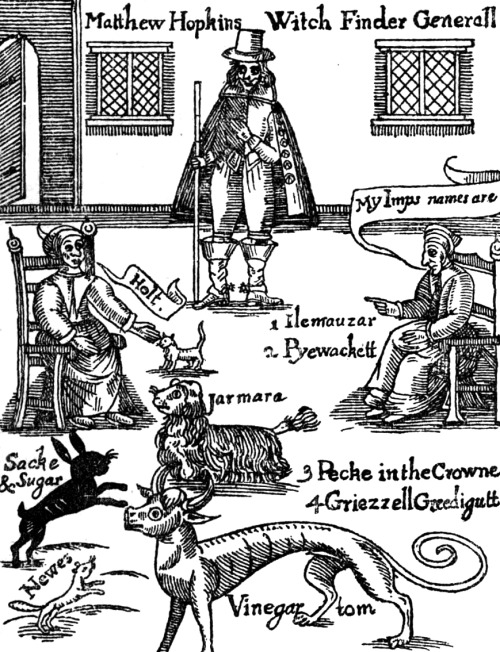
Matthew Hopkins, Witchfinder General, London, 1647


Matthew Hopkins, Witchfinder General, London, 1647

20 May 12:15

Lady Oscar red anime uniformVilla Belussi (Italy) Cosplayer :...

Russian Sledges

attn otters

let's tour the palaces of the world while dressed as heroic anime ladies


Lady Oscar red anime uniform
Villa Belussi (Italy)


Cosplayer : Kurimi
Photo: ByZa

20 May 05:42

humanoidhistory: The solar eclipse of May 6, 1883, observed...

by ushishir


humanoidhistory:

The solar eclipse of May 6, 1883, observed from Caroline Island, Kirabati, sketched by Étienne Léopold Trouvelot (1827–1895).

20 May 05:40

U.S. Cites End to C.I.A. Ruses Using Vaccines

by By MARK MAZZETTI
A top White House official has pledged that the C.I.A. will no longer use vaccination programs as cover for spying operations.


20 May 05:33

Thailand's Army Makes Coup-Like Martial Law Declaration, Insists It's Not a Coup

by Sara Morrison
Image AP
Not a coup. (AP)

Thailand's army declared martial law today, in a move that looks a lot like a coup but that the army says is not a coup.

Following months of protests, the country's prime minister Yingluck Shinawatra and some members of her cabinet were ordered to step down on May 7. Niwatthamrong Boonsongphaisan is currently the country's acting prime minister, but protestors aren't happy with him. He's refusing to resign, and the Senate -- the only legislative body remaining in the country after Yingluck dissolved the Parliament in December -- will only appoint a new interim prime minister if the current one steps down. Stalemate.

Thai soldiers patiently wait in the lobby of the National Broadcasting Services of Thailand. Army officials took to Thailand's airwaves to announce that the army was declaring martial law. (AP)

Army officials made the martial law announcement on several television stations, saying the move was to "keep peace and order," and that "the public do not need to panic but can still live their lives as normal." According to the AP, "armed troops entered multiple private television stations in Bangkok to broadcast their message nationwide." 

The army will now be in charge of the nation's security, but, it insists, that's it. Though Thailand's army has staged 11 successful coups since 1932, this is not one of them (yet). An unnamed official told the AP that "this is definitely not a coup. This is only to provide safety to the people and the people can still carry on their lives as normal."

An aide to the interim prime minister, however, said the government was not told about this before the fact, and called it "half a coup d'etat."

Thailand's last coup was in 2006, when Yingluck's brother, Thaksin Shinawatra, was removed from his post as prime minister after being accused of corruption and abuse of power. Yingluck has also been accused of abuse of power. Thaksin is still popular in parts of Thailand, and his supporters have clashed with anti-government protestors.

On May 13, U.S. Defense Department official Amy Searight said the country was "reasonable confident" that the Thai military wouldn't stage another coup and commended it for its restraint. 


19 May 21:22

Walpurgis Night, Brocken, Germany, April 30, 1932 

Russian Sledges

#TRAINS


Walpurgis Night, Brocken, Germany, April 30, 1932 

19 May 18:58

louchan: There is literally no Utena merchandise I want as much...

Russian Sledges

I will get these and I will throw a party


louchan:

There is literally no Utena merchandise I want as much as these babies.

18 May 20:13

Turn a video of upside-down bats upside down and it turns out they’re dancing together

by Joey White
Russian Sledges

via firehose

#tinygothclub

Filmmaker Paul Wood took video of three bats hanging upside down, flipped it around, and put music and sound effects to it. The end result is as funny as it is bizarre…

18 May 20:10

Baby owls adorably bob their head side-to-side with a camera

by Joey White
Russian Sledges

via firehose

<3

When Tessa Kangasperko saw a couple of baby owls on a walk through the woods in Finland, she pulled out her camera. The owlets were fascinated…

(via Tastefully Offensive)

18 May 20:08

Anima Sola, Souls in purgatory, Mother Church of Ílhavo,...

Russian Sledges

via firehose


Anima Sola, Souls in purgatory, Mother Church of Ílhavo, Portugal

18 May 20:08

Witches at a Sabbath having supper with the Devil and his demons

Russian Sledges

via firehose

#harvard


Witches at a Sabbath having supper with the Devil and his demons

18 May 20:07

Data Mining Shows How Down-Voting Leads To Vicious Circle of Negative Feedback

by Soulskill
Russian Sledges

via firehose

KentuckyFC writes: "In behavioral psychology, the theory of operant conditioning is the notion that an individual's future behavior is determined by the punishments and rewards he or she has received in the past. It means that specific patterns of behavior can be induced by punishing unwanted actions while rewarding others. While the theory is more than 80 years old, it is hard at work in the 21st century in the form of up- and down-votes — or likes and dislikes — on social networks. But does this form of reward and punishment actually deter unwanted actions while encouraging good behavior? Now a new study of the way voting influences online behavior has revealed the answer. The conclusion: negative feedback leads to behavioral changes that are hugely detrimental to the community. Not only do authors of negatively-evaluated content contribute more but their future posts are of lower quality and are perceived by the community as such. What's more, these authors are more likely to evaluate fellow users negatively in future, creating a vicious circle of negative feedback. By contrast, positive feedback does not influence authors much at all. That's exactly the opposite of what operant conditioning theory predicts. The researchers have a better suggestion for social networks: 'Given that users who receive no feedback post less frequently, a potentially effective strategy could be to ignore undesired behavior and provide no feedback at all.' Would Slashdotters agree?"

Share on Google+

Read more of this story at Slashdot.


18 May 19:33

When Kale and Brussels Sprouts Combine

by Heather Hansman
Russian Sledges

via saucehose

#brassicas

Turns out, Tozer Seeds, a British vegetable breeding company, is one step ahead of you. They’ve developed a Brussels-kale hybrid that they’re calling Kalettes™, which shoppers will be able to find in supermarkets in the U.S. starting this fall. Tozer successfully produced a vegetable cool kid — but it was kind of an accident, and it took them 15 years.

Tozer mainly focuses on tweaking existing seeds. They develop things like canker-resistant parsnips, slow-bolting celery and new varieties of runner beans, but they also do some seed breeding experiments, which their sales director David Rogers calls “Blue Sky projects.” In the lab, scientists mix plant strains to see what they come up with.

Tozer successfully produced a vegetable cool kid — but it was kind of an accident, and it took them 15 years.

In 1995, Dr. Jamie Claxton, who was relatively new to the company at the time, started mixing brassica lines. He mashed up kale and Brussels sprouts and the resulting vegetable, which had kale-like leaves on a Brussels-y stalk, was interesting enough that Tozer decided to put some research behind it. Brussels sprouts sales, which had always been pretty high in the U.K., were dropping, and they thought they might be able to perk them up.

But that’s where trend forecasting gets a little fuzzy. The success of this mashup came down to luck. The scientists had no idea that kale, bolstered by future appearances on “The Ellen Show” and being named one of the “trendiest” vegetables of the last 50 years by Bon Appétit, would become cool. After all, it takes a long time to develop a new species, even when you’re in a lab and with a team of scientists. “If you cross two lines, it takes a year to see how it turns out,” Rogers says.

That’s why you don’t often see completely new vegetables. The last new veggie to be introduced was Broccolini, which was developed in 1993 by Sakata Seed Company in Japan. It took Tozer almost 15 years until they felt like they had a marketable product. They tweaked the flavor to tone down the Brussels, worked on varieties that had longer growing seasons and bred in strains that they deemed more attractive. Even now, as it’s being sold, they’re still tweaking the details.

Getting a lab-perfected plant is only part of the process. From there you have to convince farmers to grow it and stores to sell it. Rodgers says that was the hardest part. It’s a gamble, because it’s hard to tell how consumers are going to react to a totally new food. “Growers could see that it had potential, but no one wanted to grow it on scale, because they weren’t sure if stores would sell it,” he says. In the U.K., they ended up setting up an exclusive deal with one grower, Mani Fresh, and one grocery store, Marks & Spencer. After the first year, the new vegetable, which they started calling Flower Sprouts, was popular enough that both signed on for another. That gave Tozer some confidence. They then brought it to Fruit Logistica, an agriculture trade show in Berlin and won 3rd place in the annual innovation awards. That’s when Tozer decided to try to start selling it in the U.S.

Coming to America came with a new set of challenges. Kale is trendier in the U.S. than it is in England, and they wanted to capitalize on that. The name “Flower Sprouts” wouldn’t fly, they decided. They changed the name to Kalettes to appeal more to America’s obsession with kale’s health benefits.

The last new veggie to be introduced was Broccolini, which was developed in 1993 by Sakata Seed Company in Japan.

Tozer also faces issues of infringement. Exclusivity is a big part of being cool, so when you’ve made something completely new it’s in your best interest to claim it, even if that new thing, theoretically, is repeatable. “You can’t stop another seed company from creating a cross, it’s not a difficult thing to do,” Rogers says. He says the only thing you can really keep ownership of is the name, and that’s why they’ve thought so much about branding. Kalettes is intentional, and they’re trying their hardest keeping it exclusive. Only certain commercial growers will get access to the seeds, and they’re figuring out partnerships with stores. If you want to grow it yourself, he says that seeds will be available for small farmers and individual gardeners.

Despite all the work Tozer has done to brand their particular vegetable mashup, Rogers says that most of it comes down to luck. “It’s lifted by the fact that kale is so popular right now,” he says. “In 1995 that wasn’t there. In the U.K. kale has always been sheep food.”


The post When Kale and Brussels Sprouts Combine appeared first on Modern Farmer.

18 May 19:30

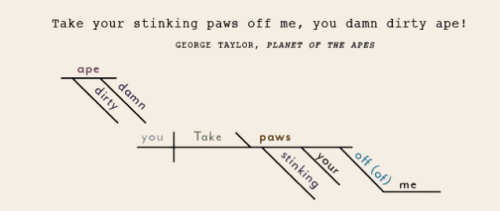
A Diagrammatical Dissertation on Notable Lines of Cinematic...

Russian Sledges

via firehose


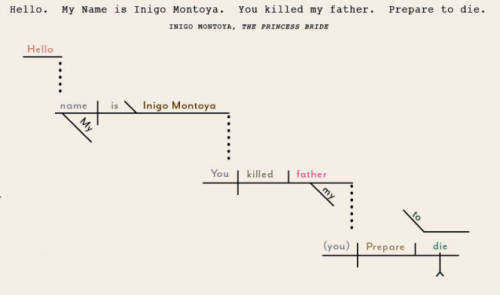
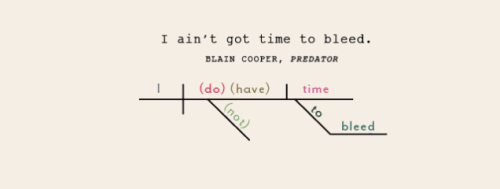
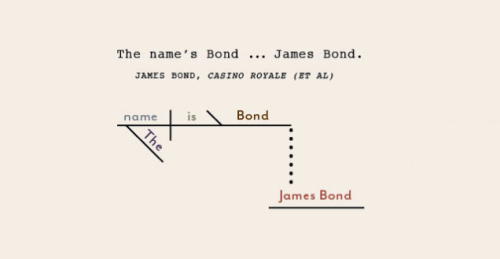
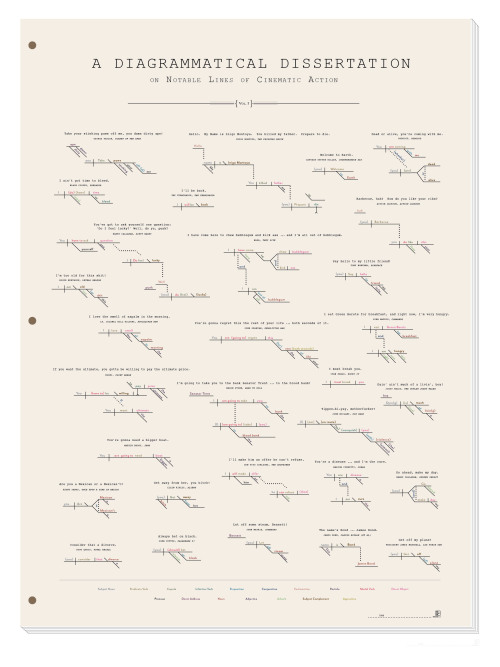
A Diagrammatical Dissertation on Notable Lines of Cinematic Action | Pop Chart Lab | Via

From Schwarzenegger to Segal to Eastwood to more Schwarzenegger, presented here is a semantic breakdown of cinematic action dialogue—the florid poetry of the gun-toting and glass-smashing, who express the complexities of the human condition through both verse and violence.

A chart full of weaponry and unequivocal wisdom, marvel at the explosive language of the men and women who make sonnets with semiautomatics, who compose couplets out of car crashes, who fight aliens and outlaws with their literal fists. Each famous action line is broken down into its constituent grammatical parts, revealing at once something both profound and beautifully simplistic about the way these singular heroes see the world and its myriad menaces.

18 May 00:19

MAN ON FIRE: OWEN PALLETT WAS THE MAINSTREAM’S BEST KEPT SECRET …

by NINA CORCORAN
FT_Owen(PeterJuhl)

Image by Peter Juhl

There’s a scene in the Spike Jonze film Her in which Joaquin Phoenix is running on a pier at night, eyes closed, with his OS (Scarlett Johansson) held out in front of him. It’s one of the few times we see him happy. In a film heavy with sorrow, regret, and emptiness—all the more emphasized by Arcade Fire’s meditative score—the scene soars on a genuinely bright spark cued by the music’s undertones. While it’s easy to picture the composing band’s Win Butler and Régine Chassagne writing the minimalist soundtrack themselves, fellow Canadian Owen Pallett was busy adding to the sound, too.

“I thought, ‘If I win this [an Oscar], I’ll be one Tony away from being the lamest EGOT ever; the first without a number one hit or even a charting single,’’’ Pallett says in a generously candid interview with DigBoston. With an Emmy and Grammy already perched on his mantle and the Her soundtrack nominated for an Academy Award, Owen was close to winning all four major prizes, a showbiz grand slam only a dozen people have ever achieved. All this while his solo material, a romantic buildup of sweeping baroque art-pop, has only won the Polaris Music Prize (under the moniker Final Fantasy back in 2006) and landed mid-sized touring gigs like Pallett’s show at Brighton Music Hall this Saturday.

Not that his achievements are anything to sneeze at. At 34 years old, Pallett’s played in arenas with Arcade Fire, arranged string sections for Taylor Swift and Linkin Park, and hypnotized crowds abound with his violin and loop pedal performances. He’s an arranger, a singer-songwriter, a violinist, a composer. He’s collaborated with The Mountain Goats. He lunches with Brian Eno. He’s published viral music theory essays on Slate. He won an Emmy for composing the T Magazine‘s “Fourteen Actors Acting” project for the New York Times. Owen Pallett is, short and simple, mainstream music’s best kept secret. Well, until now.

HOW MUSIC WORKS

When asked how early he started writing, Pallett needs clarification: “Professionally? Or commissioned?” He began studying classical violin at age three, brought his pen to paper at age five, and received his first paycheck in exchange for music, written for a video game, at age 12. His two brothers are cellists. His father is an organist. As such, his family grew up actively listening to classical music, a habit no doubt influential in his understanding of music.

“Owen consistently works his ass off,” says Jessie Stein, the frontwoman for The Luyas with whom Pallett finessed 2011’s Too Beautiful to Work. “There’s who you are and what you give to something, and then there’s also what the world gives you back and how that feeds you. He’s been on a pretty beautiful cycle of giving to the world and getting something back.”

That cycle of giving and receiving has brought Pallett to work with innumerable top musicians. Over the past decade, he’s written for R.E.M, Pet Shop Boys, Duran Duran, and indie kings The National, Beirut, and Franz Ferdinand. Even when collaborating close to home, though, Pallett is a proud independent soul. “Arcade Fire are my perennial favorite clients,” he says, having done the arrangements for Funeral, Neon Bible, The Suburbs, and Reflektor. Still, despite touring and songwriting with Arcade Fire—their budget allows him to use a full orchestra and their long leash to score as he pleases—he’s not a part of the band. Says Pallett of their fruitful but unique arrangement: “I love working with Régine. She’s usually the one that has the most complicated and difficult-to-communicate ideas. Her taste and my taste are very similar; we both listen to more classical music than pop music.”

In creating music on his own, Pallett experienced things a bit differently. Usually he plugs his violin into a loop pedal and creates dizzying layers on his own; think Andrew Bird, not Miri Ben-Ari. For his upcoming fourth album, In Conflict, he says he let ideas run rampant as normal, but was also forced to figure out how to play with a band in a solo capacity.“It seems like the most natural thing in the world to anyone else,” he says, “but I wanted to find a medium that would maintain the same sort of drill of having the processed bass performance factor with the looped violin but also create a rhythm section … Essentially what that meant is not only did Matt [Smith] and Rob [Gordon] have to teach themselves how to accompany me, but we had to pin down the language that we were going to use to write new songs. Every step represented a new challenge.”

Listen up for Brian Eno singing alongside him. After cracking a new set of backing vocals reminiscent of The Talking Heads’ “The Great Curve,” Pallett had to bring him on board. “I knew, as an Eno fan, that he loves backing vocals,” he says. “He loves hearing them on other people’s records, putting them on records he’s working on, and specifically he loves to sing them. He takes pride in the way his voice sounds when he stacks it up.”

JANE’S ADDICTION

It was while working on Jim Guthrie’s Morning Noon Night in 2002 that Pallett decided to take composition work more seriously. At the time, he was playing in The Hidden Cameras, showing up with his violin and sawing away. “I wasn’t really taking into account the sound of the set or how the parts were fitting into the larger construct of the song, let alone the album or pop music in general,” he says.

Not long after, The Hidden Cameras signed to legendary British imprint Rough Trade and received a free copy of Adam Green’s Friends of Mine, which featured cellist Jane Scarpantoni who had also done arrangements for Lou Reed, the Beastie Boys, and Swans. “Hearing Jane’s arrangements take up the entirety of the record and transform a songwriter like Adam Green, who I was fairly ambivalent about, into something fairly magnetic made me turn to [Hidden Cameras bandmate] Joel and say, ‘This is what I want to do. I can do this, and I want to.’”

Much of Pallett’s arranging is rooted in his natural language. Each session begins with an in-depth discussion about the client’s favorite records and goals for their own project. “It’s been kind of funny because every year there’s another record people want to sound like,” he says. One year it’s Nick Drake’s “River Man” (repetitive catalogue arrangements), sometimes it’s Dillard & Clark (high-registered strings), another year it’s Scott Walker’s It’s Raining Today (microtunnel stuff). “You’re seeing, very physically, people’s tastes and music taking this mass turn of events,” he explains.

“Owen created a new role for himself and crushed it so hard that he will never be dethroned from that role until he’s dead or retired,” says Titus Andronicus frontman Patrick Stickles, a satisfied Pallett client. “Hearing [his work on Local Business] for the first time was like taking a fucking dump and somebody drips gold all over it. It was a bronze turd that Owen gave me on those tracks. I just loved it.”

Not every session goes smoothly. There are times he never meets the band he’s working with and has to hash out ideas with producers. Other times, his arrangements are mixed too low to truly resonate. He’s been fired from a session twice, both times because the artist wanted more control. “You’ll have a better idea of what you want instead of having me sit here and try to read your mind,” he says, recalling a 2007 session with Spoon in which the band’s lead singer and songwriter, Britt Daniels, decided to take the reins. In his eyes, that’s a job well done.

In rare instances, Pallett is hesitant to touch a band’s work at all. Years ago, Grizzly Bear’s Ed Droste sent him 10 songs from a nearly-completed version of the 2006 album Yellow House asking for strings, but Pallett felt everything should just be left alone. “Not only was it so nicely recorded, but I was hesitant to do anything because I felt even a really talented string quartet playing a classic part would be a smudge on this beauty,” he says. Nevertheless, after some back and forth discussion, Pallett wound up adding strings to two tracks, “Marla” and “Little Brother.”

“‘Marla’ felt very sparse and needed something different, a different texture,” says Ed Droste, thinking back to the mixing sessions for Yellow House. “We had a lot of other instruments and all agreed we would appreciate a string presence … We weren’t sure, and [Pallett] was right—maybe we didn’t need it. But I’m so glad we pushed it, because his string contribution was really invaluable.”

TEACHING MASSES

In March of this year, longtime jazz critic and historian Ted Gioia published an essay on the Daily Beast titled “Music Criticism Has Degenerated Into Lifestyle Reporting” that set the blogosphere ablaze. In response, Pallett’s friends challenged him to explain a pop song using music theory in a “not boring” way—a highbrow rebuttal of sorts to Gioia’s harsh polemic—and within an hour he posted an analysis of Katy Perry’s “Teenage Dream” to Facebook. As these things go, Pallett’s thoughts were later published on Slate, prompting two more essays—one on Daft Punk’s “Get Lucky,” another on Lady Gaga’s “Bad Romance”—plus the requisite harsh comments and misunderstanding. “I wasn’t trying to stake a claim on pop music criticism nor alienate anybody,” he says of the negative feedback. “It was meant to be an absurd exercise.”

His writing, much of which was tongue-in-cheek, was clear: “The title of the song is rhythmically weighted two ways,” he wrote in “Skin Tight Jeans and Syncopation,” his Perry piece. “It’s like a flank attack … You WILL remember the name of this song.” Depending on who you ask, he may or may not have proven his point: “The part that makes my skin crawl whenever I do read theory pieces about pop music online is the level of patronizing that people feel needs to be had,” says Pallett. “As soon as a writer starts breaking out theory, it seems more for the underlining of their own authority as opposed to actually connecting with a pop audience.”

Offline, Pallett is accustomed to sharing knowledge and being appreciated for it. “I’m always texting him like, ‘Oh, I noticed this other little concept,’ trying to get a pat on the head like the teacher’s pet,” laughs Stickles of Titus Andronicus. “Last night I was blowing up his phone because I don’t know how to arrange a 12-note chord, so he took the time to help me figure out a couple different ways. He gave me what I often wanted and rarely received in my life without even realizing it; he was the older, wiser brother.”

His unassuming role as teacher takes root in his fearlessness of contradicting the norm and pushing others to try doing the same. “I love how compassionate he is and contrary at the same time,” says Grizzly Bear’s Droste. “He’s got a very strong, exciting opinion and will really challenge you. That’s cool.”

Others are continuing to take notice, or at least Pallett is becoming more comfortable around his industry’s top names. At the Oscars, he watched closely as John Legend serenaded the black tie crowd—“I don’t think I’ve ever sat down and focused on what an incredible pianist he is,” he says—and dined with legendary maestros like John Williams, Alexandre Desplat, Randy Newman, and Charles Fox. Pallett is accustomed to being in the company of great. Still, he likes “being in spaces where [he is] either the center of attention or equal parts an important person in the room.” As he quickly matures from a liner note mention to a household name in his own right, that may be the case by the next time award season rolls around.

FT_Side

17 May 19:48

The Hindus, Hitler, and the Politics of Looking Forward

by Kali Handelman
Russian Sledges

"The Times of India conducted a poll in 2002, finding that among students in elite institutions across the country, 17% favored Hitler as the kind of leader India ought to have."

The Hindus: An Alternative History by Wendy Doniger

The Hindus: An Alternative History by Wendy Doniger

By Drew Thomases

Earlier this year, Penguin Books India agreed to withdraw Wendy Doniger’s The Hindus: An Alternative History from publication. The petition by Dina Nath Batra and his Shiksha Bachao Andolan Samiti (“Committee for the Struggle to Save Education”) argues that the book is a “shallow, distorted and non serious presentation of Hinduism” written with the intent “to ridicule, humiliate & defame the Hindus.” Doniger’s effort to present a different narrative about Hinduism—with emphases on women, sexuality, animals, and untouchables—is admittedly selective, though Batra finds her approach both offensive, and more shockingly, suggestive of “a woman hungry of sex.” Ad hominems notwithstanding, offense is enough to stir things up. Section 295 A of the Indian Penal Code holds culpable those who might insult or attempt to insult any religion or religious belief with the intention of hurting someone’s “religious feelings.” Under threats of a criminal case brought against the author and publisher, Penguin buckled.

Much digital ink has been spilt on the subject, some attacking Batra’s position and Penguin’s milquetoast decision, others defending the petition, and a few taking on the Penal Code itself. Wendy Doniger penned her own reply, and by now most have drawn their lines in the sand. For me, the Doniger debate has brought to mind a very different book, one which has seen incredible popularity in India, and which unlike The Hindus, faces little danger of being pulled and pulped: Adolf Hitler’s Mein Kampf. This situation—Doniger nowhere, Hitler everywhere—provides an unusual vision of India’s current political landscape.*

Waiting for my train in New Delhi Railway Station, I glance over some of the titles at the bookstall near platform #16. Next to Fifty Shades of Grey and resting gently on The Seven Habits of Highly Effective People is a book with a blood-red cover, and the world’s most infamous mustache. “What’s this about?” I ask, pointing to Mein Kampf. “Oh this,” the vendor says, “this is a really good book, a bestseller.”

For those who have spent time in India, this should come as no surprise. Mein Kampf is remarkably visible, not only because its availability spans from tiny bookstall to mega-vendor across the subcontinent, but also because it is often piled so high—like pancakes stacked and going fast. Even at the book tent of Jaipur’s now-famous Literature Festival, no less than twenty copies of Hitler’s tome burdened the shelves. According to an article from 2009, Jaico Publishing House—one of several purveyors of Mein Kampf in India—sold upwards of 15,000 copies each year in Delhi alone. Moreover, the reading audience extends beyond the English language; translations of Mein Kampf are now available in Hindi, Gujarati, Bengali, Marathi, Tamil, Kannada, and Malayalam.

Why the popularity? One of the more prominent answers seems to be a perception of Hitler’s leadership skills and undying patriotism. The Times of India conducted a poll in 2002, finding that among students in elite institutions across the country, 17% favored Hitler as the kind of leader India ought to have. Just this April, All India Radio News posted a story on Facebook about the recent developments surrounding the Führer’s wife, Eva Braun, and her possibly Jewish ancestry. Civilization would perhaps crumble if we were to read too much into Facebook comments, but some of these are illuminating: “People may hate him but remember one thing[:] whatever he did was for his motherland”; “except his genocide he was a grt patriot”; “Hitler had a great love for his country n he sacrificed his life for his motherland…whatever he did [was] only in the rage of patriotism.”

With India’s general elections taking place right now, the “rage of patriotism” is far from irrelevant. This rings especially true because of the resurgence of the right-wing Bharatiya Janata Party (BJP), with Narendra Modi and his muscular Hindu nationalism at the helm. Without Nazi-baiting or succumbing to Godwin’s law, it is nevertheless pertinent to consider how Modi’s popularity—like Hitler’s in India—has also required an erasure of past violence. In 2002, Modi was put under the media microscope for being accused of complicity in the communal riots in Gujarat, which transpired while he was Chief Minister and led to over 1,000 deaths—most of them Muslim. Regardless of one’s opinion on the matter, there is no doubt that Modi’s future successes could only be possible with a massive campaign of disremembrance. Time and again, the BJP tells the Indian electorate to look forward, to worry more about what India can become than what it has been, and finally, to put aside the divisiveness of left-wing, minority-based politics. Modi, they say, can deliver progress.

Fear of a nation divided seems very much the province of the majority; the assertion of sameness does not hurt them because they command it. The past is the past, and a united future requires only strength of resolve and love of country. As for those on the margins, their struggles are erased and their unique experiences rendered incompatible with an undivided India. Whose voices should be heard? Whose concerns—or “religious feelings,” as it were—should shape the future? Dina Nath Batra, the Shiksha Bachao Andolan Samiti, and the people he claims to represent: that’s who. In the end, it is precisely this political logic that allows for Hitler’s Mein Kampf to be so popular, and Doniger’s The Hindus to be pulled from the shelves. This is the politics of looking forward: a shrug to past violence, and a wink to the majority.


*A longer piece would also take consideration of Rushdie’s The Satanic Verses—its being banned in India and the aftermath—which some would see as a counterpoint to my main argument. My point, though, is that the political backdrop of the banning of The Satanic Verses served as one of many factors leading to a growing distrust of minority-based politics. That, in turn, helped to shape today’s landscape.

***

Drew Thomases is a Ph.D. candidate in Columbia University’s Department of Religion, studying the anthropology of Hindu traditions. He holds a B.A. from Hamilton College in religion and Asian studies, as well as an M.A. and M.Phil. from Columbia University, both in religion. His dissertation research is based in Pushkar, India, where he explores the intersections of pilgrimage, tourism, and globalization.

17 May 16:48

Apparently it's a thing to crochet sweaters for turtles

Russian Sledges

via willowbl00

kyos-cock:

So I accidentally discovered this picture while i was looking for cute things to crochet and THERE ARE ENTIRE BLOGS DEDICATED TO TURTLE COZIES.

image

THEY LOOK SO CUTE THEY HAVE NORMAL ONES

THEY HAVE ONES THAT LOOK LIKE FUCKING BOWSER

image

THEY HAVE ONES SHAPED LIKE ANIMALSimage

image

THEY HAVE ENTIRE BLOGS DEDICATED TO MAKING YOUR TURTLES LOOK LIKE FOOD

image

image

image

THE PUMPKIN IS SO CUTE BUT THIS GEM IS MY PERSONAL FAVORITE:

image

BUT HOW DO YOU CHOOSE A FAVORITE WHEN THEY’RE ALL SO CUTE

image

17 May 15:30

"I listen to Judge John Hodgman every week while I am picking pubes and scrubbing toilets and wiping..."

Russian Sledges

via rosalind

I listen to Judge John Hodgman every week while I am picking pubes and scrubbing toilets and wiping phlegm out of bath tubs. I make minimum wage and am told that I am expected to clean a room every 20 minutes. A five dollar tip (in ones or a single $5 bill - no loose change please) doubles my wage and therefore comes close to approaching a living wage for those twenty minutes. Judge Hodgman was right on when he said it is a sign of respect. A sign of respect for those of us, due to circumstances that are often beyond our control, end up doing the work that many of are guests would refuse to perform.

When I enter a room with beer bottles and pizza boxes and wet towels spread all over the room and often on the floor, I know that there are idiots in the world and there is nothing I can do to help them not be idiots. It makes the rest of my work much harder and I am discouraged with myself for letting the idiots of the world get me down. But then… I open the next door to see the trash in the trash cans, the towels gathered together in the tub or on the sink and the beds - slept in - but the spread neatly pulled up, I know that someone else, NOT an idiot, has respect for the hard work I do to make their stay more comfortable.

Paper money that I can quickly fold and place in my smock is very much preferred. Change gets heavy and is awkward when I’m making a quick trip through a fast food drive through on my way to my other low wage job.

Thank you so much, Judge Hodgman, for the respect that you showed us housekeepers with the comments you gave with your judgement.


- A Judge John Hodgman listener, in response to our episode “Tipping the Scales (of Justice).” Thank you. (via jessethorn)

I have always left a thank you note with a tip in my hotel rooms, and I’ve always done what I can to straighten up the room before I left. I just thought that was common courtesy and that everyone would do it. Good on John for encouraging more people to do this.

17 May 15:20

mrrobotico: Christ returning to earth like..

Russian Sledges

via willowbl00


mrrobotico:

Christ returning to earth like..

17 May 15:19

humanoidhistory: Neil deGrasse Tyson in groovy space T-shirt...

Russian Sledges

via willowbl00


humanoidhistory:

Neil deGrasse Tyson in groovy space T-shirt while doing post-grad work at the University of Texas, where he would receive a Master of Arts in astronomy in 1983.

17 May 14:14

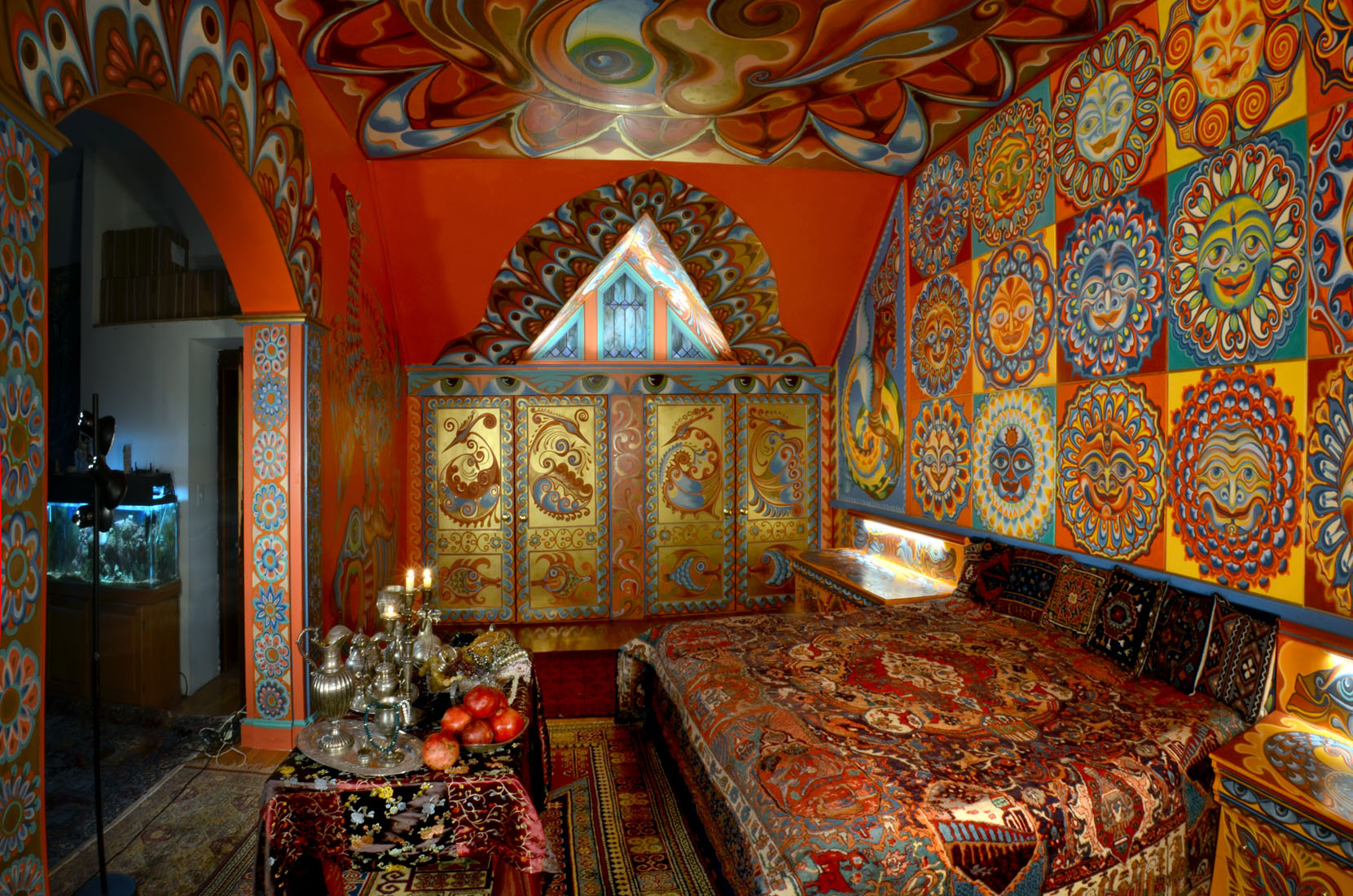
My Hometown Masonic Lodge turned Psychedelic Art House

by Rozena Crossman
Russian Sledges

I've been here; it's on college ave

Latest ModRen Facade

Let this story be a lesson to you to never, ever underestimate how many wild secrets are hiding under your nose. Your own small town is probably hiding more treasures than an un-excavated pyramid—probably because no one thinks to look there. Where are you right now? Who built the building? Who owned it? What’s under it? A river? A burial ground? Another building?

Two years ago I visited my sleepy, innocuous New England hometown outside of Boston, Massachusetts for the first time after moving to Paris, an ancient city bursting at the iron-wrought windowsills with undiscovered bijoux. On my first night back, we were driving into the city for a dinner when something in the town of Somerville made me gasp out loud.

“That house has a DRAGON ON IT!”

Oh come on, they said. Someone is a little jetlagged, they said. But I swore by what I saw and made them take the same route on our way home.

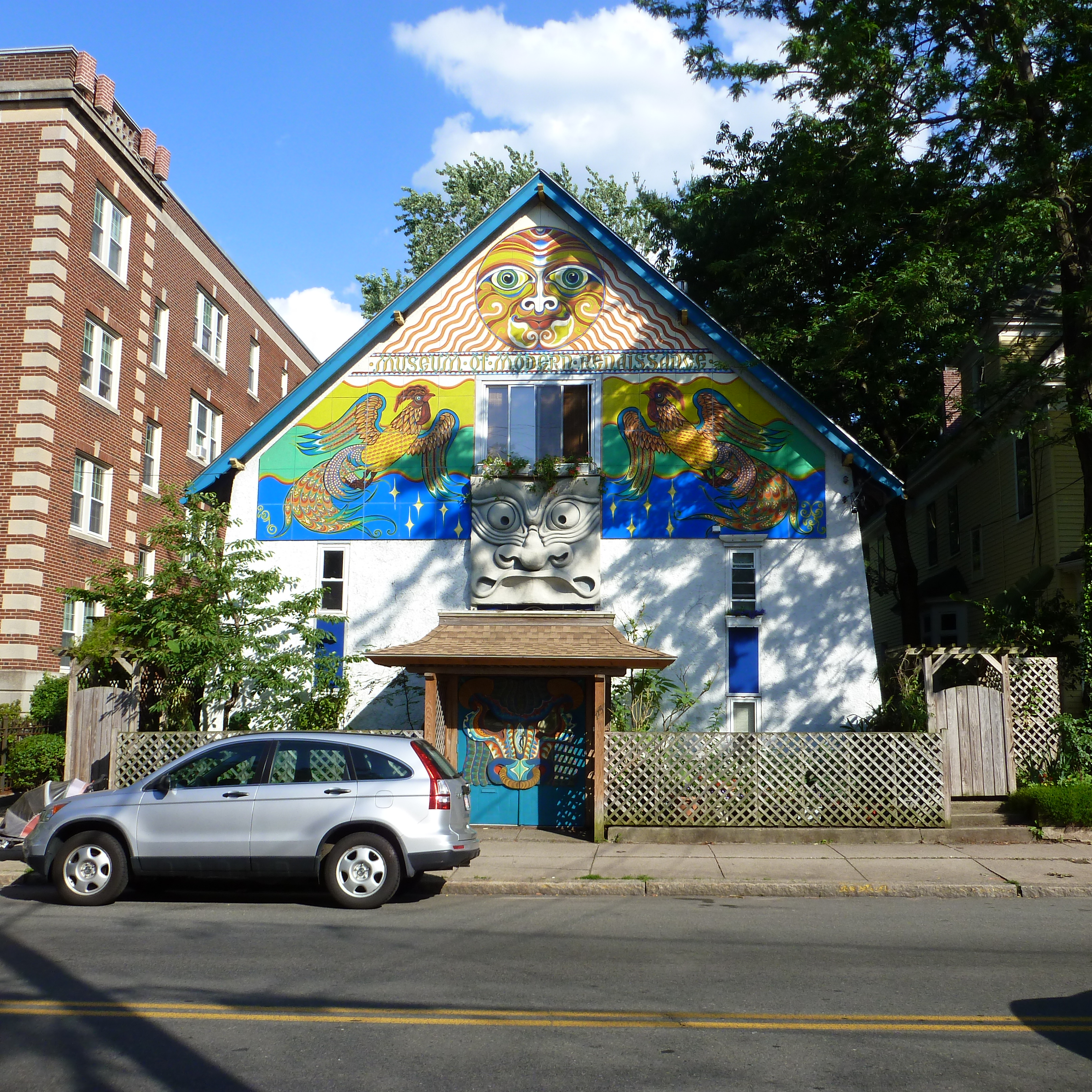
Lo and behold what was politely hiding between the mundane suburban houses:

my pic front of house

What you’re looking at is the Museum of Modern Renaissance, a former Masonic Lodge …

Anon old view of house

…. converted into a temple of art.

museumfurniture

front stairs

MOMR cups n stuff

I had to go! Unfortunately, it’s not the sort of place where you can just drop by. For a year and a half I obsessively checked its website and e-mailed the poor owners from the other side of the pond until, miraculously, they happened to be hosting a yoga class during one of my visits to the States. Once inside, it’s hard to believe this place isn’t a portal into a sideways universe. Going up the stairs, I almost felt like the murals were moving as I walked.

teapot sink

I’d been to a lot of yoga classes in my life but this was hands down the wildest backdrop to any downward dog I’ve ever done. And I didn’t even know the history of the house yet….

old UU church postcard

My yoga mat was on a floor that had seen over a century of urban and social transformation. Built in 1909 as the Second Unitarian Church of Somerville, Massachusetts, the building hosted lecturers such as Swami Paramananda, one of the first Indians to introduce Hindu philosophies to America, in 1916.*

old UU church side

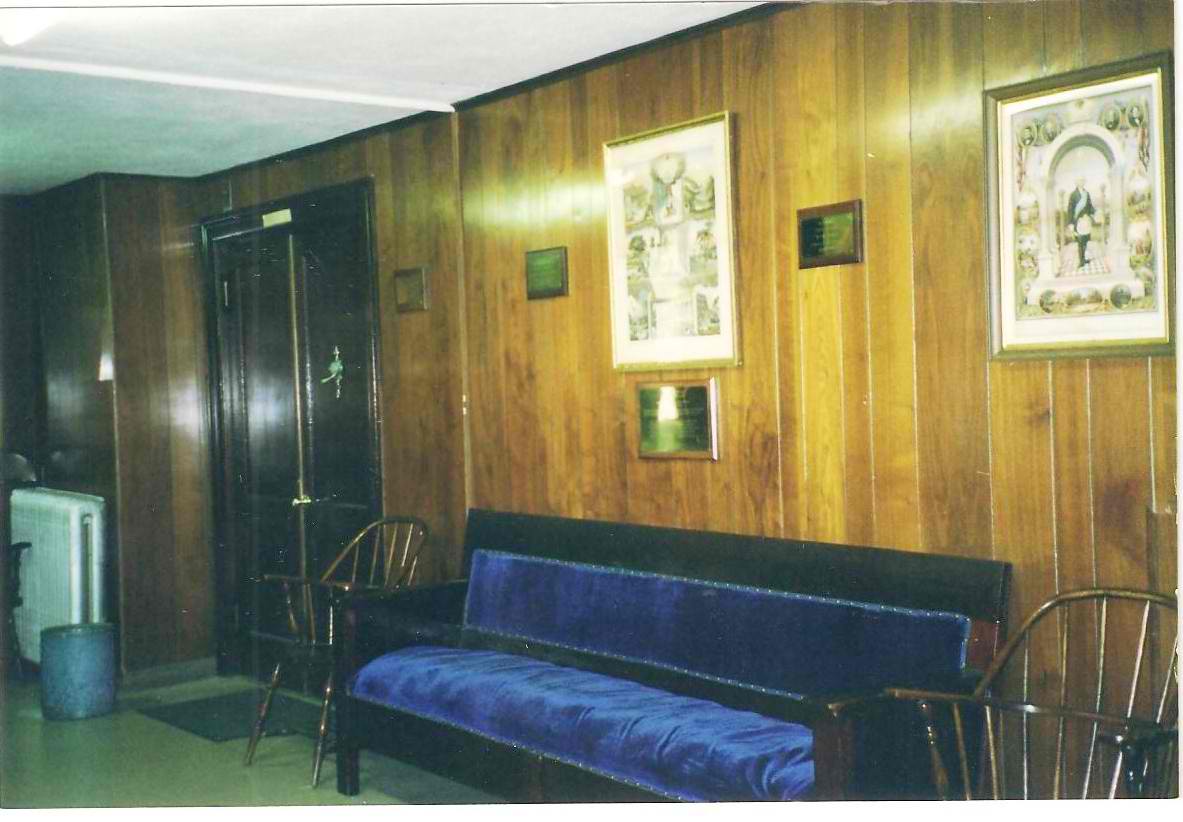
In 1932 the Independent Order of Odd Fellows, a fraternity associated with the Ancient Free & Accepted Masons, bought the church. The Freemasons themselves eventually took over in 1963 and the building became a Masonic Lodge.

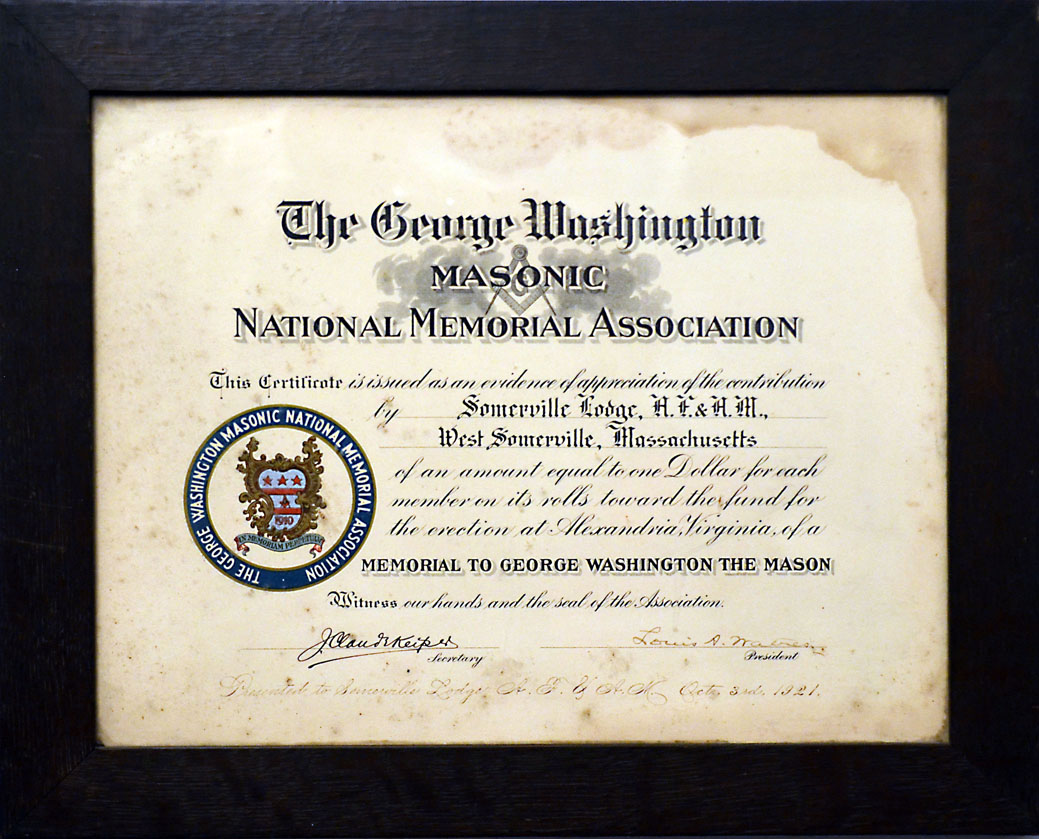
Somerville lodge certificate

Does “Masonic Lodge” sound ominous to you? Then you’ve been reading too much of The Da Vinci Code. Although doing more research on the group doesn’t make them any less mysterious. For example, no one really knows where they came from. Some say their origins lie in the creation of the Egyptian pyramids, others believe they are connected to the Knights Templar.

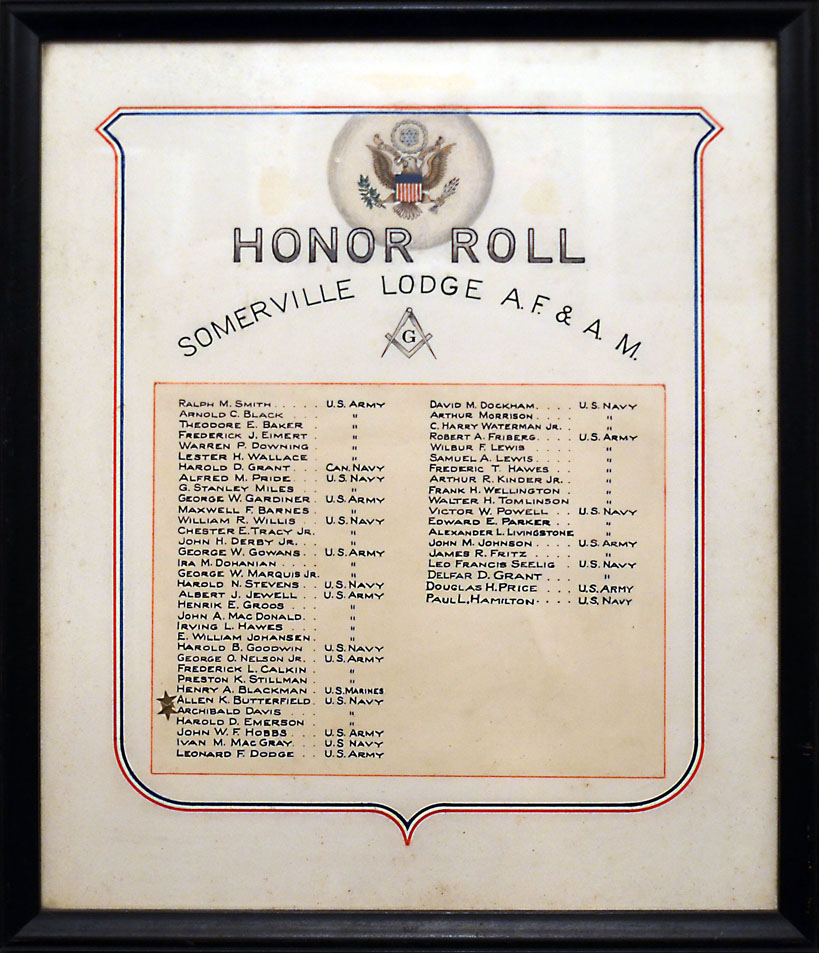
In any case, “modern Freemasonry” started when the first Grand Lodge was built in London in 1717.  Not long after, European governments became suspicious of the secret brotherhood and started banning, excommunicating and even murdering Freemasons. Lucky for the brotherhood, the early 1700s was prime American colonization time and they exported the Masonic order to the other end of the Atlantic. Since then, famous Americans from George Washington to Henry Ford have been sworn into this secretive society. Check out how many members of the Somerville lodge served in the US military:


masonic honor roll

masons 1925-26

The Masonic Lodge got its psychedelic update one night in 2002, when Nicholas Shaplyko and Ekaterina Sorokina received a phone call from their friend, a broker:

[Our friend] called us at midnight. It was very mystical, other brokers were swarming around and there was kind of an uneasy feeling. We had never been in a Masonic temple before and there was a lot of strange furniture, hammers— all the symbols of Masons.

red bedroom

The two Russian artists had always dreamed of creating their own museum. Ekaterina’s grandfather owned a museum next to Red Square, and although she holds a PhD in economics and building construction, she has been drawing and designing costumes since she was a child. Nicholas studied in a time before computers, when things were done “the hard way” and an architect needed to be able to “make everything from a doorknob to a general plan.” Trained in sculpture, painting, drawing, drafting, world history, art history and the history of architecture, among many other things, he and Ekaterina use every practical skill imaginable in the continuous process that is the Museum of Modern Renaissance. The result is unlike any other museum on earth.

great hall ceiling

If you’ve never heard of the Modern Renaissance movement, it’s because there isn’t one. Nicholas Shaplyko and Ekaterina Sorokina aren’t looking to crusade for a new form of art. Modern Renaissance, as they have dubbed it, is a response to today’s art world, which, according to them, is “full of many violent things, nasty things with blood, which have become very popular.” So they decided to stir it up.

We decided to do something different, like during the Italian Renaissance. It was like a song of beauty about the human body, the human soul, human creativity and human ability. It was like a resurrection of something that was before but then forgotten. 


art studio

Relics of the Freemasons scattered around the house were a reality-check that reminded me of the house’s place in space and time.

mason door symbol

Right on the door remains a symbol. The thrones still remain and we actually use all this masonic furniture because its good quality. We just lent it to our interior.”

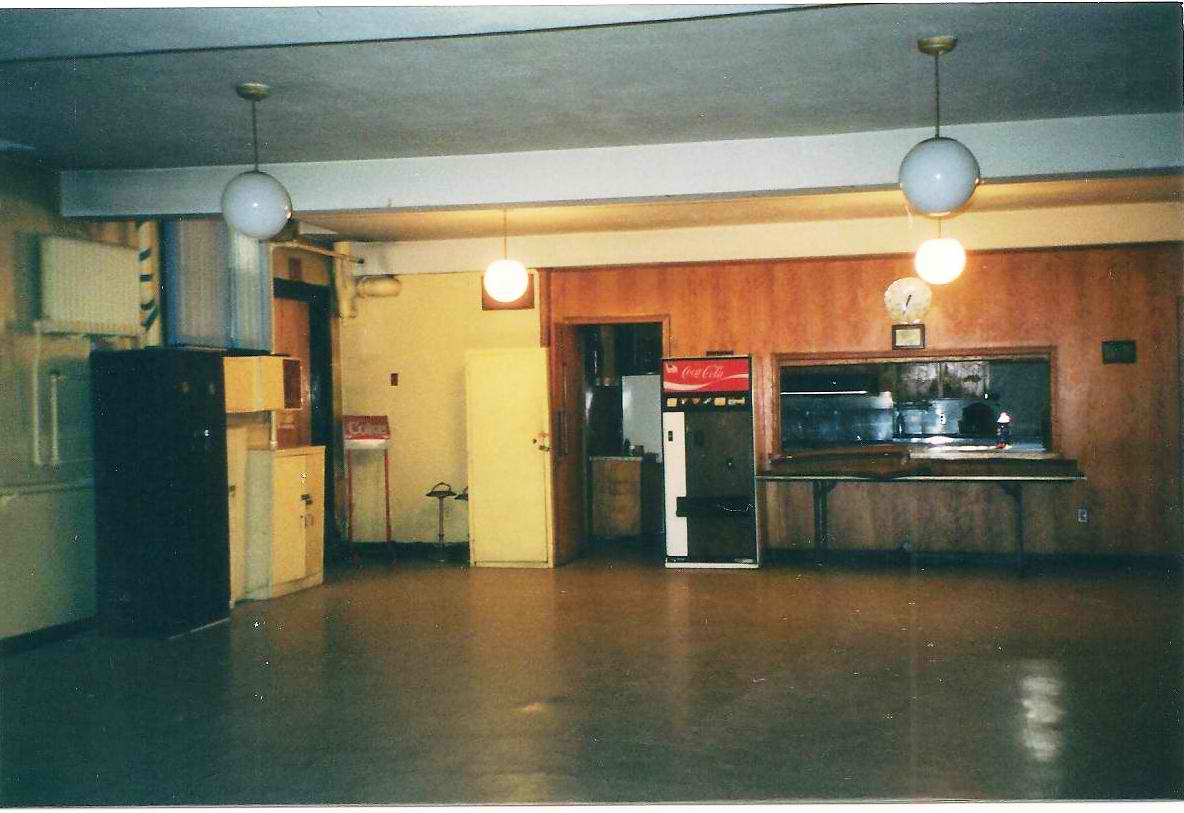
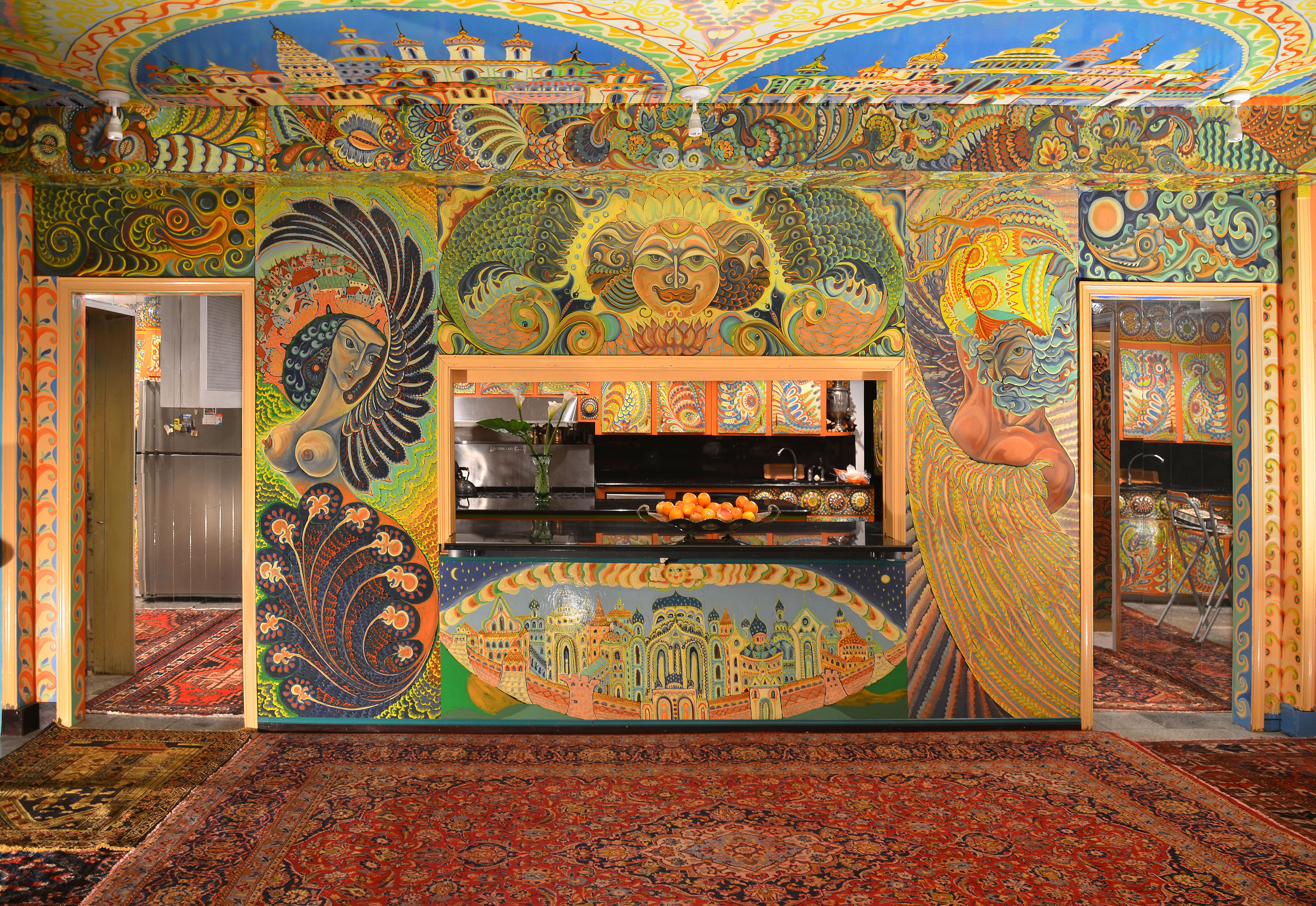
Here come the before & afters …

masonic grand hall 2

blue mason bench

See the wooden thrones and those blue chairs? Wait for it…


Grand Hall


Masonic kitchen

See that counter? wait for it….

GOOD kitchen counter

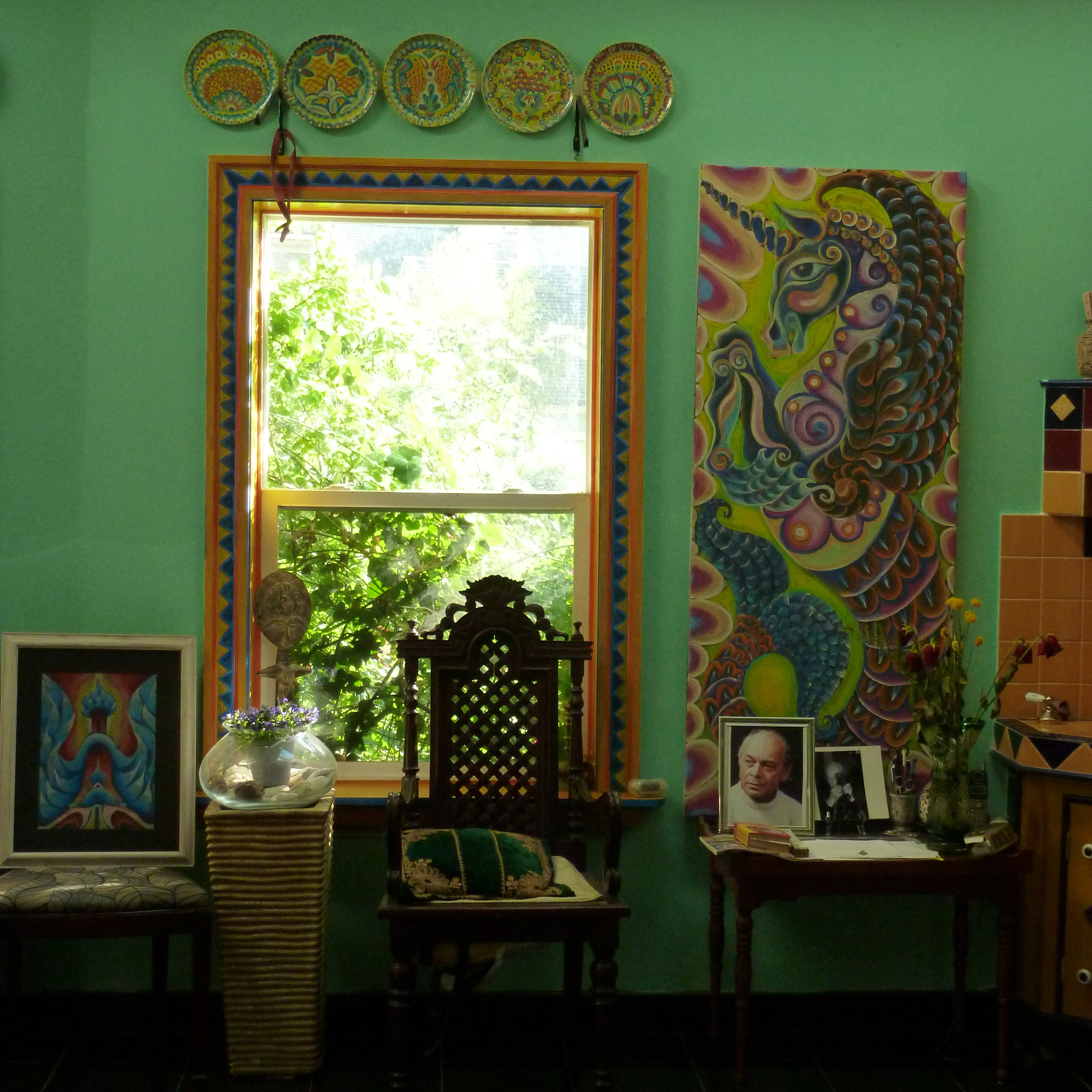
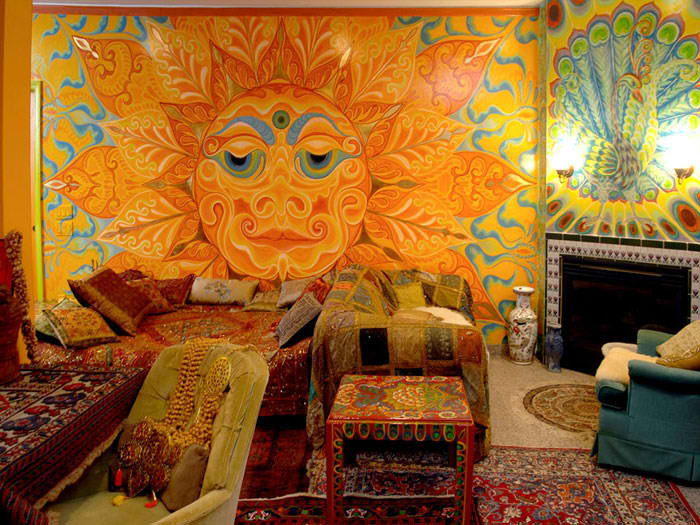
All of the artwork (and a lot of the furniture) in the house is created by Ekaterina and Nicholas– by themselves, with their hands, the old-fashioned way.

Neptune

“Ekaterina actually started yoga because she spent so many days bent backwards, painting the ceiling like Michelangelo,” says Nicholas, pictured above.

Nicholas paints the ceiling

Although they’ve covered the former Masonic dwelling head-to-toe, they’re still not finished. They are eternally creating and changing the house, as if it were a living being undergoing a continual metamorphosis rather than a stagnant and impersonal inanimate object.

kitchen

By the way, “museum” means “a house or home where the muses are living.” And that’s the most important thing. The muses need to be alive, not dead and dry like in a conventional museum. Everything should be alive, people should laugh and dance and drink the wine and sing the songs. It should be all the meanings of life. That’s what we have here. A lot of people come here and become our friends and when we have a New Year’s party we cannot invite everybody. Probably 50 people can fit comfortably but we have more than 50 friends !


sun room

bedroom angle

The muses aren’t the only ones occupying the house. Nicholas and Ekaterina not only live in their museum but often host events such as yoga classes and concerts. Many opera stars from the Metropolitan Opera, the New England Conservatory and the St Petersburg Conservatory travel to this unusual space perform because of the great hall’s amazing acoustics. In fact, singing at the Museum is rumored to bring good luck to young vocalists as many who debuted there ended up at Carnegie Hall and the Metropolitan Opera.

With musicians, we have a mutual understanding, I don’t know why. Maybe because the most abstract art is music. Maybe because there is always music playing when we are working. Mostly classical, but also folk music. And even our cat, he likes the music. Especially Pavarotti. I don’t know why Pavarotti but when he hears it he starts to dance. And he’s a cat. 

phoenix

What will be the next phase of the museum? Any more renovations and the walls will probably start talking. And man, will they have some stories to tell.

To see the dancing cat and the phoenix of a building that just gets curiouser and curiouser, contact Ekaterina and Nicholas via their website.

About this contributor

rozenaRozena Crossman moved to Paris on a whim two-and-a-half years ago. Bilingual assistant by day and adventurer by night, she is relentlessly improving her linguistics in both English and French at the Graduate School of Life.

You can connect with Rozena via her Twitter / Instagram / LinkedIn profiles. 

Also by Rozena: Hunting for the Lost River of Paris