Shared posts

22 Feb 01:03

Your input here

by Donya Alinejad
Tertiarymatt

Discussed this sort of thing briefly the other day.

I’ve seen some proposals for resistance to the corporatization of the university being circulated among anthro colleagues recently. These range from ideas about boycotting the peer review process of for-profit academic journals, to the Cost of Knowledge campaign, to the widespread action by academics to free their work from paywalls in the PDF Tribute in response to the tragic death of Aaron Schwartz, to the call not to pay (as many) conference fees by minimizing/strategizing conference attendance. The other day some colleagues of mine also suggested subversive, pro forma mass-co-authorship of articles in response to the pressure of quantitative publication norms as a criterion for good scholarship.

While I’m supportive and agree with the statements these proposals make, they also make me wonder. If it’s important to pay attention to the processes of production within which we are (and our academic work is) implicated, then aren’t our relations to our universities especially worthy of attention? Moreover, aren’t our universities the places where, as students and employees, our voices are already supposed to count? So what about the role that our institutions play in perpetuating the conditions of the underpaid academic precariat? (that is, the conditions that make those conference fees a stretch for us in the first place).

It brings me back to the questions I posed here earlier this month: what knowledge have we each gained from our own struggles for the future of our universities, at our universities? How are our (anthropological) insights about the intersection between academia and contemporary capitalism informed by our own practices of struggle? And is it worth building an exchange of these stories and strategies between locales in some way or another? I tend to think so. And I’d like to experiment with that here. That’s why I look forward to telling you about the conflict that’s been playing out these past two weeks at the Vrije Universiteit in Amsterdam over the failed reorganization of the university library. But in the meantime, this is just a little reminder that this experiment needs your input, too. So feel free to voice any thoughts.


Donya Alinejad is a PhD candidate at the department of Social and Cultural Anthropology at the Vrije Universiteit Amsterdam. She does research on the role of internet media in the formation of selves among the children of immigrants from Iran in Los Angeles, California.

21 Feb 14:16

Go read Coding Freedom

by Rex
Tertiarymatt

Interesting. Also: FREE BOOK. That I think bl00 in particular may want to read.

I wanted to take a little bit of time today to shamelessly plug my friend and co-author Biella Coleman’s new book Coding Freedom. When the book first came out I wanted to right a full review of it to explain that it is a full-length monograph about hackers, debian developers, anonymous, and other digital phenomena that carefully combines deep, deep ethnographic knowledge with a thoughtful theoretical contribution the literature on commons-based peer production, liberalism, and the trickster figure. Best of all, the book has been released under a creative commons license and can be downloaded and freed for free.

After taking a couple of stabs at it, unfortunately, I found that I just knew Biella too well to write a review that was neutral, or that pretended to neutrality. I kept writing sentences like “Biella RAWKS” and “Biella’s book is radz0r!!!”, which is sort of hard to massage into “this ethnography provides a substantive contribution to the existing literature on liberalism”. So instead I decided to write this ridiculously partisan plug to let you know how rad Biella is and how much her book rawks.

There are a lot of people doing cultural studies, qualitative research, ethnography, etc. on digital culture, virtual worlds, the Internet etc. and, frankly, the quality of much of this work is not very good. Much of the connoisseurship literature written by fans of video games, for instance, is better than academics writing on video games. Biella’s work bucks this trend by bringing a deep, immersive familiarity with the lifeworld she describes. At times, in fact, I think Coding Freedom does not do enough to show off her erudition in this area. Although people (including maybe Biella) will be tempted to see her work as exemplifying something new, non-disciplinary, or cutting edge, in my opinion what really makes her work so good is the way that it epitomizes anthropology’s values of immersion and description. She really knows her stuff. And after you read her book, you will too.

21 Feb 09:00

Law, Justice, and War in World Until Yesterday

by Rex
Tertiarymatt

At some point I'm going to have to read this damn book.

I just finished my full (~4000 word) review of Diamond’s World Until Yesterday, which will appear over at the shiny new journal The Appendix in, like, April. Writing that and catching up on Diamond coverage around the web (Stephen Corry’s review at the Daily Beast is the most intemperate but the second half is worth reading) means I have hardly no time to blog about Diamond — or anything else — so let me jump right on to chapter 2 (and remember, my notes on World are online as well).

In this chapter Diamond examines the pros and cons of ‘traditional’ and ‘state’ systems of justice. He begins with the story of a compensation payment in Papua New Guinea: A man driving a company car around hits and kills a young child. The child’s family negotiate with an older and wiser company employee, and eventually a compensation payment is made. Diamond contrasts this form of compensation with Western legal systems: compensation is aimed at bringing emotional closure and restoring a network of social relationships, whereas state justice is concerned with punishing criminals and making an example of you so that your fellow citizens will stay in line. Western courts are slow, Diamond says, but they break the cycle of feud and payback killings that characterize — according to him — traditional societies. Thus Diamond writes:

Maintenance of peace within a society is among the most important services that a state can provide. That service goes a long way towards explaining the apparent paradox that, since the rise of the first state governments in the Fertile Crescent about 5,400 years ago, people have more or less willingly (not just under duress) surrendered some of their individual freedoms, accepted the authority of state governments, paid taxes, and supported a comfortable individual lifestyle for the state’s leaders and officials. (World, 98)

This is the first of three chapters that deal with war, peace, and the state and it’s the least problematic of the three. Diamond’s description of compensation in Papua New Guinea jives well with the comp payments I’ve attended. If people haven’t heard of compensation payments, then they should. Transacting goods to rearrange social relations is an important thing, and one that Papua New Guineans are experts at. Today, people complain that payments can be excessive, that contemporary exchanges warp traditional culture, are tied up in political corruption in the country, and so forth — and there’s a lot of truth to that. But I am glad that Diamond talks about them in his book, because a lot of people still think of them as ‘irrational’ or ‘backwards’. Which is ridiculous. Additionally, I’ve always been amazed at the emotional satisfaction that they can bring, when they are well done — Diamond is right to emphasize how different, and often better, homicide compensation can be compared to other forms of grieving.

The chapter has a structure that recurs throughout World: long sections summarizing ethnographic data, with a few tentative normative speculations at the end. There’s no analysis, in the sense that cultural anthropologists expect there to be — no sense of the author adding value to the data through interpretation. Of course, this may be a plus for some readers. But I think that it also has its drawbacks — Diamond doesn’t think deeply enough about compensation and courts.

So many others have beaten Diamond up for not having more footnotes that I didn’t want to go there — it’s a conscious decision you can disagree with, not an oversight. So whatever. But I do think that it’s amazing that Diamond discusses Western culture without having any serious reference to anything that’s been written on law. And there’s a lot. Diamond’s mistaken assumption that he doesn’t need to learn about the unexamined side of the contrast between the West and the Rest is, for me, a big problem. It’s actually quite anthropological — we’re well known for saying “They do X while we do Y” without ever actually studying what ‘we’ in the West do. It drives historians crazy, and it’s actually why I made my second field site a study of the US.

I’m puzzled at Diamond’s claim that the purpose of law is to make peace — that it is the type of thing that would be improved by including mediators and restorative justice. It doesn’t take a lot of insight (or experience with the court system) to realize that law is a way of making war, not making peace. Diamond, thinking like Hobbes, seems to think this is the case with criminal law, where the state makes war with its citizens. But it’s equally true of civil law. Suing someone is what you do when the talking is done. This is something that Papua New Guineans have often remarked to me in the course of litigating against mining companies: when you have gavman (government) you fight with money, not arrows.

I also think that Diamond doesn’t understand how compensation claims really work. I will try to prove my point by throwing a lot of quotes at you from Laurence Goldman, who works with Huli people, because I happen to have that bit of my notes open at the moment.

Diamond seems to suggest — but does not ever make clear, which is handy for him — that ‘traditional societies’ are in a state of equilibrium and harmony until a dispute arises, and the purpose of compensation is to get back to that harmony. So far, so Radcliffe-Brown. And yet he also seems to suggest that traditional societies are in a constant state of crisis, payback, and killing. And for Diamond the first situation is good and the second situation is bad.

Anthropologists who actually study PNG for a living tend to see Papua New Guineans — and here I really mean the highlands community that I know best, from Hagen to Tari, as interested in maintaining relationships between groups. In fact, groups are ‘elicited’ — they form in opposition to each other, around some particular issue (Wagners “Are There Groups in the New Guinea Highlands” goes into this). The goal is not ‘peace’ in the sense of an equilibrium in which no one owes anything else. This would cut the relationship. As Goldman writes

For indigenes… the idea of a ‘community without conflict’ may be an objective which is neither socially imaginable nor even desired. Anthropologists, in particular, have long argued that disputes per se are not symptomatic of anomie. Social equilibriums are predicated on cyclic patterns of grievance management and are not perturbed by them.” (2003, Hoo-ha in Huli p.1)

Thus we should not see “friction as failure” in the sense of “a lack of rules sanctioned by judicial institutions or a reluctance to abide by them” (p. 1). Rather,

fighting forms part of a sequenced set of behavioural responses that may itself constitute a coda or precipitate closure. Attempts to gloss such commotion as part of an opposition between ‘war’ versus ‘law’ have long been rejected as ethnocentric and over-simplistic. It is more useful to focus on understanding the patterns of recourse to different conflict resolution mechanisms and the prevalent sequential relationships between physical and verbal conflict (p. 2)

Relationships and disputes never end. Rather, they are modulated into different forms: now war, now peace. In fact, sometimes if Papua New Guineans feel like relationships with someone or something are not quite right, they will blow them up and precipitate a crisis or conflict in order to rearrange them in less conflictual form. This, for me, was one of the greatest lessons I learned from living in PNG (although perhaps the people in my department wish I did not always use it in faculty meetings): sometimes if things aren’t working right, the best thing to do is just explode the whole thing, rile everyone up, create a huge mess, and use the crisis to create a better status quo afterwards.

In this viewpoint, disputes never end — they are only dormant and can always be mobilized in the course of other disputes. Citing the title of his previous book (Talk Never Dies, a very rigorous and detailed but also very boring analysis of Huli dispute talk (“you need a cup of coffee between each page!” Laurence once told me apologetically)), he emphasizes

‘Talk Never Dies’ precisely because between potential litigants there were always a number of issues that remained unresolved after talking or fighting. That is, many claims would lay dormant until such time as a strategically significant dispute arose allowing claimants to ‘activate’ past unresolved disputes in a sequenced set of claims. Disputes were always ‘multiple-claim’ affairs. It was never the case that a “conflictless” set of conditions prevailed within any Huli community.” (p. 4)

Again, I think there is something to learn here from PNG, even if Diamond himself hasn’t (or hasn’t been able to explain it to us): any particular argument is always about that one thing, but it’s also abut your entire history with a person and all the arguments you’ve had in the past with them. Anyone who has ever watched others blow up over a little thing like leaving the refrigerator door open will understand this: it’s not just the refrigerator door, it’s a whole history of arguments about the door, taking out the trash, cleaning the bathroom, etc. of which the refrigerator door is just the last straw. Huli (and other highlanders) recognize this explicitly and work in and through these histories of disagreement. Too often Americans and other Westerners do not. This is not brutal, traditional chaos — it’s a different culture with a different way of managing disputes.

Ironically, trying to pacify people through the introduction of a court system doesn’t really work. As Goldman reports for Huli:

The lesson to be drawn from this period of response to ‘law and order’ is that interventionist activities can often be a catalyst for increased levels of the very activity they attempt to address. The whole ‘court’ system became a larger referral network for dispute processing and an alternative avenue of recourse when customary talking failed to produce a desired outcome. (p. 7)

Given the incredibly virtuosity with which Huli manage disputes, ”the wholesale reinvention of indigenous grievance management processes [through some new government system] for Huli would be akin to showing a professional golfer how to hold a golf club” (p. 11). “This is why any faith placed in the judiciary as a source of control is misplaced and ill conceived”. Huli end up colonizing the legal system, politicizing it, and using it as yet another arena for the on-again, off-again management of conflict.

Of course, the Huli are notorious in Papua New Guinea for being disputatious. But the same argument could be made in Enga province, or Western Highlands province, or in other areas of the highlands, and probably the coast as well. ‘Peace’ is not necessarily the goal of Papua New Guineans, and ‘war’ is not just the result of uncontrollable human anger directed towards vengeance. It’s a culture of conflict, one which requires of observation to watch play out (something Diamond may not have seen, given his movements across the country).

I personally do not want to live in a world run along Huli lines — since it probably wouldn’t involve a lot of, you know, working infrastructure. There are a lot of benefits to living in a state. But I think that when it comes to compensation and conflict, Diamond is looking at the trees and missing the forest.

21 Feb 00:11

What the Future of Fish Can Teach Us about Designing Systems, by Cheryl Dahle

Tertiarymatt

Really didn't expect to see a piece on Global Fisheries on Core77.

compostmodern_banner.jpg

FutureofFish_processing.jpgThis is the first article in a series examining the potential of resilient design to improve the way the world works. Join designers, brand strategists, architects, futurists, experts and entrepreneurs at Compostmodern13 to delve more deeply into strategies of sustainablity and design.

When I began my journey to understand global overfishing, I knew that it was a sprawling and complex tangle of intertwining problems touching the spheres of policy, commerce, environment and livelihood. Now, almost five years in, I see its complexity through the stories of people I've met who live in that tangle: The New England fisherman whose house was firebombed when he dared to embrace policy reform. The shark researcher who once used a tag he'd put on a shark's fin to record its migration pattern to then hunt the poacher who finned the shark and kept the device as a souvenir. The old Chinese fish farmer who, in a trick to trump Pavlov, proudly rang a bell to bring hundreds of tilapia called by its vibration to the surface of a pond to feed.

Each of the players in this system has an incredibly personal stake in how we humans choose to rethink the way we hunt, eat and protect fish. Given that 1 billion people in the world rely on fish as their primary protein, and that 85 percent of the world's fisheries are currently harvested at or beyond their limits, the cost of failing is unthinkable.

FutureofFish_nets2.jpg
FutureofFish_nets1.jpg

When we were first asked by The David and Lucile Packard Foundation to uncover new market-driven solutions to encouraging responsible fish harvesting, we did not set out to find one solution for all players. But because we intended to design for a system, we couldn't look for solutions for just one player or user. We had to find openings—stuck points—that once resolved, might prove the giving knot to unwind the tangle. We had to figure out how to design for many.

At every stage of our work—through four distinct project teams, three sponsoring organizations and multiple iterations—we made some right calls and some mistakes. Here's a brief look at some of the insights we gleaned along that path.

FutureofFish1.jpg

Who's the user?

Our process included two components: 1) pattern recognition to identify which problems in the system received ample attention from existing strategies and which were unaddressed, and 2) a "design thinking" process that included sending teams of anthropologists into the field to observe.

The first phase of that process identified the middle of the seafood supply chain as a ripe area to explore; most solutions targeted fishermen or retailers at either end of the supply chain, leaving processors and distributors out of the conversation. The next phase was initially puzzling. Given a target as broad as the middle of a global supply chain, what should we observe? Who was our user? What did we need to see to guide our design? We thrashed about for a bit and sought guidance from some of the most experienced practitioners in the design world. They counseled our team to, "go with your gut."

FutureofFish2.jpg

Since I have the gut of a trained journalist, my instincts told me to go where the conflict was. I offered to my co-lead in the project that the front line of our problem seemed to be transactions—whenever fish traded hands. What did those conversations and negotiations look like? What unspoken context shaped those outcomes? We ultimately dispatched teams of anthropologists to eight sites in four countries, looking for examples of distributors and processors buying and selling fish?

(more...)


21 Feb 00:10

A Walk in the (Pop-Up) Park: Softwalks Creates Social Spaces from Scaffolding

Tertiarymatt

I love this.

Softwalks_childsit.jpg

New Yorkers take their sidewalks seriously: With over 12,000 miles of sidewalk in the city, there is a lot to care about. So who wouldn't like the idea of making one of the most used urban features just a bit nicer? The recently funded Kickstarter project Softwalks makes small design tweaks to drab New York sidewalks, transforming them into fully-fledged public spaces. At launch, the Softwalks 'kit' consists of four parts; seat, counter, planter and light reflector, all directly attachable to preexisting scaffolding using an adjustable clamp system. The team is also developing an additional screen, bench and game board to expand the kit.

Softwalks_Kit.jpg

Designing for existing urban structures isn't exactly a new idea; projects like Michael Karowitz's paraSITE immediately come to mind. Still, urban planning is a big job, so why not start small? By designing for scaffolding that covers many of New York's sidewalks—technically known as 'sidewalk sheds' to protect pedestrians from debris—the project has the potential to make a pop-up park practically anywhere. Considering that New York City currently has approximately 189 miles of sidewalk sheds, it shouldn't be a problem finding a sidewalk in need of sprucing.

(more...)


20 Feb 20:25

'Interactive Lasercutting': Yea or Nay? Does it Defeat the Purpose of CNC, or Provide Better User-Material Bonding?

Tertiarymatt

Measure twice, cut once.

constructable-interactive-lasercutting.jpg

In broad strokes, mankind's woodworking abilities have gone from 1) hand tools, to 2) power tools to 3) CNC machinery. And although the power tools step was a quantum leap from hand tools, it still requires you physically touch the material quite a bit, guiding and steadying it while performing your operations; with CNC, you only contact it when you're loading and unloading it into the machine. There is a materials disconnect with CNC, as you're not physically guiding the cuts, and you don't even have to be in the room when it's happening.

Which is why I found this human-computer-interaction concept from Germany's Hasso Plattner Institut so interesting. Called "Interactive Lasercutting," the researchers use a self-rigged lasercutter called the Constructable, and require the user to be present during the cutting. Rather than drawing up a CAD file, converting it into a tool path, loading the machine and taking lunch, the user is meant to stand over the machine and instigate each cut, or series of cuts, by "drawing" on the wood with a laser pointer. The machine then translates your sloppy strokes into precise cuts, something like handwriting recognition turning your chicken scratch into typography. Observe:

Hopefully you're able to disregard the clunky interface—all those styluses represent different types of cuts—and weird editing, and just focus on the concept: Do you think this has merit? For single-object production, could this actually be more efficient than doing the CAD/toolpath dance? I suspect not, but there's something I like about being able to stand over the material and manipulate it in real time.

Thoughts?

See also: A Handheld CNC for 2D Applications

(more...)


20 Feb 20:21

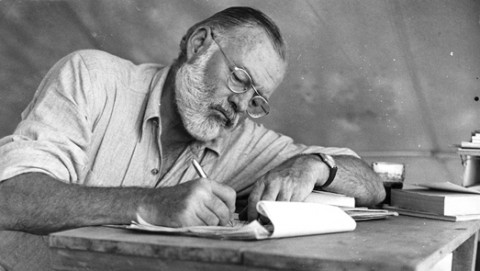
Seven Tips From Ernest Hemingway on How to Write Fiction

by Mike Springer

EH-354

Before he was a big game hunter, before he was a deep-sea fisherman, Ernest Hemingway was a craftsman who would rise very early in the morning and write. His best stories are masterpieces of the modern era, and his prose style is one of the most influential of the 20th century.

Hemingway never wrote a treatise on the art of writing fiction.  He did, however, leave behind a great many passages in letters, articles and books with opinions and advice on writing. Some of the best of those were assembled in 1984 by Larry W. Phillips into a book, Ernest Hemingway on Writing. We’ve selected seven of our favorite quotations from the book and placed them, along with our own commentary, on this page. We hope you will all–writers and readers alike–find them fascinating.

1: To get started, write one true sentence.

Hemingway had a simple trick for overcoming writer’s block. In a memorable passage in A Moveable Feast, he writes:

Sometimes when I was starting a new story and I could not get it going, I would sit in front of the fire and squeeze the peel of the little oranges into the edge of the flame and watch the sputter of blue that they made. I would stand and look out over the roofs of Paris and think, “Do not worry. You have always written before and you will write now. All you have to do is write one true sentence. Write the truest sentence that you know.” So finally I would write one true sentence, and then go on from there. It was easy then because there was always one true sentence that I knew or had seen or had heard someone say. If I started to write elaborately, or like someone introducing or presenting something, I found that I could cut that scrollwork or ornament out and throw it away and start with the first true simple declarative sentence I had written.

2: Always stop for the day while you still know what will happen next.

There is a difference between stopping and foundering. To make steady progress, having a daily word-count quota was far less important to Hemingway than making sure he never emptied the well of his imagination. In an October 1935 article in Esquire “Monologue to the Maestro: A High Seas Letter”) Hemingway offers this advice to a young writer:

The best way is always to stop when you are going good and when you know what will happen next. If you do that every day when you are writing a novel you will never be stuck. That is the most valuable thing I can tell you so try to remember it.

3: Never think about the story when you’re not working.

Building on his previous advice, Hemingway says never to think about a story you are working on before you begin again the next day. “That way your subconscious will work on it all the time,” he writes in the Esquire piece. “But if you think about it consciously or worry about it you will kill it and your brain will be tired before you start.” He goes into more detail in A Moveable Feast:

When I was writing, it was necessary for me to read after I had written. If you kept thinking about it, you would lose the thing you were writing before you could go on with it the next day. It was necessary to get exercise, to be tired in the body, and it was very good to make love with whom you loved. That was better than anything. But afterwards, when you were empty, it was necessary to read in order not to think or worry about your work until you could do it again. I had learned already never to empty the well of my writing, but always to stop when there was still something there in the deep part of the well, and let it refill at night from the springs that fed it.

4: When it’s time to work again, always start by reading what you’ve written so far.

T0 maintain continuity, Hemingway made a habit of reading over what he had already written before going further. In the 1935 Esquire article, he writes:

The best way is to read it all every day from the start, correcting as you go along, then go on from where you stopped the day before. When it gets so long that you can’t do this every day read back two or three chapters each day; then each week read it all from the start. That’s how you make it all of one piece.

5: Don’t describe an emotion–make it.

Close observation of life is critical to good writing, said Hemingway. The key is to not only watch and listen closely to external events, but to also notice any emotion stirred in you by the events and then trace back and identify precisely what it was that caused the emotion. If you can identify the concrete action or sensation that caused the emotion and present it accurately and fully rounded in your story, your readers should feel the same emotion. In Death in the Afternoon, Hemingway writes about his early struggle to master this:

I was trying to write then and I found the greatest difficulty, aside from knowing truly what you really felt, rather than what you were supposed to feel, and had been taught to feel, was to put down what really happened in action; what the actual things were which produced the emotion that you experienced. In writing for a newspaper you told what happened and, with one trick and another, you communicated the emotion aided by the element of timeliness which gives a certain emotion to any account of something that has happened on that day; but the real thing, the sequence of motion and fact which made the emotion and which would be as valid in a year or in ten years or, with luck and if you stated it purely enough, always, was beyond me and I was working very hard to get it.

6: Use a pencil.

Hemingway often used a typewriter when composing letters or magazine pieces, but for serious work he preferred a pencil. In the Esquire article (which shows signs of having been written on a typewriter) Hemingway says:

When you start to write you get all the kick and the reader gets none. So you might as well use a typewriter because it is that much easier and you enjoy it that much more. After you learn to write your whole object is to convey everything, every sensation, sight, feeling, place and emotion to the reader. To do this you have to work over what you write. If you write with a pencil you get three different sights at it to see if the reader is getting what you want him to. First when you read it over; then when it is typed you get another chance to improve it, and again in the proof. Writing it first in pencil gives you one-third more chance to improve it. That is .333 which is a damned good average for a hitter. It also keeps it fluid longer so you can better it easier.

7: Be Brief.

Hemingway was contemptuous of writers who, as he put it, “never learned how to say no to a typewriter.” In a 1945 letter to his editor, Maxwell Perkins, Hemingway writes:

It wasn’t by accident that the Gettysburg address was so short. The laws of prose writing are as immutable as those of flight, of mathematics, of physics.

Related content:

Writing Tips by Henry Miller, Elmore Leonard, Margaret Atwood, Neil Gaiman & George Orwell

The Big Ernest Hemingway Photo Gallery: The Novelist in Cuba, Spain, Africa and Beyond

The Spanish Earth, Written and Narrated by Ernest Hemingway

Archive of Hemingway’s Newspaper Reporting Reveals Novelist in the Making

Seven Tips From Ernest Hemingway on How to Write Fiction is a post from: Open Culture. You can follow Open Culture on Facebook, Twitter, Google Plus and by Email.

20 Feb 20:13

Mark Twain Shirtless in 1883 Photo

by Dan Colman

mark twain shirtless 2Last year, Edwin Turner, the mastermind behind the Biblioklept blog, assembled a fine photo gallery that captured Ernest Hemingway posing shirtless. Big, burly and barrel-chested, Papa projects the masculine image that he carefully cultivated for himself and for the world to see.

Hemingway’s photos seem right in keeping with his public persona (we’ll have more on him later today). But this 1883 portrait of Mark Twain will perhaps give you pause. To be sure, Twain cared deeply about his public image. The writer carefully crafted his public identity, giving more than 300 interviews to journalists where he reinforced the traits he wanted to be known for — his wit, irreverent sense of humor, and thoughtfulness. Twain also loved having his picture taken, posing for photographers whenever he had a chance. The camera offered yet another way to fashion his own personal myth.

Of course, the author is best remembered for one set of iconic images — the one where he dons a white suit in 1906, upon traveling to Washington D.C. to lobby for the protection of authors’ copyrights. But, as The Routledge Encyclopedia of Mark Twain explains, the novelist also let his image be used in countless advertisements — in ads for restaurants, pharmacies, dry goods and cigars too. The encyclopedia gives the impression that the shirtless photo was perhaps taken within this commercial context. It’s not clear what product the portrait helped market (care to take a guess?), or precisely how Twain saw it contributing to his public image. The details are murky. But one thing is for certain: The 1880s image is authentic. It’s the real shirtless Mark Twain.

This vintage pic comes to us via Wired writer Steve Silberman. Follow him on Twitter at @stevesilberman.

Mark Twain Shirtless in 1883 Photo is a post from: Open Culture. You can follow Open Culture on Facebook, Twitter, Google Plus and by Email.

20 Feb 14:59

Hell in a Handbasket: Mannequins with Cameras in Their Eyes

Tertiarymatt

Goddamnit.

eyesee-mannequin-01.jpg

As if my robophobia wasn't acute enough, now I have to expand it into a new category.

An Italian company called Almax manufactures the EyeSee Mannequin, which is equipped with a camera behind one eye. Meant to be placed in a window display or inside the store, the EyeSee checks you out to see what you're checking out, and tries to figure out what demographic you belong to.

eyesee-mannequin-02.jpg

This special camera installed inside the mannequin's head analyzes the facial features of people passing through the front and provides statistical and contextual information useful to the development of targeted marketing strategies. The embedded software can also provide other data such as the number of people passing in front of a window at certain times of the day.

...[The system can] make it possible to "observe" who is attracted by your windows and reveal important details about your customers: Age range, gender, race, number of people and time spent.

(more...)


20 Feb 04:00

CoreToon: Mantone 2013 Color Forecast

19 Feb 14:43

Test Your Visual Acuity with the Eyeballing Game

Tertiarymatt

Oh, you know you want to try this.

eyeballinggame.jpg

Speaking of eyeballing, Matthias Wandel took a break from woodworking long enough to create The Eyeballing Game. It's a simple, in-browser test of visual acuity that rates both your eyeballing accuracy and your speed.

Anyone from carpenters to designers to architects—basically anyone who deals with creating lines for a living—ought give it a go. Warning: A subset of you are going to find it extremely addictive and/or become hellbent on improving your score. (I thought I was pretty good, but I'm consistently getting in the 4.- range. I also discovered that I rock at determining a dead-accurate right angle and suck at parallelograms, as I keep subconsciously trying to turn them into planes with accurate two-point perspective.)

Play it here.

(more...)


19 Feb 08:54

I'm Waiting for my UPS Man

by n+1 magazine
Tertiarymatt

This article is sort of strange, really. Also, I didn't know you could use Bitcoins to buy horse. Fascinating.

by Ned Beauman

Image: Image copyright (c) 2010 by J. Peter Siriprakorn

There are two websites where you can add a gram of heroin to your shopping cart as if you were buying asparagus on Fresh Direct. One belongs to Sigma-Aldrich, the St. Louis chemical company that synthesizes pure opioids for use in laboratory studies. For this you need to be a federally accredited laboratory. The other is Silk Road, the anonymous marketplace where drugs are priced in untraceable Bitcoin currency. For this you just need an internet connection.

Most of us do so much online shopping, and the interface has become so standardized, that the bland machinery of ecommerce is part of the texture of our waking lives: clicking "add to shopping cart" is like flicking a light switch. So although you might be perturbed if a salesperson offered you heroin from behind a department store counter, the aesthetic of the product page makes the transaction seem instantly mundane. Really, the only surprise is that Amazon hasn’t gotten into the game already. It’s strange to recall that rock music once made the act of buying drugs sound as mythically cool as the act of taking them. Today, Lou Reed would go to Silk Road instead of Lexington and 125th, and the man he'd be waiting for a week later would be totally unwitting, and from UPS.

Silk Road got a lot of publicity in 2011 for its heroin and LSD offerings; most of the websites that sell recreational drugs specialize in experimental compounds imported from China, still legal or quasi-legal because no legislative body can possibly keep up with an enterprising chemist. However, to dodge broader regulations about what you can encourage people to put in their bodies, most of these drugs are advertised under some other category: bath salts, plant food, pool cleaner. Like the ecommerce interface itself, the product pages are redolent of dull domestic life. So far, the most popular of these drugs is mephedrone (not to be confused with methadone), a substitute for MDMA that arrived in the UK in around 2009 and in the US last year. Mephedrone became famous in the British tabloids as "Meow Meow," a "street name" that turned out to have been the invention of a lone Wikipedia user. It's now been banned almost everywhere, after being implicated in a handful of deaths (and one notorious face-eating, which later turned out to have nothing to do with it). But dozens of its relatives still count as legal highs.

While Silk Road is like eBay, many of the websites offering "research chemicals" are more like Zappos: full-featured specialist retailers that operate openly and expect to be around for long enough that it's worth investing in customer retention. These websites don’t just have shopping carts and checkouts: they also have user reviews, product alerts, seasonal sales and multiple worldwide delivery options. ("Really great product these pellets are. compared to the "o5" pellets, and the 6apb powder ive had from numerous sources, these absolutely blew me away. 2 pellets made for an amazing reaction, the 5apb adds SO much to the mix. Also, top notch customer support and service, as usual. Shipped same day. rc-lab is always a pleasure to do business with.") We all know from The Wire that drug dealers have learned a lot from the marketing techniques of legitimate businesses. But the timing of their seasonal sales, for instance, doesn't quite make sense: it's not as if you need to clear out all your heavy winter junk to make way for the graceful new spring collections. One wonders if the retailers are so delighted with their off-the-shelf e-commerce platforms that they’ve decided to imitate more mainstream websites by any other means that occur to them.

+ + +

There is, however, one area in which they really fall down, and that's friendliness to the newbie. Methoxetamine, methiopropamine, ethylphenidate, etizolam, benzofuran, camfetamine, pentedrone—who can keep up? The merchants can give you the best customer service in the world, but the one thing they can’t do is explain the effect of these drugs and how much you might want to swallow, because, remember, they're only selling plant food. Could it be that, just when it seemed like the internet was robbing the drug world of all its dangerous glamor, the problem's actually just been flipped upside down? In the old days, you knew what you wanted but didn’t know where to get it. In 2013, you can get almost anything but have no idea what it is.

That is, if you want anything at all. The UK edition of Vice magazine is basically the Martha Stewart Living of recreational drug abuse, but even there, you won't find much hype any more. One of the editors wrote recently, "When was the last time you took a mysterious chemical that made your life better? Over the past few years, all the new drugs that have cropped up have been horrible. None of them work until you're actually addicted to them, the comedowns last for about sixteen weeks, and every time you go to sleep, you get night terrors and think that you're going to die." One reason for the frequent clearance sales on these websites may be that a lot of these drugs only have a short period of commercial viability before word gets around about how grim they are. I've even heard the Zizekian theory that products like mephedrone are a sort of delayed act of vengeance for the East India Company's aggressive trade in opium: two hundred years later, the Chinese finally get to sell a debilitating narcotic back to the British. In 2010, undercover reporters from the Daily Mail visited a "filthy Shanghai laboratory" where legal highs were synthesized right next to "heart-disease drugs" and "fake Viagra"—from the start, the new chemical underground goes hand in hand with middle-aged tedium.

Still, if you are truly determined to experiment with this stuff, then you will find that the merchants have their necessary counterparts: message boards that translate the specials that are untranslated on their menus. These message boards are enthralling even if you've never taken drugs in your life, because, like William Gibson novels, they make you feel as though you’ve jumped twenty minutes into the future. Some of their users are evidently trained chemists, while the rest are enthusiastic autodidacts, rather like Victorian gentleman scientists, so there is much talk of moieties, isomers, and chiral centers, as well as debate about the best cheap microgram scales. On the message boards, the pursuit of pleasure is coldly pragmatic, with none of the hippie transcendentalism you sometimes find on older sites like Erowid. Here, no one gives a shit about Terence McKenna and his elves.

+ + +

When we talk about the deglamorization of heroin, we normally have in mind films like Trainspotting and Requiem for a Dream—heroin as aestheticized nightmare—"outstaring death," as Edward St. Aubyn sardonically characterized it, "returning with the scars and medals of a haunting knowledge, Coleridge, Baudelaire, Leary." But on the message boards, heroin for the most part comes across as an obscure hobby that takes up way too much free time. People start threads asking about the most "heroin-friendly city" in the US; hard tar versus soft tar; picking your cuticles too much between injections. There's no secrecy, no rebellion, and no post-punk soundtrack. It's an opium den with Ikea furniture and very bright lights. These forums do what no government anti-drug campaign has ever been able to accomplish: they make hard drugs seem boring.

Once in a while, though, the stakes get raised. In October 2009, an administrator posted a thread with the subject line "If you have ordered 2C-B-fly from Haupt-RC, then your life may be in danger." He explained that an acquaintance of his, a 22-year-old man from Copenhagen with the online handle "Minimal," had died after taking 18 mg of a substance imported from a wholesaler in China. Minimal was not only a forum user himself, he was also a small-time online vendor, and in the five days between making the compound available on his site and accidentally ending his own life he had sent out "an unknown number of orders around the world." Soon afterward, there were reports from San Jose, California of another death from the same batch, which in subsequent laboratory tests would turn out to have been a mislabeled hallucinogen called Bromo-DragonFLY mixed with various lethal impurities. Warnings about new products are seen every so often on the forums, but this was the first time that, in some sense, the message board itself was the disaster site.

The two hundred replies that followed the original post are worth reading because they constitute such a genuine report on what the internet has done to drug culture. By post 9, someone has uploaded a photo of a 500mg bag of the compound to help out others who thought they might have bought some. By post 14, someone is complaining about a Wikipedia editor taking down information about Minimal's death on the basis that, the editor claimed, "Wikipedia is not a newswire or a drug advice center, it is an encyclopedia." By post 24, someone is asking for advice about how to convince his friends to throw away their stash of the drug: "These are Texans we're talking about here, I need hard data." By post 60, the high-level chemical discussion has begun: "The RC vendor's website's structure for the so called 2cbfly indicated saturation on the outer furan rings." By post 62, two friends of the man who died in San Jose have arrived to tell their stories. By post 111, someone has uploaded a photo of their DIY Marquis reagent test on the compound, and by post 157, someone has uploaded a graph of the gas chromotography-mass spectrometry data from a Spanish drug analysis organization called Energy Control.

The superabundance of information that's now accreting around drug use will no doubt save a few (or more than a few) lives. But there's also something paradoxical about it, because drugs are, by their nature, anti-informational. Rationality trickles off them like water off Gore-Tex. One of the most common reasons people give for staying off psychoactives is that they don't want to lose their sense of self-control. And surely all this online scholasticism is on some level an attempt to wrest some of that control back.

But it's a futile attempt. Proust once suggested that no matter how much we educate ourselves about medicine, we will still find it impossible to make sense of what's going on in our bodies when we're ill, because our interiority is just a glimmer in a fathomless expanse of shadow. Illness, he wrote, makes us "recognise that we are chained to a being from a different realm, worlds apart from us, with no knowledge of us, and by whom it is impossible to make ourselves understood." Drugs are the same. We can pretend all we like that buying them is just like buying a new TV, but when our neurotransmitters start vomiting catecholamines, that's one of the few things in our lives that still take place entirely and irretrievably offline. 

There is another drug you can buy online. It's a little mean sometimes, and dangerous, but the aftereffects are mostly salutary and it won't lead to the Feds breaking down your door (not that they won't want to). Get it here.

Purchase print issue »

19 Feb 05:30

Nice Look at the Design, and Design Process, Behind Volvo's New FH Truck

Tertiarymatt

Because trucks?

volvo-fh-design.jpg

Those of you enrolled in transportation design programs probably dream of designing swoopy cars. It's a select few of you that are interested in trucks, even though it is trucks that have brought everything—your Wacom tablet, the bag you carry to school, the clothes on your back—to the store where you bought it. The importance of trucks in our product-driven society cannot be understated, yet we rarely hear about their design, or the design teams behind them.

Thankfully, rectifying that is this video from Volvo, where Design Director Rikard Orell and his team tell you about the design thinking—style vs. functionality, heart vs. brain—that went into their new FH cab-over:

(more...)


19 Feb 00:20

Review: Bulleit and Bulleit 10 Year Bourbon

by Jason Pyle
Tertiarymatt

I've had their whiskey, and it's decent, but it gave me a terrible hangover.

Bulleit is a growing brand owned by the largest beverage alcohol company in the world, Diageo. Bulleit has certainly made a name for itself in the last 14 or so years. A lot of Bulleit’s growth has to do with being embraced by the ‘craft’ cocktail movement that has taken place in the last decade. I don’t have a plethora of facts to back that up admittedly but if you have been paying attention at your local upscale watering holes I think you’ll agree.

The first product produced under the Bulleit brand was Bulleit Bourbon, a high rye grain bill made for Diageo by Four Roses distillery in Lawrenceburg, KY. Seagrams owned Four Roses since the early 1940′s, and purchased the Bulleit brand name in the late 90′s. Upon hitting hard times due to a diluted portfolio, Seagrams was purchased by Vivendi, who then sold it’s whiskey brands to Diageo. Whew (almost done)! Diageo then sold Four Roses to Kirin out of Japan, but kept the Bulleit brand name, which was distilled at Four Roses under contract. That contract continues to this day for Bulleit brand bourbons.

In the last year and a half, Bulleit expanding portfolio saw the introduction of a rye whiskey produced by Midwest Grain Products (MGP, formerly LDI). In the last month they’ve released a 10 year old version of namesake Bourbon. The subject of this review is the company’s orange labeled flagship as well as the new 10 year old. Let’s get to tasting shall we…….

Bulleit Bourbon Frontier Whiskey, 45% abv (90 Proof), $25/bottle
Color: Medium Amber/Deep Orange
Nose: Caramel, fragrant and sweet orange rind, clove, vanilla, spiced honey, hints of banana, and wet stone. The nose is crisp, mildly floral, and razor sharp.
Palate Caramel and vanilla up front but overcome quickly by cinnamon red hots, orange rind, and clove. Healthy spices here but with an attitude that is not overly aggressive nor too “hot”.
Finish Cinnamon, vanilla, lingering earth/minerality and barrel.
Overall: One sip and you’ll see why Bulleit is loved by cocktail enthusiasts. It’s clean and sharp leaning towards the drier side of things on the palate. As a neat sipper it works very well and offers versatility in a shaker to boot. Much like Four Roses Small Batch, when used to make an Old Fashioned or Mint Julep, the fruit and spice notes really come through. This one is not very frontier like at all, and that’s probably a good thing.
Sour Mash Manifesto Rating: 8.4 (Very Good)

Bulleit 10 Year Old Bourbon Frontier Whiskey, 45.6% abv (91.2 Proof), $45/bottle
Color: Medium Amber/ Deep Orange/ Copper
Nose: Stickier, richer and fuller on the nose than little brother. Caramel candy, maple sugars, vanilla, citrus rind, black tea, clove, and a healthy backbone of wood.
Palate Caramel and vanilla wrapped around a fruity core of orange and red apple. The wood notes ramp up quickly at mid palate. Barrel spices abound (cinnamon, clove, and a bit of licorice bite) without being overly dry.
Finish Big barrel spice and wood notes. Subtle caramel sweetness. Moderate length.
Overall: Certainly the oak influence is ramped up considerably as you would expect, but not overly so. It’s a bit sweeter, richer, and bolder than the younger Bulleit. It’s also a great sipper neat, with a splash, or with a cube. I found the fruitier and sweet spice notes more pleasing to my palate on the whole, but keep in mind the $20 price difference. Is it worth it? If you are a Bulleit fan or a fan of drier bourbons I’d recommend this one.
Sour Mash Manifesto Rating: 8.7 (Excellent)

19 Feb 00:17

Rapid changes in the Arctic ecosystem during ice minimum in summer 2012

Tertiarymatt

More awesome news! Well, actually, it's sort of ambivalent news, since there's not really a good understanding of the system.

Huge quantities of algae are growing on the underside of sea ice in the Central Arctic: In 2012 the ice algae Melosira arctica was responsible for almost half the primary production in this area. When the ice melts, as was the case during the ice minimum in 2012, these algae sink rapidly to the bottom of the sea at a depth of several thousands of meters.
16 Feb 04:13

(via Electoral college reform (fifty states with equal...

Tertiarymatt

Fascinating project.

16 Feb 03:55

http://whiskystuff.blogspot.com/2013/02/the-rapidly-changing-world-of.html

by ralfy
Tertiarymatt

I'm having a hard time shaking the desire to distill.

The rapidly changing world of distilleries.
(thanks Devin !)

Craft spirits infographic
16 Feb 03:53

Red, Glossy and Italian - The Molto Bene Toolbox - New & In Stock at Hand-Eye Supply

Tertiarymatt

I admit to wanting one of these.

USAG.jpg

At Hand-Eye Supply we've been on a long time quest to find a decent tool box. It hasn't been easy. We've found sturdy and dependable toolboxes at hefty price points, and lower priced boxes that are cheaply made and wouldn't hold up to the rigors of even a gentler shop environment (what would that even be, anyways?).

Then we discovered this: The USAG 646 Toolbox—reasonably priced and so red you might get a speeding ticket.

This USAG 646 toolbox is made in Italy out of sheet steel which is coated using electropheretic deposition, a high quality finishing process which produces a durable color and thickness consistency.

The cantilever top is double-handled, with two upper compartments and one large lower compartment. It's nicely engineered so that in the process of closing the box the lips of the lid perfectly overlap. There's a small hole for a light duty u-lock, so you can keep your tools secure.

USAG_02.jpg

USAG_03.jpg

USAG_04.jpg

USAG_05.jpg

(more...)
14 Feb 21:35

I just published a comic book! Sorta.

by Christopher Wright
Tertiarymatt

Curveball is a great character, and I think Chris really nails the tone of the genre, and takes it in some interesting places.

When I started Curveball the primary conceit was "it's a comic book without the pictures." Only, it wasn't a comic book, because creating physical objects is a lot more expensive than creating electronic ones. There's no specific market for them, so it falls into the "it would be neat if I could do this" category, which means Print On Demand, which means "more expensive than a traditional print run," which means "nope, can't justify it."

Except I figured out how to make it work.

Front:

Back:

That's right. Curveball is now available as a trade paperback. Or, as I like to call it, a "prose comic book."

14 Feb 21:33

The Metrics System

by Christopher Wright
Help Desk, by Christopher B. Wright
14 Feb 06:51

Marcus Thymark's FilaMaker Will Let You Reprocess Your 3D Printed Projects Into Fresh Filament

Tertiarymatt

Printed object not come out how you want? SHRED IT.

filamaker-01.jpg

So you've got a 3D printer. What do you do with all of your 1-, 2- and 3.0's that you had to print out before perfecting your desired gewgaw? Those rolls of ABS filament you used to make them are affordable, but not cheap.

Thanks to German programmer and inventor Marcus Thymark, you may soon be able to grind your old projects up and re-extrude them into fresh filament, ready for another go-round.

Thymark's invention is called the FilaMaker, which is topped with a hand-driven mini-grinder that crunches your plastic into bits, which are then melted and extruded by the rest of the machine. Unless more design progress is made, the grinding looks to be a bit of a messy process. (You needn't watch this whole video—it's painfully shaky and nearly ten minutes long—so just scan to get the idea.)

The bad news is the FilaMaker's not ready yet; Thymark's still working on the melter and extruder. But the good news is, he's opted to go open-source on it. You can stay abreast of developments here.

(more...)
14 Feb 06:49

Video of Snowblowing Trains

Tertiarymatt

Some of these vids will also link to one of a snowplowing train stuck in pack, with 3 engines. It ends up taking eight or so to pull it out, at absolute full power.

snowblower-train-01.jpg

Prompted by the photo above of yet another type of snow-clearing train, this one in Alaska, I wanted to find video of the various types of snowblowing trains in action. Armed with these monster circular blades--it kind of looks like the tunneling machines we looked at last year—a train like this can clear snow in one pass when the level is manageable, i.e. less than half the height of the train:

But once the snow reaches a certain height and/or density, the snowblowing train has to go at it jackhammer-style:

(more...)
14 Feb 06:33

Smittybilt G.E.A.R. Turns Your Jeep/Truck into a Rolling Rucksack

Tertiarymatt

For your End of the World ride.

smittybilt-gear-01.jpg

Here in New York, from time to time I'll still spot broken safety glass in the gutter. Sometimes the burglarized car is still sitting there, the seats picked clean, the glovebox open. I'm amazed anyone in NYC would leave anything in their car to tempt a thief, but I think our declining crime rates are making people complacent.

For those who live in areas where burglary isn't a problem, a car can be a handy place to store things. Off-road vehicle accessories manufacturer Smittybilt makes a line of gear for just that purpose: Their G.E.A.R. seat covers use what looks like the military's PALS (Pouch Attachment Ladder System) webbing to modularly attach a series of bags, pouches and tool rolls.

smittybilt-gear-02.jpg

The bulk of the G.E.A.R. line-up is made to custom-fit different models of Jeep (CJ, Wrangler, and Wrangler Unlimited models made from the mid-'70s to today), though they also offer Universal models without the seatcovers.

smittybilt-gear-03.jpg

While I like the concept and design, they may need to upgrade their materials; if one Amazon review is to be believed, the front seams frayed after six months of top-down, always-exposed-to-the-sun use. My guess is they used polyester thread rather than nylon, as the former tends to break down under constant UV.

(more...)
14 Feb 06:32

Japanese Wood Planing Competition

Tertiarymatt

People will compete over anything. However, those are some seriously impressive wood shaving.

woodplanecompetition.jpg

I used to teach middle school kids in Japan, and this is one of the funnier things I observed in the classroom:

GIRL: It's hot in here, isn't it?
BOY: It is.
GIRL: Shall I open a window?
BOY: Yes, about five centimeters.

The girl opened the window wide.

BOY: I said FIVE CENTIMETERS!

To say there are a subset of Japanese people concerned with precision is a bit of an understatement. And speaking of block planes, I guess it comes as no surprise that Japan is home to an annual wood-planing competition.

(more...)
14 Feb 06:28

The top ten rated whiskies from the spring 2013 issue of Whisky Advocate

by John Hansell
Tertiarymatt

Yes please.

The ten highest-rated whiskies from Whisky Advocate’s spring issue are being announced right here, today, before the magazine hits the streets. Our list begins with the #10 whisky and ends with the #1 rated whisky of the issue.

#10: Wiser’s Legacy, 45%, C$50
wisers-legacy[1]
Winemakers have long known that toasted oak is very spicy. Today’s whisky makers are slowly catching on. Cinnamon hearts and hot peppermint add zing to a rich and creamy mouthfeel. Although the whisky is not overly sweet, it has a candied feel. Cloves and hot pepper round out the spices while vanilla and butterscotch lend smoothness as they keep earthy, flinty rye notes under control. Essences of cedar cigar box and black, withered figs contribute additional complexity. —Davin de Kergommeaux
Highwood 25 year old Calgary Stampede Centennial

Advanced Whisky Advocate magazine rating: 91

#9: Highwood 25 year old Calgary Stampede Centennial, 40%, C$52

A few years ago, Alberta’s Highwood distillers purchased all the remaining stock from Potter’s whisky brokerage just over the Rocky Mountains in Kelowna. With it, Highwood skillfully created a sumptuous, limited-edition bottling that is as sweet, smooth, and creamy as French vanilla ice cream, and richer in fresh clean wood than a carpentry shop. Dried cloves and red cedar balance real maple syrup and butterscotch which, in turn, dissolve into sweet white grapefruit. (Alberta only) —Davin de Kergommeaux

Advanced Whisky Advocate magazine rating: 91

#8: Old Pulteney 40 year old, 51.3%,  £1,490
Old Pulteney 40 yo
The oldest bottling of Old Pulteney to date has been matured in American bourbon and Spanish sherry casks, and was personally bottled by distillery manager Malcolm Waring. The nose of this highly accomplished veteran is fragrant and waxy, with cooking apples, milk chocolate orange, Christmas spices, vanilla, and fudge. Initially, the substantial palate offers spicy fresh fruits, seasoned timber, then a hint of brine, with sultanas and plain chocolate. The finish is figgy, gingery, and sherried.  — Gavin Smith

Advanced Whisky Advocate magazine rating: 91

#7: Alberta Premium Dark Horse, 45%, C$30Alberta Premium Dark Horse

For six decades, Alberta Premium has been one of Canada’s favorite economy-brand mixers. Floral, herbal, and fruity, with charcoal and wet slate, this new addition to the lineup is clearly meant for connoisseurs. While the original is made entirely from rye grain, Dark Horse beefs up the flavor and body with a dollop of corn whisky and a sherry finish, creating a vanilla-rich symphony of pepper, hot ginger, pickle juice, and crisp, clean oak. —Davin de Kergommeaux

Advanced Whisky Advocate magazine rating: 92

#6: Big Peat Small Batch, 53.6%, $48
Big_Peat_-_medium[1]

The original Big Peat was a mix of smoky Islay malts and was already up there with the very best competition in the category, even though many of the others were bottled at cask strength. I scored it at 90. Now it’s back to play in the big boys’ pool with a killer cask strength whisky of its own. This is to whisky what AC/DC is to heavy rock: old school, predictable, but great and exactly what fans want.  — Dominic RoskrowGibson's Finest Rare 18

Advanced Whisky Advocate magazine rating: 92

#5: Gibson’s Finest Rare 18 year old, 40%, C$75

A quintessential Canadian whisky that holds fresh-cut lumber, hot white pepper, and creamy oak caramels in delicate balance. Long years in oak have delivered a range of complex flavors that evolve slowly in the glass and on the tongue. Sweet vanilla contrasts with dusty rye, while a drop of pickle juice slowly matures into poached pears with cloves. Dry grain ripens into fresh-baked biscuits before it all fades away in clean oak and citrus pith. —Davin de Kergommeaux

Advanced Whisky Advocate magazine rating: 93

#4: Millstone Sherry Cask 12 year old, 46%, €60
Millstone sherry cask 12 year oldLR

Millstone is made by Zuidam, a Dutch spirits and liquor company that prides itself on never cutting corners and in using the very finest ingredients. There are hundreds of European distilleries making spirit, but few this good. Its malt and rye whiskies have always been special, but this is Premier League, a world class sherried 12 year old that matches many sherried Scotch whiskies flavor to flavor. That’s a first for Europe.  — Dominic RoskrowMichter's 20 year old bourbon

Advanced Whisky Advocate magazine rating: 93

#3: Michter’s (Barrel No. 1646) 20 year old, 57.1%, $450

A soothing bourbon, with maple syrup, blackberry preserve, polished leather, roasted nuts, marzipan, vanilla toffee, dusty dates, subtle tobacco, and a hint of pedro ximinez sherry. Soft, flavorful finish. The oak is kept in check, with layered sugars and fruit for balance. The price of admission is steep, but this whiskey is very satisfying. –John Hansell

Advanced Whisky Advocate magazine rating: 93
Evan Williams Single Barrel 2003

#2: Evan Williams Single Barrel 2003 Vintage (Barrel No. 1), 43.3%, $26

Silky smooth. Lush honey notes married with bright orchard fruit and candied tropical fruit. Soft vanilla, mint, and cinnamon round out the palate.  Seamless and perilously drinkable. Proof that a bourbon doesn’t have to be old, high in alcohol, or expensive to be good. –John HansellMasterson's Rye 10 yr old

Advanced Whisky Advocate magazine rating: 93

#1: Masterson’s Straight Rye, 45%, $70

A seamless fusion of rain-moistened earth, gunnysacks, and searing white pepper underpins the delicately bitter grain-like notes of fresh-baked rye bread. Lilacs and violets speak of rye grain, as do delicate cloves and tingling ginger, while dark stewed fruits attest to age. A mingling of hand-selected barrels of 10 year old all rye whisky, Masterson’s is redolent of vintage car leather and kiln-dried burley tobacco, with touches of dry herbs and spearmint. Sweet vanilla envelops early butterscotch. —Davin de Kergommeaux

Advanced Whisky Advocate magazine rating: 94


12 Feb 03:54

Some Notes on Toilets

by Kerim
Tertiarymatt

Toilet humor.

Sometimes you think that a topic would be interesting to research, but don’t have time to do it yourself. I figure that this is exactly what blogs were invented for. So, without further ado, here are some links about toilets presented without discussion (although the juxtaposition of stories is not always accidental). Feel free to add your own in the comments.

Taiwan’s Modern Toilet Restaurant:

Toilet Restaurant
Picture by Fun Fever.

Japan sniffs at Taiwan’s toilet culture:

Japanese tourists are said to be frequently distressed at the lack of clean public toilet facilities in Taiwan. In particular, they are horrified at the sight of bathroom trash bins filled with used toilet paper.

Mainland Toddler Poops In Taiwan Airport, Predictable Uproar Ensues:

In a Taiwan airport recently, someone snapped a picture of a toddler defecating onto a newspaper in the middle of the ground, reportedly with a bathroom nearby.

Toilet Paper: How America Convinced the World to Wipe

Currently, the United States spends more than $6 billion a year on toilet tissue—more than any other nation in the world. Americans, on average, use 57 squares a day and 50 lbs. a year.

Don’t Just Sit There! How bathroom posture affects your health:

there’s now some empirical evidence for the claim that defecation posture affects your body

Improving Women’s Status, One Bathroom at a Time

For thousands of women across India, the existence of a toilet near their workplace is no small thing. It affects women’s ability to work, their safety… and their mobility.

Bride, who demanded toilet after marriage, rewarded

Anita Bai Narre of Chichouli village of Betul district in Madhya Pradesh was handed a cheque for Rs. 5 lakh by Union Minister of Rural Development Jairam Ramesh, on behalf of Sulabh International, for standing up for her dignity on reaching her husband’s place and demanding the construction of a toilet.

Slavoj Zizek about toilets and ideology

UPDATE: Plumbing the depths: Toilets, transparency and modernity – a special issue of Postcolonial Studies.

UPDATE: “Here We Go Again: Toddler Poops In Airplane Aisle

11 Feb 23:49

Tomas Kral's Homework Desk: Drawerless, with Drainage

Tertiarymatt

Seeing this "desk with gutter" designs makes me want to rework the top of my jewelers bench to incorporate a gutter of some kind. It looks hella useful.

tomas-kral-homework-01.jpg

Switzerland-based designer Tomas Kral's Homework Desk is unusual: Made from cast aluminum sandwiched between two sheets of ash, it contains a sort of gutter that runs around three edges. Rather than being for drainage, it's meant to store desktop items, well, off of the desktop. For his part, he describes the wraparound as "A toolbox to store documents, objects, photos that you need or simply desire to work." No drawers necessary.

tomas-kral-homework-02.jpg

Here's a shot of an early mockup made with cardboard and particle board:

(more...)
11 Feb 19:34

It's the Modem

by Christopher Wright
Help Desk, by Christopher B. Wright
11 Feb 03:06

The Supreme Court should be mindful of naturally derived products other than nucleic acids when deciding Myriad

by Susan McBee and Bryan Jones
Tertiarymatt

I'm not really a fan of this argument, but the question of what biotech firms can patent and what they can't looms very large. Especially in the current, extremely unhealthy patent environment.

The following contribution to our gene patenting symposium come from Susan McBee and Bryan Jones. Ms. McBee is the Chair of the Life Sciences Intellectual Property Team for Baker, Donelson, Bearman, Caldwell, and Berkowitz, P.C. Bryan Jones is a registered patent attorney in the Washington D.C. office of Baker, Donelson, Bearman, Caldwell, and Berkowitz, P.C.  

In April, the Supreme Court will hear oral argument in Association for Molecular Pathology v. Myriad, ostensibly on the question whether so-called “gene patents” satisfy 35 U.S.C. § 101.  However, Myriad is about more than whether “genes” can be patented.  It is about what types of activities justify patent protection.  Does one need to create something that is unlike anything else that has ever existed in order to justify a patent?  Or is it enough to discover something that was previously unknown, remove it from its natural environment, and show that it has a practical application?

This is a critical question to the biotechnology industry, because many biotechnological products are not novel chemical structures, but naturally occurring products.  Between 1981 and 2006, approximately forty percent of all pharmaceuticals approved for use by the FDA were a biologic, natural product, or derived from a natural product.  Moreover, for start-up biotechnology companies, patents covering such products are incredibly important, “as they are often the most crucial asset they own in a sector that is extremely research-intensive and with low imitation costs.” Strong and enforceable patents to these core products therefore are vitally important to the healthy development of the biotechnology industry.

Before the Myriad case, the Court has not had an opportunity to consider the patentability of such products.  Therefore, this case has the potential to have an enormous impact on the viability of the business model in this industry.

In Myriad, Judge Lourie and Judge Moore both found “isolated” nucleic acids to be patentable, but for different reasons.  Judge Lourie was convinced that isolated nucleic acids are patentable because isolation “breaks covalent bonds” relative to the longer native nucleic acid, thereby resulting in a new chemical entity.  Judge Moore reasoned that, if analyzed on a blank slate, she would require the product to have a “substantial new utility” relative to its natural function in order to satisfy 35 U.S.C. § 101.  While we agree that the generation of a novel chemical entity or demonstration of a new utility would be sufficient to satisfy 35 U.S.C. § 101, we do not believe these to be necessary requirements.

Consider, for example, Taq polymerase.  The inclusion of Taq into a process called polymerase chain reaction (PCR) has often been credited as being the single most important technological advance to the modern biotechnology industry.  PCR uses repeated cycles of increasing and decreasing temperatures in the presence of a polymerase to amplify a target nucleic acid.  In the original iteration of PCR, new polymerase enzyme had to be added to the reaction mixture after each heat cycle, because the high temperature permanently deactivated the enzyme.  Taq, however, is heat stable and thus does not lose activity when subjected to high temperatures.  Because of this stability, Taq only needs to be added to a PCR reaction mixture once, thus greatly reducing the costs and the time of performing the process, and permitting easy automation.  Clearly, then, the identification and characterization of this enzyme is a significant technological advance, from which the public obtains a significant benefit.  Yet the properties of Taq that make it so attractive for PCR are a consequence of its structure and function in the natural world.  Taq is naturally produced by Thermus aquaticus, a bacterium that is naturally found in hot springs.  Therefore, in nature, just like in PCR, Taq functions as a thermostable enzyme that catalyzes the amplification of a nucleic acid.  Why should this render Taq unpatentable?

The Constitution does not require a claimed compound to have a formally “new” chemical structure or new function to justify a patent.  Article I, section 8 of the Constitution authorizes patents “[t]o promote the Progress of Science and useful Arts . . . .”  As explained by the Court:

Congress may not authorize the issuance of patents whose effects are to remove existent knowledge from the public domain, or to restrict free access to materials already available.  Innovation, advancement, and things which add to the sum of useful knowledge are inherent requisites in a patent system which by constitutional command must ‘promote the Progress of useful Arts.’  This is the standard expressed in the Constitution and it may not be ignored.

Thus, the Constitution only limits patents that “remove existent knowledge from the public domain” or “restrict free access to materials already available.”  Assuming that Taq was not previously known, a claim to it in isolated form simply cannot “remove existent knowledge from the public domain.”  Because Taq naturally exists only in the context of a living organism, claiming it in “isolated” form cannot “restrict free access to” its source.  Thus, constitutional limits cannot justify a prohibition on patents covering isolated naturally occurring products.

Nor does 35 U.S.C. § 101 clearly prohibit such patents.  The statute specifically encompasses “discoveries,” so long as those discoveries relate to processes, compositions of matter, or articles of manufacture that are “new” and “useful.”  In most cases, naturally occurring products are found in very minute quantities in complex association with other molecules inside living organisms.  The act of isolating the natural product removes them from this context, thereby inevitably resulting in a composition that is materially different than anything that exists in nature.  An “isolated” natural product therefore is “new” compared to the same product in its natural state.  Its discovery thus could justify a claim under 35 U.S.C. § 101.

Finally, Supreme Court precedent does not clearly prohibit patenting of such claims.  Under the closest Supreme Court precedent, a patent that is limited to a “non-naturally occurring article of manufacture or composition of matter” satisfies 35 U.S.C. § 101.  Although it is often convenient to describe naturally occurring compounds in terms of chemical structure or nucleotide or amino acid sequence, they rarely if ever exist in nature as isolated compositions.  Rather, they are found in complex associations with other compositions, usually within living organisms.  The removal of these products from their natural context sometimes results in distinct chemical entities, such as the isolated nucleic acids in Myriad.  Other times, the result is a highly purified form of the compound, such as isolated adrenaline or purified vitamin B12.  In each case, however, the intervention of man is required to produce the “isolated” composition.  Claims directed to “isolated” natural compounds thus are limited to purely artificial, non-naturally occurring compositions of matter.  This should make them patentable, irrespective of whether they have a novel chemical structure or new utility in isolated form.

It is our sincere hope that the Court will not only find isolated nucleic acids to be patentable, but that it will do so under a rationale which allows for other naturally derived products to similarly be patentable.  In as much as a possible test can be garnered, our recommendation is to find that a naturally derived product satisfies 35 U.S.C. § 101 as long as it is claimed in a purely man-made form (and thus is “new”), and the form in which it is claimed has a practical utility disclosed in the Specification (and thus is “useful”).  This test closely aligns with the plain language of 35 U.S.C. § 101.  Challenges to the eligibility of such claims could then focus on two clear issues: (1) whether the claim encompasses the product in its natural state; and (2) whether the claim is reasonably commensurate in scope with the disclosed utility (i.e., is the claim narrowly tailored to products that possess the disclosed utility?).  This allows overly broad claims to be invalidated without resorting to a categorical ban on a broad class of subject matter.  Moreover, it would not require courts to answer the philosophical question of whether something has enough of a structural or functional change to justify a patent.

In association with Bloomberg Law

11 Feb 02:23

Aaron Mickelson's Proposals for Disappearing Packaging

Tertiarymatt

Some quite clever ideas here.

AaronMickelson-TheDisappearingPackage.jpg

For his Masters Thesis in Packaging Design at Pratt Institute, Aaron Mickelson created a series of eco-friendly packages that are designed to be consumed with the products they hold such that no waste remains. Per his description of the Disappearing Package:

Every year, we throw away a ton of packaging waste (actually, over 70 million tons). It makes up the single largest percentage of trash in our landfills (beating out industrial waste, electronics, food... everything). Figures released by the EPA indicate this problem is getting worse every year.

As a package designer (and grad student—meaning I know everything and can solve every problem, naturally), I was concerned about where this trend is going. Of course, many talented designers working in the field have made great efforts over the past few years to reduce the amount of packaging that goes onto a product. However, for my Masters Thesis, I asked the question: Can we eliminate that waste entirely?

AaronMickelson-TheDisappearingPackage-OxoGroup.jpg

To that end, Mickelson has come up with five potential solutions that either incorporate water-soluble materials and/or printing directly on products as hypothetical but largely feasible alternatives to superfluous paper and plastic packaging. "I realize each presents its own manufacturing or distribution challenge; however, each also presents opportunities available to package designers right now."

AaronMickelson-TheDisappearingPackage-Oxo.jpg

As in Diane Leclair Bisson's Edible Containers, the packaging is generally designed to be consumed with its contents, leaving nary a trace of excess.

AaronMickelson-TheDisappearingPackage-TidePods.jpg

Hit the jump to see his solutions for GLAD garbage bags, Twinings teabags and Nivea soap...

(more...)