
Shared posts

11 Feb 02:19

Highly Impressive Snow-Clearing: Japan's Tateyama-Kurobe Alpine Route

Tertiarymatt

This is what really thorough snow removal looks like.

tateyama-kurobe-01.JPG

Here in the American northeast we've got a bit of a storm on, with six to twelve inches of snow projected to fall on Core77 HQ. That sounds like a lot of snow, until you put it in perspective by looking at the Tateyama Kurobe Alpine Route, which connects the Japanese municipalities of Tateyama and Omachi.

tateyama-kurobe-02.jpg

tateyama-kurobe-03.jpg

(more...)
11 Feb 02:17

Nothing under the sun that is made of man

by Andrew Torrance
Tertiarymatt

This is another take on the possible Myriad decision.

The following contribution to our gene patenting symposium comes from Andrew Torrance, Professor of Law at University of Kansas School of Law.

Introduction

The Supreme Court may soon place its imprimatur on a principle that has been gathering force within patent law for several decades:  human beings constitute unpatentable subject matter.  In Association for Molecular Pathology v. Myriad Genetics, Inc., the Court will most likely answer its question – “Are human genes patentable?” – in the negative.  Synthetic DNA sequences, designed by humans, may be excluded from this prohibition, but the invalidation of patents claiming human genes will wipe out vast amounts of private investment, and be a body blow to the biotechnology industry.  However, this legal result will have been predictable through a careful reading of the entrails of judicial decisions, Congressional bills, and executive branch pronouncements about patents claiming human-related inventions, all of which have echoed the spirit of the Thirteenth Amendment by proscribing property rights – even intellectual property rights – in human beings.  To understand how patent law has evolved towards this result, one may trace the legal treatment of patents claiming human embryonic stem cells (“hESCs”), chemical products of human physiology, human thought, and, yes, human genes.  Woven together, these strands of evidence lead towards the likely rejection of human gene patents by the Supreme Court.

Origins of gene patents

When the Supreme Court first addressed the patentability of genes, their source was bacteria, rather than humans.  In Diamond v. Chakrabarty (1980), a five-to-four Court ratified the patent eligibility of both transgenic microorganisms and DNA.  This decision settled expectations that at least some biotechnological inventions were patent-eligible, and encouraged investment in such inventions.  As Sheila Jasanoff suggested in her book, Designs on Nature,

extension of patents to the life sciences created new classes of property rights in things that were previously outside the realm of what could be owned, or even thought of as subject to ownership claims. As a result, these objects became commodities that could have value, be exchanged, circulate in markets, and foster productivity.

Soon, a large biotechnology industry formed, relying on patent portfolios to justify the long lag between inventions and commercial products.  Liberal standards of patentability were eventually exported to the United States’ trading partners in Article 27 of the World Trade Organization Trade Related Aspects of Intellectual Property (“TRIPs”) agreement, which requires that member nations make patents available “for any inventions…in all fields of technology” (Article 27(1)), with exemptions allowed for inventions that threaten “ordre public or morality” (Article 27(2)) and for macroscopic “animals…and essentially biological processes” for making them (Article 27(3)).  Patentable subject matter in biotechnology was at a high-water level, and appeared limited less by law than by the inventive imagination.  However, human-related inventions such as hESCs, chemical products of human physiology, human thought, and human genes have been an exception to this rule, stubbornly defying patentability.

Human embryonic stem cells

In 1999, the European Patent Office (“EPO”) issued European Patent 0695351, entitled “Isolation, Selection, and Propagation of Animal Transgenic Stem Cells.”  The claims, when interpreted in tandem with the patent specification, appeared to assert intellectual property rights that included a method of preparing a transgenic human.  Public outrage was rapidly followed by the owner, the University of Edinburgh, amending the offending claims to remove the possibility they might be construed to cover a human being.  Across the Pond, the Wisconsin Alumni Research Foundation (“WARF”) faced dogged opposition to its patents claiming aspects of hESCs and methods for their production.  The United States Patent and Trademark Office (“USPTO”) granted WARF a series of fundamental hESC patents (e.g., U.S. Patent No. 6,200,806), and Geron Corp., in turn, secured potentially lucrative license rights it hoped to use to develop commercial WARF products.  The USPTO elected to reexamine several of WARF’s patents, and found a number of serious flaws in them.  Two major legal setbacks beset hESC patents in 2011:  the European Court of Justice (“ECJ”) ruled hESCs unpatentable under Article 28(c) of the European Patent Convention (“EPC”) because their production necessarily results in the destruction of human embryos;  and, the America Invents Act (“AIA”) made major changes to U.S. patent law, including a prohibition in Section 33 that “no patent may issue on a claim directed to or encompassing a human organism.”  Emblematic of the hostile environment facing hESC patents, Geron announced its abandonment of hESC research in late 2011.

Chemical products of human physiology

When one substance, such as a chemical compound, is ingested or injected into the body of a living organism, it is often altered significantly by physiological or metabolic pathways inside that organism, and transformed into a second, distinct substance.  This process is referred to as in vivo conversion (“IVC”).  In the context of human medicine, the initial substance is a “prodrug” that is converted by the human body into a corresponding “drug.”  Companies often pursue patent protection not only on prodrugs they produce, but also on drugs produced by the human body.  The USPTO has been receptive to granting patents on such IVC products.  Courts, by contrast, have almost uniformly found such patents invalid or refused to enforce them, with the rationales for their decisions usually suggesting that the products of human physiology should be ineligible for patent protection.  The Court’s 2012 decision in Mayo Collaborative Services v. Prometheus Laboratories also focused on products of human metabolism, and their use in diagnosis and treatment of disease.  Here, the Court emphasized the unpatentability of inventions produced by the human body:

Prometheus’ patents set forth laws of nature—namely, relationships between concentrations of certain metabolites in the blood and the likelihood that a dosage of a thiopurine drug will prove ineffective or cause harm…While it takes a human action (the administration of a thiopurine drug) to trigger a manifestation of this relation in a particular person, the relation itself exists in principle apart from any human action. The relation is a consequence of the ways in which thiopurine compounds are metabolized by the body—entirely natural processes. And so a patent that simply describes that relation sets forth a natural law. [Emphasis added.]

Case law in federal district and appeals courts had already rejected the patentability of human IVC products.  Mayo v. Prometheus added the Supreme Court’s voice to the chorus.  Furthermore, as the judicial decision that the Court asked the Federal Circuit to bear in mind as it was ordered to consider Myriad Genetics v. Association for Molecular Pathology for the second time,  Prometheus, with its rejection of patent claims covering human-related inventions, is a likely harbinger of the Court’s decision in Myriad.

Human thought

The “mental steps” doctrine limits the patentability of methods that are overly dependent on processes of human thought.  The Court of Customs and Patent Appeals (“CCPA”), the predecessor court of the Federal Circuit, stated in In re Abrams (1951) that “[i]t is self-evident that thought is not patentable.”  Three decades later, the Supreme Court warned, in Diamond v. Diehr (1981), that “mental processes and abstract intellectual concepts” are not patent-eligible.  Most recently, in Bilski v. Kappos (2010), the Supreme Court reconfirmed the vitality of prior precedents banning the patentability of abstract human thoughts.  Regardless of whether one conceives of human thought in the abstract or as a result of human neuronal processes, if a human mind is capable of carrying out the steps in a method, that method is not patent-eligible.  As with human ESCs and IVC products of the human body, the association of property-like patent rights with the “human” in human thought has troubled and motivated the courts.

Human genes

Over the past century, genes have been conceived of as particles, sequences of DNA, information storage units, computer programs, and, most recently, as metaphorical pieces of lego, or BioBricks.  Since Diamond v. Chakrabarty was decided, methods of determining specific nucleotide sequences of genes have improved rapidly, leading to a “gene rush” of patents during the 1990s and 2000s.  Patent applications claiming human genes, or fragments thereof, soared, peaking around 2000, and then gradually declining thereafter.  This flood of human gene patent applications, followed by issued human gene patents, inspired considerable opposition from many quarters.  One prominent example was an alarum by author Michael Crichton, in The New York Times in 2007, warning that “YOU, or someone you love, may die because of a gene patent.”  Action to limit gene patents had already been gaining momentum.  The Federal Circuit’s decision in In re Fisher (2005) announced a tough judicial stance on the patentability of fragments of genes, Congressman Xavier Becerra introduced the “Genomic Research and Accessibility Act of 2007,” calling for a ban on human gene patents, and Section 33 of the AIA became law in 2011.  Remarkably, although the USPTO was initially a defendant in the Myriad case, the Department of Justice broke with traditional patent policy in October 2010, by announcing its formal opposition to patents claiming “isolated but otherwise unmodified genomic DNA.”    After having reached the Federal Circuit twice, Myriad is now in the hands of the Supreme Court, marking the arrival of the human gene patenting issue on the highest judicial stage.  The Court has the power to declare human genes ineligible for patent protection.  It is likely to do just that.

The unpatentable human being 

With Myriad, the Court stands on the verge of endorsing a venerable principle in biotechnology patent law:  human beings are improper subject matter for patenting.  Under U.S. law, humans may not be property.  Even human body parts, such asorgans, may usually not be owned and sold as property, whether from the living or the dead.  The evidence from attempts to maintain patent rights covering hESCs, IVC products, human thought, and human genes are in accord:  intellectual property may not confer ownership over human beings or human-related inventions.  Add to this the force of AIA Section 33, banning patent claims “directed to or encompassing a human organism,” and it is likely the Supreme Court will answer its question on appeal in the negative:  human genes are not patentable.  Such a result will roil the biotechnology industry, while delighting the many critics of patents claiming human genes.  However, the full effect on biotechnology may be modest because synthetic genes are quite likely to remain patentable.  ven if the Court were to end the patentability of all genes, both natural-source and synthetic, copyright protection for DNA sequences may be waiting in the wings, and reliance on trade secrecy may become greater.  One benefit that would flow from a decisive Supreme Court rejection of human gene patents would be the repose that legal certainty could bring.  Evolving legal standards for the patentability of biological inventions have made it difficult for researchers and industry to maintain settled expectations of their and others’ legal rights.  By holding in Myriad that human genes cannot be patented, the Supreme Court would hand non-commercial researchers and critics of human gene patents a valuable gift.  However, even a negative outcome for human gene patents holds the potential to establish more predictable legal standards for the biotechnology industry, allowing it to forge its future path in an atmosphere of greater certainty.  In any case, if the law’s prior treatment of human-related inventions is a reliable guide, it is likely that human gene patents will soon be history.


In association with Bloomberg Law

11 Feb 00:57

DeLong and the economists on Debt, Chapter 12

by Ryan
Tertiarymatt

The comments thread on this (as seems inevitable, weirdly) is full of a back and forth between David Graeber and some of his detractors. I think his characterization of some of the posts where he went on the warpath is pretty accurate. I recall reading the post by Farrell and wondering what his problem was... though I wasn't impressed with D. Graeber for losing his temper in the comments. But I know I'd probably be no better. So there's that.

UPDATE 2/9/13: A bit of a correction to the title here.  I called this post “DeLong and the economists on Debt” but it should have been called “DeLong, the political scientist (Farrell), and the sociologist (Rossman) on Debt.”  Apologies for that–I didn’t do my homework there.  Thanks to Gabriel Rossman for pointing this out.

I was reading through some of the comments to Rex’s latest post about Jared Diamond, in which he ultimately argues that David Graeber’s Debt might be seen as the anti-Diamond (in terms of argument).  Debt, Rex argues, is one of the few “big picture” books that have been written by an anthropologist since Wolf’s Europe and the People Without History, which was published more than 30 years ago (1982).  Three decades is a pretty long time (and we anthros wonder why so few people seem to know what we do).  Diamond gets a lot of attention from many anthropologists, in part, because he is writing exactly the kinds of books that we really do not produce anymore.

Personally, I think we give him a little too much attention and air-time when we put so much energy into combating his arguments.  If anthropologists disagree with the version of world history that Diamond is putting out there, my answer (as it was when I wrote this) is to write solid books that make our case.  Yes, of course that’s easier said than done–but please tell me one thing that’s truly worthwhile that doesn’t require a ton of work.  Nobody said any of this should be easy.  If we have different–or “better”–ideas, then we need to find ways to get them out there (through books, or blogs, or interviews or smoke signals or whatever).  Going directly after Diamond every time he publishes is kind of a dead end if you ask me.  It continually sets us up for claims that we’re just reacting because of jealousy or sour grapes.  The way around that is to jump in the ring, take part, and produce the kinds of books that mark the way to a different explanatory path.*

Debt, argues Rex, is one of those books.  And I think he’s right.  The book has indeed garnered a lot of attention both inside and beyond anthropology (and academia in general).  This is a good thing, since it can potentially lead to more discussion and debate.  Of course, when a book or author gets more attention, “discussion” can go in some very different directions, some more productive than others (Diamond is actually a pretty good example of this sort of thing).  And while Graeber’s book has received a lot of praise, it also has its critics.  Nothing wrong with that…in fact, this is also a good thing.  But, just as unthinking praise is pretty much a waste of time, so is baseless criticism.  It all depends, and it’s the risk we all take when we step foot into more public arenas.

Anyway, what brought me back to Rex’s post was a comment a couple of days ago by economist Brad DeLong.  Here’s what he wrote:

You do realize that Graeber’s “Debt” is an absolute empirical disaster when it gets to the post-WWII period, and that strikes all of us as the equivalent of the clock that strikes XIII in terms of making us suspicious of the rest of it?

Now, the first part of that statement is fair game, albeit a bit severe.  DeLong argues that the book is supposedly an “empirical disaster,” and then it’s up to him to demonstrate his argument.  I posted a comment asking Mr DeLong to share his assessment of the book (hasn’t happened yet).  But the second part of his charge is a bit suspect.  DeLong’s argument here is this: If there are indeed some errors or factual inaccuracies within any part of Graeber’s book, then this should make readers suspicious of every argument presented in the entire book.  To me, this is specious argumentation, as I doubt DeLong would extend this sort of critical claim to the work of Adam Smith, John Maynard Keynes, Joe Stieglitz, or hell, even himself.  This aspect of DeLong’s argument is absolutely bankrupt, meaning that he has literally gone Chapter 11 on Chapter 12 here.**

In a follow up comment, DeLong does indeed expand on what he’s talking about, explaining that he’s always looking for better books than Diamond’s Guns,Germs, and Steel and Wolf’s Europe and the People Without History to recommend to people (kudos to DeLong for valuing Wolf’s book).  He adds that he has considered assigning Graeber’s Debt to his classes because it has some “wonderful” passages.  However, DeLong explains,

The problem is that Debt also contains passages like:

“Apple Computers is a famous example: it was founded by (mostly Republican) computer engineers who broke from IBM in Silicon Valley in the 1980s, forming little democratic circles of twenty to forty people with their laptops in each other’s garages.”

and:

“When Saddam Hussein made the bold move of singlehandedly switching from the dollar to the euro in 2000, followed by Iran in 2001, this was quickly followed by American bombing and military occupation. How much Hussein’s decision to buck the dollar really weighed into the U.S. decision to depose him is impossible to know, but no country in a position to make a similar switch can ignore the possibility. The result, among policymakers particularly in the global South, is widespread terror.”

and:

“One element, however, tends to go flagrantly missing in even the most vivid conspiracy theories about the banking system, let alone in official accounts: that is, the role of war and military power There’s a reason why the wizard has such a strange capacity to create money out of nothing. Behind him, there’s a man with a gun…. The essence of U.S. military predominance in the world is, ultimately, the fact that it can, at will, drop bombs, with only a few hours’ notice, at absolutely any point on the surface of the planet. No other government has ever had anything remotely like this sort of capability. In fact, a case could well be made that it is this very power that holds the entire world military system, organized around the dollar, together.”

that are completely, 100%, totally wrong analyses of important things like employment patterns in Silicon Valley, of the origins of Gulf War II, and of why the dollar is the world’s principle reserve currency and why China holds so much U.S government debt.

And that’s the point where I asked DeLong if he’d be willing to lay out his critiques a bit more.  Thanks to a helpful comment (thanks Pat!) and some time browsing on DeLong’s blog, it became pretty clear that his argument is actually based primarily in two reviews written about Debt a while back: One by Gabriel Rossman and the other by Henry Farrell at Crooked Timber.  Both have a lot of good things to say about Graeber’s work: Rossman calls it “very impressive and thought-provoking” and Farrell takes the time to write about the aspects of the book he appreciated.  I recommend reading both of these posts–there was a pretty good discussion on Farrell’s in the comments section that is well worth reading through, since it gets into more depth about some of the arguments and disagreements going on here.  I will say that Farrell’s post does start off with a bit of an intellectual cheap shot when it calls out Graeber at the very start–the post would have been much better without that sort of thing.  In fact, I think the best part of his post is actually the back and forth going on in the comments section.

There are certainly things to debate here–about the role of violence and military force in the global economy, about Graeber’s “tribute” argument, or about just how much conscious intentionality there really is behind the global capitalist system.  Among other things.  Graeber’s book is by no means the end all, be all when it comes to understanding things like debt, money, or the global economics system.  But it does raise some pretty fascinating, insightful, and often provocative discussions about these issues, and it’s worth reading in its entirety (rather than just skimming through a few pages here and there and then jumping on one band wagon or another).  Read it, see what you think.  If you’re looking for a perfect book, well, good luck.  I have read my fair share of books, and I can’t name any that don’t have their shortcomings, flaws, or outright mistakes.  It happens.  Part of the work in reading and assessing books like this is trying to take everything into account without getting lost in some of the details or side arguments.  Or losing touch with the big picture (which is the point, after all).  The best part of reviews and extended discussions of any book, as I see it, is when the ups and downs of an author’s arguments are really explored, taken to task, and critically evaluated.  That’s the whole point, isn’t it?  That’s what the whole “knowledge production” thing is all about, right?

But let’s not let ourselves get sidetracked with what ultimately comes down to cheap shots and superficial argumentation.  That sort of thing is petty at best, and ridiculously pointless at worst.  And it just leads us to the kind of grade-school level debate that ends up going nowhere quite rapidly.  Which is, by the way, a form of “debate” that plagues the internetz.  DeLong’s “well if there’s one thing wrong how can we trust the rest of the book” sort of argumentation is one form of this sort of thing.  The “Apple” example (cited above) being a good case in point.  Ya, Graeber got that one wrong.  So what?–it’s not as if the sentence about the formation of Apple was a major beam in the overall structure of his argument.  Even Gabriel Rossman added a note to his post: “Struck through the bit about Apple because I think people make way too big of a deal about this. It’s an isolated mistake in a very long book, big deal.

Sometimes, we gotta move on.  Be fair.  Pick our battles.

But yes, by all means, let’s all debate Graeber’s book–and others that try to tackle the complex, interconnected, often highly political issues that he addresses in Debt.  We need more of this, not less.  But we also need to avoid getting sidetracked by superfluous nitpicking, petty personal battles, and the like.  Frankly, I could care less about getting into some academic/personal brawl about who does and does not like who.  So, my point here is this: Cut the crap, get to the substance.  Because, in all honesty, I would much rather read DeLong’s actual critiques of Graeber’s work than see the drive-by, baseless critiques of the “Apple” variety that ended up on Rex’s post.  We can all do better than that…but it’s definitely a two-way street.

I think us anthropologists have engaged in this sort of thing when it comes to critiquing the economists as well (yep, me too).  In fact, I KNOW we have.  So let’s not pretend that we’re the empirically-grounded, ethnographic geniuses sitting outside the fray with little halos around our heads.  The disciplines of anthropology and economics have a long, often tense relationship with one another.  This has led to some pretty interesting debates and discussions, along with less than dignified interactions.  So where to next?

Here’s what I think is most interesting about what’s going on with Debt: there are a lot of people, including anthropologists and economists, reading and debating this text.  All of the major arguments and disagreements aside, this is undoubtedly a success on an important level, since the book is speaking to various audiences that aren’t always in direct contact with one another.  So then, what to do at this crossroads?  Draw disciplinary lines in the sand and defend them at all costs?  Or something else?

Here I think the anthropologists and economists have a pretty nice opportunity, if some of them are willing to take it.  As I read through some of the reactions to Graeber’s book, I noticed that more than one person has expressed the view that they feel unable to assess some aspects of the book because it’s outside their area of knowledge or expertise.  That’s a pretty fair point to make.  For my own part, I’ll go ahead and admit that there are plenty of aspects of macroeconomics that I find perplexing, complex, and sometimes a bit confusing.  I’m not a macroeconomist, so that’s pretty understandable.  What this means is that when I read papers or books that delve into some of the details of economic theory or methods,  I sometimes end up doing a lot of research on the side to try to pick up what’s going on.  Not really a substitute for getting a PhD in econ, but hey, I do what I can.  It’s basically impossible to keep up with everything, especially at a certain level.  This is a long way of saying I can definitely understand the point these folks are saying when they admit they don’t know much about the politics and economics of ancient Mesopotamia.  That’s why we have archaeologists, historians, and historically-minded anthropologists like David Graeber, right?

So here we are.  Anthropologists and economists, together again.  We each have certain strengths we bring to the table, and we each have our shortcomings and weaknesses.  What are we going to do?  Are we going to dig our trenches and get ready for another round of endless disciplinary warfare?  Are we going to sit on the sidelines and be content with lobbing pot shots here and there?  Or are we going to honestly assess our respective strengths and weaknesses, get on with it, and shift the conversation in more a open, meaningful direction?  We could even consider–GASP!!!–some sort of collaboration?!?  Or we can stick to the same old divisions: the economists and their mathematical models on one side of the dance floor, the anthropologists and their tape recorders and notebooks on the other.  Another standoff?

Maybe not.  In the end, it’s up to us whether or not we decide to maintain the sort of relationship that was wrought by our economic and anthropological ancestors.  Because, no matter the distance they truly fall from the tree, there’s really no reason to let any more bad apples get in the way of the potentially meaningful–and necessary–conversations that we have in store.

Yes, this all sounds so kumbaya and polyanna and all that.  But–and this should really draw in you economists out there (joke)–there is indeed some self-interested behavior going on here: I want to know a little more about your methods, your models, and what “seigniorage” is all about, among other things.  So much to learn, so little time to download all of 20th century economic thought onto my Kindle.  But seriously, I have a genuine interest in learning more about how economists do what they do.

All of this, of course, is assuming that we do indeed have something to talk about, us anthros and econs.  It’s probably pretty clear by now that I think we do–but I am sure there are plenty of fine folks out there who disagree.  In fact, if you’d asked me about this several years ago I would have probably answered “An economist?  What could I possibly learn from an economist?”  We all have to reconsider our blind spots and biases, myself included.  So yes, I think that many anthropologists and economists could do well in comparing some notes.  In other cases, however, I think some of the divisions and chasms are quite deep, and extend to a more philosophical or political level.  And no amount of discussion is really going to bridge those kinds of gaps.  But then, those sorts of divisions go far beyond mere academic boundaries.  They have been around for a long time, they will persist, and they will undoubtedly lead to more of the same longstanding sorts of Cold War-esque statemates (about markets, states, capitalism, communism, and all the usual suspects).  Some folks want to keep holding onto the same old stories, no matter where the tracks seem to be heading.

In the mean time, those of us who are willing to open things up, listen to one another, and look in some new directions will do what we can.

What else is there?


*Such an effort might also help combat some of the seriously misinformed understandings of contemporary anthropology that happen to be floating around out there, this being a case in point (although I am not sure how much rational argumentation will help in that case, since Mr Khan seems to be dealing more with preconceived opinions than facts or evidence in his assessment of cultural anthropology).

**Chapter 12 is the primary chapter that DeLong and the other economists authors take issue with, as is explained soon after this paragraph.  Sorry, these things just come to me and I can’t help but allow my bad sense of humor to escape.  It’s like an evil dragon that refuses to remain in chains.  Apologies if my lame attempt at humor has caused you any sort of gastrointestinal distress.

11 Feb 00:53

Certainty of Hopelessness

by n+1 magazine
Tertiarymatt

Sorrow. I don't like to think about the looming debt beast that is just waiting to devour my eventual, probably not very large income steam.

How to Discharge Student Debt

by Christopher Glazek, Sean Monahan

Senior editor Christopher Glazek and Sean Monahan presented their pamphlet "Certainty of Hopelessness: A Primer on Discharging Student Debt" at the LA Art Book Fair last week, in collaboration with Paper Chase Press. We've shared the introduction and a link to download the book below. Chris writes that it's "deliberately shameless, and encourages debtors to 'think strategically' — and often, to lie — by adopting the kind of adversarial approach to their own financial situation that we often reserve for the rich and powerful."

Discharging student debt is a black-box dilemma. While bankruptcy protocols are always complex, student debt is loaded with its own special brand of illegibility. Debtors are misled by the media into thinking that discharging student loans is impossible and shamed into treating the mere notion of relief as a form of extravagant welfare-queenism.

Our original intention was not to create a satire, but rather to map the possibilities for broke postgrads interested in taking a more adversarial approach to dealing with their debt. Guides like Strike Debt’s Debt Resistors Operations Manual help combat the vilification of debtors and address pragmatic concerns about keeping loans out of default. For hundreds of thousands of ex-students, though, default is inevitable and discharge should be the goal.

Bankruptcy filers have the option of calling for a special separate hearing, called an “adversary proceeding,” during which a bankruptcy judge determines whether a student loan can be considered in a broader bankruptcy claim. To clear the legal hurdle, debtors must not only demonstrate that they are currently unable to pay—they must also demonstrate that their future life prospects are characterized by a “certainty of hopelessness.”

The Ninth Circuit Court of Appeals has isolated twelve criteria for determining if individuals qualify as legally “hopeless.” The following pamphlet is a brainstorm: it considers what steps a debtor might take in order to persuasively claim the mantle of hopelessness. Rather than examine softcore options, we explore the potential of self-inflicted tragedy.

The following is a user’s manual that addresses each of the Ninth Circuit’s criteria for evaluating claims of hopelessness or undue hardship. Its functionality is proportional to any given reader’s desperation. 

To read the full pamphlet, click here.

Purchase print issue »

10 Feb 06:52

Rowland S. Howard - Sleep Alone (by DuckiChan) Seriously...

Tertiarymatt

Oh, the wail of the guitar! The cold spoken lyrics! The noise breakdown! So perfect.


Rowland S. Howard - Sleep Alone (by DuckiChan)

Seriously everyone, this is so fucking amazing. I will post it a billion times over. 

10 Feb 05:14

Your Warming World: a Global Analysis of Surface Temperatures

warming_world.jpg
Warming World [newscientistapps.com], developed by Chris Amico and Peter Aldhous for the New Scientist, shows the distribution of ambient temperatures around the world, ranging from 1951 to now. The graphs and maps highlight the changes relative to the average temperatures measured between 1951 to 1980.

Users can click anywhere on the map and investigate an entire temperature record for that grid cell, retrieved via NASA's surface temperature analysis database GISTEMP, which is based on 6000 monitoring stations, ships and satellite measurements worldwide. Via the drop-down list at the top, users can also switch between different map overlays that summarize the average temperatures for different 20-year pictures. Accordingly, climate change become visible as the cool blue hues from previous decades are replaced with warm red and yellow hues around the start of the 20th Century.

Accordingly, this tool aims to communicate the reality and variability of recorded climate change, and compare that local picture with the trend for the global average temperature..

The accompanying article can be found here.

See also Cal-Adapt and Climate Change Media Watch.

10 Feb 05:12

U.S. Gun Murders in 2010: an Alternative View

Tertiarymatt

Kind of a weird graphic, but interesting.

us_gun_murders.jpg
How many gun murder victims in the U.S. are black? How many were killed with hand guns (and not with the now fiercely debated assault rifles)? U.S. Gun Murders in 2010 [periscopic.com] by Periscopic combines function and beauty to examine the data retrieved from the U.S. Federal Bureau of Investigation's Uniform Crime Report. Its main goal consist of encouraging people to consider individual lives instead of just the statistics.

Each arc represents a unique person, where the yellow color denotes how long they lived before being shot, and the white color how long they could have lived. Each arc is clickable and reveals more detailed information about that casualty.

A relatively hidden button at X-axis origin shows a cumulative graph of this data, revealing the relative peaks of age of the victims of gun crimes. Additionally, at the bottom of the page, a small collection of insights is provided.

10 Feb 01:18

http://whiskystuff.blogspot.com/2013/01/a-rare-thing.html

by ralfy
Tertiarymatt

"the Scots made whisky like the bees made honey"

Also, I need to seek out the rest of these, if only to watch Brian Cox get high on opium.

A rare thing,    . . . a decent BBC whisky documentary

10 Feb 00:50

http://whiskystuff.blogspot.com/2013/02/good-to-see-another-scotch-distillery.html

by ralfy
Tertiarymatt

Interesting that they plan on going to market with such a young whisky. I don't know that they'll even be allowed to call it Scotch! But there are plenty of quite good young whisk(e)ys out there, so we shall see.

Good to see another Scotch Distillery.

Whisky makers toast first Wolfburn cask


Distillery manager Shane Fraser hammering the bung into the first cask of the new Wolfburn spirit. Distillery manager Shane Fraser hammering the bung into the first cask of the new Wolfburn spirit. THE country’s newest distillery has raised a glass to the first barrel of whisky made in Thurso in over a century.
Wolfburn Distillery began creating its single malt whisky this week at its new premises on the outskirts of the town, metres from where the original distillery was located. The private consortium behind the project was granted planning permission to build the distillery in June, with construction starting in August and the distillery equipment installed in December. The first oak casks were filled with the Wolfburn malt on Wednesday, the first such process to take place in Thurso for 136 years. Production manager Shane Fraser said the firm is delighted that everything has gone according to schedule so far and revealed the first casks being filled with malt was an exciting moment for everybody involved. “To watch the distillery go from concept to reality has been a truly superb experience,” he said. “Commissioning went very smoothly indeed – the equipment performed exactly as expected and the first spirit is already flowing from the stills.” The distillery has been built at Thurso Business Park, 350 metres from the original Wolfburn distillery which closed in 1877 and the ruins can still be seen today. The distillery draws its water from the Wolf Burn, as did the original building which was constructed in 1821. It was owned by William Smith and was passed down through subsequent generations of the Smith family in the 19th century and in its heyday was the largest distillery in Caithness. Wolfburn has now taken Old Pulteney Distillery’s title as the most northern distillery on the UK mainland and it has also been announced the Thurso distillery will be mentioned in the Malt Whisky Yearbook 2013. The first bottling of the Wolfburn single malt is expected in early 2016 when it is planned to be marketed in the UK and abroad to capitalise on the success of the Scotch whisky industry. The firm consists of three members of staff but once the whisky is on the market it plans to hire more staff to promote the product.


10 Feb 00:47

"In the opening scene of Bridget Jones’ Diary, the lecherous Uncle Geoffrey sidles up to Bridget at..."

Tertiarymatt

Pretty decent article, overall. As someone with no desire to have children (and who faces little stigma for feeling that way), I sympathize with all my uterus-possessing friends who also don't want any.

In the opening scene of Bridget Jones’ Diary, the lecherous Uncle Geoffrey sidles up to Bridget at her mother’s turkey curry buffet and asks that dreaded question: when is she going to get “sprogged up”? “You career girls,” he leers, “can’t put it off forever. Tick-tock, tick-tock.”

Childless women – whether they’re 32, like Bridget, or 67, like Dame Helen Mirren, whose comments in this month’s Vogue have reignited the debate on childlessness – have had to put up with jibes like this for centuries. When a woman reaches a certain age, she is expected to start thinking about having children. If she doesn’t, society demands an answer. But why doesn’t she have children, people will whisper. Isn’t she able to have children? Doesn’t she want children?

In the past, Mirren has answered with defiance. “I have no maternal instinct whatsoever,” she once said. “Motherhood holds no interest for me.” In her latest interview, however, Mirren, who has been married for 15 years, admits that she always expected to be a mother. “It was not my destiny,” she says. “I kept thinking it would be, waiting for it to happen, but it never did, and I didn’t care what people thought.”
Women, she adds, never gave her a hard time: “it was only boring old men. And whenever they went ‘What? No children? Well, you’d better get on with it, old girl,’ I’d say ‘No! F—- off!’”


- Helen Mirren confronts the final female taboo - Telegraph
09 Feb 23:27

Modern Churches + Chickens via Architizer

Tertiarymatt

What I would not give to see this done for real.


Modern Churches + Chickens via Architizer

08 Feb 20:40

Trademark Enforcement Run Amok: Games Workshop, you're on my list

by Christopher Wright

UPDATE: Based on what I have to assume is the blistering outrage from the masses, including some people of considerable importance in the speculative fiction arena, Spots the Space Marine is once again available for Kindle on Amazon.com.

Original article follows:

Games Workshop has published some really neat games.

They are most famous for their Warhammer 40K miniature-based wargame, but the game I love the most was their Warhammer fantasy role-playing game. When they first published it the rulebook came in an absolutely gorgeous hardback, filled with color pictures of the world it took place in (an alternate-history earth filled with chaos and magic and elves and Other Nasty Things), pictures of the gods in their various pantheons, and some great material that really gave you a feel for their world. Imagine Lovecraft in a fantasy world, but where the general population is mostly aware of the threat of the Elder Gods and has said "no, we won't just stand by and be food." Terrible, epic, nearly futile, magnificent struggle against dark forces that corrupt from without and within. Great stuff.

Screw those guys. I don't know what happened to that company, but they don't exist any more. The guys who exist now are accusing a friend and colleague of violating a trademark, and they are preventing one of her books from being sold as a result. The author is M.C.A. Hogarth, who I have reviewed on this site before. Her book is called "Spots the Space Marine," which was a successful web serial before it was published.

What is the trademark Games Workshop is accusing her of violating? "Space Marine."

08 Feb 16:50

Zombees arrive in Washington

by Rusty
Tertiarymatt

Blarg.

It’s ironic that just two weeks ago I signed up with ZombeeWatch.org, intending to set up a light trap and send my results, positive or negative,  into the database. I just had a feeling the parasite would be here because we are not that far from California and Oregon, places with known Zombees. Sure enough, an article in today’s Seattle Times reports the first confirmed case of Zombees in Washington, in a town about 55 miles north of where I live.

I first wrote about the parasitic fly, Apocephalus borealis, back in January (A fly in the hive causes bees to flee) but after that I didn’t hear much about them until one of my readers on the east coast wrote last month, asking if there was anything thing else that would cause honey bees to be attracted to light. While looking for an answer, I got interested in the phorid flies again and joined ZombeeWatch.

I have no particular reason to think I have a problem with the flies, but I thought it would be interesting to set up a trap. I don’t normally run exterior lights at night so unless I deliberately set up a light trap, I would probably never notice bees at a light source.

My hunch—at that’s all it is—is that the parasitic flies are widespread and much more common that anyone suspects. Since they are a native species that preys on bumble bees and certain wasps, I suspect they more-or-less follow the distribution of those species. The big unknown is whether the flies have always affected honey bees or if they have recently evolved to parasitize them. And, of course, if it is a recent change, how bad will it get?

The article about the first Washington case can be found here: “State’s first case of ‘zombie bees’ reported in Kent.” You can join ZombeeWatch.org—or just learn more about the so-called scuttle flies—on their website.

If you are unfamiliar with this parasite, the small adult fly lands on the back of a bee and injects its ovipositor into the bee’s abdomen. It lays eggs there which eventually hatch into larvae and feed on the inside of the bee. The bees become increasingly agitated and, at some point, become attracted to light. They fly from the hive at night and hover around a light source until they die. After the bees die, the larvae crawl from the bee’s body and pupate into something the size and shape of a grain of rice. New adult flies emerge from the pupae several weeks later.

Rusty
HoneyBeeSuite

07 Feb 23:03

Aesop Rock - Speed Drawing Pen Art by Tai of Skelethon Ruby...

Tertiarymatt

I don't know why. It just does.


Aesop Rock - Speed Drawing Pen Art by Tai of Skelethon Ruby ‘81 (by weirdchief)

This song makes me tear up, every time.

Damn you, Aes.

07 Feb 02:26

(via Watch a City-Sized Glacier Collapse (Video) :...

Tertiarymatt

If you're prone to climate change related anxiety, I don't recommend watching this little bit of footage.


(via Watch a City-Sized Glacier Collapse (Video) : TreeHugger)

This is visually amazing, but it makes me feel not very good at all.

06 Feb 00:46

Once upon a time, I inadvertently started a cosplay race war on...

Tertiarymatt

Via my buddy Dan on the borking of faces.


Once upon a time, I inadvertently started a cosplay race war on Tumblr. Whoops. So, here’s the deal: I’m a cosplayer. If you don’t already know one of us in person, (and you probably do) (WE’RE EVERYWHERE) you’ve probably seen people like me on the news — all dolled up in a rainbow of face paint and eye popping wigs, 50 shades of spandex and skyscraper shoes, for the sake of expressing love for and bringing our favorite characters to life at sci-fi, comic book, video game and anime conventions. Since I started cosplaying in 2008, I’ve traveled the country, hitting up as many cons as financially possible. all the while making incredible friends, unforgettable memories and lugging hard-to-get-through-airport-security props along the way. (Have you ever tried to fly with a dress made out of plastic bubbles? Fun fact — YOU CAN’T. But you can ship it to your hotel!) Here’s the second deal: I’m also black. Which is fine by most everyone, until I have the audacity to cosplay a character who isn’t. After my pictures started making the rounds on deviantArt, tumblr and 4chan, it became pretty clear that my cosplay brings all the racists to the yard, and they’re like…white cosplay is better than yours. I got a crash course in this when in 2010, I cosplayed Sailor Venus, my favorite character from my favorite anime, Sailor Moon. I found a fellow cosplayer to commission it from, as I wasn’t able to sew at the time, and worked carefully with her to bring the costume to life. I then constructed all of my accessories, agonized over choosing a shade of blonde I thought would compliment me, and wore her to A-Kon 21, a yearly anime convention in Dallas. One of the big draws for cosplayers at cons is going to the series-specific photoshoot, where you gather with other people doing characters from the same series and pose for pictures. While at the Sailor Moon shoot, I chatted up and befriended a photographer who took the now infamous picture of me that would eventually go on to accompany numerous blog and forum posts arguing about whether or not black people should cosplay outside of their race. (via I’m a Black Female Cosplayer And Some People Hate It | xoJane)

05 Feb 08:19

Hourly Comic Day

by Emily Carroll
Tertiarymatt

More Hourly Comics

So yesterday was Hourly Comic Day, which I've never done before, so I finally gave it a shot! I don't usually do autobio comics, and I don't think I'll do more of them in the future really, but it was interesting to try it out in such a loose format. And before I get started saying any more self-conscious, apologetic stuff: there's a forum here full of hourly comics by other people too. Also Eleanor Davis's were good. And Anthony Clark's.

A note: eventually I say some things about the end of the game Journey.


05 Feb 06:03

neil-gaiman: espritfollet: fitforafemme: via stfusexists + our...

Tertiarymatt

Things are happening in India.


neil-gaiman:

espritfollet:

fitforafemme:

via stfusexists + ourmobileworld: The Times of India is running 1/4 page ads on why men should respect women. This is huge. There are no words for how happy I am to post this vs everything I usually reblog.

(Waiting for the NY Times to do something similar. Of course, they’d have to take time off from justifying the actions of gang rapists.)

They have it in other languages, or only English?

This is brilliant.

05 Feb 05:15

"On Sunday, February 3, 2013 at approximately 8:40 p.m., Seattle Police were called to a reported..."

Tertiarymatt

Dan takes my awkward feeling and make something useful out of it.

On Sunday, February 3, 2013 at approximately 8:40 p.m., Seattle Police were called to a reported strong-arm robbery in the 4200 block of 12th Ave N.E. Earlier in the evening the victim, who is not affiliated with the University of Washington, had been at a restaurant/bar in the University District when he struck up a conversation with an unknown male subject. During the conversation, the victim showed the suspect contents of his backpack, which contained a large sum of cash. When the victim departed the establishment, he was confronted by three male suspects wearing dark color hooded sweatshirts who assaulted him. The victim was knocked to the ground and his backpack containing the cash was stolen. The three suspects fled in two different directions. The victim was slightly injured and later transported himself to UWMC for treatment.

The three suspects are described as male adults without any additional identifiable descriptors.


-

From UW Alert.

Okay, victim blaming is bad, right?  But Jesus Christ

(via thedistantone)

You know, here’s what interesting about this post: 

Even in this situation, where a reasonable person might come away from it thinking, “Okay, dummy, it’s probably a bad idea to show off your backpack full of cash to strangers at a bar,” the reporting on it still differs dramatically from how we report on rape charges.

  • It takes as a given that a crime occurred.
  • It describes the motherfucker as a “victim,” which is actually sloppy crime reporting. (“Complainant,” or “complaining witness,” would be more accurate.)

In other words, even in a case where victim-blaming is all but inevitable — if the guy doesn’t show off his backpack full of cash, the odds that his backpack is the one the guys are going to steal drop dramatically — the language surrounding it is significantly different from the language surrounding rape. 

I have friends who are defense lawyers, and I read a lot of criminal defense blogs (strong suggestion: this should probably be a part of the diet of anyone interested in social justice on the Internet), and we frequently disagree on how rape charges are reported. I favor great restraint and circumspection — anything that speculates on what happened in a given situation is probably irresponsible reporting — but I frankly rarely hear the same disagreement when the crime being reported is robbery.

Which is to say: Yeah, lawyer friends, we do talk about rape in a fundamentally different way than we do other criminal charges. That is part of what the term “rape culture” refers to. Nobody accuses this guy of maybe asking for it, or claims that maybe he wanted them to have his backpack. Even in this situation, the story isn’t — and shouldn’t be — reported as though he may have been complicit in his own robbery. He did a dumb thing, and if you have a bag full of cash, you should not show it off to strangers, but we still all agree that the people responsible for the robbery are the fucking robbers. 

(via dansolomon)

Dan is better at social commentary than I am.

05 Feb 04:07

"On Sunday, February 3, 2013 at approximately 8:40 p.m., Seattle Police were called to a reported..."

Tertiarymatt

I really feel conflicted at the moment about feeling like this guy is a total idiot.

On Sunday, February 3, 2013 at approximately 8:40 p.m., Seattle Police were called to a reported strong-arm robbery in the 4200 block of 12th Ave N.E. Earlier in the evening the victim, who is not affiliated with the University of Washington, had been at a restaurant/bar in the University District when he struck up a conversation with an unknown male subject. During the conversation, the victim showed the suspect contents of his backpack, which contained a large sum of cash. When the victim departed the establishment, he was confronted by three male suspects wearing dark color hooded sweatshirts who assaulted him. The victim was knocked to the ground and his backpack containing the cash was stolen. The three suspects fled in two different directions. The victim was slightly injured and later transported himself to UWMC for treatment.

The three suspects are described as male adults without any additional identifiable descriptors.


-

From UW Alert.

Okay, victim blaming is bad, right?  But Jesus Christ

05 Feb 04:05

myjetpack: A book of my cartoons will be out in late...


myjetpack:

book of my cartoons will be out in late April.

I feel like this a lot, sometimes.

05 Feb 00:35

Grassfed vs. Organic Butter, And Which One Will Kill You Faster

by Erica
Tertiarymatt

Expect the regional variation here to be tremendous. Most grass-fed farms are going to have some history of pesticide use that may produce traces of various compounds in dairy from the remnants left in the soil that are ingested by dairy cows. The more important (assuming wicked pesticide use stopped a relatively long time ago) factor is really water (both surface and ground) and airborne contamination plumes related to nearby industry.

butter

Butter Basics

Butter. Oh yum, butter. Butter on corn, butter on scones, green beans in brown butter, buttercream icing, herb butter… Oh, butter, no other fat is quite like you, and we love you for it.

But let’s start at the beginning. Cow’s milk is separated into milk and cream. Butter is made from agitating (churning) this cream until the fat globules stick together and separate from a thin liquid called buttermilk. In the US, commercial butter must be at least 80% fat. The rest is generally water, milk solids and salt.

Basic butter quality is determined by freshness, fat content (higher fat means a richer product) and salt levels. Salting both flavors and preserves butter, helping it to last up to several months longer than unsalted butter. The longer shelf life of salted butter is both a blessing and a curse. Added salt means your butter in the fridge or on the counter stays fresh longer, but also means the store can sell you older butter, and the butter manufacturer can use older cream to make the butter.

In general, quality flaws and age can’t be “hidden” in unsalted butter. Plus, when you use butter as an ingredient, the salt level in the butter can change the flavor of your finished good. This is something bakers, in particular, think about. For these reasons, the standard advice is to go with unsalted. You won’t get an argument from me, but I but, to be frank, I like salt and I usually buy salted butter.

Grassfed Butter vs. Organic Butter

I compared two butters. In all photos, (A) on the left is Kerrygold, a rather well distributed grass fed butter from Ireland. (B) on the right is the Costco Kirkland Signature Brand Organic Butter I normally buy.

The Kerrygold at Costco was $6.99 for 3, 8-ounce bars, or $4.66 per pound. The KS organic was $7.99 for 2 pounds, or $3.99 per pound.
Butter (11)

I know some people have a problem with Kerrygold (hello, environmental impact of butter from Ireland!) and I’m sure it is not as delicious as the cultured butter some of you make from raw milk you get from a farm 14 minutes away, but it’s commercially available for a moderate price more or less nationally, so it’s good for this taste test.

The Taste Off

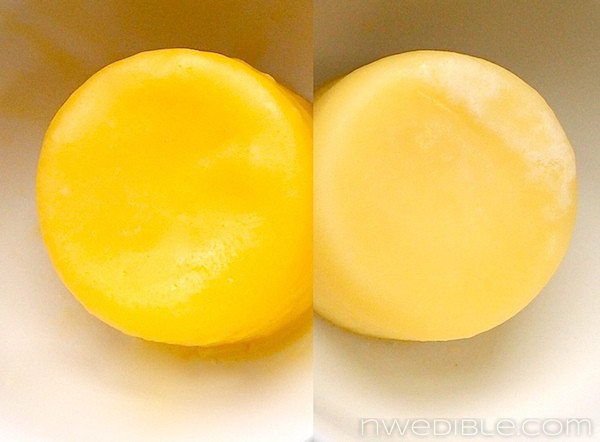
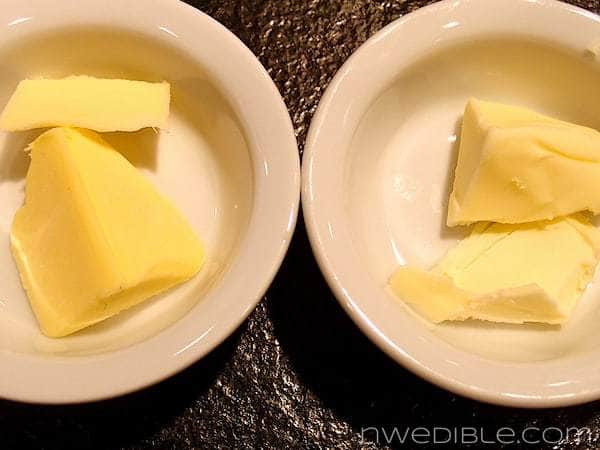
So, which delicious slab of saturated fat was more delicious? The grass fed butter was noticeably darker and more deeply yellow than the conventional butter. The photo below doesn’t actually capture how different the color was in person. Striking difference.
I asked my husband and daughter to weigh in with opinions on which butter they preferred.

My daughter on the appearance: “(A – grassfed butter) is more yellowy, a soft yellow. (B – organic butter) is more white and plain. It looks harder.” (Note both butters were at the same cool room temperature.)

Neither was told which butter they were tasting when they gave eyes-closed feedback.

Comments about (A) – The Grassfed Butter

  • “Hell of a lot more going on.”
  • “Full and creamy, nicely salty.”
  • “It tastes like it lasts a lot longer in your mouth, like after you swallow it you can still taste that there is butter there.”
  • “Melts like butter. Soft.”
  • “Really good.”

Comments about (B) – The Organic Butter

  • “Smooth, slightly sweet.”
  • “Tastes…like butter.”
  • “Really salty but the flavor doesn’t last very long.”
  • “It’s more lubricating than flavorful.”
  • “Feels hard but melted quickly.”

My daughter concluded, “I would rather have less salty (A) for longer than super salty (B) for a short period of time.” Both definitively preferred the flavor of the grassfed butter, praising a more complex and longer lasting flavor. In contrast the organic butter seemed overly salty and simple in flavor profile.

Clear Winner: Grass-fed

Why Organic? Why Grass Fed?

Why buy fancy-pants butter in the first place? Most people who seek out organic dairy do so because they believe it to be healthier, both for the planet and for the end-consumer. I’d guess that everyone who seeks out grassfed dairy thinks they are buying a healthier product.

But the specific “better” reasons for these two specialty butters tend to have a slightly different focus. Organic dairy is thought to be less contaminated by pollutants and toxins, whereas grassfed dairy is primarily praised for a better micro-nutrient profile, including much higher levels of CLA, better Omega-3 to Omega-6 fatty acid ratios and dramatically higher levels of Vitamin A and E.

Now, I happen to agree with the grassfed proponents on the nutrition stuff, and go out of my way to buy grassfed beef and, slightly less consistently, grassfed milk.

Let’s talk contamination. Pesticides, herbicides and toxins tend to build up over time in the fat, including in the dairy fat of animals. (More on this later.) It is a reasonable assumption that animals fed foods less tainted by these pesticides, herbicides and toxins would make foods, including milk and dairy products, less tainted by them.

Most large scale dairy operations practice some degree of confinement feeding, where corn and soy based feed are brought to the cows, instead of sending the cows out to eat grasses. This is true even for large organic dairies, with the major difference being that the corn and soy feed is (supposed to be) certified organic.

My sister, a professional animal scientist specializing in dairy breeding, once described to me the facilities at a major (major) organic dairy she toured. The cows walked around on bare dirt and were fed grain from troughs. The only thing that distinguished this operation from any other industrial dairy was the organic certification of the pesticides sprayed on the feed grains that were eventually given to the cows. My sister was not impressed.

Be that as it may, the theory is that, because of reduced exposure to pesticides, herbicides and other toxins on the feed, organic dairy is less contaminated than conventional dairy.

Grassfed dairy cows, like grassfed beef cows, graze only on pasture and dried forage and are therefore in theory are not getting any added toxic chemicals in their diet. But in practice, as you probably guessed, it’s more complicated.

Will Your Butter Kill You? The Giant Toxic Dairy Fat Issue

Unless you are opposed to butter on ethical (animal product) or fat-avoidance (fat! fat! fat!) grounds, there doesn’t seem to be a whole lot not to love about this substance. It’s delicious. It has great mouthfeel. It carries other flavors beautifully.

But there is one little thing that takes the shine off butter, and it’s called bioaccumulation. It turns out that animals tend to store many of the various chemical environmental toxins they are exposed to, like dioxins and nasty pesticides, in their fat. Fat is like the body’s savings account for building up a nice stash of terrible toxins.

In lactating mammals (including dairy cows and nursing moms) these chemicals are stored in the milk fat, too, and are in turn absorbed by whomever consumes that milkfat, be they calf, infant, or Starbucks Venti Whole Milk Latte lover. (Infants, our littlest, most vulnerable people, have some of the highest levels of toxic burden shoved upon them because of this milk fat toxin issue.)

Since butter is mostly fat, it is one of the most concentrated food sources of these bioaccumulative toxins. According to the Environmental Protection Agency’s Evaluation to Measure Persistant Bioaccumulative Toxic Pollutants in Cow Milk (link goes to a PDF):

The US EPA estimates that approximately 35% of an adult’s daily intake of dioxins is derived from dairy products. The percentage for children is even higher. Persistent, bioaccumulative and toxic pollutants (PBTs), including dioxins, bioaccumulate through the food chain and ultimately result in low-level contamination in most animal fats. It is important to understand the PBT levels in milk, as milk fat may be one of the highest dietary sources of PBT exposure. Analysis of milk also allows the opportunity to investigate geographic variability, as milk is produced and distributed on a regional scale.

So, to summarize, dairy cows store many icky chemical pollutants in their fat, including their milk fat. Dairy items highest in fat, including cheese, ice cream, cream and, alas, butter, are the most likely to contain concentrations of those icky chemical pollutants, and whenever we eat these goodies, the toxins go right into us.

And these bioaccumulated toxins? They are all really quite nasty. You would do well to avoid them as much as possible.

So, does buying organic or grass-fed butter lower your exposure? I wish I could say here that grass-fed dairy is inherently safer from a toxin accumulation stand-point – because I sure believe grass fed milk and butter are better from a micro-nutrient level – but the evidence I found actually suggests the opposite.

In the case of dioxin exposure in particular, animals that graze on contaminated soils and ingest that soil show the highest level of dioxin accumulation. The more contaminated silage or forage and soil they ingest, the more contaminated they become.

Grain finished ruminants, as distasteful as I find it to admit, may actually show lower dioxin levels because they spend less time eating contaminated grass.

According to the USDA report, Dioxins in the Foodchain (Link to PDF):

For terrestrial animals, the intake of vegetation or roughages is considered the most important dioxin exposure factor (Fries 1995a). Feeds derived from seeds contain lower concentrations of dioxins, since the seed is not directly exposed to the air. Ruminants therefore are more vulnerable to dioxin exposure than poultry and swine, as their feed source is predominantly roughage based…Finishing cattle in feedlots is thought to significantly reduce concentrations of dioxins in beef. This is hypothesized to be due to the feeding of a predominantly grain based diet for several months before slaughter (Lorber, et al. 1994).

Again with the summary: grains aren’t as contaminated because they aren’t in contact with the soil. Grass is. Therefore grain-fed cows may be less contaminated by dioxins than grass fed cows.

Oh, the humanity! Are you freaking kidding me? Is nothing sacred?

But, before you decide that you really can’t trust anything anymore and that even happy-hippie organic and grassfed foods are out to get you, know that sewage sludge, which contains all kinds of nasty bioaccumulative and heavy metal contaminants, is not allowed in USDA certified organic food production. So that’s something at least.

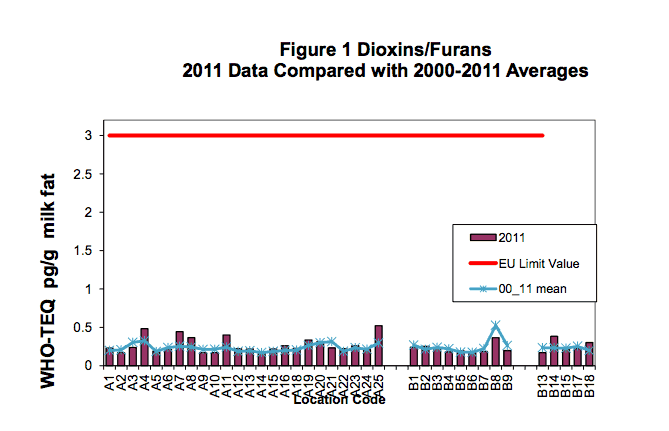
And in the case of Kerrygold butter in particular, we have the advantage of pretty good information about the level of dioxins occurring in milk, thanks to annual reports from the Irish Environmental Protection Agency which detail just this issue. And I’m no expert, but it appears that contaminants of Irish milk are very low.
Dioxin in Irish Milk

This chart shows dioxin levels in Irish cow’s milk compared with the EU limit value (the red line at the top of the chart). According to the report, Ireland compares favorably with other European countries, and the report says that exposure of Ireland’s citizens to dioxins is low.

From this I tentatively conclue that dairy products which are made with Irish cow’s milk, including Kerrygold butter, are probably very low risk from a bioaccumulative toxicity perspective. This, it would seem, is the best of both worlds: low toxin levels in the butterfat and the superior micro nutrient profile of grass fed dairy .

People eating a lot of grass fed butter (I’m looking at you, Mark’s Daily Apple guy) would probably be wise to investigate any known dioxin or other long-term contaminent issues in the area where the cows from which their butter is made graze in order to reduce their own bioaccumulation buildup.

What’s the takeaway from all this? Probably that you should consider moderating your consumption of dairy, particularly delicious high-fat, lovely, tasty dairy like cheese and butter. Sorry, that wasn’t the answer I was hoping for either. In fact, if I had known what I would find when I started this research I would have chosen to remain happily in ignorance, assuming I could eat grass fed butter and organic cheese with impunity.

But I am convinced that the superior flavor and low likelihood of contaminents make the relatively minor price increase between organic and Kerrygold butter worth it for my family. So it looks like I’ll be going grass fed from now.

What is your relationship with butter? Do you buy fancy grass-fed or organic butters?

05 Feb 00:23

EarthScope: A Seismic Shift in Data Gathering

by Ben Preston
Tertiarymatt

BIG DATA

On Feb. 7, 1812, a magnitude 7.7 earthquake pummeled the Mississippi River town of New Madrid. The quake, which was then the largest in U.S. history, was the fourth temblor to hit the region in a three-month span, and newspapers reported that people as far away as New York and Charleston, S.C. felt the vibrations. In one account, the shaking centered in the Louisiana Territory, about 150 miles south of St. Louis, caused bells to toll out of turn in Boston.

Even though hundreds of smaller quakes occur annually in the New Madrid Seismic Zone, scientists are at a loss to explain when and how the area’s faults become more active. Nothing as potent as the 1811-12 quakes has happened there since then. Plus, New Madrid is roughly at the center of the North American continent, thousands of miles away from the plate boundaries normally associated with seismic and volcanic activity.

“There’s geologic evidence that something about this area is different,” said Chuck Langston, director of the Center for Earthquake Research and Information (CERI) at the University of Memphis. “Gravitational pull is stronger there; it could be because of greater mass [below the surface].”

To gain a greater understanding of the subsurface geologic structure, researchers started a moving, continent-wide imaging effort called EarthScope. As it creeps across the continent, Earthscope measures subsurface conditions in multiple ways — one geologist compares it to giving North America a series of CT scans and MRIs — allowing scientists to compare different models and create a clearer, more complete picture of what it looks like down there.

“If you actually looked at the geologic features under the surface, it would be as striking as looking at the Himalayas,” Langston explained.

Earthscope: What Lies Beneath

Pictured is the 'upper chamber' of the Transportable Array station installed in Carbondale, Illinois, which shows the electronics and communications systems and batteries for the station. The sensor is in the 'lower chamber' (not shown) beneath the batteries. (Image courtesy IRIS)

Before the project began in 2004, subsurface data collection was limited to sporadic seismograph stations and isolated study areas, such as the New Madrid Seismic Zone and the Yellowstone Caldera, another mid-plate anomaly. The seismic measurement stations associated with EarthScope — dubbed USArray — consists of about 400 mobile seismometers and a smaller number of instruments designed to measure the electromagnetic properties of subsurface rock. Spaced 70 kilometers (43 miles) apart, the transportable array is the densest system of seismological equipment ever devised; the tight grid allows seismologists to sample the detailed 3D structure of the earth from the crust-mantle boundary to the lower mantle, a depth of nearly 3000 kilometers.* The grid is set to fill the voids left by the more scattered seismograph stations that were already silently gathering data. Technicians travel around the lower 48 throughout the year — avoiding extreme temperatures by concentrating on northern stations in summer and southern ones during winter — pulling up and re-positioning about 200 stations annually. (Each station records data for about two years before being removed.) Moving from west to east, the project has only recently reached New Madrid, but progress has picked up as the teams leave behind the challenging terrain of the Rocky Mountains.

“I kind of think of it as a scan of the continent,” said Bob Woodward, USArray’s director, and the director of instrumentation services at Washington, D.C.-based Incorporated Research Institutions for Seismology, or IRIS. “The thing that comes out of USArray is a much clearer picture of the structure below the surface.”

The array provides detailed information through a process called seismic tomography. Each super-sensitive seismograph can pick up earthquakes of magnitude 5.0 and greater on the opposite side of the planet, and smaller ones nearer the seismometer. Receiving signals from below in all directions, scientists are able to create high-resolution images to help them better understand the makeup of North America’s baffling geology.

“The continent that the U.S. sits on has been pulled apart and smashed together quite frequently,” said Woodward. “It’s complex, and this helps [scientists] put it all together.”

A phalanx of institutions cooperate to run EarthScope, the key players being the IRIS, the University Navstar Consortium (which operates the Plate Boundary Observatory), Stanford University, the U.S. Geological Survey, and NASA. The National Science Foundation funded the project with a 10-year grant, of which the seismic monitoring portion alone costs about $9 million annually.

EarthScope also has a seismic equipment pool — “kind of like a lending library for seismic instruments,” as Woodward calls it. With hundreds of instruments available for more specific National Science Foundation approved and funded projects, EarthScope lends out equipment for locally focused “detail shots” within the general continental scan. Most of the gear is currently checked out, said Woodward, operating in seismic studies in parts of Wyoming, Missouri, Georgia, Idaho, Nevada, Minnesota, and Illinois.

EarthScope Diagram

A schematic of a Transportable Array station S44A near Carbondale, Illinois. Click to enlarge. (Image courtesy IRIS)

One of EarthScope’s other detail-oriented facets is the magnetotelluric observatory — about 50 portable instruments designed to collect subsurface electromagnetic data from depths of up to 100 km. Much of the study’s attention has been focused on the Yellowstone Caldera, a subterranean supervolcano sitting atop a plume of magma extending into the Earth’s crust from its molten mantle. Geologists believe there have been a number of earthquakes and super-eruptions there over the past 18 million years, leaving behind a series of craters and geothermal vents — including the famous geyser, Old Faithful — at Yellowstone National Park.

The massive chamber of trapped magma and pressurized gases have even recently caused visible changes in Yellowstone’s elevation — for a few years after 2004, the ground rose an average of 7 centimeters, a little under 3 inches, per year before subsiding again after 2011 — as well as thousands of minor earthquakes (known as swarms when they occur in clusters over a short period of time) every year. The caldera could blow again at any time, but no one knows when or how big the blast would be.

Yellowstone is no stranger to quakes. A magnitude 7.5 earthquake struck in August 1959 — at the height of tourist season — causing a landslide that killed 28 people. The slide also created Quake Lake when it blocked the Madison River.

* This originally gave a figure of 70 kilometers for the readings, a depth about 43 times less than actually being detailed. Back

Sign up for the free Miller-McCune.com e-newsletter.

“Like” Miller-McCune on Facebook.

Follow Miller-McCune on Twitter.

Add Miller-McCune.com news to your site.

Subscribe to Miller-McCune

05 Feb 00:17

Nuclear Renaissance in Space

by Wendee Holtcamp
Tertiarymatt

The public has a poor handle on the safety surrounding nuclear power?!?

In this, the 50th year of using nuclear energy for space missions, the U.S. is preparing to restart domestic production of a plutonium isotope that fuels space vehicles — a topic that was front and center at the recent Nuclear and Emerging Technologies for Space conference, held in The Woodlands, Texas.

Despite the utility and the necessity of using radioisotopes to power missions ranging from the Mars Rovers to the Voyager 2 probe now exploring the furthest edge of our solar system, the assembled experts said the public has a poor grasp of the safeguards in place for nuclear power in space.

“It’s widely misunderstood,” says Cornell University professor and Mars Rover principal investigator Steve Squyres. “People hear nuclear and radiation, and they immediately get nervous — with good reason. The problem is the devil is in the details, and the details in this case point a certain direction about what’s safe and what’s not.”

“I am utterly convinced there is no credible risk to human health and safety from launching,” Squyres said in an interview. “I really believe that, and I’ve looked at it hard.”

Plutonium-238 is used because its rate of radioactive decay generates sufficient heat, and hence power generation, to finish missions that span years or decades. (Its rate of decay, or half-life, is 87.7 years, compared to the 24,100 years of P-239, the stuff used in nuclear power plants and weapons.) Also, P-238 only emits alpha particles as it decays, rather than the more penetrating gamma or X-rays emitted by other radioisotopes.

Ralph McNutt, space scientist at the Applied Physics Laboratory at Johns Hopkins University and project scientist for the MESSENGER Mercury space probe, described the technology’s history and current use in an opening plenary session at the conference. “Radioisotope power systems are an enabling technology that we use on space missions to be able to go out in regions of the solar systems and do things we simply could not do any other way,” he explained.

“If you’re sending astronauts to Mars, I wouldn’t want to drive a solar-powered vehicle,” Squyres said during his public talk, covering future nuclear-powered missions in space well beyond programs in the next decade’s space plans.

Squyres also spoke of the “holy grail of planetary exploration” – sending a robotic submarine to Jupiter’s moon Europa to look for life underneath the miles-thick ice covering its surface. If, as predicted, geothermal vents lie beneath the ice on the ocean floor, Europa may offer the best chance of finding life in our solar system. “How do you get down through ice? It’s best to melt using something really hot. I think I see a solution, that’s all I’m saying.”

But supplies of plutonium-238 are just about spent. The U.S. stopped producing the isotope in 1988, and subsequently bought it from Russia, which recently reneged on its contract to supply the U.S. At the conference, Wade Carroll, the Department of Energy’s deputy director for space and defense power systems, announced that the federal budget includes money to relaunch domestic production.

NASA was appropriated $3.5 million in the 2011 fiscal year and $10 million the next to relaunch domestic production of plutonium-238 at Oak Ridge National Laboratory, but before that begins, it must undergo a full National Environmental Policy Act review. If approved, the U.S. would produce up to 2 kilograms per year. It will take five or six years before new plutonium will be available.

Danger associated with plutonium-238 comes almost exclusively from inhaling it; particles can lodge in the lungs, where they emit damaging alpha particles into the body. Once in the lungs, it can spread throughout the blood and get lodged in bone and the liver, leading to cancer. On the other hand, if particles land on skin, the layer of dead skin cells block radioactive alpha particles from moving deeper and the radioisotope can be readily washed off. Even swallowing the isotope is not a significant health risk; the digestive tract does not readily absorb it.

Accidents associated with producing or maintaining the radioisotope have occurred. In 2000, a faulty glovebox at Los Alamos National Lab leaked, exposing several workers to radiation from the lab’s plutonium-238 stockpiles.

And despite precautions, scenarios exist in which plutonium-238 from spacecraft could contaminate Earth. If a nuclear-laden spacecraft performed a high-speed slingshot fly-by and a calculation mistake occurred, the craft could enter the Earth’s atmosphere, disintegrate, and spew plutonium throughout the planet.

After the Cassini-Huygens probe launched in 1997, NASA guided it in slingshot maneuvers by Venus, Earth, and Jupiter before heading out to Saturn, and if an accident would have occurred during this maneuver, it could have resulted in an estimated 2,300 cancer deaths worldwide. No current or upcoming space mission plans to use a high-speed Earth flyby.

Plutonium pellets are clad in iridium and then placed in carbon fiber shells to protect them from extreme heat in the case of an accident. Unlike in the case of a slingshot maneuver, if an accident occurred during launch, the pellets would break into chunks too large to stay airborne and be inhaled. Protestors attended the launch of the Cassini-Huygens probe in 1997, but not the more dangerous flyby. Both went off without a hitch. “The stresses that can occur in a launch accident cannot destroy these things,” says Squyres, who chairs the NASA Advisory Committee.

Later launches of the Mars Rovers and most recently, the Mars Science Laboratory Curiosity, which lands August 5, have not met with any protests. “People are starting to get that launching these things is not risky,” said Leonard Dudzinski, NASA executive for radioisotope power, at the plenary Q&A.

“Anybody involved in flying one of these things knows how much goes into worrying about safety,” said McNutt. Analysis, an environmental impact statement, and presidential approval are required anytime nuclear material gets launched into space.

“Unless we maintain the ability to make plutonium-238, we will not have these missions,” concluded McNutt. The public will have to weigh the benefits of these pioneering space missions against the costs and risks of use, including domestic production, and will get a chance as NASA submits its plans for new domestic production and the National Environmental Policy Act process unfolds.

05 Feb 00:16

Apples: An Anti-Obesity Pill?

by Matt Skenazy
Tertiarymatt

Life is weird sometimes.

Apples as Diet Food

Could an apple a day help keep obesity away? In a new study, researchers at the University of Iowa found that ursolic acid, a compound found in the waxy skin of apples, increased muscle mass and reduced total body weight.

The researchers put two groups of mice on high-fat diets where 55% of their calories came from fat. But for one of the groups, researchers added an ursolic acid supplement to their diet. The mice that had the supplement developed more muscle mass, were able to exercise longer and had an increase in brown fat—a type of tissue that burns large amounts of calories to maintain body temperature—than the mice without the supplement. Turns out, the ursolic acid led a multi-pronged, calorie burning assault on the high-fat diet of the mice. Not only that, but it reduced glucose intolerance and fatty-liver disease, common ailments for obese people.

The results suggest that ursolic acid is “a potential therapeutic approach for obesity and obesity-related illness,” the researchers write. More muscle, more energy, more calories burned? Maybe that’s why Eve ate the apple.

05 Feb 00:13

A New Breed of Therapy

by Eric Leake
(PHOTO: VIKARAYU/SHUTTERSTOCK)

Ellen Kinney opens the barn door for Dahlia and Duncan. Two black-and-silver pygmy goats, each about a year old, prance out. Kinney has trained them to respond to a clicker, so that Dahlia seems to dance while Duncan jumps up and down from a plastic chair.

Those aren’t their best tricks. Dahlia and Duncan work as therapy animals at the Barking C.A.A.T. (Center for Animal-Assisted Therapy) Ranch in Lakewood, Colo. Among the ranch’s clients is a teenage girl with severe social anxiety who works with the goats, getting to know and be comfortable with them, going for walks in the park with them (and a therapist). When others ask her about the goats (and they always do) the girl introduces them, sparking natural, unforced conversations.

“Here she gets to build a whole new confidence and competencies that she didn’t have before,” says Kinney, who manages clinical services at the ranch. “It’s just really changed her personality. Since she’s been working with us she goes out to dinner with her family and has reconnected with her friends.”

Dahlia and Duncan are joined at the ranch by two miniature horses, a full-sized horse, an assortment of service dogs, two therapy rats, and at least one therapy cat. The ranch’s human staff consists of five therapists and 20 volunteers. They work with a variety of clients, including children and adolescents, veterans, and couples. The animals assist in providing comfort, responding to the clients, and serving as means for interaction and discussion of issues that otherwise might be less accessible. A child dealing with abandonment, for example, might be better able to talk about those feelings while sitting beside and looking through the photo album of Sasha, a rescued Shar-Pei mix who found a loving home at the ranch.

Barking C.A.A.T. is part of a growing effort to better understand animal-human connections and apply that understanding to therapy and social work. At the vanguard of that effort is the University of Denver’s Institute for Human-Animal Connection, which conducts research and offers a graduate certificate in animal-assisted social work. Denver was the first to offer such a certificate in the growing field. Kinney and many of the ranch’s therapists are alumni.

The animal-assisted social work program is coordinated by Philip Tedeschi. Sitting in his office, with at least four dog photos on the wall and a water dish beside the conference table, Tedeschi talks of how animals and people already interact emotionally, neurologically, and physiologically.

“We’re starting to recognize that these are some of the most reliable and consistent relationships that people have,” he says. “The interesting question has become what are all the different ways that animals can be utilized to participate in educational and therapeutic initiatives?”

Tedeschi studies both the positive and negative aspects of human-animal interactions. (Watch his 2010 TEDx talk here.) He collaborated with law enforcement, animal control, and social service agencies in the Colorado Link Project to recognize animal abuse as an early indicator for preventing further abuse and personal violence. He also works on conservation and environmental social work issues in East Africa. Throughout all of this he stresses the ethical considerations of working with animals. “If it doesn’t work well for the animal,” he says, “then the chance of therapeutic success is low.”


A CHILD IN THE U.S. IS MORE LIKELY to grow up with a pet than a father at home, observes Layla Esposito, program director at Eunice Kennedy Shriver National Institute of Child Health and Human Development. “The question is, what kind of an impact does that have?” she asks. “Does it help with emotional development, with empathy? Anecdotally there is strong evidence, but we’re looking to understand that more fully.”

With major longitudinal research initiatives and advances in studying human responses, “it appears that human-animal interaction has turned a corner where we’ve had difficulty studying these interactions in the past,” Tedeschi adds. Still, the field must continue developing research-based clinical protocols for animal-assisted practices to be more widely accepted and applied, he says.

While animals have long been recognized for their therapeutic and health value as companions, much evidence was considered anecdotal and sentimental. Formal research on these interactions is time-consuming and expensive. As the field has progressed, animal-assisted therapies have gained standing in medical settings and now in social work programs, although “I wouldn’t describe this as close to having the full endorsement of the mainstream medical community,” Tedeschi adds. With additional research, animal-assisted therapies are moving toward greater legitimacy. “I also wouldn’t describe it as being fully in doubt, because we are accumulating the evidence. It belongs in academia right now because we need a lot more thinking and research.”

This research imperative is supported by the Shriver institute, which created a private-public partnership with pet food maker Waltham-Mars. The partnership has funded 21 studies, a dozen of those under way this year, and has published two edited collections, Animals in Our Lives and How Animals Affect Us.

Current institute-funded studies include an examination of classroom guinea pigs in working with autistic children, the training of shelter dogs at juvenile detention facilities to develop empathy and social functions, and using therapy dogs to support children when testifying in abuse cases.

The point, Esposito says, is to understand how people and animals interact and the conditions under which those interactions might be most beneficial.

“There is so much personal belief about the benefits of human-animal interaction that it’s sometimes hard to tease out what has actually been supported by science,” she says. “We want standardized protocols. We want to know if you add an animal to an intervention, is it really the addition of the animal that is leading to these results?”


IN OPENING A RECENT GRADUATE CLASS on animal-assisted social work, Tedeschi announces, “Welcome everybody, those of you with two legs and those with four.” Twenty students and half as many service dogs greet him. During the class, students role-play animal-assisted therapy sessions.

“The start of the relationship can be through the animal. The animal is the conduit,” Tedeschi explains. Two students sit in the middle of the classroom. One acts disaffected while the other introduces a dog as a way to practice voice modulation and effective eye contact.

“You can use the animal relationship to get a different perspective,” Tedeschi says. “We also know that physiological interaction in the animal-human relationship can bring down blood pressure and increase oxytocin levels.”

The students brainstorm ways to work with other issues and animals, such as horses, cats, and even rats in addressing trust.

A graduate of the program, Kelsey Hopson coordinates animal-assisted services with CBY YouthConnect in La Junta, Colo., a residential treatment facility for adolescent boys. “There is a lot of media about the magic of having a dog around a kid and that if you just introduce a dog, that works,” Hopson says while Samantha, a Labrador and golden retriever mix, lies quietly behind her. “The burden is on you as the therapist. Sam’s an excellent dog, but she’s not the therapist.”

Hopson describes the ways that she and Samantha work with at-risk youth. Samantha’s dislike for baths provides a lesson on hygiene. Kids build teamwork and patience in teaching Samantha to navigate an agility course. Samantha accompanies a child to help facilitate peer relationships. Because their time with Samantha is limited, kids with attachment issues practice saying goodbye.

“I’m surprised by the variety of applications,” Hopson says. “I think there’s room for tremendous growth in this field. I’d like to see it be the best professional field it can be.” As she prepares to leave, Samantha gets up, too, and she’s with her every step of their way.

05 Feb 00:03

The Audacity of Brainless Slime Mold

by Kevin Charles Redmon
(PHOTO: SHUTTERSTOCK)

As any proud iPhone 5 owner knows, even genius takes a day off once in a while: When Apple decided to ditch Google and rebuild its popular Maps app using a proprietary platform, the result was a colossal cartographic #fail that still gets cited in Apple’s current share price travails. The sloppy coding directed users onto airport runways, into the ocean, and even inspired its own Tumblr.

Brainless slime mold—yes, that’s the official scientific nomenclature—has no such problems. In fact, it doesn’t even have a central nervous system. But in a paper published last fall in the Proceedings of the National Academy of Sciences, Australian and French researchers showed that the unicellular protist knows how to “map” its surroundings and navigate complex mazes in order to find food.

Such behavior, from an organism with no consciousness, sheds light on the origin and evolution of memory among us brainier creatures.

“External memory,” the authors write, is a common phenomenon in nature: ants use pheromone trails to find their way from food source to nest; bees use landmarks to guide their in-flight navigation. Such tactics, biologists believe, likely preceded “internal memory” and allowed simple life forms to solve spatial problems, long before they could “think” or “feel.” Even robots learn this way. A robot can, of course, come pre-loaded with a map of its environment, or be programmed to build one as it explores—but such capabilities are technologically expensive. A simpler robot might instead employ “reactive navigation,” and solve spatial problems by keeping track only of its immediate surroundings.

So it is with brainless slime mold: no fancy on-board computer, no nervous system, no memory. But that doesn’t prevent it from making smart decisions.

The researchers report that when Physarum polycephalum “senses” food—via the activation of membrane surface receptors—and begins to flow in its direction, the mold leaves behind a “thick mat of nonliving, translucent, extracellular slime” in its wake. (Consider the slug.) When it begins to “forage” again, it will “choose” to explore new territory by avoiding its old, slime-covered path. (Only if there are no virgin swaths of Petri dish to traverse will the mold double back on its previous turf.) Such behavior, the researchers write, “strongly suggests that it can sense extracellular slime upon contact, and uses its presence as an externalized spatial memory system to recognize and avoid areas it has already explored.”

To test this, the biologists ran a series of Petri dish trials involving U-shaped mazes. Half the dishes contained only agar. The other half were pre-coated in slime, effectively jamming the mold’s radar. On these dishes, the mold had no way to find (and thus avoid) its own navigational trail. The results were striking: when the mold’s “external memory” was blocked, it failed to escape the U-trap and find its way to a food source two-thirds of the time; when its external memory was uncompromised, however, the slimy subject performed almost flawlessly. It also spent dramatically less time exploring tracts of Petri dish where it had already been, and hewed closer to the optimal search route. By taking advantage of an “externalized spatial memory system,” the researchers conclude, the mold greatly enhances its navigational ability.

This is not the first time scientists have used brainless slime mold to shed light on how higher-order creatures like us humans interact with our spatial environment. In 2010, Japanese researchers at Hokkaido University devised a clever experiment that modeled the Tokyo rail system in a Petri dish of Physarum polycephalum. They distributed 36 food sources to match the geographic locations of cities around the Japanese capital, and turned the slime mold loose to see how efficiently it would connect the dots. The authors found that the resulting network closely matched the city’s real-world railways—a neat trick considering that Physarum has no capacity for central planning or urban design.

The takeaway? Great minds and brainless slime mold think alike.

04 Feb 19:27

(via Three Panel Soul)

Tertiarymatt

Other powers include needing to pee all the time.

03 Feb 03:15

Social Media: Pulse of the Planet?

by Patrick Meier
Tertiarymatt

This raises an interesting question regarding the scientific and social usefulness of non-anonymous data streams like twitter.

In 2010, Hillary Clinton described social media as a new nervous system for our planet (1). So can the pulse of the planet be captured with social media? There are many who are skeptical not least because of the digital divide. “You mean the pulse of the Data Have’s? The pulse of the affluent?” These rhetorical questions are perfectly justified, which is why social media alone should not be the sole source of information that feeds into decision-making for policy purposes. But millions are joining the social media ecosystem everyday. So the selection bias is not increasing but decreasing. We may not be able to capture the pulse of the planet comprehensively and at a very high resolution yet, but the pulse of the majority world is certainly growing louder by the day.

mapnight2

This map of the world at night (based on 2011 data) reveals areas powered by electricity. Yes, Africa has far less electricity consumption. This is not misleading, it is an accurate proxy for industrial development (amongst other indexes). Does this data suffer from selection bias? Yes, the data is biased towards larger cities rather than the long tail. Does this render the data and map useless? Hardly. It all depends on what the question is.

Screen Shot 2013-02-02 at 8.22.49 AM

What if our world was lit up by information instead of lightbulbs? The map above from TweetPing does just that. The website displays tweets in real-time as they’re posted across the world. Strictly speaking, the platform displays 10% of the ~340 million tweets posted each day (i.e., the “Decahose” rather than the “Firehose”). But the volume and velocity of the pulsing ten percent is already breathtaking.

Screen Shot 2013-01-28 at 7.01.36 AM

One may think this picture depicts electricity use in Europe. Instead, this is a map of geo-located tweets (blue dots) and Flickr pictures (red dots). “White dots are locations that have been posted to both” (2). The number of active Twitter users grew an astounding 40% in 2012, making Twitter the fastest growing social network on the planet. Over 20% of the world’s internet population is now on Twitter (3). The Sightsmap below is a heat map based on the number of photographs submitted to Panoramio at different locations.

Screen Shot 2013-02-05 at 7.59.37 AM

The map below depicts friendship ties on Facebook. This was generated using data when there were “only” 500 million users compared to today’s 1 billion+.

FBmap

The following map does not depict electricity use in the US or the distribution of the population based on the most recent census data. Instead, this is a map of check-in’s on Foursquare. What makes this map so powerful is not only that it was generated using 500 million check-in’s but that “all those check-ins you see aren’t just single points—they’re links between all the other places people have been.”

FoursquareMap

TwitterBeat takes the (emotional) pulse of the planet by visualizing the Twitter Decahose in real-time using sentiment analysis. The crisis map in the YouTube video below comprises all tweets about Hurricane Sandy over time. “[Y]ou can see how the whole country lights up and how tweets don’t just move linearly up the coast as the storm progresses, capturing the advance impact of such a large storm and its peripheral effects across the country” (4).


These social media maps don’t only “work” at the country level or for Western industrialized states. Take the following map of Jakarta made almost exclusively from geo-tagged tweets. You can see the individual roads and arteries (nervous system). Granted, this map works so well because of the horrendous traffic but nevertheless a pattern emerges, one that is strongly correlated to the Jakarta’s road network. And unlike the map of the world at night, we can capture this pulse in real time and at a fraction of the cost.

Jakmap

Like any young nervous system, our social media system is still growing and evolving. But it is already adding value. The analysis of tweets predicts the flu better than the crunching of traditional data used by public health institutions, for example. And the analysis of tweets from Indonesia also revealed that Twitter data can be used to monitor food security in real-time.

The main problem I see about all this has much less to do with issues of selection bias and unrepresentative samples, etc. Far more problematic is the central-ization of this data and the fact that it is closed data. Yes, the above maps are public, but don’t be fooled, the underlying data is not. In their new study, “The Politics of Twitter Data,” Cornelius Puschmann and Jean Burgess argue that the “owners” of social media data are the platform providers, not the end users. Yes, access to Twitter.com and Twitter’s API is free but end users are limited to downloading just a few thousand tweets per day. (For comparative purposes, more than 20 million tweets were posted during Hurricane Sandy). Getting access to more data can cost hundreds of thousands of dollars. In other words, as Puschmann and Burgess note, “only corporate actors and regulators—who possess both the intellectual and financial resources to succeed in this race—can afford to participate,” which means “that the emerging data market will be shaped according to their interests.”

“Social Media: Pulse of the Planet?” Getting there, but only a few elite Doctors can take the full pulse in real-time.


02 Feb 22:20

(via The antidote to apathy. [VIDEO])

Tertiarymatt

Hey, thanks for not sending the video to the feed, tumblr! Anyway, incisive commentary here.