Shared posts

19 Nov 04:18

Watch Wes Anderson’s Charming New Short Film, Castello Cavalcanti, Starring Jason Schwartzman

by Colin Marshall

Wes Anderson, it seems, has entered his European period. His next feature film, The Great Budapest Hotel, which comes out in March, takes place in its titular location. His new short film Castello Cavalcanti, too, takes place in its titular location, a hamlet tucked away somewhere undisclosed in Italy. Then again, hasn’t Anderson, aesthetically and referentially speaking, always enjoyed something of a European period? (Maybe we can call it European by way of his native Texas, which, for me, only adds to the visual interest.) This, combined with his apparent fascination with the objects and built environment of the early- to late-middle twentieth century, has won him a great many fans sympathetic to his sensibilities. (Along with, of course, a handful of detractors less sympathetic to them.) This brief but vibrant new piece should, for them, resonate on several levels at once.

Anderson transports us to Castello Cavalcanti in the suitably midcentury year of 1955. The quiet evening scene, exuding that richly Italian feeling falling somewhere between idyll and indolence, splinters apart when a race car crashes into the center of town. Out of the wreck emerges the unscathed but enraged driver: Jed Cavalcanti, played by none other than Jason Schwartzman, star of Anderson’s 1998 breakout Rushmore. Once his anger at his brother-in-law mechanic cools — evidently, the steering wheel got screwed on backward — the Italian-American Cavalcanti realizes he may have driven not only straight into his own ancestral village, but into the company of his ancestors themselves. These charming and vividly colorful seven Andersonian minutes come brought to you by Prada, who, apart from our hero’s racing suit, don’t seem to have left many overt stamps on the finished product. Prada’s prices may still keep me away from their door, but their taste in directors sure won’t.

Castello Cavalcanti will be added to our collection of 600 Free Movies Online.

Related Content:

Watch 7 New Video Essays on Wes Anderson’s Films: Rushmore, The Royal Tenenbaums & More

Wes Anderson from Above. Quentin Tarantino From Below

Wes Anderson’s First Short Film: The Black-and-White, Jazz-Scored Bottle Rocket (1992)

Colin Marshall hosts and produces Notebook on Cities and Culture and writes essays on literature, film, cities, Asia, and aesthetics. He’s at work on a book about Los AngelesA Los Angeles Primer. Follow him on Twitter at @colinmarshall.

Watch Wes Anderson’s Charming New Short Film, Castello Cavalcanti, Starring Jason Schwartzman is a post from: Open Culture. You can follow Open Culture on Facebook, Twitter, Google Plus and by Email.

15 Nov 20:29

Startup Chime

Tertiarymatt

I know that feel, bro.

no one gets out of coffee alive.

Speaking of working a lot, I launched the one and only "Fuck This." ice scraper today. What have I WROUGHT?

14 Nov 19:30

An Unexpected Gift From Hurricane Sandy?

by Will James
Tertiarymatt

I have exactly zero sympathy for rich people living on barrier islands.

In the mid-1980s, Long Island's Great South Bay turned the color of Earl Grey tea. It was the first outbreak of an algal bloom known as the brown tide, and it would return year after year, fueled by pollution from the island's septic systems. Over three decades, it would wipe out thousands of acres of underwater grass, contribute to the demise of a once-booming shellfish industry and make the shallow, 45-mile lagoon a symbol of the suburban island's troubled relationship with water.

Then, a year ago, Hurricane Sandy blasted a new inlet through Fire Island, the slender barrier island separating the Great South Bay from the Atlantic Ocean. Fishermen began to spot river herring, fluke, weakfish, sea turtles—even a seal that popped its head up alongside a dock—in a formerly stagnant, eastern swathe of the bay. Scientists watched water there grow clearer and the brown tide weaken and dissipate more quickly. As the year passed, parts of the Great South Bay started to look a bit more like the body of water many Long Islanders remember swimming in as children and scouring for shellfish in young adulthood.

It’s now a year since Hurricane Sandy made landfall, and the new waterway remains a fiercely debated piece of the storm's legacy in New York State. Teams of scientists putter around it in skiffs. Residents pack high-school auditoriums to argue over whether it represents a blessing or a threat. Anglers flock to the scattered shoals at its mouth, and beach-goers walk a mile down the shore to bathe in it. A trio of governmental agencies continue to consider plugging it with sand.

Some fear the breach—now roughly the width of two football fields laid end-to-end—will magnify the power of the next super-storm, allowing more water to fill the bay and crash along the coast. "It's a giant hole," says Aram Terchunian, a Long Island coastal geologist who has worked as a consultant on other breach-closure projects. "What do you think is going to happen? You're going to get a storm surge, water's going to come flooding in through the inlet and it’s going to fill up the Great South Bay. It’s not rocket science."

Others see a positive development and symbol of nature’s power of self-renewal—an instance of the ocean breaking through a barrier of land to rescue a bay that overfishing and overdevelopment had rendered all but unrecognizable. The blueness of the water around the inlet forms a stark line against the brown tide, reminding some residents of just how far Long Island's waterways had fallen.


Ryan Wallace, a Stony Brook University doctoral student, analyzes water quality data in Long Island's Great South Bay in October 2013. (Will James)

"The bill came due in a lot of ways," Marshall Brown says, "with Sandy and what it uncovered."

Brown remembers the Great South Bay before the brown tide came. He was a kid growing up in Sayville, a Long Island hamlet that sits at the water’s edge. Native eelgrass grew so thick, he says, that boaters would have to reverse their outboard motors to spin slimy strands off their propellers. In the mid-1970s, when Brown was a teenager, baymen raked and dredged more than half the hard clams eaten in the country off the bay's floor. Black-and-white photographs from that era show clam boats stretching to the horizon.

When Brown returned to Sayville for a high school reunion 35 years after he left for college, he walked his son down to the beach and found something entirely different. The water looked "disgusting," he says —"dark, dirty, lifeless." Fields of eelgrass were gone. So were the baymen. Just a handful still eked out a living off what was left on the bay’s floor.

What happened in between is one of Long Island's most storied environmental collapses. Scientists blame, in part, over-harvesting by the shellfish industry. But blame has fallen increasingly on the brown tide, which blocks sunlight and kills the eelgrass beds that shellfish use as nurseries. It also causes shellfish to close up and stop feeding, although scientists don't know exactly why.

In recent years, studies have traced the brown tide to nitrogen pollution flowing from the island’s buried backyard septic systems. Long Island is home to 2.8 million people and part of the most populous metropolitan area in the country, but huge swaths of it aren't connected to sewers, relying instead on septic tanks that allow wastewater to collect underground and leach into the earth. From there, nitrogen—a nutrient found in human waste—winds its way through the groundwater and into the bays, where it feeds the algal blooms.

Nitrogen pollution is emerging as a major environmental threat in many spots on the East Coast—like parts of Massachusetts, Rhode Island and Florida—where houses have sprouted up along the shoreline. Long Island, though, stands out. Christopher Gobler, a Stony Brook University marine biologist, calculates that nitrogen levels doubled in one Long Island aquifer and rose 40 percent in another between 1987 and 2005. New York State in 2010 added the Great South Bay to a federal list of impaired water bodies, citing the nitrogen problem.

This is what Brown found when he moved back to Long Island after a career building Wi-Fi networks in New York City parks. When he founded Save the Great South Bay, a conservation group, with some high school friends the summer before Hurricane Sandy, he planned to organize beach cleanups and advocate for stricter environmental controls. He didn’t anticipate becoming one of the loudest advocates of an inlet carved by a hurricane. "It’s been very much a battle," he says, against "bureaucratic momentum and, let's say, the misplaced desire to make people feel safe."


An aerial view of the new inlet in Fire Island as it was on April 18, 2013. (John Vahey)

The ocean bored through Fire Island sometime on October 29, 2012. It swept away a dock, a boardwalk and untold quantities of sand. Long Islanders dubbed it "New Inlet," but it wasn’t exactly new – it came through at a low-lying stretch of beach where an older waterway once allowed oceangoing ships to cross through Fire Island and enter the Great South Bay. Some historical accounts say it closed in the 19th century, after a brig wrecked at its mouth.

Storms often carve new inlets in the barrier islands along the East Coast and the Gulf of Mexico. The breaches tend to last a while, changing shape, until sand chokes them off. As a series of nor'easters battered Long Island the winter and spring after Hurricane Sandy, the inlet stretched and narrowed and slid into a diagonal orientation. An ever-shifting array of sand islands and channels sprouted at its mouth. Last month, it had stretched to 1,302 feet—roughly the length of the Empire State Building laid on its side.

Charles Flagg, a Stony Brook oceanographer, says the inlet has evolved into something of "a stable system" in recent months, but, like all inlets, it will eventually "squeeze itself off." "It gets long and skinny and vulnerable, and then something happens and that's it," he says. "When that’s likely to happen, god only knows."

Some don't care to wait. Opposition to the inlet has evolved over the past year, but a common theme unites it: The breach may be flushing out the bay, but it is dangerous, and cleaner water isn’t worth sacrificing more homes.

The breach may be flushing out the bay, but it is dangerous, and cleaner water isn’t worth sacrificing more homes.

Fire Island residents see the breach as a disruption in the barrier island's already scant infrastructure. The narrow tract of land—32 miles long and about a half-mile wide—is a national park where thousands of people have summer homes but only about 400 live year-round. One of them is Mary Parker, one of two people who live out the winter in Davis Park, an outpost of bungalows and twisted trees about five miles west of the inlet.

Like most of Fire Island's 17 communities, Davis Park has no roads. Its infrastructure consists mostly of boardwalks stretching from the bay to the ocean. Parker, a retired Wall Street stocks-and-bonds researcher, says she once could drive her aging Jeep Grand Cherokee east along the shore, over the Smith Point Bridge and onto the mainland in a few minutes. Now that the inlet lies in her path, she has to drive west to another bridge, an hour away. “It made a big difference for me. I would drive off and get groceries and do laundry, go to meetings," says Parker, president of the Davis Park Association, a civic group. "Now, it’s a major undertaking for me to leave the island in the winter."

Parker, who also serves as a volunteer firefighter, fears the breach could prove more than an inconvenience if Davis Park’s wooden bungalows went up in flames. The Great South Bay sometimes freezes in the winter, blocking passage by boat. Mainland emergency responders used to be able to speed over the Smith Point Bridge and down the barrier island’s shore. Now that the inlet blocks their path, they could take an hour longer. "There are people who live here and there are people who have homes here – and they’re not inexpensive homes – who don’t have protection during the winter," Parker says. "You'd have to sit and watch them burn."

Chris Soller, the superintendent of the Fire Island National Seashore, the National Park Service unit that oversees the island, doesn’t share those fears. Soller, who lives on Fire Island part-time, says high tides often block the shore route, inlet or no. "I hear them," he says, referring to residents like Parker, but closing the breach is "not a guarantee that they'll have emergency services. They’re vulnerable because they live five miles out in the ocean on a barrier island, and there are fewer and fewer emergency personnel living there than there ever was."

The safety concerns pit concerned residents against environmentalists—a change from the alliances of the past, according to Lawrence Levy, the executive dean of the National Center for Suburban Studies at Hofstra University and an expert on Long Island politics. "A lot of people who live on the south shore of the main island would normally be part of the environmental movement, because they have interest in protecting the values of their properties," he says. "Superstorm Sandy changed their calculation of what is a threat."

Long Islanders on the mainland fear the inlet could whip the bay into a destructive force when the next hurricane strikes. "The amount of water going into the basin is going to increase," says Terchunian, the coastal geologist. "It has to flood. There's no other way. Where is the water going to go? It’s not like there’s a force field keeping water away form the developed areas."

And Terchunian, like others in his camp, says leaving the breach open is a cheap and irresponsible way to cleanse the Great South Bay – it ignores the pollution at the heart of the problem. "We have a water quality issue,” he says, "and we need to address the water quality issue."


Florian Koch, of Stony Brook University, prepares a net he uses to gather scientific samples from Long Island's Great South Bay. (Will James)

Many scientists studying Long Island's dying waterways have turned their attention to the inlet over the past year. On a freezing morning about a week before Hurricane Sandy’s anniversary, Florian Koch and Ryan Wallace, two Stony Brook researchers, crisscrossed the Great South Bay in a skiff, leaving behind a trail of wake that looked vaguely like watered-down whiskey. The brown tide had struck earlier in the fall, giving the choppy bay the appearance of dried mud stretching from Long Island’s southern coastline to Fire Island in the distance.

Koch, a postdoctoral researcher, says nitrogen is natural – living things need it, and it makes plant fertilizer work – but it can over-nourish some life. 

"Food's not bad for the human body, but obesity is, you know?" says Koch. "You can almost think of nitrogen pollution like we're making the bays fat. It’s like the obesity epidemic of the bay, right? Because we’re feeding it to death."

They sped closer to the inlet and, in an instant, the water changed. It turned a granite color and sandy ripples came into view on the bottom. The two scientists measured upswings in water clarity and salinity – an indication that ocean water was flowing in – and a drop in chlorophyll, indicating the brown tide had thinned out.

Gobler, the marine biologist, has found that average water clarity near the inlet increased 35 percent this year over historical averages, meaning that, for perhaps the first time in decades, part of the bay meets state standards for swimming. The brown tide's density near the breach last month was just 2 percent the density in an adjacent section of the bay.

Gobler admits the inlet’s cleansing power is limited to an eastern swathe of the Great South Bay, but says that area has changed so much it’s now operating almost like "a totally different system." And he sees an opening there for marine life to get a foothold again. "A lesson from the inlet is that if water quality is addressed," he says, "the ecosystem can improve."

Many environmentalists want policymakers to let the inlet live out its natural lifespan, allowing those improvements to continue. Brown wants to go further, and plant eelgrass and shellfish near the breach. Maybe, he says, the clams' tiny filters will cleanse a greater swathe of the bay and spark a feedback loop. "I think it’s a good idea in theory," he says, "and I’d like to hear a counter-argument."

The inlet's fate, though, will be determined by three governmental entities: The Army Corps of Engineers, the Fire Island National Seashore, and the New York State Department of Environmental Conservation. The Army Corps of Engineers said it is waiting on a decision by the other two. The Fire Island National Seashore, a branch of the National Parks Service, said it would like to study the inlet's environmental effects before making a decision, but has so far failed to obtain funding to do so. The New York State Department of Environmental Conservation has been silent, and has not returned calls seeking comment on the issue for several weeks. Terchunian estimated the job would cost $20 million and require more than a million cubic yards of sand. 

If policymakers are waiting for the public to settle on one perception of the inlet, they may have to wait a long time. The debate over the breach has grown to encompass many of the issues facing Long Island at this point in its history: the downsides of suburban development, the degradation of its water, the question of whether movements of sand should be viewed as natural or as damage in need of repair, and, of course, the looming danger of the next superstorm.

"We're talking about balancing the benefits of cleaner bay water, which you can see every single day," says Levy, the political expert, "versus the need to protect yourself from something that may not come for many, many years."

Top image: An aerial photograph of the inlet taken on September 15, 2013. (Charles Flagg)

This post originally appeared on The Atlantic.


11 Nov 03:50

the Automaton

Tertiarymatt

I am strangely fond of the psycho OGLAF dwarves.

http://oglaf.com/automaton/

10 Nov 23:10

nicholasgurewitch: THOR SPOILER: Kate Beaton and I collaborated...

Tertiarymatt

I understand this is the bulk of the second Thor movie. Thor needs to win Jane a teddy bear to apologize for being away so long, so Loki sabotages all his attempts to win prizes at the State Fair, until Thor loses his temper and wrecks stuff.


nicholasgurewitch:

THOR SPOILER: Kate Beaton and I collaborated on this Marvel parody piece in 2011, for their Strange Tales series.

I’m not as good at doing Nick Gurewitch comics as Nick Gurewitch is, but it was fun to try!  Marvel was always great with this series, they just wanted artists to have a laugh with their characters.  Hope it comes back sometime.

07 Nov 18:17

A box of cold bees

by Rusty
Tertiarymatt

Nice pic of a naked hive.

The central part of New York State has cold winters, way too cold for honey bees in an unprotected nest. Nevertheless, the nest in the photos was found last week by Pam and her boyfriend, Jay, in that chilly part of the country. The nest was nine feet off the ground in a box elder […]
06 Nov 03:46

Oh Joy Guest Comic

no one gets out of coffee alive.

( read the rest here )

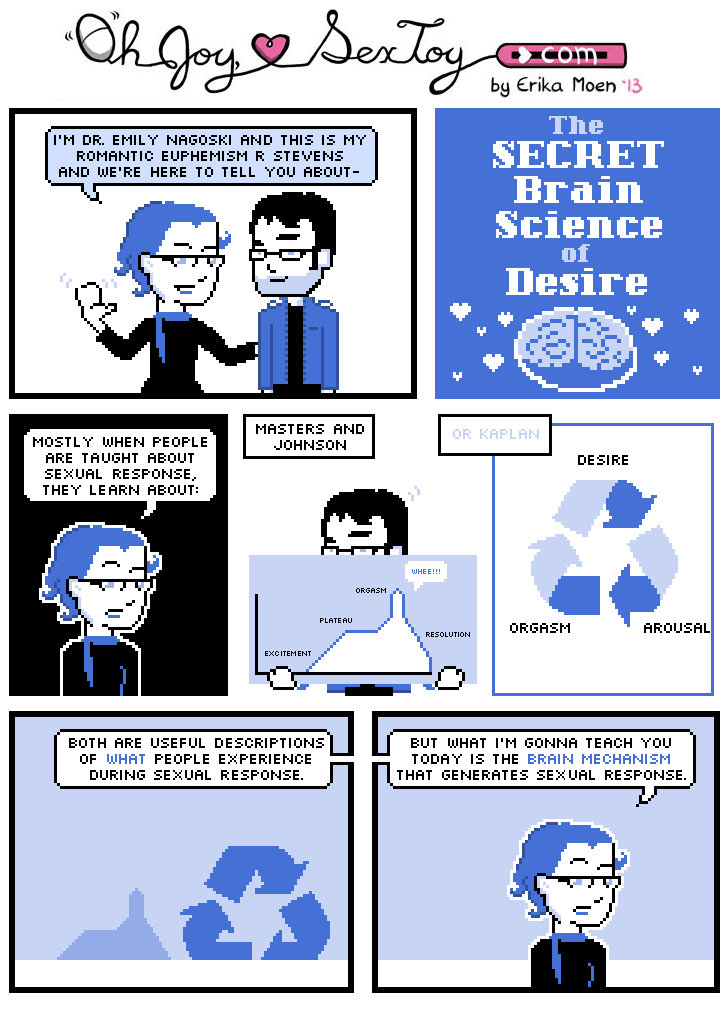
No DS today due to secret lockdown M-W-F schedule, but Dr. Emily and myself have a guest comic over at Erika Moen's Oh Joy Sex Toy.

This one is about science and is safe to read at work. The genitals are highly abstract. It's 3 pages. I've attached the first here.

You should check out Emily on her blog and on Twitter.

***

I mayyyyy have also put up a new shirt from Erika that cracks me up.

05 Nov 19:06

A Quintessentially Canadian Idea for Winter Smartphone Use

by Jenny Xie
Tertiarymatt

Just put away your phone for a minute.

Winter is coming, and a group of Canadians are on a mission to keep phones and their users warm.

Behold Tahka, a portable cocoon for your smartphone addiction. Spearheaded by proud Canadian Mina Mais, Tahka is made of waterproof nylon on the outside and polar fleece on the inside. There’s also an area of clear plastic coated with anti-fog agents, for an unobstructed view of the phone. Texting while waiting for the bus in the cold doesn't have to be a torture.

The early bird price for a Tahka is $49 on Kickstarter. But for $9 more, you can get a handy talisman, shown above. Tahka is a perfectly functional concept, once you get over the fact that it exists.


05 Nov 04:02

Sunday's Solar Eclipse and the Empire State Building Made a Beautiful Pairing

by John Metcalfe

Alone, the New York City skyline afire with the golden glow of dawn is a spectacular sight. But throw in a "hybrid" solar eclipse so rare it won't happen again until 2172, and you got yourself a photograph so awesome it might make you gape at your monitor like a deer in the headlights of a monster truck.

Chris Cook captured the singular image at 6:38 a.m. on Sunday morning while the moon photo-bombed the sun for three hours (to count the eclipse's 8,500-mile path over the planet). It was no accident that brought the self-described "over-the-hill" photographer from Harwich, Massachusetts, to the big city. Cook had been planning for months on how to best capture the once-in-a-lifetime event, first thinking he'd shoot it behind the new World Trade Center before logistical issues forced him to select another famous landmark, the Empire State Building.

"I photographed about 5 minutes worth of the eclipse, but it lasted longer than that," emails Cook. "The sun went behind a cloud deck and never came back out."

The photographer was using a Canon 40D with no special filters, although he had to do some creative handiwork to line up the scene. "I composed the shot using the LCD screen on my DSLR," he says. "The sun was too bright to look at even at that low altitude."

So what made this eclipse an astronomical oddballl? Here's the explanation from NASA:

The last eclipse of 2013 was an unusual one. Known as a hybrid eclipse, the Moon blocked just part of the Sun—an annular eclipse—at sunrise along the east coast of the Americas, and then moved into total eclipse along a long, narrow path across the Atlantic Ocean and central Africa. For a little more than three hours, the shadow of the Moon traced a path about 13,600 kilometers (8,500 miles) long but no more than 58 kilometers (36 miles) wide....

The 2013 event was even more unusual because the eclipse shifted from partial (annular) to total and then ended. Hybrid eclipses typically start as annular, become total, and then finish as annular. The last hybrid eclipse occurred on November 20, 1854, and the next one will not occur until October 17, 2172, according to Sky & Telescope magazine.

Cook wasn't the only shutterbug out on Sunday morning. Check out this gallery at Spaceweather for more fantastic shots, and here's an ominous view of the "lunar umbra" looming over western Africa. The folks at NOAA stitched it together using several satellite images. "Three orbits of the Suomi NPP satellite are shown here," they write, "each around 97 minutes apart":

Top image used with permission of Chris Cook / CookPhoto.com


04 Nov 23:03

Now Available: Curveball Year One: Death of a Hero

by Christopher Wright
Tertiarymatt

All in one place.

Curveball Issue 13 isn't quite out on sale yet, but I'm pleased to announce that Curveball Year One: Death of a Hero is now available in both eBook and Trade Paperback form.

What is this, you ask? Well, for those of you who have been following the serial since its inception, there's not much new. It's issues 1-12, collected into a single volume. The trade paperback even includes the covers for each issue (in grayscale--color interiors are expensive).

The trade paperback weighs in at 363 pages, and is available for $13.50 on CreateSpace and Amazon.com (less if you have an Amazon Prime account), and will be available on other sites like Barnes & Noble shortly.

The eBook is currently available for $4.99 on Amazon.com, Barnes&Noble.com, the Google Play Store, Kobo, and Smashwords (though I seem to be having formatting issues with the Smashwords edition), with iTunes and others to come.

04 Nov 21:19

dress code….

by tom
Tertiarymatt

In case you were wondering.

This is a very interesting article and clear dress code for formal wear. Savile Row tailoring has changed quite a lot of the years and especially at the finest end of our business, well to me personally, dress wear. Put simply we’re all enjoying a great return to people enjoying beautiful bespoke tailoring. However, we’ve a long way to go to return to the days when black and white tie formal wear was so common place.

When I was in Anderson’s when they were on Savile Row we had a specialist dress wear maker called Ted Arronowski. He was a lovely Polish gentleman who flew with the Royal Air Force then stayed in England after the war. Even ten or fifteen years ago we were blessed to have a lot more active coatmakers who were all highly skilled.

Ted however, was and still is legendary even though he’s passed on years ago. The reason for this is that all he made was dress wear. Black, white tie and all tail coats. His speciality was the way he put on the silk facings by hand which isn’t easy. He always managed to keep them soft with a beautiful roll but still managed to keep them clean without a bubble or crease.

Everything was either satin or corded silk as we still use today. However, as the skill level dropped off then sadly a lot of people started using silk facings mixed with man made fibres. They look and feel reasonable and are certainly a lot easier to use but still pretty horrible as far as I’m concerned. And before you ask we never use them.

Anyway, I digress we got sent this link from Kelsi Trinidad of the Gentle Manual. Its’ a super guide and I know a lot of this knowledge is lost and unclear. I can’t thank them enough for making such a clear simple point of reference.

We make a lot of dinner suits, or tuxedo’s as they’re called in the USA. Also, we make a few white tie outfits which is a lot rarer these days but looks fantastic if you want to turn a few heads.

gm_logo

CRACKING THE DRESS CODE – THE FORMAL EDITION

Oct 11th, 2013 InfographicsStyle Author: Kelsi Trinidad

Another invite and another attempt to decipher the sometimes daunting dress code. With categories like White Tie, Black Tie, and Lounge, it can be overwhelming and confusing at times. Whether it’s charity gala, or a formal wedding, dressing the part doesn’t have to be a cryptic task. Take a good look at our thorough infographic and rule guide below for your edification.

Formal Dress Code

White Tie

Also known as “full dress,” the White Tie dress code is the rarest and most formal of them all. Even the White House only has a couple White Tie events in a year. Though for most people, an invitation to an event that has a White Tie dress code is a pretty unlikely one, it is great to know the rules if you ever given the honor. First, you should know that this dress code the most strict. The required parts of a White Tie ensemble include a white waistcoat (style of vest) worn over top of a white full-dress stiff bosom shirt with a detachable white pique wing collar. This shirt is secured white shirt studs and white cufflinks. A matching white bow tie is an absolute essential, hence the name of this dress code. On the bottom half is worn black pleated trousers with a black satin strip that covers the outer seams (known as the tuxedo stripe). These formal trousers can either be tightened with adjustable side tabs or held up by white suspenders that are worn under the waistcoat.

We should note that proportions are very important when it comes to full dress. The trousers are high-waisted (by today’s standards) and the waistcoat must cover the waistband of the trousers but cannot extend below the front of the tailcoat. Although this is this strictest code, you can add a subtle touch of your personal style with your choice of formal cufflinks (silver, mother of pearl, etc.), adding a boutonniere, or maybe integrating a white pocket square.  Proper footwear is either the more traditional black patent court pump with grosgrain ribbon or black patent leather oxfords. The most common events that call for White Tie attire are charity galas, official ceremonies, government ceremonies, and the opera.

Auction_offers_high_tea_with_Downton_Abbey_s_Lord_Grantham
Lord Grantham wearing White Tie/Full Dress in Downton Abbey

Black Tie

The words “Black Tie” may conjure up memories of high school dances, but now that you are all grown up, this type of affair is a bit more involved than renting the generic polyester tux set from your local suit emporium (gross). When you attend the company awards nights, your sister’s formal wedding, or charity event that calls for Black Tie, it’s important  abide by the rules to look your best. You don’t want your peers to get the impression that you’re as clueless as a pimply teenager. A classic black tuxedo is still the standard at these events. The typical tuxedo jacket has a single button and is single breasted with a satin peak lapel and no vent. A black bow tie and black patent leather oxfords are a must. Optional additions to the basic tuxedo include a simple (usually white) pocket square or an elegant opera scarf if you’re feeling a bit spry.

Black Tie is the most commonly used dress code for any polished event and knowing how to dress for it is a great weapon to have in your arsenal. A variation on the traditional Black Tie dress code is Warm Weather Black Tie which features a white jacket instead of black and is sometimes called upon for summer formal events. Formal or evening weddings, company awards dinners, and some private dinners are all occasions that may require you to don a tuxedo.

Mad Men Attire
Cast of AMC’s Mad Men wearing Black Tie

Black Tie Optional

The fact that the word “optional” is in the title is only begging for confusion. A host may choose this dress code if they want to be considerate of the fact that not all guests may have a tuxedo. At these events, it is acceptable to forgo the tuxedo (if you absolutely must) and opt for a polished black suit. However, if you have the means, we still encouraged you to wear a tuxedo of some sort. Because of the precarious nature of the word “optional,” we suggest you to contact the host if you need clarification.

A Black Tie Optional event is still formal in nature but it has a slightly more relaxed rules for attire. A tie is still necessary and so are your polished black shoes. Accessories can be used to express personal style. Instead of a bow tie, you can opt for a necktie with ahandsome tie bar or a classy lapel flower. Tie bar placement is key, so if you are a tie bar rookie, check out our ultimate guide to tie bars. You’re most likely to run into this category at weddings, stylish events, formal dinners, and galas.

Will Arnett, Aaron Paul, Bryan Cranston and Kevin Spacey sporting Black Tie Optional at the 2013 Emmy Awards

Black Tie Creative

This variation on the standard Black Tie category allows the party to get started with a little festivity. Black Tie Creative is an opportunity to showcase your personal style in terms of color, accessories, and collar and lapel style. You may opt for the uncommon shawl lapel or a slim cut tuxedo in a dark saturated color like midnight blue or maroon. A colored jacket, colored wingtips shoes, or a brightly colored bow tie are all fair game in this category. Even going with a black shirt instead of white can add subtle creative flair. Although this dress code offers flexibility, it is important to keep in mind that if the event is “Black Tie” at all, no matter how festive or creative it is, it is a formal event and your sartorial modifications should still honor a the formal atmosphere of the event. Keep in mind that wearing a standard tux or an ensemble with “black tie optional” qualities is also perfectly acceptable.

A variant of the Black Tie Creative dress code is Festive Black Tie. How you should dress to this occasion depends on the given situation or theme of the party. The most common example of a Festive Black Tie event is a company Christmas party, but there are infinite ways to twist it and that depends on the host. Fun themes like “Black Tie and Boots” call for wearing a bolo tie with a tuxedo or sporting a Western themed tie or cufflinks.

Black Tie Creative on the Red Carpet
Ryan Gosling, Neil Patrick Harris and Chris Pine wearing Black Tie Creative

Lounge

A Lounge dress code event maintains formality while allowing for integration of more color and options into your look. Tuxedos are totally out of the picture for this dress code. A suit in a dark, neutral color such as classic black, navy, or gray is recommended. Take a little liberty with your lapel and collar style as Lounge attire is less strict than the other formal dress codes. Polished shoes are not necessary and both black and brown shoes work. If you are feeling adventurous, mix in a pastel colored shirt or a subtly patterned tieto give your suit character. Pairing a skinny tie with a nice tie bar can give your Lounge outfit a modern edge. This category can be worn to daytime formal parties or business dinners.

crack_dress_code_lounge_redcarpet_GM_01
Hugh Jackman, John Krasinski and Joseph Gordon-Levitt wearing Lounge attire on the red carpet

Gone is the dread of another invitation with a dress code! Now that you are seasoned in formal dress codes, take a little liberty when you can and remember when you shouldn’t. The age-old rule of thumb has not changed, it’s better to be overdressed than under-dressed.

decode_dress_code_formal_GM_12

So if you’ve got a big event coming up this will be a lot of use.

04 Nov 16:04

Where Millennials Can Make It Now

by Nona Willis Aronowitz
Tertiarymatt

Midsize cities are going to be where the action is, due to the fact that they haven't grown themselves into a corner.

My generation, the Millennials, are infamously the first Americans who are not necessarily expected to do better than their parents. Having come of age during the Great Recession and now a long-lived weak job market, the assumption is not only that we'll be less wealthy, but that the traditional markers of adulthood will be delayed. Or never achieved at all.

Where Millennials Can Make It
The new geography of being young in America
See full coverage

Yet this worry also assumes today's twentysomethings are aiming for the same things as previous generations: either to make it big in the major cities that have traditionally held the promise of success, or to settle down in the house with the white picket fence in the suburbs. Some of us certainly still yearn for this paradigm, but most of us are adjusting our expectations. We’re realizing that those big, bustling cities have become unaffordable for those of us just starting out. And the house in the suburbs, with its long commutes and high gas bills, doesn’t fare much better. So where does a Millennial turn?

I traveled across the country for six weeks in search of the best, most affordable places for twentysomethings to achieve their goals nowadays—whether it’s to start a business, live off their art, have kids earlier, or just finally find a fulltime job. Over the next two weeks, I’ll be sharing what I found.

But first, let’s define some terms. I avoided cities already deemed magnets for young, creative people—place like New Orleans, Austin, or Detroit. Along the way, I was able to find nine cities where more young people than you might realize are trying to make it work in 2013, and they fit into four basic categories:

Small Ponds for Big Fish

Prototypes:
Omaha, Nebraska
Jackson, Mississippi

These are cities where creativity and entrepreneurship are on the rise, even as the rents remain reasonable. Chances are, small ponds have DIY art scenes: Omaha boasts a thriving start-up economy and the still-relevant force of Conor Oberst’s Saddle Creek Records while Jackson’s Fondren and Midtown neighborhoods have sparked a local art community. Yet even in the gentrified corners of town, the price points remain low by necessity, since most people aren’t making much money. And since there isn’t a shortage of space, local politicos are practically begging young people to take abandoned buildings and empty lots off their hands. Many of the twentysomethings I spoke with in these towns were on a first-name basis with the mayor or city council. One Jackson native was even running for office. These cities have a growing population of young people who would rather start something from the ground up and live cheaply than scramble anonymously in huge cities.

The Gems Next Door

Prototypes:
Jersey City, New Jersey
Milwaukee, Wisconsin

These more modestly sized, vibrant cities tend to be adjacent to giant ones. They mimic some of the charms of their bigger siblings, but at a dramatically reduced price point. In places like Milwaukee and Jersey City, local governments are more accessible, and the likelihood of being able to buy property or pay rent without scrambling is far higher. In each case, places like Chicago or New York are short drives or train rides away, but Jersey City and Milwaukee are more than mere commuter towns—they have attracted a niche of young people invested in their communities.

Towns Luring Back Their Townies

Prototypes:
Cleveland, Ohio
Pittsburgh, Pennsylvania
Albuquerque, New Mexico

Countless trend stories have been written about young, ambitious people flocking to Detroit because it’s cheaper and in need of fresh ideas. But smaller post-industrial cities like Cleveland and Pittsburgh (and its neighboring suburb, Braddock) aren’t under the same spotlight, and most of the young people taking advantage of their virtues are natives. They’ve been there along, reasoning that the economy was too precarious for them to take a risk in a bigger city where had far fewer connections. Or they’ve returned after college or a disappointing stint in a major metropolis, realizing that they need their hometown just as much as their hometown needs them. Albuquerque has been retaining some of its natives, too, especially those who initially flocked to super-pricey California and realized that their quieter, cheaper hometown was the ideal place to ride out the recession.

Budget Boom Towns

Prototypes:
San Antonio, Texas
Houston, Texas

Not every Millennial wants to be an artist or a web designer. Some of us just want a steady 9-to-5 in a city we can afford, so we can achieve at least some of the same milestones our parents did. San Antonio and Houston are keeping the American dream relatively intact. They’re both growing cities with young populations and impressively low unemployment rates. Houston is dominated by oil money, which provides energy jobs and trickles down to its excellent art and restaurant scene. San Antonio has a thriving technology sector and offers a cheaper, chiller alternative to Austin. These cities both have millions of people, but they’re still incredibly affordable—many young people I spoke to, even working class ones, have been able to buy property and start a family without financial hardship.

•       •       •       •       •

One note before we proceed: The opportunities I describe above weren’t available to every twentysomething; in every city I visited, there was a low-income side of town that was excluded from these burgeoning communities. (The size of this chasm varied wildly; Jackson’s art scene was a lot less homogenous in terms of class and race than, say, Omaha’s.) Still, I factored the chance for upward mobility in my decisions. Mostly, I chose these cities for their potential to fit into new paradigms of what Millennials want for the future: fulfilling jobs; affordability; creative and diverse communities; and a sense of ownership and influence.

I look forward to exploring these cities with you over the next two weeks!

Top image (clockwise from top left): San Antonio (Jo Ann Snover/Shutterstock.com); Jersey City (SeanPavonePhoto /Shutterstock.com); Albuquerque (gary yim/Shutterstock.com); Pittsburgh (Sahani Photography /Shutterstock.com)


04 Nov 15:14

on Good Timing

by Ian
Tertiarymatt

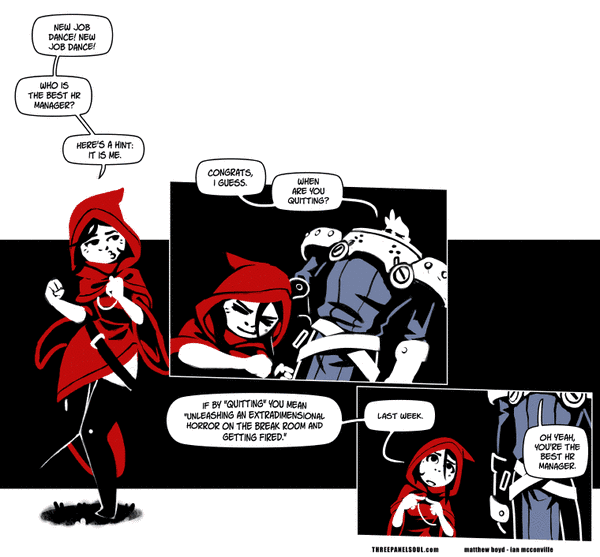
Usually it's the bathroom that gets the extradimensional horrors.

on Good Timing

04 Nov 14:52

How Republicans Killed America's High-Speed Rail Plan

by Eric Jaffe
Tertiarymatt

Fucking over the public just to make sure Obama doesn't "win"? I NEVER

The Obama administration had grand plans for a national high-speed rail network, but they didn't stay grand very long. After the 2010 midterm elections, new Republican governors in Wisconsin, Ohio, and Florida spoiled hopes of such a system by rejecting federal money for routes through their states. At the time, the three governors cited fiscal responsibility as their official reasoning, but the situation always had the feel of political collusion.

A new report in the Tampa Tribune adds some spice to that notion. The paper details an interesting exchange between one of these governors, Rick Scott of Florida, and Paula Dockery, a (now former) political ally who favored the proposed high-speed route from Tampa to Orlando. Dockery tells the paper that Scott promised her in February 2011 that he'd accept $2.4 billion in federal money pledged for the project — in no uncertain terms:

Dockery said she warned Scott he would get intense pressure from fellow Republicans to reject it "because it looks like Obama wins" if the project succeeds.

"There were other Republican governors who were turning down rail money," she said in the interview. "That was kind of the national plan of the Republican governors."

"He said, 'Don't worry about it.' ... His mind already was made up," she added. "There was no misinterpretation."

Apparently his mind wasn't made up, because two weeks later Scott announced that he was declining the money. So what do we learn from this insider's revelation? Well, for one thing, it strongly suggests that the series of high-speed rail refusals had as much (if not more) to do with petty politics as with fiscal prudence. Beyond that, we're left to wonder if Scott himself received direct political pressure to change his position.

Florida's high-speed route was supposed to be the first piece of Obama's national network and the model for other cities and states around the country to follow. The line was far from ideal: it was far too short, at just 84 miles, which meant that it would compete with car travel instead of air travel. At the same time, the project was fully funded, could have been finished by 2015, and always kept the option of one day extending to Miami.

But these weren't the problems that Scott emphasized in his February 16, 2011, letter to then-Transportation Secretary Ray LaHood turning down the funding [PDF]. Instead, Scott focused on concerns that cost overruns would put Florida taxpayers on the hook for billions of dollars. In fact, several companies had already agreed to cover any excess costs, and studies determined that ticket revenue would have covered the train's operating expenses — as is the case for most high-speed rail lines around the world.

Dockery's comments raise a lot of questions about the timeline of Scott's decision. The governor's concerns over a possible cost overrun were reportedly based on a Reason Foundation analysis opposing the project that was released in January 2011. If Scott still believed he would accept the money in early February, as Dockery claims, then one of several things must have occurred before his February 16 announcement:

  1. Scott read the analysis in January and found it unconvincing, then had a massive change of heart toward it shortly after his promise to Dockery.
  2. The report came to Scott's attention after his discussion with Dockery, which means his earlier favorable opinion toward high-speed rail had been formed by other reports or information he later discarded.
  3. Scott actually based his decision on factors unrelated to the report and simply cited it out of convenience.

Florida taxpayers (and the rest of us) have a right to know the true chain of events.

What's most upsetting about the Tribune report — though in a way also a little encouraging — is that it shows the death of Obama's high-speed rail plan was not inevitable. Many Republicans involved in the story clearly favored the idea: from LaHood to Dockery to former Florida Governor Charlie Crist, who initially accepted the federal money for his state. This wasn't a widespread Republican refusal; it was a localized extreme Republican refusal. The distinction is important to recognize.

The coda to all this, as rail blogger Robert Cruickshank points out, is that Scott's decision to halt high-speed rail may soon bring his own time in office to an end. Crist, now a Democrat, has decided to run against Scott in the next election and currently leads polling by 12 points. He will no doubt be portrayed as a flip-flopper, going from one party to another, but now he can portray his opponent as the same.

Top image: Oleksiy Mark /Shutterstock.com


04 Nov 00:30

Final Report Submitted to SwissMedic

Tertiarymatt

MAPS does good work.

On September 17, 2013, the Final Report for our completed Swiss study of LSD-assisted psychotherapy for anxiety associated with advanced stage illness was submitted to Swissmedic. The report contains information about the study protocol, how the study was conducted, and all data in both raw and analyzed formats. This report is required under International Council on Harmonization/Good Clinical Practice (ICH/GCP) as well as FDA regulations. View the report
01 Nov 22:32

Issue 13: Shadows

by Christopher Wright
Tertiarymatt

Stuff is beginning to be revealed!

Story: Christopher Wright
Cover: Pascalle Lepas
Logo: Garth Graham
... Happy Halloween!

01 Nov 22:31

A Rake by Starlight - Chapter 04

by Christopher Wright
WHEREIN A Search For Hidden Treasure Produces Uneven Results

Mac Wallen was a short, stocky man. It wasn’t a build most people associated with zero gravity work, but his heft was deceptive. Mac had been an asteroid miner before embarking on a life of crime, and he and his crew were old hands at working in zero gravity environments.

That was what convinced Captain Vindh to bring them on. It hadn’t been an easy decision, from his perspective: he didn’t know anything about them, Mac and his crew had a history, and ship mutinies were on the rise. Vindh decided to take the risk—after taking great pains to describe what had happened to the other hires who’d tried to mutiny on his boat—and after a few months Mac thought the rest of the crew was starting to warm up to them. Cyrus more than the others, Amys significantly less.

01 Nov 06:05

Planned Parenthood Donation

by Erika Moen
Tertiarymatt

Erika is rad.


Today I donated $1,150 to Planned Parenthood from the funds Lucy Knisley and I raised by selling the original artwork and limited edition prints of our Party With Planned Parenthood illustration. More details about our project can be read here.

We’re not done yet, though!

We haven’t sold out of all the prints yet, so we can still raise more funds for Planned Parenthood.

If we sell another seven prints, we’ll have raised $1,500!

And if we sell out, that number will be raised to $1,650

Party With Planned Parenthood
I will continue to make a lump sum donation at the end of each month until we sell completely out.

Want to see some of the work that went into creating this illustration? Lucy and I have a high-speed video to give you a taste of how this artwork came to be:

Party With Planned Parenthood from Erika Moen on Vimeo.


Thank you so much to everyone who’s bought a print or the original artwork. I’m so excited we can all pitch in to help an invaluable organization and make the world a little more beautiful through the arts– at the same time ;)
31 Oct 21:45

Like honey in the bank

by Rusty
Tertiarymatt

Chanterelles had a really good year this year, apparently.

If you opened the door to my fridge today, thirty-five pounds of chanterelles would avalanche to the floor. They’re in boxes and bags, stashed in every conceivable cranny. I acquired this overwhelming supply of ‘shrooms in exchange for a few squares of comb honey. I’ve also traded honey for concord grapes, line-caught salmon, new potatoes, […]
31 Oct 19:27

Melissodes sleeping in a thistle

by Rusty
Tertiarymatt

Marvelous picture and facts in this post.

You might think sleeping in a flower would be a dream come true, yet for many bees, it is simply a fact of life. But sleeping in a flower only sounds good. In truth, many flower-sleepers wake up covered in dew and stiff from the cold. I found his pair of male long-horned bees by […]
31 Oct 19:19

Whose honey is it?

by Rusty
Tertiarymatt

People think strange things.

A new beekeeper in the Midwest wrote to say that she harvested thirty pounds of honey from each of her two hives, but now her bees were taking syrup like crazy. She wondered how long she should keep feeding and if the bees would have enough stores. Then came the disturbing question: “Why would each […]
31 Oct 01:54

OUT OF SKIN

by Emily Carroll

emcarroll.com/comics/skin/

Happy Halloween!

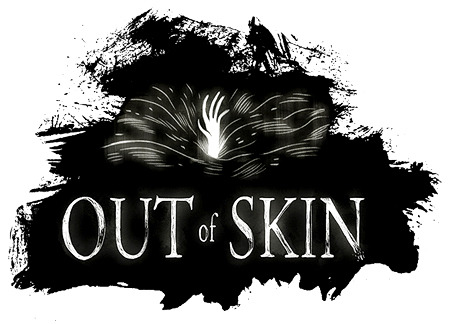
I have a new comic up today! Click the above image to read. This one's horror (in the spirit of the season) and -- just as a note -- contains more body based horror than I've explored in the past. I consider it part of a trilogy in terms of setting & theme with my earlier comics His Face All Red and Margot's Room, though they are all of course stand alone short stories as well.

And for those Tumblr inclined, it's been posted over here.

Thanks for reading!
30 Oct 02:35

Shirt ideas for the store, 2013 - To the last, I grapple with...

Tertiarymatt

WHALEMETAL


Shirt ideas for the store, 2013 - To the last, I grapple with thee.  From hell’s heart, I hug at thee

29 Oct 19:26

New Street Art Targets L.A.'s Vacuous Celebrities

by Jenny Xie

In a series of new interventions, street artist Plastic Jesus is sending a clear message to Los Angeles: Stop making stupid people famous.

The artist has been complaining about "celebrities with little talent and questionable intelligence" for years. He finally took action three months ago, creating a stencil. This month, he began amplifying that message, posting it on stop signs and even roads.

Plastic Jesus is not sure about the true origins of the phrase. The artist is, however, beyond certain that people connect with the message -- which has also been reproduced on t-shirts. "Every time I wear one of my t-shirts I get multiple comments from passersby," he writes in an email.


29 Oct 08:31

benito-cereno: "The Thing on the Fourble Board" from Quiet,...

Tertiarymatt

I need to make time to listen to this. Tomorrow, perhaps.


benito-cereno:

"The Thing on the Fourble Board" from Quiet, Please (1948)

A few months ago, following a certain post I made (to say which one would be a bit of a spoiler), someone brought this delightful piece of history to my attention, and I am very excited to share it with you now.

"The Thing on the Fourble Board" is widely considered the best and scariest piece of radio to have come out of radio’s golden age of horror and mystery programming. If you listen, you will learn why.

A fourble board is a horizontal platform on an oil derrick that is as high off the ground as four lengths of pipe are long (“fourble”=”quadruple”). This is the tale of a worker at the oil derrick and the staff geologist, and what they discover about the things their drilling has (literally) unearthed.

I’m trying my best to find the right balance between not over-hyping this and making it clear that this is the coolest fucking thing you will hear this Halloween.

I know asking you to listen to 25 minutes of old timey radio is asking a lot in this crazy iPad world we live in, but this is exactly the length of an episode of Welcome to Night Vale, so I know you can find time for it. Just imagine the narrator is Cecil and the geologist is Carlos. We can do this, together. Don’t worry: the writing is tight and the pace is fairly brisk. You won’t get bored.

You can download an mp3 of the show here if you want it on your listening devices instead of playing it on YouTube. (please let me know if this link doesn’t work)

Just take a few minutes, maybe while you’re cooking dinner or washing dishes or whatever, and give a listen to one of the most revered pieces of horror radio in history, and if you like it, please share it with someone you think would enjoy it.

29 Oct 04:35

Shirt ideas for the store, 2013 -  Peacocks, the Ryan Gosling of...

Tertiarymatt

I confess I might wear this as a form of sexual signalling.


Shirt ideas for the store, 2013 - 

Peacocks, the Ryan Gosling of birds

29 Oct 04:32

Here are some silly Halloween postcard comics i made.  Just...

Tertiarymatt

dicpics


Here are some silly Halloween postcard comics i made.  Just click through!

29 Oct 02:31

on Baby Futures

by Ian
Tertiarymatt

SPORTSBALL

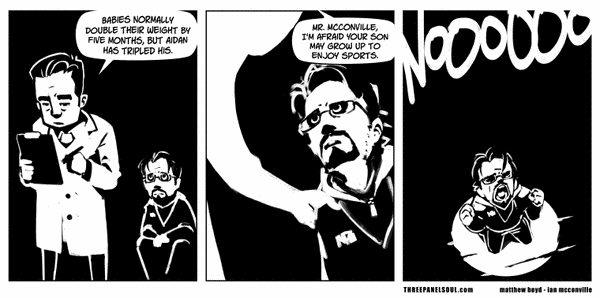
on Baby Futures

28 Oct 22:16

How Local Governments Hinder Our Response to Natural Disasters

by David Wachsmuth
Tertiarymatt

Attn: Snork and Bl00.

The northeast Atlantic seaboard is the most densely urbanized area of the United States. And over generations, a bewildering patchwork of governance has evolved, with thousands of municipalities, hundreds of special-purpose agencies, dozens of cross-state partnerships, and a handful of states all sharing—and fighting over—governmental responsibilities.

The state of New Jersey alone has 565 municipalities representing a population only slightly larger than the single municipality of New York City. This fragmentation can be a real problem in the face of a major disaster like Hurricane Sandy. Storms don't respect jurisdictional boundaries, after all, and they likewise challenge us to coordinate disaster response on a regional scale.

Rethink,Rebuild bug
Resilient design after Hurricane Sandy
See full coverage

Unfortunately, there was little successful inter-jurisdictional coordination in the aftermath of Hurricane Sandy. New York City's Office of Emergency Management was theoretically responsible for coordinating the different city agencies. But it was quickly sidelined by the Mayor's Office. The result was a haphazard approach that led to some notable failures with respect to evacuations and the safety of public housing residents.

On a larger scale, emergency managers from New York, New Jersey, Connecticut, and Pennsylvania created a Regional Catastrophic Planning Team for precisely this kind of emergency. But when the storm hit, the RCPT’s plans stayed on the shelf, particularly in New York City. As one NYC emergency manager described it to me, "The federal government spent millions of dollars on [the regional plan] and…we did not do anything. All the planning and all the dollars that were spent on regional planning [and] not once did we open the book to say, 'Let's do it this way.'"

How can we do better? One place to start is to look at other examples of successful regional collaborations in the U.S. Two in particular stand out: the Great Lakes Compact and the Gulf of Mexico Alliance. These are both successful collaborations between state governments, which are based on common interests in a shared waterway. And both have gotten stronger over time—even, in the latter's case, through the trauma of Hurricane Katrina.

Here are a few lessons we can learn from them:

Collaborations need to be achievable to be useful. The sociologist Lee Clarke argues that disaster plans are "fantasy documents"—tools for building trust in an organization rather than actual, implementable plans. This was certainly true in the response to Sandy. More modest plans, which take account of political realities and power relations, are more likely to be useful than comprehensive but unachievable fantasy documents.

Good regional governance needs strong state buy-in. Many of the most effective regional collaborations in the country work via special-purpose agencies (for example, the Port Authority of New York and New Jersey). Almost invariably, these agencies are creations of state governments. While the federal government has an important role to play by directing funding dollars, regional collaborations ultimately live or die by whether the relevant state governments support them. New York City, with a population and governmental capacity larger than many states, is something of an exception here, and its buy-in is equally vital to regional collaborations. One of the things that doomed the RCPT effort was that, although many city agencies were involved in its creation, City Hall wasn't. As a result, the Mayor's Office didn't put its trust into a plan it didn't know.

Collaborations need strong commonalities of interest. Both the Great Lakes Compact and the Gulf of Mexico Alliance began with a narrow focus on an issue that truly cut across all member states. They avoided topics that would have been controversial, even when these issues were of broad importance to the regions. For example, offshore drilling has major economic and environmental impacts in the Gulf region, but Florida opposes it while Louisiana and Texas strongly support it, so the Gulf of Mexico Alliance has avoided dealing with it directly. Sticking strictly to commonalities of interest has allowed both these organizations to build trust between members, and they have begun to leverage that trust by branching out into more controversial issues.

Disaster response should be guided by geographies of need, not geographies of government. In New York and New Jersey, the most agile, adaptive disaster response generally didn't come from local and state governments, but from grassroots response networks like Occupy Sandy. One important thing that differentiated Occupy Sandy from governments is that it wasn't constrained by jurisdictional boundaries. As such, it could simply devote its resources where need was greatest. If governments are unable to work effectively across jurisdictions, they should partner with informal actors who can.

Top image: Andrew F. Kazmierski /Shutterstock.com


27 Oct 23:09

In a sperm’s journey, physics meets biology and art

by aatish
Tertiarymatt

Batshare. Yes, really.

Sperm keeps on swimmin' swimmin' swimmin'

Sperm keeps on swimmin’ swimmin’ swimmin’. Animation by Brad Purnell

I’ve been working on something really exciting, and it’s finally ready to show you. It’s a video brought out in collaboration with TED-Ed. In it, I explain how the world of a sperm is so fundamentally different from the world of sperm whale. I describe a big idea from fluid mechanics called the Reynolds number, and explain why size matters a  LOT for a swimmer.

It was a blast working with the uber-talented animator Brad Purnell who developed my script into what I think is a brilliant piece of art.

tumblr_mtni773ORX1sjwwzso1_500

What do some microbes have in common with this lazy cow? Watch the video to find out. Animation by Brad Purnell

sperm1

Artwork by Brad Purnell

sperm3

Artwork by Brad Purnell

sperm5

Artwork by Brad Purnell

sperm7

Artwork by Brad Purnell

I won’t give away the punch line, so go check out the full lesson here, which comes with puzzles that test your understanding and links to let you dig deeper. Or you can skip all that good stuff and just watch the video below (watch it in HD to get the full effect of Brad’s wonderful animation).

If you want to dig deeper into the physics of fluids and microscopic swimmers, go to the lesson page, click on the side buttons and explore. Have fun!

For more on Brad’s work, here’s his website. Thanks also to Rose Eveleth for invaluable editorial help, and to the editorial and production team and Logan Smalley at TED-Ed for making this possible.