Shared posts

02 Jun 22:51

Scab Cinema and Pseudo-Reality TV

When critics talk about movies or TV shows, they mostly treat them as self-contained texts to be described, interpreted, and “read.” This way of thinking similarly dominates the way most of the audience thinks about the work. If anyone talks about the production side, it is usually from a managerial perspective: the eccentricities of the director, how many millions production cost in total, what the show-runner is like, big casting decisions, and so on.

As with any consumer products, workers are made invisible here: you don’t often here about key grips, production assistants or electricians. Even in the rare instances where a writer does speak to the labor conditions at work in some piece of visual media, it is usually as an aside, or as a separate valence of critique. Labor conditions don’t exist as an external issue: they’re only significant insofar as they help dictate what appears on the screen. But what appears on the screen, in fact, has a huge impact on many aspects of film and TV labor.

Consider special visual effects. CGI doesn’t only make previously impossible images possible, it also makes certain kinds of images inevitable. The technology actually determines how TV and movies get made, and the kinds of stories that get told. Much of the way modern blockbusters look and feel is based around management figuring out how to screw workers—a reactionary anti-labor bias is literally contained within the aesthetics of blockbuster cinema, in individual shots, and in the imagery itself.

green screen

Green screen creep. / Photo by Sam Greenhalgh

Massive Hollywood spectacle has been the name of the game since D. W. Griffith, and million-dollars-per-minute action set pieces go back to Star Wars. The big climax involving hundreds of swarming aliens or Captain America smashing the engine out of a helicarrier is going to require some CGI. But maybe you’ve noticed a bit of special-effects mission-creep: how often films these days use green-screen and digital motion—not just for climactic 3D battles, but for dialogue scenes, for exposition or romantic side plots. One reason is that even the simplest live-action shots require electricians, best boys, truckers, set builders, location scouts—union workers, every one. CGI does away with an awful lot of that.

Although using CGI often means it takes more people to get the same effect, special-effect workers are not unionized, and most animating labor is now being outsourced overseas. CGI is dirt-cheap when compared to hiring all those pesky unionized workers to achieve a similarly amazing effect.  In general, talk about CGI focuses on how expensive it is, but that’s a bit of a canard; the number of workers and man-hours Hollywood is saving for the money it spends on CGI is through the roof. Furthermore, despite how much money is spent on movie production, it’s a pretty good rule of thumb that, these days, at least half of that production-cost total goes to marketing. So actual production costs are way down, when considered as a percentage of overall film budgets.

Aside from CGI, another, very different way that management-labor struggles have shaped the content of our culture is reflected in the rise of reality television. When reality TV first came to major prominence, in the mid- and late-1990s, critics spilled endless ink bemoaning a dumbing down of American culture represented therein. Such critiques always pointed their barbs, either more or less subtly, at the consuming public, when the barbarism of reality TV really emerged out of television management’s fear of writers’ strikes.

While aspects of reality TV were present as early as 1950, in game shows like What’s My Line or To Tell The Truth, the first reality shows as we would recognize them didn’t air until 1989. And they emerged as a direct result of 1988’s massive writers’ strike, the longest in U.S. history. The Writers Guild of America (WGA) went on strike over residuals and creative rights in March of 1988, and the strike lasted 155 days. TV stations were caught showing reruns and whatever sports content they could drum up, and the strike resulted in drastically lower ratings. Industry-wide, the strike cost $500 million.

Hoping never to get caught in the same situation again, Fox commissioned Cops explicitly in response to the possibility of another strike. Cops is perhaps the first (and now the longest running) reality TV show. The irony of a show about cops developing as a way for management to scab in case of a strike and as the birth of reality TV should be lost on no one.

The next big reality hit, The Real World, was also directly designed to work for cheap by forgoing those horrible expensive creative workers. Designed to glom onto the success of teen dramas like Melrose Place and Beverly Hills: 90210, as Meredith Blake wrote on the show’s twentieth anniversary,

MTV wanted to develop its own scripted soap opera but quickly discovered that paying writers, actors, costume designers, and make-up artists costs lots and lots of money. A much cheaper option, it turned out, was casting a bunch of “regular people” to live in an apartment and taping their day-to-day lives.

Of course, as everyone knows, there is basically nothing unscripted about “unscripted” television, where specific reactions, dramas and romances are coaxed out of “contestants” by producers and writers, and where hours upon hours of raw footage are painstakingly edited into tight narrative units by creative minds. But TV production companies have used reality TV’s status as psuedo-documentary as a legal loophole to avoid employing union workers or paying union rates.

People bemoaning the excessive use of special effects or the stupidity of reality television, then, shouldn’t focus their acrimony at the viewing public, but should rather put their efforts into supporting struggles by cinema and TV workers to stop producers’ abusive practices. For the last two years, visual effects artists have demonstrated outside the Oscars, but film critics rarely cover these protests or the contents of their demands, perhaps considering them outside of their purview. The WGA is now successfully bringing many reality TV shows under writing contracts, in an attempt to improve the legal situation surrounding reality television, one program at a time.

These struggles don’t just affect the lives of the workers; they directly affect what kinds of movies, shows, and images appear on our screens. The political and cultural force of screen images do not emerge whole-cloth from the minds of the directors, writers, and cinematographers who receive credit for them, but are also underwritten by the labor practices that produce them.

It just so happens that two aspects of visual media—CGI and reality TV—that most misrepresent “reality” were both directly influenced by managerial strategies and labor-cost-cutting. And when the owners and managers have more say, through their labor practices, in what gets called “reality,” it’s often reality that suffers.

02 Jun 18:16

code maintenance

by Ian
Tertiarymatt

That is not a nice thing to do.

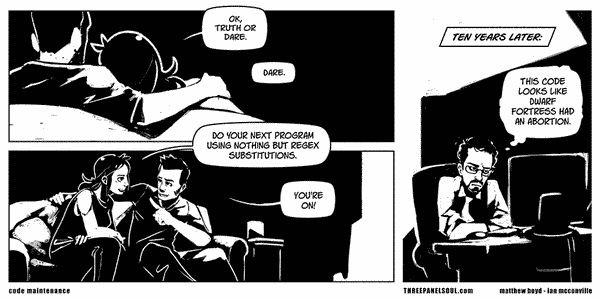
code maintenance

02 Jun 10:25

Free NASA eBook Theorizes How We Will Communicate with Aliens

by Dan Colman
Tertiarymatt

NASA BOOK

Douglas A. Vakoch

During the past few years, NASA has released a series of free ebooks, including NASA Earth As Art and various interactive texts focusing on the Webb and Hubble space telescopes. Last week, they added a new, curious book to the collection, Archaeology, Anthropology, and Interstellar Communication. Edited by Douglas A. Vakoch (the Director of Interstellar Message Composition at the SETI Institute), the text contemplates how we’ll go about “establishing meaningful communication with an extraterrestrial intelligence.” The scholars contributing to the volume “grappl[e] with some of the enormous challenges that will face humanity if an information-rich signal emanating from another world is detected.” And to make sure that we’re “prepared for contact with an extraterrestrial civilization, should that day ever come,” they draw on “issues at the core of contemporary archaeology and anthropology.” Why archaeology and anthropology? Because, says Vackoch, communication with intelligent life probably won’t be through sound, but through images. We will need to read/understand the civilization we encounter based on what we observe. Vakoch says:

[D]on’t think of “sound worlds” or music or speech as the domains, vehicles, or contents of ETI [extra terrestrial intelligence] messages. Regardless of semiotic concerns, the accessibility of acoustic messaging must remain doubtful. Furthermore, there will be intended and unintended aspects of performance, which elaborate the difficulties of using sound. In my view avoidance of the sound world need not be controversial.

On the other hand, vision and the use of images would appear to be at least plausible. Although spectral details cannot be considered universal, the physical arrangement of objects on a habitable planet’s surface will be shaped in part by gravity (the notion of a horizon might well be universal) and thus multispectral images might plausibly be considered worthwhile for messages. More generally, the implications for considering SETI/CETI as some sort of anthropological challenge need teasing out.

The 300-page book, Archaeology, Anthropology, and Interstellar Communication, has been made available in three formats, and added to our own collection, 600 Free eBooks for iPad, Kindle & Other Devices:

› Kindle readers: MOBI [2.8 MB]

› All other eBook readers: EPUB [3.8 MB]

› Fixed layout: PDF [1.7 MB]

Below you can watch Vakoch give a TEDX talk called,”What Would You Say to an Extraterrestrial?”

via Gizmodo/Kim Komand0

Free NASA eBook Theorizes How We Will Communicate with Aliens is a post from: Open Culture. Follow us on Facebook, Twitter, and Google Plus, or get our Daily Email. And don't miss our big collections of Free Online Courses, Free Online Movies, Free eBooksFree Audio Books, Free Foreign Language Lessons, and MOOCs.

The post Free NASA eBook Theorizes How We Will Communicate with Aliens appeared first on Open Culture.

02 Jun 07:51

A Master List of 1000 Free Courses From Top Universities: 30,000 Hours of Audio/Video Lectures

by Dan Colman
Tertiarymatt

Mega MOOCing.

free courses online 1000

We reached a little milestone this week. Our big list of Free Online Courses now features 1,000 courses from top universities. Let’s quickly break things down for you: The list lets you download audio & video lectures from schools like Stanford, Yale, MIT, Oxford and Harvard. Generally, the courses can be accessed via YouTube, iTunes or university web sites, and you can listen to the lectures anytime, anywhere. We didn’t do a precise calculation, but there’s probably about 30,000 hours of free audio & video lectures here. Enough to keep you busy for a long, long time.

Right now you’ll find 113 free philosophy courses, 78 free history courses, 100 free computer science courses, and 54 free physics courses in the collection, and that’s just beginning to scratch the surface. You can peruse sections covering Astronomy, Biology, BusinessChemistry, Economics, Engineering, Literature, Math, Political Science, Psychology and Religion.

Here are some highlights from the complete list of Free Online Courses. We’ve thrown a few unconventional/vintage courses in the mix just to keep things interesting.

The complete list of courses can be accessed here: 1,000 Free Online Courses from Top Universities

Related Content:

550 Free Audio Books: Download Great Books for Free 600 Free eBooks for iPad, Kindle & Other Devices 675 Free Movies Online: Great Classics, Indies, Noir, Westerns, etc. Learn 46 Languages Online for Free: Spanish, Chinese, English & More

A Master List of 1000 Free Courses From Top Universities: 30,000 Hours of Audio/Video Lectures is a post from: Open Culture. Follow us on Facebook, Twitter, and Google Plus, or get our Daily Email. And don't miss our big collections of Free Online Courses, Free Online Movies, Free eBooksFree Audio Books, Free Foreign Language Lessons, and MOOCs.

The post A Master List of 1000 Free Courses From Top Universities: 30,000 Hours of Audio/Video Lectures appeared first on Open Culture.

02 Jun 07:50

Watch William S. Burroughs’ Ah Pook is Here as an Animated Film, with Music By John Cale

by Jonathan Crow
Tertiarymatt

I do love the old bastard's voice.

The work of William S. Burroughs can be by turns hilarious, opaque and profane – filled with images of drugs, insects and other oddities. Though it might be fascinating, if difficult, on the page, his work really comes alive when read aloud, preferably in Burroughs’s signature deadpan drawl. And if it’s accompanied by some trippy visuals, then, all the better.

The above video is exactly that. In 1994, animator Peter Hunt made this appropriately grotesque stop motion animated film, Ah Pook is Here, with audio taken from Burroughs’s 1990 album Dead City Radio. (You can read along to the video below.) John Cale provides the music. The winner of 10 international film awards, the short film has been archived in the Goethe Institut.

Ah Pook is Here started in 1970 as a collaboration with artist Malcolm McNeil. Originally it was slated to be a magazine comic strip but when the publication folded, Burroughs and McNeil decided to turn it into a book. Ah Pook is Here and Other Texts was finally published in 1979, though without McNeil’s illustrations. You can see them here.

When I become Death, Death is the seed from which I grow…

Itzama, spirit of early mist and showers.
Ixtaub, goddess of ropes and snares.
Ixchel, the spider web, catcher of morning dew.
Zooheekock, virgin fire patroness of infants.
Adziz, the master of cold.
Kockupocket, who works in fire.
Ixtahdoom, she who spits out precious stones.
Ixchunchan, the dangerous one.
Ah Pook, the destroyer.

Hiroshima, 1945, August 6, sixteen minutes past 8 AM.

Who really gave that order?

Answer: Control.

Answer: The Ugly American.

Answer: The instrument of Control.

Question: If Control’s control is absolute, why does Control need to control?

Answer: Control… needs time.

Question: Is Control controlled by its need to control?

Answer: Yes.

Why does Control need humans, as you call them?

Answer: Wait… wait! Time, a landing field. Death needs time like a junkie needs junk.

And what does Death need time for?

Answer: The answer is sooo simple. Death needs time for what it kills to grow in, for Ah Pook’s sake.

Death needs time for what it kills to grow in, for Ah Pook’s sweet sake, you stupid vulgar greedy ugly American death-sucker.

Death needs time for what it kills to grow in, for Ah Pook’s sweet sake, you stupid vulgar greedy ugly American death-sucker… Like this.

We have a new type of rule now. Not one man rule, or rule of aristocracy, or plutocracy, but of small groups elevated to positions of absolute power by random pressures and subject to political and economic factors that leave little room for decision. They are representatives of abstract forces who’ve reached power through surrender of self. The iron-willed dictator is a thing of the past. There will be no more Stalins, no more Hitlers. The rulers of this most insecure of all worlds are rulers by accident inept, frightened pilots at the controls of a vast machine they cannot understand, calling in experts to tell them which buttons to push.

You can find Ah Pook is Here in the Animation section of our collection, 675 Free Movies Online: Great Classics, Indies, Noir, Westerns, etc..

Related Content:

The Junky’s Christmas: William S. Burrough’s Claymation Christmas Film

William S. Burroughs on Saturday Night Live, 1981

William S. Burroughs Reads Naked Lunch, His Controversial 1959 Novel

Jonathan Crow is a Los Angeles-based writer and filmmaker whose work has appeared in Yahoo!, The Hollywood Reporter, and other publications. You can follow him at @jonccrow.


Watch William S. Burroughs’ Ah Pook is Here as an Animated Film, with Music By John Cale is a post from: Open Culture. Follow us on Facebook, Twitter, and Google Plus, or get our Daily Email. And don't miss our big collections of Free Online Courses, Free Online Movies, Free eBooksFree Audio Books, Free Foreign Language Lessons, and MOOCs.

The post Watch William S. Burroughs’ Ah Pook is Here as an Animated Film, with Music By John Cale appeared first on Open Culture.

02 Jun 07:40

140 Massive Open Online Courses Getting Started in June: Enroll in a MOOC Today

by Dan Colman
Tertiarymatt

Should you be interested in joining a MOOC.

Have some downtime this summer? Would your time be well spent taking a Massive Open Online Course (MOOC)? Then you’ll want to look through the slew of summer MOOCs getting started this June. We’ve gathered some 140 courses launching this month — courses offered by major universities from the United States, Canada, Europe, the Middle East, and Asia. Visit our comprehensive list of MOOCs here and find a course that speaks to you. Some of the ones that piqued our interest include:

Don’t miss anything from Open Culture in 2014. Sign up for our Daily Email or RSS Feed. And we’ll send cultural curiosities your way, every day.

140 Massive Open Online Courses Getting Started in June: Enroll in a MOOC Today is a post from: Open Culture. Follow us on Facebook, Twitter, and Google Plus, or get our Daily Email. And don't miss our big collections of Free Online Courses, Free Online Movies, Free eBooksFree Audio Books, Free Foreign Language Lessons, and MOOCs.

The post 140 Massive Open Online Courses Getting Started in June: Enroll in a MOOC Today appeared first on Open Culture.

02 Jun 07:38

SCI CODE’s Coma Niddy (Mike Wilson) explains why you...

by rion
Tertiarymatt

I wash pants way less frequently than most people, but I seem to inevitably get food on them.


SCI CODE’s Coma Niddy (Mike Wilson) explains why you don’t need to wash your jeans.

Related watching in the archives: Planet Money Makes a T-Shirt and How Your T-Shirt Can Make a Difference.

02 Jun 07:07

Straight or Crooked…

by Tom Mahon

clinton235.jpg
(Mr Clinton in a very “straight” coat- lots of shirt visible.)

jstewart567.jpg (Mr Stewart wearing a “crooked” coat- not a lot of shirt visible.)

Two rather strange tailoring terms are “straight” and “crooked” to describe a coat. I’ll try to clarify.

Obviously there are lots of details that give a suit a certain style that distinguishes it from others. This can be the cut of the silhouette, slim or relaxed. the construction of the coat, hard or soft etc. These are pretty obvious to even the untrained eye. How straight or crooked a coat is just as important and certainly makes a huge difference to how a jacket feels and looks. But is much more difficult to discern.

It’s a difficult detail to quantify and explain, so much so that I know of many trainee cutters who have struggled unsuccessfully in the past to get their head round the subject.

With the help of my drawings (please excuse the quality) I will try to show you what I’m on about. It’s all to do with the neck point position in relation to the front edge of the coat.

pattern567.jpg

Basically the fit of a straight coat has less material forward of the neck point on the front edge. This gives the jacket a slimmer feel, showing more shirt, especially on a double breasted. Also another characteristic is that the collar although fitted well, sits lower around the neck. This again shows more of the shirt and gives a slimmer feel to the wearer. This cut gives the feeling of a more youthful cut simply because as we age we invariably gain a little in the front. We then obviously require more material to compensate, or less when we are slim.

A crooked coat has basically the opposite characteristics. The coat should always fit neatly around the collar, however it will generally sit higher, showing less of the shirt collar stand. Also even if the coat is slim through the side seams it will still be easy in the front. There will be less shirt showing, again especially on double breasted.

You can see classic examples of this in the photo of Jimmy Stewart above. The double breasted suits close very high, with only a few inches of shirt and tie showing.

There is nothing wrong with either of these styles. the only problem is when you have extremes. Especially if the coat is finished. A coat that’s too straight will always look tight and skimpy. Even if you let out the side seams, all that will happen is that the coat will have shapeless silhouette and still be tight at the front. It can not be easily altered as the front edges are finished. And the too crooked coat suffers from the opposite. No matter how you take in
the side seams, even too the point of being tight, it’ll still feel frumpy and big on the front. Again, if it’s finished, you’re stuck. You can’t trim the front edges because the buttonholes are in. Not very nice scenarios at all.

There are ways round this which has can be improve or cure the problem, but its way too complicated to explain. The reason why I’ve brought this matter up, is that it is another factor that makes a coat feel just right, or can make two coats that have the same measurements feel totally different.

To sum it up- a straight coat is a more youthful cut, and a crooked coat more mature.

So now, when you’re having a fitting, instead of telling your tailor, “This sleeves are a little short,” or “The shoulders are a little wide”, you can hit him with “This coat is a little crooked” or “This coat is a little straight”. He might have heart failure.

Just please don’t tell the tailor I told you all this, or I’ll never be invited for a drink on the Row ever again.

Written by Mr. Mahon – (May 2005)

02 Jun 06:55

Jump

Tertiarymatt

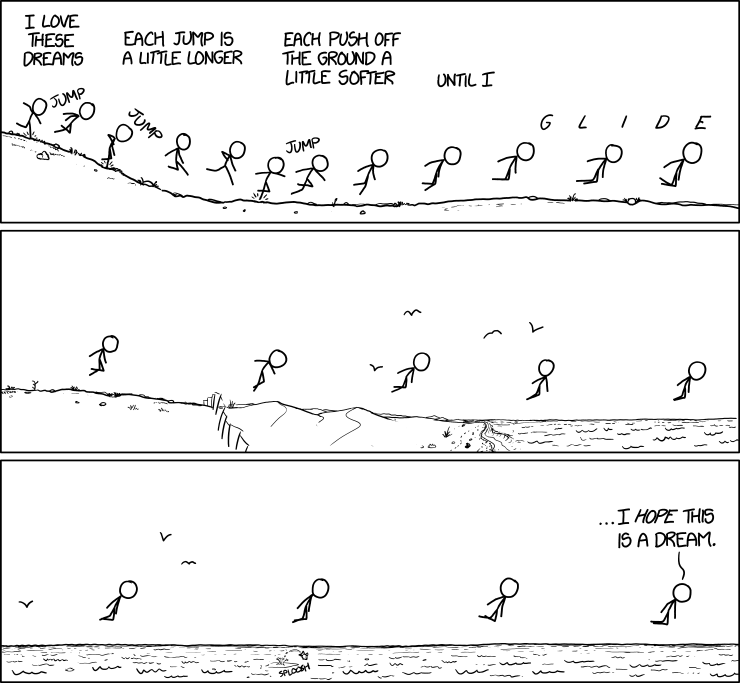
I have these dreams really frequently. The main thing about them is that other than the flying/gliding, they are always really banal, realistic, and usually take place in areas I know really well. And thus they leave me with the nagging feeling that this should really be happening in my day-to-day life.

Or that I'm at least following the curve of the Earth around to land ...
02 Jun 03:18

Joe Costello: Why the Oil Industry is Running Into Major Trouble

by Yves Smith
Tertiarymatt

This is a really good piece, aside from it being in desperate need of editing.

Here's to new nukes and electric goddamn everything!

By Joe Costello, the author of Of, By, For: The New Politics of Money, Debt and Democracy. Cross posted from Alternet

Over the last year, some deep truths about oil and the oil industry have begun to bubble to the surface. Not necessarily that they were ever hard to see, but they were easy to obscure and maybe more importantly, without too much effort, ignore. No longer. Spread across the oil companies’ quarterly reports and the pronouncements of government agencies from the U.S. Energy Information Agency to the International Energy Agency are the hard facts that the era of cheap oil is over. It’s impacting the U.S. and global economies and forcing a fundamental rethinking and restructuring of our economic activities and thinking.

Four decades ago, it was abruptly brought to the world’s attention oil was a limited resource. This was of greatest concern for the United States, who at that point had built an economic infrastructure completely oil dependent. With only 5% of the global population, the U.S. consumed over 25% of the world’s oil, a model neither sustainable or exportable to the vast majority of earth’s population.

Nonetheless, little was done to change these circumstances and most amazingly U.S. oil based development was adopted by other parts of the world, most notably China, whose oil consumption in the last three decades has quintupled, becoming the second biggest oil consumer in the world. Simultaneously, the greatest action taken by the U.S. was spending trillions of dollars “securing” much of the remaining conventional oil sources around the Persian Gulf, doing little to nothing to cut demand.

However, during this time, there’s been significant change in the industry itself. For most of oil’s history, the global industry was run by a handful of private companies in the U.S. and Europe. Today, the five biggest – Total, BP, Exxon, Chevron, and Shell – account for only 13% of global oil, while national companies including Saudi Aramco, Russia’s Rosneft, and China National Petroleum Company control over 75%.

This led to a tightening of supply available to the private companies, while just as importantly, an increasing number of former big oil exporting countries, such as Indonesia, Mexico, Venezuela and Norway produce an ever decreasing amount of oil. In the first seven years of the century, the price of oil went up from $10 a barrel to over a $100 dollars a barrel. In 2008, the difference between global oil supply available and growing global demand shrunk to the smallest amount in oil’s brief history, helping spike price to $150 a barrel and pushing the world into the worst economic recession in seventy-five years.

With the global recession, supply constraints gained a short reprieve as demand slackened, going down over 12% in the U.S. and over 20% in parts of Europe. Yet, after a brief dip, oil prices remained stubbornly high. For the past two years, even though the global economy remains lackluster, oil remains at $100 barrel. In the past year, the tightening supply and growing cost of any new oil began showing-up in the quarterly reports of the oil companies, who despite having plus a $100 barrel prices, revealed increasingly small profit margins, growing expenditures for all new oil and declining production. In the second quarter of 2013, the oil companies balance sheets became increasingly alarming led by Exxon’s 57% profit decline and eight consecutive quarters of production declines.

This disruption continues with the oil companies 2014 first quarter reports. All five top oil companies announced declining production numbers despite increased expenditures. At an oil conference last month, the Houston Chronicle reported Chevron CEO John Watson stated, “That new reality for our industry is that costs have caught up to revenues for many classes of projects. Essentially, for a company like mine and many others, $100 a barrel is becoming the new $20 in our business.”

This is an extremely important development, especially for an industry which for over a century printed money. The oil industry is now becoming ever more capital intensive, not a printer of a money, but a growing capital black hole. Yet incredibly, as shareholders begin to grumble, the old majors begin to cut their expenditures and divest of future reserves to maintain non-sustainable dividend levels. The Los Angeles Times reports, “Exxon’s capital and exploration expenditures fell 28 percent in the first quarter(2014), which helped deliver higher profits even though oil and gas production fell 5.6 percent.”

Obviously, not a long term strategy, but what is the oil industry’s long term strategy? Well for the last few years, we’ve heard a lot about the great “shale revolution,” even President Obama hailed it in his 2012 State of the Union speech. Yet, as oil analyst Chris Nedler stated, “Shale’s not a revolution it’s a retirement party.”

Shale is both expensive and not nearly as plentiful as been propagated. The great shale revolution is greatly distorted by mountains of Wall Street generated debt, it might most accurately be described as “subprime” energy. Take for example the greatest shale company, Chesapeake, loaded with debt that’s created unprofitable and unsustainable prices. They’ve found it hard to make much profit in the last couple years – for an oil and gas company, that truly is a revolution.

In order to survive with over 13 billion dollars in debt, over the last couple years, Chesapeake shed billions of dollars in assets. Just last week, the prestigious oil industry publication, “The Oil and Gas Journal” announced Chesapeake’s latest divestiture, a rather unintentionally amusing and revealing report on the business and “accounting” of shale:

Chesapeake Energy Corp., Oklahoma City, has decided to proceed with spinning off its oil field services business, currently conducted through its wholly owned subsidiary Chesapeake Oilfield Operating LLC (COO), almost 3 months after reporting that a spinoff or outright sale of the business was under consideration. COO will also convert into a corporation and change its name to Seventy Seven Energy Inc.

Upon completion of the spinoff and an expected recapitalization, $1.1 billion of consolidated COO debt will be eliminated from Chesapeake’s balance sheet and Chesapeake will receive a $400 million dividend that will be applied to pay off intercompany debt from the oil field services business, the company said.

But, it’s not just the industry leader having trouble profiting from shale, so to the massive oil service company BHP Billiton, who in 2012 wrote down almost $3 billion in shale assets and the old oil companies such as Shell, which this year wrote down $3 billion of their own shale plays. Bloomberg announced recently that “shale debt has almost doubled over the last four years while revenue has gained just 5.6 percent.” The entire shale industry has $162 billion in debt and a massive “shakeout” is inevitable.

Importantly, it’s not only no one can make money on shale, but there’s not nearly as much of it as Wall Street proclaimed. Recently, the Energy Information Agency stated the Monterrey Shale in California, which was being promoted to account for two-thirds of developable shale oil in the US, only contained 4% of previous estimates, a 96% drop! Thus, there’s only one-third as much shale oil as been touted in the financial press, that too is a highly suspect number.

Globally, the production of conventional oil – “black gold, Texas Tea” – plateaued ten years ago at around 75 million barrels per day. Meanwhile “unconventional” oil and oil substitutes such as Natural Gas Liquids, have seen the biggest growth in oil accounting. However, they are neither cheap or simple substitutes for crude.

Four decades after learning oil was a limited resource, the world, and especially its most oil dependent member the United States, now face a hard accounting. The present hundred dollar a barrel oil has created a serious drag on a global economy that for a hundred years has grown on cheap oil, while oil has kept its price, despite five years of a largely stagnant or deflating global economy.

All new oil is going to be less plentiful and more expensive. It is going to take increasing amounts of money both to find and bring to the surface. The once mighty oil companies, that strode across the global landscape like giants, are going to increasingly shrink in stature and power.

We need to undertake an all encompassing energy transition which will impact every aspect of our economy and our lives. We can look at what the energy component, particularly that which comes from oil, is of everything, from transportation, to food, to money itself, figuring out how it will be replaced with other sources of energy, accomplished by using less energy, or abandoned.

Ready or not, the great energy transition has arrived. It can no longer be ignored, a new world is in the offing.

02 Jun 01:24

Now THIS Is a Synapse

by Virginia Hughes

Every time I read about the synapse, the all-important junction between two neurons, the cartoon above pops into my head. It shows the gist of how a synapse works: An electrical pulse enters the cell on the left and activates those little blue balls, called vesicles, to release their chemical contents, called neurotransmitters. The neurotransmitters spill out into the space between the cells, called the cleft, and activate those blue rectangles, called ion channels. The channels trigger the cell on the right to fire its own electrical pulse, or action potential, and this message travels on to the next cell. It’s pretty neat. Our brains are full of trillions of synapses, each with the capability of converting an electrical signal into a chemical one and back again.

My doodle is conceptually useful for understanding many neuroscience studies. It helped me visualize, for example, how researchers record the messages of brain cells, and how the synapse plays a role in developmental disorders, and how the firing patterns of all of these synapses provide our brains with a sophisticated coding scheme.

The downside of the cartoon synapse is that it gives a false impression. It makes it seem as if the synapse is simple and all figured out, when actually it’s mostly baffling. I was reminded of its complexity by a study published in today’s issue of Science. Researchers in Germany used an array of techniques — including Western blot, mass spectrometry, electron microscopy, and super-resolution fluorescence microscopy — to create a three-dimensional model of a typical synapse in the adult rat brain. You’ll see in the video below that their new model doesn’t look much like my drawing:

To get the most out of the video, click on the white arrows in the lower right hand corner, which will expand it to full screen. The video shows the synaptic bouton, which is the left part of my cartoon. The glowing red “active zone” at the bottom is where the neurotransmitters get dumped into the cleft. Toward the end of the video you can see a close-up of a vesicle releasing its contents and then being recycled by the cell.

The model shows some 300,000 individual proteins, and remember — they’re all hanging out at a single synapse! The image below shows a cross-section of the bouton; each color corresponds to a different kind of protein. The active zone is again the glowing red part at the bottom.

(Click to enlarge)

More often than not, neuroscientists (and therefore, science writers covering neuroscience) tend to focus on a single protein at a time. For instance, I’ve written about that green guy, parvalbumin, because in certain neurons the protein seems to trigger high-frequency brain waves that have been linked to cognition. And that red SNAP-25 has been linked to ADHD, and the yellow VDAC has been proposed as a good target for chemotherapy drugs.

The only way to untangle this complex picture is to focus on its individual components, figuring out one piece at a time. But the next time you read about one of those pieces, recall how it fits into the whole, and be wowed.

02 Jun 01:00

Citizen Science for Lovers of Birds and Bees

by Lily Bui (Editor)
Tertiarymatt

birb & beez

Let us tell ‘ya about the birds and the bees — for citizen science, that is! Here are just a few buzz-worthy projects to get you started.

Also, don’t forget to stop by DISCOVER Magazine and SciStarter’s online Citizen Science Salon; look for our new collaboration in the pages of Discover starting this month; or listen to beautifully produced citizen science stories from our partners at WHYY radio!


unnamed

The Great Sunflower Project

Help researchers create a national bee population map to study the decline of bees. Simply plant sunflowers and watch for bee visits a few times a month. Get started!


Celebrate Urban Birds

Help ornithologists learn about 16 key species of urban birds by tracking up to 16 species of birds for just 10 mins in a small area near you. Get started! (Photo: Louise Docker)


Bee Hunt

Use digital photography to help provide a better understanding of pollinators’ importance in growing food and maintaining healthy natural ecosystems. Get started!


North American Bird Phenology Program

Millions of bird migration records have been scanned. Care to illuminate almost a century of migration patterns and population status of birds? Transcribe records so they can be included in an open database for analysis. Get started!


ZomBeeWatch
The Zombie Fly has been found parasitizing honey bees in California, Oregon, South Dakota, Vermont and Washington. Where else in North America are bees infected by Zombie Flies? Help solve the mystery by collecting honey bees and reporting easy-to-spot signs of infection. You’ll know it when you see it! Get started!


On Sunday, 5/18 at 9:26 am ET, the Space X Dragon Cargo will be released from the International Space Station to return to Earth. The Cargo will splash down into the Pacific Ocean returning our very own citizen science research project, Project MERCCURI, to Earth! You can watch this all take place, LIVE, on NASA TV: May 18, Sunday 9 a.m.

Learn more about Project MERCCURI at SpaceMicrobes.org.

Want your project featured in our newsletter? Contact jenna@scistarter.com

The post Citizen Science for Lovers of Birds and Bees appeared first on CitizenSci.

02 Jun 00:59

Coop’s Citizen Sci Scoop: Weekly Roundup

by Caren Cooper

weekly roundup 4

A peek at publications from this week that relied on citizen science covered topics of birds and bears.

1. Ikin K, Barton PS, Stirnemann IA, Stein JR, Michael D, et al. (2014) Multi-Scale Associations between Vegetation Cover and Woodland Bird Communities across a Large Agricultural Region. PLoS ONE 9(5): e97029. doi:10.1371/journal.pone.0097029

2. Wilton CM, JL Belant, and J Beringer. 2014. Distribution of American black bear occurrences and human-bear incidents in Missouri. Ursus 25:53-60.

3. Rolland J, F Jiguet, KA Jonsson, FL Condamine, H Morlon. 2014. Settling down of seasonal migrants promotes bird diversification. Proc R Soc B 281.

The authors Ikin and colleagues relied on bird watchers of the Canberra Ornithologists Group and found that birds benefited from mistletoe in woodland patches. The bird community, particularly birds of conservation concern, also benefited from more woody plants in the areas surrounding the patches where they lived.

The authors Wilton, Belant and Beringer relied on data from the Report A Bear Sighting program run by the Missouri Department of Conservation. The public contributed more than 1,000 bear sightings. These reports were challenging to analyze because they were anecdotal and further complicated because public effort over time vary with the amount of media attention the project received. Nevertheless, the authors use the data to make a case that black bears are re-colonizing forests across all of Missouri.

In the paper by Rolland and colleagues, they used the distribution range maps for over 9,000 species that BirdLife International had created from numerous data sources, including citizen science data. Over 80% of bird species are sedentary, which appears to be the ancestral state. The authors found that migratory behavior evolved multiple times during the evolutionary speciation of birds.

Thanks to citizen science, discoveries related to bird habitat, bird evolution, and black bear distribution were possible.

Remember: This is just a sample of citizen science contributions published in journals this week. Help me fill in the blanks by sending links of more papers reporting the results of research that relied on citizen science. Send to me via twitter @CoopSciScoop, to caren@scistarter.com, or put in the comments below.


Photo credit:  Luca Galluzi (bear), JJ Harrison (Gang Gang Cockatoo)


The post Coop’s Citizen Sci Scoop: Weekly Roundup appeared first on CitizenSci.

02 Jun 00:23

Reproducibility, Correctness, and Buildability: the Three Principles for Ethical Public Dissemination of Computer Science and Engineering Research

Tertiarymatt

Aimed at CompSci, but applicable elsewhere.

Use the link to access the full text article.  The abstract reads as follows: "We propose a system of three principles of public
dissemination, which we call reproducibility, correctness, and buildability, and make the argument that consideration of these principles is a necessary step when publicly disseminating results in any evidence-based scientific or engineering endeavor. We examine how these principles apply to the release and disclosure of the four elements associated with computer science research: theory, algorithms, code, and data. Reproducibility refers to the capability to reproduce fundamental results from released details. Correctness refers to the ability of an independent reviewer to verify and validate the results of a paper. We introduce the new term buildability to indicate the ability of other researchers to use the published research as a foundation for their own new work. This is more broad than extensibility, as it requires that
the published results have reached a level of completeness that the research can be used for its stated purpose, and has progressed beyond the level of a preliminary idea. We argue that these three principles are not being sufficiently met by current publications  and proposals in computer science and engineering, and represent a goal for which publishing should continue to aim. We introduce standards for the evaluation of reproducibility, correctness, and buildability in relation to the varied elements of computer science research and discuss how they apply to proposals, workshops, conferences, and journal publications, making arguments for appropriate standards of each principle in these settings. We address modern issues including big data, data confidentiality, privacy, security, and privilege. Our examination raises questions
for discussion in the community on the appropriateness of publishing works that fail to meet one, some, or all of the stated
principles."
02 Jun 00:17

Coop’s Citizen Sci Scoop: Shake it up with the fast pace of citizen science

by Caren Cooper

For the past few weeks, I’ve been highlighting scientific findings made possible by citizen science that appeared in the literature each week. Methods of public engagement in sharing observations are not only useful to science, but also in a wide range of areas that need reliable information, such as urban planning, public health, environmental justice, and disaster relief. Consequently, the practice of citizen science is itself an area of innovation and active inquiry.

Roundup:

As I’ve pointed out before, the inquiry often includes comparisons of experts and amateurs. This weeks was no exception with the following two examples:

(1)  Mining urban deprivation from foursquare: implicit crowdsourcing of city land use. by Quercia and Saez.

Even when people share information for non-scientific reason, that shared information can be useful for investigations. In this example, the authors created maps of land-uses based on data from the social-media users of Foursquare in London. These maps were comparable to proprietary commercial maps. Plus, the maps revealed that well-off neighborhoods were more likely to have amenities that promote health and wellbeing, such as dance studios, hobby shops, pools, tea rooms, movie theaters, and kid stores. The poor areas were more likely to have health threats, such as factories, light rail, airports, strip clubs, and whisky bars. (This paper  was part of a special feature on citizen science in the IEEE journal Pervasive Computing. Other articles from the special feature are summarized in the footnote at the end of this post).

(2) Conducting disaster assessment with Spatial video, experts, and citizens. by Lue et al in Applied Geography 52:46-54.

In this case, Lue et al. compared the effectiveness of laypeople at CrisisMappers and experts at the American Red Cross using video to carrying out damage assessment after a natural disaster. Assessments from experienced and inexperienced people were similar, though assessing damage from video turned out to be a difficult task, irrespective of on-the-ground experience.

The potential for engaging crowds in solving problems related to disasters is widely recognized but there are many obstacles to overcome since the inquiry inherently needs to be quick. Individuals can be quick, but rarely can large crowds be coordinated to accomplish anything quickly. Let’s look at examples where citizen science happens quickly after earthquakes.

Disaster_images

Earthquake studies and responses

There are an estimated 500,000 earthquakes annually. About 100,000 release enough energy close to the surface (that is, high magnitude) that the seismic waves produce shaking that people can feel (that is, high intensity). But we cannot anticipate when they will occur.

One great example to illustrate speedy citizen science is a project called Did You Feel It? In 1997 the USGS moved their post-earthquake survey from the mail to online. At first it was called Community Internet Intensity Maps, and more recently adopted the name Did You Feel It?  With the (more than) 2,790,000 responses so far, Did You Feel It? uses an algorithm to quantify earthquake intensity by processing data on where, what was observed and what was experienced by people. Post-quake, people report remarkably similar experiences which leads to quick consensus on intensity, calculated to one decimal point, and detection of quakes even under 2.0 magnitude.

Some projects recruit people to host earthquake sensors. With these fairly effortless contributions, automated systems using low-cost micro-electronic accelerometers provide essential data to scientists. Participatory sensor networks include the Quake-Catcher Network, the Community Seismic Network, SeisMac, and iShake Cal (under development, this project uses iPhones because they already contain motions sensors).

Other projects involve incidental contributions, such as through the Twitter Earthquake Dispatch (@USGSted) algorithm developed by a team at the National Earthquake Information Center. There are 500 million people using Twitter. Cumulatively, these users publically document events. People use twitter to learn about events before those events appear in the news. Since people re-tweet, when a earthquake is mentioned, the word “earthquake” is likely to be amplified quickly – which is an easy signal to detect automatically. The TED algorithm (which looks for increases in use of the word “earthquake” in several languages) can detect a quake within 2 minutes, though it tends to miss small ones.

Using citizen science to advance our understanding of earthquakes is only half of the story. Citizen science can aid response and rescue efforts, even from a distance. Through The Global Earth Observation Catastrophe Assessment Network (GEO-CAN), people can use the Virtual Disaster Viewer (VDV) to view satellite imagery of an area before and after quake, mark differences, add notations of damage grades, and share the information with emergency responders. The Internet and smart phones have been leveraged for citizen science in ways that support the work of first responders to disasters, such as earthquakes in Wenchuan, China in 2008, Haiti in 2010, and Christchurch, NZ in 2011. Non-governmental efforts use citizen science too. The Humanitarian Open Street Map is an online platform for data sharing for humanitarian responses.

Most citizen science does not hinge on speedy reporting. For example, about 15 percent of all bird observations in Project FeederWatch this past winter arrived on paper sheets marked with number 2 pencils, delivered to the Lab of Ornithology by the USPS. It is convenient that people can enter their bird observations online, but it is far from crucial, and even by mail the projects are likely faster than global collaborations in the early, quill-pen-wielding days of citizen science. Earthquakes carry urgency. At such times, information needs to be centralized rapidly. And as the old drug-testing joke goes, the one drug that won’t be found among postal workers is speed. Most extend that joke to other government agencies, all of which can get mired in bureaucracy. Then how is it that, for example, the USGS has been able to carry out speedy citizen science with Did You Feel It?

Citizen Seismology

Last fall, the USGS and the Woodrow Wilson Center released a report on the tools of citizen seismology. The report is intended to provide lessons for other government entities wanting to develop citizen-science projects.

The trick to crafting projects with fast response times is to get all ducks in a row in anticipation of the inevitable events – there are 350 tiny quakes daily for study and invariably the big disasters that require emergency aid. Any entanglement in red tape must be prevented by moving through the obstacle course beforehand. It means navigating practical, legal, technical, policy, and ethical considerations of the whole system well ahead of time. Risk management associated with disasters is serious work: recall that in wake of deaths from after-shocks of the earthquake in L’Aquila in 2009, Italian courts convicted six scientists for manslaughter, sentencing them to 6 years in prison and $10.2 million in fines. Speedy citizen science means creating a mutually clear environment conducive to government-citizen collaborations.

The report covers two frequent stumbling blocks: the Privacy Act and the Paperwork Reduction Act. Most seismologists don’t have training in working with human subjects or experience with policies on how government entities can interact with citizens. The laws can be particularly cumbersome because they were not enacted with citizen science in mind.

The Federal Privacy Act of 1974 covers policies and procedures for how the government must handle personally identifiable information (name, social security number, finger prints, voice, photographs, and more).  Until an agency begins assembling public data submissions, typically from computers with unique IP addresses, they may not have fully explored the scope of this Act.

The intentions of the Paperwork Reduction Act of 1980 are to reduce the burden of paperwork that the government imposes on citizens. Ironically, the Act puts an overburden of paperwork on agency staff and requests to gain approval for public data collection must be submitted to the Office of Management and Budget. The approval process lasts a minimum of 90 days, which includes 60-day and 30-day public comment periods. In 2009, a Presidential Directive about Open Government resulted in inclusion of social media in the mandates of this Act.

Taken together, the tools of citizen seismology provide rapid detection, information for emergency response, and information dissemination. We need agencies to get prepared. When crises arises, we need government systems in place to quickly draw on crowds to collectively build global maps of rapidly changing conditions, and assist in emergency response.

Yes, despite red tape, agencies can provide tools for crowds to work fast. Do you feel the ground shake? The citizen science possibilities register at 9 on my Richter scale.

Photo credit:  Haiti earthquake damage in UN Photo/Logan Abassi, UN Development Programme, & screen capture of Virtual Disaster Viewer.

Footnote:

More Roundup: other articles in the special feature in Pervasive Computing included:

(1) Stevens et al. Taking participatory citizen science to extremes.

These authors help marginalized communities have a voice by supporting the communities to share their indigenous knowledge. They illustrate ways to structure citizen science to stimulate inclusion, and thereby empower communities. Visit the Extreme Citizen Science group at University College London to learn more.

(2) Bahanamonde et al. Mining private information from public data: the Transantigao case.

They use publicly available information on the smartcards cards that passengers use for daily travel on the public transportation system in Transantiago, Chile. Even though the data were anonymized, the researchers demonstrated how they can hone in on where people live and thus revealed and explored the privacy implications.

(3) Angus et al. Public goods: using pervasive computing to inspire grassroots activism.

The author illustrate how artists and engineers can work together. The artists bring the cultural interventions and the engineers bring the technical solutions. Together they offer creative, low-cost tech air pollution devices to create experiences around local concerns that mobilize communities.


The post Coop’s Citizen Sci Scoop: Shake it up with the fast pace of citizen science appeared first on CitizenSci.

01 Jun 23:16

Links 6/1/14

by Yves Smith
Tertiarymatt

I had no idea Venezuela was having drought problems. Among many other things I learned from the link list today.

The woman who lived in sin with a dolphin Telegraph

More Pet Brands Target Owners Who Like to Cook Their Own Dog Food Wall Street Journal

Cynical? You may be hurting your brain health ScienceDaily (Chuck L). This looks like junk to me. How do you define “high levels of cynicism” v. garden varieties of cynicism? Plus in this case, the cynicism may actually be a proxy for other issues that lead to poor outcomes, namely, weak social bonds or financial insecurity (aka stress).

The Enduring Promise of a Thinner You New York Times

Buried Carbon Causes Deep Concern Truthdig (Chuck L)

Nuclear-waste facility on high alert over risk of new explosions Nature

It’s simple. If we can’t change our economic system, our number’s up Guardian (Lawrence)

After the Sun (Microsystems) Sets, the Real Stories Come Out IEEE Spectrum (Chuck L)

Microsoft shows off real-time universal speech translator for Skype, coming in 2014 ExtremeTech (furzy mouse)

Turn Gmail Into an RSS Reader With IFTTT Gizmodo

Animated Map Visualizes NYC’s Raging Workaholism Fast Company

Come Saturday Morning: The Worst Places to Work, Worldwide Phoenix Woman, Firedoglake

China denounces Japan and US over ‘provocative’ speeches BBC

Southeast Asia’s Regression From Democracy and Its Implications Council on Foreign Relations (furzy mouse). Free download

Want to unwind Thailand’s coup? Look to palace politics Christian Science Monitor

Sex, Drugs and Accounting in Europe Bloomberg

Climate change to boost summer flash floods, says study BBC

RBS could fail due to ‘£100bn black hole’ – with British taxpayers in line to lose their entire £45bn stake Independent. FYI, the book is by Ian Fraser, a sometimes contributor to NC.

Bank of England governor: capitalism doomed if ethics vanish Guardian. A bit late to be worrying about that. However, as Harry Shearer points out: “Can you imagine a head of the Fed talking like this?”

Caracas Goes Thirsty as Taps Run Dry and Bottles Vanish Bloomberg

Venezuela: A plan for coup d’état and assassination of Maduro failed evolution

Ukraine

Ukraine Fights Separatists in East, Approaches Russian Gas Deal Bloomberg

Russian ForEx Reserves and Balance of Payments Vulnerabilities Menzie Chinn, Econbrowser

Encyclopedia of Ukrainian oligarchs Eurozine (Richard Smith)

Alexander Lebedev and Vladislav Inozemtsev: Western financiers welcomed dirty money but now it must be stopped Independent (Richard Smith)

Big Brother is Watching You Watch

What a Drone Can See YouTube (Lawrence)

New federal database will track Americans’ credit ratings, other financial information Washington Examiner (Chuck L)

Frontline, in case you missed it: How the NSA Can Get Onto Your Computer, How the NSA Can Get Onto Your iPhone, How the NSA’s Secret Elite Hacking Unit Works

Another viewing item if you didn’t see it last week: Edward Snowden Exclusive Interview with NBC Brian Williams YouTube

5 Reasons The Deficit Has Fallen By Nearly $5 Trillion (And Why That’s A Bad Thing) National Memo

New Law ‘Facilitates Privatization’ of US Water Systems Mint Press (furzy mouse)

Police didn’t search database showing Calif. shooter had bought guns Washington Post (furzy mouse)

Daily Meme: Hit Me With Your Best Shot American Prospect. Revealing Dean Baquet remarks.

George Clooney ‘planning to launch career in politics after marriage to British lawyer’ Daily Mail

The New Paradigm for Banks Mohamed A. El-Erian

Fed Officials Downplay Financial Stability Concerns WSJ Economics

Reconciling Hayek’s and Keynes’ views of recessions VoxEU

FT v. Piketty

Everything You Need to Know About Thomas Piketty vs. The Financial Times New York Times

You shouldn’t use a spreadsheet for important work (I mean it) Daniel Lemire. Ahem, some of the problems are not due to spreadsheets in general but Excel in particular. I can’t stand to use Excel because it is a terrible tool. I relied on Improv because even in the early 1990s you could build multi-dimensional models (oh, and easily rotate them), plus it documented formulas using the labels you input (as in your column/row names) making them easy to check. It also has all sorts of complicated financial and mathematical formulas built in as function choices, so you don’t have to generate them. IBM refused to sell Improv after it acquired it, despite many offers, so some developers built an imitation, Quantrix, and then improved on it. Unfortunately, it cost over $1500 , so if a reader connected with the company is feeling generous, I’d love a copy.

Class Warfare

Not Walking the Walk on Board Diversity Gretchen Morgenson, New York Times

Tech Titans on Income Inequality and Their “Stingy, Stingy” Industry re/code

Fast Food Workers’ Movement: Union 2.0? Real News Network

eBay Shrugged: Pierre Omidyar believes there should be no philanthropy without profit Mark Ames Pando. Important. Also documents more of Omidyar’s relationships to the US security state.

Don’t believe brokers, the government, or Piketty: Your property values won’t grow faster than your paycheck Amar Bhide, Quartz. Today’s must read.

Antidote du jour (furzy mouse):

anitdote_ATT95112151

See yesterday’s Links and Antidote du Jour here.

01 Jun 18:38

Guy Makes Pyro Backpack, Shoots Flames Everywhere

by Chris Person
Tertiarymatt

Via Coop.

Guy Makes Pyro Backpack, Shoots Flames Everywhere

Pyro from X-Men isn't one of the best known characters in the Marvel universe, but that doesn't mean his backpack mounted flamethrower isn't cool as all heck. And for our amusement, one tinkerer decided to bring it to life.

Watch inventor Colin Furze (the same guy who made retractable wolverine claws) takes on a nerdy tinkering challenge and sets stuff on fire in the process . Throw some space marine armor and that could also pass as a sweet Terran Firebat costume.

It should be noted that strapping a tank of propane to your back and having wrist-activated flamethrowers is probably incredibly dangerous and stupid, so whatever you do don't try this at home. Unless that is you're really, really cool and want to impress all your friends, in which case I'm not gonna narc on you, man. Here's how Colin did it:

You got my attention, Colin!

Colinfurze via Devour

To contact the author of this post, write to chrisperson@kotaku.com or find him on Twitter at @papapishu.

This entry passed through the Full-Text RSS service — if this is your content and you're reading it on someone else's site, please read the FAQ at fivefilters.org/content-only/faq.php#publishers.

01 Jun 07:27

(via VAYGACH THROWING AXE) I confess to wanting one of these.


(via VAYGACH THROWING AXE)

I confess to wanting one of these.

01 Jun 07:26

Michael Hudson: The EU Parliament Elections as a Vote Against the Oligarchs

by Yves Smith
Tertiarymatt

It is fascinating to read current European Leftists, and be reminded just how far from the Left the US is, in the grand scheme of things.

Yves here. Michael Husdon spoke last week on Real News Network about the EU parliament elections, and after his interview, provided some additional, pithy remarks on his website. As he did, I’m starting with his latest thoughts, and then including the interview proper, which includes important background on the EU parliament election significance and results.

By Michael Hudson, a research professor of Economics at University of Missouri, Kansas City, and a research associate at the Levy Economics Institute of Bard College. His latest book is “The Bubble and Beyond.” Cross posted from his blog

Reflecting on this topic, I add:

The US press and newscasts make it appear that Europeans have voted against poor immigrants and foreigners. What they voted against wasthe super-rich, the oligarchy. The “foreigners” being opposed include the United States insisting on drawing NATO into its wars in Libya,Iraq, Syria and Afghanistan – and now, subsidizing Ukraine to confront Russia. The “nationalist” parties voted against the EU constitution written by the oligarchy to favor the banks against labor. It is a neoliberal constitution that prevents governments from running budget deficits of more than 3% of GDP – except of course to bail out banks and bondholders. It centralizes foreign policy in a US- and NATO-appointed bureaucracy of “technocrats.”

The US press characterized Sunday’s May 25 vote opposing this bureaucratic circumventing of democracy as a vote against “democratic Europe.” This is an Orwellian description of what happened.

Already in 2005, France and the Netherlands rejected the EU constitution. The EU’s response was to impose the right-wing Lisbon Treaty by fiat, not permitting any vote on membership. When Greek Prime Minister Papandreou sought a referendum, he was quickly replaced by a technocrat. Likewise in Italy, when Prime Minister Berlesconi sought a referendum, he was quickly removed by an EU “technocrat.”

This is not democracy. It is oligarchic extremism. And yet the anti-EU voters seeking to recover power for their national governments to run budget deficits to lower the unemployment rate below its current 10.5% is called extremist.

The underlying issue on May 25 was whether voters would support more economic austerity and privatization sell-offs. It is obvious that they didn’t.

They also didn’t want a new Cold War with Russia, or yet more contributions to NATO to support US unipolar world. So when the nominally Socialist parties joined with the right-center to support more financial austerity, and centralization of Eurozone policy in the hands of unelected bankers, they suffered a resounding defeat.

Neocons and neoliberal pundits have tried to focus on the “poison” message of the right-wing parties. But the real story is the inability of the left to provide an alternative.

A century ago the socialist, labor and social democratic parties had an economic program. It included progressive taxation, taxation of land and natural resources, and public infrastructure investment so as to prevent monopolies from occurring. This included a public banking system.

Today, the left wing has reversed all these policies. Tony Blair led the British Labour Party to make a right-wing run around the Conservatives, even to the point of privatizing railways and the Public/Private Partnership giveaway to the City of London. In America, Bill Clinton abolished Glass Steagall and deregulated derivatives trade. Then Barak Obama achieved what a Republican president could not have done: He is leading the fight for the Trans-Pacific Partnership to dismantle financial regulation altogether, along with public environmental regulation. He has escalated the Cheney-Bush military policy seeking to grab foreign oil and gas resources, most recently in Ukraine where Secretary of State Kerry’s and Joe Biden’s families have taken a kleptocratic position in that poor country’s gas resources.

So where is the left?

Today’s political situation is much like 1968, when George Wallace – a “southern cracker” – was the only candidate talking about economic policy and urged withdrawal from Vietnam. He was shot.

The vote against what Marine LePen calls “the Brussels Monster” was against the capture of the EU bureaucracy by NATO neocons and neoliberals opening the immigration floodgates to what threatens to be a wave of “Ukrainian plumbers” and other refugees from America’s most recent attempt to tear up a nation Syria-style, Libya-style or Iraq-style. The vote also was against the TTIP, the Transatlantic Trade and Investment Partnership.

But stock markets soared, because the pro-US and pro-austerity parties are still on top, especially in Italy where the right-wing Democrat party won behind Renzi, and Germany’s Christian Democrats in support of Merkel.

So all one can say is that the Euro-Parliament elections provided a dress rehearsal for the national elections coming up. Only a renewed assertion of national governments can oppose the bad pro-austerity EU constitution. If it cannot be rewritten and if the euro cannot be reformed to promote growth instead of austerity, then there is little reason for labor and industry to support it.

Michael Hudson says that the nationalist parties will not challenge austerity in Europe despite widespread discontent with economic policy.

ANTON WORONCZUK, TRNN PRODUCER: Welcome to The Real News Network. I’m Anton Woronczuk in Baltimore. And welcome to another edition of The Michael Hudson Report.

Now joining us is Michael Hudson. Michael Hudson is a distinguished research professor of economics at the University of Missouri-Kansas City. His two newest books are The Bubble and Beyond and Finance Capitalism and Its Discontents.

Thanks for joining us, Michael.

MICHAEL HUDSON, PROF. ECONOMICS, UMKC: Good to be here.

WORONCZUK: So, Michael, let’s talk about the EU parliamentary election results. What were the main political issues surrounding the elections? And how did the different parties fare?

HUDSON: The main political issue is that unemployment is over 10.5 percent in Europe. But the European Parliament has no power over the domestic policy that’s dictating austerity. That power is in the hands of the bankers, who are imposing austerity and unemployment. The Euro-Parliament also has no power over foreign policy. That’s in the hands of a NATO-linked bureaucracy.

So the nationalist parties in France, England, Denmark and other countries are saying, wait a minute, we want a real government that can use a central bank to restore employment by running a budget deficit. The European Lisbon Treaty won’t let us do that. We want a government that’s not going to contribute to NATO to go to war in Afghanistan and Libya and Iraq, and now maybe Ukraine. We want to spend this money at home, because we’re in a depression.

Newspapers call this a victory of the right, but the right only got 25 percent overall. So they will simply be cut out of Euro-policy making by the center-right parties in line with the social democrats. So the most important result isn’t so much the rise in the right, but that voters have lost faith in the left, or what still call themselves “Socialist” and “Labour” parties. They’ve become pro-austerity parties whose plan is mainly to cut taxes and pro-privatize public assets to balance government budgets. The result is that throughout Europe there’s been a rejection of these parties that call themselves socialist.

The reason is clear enough. Ever since Tony Blair sort of made a right ring run around Thatcher and out Thatcherized the Conservatives in England,you’ve had “New Labour” doing much what the Clinton-Gore-Obama “New Democrats” have done in the United States. They’ve taken the lead in urging austerity and kindred anti-labor policies.

It’s as if there’s no memory at all of what socialism advocated a century ago – to increase government spending on industry subsidies, and to promote higher living standards by public education, public health and so forth. The once-socialist parties have been co-opted by the right-wing, so there really isn’t any party that’s having an alternative to the current austerity that’s just tearing Europe apart.

The real increase in voting was nonvoters: people voting with their backsides rather than voting for nominal socialists, conservatives or the so-called right-wing. None of these parties have an alternative to the austerity neoliberal neocon economic model that is being operated out of Brussels.

The two parties that do have an alternative did quite well: Syriza in Greece, and Spain’s Podemos (“We Can”) party, which was just created a few months ago and already polled third. Spain’s opposition Socialists failed to unseat the existing right-wing party, because voters obviously found that they don’t really have any alternative program at all. And in Greece, the former governing Socialist Party of Papandreou has now shrunk to near invisibility. Syriza’s success shows that indeed populations do want what traditionally was called a socialist alternative.

WORONCZUK: You said earlier that the EU Parliament doesn’t really have any influence over some major national policies, like banking policy and foreign policy. What powers does it have?

HUDSON: Very little. It has the power to say yes; yes, please; and yes, thank you to the bankers and the neoliberals when they insist on more unemployment; when they say, we’ve got to tighten money against inflation, we’ve got to basically squeeze labor, and we’ve got to bail out the banks so that the banks can pay the bondholders. They don’t really have the power to say “No” to any of this, because it’s not really the kind of a parliament that you’d have in a nation state.

A real nation state is defined as controlling the money supply, which the EU Parliament doesn’t do, the power to declare war, which the European Parliament has relinquished to NATO, and the power to set taxes. There is no real eurozone tax system. The taxes that are being supported are taxes that fall only on labor–the value added tax and the income tax, and they’re charging labor for the Social Security and the health taxes.

So the fact that the parliament has so little power is what is leading the nationalist parties to say, “Wait a minute, if Europe isn’t going to have these powers, if only nation states have the power to say this, then let’s withdraw from the eurozone and let’s create a nation state that can do what governments are supposed to do – pull us out of the depression, subsidize industry, and make us grow again like we did before the eurozone and the euro came in to being.”

WORONCZUK: Talk about this co-option of the political left by the right-wing parties. How did this happen?

HUDSON: Many people, especially in Italy say, well, the Americans have a National Endowment for Democracy (meaning oligarchy). And the Americans have been subsidizing the most right-wing leaders within the socialist parties. So in England you had Tony Blair saying that the way to get votes for the Labour Party is to move to the center and to out-Thatcher Thatcher, to actually become an anti-labor party. I guess you could say what has happened is a lack of economic theory to counterpoise to the neoliberal theory that imposes austerity, and the theory that giving money to the banks will all trickle down. The socialists becametrickle-down theorists.

When a few socialists have raised their hands and said, wait a minute, maybe we ought to have a referendum on this, they’ve been very quickly removed–for instance, in Greece, when the socialist Papandreou said, Let’shave a referendum on whether to repay all of Greece’s creditors, he was removed within a week. And in Italy, when Berlusconi said, Let’s have an Italian referendum on the euro, he was quickly removed. So there’s a feeling that the eurozone bureaucracy has turned into an oligarchy that’s not democratic it all. You could say that the people who are called anti-democrats and extremists in reality are democratic, because they’re saying, “No” to the oligarchy. They want to protect the democracy from the oligarchic takeover that’s occurred out of Brussels.

WORONCZUK: Do you think the SYRIZA gains in Greece are going to offer a challenge to this, the neoliberal governance, throughout the EU?

HUDSON: Yes. To me, that’s the best result of all of this. In practice, in the European Parliament, the fact that the opponents of neoliberalism are only 25 percent means that they’re going to be ignored. The election will have zero effect on what the European Parliament actually does, because they cansay, “We’re in the majority, we don’t have to give you anything at all.” That’s what happened in the Baltics to opponents of neoliberals.

So in terms of actual political policy making, all the SYRIZA victory means is that they can show the people, “Look, we’ve done it here, we can win; now we need a national election, and if youelect us as a national election, we will then stop paying the foreign debts and we’ll try to make the Greek economy grow again so that you don’t have to emigrate in order to find work.”

WORONCZUK: Much of the press coverage of the election results have focused on what’s happened in the U.K. and what’s happened in France, Germany, and Greece. What about theBaltic states? Is anything interesting happening there?

HUDSON: Well, the U.S. coup in Ukraine frightened the Baltic voters. One politician from Latvia told me yesterday that most Latvians didn’t vote, because they weren’t going to vote for austerity. But the pro-austerity newspapers said that Russia is about to invade, and urged Latvians to vote for the neoliberal parties supporting austerity, or else the other parties – especially Harmony Center, which has mostly Russian-speakers – might invite the Russians in. So you had the usual saber-rattling about Russia as a means of supporting the right wing. Harmony Center only got 13% (compared to nearly a third of the last national election vote).

The strategy is like the old McCarthyite mudslinging in the United States, calling everybody who opposes unemployment, neoliberalism and the austerity “communists” – or in this case, pro-Russians. So many Latvians were panicked into supporting the right wing.

01 Jun 02:25

Links 5/31/14

by Yves Smith
Tertiarymatt

I do recommend reading the Baffler story at the bottom. So amazingly fucked up.

Quantum phenomenon shown in $15m D-Wave computer BBC

Canadian Weather Forecasters Forbidden From Discussing Climate Change IFI Science (RR)

U.S. Sway in Asia Imperiled as China Tests Alliances New York Times

China on Wrong Path, Warns U.S. Commander Wall Street Journal

No end in sight to Sino-Vietnamese maritime clash Nikkei

Hazardous level of trace metals in Hong Kong’s air as scientists warn of health crisis South China Morning Post

No, China Isn’t Really Rebalancing Bloomberg

Pictured from a passenger plane: Menacing 12-mile-high ash cloud looms over Indonesia’s ‘Mountain of Spirits’ after volcano erupts Daily Mail

Thailand’s secret story: the battle for a $37b royal estate Australian Financial Review

ECB poised to cut main interest rates Financial Times

The Result of Austerity and Neo-Liberalism is the Rise of the Neo-Fascist Right Ian Welsh

Financialization and the Collapse of European Social Democracy – Costas Lapavitsas on Reality Asserts Itself Real News Network

Syria: Obama To Work With Assad? Moon of Alabama

Ukraine

War Nerd: What’s happening in Eastern Ukraine is very simple, rational, and straightforward Pando (bob, Richard Smith)

Ukraine makes part payment on Russian gas debt BBC

Even With Pullback, Russia Holds Huge Financial Sway Over Ukraine WSJ Economics

Big Brother is Watching You Watch

NBC’s Snowden Interview Overlooks Pre-9/11 Data Collection by the NSA Real News Network

Daniel Ellsberg: Snowden would not get a fair trial – and Kerry is wrong Guardian (RR)

What Would REALLY Happen to Snowden If He Returns to the United States? George Washington

EFF Accuses the Government of Spoilation of Evidence Marcy Wheeler (Chuck L)

US cybercrime laws being used to target security researchers Guardian

Cisco purchase of CIA-funded company may fuel distrust abroad reddit (Maxwell)

“TrueCrypt is not secure,” official SourceForge page abruptly warns ars technica

Obamacare Launch

Gallup: Health Care Law Still Unpopular Jon Walker, Firedoglake

IRS says it will penalize employers dumping employees into Obamacare Lexology

Health Insurance Options for Early Retirees Huffington Post

New Allende Overthrow Info Reconfirms US Suppresses Economically Rebellious Democracies Truthout

Bernie Sanders Talks Koch Problems YouTube (furzy mouse)

Fox News Suffers Worst Ratings In Thirteen Years – And That’s Not Their Big Problem Daily Kos (furzy mouse)

L.A. Sues JPMorgan Chase For Pushing Minorities Into Cruddy Mortgages Consumerist

Lower mortgage rates unlikely to boost the housing market Walter Kurtz

US money slump flashes warnings as economy contracts Ambrose Evans-Pritchard, Telegraph

Inflation Creeps Higher But Undershoots Fed Target For Two Years WSJ Economics

Investors Have Forgotten What Normal Economic Growth Looks Like Business Insider

William D Cohan on Wall Street whistleblowers Financial Times (Richard Smith)

Kenneth Rogoff is an Even Worse Criminologist than Economist Bill Black

Private Equity

Banks deny KKR buyout loan amid regulatory crackdown Reuters (Scott)

PSERS to pull alternative investment contracts from public view Chris Witowsky. FYI, “PSERS” is the Pennsylvania public pension fund that entered into the limited partnership agreements that we released.

Class Warfare

Someone finally polled the 1% — And it’s not pretty Daily Kos

Rich People Apparently Dumb Gawker

Friends without Benefits Baffler (Harry Shearer). Today’s must read.

Antidote du jour (mark w):

antidote_notebook_itsalive_2

See yesterday’s Links and Antidote du Jour here.

01 Jun 01:44

Big Food, Big Pharma, Big Tobacco, Big Finance, and Little Marijuana

by Yves Smith
Tertiarymatt

The author's concern's are real, I think. The siphoning of money, resources, and agency out of local economies into the pockets of the global rich is a real and serious problem. The solution isn't to keep weed illegal at the Federal level, though. The solutions, to me, seems to be that we need to consciously choose not to accept the replacing of the local and regional with the multinational and global.

Yves here. This post is an interesting “be careful what you wish for” warning as far as the legalization of marijuana is concerned.

By Sasha Breger, a lecturer at the Josef Korbel School of International Studies at the University of Denver and author of the recent book Derivatives and Development. Her research includes global finance, derivatives, social policy, food, and farming. Cross posted from Triple Crisis

Passed in 2012, Colorado’s Amendment 64 legalized the growing and selling of marijuana on a recreational basis. With medical marijuana, recreational marijuana has helped lift the people of Denver out of the Great Recession by inspiring leagues of new small businesses, creating new jobs, boosting commercial real estate values, and increasing state and local tax revenues. It turns out that the local marijuana market is fairly recession-proof and is actually bolstering local resilience to global crisis.

As I’ve watched this novelty unfold over the past couple of years (with considerable delight, to be frank) and witnessed first hand the important benefits for our local economy, I’ve grown increasingly concerned about the possibility of legalization on the federal level. While state level legalization has—for all of its still considerable problems—motivated economic recovery and helped working and middle class folks earn more income, get better jobs and enjoy more robust public services, federal legalization risks these benefits leaking out of local economies into the pockets of Big Business.

As things stand today, the $2.3 billion legal U.S. marijuana market is the domain of small pot shops and grow operations, slightly larger local chains (with a handful of stores), a few inter-state mid-sized retail establishments with outlets in two or more states, and other generally smaller local businesses that provide inputs and services to the marijuana growing and retail firms.

In Colorado, a few different dynamics explain the structure of this highly decentralized and relatively competitive marketplace. First, state regulations work to limit the size of growing and retailing firms by regulating the number of plants that a single firm can grow, the amount of marijuana a single person can purchase and possess, and increases/decreases in firm space and capacity, among other constraints (go to this link and this link for the most recent state laws). Because the state has established residency requirements for marijuana firm ownership and operation, out of state ownership is effectively prohibited.

Second, and perhaps more importantly in the long-run, federal level illegality prevents larger businesses from outside of Colorado from engaging in growing and retailing, and even from providing certain services to Colorado marijuana firms. Federally insured banks, for example, cannot provide banking and financial services to the marijuana industry for fear of incurring federal penalties for violation of the Controlled Substances Act. Federal illegality has meant that Colorado’s pot revenues flow into local credit unions, and will soon support a network of local banking cooperatives.

I’m deeply worried about Colorado’s economic fortunes should federal level legalization occur. I fear that the local and decentralized marketplace will be replaced by a national or even international market governed by large multinational firms that whisk their profits away to other places, degrade product quality, and stymie innovation and employment.  The evolution of the global food system is instructive in thinking about what may happen to pot in a fully legalized world.

Small and innovative firms will be bought out by ever-larger conglomerates seeking to add one more brand to their portfolio. Mass, centralized, industrial pot production will displace local artisanal and craft production. Indeed, rumor has it that Marlboro already attempted to patent the name “Marley” in anticipation of federal legalization. If we’re not careful, you’ll soon be able to buy Marley’s by the case at the Wal-Mart near you. If the Waltons are smart, they’ll probably be shelved right next to the Twinkies. Multinational input providers will displace local garden and hydroponics stores, providing cheap fertilizers and grow equipment at prices with which the mom and pop stores can’t compete. Round-up Ready AK-47 clones from Monsanto, anyone? Pfizer and GlaxoSmithKline will patent strains that have been pioneered by Colorado locals to treat various health problems. I can hear the drug commercials now: speak with your doctor to see if Canna is right for you! Don’t forget that the global financial system will also intervene—Visa and Mastercard will take 5% of every pot transaction, Goldman Sachs will develop an exchange-traded Global Marijuana Fund, and maybe we’ll be able to start trading “weed” futures on the Chicago Mercantile Exchange. If the rest of the world goes the way of Uruguay and Jamaica, then we can also look forward to Cargill and Archer Daniels Midland monopolizing the global weed trade and buying up all of the world’s pot storage facilities. Who knows? Perhaps the World Bank will even incorporate weed into structural adjustment programs, and start recommending marijuana exports to developing countries as a way to finance debt repayment.

If the food system is any indication, federal legalization of pot will impoverish vibrant, local marijuana economies. Local economic benefits will leak out to already wealthy and powerful MNCs. In a world where big monopolistic companies rule the formal economy, grey markets like Colorado’s marijuana market provide a safe-haven for small businesses and a stimulus to local economies.

01 Jun 01:35

Randy Wray: Taxes and the Public Purpose

by Yves Smith
Tertiarymatt

More on MMT

By L. Randall Wray, Professor of Economics at the University of Missouri-Kansas City, Research Director with the Center for Full Employment and Price Stability and Senior Research Scholar at The Levy Economics Institute. Originally posted at New Economic Perspectives

In previous instalments we have established that “taxes drive money”. What we mean by that is that sovereign government chooses a money of account (Dollar in the USA), imposes obligations in that unit (taxes, fees, fines, tithes, tolls, or tribute), and issues the currency that can be used to “redeem” oneself in payments to the government. Currency is like the “Get Out of Jail Free” card in the game of Monopoly.

Taxes create a demand for “that which is necessary to pay taxes” (and other obligations to the state), which allows the government to purchase resources to pursue the public purpose by spending the currency.

Warren Mosler puts it this way: the purpose of the tax is to create unemployment. That might sound a bit strange, but if we define unemployment as a situation in which job seekers want to work for money wages, then government can hire them by offering its currency. The tax frees resources from private use so that government can employ them in public use.

To greatly simplify, money is a measuring unit, originally created by rulers to value the fees, fines, and taxes owed.

By putting the subjects or citizens into debt, real resources could be moved to serve the public purpose. Taxes drive money.

So, money was created to give government command over socially created resources.

As Warren puts it, taxes function first to create sellers of real goods and services, and have further consequences as well, including what falls under ‘social engineering’, which are political decisions—something we’ll discuss a bit more below.

This is why money is linked to sovereign power—the power to command resources. That power is rarely absolute. It is contested, with other sovereigns but often more important is the contest with domestic creditors. Too much debt to private creditors reduces sovereign power—it destroys the balance of power needed to govern.

We also know that money’s earliest origins are closely linked to debts and recordkeeping, and that many of the words associated with money and debt have religious significance: debt, sin, repayment, redemption, “wiping the slate clean,” and Year of Jubilee. In the Aramaic language spoken by Christ, the word for “debt” is the same as the word for “sin.” The “Lord’s Prayer” that is normally interpreted to read “forgive us our trespasses” could be just as well translated as “our debts” or “our sins”—or as Margaret Atwood says, “our sinful debts.”

Records of credits and debits were more akin to modern electronic entries—etched in clay rather than on computer tapes—than to what is erroneously called “commodity money” such as stamped gold coins. And all known early money units had names derived from measures of the principal grain foodstuff—how many bushels of barley equivalent were owed, owned, and paid.

All of this is more consistent with the view of money as a unit of account, a representation of social value, and an IOU rather than as a commodity. Or, as we Chartalists say, money is a “token,” like the cloakroom “ticket” that can be redeemed for one’s coat at the end of the operatic performance.

Indeed, the “pawn” in pawnshop comes from the word for “pledge,” as in the collateral left, with a token IOU provided by the shop that is later “redeemed” for the item left. St. Nick is the patron saint of pawnshops (and, appropriately, for thieves who pawn their stolen goods), while “Old Nick” refers to the devil (hence, the red suit and chimney soot—and “to nick” means to steal) to whom we pawn our souls.

The Tenth Commandment’s prohibition on coveting thy neighbor’s wife (which goes on to include male or female slave, or ox, or donkey, or anything that belongs to your neighbor) originally had nothing to do with sex and adultery but rather with receiving them as pawns for debt.

Somehow, the admonition “Don’t covet thy neighbor’s donkey” just doesn’t have the right ring to it today.

We all know Shakespeare’s admonition “neither a borrower nor a lender be”—and religion typically views both the “devil” creditor and the debtor who “sells his soul” by pawning his wife and kids (and four footed friends) into debt bondage as sinful—if not equally then at least simultaneously tainted, united in the awful bondage of debt.

And, as we know, Lucifer records the debts—of the souls he will collect. He’ll sell you a good time now, but your soul lies in the balance. You buy now, you pay forever. Sort of like Student Loans in America.

For most of humanity today the original sin/debt is to the tax collector, because as they say, the only things in life you cannot escape are death and taxes. Old Nick has a lock on both of those—the tax collector who calls at death.

It is said that only death can “wipe the slate clean” as “death pays all debts;” however, once your soul is sold, there is no escape because hell is the roach motel—you’ve checked in and you will never get out. But Christ is the redeemer—he’s a sin eater, repaying your debts to let you sinners get to heaven.

You can redeem your tax debts by delivering the sovereign’s own IOUs in payment. Widespread debts to the sovereign ensure widespread acceptance of the sovereign’s own IOUs. This means that many will work for the sovereign, or work to produce what the sovereign wants to buy. Even those without tax debts will work for the sovereign’s IOUs knowing that others need them.

This is now the most common way that sovereign government moves resources to the public sector: In recent centuries through taxes, although as we go back in time, other liabilities such as fines, fees, tithes, and tribute were more important.

Of course, there are other ways to move resources to the public sector. On one end of the spectrum of alternatives we have the military draft or eminent domain. On the other we have volunteerism—Peace Corps or VISTA.

For many purposes, however, “monetization” has proven to be more effective for a variety of reasons that need not detain us now. Monetization proceeds in two steps: the first is to impose a monetary tax and the second is to put a monetary price on the resources government wants.

(That leads to issues related to pricing power and hence inflation—topics for another day. As monopoly issuer of the currency that is required to “get out of jail free”, sovereign government potentially has a great deal of power to set prices that it pays, far more than it normally exercises. Not saying that it necessarily should exercise those powers, however, this is part of MMT’s answer to hyperinflation hyperventilators.)

From this vantage point, taxes do not “pay for” government spending. Indeed, no taxes can be collected until government has spent. Taxes create a demand for the government’s spending and logically precede that spending.

As we’ve argued, it is neither correct nor politically sensible to link “give to the poor” policy to “tax the rich” policy. The purpose of the tax is to free up resources to pursue the public purpose—including anti-poverty programs.

But our tax system is already doing a HECKUV A JOB creating unemployed resources. We can spend on the poor (and on a full range of other public policies) and thereby mobilize those unemployed resources. We do not need more taxes—now—to cause even more unemployment.

If Congress ever got hold of its senses (no, I’m not holding my breath), it would increase spending (or reduce taxes) to employ idle resources. At some point (probably later rather than sooner) we could come up against resource constraints. At that point we might need to curtail spending and/or raise taxes.

We can examine how to deal with the happy problem of chock-full employment later—we haven’t seen it in the US since WWII and it isn’t on any horizon at present.

Taxes can serve other purposes, too, as I’ve argued earlier in this series. We can use taxes to discourage “sins”—in which case the purpose of the tax is to eliminate “sin” so the optimal sizing of the tax would eliminate sin and hence raise no revenue at all.

Previously, I argued that we can view excessive riches as a sort of “sin” that we want to tax away. Some commentators have argued that high tax rates on high incomes in the early postwar period “worked” by discouraging corporations from paying high incomes to top executives. Exactly! That is how sin taxes are supposed to work. The goal is not to raise revenue but to reduce sin.

I have argued that “predistribution” rather than “redistribution” works better. Once you’ve let the rich become super rich, they have the incentive and the power to defeat the effort to tax them. In my view, those horses have already got out of the barn.

Warren Mosler puts it this way: it is better to tackle inequality at the source. You tackle inequality at the bottom by providing jobs. MMT supports the job guarantee.

You tackle it at the top by constraining the rewards. Warren agrees that high tax rates on the rich is a legitimate political decision, and falls under what he calls social engineering (not to raise revenue but to change behavior). However, he’s proposed what might be more effective measures, such as eliminating treasury securities (that provide interest income to rentiers), banning stock ownership by pension funds backed by the federal government (PBGC), and regulations to constrain and narrow permitted banking activities–all of which remove most of the highest incomes in question at the source.

I’d add limits on executive pay packages at corporations.

We’ve already hinted that a broad-based tax makes sense if the goal is to move resources to the public sector. However, we need to also look at issues of fairness and incentives.

This series will continue with a look at which taxes make the most sense from a public policy perspective.

31 May 20:00

Rescuers say presumed location of Mt. Rainier climbers' bodies is too ... - Washington Post

Tertiarymatt

Their office (or one of them, anyway) is right down the street from me.


Washington Post

Rescuers say presumed location of Mt. Rainier climbers' bodies is too ...
Washington Post
WASHINGTON. Climbers' bodies. too difficult to reach. Rescuers think they know the final resting place of six climbers who set out last week to attempt one of the most technical and physically grueling routes to the peak of Mount Rainier in Washington state.
Official: Recovering fallen climbers too dangerousSTLtoday.com
Truckee resident one of six climbers killed on Mount RainierKRNV My News 4
Limited search planned for missing Mount Rainier climbersChicago Tribune
Reuters -KIRO Seattle
all 606 news articles »
30 May 19:05

Wolf Richter: Housing Bubble 2 Already Collapsing for the 99%

by Yves Smith
Tertiarymatt

This doesn't bode well.

By Wolf Richter, a San Francisco based executive, entrepreneur, start up specialist, and author, with extensive international work experience. Originally published at Testosterone Pit.

This is precisely what shouldn’t have happened but was destined to happen: Sales of existing homes have gotten clobbered since last fall. At first, the Fiscal Cliff and the threat of a US government default – remember those zany times? – were blamed, then polar vortices were blamed even while home sales in California, where the weather had been gorgeous all winter, plunged more than elsewhere.

Then it spread to new-home sales: in April, they dropped 4.7% from a year ago, after March’s year-over-year decline of 4.9%, and February’s 2.8%. Not a good sign: the April hit was worse than February’s, when it was the weather’s fault. Yet April should be the busiest month of the year (excellent brief video by Lee Adler on this debacle).

We have already seen that in some markets, in California for example, sales have collapsed at the lower two-thirds of the price range, with the upper third thriving. People who earn median incomes are increasingly priced out of the market, and many potential first-time buyers have little chance of getting in. In San Diego, for example, sales of homes below $200,000 plunged 46% while the upper end is doing just fine. But the upper end is small, and they don’t like to buy median homes [read… Housing Bubble 2 Veers Elegantly Toward Housing Bust 2] 

Yet it’s going according to the Fed’s plan. Its policies – nearly free and unlimited amounts of capital for those with access to it – have created enormous wealth in a minuscule part of the population by inflating ferocious asset bubbles, including in housing. But now electronic real-estate broker Redfin has made it official: in 2014 through April, sales of the most expensive 1% of homes have soared 21.1% year over year, while sales in the lower 99% have dropped 7.6%.

And it wasn’t the first year. In 2013, sales of 1%-homes jumped 35.7%, while sales of the other 99% rose 10.1%. And in 2012, sales of 1%-homes rose 17.5%, while the rest of the market inched up a mere 2.9%.

The downtrodden who have to make do with buying the remaining 99% of the homes, these modern hoi polloi so to speak, whose real incomes have stagnated or declined as they face the soaring home prices of the Fed’s second housing bubble in less than a decade, to be financed at still historically low mortgage rates, well, they’ve hit a wall.

But at least luxury is thriving. In 9 of the 29 markets Redfin tracked, sales of the priciest 1% of homes jumped by over 50%. The top three were all here in the Bay Area – not surprisingly, given the miracles of the worldwide money transfer machine of IPOs and multi-billion-dollar startup acquisitions [Momentum Stock Fiasco Pricks San Francisco Housing Bubble].

In Oakland, sales of 1%-homes skyrocketed 96.2%, in San Jose 91.2%, and in San Francisco 72.2%. But in all three cities, sales of the 99% are down so far this year! So this isn’t exactly a booming housing market but a booming luxury market. A lopsided monstrosity that looks like this:

US-Homes-Sold-2014-1percent-v-99percent


In a number of cities, including in some of the red-hottest housing markets of last summer, sales of homes in the 99% category have plunged. The worst: Los Angeles -11.7%, San Diego -12.3%, Minneapolis -12.5%, Orange County -12.7%, Sacramento -15.5%, Phoenix  -15.7%, Las Vegas -16.3%, and Ventura -16.3%.

Some of these cities aren’t exactly cheap places to buy a 1%-home. In San Francisco, the median price is already over $900,000. But the minimum 1%-home? $5.35 million, according to Redfin. You’ll need enough after-tax income – if you’re not plunking down the cash you got from selling your startup – to cough up a monthly mortgage payment of $21,300. LA is second in line with the minimum 1%-home setting you back $3.65 million, or a monthly mortgage payment of $14,600. That’s the minimum. On the upper end, only the sky is the limit….

Location, location, location. Prices of 1%-homes vary by neighborhood. In my crazy San Francisco, Redfin found that Presidio Heights came out on top at $7.48 million for the average 1%-home, neck to neck with neighboring Pacific Heights at $7.18 million, and well ahead of Russian Hill at $6.53. But Presidio Heights was only the 6th most expensive neighborhood in the report, the top five all being in LA. King of the hill: Beverly Glen, where the average 1%-home costs a cool $11.86 million.

US-homes-average-price-top-1percent


There are more expensive towns in the Bay Area, like Atherton, that could compete with the priciest neighborhoods LA has to offer. But they’re too small to make it into the stats. And these stats are a perfect illustration of what the Fed has set out to accomplish: the “Wealth Effect” – a semi-religious doctrine propagated by the Greenspan Fed and elevated to a state religion by the Bernanke Fed.

The relentless money-printing binge and zero-interest-rate policy did what it was designed to do: inflate asset bubbles and make some players rich, but not all. A home that cost $150,000 and jumps 50% in price will make the owner $75k. A home that cost $15 million and then jumps 50% will make the owner $7.5 million. A private equity firm that can borrow at near zero cost to buy up 40,000 homes might hope to gain around $5 billion. That’s how the Wealth Effect works.

The problem for the housing market is that there aren’t enough home buyers in that coddled 1%-category. The few can push up prices for a while but aren’t numerous enough to push up sales of the overall market. And they don’t like to buy median homes. Yet, as prices rise, homes move further out of reach of the 99%, and inevitably, sales drop further. At some point, something has to give. We already know from the last housing bubble and bust cycle what will give: prices. And afterwards, we’ll wonder, as we sort through the debris, how the Fed managed to sucker us into a second housing bubble and bust in just one decade.

The equation might not have gone so horribly awry if each class of college graduates had seen their incomes skyrocket in line with their student debt. But that’s a crummy joke in America. Read….This Chart Is The Fate of Housing In America As Student Loans Bankrupt A Whole Generation

30 May 18:42

Fast Production Tips by Izzy Swan, Part 2: How He Produces His Pallet Pal Wood Reclaiming Tool

Tertiarymatt

Attn: Capt. Bunker...

0izzyswanpalletpal.jpg

Izzy Swan has much in common with Ron Paulk: Both guys know their way around a shop and ran their own businesses, neither guy went to D-school yet both design things that lots of other people want to buy.

Swan developed his Pallet Pal tool as a simple way to dismantle shipping pallets to reclaim the wood from them. The design of the tool relies mechanical advantage and body weight rather than physical strength to produce the power; Swan posted a video of his 7-year-old daughter demonstrating how to use the tool. Well, people started ordering the thing in droves, and then a company looking to kit their workers out with the device ordered a boatload. Swan was faced with the classic independent designer's problem where you've got to move from tinkering to reproducing—quickly.

To crank these things out in batches, Swan devised a number of clever workshop solutions that would maintain consistency while speeding production time. First off, check out how he turns the handles. Lathe? Nah, not fast enough—try a power drill and a table saw with a dado stack:

(more...)
30 May 06:21

River cleanup in Baltimore has gotten easier (and more fun to...

by rion
Tertiarymatt

This is great, but I'd be better if they returned the woody debris to the river.


River cleanup in Baltimore has gotten easier (and more fun to watch) with the construction of the Healthy Harbor initiative's Water Wheel. Designed by John Kellett and Daniel Chase, the solar and water-powered trash collector stops up to 50,000 lbs of daily trash and debris, often stormwater runoff, from continuing out into Baltimore Harbor. From Inhabitat

Here’s how it works: two orange booms help funnel debris towards the Water Wheel, where spring-loaded leaf rakes intercept the trash and push it onto a moving conveyor belt which empties out into a 16 yard dumpster, located on top of a floating dock. Once the dumpster is full, the dock is detached, hooked up to a boat, and then taken to a RESCO waste-to-energy plant, where the trash is incinerated and turned into electrical energy. The solar-powered pumps move 20,000 gallons of water an hour onto the rotating waterwheel that turns the conveyer belt.

In addition to cleaning up the harbor, the Water Wheel also provides other benefits. The constant rotation of the waterwheel puts much needed oxygen back into the water, helping to attract schools of fish and improve habitat conditions and water quality. The trash collector also removes organic waste, which if left to decompose, causes oxygen depletion and releases ammonia. As a project of the Healthy Harbor Living Laboratory, the Water Wheel also serves to educate people about stormwater management and the Inner Harbor.

The initiative’s goal: swimmable, fishable waters by the year 2020.

In the archives, more solutions: turning plastic bottles into football jerseys, small houses, and bright DIY lights.

via Viral Viral Videos.

30 May 05:16

Those are not flowers or snowflakes, nor are they small Easter...

by rion
Tertiarymatt

Bugs are weird.


Those are not flowers or snowflakes, nor are they small Easter parade hats or very tiny Komondors. These are a species of Planthopper Nymphs featured in the Smithsonian Channel’s Wild Burma: Chasing Tigers, and they can spring quite quickly out of harm’s way. 

It’s probably best to not irritate small creatures (or large ones), but thankfully these are quite a sight even when they’re not hopping or being irritated. Below, one is spotted at the Khao Yai National Park & Sakaerat Biosphere Reserve in Thailand: 

In the archives: the Peacock Spiders of Australia, The Leaproach, and the Golden Age of Insect Aviation: The Great Grasshoppers. Bonus: Sir David Attenborough bewitches a cicada.

30 May 03:58

Crucified Barbara Wonder How it Feels “To Kill a Man”

by Axl Rosenberg
Tertiarymatt

"One fifth of all the world’s women have been raped or assaulted in their lifetime. The dark statistics became the basis for the song ‘To Kill a Man’ and our most important message of the video. The production company 11Frames has captured our vision perfectly, and we are proud that we take the opportunity lifting heavy topics such as violence and sexism with a really heavy hard rock video.”

Quartet's new song and video could not be more relevant.

The post Crucified Barbara Wonder How it Feels “To Kill a Man” appeared first on MetalSucks.

30 May 03:55

Part 3 of a series in which I redraw characters from MASK, the...


Part 3 of a series in which I redraw characters from MASK, the superheroine league I created in middle school. Complete series here.

CODE NAME: FIREFOX
REAL NAME: ERIN JONSTON
POWERS: METAL MANIPULATION

BIO:

Firefox is a core member of the organization’s combat squad. With her ability to super-heat and shape any metal object, she can deal out massive damage or lock opponents down inside improvised metal structures. She also crafts her own armor to suit the combat situation. Firefox doesn’t just use what’s around her though; she packs her invented weapon of choice – a sort of tailed comet with semi-molten metal at the lead and a long, whippable/aimable/wrappable tail behind. If you see Erin on the field - get out of the way!

MY RECOLLECTIONS:

I’m not sure that Firefox’s character ever got a ton of fleshing out; I mostly just thought her powers were insanely cool, and the fact that she wore a flame-retardant mask made her a bit of a mystery. She didn’t bring a whole ton of personal baggage to the team, just a can-do attitude and a blacksmith’s focus.

As for Firefox’s name, it predates the naming of the Mozilla browser, and I’m not sure where the inspiration came from. But the outfit is suitably foxy-orange.

DESIGN NOTES: 

I was always really proud of this drawing. I still think it’s a pretty cool concept/design. Firefox’s weapon is, I think, a riff on a particular 90’s craze. For a few years, every park in Seattle was infested with people hurling comet balls - essentially tennis balls or hacky-sacks with long nylon fabric streamers attached. You could whip them like a slingshot or just toss the ball and watch the fabric describe a pretty arc through the air. 

Now imagine if that same thing were made of bad-ass hot metal and the tail was razor-sharp. Lethal!

As for the orange with black directional piping, I think I was going for a sort of cool version of an industrial safety suit. Presumably that outfit is lined with asbestos. Maybe the safety aspect is why Firefox’s outfit is alone in its lack of shiny chrome-ness, or maybe I just wanted to offset the gleam of the metal and the helmet. It seems like Firefox herself is highly heat-tolerant but not invulnerable to burning.

In the updated version: Pretty straight-forward. I edited the shape of the mask a little to actually suggest a fox’s face, and I altered her body-armor to have a slimmer profile and shaping designed to deflect blades.

Up next: PSYALYD!

30 May 03:08

MMT on a Postcard

by Lambert Strether
Tertiarymatt

MMT is interesting, and seems to me to be pretty accurate.

By Lambert Strether of Corrente.

I like to think that economics should be like plumbing, and if you had my house you’d see why I’d be happy if there were a Sveriges Riksbank Prize for the great plumbers of the world. Good plumbing is very important, as you know if you’ve ever had the pipes fail. There is also an ethic to plumbing; the plumber should exercise all this skills of their craft as a contractor, shouldn’t put in cheap stuff when good stuff was specified, should warn you if you are about to do something stupid, and needs to deliver toilets that actually flush and sinks that actually drain, and needs to ensure that sewer gas doesn’t blow up the whole house. (We could think of neo-liberals as rotten plumbers who did blow up the house.) And although every plumber has a slightly different toolbox, and a slightly different techniques and points of emphasis, nevertheless there is scientific reasoning behind plumbing — for example, “water runs downhill” — and you can go to plumbing school and learn about it. Of course, I could never be a plumber, though some days I wish I could have been, because I don’t see very well and I’m all thumbs. However, I know enough about plumbing, and enough about my house, to find a good plumber when I need one. A plumber that will free up the pipes and get the job done.

And I like to think of MMT as the kind of plumber I’d like to have work on the economy. I’m not an economist and didn’t go to that school. But I think I know enough about MMT, and enough about political economy, to pick my plumber.

My reasons are simple and pragmatic: I want people like me (working people) to have nice things — concrete material benefits. Lots of them. And I believe MMT — unlike other schools of thought, but especially neo-liberalism — can deliver on that promise, given the chance. But there are obstacles: MMT, like plumbing, isn’t all that simple, it’s not all that well-known, and it’s “heterodox,” where neo-liberalism is Orthodox with a capital O.

So I took on the project of putting “Why MMT” onto a postcard. That’s not the same as getting an entire textbook of MMT onto a postcard, but I hope to at least persuade you to put the postcard up on your fridge and keep it there. Here it is:
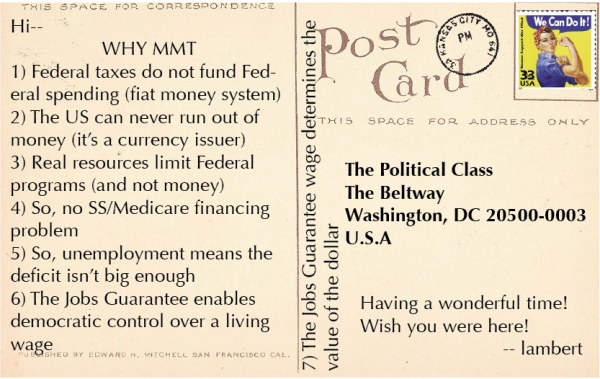
mmt_postcard_final

Let me just go point by point. (I’m going to be linking mostly to the MMT Primer[1] at New Economic Perspectives, but also to this trenchant article from Professor Paul Davidson, and transcripts from the 2010 Fiscal Sustainability Conference. Not being an expert or especially creative, I have to go to the sources and quote them. I apologize in advance for any severe pain caused to those quoted.[2])

1) Federal taxes do not fund Federal spending (fiat money system)

Stephanie Kelton said in her presentation at 2010′s Fiscal Sustainability Conference:

[T]he government is the issuer of its currency. It is not like a household. It doesn’t have to raise money by borrowing or collecting taxes in order to spend. Those of us in the private sector have to earn or borrow dollars before we can spend. The government must spend first. And we say this, and sometimes people have a hard time understanding that. How can the government spend first? How can it not spend first? How could the government collect taxes, in dollars, first? It first had to have spent those dollars into existence. The spending has to come before the payment or the collection of taxes. The government must spend first. Government spending is not (we use this term a lot) operationally constrained by revenues. It doesn’t need tax payments and bond sales in order to fund itself. It is not operationally constrained. The only relevant constraints are self-imposed constraints. We talked a little bit about this earlier, things like debt ceilings. That’s a self-imposed constraint. Rules that prevent the Treasury from running an overdraft in its account at the Fed. That’s a self-imposed constraint. It is a constraint that is imposed by Congress. Rules that prevent the Fed from buying Treasury bonds directly from the Treasury, so-called monetizing the debt, is a self-imposed constraint.

So why do we have taxes, then? To give money value! Rebecca Rojer in The New Enquiry:

Forcing people to pay their taxes in a money that is otherwise worthless creates demand for money and gives it its value. This idea, called chartalism, is one of the core building blocks of Modern Monetary Theory. “Modern money” is fiat money, state-issued currency not backed by precious metals or any other commodity. … You cannot trade in fiat money with the state for a fixed quantity of gold or barley, but you still need it to pay taxes.

Sovereigns [like the United States] create money as a tool to obtain the labor and other resources they need to fulfill their political goals. The sovereign steers the ship, at least initially, not some money god. If sovereignty lies with the people, money can be used to serve the common good. If people lack formal political power, more democratic layers of sovereignty may be possible in the shadow of the official sovereign, provided the means of production exists within a community. An understanding of modern money, and its relationship to sovereignty, would be necessary but far from sufficient to bring about such transformations.

Here I should address the pre-2008 pre-2016 hope and change “tax the rich” meme being pushed by the same crowd that brought us Obama. MMT, as such, isn’t against taxing the rich, and many MMTers are for it. For example, I think it’s good to tax the rich to prevent the formation of an aristocracy of inherited wealth, to prevent the rich from buying the government up with their loose cash, and for the sake of their children, to whom wealth often does not bring happiness. However, a program of taxing the rich is often coupled with the claim that such taxes are needed to fund services, a claim that puts us squarely into “it’s what they know that ain’t so” territory.

2) The US can never run out of money (it’s a currency issuer)

Stephanie Kelton had this to say in her presentation at 2010′s Fiscal Sustainability Conference:

Can the government run out of money? The U.S. government can’t run out of money any more than the Washington Nationals Baseball team stadium can run out of points. Every time a ball game is played at Washington National Stadium, some team scores some points and they appear on the screen and then the other team scores and some more points appear on the screen. And there’s nobody behind the screen going, ‘Hey Johnny, we’re running out of points here’, you know, right? Look in the trust fund. That’s not the way it happens. You just add the points.

Same exact thing with the way the government operates. And this is the quote that Marshall brought up earlier and the one that Warren likes to use a lot, and I like it too. So here it is in writing so that you know we didn’t make it up. This is Ben Bernanke in an interview on Sixty Minutes just last year when Pelley asked him, “Is that tax money the Fed is spending?” And Bernanke says, “It’s not tax money. The banks have accounts at the Fed much the way that you do, have an account at a commercial bank. So when we want to lend to a bank, we simply use the computer to mark up the size of the account they have with the Fed.

Note that this demolishes the constant refrain of Beltway institutions like the Peterson Institute, or Bowles-Simpson, or the Can Kicks Back, that “we’re running out of money.” Not only are we not, we can’t. The United States is sovereign in its own currency, creates it by fiat, and literally and truly cannot run out. Bill Mitchell writes:

[T]he government in a fiat monetary system is not “revenue-constrained”.

Intuitively this is hard to accept because we are so wedded to the idea that nothing is certain but death and taxes and that the latter is to raise money for governments to spend. The issue of taxation is also very emotional – as we see in some comments on my blog – taxation is linked by conservatives to concepts of slavery; loss of freedom; etc.

So the idea of a government that is not revenue-constrained is hard to grasp at the emotional level.

It is. It is indeed.

3) Real resources limit Federal programs (and not money).

Quoting (at Warren Mosler’s suggestion) Professor Paul Davidson:

The U.S. dollar is not legally convertible into anything by the government on demand [and hasn't been since Nixon closed the gold window]. It is, however, designated by the government as the only means of discharging federal tax liabilities. Tax liabilities are an ongoing debt the private sector owes the government, and they create a continuous need for dollars. The private sector obtains the needed dollars primarily as payment for the transfer of real goods and services to the government, and it is government spending or lending that provides the dollars needed to pay taxes. For purposes of this analysis, government spending includes spending by the government or any of its agents. For example, when the central bank buys foreign currency, it is the same, for cash flow analysis, as the treasury buying military equipment. This is commonly referred to as viewing the treasury and central bank on a consolidated basis.

The imperative of taxation is to create sellers of real goods and services willing to exchange them for the unit of account selected by the government. Dollar denominated tax liabilities function to create sellers of real goods and services who must have dollars to extinguish their tax liabilities. Raising revenue, per se, is of no consequence to the government, as dollars are not a limited government resource, but a liability, or tax credit, that can be issued at will. The government’s ability to raise revenue does not limit what it is able to purchase. The purchasing power of the government is limited only by what is offered for sale in exchange for dollars.

“[W]hat is offered for sale in exchange for dollars”: That is the real resources. Look around you. Is there work that needs to be done? Are there the real resources to do it? Then we can afford to do it. Rebecca Rojer writes:

Those at the very tip of our economic pyramid understand that fiat money is unlimited, but most everyone below believes it to be scarce.

How those at the tippy top must be laughing!

4) So, no SS/Medicare financing problem

Stephanie Kelton on Social Security:

”Funding Social Security is always and everywhere a political choice. The strongest evidence of this comes directly from the 2009 Annual Report of the Trustees. In that report, they predict gloom and doom for Social Security because “there is no provision in current law that would enable full payment of benefits, once the Trust Funds are exhausted”.

In contrast, the Supplementary Medical Insurance (SMI) Trust Funds are “both projected to remain adequately financed into the indefinite future because current law automatically provides financing each year to meet next year’s expected costs.”

It is that simple. The former is in ‘trouble’ because the government isn’t committed to making the payments, and the latter gets a clean bill of health because the government will always make the payments.”

Exactly the same logic applies to Medicare.

5) So, unemployment means the deficit isn’t big enough

Bill Mitchell, on What Causes Mass Unemployment:

The purpose of State Money is to facilitate the movement of real goods and services from the non-government (largely private) sector to the government (public) domain.

Government achieves this transfer by first levying a tax, which creates a notional demand for its currency of issue.

To obtain funds needed to pay taxes and net save, non-government agents offer real goods and services for sale in exchange for the needed units of the currency. This includes, of-course, the offer of labour by the unemployed.

The obvious conclusion is that unemployment occurs when net government spending is too low to accommodate the need to pay taxes and the desire to net save.

This analysis also sets the limits on government spending. It is clear that government spending has to be sufficient to allow taxes to be paid. In addition, net government spending is required to meet the private desire to save (accumulate net financial assets).

It is also clear that if the Government doesn’t spend enough to cover taxes and the non-government sector’s desire to save the manifestation of this deficiency will be unemployment.

6) The Jobs Guarantee enables democratic control over a living wage

How would the JG work from the perspective of a working person (not an owner?) Or from the perspective of the millions of permanently disemployed? The MMT Primer:

If you are involuntarily unemployed today (or are stuck with a part-time job when you really want to work full time) you only have three choices:

  1. Employ yourself (create your own business—something that usually goes up in recessions although most of these businesses fail)
  2. Convince an employer to hire you, adding to the firm’s workforce
  3. Convince an employer to replace an existing worker, hiring you

The second option requires that the firm’s employment is below optimum—it must not currently have the number of workers desired to produce the amount of output the firm thinks it can sell. …

If the firm is in equilibrium, then, producing what it believes it can sell, it will hire you only on the conditions stated in the third case—to replace an existing worker. Perhaps you promise to work harder, or better, or at a lower wage. But, obviously, that just shifts the unemployment to someone else.

It is the “dogs and bones” problem: if you bury 9 bones and send 10 dogs out to go bone-hunting you know at least one dog will come back “empty mouthed”. You can take that dog and teach her lots of new tricks in bone-finding, but if you bury only 9 bones, again, some unlucky dog comes back without a bone.

The only solution is to provide a 10th bone. That is what the JG does: it ensures a bone for every dog that wants to hunt.

It expands the options to include:

  • There is a “residual” employer who will always provide a job to anyone who shows up ready and willing to work.

It expands choice. If you want to work and exhaust the first 3 alternatives listed above, there is a 4th: the JG.

It expands choice without reducing other choices. You can still try the first 3 alternatives. You can take advantage of all the safety net alternatives provided. Or you can choose to do nothing. It is up to you.

If I were one of the millions of people permanently disemployed, I would welcome that additional choice. It’s certainly far more humane than any policy on offer by either party. And the JG is in the great tradition of programs the New Deal sponsored, like the CCC, the WPA, Federal Writers’ Project, and the Federal Art Project. So what’s not to like? (Here’s a list of other JGs). Like the New Deal, but not temporary!

OK, what do you mean by “democratic control over the living wage,” then? The MMT Primer describes JG program design:

The national government provides funding for a universal program that would offer a uniform hourly wage with a package of benefits.  The program could provide for part-time and seasonal work, as well as for other flexible working conditions as desired.

The package of benefits would be subject to congressional approval, but could include health care, child care, old age retirement or social security, and usual vacations and sick leave.  The wage would be set by government and fixed until government approved a rate increase—much as the minimum wage is usually legislated. …

And this program wage cannot be “market determined”. It must be socially determined: government offers an infinitely elastic demand for labor at the wage (plus benefits) it chooses to pay. It sets the wage as public policy, then hires all those who accept the offer of a job. To get workers, the private sector will have to offer something better than the JG compensation package. It could be a higher wage, better benefits, better working conditions, or better opportunities for career enhancement.

Intuitively: What the JG does is set a baseline[3] for the entire package offered to workers, and employers have to offer a better package, or not get the workers they need. When I came up here to Maine I’d quit my job voluntarily and so wasn’t eligible for unemployment. Then the economy crashed, and I had no work (except for blogging) for two years. There were no jobs to be had. I would have screamed with joy for a program even remotely like this, and I don’t even have dependents to take care of. It may be objected that the political process won’t deliver an offer as good as the Primer suggests. Well, don’t mourn. Organize. It may be objected that a reform like the JG merely reinforces the power of the 0.01%. If so, I’m not sure I’m willing to throw the currently disemployed under the bus because “worse is better,” regardless. Anyhow, does “democratic control over the living wage” really sound all that squillionaire-friendly to you? Aren’t they doing everything in their power to fight anything that sounds like that? The JG sounds like the slogan Lincoln ran on, to me: “Vote yourself a farm!” [3]

So, what does the JG for the economy? MMT was put together by economists; from an economists perspective, what is it good for? Why did they do that? The Primer once more:

some supporters emphasize that a program with a uniform basic wage[4] also helps to promote economic and price stability.

The JG/ELR program will act as an automatic stabilizer as employment in the program grows in recession and shrinks in economic expansion, counteracting private sector employment fluctuations. The federal government budget will become more counter-cyclical because its spending on the ELR program will likewise grow in recession and fall in expansion.

Furthermore, the uniform basic wage will reduce both inflationary pressure in a boom and deflationary pressure in a bust. In a boom, private employers can recruit from the program’s pool of workers, paying a mark-up over the program wage. The pool acts like a “reserve army” of the employed, dampening wage pressures as private employment grows. In recession, workers down-sized by private employers can work at the JG/ELR wage, which puts a floor to how low wages and income can fall.

Finally, research indicates that those without work would prefer to have it:

Research by Pavlina Tcherneva and Rania Antonopoulos indicates that when asked, most people want to work. Studying how job guarantees affect women in poor countries, they find the programs are popular largely because they recognize—and more fairly distribute and ­compensate—all the child- and elder care that is now often performed by women for free (out of love or duty), off the books, or not at all.

Enough of this crap jobs at crap wages malarky!

7) The Jobs Guarantee wage determines the value of the dollar

Quoting Professor Paul Davidson once again:

The proposed [JG] program recognizes that the government is a monopoly supplier of its currency. Price is set through the [JG] wage, which defines the purchasing power of the currency.

The current monetary system is a classic monopoly with the traditional analysis of monopoly sufficient to describe all aspects. The government is the monopoly issuer of the dollars needed by the private sector to pay taxes. … With a gold standard, gold can always be considered fully employed as gold can always be sold to the government at the fixed price. Likewise, with an [JG] policy, labor can always find a buyer. … The government sets the [JG] wage and lets the market allocate all other resources accordingly. This is the same process that determines relative value under a gold standard. Under the ELR proposal, the government adjusts fiscal and monetary policy to maintain the ELR pool much the same way that a government adjusts fiscal and monetary policy to maintain a buffer stock of gold with a gold standard.

* * *

All this said, the house design as a whole is not up to the plumber, but the architect. In a democracy, we the people are the architect! And it is up to us to design an ethical house, and also to determine the plumber to hire — I hope MMT — and to design the plumbing. Democratically.

ACKNOWLEDGEMENT: I would like to thank letsgetitdone (Joe Firestone), Scott Fullwiler, and Warren Mosler for their help with the points on the card. Any errors on the card or in the post are, of course, my own.

NOTE [1] Granted, it’s 52 chapters of Primer goodness. Professors! But many of those chapters are responsive to questions or critiques, and others address issues brought up by particular schools, like the Austrians. So just like Wagner’s music is better than it sounds, the MMT Primer is shorter than it looks. So it’s a textbook that needs to be popularized and simplified like the work of every other economic school. Of course, MMT doesn’t have think tank and entire economics departments funded by well-endowed squillionaires to get that work done. Go figure.

NOTE [2] The metaphor that MMT is a toolkit or smorgasbord is appealing but limited. I can’t do justice to Joe Firestone’s work on “knowledge claim networks,” but here’s a discussion.

NOTE [3] At this point, the real economists blanche, and point out that JG jobs are conceived of as “transitional,” and aren’t supposed to replace private jobs, merely to supplement them. And that is probably where the temper of the country is, right now. But I think democratic control over the living wage is a good thing to have until the glorious day when the soviets really do take power, or, more prosaically, until a lot more co-operatives start shaping the political economy to the liking of their members.

NOTE [4] Why doesn’t the minimum wage do this? You must be employed :-):

But the more important point is this: with the JG in place, the program wage and benefits set an effective floor, an effective minimum wage. As Hyman Minsky used to always argue, without the JG the legislated minimum wage is a lie. The true minimum wage is zero—if you cannot find a minimum wage job, you get a zero wage. With the JG in place, the true minimum is the program wage (plus benefits).

NOTE OK, there should be no plumbing! We should all use composting toilets in our back yard! I’m down with that, I’m a permaculturalist! It’s just a metaphor!