72 Degrees in the shade.
The Animated Self Portrait
T.S Abe
72 Degrees in the shade.
The Animated Self Portrait
T.S Abe

Eye Detail from the Animated Portrait.
T.S Abe

Matthew woke from the sound of the rattling in his chest.
It was a long, drawn out rasp, the kind that old smokers have, and it ended in a fit of coughing so intense that his lungs burned as he drew breath. He instinctively covered his eyes with his arms, trying to keep out the sharp, piercing light of the sun. His eyes felt heavy and swollen. His eyelashes were crusty and felt glued shut.
He groaned softly, voice trailing off into a miserable croak as he quickly ran out of breath. It was too hot, too humid. The wind that blew across his face was stale and suffocating. He drew himself up into a ball, tightened his arms around his head, and lay there motionless until he could collect his thoughts.
TertiarymattThis is crazy, but I honestly find it frustrating.
TertiarymattThis pen is super hot.


TertiarymattEnglish Cut moving towards some made to measure is a go, it seems.

(The Connaught. Classic birdseye wool worsted from our new range)
To everyone who’s signed up for more information on our new service. We’re delighted to let you know that you’ll be able you’ll pre-order soon.
You’ll be able to order a beautiful English Cut suit online. It’s design and concept follows everything we think is important in a garment.
Our made to measure garments are made from fine English Cloth and manufactured to what we believe are the highest standards in the world
If you’d care to be updated as soon as our service is available then please register here.
To introduce our new customers, a short video to capture our bespoke tailoring heritage. The essence of English Cut.
The post arriving autumn 2014….. appeared first on English Cut - Bespoke Savile Row Tailors.
TertiarymattAn important little article.

Illustration by the author
It's been a summer of monsters.
Last week, the Islamic State released a video broadcasting the execution of James Foley in Syria.
Foley was a photojournalist. He was a brave, handsome man, who, according to people who knew him, was kind under stress. He was a member of a world I've only dipped into—that of freelancers reporting on war. It's a scene bonded over whiskeys in Gaziantep or Beirut. Because they have scant backup, freelancers look out for their own. This might mean sharing tips on fixers. Or it might mean something beyond the job, like raising money for the kids of a colleague killed in the field.
James Foley was kidnapped two years ago near Aleppo. A foreigner (or well-off Syrian) can net a fortune in ransom. Later, ISIS acquired him. They murdered him on the hills outside Raqqa. The voice on their propaganda tape was from London's East End.
I learned of Foley's death via a Skype message from a Syrian media activist. “Have you seen the video?? James :( May god bless his pure soul.” It was 4 AM. I googled, then doubled over in ugly sobs. Behind my eyelids, I saw the orange jumpsuit ISIS forced Foley to wear, echoing Gitmo. How many captives were still locked in their basements? How many Syrians had they murdered? Those names would never trend on Twitter.
I was in Sweden. The country's neat politeness made an obscene contrast to social media, where the stream showed police rampaging in Ferguson, Missouri. A cop had killed a black teenager named Mike Brown. Police would lay siege to the town to protect the man who shot him. Cops gassed an eight-year-old boy, or a woman fleeing in her wheelchair. Despite their sci-fi toys, the police's violence was as old as slavery. With raw courage, Ferguson kept protesting.
Weeks before, New York City police strangled to death a black grandfather named Eric Garner. A week before that, a California cop pummeled Marlene Pinnock, a black great grandmother. Back in New York, police stripped a black mom naked in the hallway outside her apartment, then arrested her entire family. They had knocked on the wrong door. Social media presented a parade of videos showcasing state violence that black people have endured since they were kidnapped to America.
Weeks before officer Darren Wilson killed Mike Brown, Israel invaded Gaza under Operative Protective Edge. They bombed homes, hospitals, mosques, even UN schools where Palestinians were told to shelter. After six weeks, the IDF had killed over 2,000 Gazans, most of them civilians. Palestinians tweeted photos of the devastation. Israel claims to have the “world's most moral army.” Those photos showed this to be a lie.
During Gaza or Ferguson, I could not look away. These were events in which I, as a white-skinned woman or an American, was unwillingly complicit. But I wondered about the nature of looking. Was it voyeurism, to watch people attacked each night and do nothing but donate to bail funds? Or was it worse not to look, to retreat because one was able?
Journalism often feels like vampirism. Before Ferguson or Gaza, I'd been reporting from Abu Dhabi, Turkey, Lebanon, Syria. Before that, Guantanamo. Sources told me about repression and violence. A journalist on the disaster beat told me to be a funnel for this pain. “Let it go through you. Get it down truthfully. Move on.”
I could not.
Writing about others' trauma bears no relation to living it. Yet I was a ruin more and more. The word “burnout” is dead from overuse. Constant exposure to pain burns in.
Quinn Norton once advised me to write about what I loved. Rage came more easily. I'd make my lines bloody, my words damning. I didn't know how to write about happiness. What did it mean, the night I danced on the street in New Orleans? A brass band howled. I'd woven flowers into my hair, but they dissolved beneath the Halloween rain. My friends and I danced for hours.
It was one night, on one sliver of earth.
We need beauty. But what right did I have, I kept asking myself, in a world so full of hell?
In his poem, “A Brief for the Defense,” Jack Gilbert attempted an answer. “We must risk delight,” he wrote. Life contains everything. Tear gas in Ferguson. Books read on the grass. Foley's murder. Dancing in New Orleans, till sunrise blots the stars. We're meat—fragile and finite. But joy is survival.
To remind myself, every summer I visit Coney Island. My mother used to visit, as did my grandmother. I love Coney's tattered glamor. I love the animatronic Grandma spitting fortunes, or the monsters Chico airbrushed at The Spook House. I love the dizzy minutes when the Wonder Wheel freezes. I'm above it all. Alone with the sky.
For a hundred years, Coney Island's been a symbol for working class pleasure. But New York lacks space for such darlings. In 1964, Fred Trump (Donald's father) bought Steeplechase, Coney's grandest park. He intended to raze it for apartments. Though he failed to push through the necessary rezoning, he destroyed Steeplechase anyway. On the night before the bulldozers, Trump threw a party.
At the party, bikini models presented bricks to Trump's friends. The moguls hurled the bricks through Steeplechase's stained-glass windows. They must have giggled as the glass broke.
Every year, Coney Island faded. In the early 2000s, Thor Equities bought up much of the boardwalk. They expelled a culture as sparkling as the glass crushed into Times Square's sidewalks.
In 2012, Hurricane Sandy ravaged Coney Island. No one even repainted the signs.
When my friends and I visited Coney Island this summer, the old parts had shrunk to bones. As we watched the storm come off the water, Coney's lights seemed fainter than ever.
I thought of Fred Trump as he hurled bricks through Steeplechase's windows.
Spaces of joy are always threatened. Blink, and they've been destroyed.
I thought of the gunships blocking Gaza's sea from fishermen, or the Islamic State smashing ancient statues, or the New York cops who would choke a black man to death for little more than being outside in the sun.
I thought of the roses laid in the street where Darren Wilson shot Mike Brown.
Power seeks to enclose beauty—to make it scarce, controlled. There is scant beauty in militarized zones or prisons. But beauty keeps breaking out anyway, like the roses on that Ferguson street.
The world is connected now. Where it breaks, we all break. But it is our world, to love as it burns around us. Jack Gilbert is right. “We must risk delight” in the summer of monsters. Beauty is survival, not distraction. Beauty is a way of fighting. Beauty is a reason to fight.
Follow Molly Crabapple on Twitter.
TertiarymattA bit long, but very important.
TertiarymattI am kind of required to like a metal band named "Resilience". Also lots of good genre smashy stuff happening in here. via multitasksuicide
 |
TertiarymattThis must have been very satisfying to make. via willowbl00.
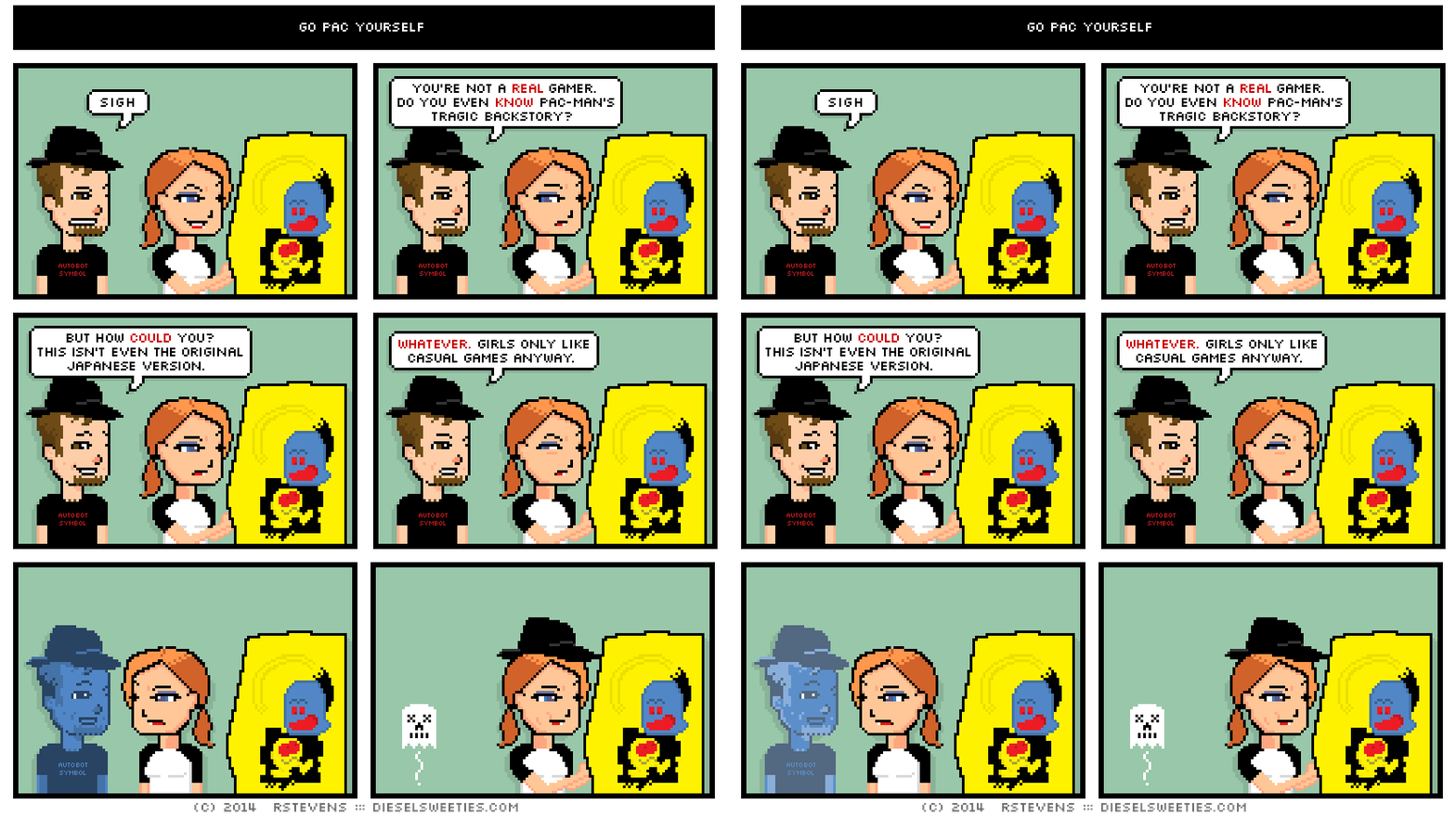
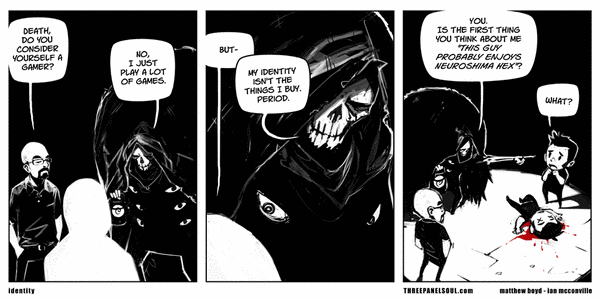
TertiarymattMore on playing games with Death, and what it means to be a 'gamer'.
TertiarymattNew Curveball. If you haven't read it, you should start with Issue 1, but it's quite good.
TertiarymattIn case you need some Swans. (You do)


Tertiarymattsonsabitches
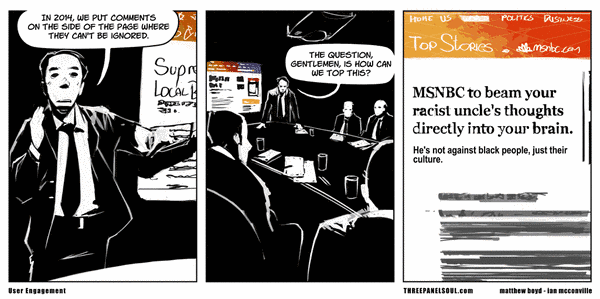
TertiarymattSpread the word. via Arnvidr

Google product engineer Ian Webster believes sponsored articles should be more easily identifiable (as they should be!), so he built the AdDetector plug-in in his spare time to make that happen. More and more publications turn to sponsored content or native ads these days (even Tumblr does it), but some of them just add disclaimers at the very bottom of the page or small, easy-to-miss bylines. Webster says the problem is that bad native ads depend on you, readers, not knowing that they're, well, sponsored. So, he designed the plug-in to plaster large red banners on paid article pages whenever it detects unfortunately small sponsored disclaimers, in order to boost transparency on the web. He also hopes that by making paid articles more obvious, sponsors would make an effort to put out better content. You can install AdDetector (and make sure this post wasn't sponsored) for Chrome and Firefox from Webster's website.
Filed under: Internet
Source: AdDetector
TertiarymattThis one is almost Bacon-esque.



a comic done by christianne benedict, posted on the womanthology art forum. brilliant!
YES. Jesus, thank you.
I cannot tell you how many times I have had to point out what the audience at conventions actually LOOKS like to people in the industry. They can do signings in a booth full of every kind of person all day long, every color, every size, every orientation and more, and STILL go online and talk about how only white straight males read comics.
IT IS PROFOUNDLY UNTRUE AND INSULTINGLY IGNORANT.
TertiarymattI don't really understand what is happening here.

Art of the day: pass the fish!
TertiarymattDan writes about "Cop Killer". Mayhem ensues.

by Body Count
album Body Count
150 Favorite Songs: #65, “Cop Killer,” Body Count (1992)
The thing about “Cop Killer” that’s so remarkable is that even 22 years later, it still sounds positively dangerous. It wasn’t the first song to suggest that maybe the singer would support violence against law enforcement, of course—that dates back from “Fuck Tha Police” to “I Shot The Sheriff” to “Policeman.” But “Cop Killer” is the one that still sounds like something that you shouldn’t be able to get away with singing about.
I mean, “Fuck Tha Police” is arguably the more important song, but it is nowhere near as unapologetic and unequivocal as “Cop Killer.” The conceit of “Fuck Tha Police” is that the cops are on trial for the way they’ve treated young black men like Cube, Dre, Ren, and Eazy-motherfucking-E (Yella’s voice and name are absent on the recording). “Judge Dre” presides while the others give their impassioned testimony: Cube talks about the violence he’s endured, the indignity of being searched and touched inappropriately, the way that black officers react toward him when they’re with white cops, etc, etc—it’s a detailed argument for why the police are fucked. By the time he promises that “when I’m finished / there’s gonna be a bloodbath / of cops dying in LA,” you can understand that he’s justifiably angry.
"Cop Killer" makes "Fuck Tha Police" seem downright polite by comparison. Ice-T doesn’t fuck around at all here. It’s less a "this is why I hate cops" and more a "how-to" power fantasy. It’s all "I got my black gloves on / I got my ski mask on" and "I got this long-ass knife / and your neck looks just right." Even in the preamble to the song, he lays out his position—that police who brutalize the people they’re supposed to protect are committing such a violation that he’d be happy to "take a pig out here in this parking lot and shoot him in his motherfucking face." He’s not even picky which cop it is.
That’s the other thing about “Cop Killer”—there’s no equivocating here. One of the most interesting things about the song is the fact that Ice-T, like, acknowledges the shared humanity of the police officer. It’s in the fucking chorus! “I know your family’s grieving—fuck ‘em!” That is some harsh shit. If “Fuck Tha Police” is about how the rage against the police that the NWA guys felt is justifiable because of how they’d been treated, “Cop Killer” takes for granted that police are the enemy. And that, as the enemy, they need to die.
I mean, shit. That got this record pulled 22 years ago, and it’s still hard to believe he got it on the shelves in the first place. It’s so transgressive even after two decades that it feels like you’re doing something wrong if you sing along (try it with the windows down!).
But, of course, Ice-T demands that you sing along. That’s the other genius of “Cop Killer”—it’s participatory. After the “fuck the police!” breakdown near the end, he starts calling you out: “Have some motherfucking courage,” he commands, punctuating it with a “fuck the police” before imploring the listener to sing along. “What do you want to be when you grow up?” “Cop killer!” the listener is supposed to shout. “Good choice.”
There’s something fascinating about taking a sentiment like that—a sentiment that got his record yanked off of shelves, that still has police angry with him (cops are still pissed that Ice-T is on Law & Order: SVU), and demanding it become universal.
Because that’s the other thing about “Cop Killer”: it was on the Body Count record, which was Ice-T’s heavy metal crossover album. That was a record that he knew would be played by an awful lot of white kids. Demanding that a largely-white audience sing along about the very specific ways that they’d go out and kill some cops (with the headlights turned off and a twelve-gauge sawed-off) is scary as hell. Of course they banned this shit.
At the same time, there are only a few times that rock and roll actually felt dangerous. There was a time when people rioted to “Rock Around The Clock” (at least, that’s the myth), when Elvis’ hips threatened to impregnate all of the teenage girls in America, when kids suddenly had hairstyles and clothing that their parents could never understand.
That power left most music a couple decades ago, though. These days, the Public Enemy logo has a Beats By Apple logo on the other side; “dangerous” artists are more likely to prove their bonafides by not showing up for their gigs than for saying something provocative. Maybe “Cop Killer” was the last truly dangerous rock song—and that alone makes it powerful enough to keep talking about.
6 plays

The next chapter of the Pen and Cape Society's Super Choice Adventure is up. This chapter is written by R.J. Ross, author of the Cape High books. I discuss her stories a little on this site in Introducting the Pen and Cape Society.
This installment gives you the chance to vote me in as the next author up to bat. Read through the latest installment and choose which power you want Willow to use next. If you choose "fire manipulation" then I'll need to figure out exactly how the the heck I'm going to work fire manipulation into the storyline. If you're not interested in fire manipulation, that's OK. I'll get my turn eventually.
TertiarymattMind the Giant Picture of Roger Ailes.
 Bill O’Reilly “mash up” illustration provided by author.
In 1996, media titan Rupert Murdoch asked a former U.S. Republican Party political strategist Roger Ailes to found Fox News. From the outset, Fox was accused of being little more than a mouth piece for the Republican party, placing a right wing slant on much of its reportage. While this tactic was at odds with existing journalistic practices, it proved a ratings windfall, and Fox soon became the most watched news network in the U.S. Through the years, Fox’s coverage has become even more skewed, regularly trafficking in headlines such as “Obama Praises Indian Chief Who Killed U.S. General” and “Obama loves Gangsta rap.”
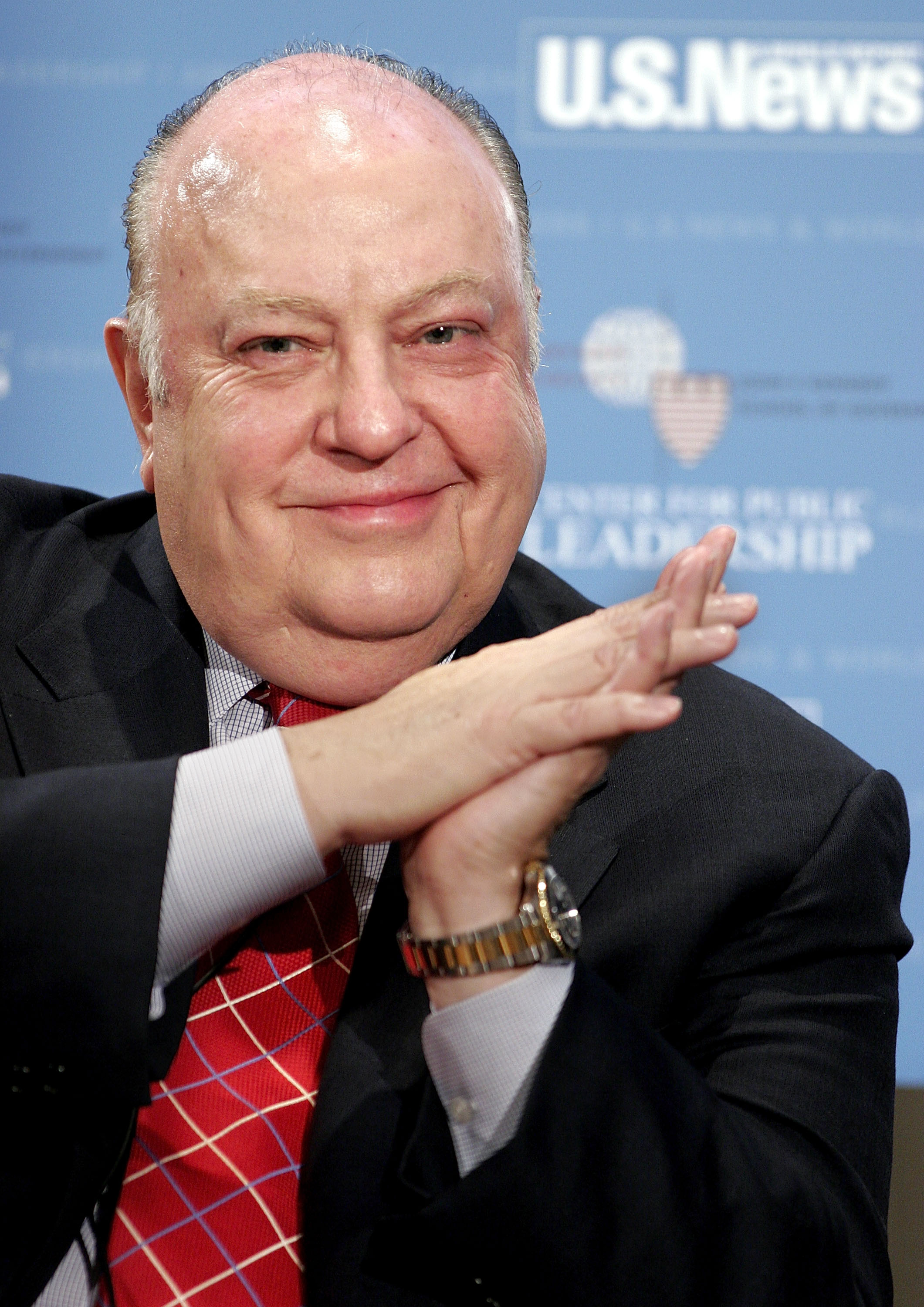
Defending news coverage filled with right wing propaganda has presented a significant public relations challenge for Ailes. To counter critics, he and the Fox team aggressively brand their approach “real journalism,” dubbing the popular O’Reilly Factor a “no spin zone,” and adopting the motto “fair and balanced.” Ailes did not invent this mode of rhetorical white washing. It actually dates back to an equally savvy political strategist: Plato.
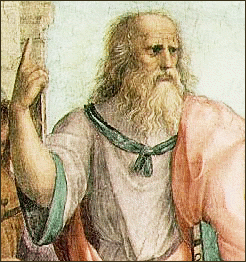
Like Ailes, the founder of the western philosophic tradition once had political aspirations. The son of an aristocratic family, he was an elitist, who believed only a small fraction of the populous possesses the natural endowments to govern others. He was also a moralist, struggling to save society from contamination by dangerous thought. And he was an egoist, who believed that human beings are guided primarily by rational self-interested. Plato sought political office on several occasions with no success. But after his teacher Socrates was put to death for clashing with the authorities of his day, he abandoned political life in favor of scholarship.1 He did, however, go on to write The Republic,2 a work that describes a future utopia ruled by philosopher kings, wise men like him, but with real political clout. In his last and longest dialogue, Laws,3 Plato grows more pragmatic and more reactionary, imagining a future society where those who reject his philosophy are taken to the courts and, if found guilty, given no less than five years solitary confinement in a reformatory where they will be subjected to intensive indoctrination. If this fails to cure them, they should be put to death. Clearly, with such laws in place, it would be illogical to disagree with Platonic “reason.”
Another link between Platonism and Fox News is the use of religious doctrine to support truth-claims. Because Fox frequently panders to Christian right, pundits and correspondents often invoke biblical authority in contrast to that worldly stuff scientists call “empirical evidence.” What’s more, Fox producers often generate stories focusing on Christian themes, such as the perceived “attack on Christmas.”

In a similar sense, many of Plato’s truth-claims were undergirded by dogma. According to classical scholar E.R. Dodds,4 his philosophy is a cross fertilization of Greek rationalism and various magico-religious ideas gleaned from shamanistic cults. Plato believed in reincarnation and felt that philosophers were uniquely gifted individuals capable of retaining knowledge of ultimate truths glimpsed during their passage through the afterlife.
This ideological component has its antecedents of the Pythagorean movement. Plato’s forbearer Pythagoras was a brilliant logician. He invented the mathematical formula known as “the Pythagorean Theorem.” And coined the term “philosopher.” But he was also the leader of a religious sect and often addressed his devotes from behind a gauzy veil.
 Pythagoreans celebrate sunrise.
Pythagoras claimed to channel the spirit of the late shaman Hermotimus.5 Such invocations were common in ancient Greece. Ritual mediums often conjured spirits of the dead in order to invest their pronouncements with divine authority. Thanks to the advent of the written word Plato was able to invert this process. His teacher, Socrates, does not speak through him. Instead, Plato speaks through Socrates. Likewise, Fox commentators frequently invoke deceased presidents, Washington, Jefferson, Lincoln and especially Ronald Reagan and speculate as to how they might respond to various current events. No news channel channels the dead as frequently or as overtly as Fox, and for true believers, such mystical invocations appear to lend credence to partisan hype masquerading as journalism.
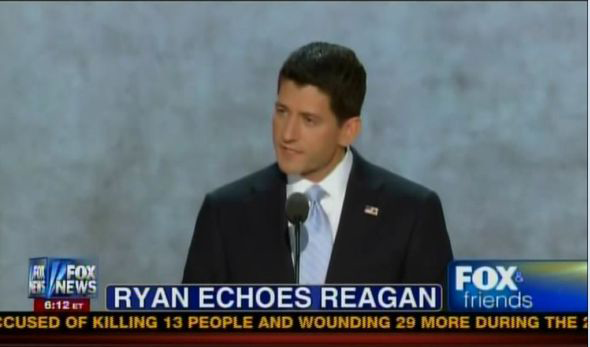 Paul Ryan invokes Reagan on Fox.
This act of “textual ventriloquism” has several advantages. Claiming to speak for living authorities is problematic. The living can object when their views are misinterpreted or deliberately distorted, while the convenient silence of the dearly departed offers no such hazard. Also, the dead are no longer capable of contradicting or amending their own views. Posthumous utterances representing an evolving idiosyncratic worldview commenting on issues relevant to a particular place and time are thereby invested with the gravity of immutable truths. In this way, Fox conjures celestial imprimatur via the esteemed ghosts that tirelessly haunt its airwaves. What’s more, a pundit speaking in the name of a dead authority figure is donning a type of mask that partially disguise his own motives and worldview. This ideological camouflage allows him to feign objectivity without actually attempting it.
 Depiction of dialectical method for argument.
The methodological cornerstone of Platonic rationalism is the dialogue, the process of two or more people expressing different points of view in an effort to ascertain truth visa reasoned argument. By allowing the audience to consider more than a single perspective, the dialogue creates opportunities for productive debate in which ideas are asserted, challenged and improved in a dialectic fashion. This process can enhance understanding, but it can also delude. In Plato’s work, it does both. This is because, for him, the dialogue is more than just an objective discussion between equals; it is a rigged game, a rhetorical framing device that persuades by claiming to transcend rhetoric. Socrates appears to meet his opponents on equal footing, while Plato remains off stage and out of view. Meanwhile, Socrates always has the upper hand. Plato covertly controls everything from behind the scenes, and Socrates appears to win every argument. His (Plato’s) wisdom triumphs over all.
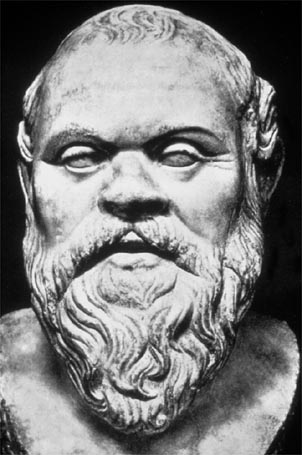 Greek philosopher Socrates often portrayed in Plato’s dialogues.
Plato was highly critical of the Sophists, a group of competing scholars who taught the art of rhetoric. He felt that their persuasive monologues were deceptive and inferior to his dialogues, which, he claimed, allowed readers to consider both sides of every argument. Yet, in many respects, Platonic dialogues are simply monologues in disguise. They persuade by appearing unbiased, but the author’s true intentions are always simmering just beneath the surface. This is what makes the dialogues so compelling and so deceptive. The Sophists never claim to be objective, but Plato does and this imbues his works with a sense of heightened credibility.
Fox News has made the dialogue a staple of their “fair and balanced” programming. As with a magician’s sleight of hand, it directs attention away from right wing pandering network executives wish to conceal. Rather than attempting to actually make their reportage less biased, they have constructed highly constrained editorial spaces in which a few handpicked liberals are permitted to express opposing views in an often-ineffectual manner.6 This is what passes for objective journalism on Fox and the illusion is somewhat convincing as long as viewers don’t question the motives of the supposedly neutral moderator, or examine how the show’s producers have chosen to frame the topic of discussion.

Like Plato, Roger Ailes has anointed himself a sage capable of discerning ultimate truth more effectively than others. Yet at first blush, he appears a somewhat ironic figure, one whose authority is dependent on a means of expression he seems determined to disparage. Ailes, after all, is high power media mogul who constantly disparages the media itself. He wants to convince viewers that this is an act of alchemy, not hypocrisy. The first step involves insisting that the media at large is inherently liberal and thus corrupt. Only then, can the Fox News team perform the feat of magically transforming this base material into something of true value. They do so by fighting fire with fire, using media to transform itself.
In a similar sense, Plato considered the written word corrupt. In Phaedrus, he compares writing to orality. He is critical of the former and praises the latter. For the first time in western thought, two types of media are evaluated in relation to one another and media theory is born. Plato even conflates literacy with a poison (pharmakon) that will cause human memory to atrophy. This implies a counter conflation, namely, that Plato’s dialogue is the cure. Plato, the philosopher, may disparage the written word, but Plato, the alchemist, needs it, as his dialogue is the philosopher’s stone that can insure its transmutation. He is not a hypocrite for using literacy to serve his own ends. He is a redeemer, a purifying filter, distilling away toxic impurities.
In the essay “Plato’s Pharmacy,” Jacques Derrida7 challenges the hidden biases of this supposedly impartial dialogue. He states that Plato’s critique of the written word is a self-serving gesture, perpetuating long-standing patriarchal norms. In Phaedrus, Plato (through Socrates) suggests that truth (logos) committed to words is like a child orphaned by his father. By redeeming the word, Plato strives to return it—and all of us—to the care of a benevolent and all-knowing patriarch. This too, is in keeping with the Fox News bias toward “family values” and patriarchal norms.
In addition to disparaging the written word, Plato condemns poetry and the theater for a tendency to trigger mimetic acts. He fears that uneducated readers and audience members lack the critical faculties to entirely distinguish between reality and stagecraft and might be compelled to imitate the transgressions dramatized in works of fiction. In The Republic, written around the same time as Phaedrus—about 370 BC—Plato suggests that community leaders should supervise poets, and compel them to praise virtue in their poems. Poems that focus on vice are compared to poisonous weeds corrupting souls. Here is the first “media effects” argument.8 Plato insists that society is under threat from nefarious influences eroding social norms. His enemies, the sophists, are deceivers, blinding humankind to the fundamental Truths of existence.
In a similar sense, Fox News host, Bill O’Reilly is a self-described “cultural warrior, determined to protect his audience from harmful images and ideas circulating in the “liberal media.” To this end, O’Reilly often tells those who disagree with him to “shut up” in an attempt to silence perspectives that don’t align with the Republican talking points he is obliged to parrot.

Plato tells us Socrates was the wisest man because he claimed to know nothing. But perhaps, Plato was the shrewdest man because he claimed to lack an agenda. The apparent parallels I have sketched between the methods of Fox News and the traditions of Platonism unsettle familiar notions of objective journalism and unbiased philosophy. They also raise concerns regarding the long-term credibility of a two party democracy. Whenever two parties—individual or collective—converse, their dialogue is not occurring in a value-free vacuum. Some unseen philosopher king, or collective of like-minded stakeholders is limiting and guiding what can be spoken and heard. Yet acknowledging that all public debates are inevitably framed and distorted by private interests is not the same as accepting that all accounts of the so-called “objective truth” are equally biased. The US may always have a two party system, but that ongoing political dialogue need not become as right leaning as Fox News’s narrowing circumscribed rhetorical universe. And even Fox, devoted as it is to carrying out neo-conservative marching orders, will never be an entirely closed system. This is because no dialogue, however carefully constrained, is ever entirely predictable. Discourses are living things comprised of complex individuals who share similar ideological commitments, but are not perfectly in lockstep regarding all issues. Thus even in a tightly controlled discursive space there are opportunities for legitimate debate and even dissent, not necessarily been the straw-man liberal pundits, Fox sets up and knocks down for sport, but between the Fox correspondents owe varying degrees of allegiance to different groups: The Tea Party, the Christian right, the NRA, Republican politicians and big business. Those same reporters are also committed to different ideological agendas: nationalism, capitalism, neo-conservatism, elitism, populism, patriarchy, jingoism, heteronormativity, militarism, and, yes, even journalistic ethics. These competing commitments and perspectives complicate their ability to present a perfectly united front.
As public discourse becomes more multi-centered and complex, we are required to think, not of the public sphere, but of the public spheres—plural. Even a dialogue between two people draws on a number of competing discourses. This means, the producers of Fox News can never perfectly contain and control what occurs on their airwaves. And indeed, many liberal pundits including Cornel West, Jon Stewart and Bill Clinton have successfully challenged the Fox News team on their own turf, undermining the republican party’s ability to always bring its favorite media lapdog perfectly to heel. While it is in the best interest of moneyed elites to make it appear as if the motives and beliefs of various right wing discourses are perfectly aligned, the general public benefits more when their contrasting perspectives are exposed and some semblance of actual debate is generated within the Fox News universe. This is the best hope of keeping Fox News a little more honest, and perhaps even remotely “fair and balanced.”
Image Credits:
1. Bill O’Reilly, Plato, Parthenon
2. Roger Ailes
3. Plato
4. Pythagoreans
5. Paul Ryan
6. The Dialogue
7. Socrates
Please feel free to comment.
NOTESTertiarymattThis shirt is very fine.
Hello, my dears! Thank you all for your patience last week. My computer is back up and running (and so am I). I can’t wait to finish this chapter!
News news news…there’s a new t-shirt designed by me (suitable for D&D nerds) up in the PvP/TableTitans store on WeLoveFine. It’s all about the big news in the fantasy healthcare world; the Affordable Cleric Act. (I had fun.)
It was originally a GenCon exclusive but people went so bonkers over it on Twitter that they’re releasing it early in men’s sizes. Perhaps you’d like one!
TertiarymattThis sounds like a good time.

Did you like "Choose Your Own Adventure" stories back in the day? Do you like stories where the ending hasn't been figured out yet? Do you like those crazy stories where multiple authors take turns pushing it forward? What about all three smooshed together?
Introducing Super Choice Adventure: the adventure that's sort of like Choose Your Own Adventure but not close enough to violate any copyrights that's being written by multiple authors who haven't figured out the ending yet!
Various members of the Pen and Cape Society (including yours truly) have banded together to tell the story of a heroine with the ability to mimic the powers of fictional characters. It updates every Monday, Wednesday, and Friday, and at the end of each update the readers get to choose which power she mimics next -- and which Pen and Cape author tells the story.
TertiarymattNot a huge fan of music, but Valerie is great.