‘do a couple things’
The Amenity Illustrations
TertiarymattWomen are strange and terrible creatures, it seems.


TertiarymattSo, this is pretty neat.
TertiarymattI think this is also mommy stuff.

Worked on this concept/study while my little one napped .. Now back to mommy stuff. ✨
TertiarymattOnly 30L per day!
 |
| Ted McLelland and the equipment used to make reagents newly arrived at 20x24 |
 |
| Inspection of the heat exchanger, which controls the process temperature |
 |
| The vessel in which the reagent is mixed under heat and pressure |
 |
| A large motor and gearbox turn the mixer. |
TertiarymattThis is pretty fascinating.

Time-lapse of the reactor pressure vessel scan, and the muons tracking through it (Image via NHK)
The blisteringly hot epicenter of the Fukushima Daiichi nuclear meltdown has finally been exposed by a massive machine that uses space-based beams to look through reactor shielding. This method, called Muon tomography, has essentially provided the first pictures from within the interior of the now-defunct reactor.
Outside of the controlled environment of a functional reactor, scientists explore the mysteries of nuclear meltdowns using equations and computer modeling; The alternative of simply cracking open a fractured containment vessel and taking a good long look inside is not recommended. For obvious reasons, doing so would exacerbate an already catastrophic environmental disaster.
This poses a bit of a conundrum. In order to determine whether or not a reactor has melted down and breached its pressure vessel, someone has to get a good look inside of it—where high levels of radiation lurk.
Using billboard-sized detectors, which are filled with inert gases designed to detect and track the path of subatomic particles called muons, scientists have produced a remarkably clear image of the interior of Fukushima’s containment vessel.
An image which shows: nothing. But nothing is exactly what you would expect to see if the core’s fuel has melted down and escaped the pressure vessel.
Muon tomography, in a sense, is a bit like taking an X-ray image, only on a cosmic scale. They are effective for penetrating relatively flimsy things like human skin and nylon carry-on luggage. But particularly thick materials— say, the containment vessel for a nuclear reactor, which is explicitly designed to prevent radiation from seeping through—is not as conducive.

The detector setup and images from the reactor interior (Image via TEPCO)
Enter muons. Muons are high-energy subatomic particles. Outside of specialized particle accelerators, they are primarily generated by cosmic rays hitting Earth’s atmosphere: the charged protons collide with atmospheric molecules and split into muons. They exist, on average, for only two microseconds, which is still plenty of time for them to penetrate Earth’s crust and other structures.
Making use of those high-energy rays to get a glimpse into large structures is not new. Most famously, muon tomography was used in the 1960s to get a glimpse inside one of the ancient Egyptian pyramids in Giza.
The tomographs have not revealed anything unexpected in the Fukushima Daiichi Number One Reactor, which is a good thing; the calculations and models used to simulate the meltdown and all potential outcomes appear to have been accurate. However, the details of what the interior of the reactor pressure vessel currently looks like helps resolve lingering matters of uncertainty—like whether or not all of the fuel melted out, or if some was left which will warrant special clean up.
The situation as a whole remains unappealing. The plans to scrap the reactors (rather than simply entomb them, as we did after the Chernobyl disaster) will take 40 some years to complete.
The post Particle Physics Glimpses Inwards of Fukushima Meltdown Site appeared first on From Quarks to Quasars.
TertiarymattSo, this is sort of cheerfully depressing.
Assuming the universe exists in a state similar to how it is now, without the big rip, big freeze, big bounce, big slurp or any other proposed scenarios taking place, what will our descendants see when observing distant sources of light? Or rather, what will they not see? How will the universe change over the next few trillion years?
From Quarks to Quasars is two people, Jaime and Jolene.
We want to make the world a more sciencey place.
We’re doing that, but with your help, we can do even more.
FQTQ takes a lot of time, money, and effort.
Here, you can support us, get to know us, and access extra content:
The post Timeline of the Far Future of Our Universe (infographic) appeared first on From Quarks to Quasars.
TertiarymattSometimes bees do dumb things, and people put in a ton of work to help them out. But awesome images here of what a naked, natural hive looks like.
TertiarymattThis is a tremendous resource.
TertiarymattRusty wraps up a lot of my thoughts on the whole Flow extractor thing.
TertiarymattWhy flowers are important.
TertiarymattOn Authorial Intent

I'm going to add a little context, but for the most part I think the tweets should speak to themselves.
Yesterday I heard about a service called CleanReader, but didn't pay too much attention to it. This morning K.B. Spangler, a fantastic web cartoonist AND author, had some very clear opinions on it:
Gonna be grumpy about #CleanReader now. Rant mode enabled (1/5)
— K.B. Spangler (@KBSpangler) March 25, 2015
TertiarymattClick thru for full text. I really dislike these companies.
By Ben Wear - American-Statesman Staff
I’ll say upfront that I don’t believe Uber and Lyft’s flouting of municipal and state laws across the country will lead us to a “Lord of the Flies” scenario where the social contract disintegrates and it becomes every U.S. man, woman and child for themselves. There’s a very good chance that the “transportation networking company” business model is a one-off. No other large companies are emulating it so far, to my knowledge.
But what they’re doing is jarring, to say the least.
TertiarymattScandinavian design.

March, 23rd
TertiarymattAnti-narnia indeed. SFX gore galore.

Cover by Philippe Jozelon.
We open with trailers for Coming Attractions: to the immediate right you can see the French cover for Echopraxie, from Fleuve. I like it. Whoever the artist is, they’re channeling a bit of a Giger vibe.
Immediately below, on the other hand, is the cover for Head of Zeus’s UK edition (they’re the guys who put out the Firefall omnibus; the stand-alone Echopraxia appears slotted for a May release). I think I may like this cover even more than Firefall (and I liked that a lot)— it has a kinda literary feel to it, plus it’s the first time I’ve seen the word “fucking” quoted as part of a front-cover blurb (even if they did asterisk out a couple of letters).
But what I especially like is the contrast between these two covers: the cool palette vs. the hot one, the light vs. shadow. I kinda wish they could be front and back covers of the same edition…
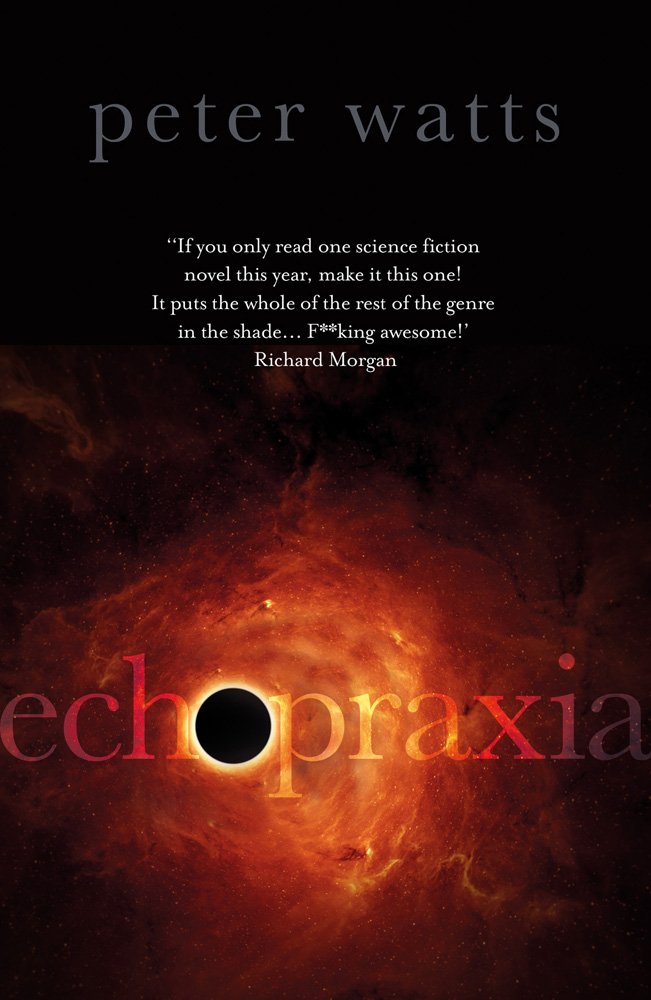
Cover by Jessie Price.
***
And Now—Our Main Attraction. (Please turn off your cell phones.)
***
Up in the frigid wastes of Scarberia— not too far from the Magic Bungalow, as it turns out— there’s an unremarkable door set into an unremarkable brick wall in an unremarkable industrial park. It’s nothing you’d look at twice, if you didn’t know that it was a portal to a whole other world. Think of it as the back of the wardrobe, from those Narnia books.
Assuming, of course, that the Narnia books had been written by HP Lovecraft.
One of the cool things about having fans is that you never know what any one of them might turn out to be. You answer an email from some anonymous reader and they turn out to be half an industrial rock duo with NASA connections, or an astronomer whose brain you can pick when you find yourself on thin ice. I have a whole subdirectory of such wondrous fans, ripe for exploitation.
A few of them have turned out to be economists; I’ll be exploiting them a fair bit over the next few months. But only one of these economists has a partner who makes disembodied bodies for a living. The company she works for is called MindWarp, and you’ve seen their handiwork in everything from “12 Monkeys” to “Pacific Rim”. Not to mention “Hannibal”, for which they do pretty much all the rubber work these days.
Thanks to Joe Fenner (the Economist) and Jenn Pattinson (the Rubber Woman), I got a chance to take my whole family to antiNarnia for a visit last week. Some of what we saw has yet to appear in public. I wish I could show it to you— some of it moves— but the unaired stuff is embargoed.
If you watch any kind of genre at all, though, you may recognize a fair bit of what follows. (All pics can be embiggened by clicking.)
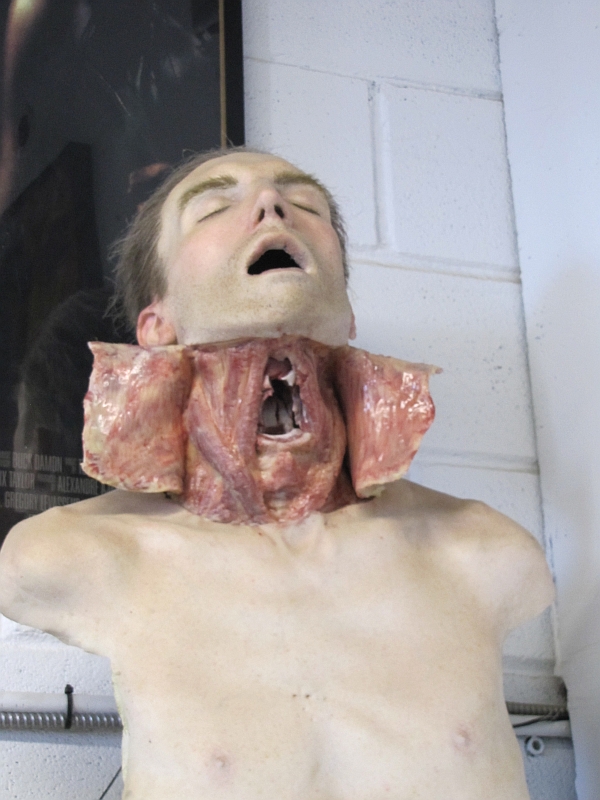 I believe this was from the episode where the crazed violinist use a bow to play the guy’s vocal cords. |
 Not sure which instrument this guy was played on. Maybe the kettle drums. |
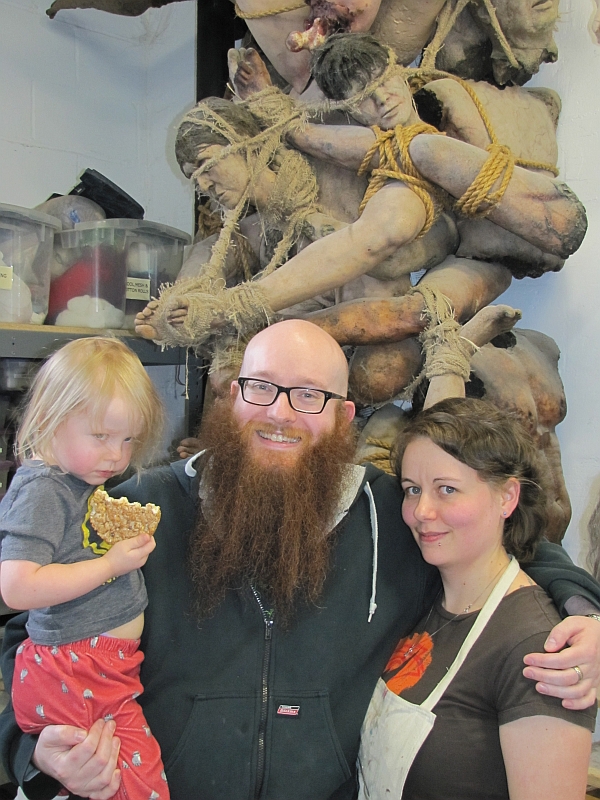 One of these people is an economist. One of them builds corpses. One will be spending a lot of time in therapy. |
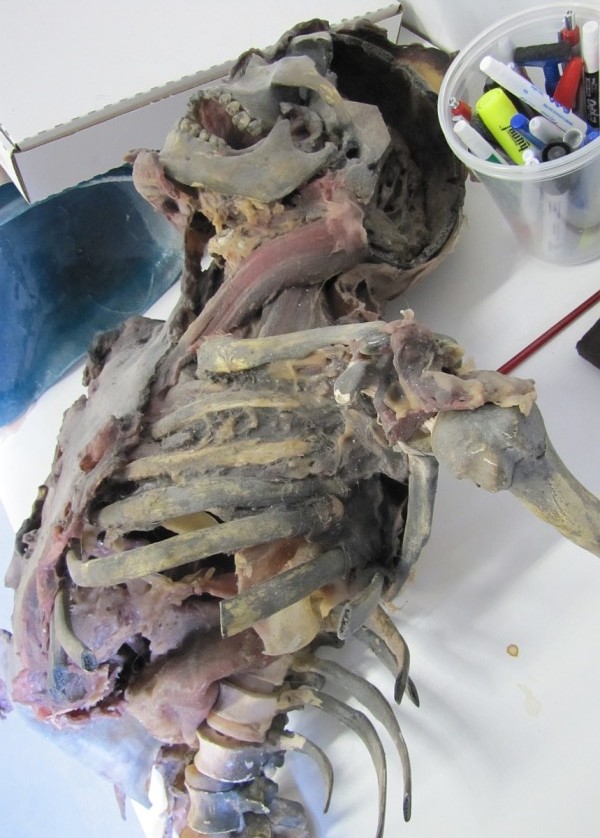 If any of you are still watching “12 Monkeys”, this is where the virus came from. (The crayons? This pic was taken in MindWarp’s on-site daycare center.) |
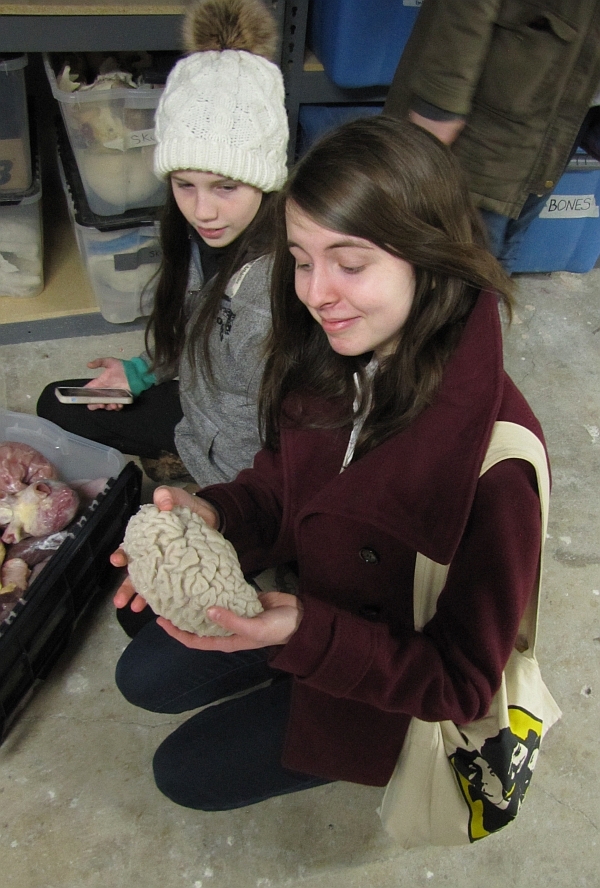 The brain in Mesopone’s hands is a bit of FX. The tribble on Micropone’s head is not. |
 The truly creepy thing is, these things don’t just look real; they feel that way, too. |
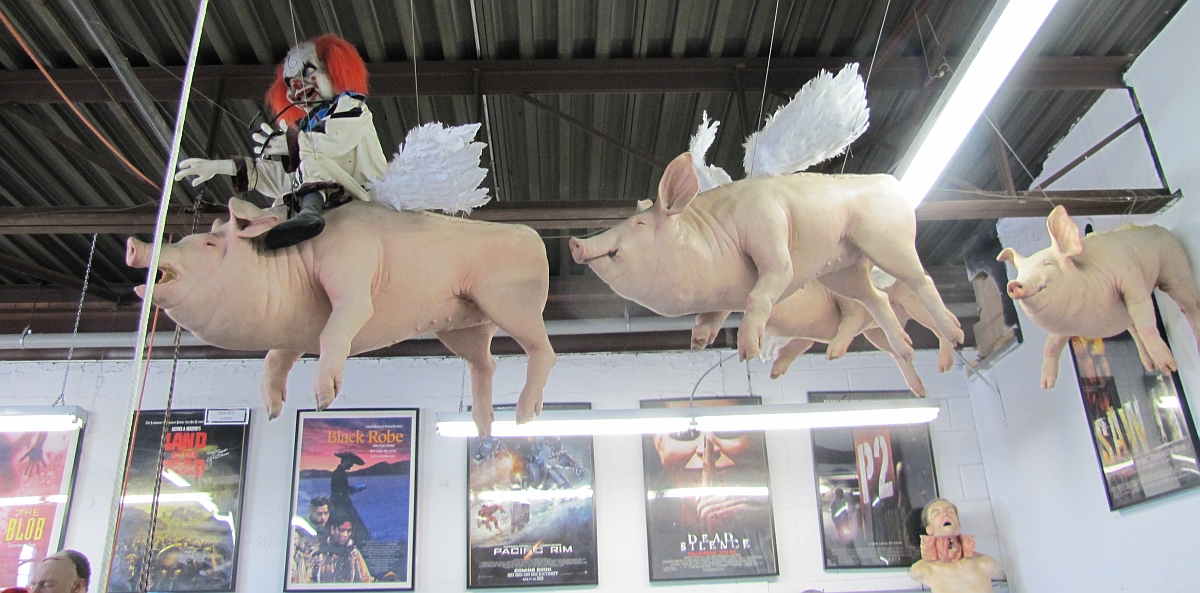
A bit of whimsy to lighten the mood. Also a sampling of the productions to which MindWarp has contributed (just out-out-of-frame: every Saw movie ever made). “Pacific Rim” surprised me; I thought that was all CG. “Black Robe” surprised me more; that was just missionaries and Iroquois. (Although I guess there were some pretty explicit torture scenes in there…)
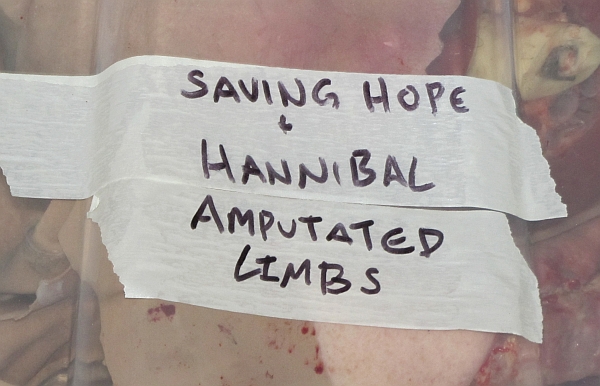 Tell me this wouldn’t be the coolest chick-flick crossover ever.  I’m not entirely sure. |
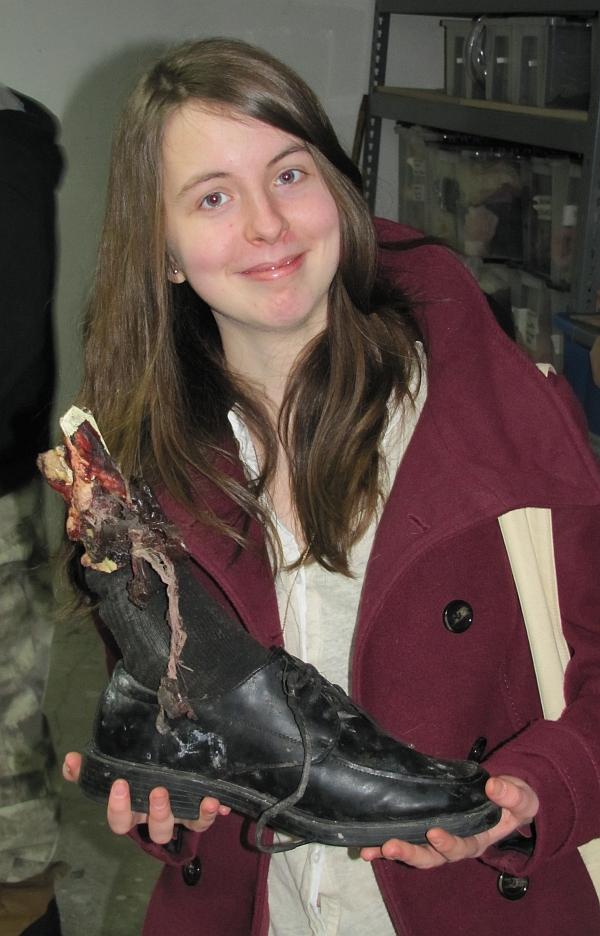 Mesopone, aka “The Meez”, holding a tragic reminder of the Human cost of the Polish Alcohol-Industrial Complex. |
 This is not a movie prop. It was built for the sole purpose of dropping down on unsuspecting trick-or-treaters during Hallowe’en. |
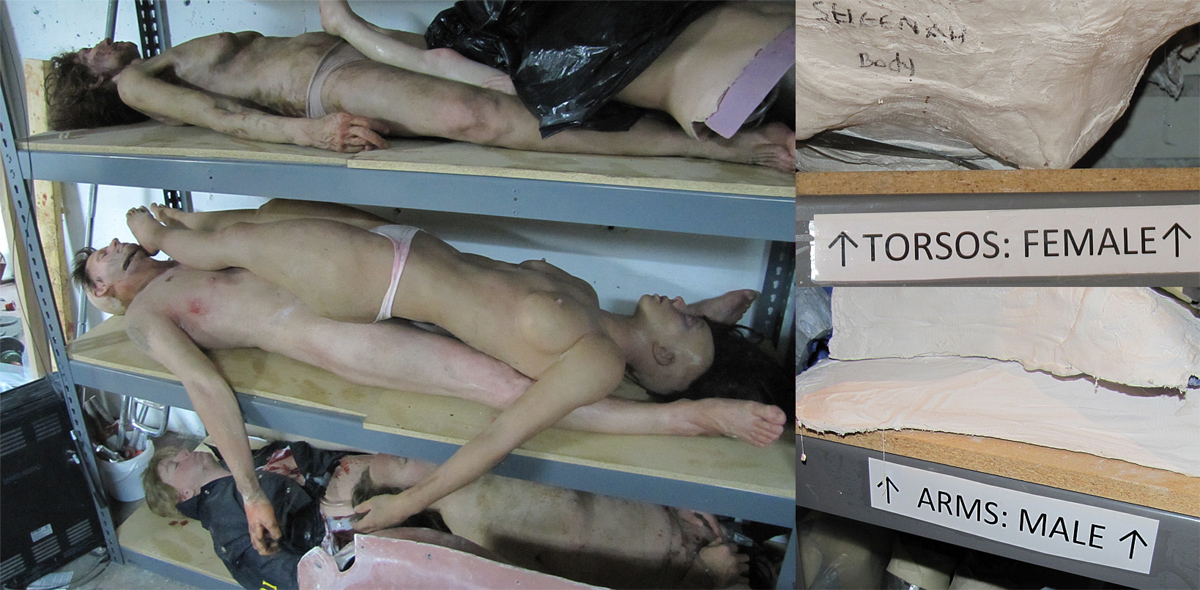
Who doesn’t wish they had a basement storage room like this?
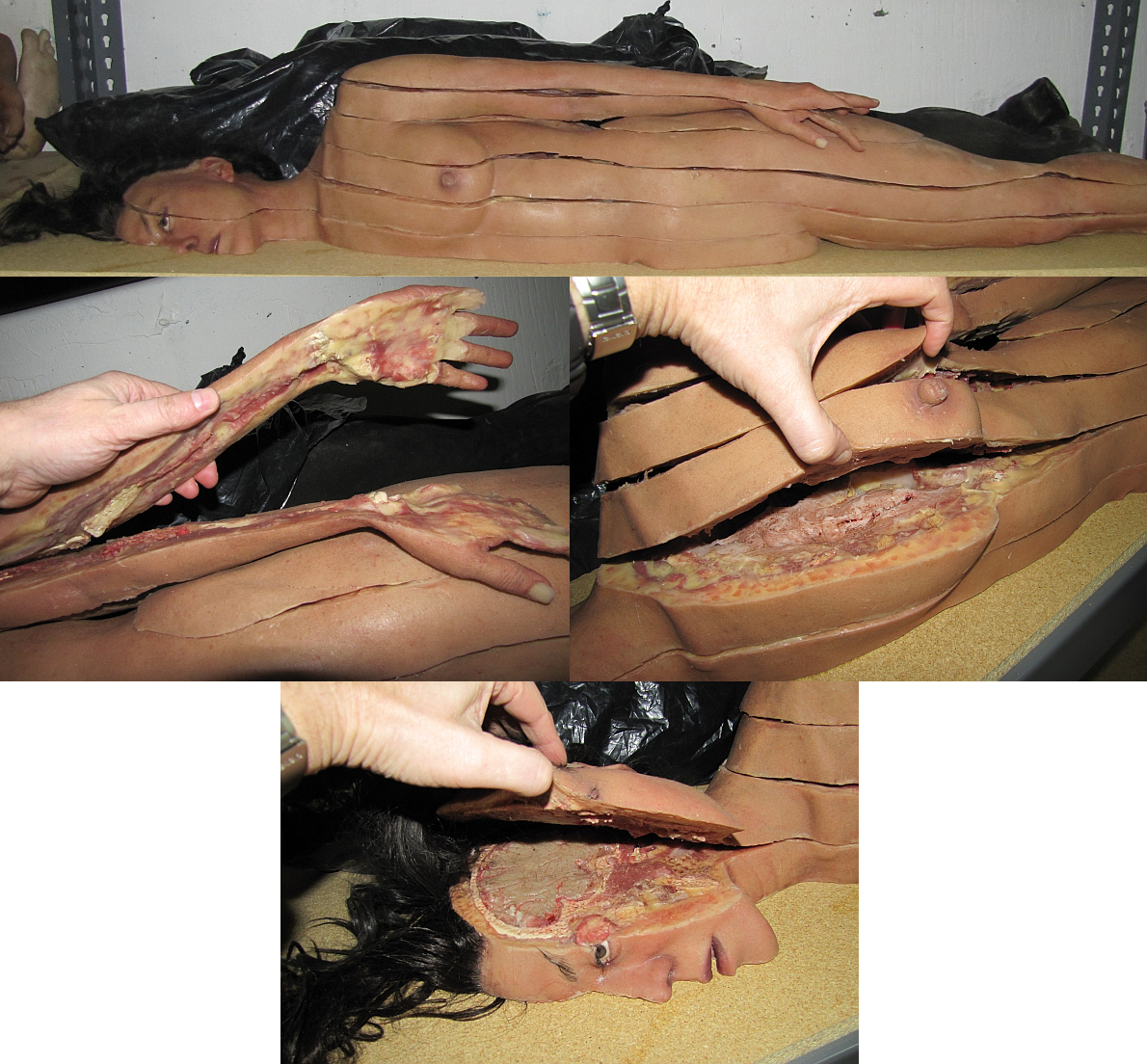
Lesser FX houses would just build a solid mannequin, slice it up, and paint the slices. Not these guys. These guys built the body from the inside out— viscera, skeleton, body fat, connective fascia, musculature— and then carved it up. I don’t know if mere pictures can convey the icky verisimilitude of the result.
 The tragic cost of teen pregnancy. |
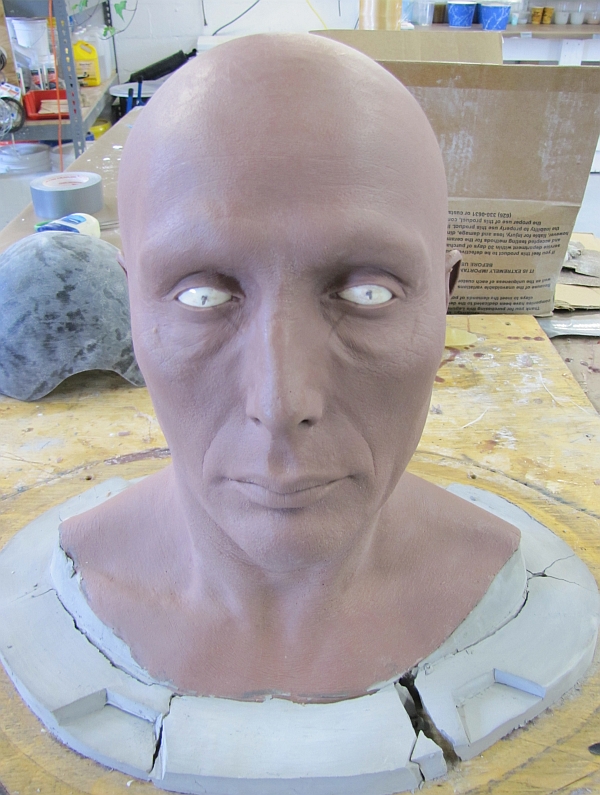 Dream therapist. |
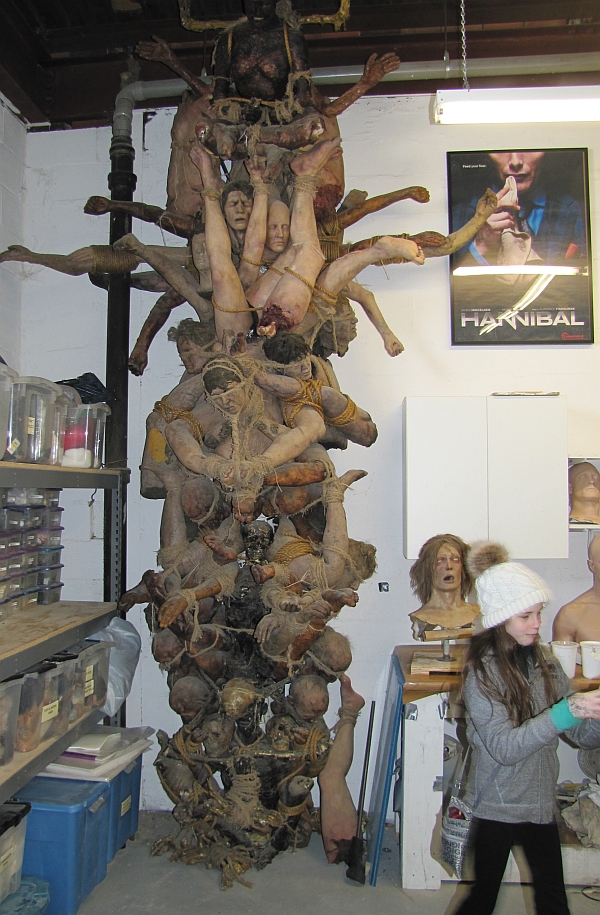 Poantempole. |
TertiarymattSaw these guys live at the Highline with Annie, along with Ancient Warlocks, Ramming Speed, and Valient Thorr. Many battle jackets were to be seen.
Dead simple, fun video. Not to be watched if you're afraid of evil dwarves, though.
TertiarymattDie Yuppie Scum
TertiarymattEven if you don't give a shit about R, this will help you learn about FOAAS.
There are two things that make R such a wonderful programming environment - the vast number of packages to access, process and interpret data, and the enthusiastic individuals and subcommunities (of which rOpenSci is a great example). One, of course, flows from the other: R programmers write R packages to provide language users with more features, which makes everyone's jobs easier and (hopefully!) attracts more users and more contributions.
But what if you have an idea, or a need, but not the time or confidence to write a package for it? I can't speak for this blog's readers, but I've been writing R for about two years and it took a good long while before I felt comfortable contributing upstream to CRAN. Or, what if you do have the time, and do have the confidence, but want to spend that time well, on things that you know other people will find useful, and don't know what that is?
After a conversation on Twitter (where all the best R things happen) we've decided to create a dedicated repository to serve as a wishlist of scientific R packages - appropriately named "wishlist". We're still getting the "meta" documentation together, but it's open and accepting ideas!
If you've got an idea for a package, but are looking for collaborators, open an issue! Explain what the package does, what its necessary features are, and what the use cases are. What sort of help are you looking for - someone to write the entire thing? Someone to work on integrating a particularly thorny piece of C++? A statistics expert to check the implementation of an algorithm? Are there any C or C++ libraries we could integrate? Are there libraries in other, less-easily-integrated languages which we could use as a template for what the package should do?
Once an idea is accepted, it lives on the wiki. If you've got the time to work on a project, head over there and see if anything strikes your fancy. If it does, contact the original authors and the other volunteers, start a repository somewhere, and have fun! Just make sure to note ''on'' the wiki that you're working on it, and where you're doing so, for the sake of future readers :).
The only criteria for an idea's inclusion is that the package serve a clear scientific use (as an example: "wouldn't it be nice if we had an API client for this data repository?" qualifies. rfoaas probably wouldn't). A good heuristic would be: if you can explain how this package would benefit scientists or researchers in a way that's convincing to you, propose it!
TertiarymattSome really good results, and some good images, too. Really impressive development on the old rolls.
 |
| R3 processed TMY |
 |
| Efke 25 4x5. Ted McLelland |
 |
| Ilford Pan F Plus D Fyler |
 |
| Ilford Pan F Plus R Crowley |
 |
| TMX 120 D Fyler |
 |
| TMX 120 D Fyler |
 |
| TMX 120 D Fyler |
 |
| TMX 120 D Fyler |
 |
| TMX 120 D Fyler |
 |
| TMX 120 (crop) |
 |
| TMX 120 |
 |
| TMY 135 R Crowley This was a lost roll, unprocessed for 20 years. |
 |
| Tri X 6x7 R Crowley |
 |
| A very old roll of Pan X 120 found in a flea market TLR and processed in R3 |
TertiarymattI feel like this post is going to annoy Lev.
 There were 325 comments on my previous post the last time I checked. I haven’t read all of them. But a number of them appear to be discussing the matter of Enlightenment. Someone said that Zen is definitely a religion because it promises Enlightenment, which is the freedom from suffering.
I never really understood that. My teachers never said anything remotely like, “This practice will bring you to Enlightenment, which is freedom from suffering.” The only places I ever saw or heard statements like that were in books and magazine articles that I did not trust, or from people who clearly had no idea what they were talking about. Those people and, of course, Yoda from Star Wars.
I can’t tell you whether the practice of Zen will lead you to Enlightenment and relieve you from suffering. I’ve done this stuff for over thirty years now, though, so I may be able to say a little about what it seems to have done for me.
To me, meditation — zazen specifically — is a way to decrease some of the distractions of the mind. We don’t realize, generally, how incredibly distracted we are by the processes going on in our own brains. But if you work on dealing with some of your distractions you discover that there was a whole world out there you had not noticed before because you were too distracted to perceive it. Do this for long enough and a shift in perception/understanding occurs. At least that’s how it was for me.
I don’t like words like “Enlightenment” or “kensho” or “satori” or “awakening” or any of the other terms commonly used to refer to what happens after you do this process for a long time. They’re inaccurate and misleading. However, after years of doing this process I had a number of interesting shifts in my understanding of things. There was one major shift and countless clusters of others that accompanied it and that keep on occurring even now.
People tend to picture these experiences as a change from confusion to certainty. In a sense that’s kind of the way it is. But the certainty is more about what’s not true than about what is true.
For example, before this stuff started happening to me, I would have pictured Enlightenment as giving me, among other things, certainty about whether there is or is not a God and whether there is or is not life after death. I thought the answer would be either yes or no. How could there be any other answer to questions like that?
Now I comprehend that there is another answer and that is; “framing such questions in the form that requires a yes or a no as an answer is absurd.”
The problem is that EVERYONE HATES THAT ANSWER. You hate it. I hate it. The Pope hates it. Pat Robertson hates it. Richard Dawkins hates and despises it so much he hacks up a giant phlegm ball and spits on it. Deepak Chopra hates it more than Oprah does. You will never make big money with that kind of answer.
I understand now that the very way I was trained to think and to communicate my thoughts to others does not allow for me to answer these questions any better than that. There is no linguistic solution to this particular problem. When I say that there is certainty, that’s what I’m referring to. This aspect of the problem is certain.
Language communicates common experience. If you have seen a plate of shrimp and I have seen a plate of shrimp, then when I say “plate of shrimp” to you, you have some idea what I’m talking about. But if you said “plate of shrimp” to an inhabitant of the planet Mephiras in the Andromeda Galaxy, zhe would have no idea what you were talking about.
Sometimes, if I’m talking to someone else who has sat with their own minds for a few decades, I can discuss matters like this and can communicate about them. But I can’t put straightforward answers to these kinds of questions into a blog or a book. I’ve tried. Dogen tried. Lots of people have tried. It doesn’t work. The questions themselves make it impossible. Although if you sit for a long time observing your own mind, you can sometimes read things like the stuff Dogen wrote (to take one specific example) and they’ll make sense to you.
So that’s Enlightenment in 200 words or less. What about suffering? Does this practice lead you to freedom from suffering?
Well… my friend Logan died last year and that made me very sad. It still does. A couple months ago I caught a cold and I felt like shit for a few days. Next time I catch a cold, the same thing will happen. I sometimes wish I had things I don’t have. I sometimes wish I did not have things I do have. I dislike doing certain things that I nevertheless must do, like my taxes. And so on and on.

Any excuse to run this pic again is good enough for me. Look! It’s in color now!
What would relief from suffering look like? Would it look like Father Yod in his swimming pool full of naked girls? Would it look like Neem Karoli Baba sitting under a blanket with a bunch of people asking him questions and feeding him oranges? Would it look like Tom Cruise in a mansion in Beverley Hills with enough money and fame to buy him anything on eBay or Craig’s List? Would it look like Krishna, perpetually beautiful and immortal?
What are you asking for when you ask for an end to suffering? Do you even know? Maybe you do, but I don’t.
Are you asking for a way in which you can do your taxes and enjoy it? Are you asking for a way in which you can have cancer and yet not feel shitty? Do you think that exists? Do you wish it existed? Will wishing it existed make it so?
Don’t fill my comments section up with answers. Thanks.
UPCOMING EVENTS
April 3, 2015 Pomona, CA Open Door 2 Yoga 6 pm 163 W 2nd St, Pomona, California 91766
April 24-26, 2015 Mt. Baldy, CA 3-DAY ZEN & YOGA RETREAT
May 16-17, 2015 Nashville, TN 2-DAY RETREAT AT NASHVILLE ZEN CENTER
July 8-12, 2015 Vancouver, BC Canada 5-DAY RETREAT at HOLLYHOCK RETREAT CENTER
August 14-16, 2015 Munich, Germany 3 DAY ZEN RETREAT
August 19, 2015 Munich, Germany LECTURE
August 24-29, 2015 Felsentor, Switzerland 5-DAY RETREAT AT STIFTUNG FELSENTOR
August 30-September 4, 2015 Holzkirchen, Germany 5-DAY RETREAT AT BENEDIKTUSHOF MONASTERY
September 10-13, 2015 Finland 4-DAY RETREAT
ONGOING EVENTS
Every Monday at 8pm I lead zazen at Silverlake Yoga Studio 2 located at 2810 Glendale Boulevard, Los Angeles, CA 90039. All are welcome!
Every Saturday at 9:30 am I lead zazen at the Veteran’s Memorial Complex located at 4117 Overland Blvd., Culver City, CA 90230. All are welcome!
Registration is now open for our 3-day Zen & Yoga Retreat at Mt. Baldy Zen Center April 24-26, 2015. CLICK HERE for more info!
Plenty more info is available on the Dogen Sangha Los Angeles website, dsla.info
* * *
Are you suffering from too much money? Relieve your suffering with a donation to the continuing operation of this blog!
“What do you see in my eyes?” “Death.”
—from 1936’s Dracula’s Daughter
The image of the cinematic vampire femme fatale is so ubiquitous, it’s strange to think that Dracula’s Daughter, its earliest iteration, was the only one of its kind for a generation. It becomes markedly less strange, though, when these characters are seen as dots on a timeline, with a rise in cinematic vampire women paralleling changing social attitudes about feminism. What easier form is there for an ambitious woman than a monster, and what better way to subvert derogatory attitudes then by making them infinitely powerful and alluring?
Dracula’s Daughter arrived at Universal in 1936, an unwanted stepchild of its horror family, more famous for an absence of Bela Lugosi than the presence of anything in particular. Studio disillusionment was palpable in the way it was sold: The trailer halfheartedly promised, “More exciting than DRACULA,” with the exclamation point sheepishly excised. But the film offered images that became a blueprint: Contessa Marya Zaleska (Gloria Holden) is a woman of preternatural self-possession, with intellect and powers above those of mortal men. She also trends toward the Sapphic—a poster warned, “Save the Women of London from Dracula’s Daughter!”
The film itself, though with fewer Gothic thrills than its predecessor, is buoyed by a focus on the psychology of its namesake, inviting feminist interpretations. Zaleska—who keeps a manservant to clean blood off her evening cloak, and bends others to her will almost as an afterthought—longs for independence from Dracula’s ways, burning his body in hopes of shaking the family legacy: “Free to live as a woman,” she vividly imagines, “free to take my place in the bright world of the living!” She even hopes psychiatry can cure her, though it takes only one fetchingly aimless young woman to push Zaleska off the wagon. And smarmy Dr. Garth (Otto Kruger) soon discovers her powers easily overcome the male condescensions of science. The only thing stronger than Zaleska… is death. (Exclamation point sheepishly excised.)

The movie underperformed, and ended up being the last of Universal’s initial run of classic-monster movies, but Zaleska—longing to escape from patriarchal obligations—became the first onscreen vampire with a feminist agenda. Appearing less than a generation after American suffrage, a mere eight years after full U.K. suffrage, and three years before Countess Zaleska could have voted in Romania, that’s no small feat.
Vampirism is a charmingly reliable metaphor for a particular brand of cinematic feminism. There’s no more economical embodiment of the powerful woman as both terrifyingly predatory and soothingly seductive. Whether it’s Hammer’s chemised pin-ups or hyper-stylish Miriam Blaylock in The Hunger, tucking desiccated conquests out of guests’ sight, the vampiric woman reflects both the horror premise that a powerful woman is a direct threat—a literal bloodsucker, out for domination—and the fantasy premise that even if a woman who casts no reflection is out to kill you, she’ll still take the time to look her best. And as the cultural discussions around feminism shift, so too do onscreen portrayals of vampire women.
The transformative nature of vampirism, and the autonomy that comes with it, is crucial. Dracula had his captive brides, but usually, the lady vampire is an active, independent figure in her narrative; she holds the frame with that force of will. Vampirism in film is largely its own occupation—cinematic vampires are consumed with the hunt for blood, the search for love, or the nature of immortality itself. A female vampire is, by default, a career woman. She might not always be elite (as with the blue-collar vampires of Near Dark), but vampirism provides her both goals and resources—a powerfully feminist combination. It also suggests freedom from prescribed sexual and social mores, a narrative pulp culture has never hesitated to explore.
Though some filmmakers (like Jean Rollin) explored this connection through original mythology, many drew on foolproof source material. Sheridan Le Fanu’s 1872 novel Carmilla is a playground of psychosexual Gothic tropes, including a lesbian vampire whose desire for a milquetoast ingenue eventually blows her cover. Carmilla is a mysterious firebrand perfectly suited to cinema about women’s taboo appetites. Roger Vadim adapted it as the surreal, slightly straightwashed baroque feature Blood And Roses, but perhaps the most familiar exploration is 1970’s The Vampire Lovers. A more-faithful-than-expected Hammer adaptation of Carmilla, it follows enigmatic Carmilla (frequent Hammer star Ingrid Pitt) as she ingratiates herself with virgins of the country gentry, drawing them away from fiancés and fathers, and putting them under her influence. With Carmilla seducing victims in a very literal sense, that influence is largely erotic, to nobody’s surprise: the source material is Sapphic, the studio is Hammer, and the gaze of the lens is male.

But Carmilla’s intent reads as something other than mere lust, bloody or otherwise. Pitt’s cool-eyed dismissal of men’s opinions repeatedly swamps the frame—the real warning sign, the movie suggests, of her evil. In the soft-focus, softcore Hammer wonderland, intimate moments with her familiars are framed as enthusiastic love scenes or as bittersweet struggle. Carmilla is tempted to kill the girl she loves—at the psychic behest of the horseman who haunts her steps, which only underscores hatred of men as the major conflict.
Coming in the midst of second-wave feminist discussions of sexual freedom as crucial to an independent life, women’s eagerness to keep Carmilla’s company suggests a mirror to political lesbianism, the movement that emerged within the second movement in which activists were encouraged to disown men altogether, regardless of sexual orientation. All three of Carmilla’s targets abandon men’s attentions in Carmilla’s favor. In that light, the film hints at a campy undead female solidarity. (The film beat the cult honeymoon-disaster tone-poem Daughters Of Darkness to the post by a year: Daughters also had the subtext of sisterhood at the expense of men, with vampire Elizabeth Bathory attempting to rescue a newlywed from the clutches of her abusive husband.)
The lustful-vampire sisterhood quickly became one of horror’s most popular low-budget tropes. It got a particularly explicit narrative in 1974’s Vampyres, which is more concerned with the sex life of its lesbian couple than any vampire lore. But even that movie claims as its most uncanny moment a post-coital male victim awakening to find seductress Fran (Marianne Morris) watching him with unblinking eyes, an inversion of the usual sexual gaze—both his and the camera’s. And in Tony Scott’s The Hunger, one of cinema’s most stylish takes on the female vampire, Miriam (Catherine Deneuve) sets aside David Bowie himself in favor of the more modern Dr. Sarah (Susan Sarandon)—who decides she wants nothing to do with the lifestyle to which Miriam’s consigned her. Though Scott’s original ending left it ambiguous whether anyone survived, MGM insisted on an epilogue that showed Sarah making the most of the luxe afterlife, with Miriam a half-living specter of her past.

Reportedly, neither Scott nor Sarandon approved of the ending, seeing it as too neat a finish for a story suffused with the visual entropy of addiction. But it was the beginning of a new era for the vampire femme fatale—one who sought to examine and understand her nature, and who often rejected her expected role, or asked the audience to reject their expectations. These were Dracula’s granddaughters.
Some of the most deliberate deconstructions of the vampire woman are those that actively engage with the supposed eroticism of the familiar image, turning it into an element of horror. In Interview With The Vampire, Neil Jordan uses Claudia’s immortal ennui as currency, trading on the unsettling imagery of Kirsten Dunst growing up and getting wise when the men around her didn’t want her to. Claudia becomes keenly observant and bitter about her forced girlhood, killing the man who kept her in girls’ dresses, and claiming his partner as her lover in a scene staged as near-religious iconography, designed to raise questions about the sexual expectations placed on women in a man’s world. (It’s the same monstrous-girl taboo that became the linchpin of the moody, understated Let the Right One In.) However, in an age of debate about sex positivity and its portrayals in popular culture, Jordan himself returned to the unerotic identity in Byzantium, in which Gemma Arterton’s sexuality-as-performance in skintight dresses and thick eyeliner are shot with such asexual detachment, they take on the the wildlife-documentary dread of an insect luring a meal.
Feminism has become so powerfully entwined with the pop-culture image of the woman vampire that it’s possible to remove the signifiers of vampirism and maintain a perfectly recognizable vampire narrative. Park Chan-wook followed up Thirst (in which a female vampire is ruthless beyond death) with the Connecticut Gothic masterpiece Stoker. The pitch-black comedy centers on the uncanny, incestuous, uncomfortably-erotic exchange of power between young India (played with exhausting alertness by Mia Wasikowska) and her sociopathic uncle Charlie (Matthew Goode), who comes to town with a seductive fixation on India, just as the maternal figures in her life start mysteriously disappearing. India is initially seduced by his interest, but soon she discovers her real interest is in her own potential for destruction instead. (Even her primary sexual experience is masturbation—this is a young woman decisively realizing codependence doesn’t suit her.) In her triumphant moment, she eclipses her male influencer, accepts her appetite for death, and learns at last to protect the women of the family—all without a fang in sight.

The bloodless vampire is more the exception than the rule, of course. The genre still eagerly returns to some common signifiers, even after the pulp taboo has lost its thrill: the enigmatic calmness, the subtle effects on the natural world, the gleaming blood, the supernaturally pale skin. (There’s feminist subtext to be found in movies featuring vampires of color—Hollywood has doled out N’Bushe Wright’s Dr. Karen Jenson, whose vampiric limbo in Blade rallies her to the cause, Lucy Liu’s vengeful Sadie in the D-movie Rise: Blood Hunter, and more recently the Girl from A Girl Walks Home Alone At Night—but largely, cinematic vampirism is still a white woman’s game.) 2014’s Only Lovers Left Alive centers a quietly feminist vampire that embodies all these qualities: Eve (Tilda Swinton), a bohemian dilettante with the calm mien of long and unquestioned autonomy. Even her thirst is easily satisfied with bagged blood, with hunting as a last-ditch option; she’s a rare glimpse of the vampire with nothing left to rebel against.
It’s noteworthy, then, that A Girl Walks Home Alone At Night was also released in 2014. Its nameless vampire girl (Sheila Vand) is stranded in Iran’s mythical Bad City, a positively misandrist edge-of-the-wilderness town ringed by a ditch of men’s corpses. Within its cultural context, the Girl stalking the night and eliminating men who threaten women is such a feminist character that she doesn’t even need a name. Her very presence is vengeance against violent men (mistreating a woman—or suggesting the intent to—is a one-way ticket), and the vampire is just the form in which that social resentment has been most recognizably made flesh. Women still can’t safely walking home alone at night. The vampire-girl signals her supernatural nature simply by her fearlessness.

It’s striking to realize that the Girl and Eve would hardly recognize each other if they met. They’re two of Dracula’s daughters who have split markedly far from that matriarch of the family tree. The breadth of the trope visible between them feels like the fulfillment of Le Fanu’s haunting Carmilla conclusion: “…to this hour the image of Carmilla returns to memory with ambiguous alternations—sometimes the playful, languid, beautiful girl; sometimes the writhing fiend I saw in the ruined church; and often from a reverie I have started, fancying I heard the light step of Carmilla at the drawing-room door.” That’s the nature of any cinematic idea that so directly reflects its cultural climate. In these films, the changing nature of these vampires mirrors the promise that women will be what they must be to survive.
TertiarymattValue-in-magical-thinking beat?
On Friday my friend Bryan Clark told me about a film called An Honest Liar and I took him up on his invitation to go see it. I’m glad I did. It’s a really good film.
It’s a documentary about the Amazing Randi. James Randi is a Canadian magician who made a cause of exposing other magicians who, rather than being honest about their use of tricks and sleight of hand, presented themselves as psychics and faith healers. Randi was angered by how these people used the same sorts of tricks he entertained audiences with to lie to their followers and swindle them out of their money.
In the Seventies, James Randi famously exposed the fakery of spoon-bending psychic Uri Geller and phony faith-healer Rev. Peter Popoff. Yet, even after being exposed as fakes, both Geller and Popoff prospered rather than faded away.
James Randi is a big fan of hard-line Skeptics (with a capital S) like Richard Dawkins and Sam Harris. Neither appear in the film, but after the screening I saw at the Nuart Theater, co-director Tyler Maesom did a Q&A in which he mentioned this. I think he said they interviewed Dawkins for the movie but didn’t use it in the final cut. Maesom also mentioned that he’d gotten interested in the Amazing Randi because he was raised a Mormon and had a lot of anger around finding out he’d been lied to by the Church.
This got me thinking of another documentary I saw at the Nuart Theater, New York Doll. This film tells the story of Arthur “Killer” Kane, bass player for the New York Dolls. It’s also the subject of one of Robyn Hitchcock’s best songs, NY Doll. In a nutshell, after the New York Dolls’ short and explosive career came to an end, Arthur Kane found himself adrift and broke in Los Angeles, doing lots of drugs and attempting suicide by jumping out his kitchen window.
 Then one day, Kane happened to walk into the big Mormon Temple on Santa Monica Boulevard. The Mormons took him in, got him off drugs, gave him a sense of purpose and even helped him get the Dolls back together for one last show with the original members. Then just 22 days after that show, Kane died of leukemia at age 55. He’d had the disease for a long time and it was the prospect of the reunion show that kept his spirits up enough to keep on going.
I started to wonder; Would Arthur Kane have been better off if, instead of the lying Mormons, he’d run into the truth-telling, falsehood-debunking followers of Richard Dawkins instead?
We know the answer. Dawkins and his friends could have offered Kane plenty of hard truths but no comfort. Kane wouldn’t have made it to that Dolls reunion and his final years would have been much sadder than they were.
Sure, all that stuff in the Book of Mormon about Joseph Smith finding golden tablets that mysteriously disappeared before anyone else got a look at them and the rest of it is bullshit. The way they flip-flopped on the issue of whether black people could go to Heaven and their intolerant stance on homosexuality is reprehensible. Yet in spite of this, they are able to do their members a lot of good in ways that skeptics are woefully unable to.
I think that in Zen, we try to find the Middle Way through all of this. The Zen attitude towards its own scriptures and ceremonies has always been thoroughly skeptical. To cite just one example, even though the Lotus Sutra says Buddha could fly and that his lectures were attended by all sorts of weird beings from alternate universes, nobody in the Zen lineage ever insists that you need to actually believe any of that stuff. And even though we hold elaborate religious style services with plenty of chanting, bowing and incense offerings to statues, there is never any pressure to believe that some kind of magic happens when we do that stuff.
I’m basically a skeptic. But I’m not a hardline skeptic. I see the value of a certain degree of faith. It’s rational to have faith sometimes. Not faith in the supernatural, but faith that what we know is not all there is to know.
Groups like the Mormons and others like them offer what they offer for a price, and that price is that you must believe. In a brilliant article for the LA Weekly called Why I’m Not an Atheist, Henry Rollins speculated on the origins of religion and said some of the same stuff I often say (Henry, do you read me?). He said, “Since there aren’t enough resources for everyone to have a personal cop monitoring their every action, there must be a mega-cop so huge that his omnipresence is invisible and unquestionably powerful. This is what I figure religion is. Try to be good. Being human, you will make mistakes, but all is not lost. You can ask to be forgiven; by meditating on your mistake, you will see that it would be unwise to repeat the behavior. Throw in the idea of punishment and reward and it’s a workable system.”
Yet that system is breaking down under the weight of skepticism and the wider understanding of how the universe really works. It’s harder and harder for people to believe in their old Gods. Some try to take up arms against science but it’s a fight that’s doomed to fail.
What we need is a religion without beliefs. Fortunately we already have one and it’s been around for a long time.
UPCOMING EVENTS
April 3, 2015 Pomona, CA Open Door 2 Yoga
April 24-26, 2015 Mt. Baldy, CA 3-DAY ZEN & YOGA RETREAT
May 16-17, 2015 Nashville, TN 2-DAY RETREAT AT NASHVILLE ZEN CENTER
July 8-12, 2015 Vancouver, BC Canada 5-DAY RETREAT at HOLLYHOCK RETREAT CENTER
August 14-16, 2015 Munich, Germany 3 DAY ZEN RETREAT
August 19, 2015 Munich, Germany LECTURE
August 24-29, 2015 Felsentor, Switzerland 5-DAY RETREAT AT STIFTUNG FELSENTOR
August 30-September 4, 2015 Holzkirchen, Germany 5-DAY RETREAT AT BENEDIKTUSHOF MONASTERY
September 10-13, 2015 Finland 4-DAY RETREAT
ONGOING EVENTS
Every Monday at 8pm I lead zazen at Silverlake Yoga Studio 2 located at 2810 Glendale Boulevard, Los Angeles, CA 90039. All are welcome!
Every Saturday at 9:30 am I lead zazen at the Veteran’s Memorial Complex located at 4117 Overland Blvd., Culver City, CA 90230. All are welcome!
Registration is now open for our 3-day Zen & Yoga Retreat at Mt. Baldy Zen Center April 24-26, 2015. CLICK HERE for more info!
Plenty more info is available on the Dogen Sangha Los Angeles website, dsla.info
* * *
It is rational to donate to the continuation of this blog since you are reading it. You can donate as little as one dollar! It all helps.
TertiarymattA solution to the "I need my morning coffee" problem?

Tonight’s comic is about fuckin’
TertiarymattThis is a remarkable bit of work, and also a REALLY TERRIBLE IDEA.
Evolution with Foresight: an oxymoron, right? Evolution has no foresight. Natural selection only promotes what works in the moment. If a particular mutation doubles your reproductive rate, you will fill the world with thy numbers; the process doesn’t understand too much of a good thing, doesn’t care if greater fecundity today means overpopulation, starvation, and extinction tomorrow. All it cares about is whether the latest edit gives you an edge right now. Natural selection is the very incarnation of instant gratification (which, I’ve always thought, explains a great deal about human stupidity.)
But what if we could build foresight into the system? What if we could build a gene for— I dunno, say reduced fertility, give the biosphere a break— and let it loose in the human population? Obviously it would go extinct; people with that gene would breed less, the rest of us would breed more, and a few generations down the road you’d be right back where you started.
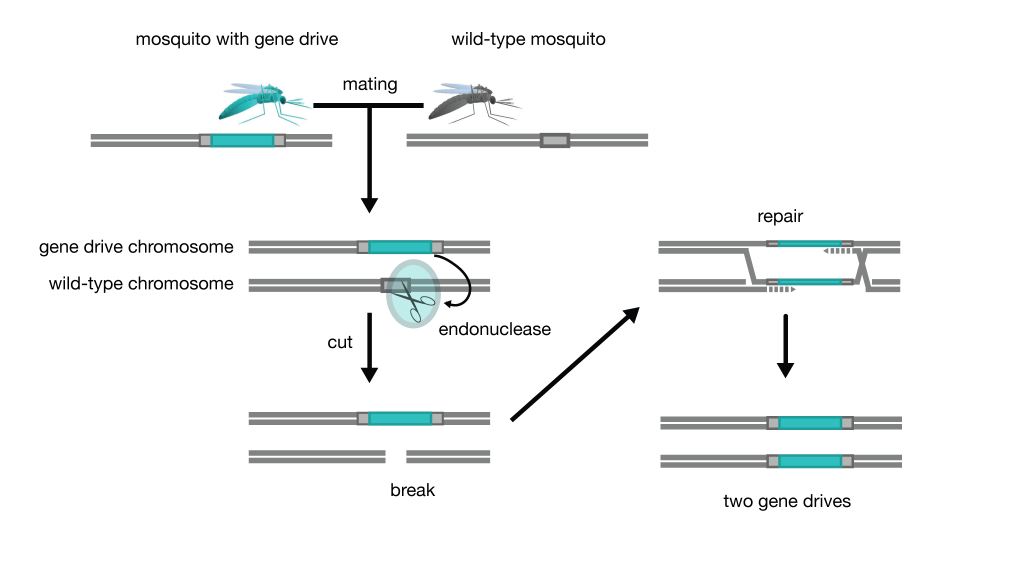
Today, Walden Puddle…
But what if— what if— you could force that gene onto the next generation, even if it reduced fitness in the classic sense? What if you could build code that would be beneficial over the long term, and ensure its spread even if it costs you in the moment? What if we could gift evolution with foresight?
Enter the Gene Drive, CRISPR/Cas9 for short. It’s a clever little machine built of enzymes and RNAs, and you can attach it to pretty much any gene you like. When a gamete from your transgenic organism hooks up with one from a baseline, CrisperCas detects the presence of the competing wild allele, cuts it out of the opposite strand, and splices your engineered code into the gap. It overwrites wild genes with engineered ones, turns heterozygous pairings homozygous. You can see how this would stack the odds.
And introducing engineered, virtually-unkillable genes into wild ecosystems to do our bidding?
What could possibly go wrong?
CrisperCas flew right under my radar when Esvelt et al took it on tour last summer (I was too distracted birthing Echopraxia). Fortunately this month’s piece in h+ got me up to speed, providing links to some of those earlier articles (also here and here). To do them credit, CrisperCas’s advocates admit that their technology has the potential to “alter ecosystems … so we’ll have to be very careful not to cause damage accidentally”. If that’s not enough assurance for you, Oye et al have also put out a piece in Science admitting that “Scientists have minimal experience engineering biological systems for evolutionary robustness”, and urging us all to get our ducks in a row before we start fiddling with their genes at the population level. They advocate extensive public consultation, careful risk management, and scrupulous regulation to make sure that nothing goes wrong. They introduce something called a “reverse drive”, which can be called upon when something inevitably does. (Reverse drives seem to be basically another iteration of the gene drive, configured to undo what the last one wrought. I’m thinking a better name might be “The Little Old Lady Who Swallowed a Fly Drive.”)
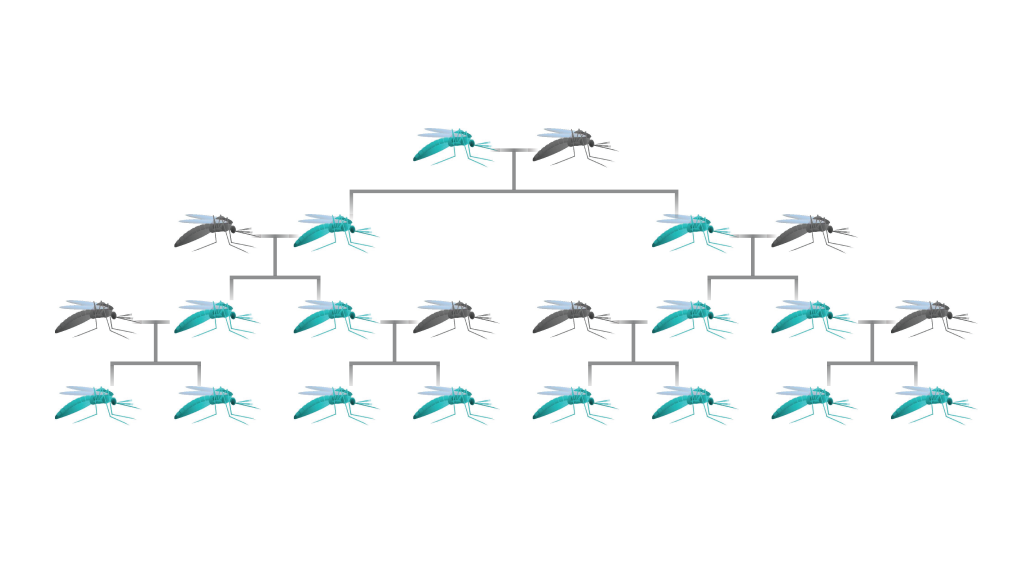
…Tomorrow, the World.
As Esvelt and his buddies point out, it would take centuries to engineer human populations this way; we large mammals are relatively slow breeders. They’re much more excited about inflicting the tech on other pest species; disease-carrying mosquitoes, for example, or crop-eating beetles whose resistance to the usual pesticides might be undone by gene drives. But I’m looking even further down: down past the insects, the protists, even the bacteria. I’m remembering that line from Dawkins— life is information, shaped by natural selection— and my recurrent musings (admittedly less cutting-edge now than they once were) that life can be built from ones and zeroes as easily as from carbon and nitrogen. Hell, if you buy into digital physics, that’s all any of us are anyway.
Natural selection with foresight. It could change the world even up here, albeit slowly. Think of what it could accomplish in your smart watch.
I wonder if this has anything to do with how the Maelstrom gets started…
Tertiarymatt#birb
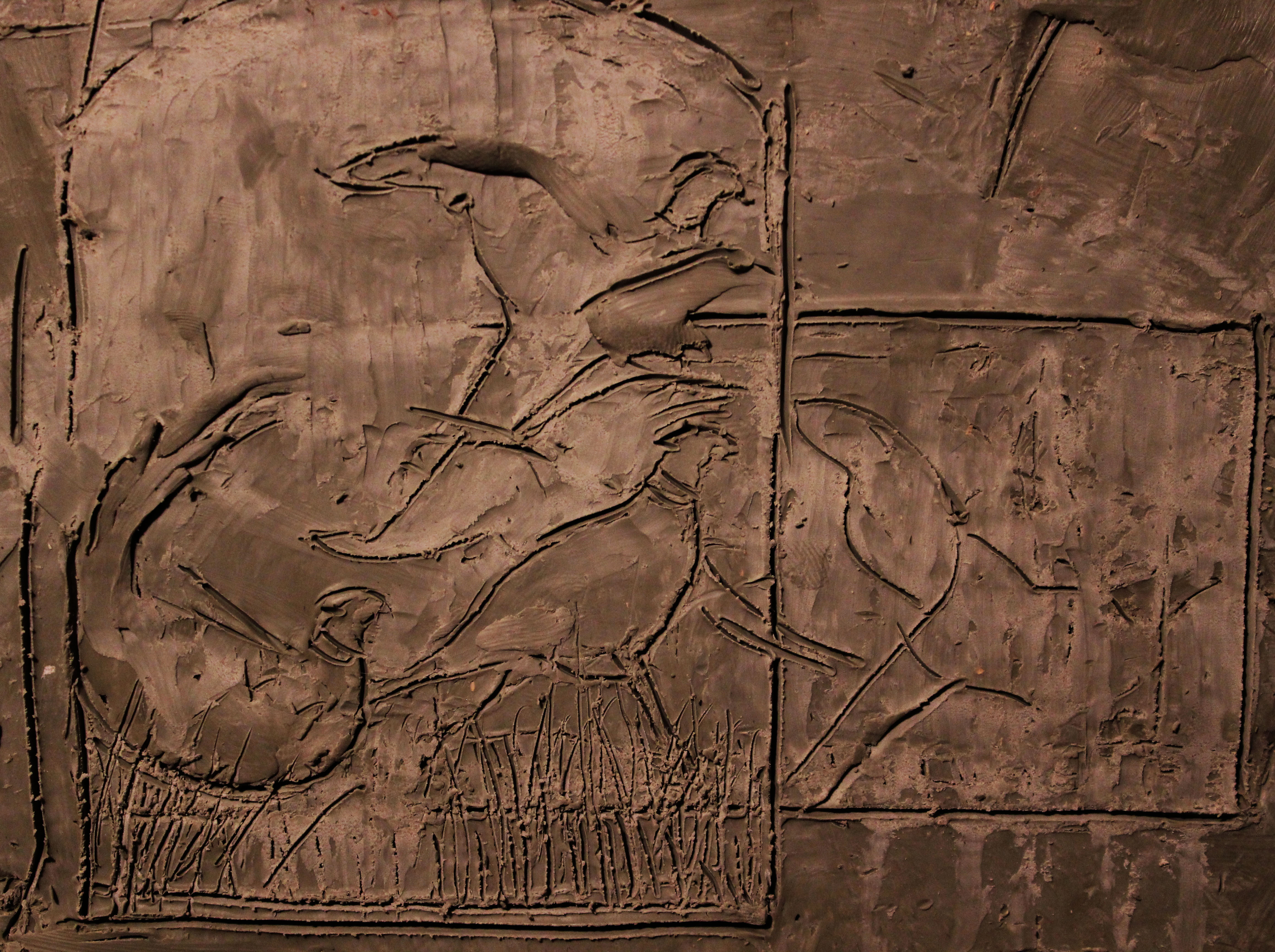
The design of the fifth ornament in the Twelve Days of Christmas bas-relief ornament series is underway and you can follow the progress here. It is possible that the ‘five golden rings’ is a reference to ring-necked pheasants, and in keeping with the song’s early emphasis on birds, we are going that route.
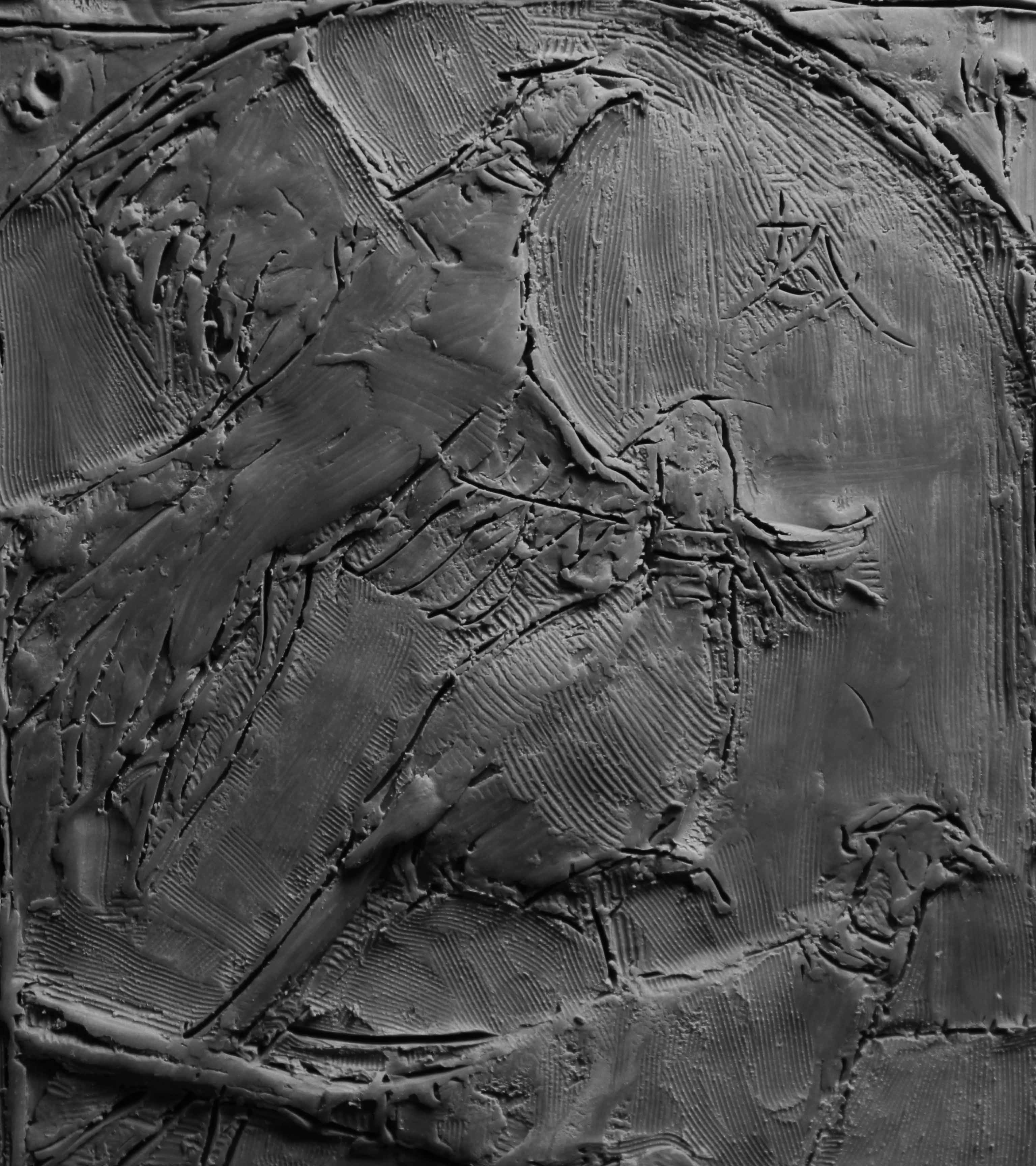
The pheasants are rearranged in an arch format.
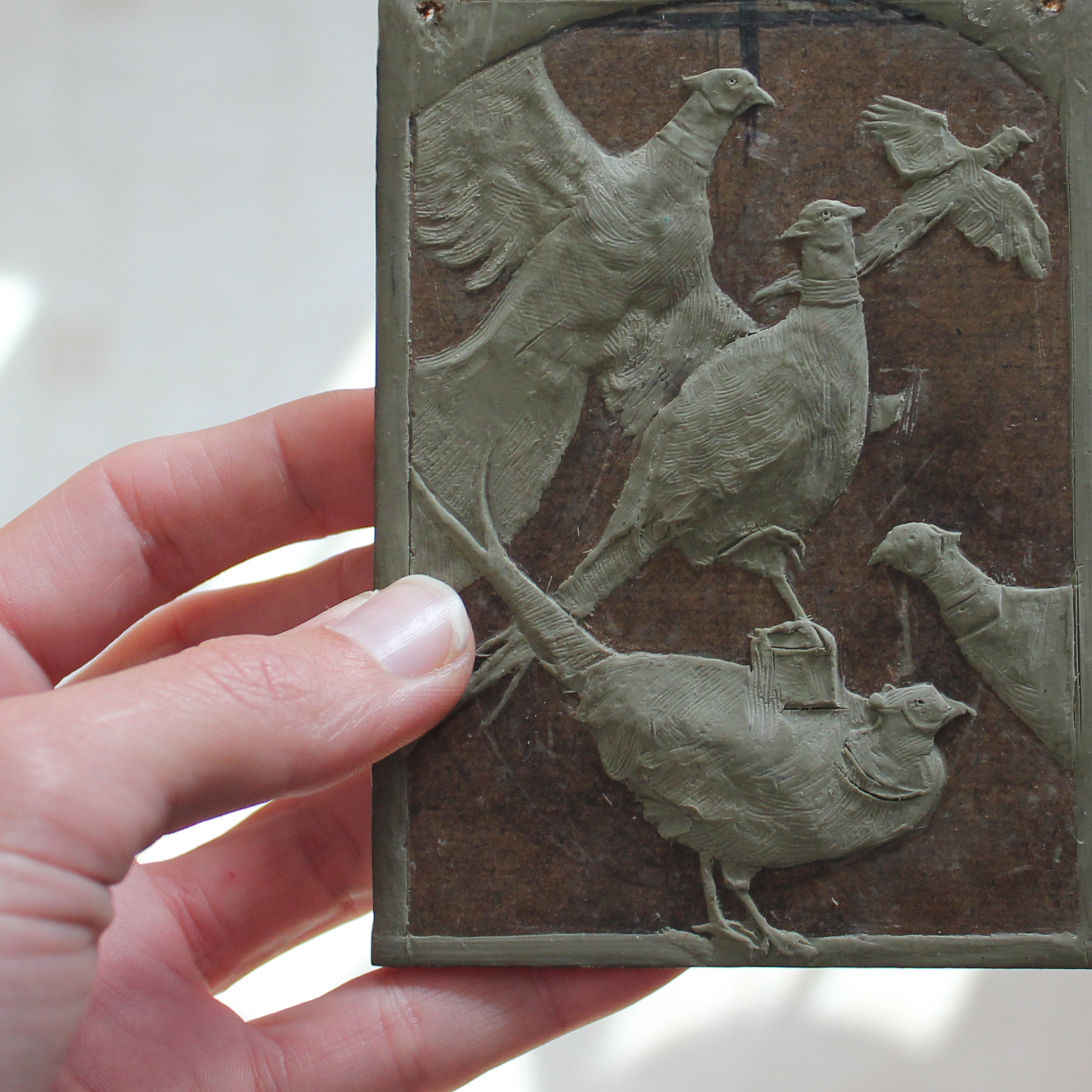
Many have expressed their enthusiasm for the pheasant, but some associate the bird with thrift store hunting scenes. In the year of the Three French Hens, a visit to a student’s farm revitalized that piece before the deadline, and live pheasants were located in a bid to inject this year’s work with similar good humour.

The friendly farmer warned that Death might be glimpsed in the enclosure due to the occasional visit by a hawk. The actual concern was the sight of birds lifting into flight only to fall again to the earth. And so I was very still and they gradually drew near.
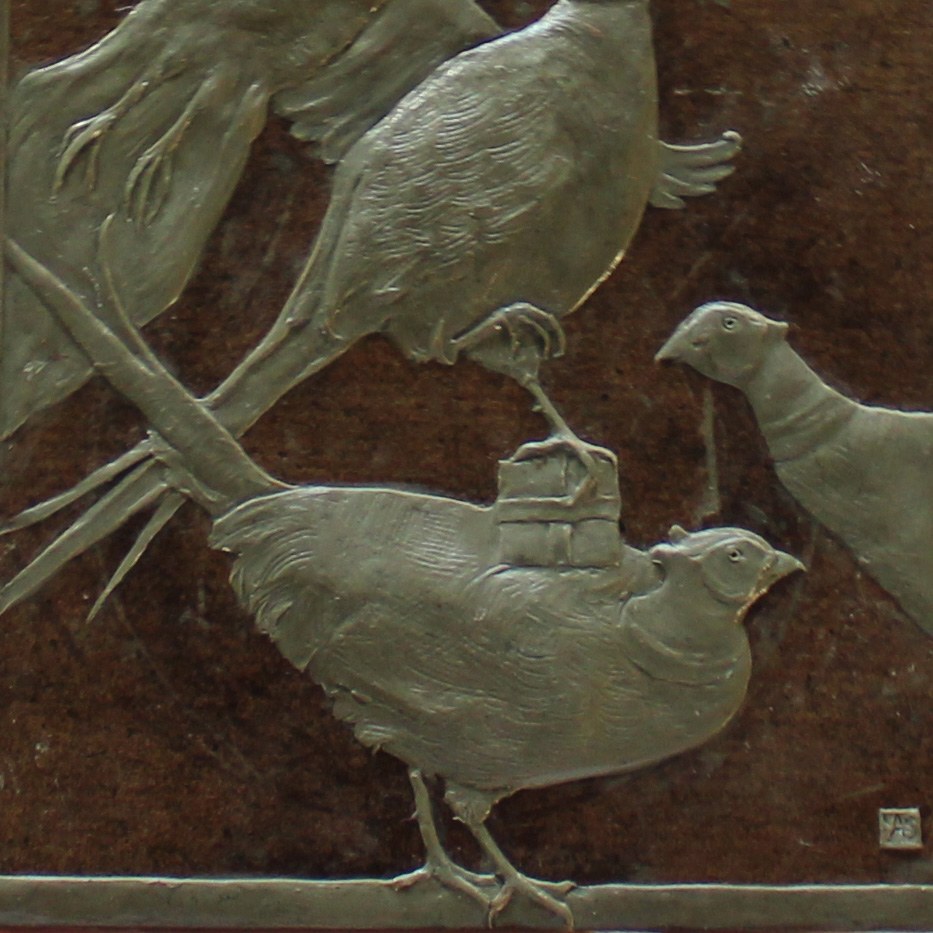
A detail of the sealed original.
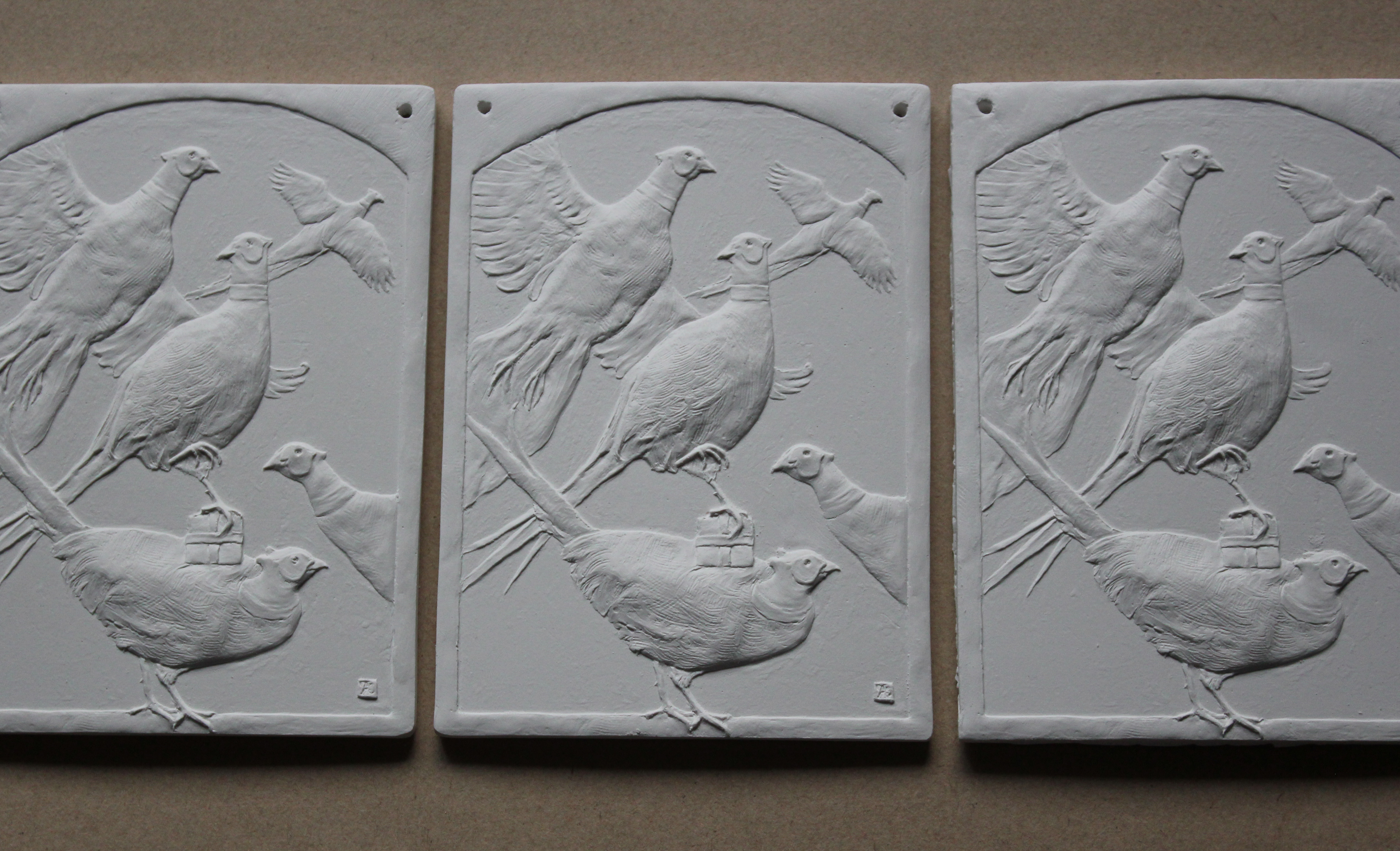
The raw casts.
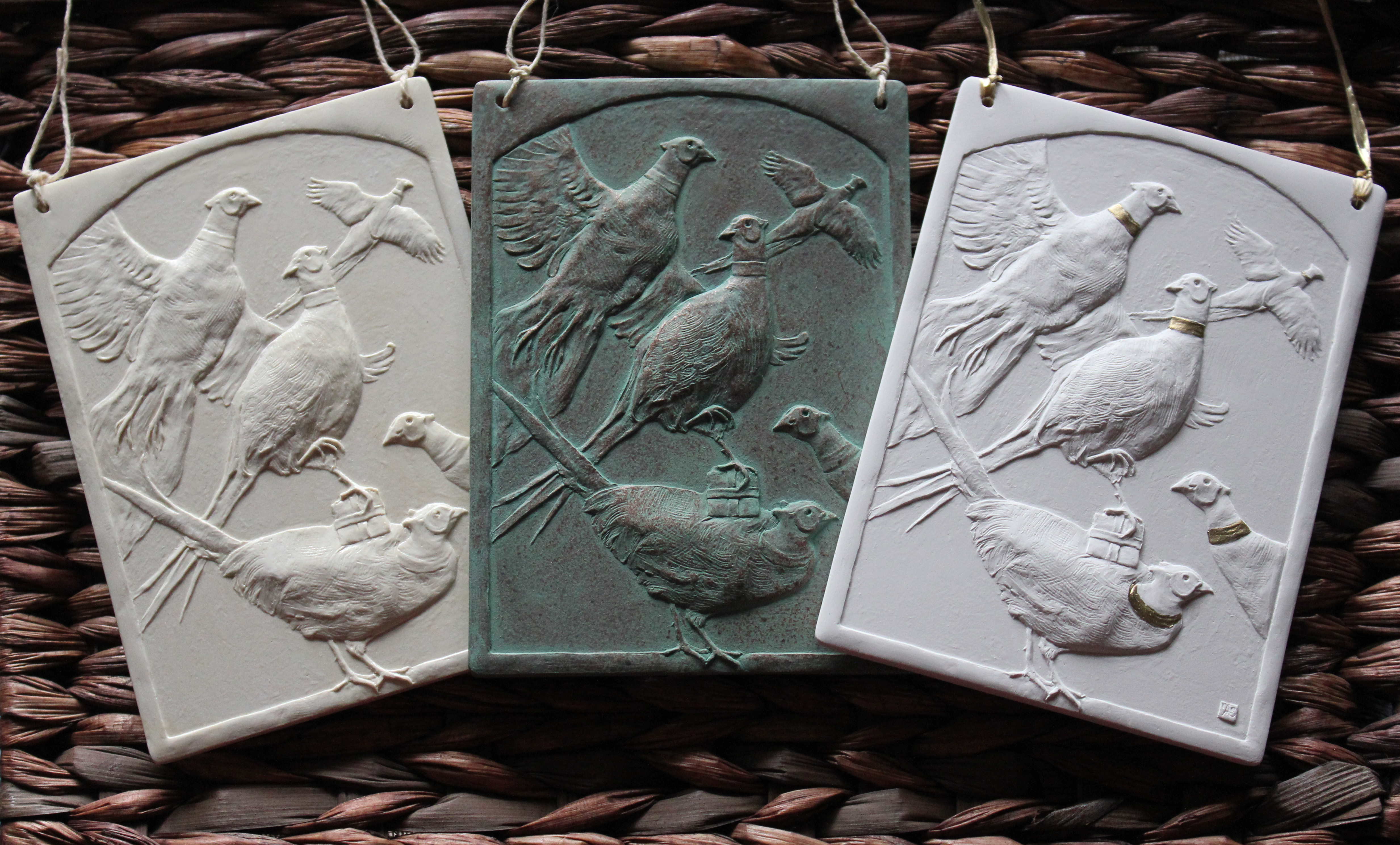
The ornaments with their Antique, Verdigris, and Gold Leaf (limited edition) finishes.
TertiarymattI have wanted one of these for a long time.
If you're familiar with 3D printing (you're reading Tested, chances are you're probably pretty familiar with the topic), it isn't too difficult to understand the basics of CNC milling. Instead of building up a form layer by layer, milling carves away from a block of stock material. Replace the plastic extruder of an FDM 3D printer with a high speed spindle turning a sharp cutting bit. CNC milling also requires CAD models of the desired form. And just like 3D printing, CNC mills have been moving from the workshop to the desktop. These machines have become affordable, small, and relatively easy to use.

Milling--subtractive fabrication--is often louder, messier, and let's be honest, not nearly as “magical” as additive 3D printing. The results don’t have the same wow factor as a Yoda bust you can make with a basic 3D printer. But this process creates more accurate and durable parts from a much wider selection of materials.

I’ve been testing several CNC mills for my work at NYU’s ITP program, and wanted to share some of my results. Some of these machines work right out of the box, some are kits (like the first home 3D printers). I’ll also discuss the difference between home mills and higher-end models designed for workshops, as well as my thoughts on the future of desktop milling. But this week, we’ll start off with a machine you may have seen on Tested before: the Othermill.
First up is the Othermill Version 1, made by the Other Machine Co. . Other Machine Co. designed this CNC mill with the belief "that regular people should be able to use professional tools". And I think they knocked it out of the park with this little guy.

The machine is ready to go right out of the box. It has easy to understand controls, just one button. The two wrenches, used to secure and remove the cutting end mills, can be secured to magnets on the front of the machine. This is such a simple little thing, but it is so handy. I'm now convinced every tool that requires a specialty wrench/chuck key/whatever should be held to the machine by a magnet. Seriously, this should be standard for all power tools.
The mill has a work area of 5.5" x 4.5" x 1.25", meaning it can work with blocks of material that size or smaller. Recommended materials--wood, metal, and plastic--are fixed to the aluminum bed using double sided tape, hot glue, or screwed down using any of the numerous tapped mounting holes.
Otherplan is the recommended free software. It is Mac only, which is practically unheard of in the CNC world, and is intuitive and easy to use, which is also pretty unheard of in the CNC world. You can be up and running in minutes--it took me longer to mount the material to the mill than to set everything up in Otherplan and begin cutting.

Otherplan has taken a lot of the things that are usually a drag about CNCing and made them easy. Determining mill feeds and speeds for a particular material is typically an educated guess/trial and error kind of process. Otherplan let’s you pick material from a drop down list with pre-set values. All of the pre-sets I’ve used have been right on the money. There is an advanced setting called "Bit Breaker" that allows you to adjust the settings. But I found out the hard way that Bit Breaker can be an apt name.
In my experience, setting the Z axis (the up and down direction) origin on CNC machines is usually a pain in the neck. The Othermill simples this too. The end mill is brought down to the aluminum bed and completes an electrical circuit on contact. The downward motion is stopped and zero is set. The only catch, you need to be fairly accurate in determining the thickness of your material. I wouldn't use this mill without a set of digital calipers close at hand.
If material is mounted to the bed by screws, you can select which threaded hole(s) you are using and Otherplan will steer clear. Fantastic.

Now I would never leave a running CNC unattended (and you shouldn't either), but the Othermill does have a "set it and forget it" kind of feel. For longer jobs, I’d have it running on my desk and keep an occasional eye on it while doing other work, so far so good.
I feel the Othermill really shines when making 2.5D parts. 2.5D parts are actually three dimensional objects created from two dimensional drawings. A 2D .svg file made in a vector graphics program (Adobe Illustrator, InkScape, etc) can be imported and Otherplan does all the heavy lifting. Shapes are set as either cutouts or engravings and multiple files can be layered on top of each other, allowing for a lot of control and experimentation. It felt a little like sketching, only I had actual physical parts when I was done.

It’s also possible to make true 3D parts with curvy surfaces (I'm envisioning a lot of self-portraits frozen in carbonite) by importing g-code, the programming language for CNC machines. But a third party CAM software will be necessary to create the code. Other Machine Co. recommends Autodesk CAM tools.
When cutting softer materials the noise and mess levels are pretty low. You could keep this guy running on your desk, still get work done, and not tick anyone off (for the most part). Cutting hardwood and aluminum is a different story. The machine can get loud, I had to take it all the way back into the workshop for the dirty looks to stop. But the mill only weighs 16.8 lbs. and has two convenient carrying handles, so it is very mobile. The mess is pretty contained, some dust might get on your work surface, but a decent shop vac is necessary to properly clean out the mill. I'm told the Othermill Version 2, the model they're shipping now, is more contained and noise and mess are even less of an issue.

I experimented cutting a wide variety of materials: wood, metal, PCB boards, plastic, even mushrooms (long story). The Othermill cuts hardwoods beautifully, I tested mostly with walnut and it produced really clean lines. I got a lot of tear out with plywood, but I chalk that up to the low grade ply I was experimenting with. In the beginning I cut a lot of aluminum, there is something incredibly empowering about making metal parts. The mill is not exactly a beast, and aluminum put a little wear and tear on the machine. The cuts were fine, but I wouldn't have this guy ripping through metal all day. But for the occasional metal part, it does the job.


The material I was happiest with is a plastic made by DuPont called Delrin. I know I'm late to the party here, but Delrin, where have you been all my life? It just wants to be machined. The milled surface finish looks incredible. Delrin is pretty much self lubricating and perfect for mechanical parts. Chocolate and peanut butter, Butch and Sundance, Othermill and Delrin.

A Good Place to Start
From my testing, the Othermill seems ideal both for first timers looking to get into CNCing and experienced makers who want to create fussy little parts. I loved how simple it is to get up and running and the price is right, compared to higher-end milling machines. Other Machine Co. has a good product here.
Photos by Ben Light. Find more of Ben's projects on his website.