A recent debate over overtime pay in California reflects just one of the many policies and practices that keep pay and opportunity low for those off the tenure track, write Jack Longmate and Keith Hoeller.
Shared posts
08 Oct 20:29
Essay on the many ways higher education holds back those off the tenure track
by Jack Longmate and Keith Hoeller
02 Dec 01:38
3-Minute Lesson on How to Speak in a Proper British Accent
by EDW Lynch
David Ley, a drama professor at the University of Alberta in Canada, demonstrates how to speak in a proper British accent in this three-minute video.
video via University of Alberta Alumni Association
firehose likes this
02 Dec 01:35
Supercut of Rappers Introducing Themselves During Songs
by Justin Page
“So just let me introduce myself. My name is Humpty, pronounced with a ‘umpty’”
New York City-based writer, comedian, and video editor Bryan Menegus has created a supercut video for Slacktory of rappers introducing themselves during songs. Here is a list of the hip-hop artists and songs, in order of appearance.
Hip-hop artists are known for being polite.
submitted via Laughing Squid Tips
Russian Sledges, firehose likes this
22 Oct 09:09


Inside the Rainbow: Gorgeous Vintage Russian Children’s Book Illustrations from the 1920s-1930s
by Maria Popova
“A lovely primary-colored geometrical wonderland-light sparkling with every conceivable kind of wit and brilliance and fantasy and fun.”
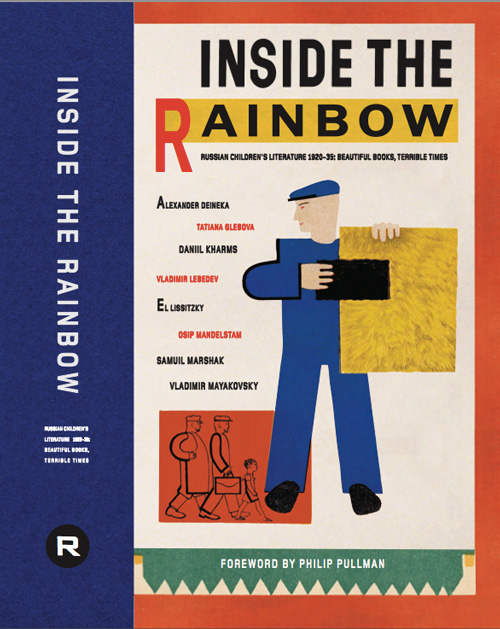 Since the golden age of children’s literature in mid-century America and Europe, we’ve seen children’s books used for purveying everything from philosophy to propaganda to science. But two decades before this Western surge of design innovation and conceptual experimentation in children’s books, a thriving scene of literature and art for young readers was taking root on the other side of the soon-to-be Iron Curtain. Inside the Rainbow: Beautiful Books, Terrible Times (public library), edited by Julian Rothenstein and Olga Budashevskaya, collects the most vibrant masterpieces of Russian children’s literature from the short but pivotal period between 1920 and 1935 — a time-capsule of the ambitious aesthetic and imaginative ideology that burned bright for a few brief moments before the onset of communism cast down its uniform grayness.


Philip Pullman, who knows a thing or two about the permeating power of children’s storytelling, writes in the foreword:
The world of Russian children’s illustrated books in the first twenty years or so of Soviet rule is almost incomparably rich. What were they doing, these commissars and party secretaries, to allow this wonderland of modern art to grow under their very noses? I expect the rule that applies to children’s books was just as deeply interiorized in the Soviet Union as it has been in the rest of the world: they don’t matter. They can be ignored. They’re not serious.
(Coincidentally, Neil Gaiman recently lamented that “there is [no] such a thing as a bad book for children. … Well-meaning adults can easily destroy a child’s love of reading.”)


Pullman contrasts the distinctive, indigenous style of this Russian book art with its Western counterparts from the same era:
The kind of modern art that lives so vigorously and joyously in these pages is, of course, one with a Russian ancestry. There is no Cubism here … no Post-Impressionism … no Dada. What there is is Constructivism, and plenty of it, and of its metaphysical parent, Suprematism. Basic geometrical shapes, the square, the circle, the rectangle, are everywhere; flat primary colors dominate.
And yet, conceptually, many of these illustrations find — and often presage — certain Western counterparts. Take, for instance, these spreads from Boris Ermolenko’s 1930 visual taxonomy of occupations, Special Clothing, which call to mind beloved French illustrator Blebolex’s book People, one of the best children’s books of 2011:


Among the visual ephemera are also some instructional manuals on child-rearing and child-care, like this list of tips on upbringing found in the reception rooms of Cre?ches and the Museums of Mother and Child — a curious mix of practical common sense, questionable advice, and timeless, remarkably timely wisdom:
HINTS ON UPBRINGING
It is very hard to give due education to a single child, for a child needs the company of others his own age. Never take a child to motion pictures or the theatre.
Do not carry a child in your arms for any length of time; he must move.
Do not help a child who is in a difficult situation unless it be dangerous; he must learn to care for himself. If you are ill, upset or unhappy, do not let the child feel it.
Never whip, kick, or spit on a child.
Parents and elders should agree on what is allowed to and forbidden to children. It is bad to have one parent allow what the other forbids
A well-balanced routine makes a child grow healthy and accustoms him to organized social life.
Teach a child to work for others.
Understand and take part in a child’s happiness and sorrow, and he will come to you when he needs you. Do not disturb a child while he plays, or he will disturb you while you work.
If a child is annoyed with a toy, take it away and give it to him after he has forgotten his grievance.
Be careful of any trifle which a child considers a toy, even though it may only be a piece of wood or a stone.
Not everything you see in the toyshop is a good toy. Before buying a toy, see if you have anything in the house which will serve the same purpose.
Never forbid a child to play with other healthy children.
Do not tell stories to a child before he goes to sleep, for you will disturb him with new impressions.
Do not awaken a child without need when he should be sleeping.
Fresh air is as necessary in a child’s room in winter as in summer.
A child should be given a chance to urinate before and after sleeping.
Do not allow a child to stay up later than eight o’clock in the evening.
Sleep for a child under three years of age is as necessary during the day as during the night.
Each child must sleep in an individual bed; and each bed must consist of a hair mattress, an oilcloth, a pillow, blankets and sheets.
A child must spend between three and four hours outdoors each day, and, if he is old enough, he should walk during that time.
Some of the most charming pieces explore the burgeoning world of transportation:


Then there are the sheer, unmediated delights, such as Kornei Chukovsky’s playful 1927 poetry book The Telephone.

It begins:
Ting-a-ling-a-ling… A telephone ring! “Hallo! Hallo!”
“Who are you?” “Jumbo Joe,
“I live at the zoo!” “What can I do?” “Send me some jam For my little Sam.” “Do you want a lot?” “A five-ton pot,
And send me some cake — The poor little boy
Has swallowed a toy
And his tummy will ache If he gets no cake.”
“How many tons of cake will you take?” “Only a score.
He won’t be able to eat any more –
My little Sam is only four!”
And after a while
A crocodile rang from the Nile:
“I will be ever so jolly
If you send us a pile
Of rubber galoshes –
The kind that one washes –
For me and my wife and for Molly!”
“You’re talking too fast! Why, the week before last I posted ten pair
Of galoshes by air.”
“Now, doctor, be steady!
We’ve eaten already
The pile that you posted!
We ate them all roasted,
And the dish it was simply delicious, So everyone wishes
You would send to the Nile
A still bigger pile
That would do for a dozen more dishes.”


What’s most striking about these vibrant, colorful, exuberant images and verses, however, is their stark contrast to the cultural context in which they were born — alongside them we find grim photographs of desolate little faces in shabby schoolrooms, the faces of a generation that would be soon engulfed by communism’s dark descend. And yet these children’s books, Pullman marvels, emanate “a lovely primary-colored geometrical wonderland-light sparkling with every conceivable kind of wit and brilliance and fantasy and fun” — a light at once heartening as glimmer of generational hope and bittersweet against the historical backdrop of the oppressive regime that would eventually extinguish it as communism sought to purge the collective conscience of whimsy and imaginative sentimentality.


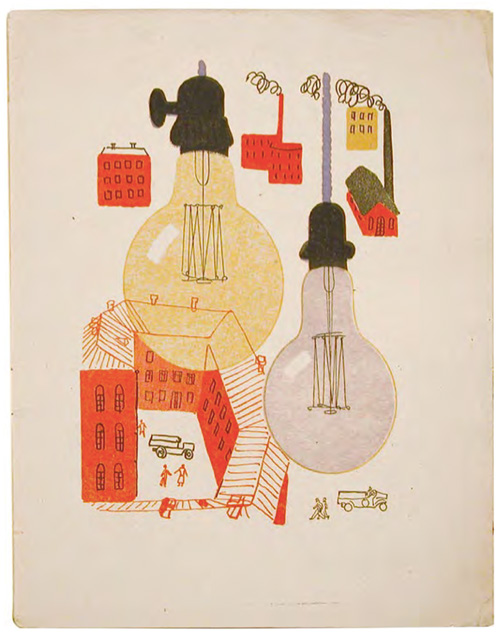
Inside the Rainbow: Beautiful Books, Terrible Times is an absolute treasure trove, both as a portable museum of magnificent graphic design and as a time-capsule of a pivotal moment in world history. Complement it with these vintage Soviet art and propaganda posters from the same era.
Donating = Loving
Bringing you (ad-free) Brain Pickings takes hundreds of hours each month. If you find any joy and stimulation here, please consider becoming a Supporting Member with a recurring monthly donation of your choosing, between a cup of tea and a good dinner:
| ♥ $7 / month♥ $3 / month♥ $10 / month♥ $25 / month |

You can also become a one-time patron with a single donation in any amount:
 Brain Pickings has a free weekly newsletter. It comes out on Sundays and offers the week’s best articles. Here’s what to expect. Like? Sign up.
Brain Pickings takes 450+ hours a month to curate and edit across the different platforms, and remains banner-free. If it brings you any joy and inspiration, please consider a modest donation – it lets me know I'm doing something right.

21 Oct 16:29


Museum of Four in the Morning
by David Pescovitz
"Four in the morning" appears with strange frequency in movies, TV, art, and culture. The Museum of Four In The Morning collects such references. Submit yours!
    
|
nealteam and -1 others like this
21 Oct 16:24
The Great American Menu, Ranking Regional Foods Across the U.S.
by Kimber Streams

Albert Burneko and illustrator Jim Cooke have put together the Great American Menu, a list of signature regional foods from each state in the United States, plus the District of Columbia. According to the ranked list, Illinois’ Chicago-style deep-dish pizza is the best regional food in the country, while Ohio’s Cincinnati chili is considered the worst, ranked just below “being hit by a car.” Check out the rest of the Great American Menu at Deadspin.
image via Deadspin
21 Oct 16:23
Maps of the Most Popular Baby Names for Girls From 1960 to 2012
by Kimber Streams

Using data from the Social Security Administration, Jezebel has put together a series of color-coded maps that show the most popular baby names for girls for each state from 1960 to 2012. To explore the full series of maps, head over to Jezebel.


images via Jezebel
21 Oct 16:04


Microsoft Word considered harmful
by Cory Doctorow
 Charlie Stross really, really hates Microsoft Word. So much so that he's written a 1600-word essay laying out the case for Word as a great destroyer of creativity, an agent of anticompetitive economic destruction, and an enemy of all that's decent and right in the world. It's actually a pretty convincing argument.
As the product grew, Microsoft deployed their embrace-and-extend tactic to force users to upgrade, locking them into Word, by changing the file format the program used on a regular basis. Early versions of Word interoperated well with rivals such as Word Perfect, importing and exporting other programs' file formats. But as Word's domination became established, Microsoft changed the file format repeatedly -- with Word 95, Word 97, in 2000, and again in 2003 and more recently. Each new version of Word defaulted to writing a new format of file which could not be parsed by older copies of the program. If you had to exchange documents with anyone else, you could try to get them to send and receive RTF — but for the most part casual business users never really got the hang of different file formats in the "Save As ..." dialog, and so if you needed to work with others you had to pay the Microsoft Danegeld on a regular basis, even if none of the new features were any use to you. The .doc file format was also obfuscated, deliberately or intentionally: rather than a parseable document containing formatting and macro metadata, it was effectively a dump of the in-memory data structures used by word, with pointers to the subroutines that provided formatting or macro support. And "fast save" made the picture worse, by appending a journal of changes to the application's in-memory state. To parse a .doc file you virtually have to write a mini-implementation of Microsoft Word. This isn't a data file format: it's a nightmare! In the 21st century they tried to improve the picture by replacing it with an XML schema ... but somehow managed to make things worse, by using XML tags that referred to callbacks in the Word codebase, rather than representing actual document semantics. It's hard to imagine a corporation as large and [usually] competently-managed as Microsoft making such a mistake by accident ...

|
|
Christian, J.w.dillow likes this
21 Oct 16:03

Why have young people in Japan stopped having sex?
by Abigail Haworth
What happens to a country when its young people stop having sex? Japan is finding out… Abigail Haworth investigates
Ai Aoyama is a sex and relationship counsellor who works out of her narrow three-storey home on a Tokyo back street. Her first name means "love" in Japanese, and is a keepsake from her earlier days as a professional dominatrix. Back then, about 15 years ago, she was Queen Ai, or Queen Love, and she did "all the usual things" like tying people up and dripping hot wax on their nipples. Her work today, she says, is far more challenging. Aoyama, 52, is trying to cure what Japan's media calls sekkusu shinai shokogun, or "celibacy syndrome".
Japan's under-40s appear to be losing interest in conventional relationships. Millions aren't even dating, and increasing numbers can't be bothered with sex. For their government, "celibacy syndrome" is part of a looming national catastrophe. Japan already has one of the world's lowest birth rates. Its population of 126 million, which has been shrinking for the past decade, is projected to plunge a further one-third by 2060. Aoyama believes the country is experiencing "a flight from human intimacy" – and it's partly the government's fault.
The sign outside her building says "Clinic". She greets me in yoga pants and fluffy animal slippers, cradling a Pekingese dog whom she introduces as Marilyn Monroe. In her business pamphlet, she offers up the gloriously random confidence that she visited North Korea in the 1990s and squeezed the testicles of a top army general. It doesn't say whether she was invited there specifically for that purpose, but the message to her clients is clear: she doesn't judge.
Inside, she takes me upstairs to her "relaxation room" – a bedroom with no furniture except a double futon. "It will be quiet in here," she says. Aoyama's first task with most of her clients is encouraging them "to stop apologising for their own physical existence".
The number of single people has reached a record high. A survey in 2011 found that 61% of unmarried men and 49% of women aged 18-34 were not in any kind of romantic relationship, a rise of almost 10% from five years earlier. Another study found that a third of people under 30 had never dated at all. (There are no figures for same-sex relationships.) Although there has long been a pragmatic separation of love and sex in Japan – a country mostly free of religious morals – sex fares no better. A survey earlier this year by the Japan Family Planning Association (JFPA) found that 45% of women aged 16-24 "were not interested in or despised sexual contact". More than a quarter of men felt the same way.
Many people who seek her out, says Aoyama, are deeply confused. "Some want a partner, some prefer being single, but few relate to normal love and marriage." However, the pressure to conform to Japan's anachronistic family model of salaryman husband and stay-at-home wife remains. "People don't know where to turn. They're coming to me because they think that, by wanting something different, there's something wrong with them."
Official alarmism doesn't help. Fewer babies were born here in 2012 than any year on record. (This was also the year, as the number of elderly people shoots up, that adult incontinence pants outsold baby nappies in Japan for the first time.) Kunio Kitamura, head of the JFPA, claims the demographic crisis is so serious that Japan "might eventually perish into extinction".
Japan's under-40s won't go forth and multiply out of duty, as postwar generations did. The country is undergoing major social transition after 20 years of economic stagnation. It is also battling against the effects on its already nuclear-destruction-scarred psyche of 2011's earthquake, tsunami and radioactive meltdown. There is no going back. "Both men and women say to me they don't see the point of love. They don't believe it can lead anywhere," says Aoyama. "Relationships have become too hard."
Marriage has become a minefield of unattractive choices. Japanese men have become less career-driven, and less solvent, as lifetime job security has waned. Japanese women have become more independent and ambitious. Yet conservative attitudes in the home and workplace persist. Japan's punishing corporate world makes it almost impossible for women to combine a career and family, while children are unaffordable unless both parents work. Cohabiting or unmarried parenthood is still unusual, dogged by bureaucratic disapproval.
Aoyama says the sexes, especially in Japan's giant cities, are "spiralling away from each other". Lacking long-term shared goals, many are turning to what she terms "Pot Noodle love" – easy or instant gratification, in the form of casual sex, short-term trysts and the usual technological suspects: online porn, virtual-reality "girlfriends", anime cartoons. Or else they're opting out altogether and replacing love and sex with other urban pastimes.
Some of Aoyama's clients are among the small minority who have taken social withdrawal to a pathological extreme. They are recovering hikikomori ("shut-ins" or recluses) taking the first steps to rejoining the outside world, otaku (geeks), and long-term parasaito shingurus (parasite singles) who have reached their mid-30s without managing to move out of home. (Of the estimated 13 million unmarried people in Japan who currently live with their parents, around three million are over the age of 35.) "A few people can't relate to the opposite sex physically or in any other way. They flinch if I touch them," she says. "Most are men, but I'm starting to see more women."
Aoyama cites one man in his early 30s, a virgin, who can't get sexually aroused unless he watches female robots on a game similar to Power Rangers. "I use therapies, such as yoga and hypnosis, to relax him and help him to understand the way that real human bodies work." Sometimes, for an extra fee, she gets naked with her male clients – "strictly no intercourse" – to physically guide them around the female form. Keen to see her nation thrive, she likens her role in these cases to that of the Edo period courtesans, or oiran, who used to initiate samurai sons into the art of erotic pleasure.
Aversion to marriage and intimacy in modern life is not unique to Japan. Nor is growing preoccupation with digital technology. But what endless Japanese committees have failed to grasp when they stew over the country's procreation-shy youth is that, thanks to official shortsightedness, the decision to stay single often makes perfect sense. This is true for both sexes, but it's especially true for women. "Marriage is a woman's grave," goes an old Japanese saying that refers to wives being ignored in favour of mistresses. For Japanese women today, marriage is the grave of their hard-won careers.
I meet Eri Tomita, 32, over Saturday morning coffee in the smart Tokyo district of Ebisu. Tomita has a job she loves in the human resources department of a French-owned bank. A fluent French speaker with two university degrees, she avoids romantic attachments so she can focus on work. "A boyfriend proposed to me three years ago. I turned him down when I realised I cared more about my job. After that, I lost interest in dating. It became awkward when the question of the future came up."
Tomita says a woman's chances of promotion in Japan stop dead as soon as she marries. "The bosses assume you will get pregnant." Once a woman does have a child, she adds, the long, inflexible hours become unmanageable. "You have to resign. You end up being a housewife with no independent income. It's not an option for women like me."
Around 70% of Japanese women leave their jobs after their first child. The World Economic Forum consistently ranks Japan as one of the world's worst nations for gender equality at work. Social attitudes don't help. Married working women are sometimes demonised as oniyome, or "devil wives". In a telling Japanese ballet production of Bizet's Carmen a few years ago, Carmen was portrayed as a career woman who stole company secrets to get ahead and then framed her lowly security-guard lover José. Her end was not pretty.
Prime minister Shinzo Abe recently trumpeted long-overdue plans to increase female economic participation by improving conditions and daycare, but Tomita says things would have to improve "dramatically" to compel her to become a working wife and mother. "I have a great life. I go out with my girl friends – career women like me – to French and Italian restaurants. I buy stylish clothes and go on nice holidays. I love my independence."
Tomita sometimes has one-night stands with men she meets in bars, but she says sex is not a priority, either. "I often get asked out by married men in the office who want an affair. They assume I'm desperate because I'm single." She grimaces, then shrugs. "Mendokusai."
Mendokusai translates loosely as "Too troublesome" or "I can't be bothered". It's the word I hear both sexes use most often when they talk about their relationship phobia. Romantic commitment seems to represent burden and drudgery, from the exorbitant costs of buying property in Japan to the uncertain expectations of a spouse and in-laws. And the centuries-old belief that the purpose of marriage is to produce children endures. Japan's Institute of Population and Social Security reports an astonishing 90% of young women believe that staying single is "preferable to what they imagine marriage to be like".
The sense of crushing obligation affects men just as much. Satoru Kishino, 31, belongs to a large tribe of men under 40 who are engaging in a kind of passive rebellion against traditional Japanese masculinity. Amid the recession and unsteady wages, men like Kishino feel that the pressure on them to be breadwinning economic warriors for a wife and family is unrealistic. They are rejecting the pursuit of both career and romantic success.
"It's too troublesome," says Kishino, when I ask why he's not interested in having a girlfriend. "I don't earn a huge salary to go on dates and I don't want the responsibility of a woman hoping it might lead to marriage." Japan's media, which has a name for every social kink, refers to men like Kishino as "herbivores" or soshoku danshi (literally, "grass-eating men"). Kishino says he doesn't mind the label because it's become so commonplace. He defines it as "a heterosexual man for whom relationships and sex are unimportant".
The phenomenon emerged a few years ago with the airing of a Japanese manga-turned-TV show. The lead character in Otomen ("Girly Men") was a tall martial arts champion, the king of tough-guy cool. Secretly, he loved baking cakes, collecting "pink sparkly things" and knitting clothes for his stuffed animals. To the tooth-sucking horror of Japan's corporate elders, the show struck a powerful chord with the generation they spawned.
Kishino, who works at a fashion accessories company as a designer and manager, doesn't knit. But he does like cooking and cycling, and platonic friendships. "I find some of my female friends attractive but I've learned to live without sex. Emotional entanglements are too complicated," he says. "I can't be bothered."
Romantic apathy aside, Kishino, like Tomita, says he enjoys his active single life. Ironically, the salaryman system that produced such segregated marital roles – wives inside the home, husbands at work for 20 hours a day – also created an ideal environment for solo living. Japan's cities are full of conveniences made for one, from stand-up noodle bars to capsule hotels to the ubiquitous konbini (convenience stores), with their shelves of individually wrapped rice balls and disposable underwear. These things originally evolved for salarymen on the go, but there are now female-only cafés, hotel floors and even the odd apartment block. And Japan's cities are extraordinarily crime-free.
Some experts believe the flight from marriage is not merely a rejection of outdated norms and gender roles. It could be a long-term state of affairs. "Remaining single was once the ultimate personal failure," says Tomomi Yamaguchi, a Japanese-born assistant professor of anthropology at Montana State University in America. "But more people are finding they prefer it." Being single by choice is becoming, she believes, "a new reality".
Is Japan providing a glimpse of all our futures? Many of the shifts there are occurring in other advanced nations, too. Across urban Asia, Europe and America, people are marrying later or not at all, birth rates are falling, single-occupant households are on the rise and, in countries where economic recession is worst, young people are living at home. But demographer Nicholas Eberstadt argues that a distinctive set of factors is accelerating these trends in Japan. These factors include the lack of a religious authority that ordains marriage and family, the country's precarious earthquake-prone ecology that engenders feelings of futility, and the high cost of living and raising children.
"Gradually but relentlessly, Japan is evolving into a type of society whose contours and workings have only been contemplated in science fiction," Eberstadt wrote last year. With a vast army of older people and an ever-dwindling younger generation, Japan may become a "pioneer people" where individuals who never marry exist in significant numbers, he said.
Japan's 20-somethings are the age group to watch. Most are still too young to have concrete future plans, but projections for them are already laid out. According to the government's population institute, women in their early 20s today have a one-in-four chance of never marrying. Their chances of remaining childless are even higher: almost 40%.
They don't seem concerned. Emi Kuwahata, 23, and her friend, Eri Asada, 22, meet me in the shopping district of Shibuya. The café they choose is beneath an art gallery near the train station, wedged in an alley between pachinko pinball parlours and adult video shops. Kuwahata, a fashion graduate, is in a casual relationship with a man 13 years her senior. "We meet once a week to go clubbing," she says. "I don't have time for a regular boyfriend. I'm trying to become a fashion designer." Asada, who studied economics, has no interest in love. "I gave up dating three years ago. I don't miss boyfriends or sex. I don't even like holding hands."
Asada insists nothing happened to put her off physical contact. She just doesn't want a relationship and casual sex is not a good option, she says, because "girls can't have flings without being judged". Although Japan is sexually permissive, the current fantasy ideal for women under 25 is impossibly cute and virginal. Double standards abound.
In the Japan Family Planning Association's 2013 study on sex among young people, there was far more data on men than women. I asked the association's head, Kunio Kitamura, why. "Sexual drive comes from males," said the man who advises the government. "Females do not experience the same levels of desire."
Over iced tea served by skinny-jeaned boys with meticulously tousled hair, Asada and Kuwahata say they share the usual singleton passions of clothes, music and shopping, and have hectic social lives. But, smart phones in hand, they also admit they spend far more time communicating with their friends via online social networks than seeing them in the flesh. Asada adds she's spent "the past two years" obsessed with a virtual game that lets her act as a manager of a sweet shop.
Japanese-American author Roland Kelts, who writes about Japan's youth, says it's inevitable that the future of Japanese relationships will be largely technology driven. "Japan has developed incredibly sophisticated virtual worlds and online communication systems. Its smart phone apps are the world's most imaginative." Kelts says the need to escape into private, virtual worlds in Japan stems from the fact that it's an overcrowded nation with limited physical space. But he also believes the rest of the world is not far behind.
Getting back to basics, former dominatrix Ai Aoyama – Queen Love – is determined to educate her clients on the value of "skin-to-skin, heart-to-heart" intimacy. She accepts that technology will shape the future, but says society must ensure it doesn't take over. "It's not healthy that people are becoming so physically disconnected from each other," she says. "Sex with another person is a human need that produces feel-good hormones and helps people to function better in their daily lives."
Aoyama says she sees daily that people crave human warmth, even if they don't want the hassle of marriage or a long-term relationship. She berates the government for "making it hard for single people to live however they want" and for "whipping up fear about the falling birth rate". Whipping up fear in people, she says, doesn't help anyone. And that's from a woman who knows a bit about whipping.
theguardian.com © 2013 Guardian News and Media Limited or its affiliated companies. All rights reserved. | Use of this content is subject to our Terms & Conditions | More Feeds
21 Oct 16:01


Universities putting research before teaching, says minister
by Peter Walker
David Willetts says higher education system lopsided, as survey shows students receiving less feedback than 50 years ago
Universities need a "cultural change" towards teaching, the universities minister, David Willetts, has argued, as a survey of UK undergraduates showed they were being set less work and received notably less tutor feedback than did their peers 50 years ago.
Willetts, writing in a pamphlet published to mark the anniversary of the 1963 report by the academic Lord Robbins that paved the way for a significant expansion in university education, says the higher education system has become "so lopsided away from teaching" that universities need to fundamentally rethink their role and priorities.
The Conservative minister's treatise, Robbins Revisited, published by the Social Market Foundation thinktank, notes a significant shift in emphasis away from teaching in favour of research, particularly in the older institutions. Willetts cites figures showing that in 1963 academics devoted 55% of their time on average to teaching and 45% to research.
For pre-Robbins universities the split is now 40% to 60%, and for institutions created between 1963 and the next huge expansion in universities in 1992 the ratio is 43% to 57%.
In contrast, Willetts notes, the former polytechnics and FE colleges that were made universities after 1992 are "heavily focused on teaching", with a 89% to 11% split.
Willetts argues that Robbins' vision was one in which research and teaching complemented each other, but that this idea has been lost. "Looking back we will wonder how the higher education system was ever allowed to become so lopsided away from teaching."
A study of more than 17,000 UK undergraduates commissioned by the consumer group Which? found a reduction in the amount of contact time students have with lecturers and the changing nature of feedback about work.
Students had on average 14 hours and 48 minutes of contact time a week in 1963, against 13 hours 42 minutes in 2012. Perhaps more significantly, while almost two-thirds of the 1963 cohort received oral feedback on work as well as written comments, now 77% of current students get just a grade and written comment.
The study also showed that 2012 students were obliged on average to submit one piece of written work a fortnight, as against one a week for those in 1963.
While some critics argue that the post-Robbins and, particularly, post-1992 expansion of universities has helped bring about this situation, in his pamphlet Willetts explicitly argues for greater numbers of students still, suggesting that within 20 or so years student numbers could rise by another 25%.
theguardian.com © 2013 Guardian News and Media Limited or its affiliated companies. All rights reserved. | Use of this content is subject to our Terms & Conditions | More Feeds
16 Oct 18:52
Steven Fry lets gay-"curing" doctor explain himself badly
by Rob Beschizza
Stephen Fry interviews Dr. Joseph Nicolosi of the National Association for Research & Therapy of Homosexuality. Nicolosi's beliefs are so flatly pseudoscientific and Victorian (Homosexuality caused by parental neglect and emotional trauma, etc) that it'd be easy to make a fool of him--Fry, however, being Fry, lets him make a fool of himself. [Video Link via Gawker]


|
|
J.w.dillow, Christian likes this
16 Oct 17:23

David Byrne: 'The internet will suck all creative content out of the world'
by David Byrne
The boom in digital streaming may generate profits for record labels and free content for consumers, but it spells disaster for today's artists across the creative industries
Awhile ago Thom Yorke and the rest of Radiohead got some attention when they pulled their recent record from Spotify. A number of other artists have also been in the news, publicly complaining about streaming music services (Black Keys, Aimee Mann and David Lowery of Camper van Beethoven and Cracker). Bob Dylan, Metallica and Pink Floyd were longtime Spotify holdouts – until recently. I've pulled as much of my catalogue from Spotify as I can. AC/DC, Garth Brooks and Led Zeppelin have never agreed to be on these services in the first place.
So, what's the deal? What are these services, what do they do and why are these musicians complaining?
There are a number of ways to stream music online: Pandora is like a radio station that plays stuff you like but doesn't take requests; YouTube plays individual songs that folks and corporations have uploaded and Spotify is a music library that plays whatever you want (if they have it), whenever you want it. Some of these services only work when you're online, but some, like Spotify, allow you to download your playlist songs and carry them around. For many music listeners, the choice is obvious – why would you ever buy a CD or pay for a download when you can stream your favourite albums and artists either for free, or for a nominal monthly charge?
Not surprisingly, streaming looks to be the future of music consumption – it already is the future in Scandinavia, where Spotify (the largest streaming service) started, and in Spain. Other countries are following close behind. Spotify is the second largest source of digital music revenue for labels in Europe, according to the International Federation of the Phonographic Industry (IFPI). Significantly, that's income for labels, not artists. There are other streaming services, too – Deezer, Google Play, Apple and Jimmy Iovine of Interscope has one coming called Daisy – though my guess is that, as with most web-based businesses, only one will be left standing in the end. There aren't two Facebooks or Amazons. Domination and monopoly is the name of the game in the web marketplace.
The amounts these services pay per stream is miniscule – their idea being that if enough people use the service those tiny grains of sand will pile up. Domination and ubiquity are therefore to be encouraged. We should readjust our values because in the web-based world we are told that monopoly is good for us. The major record labels usually siphon off most of this income, and then they dribble about 15-20% of what's left down to their artists. Indie labels are often a lot fairer – sometimes sharing the income 50/50. Damon Krukowski (Galaxie 500, Damon & Naomi) has published abysmal data on payouts from Pandora and Spotify for his song "Tugboat" and Lowery even wrote a piece entitled "My Song Got Played on Pandora 1 Million Times and All I Got Was $16.89, Less Than What I Make from a Single T-shirt Sale!" For a band of four people that makes a 15% royalty from Spotify streams, it would take 236,549,020 streams for each person to earn a minimum wage of $15,080 (£9,435) a year. For perspective, Daft Punk's song of the summer, "Get Lucky", reached 104,760,000 Spotify streams by the end of August: the two Daft Punk guys stand to make somewhere around $13,000 each. Not bad, but remember this is just one song from a lengthy recording that took a lot of time and money to develop. That won't pay their bills if it's their principal source of income. And what happens to the bands who don't have massive international summer hits?
In future, if artists have to rely almost exclusively on the income from these services, they'll be out of work within a year. Some of us have other sources of income, such as live concerts, and some of us have reached the point where we can play to decent numbers of people because a record label believed in us at some point in the past. I can't deny that label-support gave me a leg up – though not every successful artist needs it. So, yes, I could conceivably survive, as I don't rely on the pittance that comes my way from music streaming, as could Yorke and some of the others. But up-and-coming artists don't have that advantage – some haven't got to the point where they can make a living on live performances and licensing, so what do they think of these services?
Some artists and indie musicians see Spotify fairly positively – as a way of getting noticed, of getting your music out there where folks can hear it risk free. Daniel Glass, of Glassnote records, who have the very popular band Mumford & Sons says: "When you have quality and you're in the sophomore stage of this band's career, I think the fear of holding it back is worse than letting it go. Opening up the faucet and letting people hear it, stream it and all that stuff is definitely very healthy." Cellist Zoë Keating sees it similarly: Spotify is "awesome as a listening platform. In my opinion artists should view it as a discovery service rather than a source of income."
I can understand how having a place where people can listen to your work when they are told or read about it is helpful, but surely a lot of places already do that? I manage to check stuff out without using these services. I'll go directly to an artist's website, or Bandcamp, or even Amazon – and then, if I like what I hear, there is often the option to buy. Zoë also seems to assume there will be other sources of income (from recorded music). If these services fulfil their mandate, there won't be.
I also don't understand the claim of discovery that Spotify makes; the actual moment of discovery in most cases happens at the moment when someone else tells you about an artist or you read about them – not when you're on the streaming service listening to what you have read about (though Spotify does indeed have a "discovery" page that, like Pandora's algorithm, suggests artists you might like). There is also, I'm told, a way to see what your "friends" have on their playlists, though I'd be curious to know whether a significant number of people find new music in this way. I'd be even more curious if the folks who "discover" music on these services then go on to purchase it. Why would you click and go elsewhere and pay when the free version is sitting right in front of you? Am I crazy?
Artists often find this discovery argument seductive, but only up to a point. Patrick Carney of Black Keys said in 2011: "For unknown bands and smaller bands, it's a really good thing to get yourself out there. But for a band that makes a living selling music," streaming royalties are "not at a point yet to be feasible for us". How do you make the transition from "I'll give away anything to get noticed" to "Sorry, now you have to pay for my music"? Carney's implied point is important – the core issue is about sustainability; how can artists survive in the long term beyond that initial surge of interest?
Are these services evil? Are they simply a legalised version of file-sharing sites such as Napster and Pirate Bay – with the difference being that with streaming services the big labels now get hefty advances? The debate as to whether those pirate sites cannibalise possible sales goes on. Some say freeloaders wouldn't have paid for music anyway, so there's no real loss; others say freeloaders are mainly super-fans who end up paying artists in other ways, buying concert tickets and T-shirts, for example. Though, as author Chris Ruen points out in his book Freeloading, if you yourself didn't pay for any of the music by your favourite bands, then don't be surprised if they eventually call it quits for lack of funds.
Musicians are increasingly suspicious of the money and equity changing hands between these services and record labels – both money and equity has been exchanged based on content and assets that artists produced but seem to have no say over. Spotify gave $500m in advances to major labels in the US for the right to license their catalogues. That was an "advance" against income – so theoretically it's not the labels' money to pocket. Another chunk of change is soon to follow. The labels also got equity; so they are now partners and shareholders in Spotify, which is valued at around $3bn. That income from equity, when and if the service goes public, does not have to be shared with the artists. It seems obvious that some people are making a lot of money on this deal, while the artists have been left with meagre scraps.
The major labels are happy, the consumer is happy and the CEOs of the web services are happy. All good, except no one is left to speak for those who actually make the stuff. In response to this lack of representation, some artists – of all types, not just musicians – are forming an organisation called the Content Creators Coalition, an entity that speaks out on artists' behalf.
Is there a fair solution? And does it matter? Historically, musicians who weren't among the top pop stars were never well-paid – isn't that just the way it goes if you decide to make music your calling? Like writers and fine artists, most of them will never make a living doing exclusively what they love doing? Is this griping equivalent to Metallica's complaint about Napster – viewed by many as the moaning of a bunch of fat cats who were out of touch? Were recording artists simply spoiled for a few decades and now those days are gone? Even Wagner was always in debt and slept with rich women to get funding – so nothing's new, right? I know quite a few fine artists who teach – presumably to make ends meet and to allow them the freedom to do what they want. But I don't see hordes of band-members getting comfy spots in universities anytime soon.
The larger question is that if free or cheap streaming becomes the way we consume all (recorded) music and indeed a huge percentage of other creative content – TV, movies, games, art, porn – then perhaps we might stop for a moment and consider the effect these services and this technology will have, before "selling off" all our cultural assets the way the big record companies did. If, for instance, the future of the movie business comes to rely on the income from Netflix's $8-a-month-streaming-service as a way to fund all films and TV production, then things will change very quickly. As with music, that model doesn't seem sustainable if it becomes the dominant form of consumption. Musicians might, for now, challenge the major labels and get a fairer deal than 15% of a pittance, but it seems to me that the whole model is unsustainable as a means of supporting creative work of any kind. Not just music. The inevitable result would seem to be that the internet will suck the creative content out of the whole world until nothing is left. Writers, for example, can't rely on making money from live performances – what are they supposed to do? Write ad copy?
As Lowery has pointed out, there's no reason artists should simply accept the terms and join up with whatever new technology comes along. Now I'm starting to sound like a real Luddite, but taking a minute to think about the consequences before diving in seems like a pretty good idea in general. You shouldn't have to give up your privacy, or allow all sorts of information about yourself to be used, whenever you go online, for example.
I don't have an answer. I wish I could propose something besides what we've heard before: "Make money on live shows." Or, "Get corporate support and sell your music to advertisers."
What's at stake is not so much the survival of artists like me, but that of emerging artists and those who have only a few records under their belts (such as St Vincent, my current touring partner, who is not exactly an unknown). Many musicians like her, who seem to be well established, well known and very talented, will eventually have to find employment elsewhere or change what they do to make more money. Without new artists coming up, our future as a musical culture looks grim. A culture of blockbusters is sad, and ultimately it's bad for business. That's not the world that inspired me when I was younger. Many a fan (myself included) has said that "music saved my life", so there must be some incentive to keep that lifesaver available for future generations.
theguardian.com © 2013 Guardian News and Media Limited or its affiliated companies. All rights reserved. | Use of this content is subject to our Terms & Conditions | More Feeds
16 Oct 14:59


South London school bans "slang"
by Cory Doctorow

An "Academy School" (like US charter schools) in south London has banned "slang" from its student body, under the mistaken apprehension that English has a language academy that determines what is and is not correct speech. The argument is that privileged British people look down on people who talk "poor" -- using words like "woz" and "ain't" -- and that the inability to code-switch into rich-person's English makes it harder to get a job. There is some validity to this (that is, rich people are indeed bigoted against poor people), but my experience in my own neighbourhood is that people are perfectly capable of code-switching to formal registers if they want to.
In the meantime, the school is throttling the expressive potential of their kids' English (as a writer, it's totally obvious to me that "I wasn't doing nuffink" has a totally different flavour from "I did nothing" or "It wasn't me").
Academy Schools have a lot of freedom to diverge from the curriculum, to hire unusual instructors, and to try variations on school meals and other conventions. In theory, this makes room for schools that are freer and more student-oriented. In practice, many of them are run by Young Earth Creationists who teach that the universe is 5,000 years old; or sell sugary drinks and candy bars as a source of profit for the school's investors; or do sweetheart deals with preferred suppliers for mandatory, overpriced school uniforms that include some form of kickback for the school; or hire totally unqualified ideologues to teach the kids.
Academies are "selective schools," meaning that they can suck all the high-scoring kids out of the local state schools, which brings down the average performance of the state schools, costing them budget and ensuring that parents will try to keep their kids out of them. And Academies are only accountable to the national government, instead of the local council, so if your local Academy is screwed up, your only real remedy is to ask your MP to raise a question about it in Parliament.
It's great if your neighbourhood Academy is a progressive hotbed of exciting educational ideas that uses community-based experts in its instruction and grows a garden to supplement the school dinners. But if it's a rent-seeking hotbed of loony Creationism and dumb ideas about policing language, it's still likely to be the only game in town for your kids, after the state school has been drained of any kid with the chance to go somewhere else, and then punished for failing.
In a statement, the school said: "In addition to giving students the teaching they need to thrive academically, we want them to develop the soft skills they will need to compete for jobs and university places.
"This particular initiative is just one of the many ways in which we are building the vocabulary of our students and giving them the skills they need to express themselves confidently and appropriately for a variety of audiences."
Terry Victor, editor of the New Partridge Dictionary of Slang and Unconventional English said: "It's wrong.
"You cannot censor a young person's language, they're not talking about words that are offensive, they're talking about some of the words that politicians use.
"[The word] 'ain't' was around in the 19th Century, people like Dickens used it... and how many politicians have you heard say "basically" to begin a sentence?
"Yes, it's irritating but it's part of deliberate language."
Slang banned from Croydon school to improve student speech 
|
|
16 Oct 14:59


Chinese tourists with room full of Euro coins weren't counterfeiters; they got 'em from scrap cars
by Cory Doctorow
 A hotelier in Paris called the cops on a pair of Chinese guests who were paying their bills nightly with Euro coins and who had 3,700 more in their rooms. He thought they were counterfeiters. It turned out that they were friends with a Chinese car-scrapper who had harvested forgotten coins from European cars on their way to the wrecker.
"Investigators suspected they were dealing with a case of forged currency," a source was quoted as saying by France's Le Parisien newspaper.
But banking experts checked the coins and confirmed that they were not fake.
It was later established that the two men - who have not been identified - had friends in the scrap metal trade in China and bought the coins from them.
Thousands of European cars are shipped to China for scrap every year.
They are meticulously searched before demolition - and it appears that the most common valuables left inside are one-euro coins.
Chinese tourists detained in Paris over one-euro coins
(Image: Euro, a Creative Commons Attribution (2.0) image from christopherlotito's photostream) 
|
|
Andreidignart likes this
15 Oct 22:15
Hannah Goldfield: Jewish-Japanese fusion at Shalom Japan, in Williamsburg.
by Hannah Goldfield
Jewish and Japanese are not words or cuisines usually associated with each other. Shalom Japan, the name of a new restaurant in South Williamsburg, sounds almost like the punch line to a joke—“A Jewish guy and a Japanese woman walk into a bar . . .”—but the . . .
15 Oct 11:32


Homlessness and technological literacy: the Tenderloin Technology Lab
by Cory Doctorow

Wired profiles Darrell Pugh, a formerly homeless man who teaches people who have no homes or are otherwise in economically precarious position how to use networks and computers, at the Tenderloin Technology Lab in San Francisco. It's an amazing story and draws an important connection between technological literacy and the ability to live a full life in modern society. Pugh's own perspective on this ("Educating myself and passing what I know onto other people so they can try, that’s all part of what I think we need to do. We shouldn’t hold back our knowledge from each other. We should share it so we’re all better.") is fantastic.
After earning his certification, he landed a job at a phone company, helping people fix problems with their DSL internet connections. A few months later, he lost the job when the facility where he worked was shut down, but the experience helped boost his confidence and, ultimately, changed the course of his life.
In 2009, he spent the last of his cash on a bus ticket to San Francisco. When he arrived, he promptly landed in the hospital with a kidney stone, and his doctors diagnosed him with type II diabetes and asthma. But he wound up getting help at St. Anthony’s, a non-profit that offers medical care to the city’s homeless, and St. Anthony’s pointed him to the Tenderloin Technology Lab. At first, he hung out at the lab just to use the computers and scour Craigslist for jobs, but he ended up sitting in on a computer hardware class and eventually asked the teacher if he could serve as an assistant, pointing to the certification he’d earned in Florida.
The teacher told him no. He wanted Pugh to teach the whole class himself.
The Internet Is a Universal Human Right. Just Ask the Homeless [Daniela Hernandez/Wired]
(Image: Alex Washburn/WIRED) 
|
|
15 Oct 00:06


Pride and Prejudice Translated into Academiotics (and More Fun with Scholarly Jargon)
by Dan Colman
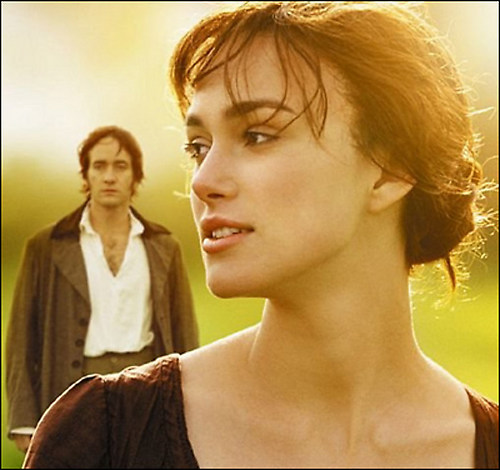
Over at The New Yorker, Victoria Dailey is having a little fun translating lines from Jane Austen’s Pride Prejudice into “Academiotics” — in short, academic speak. Here’s a little taste for you:
“It is a truth universally acknowledged, that a single man in possession of a good fortune, must be in want of a wife.”
Translation:
The heterogeneity of assumed intentions may incur a conclusory stereotype regarding gender selections in marriage-based societies, especially in those where the masculine hegemony of capital resources presupposes the feminization of property and uxorial acquisition.
Is taking shots at humanists not your favorite sport? It’s just too easy? Maybe spoofing social scientists is more your thing? Then you can read all about the Serbian academics who recently published a completely fabricated article in a Romanian journal. The published article itself, “Evaluation of transformative hermeneutic heuristics for processing random data,” appears on Scribd.
Related Content:
John Searle on Foucault and the Obscurantism in French Philosophy
Noam Chomsky Slams Žižek and Lacan: Empty ‘Posturing’
The Recipes of Iconic Authors: Jane Austen, Sylvia Plath, Roald Dahl, the Marquis de Sade & More
13 Oct 22:03


Famous Philosophers Imagined as Action Figures: Plunderous Plato, Dangerous Descartes & More
by Josh Jones

Americans do not live in a culture that values philosophy. I could go on about the deep veins of anti-intellectualism that run under the country like fault lines or natural gas deposits, but I won’t. Let’s just say that we favor more obvious displays of prowess: feats of strength, agility, and physical violence, for example, of the superhero variety. With this fact in mind, first-year graduate student Ian Vandewalker decided he “wanted to do something that would bring a discipline that is often seen as difficult, esoteric, and even irrelevant, into new light—especially in the eyes of young people.” Remembering a poster he once saw of “an action figure of Adam Smith with Invisible Hand action,” Vandewalker decided he would combine his own love of toys and philosophy into a philosopher action figure series he called “Philosophical Powers!” Here are just a few of Vandewalker’s creations, designed somewhat like professional wrestlers, with their various leagues and range of epithets.
He begins at the traditional beginning, with figures of “Plunderous Plato” and “Arrogant Aristotle” (above), “The Angry Ancients.” Aristotle, known as the “peripatetic” philosopher, has only one power: “walking.” His quality is attested by a rather circular syllogism: “All Philosophical Powers figures are totally awesome. This toy is a Philosophical Powers figure. Therefore, this toy is totally awesome.” Like much of Aristotle’s deductive reasoning, the argument is airtight, provided one accept the truth of its premises.

In the category of “Contumelious Continental Rationalists,” who began the revolt against those Aristotelian “Merciless Medievals,” we have “Dangerous Descartes.” René Decartes may have claimed to doubt everything—every principle that Aristotle took for granted—but he fell prey to his own errors, hence his action figure’s weakness, the “Cartesian circle.” Decartes’ method of doubt produced its own brand of dualistic certainty about his own existence as a “thinking thing,” and the existence of God, hence “certainty” is one of his action figure’s strengths.

Skipping ahead over a century, we have the lone figure in “The Abominable Absolute Idealist” series, “Hateful Hegel.” Hegel is the ultimate systematizer whose embrace of contradiction can seem maddeningly incoherent, unless we believe his metaphysic of “Absolute Spirit.” Given his dialectic of everything, Hegel’s power is that “he is infinite.” His weakness? “He is finite,” of course. Given Hegel’s teleological theory of history, people who purchase his action figure “can expect them to become more and more valuable as time passes.”

The most amusing of “The Antagonistic Analytic Philosophers” is Ludwig Wittgenstein, who was himself an amusingly eccentric individual. Known for his terrible temper, which would often drive him to verbally abuse and strike those poor students who couldn’t grasp his abstruse concepts, “Vindictive Wittgenstein” has the power of “poker wielding ability.” His weakness, naturally, is his “teaching ability.” I particularly like the “notes” section of the figure’s description:
Wittgenstein figures come in two variations: the early model’s recorded messages include nonsense about language being a “picture” of the world, while the later model’s messages include nonsense about games and their “family resemblances” to one another. It’s fun to communicate! (Doll does not actually communicate. Children who claim that Wittgenstein figures talk to them with their own “private language” are mistaken or lying and should be severely beaten by their teachers.)
You can see the whole set at the Philosophical Powers site. It is problematic that we only get dead white men represented, but this is not solely the fault of Vandewalker but also a problem of history and the traditional academic history of ideas. One would hope that the concept is clever enough that it might make philosophy appealing to people who find it dull or unapproachable. That may be too lofty a goal, but these figures are sure to amuse the already philosophically-inclined, and perhaps spur them on to learn more.
Related Content:
10th Graders Draw Pictures Imagining Philosophers at Work
The Daily Habits of Highly Productive Philosophers: Nietzsche, Marx & Immanuel Kant
What Do Most Philosophers Believe? A Wide-Ranging Survey Project Gives Us Some Idea
Philosopher Portraits: Famous Philosophers Painted in the Style of Influential Artists
Download 90 Free Philosophy Courses and Start Living the Examined Life
Josh Jones is a writer and musician based in Durham, NC. Follow him at @jdmagness
 (Via
(Via 
13 Oct 09:33


American education's use of "value added measures" is statistically bankrupt
by Cory Doctorow
American teachers are widely assessed on the basis of "value added measures," a statistical tool for analyzing the outcomes of their teaching. But as Jerry Genovese points out, this is statistically completely bankrupt -- unless you randomize your samples, you get no insight into the quality of the teaching. I asked my father, Gord Doctorow -- a mathematician, math teacher, and professor of education -- what he thought of Genovese's piece, and he sent me some great material, which you'll find after the jump.
In the past few weeks I have been analyzing data from a research project. The topic is not important for our discussion here, the methodology, however, is. The approach I am using is called a gain score analysis. Participants are assigned to one of two groups, each group will receive a different intervention. For each group we measured our outcome variable at baseline, that is before treatment. After the intervention we will measure our outcome variable again. Gain score is defined as the final measurement minus the baseline measurement. In other word the magnitude of the change. By focusing on the magnitude of the change we don’t have to worry about the fact that the baseline scores were not identical. We use a statistical test to see if one group gained significantly more that the other.
A value added measure of teaching is also a gain score analysis. They measure the students’ performance at the beginning of the year and then measure their performance again at years end. The difference would be the gain score or, as it is called in education, the value added. The average gain score for a group of students is said to be the value added by the teacher.
What is wrong with this approach? After all it seems to be identical to what my colleagues and I are doing in our research. Unfortunately, there is a crucial difference. In my study the participants were randomly assigned to the two groups. A gain score analysis can not be valid if the group assignments are not random.
Here's what my Dad added:
I agree with Jerry Genovese. There are several methodological problems with value-added evaluations of teachers, as I understand the concept from Jerry's blog. First, the issue of comparisons: he's right that sampling has to be random. Not only that, the sample size has to be sufficiently large (sufficient power) and representative. To be representative, the proportions of certain demographically defined groups of students have to be proportionally represented in the comparison groups. Besides that, there is the issue of what constitutes an appropriate measure of value. In the case of student scores, we need to know whether the tests of student performance are good predictors of future success. In Finland, the students are not exposed to such tests until later on when they compete in the PISA, which is an international test of performance by country. Yet despite, or perhaps because of, this lack of emphasis, they greatly outperform American kids. The value that Finns use to compare teachers is based on rigorous standards of pre-service education, including attainment of a Master's degree, and very competitive salaries. These teachers are expected to be knowledgeable and innovative. In the U.S., the teachers are expected to get their students to attain scores on standardized tests in a high stakes environment, which inevitably leads to cheating and sacrifice of creative learning opportunities.
Finally, in order to do a proper comparison of teacher performance, you have to eliminate (control for) variations in the student populations being served. Students learn at different rates, are subject to cultural influences, have varying degrees of home encouragement and support, and the list goes on. There can be no meaningful comparison among teachers who have vastly different student populations because a significant variable plays a confounding role.
Value added measures of teachers are invalid (Thanks, Jeremy!) 
|
|
11 Oct 00:25


I get this question a lot: "Should I go get a PhD?" (or its...
I get this question a lot: "Should I go get a PhD?" (or its variant, “How can I get a PhD in X?”) This is just one small part of my answer to that question (we’ll dig in more in the future, I promise). It’s very important that people see this graph before taking the plunge. This isn’t me telling you no, just something you should know about this game, should you choose to play it. I don’t mean to depress you, but we need to do some Real Talk™.
The chart above details the biggest problem with science and engineering PhD education as it currently stands (via this article). It speaks for itself, but here’s the caption:
Since 1982, almost 800,000 PhDs were awarded in science and engineering (S&E) fields, whereas only about 100,000 academic faculty positions were created in those fields within the same time frame. The number of S&E PhDs awarded annually has also increased over this time frame, from ~19,000 in 1982 to ~36,000 in 2011. The number of faculty positions created each year, however, has not changed, with roughly 3,000 new positions created annually.
If you want to be a professor, or on faculty in any way, then get ready for the Shitty Hunger Games. It’s like the regular Hunger Games, except the odds are in no one’s favor.

There’s certainly lots you can do with a PhD besides be professor (I’m living proof of that). That’s the #1 defense to this kind of data. But I have never seen a convincing case that getting a PhD is something that you need to get if you’re not going to be a prof. Yes, you will be a better thinker/scientist/banker/general human being, but you don’t strictly need to suffer through a PhD to do that. Prove me wrong! I would love to see data that says otherwise because I don’t like this thought!
I don’t think it makes sense for this many people to miss out on years of earning potential and join our magical monkhood for the purpose of receiving some set of special powers and a funny hat. At least not as PhDs are currently designed (and changing that would be something indeed, although yes, please change that).
Because right now, the vast majority of PhD programs train people to be professors, which makes perfect sense because 100% of their mentors decided to go that route. Yes, grad programs are getting better at expanding what PhD students learn and prepping students for alternative careers, but that still strikes me as kind of a joke …
Because faculty jobs ARE the alternative career, people.
09 Oct 22:33
Cool, interactive site shows you how ocean currents carry flotsam around the globe
by Maggie Koerth-Baker
Drop a message-in-a-bottle into the Gulf of Mexico, somewhere near New Orleans, and, 10 years later, your missive has a high likelihood of ending up near Cuba — or northern France. The website Adrift uses data from a global system of floating buoys to show you how ocean currents carry things like plastic debris around the planet. 


|
|
Yasutada.sudo, nealteam likes this
09 Oct 22:03


Ask a Slave, funny web video history series
by Xeni Jardin
"Ask a Slave" is great stuff. [Video Link] to one episode, and the entire web series is here. Actor/comedian Azie Mira Dungey once worked as a historical re-enactor at Mount Vernon, and her experiences answering stupid questions form the base of this delightful video series. More: askaslave.com. (Thanks, Bella!)

|
|
Yasutada.sudo, J.w.dillow likes this
09 Oct 21:53
CDZA: 'An intro to drums' (music video)
by Xeni Jardin
"Allan Mednard gives us the details on two very popular styles of drumming, and what their rhythms are all about," says Joe Sabia. "This is the first in CDZA's brand new THE INSTRUMENTALS series. More to come." [Video Link]


|
|
09 Oct 21:42


Iggy Pop performs "The Passenger" (1977)
by David Pescovitz
The inimitable Iggy Pop performs a searing rendition of "The Passenger" live at The Apollo in Manchester, England, October 1977.
|
|
Benjaminsavage, Skinny.honkie and one other like this
09 Oct 14:12


Oxford vice-chancellor: let better universities charge higher tuition fees
by Alexandra Topping
Professor Andrew Hamilton says tuition fees system is out of kilter and higher fees need not be a barrier to access
Top universities that offer better outcomes for students should be allowed to charge significantly higher tuition fees than institutions that provide an inferior education, Oxford University's vice-chancellor has said.
Professor Andrew Hamilton said tuition fee increases that allowed universities to charge undergraduate students up to £9,000 a year had made little difference to Oxford, which faced a funding "chasm".
In his annual speech, he said Oxford's world-class education would be under threat if no more money could be found to plug a £70m annual shortfall. He called for a new system that would reflect the diversity of education on offer from British universities, and said the current system was "out of kilter".
"The idea of a market – and that is what is ostensibly being created – in which every item, virtually regardless of content and quality, is the same price seems, well, a little odd," he said.
"On the other hand, given the great diversity of the institutions in our higher education system, the notion of different universities charging significantly different amounts doesn't feel inherently unnatural. It is the current situation that seems out of kilter."
A university should be able to charge fees "aligned with what it offers", he said, adding that high fees should not be a barrier to student access if financial support was available and loans were only payable after graduation and linked to earnings.
University figures suggest that around 1,000 students a year turn down a postgraduate place at Oxford because of the financial demands of studying there. Postgraduate students do not automatically qualify for student loans or financial aid.
In January 26-year-old Damien Shannon launched a legal case against St Hugh's College, Oxford, accusing it of "selecting by wealth" by asking students with a conditional place at the university to demonstrate that they held funds to cover tuition fees, plus at least £12,900 a year for living costs.
Hamilton said Oxford's track record on student support was "exceptional" and it offered "the most generous financial package for low-income undergraduates of any university in the country".
He added: "Of course, it is understandable that so much attention is focused on a student's financial circumstances before university, but what happens after is also crucially important. And certainly, so far as Oxford is concerned, all the evidence indicates that the quality of the education a student receives here is overwhelmingly his or her best investment for the future. That in turn means that support for our students in the form of loans from the public purse is also a pretty sound investment."
He did not rule out the possibility that Oxford could raise money by issuing bonds, following the lead of US universities. "None of this means that such a course of action is necessarily right for Oxford and any substantial policy of borrowing – whether as a bond or some other form of loan – would require careful reflection and planning in order to establish clarity about priorities and processes, including how interest payments would be structured and met," he said.
He went on to address accusations that the university had an institutional bias against black and ethnic minority students. The Guardian revealed this year that white applicants to some of the most competitive courses were up to twice as likely to get a place as others, even when they get the same A-level grades.
Figures for applications to the university in 2010 and 2011 revealed that 25.7% of white applicants received an offer to attend the university, compared with 17.2% of students from ethnic minorities. White applicants to medicine, one of the most prestigious courses, were twice as likely to get a place as ethnic minority candidates, even when they had the same triple A* grades at A-level.
Hamilton said the university had "a much more diverse community than you may be encouraged to believe from media stereotypes", with 20% of students from a minority background.
He admitted that figures indicated "that white applicants with similar exam grades tend to fare better than non-white applicants", but said that in some subjects non-white students were more likely to get an offer than white students, and that under-represented groups were more likely to apply for the most competitive courses.
"Any variation can throw up eye-catching but misleading disparities in success rates. Factors like these make hard and fast conclusions both extremely difficult and potentially dangerous," he said.
Hamilton said that last year the university had announced a £1m initiative to promote diversity among academic and research staff after figures revealed that 25% of academic staff and 18% of professorial staff were women.
theguardian.com © 2013 Guardian News and Media Limited or its affiliated companies. All rights reserved. | Use of this content is subject to our Terms & Conditions | More Feeds
08 Oct 19:11


Harvard Business Review to universities: your subscription doesn't include classroom use
by Cory Doctorow
The University of Toronto's School of Business has advised its faculty to avoid assigning articles from the Harvard Business Review to their students. Though the U of T library has a digital subscription to the Review, Harvard has put it -- and other schools -- on notice that they will be billed separately if they are caught assigning, suggesting, or referring to HBR articles in classrooms. That's because the license agreement for academic HBR subscriptions forbids using HBR in coursework, and Harvard is now enforcing those terms, and hoping to extract rent from universities where the profs assume, foolishly, that just because a scholarly journal is in their library on a paid-up subscription, they can tell the students to go and read it.
Harvard Business Review Notice of Use Restrictions, May 2009 Harvard Business Review and Harvard Business Publishing Newsletter content on EBSCOhost is licensed for the private individual use of authorized EBSCOhost users. It is not intended for use as assigned course material in academic institutions nor as corporate learning or training materials in businesses. Academic licensees may not use this content in electronic reserves, electronic course packs, persistent linking from syllabi or by any other means of incorporating the content into course resources. Business licensees may not host this content on learning management systems or use persistent linking or other means to incorporate the content into learning management systems. Harvard Business Publishing will be pleased to grant permission to make this content available through such means. For rates and permission, contact permissions@harvardbusiness.org.
Harvard Business School Publishing crosses the ‘evil’ academic line 
|
|
08 Oct 19:08
The typical Nobel winner is a 61-year-old American man affiliated with Harvard
by Maggie Koerth-Baker

08 Oct 16:58
Genes Suggest European Women at Root of Ashkenazi Family Tree
by By NICHOLAS WADE
A genetic analysis indicates that the women who founded the Ashkenazi Jewish community of Europe were not from the Near East, as previously thought.


|
|
08 Oct 16:56
Mystery over Obesity 'Fraud'
Ghost writing is taking on an altogether different meaning in a mysterious case of alleged scientific fraud. The authors of a paper published in July ( A. Vezyraki et al . Biochem....
-- Read more on ScientificAmerican.com


-- Read more on ScientificAmerican.com