Behavioural economics is much more about behaviour that it is about economics. In psychology, behaviourism has been largely superseded by cognitive psychology. In economics, behaviourism is still in the ascendant, perhaps because it helps to rationalise the work of economists. If people are assumed to be irrational and easily manipulated, all the more need for experts to analyse and correct their failings
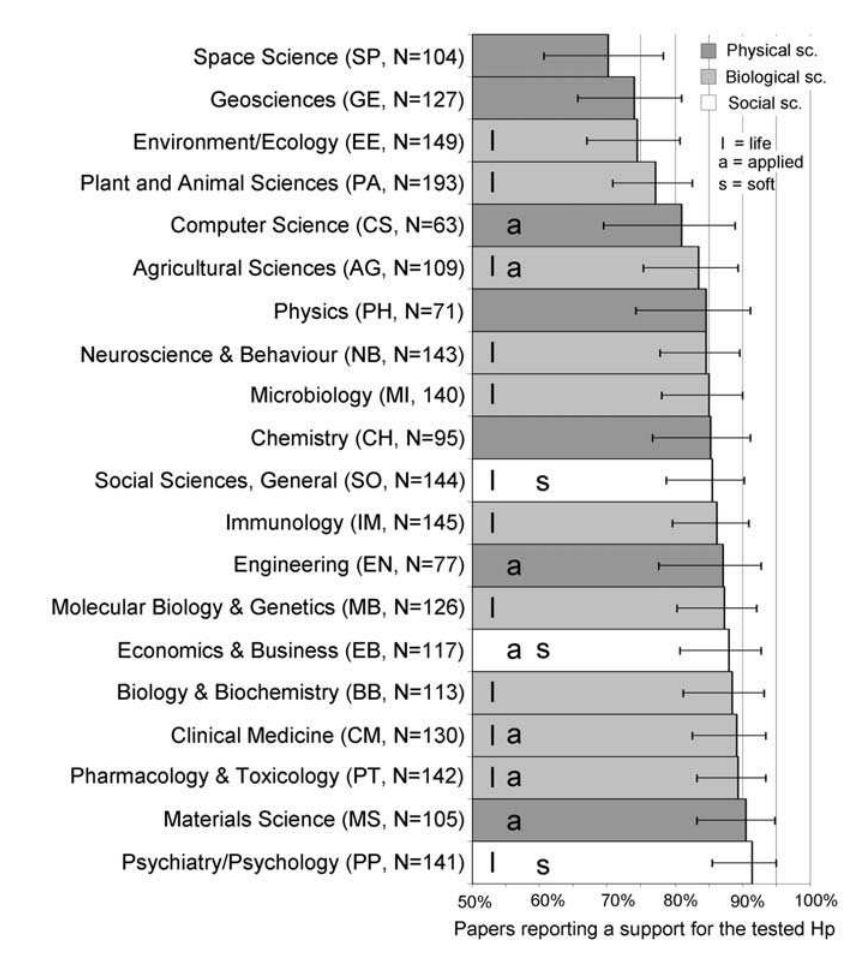
Joachim Voth points me to a paper that looks for a “hierarchy of science” according to whether or not the discipline publishes null results.
Here’s how a sample of papers perform, by discipline:
You can quibble with sampling, sample sizes, definitions, etc (and I would) but anyone who has had tremendous difficulty getting a null result published (I have, twice) knows that confirmation and publication bias is alive and well. If they simply got pushed to the good field journals, I could understand, but even there it can be tricky.
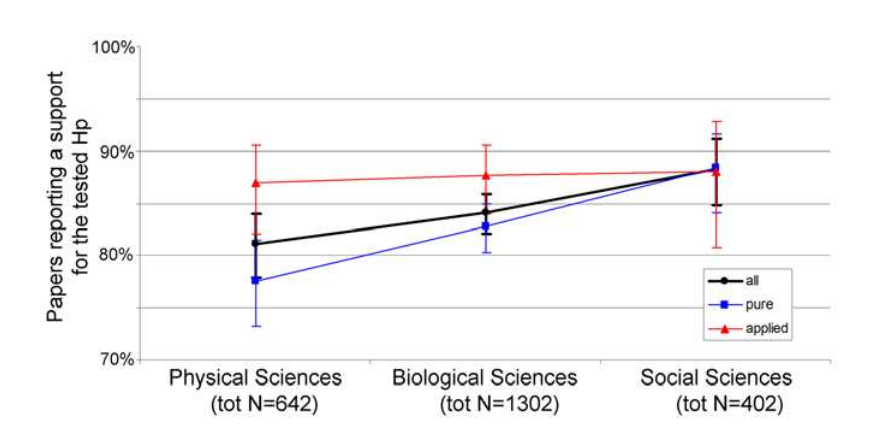
Even so, one reason to take the so-called hierarchy of science with a grain of salt is the following figure:
Everything is driven by “pure” science, meaning (I think) the testing of theories and predictions from very basic science (think theoretical physics). The article is weak on definitions.
So the punchline is that empirical tests of highly theoretical models seldom pan out. Which is basically my experience in economics and political science too.
Even so, the next time you are asked to referee or report on a null result, give it a second chance.
Heuristic models have been proposed for many domains of choice. We compare heuristic models of intertemporal choice, which can account for many of the known intertemporal choice anomalies, to discounting models. We conduct an out-of-sample, cross-validated comparison of intertemporal choice models. Heuristic models outperform traditional utility discounting models, including models of exponential and hyperbolic discounting. The best performing models predict choices by using a weighted average of absolute differences and relative (percentage) differences of the attributes of the goods in a choice set. We conclude that heuristic models explain time-money tradeoff choices in experiments better than utility discounting models.
The debate about behavioral economics - the incorporation of insights from psychology into economics - is often framed as a question about the foundational assumptions of economic models. This paper presents a more pragmatic perspective on behavioral economics that focuses on its value for improving empirical predictions and policy decisions. I discuss three ways in which behavioral economics can contribute to public policy: by offering new policy tools, improving predictions about the effects of existing policies, and generating new welfare implications. I illustrate these contributions using applications to retirement savings, labor supply, and neighborhood choice. Behavioral models provide new tools to change behaviors such as savings rates and new counterfactuals to estimate the effects of policies such as income taxation. Behavioral models also provide new prescriptions for optimal policy that can be characterized in a non-paternalistic manner using methods analogous to those in neoclassical models. Model uncertainty does not justify using the neoclassical model; instead, it can provide a new rationale for using behavioral nudges. I conclude that incorporating behavioral features to the extent they help answer core economic questions may be more productive than viewing behavioral economics as a separate subfield that challenges the assumptions of neoclassical models.
In the ideas issue of TheAtlantic last summer—“How Genius Happens”—we missed a chance to resurrect a fascinating piece from 1933. It’s called “Confessions of a Novelist,” and it’s by one of magazine’s most illustrious contributors. At 71, Edith Wharton could have been forgiven for feeling a little defensive. Her novels had once been hailed as revolutionary, but now her name was often prefaced by “the killing word ‘distinguished,’” as her biographer Hermione Lee puts it. The Depression had been hard on Wharton. (“Like everyone in America, I find my income diminishing day by day,” she wrote her publisher.) Magazine editors, her agent had to break it to her, were no longer clamoring for her fiction: It “did not fit in” was an increasingly frequent verdict. Readers were looking for gritty realism or escapist romance, and Wharton’s psychological probing of high society had begun to seem old-fashioned.
Writers and editors on their favorite stories from our 157 years. Read More
But she was undaunted and so, I’m glad to say, were the editors at TheAtlantic. Wharton set out to explore “the deeper processes” at work in her art, and she was not afraid to risk sounding a little dotty, which greatly adds to the appeal of the essay. Puzzled that “so few writers seem to have watched themselves while they wrote,” she promised exciting self-scrutiny. Move over Henry James: she wasn’t about to offer tame “analyses of … the technical procedure employed” in constructing her books. Wharton was ready to reveal “the teeming visions which, ever since my small-childhood, and even at the busiest and most agitated periods of my outward life, have incessantly peopled my inner world.”
Wharton, of course, could not have foreseen the flood of experts on creativity who now peddle their neuroscientific wisdom. They, and the rest of us, could benefit from a backward glance at her boldly inconsistent revelations about the “mystery of what happens in the brain” when a story takes root. Wharton blends magical channeling (characters “start up before me, coming seemingly from nowhere”) and matter-of-factness (they have names that, however peculiar, she can’t possibly change). Their dialogue, she insists, is out of her hands: she’s “merely a recording instrument.” Yet her characters can’t just walk away with the drama; their fate is under her control. Wharton is well aware how weirdly elusive yet hyper-vivid it all sounds: “the process, though it takes place in some secret region on the sheer edge of consciousness, is yet always illuminated by the clear light of my critical attention.”
Don’t get the idea that the prose simply gushed forth from such a well-stocked font of inspiration. Wharton doesn’t mind confessing that she’s “always been a slow worker,” and has known her share of insecurity. Right in step with the current emphasis on practice, practice, practice, she swears by “the effect on my imagination of a systematic daily effort.” Her motto, after she’d written House of Mirth, was a stunningly humble goad I’m not going to forget: “I remember saying to myself, when the book was done: ‘I don’t yet know how to write a novel; but I know how to find out how to.’”
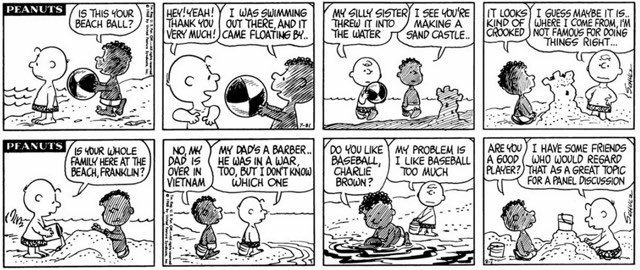
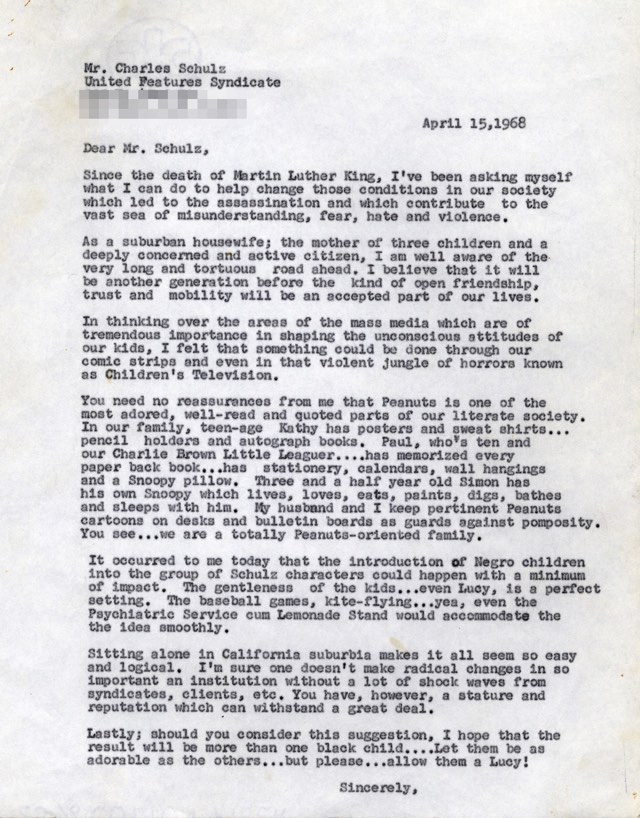
Franklin, the first black member of Charles Schulz's Peanuts gang, made his debut in July 1968. His presence came about through the efforts of Los Angeles schoolteacher Harriet Glickman, who wrote Schulz several letters in the wake of Martin Luther King Jr's assassination arguing that the inclusion of black characters in the most popular comic strip in America would be a positive thing. Here is her initial letter to Schulz:
After some back and forth between Schulz and Glickman, Franklin made his first appearance in the strip.
Franklin's introduction was part of a five-day sequence featuring Sally tossing away Charlie Brown's beach ball and Franklin rescuing it. In some ways, this seems an aggressive bit of integration -- many American public beaches, while no longer legally segregated, were still de facto segregated at the time. In other ways, the strips suggest what might be seen today as an excess of caution; of the twenty panels of the series, Franklin is in ten panels and Sally is in eight, but never is Franklin in the same panel as the white girl. Franklin would not reappear for another two and a half months, when he came for a visit to Charlie Brown's neighborhood. He was somewhat lighter skinned here, which seems to be less a matter of trying to make him acceptable to the readers and more a matter of cutting back on shading lines which were overpowering his facial features. Franklin's job in this series was to react to the oddness of the neighborhood kids, and that was a precursor to what would be his primary role in the strip as a whole. Perhaps due to excessive caution, Franklin was never granted any of the sort of usual quirks that define a Peanuts character, the very sort of mistake that Glickman was warning about when she called for one of the black kids to be "a Lucy."
His inclusion made news nationally and upset many people, particularly in the South. Schulz had a conversation with the president of the comic's distribution company:
I remember telling Larry at the time about Franklin -- he wanted me to change it, and we talked about it for a long while on the phone, and I finally sighed and said, "Well, Larry, let's put it this way: Either you print it just the way I draw it or I quit. How's that?"
On Reddit, a fan of The Simpsons recently outlined his theory that Homer Simpson has been in a coma for the past 20 years and everything on the show since mid-1993 has taken place in Homer's head. Here's the argument...
In the series' first clip show, which aired in the fourth season, Bart pranks Homer by shaking up his beer can in a paint shaker. The beer explodes and knocks Homer into a coma. At the end of the episode, Homer is shown waking up from the coma. But maybe he didn't? As possible evidence, the theorist suggests that's why the Simpsons never age:
This is why the characters don't age. Homer remembers Bart, Lisa, and Maggie as 10, 8, and 1 year old, so they will always appear that way in his dreams. He is subconsciously aware of time passing, so his mind will often "update" his memories so that the year they occurred matches up with the age he thinks he is.
And it's also why the plots on the show became more outlandish after the coma episode:
This is clearly Homer's imagination running wild. With no real world restrictions, Homer's mind is able to dream up scenarios of him and his family in fantasies involving him winning a Grammy, his father fighting his boss for buried WW2 treasure, his wife getting breast implants, his infant daughter saving him from drowning, etc.
That's pretty clever. It immediately reminded me of two things:
1. The entirety of St. Elsewhere took place inside the mind of an autistic kid named Tommy Westphall. And since St. Elsewhere was referenced on other TV shows like Homicide: Life on the Street, that means those shows (and the shows referenced on those shows) also took place in Westphall's mind.
2. From 1991 to 1994, a show called Herman's Head aired on Fox. The show took place partially in the main character's head. Among the cast are two regular Simpsons cast members: Hank Azaria (Moe, Chief Wiggum, Apu, Comic Book Guy, etc.) and Yeardley Smith (Lisa). Super-crazy theory: perhaps Herman's Head inspired Homer's coma?
As for directors, Alfred Hitchcock is the most often cited, making the list 5 times (although not placing in the top 10), and spanning 3 decades. Right behind him are Steven Spielberg and Francis Ford Coppola, both of whom made the list 4 times. Like Hitchcock, Spielberg's pictures were released over 3 decades. Coppola's pictures, however, were all released in the 1970s - with 2 in 1974 (the only director with 2 films in a single year). All of his pictures placed in the top 22 films, with 3 of them in the top 11. At the other end of the continuum, there were 33 years between Terrence Malick's 2 films on the list.
Directors Stanley Kubrick and Martin Scorsese follow, with 3 films each making the cut. Tied with Malick for 2 pictures are Bob Fosse, William Friedkin, Akira Kurosawa, Christopher Nolan, Ridley Scott, Steven Soderbergh, Orson Welles and Bob Wise; all others received 1 mention.
The top ten:
1. "Raging Bull" (Thelma Schoonmaker, 1980)
2. "Citizen Kane" (Robert Wise, 1941)
3. "Apocalypse Now" (Lisa Fruchtman, Gerald B. Greenberg, Walter Murch, 1979)
4. "All That Jazz" (Alan Heim, 1979)
5. "Bonnie And Clyde" (Dede Allen, 1967)
6. "The Godfather" (William H. Reynolds, Peter Zinner, 1972)
7. "Lawrence of Arabia" (Anne V. Coates, 1962)
8. "Jaws" (Verna Fields, 1975)
9. "JFK" (Pietro Scalia, Joe Hutshing, 1991)
10. "The French Connection" (Gerald B. Greenberg, 1971)
You think of filmmaking as male dominated, but one thing I noticed about that top 10 right away: five women in the list, including three in the top five. (via hitfix)
For much of Hollywood history, there were virtually no filmmaking opportunities available to women other than screenwriting and acting -- with one major exception. Women have always been welcomed -- and in many quarters preferred by male directors -- as film editors, or "cutters," as they were originally known. In the early days, the job was regarded as menial labor, and it largely was. Cutters worked by hand, running film on reels with hand cranks and manually cutting and gluing together strips of it. (Moreover, they almost never received screen credit.) After the advent of the Moviola editing machine in 1924, the process became faster and easier, but was still tedious and low paying, which is why most cutters remained young, working-class women.
It was around this time that the job of cutting films became less about just maintaining proper continuity and more about being creative. The Russian films of Sergei Eisenstein introduced the concept of montage -- how "colliding" separate pieces of film together could advance a storyline and manipulate viewers' emotions -- and this approach became widely discussed and imitated the world over, not least of all by some of the more enterprising female cutters in America, some of whom, like Margaret Booth, began to experiment with leftover footage on the cutting room floor and proved to be quite inventive.
This NYT article has been widely read and emailed. Ron Lieber argues yes, you should tell your children, but I’m not sure I can pull out the exact thread of his argument from the piece.
I say no you should not tell them. But you should tell them something about your monetary situation. If you are not so well off, you should tell your children that you are upwardly mobile, and will someday be more prosperous, through hard work. At the very least then they won’t be scared. If you are middle class, tell them a somewhat scaled-up version of the same. You don’t want to tell them anything they can use as a “club” against their possibly poorer friends, so leave creative ambiguity in your answer. If they boast about the family income, they will mostly end up embarrassing themselves, in addition to the negative externalities they might impose on others.
That said, you are marking out a range, so when they grow up and the time comes for them to learn the exact truth, they won’t feel you were tricking them or keeping family secrets. In the meantime you are a role model for upward mobility.
If you are well off or very well off, tell them “Yes, we are well off but the real metric of success is X,” depending on what you think they need to hear, within the bounds of realism of course. X might be how many friends you have, how happy your children are, how holy or pious or God-fearing you are, how many books you have read, or how much you have helped the world, among other candidates. Serve them up a weighted average of those Xxs over time, so as to a) avoid seeming like a monomaniac, and b) give them a sense that many values are important, and c) drive home that money is not at the top of the list, even if you think it is. They’ll have enough chances to learn to feel that way.
Remember, you’re trying to maximize some weighted average of covering your bases for future revelations, moral instruction, not scaring them with Piketty-like reasoning, stopping your kids from making fools of themselves with the information you give them, and stopping your children from making you look foolish or like a bad parent. You’re in essence the central bank here, and it’s creative ambiguity all the way.
There are gender differences in certain preferences and abilities, on average. Take competition: when running around is described as a race, girls typically run more slowly than usual, while boys start running faster. And whereas women are better at detecting emotions, men tend to score higher at spatial reasoning. Are these average gender differences – in competitiveness, empathy, and systemising - visible even within specific jobs, or do attraction and selection processes smooth out the differences? Should we expect more feminine traits in a female teacher than a male teacher, or will their shared teacherly attributes dilute any gender differences?
Looking across six different professions as various as dentists, environmental inspectors and social science teachers, Vibeke Nielsen at Aarhus University found that the answer depends on the job. She used survey data from 1320 Danish public employees, which means we are drawing conclusions based on ratings of statements like “I find it easy to put myself in somebody else’s place” (empathy) to determine traits, rather than using objective tests.
In many professions, clear gender differences were identified: for instance, 14 per cent of the variability of empathy in dentists is explainable by gender, meaning if you were to switch from a male to a female dentist you wouldn’t be crazy to expect somewhat more concern for your feelings and experiences. For systemising, the biggest gender-based difference was eight per cent, found between male and female environmental inspectors. At the other extreme, among social science teachers, just one per cent of empathy and two per cent of systemising differences were explainable by gender, with no differences in competitiveness found.
What this suggests is that professions such as social science teaching place a narrow band around traits, such as empathy, that are normally grounds for gender differentiation. In contrast, other professions are more multi-faceted: dentistry, for example, is a healing profession which could attract those women who are more stereotypically empathetic - but it is also seen as high-status and prestigious, attracting men who are stereotypically male in terms of having lower empathy. Its selection process may be as stringent as in teaching, but the filters are varied and don’t have the effect of eliminating gender differences.
We shouldn’t, therefore, assume that gender differences will evaporate within specific professions. In fact, given that Denmark is a highly gender-equal society, any within-profession gender differences may be even more pronounced in other cultures.
This is a wake-up call in terms of gender equality. Just because a woman is drawn to a stereotypically masculine profession, doesn’t mean that she has masculine traits and will therefore be immune to structures and processes that are biased against femininity, from winner-takes-all career progression, to biases in how different skills are valued. And it's a similar story for men in stereotypically female roles.
_________________________________
Nielsen, V. (2014). Differences in Male and Female Employees’ Personal Attributes? Myth or a Reasonable Assumption: Even Within Professions? Gender Issues, 31 (3-4), 163-184 DOI: 10.1007/s12147-014-9123-0
I assign Angrist and Pischke’s Mostly Harmless Econometrics in virtually all of my graduate courses in economics and political science, largely because it’s one of the best, most practical, and most readable guides to causal inference out there. But it’s still a very hard book, with mathematical passages I myself struggle to follow once in a while.
What’s been needed for some time is a more casual introduction. And it has arrived.
Mastering Metrics is a more intuitive, example-strewn introduction to methods for figuring out causality in statistics. Just as the previous book used the Hitchhiker’s Guide to the Galaxy as a cute narrative device, this one uses Kung Fu. And more prose than math.
I have only skimmed the book (a review copy from the publisher) and it looks very good. A colleague in comparative politics walked into my office, saw it on the table, and got very excited. I expect this to be the general reaction. I also listened to Russ Roberts’s interview of Angrist on EconTalk a couple of weeks ago. It’s a nice overview, but sadly few deep insights or personal stories you won’t find in the book.
The real test will come from teaching with the new book, which I plan to do in the fall. But I expect advanced undergraduates, master’s and PhD students all to find this useful, especially alongside the previous book.
Personally I would like more international examples, and more on matching (and how it’s often misused). But these are small things.
More importantly, I build my courses around tearing apart new papers, and running replications and new data analysis. The Angrist and Pischke books are limited on their own.
Indeed, a quote, attributed to the Kung Fu Master Tan Soh Tin:
Never forget that, at the most, the teacher can give you fifteen percent of the art. The rest you have to get for yourself through practice and hard work. I can show you the path but I can not walk it for you.
Watch as farmer Derek Klingenberg calls his cattle in by playing Lorde's Royals on his trombone.
I can't tell if this is the perfect Monday video or the perfect Friday video. Maybe I'll post it again on Friday and we'll compare. (via the esteemed surgeon and writer @atul_gawande)
Over the years, however, I've started to wonder whether Netflix's big decisions are truly as data driven as they are purported to be. The company does have more audience data than nearly anyone else (with the possible exception of YouTube), so it has a reason to emphasize its comparative advantage. But, when I was reporting a story, a couple of years ago, about Netflix's embrace of fandom over mass culture, I began to sense that their biggest bets always seemed ultimately driven by faith in a particular cult creator, like David Fincher ("House of Cards"), Jenji Leslie Kohan ("Orange is the New Black"), Ricky Gervais ("Derek"), John Fusco ("Marco Polo"), or Mitchell Hurwitz ("Arrested Development"). And, while Netflix does not release its viewership numbers, some of the company's programming, like "Marco Polo," hasn't seemed to generate the same audience excitement as, say, "House of Cards." In short, I do think that there is a sophisticated algorithm at work here -- but I think his name is Ted Sarandos.
I presented Sarandos with this theory at a Sundance panel called "How I Learned to Stop Worrying and Trust the Algorithm," moderated by Jason Hirschhorn, formerly of MySpace. Sarandos, very agreeably, wobbled a bit. "It is important to know which data to ignore," he conceded, before saying, at the end, "In practice, its probably a seventy-thirty mix." But which is the seventy and which is the thirty? "Seventy is the data, and thirty is judgment," he told me later. Then he paused, and said, "But the thirty needs to be on top, if that makes sense."
Some of you will know that Average is Over contains an extensive discussion of "freestyle chess," where humans can use any and all tools available -- most of all computers and computer programs -- to play the best chess game possible. The book also notes that "man plus computer" is a stronger player than "computer alone," at least provided the human knows what he is doing. You will find a similar claim from Brynjolfsson and McAfee.
Computer chess expert Kenneth W. Regan has compiled extensive data on this question, and you will see that a striking percentage of the best or most accurate chess games of all time have been played by man-machine pairs. Ken's explanations are a bit dense for those who don't already know chess, computer chess, Freestyle and its lingo, but yes that is what he finds, click on the links in his link for confirmation. In this list for instance the Freestyle teams do very very well.
I wonder what the human/cyborg split is at Buzzfeed or Facebook? Or at food companies like McDonald's or Kraft? Or at Goldman Sachs?
We use a variant of the Implicit Association Test (IAT) to examine individuals' implicit attitudes towards various ethnic groups. Using a population from the Democratic Republic of Congo, we find that the IAT measures show evidence of an implicit bias in favor of one's own ethnicity. Individuals have implicit views of their own ethnic group that are more positive than their implicit views of other ethnic groups. We find this implicit bias to be quantitatively smaller than the (explicit) bias one finds when using self-reported attitudes about different ethnic groups.
A commonly held view is that laboratory experiments provide researchers with more "control" than natural field experiments, and that this advantage is to be balanced against the disadvantage that laboratory experiments are less generalizable. This paper presents a simple model that explores circumstances under which natural field experiments provide researchers with more control than laboratory experiments afford. This stems from the covertness of natural field experiments: laboratory experiments provide researchers with a high degree of control in the environment which participants agree to be experimental subjects. When participants systematically opt out of laboratory experiments, the researcher's ability to manipulate certain variables is limited. In contrast, natural field experiments bypass the participation decision altogether and allow for a potentially more diverse participant pool within the market of interest. We show one particular case where such selection is invaluable: when treatment effects interact with participant characteristics.
…the truth is, in the contemporary world, Christians won big. And the frustration and humiliation that Muslims now feel as a result can help explain terrorism. That frustration and humiliation is rooted in politics rather than sex and in modern experience rather than deep history. And it has little to do with the Koran.
I cannot agree more: this helps explain Islamist terrorism, at least in this moment. I believe that humiliation and perceived injustice are much more powerful motivators than many people believe. Though scientific evidence remains elusive.
But I’ll answer Fish’s question in slightly stronger terms: no way. Terror is not Islamist. Terror is a tool, used not only by the weak or humiliated but by the powerful.
We can quibble about definitions, but the big thing to me is the following: it is violence where the intended target is not the person hurt, but the wider audience that identifies with that victim. Terror is a weapon of mass intimidation.
From the Irish Republican Army to the military wing of the African National Congress (of Nelson Mandela fame), terror has usually been a tool of the weak or oppressed.
But look to Robert Mugabe (or any other thuggish dictator who punishes a few opposition supporters to frighten the many). Terror isn’t simple the tool of those out of power.
Colombian Marxists. Italian mafias. Joseph Kony and the Lord’s Resistance Army. Sierra Leonean rebels. They massacre and beat and mutilate to send messages. The line from acts of war to acts of terror is blurry.
And the United States military? I ask you to consider that the targets of drone strikes are not limited to those blown to smithereens.
The definitive piece about the public programme at Davos. “A Davos panel discussion is an opportunity for CEOs to feel important, and for the audience to feel as though they’re learning from top-level thought leaders. The main purpose of the panel is generally simply to exist. The message is: these people are talking about this important issue, and they take it seriously. The actual substance of what is said? Not particularly important”
Instead, you should ask for the distribution of the forecast: How probable is a major blizzard? You also need to weigh the damage done by a false positives (you warn of a blizzard and it doesn’t come) against the damage done by a false negative (you don’t warn of a blizzard, and it does come). New York City probably made the right choice in preparing for a blizzard that didn’t happen, but it would be nice to know more about the data
How Vladimir Putin sees the world. America is the far enemy. Germany is the near enemy. Russia’s priority is to prevent Europe consolidating under German leadership. “He is betting on German failure, not on Russian success. The goal of Russian policy in Ukraine is not to conquer Ukraine, but to demonstrate that Germany cannot save Ukraine or organize Ukraine. It doesn’t have the money, the military culture or the political skills”
American Sniper is one of the best anti-war movies I have seen, ever. But it shows the sniper-assassin, and his killing, to be sexy, and to be regarded as sexy by women, while the rest of war is dull and stupid. (Even the two enemy snipers are quite attractive and fantastic figures, and there is a deliberate parallel between the family life of the Syrian sniper and the American protagonist. The klutziness of the non-assassin soldiers limited how many African-Americans and Hispanics they were willing to cast in those roles, as it is easiest to make white guys look crass in this way without causing offense.) By making the attractions of war palpable, this film disturbs and confuses people and also occasions some of the worst critical reviews I have read. It also, by understanding and then dissecting the attractions of blood lust, becomes a quite convincing anti-war movie, if you doubt this spend a few months studying The Iliad. (By the way, Clint Eastwood, the director and producer, describes the movie as anti-war.) The murder scenes create an almost unbearable tension, the sandstorm is a metaphor for our collective fog, and they had the stones to opt for the emotional overkill of four rather than just three tours of duty. Iraq is presented as a hopeless wasteland with nothing of value or relevance to the United States, and at the end of the story America proves its own worst enemy. It is not clear who ever gets over having killed and fought in a war (can anything else be so gripping?…neither family life nor sex…), even when appearances suggest a kind of normality has returned. The generational cycle is in any case replenished. I say A or A+, both as a movie and as a Rorschach test.
Two Days, One Night has some of the worst economics I have seen in a movie, ever. It would be brilliant as a kind of Randian (or for that matter Keynesian) meta-critique of the screwed up nature of Belgian labor markets and social norms, and most of all a critique of the inability of the Belgian intelligentsia to understand this, except it is not. It is meant as a straight-up plea for sympathy for the victim and as such it fails miserably, even though as a movie it embodies reasonably good production values. Everything in the workplace of this solar power company is zero-sum across the workers and we never see why. The protagonist campaigns to get her job back, but never asks or even considers how she might improve her productivity or attitude, asking only on the basis of need. (And she is turned down only on the basis of need.) At one point her employer states the zero marginal product hypothesis quite precisely, something like “when you took time off, we saw that sixteen people could do the work of seventeen.” She never asks if there might be some other way she could contribute — but she does need the money — nor does the notion of a better job match somewhere else rear its head. The depictions of financial hardship confuse wealth and income, basic survival and discretionary spending. The rave reviews this movie has received represent yet another Rorschach test and one which virtually every commentator seems to have failed.
In their latest full episode, Radiolab examines the concept of worth, particularly when dealing with things that are more or less priceless (like human life and nature).
This episode, we make three earnest, possibly foolhardy, attempts to put a price on the priceless. We figure out the dollar value for an accidental death, another day of life, and the work of bats and bees as we try to keep our careful calculations from falling apart in the face of the realities of life, and love, and loss.
I have always really liked Radiolab, but it seems like the show has shifted into a different gear with this episode. The subject seemed a bit meatier than their usual stuff, the reporting was close to the story, and the presentation was more straightforward, with fewer of the audio experiments that some found grating. I spent some time driving last weekend and I listened to this episode of Radiolab, an episode of 99% Invisible, and an episode of This American Life, and it occurred to me that as 99% Invisible has been pushing quite effectively into Radiolab's territory, Radiolab is having to up their game in response, more toward the This American Life end of the spectrum. Well, whatever it is, it's great seeing these three radio shows (and dozens of others) push each other to excellence.
First impressions lead to a multitude of assumptions, and trustworthiness is one of them: faces with v-shaped eyebrows and frowning mouths are consistently judged as less trustworthy than others with ^-shaped brows and mouths with upturned corners (this may be related to the former betraying a hidden anger and the latter having positive undertones). Now a study by Brian Holtz suggests that a person's looks can colour perceptions, not only of how trustworthy their character might be, but of whether their actual deeds are fair and well-intentioned.
In an ideal world, we’d trust people based upon what they say and do, and use that track record to evaluate whether their subsequent actions were in good faith. These new results suggest that often isn't so - instead, our superficial impressions influence how we evaluate their behaviour.
The first study presented data on an imaginary company to 609 people recruited through an online portal, all of whom had experience of being in work. They were asked to evaluate a decision made by the CEO to cut pay by 15 per cent for all staff (including the CEO himself) in order to avoid cut-backs in tough economic times. Participants felt more trust towards the CEO and judged the decision as fairer when the CEO’s biography included a facial photo previously rated as highly trustworthy, rather than an untrustworthy one.
In the lead-up to this evaluation, participants were asked if there were other solutions to the financial crisis, and if so, if they could have been fairer. When they thought the CEO had a trustworthy face, they were less likely to believe there were fairer alternatives he could have taken. In both this and a subsequent replication, this doubt in viable alternative options mediated how strongly the photo drove trust in the CEO’s behaviour. This is fascinating and surprising to me - it suggests that a gut feeling, based on physical appearance, could have consequences for how we intellectually review a situation. I should note a third study with a smaller sample, conducted in the context of fairness in university marking, didn’t find this mediating route, but the main effect of facial appearance on trust in a person’s behaviour was replicated.
When we assume that certain facial characteristics can mark someone out as special - more electable, fit for higher rank, or a better captain of industry - these assumptions often become self-fulfilling. But whereas it’s easy to be accepting about the inevitability of some of these effects - people who look imposing will obviously be more imposing - most of us like to believe that perceptions of trust go deeper and are truly shaped by a person’s ethics and actions. Yet the sad truth is, some faces seem to mark one out as an easy scapegoat, while others are able to get away with murder.
_________________________________
HOLTZ, B. (2014). FROM FIRST IMPRESSION TO FAIRNESS PERCEPTION: INVESTIGATING THE IMPACT OF INITIAL TRUSTWORTHINESS BELIEFS Personnel Psychology DOI: 10.1111/peps.12092
Yitang Zhang kept the accounts for a Subway franchise in Kentucky, taught calculus in New Hampshire — and then, at the age of 55, solved a fundamental problem in prime-number theory which had been troubling mathematicians since Euclid. Euclid proved that the sequence of prime numbers was infinite; Zhang showed that there were rules governing the distribution of them. Now he has “some other visions”
The Bowthorpe Oak is a massively thick, millennium-old tree in Lincolnshire, England that once was rumored to hold three dozen people in its enormous, hollowed-out trunk. Beth Moon photographed the leafy giant some 15 years ago and was struck by this tree's solemn nobility and overwhelming presence. Thus began a pilgrimage that would take her around the world to document the planet's most ancient trees.
In Our Time: Phenomenology On BBC Radio 4, Melvyn Brag and his guests discuss phenomenology, a branch of philosophy that has given its proponents the chance to "talk about everything from the foundations of geometry to the difference between fear and anxiety." (Listen again on iPlayer)
Why Some Teams Are Smarter Than Others The smartest teams are distinguished by three key characteristics, says this column written by psychologists for the NYT.
Pretty in Pink "My two-year-old daughter already knows that pink is for girls. And she loves it," writes Elisabeth Camp for Aeon. "Why does that make me see red?"
Like most secular people, and many religious ones, for most of my life I believed the dominant cultural idea about suicide: that it was everyone's private choice. That it was morally neutral. And that since we cannot presume to comprehend the pain that concludes in such an act, we should drop the subject. I no longer think any of that is true.
What caused me to change my mind? I lost two friends to suicide, within about a year and a half of each other. I, too, couldn't help but think about suicide sometimes. I'm a poet and a historian, and I've written a lot about the history of secular ideas, so I thought hard about what I was going through. I noticed it was strange that we all feel so alone in our suicidal suffering and yet how keenly we feel connection when someone we know dies by suicide. I started to think of the positive side of what that pain tells us. We are not as alone as we think, and we can make a huge contribution to society just by staying alive. I had often read that one suicide can lead to more suicides. That means even if you believe that are a terrible burden right now, your suicide would be a much bigger burden.
I came to these conclusions by writing first a poem, and then a blog post about suicide. Responses were moving and made me feel that I had to learn and write more. Thus began a period of deep research on suicide throughout history and today.
What I learned is that, compared to ours, most societies have had stronger messages about rejecting suicide, because of what we mean to each other and because of what we owe to our future self. Socrates is often remembered as a suicide. But in the jail cell where he took the hemlock, Socrates told his students and friends that they must not kill themselves, unless they too are condemned to it in court; and Aristotle also spoke of suicide as wrong because "the just and the unjust always involve more than one person." We moderns have lost contact with this and other crucial ideas because of a turf war between religion and secularism. It was time to rethink the secular stance on suicide on its own terms. This research became my book, Stay: A History of Suicide and the Arguments Against It.
Let me clarify that I am not talking about end-of-life care, which I believe should include the right to die, especially in an age when people are medically kept alive for so long. I sometimes say that I am addressing "despair suicide." Loosely, I am talking about a person whose loved ones, or medical caretakers, would think needs to keep living.
After several years of thinking and writing, I've boiled down ten ideas for how we can think differently about suicide.
1) We don't have the right to suicide
Suicide hurts other people terribly. For some it is fatal: Throughout history people have noted that one suicide can lead to more suicides, in all sorts of groups. After the publication of Goethe's The Sorrows of Young Werther, some young men across Europe killed themselves dressed as Werther, or holding the book, and by many accounts there was a rise in suicide in countries where the book was available.
Now modern statistical studies repeatedly demonstrate the existence of suicide clusters, each representing a real rise in the suicide rate in certain high schools, colleges, regiments, and towns, age groups, and professions. You may remember headlines, over the past few decades, about suicides among farmers, policemen, among teens in the eighties; at certain colleges, or in a particular college dorm. Recently there have been major headlines about a shocking rise in suicide rates among baby boomers, military personnel, and Native Americans (especially the young).
There are a variety of indications of the significance of influence. In the 1970s researcher David Philips, now a sociology professor at University of California San Diego, followed the rise in suicides after the death of Marylyn Monroe and other celebrities and called it the Werther Effect. The rise is strongest for those of the same age and gender as the celebrity. Beyond celebrities, studies show a robust correlation between media reports about suicide and an increase in actual suicide in the area that hears about it, again especially among people of the same age and gender. Media influence on suicide seems especially potent with adolescents and young adults. There is even a dose response, such that more exposure to such news leads to more suicidal behavior.
Victor Hugo rejected suicide because, "As soon as it touches your neighbors, suicide is murder." And Jean Jacques Rousseau had a wise character tell a younger, suicidal friend that suicide must be rejected for many reasons, including that it might cause more suicide. Suicide is too harmful to be a right.
2) Staying alive is a life-saving social contribution
Because of the power of suicidal influence, staying alive through your dark night keeps other people alive. In a very careful and large study out of Johns Hopkins in 2010, researchers found that the suicide of a parent of a child under 18 triples the children's suicide rate, with different patterns of hospitalization and death depending on the child's age at the time of parent's suicide. A 2014 study shows that a parent's suicide attempt increases the likelihood that the child will make a suicide attempt fivefold, "even after adjusting for the familial transmission of mood disorder."
That means that if you don't kill yourself, your daughter is less likely to kill herself; and if you make it through, maybe she does too. An ex-Army Ranger quoted this idea from Stay in a personal essay on suicide for the Daily Beast and added: "If you want your Ranger buddy to survive, you have to accept help and fight through your own battles." I don't know why we cannot always see our own value, but when people realize that getting help and surviving will keep others alive, they feel less self-indulgent when they take steps to make it through the crisis. We save each other's lives when we look after ourselves. Society should express gratitude to those who stay alive for others, and I'm happy to start. Thank you. We are often telling people to get help, but we don't tell them why.
A suicide prevention sign on the Golden Gate bridge in San Francisco (Jamie McCaffrey)
3) We need to consider the rights of our future selves
Albert Camus, famous for announcing that we must all confront the question of suicide, is less famous for his powerful conclusion that we must reject suicide. He argued that more life is always better, even if it is not happy. Camus says that what you will learn from experience is unknowable until you get there, and very much worth the wait and struggle.
Just as our culture minimizes the interconnected nature of our selves, it also sees the self as an unchanging agent. We forget that we will change and grow in ways we cannot now imagine. Who are we going to become? We should make an effort to have respect for that person.
Many figures through history have reminded us that even when all seems lost, circumstances sometimes change abruptly. The Renaissance philosopher Michel de Montaigne offered many tales of suicides completed just before everything changed for the better, and other tales of the rejection of suicide leading to a wonderful and storied life. For we moderns, there might also be a new drug or other intervention, if we can wait for it.
There are certain people who need to give the "future self" idea particular thought. Up until age 25, the brain's prefrontal cortex isn't finished growing. Until then, you do not know how you will experience the world in a few years. The prefrontal cortex is the location of executive function: planning complex cognitive behavior, personality expression, decision-making, and moderating social behavior. You are about to get much better at getting what you want to get. For now, find a way to wait. For we who are older, if you are going through a period of life that is infamously taxing, remember that things may get better for you too, if you can trust your future self to know things you do not yet know.
4) Suicide is among the top ten killers of Americans
In 2000 the number of American suicides was 30,000, and it began rising. The last full count was in 2012, and it was up to 40,600. Suicide is the second leading cause of death for people between the ages of 15 and 24. In a recent study of college students, suicide beat out alcohol as a cause of death.
Meanwhile, most suicides are older white men. Women attempt suicide more, but men die of it more. That's most likely because men have more access to guns; in 2010 suicide accounted for 61 percent of gun deaths in the US. Suicide kills more than murder.
As for war, a 2012 study showed that more US military personnel died of suicide than of combat or transport accidents that year. (The numbers for 2013 just came out this week: while active military suicides are down, there has been a rise in suicide among reservists.) In the general population suicide recently out-killed car accidents.
The World Health Organization estimated that the global rate of suicide is up 60 percent since 1945. In 2010, in the developed world, suicide became the number-one killer of people ages 15 to 49. Except for the three worst years of the disease, it has killed more people annually than AIDS. Worldwide we are at a million suicides a year.
5) Suicide is often impulsive, such that if the impulse is thwarted, the person lives
Whenpeople try to kill themselves and survive, they overwhelmingly report being glad they lived, according to studies and observations by suicidologists. A follow-up on 25 years of people who tried to jump off the Golden Gate Bridge showed 96 percent alive or having died of other causes. We often think of suicide as the unavoidable end point of a life-long battle with agonizing depression, but it often isn't that, or isn't only that. Recent humiliation or loss is very often a determinant.
We think of military suicide as the result of PTSD and other direct results of the wars, but note that the study on military suicides in 2012 showed that a full third of the deceased had never been deployed, while more than half had recently suffered the loss of an important relationship, or a humiliation at work. A recent study of police suicides showed that 64 percent were described as "a surprise." There are news reports of popular and successful college students who gave little sign of depression suddenly ending their lives. If part of the problem is that in certain groups, at certain times, suicide seems like a popular option, it is useful to name that and to be ready to resist it. If you do not want to someday die of suicide, tell yourself now that you are on the lookout for such inclinations and that you are prepared to reject them.
6) Physical barriers to suicide have been shown to work and so can conceptual ones
Studies show that when we put up a barrier fence on a bridge famous for suicides, the people who go there to jump do not go to another bridge. Bridge barriers lower the real, overall suicide rate. That is why we are finally putting up a barrier on the Golden Gate Bridge — as a chorus of experts in various fields explained, suicide barriers save lives. The act is so impulsive that most of the time people do not seem to plan ahead enough to find a backup bridge and make sure it is climbable and high enough to do the job.
In the 1990s the United Kingdom was seeing a lot of suicide by acetaminophen overdose, so they legislated that the drug had to be sold in smaller quantities. Deaths by acetaminophen overdose fell significantly. The number of overdoses stayed constant, but far fewer were fatal. People survived because the act is so impulsive that they only ingest what is in the house, so smaller bottles save lives.
In the US over half the gun deaths are suicides and over half the suicides involve guns. Having immediate means is bad. If you are looking after yourself, see that it would at least take you a few hours and a bit of effort and human interaction. I have heard from several men and women who store their guns in someone else's home for this reason.
The Austrian philosopher Ludwig Wittgenstein said suicide is always a rushing of one's defenses, and added that there is nothing worse than rushing your defenses. Wittgenstein felt suicidal off-and-on his whole life and three of his four brothers committed suicide, but he had worked out reasons suicide was wrong and he didn't do it. As a rule, we cannot usefully tell ourselves not to be depressed, but it seems that we can usefully tell ourselves not to commit suicide.
7) We can't always trust our moods, so we should train ourselves to override suicidal impulses
Ralph Waldo Emerson said, "Our moods do not believe in each other." Of the roughly 40,000 people who commit suicide a year in the US, surely some would not have predicted such a death for themselves. Some just got caught in a bad moment, with lethal means, and no solid ideas about not doing it. There is a part of many suicidal people that fiercely does not want to die; the part of us that calls hotlines, for instance. That part of us needs encouragement.
There are people reading this who do not see themselves as at risk for suicide but who will die that way, unless they take some mental action now. Inoculate yourself, as much as you can, by thinking some of this over in this new context. Don't let yourself be killed by the classic blind forgetfulness of misery. Practice remembering that depression casts an illusion of constancy whenever it arrives.
I received a letter from one man, a lawyer, who told me that my presentation of the numbers regarding the suicide of parents with children under 18 had settled the matter for him after decades of painful vacillation. It was a relief. He also gave me a great insight: he writes a note to himself when he is happy, because when he feels bad only his own handwriting can show that he ever felt happiness, or ever would again. Decide now not to let your worst mood kill off all the others.
8) If individuals knew how common suicidal thoughts are, they would be less frightened of their own
A lot of people think about suicide — my educated guess is well over half the population. A 2006 study of 26,000 college students (undergraduate and graduate) showed that over half had considered suicide at some point. Eighteen percent of undergraduates had thought seriously about it. Anecdotally, when I speak to adults, most of them confess to sometimes wanting to die. Thinking about it is not an indication that you should do it, or will do it. Take the thoughts seriously as an indication that all is not well, and find someone to talk to. But the thoughts are too common to be terrifying. If we all knew how many of us sometimes think about it, we would be less inclined to be pushed around by our ideation.
9) Our increasing suicide rate is a trend, and trends can be slowed or reversed
The suicide rate goes up and down. The mechanism that makes sense to me is that people copy each other's behavior ever more, until they reach a saturation point and begin to see that behavior as old-fashioned. When that feeling is forgotten, the cycle starts again.
Human societies have stopped trends in the past, even with very addictive drugs. There are social trends that were endemic for centuries, like foot binding, dueling, and the Atlantic slave trade, that were stopped by a re-examination of what is good and a rejection of something that is causing suffering and waste. Perhaps we can change this, too.
I am sure the conditions of one's life matter tremendously to people's moods, but whether or not suicide is on the table as a response to that pain is often based on things that trend, like how many suicides you have heard of, by people similar to you. We can make a point of not dying by trend. Of course, the part of our suicidal thoughts that come from trauma, neglect, and bad chemistry needs to be taken care of, and the part of our suicidal ideation that comes from economics, politics, war, and the loss of the natural world ought to be a spur to action. But sometimes what makes the difference is whether suicide seems like a viable response to suffering for a person like you, and we can be on guard against that.
10) If we manage to lower the suicide rate and keep it low, people in the future will look back at our age and see a massacre
What would you think if I told you about a civilization where 40,000 men, women, and children took their lives every year? How is this not a kind of blood sacrifice? Suicide notes are full of people explaining that they are a burden. How did they get that idea? Our culture told them that it is up to them to decide if life is worth living. They have been told it is up to them to weigh their contributions and deficits, joy and anguish. What a cruel and wrong-headed thing to tell people.
I believe that community and culture make meaning and it is not up to any one of us to sustain meaning all the time. Imagine that tomorrow morning you wake up alone on the planet. Would you do anything the same? We make life and meaning together, in the context of others. Can you imagine trying to know about meerkats by grabbing one specimen and looking it over in the lab? We are what we are together and we should say so. Or don't say anything about it, but stop saying it is morally neutral to kill yourself, and stop saying it is everyone's choice. If this society is in any way complicit in making us hate ourselves, I don't think we should listen to it invite the miserable to die and get out of the way. For many of us who think about suicide, part of the appeal is to shove life back in life's face. I think the better rebellion is to stay alive.
This is a very good list of questions that a good doctor should ask every patient, from Angelo Volandes, an internist at Massachusetts General Hospital:
The list of questions is short, but actually answering them probably isn't. These are questions that get at some very fundamental decisions about what makes life worth living — and at what point a patient might decide to stop fighting a disease.
But as Volandes, who also founded a group dedicated to advanced end-of-life planning, argues, they are absolutely necessary questions to answer — even when you're perfectly healthy.
"The best time is when the patient is feeling great, when they have their wits about them, and not critically ill," Volandes recently told HealthLeaders. "This is not a one-time conversation. Doctors should be having these routinely. At a minimum, with anyone over 65, with a critical illness. [Otherwise] it's depriving them of having their wishes honored. We are so compartmentalized that we think we have to pass it off to the oncologist or cardiologist. No, this is a fundamental part of your job."
There's a beautiful story that Atul Gawande tells in his new book, Being Mortal: Medicine and What Matters in the End, that really helps underscore how crucial these types of questions are. It's about a man named Jack Block. At 74, he had to decide whether to undergo a surgery to remove a mass growing on his neck. The procedure ran a 20 percent chance of paralyzing him from the neck down — but without it, the growth would definitely leave him unable to move his legs or arms.
This is the moment, Gawande argues, that there had to be some version of the six questions conversation. Gawande interviews Block's daughter, Susan, who is a palliative-care specialist. And even though this is her line of work, she tells him that the conversation about this surgery was "really uncomfortable:"
We had this quite agonizing conversation where he said — and this totally shocked me — ‘Well, if I’m able to eat chocolate ice cream and watch football on TV, then I’m willing to stay alive. I’m willing to go through a lot of pain if I have a shot at that.’
Susan says this wasn't the answer she expected; she didn't even remember her father watching football. But just hearing what mattered — knowing what Jack would consider a life worth living — ended up guiding all further decisions. When Susan's father developed spinal bleeding, she asked the surgeons: will he be able to watch football and eat ice cream? The answer was yes. They kept going with treatment until the answer was no.
"Few people have these conversations, and there is good reason for anyone to dread them," Gawande writes. "They can unleash difficult emotions. People can become angry or overwhelmed. Handled poorly, the conversations can cost a person’s trust. Handled well, they can take real time."
But these conversations could be the starting point for a health-care system that cares just as well for patients who will heal as those who will not. They're the place where autonomy gets defined for each patient: whether a life worth living means one where they are able to see friends, or drive their car, or eat chocolate ice cream, or the millions of other things they may hold dear. Those conversations don't happen now. And as long as that's the case, all of our autonomy, as we inevitably grow old and become more dependent, is at risk.
As part of a publicity stunt, author James Patterson is giving away 1,000 self-destructing digital advance copies of his latest novel, Private Vegas. If you score one, you have 24 hours to finish the entire book before the text vanishes forever. And if that’s just not risky enough, Patterson is selling a real self-destructing copy (for a whopping $294,038) that includes a dedicated bomb squad, among other creature comforts. There are likely much better ways to spend six digits in record time, but it’ll probably be the most exciting reading experience you ever have — no matter how good the story might be.
There is more here, via Kurt Busboom. Much better than my advice, it would seem.
[I say 'choose' because anyone who has worked with programmers understands that the great ones are worth far more than the average ones. Sometimes 50 times as much. That's because great programmers are able to architect systems that are effective, that scale, and that do things that other programmers can't imagine until after they're done.]
While this is a post about people who work to become great programmers, I think it applies to most fields, including sales and design.
Many programmers are drawn to famous, hip, growing tech companies. There are literally tens of thousands of programmers working at Apple, Google and Facebook, and each company receives more than a thousand resumes a day.
It might not be a great choice, though. Not for someone willing to exchange the feeling of security for the chance to matter.
The first challenge is freedom: Not just the freedom to plan your day and your projects, but the freedom to try new things, to go out all the way out to the edge, to launch things that might not work.
A key element of freedom is control. Controlling what you work on and how you do it. If you are part of a team of a hundred people working on an existing piece of software, you will certainly learn a lot. But the areas you have control over, responsibility for, the ability to change—are small indeed.
The team that built the Mac (arguably one of the most important software teams in history) was exactly the right size for each member to have freedom and control while also shipping important work.
Alas, when an organization gets bigger, the first technical choice they make is to build systems based on programming jobs that don't need brilliant engineers. The most reliable way to build a scalable, predictable industrial organization is to create jobs that can be done by easily found (and replaced) workers. Which means less freedom and less control for the people who do the work, and more freedom and more control for the organization.
When faced with the loss of freedom and control, many talented people demand an increase in security and upside. That's one big reason (irony alert) that fast-growing companies go public—so they will have the options currency to pay their team handsomely, which puts the future of the company in the hands of Wall Street, which will happily exchange stock price growth for the banality of predictable. This, of course, leads to programmers losing even more freedom and even more control.
It's entirely possible that an industrialized organization is going to change the world, but they're going to do it with you or without you.
The alternative, as talented outliers like Marco Arment have shown us, is to take a good idea (like Tumblr or Overcast) and make it into something great.
The challenges here are that finding a great idea is a lot of work (and a distinct skill) and making it into a company that succeeds is a lot of work as well. Programmers who do both those jobs are often left fighting for the time to do the programming they actually love to do. (Mark Zuckerberg decided to give up serious programming at Facebook, Dave Filo chose not to at Yahoo).
The alternative? Be as active in finding the right place to work as great founders are in finding you. The goal might not be to find a famous company or even a lucrative gig. Instead, you can better reach your potential by finding the small shop, the nascent organization, the powerful agent of change that puts you on the spot on a regular basis.
This is a lot of work. Not only do you need to do your job every day, and not only do you need to continually hone your skills and get ever better at your work, but now you're expected to spend the time and energy to find clients/bosses/a team where you are respected and challenged and given the freedom and control to do even better work.
If I were a great programmer, I'd be spending the time to figure out what I'd want my day to look like, then going to events, startup weekends, VC firms and other places where good idea people are found. The best jobs might be the most difficult to find.
Bernie Taupin needed Elton John as much as John needed Taupin.
You can't get away with this strategy of self-selection if you're simply a good programmer. It won't work if you don't have a point of view about your craft and if you need management supervision in order to ship great code. You need to build a trail that proves you're as good as you assert you are. But those are all skills, skills worth acquiring in an age when they are worth more than ever before.
Once you have those chops, though, the onus is on you to choose not to be a cog in a well-oiled machine that will rob you of freedom and control, not to mention the personal development and joy that come with a job where you matter.
To be really clear, it's entirely possible to be a great programmer doing important work at a big company. But those companies must work overtime to create an environment where systems-creep doesn't stifle the desire and talent of the best people on the team.
The naive person wonders, "how come so many great architects build iconic buildings early in their career?" In fact, the truth is:
doing the work that earns a commision for an iconic building makes you into a great architect.
Michael Graves and Zaha Hadid didn't wait for someone to offer them a great project. They went and got it.
[If this resonates with you, I might have precisely the right gig for the right programmer. You can read the details here. If you know someone, please share.]
 Everything is driven by “pure” science, meaning (I think) the testing of theories and predictions from very basic science (think theoretical physics). The article is weak on definitions.




 There are gender differences in certain preferences and abilities, on average. Take competition: when running around is described as a race, girls typically run more slowly than usual, while boys start running faster. And whereas women are better at detecting emotions, men tend to score higher at spatial reasoning. Are these average gender differences – in competitiveness, empathy, and systemising - visible even within specific jobs, or do attraction and selection processes smooth out the differences? Should we expect more feminine traits in a female teacher than a male teacher, or will their shared teacherly attributes dilute any gender differences?


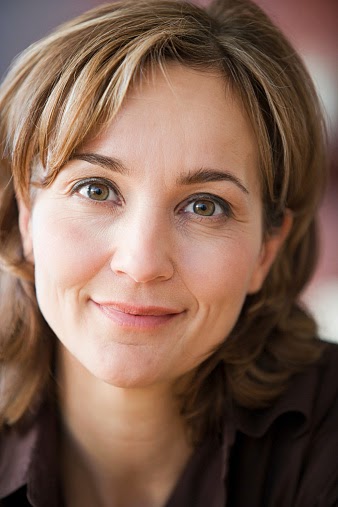 First impressions lead to a multitude of assumptions, and trustworthiness is one of them: faces with v-shaped eyebrows and frowning mouths are consistently judged as less trustworthy than others with ^-shaped brows and mouths with upturned corners (this may be related to the former betraying a hidden anger and the latter having positive undertones). Now a study by Brian Holtz suggests that a person's looks can colour perceptions, not only of how trustworthy their character might be, but of whether their actual deeds are fair and well-intentioned.




 Our pick of the best psychology and neuroscience links from the past week or so:


/cdn0.vox-cdn.com/uploads/chorus_asset/file/3329286/7556589672_46a41204e1_o.0.jpg)


