Shared posts

26 Jan 12:40

Mahmood Mamdani on Charlie Hebdo

by Chris Blattman

Western societies have worked out internal compromises over time in an endeavour to build durable political societies. …Their thrust is to call a ceasefire in struggles of great historical significance in the name of civility.

…After the Holocaust, Jews were brought into the Western political fold. It became conventional to speak of a Judeo-Christian heritage in the West, when it had been customary to speak of a longstanding conflict between Judaism and Christianity before. So, today the law in many European countries, including France, criminalises Holocaust denial. But no law criminalises the denial of colonial genocide, including widespread colonial massacres in Algeria, the country of origin of the largest number of French Muslims.

The political and social compact in Europe has been evolving historically. The state stepped in to moderate the conflict between ardent Christians and secular Christians. Jews were included in this compact after the Holocaust. Muslims have never been part of this compact. The Muslim minority in Europe is the largest in France, around 10 per cent. In the Mediterranean city of Marseille, it is roughly 30 per cent. It represents the weakest and the most disenfranchised section of French society.

…Of course, it is possible to include Muslims in the social and political compact in France. But that will take a major political, intellectual and cultural struggle. Centers of power – and people – in France will have to accept that it is possible to be French and Muslim, that it is OK for a pious Muslim woman to wear a ‘hijab’, as it is for a Catholic nun – so long as this act of piety does not banish either from participation in the public sphere. In other words, we are talking of a political struggle for meaningful citizenship.

Full interview in The Hindu.

The post Mahmood Mamdani on Charlie Hebdo appeared first on Chris Blattman.

26 Jan 11:57

Trampender Roboter: Der Hitchbot kommt nach Deutschland

Er trägt einen Mülleimerdeckel auf dem Kopf und will bei Fremden im Auto mitfahren - der Hitchbot ist ein trampender Roboter. Im Sommer ist er durch Kanada gereist, Mitte Februar kommt er nach Deutschland.
20 Jan 15:20

News Assistants: The Unsung Heroes of Journalism in China

by Matt Schiavenza
Image

For her last two years in China, Angela Kockritz, a Beijing-based reporter for the German newspaper Die Zeit, worked closely with a 40-year-old Chinese news assistant named Zhang Miao. When pro-democracy protests erupted in Hong Kong last September, Kockritz and Zhang traveled to the territory to cover the story. As the two walked among the demonstrators and spoke to student leaders, Zhang got swept up in the excitement. She pinned a yellow ribbon—a symbol of the movement—to her clothes and uploaded photographs of herself to WeChat, a social network popular in China.

On October 1, Zhang returned to Beijing while Kockritz stayed behind in Hong Kong. The next day, the news assistant and friends discovered that they were being followed by the police. They attempted to lose their tail on foot, but the police caught them. An officer slammed Zhang against the car, arresting her on the charge of involving herself in a "village squabble." When Kockritz returned to Beijing, she tried to negotiate Zhang's release with state security forces, who showed the journalist evidence they had culled from Zhang's WeChat account. The police cajoled, threatened, and intimidated Kockritz; they did not allow her to see or contact Zhang. Eventually, fearing that she herself was under suspicion of spying, Kockritz gathered her belongings and fled the country.

"I am not a hero like Nelson Mandela or Dr. Martin Luther King. I can't sacrifice my life for what I believe."

She wrote an article about Zhang's arrest, however. Written from exile, it reads like a tense thriller, revealing the ruthlessness of China's internal security apparatus. But the article has also directed new attention to the unseen but vital work of China's news assistants, men and women tasked with helping the country's foreign correspondents do their job. Chinese citizens cannot legally report from China for foreign news sources, and those acknowledged as contributing to articles often use an assumed name. But they are indispensable to their foreign colleagues. They arrange interviews, conduct research, handle logistics, interpret, and translate. News assistants also act as a cultural liaison for foreign colleagues who may speak no Mandarin or know little about the country.

Chinese news assistants tend to be highly educated and multi-lingual, skills that would position them for lucrative careers in China's rapidly globalized economy. But in a country where journalists are expected to reinforce, rather than check against, state power, news assistants toil out of a love of the craft. One anonymous assistant, recently interviewed by the Asia Society's Eric Fish, explained this persistence.

"Overall, I think working for the foreign press makes me feel like a real journalist and I love every minute of it!" the news assistant said. "However, being Chinese, one just has to accept that dealing with the authorities is part of your lifestyle."

News assistants face risks that far exceed those of their foreign colleagues. State security officials, who monitor foreign news coverage closely, frequently invite news assistants "for tea," a common Chinese euphemism for unwelcome encounters with government authorities. In these meetings, news assistants are asked to divulge what foreign journalists are working on, the names of their sources, and other information vital to their work. Those who refuse to comply risk harassment, beatings, and indefinite detention.

Conditions for international media organizations in China have worsened under Xi Jinping, who became the country's supreme leader in 2012. After Bloomberg and The New York Times published investigations into the financial largesse of top leaders, China blocked each website and refused to issue new visas to reporters sent to the country. Reporters have reported facing greater difficulty in accessing critics of the Communist Party, many of whom are imprisoned. Chinese authorities have curtailed access to politically sensitive areas—such as Xinjiang and Tibet—where ethnic minority groups occasionally scuffle with state forces.

A few foreign journalists, like Kockritz, have been forced to leave China under pressure from the government. But the individuals who bear the brunt of China's censorship apparatus, like Die Zeit's Zhang Miao, are Chinese nationals. Another news assistant interviewed by Fish says that these pressures drove her from the profession.

"I am not a hero like Nelson Mandela or Dr. Martin Luther King," she said. "I can't sacrifice my life for what I believe. Therefore, I quit my job and went abroad."


20 Jan 09:02

Claims about farm animals

by Tyler Cowen

From a 2007 piece by Matheny and Leahy:

Campaigns directed toward pigs and cattle, however, could have a negative welfare effect by shifting consumption to poultry and fish products, which provide significantly less food per animal life-year. In fact, removing only poultry, eggs, and farmed fish from the diets of one hundred people would affect more animals than turning ninety-nine people vegan. If it is easier for consumers to shift consumption among animal products than to eschew all animal products, then this arithmetic has implications for both welfarist and abolitionist strategies.

That is from Natalie Cargill.  And the article is informative throughout.  You will note however that when it comes to environmental impact, red meat from the larger animals is typically the much larger problem.  So which do you care about more, animal welfare or the environment?  Or are you only willing to talk about margins where both improve?  By the way:

In the United States, there are only 220 veterinarians responsible for the care of more than nine billion farm animals.
20 Jan 08:58

A Softer World: 1190


buy this comic as a print!
Or share on: facebookreddit
If you enjoy the comic, please consider supporting A Softer World on Patreon
19 Jan 15:03

11 forgotten Martin Luther King quotes that show he was a revolutionary

by Jenée Desmond-Harris

You hear them every year around this time: The famous, feel-good Martin Luther King Jr. quotes about looking over the mountaintop, about judging people by the content of their character and not the color of their skin, about children in cross-racial friendships holding hands.

Of course, America's favorite civil rights sound bites don't represent King's entire life or worldview. By now, it's no secret that he was more revolutionary than his most famous quotes suggest, and that he talked about a lot more than just his famous "dream." And the quotes that do outline his broader vision tend to get ignored — because they're more sobering than inspiring, or because they're too specific to be deployed by commentators seeking to invoke King in support of their own opinions.

That's too bad. Because many of the sentiments that are less quotable — that don't lend themselves to mugs or T-shirts — are the very same ones that demonstrate King's most interesting and impressive qualities: He was insightful, edgy, funny, bold and not at all shy with the criticism— plus, he was pretty good at predicting the future.

Here are a few of the best lesser-known MLK quotes, on everything from the work of William Faulkner to the war in Vietnam.

1) In March 1956, speaking at the Concord Baptist Church in Brooklyn, New York — his first address in the North since the beginning of the Montgomery Bus Boycott — he dropped the soaring rhetoric and made the sentiment underlying the protest very plain:

Today's expression in Montgomery is the expression of 50,000 people who are tired of being pushed around.

2) And he was perfectly clear about the source of the conflict surrounding the civil rights movement:

Yes, there are tensions in the South. But the tension we experience there is due to the revolutionary reevaluation of the Negro by himself.

3) He proved he wasn't afraid to point out the ignorance of his critics, either. He had this a remark for William Faulkner, who'd recently said the civil rights activists should calm down while white people got used to the idea of black people having equal rights. King's message was essentially, "Sorry, not gonna happen."

He said, "We can't slow up because of our love for democracy and our love for America. Someone should tell Faulkner that the vast majority of the people on this globe are colored."

4) He used a little bit of humor to explain how messed up things were in the South:

Dixie has a heart all right. But it's having a little heart trouble right now.

5) In the address he delivered at the conclusion of the Selma to Montgomery march on March 25, 1965, he gave credit where credit was due to white allies — with a nod to the idea that the "ugly" tradition of racism was nothing that anyone should be getting all sentimental about:

On our part we must pay our profound respects to the white Americans who cherish their democratic traditions over the ugly customs and privileges of generations and come forth boldly to join hands with us.

6) He also broke some news to poor white people: They weren't exactly winning in a segregated society:

If it may be said of the slavery era that the white man took the world and gave the Negro Jesus, then it may be said of the Reconstruction era that the southern aristocracy took the world and gave the poor white man Jim Crow.

7) In a speech titled "Beyond Vietnam," delivered April 4, 1967, in New York, he showed he didn't see anything through rose-colored glasses, and admitted that he wasn't super hopeful about the US's prospects in Southeast Asia:

The world now demands a maturity of America that we may not be able to achieve.

8) And he made it very clear that in his view, no one was excused from working for justice, saying, "Every man of humane convictions must decide on the protest that best suits his convictions, but we must all protest."

9) Sadly, he made a pretty decent prediction in this "rallies without end" bit, saying,

The war in Vietnam is but a symptom of a far deeper malady within the American spirit, and if we ignore this sobering reality, we will find ourselves organizing "clergy and laymen concerned" committees for the next generation. They will be concerned about Guatemala and Peru. They will be concerned about Thailand and Cambodia. They will be concerned about Mozambique and South Africa. We will be marching for these and a dozen other names and attending rallies without end unless there is a significant and profound change in American life and policy.

10) He admonished those who couldn't see the structural forces in need of combatting:

True compassion is more than flinging a coin to a beggar. It comes to see that an edifice which produces beggars needs restructuring.

11) And he had no problem at all calling for an endless battle (against the right targets, of course). He said, "Our only hope today lies in our ability to recapture the revolutionary spirit and go out into a sometimes hostile world declaring eternal hostility to poverty, racism, and militarism."

So, tell your friends you're celebrating King's life this year by refusing to be pushed around, and by being eternally hostile. (You can continue to dream of little children holding hands, too  — we have to admit, they're pretty cute.)

Further reading

18 Jan 18:13

David Ehrlich's top 25 films of 2014

by Jason Kottke

David Ehrlich returns with a video montage of his 25 favorite movies of 2014. (Here's his 2013 video.)

His top 5:

5. Gone Girl
4. Nymphomaniac
3. Under The Skin
2. Inherent Vice
1. The Grand Budapest Hotel

These year-end videos by Ehrlich are incredibly effective trailers for movies. Not just the individual films, but the whole idea of cinema itself. Having just watched this, I want to leave my office, head to the nearest theater and just watch movies all day.

Tags: best of   best of 2014   David Ehrlich   lists   movies   video
16 Jan 10:16

The Lego Movie got snubbed by the Oscars. Its director's response was perfect.

by Brandon Ambrosino

Phil Lord, who co-directed The Lego Movie with Christopher Miller, had the perfect response to his movie not receiving an expected nomination for the Oscar for Animated Feature.

It's okay. Made my own! pic.twitter.com/kgyu1GRHGR

— philip lord (@philiplord) January 15, 2015

Regardless of who actually wins that Oscar, after this tweet, we all know who really won.

16 Jan 08:47

Most water problems can be solved by better property rights and higher prices

by Tyler Cowen

In his 2011 book Brahma Chellany reports:

…Singapore has pursued demand management through greater water productivity and efficiency.  By plugging system leaks and inefficiencies and raising the price of domestic water, with the tariff and tax rising steeply after the first 40 m3 a month, it managed to reduce household water use by about 10 percent since the mid-1990s to about 155 liters per person per day in 2011.  That consumption level is nearly four times lower than that of an average American.

That is from Water: Asia’s New Battleground, which is actually one of the most interesting political economy books published in the last few years.

14 Jan 18:20

One in ten student research participants don't make an effort

by Research Digest
It's near the end of your university semester, you're tired and now you've got to sit through 90 minutes of monotonous psychology tests to fulfil the requirements for your course. This is a familiar situation for psychology undergrads, many of whom form the sample pools for thousands of psychology studies.

Concerns have been raised before that psychology findings are being skewed by the (lack of) effort students put into their performance as research participants. Last year, for example, researchers found that students who volunteer near the end of term perform worse on psychology tests than those who volunteer earlier.

Now Jonathan DeRight and Randall Jorgensen at Syracuse University have investigated student effort in 90 minutes of computerised neuropsychology tests designed to measure attention, memory, verbal ability and more. The session, which took place either during a morning or afternoon late in the Spring semester, involved the students taking the same broad battery of tests twice, with a short gap in between. The students received course credits for their time.

To test whether the students were making a proper effort, the researchers embedded several measures - for example, performing worse than chance on a multiple-choice style verbal memory challenge was taken as a sign of low effort; so was performing more slowly on an easier version of a mental control task than on the more difficult version.

Among the 77 healthy student participants who took part (average age 19; 36 women), the researchers identified 12 per cent who failed at least one of the embedded measures of effort during the first battery of neuropsych tests; 11 per cent also failed one or more measures during the second battery. The vast majority of those who showed low effort had participated in the morning. In fact, focusing only on the morning participants, one in four displayed low effort.

Unsurprisingly, low effort also went hand in hand with poorer performance on the neuropsych tests, especially one of the longest and most dull cognitive tests (the "continuous performance task"), and especially during the second battery. A consistent exception was a particularly complex version of a test of mental self-control (the Stroop task) - perhaps because the challenge of the task provoked more concentration, even from students who were mostly not trying hard.

The estimate from this study of the fraction of student research participants not making an effort are consistent with some prior studies, but not others (the latter research found less evidence of poor effort). Clearly more research is needed. DeRight and Jorgensen concluded that "healthy non-clinical samples cannot necessarily be assumed to have put forth adequate effort or valid responding." They added: "Assessing for effort in this population is imperative, especially when the study is designed to provide meaningful results to be used in clinical practice." This last, important point is a reference to the fact that results from students are often used to establish estimates of "normal" performance on neuropsychology tests, for comparison when investigating patients with brain damage or other problems.

_________________________________ ResearchBlogging.org

DeRight, J., & Jorgensen, R. (2014). I Just Want My Research Credit: Frequency of Suboptimal Effort in a Non-Clinical Healthy Undergraduate Sample The Clinical Neuropsychologist, 1-17 DOI: 10.1080/13854046.2014.989267

--further reading from The Psychologist--
Improving the student participant experience
The use and abuse of student participants

Post written by Christian Jarrett (@psych_writer) for the BPS Research Digest.

14 Jan 14:46

On the importance of diners

by Jason Kottke

At Serious Eats, Ed Levine writes about Why Diners Are More Important Than Ever. From his ten-point list of what defines a diner:

8. All-occasion places: Diners must rise to many occasions, from first dates to pre- or post-game celebrations by fans or teammates, to wallowing in solitary self-pity. Diners are the best restaurants for planning murders, stick-ups, or other nefarious enterprises.

Being an all-occasion place is not the only egalitarian thing about diners:

People talk about Starbucks reintroducing the notion of what sociologist Ray Oldenburg coined the "third place" in American life: spaces where we gather besides home and work to form real, not virtual, communities. Starbucks and more high-minded cafes that followed in its wake have surely succeeded on this point, but long before 1971, when the first Starbucks opened in Pike Place Market in Seattle, diners were already serving that invaluable function for us, along with the corner tavern.

And that's why we need to cherish our local diners, whether it's a mom and pop or a Waffle House or a Greek coffee shop. They're some of the few cheap, all-inclusive places to eat and hang out and laugh and cry and stay viscerally connected with other folks.

And it warmed my heart to see Ed include Cup & Saucer and Eisenberg's on his list of notable NYC diners. An unusual thing I've noticed about Eisenberg's: instead of getting your check at the table, you just tell the cashier what you ordered on the way out and pay for it. Like on the honor system! Is there anywhere else in NYC that does this? I wonder what their loss rate is compared to the norm?

Tags: Ed Levine   food   NYC   restaurants
14 Jan 12:54

The 'Worst' German Word of the Year

by Adam Chandler
Image

On Tuesday, a panel of linguists in Germany declared Lügenpresse the dubious winner in the annual "Unwort des Jahres" competition. The annual, politically charged "non-word of the year" event critiques phrases that have taken on a pernicious meaning in the country over the course of a given year.  

The coronation of Lügenpresse represents a troubling trend. The Nazi-era phrase, which means "lying press," has become something of a watchword among Germany's increasingly vociferous anti-immigrant (and largely anti-Muslim) activists. In recent months, these demonstrators have called on the media to "tell the truth" about what immigrants are doing to Germany.

Other recent winners include Sozialtourismus ("social tourism"), which in a certain context also relates to immigrants who come to Germany to indulge in state benefits, and Döner-Morde (Döner murder), which dismissively refers to murders of Turkish and Greek people. (For a compelling contrast, consider that just last week, the American Dialect Society named #blacklivesmatter as 2014's word of the year—the first time a hashtag has won.)

The non-word announcement came one day after the anti-immigrant group PEGIDA, the Patriotic Europeans Against the Islamization of the West, staged a massive, 25,000-strong rally in the German city of Dresden. The event, scheduled before last week's shootings in Paris, doubled as a tribute to victims of the Charlie Hebdo massacre and a rally to promote an anti-immigration platform. According to Reuters, the crowd marched to chants of Lügenpresse, halt die Fresse ("Shut up, lying press").

PEGIDA has inspired even larger counter-demonstrations across Germany, including one in Dresden this past Saturday, which drew 35,000 participants. (Hours before the rally, arsonists firebombed the offices of Hamburger Morgenpost, a German tabloid that had republished cartoons mocking the Prophet Muhammad in solidarity with the victims of the Charlie Hebdo attack.)

French cartoonist Michel Cambon's cartoon ahead of tonight's PEGIDA demo in Dresden. pic.twitter.com/B76cgF9Ao1

— Helen Russell (@helengoth) January 12, 2015

As The New York Times reported, a group of cartoonists known as Caricaturists Against PEGIDA also disseminated cartoons slamming the PEGIDA for capitalizing on the events in Paris to further stoke anti-immigration fervor.

In a statement, the group said: “PEGIDA is cynically seeking to exploit the Paris attack. We reject that the memory of our friends is being exploited and dragged through the mud in this way.”


14 Jan 09:00

Death Of A Hero | Joshua Hammer | Matter | 12th January 2015

by Joshua Hammer
Fantastic piece of reporting on the life and death of Dr Sheik Humarr Khan, an expert in tropical diseases who ran a hospital at the heart of Sierra Leone’s Ebola epidemic. He caught Ebola himself. He died a gruesome death. Yet close to his bed was a fridge containing three vials of a rare drug which could have saved his life. Why did he not get it? The apparent answer is that the drug was being reserved for Westerners

Subscribe to the Browser to receive a feed with direct links to the recommended content

14 Jan 07:49

How judges, loan officers, and baseball umpires overcompensate for past decisions

by Tyler Cowen

The actual title is “Decision-Making under the Gambler’s Fallacy” (pdf) and the authors are daniel Chen, Tobias J. Moskowitz, and Kelly Shue.  Here is one short bit from what is more generally a very interesting paper:

We test our hypothesis in three high-stakes settings: refugee court asylum decisions in the US, a field experiment by Cole et al. (2013) in which experienced loan officers in India review real small-business loan applications in an experimentally controlled environment, and umpire calls of pitches in Major League Baseball games. In each setting, we show that the ordering of cases is likely to be conditionally random. However, decisions are significantly negatively autocorrelated. We estimate that up to 5 percent of decisions are reversed due to the gambler’s fallacy.

To make that more concrete, if a baseball umpire first calls a ball, the next pitch he is more likely to then call a strike.  Of course this may plague your paper refereeing decisions, whether or not you finish your next book, and your dating life.

The original pointer was from Cass Sunstein on Twitter.

12 Jan 14:44

Taking Care Of Our Own | Ricardo Nuila | VQR | 9th January 2015

by Ricardo Nuila
Houston’s Ben Taub hospital provides undocumented immigrants with some of America’s best health care, because giving sick people scheduled access to treatment works out cheaper than having them “flooding emergency rooms”. The system works well — but play that down. “The fear of the board of managers is that if we do too good a job word will spread across the United States: Go to Houston for your compassionate care”

Subscribe to the Browser to receive a feed with direct links to the recommended content

12 Jan 14:44

Jim’s Rule Of Buts | Jim Henley | Unqualified Offerings | 10th January 2015

by Jim Henley
Useful rule to remember when condemning the Charlie Hebdo massacre while expressing reservations about the newspaper’s editorial line. The clause which precedes a but is dominated by the clause which follows it. “I don’t support violence, but you really shouldn’t be offending people”, is not OK. “You really shouldn’t be offending people, but I don’t support violence”, is probably what you want to say

Subscribe to the Browser to receive a feed with direct links to the recommended content

12 Jan 14:06

Kids, the Holocaust, and "inappropriate" play

by Jason Kottke

On a strong recommendation from Meg, I have been reading Peter Gray's Free to Learn: Why Unleashing the Instinct to Play Will Make Our Children Happier, More Self-Reliant, and Better Students for Life. Gray is a developmental psychologist and in Free to Learn he argues that 1) children learn primarily through self-directed play (by themselves and with other children), and 2) our current teacher-driven educational system is stifling this instinct in our kids, big-time.

I have a lot to say about Free to Learn (it's fascinating), but I wanted to share one of the most surprising and unsettling passages in the book. In a chapter on the role of play in social and emotional development, Gray discusses play that might be considered inappropriate, dangerous, or forbidden by adults: fighting, violent video games, climbing "too high", etc. As part of the discussion, he shares some of what George Eisen uncovered while writing his book, Children and Play in the Holocaust.

In the ghettos, the first stage in concentration before prisoners were sent off to labor and extermination camps, parents tried desperately to divert their children's attention from the horrors around them and to preserve some semblance of the innocent play the children had known before. They created makeshift playgrounds and tried to lead the children in traditional games. The adults themselves played in ways aimed at psychological escape from their grim situation, if they played at all. For example, one man traded a crust of bread for a chessboard, because by playing chess he could forget his hunger. But the children would have none of that. They played games designed to confront, not avoid, the horrors. They played games of war, of "blowing up bunkers," of "slaughtering," of "seizing the clothes of the dead," and games of resistance. At Vilna, Jewish children played "Jews and Gestapomen," in which the Jews would overpower their tormenters and beat them with their own rifles (sticks).

Even in the extermination camps, the children who were still healthy enough to move around played. In one camp they played a game called "tickling the corpse." At Auschwitz-Birkenau they dared one another to touch the electric fence. They played "gas chamber," a game in which they threw rocks into a pit and screamed the sounds of people dying. One game of their own devising was modeled after the camp's daily roll call and was called klepsi-klepsi, a common term for stealing. One playmate was blindfolded; then one of the others would step forward and hit him hard on the face; and then, with blindfold removed, the one who had been hit had to guess, from facial expressions or other evidence, who had hit him. To survive at Auschwitz, one had to be an expert at bluffing -- for example, about stealing bread or about knowing of someone's escape or resistance plans. Klepsi-klepsi may have been practice for that skill.

Gray goes on to explain why this sort of play is so important:

In play, whether it is the idyllic play we most like to envision or the play described by Eisen, children bring the realities of their world into a fictional context, where it is safe to confront them, to experience them, and to practice ways of dealing with them. Some people fear that violent play creates violent adults, but in reality the opposite is true. Violence in the adult world leads children, quite properly, to play at violence. How else can they prepare themselves emotionally, intellectually, and physically for reality? It is wrong to think that somehow we can reform the world for the future by controlling children's play and controlling what they learn. If we want to reform the world, we have to reform the world; children will follow suit. The children must, and will, prepare themselves for the real world to which they must adapt to survive.

Like I said, fascinating.

Tags: books   Children and Play in the Holocaust   education   Free to Learn   Holocaust   parenting   World War II
11 Jan 03:48

9 secrets I've uncovered about depression

by Kady Morrison

My relationship with depression is a complicated one. I have, clinically speaking, been grappling with it since I was a teenager; I was diagnosed for the first time at 15, and then again in my early twenties, and then again by my current therapist a little less than a year ago. The question of how long I've known I suffered from depression, however, is where things get a little hairy — I thought it was laughable at 15, and considered it a misdiagnosis at 20. It's only in the last year that I've really looked the thing in the face, accepted it as part of my life, and started to consciously do the work involved in keeping it under control.

A few months back, I wrote an article here on Vox about the 9 things I wish people understood about anxiety. I was comfortable writing that piece, because after a lifetime with generalized anxiety disorder and five years actively wrestling with how best to manage it, I feel like I really understand anxiety: its ins and outs, its ups and downs, the shape and size of the thing. I like to think that some day, I will be able to write that sort of article about depression. I like to think that some day, I will know this piece of myself that well.

Today, however, is not that day. Depression and I are in a much more tenuous place with one another. I am still learning its landscape, and it is still surprising me, tripping me up, and shaking the foundations of things that I once thought I knew. I can't tell you what I wish people understood about depression because I myself don't fully understand it yet, and I can't imagine delineating a list that I myself am still struggling to learn. So, instead, here are nine secrets I've uncovered about depression in experiencing it, which no one told me about, and which I never could have anticipated going in. They may not be secrets to everyone, and I hope they don't stay secrets to anyone for long, because knowing each one of them has helped me through this process.

1) Depression is a liar

If I had the power to put anything on television, it wouldn't be a channel that showed nothing but Boy Meets World reruns. It wouldn't be a ticker that ran along the bottom of the screen during sporting events with the text of the Harry Potter novels in it, so that those of us who hate football would have something to do in sports bars. No, it would be a 15-second spot, airing during every single commercial break on every single channel, that said: "If you have depression, it is lying to you." Because it is. Every moment of every day, in your waking and sleeping hours, depression is telling you lies.

Here is a small sampling of the lies depression has told me over the years: you're lazy. You're worthless. You're never going to amount to anything. If you ever do amount to anything, it will be a complete fluke, and not the result of any work, skill, or talent on your part. Your family hates you. Your friends hate you. Your family and friends don't hate you, but they would, if they knew what you were really like. You're rotten. You're stupid. The very core of who you are is garbage. The people in your life would be better off without you. The world at large would be better off without you. Nothing you do matters. Nothing you say matters. Nothing at all matters, except how terrible you are, which matters more than anything else could ever matter. You suck. You suck. You suck.

Today — to be strictly accurate, at the moment of writing this article — I know that these are lies. I know that they're lies because I've spent a lot of time in therapy learning that they are lies, and that depression is a liar, and that the things your brain spits at you when it's in a depressive period are lies the vast majority of the time. But when I'm depressed, I really, really believe these things are true. In fact, if during a future depression I were to come back to this article and stare at it, I can promise you I would think, "What was I talking about? Those aren't lies — in fact, that's the truth. The idea that those things might not be true — that's the lie."

2) Depression is a bully

It's a sneaky, manipulative bully. Not only that — it's a sneaky, manipulative bully that knows all your weaknesses and tender spots, and has at its disposal an arsenal of every uncomfortable moment, rejection, embarrassment, and emotional wound you've ever sustained in your life. It is, to put it simply, that kid who throws rocks at other kids on the playground.

I was lucky enough to grow up with two emotionally intelligent parents. They taught my brothers and me that bullying, more often than not, comes from a place of unhappiness. And of course depression is, in a number of ways, unhappiness given a name and a medical classification — it makes sense that it would have so much in common with that type of personality. But the thing about bullies is that the common wisdom about them often proves false. "Sticks and stones might break my bones, but words will never hurt me," for example, has been thrown around for generations, but most people I know (myself included) would happily trade a wallop with either object for the erasure of certain words from our personal histories. Likewise, the "just ignore it" theory, regularly presented as the solution to a bullying personality, is virtually useless advice when it comes to fighting depression. Depression does not want to be ignored; it wants to be in charge, and it will take advantage of any opportunity to gain ground. Left unchecked — indeed, ignored — depression can sneak and manipulate its way into the deepest recesses of your brain, becoming that much harder to eradicate.

Which is why:

3) If you think you might be depressed, you have to tell somebody

I know, I know — this isn't a secret. You've heard this one before. So have I: as part of anti-suicide campaigns, or scrawled at the bottom of pamphlets with things like "There Is Hope For You" written on the cover. I have to mention it anyway, though, because of the thought I've always had in response to the "tell somebody" advice: "It doesn't apply to me."

See, one of the complicated things about depression is that it comes in a variety of types and severities. The most visible types are the ones that can put people at high suicide risk: severe bipolar disorder — which can jerk people from manic highs to frightening lows — or an intense bout of clinical depression, which might drop someone so deep into what I think of as "the pit" that without seeking immediate help, they could be in very real danger of hurting or even killing themselves. And, of course, if you suspect that you or a loved one are at high risk for self-harm or suicide, you should absolutely tell someone at once. I don't for a second mean to suggest that that isn't the case. Tell your family! Tell a therapist! Don't tell me — I'm just a girl on the internet with some lived experience, and I make no claims of being a professional — but definitely, definitely tell someone.

Having said that, though, for a lot of us, depression isn't — or at least doesn't feel like — something that makes us high-risk for suicide. What I have, for example, is moderate clinical depression, linked in to my generalized anxiety disorder. It's the kind of thing that might slow me down or even stop me in my tracks, but it's never pushed me to a place where I was in danger of seriously harming myself. And that fact — the fact that I'm not thinking about killing myself any time soon — has, more than once, given depression an avenue to keep me from getting help. It has allowed thoughts like, "You're not depressed enough for it to really count," or "This is something you should be able to handle on your own," or, "Nobody wants to be bothered with your problems," or, "When they say you should tell someone if you think you're depressed, they're not talking to you."

I am here to say: if you think you might be depressed, then I am talking to you. Whether mild, moderate, or severe, depression is not something you should be trying to handle on your own. That's not, by the way, because you're not strong enough, or smart enough, or anything enough to deal with it by yourself — it's because depression distorts your thinking, and to sort through something that distorts your thinking, you need help that does not live inside your own brain. You need an ally that your depression does not have the power to affect. You need an objective party, and when you are depressed, thinking about yourself in an objective way becomes incredibly difficult.

4) Suicidal thoughts aren't always part of depression, and even when they are, they're not always active suicidal thoughts

An active suicidal thought might look something like this: "I wish I was dead, so today/tomorrow/next week/next month, I'm going to overdose on enough pills that I don't have to continue being alive." Active suicidal thoughts involve intent, even if it's intent to do something a long time from now. They involve a plan, even if it's a vague plan. They're what people think "suicidal thoughts" mean, and they're not wrong, exactly. It's just not the entire definition.

The other variety of suicidal thoughts looks more like this: "I'm going to go to sleep, and I hope that I don't wake up tomorrow," or, "Man, if I just jerked the steering wheel a little to the left, my car would flip over the highway partition and I could stop living — wouldn't that be nice?" These are what are called passive suicidal thoughts; there's no real intent behind them, and there's not necessarily a concrete plan involved. They are, in essence, fantasies about dying, which crop up because depression has made the idea of dying more appealing than the idea of continuing to be alive. I won't lie here, though I'd honestly prefer to: though I've never been in danger of truly harming myself, I've experienced passive suicidal thoughts alongside depression many times over the years. This type of thought is not as dangerous as the active type, of course, but that doesn't mean that it's not dangerous, because the one can lead to the other. Enough passive suicidal thoughts, built up over time, can become an active one.

Having said that, depression is often reduced — even in the minds of the depressed — to, essentially, the suicide disease, and that's neither accurate nor helpful. Some of us never experience suicidal thoughts at all; some of us have only ever experienced the passive ones I just mentioned; some of us have experienced active suicidal thoughts, but they've been few and far between.

Regardless of the volume of these thoughts, treating a friend or loved one who has told you they are depressed like they are automatically a suicide risk is often a mistake. For one thing, if a depressed person knows you are worried about that, they may be afraid to talk to you, or think that mentioning it would be burdening you, in the event that those thoughts do crop up. And, of course, there is the fact that the person underneath the depression — the person that depression is lying to, bullying, and bossing around — is probably very, very frightened of both the idea and the reality of suicidal thoughts. Having a part of your brain wishing you would die, whether actively or passively, is really scary, and it can be incredibly exhausting to have to comfort others on that subject when you're already struggling to comfort yourself.

5) Depression and sadness aren't (always) the same thing

Don't get me wrong — they can be. Certainly depression can bring with it bouts of sadness and despair. Certainly, when depressed, things that might not bring you down otherwise can sink you into a dark mood. Depression once made me burst into tears of anguish over a Simple Plan song, so trust me, it can find the melancholia in almost anything. But more than sadness, more than despair, the word that really characterizes depression is numbness. Depression takes your feelings and bottles them up, only to release them without warning in unpleasant, incongruous bursts. When you're depressed, you tend to bounce between feeling so much you think it might tear you to pieces, and feeling absolutely nothing at all.

The way that I always think of it can be sourced back to Terry Pratchett, the author of a number of my favorite novels. He brings up this paradox in a few of his books: "Open the box with the crowbar you will find inside." That's what the numbness portion — by which I mean, the vast majority — of depression is like. Your emotions, normal reactions, motivations, positive thoughts; these things are inside of a box, and also inside of that box is a crowbar with which the box can be opened. It's a frustrating situation, although, of course, it doesn't feel frustrating when it's happening, because your ability to feel frustrated is inside the box with everything else. Instead, you mostly feel like it doesn't matter, because you mostly feel like nothing matters.

6) You can be depressed without knowing it

Yes, it's counterintuitive. Yes, it sounds impossible. Still, the fact remains that it's true. The thing about the overwhelming numbness of depression, the constant certainty that nothing at all matters, is that it can blind you to changes in your mood and behavior. Even if you're tracking those things, if nothing matters, then they don't matter either. I've been depressed, more than once, without having any idea that that's what was going on. I've also realized that I was depressed in the middle of periods of depression, rather than at the beginning, and only realized the full extent of things in looking over the weeks and months prior.

The people in your life can be hugely helpful on this front, especially if they know what to look for, because:

7) Depression can be visible

It can also be invisible, of course, but the idea that it's always invisible is just not accurate. Depression often erodes one's abilities to complete basic tasks that wouldn't be a problem in a healthier, less depressed period, and personal care and hygiene are very much included in that list. When I get depressed, my clothing, hair, and physical appearance all tend to suffer, not to mention the cleanliness of my apartment (which I must admit is not what you'd call spotless at the best of times).

If you're someone who knows they are prone to depression, taking the time to sit down with the people in your life and ask them to keep an eye out for this kind of slippage can be really, really helpful in catching a depressive period before you're all the way at the bottom of the hole. Conversely, if there's someone in your life you know is prone to depression, it can be good idea to keep this point in mind. I'm not, of course, advocating screaming, "YOU'RE DEPRESSED!" in someone's face if you notice that they're not looking fantastic one day. But in the event that you see slippage for a few weeks at a time, it may be worthwhile to (gently, kindly) ask them if they are feeling all right, and if there is anything you can do to help. It can be really, really difficult for a depressed person to reach out and ask for help — remember, depression is a liar and a bully, and often insists that to ask for assistance is selfish and wrong. Your taking that first step can mean the world to someone who is struggling.

8) Depression responds to routine and structure

No, really. It does. When you're depressed, it doesn't feel like it's going to. When you're depressed, the idea of maintaining any routine, following any structure or, indeed, getting out of bed often feels borderline insane. But the fact remains that this is true. Conversely, long periods without routine and structure can be depression's breeding ground; this is why unemployment and depression are common bedfellows.

I'm not, by nature, someone who is much for either structure or routine; in fact, if I'd been born neurotypical, my life might well be a nomadic one where I followed my whims, or the remaining members of the Grateful Dead, or both. As it is, I've figured out a variety of little routines and structures that I can apply to my days, weeks, and months, and which help immensely in keeping my head above the depression waters. I'm not going to detail those routines here, because depression management is a very personal thing, and works a little differently for each person. But it is manageable.

9) Depression is not the end of the world

It'll do its best to trick you into believing it is, but that's just another one of its lies. The truth is, depression is a pain, both figuratively and literally; it can be dangerous and frightening; it can slow down or even stall out your life for a while; it can be hard to deal with, overwhelming, and upsetting. But it's not the end of the world. It's just something that requires some careful thought, awareness, and management — in other words, it's something that requires some work. The trick, at least in my experience, is knowing that it's doable work, work that you are more than capable of handling, no matter what your depression tries to tell you. And, like all work, it gets easier the longer you do it. The incomparable Allie Brosh wrote a two-part post on depression a few years ago, which was then and remains to this day the best explanation I've ever seen on this topic; it's sharply funny as well as being searingly honest, and I highly recommend reading it. It truly illustrates the whole of the thing — the way there is struggle to this, but hope too, and levity even where you're not expecting to find it.

As for me: today, right now, depression is still hard work, but it's not the backbreaking effort it was a few years ago, or even the uphill climb it was a few months back. Some day, I truly believe that managing it will be no more difficult than, say, feeding myself, or keeping my unruly hair in check — daily tasks that, though not effortless, I mastered years ago, and even take some pleasure in doing these days. Until then, I will continue to strive and struggle, succeeding in some moments and failing in others, and taking heart in the fact that I am far from alone. That's no secret, but it bears repeating: no matter where you are in the process of figuring out depression, you are not alone.


First Person is Vox's home for compelling, provocative narrative essays. Do you have a story to share? Read our submission guidelines, and pitch us at firstperson@vox.com.


11 Jan 03:34

Boko Haram's massacre in Nigeria: what happened and why

by Max Fisher
  • The Nigerian terrorist group Boko Haram launched its worst attack ever in the northeastern town of Baga, where it killed hundreds or possibly more.
  • The motivation is unclear, but it appears aimed at intimidating Nigerians into not voting in the coming presidential election.
  • Key context is the military's indifference to northern Nigerian lives. Its troops fled almost immediately, and had itself previously massacred Baga's residents.

What we know about the attack

No one knows for sure how many people the Nigerian terrorist group Boko Haram slaughtered during its six-day rampage in the northeastern town of Baga. A lone and speculative early report said 2,000 dead, though subsequent counts suggest "dozens" or "hundreds." But there is little question this is a massacre of breathtaking and possibly unprecedented severity, even for Boko Haram. If you zoom out, though, you can see that a crucial part of this story is the Nigerian military's repeated and demonstrated indifference to the lives of northern Nigerians.

Here is what appears to have happened: On Saturday, January 3, Boko Haram fighters in pickup trucks drove up to a military outpost in Baga. The Nigerian troops immediately began fleeing; Boko Haram captured the outpost by noon. In the next few days, the group raided surrounding villages, killing civilians. On Wednesday, it overran Baga itself, beginning a days-long process of methodically razing buildings and killing everyone the group saw.

"When they neutralized the soldiers, they proceeded to Baga and started killing everyone on sight," a witness told the New York Times. "There was no pity in their eyes. Even old men and children were killed."

Here is what we know about why they did it: It is still not totally clear why Boko Haram so viciously attacked Baga. But the closest thing to evidence of a motive came on Friday. As Boko Haram slaughtered Baga's residents, its fighters visited several nearby villages. They shot villagers, apparently at random, and commanded the survivors not to vote, the Wall Street Journal reports.

Boko Haram condemns democracy itself as religiously forbidden; on Thursday, its leader had released a video ranting against democracy in all its forms, and it has long stated that voting is a crime. Nigeria is in the middle of a presidential campaign and is gearing up for a presidential election on February 14.

The country is roughly split between Muslims and Christians; ironically, Boko Haram's anti-democracy attacks could swing the election in favor of incumbent President Goodluck Jonathan, a Christian, by suppressing turnout among mostly Muslim northern Nigerians who would likely vote against him.

The bigger picture: the Nigerian military's failure

A Nigerian woman walks past burned homes in Baga in 2013, shortly after the military destroyed much of the town (AFP/Getty Images)

Like the larger story of Boko Haram itself, the story of the Baga massacre is a story of Boko Haram's depravity but also of the Nigerian military's abject failure.

It is not just that the Nigerian troops stationed in Baga fled almost immediately on Boko Haram's arrival. The military has itself played a role in Baga's terror. In April 2013, a handful of Boko Haram fighters ambushed some Nigerian troops near Baga. In response, the military stormed Baga, burning down thousands of homes and killing 200 people.

This is wholly consistent with the Nigerian military's conduct in its so-called fight against Boko Haram in northern Nigeria, where the group operates.

The heavy-handed military — which, recall, ruled as dictators not so long ago — has been accused time and again of atrocities in its campaign against Boko Haram. They are typically accused of targeting civilians, but sometimes, they kill out of what appears to be simple incompetence. In March 2014, for example, some very brave northern Nigerians alerted the military that Boko Haram was operating near their village. The military did nothing for several days, then bombed the village, killing the very people who'd tried to help, by which time Boko Haram had left.

None of this created Boko Haram, but it helps provide an environment where the group is able to operate more widely and freely than it otherwise could. The military's utter failures, and at times active efforts to commit atrocities, are a crucial component of the Boko Haram story, nationally and in Baga.

11 Jan 03:18

Pixel, a dancing light show

by Jason Kottke

Pixel is a dance show that premiered in November at Maison des Arts de Créteil in France. The dancers are synced cleverly with an elaborate light show that makes it seem as though the two are interacting in real time. The effect is very convincing:

Tags: dance   video
10 Jan 10:45

A Mile Wide, An Inch Deep | Evan Williams | Medium | 5th January 2015

by Evan Williams
Quantity is easy to measure; quality much harder. Is Buzzfeed “bigger” than the New York Times? In page-views, perhaps yes. But as a force in world affairs, surely not. Likewise for social media: Instagram may have more traffic than Twitter, but Twitter does more important work. Traffic is a useful metric, but a limited and sometimes dangerous one; platforms that chase traffic for its own sake can rise fast, but they fall even faster

Subscribe to the Browser to receive a feed with direct links to the recommended content

10 Jan 10:44

Encounter With The Infinite | Benjamin Phelan & Robert Schneider | The Believer | 8th January 2015

by Benjamin Phelan & Robert Schneider
Notes from a trip to India in the footsteps of Srinivasa Ramanujan, a self-taught genius so far ahead of his time that mathematicians are still struggling to understand his ideas a century after his death at 32. He duplicated Euler’s work without knowing Euler had got there first; he solved problems of the infinite which had driven Cantor mad. “The simplest explanation is that Ramanujan was a time traveler from the future”

Subscribe to the Browser to receive a feed with direct links to the recommended content

06 Jan 09:41

Do we self-deceive to better fool others?

by Tyler Cowen

Here is the final paragraph from a recent MRI paper by Farrow, Burgess, Wilkinson, and Hunter, “Neural correlates of self-deception and impression-management“:

Taken together, one appealing ‘pop-psychology’  interpretation of these results would be that being excessively honest with ourselves (‘faking bad’ at self-deception) is our least indulged in pursuit while giving out the best possible image of ourselves to other (‘faking good’ at impression-management) is a behaviour with which we are much more familiar and practised.

From the abstract you can read that “Our neuroimaging data suggest that manipulating self-deception and impression-management…engages a common network…”

Robin Hanson has suggested related hypotheses in the past.  Caveat emptor, for the pointer I thank Michelle Dawson.

02 Jan 22:58

The Kingdom of Dreams and Madness

by Jason Kottke

The Kingdom of Dreams and Madness is a documentary which presents a year in the life of Studio Ghibli and its famed director, Hayao Miyazaki. The year in question was a particularly interesting one during which Miyazaki announced his retirement. The trailer:

Granted near-unfettered access to the notoriously insular Studio Ghibli, director Mami Sunada follows the three men who are the lifeblood of Ghibli -- the eminent director Hayao Miyazaki, the producer Toshio Suzuki, and the elusive and influential "other director" Isao Takahata -- over the course of a year as the studio rushes to complete two films, Miyazaki's The Wind Rises and Takahata's The Tale of The Princess Kaguya. The result is a rare "fly on the wall" glimpse of the inner workings of one of the world's most celebrated animation studios, and an insight into the dreams, passion and singular dedication of these remarkable creators.

(via @garymross)

Update: The Kingdom of Dreams and Madness is now available for rent/buy on Amazon and iTunes.

Tags: Hayao Miyazaki   movies   Studio Ghibli   The Kingdom of Dreams and Madness   trailers
26 Dec 08:22

Late-age motherhood is nothing new

by James Choi
The shift toward late motherhood – commonly defined as motherhood after 35 – is often presented as a story of progress and technological liberation from the biological clock. ...

While this triumphal narrative contains a few grains of truth, it is as simplistic as it is satisfying. History shows us that the “best age” to have a child is very much a product of the cultural and economic moment, not a just dictate of biology that we need to escape. ...

In fact, it was only after World War II that early parenthood became a cultural norm. A strong economy and widespread embrace of domesticity encouraged both early marriage and childbearing, resulting in a “baby boom” that lasted almost two decades. ...

The roots of our modern discussion on delayed parenthood lie in the 1970s, when the average age at first birth began to increase dramatically. The number of women having their first child between the ages of 30 and 34 almost doubled, from 7.3 births per 1,000 women in 1970 to 12.8 per 1,000 in 1980. But the 1980 figures mirror those recorded between 1920 and 1940, where the number of first births among women ages 30 to 34 averaged 12.1 births per 1,000 women.
--Jenna Healey, Washington Post, on the cyclicality of reproductive history
24 Dec 07:08

Assorted links

by Tyler Cowen

1. One million mummies.

2. Schemes to clean up Beijing’s air.

3. National security Christmas gifts.

4. How do people encounter bourbon?

5. Krugman’s model of monetary impotence. and more here.  I say if there is no representative agent, there is a game-theoretic scramble for goods in period one, following an increase in the (purely current) money supply.  That said, you still shouldn’t expect the quantity equation to apply to the monetary base.  Scott Sumner responds here.  Empirically, the problem is to explain both Switzerland and the UK (some price inflation over five percent), not to cite one or the other.  I say that depends on what the central bank/government wants, not time consistency issues by the way.

6. Does the plasticity of human nature favor conservatism?

22 Dec 02:28

The economic and social returns to building character

by Chris Blattman

I personally find this line of research fascinating and in need of more international research. A new paper by Tim Kautz, Jim Heckman, and coauthors:

This paper reviews the recent literature on measuring and boosting cognitive and noncognitive skills. The literature establishes that achievement tests do not adequately capture character skills/personality traits, goals, motivations, and preferences that are valued in the labor market, in school, and in many other domains. Their predictive power rivals that of cognitive skills.

Reliable measures of character have been developed. All measures of character and cognition are measures of performance on some task. In order to reliably estimate skills from tasks, it is necessary to standardize for incentives, effort, and other skills when measuring any particular skill. Character is a skill, not a trait.

At any age, character skills are stable across different tasks, but skills can change over the life cycle. Character is shaped by families, schools, and social environments. Skill development is a dynamic process, in which the early years lay the foundation for successful investment in later years. High-quality early childhood and elementary school programs improve character skills in a lasting and cost-effective way. Many of them beneficially affect later-life outcomes without improving cognition.

There are fewer long-term evaluations of adolescent interventions, but workplace-based programs that teach character skills are promising. The common feature of successful interventions across all stages of the life cycle through adulthood is that they promote attachment and provide a secure base for exploration and learning for the child. Successful interventions emulate the mentoring environments offered by successful families.


The post The economic and social returns to building character appeared first on Chris Blattman.

17 Dec 03:31

Michael Lewis' Wall Street wish list

by Jason Kottke

Michael Lewis has Eight Things I Wish for Wall Street.

2. No person under the age of 35 will be allowed to work on Wall Street.

Upon leaving school, young people, no matter how persuasively dimwitted, will be required to earn their living in the so-called real economy. Any job will do: fracker, street performer, chief of marketing for a medical marijuana dispensary. If and when Americans turn 35, and still wish to work in finance, they will carry with them memories of ordinary market forces, and perhaps be grateful to our society for having created an industry that is not subjected to them. At the very least, they will know that some huge number of people -- their former fellow street performers, say -- will be seriously pissed off at them if they do risky things on Wall Street to undermine the real economy. No one wants a bunch of pissed-off street performers coming after them.

(via nextdraft)

Tags: finance   lists   Michael Lewis
10 Dec 07:05

Assorted links

by Tyler Cowen
03 Dec 15:23

Great Writing Is Humble

by Joe Fassler

By Heart is a series in which authors share and discuss their all-time favorite passages in literature. See entries from Claire Messud, Jonathan Franzen, Amy Tan, Khaled Hosseini, and more.

Doug McLean

Peter Stamm, author of All Days Are Night, doesn’t like big, dramatic gestures in fiction. As he explained in our conversation in this series, he writes for feeling rather than flashy plot. Using a passage from Georges Perec’s A Man Asleep, Stamm praised smallness: The best literature, as he sees it, is humble, rooted in the everyday, and based on looking very closely.

Not that Stamm eschews drama altogether—he only looks for it in unexpected places. All Days Are Night hinges on a fatal crash: A couple gets into a fight at a boozy party, and they wreck the car on the way home. The husband, the driver, is killed. The wife, a television host, suffers a crueler fate: She’s disfigured beyond recognition—an ear torn away, her nose gone. But Stamm refuses to derive tension from flying sparks and tearing steel; he gives the accident just one fleeting description, and works its aftermath instead.

In addition to All Days Are Night, translated from the German by Michael Hofmann, Stamm is the author of three previous novels and two story collections. In 2013, he was shortlisted for the Man Booker International Prize; his stories appear in venues such as The New Yorker and A Public Space. He spoke to me by phone from his home in Winterthur, Switzerland.


Peter Stamm: Georges Perec’s A Man Asleep is a very simple book, and that’s probably why I like it. It’s about a student who skips a test he has to take. That’s where the book starts: He simply doesn’t show up for the test. From there, he realizes he doesn’t really have to do anything he doesn’t want to do. He slowly withdraws from his life and responsibilities, reveling in the fantasy that doing so makes him special, maybe a genius. In a way, he stops living all together, doing very little besides eating the same things every day and reading the paper from beginning to end. He does this for a long time, until the very end.

I think, once, when I was younger, I was maybe a little bit like this guy: this young man who seems to be untouchable, so indifferent, who tries to refuse to be a part of everything around him. I recognize, in his gesture, the way I was when I was 20 years old and just starting to write for the first time. Back then, I wanted to be the wise author who is somehow above everything, who somehow understands everything. I wanted to write great books, books that achieved deep insights about the world and showed other people how to live. (Maybe it’s a Swiss thing: The Swiss seem to always think they are extremely special—that we are the chosen people, somehow.)


Related Story

The Hidden Labor Behind Food: How to 'Read' a Tomato


But then things happened in my life—thankfully—that knocked me from my post. Having children, for example. When I had children, I realized that some points of view weren’t possible anymore. This whole heroic author routine—the literary genius who is above everything—well, that seemed ridiculous when you were changing diapers. It grounded me somehow. I started to realize that, despite my pretensions, I was really just like everyone else.

This is also what happens to the main character in A Man Asleep: He finds out he’s just a normal guy. It happens in the book’s wonderful final pages. I’ve now read the novel in three languages—and the last section works in English, French, and German. It’s just very beautiful. The narrator, addressing the main character as “you”—as he does throughout the novel—berates him for his show of independence, of being above the crowd.

You have learnt nothing, except that solitude teaches you nothing, except that indifference teaches you nothing: it was a lure, it was a mesmerizing illusion which concealed a pitfall. You were alone and that is all there is to it and you wanted to protect yourself; you wanted to burn the bridges between you and the world once and for all. But you are such a negligible speck, and the world is such big word: all you ever did was to drift around a city, to walk a few kilometers past facades, parks, and embankments.

Here, the narrator calls out his character’s routine for what it is: a facade born out of insecurity and loneliness. All the acts of rebellion and put-on eccentricities were part of a sad charade—no better, in the end, than a purposeless kind of drifting. The whole act was merely a “mesmerizing illusion” designed to distract the character from his own insignificance.

The narrator goes on to enumerate the ways that the character is conventional, mediocre, unoriginal. The narrator even suggests it would be better if the young man had some kind of deformity. “If you were ugly, your ugliness might perhaps be fascinating,” he writes, “but you are not even ugly, neither are you a hunchback, a stammerer, an amputee, a legless cripple, and you don’t even limp.” Any of these conditions might save him from being wholly unremarkable—but, alas.

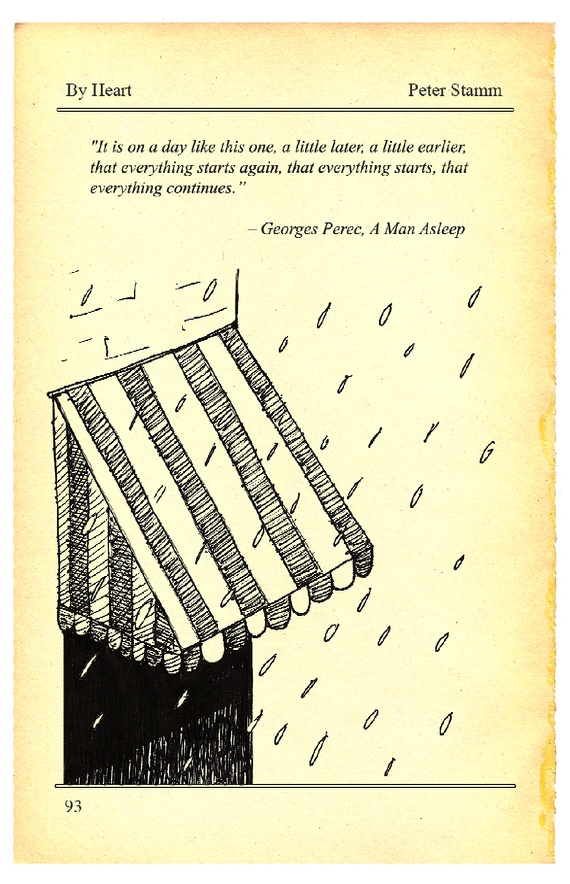
And yet it’s not some huge moment that reveals this essential sameness to the character, that proves he’s forever part of the crowd. He never sees god, or whatever. Instead it’s a dumb little thing: He realizes he doesn’t want to get wet when it rains.

No, you are not the nameless master of the world, the one on whom history had lost its hold, the one who no longer felt the rain falling … You are no longer the inaccessible, the limpid, the transparent one. You are afraid, you are waiting. You are waiting, on Place Clichy, for the rain to stop falling.

Here, he’s part of society, part of all the people who are standing around waiting for the rain to stop. Like all human beings, he wants to avoid getting wet. Like everyone else, he huddles under the awnings and archways of Paris as soon as the skies open up. To me, it’s a beautiful image, much deeper than the “big” moment somehow. And the smallness of the image—the everyday nature of this revelation—perhaps undercuts the character’s own grandiose ambitions.

I think it’s good for artists to have this kind of humility in mind. It’s good for you to realize you’re not immortal. You’re part of society. You might be forgotten. Delusions of grandeur probably make work easier—but it makes your work deeper if you admit you’re not so special. It made writing more difficult for me to be grounded, but on the other hand, I think my writing became more substantial when I realized I am no better than anyone else.

But it can be hard to come to this conclusion, especially for young people. There’s so much vanity in literature and all the arts. You see this all the time—take Hemingway, for example, who played the big-game hunter. This whole bullshit about hunting and bullfighting and fishing: That was just the image he wanted us to have of him. Maybe it helped him to feel that way. But it’s not a very mature thing to do. It does not help us understand the work at all—in fact, I think that kind of posturing ruins the work for some people. You can always read the books, in any case, and the persona recedes to the background. When you read Hemingway’s books, it’s there on the page: He wasn’t just the strong guy. He was a hardworking, serious artist, who felt things very deeply.

My writing became more substantial when I realized I am no better than anyone else.

You can’t just blame the artist, though: We half expect our cultural figures to be these larger-than-life, romantic archetypes. We don’t need them to be, but we want them to be. People want artists to be vain—it probably serves their own vanity, in a way. As long as you’re honest in your texts, it doesn’t do any major harm—but it’s still quite infantile. I think it’s best for writers to strive to be mature, as much as they can, in their life and work.

I think this authorial tendency to self-dramatize can be seen inside some works, too—so many writers seem to need to pump their stories full of sound and fury. I think, instead, of Perec—and the amazing maturity he displays by not reaching for the big, dramatic moment. There tends to be so much drama in writing—too much, in my opinion. I’m just now reading a collection of short stories, and in every short story there’s a suicide or a murder or a rape. Many writers feel that they have to put all this drama in their books in order for us to feel something. Drama is always too easy, in a way. It’s easier just to bring the big drama into things. Especially with young authors, you see so many texts that are just so filled with stuff: You think, get rid of all this! You don’t need that. The young woman I was telling you about, she’s a very good writer. But the book would be much better with fewer deaths. She seems to rely on them, but she doesn’t need them.

To me, though, it’s much more interesting to deal with everyday life, with novelty, with days going by and nothing changing. It’s more difficult, but it’s more interesting—because that’s what most of our lives are. Ninety-nine percent of our days are like the day before. It’s very seldom that we kill ourselves, that we are raped, or killed—luckily. For me, the interesting thing is to deal with that head-on: How do we live when nothing is changing? How do we deal with small things?

This is one reason I love a short paragraph from the end of A Man Asleep, so much so that I borrowed a line as a title for one of our books:

It is on a day like this one, a little later, a little earlier, that everything starts again, that everything starts, that everything continues.

You can still achieve emotional impact without big, dramatic gestures. It’s done by watching very carefully. It’s like when I went to the forest with my children. The first time you say: There’s the trees. But then, you go deeper. You start looking at the individual plants, seeing how different they all are. In one square foot of forest, you can find 20 different species. And that means 20 different types of leaves, and 20 different forms of reproduction, and so on, and suddenly things are very interesting. When you start just explaining and watching closely, a great deal can happen in a very small space.

I’m not saying nothing should happen in stories. I do like events—but the most interesting events are the small ones. Mrs. Dalloway going to buy some flowers for a party. Or, the Raymond Carver story “Viewfinder,” which starts this way: “A man without hands came to the door to sell me a photograph of my house.” The story shifts in a moment when the handicapped man takes a picture of the narrator—you can feel that it changes her life, somehow. But it’s not a big event. The big events—when someone dies, for example—they often don’t really change our lives. They are too big, somehow. And our reactions are usually paradoxical to them: we actually feel less than we think we should. So often, it’s the strange, small details that stay with us instead.

When I wrote the story “Sweet Dreams,” which was published recently in The New Yorker, I told my editor, “I’m writing a story about a woman who buys a corkscrew.” And that’s all it is: She buys a corkscrew and shows it to her boyfriend. But in this moment, you can feel that many things happen. You can see the whole relationship in this thing. Your DNA is in every cell. You can find the DNA of this relationship in this very small cell, where she’s buying a corkscrew. I don’t need the big drama. I don’t need the main characters to fight and kill each other to see who they really are.

You can feel when things are important if you’re attentive enough.

You can somehow feel which moments are important. Even in your own life, you can feel when things are important if you’re attentive enough. I’m not looking for them. But once in three months, when I see something or read something or encounter something, I have this feeling: That’s something important. Those are the things I write about. Very often, I don’t know why what I saw or read or experienced is important. I just know that there’s something there that I want to explore on the page. Sometimes, as I start writing, I discover what drew me to my subject. Sometimes, I don’t find out until after I’ve written the text and I re-read it a few times.

This feeling of intuition guides me more than any sense of structure or plot. I’m completely against the idea that you should know you character’s whole background, or whole biography, before you begin. I think that’s just nonsense. That’s how you make movies in Hollywood, but that’s not how you make art. You find out about your person by writing about them. You need to relate to them: have feelings for them, love them, hate them. Start writing. Find out about your setting by writing about it, too. I compare the process to an expedition sometimes: It’s like going into the wild and seeing where you get. Sometimes you don’t find your way and you have to turn back. Sometimes you find something incredible: America, or India, or the source of the Nile.

I don’t structure. I think I’ve developed a feeling for form just by writing for 30 years now that I can feel—even without knowing where I’m going—which way could be a good way. I sometimes introduce minor characters without knowing what they are for, and later I realized they’re important to the text. I don’t want to mystify the whole thing, but most decisions really are by feeling and intuition. I did read some crime novels when I was 20 or something, but even then I got tired of the whole plot thing. I came to George Simenon, where he gives us the information in the very beginning, and it’s not about plot any more. You always know who murdered the guy. It’s about how Commissaire Maigret figures it out. I think plot has always not been too interesting to me. If you can be open and rely on your feelings somehow, and let them guide you—not look for the bestseller, or whatever—then something good might happen.

I want to go hand in hand with my reader, to explore something together.

The readers can feel the writer’s genuine interest, and they care more about locating that interest than they do about the machinations of plot. They are not stupid. I want to go hand in hand with my reader, to explore something together with him or her. And that’s more interesting, because I think the reader can feel my interest in the subject. But if he knows that I’m just god who sits somewhere on the throne and decides what I should tell him and what not, it’s not really a good relationship.

I think entertainment isn’t the goal of literature. I’m not against entertainment—I like, say, James Bond movies or Die Hard. But I separate them from movies like Richard Linklater’s movies, which make me see things differently. To me—I’m not a religious person, so I have always looked for meaning in books. For me, literature must be more than entertainment: It’s the place where I was look for meaning and insight. Literature started as religious texts, after all. And then somehow we reduced god, and now it’s just literature left. It’s the same with images. When you see images in a cave that are 30,000 years old, it’s not about painting a bull or a tiger, but there is much more to it: These illustrations are explorations of the world and the way it works. Literature to me has always been like that. It’s about relating to the world and trying to understand it. When I want to be entertained I’ll watch a film on DVD. When I read, I’m looking for something else.

As we speak, I’m looking at maybe a thousand books. I have the authors A - H downstairs in my living room, the rest upstairs. I can see Camus, Richard Ford, Don DeLillo, all kinds of wonderful authors. Each volume is like a different being somehow. Each one is a different world. Sometimes it’s a memory of who you were when you read them—Hemingway reminds me of when I was 20, how much I learned from him as I was just starting to write. Sometimes it’s a feeling—I love Don DeLillo for the way he seems to be unsure where he’s going, the way he’s willing to experiment and try things out. Reading a good book is like meeting a real person. You relate to a book, just the way you can relate to a flesh-and-blood individual. It’s so much more than just spending time. You’ll never be the same after you’ve read a really good book—you experience something almost like life.