15 Jan 06:44
by Ming Li, Yi Yao, Jie Ding, Lu Liu, Jianhua Qin, Yaopeng Zhao, Hongwei Hou and Yaoting Fan

Inorganic Chemistry
DOI: 10.1021/ic502219y

13 Jan 10:17
Chem. Commun., 2015, 51,3604-3607
DOI: 10.1039/C4CC09812A, Communication
Arun Naibi Lakshminarayana, Jingjing Chang, Jie Luo, Bin Zheng, Kuo-Wei Huang, Chunyan Chi
Two bisindeno-annulated pentacenes were synthesized and they exhibited tunable solubility, high stability and ordered molecular packing.
The content of this RSS Feed (c) The Royal Society of Chemistry

10 Jan 07:31
by Daiki Umeyama, Satoshi Horike, Munehiro Inukai, Tomoya Itakura and Susumu Kitagawa

Journal of the American Chemical Society
DOI: 10.1021/ja511019u

08 Jan 16:12
Dalton Trans., 2015, 44,6731-6739
DOI: 10.1039/C4DT03660C, Paper
Liyan Zhang, Lulu Rong, Guoli Hu, Suo Jin, Wei-Guo Jia, Ji Liu, Guozan Yuan
Six coordination polymers with different structures have been prepared. The tunable structures and photoluminescence properties were observed due to their different metal centers and supramolecular structures.
The content of this RSS Feed (c) The Royal Society of Chemistry

08 Jan 16:11
Dalton Trans., 2015, 44,4362-4369
DOI: 10.1039/C4DT03326D, Paper
Bingbing Shi, Yuanhao Zhong, Lili Guo, Gang Li
Two novel dimethylphenyl imidazole dicarboxylate-based lanthanide(III)-organic frameworks, [Ln(H2DMPhIDC)3(H3DMPhIDC)]n (Ln = Eu (1), Tb (2); H3DMPhIDC = 2-(3,4-dimethylphenyl)-1H-imidazole-4,5-dicarboxylic acid) have been synthesized under hydrothermal conditions.
The content of this RSS Feed (c) The Royal Society of Chemistry

08 Jan 16:11
Chem. Sci., 2015, 6,1645-1649
DOI: 10.1039/C4SC03217A, Edge Article

Open Access
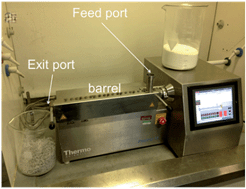
Deborah Crawford, Jose Casaban, Robert Haydon, Nicola Giri, Tony McNally, Stuart L. James
Continuous flow mechanochemical and melt-phase synthesis at kg h-1 rates from solid reagents and either no solvent, or only minimal solvent, is reported.
The content of this RSS Feed (c) The Royal Society of Chemistry

08 Jan 16:11
Chem. Commun., 2015, 51,3957-3972
DOI: 10.1039/C4CC09888A, Feature Article
Maria-Eleni Ragoussi, Tomas Torres
Organic, dye-sensitized and perovskite solar cell technologies have triggered widespread interest in recent years due to their very promising potential towards a high solar electricity future. A number of important milestones have marked the roadmap of each sector on the way to today's outstanding performances, but there still remains plenty of scope for further improvement. The most influential landmarks, together with basic concepts and future perspectives are unraveled in this review.
The content of this RSS Feed (c) The Royal Society of Chemistry

08 Jan 06:28
by Yuze Lin, Jiayu Wang, Zhi-Guo Zhang, Huitao Bai, Yongfang Li, Daoben Zhu, Xiaowei Zhan

A novel non-fullerene electron acceptor (ITIC) that overcomes some of the shortcomings of fullerene acceptors, for example, weak absorption in the visible spectral region and limited energy-level variability, is designed and synthesized. Fullerene-free polymer solar cells (PSCs) based on the ITIC acceptor are demonstrated to exhibit power conversion efficiencies of up to 6.8%, a record for fullerene-free PSCs.
08 Jan 06:26
Chem. Commun., 2015, 51,2396-2398
DOI: 10.1039/C4CC09526J, Communication
Roman Dobrovetsky, Katsuhiko Takeuchi, Douglas W. Stephan
The stoichiometric reaction of trityl cation with two equivalents of Ph2PH affords the phosphine stabilized phosphenium salt [Ph2(H)PPPh2][B(C6F5)4] via hydride abstraction, while catalytic amounts of B(p-HC6F4)3 effects catalytic phosphine dehydrocoupling with the liberation of H2.
The content of this RSS Feed (c) The Royal Society of Chemistry

08 Jan 06:25
Chem. Commun., 2015, 51,2414-2417
DOI: 10.1039/C4CC09272D, Communication
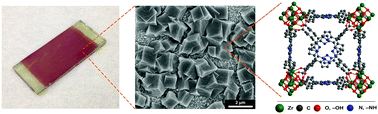
Chung-Wei Kung, Ting-Hsiang Chang, Li-Yao Chou, Joseph T. Hupp, Omar K. Farha, Kuo-Chuan Ho
Zirconium-based porphyrin metal-organic framework (MOF-525) thin films were solvothermally grown on conducting substrates; they are electrochemically addressable in aqueous media.
The content of this RSS Feed (c) The Royal Society of Chemistry

06 Jan 19:46
by Javier López-Andarias, María José Rodriguez, Carmen Atienza, Juan Luis López, Tsubasa Mikie, Santiago Casado, Shu Seki, José L. Carrascosa and Nazario Martín

Journal of the American Chemical Society
DOI: 10.1021/ja510946c

05 Jan 11:54
Chem. Commun., 2015, 51,3173-3176
DOI: 10.1039/C4CC09955A, Communication
Susan Sen, Subhadip Neogi, Kari Rissanen, Parimal K. Bharadwaj
Guest solvent triggered reversible structural transformation and concomitant Zn(II) to Cu(II) transmetalation has been realized through single-crystal to single-crystal fashion in an imidazolium functionalized 3D cationic Zn(II)-framework.
The content of this RSS Feed (c) The Royal Society of Chemistry

03 Jan 00:30
by Erin T. Chernick, Rubén Casillas, Johannes Zirzlmeier, Daniel M. Gardner, Marco Gruber, Henning Kropp, Karsten Meyer, Michael R. Wasielewski, Dirk M. Guldi and Rik R. Tykwinski

Journal of the American Chemical Society
DOI: 10.1021/ja510958k

zkevin and -1 others like this
27 Dec 13:33
by Cong Wei, Si-Yun Liu, Chang-Ling Zou, Yingying Liu, Jiannian Yao and Yong Sheng Zhao

Journal of the American Chemical Society
DOI: 10.1021/ja5112817

27 Dec 13:32
by Cagatay Dengiz, Benjamin Breiten, Jean-Paul Gisselbrecht, Corinne Boudon, Nils Trapp, W. Bernd Schweizer and François Diederich

The Journal of Organic Chemistry
DOI: 10.1021/jo502367h

25 Dec 05:40
by Dirk Leifert and Armido Studer

Organic Letters
DOI: 10.1021/ol503574k

25 Dec 05:39
by Tian-Fu Liu, Dawei Feng, Ying-Pin Chen, Lanfang Zou, Mathieu Bosch, Shuai Yuan, Zhangwen Wei, Stephen Fordham, Kecheng Wang and Hong-Cai Zhou

Journal of the American Chemical Society
DOI: 10.1021/ja5111317

24 Dec 19:05
by Walter D. Guerra, Roberto A. Rossi, Adriana B. Pierini and Silvia M. Barolo

The Journal of Organic Chemistry
DOI: 10.1021/jo5024393

24 Dec 16:01
Chem. Commun., 2015, 51,2130-2133
DOI: 10.1039/C4CC09211B, Communication
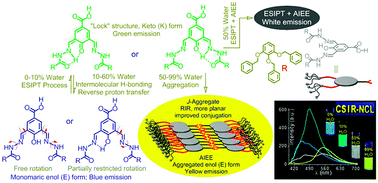
Arunava Maity, Firoj Ali, Hridesh Agarwalla, Bihag Anothumakkool, Amitava Das
A single gelator molecule (1) shows an ESIPT coupled AIEE process for generating multiple luminescent colors, including white-light, with varying aggregation as a function of the water content in a THF-water mixture. Luminescent property of 1 is retained in gel as well as in solid state.
The content of this RSS Feed (c) The Royal Society of Chemistry

24 Dec 13:06
Chem. Commun., 2014, Accepted Manuscript
DOI: 10.1039/C4CC08763A, Communication
Ling Qin, Mengxi Zheng, Zijian Guo, Hegen Zheng, Yan Xu
The obtained multifunctional compound is a promising fluorescent material that can give tunable fluorescence emissions by changing the solvent molecules. The fluorescence sensing behaviors are different for non-protonic and protonic...
The content of this RSS Feed (c) The Royal Society of Chemistry

24 Dec 13:05
Chem. Sci., 2014, Accepted Manuscript
DOI: 10.1039/C4SC03749A, Edge Article
Open Access
Li-Li Tan, Haiwei Li, Yu-Chen Qiu, Dai-Xiong Chen, Xin Wang, Rui-Yi Pan, Yan Wang, Sean Xiao-An Zhang, Bo Wang, Ying-Wei Yang
Spurred by recent advances in materials chemistry and drug delivery, a new stimuli-responsive theranostic hybrid platform, based on mechanized monodisperse nano metal-organic frameworks (NMOFs) gated by carboxylatopillar[5]arene (CP5) switches with...
The content of this RSS Feed (c) The Royal Society of Chemistry

23 Dec 09:43
by Xun-Xiang Guo, Da-Wei Gu, Zhengxing Wu and Wanbin Zhang

Chemical Reviews
DOI: 10.1021/cr500410y

23 Dec 09:41
by Sean W. Robinson, Chantal L. Mustoe, Nicholas G. White, Asha Brown, Amber L. Thompson, Pierre Kennepohl and Paul D. Beer

Journal of the American Chemical Society
DOI: 10.1021/ja511648d

23 Dec 00:16
by Shin-ichiro Kato, Takayuki Furuya, Masashi Nitani, Naoya Hasebe, Yutaka Ie, Yoshio Aso, Toshitada Yoshihara, Seiji Tobita, Yosuke Nakamura
Abstract
π-Extended thiadiazoles 4–8 fused with various electron-donating heteroaromatic moieties have been designed and synthesized. Just like thiadiazoles 1–3 synthesized previously, 4–8 exhibit intramolecular charge-transfer (CT) interactions, moderate-to-good fluorescence quantum yields of up to 0.78, and electrochemical amphoterism. In comparison with 1–3, the benzannulation in thiadiazoles 4–7 moderately extends the π conjugation and significantly increases the stability of the cationic species formed upon electrochemical oxidation. The fluorescence quantum yields increase remarkably from 3 to 6 and 7 due to the efficient suppression of nonradiative intersystem crossing resulting from the benzannulation. The properties of 4–8 strongly reflect the different species annulated to the pyrrole rings, namely benzothiophene, naphthalene, and benzofuran. Eleven crystals, including poly- and pseudopolymorphic crystals of 1 (1-Crys.(Y) and 1-Crys.(G)), 2 (2-Crys.(O) and 2-Crys.(G)), 4 (4-Crys.(O) and 4-Crys.(G)), and 6 (6-Crys.(O) and 6-Crys.(G)), were obtained and characterized by X-ray crystallography. The fluorescence colors and efficiencies are distinct for each poly- and pseudopolymorph of 1, 2, 4, and 6. It has been suggested that both the extent of the electronic interactions in the π-stacked dimers and the presence of excitonic interactions originating in the 1D face-to-face slipped columns affect the fluorescence wavelengths of the poly- and pseudopolymorphs.

π-Extended thiadiazoles: The photophysical and electrochemical properties of a series of π-extended thiadiazoles fused with electron-donating heteroaromatic moieties are disclosed. These compounds form poly- and pseudopolymorphic crystals, and the fluorescence properties in the crystalline state are significantly affected by the molecular arrangement (see figure).
haozi and -1 others like this
19 Dec 19:58
Chem. Commun., 2015, 51,1866-1869
DOI: 10.1039/C4CC07911F, Communication
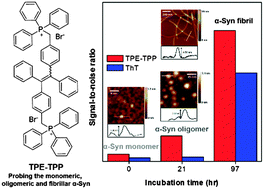
Chris Wai Tung Leung, Feng Guo, Yuning Hong, Engui Zhao, Ryan Tsz Kin Kwok, Nelson Lik Ching Leung, Sijie Chen, Nishant N. Vaikath, Omar Mukhtar El-Agnaf, Youhong Tang, Wei-Ping Gai, Ben Zhong Tang
Fluorescent probe, TPE-TPP, can differentiate monomeric, oligomeric and fibrillar [small alpha]-synuclein which was previously difficult to achieve.
The content of this RSS Feed (c) The Royal Society of Chemistry

19 Dec 08:42
Chem. Soc. Rev., 2015, 44,1053-1069
DOI: 10.1039/C4CS00342J, Tutorial Review
Open Access
Joakim Andreasson, Uwe Pischel
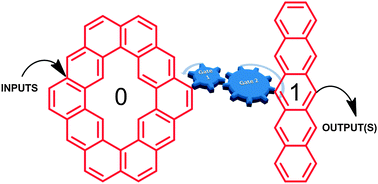
Ones and zeros can be handled by molecules through the input-control of their signaling features. The progress in this exciting field during the last five years is covered in this tutorial review.
The content of this RSS Feed (c) The Royal Society of Chemistry

19 Dec 08:37
by Katsuaki Baba, Mamoru Tobisu and Naoto Chatani

Organic Letters
DOI: 10.1021/ol503252t

18 Dec 19:28
by Ryousuke Yoshii, Amane Hirose, Kazuo Tanaka and Yoshiki Chujo

Journal of the American Chemical Society
DOI: 10.1021/ja510985v

18 Dec 01:04
by Suresh B. Kalidindi, Sanjit Nayak, Michael E. Briggs, Susanna Jansat, Alexandros P. Katsoulidis, Gary J. Miller, John E. Warren, Dmytro Antypov, Furio Corà, Ben Slater, Mark R. Prestly, Carlos Martí-Gastaldo, Matthew J. Rosseinsky
Abstract
The synthesis of metal–organic frameworks with large three-dimensional channels that are permanently porous and chemically stable offers new opportunities in areas such as catalysis and separation. Two linkers (L1=4,4′,4′′,4′′′-([1,1′-biphenyl]-3,3′,5,5′-tetrayltetrakis(ethyne-2,1-diyl)) tetrabenzoic acid, L2=4,4′,4′′,4′′′-(pyrene-1,3,6,8-tetrayltetrakis(ethyne-2,1-diyl))tetrabenzoic acid) were used that have equivalent connectivity and dimensions but quite distinct torsional flexibility. With these, a solid solution material, [Zr6O4(OH)4(L1)2.6(L2)0.4]⋅(solvent)x, was formed that has three-dimensional crystalline permanent porosity with a surface area of over 4000 m2 g−1 that persists after immersion in water. These properties are not accessible for the isostructural phases made from the separate single linkers.

Two linkers of equivalent connectivity but quite distinct torsional flexibility are used to produce [Zr6O4(OH)4(L1)2.6(L2)0.4]⋅(solvent)x that combines both structural and chemical stability in a metal–organic framework. Such a combination is not accessible for the single-linker isostructural phases. The resulting Zr-based MOF has three-dimensional channels and a high surface area of 4184 m2 g−1.
18 Dec 01:03
by Qisheng Zhang, Hirokazu Kuwabara, William J. Potscavage, Shuping Huang, Yasuhiro Hatae, Takumi Shibata and Chihaya Adachi

Journal of the American Chemical Society
DOI: 10.1021/ja510144h

   This article is licensed under a Creative Commons Attribution 3.0 Unported Licence.

   This article is licensed under a Creative Commons Attribution-NonCommercial 3.0 Unported Licence.