Chemical Reviews
DOI: 10.1021/cr500249p
Carlosla polla!
A highly fluorescent electrofluorochromic gel with quantum yields as high as 67% is prepared by incorporating the thienoviologen fluorophore 4,4′-(2,2′-bithiophene-5,5′-diyl)bis(1-nonylpridinium)bistriflimide into a polymeric matrix. The fluorescent emission spectrum of the gel at low percentages of thienoviologen shows a strong band at 530 nm. A new intense fluorescence band at 630 nm can be induced by fluorophore aggregation. Single layer electrofluorochromic devices were readily prepared by sandwiching the polymer gels between two indium tin oxide (ITO) electrodes. The fluorescence intensity can be easily modulated between a fluorescent and a quenched state, in a wide visible spectral range, by direct electrochemical reduction of the thienoviologen fluorophore. It exhibits three reduction states, each with different emission properties. The reversible interconversion among these states leads to a high electrofluorochromic stability of the device, exhibiting switching times of a few seconds and, to the best of our knowledge, the highest contrast ratio (337).

A single layer ITO/EFC/ITO device is presented where the electrofluorochromic layer is a polymer gel containing the fluorescent thienoviologen dication 4,4′-(2,2′-bithiophene-5,5′-diyl)bis(1-nonylpridinium). Its reduction allows to switch the fluorescence between a high fluorescence off state and a quenched on state in the 470–800 nm spectral range. This device exhibits high fluorescence contrasts, short switching times, and a high cycling lifetime.
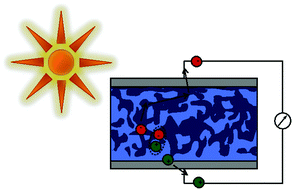
Achievement of long-term stability of organic photovoltaics is currently one of the major topics for this technology to reach maturity. Most of the techniques used to reveal degradation pathways are destructive and/or do not allow for real-time measurements in operating devices. Here, three different, nondestructive techniques able to provide real-time information, namely, film absorbance, capacitance–voltage (C–V), and impedance spectroscopy (IS), are combined over a period of 1 year using non-accelerated intrinsic degradation conditions. It is discerned between chemical modifications in the active layer, physical processes taking place in the bulk of the blend from those at the active layer/contact interfaces. In particular, it is observed that during the ageing experiment, the main source for device performance degradation is the formation of donor–acceptor charge-transfer complex ( –
– ) that acts as an exciton quencher. Generation of these radical species diminishes photocurrent and reduces open-circuit voltage by the creation of electronic defect states. Conclusions extracted from absorption, C–V, and IS measurements will be further supported by a range of other techniques such as atomic force microscopy, X-ray diffraction, and dark-field imaging of scanning transmission electron microscopy on ultrathin cross-sections.

Long-term stability analysis under non-accelerated conditions reveals spontaneous chemical interaction between bulk materials. Device degradation occurs by the formation of donor–acceptor charge transfer complexes that act as exciton quenchers. Generation of these radical species diminishes photocurrent and reduces open-circuit voltage by the creation of electronic defect states.


Electrophilic terminal phosphinidene complexes [Ar-Ar-P-W(CO)5] (Ar-Ar: biaryl or an analogue thereof) undergo a spontaneous insertion of the phosphorus atom into the vicinal C![[BOND]](http://onlinelibrarystatic.wiley.com/undisplayable_characters/00f8ff.gif) H bonds to give annelated phospholes. Twelve examples are described, including biphenyl, thienyl, pyrrolyl, and benzofuryl groups as biaryl moieties. The activation energy of the insertion reaction is quite low (about 2 kcal mol−1).
H bonds to give annelated phospholes. Twelve examples are described, including biphenyl, thienyl, pyrrolyl, and benzofuryl groups as biaryl moieties. The activation energy of the insertion reaction is quite low (about 2 kcal mol−1).

Proximity matters: Electrophilic terminal phosphinidene complexes (left, with Ar-Ar being biaryl or an analogue thereof) undergo a spontaneous insertion of the P atom into the vicinal CH bond to give annelated phospholes. The latter compounds are valuable precursors for the preparation of a variety of optoelectronic devices.

Theory and experiment are combined to investigate the nature of low-energy excitons within ordered domains of 6,13-bis(triisopropylsilylethynyl)-pentacene (TIPS-PEN) polycrystalline thin films. First-principles density functional theory and many-body perturbation theory calculations, along with polarization-dependent optical absorption spectro-microscopy on ordered domains, show multiple low-energy absorption peaks that are composed of excitonic states delocalized over several molecules. While the first absorption peak is composed of a single excitonic transition and retains the polarization-dependent behavior of the molecule, higher energy peaks are composed of multiple transitions with optical properties that can not be described by those of the molecule. The predicted structure-dependence of polarization-dependent absorption reveals the exact inter-grain orientation within the TIPS-PEN film. Additionally, the degree of exciton delocalization can be significantly tuned by modest changes in the solid-state structure and the spatial extent of the excitations along a given direction is correlated with the degree of electronic dispersion along the same direction. These findings pave the way for tailoring the singlet fission efficiency of organic crystals by solid-state structure.

A combination of micro-spectroscopy and many-body perturbation theory reveals the inter-grain orientation within polycrystalline TIPS-pentacene films and the relationship of the physical structure to optoelectronic properties.

On page 7273, H. S. Kang, H.-T. Kim, J.-K. Park, and S. Lee conceive a non-autonomic healing system, a light-powered, healable electrical conductor. The use of light allows remote access to the on-demand and repetitive restoration of its conductivity without a direct invasion of the master device, which is not accessible by other methods.

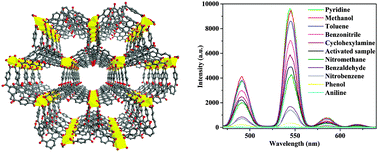
The development of efficient sensors for the determination of the water content in organic solvents is highly desirable for a number of chemical industries. Presented herein is a Mg2+ metal–organic framework (MOF), which exhibits the remarkable capability to rapidly detect traces of water (0.05–5 % v/v) in various organic solvents through an unusual turn-on luminescence sensing mechanism. The extraordinary sensitivity and fast response of this MOF for water, and its reusability make it one of the most powerful water sensors known.

Testing the water: A Mg2+ metal–organic framework (MOF) is reported. It has the extraordinary capability to detect, in real time, trace water concentrations (0.05–5 %) in various organic solvents through an unusual turn-on luminescence sensing mechanism. The sensitivity and fast response of this MOF for water, and its reusability make it one of the most powerful water sensors known.


Compounds displaying delayed fluorescence (DF), from severe concentration quenching, have limited applications as nondoped organic light-emitting diodes and material sciences. As a nondoped fluorescent emitter, aggregation-induced emission (AIE) materials show high emission efficiency in their aggregated states. Reported herein is an AIE-active, DF compound in which the molecular interaction is modulated, thereby promoting triplet harvesting in the solid state with a high photoluminescence quantum yield of 93.3 %, which is the highest quantum yield, to the best of our knowledge, for long-lifetime emitters. Simultaneously, the compound with asymmetric molecular structure exhibited strong mechanoluminescence (ML) without pretreatment in the solid state, thus exploiting a design and synthetic strategy to integrate the features of DF, AIE, and ML into one compound.

In a “scense”: A novel compound having an asymmetric structure exhibited aggregation-induced emission, delayed fluorescence, and mechanoluminescence simultaneously.
A series of dithienylethene-containing triarylboranes has been designed, synthesized, and characterized. The electrochemistry, photophysics, and photochromic behavior have also been studied. The photophysical and photochromic properties could be facilely tuned in this system by varying the thiophene spacers (thiophene, thienothiophene, and bithiophene) between the dithienylethene and the dimesitylboron (BMes2) or the position of the BMes2 substitution in the thiophene spacers. The absorption of closed form has been found to be more sensitive towards the structural modification upon incorporation of the BMes2 unit. Moreover, multi-addressable photochromic reactivity is obtained upon addition of Lewis base (F−), which is due to the formation of boron–Lewis base adduct. The dependence of the photophysical and photochromic properties on the thiophene spacers and the position of the BMes2 substitution has been further supported by computational studies.

Boron takes the lead: Facile tuning was observed in triarylborane-containing dithienylethene compounds (see picture; Mes=2,4,6-Me3C6H2). The photochromic properties can be modulated by varying the thiophene spacers between dithienylethene and BMes2 or the position of the BMes2 substitution in the thiophene spacers.
Replacement of C![[DOUBLE BOND]](http://onlinelibrarystatic.wiley.com/undisplayable_characters/00f8fe.gif) C unit with its isoelectronic BN unit in aromatics provides a new class of molecules with appealing properties, which have attracted great attention recently. In this Concept, we focus on BN-substituted polycyclic aromatics with fused structures, and review their synthesis, photophysical, and redox properties, as well as their applications in organic electronics. We also present challenging synthetic targets, large BN- substituted polycyclic aromatics, such as regioregular BN heterosuperbenzenes, which can be viewed as BN-doped nanographenes. Finally, we propose an atomically precise bottom-up synthesis of structurally well-defined BN-doped graphenes.
C unit with its isoelectronic BN unit in aromatics provides a new class of molecules with appealing properties, which have attracted great attention recently. In this Concept, we focus on BN-substituted polycyclic aromatics with fused structures, and review their synthesis, photophysical, and redox properties, as well as their applications in organic electronics. We also present challenging synthetic targets, large BN- substituted polycyclic aromatics, such as regioregular BN heterosuperbenzenes, which can be viewed as BN-doped nanographenes. Finally, we propose an atomically precise bottom-up synthesis of structurally well-defined BN-doped graphenes.

A new super hero! BN substitution in aromatic systems could provide a new family of interesting compounds. In this Concept, we focused on the development of BN-substituted polycyclic aromatics, and summarized their synthesis, properties and electronic applications. From monocyclic BN-substituted benzene to polycyclic BN heteroaromatics (like BN heterosuperbenzene), the possible ways to structurally well-defined BN-doped graphenes were proposed.


 Open Access
   This article is licensed under a Creative Commons Attribution-NonCommercial 3.0 Unported Licence.

The formation of coaxial p–n heterojunctions by mesoscale alignment of self-sorted donor and acceptor molecules, important to achieve high photocurrent generation in organic semiconductor-based assemblies, remains a challenging topic. Herein, we show that mixing a p-type π gelator (TTV) with an n-type semiconductor (PBI) results in the formation of self-sorted fibers which are coaxially aligned to form interfacial p–n heterojunctions. UV/Vis absorption spectroscopy, powder X-ray diffraction studies, atomic force microscopy, and Kelvin-probe force microscopy revealed an initial self-sorting at the molecular level and a subsequent mesoscale self-assembly of the resulted supramolecular fibers leading to coaxially aligned p–n heterojunctions. A flash photolysis time-resolved microwave conductivity (FP-TRMC) study revealed a 12-fold enhancement in the anisotropic photoconductivity of TTV/PBI coaxial fibers when compared to the individual assemblies of the donor/acceptor molecules.

Self-assembled coaxial fibers: A thiophene-based p-type gelator (TTV) and an n-type perylene bisimide (PBI) self-sort at the molecular level and undergo self-assembly at the mesoscopic level to form bundled coaxial donor–acceptor fibers. These combined processes allow the formation of coaxial p–n heterojunctions with high photoconductivity.