14 May 20:29
Chem. Commun., 2015, 51,9797-9800
DOI: 10.1039/C5CC03072B, Communication
Marc-Andre Courtemanche, Alexander P. Pulis, Etienne Rochette, Marc-Andre Legare, Douglas W. Stephan, Frederic-Georges Fontaine
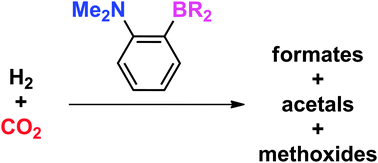
The FLP species 1-BR2-2-NMe2-C6H4 (R = 2,4,6-Me3C6H21, 2,4,5-Me3C6H22) reacts H2/CO2 to give formyl, acetal and methoxy-derivatives.
The content of this RSS Feed (c) The Royal Society of Chemistry

14 May 20:25
by Yoshihiro Matano, Yuta Motegi, Shinsuke Kawatsu and Yoshifumi Kimura

The Journal of Organic Chemistry
DOI: 10.1021/acs.joc.5b00541

hailul and -1 others like this
14 May 20:23
by Douglas W. Stephan, Gerhard Erker
Abstract
Frustrated Lewis pairs (FLPs) are combinations of Lewis acids and Lewis bases in solution that are deterred from strong adduct formation by steric and/or electronic factors. This opens pathways to novel cooperative reactions with added substrates. Small-molecule binding and activation by FLPs has led to the discovery of a variety of new reactions through unprecedented pathways. Hydrogen activation and subsequent manipulation in metal-free catalytic hydrogenations is a frequently observed feature of many FLPs. The current state of this young but rapidly expanding field is outlined in this Review and the future directions for its broadening sphere of impact are considered.

Let′s not get together: Frustrated Lewis pairs (FLP) are combinations of Lewis acids and Lewis bases which are prevented from forming a stable adduct by steric or electronic hindrance. The growth of the field of FLP chemistry during the last four years has been rapid, including small-molecule activation, applications in catalysis, and the development of unprecedented reactions.
13 May 11:23
by Sa-Sa Wang and Guo-Yu Yang

Chemical Reviews
DOI: 10.1021/cr500390v

13 May 11:20
Chem. Soc. Rev., 2015, 44,5320-5340
DOI: 10.1039/C4CS00369A, Review Article
Darius G. Rackus, Mohtashim H. Shamsi, Aaron R. Wheeler
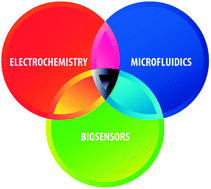
This review catalogues the convergence of electrochemistry, biosensors, and microfluidics, with an emphasis on the emergence of new application areas. Image credit: Lisa Ngo.
The content of this RSS Feed (c) The Royal Society of Chemistry

13 May 11:19
by Hiroya Oshima, Aiko Fukazawa, Takahiro Sasamori, Shigehiro Yamaguchi
Abstract
Heptalene, a nonaromatic, bicyclic 12 π-electron system with a twisted structure, is of great interest with regard to its potential Hückel aromaticity in the two-electron oxidized or reduced forms. The synthesis of thiophene-fused heptalene 5 from the reductive transannular cyclization of bisdehydro[12]annulene 4, and its solid-state structure, which was confirmed by X-ray crystallographic analysis, is presented. Chemical reduction of 5 readily generated the corresponding dianion, which was successfully isolated as [(K[2.2.2]cryptand)+]252−. The X-ray crystallographic analysis of the dianion revealed a shallower saddle structure for the heptalene moiety and a lesser degree of bond alternation relative to 5. 1H NMR spectroscopy exposed the effect of a diamagnetic ring current on dianion 52−, which was corroborated by nucleus-independent chemical shift (NICS) calculations. These results demonstrate that the heptalene dianion, containing 14 π-electrons, does indeed exhibit pronounced degrees of Hückel aromaticity.

Evolution: Reductive transannular cyclization of an arene-fused bisdehydro[12]annulene granted access to a π-extended heptalene skeleton. The tetrathieno-fused heptalene exhibits a highly twisted, nonaromatic saddle structure. X-ray crystallography shows that chemical reduction transforms this nonplanar system into a more planar heptalene dianion with lesser degrees of bond alternation, reflecting high levels of Hückel aromaticity.
12 May 17:12
by D. Suresh, Clara S. B. Gomes, Patrícia S. Lopes, Cláudia A. Figueira, Bruno Ferreira, Pedro T. Gomes, Roberto E. Di Paolo, António L. Maçanita, M. Teresa Duarte, Ana Charas, Jorge Morgado, Diogo Vila-Viçosa, Maria José Calhorda
Abstract
New bis- and tris(iminopyrrole)-functionalized linear (1,2-(HNC4H3-C(H)![[DOUBLE BOND]](http://onlinelibrarystatic.wiley.com/undisplayable_characters/00f8fe.gif) N)2-C6H4 (2), 1,3-(HNC4H3-C(H)N)2-C6H4 (3), 1,4-(HNC4H3-C(H)N)2-C6H4 (4), 4,4′-(HNC4H3-C(H)N)2-(C6H4-C6H4) (5), 1,5-(HNC4H3C-(H)N)2-C10H6 (6), 2,6-(HNC4H3C-(H)N)2-C10H6 (7), 2,6-(HNC4H3C-(H)N)2-C14H8 (8)) and star-shaped (1,3,5-(HNC4H3-C(H)N-1,4-C6H4)3-C6H3 (9)) π-conjugated molecules were synthesized by the condensation reactions of 2-formylpyrrole (1) with several aromatic di- and triamines. The corresponding linear diboron chelate complexes (Ph2B[1,3-bis(iminopyrrolyl)-phenyl]BPh2 (10), Ph2B[1,4-bis(iminopyrrolyl)-phenyl]BPh2 (11), Ph2B[4,4′-bis(iminopyrrolyl)-biphenyl]BPh2 (12), Ph2B[1,5-bis(iminopyrrolyl)-naphthyl]BPh2 (13), Ph2B[2,6-bis(iminopyrrolyl)-naphthyl]BPh2 (14), Ph2B[2,6-bis(iminopyrrolyl)-anthracenyl]BPh2 (15)) and the star-shaped triboron complex ([4′,4′′,4′′′-tris(iminopyrrolyl)-1,3,5-triphenylbenzene](BPh2)3 (16)) were obtained in moderate to good yields, by the treatment of 3–9 with B(C6H5)3. The ligand precursors are non-emissive, whereas most of their boron complexes are highly fluorescent; their emission color depends on the π-conjugation length. The photophysical properties of the luminescent polyboron compounds were measured, showing good solution fluorescence quantum yields ranging from 0.15 to 0.69. DFT and time-dependent DFT calculations confirmed that molecules 10 and 16 are blue emitters, because only one of the iminopyrrolyl groups becomes planar in the singlet excited state, whereas the second (and third) keeps the same geometry. Compound 13, in which planarity is not achieved in any of the groups, is poorly emissive. In the other examples (11, 12, 14, and 15), the LUMO is stabilized, narrowing the gap between the highest occupied molecular orbital and the lowest unoccupied molecular orbital (HOMO–LUMO), and the two iminopyrrolyl groups become planar, extending the size of the π-system, to afford green to yellow emissions. Organic light-emitting diodes (OLEDs) were fabricated by using the new polyboron complexes and their luminance was found to be in the order of 2400 cd m−2, for single layer devices, increasing to 4400 cd m−2 when a hole-transporting layer is used.
N)2-C6H4 (2), 1,3-(HNC4H3-C(H)N)2-C6H4 (3), 1,4-(HNC4H3-C(H)N)2-C6H4 (4), 4,4′-(HNC4H3-C(H)N)2-(C6H4-C6H4) (5), 1,5-(HNC4H3C-(H)N)2-C10H6 (6), 2,6-(HNC4H3C-(H)N)2-C10H6 (7), 2,6-(HNC4H3C-(H)N)2-C14H8 (8)) and star-shaped (1,3,5-(HNC4H3-C(H)N-1,4-C6H4)3-C6H3 (9)) π-conjugated molecules were synthesized by the condensation reactions of 2-formylpyrrole (1) with several aromatic di- and triamines. The corresponding linear diboron chelate complexes (Ph2B[1,3-bis(iminopyrrolyl)-phenyl]BPh2 (10), Ph2B[1,4-bis(iminopyrrolyl)-phenyl]BPh2 (11), Ph2B[4,4′-bis(iminopyrrolyl)-biphenyl]BPh2 (12), Ph2B[1,5-bis(iminopyrrolyl)-naphthyl]BPh2 (13), Ph2B[2,6-bis(iminopyrrolyl)-naphthyl]BPh2 (14), Ph2B[2,6-bis(iminopyrrolyl)-anthracenyl]BPh2 (15)) and the star-shaped triboron complex ([4′,4′′,4′′′-tris(iminopyrrolyl)-1,3,5-triphenylbenzene](BPh2)3 (16)) were obtained in moderate to good yields, by the treatment of 3–9 with B(C6H5)3. The ligand precursors are non-emissive, whereas most of their boron complexes are highly fluorescent; their emission color depends on the π-conjugation length. The photophysical properties of the luminescent polyboron compounds were measured, showing good solution fluorescence quantum yields ranging from 0.15 to 0.69. DFT and time-dependent DFT calculations confirmed that molecules 10 and 16 are blue emitters, because only one of the iminopyrrolyl groups becomes planar in the singlet excited state, whereas the second (and third) keeps the same geometry. Compound 13, in which planarity is not achieved in any of the groups, is poorly emissive. In the other examples (11, 12, 14, and 15), the LUMO is stabilized, narrowing the gap between the highest occupied molecular orbital and the lowest unoccupied molecular orbital (HOMO–LUMO), and the two iminopyrrolyl groups become planar, extending the size of the π-system, to afford green to yellow emissions. Organic light-emitting diodes (OLEDs) were fabricated by using the new polyboron complexes and their luminance was found to be in the order of 2400 cd m−2, for single layer devices, increasing to 4400 cd m−2 when a hole-transporting layer is used.

Bridge the gap: Luminescent linear and star-shaped polynuclear organoboron complexes containing iminopyrrolyl ligands linked by aryl bridges were synthesized, showing good luminescent properties depending on π-conjugation lengths of the molecules (see figure). Organic light-emitting diodes (OLEDs) were successfully fabricated with the new boron complexes, achieving luminance values of up to 4400 cd m−2.
12 May 10:33
Chem. Soc. Rev., 2015, 44,6804-6849
DOI: 10.1039/C4CS00395K, Review Article
Adeel H. Chughtai, Nazir Ahmad, Hussein A. Younus, A. Laypkov, Francis Verpoort
Novel catalytic materials are highly demanded to perform a variety of catalytic organic reactions.
The content of this RSS Feed (c) The Royal Society of Chemistry

12 May 10:30
Chem. Commun., 2015, 51,9733-9736
DOI: 10.1039/C5CC02908B, Communication
Anne B. Mabire, Mathew P. Robin, Wen-Dong Quan, Helen Willcock, Vasilios G. Stavros, Rachel K. O'Reilly
Amino-substituted maleimides form a new class of highly emissive compounds, with large Stokes shifts (>100 nm) and high quantum yields (up to [similar]60%).
The content of this RSS Feed (c) The Royal Society of Chemistry

10 May 17:13
by Bijian Li, Bo Gui, Guiping Hu, Daqiang Yuan and Cheng Wang

Inorganic Chemistry
DOI: 10.1021/acs.inorgchem.5b00535

09 May 11:06
Dalton Trans., 2015, 44,10304-10314
DOI: 10.1039/C5DT01261A, Paper
Iris de Krom, Martin Lutz, Christian Muller
Replacing nitrogen by phosphorus in otherwise similar structures changes the properties of the resulting compounds significantly due to the electronic differences that exist between these heteroatoms.
The content of this RSS Feed (c) The Royal Society of Chemistry

09 May 11:06
by Chang-Jiang Yao, Hai-Jing Nie, Wen-Wen Yang, Jiannian Yao and Yu-Wu Zhong

Inorganic Chemistry
DOI: 10.1021/ic503117k

08 May 19:00
by Xiao-Ye Wang, Dong-Chu Yang, Fang-Dong Zhuang, Jia-Jie Liu, Jie-Yu Wang, Jian Pei
Abstract
New BN-embedded, thiophene-fused, polycyclic aromatic compounds with planar geometry were designed and synthesized. The molecules showed excellent stability and chemical robustness. Postfunctionalization on this skeleton was demonstrated with a series of electrophilic bromination, palladium-catalyzed cross-coupling, and Knoevenagel condensation reactions. The π skeleton remained intact during these late-stage transformations. The optical and electronic properties have been well tuned through incorporation of electron-rich and -deficient groups on the backbone. This work shows the great advantage of the postfunctionalization strategy on BN-containing polycyclic aromatic compounds for fast diversification and materials screening.

Simple diversification: Postfunctionalization on a new planar BN-embedded thiophene-fused polycyclic aromatic compound was demonstrated with a series of electrophilic bromination, palladium-catalyzed cross-coupling, and Knoevenagel condensation reactions to provide opportunities for fast diversifications of BN-containing compounds and fine-tuning of their molecular properties (see scheme).
08 May 05:16
by Weidong Rao, Dewi Susanti, Benjamin James Ayers and Philip Wai Hong Chan

Journal of the American Chemical Society
DOI: 10.1021/jacs.5b02377

05 May 20:24
Chem. Soc. Rev., 2015, 44,6035-6058
DOI: 10.1039/C5CS00136F, Review Article
Y. Lan, M. G. Corradini, R. G. Weiss, S. R. Raghavan, M. A. Rogers
Solvent parameters provide an understanding into the driving forces governing SAFiN formation aiding in the quest for a universal gelator.
The content of this RSS Feed (c) The Royal Society of Chemistry

03 May 09:03
Dalton Trans., 2015, 44,9992-10002
DOI: 10.1039/C5DT01068C, Paper
Leif A. Korte, Robin Warner, Yury V. Vishnevskiy, Beate Neumann, Hans-Georg Stammler, Norbert W. Mitzel
Besides a series of pyridine-based Lewis pairs with B(C6F5)2 groups with varying electronic and steric situations and strong intramolecular B-N bonds, 2-[(CH2)4B(C6F5)2]-6-tBu-pyridine was found to behave as a frustrated Lewis pair.
The content of this RSS Feed (c) The Royal Society of Chemistry

03 May 09:02
Dalton Trans., 2015, 44,13490-13497
DOI: 10.1039/C5DT00606F, Paper
Carlos A. Fernandez, Satish K. Nune, Harsha V. Annapureddy, Liem X. Dang, B. Peter McGrail, Feng Zheng, Evgueni Polikarpov, David L. King, Charles Freeman, Kriston P. Brooks
A simple way to increase hydrophobicity and chemical stability in metal-organic frameworks without compromising CO2 sorption capacity.
The content of this RSS Feed (c) The Royal Society of Chemistry

03 May 08:51
Chem. Commun., 2015, 51,8825-8828
DOI: 10.1039/C5CC02225H, Communication
Fanny Frausto, Zachary C. Smith, Terry E. Haas, Samuel W. Thomas III
Diphenylacetylene (tolan) derivatives with self-complementary aryl halides and halogen bond-accepting nitriles form 2D bricklayer packing motifs when halogen bonding occurs.
The content of this RSS Feed (c) The Royal Society of Chemistry

03 May 08:46
Chem. Sci., 2015, 6,3823-3830
DOI: 10.1039/C4SC03635B, Edge Article

Open Access
Johnson Lui-Lui Tsai, Taotao Zou, Jia Liu, Tianfeng Chen, Anna On-Yee Chan, Chen Yang, Chun-Nam Lok, Chi-Ming Che
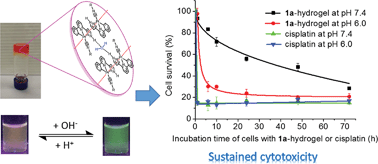
Luminescent platinum(II) complexes show anti-cancer and pH-dependent self-assembly and sustained-release properties under physiological conditions.
The content of this RSS Feed (c) The Royal Society of Chemistry

03 May 08:45
Chem. Sci., 2015, 6,3582-3592
DOI: 10.1039/C5SC00964B, Edge Article
Open Access
Jing Chen, Oliver S. Wenger
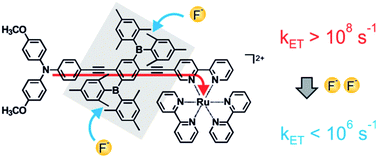
The efficiency of organoboron wires as mediators of long-range electron transfer can be controlled by anion binding.
The content of this RSS Feed (c) The Royal Society of Chemistry

03 May 08:29
by Hannelore Kast, Amaresh Mishra, Gisela L. Schulz, Marta Urdanpilleta, Elena Mena-Osteritz, Peter Bäuerle
The synthesis, optoelectronic, and photovoltaic properties of novel acceptor–donor–acceptor (A–D–A) based π-conjugated functional molecules 1–3, comprising a planar S,N-heteropentacene as central donor substituted with various terminal acceptor units, such as 1,1-dicyanovinylene (DCV) and 1-(1,1-dicyanomethylene)-cyclohex-2-ene (DCC), are reported. The structural variation of the end groups provides molecules 1–3 with gradually increased π-conjugation due to a rising number of double bonds, which comes from the DCC unit(s). From optoelectronic investigation, structure–property relationships are deduced and the novel A–D–A heteropentacenes 1–3 are implemented as photoactive donor component in solution-processed bulk heterojunction solar cells together with [6,6]-phenyl-C61-butyric acid methyl ester as acceptor. The structural variation in the S,N-heteropentacenes leads to clear trends in the photovoltaic performance and power conversion efficiencies of up to 4.9% are achieved. Furthermore, due to extension of the double bonds a clear trade-off between the open circuit voltage (V
OC) and the short circuit current density (J
SC) values is observed. The role of additives on the optimization of the nanoscale morphology and device performance is investigated. The findings presented herein demonstrate that depending on the types of materials the additive may have significantly different effects on the active layer morphology and the device performance.

A new class of A–D–A-type molecular donor materials based on S,N-heteropentacene is developed for incorporation into solution-processed bulk heterojunction solar cells providing promising power conversion efficiencies of 3.1–4.9%. The extension of the π-system and increase in the highest occupied molecular orbital energy level provide direct correlation for the improved short circuit current (J
SC) and decreased open circuit voltage (V
OC) values.
03 May 08:27
by Christopher A. DeRosa, Jelena Samonina-Kosicka, Ziyi Fan, Hansford C. Hendargo, Douglas H. Weitzel, Gregory M. Palmer and Cassandra L. Fraser

Macromolecules
DOI: 10.1021/acs.macromol.5b00394

03 May 08:27
Chem. Soc. Rev., 2015, 44,3719-3759
DOI: 10.1039/C5CS00137D, Review Article
Arnaud Fihey, Aurelie Perrier, Wesley R. Browne, Denis Jacquemin
We review molecular compounds encompassing several photochromic units with a focus on their functionalities.
The content of this RSS Feed (c) The Royal Society of Chemistry

03 May 08:26
by Zheng-Feng Chang, Ling-Min Jing, Cong Wei, Yu-Ping Dong, Yan-Chun Ye, Yong Sheng Zhao, Jin-Liang Wang
Abstract
In this work, two rigid, multiple tetraphenylethene (TPE)-substituted, π-conjugated, snowflake-shaped luminophores BT and BPT were facilely synthesized by using a 6-fold Suzuki coupling reaction. These molecules are constructed based on the nonplanar structure of propeller-shaped hexaphenylbenzene (HPB) or benzene as core groups and TPE as end groups. As a result, they reserve the intrinsic aggregation-induced emission (AIE) property of the TPE moiety. Meanwhile, both fluorescence quantum yield and piezochromic behavior in the solid state can be tuned or switched by inserting the phenyl bridges through changing the twisting conformation. The more extended structure BPT showed a much stronger AIE effect and higher ΦF,f in the solid state in comparison with that of BT. Furthermore, an excellent optical waveguide application of these molecules was achieved. However, the revisable piezofluorochromic behavior has only appeared when BT was ground using a pestle and treated with solvent.

Snowflake-shaped luminophores: Two new rigid, multiple tetraphenylethene (TPE) substituted, π-conjugated, snowflake-shaped luminophores BT and BPT (see figure) were facilely synthesized and exhibited unique aggregation-induced emission (AIE) properties. Both fluorescence quantum yield and piezochromic behavior in the solid state can be tuned or switched by inserting the phenyl bridges through changing the twisting conformation.
03 May 08:20
by Jan Kumpf, S. Thimon Schwaebel and Uwe H. F. Bunz

The Journal of Organic Chemistry
DOI: 10.1021/acs.joc.5b00577

03 May 08:20
by Sushil Kumar and Yu-Tai Tao

The Journal of Organic Chemistry
DOI: 10.1021/acs.joc.5b00423

03 May 08:19
by Peter D. Frischmann, Valentin Kunz, Frank Würthner
Abstract
A highly luminescent Zn4L6 tetrahedron is reported with 3.8 nm perylene bisimide edges and hexadentate ZnII–imine chelate vertices. Replacing FeII and monoamines commonly utilized in subcomponent self-assembly with ZnII and tris(2-aminoethyl)amine provides access to a metallosupramolecular host with the rare combination of structural integrity at concentrations <10−7 mol L−1 and an exceptionally high fluorescence quantum yield of Φem=0.67. Encapsulation of multiple perylene or coronene guest molecules is accompanied by strong luminescence quenching. We anticipate this self-assembly strategy may be generalized to improve access to brightly fluorescent coordination cages tailored for host–guest light-harvesting, photocatalysis, and sensing.

FeII-free and fluorescent: A highly luminescent (Φem=0.67) Zn4L6 tetrahedron with perylene bisimide edges and hexadentate zinc–imine chelate vertices is accessed by dynamic imine–metal coordination self-assembly. Encapsulation of multiple perylene or coronene guest molecules is detected by quenching of the host emission. The chelate may be generalized to other dyes, improving access to brightly luminescent metallosupramolecular cages.
03 May 08:18
by Zongliang Xie, Chengjian Chen, Shidang Xu, Jun Li, Yi Zhang, Siwei Liu, Jiarui Xu, Zhenguo Chi
Abstract
A novel white-light-emitting organic molecule, which consists of carbazolyl- and phenothiazinyl-substituted benzophenone (OPC) and exhibits aggregation-induced emission-delayed fluorescence (AIE-DF) and mechanofluorochromic properties was synthesized. The CIE color coordinates of OPC were directly measured with a non-doped powder, which presented white-emission coordinates (0.33, 0.33) at 244 K to 252 K and (0.35, 0.35) at 298 K. The asymmetric donor–acceptor–donor′ (D-A-D′) type of OPC exhibits an accurate inherited relationship from dicarbazolyl-substituted benzophenone (O2C, D-A-D) and diphenothiazinyl-substituted benzophenone (O2P, D′-A-D′). By purposefully selecting the two parent molecules, that is, O2C (blue) and O2P (yellow), the white-light emission of OPC can be achieved in a single molecule. This finding provides a feasible molecular strategy to design new AIE-DF white-light-emitting organic molecules.

Like fluorescent butterflies: A single white-light-emitting organic compound with aggregation-induced emission-delayed fluorescence (AIE-DF) was achieved by selection of the parent molecules. This novel design principle is a form of molecular inheritance of the tuning properties for a targeted molecule.
27 Apr 18:18
by Shingo Ito, Yuki Tokimaru, Kyoko Nozaki
Abstract
A novel nitrogen-doped corannulene derivative, 8-tert-butyl-6b2-azapentabenzo[bc,ef,hi,kl,no]corannulene, was synthesized by 1,3-dipolar cycloaddition of a polycyclic aromatic azomethine ylide with a diarylethyne and subsequent palladium-catalyzed intramolecular cyclization. This molecule represents the first example of a corannulene derivative bearing an internal heteroatom, and exhibits unique structural and physical properties caused by the introduction of the nitrogen atom and extended π-conjugation, as compared to the parent corannulene.

Bowled over: A novel benzene-fused azacorannulene (left) was synthesized by the 1,3-dipolar cycloaddition of a polycyclic aromatic azomethine ylide with a diarylethyne and subsequent palladium-catalyzed intramolecular cyclization. This molecule represents the first example of a heteroatom-doped corannulene derivative and in the solid state bowl-in-bowl columnar π-stacking is observed (right).
23 Apr 19:03
by Tomokatsu Kushida, Ayumi Shuto, Masafumi Yoshio, Takashi Kato, Shigehiro Yamaguchi
Abstract
A discotic liquid-crystalline (LC) material, consisting of a planarized triphenylborane mesogen, was synthesized. X-ray diffraction analysis confirmed that this compound forms a hexagonal columnar LC phase with an interfacial distance of 3.57 Å between the discs. At ambient temperature, this boron-centered discotic liquid crystal exhibited ambipolar carrier transport properties with electron and hole mobility values of approximately 10−3 and 3×10⁻⁵ cm2 V−1 s−1, respectively.

B planar, B aligned: A planarized triphenylborane, bearing three 3,4,5-tridodecyloxyphenyl groups, forms a hexagonal columnar liquid-crystalline phase at ambient temperature. It has a columnar π-stacked structure and ambipolar carrier-transport properties with hole- and electron-mobility values of 3×10⁻⁵ cm2 V−1 s−1 and approximately 10−3 cm2 V−1 s−1, respectively.