03 May 09:04
Dalton Trans., 2015, 44,8317-8317
DOI: 10.1039/C5DT90049B, Editorial
Eli Zysman-Colman
Welcome to this Dalton Transactions themed issue on luminescent materials for solid-state lighting.
The content of this RSS Feed (c) The Royal Society of Chemistry

03 May 08:33
by Yuichi Hirai, Takayuki Nakanishi, Yuichi Kitagawa, Koji Fushimi, Tomohiro Seki, Hajime Ito, Hiroyuki Fueno, Kazuyoshi Tanaka, Toshifumi Satoh and Yasuchika Hasegawa

Inorganic Chemistry
DOI: 10.1021/acs.inorgchem.5b00145

03 May 08:32
by Wenxiang Chai, Mingwei Hong, Li Song, Guohua Jia, Hongsheng Shi, Jiayu Guo, Kangying Shu, Bing Guo, Yicheng Zhang, Wenwu You and Xueyuan Chen

Inorganic Chemistry
DOI: 10.1021/ic502709b

27 Apr 18:19
by Qing-Wei Zhang, Kun An, Li-Chuan Liu, Yuan Yue, Wei He
23 Apr 20:32
Chem. Soc. Rev., 2015, 44,4091-4130
DOI: 10.1039/C4CS00528G, Review Article
Yaochen Zheng, Sipei Li, Zhulin Weng, Chao Gao
This review summarizes the advances in hyperbranched polymers from the viewpoint of structure, click synthesis and functionalization towards their applications in the last decade.
The content of this RSS Feed (c) The Royal Society of Chemistry

23 Apr 19:03
by Lena Hahn, Hubert Wadepohl and Lutz H. Gade

Organic Letters
DOI: 10.1021/acs.orglett.5b00942

21 Apr 08:21
by Jens U. Engelhart, Benjamin D. Lindner, Manuel Schaffroth, David Schrempp, Olena Tverskoy, Uwe H. F. Bunz
Abstract
The palladium-catalyzed coupling of a substituted o-diaminoanthracene and a substituted o-diaminophenazine to substituted 2,3-dichloroquinoxalines furnishes 10 differently substituted N,N′-dihydrotetraaza- or -hexaazahexacenes with the quinoxaline group of the azaacenes carrying fluorine, chlorine, or nitro groups. The N,N′-dihydrotetraazahexacenes with hydrogen, chlorine, and fluorine subtituents are oxidized to azaacenes, whereas only the parent N,N′-dihydrohexaazahexacenes, with hydrogen substituents, are oxidized by MnO2. The resultant azaacenes are characterized by their optical and spectroscopic data. In addition, single-crystal X-ray structures have been obtained for the parent tetraazahexacenes and their difluoro-substituted derivatives. The di- and tetrachloro derivatives of the N,N′-dihydrohexaazahexacene have also been structurally characterized.

Making acene: A series of tetraaza- and hexaazahexacenes have been obtained by a coupling/oxidation strategy and the limit of stability of the structures has been extended, enabling the generation of stable azahexacenes (see figure).
21 Apr 08:20
by Constanza Ruiz, Juan T. López Navarrete, M. Carmen Ruiz Delgado and Berta Gómez-Lor

Organic Letters
DOI: 10.1021/acs.orglett.5b00900

19 Apr 13:50
Chem. Commun., 2015, 51,7532-7535
DOI: 10.1039/C5CC00379B, Communication
Brian J. Smith, Nicky Hwang, Anton D. Chavez, Jennifer L. Novotney, William R. Dichtel
The formation and stability of boronate ester COFs is monitored by turbidity spectroscopy, establishing rules for monomer effects and insights into the growth mechanism.
The content of this RSS Feed (c) The Royal Society of Chemistry

19 Apr 13:48
Chem. Commun., 2015, 51,7543-7545
DOI: 10.1039/C5CC01551K, Communication
Javier Lopez-Andarias, Altan Bolag, Christoph Nancoz, Eric Vauthey, Carmen Atienza, Naomi Sakai, Nazario Martin, Stefan Matile
We report the design, synthesis and evaluation of increasingly electron-deficient fullerenes in multicomponent surface architectures.
The content of this RSS Feed (c) The Royal Society of Chemistry

19 Apr 13:45
Chem. Commun., 2015, 51,8037-8040
DOI: 10.1039/C5CC02459E, Communication
Raul Garcia, Manuel Melle-Franco, Aurelio Mateo-Alonso
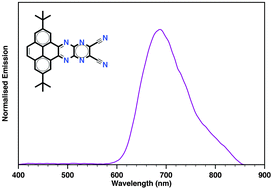
A pyrene-fused pyrazaacene with only four linearly-fused aromatic rings is reported, which remarkably shows emission at red to NIR wavelengths ([small lambda]em = 687 nm).
The content of this RSS Feed (c) The Royal Society of Chemistry

19 Apr 10:01
Chem. Sci., 2015, 6,4141-4147
DOI: 10.1039/C5SC00223K, Edge Article

Open Access
Marc Rudolf, Olga Trukhina, Josefina Perles, Lai Feng, Takeshi Akasaka, Tomas Torres, Dirk M. Guldi
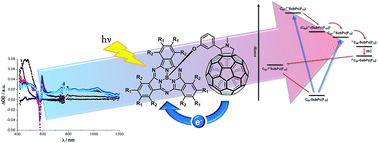
Two subphthalocyanine-C60 fullerene electron donor-acceptor conjugates have been prepared from electron deficient subphthalocyanines and C60, with evidence of an ultrafast oxidative electron transfer from C60 to the subphthalocyanines.
The content of this RSS Feed (c) The Royal Society of Chemistry

15 Apr 17:47
Chem. Soc. Rev., 2015, 44,3431-3473
DOI: 10.1039/C4CS00456F, Review Article
Open Access
Federico Bella, Claudio Gerbaldi, Claudia Barolo, Michael Gratzel
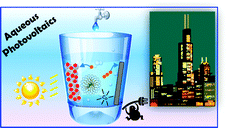
This review highlights the efforts towards the realization of an artificial photosynthetic system able to convert sunlight into electricity by using a unique solvent, water, the solvent of life.
The content of this RSS Feed (c) The Royal Society of Chemistry

13 Apr 21:44
by Charlotte Mallet, Chady Moussallem, Alexandre Faurie, Magali Allain, Frédéric Gohier, William G. Skene, Pierre Frère
Abstract
A series of 2,5-distyrylfuran derivatives bearing pentafluorophenyl- and cyanovinyl units have been synthesized for aggregation-induced emission (AIE). The effect of the type and extent of the supramolecular connections on the AIE of the furan derivatives were examined and correlated with their X-ray crystal structures. It was found that the simultaneous presence of cyano and perfluorophenyl units strongly enhances the fluorescence upon aggregation. Single-crystal X-ray diffraction analysis confirmed that C![[BOND]](http://onlinelibrarystatic.wiley.com/undisplayable_characters/00f8ff.gif) H⋅⋅⋅F, F⋅⋅⋅F, CH⋅⋅⋅nitrile, Ar⋅⋅⋅ArF (Ar=aryl, ArF=fluoroaryl), and nitrile⋅⋅⋅ArF intra- and intermolecular interactions drive the topology of the molecule and that solid-state supramolecular contacts favor AIE of the furan derivatives.
H⋅⋅⋅F, F⋅⋅⋅F, CH⋅⋅⋅nitrile, Ar⋅⋅⋅ArF (Ar=aryl, ArF=fluoroaryl), and nitrile⋅⋅⋅ArF intra- and intermolecular interactions drive the topology of the molecule and that solid-state supramolecular contacts favor AIE of the furan derivatives.

Enhanced fluorescence: A series of 2,5-distyrylfuran derivatives bearing pentafluorophenyl- and cyanovinyl units have been synthesized for aggregation-induced emission (AIE). The simultaneous presence of cyano and perfluorophenyl units strongly enhances fluorescence upon aggregation. Single-crystal X-ray diffraction analysis confirmed that intra- and intermolecular interactions drive the topology of the molecule and that solid-state supramolecular contacts favor AIE of the furan derivatives (see figure).
Carlos and -1 others like this
11 Apr 06:30
by Yang Cao, Jeffrey K. Nagle, Michael O. Wolf and Brian O. Patrick

Journal of the American Chemical Society
DOI: 10.1021/jacs.5b02078

10 Apr 21:25
Dalton Trans., 2015, 44,7554-7562
DOI: 10.1039/C5DT00835B, Paper
Taro Tsubomura, Kaoru Kimura, Michihiro Nishikawa, Toshiaki Tsukuda
Emissive copper(I) complexes bearing a phenanthroline ligand having diphenyl groups and diphosphines were synthesized. The quantum yields are enhanced by the diphenyl groups on the phenanthroline ligand.
The content of this RSS Feed (c) The Royal Society of Chemistry

10 Apr 17:52
Chem. Soc. Rev., 2015, 44,6434-6451
DOI: 10.1039/C5CS00066A, Review Article
Ferran Feixas, Eduard Matito, Jordi Poater, Miquel Sola
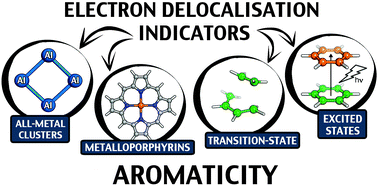
Aromaticity descriptors based on the quantification of electron delocalization are all-round indicators that outperform most of the classical structural- and magnetic-based indices.
The content of this RSS Feed (c) The Royal Society of Chemistry

09 Apr 14:39
by Motonobu Takahashi, Koji Nakano and Kyoko Nozaki

The Journal of Organic Chemistry
DOI: 10.1021/jo502889r

09 Apr 14:37
Chem. Sci., 2015, 6,3538-3543
DOI: 10.1039/C5SC00900F, Edge Article
Open Access
Zikai He, Liang Shan, Ju Mei, Hong Wang, Jacky W. Y. Lam, Herman H. Y. Sung, Ian D. Williams, Xiao Gu, Qian Miao, Ben Zhong Tang
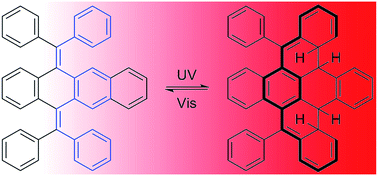
Solid-state photochromism was found in bis(diphenylmethylene)dihydrotetracene, caused by photocyclization of the embedded cis-stilbene motifs.
The content of this RSS Feed (c) The Royal Society of Chemistry

08 Apr 05:51
Chem. Sci., 2015, 6,3495-3504
DOI: 10.1039/C5SC00856E, Edge Article
Open Access
Arnaud Fihey, Denis Jacquemin
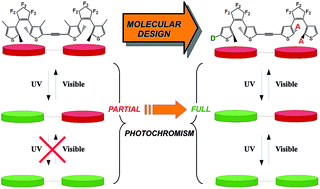
The impact of chemical substitution on the optical properties of ca. 30 dithienylethene (DTE) dyads is investigated with first-principles approaches, with the aim to provide useful guidelines for obtaining more efficient DTE multimers.
The content of this RSS Feed (c) The Royal Society of Chemistry

Carlos and -1 others like this
03 Apr 17:42
by Kazuyoshi Watanabe, Hiroyuki Hayasaka, Tatsuaki Miyashita, Kenta Ueda, Kazuo Akagi
A series of photoresponsive and full-colored fluorescent conjugated copolymers is synthesized by combining phenylene- and thienylene-based main chains with photochromic dithienylethene (DE) side chains. Solutions and cast films of the polymers exhibit various colored fluorescence in visible wavelengths of 400−700 nm corresponding to emissions of the conjugated main chain. The fluorescence is reversibly photoswitched between emission and quenching through DE photoisomerization using external stimuli from ultraviolet and visible light irradiation. The reprecipitation method with ultrasonication enables the polymers to form spherical aggregates with diameters of 20−70 nm in water. After investigating and comparing the optical properties, the resulting nanosphere solutions are assumed to exist in an intermediate state between an isolated state (i.e., in solution) and an aggregated state in cast film. The majority of the nanosphere solutions also exhibit the same photoswitchable fluorescence behavior as those in the solutions and the cast films. The results demonstrate that the visible fluorescence of the conjugated copolymers is reversibly switchable between emission and quenching using the photoisomerizing DE side chain regardless of the fluorescent colors and the polymer chain aggregation.

A series of photoresponsive and full-colored fluorescent conjugated polymers are synthesized by combining phenylene- and thienylene-based main chains with photochromic dithienylethene side chains. In chloroform solution, nanosphere solution, and solid film, the full-colored fluorescence is reversibly switchable between emission and quenching through photoisomerization of dithienylethene side chains regardless of the fluorescent colors and the polymer chain aggregation.
27 Mar 21:41
by Bernd Kohl, Frank Rominger, Michael Mastalerz
Abstract
A highly soluble pyrene-fused undecacene is realized by end-capping the rectilinear aromatic π-plane with triptycenylene units. Besides the good solubility, the compound shows a high tendency to crystallize. Two polymorphs from dichlorobenzene and chloroform are described. In the polymorph from chloroform, half of the molecules are strongly bent out of the π-plane by 26.4°.

Acenes eleven: A highly soluble pyrene-fused undecacene is prepared by adding end-capping triptycenylene units to the linear π system (see structure, N blue). The new compound shows a high tendency to crystallize; two polymorphs from dichlorobenzene and chloroform solutions could be obtained.
24 Mar 21:16
Chem. Commun., 2015, 51,7497-7500
DOI: 10.1039/C5CC01902H, Communication
Xiaoqing Wang, Qingsong Liu, Hui Yan, Zhipeng Liu, Mingguang Yao, Qingfu Zhang, Shuwen Gong, Weijiang He
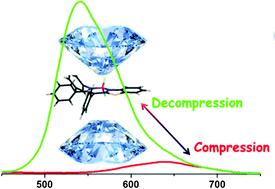
The different piezochromic luminescence behaviors of two new boron difluoride complexes were investigated.
The content of this RSS Feed (c) The Royal Society of Chemistry

24 Mar 10:03
by Youzhi Xu, Zhihua Wang, Zhenjie Gan, Qiuzhen Xi, Zheng Duan and François Mathey

Organic Letters
DOI: 10.1021/acs.orglett.5b00598

Carlos and -1 others like this
20 Mar 12:03
by Jacky Chi-Hung Chan, Hok-Lai Wong, Wing-Tak Wong, Vivian Wing-Wah Yam
Abstract
A series of dithienylethene-containing phosphole derivatives has been designed, synthesized and characterized. One of the compounds has been characterized by X-ray crystallography. Upon photoexcitation, the compounds exhibit drastic color changes, ascribed to the reversible photochromic behavior. Their photochromic, photophysical and electrochemical properties have been studied. They show photochromic reactivities with high photocyclization quantum yields. Their photophysical and photochromic properties are found to be facilely tuned in this system by substitution at the phosphole backbone, as well as variation on the extent of π-conjugation of the phosphole backbone. Some selected compounds have been demonstrated to exhibit photochromic properties in polymethylmethacrylate (PMMA) films.

Robust photoswitch: A new series of robust dithienylethene-containing phosphole derivatives has been synthesized (see figure); their photophysical and photochromic properties are found to be readily tuned by simple modifications at the phosphorus center, substitution at the phosphole backbone, as well as variation on the extent of π-conjugation of the phosphole backbone. Both the open and closed forms of the phosphole compounds have good thermal stability in benzene solution and in PMMA film.
18 Mar 09:53
Dalton Trans., 2015, 44,12029-12059
DOI: 10.1039/C5DT00280J, Perspective
Open Access
Violeta Rodriguez-Ruiz, Romain Carlino, Sophie Bezzenine-Lafollee, Richard Gil, Damien Prim, Emmanuelle Schulz, Jerome Hannedouche
This perspective provides an overview of the recent advancements in earth abundant element-based catalysts for alkene hydrofunctionalisation.
The content of this RSS Feed (c) The Royal Society of Chemistry

15 Mar 07:42
by Yingjie Zhao, Guangxi Huang, Celine Besnard, Jiri Mareda, Naomi Sakai, Stefan Matile
Abstract
General synthetic access to expanded π-acidic surfaces of variable size, topology, chirality, and π acidity is reported. The availability of π surfaces with these characteristics is essential to develop the functional relevance of anion–π interactions with regard to molecular recognition, translocation, and transformation. The problem is that, with expanded π surfaces, the impact of electron-withdrawing substituents decreases and the high π acidity needed for strong anion–π interactions can be more difficult to obtain. To overcome this problem, it is herein proposed to build large surfaces from smaller fragments and connect these fragments with bridges that are composed only of single atoms. Two central surfaces for powerful anion–π interactions, namely, perfluoroarenes and naphthalenediimides (NDIs), were selected as fragments and coupled with through sulfide bridges. Their oxidation to sulfoxides and sulfones, as well as fluorine substitution in the peripheral rings, provides access to the full chemical space of relevant π acidities. According to cyclic voltammetry, LUMO levels range from −3.96 to −4.72 eV. With sulfoxide bridges, stereogenic centers are introduced to further enrich the intrinsic planar chirality of the expanded surfaces. The stereoisomers were separated by chiral HPLC and characterized by X-ray crystallography. Their topologies range from chairs to π boats, and the latter are reminiscent of the cation–π boxes in operational neuronal receptors. With pentafluorophenyl acceptors, the π acidity of NDIs with two sulfoxide groups in the core reaches −4.45 eV, whereas two sulfone moieties give a value of −4.72 eV, which is as low as with four ethyl sulfone groups, that is, a π superacid near the limit of existence. Beyond anion–π interactions, these conceptually innovative π-acidic surfaces are also of interest as electron transporters in conductive materials.

Little wings: Single-atom sulfur bridges between the classical π acids naphthalene-diimides and perfluoroarenes on the sulfide, the sulfoxide, and the sulfone levels open access to expanded π acids and π-acidity gradients (see figure; blue=π-acidic, red=π-basic) up to DADADAD (D: donor, A: acceptor) patterns, LUMO levels from −3.96 to −4.72 eV, and chiral topologies from chairs to boats.
15 Mar 07:39
Chem. Commun., 2015, 51,6746-6748
DOI: 10.1039/C5CC01446H, Communication
F. Deiser, F. Kraus, H. Schmidbaur
The 1 : 4 and 1 : 2 complexes of silver perrhenate and triphenylphosphine, [(Ph3P)4Ag]+ ReO4- and [(Ph3P)2AgReO4]2, have been prepared and their structures determined in the solid state by X-ray diffraction.
The content of this RSS Feed (c) The Royal Society of Chemistry

13 Mar 13:26
by François Riobé, Rózsa Szűcs, Pierre-Antoine Bouit, Denis Tondelier, Bernard Geffroy, Fátima Aparicio, Julia Buendía, Luis Sánchez, Régis Réau, László Nyulászi, Muriel Hissler
Abstract
We describe the synthesis and the physical properties of polyaromatic hydrocarbons (PAHs) containing a phosphorus atom at the edge. In particular, the impact of the successive addition of aromatic rings on the electronic properties was investigated by experimental (UV/Vis absorption, fluorescence, cyclic voltammetry) and theoretical studies (DFT). The physical properties recorded in solution and in the solid state showed that the P-containing PAHs exhibit properties expected for an emitter in white organic light-emitting diodes (WOLEDs).

Getting it white: The synthesis and the physical properties of polyaromatic hydrocarbons (PAHs) containing a phosphorus atom at the edge are described (see figure). The impact of the successive addition of aromatic rings on the electronic properties was investigated by experimental (UV/Vis absorption, fluorescence, cyclic voltammetry) and theoretical studies (DFT). The physical properties recorded in solution and in the solid state showed that the P-containing PAHs exhibit the properties expected for an emitter in white organic light-emitting diodes (WOLEDs).
12 Mar 06:11
by Kwan Yin Cheung, Xiaomin Xu and Qian Miao

Journal of the American Chemical Society
DOI: 10.1021/jacs.5b00403