Timmy the Tooth
Shared posts
Wenger stands up for Arsenal having two days off
Timmy the ToothLove this guy.

Where is the Best Sushi in Chicago?
Timmy the ToothThe best sushi in Chicago is in Seattle. Where we have an actual ocean near by to get fish out of.

Sushi at Union Sushi + Barbeque Bar [Photograph: Nick Kindelsperger]
Have you recently stopped to think about how much raw seafood is around us? Almost every other new restaurant seems to have some kind of uncooked fish on its menu. Personally, I've been noticing a lot of Italian crudo, but sushi is still the most popular. Just consider the hundreds of established sushi restaurants, not to mention all-you-can-eat sushi buffets and numerous grab-and-go options available at grocery stores like Jewel-Osco and Whole Foods. But is all this raw fish equal?
I don't think it is. But what sets a certain sushi restaurants apart? Obviously, price is a huge factor, but is the most expensive sushi always the best, or are you just paying a premium for atmosphere? And what about creatively topped sushi? Does this show how talented a chef is, or is he just covering up mediocre fish?

Do you have a go-to spot for sushi? Do you prefer sushi pristine and stripped of ornamentation, or are you a fan of the wild creations found at places like Tanoshii, where Sushi Mike reigns supreme? Let me know in the comments!
How Much Should the Tooth Fairy Pay?
Timmy the ToothI gave Avie a silver coin. She doesn't spend it that way.
When we were growing up, losing baby teeth was a major deal, because doing so meant getting paid.
We would stick that wayward chopper under our pillow, and wake up the next morning to find the Tooth Fairy had left a shiny quarter, or possibly even a crisp dollar bill, in its place.
While most of us probably never got a decent explanation as to why the Tooth Fairy needed all those teeth (nourishment, perhaps), we didn’t object because even back then, we knew having money was better than not.
Now that we’re grown, and now that many of us have kids of our own, it’s good to check on our friend the Fairy and find what her going rates are these days.
As it turns out, losing teeth is big business these days, and children know it.
The National Average: $3.70 per Tooth
A recent survey conducted by Visa for their Tooth Fairy Personal Finance App revealed that, on average, kids today receive $3.70 per tooth.
Not a bad payday for an age group where parents still foot the bill for everything.
And before you blame simple inflation, just know that $3.70 is way higher than the average rate.
One dollar in 1990 is worth $1.78 in 2013 dough, which you might recognize as being much lower than $3.70.
Going back further in time, $1 in 1980 is worth $2.83 today.
In fact, a dollar doesn’t become worthy of today’s teeth until 1977 (their dollar is worth $3.84 today).
If you were raised on a quarter per tooth, you need to travel way, way back to justify paying $3.70 — a quarter in 1931 is worth $3.83 today.
So unless you’re having kids extremely late in life, inflation is not the issue.
The issue appears to be more that parents are abandoning their own personal Tooth Fairy budget the second Junior starts to feel left behind.
Kids will go to school, proud of the dollar they just got for that bicuspid that fell out over the weekend, and come home in tears because they found out their best friend got $5.
Obviously, parents don’t want their children to feel like they’re worth less than other kids, but instead of finding other, more cost-effective methods of making them smile again, they instead “have a talk” with the Tooth Fairy.
Then, with the next lost tooth, pay suddenly increases to five or possibly ten dollars. That Tooth Fairy sure is a good listener.
Toothy Trends
While part of it has to do with region (kids in the Northeast United States already pull in $4.10 a tooth on average, while Midwestern kids only get $3.30 a tooth,) toothy price tags all over are high, and they’re only going to get higher.
In 2011, the average Tooth Fairy payout was a mere $2.60. In two years, it went up over a dollar. There’s no reason to not believe that the 2014 figures will reveal an average payout of $4 or more.
But there is some good news — the Tooth Fairy App does report that about 33% of kids still get a dollar or less per tooth.
So some of the blame for high averages can be attributed to some parents who give their child anywhere from $20 to $100 for a lost tooth.
It’s kind of like how technically, the average salary for Philosophy majors is sky-high, because Steve Martin was a Philosophy major.
But it’s not all due to some kids earning higher salaries than their parents. For the majority of families, it’s just the way things are now.
Losing teeth can net kids big bucks, and the bucks are only going to get bigger.
If you catch your child in time, and continually remind them that money isn’t everything and their worth as a person isn’t tied to how much the Tooth Fairy leaves them, then you should be able to keep your Fairy bill quite low.
Just not “quarter per tooth” low. That Golden Age ended a long time ago.
Mary Hiers is a personal finance writer who helps people earn more and spend less.
World Cup 2014: Adidas pulls 'sex appeal' World Cup T-shirts after complaints from Brazil government

    
|

Russia accused of fuelling Winter Olympics medal haul with gas
Timmy the ToothGO FLAGS!
Beyond Curry: Lamb or Chicken Biryani
Timmy the ToothOne of my favorite dishes.

[Photograph: Prasanna Sankhe]
Sometimes I worry that it's wrong to love a dish so much. But the heart wants what it wants—in this case, a big helping (or two) of biryani. And, packed with meat, potatoes, rice, and spices, it certainly makes for one of the heartiest meals in my repertoire.
There are many varieties of this dish, which was originally brought to India by the Mughals—each state has its own unique and closely guarded version. The last time I counted, there were more than 15 types (and that's on the conservative side). The most common choices for meat are lamb and goat, but chicken, shrimp, and even fish have been known to find their way into this aromatic preparation.
My recipe is for home-style Bombay biryani. Yogurt is used to tenderize the meat—usually lamb, though chicken works well, too—and a slew of spices, both powdered and whole, add layers of flavor. Each has its part to play, and roasting and grinding them gives a distinct, deep intensity to each one. Indeed, this dish is big on aroma, and I've always found that it has an intoxicating effect as it finds its way into the corners of my home.
Biryani is not a complicated dish to prepare. Time consuming, yes. But not difficult. And it's one of those dishes that's diverse and satisfying enough to be the only one on the table. Some like to embellish it with a raita (a yogurt-based salad of cucumber, onion and tomato) or just garnish it with a few onion rings and lime wedges. Either way, I always try to make a little extra, because I think it tastes even better the next day, when the spices and meat have all rested together long enough to really get along.
About the author: Denise Dsilva Sankhe is a writer and creative director by profession. But that's only when she isn't eating her way across India. She recreates this delicious cuisine in her Mumbai home, which she shares with her husband, who has long since given up his determination to have salads for dinner.
Get the Recipe!EXCLUSIVE: Wayne Rooney invoice for Manchester United v. Olympiakos
[[ This is a content summary only. Visit my website for full links, other content, and more! ]]
Nile Ranger accused of being 'crazy sex pest animal' and a 'predator' in rape trial
Timmy the Tooth"crazy sex pest animal"? wow.

|
|

Transgender activist held in Sochi over gay banner
Timmy the ToothNot often that a story starts with "a transgender Italian communist"
Coveted Player to Train With U.S. Team
Timmy the ToothToday in banal football news.

|
|

Long-Exposure Faces: Moody Light Art Painted with Sparks
Timmy the ToothHey... remember that thing Picasso and Halsman did in the 30s?? No one else does either.

Light painter Diliz has worked for three years to twist, turn and perfect his single-line sparkler sketches in urban settings around the world. Each successive shot is related to a new time and place but also reflects a fresh attempt at capturing a mood and creating a sense of site-specific interaction.




Diliz (aka Vincent Delesvaux) has experimented with all kinds of photographic light art. In this particular series, dubbed 60 Seconds to Find an Exit, he set up shop at night in out-of-the-way streets and alleys, abandoned buildings and deserted basements.




His travels took him everywhere from European locations (including Verbier, Switzerland and Grenoble, France) all the way to cities in China, such as Lijiang, Yangshuo Fenghuang and Shanghai.
Next Page - Click Below to Read More:
Long Exposure Faces Moody Light Art Painted With Sparks
Want More? Click for Great Related Content on WebUrbanist:

Painting with Light: 15 Long-Exposure Light Art Photos
Luminous graffiti, eerie drawings, streaks of light, raining sparks - all of these effects and more are possible by moving a light source around in a scene. Click Here to Read More »»
Geometric Projections: Light Art Radically Reshapes Nature
Everyone knows there are mathematical patterns to be found everywhere in nature - though few such geometries are as explicit and dazzling as these. Click Here to Read More »»
Exposure: 10 Amazing Light Graffiti Artists & Photographers
Light graffiti, also known as light painting, is a kind of leave-no-trace, sustainable and incredibly awesome temporary graffiti if captured right by clever ... Click Here to Read More »»


[ By WebUrbanist in Art & Street Art & Graffiti. ]
[ WebUrbanist | Archives | Galleries | Privacy | TOS ]
Monument & Void: Massive Stone Museum of Mayan History
Timmy the ToothThis is fucking cool

Commissioned for Guatemala City, this weighty megalithic structure is set to be the largest museum commemorating Mayan culture and history in Central America. Its architectural success, however, comes as much from its empty spaces as from its imposing structure, as evidenced by the eight-story central void shown above.

At a glance, the building looks like a monolithic box set upon a piecemeal plinth, the latter helping to give the former a sense of impossible mass. This humbling exterior gives way to an only somewhat-more-human-scaled series of spatial experiences inside.

Heavy stone-clad walls pierced by patchwork voids conspire to reinforce the sense of visual thickness that permeates the project, referencing ancient Mayan temples in terms of architectural materials and concepts but also sheer scale.

This region-referencing design resulted from international collaboration between Harry Gugger Studio of Switzerland and Over,Under of Boston. More details from these firms below.

“The new Museo Maya de América is among the most ambitious cultural projects under development in Central America. It is planned to house one of the world’s most significant collections of objects, artefacts, artworks, textiles and knowledge relating to the history and culture of the Mayan Civilisation.”

“Located on the northern edge of L’Aurora Park, the new museum building will form the culmination of a cultural axis that includes the Guatemalan Museum of Contemporary Art and the Children’s Museum. This dense cluster of cultural institutions, in tandem with the large open spaces of the adjacent park will become a focal point for tourists and residents alike.”

An open central “void extends down in to the parking levels below ground, providing an interesting route up into the museum and a special place to display underworld-related artefacts. The landscaped roof of the museum is once again given back to the public with a series of different areas including a restaurant and terrace, roof gardens and viewing decks all accessible from the Cenote.”

“The large surface of the roof will also be used to collect rainwater in a manner recalling traditional Maya practices by drawing water through a series of channels into the Cenote, enhancing the museums commitment to the environment through water recycling.”
Want More? Click for Great Related Content on WebUrbanist:

Ship Shaped: Undergound Maritime Museum in Dry Dock Void
Using the existing vessel-shaped space of a six-decades-old dry dock, the Danish National Maritime Museum in Helsingor, Denmark takes visitors on a unique ... Click Here to Read More »»
Lanyang Museum Juts Out from the Landscape Like a Rock
The Lanyang Museum in Taiwan is inspired by the geological formations that surround it, jutting up out of the ground as if it's pushing forth out of the rock. Click Here to Read More »»
Human Body Museum: Undulating Design Wins Competition
Its organic form fits its function as a Cité du Corps Humain (Museum of the Human Body) like a metaphorical glove – interlocked fingers were, in fact, ... Click Here to Read More »»
[ By WebUrbanist in Architecture & Public & Institutional. ]
[ WebUrbanist | Archives | Galleries | Privacy | TOS ]
Good luck ever making a local commercial as fucking insane...
Timmy the ToothFucking wow
Good luck ever making a local commercial as fucking insane awesome as attorney Jamie Casino.
Take the time and watch the two-minute clip that ran during the Super Bowl through the local Fox station in Savannah, Georgia.
Is Pizza Castle the Second Best Pizzeria on Chicago's South Side?
Timmy the ToothAnyone? Anyone?

[Photographs: Mike Gebert]
What's the best old school pizza on the South Side? That's an easy one for dedicated players of the Chicago foodie home game—Vito & Nick's at 84th and Pulaski is the one that's been anointed by general consensus for hitting all the bases (fat chunks of fennely sausage on a cracker-thin crust, old time tavern atmosphere, waitresses that call you hon, existing in a time warp where fresh basil has yet to be discovered).
Now here's a question: what's the second best old school pizza on the South Side?
Tougher to think of one, isn't it? People who grew up there might come up with candidates—Villa Nova in Stickney, Aurelio's in various burbs, etc.—but it's a pretty steep falloff from the fame that got Vito & Nick's onto Diners, Drive-Ins and Dives to the very modest regional awareness of these others. So let me suggest a candidate, not so far away that you couldn't try it after, say, a Sox game or on the way back from Midway: Pizza Castle in Gage Park.
Pizza maven Dan Zemans and I found it on a South Side pizza recon a while back. From the street the profusion of strip mall signage made it look more like a going out of business sale than a venerable pizza joint, but we soon learned that owner Rich Jensen and his crew are the kind of guys who run the kind of place that does everything right.


They knead the dough in the back (instead of buying premade crusts), they grind and mix their own sausage (instead of buying it on the cheap from El Cheapo Finest Meats), they bake in the legendary oven of old time Chicago pizza joints, a Faulds rotary oven (no longer made, savvy pizza guys keep an eye out for spare ones to cannibalize for parts). The result is a classic Chicago thin crust—crispy crust with a just-shy-of-burnt taste, bright fennel-y sausage, good enough mozzarella.


The place was started in the 70s by Jensen's parents, and is probably about the last thing left to suggest that there was once a Danish enclave in this part of the South Side. Now the area is mostly Hispanic, and every Halloween the neighborhood kids line up in their Ninja Turtle costumes for a free square of pizza. As in, kids in costume lined up for three blocks, well into the night. The neighborhood's changed, but it still knows good pizza and good neighbors.
Virtual LEGO Blocks: Build with Chrome, Set on Google Maps
Timmy the ToothSweet.

Build with Chrome is the new, fast and simple model-maker in town, and this one lets you create structures faster than digital SketchUp or physical LEGOs ever could.

Of course, this Chrome Experiment project would not be complete without Google Maps integration, allowing you to deploy your creations around the world and interact with others.

Architecture seems the most obvious, but infrastructure, ships and other complex shapes are all ultimately possibilities as well.

Like SketchUp (previously owned by Google), the tool set is relatively simple, except in this case the learning curve is even faster, making it possible for anyone to participate with ease.

Users can select blocks, change colors, rotate with a key click, drop them into place then keep on stacking, then save or reset at any time. From private estates to pirate ships, anything is possible.
Want More? Click for Great Related Content on WebUrbanist:

If You Believe, They Put Google Maps on the Moon. Mars?
Google has conquered Earth and apparently looking for new frontiers - too bad they haven't develop Google Moon very much since releasing it. Click Here to Read More »»
Google Maps-Inspired Birdhouse Guides Birds Home
Just as the Google Maps icon shows us where our destination can be found, it leads birds to their homes in a playful birdhouse design by Shuchun Hsiao. Click Here to Read More »»
Test Your Geography Skills with Google Maps Game
Guess what city - or even what continent - the geography game GeoGuessr has dropped you into using nothing more than images from Google Maps. Click Here to Read More »»
[ By WebUrbanist in Gaming & Computing & Technology. ]
[ WebUrbanist | Archives | Galleries | Privacy | TOS ]

Japanese Experts Reveal the 'Ideal' Way to Eat a Large Burger
Timmy the ToothSuzy

Comedian Ryuichi Kosugi demonstrates the "ideal" burger-eating technique [Images: kotaku.com]
Eating burgers is a messy business; that's something I've come to accept, but if the "ideal" method revealed on Japanese variety show Honmadekka!? TV is as effective as reported, patty slippage and ingredient drippage could be a thing of the past.
The improved burger-eating technique was supposedly determined after a four-month study by experts in experts in fluid mechanics, engineering, and dentistry that used a 3D scan of a hamburger to understand how the particles in it interact when held.

"Ideal" burger holding technique
Using the traditional method—gripping the burger with your thumbs underneath and your fingers on top—causes ingredients to spill out the front and back, while the new method, which involves holding the burger with thumbs and pinkies on the bottom and your remaining three fingers on top (illustrated above), was said to avoid this problem.
The animation below is supposed to illustrate the effectiveness of the so-called ideal method, but it looks like all it succeeds at is spraying lettuce particles up your nose.

"Ideal" burger eating technique animation
I'm not convinced, but I'll probably give the method a shot. In the meantime, have any AHT'ers experimented with this technique? Tell us about it in the comments.
[Via: kotaku.com]
About the author: Erin Jackson is a food writer and photographer who is obsessed with discovering the best eats in San Diego. You can find all of her discoveries on her San Diego food blog EJeats.com. On Twitter, she's @ErinJax
Love hamburgers? Then you'll Like AHT on Facebook! And go follow us on Twitter while you're at it!
Adventures of Double-Faced Girl: Surreal Photography Series
Timmy the ToothOk, this is fucking me up.

It’s amazing what a few strokes of a black eyeliner can do – like create an unsettling optical illusion that makes it seem as if a girl has two faces. The ‘Doublefaced’ project by Sebastian Bieniek is deceptively simple, requiring no trick photography or Photoshopping. It’s just a girl with two cartoonish faces, but the results are more compelling than you’d think.

Glimpsed between messy locks of hair, a single drawn-on face gives the illusion of a tiny head on a normal-sized human body, as if a figure from a drawing or painting has gotten up off the page and walked into the real world.


The effect is even creepier when the model splits the two faces with a pole, a branch or her own hair. She becomes a set of twins that, at first glance, are almost disturbing on a level worthy of The Shining.

The artist not only captures a sense of duality in the model, but also a mash-up of two-dimensional art in a traditional medium and reality, much like a recent series that combined large-scale drawings with photography to produce incredible illusions.
Want More? Click for Great Related Content on WebUrbanist:

Two Faced: Freaky Portraits With Multiple Personalities
These cool portraits combine more than one image to create fun, crazy illusions that you have to see to believe. Click Here to Read More »»
Squint to See: Almost-Abstract Aerial Photography Series
Aerial photography takes on a whole new perspective in this enchanting series. Photographer Alex MacLean highlights the fascinating in the mundane. Click Here to Read More »»
Double Vision: 33 Examples of Multiple-Exposure Photography
When photographers intentionally capture more than one image per frame, surreal, complex layered images like these 33 eye-catching multiple exposures can ... Click Here to Read More »»
[ By Steph in Art & Photography & Video. ]
[ WebUrbanist | Archives | Galleries | Privacy | TOS ]
4 Unexpected Benefits of Lowering Your Thermostat
Timmy the ToothMy house is never above 65. What is wrong with you people?
Lowering the temperature of your thermostat can do more than reduce your energy bill (although we think that benefit is so awesome that it still made the list).
Dropping temps just two to five degrees can also help you lose weight and provide a better night’s sleep.
If you’re not ready take the temperature plunge 24/7, consider only dropping household temps at night or while you’re at work.
Tests show that lowering your home’s temperature for at least four hours a day will make a difference.
Here are five ways that lowering your thermostat can improve your life:
Below 75 Degrees: Prolong the Life of Plants
Give houseplants a longer lease on life by dropping below 75 degrees.
We’ll spare you the science as to why this works, but basically, plants need less water when they’re cool.
This is especially handy if you’re heading out of town. The chances of coming home to lifeless leaves will be much less likely (unless you have tropical plants)!
Below 70 Degrees: Lose Weight (Without Hitting the Gym)
Move over “diet and exercise,” there’s a new weight loss secret in town!
To shed a few pounds, drop your thermostat below 70 degrees.
You don’t want the room to be so cold that you’re shivering and uncomfortable, but cool enough so that a light sweater feels perfect.
Here’s how it works: When the temperature drops, your energy expenditure increases, so you burn more calories (roughly 100 more a day).
Over a period of several weeks, that increased energy can translate into an extra 3,500 calories burned, which means one lost pound.
Below 65 Degrees: Extend the Life of Your Fridge
Your refrigerator and freezer work really hard to keep your food safe and fresh, so cut them some slack.
When your home is cooler, these large appliances don’t have to work as hard to keep your food cool.
This can translate into fewer maintenance problems and a longer appliance lifespan.
The lower your thermostat, the easier things are for your fridge and freezer, so try dropping the temps dramatically for a few days if you’re heading out of town.
Just don’t go below 55 degrees Fahrenheit, or you’ll be battling frozen pipes!
Below 65 Degrees: Get a Better Night’s Sleep
If you want a better night’s sleep, lower your home’s temperature by about five degrees.
This works because when you go to sleep, your “set point” – the temperature your brain needs to reach before going to sleep – is lowered.
If your room is too hot, you’ll have a harder time reaching this point and falling asleep.
One Degree at a Time: Save Cash on Energy Bills
If the ‘ole energy bill is sucking up more cash then you’d like, look to your thermostat! Each one-degree drop can reduce your energy bill by 1-3 percent.
Tip: To save even more money, drop your thermostat by five to ten degrees while you sleep.
Not only will you get a better night’s sleep, you’ll lower your energy bill by 10-15 percent!
BrightNest is a free site that provides tools and tips to homeowners to help them save money, get organized and keep their homes in great shape.
Sign up for a free BrightNest account today!

José Mourinho launches attack on Manchester City
Timmy the ToothJose Mourinho:
Savior of English culture,
Lover of beautiful football,
Proponent of FFP,
Slayer of irony
A Super Bowl Snackdown
Timmy the ToothNERDS.
Super Bowl fever is in full swing this week, and here in Seattle we’re feeling extra excited this year. Game day isn’t just a celebration of American football; it’s an ode to the United States’ adoration of snack food. In fact, the only day that precedes Super Bowl Sunday in super snacking is Thanksgiving. Crispy, crunchy, melty, creamy, skewered, fried, baked, pressure-cooked, and even infused—we love them all. To help you celebrate, we’ve pulled together some of our favorite recipes that will bring a Modernist twist to your game-day parties.
First Half:
Half-time Show:
Crispy Chicken Wings, Korean Style
Neapolitan Pizza Dough with Classic Pizza Sauce
Silky Smooth Macaroni and Cheese
Cooking Meat Sous Vide in a Cooler
Second Half:
Extreme Street View: Google Employee Maps Deserted Island
Timmy the ToothVery cool

Street View has mapped much more than roads in its, but sending a lone urban explorer through the haunting multistory ruins of a remote island may be one of their riskiest geographic ventures yet.


Strapped with panoramic photography equipment, this video shows a lone Google employee crawling through rubble, scaling partially caved-in abandonments and standing on precarious roofs, all to document one of the most unique deserted cities on the globe.

Occupied for over a century, and briefly the world’s most densely-populated island, Gunkanjima, Japan (aka Hashima) is now one of the loneliest places on the planet.

Side trivia: if it looks familiar, you may be remembering it from scenes of Skyfall, the James Bond film.

A giant concrete wall surrounds the ship-shaped Battleship Island, giving it its nickname. At one point it was packed with an average of 1.4 residents per square meter of space, almost like an overcrowded sea vessel.


Parts of the deserted island have since been reopened to the public, but Google secured special permission to go off the beaten path and pass through long-abandoned buildings that only intrepid infiltrators have seen in recent decades past.


Thanks to their carefully mapping, virtual visitors (web viewers) can now tour the corroded corridors, crumbling stairs and uncertain roofs from a much safer distance, almost look a choose-your-own-adventure for urban explorers.
Want More? Click for Great Related Content on WebUrbanist:

5 Google Street View Images: Errors, Glitches & Mistakes
With so much focus on Google Street View privacy issues, many people have missed a whole subset of non-controversial but much more strange Street View images. Click Here to Read More »»
10 Urban Snaphots: Google Street View Pictures Freeze Time
The now-infamous Google Street View van has captured embarrassing moments, created accidental celebrities and documented interesting urban changes over time. Click Here to Read More »»
Google Street View: Accidental Art or Invasion of Privacy?
Already someone is asking Google to take down an image of her house cat - if Google complies, what could it mean but the end of this tool? Click Here to Read More »»
[ By WebUrbanist in Global & Urbex & Parkour. ]
[ WebUrbanist | Archives | Galleries | Privacy | TOS ]
Match burning in slow motion
Timmy the ToothAwesome
 |
This is a macro sequence of a match burning in slow motion. It was shot @ 4000 FPS using a Phantom Miro 4 camera with a bellows mounted on the lens to get in...
|
From:
UltraSlo
Views:
2896396
 
7999
ratings
|
| Time: 03:25 | More in Science & Technology |
Bake Bread More Easily With the Folding Proofer from Brod & Taylor
Timmy the ToothPlease buy me this and buy it for me from this link so that that I will get a commission on the sale: http://amzn.to/1dzbLq8
Thanks!

The first thing I have to say about the folding proofer ($148) from Brod & Taylor is, "How have I survived so long without this?"
Okay, I'm in the midst of developing bread recipes for a cookbook, so I'm baking more bread than a normal person. But even when I'm back to my normal rate of bread production, this will be a handy thing to have. And when it's not in use, it folds for more compact storage. That's always a bonus.
When I first unpacked the proofer, I thought it might be a little too small—it looked like it might be too short to fit my stand mixer bowl. But, no, the bowl fit in the proofer, with a little headroom. The interior measures 12 1/2 x 15 inches, and about 8 1/5 high, so it's too small for a half-sheet pan, but it's fine for plenty of other pans and bowls.
This heats to a range of 70 to 120°F in one-degree increments, so besides proofing dough you can use it for fermenting yogurt or similar products. I been using it pretty constantly for proofing dough, and I've made several batches of yogurt as well. I suspect it would also be useful for keeping food warm if you're cooking in batches or if something is finished a little sooner than it should be, but I haven't tried using it for that purpose.
Before I had this proofer to work with, my favorite place to proof dough was in my oven with the light on. But that's no use when I need the oven for something else, which is usually the case.
If you don't bake a lot of bread, obviously you won't need this. But if you make a lot of bread and you want consistent temperature for rising, this just might come in handy.
About the author: Resident yeast whisperer and bread baking columnist Donna Currie also has a serious gadget habit. When her father-in-law heard about this column, he upgraded the nickname for her kitchen from "gadget world" to "gadget heaven." You can find her on her blog, Cookistry or follow her on Twitter at @dbcurrie.
Disclaimer: Testing samples were provided to Serious Eats.
Dining with the Dowager
Timmy the ToothNOM NOM NOM
SPOILER WARNING for Downton Abbey fans: DO NOT read this if you haven’t yet seen season 3!
Will Cora and Robert’s marriage continue to heal? How will Lady Mary cope without Matthew – and with George?
And now that Bates is out of jail, will he and Anna live happily ever after?

Downton Abbey – the PBS nighttime soap opera that took America by storm 3 1/2 years ago – resumes its voyage through 1920s England Sunday night, and the show’s loyal fans are eager to learn the answer to the questions above.
The show entranced millions of us with its lush setting; its look into the private lives of the very wealthy (and their “downstairs” help) and, most of all, fine acting from what’s become an all-star cast – even though two of the beloved regulars, Sybil and Matthew, were killed off last season (BOO HISS!)
Still, so long as the Dowager Countess doesn’t disappear – I’m in.
In honor of Sunday’s season 4 opener, I’d like to offer you an array of British treats. Whether you observe the occasion with low tea, high tea, or simply a celebratory Pimm’s Cup or glass of ale, you’ll find the perfect go-with among the (English) muffins, Welsh cakes, Irish tea brack, Scottish shortbread, and other goodies, both sweet and savory, below.
First up: English muffins.

Did you know that people in England don’t eat English muffins?
In fact, they DO eat “English” muffins; it’s just that in England they’re called “muffins;” while what we think of as plain muffins (blueberry, bran) are called “American muffins.”

Do you know the muffin man? 19th-century Londoners did; some of England’s first street food was sold by dapper fellows like this, who’d roam the streets, ringing a bell and carrying their wares on their head. (Thanks to Theodora Gibbons’ A Taste of London in Food and in Pictures for this photo.)
And whether you choose classic English Muffins, Baked English Muffins, or Sourdough English Muffins, one simple rule applies:
You must never, ever slice the muffins with a knife.
But don’t take our word for it –

Here’s what Englishwoman Hannah Glasse says, in the first known written recipe for muffins, English-style:
“And when you eat them, toast them with a Fork crisp on both Sides, then with your Hand pull them open, and they will be like a Honey-Comb; lay in as much Butter as you intend to use, then clap them together again, and set it by the Fire, when you think the Butter is melted turn them, that both Sides may be butter’d alike, but don’t touch them with a Knife, either to spread or cut them open, if you do they will be as heavy as Lead, only when they are quite butter’d and done, you may cut them across with a Knife.”
—The Art of Cookery Made Plain & Easy, Hannah Glasse, facsimile first edition 1747 [Prospect Books:Devon] 1995 (p. 151) (Our thanks to the ever-helpful Food Timeline site for this.)

If you’re a beginning baker and don’t want to jump right into the kneading, rolling, cutting, and dry-frying required for classic English muffins, try this easy batter bread: English Muffin Toasting Bread. If you’ve been afraid to tackle yeast bread (or you simply want fresh, hot bread with extremely little time and effort), this is a great place to start.
Next: the quintessential English teatime treat.

Denser than muffins, crumpets share their lighter cousin’s hole-y interior. Imagine half an English muffin, craggy and tunneled, with a very light crust atop the holes: that’s a crumpet.
Butter melts and settles in the holes. Jam seeps down in there, too. The whole becomes a super-moist, super-flavorful teatime (or breakfast) treat.
Speaking of jam –

Homemade Microwave Berry Jam goes from fruit-on-the-vine to jam-in-the-jar in under 20 minutes.
Best part? You can sweeten to taste; no need to overload the berries with sugar so they “jell” correctly.

If you’re a Downton fan, you know Lady Sybil eloped with the chauffeur, Branson, to Ireland – where, unfortunately, they didn’t live ever after, happily or otherwise.
Of the three Crawley daughters, I really would have liked to have Sybil for a friend – and now she’s gone. Sigh… I hope, before she left Downton to make a couple of TV series and her character was snuffed out, Sybil enjoyed a few loaves of Irish Tea Brack, a moist, fruit-filled batter bread whose liquid is, as its name implies, strong brewed tea.
Think date-nut bread with a Gaelic twist.

If you’ve experienced Irish brown breads that are dry and fairly tasteless, try this one: Irish Buttermilk Brown Bread. Sweeter and moister than classic Irish brown bread, and thus more typically American, it’s made with lots of buttermilk; and butter both in the bread itself, and brushed over its crust.

If you’re craving what we Americans think of as Irish soda bread, though, this is your loaf: American Irish Soda Bread. With more than twice as much sugar as the aforementioned Irish buttermilk loaf, it’s assertively (though not overwhelmingly) sweet.
Studded with raisins or currants and caraway seeds, and including an egg for richness, this moist, craggy bread is basically an American muffin in loaf form.
We seem to have transitioned from breakfast to teatime, haven’t we? And you and I both know the perfect teatime treat. Or coffeetime, if Starbucks is any indication –

Scones.
British scones are usually much plainer than their American cousins, though these whole-grain English Brown Scones with Walnuts and Golden Raisins are just fancy enough to pique interest within the chocolate chip/raspberry/caramel swirl scone crowd. (You know who you are. And I’m right there with you.)

I’m also an enthusiastic fan of these 100% American Fresh Apple Cinnamon Scones, with their crunchy sugar topping, chopped fresh apples, and cinnamon chips.
I make lots of different scones; but these, Harvest Pumpkin Scones, and savory Bacon-Cheddar-Chive Scones are the most requested.
Oh, wait – I forgot Blueberry Scones, a summertime favorite.

Now, how can you serve tea without cookies? Classic Scottish Shortbread, a less-sweet, more substantial, crumblier shortbread than American shortbread (think Girl Scout cookies), this Scottish version includes ground oats – which add a delightfully nutty note to the predominant taste of butter and sugar.
Mr. Bates would enjoy these. His grandmother was Scottish – which you’d know if you were a true DAFFY (Downton Abbey Fan For Years).
So we’ve traveled around the British Isles, touching down in every country but one: Wales.
While I know very little about Welsh cuisine, I do know that these tender, moist, cinnamon-y cakes are an enormous hit whenever and wherever I serve them.


Welsh Cakes fall somewhere between a cookie, a biscuit, and a pancake. Cut like biscuits, they’re fried like pancakes, and are sweet as cookies – especially when showered with a blizzard of cinnamon-sugar.
Are they breakfast food? A coffee break snack? Dessert? I’m not sure, but I do know they’ve got a lot in common with potato chips – you can’t eat just one!
British high tea is equivalent to America’s supper – a substantial end-of-day meal. As such, it can reasonably be followed by dessert, right?

Jam-filled Victoria Sandwich Cake is the standard round cake that every English homemaker has in her repertoire. Made with “self-raising flour,” it’s considered an everyday kind of cake meant for tea, rather than for a birthday party or an elaborate celebration. You’ll find a recipe for Victoria Sandwich (or Victoria Sponge) in every British baking book. Though jam (usually strawberry) is the constant, some also include whipped cream or buttercream betwixt the layers.
NicksterSmith’s review of our recipe sums it up nicely: “I am English and Victoria sandwich cake is the quintessential tea time recipe and my comfort food. This is a good recipe and will be in my faves folder. I like the cake without cream and good quality jam in the middle and of course with a good cuppa – English tea naturally! You have made me very happy!”

Here’s another typical English cake – and another English/American “war of the words” – Sticky Toffee Pudding.
Doesn’t look like a bowl of Jell-O instant butterscotch, does it? That’s because in Great Britain, “pudding” is used to denote a wide variety of desserts, from Spotted Dick (a steamed pudding with dried fruit) to Roly-Poly (fruit or jam rolled in pastry and steamed) to Sticky Toffee Pudding: baked date cake with a rich caramel glaze.
If you like spice cake, or fruitcake, or date-nut bread – any of those dark, spicy, moist treats – you’ll adore this “pudding.”
Finally, how could we possibly finish our tea without once mentioning Wills and Kate, a.k.a. the Duke and Duchess of Cambridge?

We can’t.
The formula for Will and Kate’s Wedding Cake was one of the best-kept secrets of that stunning 2011 royal marriage, right up there with the designer of Kate’s gown.
As it turned out, the main attraction was a typical heavy, iced British fruitcake. But the groom’s cake, pictured above, was one of Will’s childhood favorites: a “cake” made of layers of rich, thick chocolate pudding (make that American-style pudding) and light, crunchy vanilla cookies.
Think your typical American Oreo “trifle” in reverse – minus the Cool Whip.
Presented with a ladylike slice of this cake at tea, we think the Dowager Countess would have sniffed haughtily – then enjoyed a secret smile.
Improve that red wine with just a push of a button
Timmy the ToothGives a new meaning to "red blend"
BY W. WAYT GIBBS
Associated Press
Something about fine wine invites mystique, ritual and more than a little pretension.
If you have ever ordered an old and expensive bottle of red from a master sommelier, you may have seen the ostentatious production that goes into decanting the stuff. The wine steward rolls out a gueridon (a little table) on which the bottle is cradled gently in a cloth-lined basket. A lit candle flickers nearby. The sommelier tips the neck of the bottle over the candle while pouring the wine with the delicacy of a surgeon into a broad-bottomed decanter so as not to disturb the sediment that has fallen out of the wine during years of aging and character development.
Thus aerated, the wine is then allowed to “breathe” for a while before it is served. Oenophiles even those back in Roman times have observed that wine of many vintages and varieties improves perceptibly when aerated for as little as a few minutes or for as long as a day. Oenologists have debated the chemistry that might account for this shift in flavor. Do the tannins change in ways that soften their distinctive flavors? Or does aeration simply allow stinky sulfides enough time to evaporate away?
Whatever the science behind it, the traditional ritual makes for a fine show. But when you’re at home pouring wine for yourself or guests, you can save time and generate entertainment of a different kind by taking a shortcut: dump the bottle in a blender, and frappe it into a froth. (Sediment is less common in wines today than it used to be, but if you are concerned about that, pour the wine very slowly into the blender, and stop before you get to the last couple ounces.)
Less than a minute of hyperdecanting, as we at The Cooking Lab have taken to calling this modern method, exposes the wine to as much air as it would see in an hour or more of traditional decanting, and does so far more uniformly. Wine aficionados may recoil in fear that such a violent treatment will “break” the wine, but the proof is in the tasting.
In carefully controlled, double-blind taste tests conducted at our lab, we presented 14 experienced wine tasters seven sommeliers, three vintners, two oenologists and two wine writers with unlabeled samples of hyperdecanted wine. The tasters also received samples taken from the same bottles but decanted the old-fashioned way. The order of presentation was varied from one trial to the next.
When we asked them which samples they preferred, only two of the 14 judges were able to distinguish a difference repeatedly, and both of those tasters consistently preferred the wine that had gone through the blender.
So the next time you uncork a well-muscled syrah or even a rambunctious riesling for your connoisseur friends, bring a blender to the table, and have a camera ready. The foam will subside within seconds. But you’ll cherish that memory of the look on their faces for the rest of your days.
___
Photo credit: Ryan Matthew Smith/ Modernist Cuisine, LLC
A Very Sous Vide Thanksgiving with Modernist Cuisine
Timmy the ToothThe potatoes look good
This Thanksgiving we are exploring the diverse bounty that cooking sous vide can produce. Call it a bit of a challenge for Modernist diehards, or a joyful homage to a technique we are truly thankful for, but make no mistake: it’s a very sous vide Thanksgiving at Modernist Cuisine.
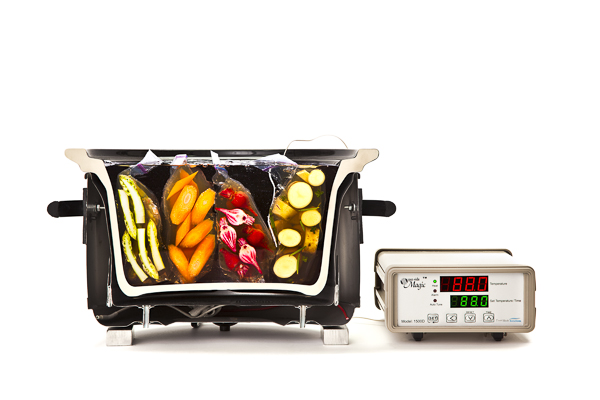
Modernist chefs have embraced sous vide cooking because of the unparalleled control it provides over the textures of cooked food. Sous vide is actually perfect for a preparation-heavy, feast-like Thanksgiving—by removing the chef as the role of human thermostat, you can yield perfectly-cooked food without any of the babysitting required by traditional roasting. Preparing dishes sous vide will also help to alleviate the competition for space (and correct temperature) in your oven on Thanksgiving Day. Make dishes like our potato puree ahead of time, and then store and reheat them in your water bath. They won’t overcook, and they’ll never dry out!
Planning a Thanksgiving dinner with the help of sous vide will require a water bath and a little organization, but those who plan ahead will be rewarded by the most delicious, stress-free family feast ever. To help you succeed, we’ve selected some professional tips, organized our recipes according to order of preparation, and included a few extra recipes that highlight our sous vide favorites. For juicy, evenly cooked meat, tender vegetables, and smooth potatoes, make all of these recipes, or just choose your favorites.

Improvising a Water Bath
If you have one or more sous vide baths, you’re ready to start cooking! But if you don’t yet have a sous vide setup (or if you want an extra), there are a few ways you can improvise. All you need is a digital thermometer.
- One of the simplest ways to improvise sous vide cooking is with a pot on the stove. Clip bags of food along with your digital thermometer to a wire cooling rack, and hang it on the rim of the pot, arranging bags carefully so that the pot isn’t overcrowded. Dial in a burner setting that maintains the desired water temperature. Keep the pot covered to retain heat, uncovering only to check on the temperature.

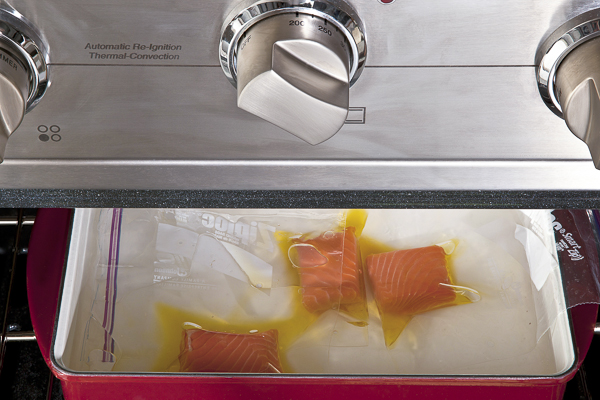
- Placing a pan filled with water into your oven will also work, but we recommend using an oven probe to be sure the temperature of your water remains stable.
- When in need, you can convert a clean kitchen sink into a water bath. Fill the basin with water that has been heated to the desired cooking temperature, adding 1–2 °C / 2–4 °F. Add bagged food to the water, refreshing it with hot water as needed. Use silverware to hold down floating bags.

- If your kitchen sink (or bathtub) is occupied, a cooler can make an excellent water bath.
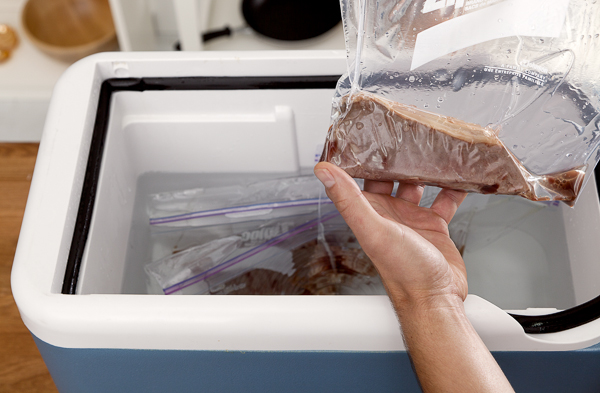
- Don’t fret if you don’t have a circulating bath. Although these baths are preferred by professional kitchens, keeping your portions in each bag small and well separated will help convective currents flow around them easily.
- Our last suggestion doubles as a party trick: believe it or not, a hot tub will work as a (giant) water bath (but only if you’re lightly cooking salmon). If only we had a photo.
Prep
Now that your water bath(s) are all ready to go, it’s time to start cooking sous vide.

1. Start your preparation by making the potato puree. This can be made two days ahead of time and then reheated just before you’re ready to serve your meal. This is not your standard mashed potatoes recipe—instead, you’ll produce velvety-smooth potatoes without a hint of gumminess or grit! Dairy-free? We also have you covered.

2. Don’t save dessert for last when it comes to sous vide. Make our Vanilla-Cinnamon Cream Pie two days ahead of time and refrigerate it. The brown butter crust and apple foam add a seasonal twist to this Modernist favorite.


3. Next, it’s time for vegetables. Chop seasonal vegetables as desired and then vacuum seal them separately. All of your vegetables can cook at the same temperature (see table), and bagging them separately will allow you to pull individual bags from your water bath when they reach the desired tenderness. Make sure you don’t overcrowd your tank; leave enough room for the water to circulate. Prior to serving your food, reheat it and dress it with our Modernist Vinaigrette.
If you prefer the traditional aesthetic of roasted veggies, feel free to make those ahead of time; then seal them in a bag with a little butter or olive oil. An hour or so before you’re ready to eat, pop the bag in your sous vide bath and your veggies will stay at a perfect serving temperature.

4. Classical approaches to roasting a bird whole can compromise your results: perfectly cooked breasts hide the undercooked dark meat of the thighs or else swap flavorful dark meat for dry, overcooked white meat. A Modernist approach is to cook each part of the bird separately. We devoted an entire chapter in Modernist Cuisine at Home to the art of roasting chicken and poultry. For Thanksgiving, we suggest a confit for the dark meat and sous vide turkey breast. Try out these recipes on the Modernist Cuisine at Home eBook on Inkling.com for just $4.99. Top your turkey with your favorite gravy recipe or dip bites into our recipe for Cranberry-Apple Sauce.

5. Infuse your meal with some family favorites—these might be the best dishes to pair with your sous vide creations.
On Thanksgiving Day, heat your water bath to a serving temperature that’s still below the lowest cooking temperature of the foods you’ll load into it—in this case, 55 °C / 131 °F. Then add your prebagged foods at least two hours before you plan to eat. That’ll give everything enough time to get nice and warm. If your guests arrive late—not to worry—your food won’t suffer at all because of the delay.

We’re very thankful for sous vide Thanksgiving. Very thankful, indeed!


Ask a Cicerone: Your Favorite Pumpkin Beer
Timmy the ToothA cicerone and a pumpkin beer walk into a bar...
GET THE FUCK OUT OF HERE.
Editor's Note: Ask a what? A Certified Cicerone®. That is, a beer expert who has passed a particular certification exam administered by the Craft Beer Institute. You can think of them as beer sommeliers: these folks have demonstrated significant beer knowledge and tasting skill, as well as professional skills in beer sales and service.

Joshua A. Cass of 821 Cafe in Richmond, VA
Whether you're stocking up for a Halloween party or just looking for the perfect fall beer to pair with chili, you're likely to see quite a few pumpkin beers on the shelves of your local bottle shop. Which are the best of the bunch? We asked our group of experts to share their favorites. Here's what they had to say...
"My perennial favorite is Weyerbacher's Imperial Pumpkin. It walks a tightrope between pumpkin spice and warm malt characteristics like a deft acrobat, and though high in alcohol, remains superbly drinkable. One of my new favorites is Hardywood Park's Farmhouse Pumpkin. The touch of wild yeast character with its subtle herbal notes is nothing short of bewitching."—Joshua A. Cass (821 Cafe)
"While there are many interpretations of the pumpkin beer style, one stands out to me as the quintessential pumpkin pie in a bottle, and that's Southern Tier Pumking."—Rob Hill (Total Wine & More)
"Luckily for me I live in St. Louis, MO, where Schlafly brews what is widely considered one of the very best pumpkin ales. They do an amazing job of balancing the delicious vegetal flavor of real pumpkin flesh with the spices common in pumpkin pie such as clove, nutmeg, and cinnamon. Toasty caramel sweetness in the grain bill closely approximates a graham cracker crust giving this brew an authentic homemade, never artificial pumpkin pie flavor. I save a six pack every year for Thanksgiving Day and enjoy one with the meal. I also find that it goes amazingly well with another St. Louis favorite, Gooey Butter Cake."—Chris Kline (Schnuck Markets)

James Tai of Pinch in Yonkers
"Many people tend to associate pumpkin with nutmeg, cinnamon, and cloves, but actually don't understand that the gourd itself is a lot more savory. When we think of 'pumpkin beer', what we're really thinking of is 'pumpkin pie beer'. That said, the fine folks over at Yonkers Brewing have recently put out a 'Spiced Harvest' beer utilizing pumpkin, but instead choosing to spice with Szechuan peppercorns and ginger. This lends a completely different perspective to this type of seasonal offering. I like having it with some gamy meats, particularly lamb, as it gives complexity to its sweetness while simultaneously balancing out its richness through the drier aspects of the beer."—James Tai (Pinch)
"This is a question that I struggle with every time a customer asks this in my store. I don't really care for pumpkin flavored beers. This year, however, there has been one that I can recommend when asked this question: Pumpkick from New Belgium. This beer takes a 'Thanksgiving dinner' approach to their beer. Instead of being solely based on pumpkin, this beer also has cranberry to add a hint of tartness and make this beer a little more rounded. The thing that I like about this beer is that the pumpkin is in the brew, but not overbearing in nature like so many of the other more traditional pumpkin beers. It would lend itself wonderfully to the traditional meal of turkey and all the fixings."—Brian Hoppe (Hy-Vee)
"The best two pumpkin beers I've had are Mr. Yuck and Yuck, Yuck, Geuze (A blend of multiple years of Mr. Yuck) by Elysian Brewing. They're phenomenal Pumpkin sours. However, they're only available at Elysian's Great Pumpkin Beer Festival and their pubs."—Christopher Barnes (Columbia Distributing)

Judy Neff of Pints and Plates in Baltimore
"Evolution Jaques au Lantern. What makes this beer unique is that they not only add pumpkin and pumpkin pie spices, but then ferment with Belgian yeast. The yeast gives it a roundness and extra level of pepperiness, dark fruit and brown sugar complexity that brings all of the flavors together. A pork loin roasted with garlic, juniper berries and cloves, brushed with a honey glaze and served over a walnut pumpkin puree is a fantastic pairing with the beer."—Judy Neff (Pints & Plates)
"Recently feel in love with 21st Amendment's pumpkin tripel from the He said He said collab with Elysian Brewery. It tastes and smells like fresh cut pumpkin—with most 'pumpkin' beers tasting like spice ales, it was a nice change of pace."—Trevor Sutherland (Heidelberg Distributing)
"Best pumpkin beer I've ever had was Cambridge Brewing Company, The Great Pumpkin Ale. It's something I would always seek out in Boston in the fall. It has the perfect blend of all the flavors of a pumpkin beer without being heavy handed. In comparison to many pumpkin beers out there the malts are on par with the spices creating a beer with a hint of pumpkin pie not pumpkin pie with a hint of beer."—Matt McComish (Whole Foods Market)

Valerie Smith of Ecliptic Brewing in Oregon
"My favorite this season is Elysian's Night Owl. It's a relatively light bodied pumpkin ale with flavored with pumpkin pie spices and you can drink more than one without being overwhelmed by alcohol or flavor. I love to pair with Mexican foods, which seasonally use pumpkins and cinnamon spices. The earthy sweetness from hot corn tortilla pairs will the earthy pumpkin beer. Try Night Owl or your spiced ale with spicy black bean tacos topped with onion, tomato, avocado, corn, and sour cream. The savory spices from the beer enhances the chili spices and actually makes the pumpkin flavor pop."—Valerie Smith (Ecliptic Brewing)
"My favorite is at the Indie Alehouse in Toronto—they make a Pumpkin Abbey beer using a spicy Belgian yeast, pumpkin prepared three-ways and (the key!) blending it with their stout for a drier, roasty finish and a slimmed-down easy-drinking flavor despite the 10 percent ABV. "—Crystal Luxmore (beer writer)
"Alaskan Pumpkin Porter. When I first tried this beer with some friends, some one said it taste's like Rolos candy. Some of my favorite fall spices are dominant in this beer: cinnamon, nutmeg, brown sugar, brown sugar, brown sugar, and of course pumpkin. Dive deeper into this porter and you'll pick up subtle smokiness from the malts. I like a complementary pairing with pumpkin beers, so the best pairing here is mom's pumpkin pie."—Bryan Rounds (Central Coast Distributing)
"Southern Tier Pumpking. Some pumpkin beers can have next to no pumpkin flavor, or aren't even brewed with pumpkin at all. Pumpking has pumpkin flavor in spades and has a solid enough background to let you know you're still drinking a beer. It's strong and spicy, perfect for a chilly Fall night. I've served it on tasting menus paired with seared foie gras, spiced pumpkin puree, maple pickled apples, and crumbled pie crust. It was fantastic."—Jesse Vallins (The Saint)
More Beer Experts, More Beer Answers
The Best Beers to Drink with Burgers
What's Your Favorite Session Beer?
What's The Weirdest Beer You've Tried?
How Far Have You Gone For Beer?
The Problems With Cinnabon's New Salted Caramel Center of the Roll Start With the Name
Timmy the ToothJust get a fork and dig into your cup of shame, that's not caramel, that shame jism at the bottom.

Cinnabon is jumping onto the sweet-meets-savory bandwagon by adding salted caramel onto a new limited-time-only treat. For those who haven't been to a mall food court in a while, the chain already features an item called the Center of the Roll. It's essentially the inner mass of a standard Cinnabon, cut into bite-sized pieces, served in a cup, to be eaten with a fork.*

*Why this is necessary to begin with is a little unclear to me. According to Cinnabon, it's supposedly more portable than a regular bun. I guess. Maybe. But that name! Good heavens, how tongue-tyingly awkward is that? "Center of the Roll" is the best a team of marketing professionals could come up with?!? Middles. Cinnacenters. Hell, even Centerbons. To this English major, as soon as you start throwing a prepositional phrase into the product name, it's already way more trouble than it's worth.

You could already opt for a Center of the Roll in either the regular Cinnabon or Caramel Pecanbon variety, but this fall you can also get your bun-bites covered in salted caramel sauce. As a rule, salted caramel is kind of a sophisticated sweet. It suggests a flavor profile a bit more refined, a bit more elegant than just overloading a dessert with straight sugar nine ways to Sunday.
I wish I could say that the new Salted Caramel Center of the Roll flavor is a complex revelation that reinvents the brand... and maybe makes a trip to the Cinnabon line feel a little less like signing up for an immediate sugar-induced coma. (For a brutally funny—and slightly NSFW—riff on this theme, check out Louis CK's brilliant comedy routine.)
But the truth is, my Salted Caramel CotR ($2.99 at my local shop) tasted exactly like an ordinary Cinnabon. While I could maybesortakinda see some shade of caramel-colored topping drizzled over the doughy chunks, there was not at all a pronounced caramel taste—at least not one that stood out above the standard Cinnabon flavor assault. And I could neither see nor detect any saltiness whatsoever. In fact, after a few bites, I actually came to the conclusion that I was misheard at the register and given a regular Center of the Roll.
So I went back. ('Cos I am nothing if not thorough. And because "I have to go to eat at Cinnabon...for work" is just damn fun to say.)
This time, I made sure to specify "salted caramel" and watched to see what happened. A pre-assembled cup was pulled from under the sneeze guard and unceremoniously plopped in an undercounter microwave. No extra goo, no pre- or post-nuking squirts of sauce, no hand-grinding of any salt.

And no change in taste. A little digging uncovered a puddle of caramel sauce at the bottom of the cup, but that runoff didn't do a thing for the bites I'd already eaten. If I had been blindfolded, I would have told you I was eating a Cinnabon. "Yes, but is it a special FLAVOR of Cinnabon?" you would ask. And I would say no... just before I slipped into a sugar-induced coma.
Let's be clear: there are days when that is precisely what I'm after. But Cinnabon Version 1.0 gets the job done just fine all by itself. I don't need my bun cut into bite-sized pieces for me, and I don't need it gussied up with a swanky-sounding flavor that's not really there.
About the Author: Todd Brock lives the glamorous life of a stay-at-home freelance writer in the suburbs of Atlanta. Besides being paid to eat cheeseburgers for AHT, pizzas for Slice, and desserts for Sweets, he's written and produced over 1,000 hours of television and penned Building Chicken Coops for Dummies. When he grows up, he wants to be either the starting quarterback for the Dallas Cowboys or the drummer for The Gaslight Anthem. Or both.