Shared posts

03 Oct 19:57

First Impressions: Honey Butter Fried Chicken

by Joe Roy
Slideshow

VIEW SLIDESHOW: First Impressions: Honey Butter Fried Chicken

[Photographs: Joe Roy]

Say you want to open a restaurant. How do you make sure you have enough customers when you open the doors to prevent closing them after a few months? One way is to build up hype for the concept based on the success of your previous ventures (hello, Parson's). Another is to build up hype the old fashioned way: by rolling up your sleeves and slinging a dish so good that word of mouth spreads like wildfire, the demand elevating from a loyal clamor to a dedicated roar.

In opening Honey Butter Fried Chicken, Josh Kulp and Christine Cikowski of the Sunday Dinner Club chose the second route. According to Josh, the brick and mortar spot in Avondale is about 10 years in the making, when the Dinner Club transformed from a side project to this pair's full time job. These "referral-only" dinners, each centered around a theme, have garnered a cult following: With barely any prodding, the woman in front of me in line couldn't stop gushing about them: "they won't serve you anything bad." And boy, is she right.

First, the chicken. It's good. Really, really good. Josh has always been averse to fried bird, so when they decided to include it in a Sunday Dinner Club menu a few years back, he wanted to make sure it packed more than a greasy crunch. A spice laden buttermilk brine ensured it was plenty flavorful, while a healthy shake of smoked Hungarian paprika post-fry added enough complexity to appease his palate.

The honey butter side of the equation involves a dubious origin story that I am duty bound as a food writer to promulgate forward: one fateful night, during staff meal, a hapless cook accidentally dropped a morsel of fried chicken into the butter vat. Not wanting it to go to waste, he fished it out, and before they knew it, the rest of the cooks were shamelessly dipping their chicken in butter, too. True or not, it's a damn good story, and as good an explanation as any for why butter dipped chicken has now become a thing.

The rest of the menu is solid as well. The creamy slaw is enhanced with kale and dried pomegranate seeds. The mac & cheese is of the pimento variety. Still, the food is not so much pushing the envelope as nudging it along, and it never veers too far from the familiar. This is accessible food, prepared well, and served by an ever-smiling, far from pretentious, staff. I could get used to this sort of treatment.

Honey Butter Fried Chicken Exterior

It's too early for a full blown review, but at first blush, I like what I see at Honey Butter Fried Chicken. Click through the slide show to see how specific dishes stacked up, but as long as your order includes fried chicken in some capacity, you'll leave happy.

03 Oct 17:24

Chicago Restaurant Kuma's Corner Has Burger With Communion Wafer, Red Wine Reduction

by Chuck Sudo
Chicago Restaurant Kuma's Corner Has Burger With Communion Wafer, Red Wine Reduction The communion wafer topping the burger and the symbology of that and the red wine reduction as the body and blood of Christ have some people upset that Kuma’s is being sacrilegious, as if serving someone 10 ounces of ground beef isn’t sinful enough. [ more › ]


24 Sep 19:06

Smoky Chipotle in Adobo from 'Mastering Fermentation'

by Kate Williams
Timmy the Tooth

Another interesting recipe. I hate buying canned chipotles because I use like just one for chili or something.

092413-267147-cook-the-book-homemade-fermented-chipotles-in-adobo-with-braised-pork.jpg

This spicy, smoky condiment is especially good when used to flavor braised pork shoulder. [Photograph: Ed Anderson]

Chipotles in adobo are one of those pantry staples that I always have around the house, but it never would have crossed my mind to make them myself. I definitely wouldn't have thought to ferment them. Mary Karlin's recipe in Mastering Fermentation does just that. Letting the adobo mixture ferment overnight helps to mellow the bite from the chiles and adds an enigmatic tang to the sauce not present in the store-bought product. The whole process is fairly involved, but you can cut down on the work a bit by using dried chipotles (rehydrate them before blending) instead of smoking your own peppers.

Why I picked this recipe: I use chipotles in adobo in a lot of my cooking, so it was about time I made a batch myself.

What worked: The complexity of the fermented adobo sauce here can't be beat. If it weren't so spicy, I would eat it with a spoon.

What didn't: My blender really struggled with this thick sauce. Next time, I'll use a food processor.

Suggested tweaks: If you're going to use dried chiles, it is easier to remove the stems and seeds before re-constituting them in hot water. You'll want to reserve some of this liquid to mix into the adobo sauce in the blender. Once you've made the chipotles, you can use them to braise pork (as Karlin demonstrates in the photo), in chili, or to liven up simple sautéed vegetables.

As always with our Cook the Book feature, we have five (5) copies of Mastering Fermentation to give away this week.

About the author: Kate Williams is a freelance writer and personal chef living in Berkeley, CA. She is a contributor to The Oxford American, KQED's Bay Area BitesBerkeleyside NOSH. Follow her @KateHWiliams.

Get the Recipe!
24 Sep 18:27

The Food Lab: How to Make Parisian Gnocchi

by J. Kenji López-Alt
Timmy the Tooth

Also looks fantastic.

Slideshow

VIEW SLIDESHOW: The Food Lab: How to Make Parisian Gnocchi

[Photographs: J. Kenji Lopez-Alt]

It's time for another round of The Food Lab. Got a suggestion for an upcoming topic? Email Kenji here, and he'll do his best to answer your queries in a future post. Become a fan of The Food Lab on Facebook or follow it on Twitter for play-by-plays on future kitchen tests and recipe experiments.

We've all met gnocchi before. Those potato-based pasta pillows that at their best are light and bouncy, though more often then not come off as leaden and heavy. Well, those gnocchi are another story for another time. Today we're hear to talk about their even pillowier, and—most importantly—far easier-to-make cousins, gnocchi à la Parisienne. If you ask me, they're tastier, as well.

I often talk about how learning the basic techniques behind good cooking is far more important than mastering a specific recipe. I can't think of a better example than learning how to make a good pâte à choux. Once you've mastered the basics of the French-style hot water, flour, and egg-based dough, you've got the chops to pull off countless recipes. You can pipe decorative logs and fill them with pastry cream to make eclairs. You can sandwich dollops of chantilly or ice cream in it to make cream puffs or profiteroles. You can deep fry it into light and puffy beignets, or mix it with herbs and cheese to be baked into savory gougères.

Or, you can do them my favorite way: gently simmered, then fried or broiled until crisp and golden brown with a light, airy center.

Here's how to make 'em.

Gnocchi Basics

While the ratios of ingredients differ, the process of making Parisian gnocchi is identical, no matter who you ask. First, boil water and butter in a saucepan, then dump in flour all at once and stir it vigorously with a wooden spoon until a smooth ball of dough forms.

20130827-gnocchi-parisian-souffle-03.jpg

After the dough comes together in a ball and begins to gently steam (an indication that the flour in it is fully hydrated and cooked), finish by adding eggs one at a time and beating that dough like your life depends on it, in order to incorporate that egg without letting it curdle. I've lost more than one long-term companion to the wooden spoon gods performing this action.

20130827-gnocchi-parisian-souffle-07.jpg

You end up with a sticky, paste-like dough that holds itself together just well enough to be piped from a piping bag (or a zipper-lock bag with the corner removed).

That's your pâte à choux dough right there, and, from this point, its final form depends on how you complete it—baking and frying are common, but in the case of Parisian gnocchi, poaching in simmering water is the way to go. You pipe the gnocchi out and cut them with a sharp knife directly into the water a few at a time, then let them poach until they float to the surface for a few moments before fishing them out.

20130827-gnocchi-parisian-souffle-37.jpg

Finally, the poached gnocchi can be eaten either as-is, or finished by frying or broiling to crisp up their exteriors.

But before we get there, let's talk a bit about how hot water doughs work.

Some Like it Hot

Parisian gnocchi are somewhat of an oddity in the Western repertoire, in that they're made with a hot water dough—much like Chinese-style dumpling or stretched noodle dough. With most Western breads and pastries, cold or room temperature liquid is added to flour before kneading it.

There are two kinked proteins in flour, glutenin, and gliadin. Get them lubricated and rub them around enough through mechanical action (like kneading), and they tend to stretch out and bind with each other, forming the stretchy protein matrix known as gluten.

Gluten is what gives dough structure, and the more it's kneaded and worked, the tighter and more elastic it becomes. A ball of well-kneaded cold water dough will spring back if you press it and contract if you stretch it. This is why, for example, pizza dough is extremely hard to roll out until it's had at least a couple hours to rest and allow this gluten to relax.

20100923 windowpane 4.JPG

Stretchy gluten network. [Photograph: Donna Currie]

A hot water dough, on the other hand, works differently. By adding flour directly to boiling water, you actually end up not only denaturing the proteins, but smashing them into small pieces. Some degree of gluten can still form, but because cooked proteins aren't nearly as stretchy or clingy as raw ones, you won't get anywhere near the elasticity of a cold-water dough. Adding butter and other fats to the dough will further diminish its gluten-forming abilities. As a result, a pâte à choux dough isn't stretchy or bouncy; its more malleable and supple, kind of like Play-Do.

The beauty of a hot water dough is that, as you can see, it doesn't bounce back as much as a cold water dough does. This is important: as the gnocchi go through their primary poaching step in simmering water, water vapor and trapped gases will expand, causing the gnocchi to inflate slightly. This change in density caused by expanding gases is what causes them to gently float to the surface of the pot as they poach.

20130827-gnocchi-parisian-souffle-14.jpg

If we were to try and make gnocchi with a cold water dough, one with plenty of springy, elastic gluten, we'd have a heck of a time getting those gnocchi hot enough to expand to the point where they come out nice and airy; Instead, we'd end up with dense, chewy nubs that taste more like damp bread. With our tender, easy-to-shape hot water dough, however, the stretching is easy, and, what's more, the gnocchi keep their stretched-out shape even after they begin to cool, ensuring that they stay light and tender no matter how we choose to finish them off.

Sure Beats Beating

Remember how I said that pretty much all gnocchi recipes are identical? Well I lied a little bit. There are really two types of gnocchi recipes: those made the old school, wooden-spoon-and-elbow-grease way, and those made with the mechanical aid of a stand mixer. The latter, which I first saw in this Thomas Keller recipe is vastly easier, particularly if your beating arm is not quite in shape.

With this method, you start out the same way: beating the flour into a boiling mixture of water and butter. But from there, you transfer the dough to a stand mixer and beat the eggs in using the paddle rather than your bare hands.

20130827-gnocchi-parisian-souffle-32.jpg

Cooked side-by-side, there's absolutely no detectable difference between the wooden spoon and the stand-mixer method, provided you beat extremely vigorously. If you're even slightly lax with the hand-beating, then the stand mixer method will produce superior results every time.

This got me thinking: if the process can be simplified by using the stand mixer for the eggs, why not just do the whole thing in there? I added my flour and eggs to the mixer, then, with the mixer running, poured in the boiling water and butter mixture before discovering why it doesn't work.

Here's what I ended up with:

20130827-gnocchi-parisian-souffle-06.jpg

Turns out that just mixing the hot water with the flour isn't enough: the flour and water mixture actually needs to be cooked for a decent amount of time in order to fully hydrate the flour's starch and to develop its protein structure. Subsequently cooking the wet, batter-like dough in a saucepan produced what looked like decent pâte à choux, but simmering and frying it proved unsuccessful:

20130827-gnocchi-parisian-souffle-10.jpg

That's the light, airy, traditionally-made gnocchi on the left, and my dense, pasty, mix-it-all-together-and-sort-out-the-bodies-later attempt on the right.

Much as I'd love to be able to say, "Hey, check out this awesome new technique!," I'm afraid that in this case, tradition triumphs*

*and, unlike some other unnamed sources, I'm not going to try and crowbar in an inferior technique just for the sake of novelty.

Pipe Dreams

After the basic dough is made, I like to add a few flavorings. Parmesan cheese is a given for me, adding a savory backbone and helping the gnocchi to brown better down the line. I take another cue from Thomas Keller and add a small dollop of Dijon mustard to my dough, as well as chopped herbs.

The most difficult part of making Parisian gnocchi—and it's really not that difficult at all—is in the piping, and it's really not all that hard. It just takes a bit of practice. To do it, you transfer the dough into a piping bag or a zipper-lock bag with the corner snipped off, then let it rest for 20 minutes or so. This will let it cool down slightly while allowing any vestiges of overworked gluten to relax and any under-hydrated starch to hydrate, helping the gnocchi to puff properly as they poach.

20130827-gnocchi-parisian-souffle-12.jpg

With the tip of the bag held out over gently simmering water, you use a paring knife held in the other hand to cut off 1-inch lengths of dough, letting them drop straight into the pot. If you've got a close friend or kitchen ally, this process is a snap—one person pipes, the other person cuts.

The goal is to pipe and cut as many gnocchi as you possibly can within about a minute, so that the last gnocchi that drops in won't be too far behind the first one that entered the pool. Once they've finished cooking, you fish them out and start again with the next batch.

20130827-gnocchi-parisian-souffle-19.jpg

The first few times you do this, it may be as few as a dozen or so at a time. As you practice and your speed goes up, you should be able to pipe 30 to 40 gnocchi per minute, which greatly reduces overall prep time.

The beauty of these gnocchi is that once they're poached, you can transfer them to a rimmed baking sheet, toss them in a bit of oil, and let them cool down. At this stage, they can be transferred to a sealed container and stored in the refrigerator for up to a few days until you're ready to fry or broil them just before serving. Just as with regular pasta, this means that if you make them in advance, dinner is only 20 to 30 minutes away.

Finishing Steps

How to serve the gnocchi? One of the easiest and tastiest ways is to broil them in a cast iron skillet.

20130827-gnocchi-parisian-souffle-21.jpg

I brown just enough butter to give them a nice coating, add the gnocchi and toss to combine, then cover them in a blanket of finely grated Parmesan cheese.

20130827-gnocchi-parisian-souffle-23.jpg

After a brief stint under the broiler, they come out puffed and crisp, ready to be served straight out of their skillet. That's a big ol' taste of comfort right there.

Want to get fancier? You can fry the gnocchi in a skillet to be used as a blank palate for any number of seasonally-based pasta dishes.

20130827-gnocchi-parisian-souffle-27.jpg

Toss them with chunks of squash cooked down in brown butter with sage and a squeeze of lemon, or with charred Brussels sprout leaves and shallots in the fall. Serve them with some great canned tomatoes in the winter. Toss them with some simply blanched fresh peas and asparagus tips in the spring.

This time of year, I like to catch the last days of summer's glory by combining them with some sautéed sweet corn, zucchini, and oven-roasted tomatoes with plenty of olive oil and Parmesan.

20130827-gnocchi-parisian-souffle-31.jpg

Did I say that the toughest part of Parisian gnocchi was the technique? That's not really true. The truly tough part is settling on the best way to serve them.

Click here for a step-by-step slideshow of the process, or check below for the complete recipes.

About the author: J. Kenji Lopez-Alt is the Chief Creative Officer of Serious Eats where he likes to explore the science of home cooking in his weekly column The Food Lab. You can follow him at @thefoodlab on Twitter, or at The Food Lab on Facebook.

Recipes!

24 Sep 13:44

Arsenal legend Thierry Henry (NYRB) uses dance to mimick foul by FC Dallas defender Michel

by Arthur Antunes Coimbra
Timmy the Tooth

I love Henry

During the closing stages of the New York Red Bulls 1-0 win over FC Dallas on Sunday, Arsenal legend Thierry Henry took exception to a foul committed by Dallas defender Michel.

Michael used his backside to obstruct the Red Bulls star as he was just about to break into the visitors box, and after been dumped on the turf Henry used the power of dance to make his frustrations known.

Thierry Henry mimicked the foul he received by performing a butt-shaking dance move, twice.

Watch Thierry Henry use dance to express his feeling of discontent below.

24 Sep 13:21

Tomato Ketchup from 'Mastering Fermentation'

by Kate Williams
Timmy the Tooth

DOING THIS.

092313-267145-cook-the-book-fermented-tomato-ketchup.jpg

[Photograph: Ed Anderson]

Would you ever think of making fermented ketchup? I certainly hadn't before pickling up my copy of Mary Karlin's new cookbook, Mastering Fermentation. Yet, after pondering the history of the condiment, it makes a lot of sense. Ketchup has its roots in Southeast Asian kecap manis, which, as a sweet soy sauce-relative, is usually fermented to a certain degree. Karlin's ketchup is definitely American, though. It's a simple mixture of tomato paste, salt, Worcestershire (if you're really ballsy, you could make your own), raw honey, and a starter culture, and it only needs a couple of days to get all bacteria-fied.

Why I picked this recipe: I've made homemade ketchup before, but I've never fermented it.

What worked: This recipe was hands-down the easiest ferment I've ever made and it definitely tasted more interesting than the store-bought stuff.

What didn't: I ended up putting the ketchup in two smaller jars and let one ferment an extra 8 hours or so. I thought the extra time mellowed out the flavor of the tomato paste, and found this batch much better than the one following Karlin's suggested timeline.

Suggested tweaks: This is a bare bones recipe, so you could add just about any spice or additional seasoning you'd like. Karlin suggests red pepper flakes, cayenne, or smoked paprika. (My vote is definitely for the smoked paprika.) I used water kefir (recipe coming later this week) as a starter, but I'm sure whey from good quality store-bought yogurt would work well if you don't have any other ferments going.

As always with our Cook the Book feature, we have five (5) copies of Mastering Fermentation to give away this week.

About the author: Kate Williams is a freelance writer and personal chef living in Berkeley, CA. She is a contributor to The Oxford American, KQED's Bay Area BitesBerkeleyside NOSH. Follow her @KateHWiliams.

Get the Recipe!
20 Sep 20:23

First Look: Cocktails at Henry, a Liquor Bar in the Hudson Hotel, New York

by Jacqueline Raposo
Timmy the Tooth

Hey look! It's a time traveler from the 1920s! Quick someone grab him and ask him how he did it!

From Drinks

Slideshow

VIEW SLIDESHOW: First Look: Cocktails at Henry, a Liquor Bar in the Hudson Hotel, New York

[Photographs: Brent Herrig]

Note: First Looks give previews of new dishes, drinks, and menus we're curious about. Since they are arranged photo shoots and interviews with restaurants, we do not make critical evaluations or recommendations.

Before you get to the actual drinks on the menu at Henry, A Liquor Bar, there's a story to read, the first of a series that will continue in seasonal installments. In it a bedraggled group travels up the Hudson River and falls at the door of a Mr. Lyan, who places before them "a restorative elixir. Instantly, their senses were awoken and their spirits lifted. It was at this point they noticed a veritable cornucopia of exotic herbs, fruits, spices and flowers lying fixed in a variety of states. Mr. Lyan busied himself amongst the lab, producing exquisite concoctions and placing them in front of each of them."

Why start with a story? "We wanted to create a bit of whimsy about the new space, so that a return visit will involve the next stages," bartender Ryan Chetiyawardana explained of the newly remodeled bar in the Hudson Hotel, which premiered last week. He penned and illustrated the menu himself, hoping to bring "a bit of fun to it."

Ryan Chetiyawardana of Ryan, A Liquor Bar

Ryan Chetiyawardana

To the award-winning London-based Chetiyawardana, that story starts with the New York state produce he believes is much more impressive than anything he can get at home in the U.K. "There's a different intensity of flavors in the produce here. At home tomatoes taste like potatoes—they're firm, almost tasteless, maybe with a spiked acidity. There's variety here, with flavors unlike what I'd experienced before."

Those introductions extended to the citrus, berries, apples, and local Adirondack honey he explored through relationships the hotel's culinary staff had established with local farmers and purveyors. A sous vide circulator and rotary evaporator that were unused in the kitchen would come into use when Chetiyawardana built his menu around the ingredients he hadn't been able to play with at home.

The bar at Henry, in the Hudson Hotel

"It's not like, 'apricots are in season so we'll do a cocktail with apricots,'" Chetiyawardana said, clarifying the role local produce plays in the 12 cocktails that will rotate seasonally. "We talked a lot about being able to preserve ingredients, so that we capture the bridge of the seasons. Autumn doesn't mean we go directly into full hibernation mode—there are still moments of warmth and sunny days. So, if cherries are at the last point of the summer, we want to carry them through like a snapshot."

To do so, he preserves fresh cherries in maraschino liqueur, which he then dilutes and re-sweetens. The final product is used in various drinks; the fruit is dropped whole into the bottom of a Champagne flute for the Jasmagne, and the residual liqueur serves as the base for the Chocolate Cocktail.

No stranger to modernist kitchen equipment—Chetiyawardana studied biology, art and philosophy while shifting his culinary training from the kitchen to the bar—he'll be just as likely to use a traditional pickling method if that's what the ingredient calls for. "We use the roto-vap and sous vide methods as a means to getting a very specific flavor, so we can change the manner of how ingredients are used. We can get the brightness of celery, instead of just using it in a cooked or fresh stage. We capture ingredients that can be used different ways to sum up the feeling of each season."

Henry, A Liquor Bar, in the Hudson Hotel

Most liqueurs and distillations are done in small batches, while preserving and pickling fruits and vegetables are done in enough quantity now to get through the upcoming changes in season.

With the current, autumnal menu, "there are some drinks which are rich and warm and others that are light and bright, because to me," says Chetiyawardana, "that kind of reflects what autumn is like. Once we transition into the wintry style of menu, some ingredients might carry through that are available now, preserved in a different manner to reflect the feeling of the season."

But, he's quick to clarify, it's more about the guest's occasion and mood than the season, and his primary goal is to fit those desires. "Even if it's cold and blustery outside you might want a drink that takes you into a different place—one that's fresher, or opposite of what the weather is or feeling is outside. So we have drinks that ride that kind of lighter, fresher, style of service."

Holy Spritz ($16)

Changing the style of service was very much the focus for Chetiyawardana and the hotel team when they chose to move away from a traditional bottle service / club atmosphere to a cocktail lounge that reflects the culinary landscape around Columbus Circle. With that in mind, reservations are recommended before 10 p.m., not only to secure seating for larger parties, but also so that staff can welcome and lead guests to their tables, then introduce them to their servers in a way reflective of a fine-dining restaurant. Wednesday evenings offer live jazz, and throughout the rest of the weekend a rotating staff of DJs takes over after 10 p.m.. For the later crowd, a nod to traditional bottle service is offered with house-made pomegranate and grapefruit juices that bartenders will mix table-side, along with cocktails that can be made in batches for large groups.

Head over to the slideshow for a peek at five of the cocktails on Chetiyawardana's debut menu »

About the author: Jacqueline Raposo writes about people who make food and cooks a lot of stuff. Read more at www.WordsFoodArt.com or tweet her out at @WordsFoodArt.

20 Sep 16:48

What's Your Favorite Bourbon Cocktail?

by Maggie Hoffman
Timmy the Tooth

Bourbon.

From Drinks

Slideshow

VIEW SLIDESHOW: What's Your Favorite Bourbon Cocktail?

Since I can no longer check the weather on the East Coast by just walking outside (I moved to San Francisco about a year ago), I notice the onset of fall on Twitter. The digital whispers of sweater weather and a chill in the air are all I need to start thinking about the upcoming holidays and casting off sunny margaritas for autumn's brown spirits. First up is bourbon, that rich and luscious liquor, warmed with a bit of barrel sweetness, just the thing for an Old Fashioned.

Of course, there are other ways to drink bourbon, too...say, with ginger, cinnamon, and a little aged tequila like they do at Mayahuel, or with hard cider and maple syrup, plus a little applejack in this drink. I've mentioned my love of the Boulevardier before, so that recommendation goes without saying, but here are a few more bourbon cocktails to inspire your mixing.

What's your favorite way to drink bourbon? Got a bourbon cocktail you make each fall? Let us know in the comments below.

About the Author: Maggie Hoffman is a Senior Editor at Serious Eats, based in San Francisco. She founded Serious Eats: Drinks in 2011. You can follow her on Twitter @maggiejane.

20 Sep 16:29

Lionel Messi once intentionally humiliated Pep Guardiola in front of Barcelona team by drinking can of coke [Hans Backe, Swedish TV4]

by Paul
Timmy the Tooth

BREAKING NEWS: MESSI DRINKS COKE.

Guardiola+messi+barca+barcablog+fcbarcelona+barcelona+barca+blog+fcb+news+Guardiola+messi+barca+barcablog+fcbarcelona+barcelona+barca+blog+fcb+news Lionel Messi once intentionally humiliated Pep Guardiola in front of Barcelona team by drinking can of coke [Hans Backe, Swedish TV4]Lionel Messi’s angelic mask is falling lower and lower, as another story emerges showing his darker, and in this case downright obstreperous side, while also showing just how far Pep Guardiola went in his doctrine to ‘just keep Messi happy’.

Former New York Red Bulls coach Backe said on Swedish channel TV4′s show ‘Superlive’, that Messi once went out of his way  to humiliate coach Pep Guardiola, who then lost face in front of the whole Barcelona squad.

The anecdote he told would have happened around four years ago, in the Treble season of 2009.

These stars are not God’s best children.

“It was three hours before the match, all the players sit and eat when Messi says he wants a Coke. ’No, no, we do not drink cola three hours before a flight,’ said Guardiola. So Messi got up from his chair and comes back a few minutes later with a can of cola, which he opens and drinks right in front of Guardiola. Imagine what happens when a great profile as Messi goes against the coach in this way. It is a war that Guardiola can not win. It is impossible.”

Back admitted he had no official source for his anecdote, but laughed off any suggestion he could face libel.”Sensational? I have a bunch of lawyers behind me.”

Given that he was coach at New York Red Bulls, it’s believed his source was most likely Thierry Henry or Rafa Marquez, both ex-Barcelona players who then played under Backe in New York.

Without pictorial/video proof, it can obviously be dismissed as mere hearsay, but two things: 1)To come out and say this on TV, one would need to be pretty confident about its veracity; and 2) If it’s a porky pie, it’s a pretty offbeat and creative one.

The other thing is – isn’t Messi sponsored by Pepsi?!

17 Sep 13:36

I just wanted to say that Bee and Puppycat was boring and and uninspiring. 90% of it looked like you just copied Adventure Time and the fact you're getting to make a series when there's a million better people out there with a million better ideas is offensive. Honestly, the ONLY reason anyone takes you seriously is because you ride Pen Ward's coat tails.

Timmy the Tooth

She's pretty awesome.

Sorry you feel that way, I’ll try harder next time……

Aaaanyway… I’m assuming that you are one of the millions of other people who have better ideas than me (and if not, then you know some of them!)… and if you haven’t already heard about it, I wanted to let you know that Frederator is actually a really easy group of people to get in contact with about pitching your cartoon ideas! You can find out more about it HERE.

Good luck!

16 Sep 18:30

Ask a Sommelier: What Under-the-Radar Wine Regions Do You Love?

by The Serious Eats Team
Timmy the Tooth

Fuck you and your pocket square too.

From Drinks

20130901jasonwagnersomm.jpg

Jason Wagner of Henri and The Gage, Chicago

When picking a wine, it can be tempting to stick with what we know is good. And while there's a reason that the regions we know and love are popular, we can sometimes forget that there's a whole world of wine to explore. Lesser-known areas can offer particularly well-priced bottles, interesting back stories...and bragging rights for introducing your friends to something new and delicious.

We asked 14 sommeliers which under-the-radar wine regions deserve more love than they're getting, and which producers are worth checking out. From the close-to-home Finger Lakes in New York State to far-flung Croatia and Romania, we knew we could count on these somms for a list of recommendations.


"There are two oft-overlooked regions here in the USA that I think should get more attention. The Finger Lakes in New York produces some stunning Rieslings from producers like Hermann J Weimer and Dr. Konstantin Frank. Ravines makes a Pinot Noir that will make you weak in the knees if you love a Burgundy-style Pinot. The North Fork of Long Island (also in New York) has some beautiful, elegant whites as well. Though most producers focus on reds, like Merlot and Cabernet Franc, there are some great successes with Pinot Blanc and Sauvignon Blanc. Lieb Cellars make a Champagne-Method Pinot Blanc that is out of this world. Shinn Estate does amazing things with Sauvignon Blanc as well as other white varieties."— Jason Wagner (Henri (Chicago))The Gage (Chicago))

"I started observing the rise of exports from many former Eastern Bloc countries about 10 or 11 years ago—Slovenia and Romania for instance... Speaking on a very general basis here: back then it seemed to be more of patriotic—or maybe nostalgic—support by ex-pats. There certainly was not the internal investment (noticeable in the quality of the imports), but you could see the possibilities. I'd read the very minor sections in wine books at the time, and it was very clear as to why these areas had once been inundated with vineyards. Foreign investment has certainly become a factor, as well as some of these countries folding into the European Union, which allowed direct financial support. Slovenia was one of the first, and I think most recently, Croatia. This EU support has allowed more promotion, and while the amount of quality exports are minimal, what is there is really astonishing. What I've seen from Croatia has been really encouraging. Outside of Kozlovic on the Istrian Peninsula, I would recommend Bura Estate on the southern slopes of the Peljesac Peninsula on the Dalmatian Coast, and Enjingi, from Kutjevo. Their late harvest Zweigelt (not sweet—it's dry) is a stunner...very impressive."— Scott Cameron (Atera)

Jeremy Quinn of Telegraph in Chicago

"Some current favorites and longtime loves include the Italian regions of Liguria (where Antonio Perrino, of Testalonga in Dolceacqua, crafts tiny amounts of stellar Rossese and Vermentino) and Valle d'Aosta (where Danilo Thomain makes a fantastic Petit Rouge in the micro-appellation of Enfer d'Arvier). I'm also a big fan of the Valais in Switzerland (home to Romain Papilloud's lovely Cornalin), Seneca Lake in New York (where Fred Merwarth at Hermann J. Wiemer produces America's finest Riesling), and the Savoie in France (from whose high-pitched slopes Jean-Yves Péron
sources some of the region's best Mondeuse)." — Jeremy Quinn (Telegraph, Webster,Bluebird, target="_blank">Reno)

"I am old school, so I am not always chasing the next great thing. Of course, I am fascinated by what is happening in many up and coming regions. At the moment I am loving both white and red wines from the indigenous grapes of Corsica. I love the wines from Domaine Comte Abatucci including my favorite rose this summer made from Sciacarellu. Good varietal for a spelling bee! I am also becoming a fan of the pinot noirs from Patagonia in Argentina, particularly Bodegas Chacra. It is an amazing and unique place to grow grapes. Lastly, I have to mention Spanish wines. While not completely under the radar, I am digging the cooler climate reds from Ribeira Sacra that are not made from Mencia but some other more obscure local varieties. My recent favorite is a Merenzao from Ronsel do Sil the 'Alpendre'. Crazy acid and so much going on in the glass." — Rick Pitcher (Manzanilla)

"Savoie. Bright fresh wines from an old school region. I'm a big fan of the whites and pink sparklers."— Patrick Cappiello (Pearl & Ash)

20130901pasacalineasksomm.jpg

"Greece, and especially Santorini, is still under the radar and they
are producing some of the most interesting white wines in the world—between an incredible soil and some of the oldest vines you can find on the planet, the result is wine with a dense, acid-driven structure, and an extra-ordinary complexity; the red can
be really great too. To look for: All the Hatzidakis, including the oak-aged Nikteri. And Sigalas 100% Assyrtiko and also his red from Mavrotragano." — Pascaline Lepeltier (Rouge Tomate)

"Two wine regions that are well known, but aren't consumed nearly enough are sherry and Madeira. In my mind they continue to fly under the radar and present great value and great satisfaction. A well chilled Manzanilla with olives, anchovies or some little fried fish is one of the best ways to start off any meal (breakfast included). Bonus points if your toes are in the sand. Hildalgo's La Gitana is pretty widely available and provided me with my sherry epiphany on a trip through Jerez. As for Madeira, where else on this planet can you find a wine that is aged for decades, tastes this amazing, and relatively cheap all considering. Oh and did I mention it's virtually indestructible so you can enjoy the same bottle over an extended period of time (if that tends to be an issue). Barbeito and D'Oliveira are two great examples for the uninitiated."— Sabato Sagaria (The Little Nell Hotel)

"I'm incredibly excited about Sicily right now and have been for a few years. It's one of these areas where you have the perfect storm of unique indigenous grapes, a variety of different climates and a handful of quality conscious producers that are changing the face of the region. These factors always make for exciting wines. I love fresh and lively reds from the Frappato grape. The 2011 Tami Frappato Rosso Sicily, ($15) and 2011 Valle dell Acate Frappato, Sicily ($15) are two great examples that won't break the bank." — Brian Smith (Club W)

20130806-261265-arthur-hon.jpg

Arthur Hon of Sepia

"Franciacorta. Because it is so overshadowed by Champagne. From a quality stand point, the DOCG has a much stricter regulations than Champagne. Its possible total output is minuscule in comparison to Champagne and the price of Franciacorta is almost a third less in price comparing to similar Champagne. Why would you say no to an artisanal sparkling made exactly like Champagne (which sometimes can be much higher in quality than some of the major Champagne houses) that costs consistently less? Some of my favorite producers of Franciacorta are Ricci Curbastro, Ca'dell Cosco."— Arthur Hon (Sepia)

"To be honest, I think that California is the 'under-the-radar' region I'm most excited about right now. California is definitely not an unknown wine region, but over the past few years there has been a shift of style taking place; moving away from the overripe, overoaked style to a more refined, elegant and balanced style. There's also more experimentation going on in California with "non-traditional" grape varieties, fermentation techniques or even something as simple as the vessel in which the wines are fermented or aged. As is the case when trying new things, some experiments work and others don't. What excites me is that there are intelligent and passionate people behind these wines. I really enjoy the white wines being made from native Italian grape varieties at Massican in Napa and the Rieslings and Grüner Veltliners from Tatomer in Santa Barbara County." — Davis Smith (Acquerello)

"Liguria! These coastal whites are so delicious. Made to pair with the local seafood and pesto, they are briny and herbaceous, great values and very unique. I love them! Some producers I like are: Punta Crena, Laura Aschero, Bisson, Ottaviano Lambruschi." — Joe Campanale (dell"anima, L'Artusi, and Anfora)

The Jura

Savanna Ray of Wildwood in Portland, OR

"I love the Jura. I met a Burgundian producer once who expressed to me his extreme distaste of Jura wines because 'they are always oxidized, funky and weird.' But that is exactly why I like them. And contrary to his belief they can actually be extremely fresh and beautiful. Trousseau Noir is an amazing grape variety that has the elegance of Pinot Noir with the tannic structure of Cabernet. It is complex and beautiful. There are also oxidized wine as he said, however, they are done intentionally and are very similar to Sherry. I love the wines from Tissot and Jacques Puffeney."— Savanna Ray (Wildwood)

"I am crazy for Sicily right now. They certainly produce plenty of wine but I think many wine drinkers forget what amazing values they offer. Planeta makes a range of wines on the island and focuses on specific appellations with each label. I recommend their Cerasualo di Vittoria. I also love COS. This winery makes everything in amphora, which is an ancient way of making wine. Their Frappato is soft and silky and loaded with bright cherry fruit. It is the Pinot Noir lover's next wine.— Emily Wines, MS, (Kimpton Hotels and Restaurants )

"A few under-the-radar wines I am into right now are: Picpoul de Pinet, an indigenous variety from France's Languedoc. I love the one from Domaine Guillemarine, whose vineyards surround a lagoon where oysters are farmed; and the single-vineyard offering from Domaine Delsol is another light, fresh option. Also Bardolino, an Italian DOC located right near Valpolicella and utilizing the same basic grapes (Corvina, Rondinella, Molinara). The wines are very different styles, however, with Bardolino tending to be a little lighter in body and fresher in style. It's light, dry and uncomplicated but still has bright red fruits, subtle spice, and that beautiful Italian quality I crave. There are bad ones on the market, but one I love is from Monte del Fra. Finally, wines from Greece, a new love of mine and completely under-represented in the US! The whites are refreshing and aromatic, perfect seafood wines. Moscafilero is a favorite white varietal of mine; try the Domaine Spiropoulos "Ode Panos" sparkling moscafilero or the Domaine Skouras. For reds, a favorite is the Thymiopoulos 'Young Vines' Xinomavro from the Naoussa appellation. It's a lighter, more Gamay-like version of its older vines relative, a red you can enjoy in hot weather or with seafood."— Lara Creasy, beverage director at No. 246 , King + Duke, et. al.

Let's have another drink! Keep in the loop with our weekly newsletter.

16 Sep 18:28

The Food Lab: Miso Ramen With Crispy Shredded Pork and Burnt Garlic Sesame Oil

by J. Kenji López-Alt
Timmy the Tooth

This looks tasty. I'm trying to make my own noodles as much as possible as well. Because I'm nuts.

It's time for another round of The Food Lab. Got a suggestion for an upcoming topic? Email Kenji here, and he'll do his best to answer your queries in a future post. Become a fan of The Food Lab on Facebook or follow it on Twitter for play-by-plays on future kitchen tests and recipe experiments.

20130910-crispy-pork-miso-ramen-03-2.jpg

[Photographs: J. Kenji Lopez-Alt]

This recipe incorporates two of my own personal humble additions to the ramen universe. They're going to stick around my repertoire, and I hope you consider incorporating them into your own because—not to too my own horn—they are damn delicious.

The first is a crispy braised pork shoulder that adds texture and rich flavor to the bowl; the second is a sweet, spicy, and bitter aromatic condiment that's sort of like the CliffsNotes of the ramen world: Stir some in and even a bowl of bottom-of-the-barrel instant ramen can come out with something interesting to say. Stir it into some home-made broth and you've got a meal that you can sit down with for a deeply intellectual discussion.

Ramen Week 2013

The second is a new meat-based topping that's simultaneously crispy and juicy, with deep, rich pork flavor. It's better than any ground or shredded pork topping I've had and it's now become the default ramen topping of choice 'round here.

Here's a quick preview:

20130910-crisp-pork-miso-ramen-2-1.jpg

But first, let's talk broth.

Miso Savory

Of the three major flavoring elements used for ramen in Japan—shio (salt), shoyu (soy sauce), and miso—miso is the newest form, first appearing in the 1960's and originating in Japan's Northernmost prefecture, Hokkaido. The chilly weather up there demands a heartier bowl of soup than the thinner salt and soy-based ramens of the south, so locals took to whisking miso—fermented soy bean paste—into their lard-laden broth, creating the style known as Sapporo ramen.

The result is rich and filling with a nutty-sweet aroma and an intensely savory flavor, thanks to the plentiful glutamates and inosinates found in miso. It's the definition of umami in a bowl. In Hokkaido, it often comes topped with sweet corn and a pat of butter.

20130910-crispy-pork-miso-ramen-06.jpg

You can make miso ramen with any sort of soup base, but this version starts out identically to my tonkotsu broth, which, I'm afraid, is a project unto itself. You can doctor up some high-quality store-bought pork broth (if you can find it, Sun Noodles' pork ramen is the best brand I know), but really, there are no shortcuts to quality.

Similarly, look for high quality red miso, which has a nuttier flavor than the white, while still retaining a sweetness that is lacking in the brown-styles. As with good miso soup, the goal when making miso ramen is to heat it to just below a simmer, but not to actually bring it to a full rolling boil after whisking in the miso. A touch of soy sauce also adds saltiness while enhancing flavor.

Hearty broth demands hearty toppings, so that's what we're going for here. I use a whole $h*t-ton of sliced scallions along with some sliced wood ear mushrooms for their crunchy texture and a soft-cooked ajitsuke tamago (you can get that recipe here).

On to the new additions to the family.

The Burnt Garlic-Sesame-Chile Oil

The idea for this sauce, intended to be drizzled over a bowl of finished ramen, originated when I was ever-so-briefly in Fukuoka a couple years ago. I stopped by the original Ippudo ramen branch, where I picked up a bottle of their spicy sesame oil condiment. Thick, creamy, and oily, the stuff in that little bottle was magical, transforming pots of mediocre store-bought broth into powerful flavor bombs with its sweet-salty-savory aroma. I went through the whole thing in about a month and haven't been able to find more since.

Sesame paste goes particularly well with robust tonkotsu and miso ramens, so I vowed to come up with my own version of sesame sauce that I could keep around in my fridge.

I started by deciding to use mayu as the oil base for my sauce.

20130910-black-garlic-sesame-mayu-ramen-2.jpg

Mayu is a condiment made by cooking grated garlic in oil until it is pitch black in color, giving the oil a bitter-sweet, garlicky aroma that adds extra dimensions to soup when used sparingly. To this base, I experimented with a whole slew of different flavorings—sesame oil, tahini paste, chili bean pasts of various sorts—before coming up with my final recipe.

20130910-black-garlic-sesame-mayu-ramen-8.jpg

After cooking down the garlic, I blitz it all in blender with some sesame oil and then return it to a clean skillet. To this mixture, I add some fresh grated garlic—in order to layer that burnt garlic with a bit of a more pungent, fresh aroma—and some sliced thai bird chilies, whose bright heat I preferred to any of the fermented pastes. I heat it up just until it starts bubbling, then let it all cool down so that the flavors can infuse.

Finally, I mix in some roasted sesame seeds that I've ground to a very rough paste in a mortar and pestle, adjusting the seasoning with a hint of sugar and salt.

20130910-crisp-pork-miso-ramen-2-3.jpg

The resultant sauce is thick, creamy, and slightly oily, with a robust, noodle-clinging texture that adds flavor to every bite. It's really dreamy stuff.

The Pork

I'm particularly happy with this new topping. The idea for it came from a few different directions at once.

I do enjoy the tender shredded braised pork shoulder that you find in ramen occasionally—think David Chang's bowls at Momofuku noodle car—but often lament the fact that they're so... textureless. They're just soft, moist, mush. Tasty mush, but mush nonetheless. Wouldn't it be great if we could get some extra flavor and texture in there?

That's when I got to thinking about carnitas, the Mexican preparation of pork shoulder that's slow-cooked in fat, then shredded and crisped. It has this magical property, able to stay simultaneously moist and crisp, even when completely doused in sauce. Perhaps a similar method would work for my shredded pork ramen?

I braised off a hunk of pork shoulder, using the simmering pot of ramen broth as my base (I could stick it into the pot as the bones started cooking, then fish it out a few hours later when it was completely tender, giving me plenty of time to let it cool while the broth finished cooking).

After shredding it up by hand, I seasoned the shredded meat with a little soy sauce and mirin, then threw it into a skillet over heat.

20130910-crispy-pork-miso-ramen-01.jpg

Looking good...

20130910-crispy-pork-miso-ramen-02.jpg

And bingo. It worked like a charm, giving me deeply flavored bits of pork that dispersed throughout the bowl and clung to my noodles as I slurped them, adding flavor and texture to every bite.

20130910-crisp-pork-miso-ramen-2-2.jpg

Want to know a little secret? You don't have to simmer that pork shoulder on its own. If you happen to live near a Mexican restaurant (and who doesn't live near a Chipotle these days?), just go in, order yourself some plain carnitas with no toppings or tortillas, and bring them home. Once you get home, season them up with a bit of soy and mirin, then crisp them in a skillet just as if you'd made that shredded pork yourself.

Your instant ramen bowl will not know the difference, I guarantee it,

Now open wide and say ahhhh...

20130910-crispy-pork-miso-ramen-04.jpg

Wider... Wider... That's it...

20130910-crispy-pork-miso-ramen-05.jpg

SLURP.

About the author: J. Kenji Lopez-Alt is the Chief Creative Officer of Serious Eats where he likes to explore the science of home cooking in his weekly column The Food Lab. You can follow him at @thefoodlab on Twitter, or at The Food Lab on Facebook.

Recipes!

16 Sep 13:26

Photo

Timmy the Tooth

I think she is one of the people behind Adventure Time, this is her blog.


15 Sep 06:23

Fixed-gear bikes ain’t nuthin’ to fuck with.

Timmy the Tooth

Funny, this is pretty much how I envision anyone who likes WUTANG

14 Sep 19:17

Hipster Overdose: Seattle Sounders’ Deandre Yedlin wears outsize glasses & tuxedo in post-match interview

by Paul
Timmy the Tooth

I bet he likes sippin vodka.

This is what you call trying too hard.

With the get-up of Deandre Yedlin, you’d swear he went out and bought a ‘Hipsters for Dummies book’.

The perfectly styled hair is no problem, but the giant glasses and tux look is just taking Hipsterism too far!

12 Sep 20:44

At last, Voyager 1 slips into interstellar space

by scinews@sciencenews.org (Science News)
Timmy the Tooth

Sweet, only 190 years before it returns as VEEGER.

Solar blast data provides definitive evidence that spacecraft has cruised beyond the sun’s clutch
11 Sep 23:43

A Excerpt from the New Voice of Witness Book High Rise Stories: Voices from Chicago Public Housing. by Audrey Petty (Editor)

Timmy the Tooth

Chigacoeans


Click here to order book.

- - -

DOLORES WILSON
AGE: 83
OCCUPATION: RETIRED CITY WORKER, COMMUNITY ORGANIZER
FORMER RESIDENT OF: CABRINI-GREEN

- - -

We first meet on a sunny day in March 2011, at a coffeehouse situated about a mile north of Dolores’s new apartment in the Dearborn Homes. Dearborn Homes is a public housing complex situated at the crossroads between Bronzeville (to the south), the McCormick Place convention center (to the east), Chinatown (to the west), and the Chicago Loop (to the north). Dearborn Homes was one of the Chicago Housing Authority’s first public housing developments and remains one of the last standing—it now houses mostly senior residents. Dolores was relocated here last month after living in Cabrini-Green for the last fifty-three years, from 1958 until 2011. As we talk, Dolores is clearly distraught at the thought of her old building’s scheduled demolition. “So many of my treasures are still there,” she says. She goes on to catalog some of the valuables (family photos, trophies, clothing, books) that she had to leave behind during the hasty relocation process. Days after our conversation, 1230 N. Burling—Dolores’s former home, and one of the last public housing high rises left standing in Chicago—was demolished.

- - -

THE STERILE WARD

I was born in Chicago in 1929. Cook County Hospital, Ward 32. I think that’s the sterile ward. They had 31 and 32. If you’re born outside the ward, your baby’s un-sterile ’cause you could catch anything in the hallway.

After I got grown and got married and started having children, my mother told me the Cook County Hospital is the best hospital to go to. She said, “They have the best doctors.” And I soon found out why, because it was like a charity hospital. You’re not turned around. They can treat this, treat that, the doctors are learning all that they didn’t get in school.

I had Chichi and Debbie at Cook County Hospital. Cheryl was born at Provident. Mike and Kenny were born at home. Those were the easiest births I had, Mike and Kenny. Chichi almost died because he was breech. Feet first. If the instrument that the doctors used to turn the baby had not been there, I would have died. But it was there when they needed it. I wrote my mother a postcard, and I said on it: “I almost died!” When I got home she said, “You don’t never write nothing like that on a postcard where the mailman and everybody can read it!”

They had this nice sudsy water or some kind of solution and a swab, and they would just clean you afterwards. Couldn’t nobody get an infection or anything in there. I loved the County. I don’t know how it was after years went by. I hate that they’re tearing it down. That whole hospital—they could have made it for the homeless. They had everything: toilets, kitchen, everything. All they had to do was just get security to make sure nobody was causing any problems. Now they gonna tear down Michael Reese Hospital too,2 for some kind of high rise. Chicago is a capitalistic town, is all I gotta say. And that’s why we’re not in Cabrini anymore.

- - -

ONE OF THE FIRST FAMILIES IN CABRINI

I lived in Cabrini-Green for fifty-three years. My husband Hubert and I raised five children there. When we moved there in ’58 the oldest was eight, the youngest were two and one, and we loved Cabrini. Where we’d been living on South Side, on Sixtieth and Prairie, they were like fire traps. The buildings were just deteriorating. The placement at the private real estate office would charge us ten dollars to find an apartment, and at that time ten dollars was a lot of money. But we paid it, and everywhere they sent us were nothing but fire traps. They were no good, and some of them said they didn’t want children ’cause they throw rocks and break windows—like every child will throw rocks and break windows.

So I kept looking, and after a while I thought, Well, Altgeld Gardens and Cabrini was offered to us by the city.2 I wanted Altgeld Gardens, ’cause the complex was made up of family homes, with little front yards and backyards, but the city buses near there ran on a slow schedule, and I didn’t want to be slowed down by anything. When I was ready to go out of the house and go somewhere, I wanted a bus that was coming in the next two minutes or something. So that’s what made me ask directions all the way to Cabrini-Green. And I loved the apartment. The apartment had three bedrooms, and it was on the fourteenth floor. When I first stepped off the elevators and looked out over the railing I thought I was going to faint! I’d never been up that high. The cars below looked like little toys. I didn’t even try to look at anything. I just looked down to see how high up I was. But after a while you get to liking everything. Just like with people, I don’t care what neighborhood you’re in. I don’t care if it’s a diverse area or what, after a while you get to love and know your neighbors and everything and get along. That’s the way it was with me and that fourteenth floor.

Me and Martha Williams, who is still my very good girlfriend, we were the first two families to move into 1117 Cleveland. She was on the second floor. After they started moving more people in on the floor, you get to have neighbors and all, and in the back of my mind I’m wondering, How this heifer gonna be? And I was thinking, I don’t want to be up here fighting nobody, telling me that they smell garlic. I’m using that as an example, ’cause we did have Puerto Rican neighbors, like the Montanes, who cooked a lot of garlic. I can’t stand the smell of a lot of garlic. Makes me sick. But they were wonderful people and even though they were young, my children always wanted to go to church with the Montanes. I was so happy to know that somebody on the same floor is taking time with my children. And they had about four or five of their own. Taking them to church. And they would cry, “Mom, I want to go to church with Miss Montanes! I wanna go to church with the Montanes!” My son Michael was the main one begging to go with them. And I’d be glad. The kids went with them all the time.

- - -

THIS IS A CASTLE

Ten years later, around 1968, we moved from 1117 because my husband’s boss wanted him to be the assistant head custodian in one of the Green buildings, and that meant maintaining a whole building. My husband’s boss was moving out, and he wanted my husband to take his place. I thought that was such an honor, but the assistant heads and the heads had to live in the building that they care for. That’s why we had to move on to 1230 N. Burling. I was so mad that we had to leave our home. That’s how attached you get to people. Ooohhh, I cried the whole time! My next door neighbor, Queenie, we were like sisters, and so she and her husband and her daughters and son helped my family move with some of the guys in the neighborhood. And when I got off from working at the Water Department that day, everything was in divine order cause I’d marked on the boxes, This goes in this room, that goes in that room. Curtains were hung and everything. I was on the sixth floor and we had four bedrooms and a bath and a half. I said, “Oooh, this is a castle.” But I still was around strangers.

The move to Burling happened right after the ’68 riots, after King3 was killed. I remember my son Kenny, who was about twelve at the time, was heading out the door when the riots first started, and he said, “Mom, I’m going over to Pioneer.” That was the grocery store nearest in the neighborhood. And I said, “Going for what?” They were rioting everywhere. And the police didn’t care. They had the National Guard, but as long as you didn’t go east across Wells, you would be safe. No harm would come to you. You could tear up everything else on that side, because the Chicago Police Department didn’t care about the stores and businesses. And you know, most of the businesses didn’t come back.

And I said, “What are you going out there for?”

He said, “I’m gonna get a shopping cart.”

He wanted to join the looters.

I said, “No you’re not.”

And he said, “Everybody else is.”

I said, “You don’t do what everybody else does. You do what I tell you to do.”

- - -

WHERE’S THAT MUSIC?

After a while, my husband became head janitor. So we lived rent-free. I’m telling you, I could see myself with a home in the sky. But the more money you get, the more money you spend. But it was wonderful, you know. And everybody, they just loved our family. They really loved my husband. All he was supposed to do as head janitor was just work with a pen and paper. But he didn’t know nothing about doing no easy work. He wanted to help push and pull the garbage, and help with everything.

They called him “Old Man.” They said, “Old Man, we got this, we got this.” So they would help him push the dumpster. That building was spotless. People loved my husband, so they wouldn’t even throw anything down on the floor.

I would come home and he’d tell me about his day and I’d tell him about mine. I worked for the Water Department. It was a secretarial job in payroll, and it was nice. Office was in the Pumping Station over on Chicago and Michigan, on the Magnificent Mile. Across from the Water Tower. Then they moved us to the purification plant near Navy Pier.

When we were at 1117 Cleveland, my husband started a drum and bugle corps. And there were kids from 1117 and 1119 Cleveland, and kids from certain buildings in our area and across the street from the Green section. And they were in three or four Saint Patrick’s Day parades. And they weren’t even in full uniform ’cause they didn’t have the money for uniforms. They would practice outside on the black top or Father Sebastian would let them come to Saint Joseph Church and practice in their school’s gym. But then it at all changed after the ’68 riots.

More people moved in from other places that had been affected by the riots. We started seeing gang writings on the wall. Sniping at different buildings. Snipers were a problem for many years. These people would set up in a window of the towers and just shoot at anyone. Two police got killed.4 I remember one day, a cop car was sent to my building and someone was sniping at them from the building facing my lot. And one young girl I remember seeing, she had on a trench coat. She was really running across the lot. When she got to the building, the back of her coat had caught a whole lot of buckshot. It was a miracle she wasn’t hurt.

The Eighteenth Police District, they sent Commander Brash and Mr. Fred Rice, who passed recently, and they worked with us and they had officers patrolling in that area, so the kids in the drum and bugle corps were protected when they were coming to practice. They’d have patrols watching them coming and going. That’s how they got safe passage from Saint Joseph’s Church to our building.

My husband worked with kids for many years. He had a basketball team and a baseball team. Those teams won trophies. The drum and bugle corps got twenty-three trophies without even being in full dress. The kids played music by ear, and when they played that “Watermelon Man,” boy, people would be looking. “Oh, where’s that music coming from?” Especially in the Saint Patrick’s Day parade. People be amazed. Where’s that music?

They were called the Corsairs, my husband’s group. My son Mike, he played that timbale, that’s the three drums. Dolores, stop bragging! Okay. Can’t help bragging. And all the gals liked him. There were the flag girls and the rifle girls. You know, the ones that twirl the rifles and the girls that twirl the flag. You know, all they say is: practice makes perfect. Beautiful! They were beautiful together. So when my husband passed away in 1981, one of the guys in the corps said, “Momma Wilson, what we gotta do is have a concert every May 11.” That’s the day my husband passed. He said we were gonna have a day to celebrate—a day for my husband. But it never came through because this one’s living here, that one’s living there.

- - -

GANGS THAT DIDN’T EVEN HAVE NAMES

I was the president of our Building Council for ten years after my husband passed away, from about ’83 to ’93. That’s how I got into the Local Advisory Council and residents’ management program. Every building had a Building Council, but in the late eighties, the residents in 1230 N. Burling started taking resident management courses. We pulled together and handled everything except the electricity and plumbing. The residents had jobs—work order clerk, janitors, maintenance men, secretary, treasurer, everything. We even collected the rent. Eventually our building was rehabbed after we went into resident management. All of the blinds, all of the kitchen, the refrigeration, double-pane windows, everything was brand new. I believe 1230 N. Burling was the first building in Cabrini-Green that went into resident management. The first President Bush, Daddy Bush, named us “a model for the nation.” We met with Jack Kemp and then Henry Cisneros in Washington, D.C. And our building was incorporated in 1992.5

Back when I first got started, at my first meeting as president of the Building Council, there was a room of people—old, young, middle-aged—waiting to hear from me. I was so happy when I came in and saw all these people in there, but then I got so flustered I didn’t even know what to say. “A dah-dah-dah-dah-dap. Uh-uh-uh dip-dip-dip-dip… we’ll have a striptease next week!” I didn’t know what to say, you know, all the different ages, waiting to hear from me. People with little babies and guys in there that belonged to gangs. Everyone was giving me suggestions. We can do this with the building, we can do that with the building.

But what really took off was working with the little kids. The grown folks, the older ones, they would make their appearances at meetings for maybe a few months, but the little kids, they’re the ones that kept working with me, improving the building, picking up trash. “You better pick! Ooh, I’m going to tell Miss Wilson you threw that paper on the floor.” They’d pick up that litter and throw it in the garbage. I’d put homemade paper badges on the kids saying they’re elevator monitors, so that folks don’t get on and leave trash. I’d have two on at a time and they worked those elevator buttons. They didn’t even want to get off.

The older kids—the boys—they didn’t join gangs because they wanted to, but in the eighties, with other gangs moving into the neighborhood, this made them form gangs in response, for self-protection. Gangs that didn’t even have names. Even I wanted to carry a gun. There was so much slicing and shooting and carrying on. I said, “I’m gonna start shooting back,” but I didn’t have no gun. One lady was shot at who had a baby in the stroller. They were just sniping from that one building, I’m telling you. And 1150 and 1160 Sedgwick. One group just took over those two buildings, and guys that used to live in the building had to go along.

My very good girlfriend, she moved over there on Sedgwick, I guess ’cause she wanted a larger place, I don’t know. But that made her son, you know, when in Rome do as the Romans do. So a lot of ’em had to be a part of that gang. Now, I’m so glad to know that this guy, he’s into the Word. He sang at a funeral for a friend of ours and to hear him speak, you wouldn’t ever think he had to pick up a gun. A lot of them, they have to join—either you shoot me or I shoot you.

The way our building was, if you come out one side you had to shoot, and if you came out the other side there was another gang waiting for you. Oooh, it was terrible. August 5, 1991, my son Michael was standing in front of our church at the corner of Hobbie and Larrabee, which is Holy Family Lutheran, the same church I’ve been going to now for forty-three years. And he got shot right there, standing there. The shot came somewhere from way up high. The bullet came straight through him. He died. He must have been forty years old.

A lot of folks knew who did it, and when the detectives came, I’m trying to tell one of the detectives who did it. He’d say, “Well, it’s just hearsay, we don’t know, we don’t know.” But I know. I heard who did it. I told him, “I want you to go up there.” They wouldn’t even go, ’cause a lot of times they don’t even care. That’s what bothers me.

- - -

IN CABRINI, I’M JUST NOT AFRAID

Not too long after my son got killed, must have been in the fall of ’91, I was at a benefit dinner, something to do with my community work, and this reporter came up to me and said, “Aren’t you Ms. Wilson?” When I said that I was, he said, “Aren’t you afraid of living in Cabrini with all this shooting and stuff?” I said, “No. I even leave out at night and go to the store,” which I did. I said, “Only time I’m afraid is when I’m outside of the community. In Cabrini, I’m just not afraid.” It’s like I told my boss, “If I’m going to live somewhere all these years and be scared, I’m crazy.”

In ’93 I retired after nearly thirty years of service with the city. I got some congratulatory letters and tapes that people made for me. Janitors and clerks and everybody. Over the years on the job, so many people there wanted to ask me how I survived Cabrini. They had extreme ideas about what was happening there. I’d get to work in the morning and somebody would come up to me: “Ooh, Dolores. Did you get hurt? I read in the newspaper about this and that shooting.” I’d say, “I don’t know nothing about it.” What got to me was the reporters didn’t put down no address in their stories. Cabrini is a big neighborhood, from Halsted down to Sedgwick. But the news would just say, “It happened at Cabrini,” and a lot of times, things would happen outside of Cabrini or nearby and they still pinned it on Cabrini. So folks wouldn’t want to come up in there. Even my own brother. He would flat out refuse.

One day, I’m waiting on the bus in the dead of winter, to get to work. Waited so long I finally tried to flag a cab down. One guy stopped and said, “My boss told me not to pick up anybody in Cabrini, said if anything happen to me or this cab, my family don’t get no compensation or anything.” And then he said, “But I’m picking you up. You look like a nice lady.” I said, “I am a nice lady.” I could hardly lift my hands to shut the cab door, they were so frozen cold.

- - -

THEY MADE ME MOVE TOO FAST
TO HOLD ON TO MY MEMENTOS

My building, 1230 N. Burling, is still standing. Supposed to knock it down in just a few days. When the last family was moving out, I felt so sorry for the lady who had just moved out of one building that they tore down. Everybody in that building had to move. You know, it’s sad when you get a little age on you, you got your place the way you want it to be, and then they’re talking about how you got to move.

When they told us that we had to leave, I’m thinking, fifty-three years in Cabrini. They gave us letters letting us know how many days. I think it was maybe 120 days, and I thought, Oh, well I got time to move. But I was still surprised. I thought that they were only going to tear down the buildings that were degraded and not working. It was such a rush to do this and do that. And it was hard for me. I was eighty-two years old when I moved. I didn’t want to give up my apartment, and it was only two bedrooms. By then, I was on the eighth floor. Me and my youngest son, Kenny, we were the only ones still there, till he passed four years ago. But it was still my home and it held everything I owned since we were in 1117 Cleveland, including memories.

I had so many mementos and they made me move too fast to hold on to them. Now I cannot find my wedding pictures. I don’t have one picture of me and my husband and my parents and his parents and our wedding cake that my aunt made. She had a bakery and I cannot find that one picture. I can’t find a picture from one of our meetings with Bertha Gilkey. She was a public housing activist from St. Louis. Bush came. Daddy Bush. And he met with all the board, not all the residents. We met with...

11 Sep 20:33

Behind the Scenes: Plating the Candy Box at Glass, Berlin

by Katherine Sacks
Timmy the Tooth

Tell me that doesn't look like a pile of garbage when it's all plated.

From Sweets

Slideshow

VIEW SLIDESHOW: Behind the Scenes: Plating the Candy Box at Glass, Berlin

[Photographs: Katherine Sacks]

At his new Berlin restaurant Glass, chef Gal Ben Moshe is putting himself to the test, changing the menu every day with the ultimate goal of creating a tasting menu of iconic dishes that each tell a story. "I want eight dishes that tell a story from beginning to end," says the Tel Aviv native. "We don't do radical changes everyday, but we make small touches every day and it pushes us to be more creative and more daring."

Lucky for us, he's already nailed down the dessert, a sweet take on his childhood experience of digging through a candy bag. "It's a childhood image that I realized I had in my head, going on a picnic with my mother, and going through her bag looking for candy," he explains. The Candy Box became an expression of that memory, and Ben Moshe collaborated with the staff, asking everyone to contribute their favorite childhood flavors.

Although some of his inspirations clearly come from his impressive background—he spent time working at restaurants greats like London's Hibiscus and Chicago's Alinea, and he plates the dessert on a mat similarly to that restaurant's famous final course—Ben Moshe says the dishes at his Charlottenburg restaurant, including the dessert, are completely unique to himself. "Those experiences gave me the tools to create really what is a very personal restaurant," he says. "It would have been very similar if I had done it without having worked at those restaurants."

And although you'll see some of the classic signs of a restaurant that some might classify as ultra modern—chocolate mousse made from liquid nitrogen, flavored powders, and tweezer plating—Ben Moshe says he's trying to bring something else to Berlin. He calls it gourmet completely reinvented. "We are not a showcase of technology, not a showroom for haute cuisine," he points out. "We are just trying to give customers an experience that is something different."

Take a look at the slideshow above to see how this master chef does just that and brings his childhood Candy Box table side.

Glass
Uhlandstraße 195, 10623 (Charlottenburg); +49 (0)30 54710861 (map) http://www.glassberlin.de/


About the author:
Katherine Sacks is a Berlin-based food and travel writer eating her way through the city. Follow her adventures at katherinesacks.com or Twitter @LaVitaCucinare.

05 Sep 13:22

�-ne-Nil to the Arsenal

Timmy the Tooth

That's me!

Writing for 7amkickoff, Tim Bostelle reflects on the signing of Mesut Ozil and what it does for the Club
01 Sep 20:06

So This is a Thing: Megaburger Pizza

by Erin Jackson
Timmy the Tooth

If you need me, I'll be in my room, covered in Taramayo.

From A Hamburger Today

08282013-megaburgerpizza-japan-top.jpg

[Photograph: Little Pizza Party]

If you thought the whole pizza-meets-burger trend would end with Boston Pizza's Pizzaburger, you were wrong. Japanese pizza chain Pizza Little Party will debut the Megaburger pizza this coming Sunday.

Weighing in at 2.65 pounds, the kooky creation features two 11-inch pizzas serving as buns, with burger patties topped with cheese, ketchup, mustard, and pickle slices sandwiched in-between. According to online reports, the combined weight of the beef patties is 400 grams, or 0.88 lbs, so it's about the same as topping a small pizza with four McDonald's cheeseburgers (minus the buns), then slapping another small pizza, face down, on top of it.

The Megaburger pizza retails for ¥2,580 (about $26 USD) and is a limited-time item, available only until November 22nd.

08282013-megaburgerpizza-japan-corn.jpg

Cream corn potato pizza from Little Pizza Party. [Photograph: Little Pizza Party]

A quick look at the English version of Little Pizza Party's menu reveals that the Megaburgerpizza might not be the Kyoto-based chain's weirdest creation. That honor goes either to the creamed corn and potato pizza, or the Taramayo,with Tarako (salted cod roe) sauce, squid, asparagus, potatoes, rice cake, and mayo.

I'm not sure about you, but a few things about the Megaburgerpizza look off. For one, the pizzas in the publicity shot look a lot like those ready-made crusts you can get at the grocery store, and I just can't get past the idea of yellow mustard co-mingling with pizza sauce. What are your thoughts? Would you try it?

[via Rocketnews24.com]

About the author: Erin Jackson is a food writer and photographer who is obsessed with discovering the best eats in San Diego. You can find all of her discoveries on her San Diego food blog EJeats.com. On Twitter, she's @ErinJax

Love hamburgers? Then you'll Like AHT on Facebook! And go follow us on Twitter while you're at it!

30 Aug 20:09

Bacteria! RUN AWAY! RUN AWAY!

by Michael Ruhlman
How to clean a chicken?! Photo by Alton Brown.

“We all need to calm the fuck down!”/Quote, illustrations, and photo by Alton Brown

The NPR blog Salt started a small #chickenshitstorm Monday when Maria Godoy wrote about a Drexel University study and campaign (a campaign!) to end the dangerous practice of washing chicken in your sink at home. The story was picked up by Slate editor L.V. Anderson and spread from there. Reaching many, including television star and renowned post-it artist, Alton Brown, whose 5-post-it editorial sums up the feelings of many cooks and chefs. When I wrote to him asking to use the image here, he added a header to the email: “We all need to calm the fuck down!”

I love that about Alton.

He’s right. And he’s right to shout. This shit is getting out of hand. Why are so many people so fucking afraid of their food? Wash your chicken or don’t wash it. I don’t care. If you’re going to have sex during the roasting I would ask you to wash your hands. Other than that, your super hot oven will kill any bugs thriving on the bird (but bits of liver, glands, and bone fragments will remain; and who knows if the processor, Julia-like, dropped the bird on the processing floor and called the five-second rule—a little grit never hurt anyone, but I don’t want to eat it).

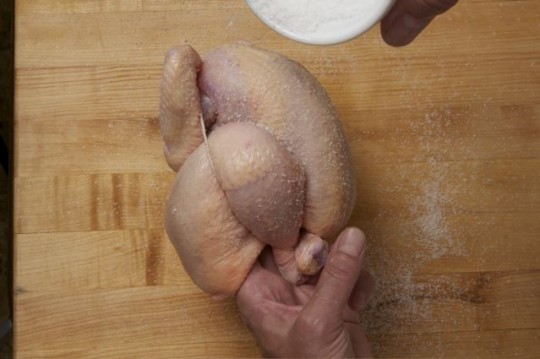
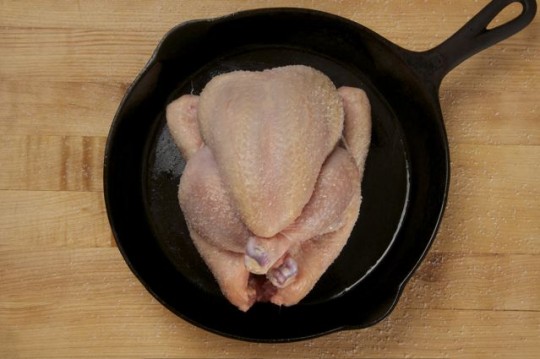
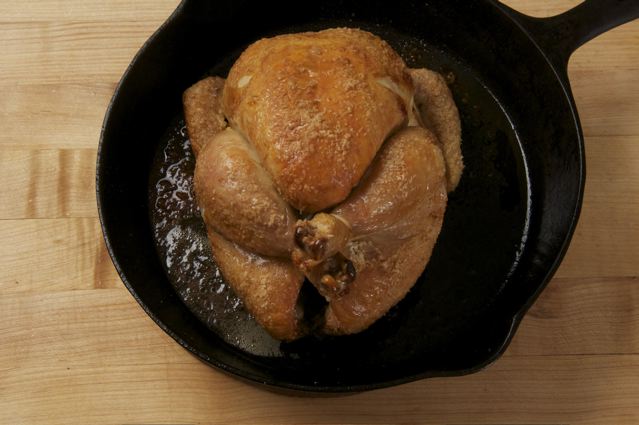
Do I wash my chicken before roasting? Usually, unless I’m in a rush. If there are fragments and stuff and viscera that I prefer not to put in my roasting pan, of course I rinse it off. I dry it. I truss it. I salt it. Then I put it in a really hot oven. Then I hope to get lucky. But I usually don’t (school night, kids).

I don’t put on an orange suit and cover the kitchen in antibacterial foam. And I don’t blow up my house, just to be sure.

What Alton is saying, and I’ll put it in my words this time, what a lot of us are saying is, “Stop being such a pussy about bacteria.” We all know they can be harmful, sometimes deadly. But I’d really like to know what the odds are for healthy people to get even a tummy ache eating food that hasn’t been processed in a plant that they cook themselves. If you’re too busy to wash your own lettuce and buy the “pre-washed” packaged stuff, that’s probably more of a risk than rinsing a chicken in your sink.

A while back the venerable Harold McGee took me to task in the NYTimes for leaving stock out on a stove “all week” because of the possibility of heat-resistant toxins growing in it. The article implied, wrongly, that I suggested it was fine to leave stock out on the stove top all week (this is the post he refers to). I don’t. (In the winter, I do do this, though I bring it daily to a simmer to kill any bacteria; summer weather is too hot and the stock sours quickly.) Just to see what would happen, I tried leaving stock out on the stovetop without simmering it, as the article had implied was my recommendation. After a day it smelled off. After two days, so bad I’d never have eaten it. After three, the smell actually made me gag. I would respond that there is indeed no danger in leaving stock on the stove top without simmering it for three days, because no one would be able to get near it, let alone eat it.

I don’t think McGee or Jennifer Quinlan, of Drexler University, are wrong. But they throw gasoline on the fire of our fears without putting the facts in context. Can you get food poisoning? Of course you can. What they don’t say is how likely you are. And that’s because there are too many variables. And every possibility, remote or likely, is a 100% possibility to a scientist.

Am I afraid of my chicken? No. Are you afraid of my chicken? Not this one, I hope. From Tea Hill Farms, washed, dried, and trussed, on the day the aforementioned articles appeared.

At rest.

A rinsed chicken should be properly salted/photos by Donna Turner Ruhlman

Please, buy good food, cook it yourself, use whatever intelligence happens to be available in that tiny head of yours. Then open a bottle of wine and eat dinner with your friends and family.

God, this shit pisses me off.

Salting the chicken.

Salting means all of the bird, and plenty of it. “Let it rain,” says Thomas Keller, on salting.

In the pan

I roast the bird in a cast iron pan at 450˚F for an hour.

BEAUTIFUL!

Let the bird FINISH COOKING for AT LEAST 15 minutes out of the oven. (It will stay hot for 45 minutes.)


If you liked this post, take a look at these links:

© 2013 Michael Ruhlman. Photo © 2013 Donna Turner Ruhlman. All rights reserved.


DiggShare

30 Aug 20:00

American Classics: Mint Chocolate Chunk Cheesecake Bars

by Alexandra Penfold
Timmy the Tooth

If you need me, I'll be in my room, covered in mint chocolate chunk cheesecake bars

From Sweets

[Photograph: Alexandra Penfold]

Die hard cheesecake fans may want to avert their eyes as what I'm about to say might be considered blasphemy: I prefer cheesecake bars to actual cheesecake. There, I said it and I'm glad.

My reasons are this:

1) I hate fussing with desserts that need to be baked in water baths
2) My true love is the cheesecake's graham cracker crust

Cheesecake bars solve both of these issues. They're super easy to prepare and that ratio of graham cracker crust to cheesecake filling is much more favorable.
While mint and chocolate might not be the first combo that comes to mind when you're envisioning a cheesecake, it's surprisingly delicious. If it works for ice cream, why not cheesecake, right? These bars take the classic mint and chocolate pairing and give it an extra bit of tang. With plenty of chocolate chips spread throughout the filling and a chocolate graham crust, this makes for a terrific dessert or late night snack for chocolate lovers.

About the author: Alexandra Penfold is mild-mannered literary agent by day, food ninja by night. Never one to skip dessert she's the Brownie half of Blondie & Brownie, a Midtown Lunch contributor, and co-author of New York à la Cart: Recipes and Stories from the Big Apple's Best Food Trucks. You can follow her on Twitter at @BlondieBrownie.

Get the Recipe!
30 Aug 13:25

This Hotel Lets You Order Pizza at the Push of a Button

by Kate Andersen
Timmy the Tooth

Other buttons I'd like to see: sex, drugs, rock and roll

From Slice

20130829-hotel-pizza-phone.jpg

The Pizza Button. [Photograph: JW Cannon]

You've just check in to your hotel after a soul-sucking flight (or train trip, or car ride), and you're starving—it's late, room service isn't an option, and the vending machine in the hall promises nothing more than a sugar crash down the line (they obviously don't have this yet). You prowl your room in hungry despair, when your eyes alight on curious salvation: a pizza button. On the phone. A button on the phone for pizza.

Thanks to pizza-wise overnighter JW Cannon (who snapped the picture of this ingenious device) and the sleuthing work of Hotel Chatter, we can take joy in assuring you that the pizza button is, indeed, real.

Well, real so long as you're staying at the Country Inn & Suites in Niagara Falls, New York. For your convenience and to free up more time for the service staff (apparently drastically overburdened with pizza inquiries), Country Inn & Suites has installed a one-click button for pizza on all of their hotel room telephones. The button connects you with a local and reputable pizza place—although which pizza place is still a mystery.

If we have any Slicer's heading to Niagara in the near future, be sure to give this a try and let us know about the experience!

About the author: Kate Andersen is a Contributing Editor for Slice.

30 Aug 12:15

Tiny human almost-brains made in lab

by scinews@sciencenews.org (Science News)
Timmy the Tooth

I know a lot of almost-brains.

Stem cells arrange themselves into a version of the most complex human organ
25 Aug 01:36

An Open Letter to Bigot Diners

by sushiwhore
Timmy the Tooth

I love Mashiko.

Dear Customers,

We are honored that you have decided to dine at Mashiko.  We know that there are many fine restaurants in Seattle, so we thank you for the opportunity to serve you.

The thing that saddens us is that some of our customers are bigots.  This letter is address to them.  To everyone else, thanks for not being a bigot.

To the bigoted diners:  We find your ignorant comments to our staff offensive.  When you then post them online, you prove to the entire world how cowardly and small you are.  Our main points of contention are as follows:

1)            We are a Japanese restaurant because we serve Japanese food.  And yes, we have Japanese ownership.  We also have several employees of Japanese descent.  But that shouldn’t matter.  By claiming that there are no Japanese people working at Mashiko, you are not only incorrect, you are also demonstrating what a racist you are.  Would you refuse service at an Irish pub if your server didn’t speak with a fanciful brogue?  You do realize that sometimes people in this great big melting pot may not have a look that accurately reflects their genetic makeup.  Do you also insist on DNA tests wherever you go?  Of course not.  Stop being an ignorant racist.

2)            Why yes, we do have a female sushi chef.  She also happens to be Caucasian.  Her name is Mariah Kmitta, and we are blessed to have her behind our sushi bar.  Mariah has been wowing customers at Mashiko for over 12 years.  She has an amazing following of devoted customers who only dine with us when Mariah is working.  If you know Hajime, you know he is one picky son of a bitch.  He entrusts Mariah because she has earned his respect.  Mariah comes to work each night eager to share exciting new textures and flavors with you.  Should you refuse her fare based on her gender or race, you are an absolute fool.

The funny thing is that our non-Japanese chefs know that they are being so overly scrutinized, and therefore they study and grow more than most chefs out there.  Trust us – we’ve had many Japanese men working here that had to be fired because they relied on their gender and race instead of making amazing food.

We are sorry to carry on like this, but this discrimination nonsense has got to stop.  Seriously.  It is ruining so many wonderful things all across the world.  Can’t we start at home by making an example that race, gender, and sexual orientation truly do not matter?

Since 1994, Mashiko has always been a non-discriminatory establishment.  All are welcome here.  So even if you don’t like our food, can’t you at least agree that we might be right about this one thing?

Regards,

Mashiko


23 Aug 20:26

A Sandwich a Day: Egg and Cheese on Challah at B & H Dairy

by Max Falkowitz

From Serious Eats: New York

In this great city of ours, one could eat a different sandwich every day of the year—so that's what we'll do. Here's A Sandwich a Day, our daily look at sandwiches around New York. Got a sandwich we should check out? Let us know. —The Mgmt.

20130821-b-h-egg-cheese-2.jpg

[Photographs: Max Falkowitz]

You can opt for one or two eggs on your egg and cheese at B & H, but there's only one choice for bread: their thick-cut fluffy homemade challah, and that's all the choice you need.

The filling here is pretty standard: eggs ($2.25 for one, $3.25 for two) and American cheese, crisped up will on the griddle with runny yolks. You may want to add a sprinkle of salt, but hey, egg and cheese is a personal thing.

20130821-b-h-egg-cheese.jpg

The slabs of challah are cooked gently on the griddle, not enough to toast up, but just so they pick up some hard-won griddle fat that makes the bread's slight sweetness come through more clearly. Even at a late dinner, the challah's pretty fresh, because matter the hour, B & H is there for you, and this sandwich is one of its simple but satisfying charms.

About the author: Max Falkowitz is the editor of Serious Eats: New York. You can follow him on Twitter at @maxfalkowitz.

23 Aug 17:05

How and why to use whom in a sentence

by Matthew Inman
Timmy the Tooth

To whom is this comic addressed? To hipsters, that's who.

How and why to use whom in a sentence

This is a grammar comic about the proper usage of who versus whom.

View
21 Aug 22:33

Crunchy Parmesan Crackers: chee-easy.

by PJ Hamel
Timmy the Tooth

Super easy home made crackers!

DSC_5092

It’s with semi-trepidation that I approach any recipe whose result is both flat, and shaped.

Oh sure, I can make chocolate chip cookies; they’re kinda flat, right?

But that’s not what I’m talking about. The recipes that really make me think twice call for a particular tool that’s been the bane of my baking existence for what feels like 100 years.

The rolling pin.

IMG_2080

Pity the poor rolling pin, object of such fear and loathing!

How many of you are just the tiniest bit hesitant about rolling pie crust? C’mon, you can admit it; we’re all friends here. As I indicated above, I’m not a happy camper when it comes to taking a disk o’ dough and turning it into a perfectly flat, perfectly even 12″ circle.

I’ve learned a lot of tricks over the years, it’s true; but there are so many potential pitfalls along the pie-way – sticky dough, dry dough, ragged edges, falling apart – it’s hard to nail each and every one perfectly, each and every time I make a pie.

Or cutout cookies. Or crackers.

Thus, when handed the winning recipe from EatingWell magazine’s Whole Grains Makeover contest – sponsored in part by King Arthur Flour and the Whole Grains Council – and asked to add it to our recipe site, I was chagrined.

Whole grain crackers? The winner couldn’t be bread or brownies or muffins or something easy, right? Had to be something requiring – gulp – a rolling pin.

So, was I ever pleasantly and totally surprised when this particular dough – made with 100% whole wheat flour – rolled out like a dream (rather than a nightmare).

Yes, there were some ragged edges to deal with (entirely my fault); but the dough itself was smooth, supple, easy to handle, and just downright cooperative.

OK, I had some other issues with these crackers (again, all my own doing, as you’ll see). But next time I make them (and there WILL be a next time – they’re super-tasty), I’ve already worked through all the kinks.

Which is why we call it the TEST kitchen. We make the mistakes, so you don’t have to!

Let’s start with one of the key ingredients in these crackers: cheese.

photo

Freshly grated Parmesan is just SO worth it, compared to the “shake cheese” in a cardboard canister you’ll find in your supermarket’s pasta aisle.

And yes, you can spend upwards of $20/lb. for “real” Parmesan. But you can also find much less expensive wedges in the store’s dairy case, or the specialty cheese area usually found adjacent to the deli.

Preheat the oven to 400°F. Get out several large baking sheets; no need to grease them.

crax1

Whisk together the following:

2 cups (8 ounces) King Arthur Unbleached White Whole Wheat Flour
1/2 teaspoon salt
a few grinds fresh black pepper, optional
1 cup (4 ounces) grated Parmesan cheese

Add 1/2 cup (8 tablespoons) cold unsalted butter, working it in until no large pieces remain; a mixer works well here.

With the mixer running (or stirring all the while), drizzle in 1/2 cup whole, 2%, or 1% milk until the dough comes together; you may not need the entire 1/2 cup.

Gather the dough into a ball, and squeeze it a few times to bring it together.

crax2

Divide the dough into three pieces. If you have a scale, they’ll weigh about 6 1/2 ounces (187g) each.

Working with one piece of dough at a time, flatten it into a rough square, and place it on a lightly floured work surface. Roll the dough 1/8″ thick; it’ll be about 10″ square (or an 11″ circle, if your rolling efforts result in a circle).

Transfer the dough to a piece of parchment or aluminum foil. Using a sharp knife, pizza cutter, or pastry wheel, cut the dough into 1″ squares; don’t separate them. You may trim the edges first, if you like, in order to separate the “good looking” crackers from the raggedy ones around the edges.

crax3

Lift the piece of parchment/crackers onto a baking sheet.

Sprinkle the crackers with coarse sea salt, additional grated cheese, and/or dried herbs, if desired.

Edit. note: The original recipe calls for sprinkling with coarse sea salt. But after tasting the crackers, we’ve made the salt an optional ingredient here; we feel the crackers are salty enough without adding more on top.

crax4

Bake the crackers for about 15 minutes, until they’re a medium golden brown. Remove them from the oven, and cool right on the pan.

As you can see, I did some experimenting with the first batch; the original recipe called for a baking time of 10 to 15 minutes. I found 15 to 16 minutes, at least in my oven, was more like it. You want to bake them until they’re crisp all the way through, without being overly browned. It’s worth it to bake and cool one pan’s worth of crackers first, to check for doneness, before baking the remainder.

So, on to the next piece of dough. Remember, there are two more – which is good, since I need the rolling and cutting practice.

What should I do differently to avoid the continent-like shape of my first rolling job?

crax5

How about shaping the dough into a flattened square before rolling?

Well, that worked OK; the result was still basically circular, but at least I avoided the ragged edges.

Still, I made a silly mistake; can anyone spot what I did?

D’OH. Rolled the dough on the silicone mat, but then cut the crackers right on the mat, rather than transferring to a piece of parchment first.

IMG_1793

Not a huge boo-boo; transferring all those little squares to the parchment/pan was a bit tricky, but a giant spatula helped.

It wasn’t completely smooth sailing yet, though.

IMG_1795

Many of the crackers puffed up into little pillows rather than lying flat. Still tasty; just a bit misshapen.

OK, I know the solution for that, too.

One more piece of dough – let’s see if I can get it all right THIS time.

crax6

Fairly straight edges; transferred to parchment before cutting; pricked each square with a fork, to prevent “pillowing.”

crax7

Not bad!

One more hint: the crackers around the edge bake faster than those in the center. This is kind of finicky but, if you like, remove the brown crackers around the edge, and put the pan back in the oven to finish baking the ones in the center.

IMG_1774

Pretty nice browning; nice shape; great flavor, and light, crunchy texture.

Some of these had a sprinkle of Parmesan added on top before baking; I really don’t think it’s necessary.

DSC_5089

They’re wonderfully cheese-y (as opposed to cheesy) even without the extra Parm.

Want to hone your rolling-pin skills, in anticipation of apple pie season? This recipe is a tasty place to start.

Please bake, rate, and review this recipe for Crunchy Parmesan Crackers, courtesy of EatingWell magazine and recipe author Pam Correll of Brockport, PA.

Print just the recipe.


21 Aug 22:23

New photos of Liverpool’s Luis Suarez in Costco with a full shopping trolley appear online

by Arthur Antunes Coimbra
Timmy the Tooth

Suarez in Costco?

Here we go again!

Several weeks after a photo of Liverpool’s Luis Suarez was spotted pushing his daughter Delfina around Tesco with a packed shopping cart went viral, more pictures of the Anfield striker doing his own shopping have hit the web.

Suarez was snapped with another full trolley on Monday as the Uruguayan bought his groceries at Costco with his wife Sofia Balbi and daughter Delfina.

Whilst the images will again lead to nonsense jokes about Suarez stocking up on goods before he leaves Liverpool, the truth is that the images represent Saurez as a rather down-to-earth guy who does his own daily chores, while the picture of him with the female fan suggest he is also personable.

See the images of Liverpool’s Luis Suarez in Costco below.

 New photos of Liverpool’s Luis Suarez in Costco with a full shopping trolley appear online New photos of Liverpool’s Luis Suarez in Costco with a full shopping trolley appear online New photos of Liverpool’s Luis Suarez in Costco with a full shopping trolley appear online New photos of Liverpool’s Luis Suarez in Costco with a full shopping trolley appear online

21 Aug 21:47

Where the Locals Eat: 5 Great Spots for Seafood in Seattle, WA

by Naomi Bishop
Timmy the Tooth

Mashiko is the best sushi in America.

20120619-seattle-postcard.jpg

Each time visitors looking for a "local" meal implore a Seattleite to tell them where the best seafood restaurant is, they're surprised to get hemming and hawing in response. The visitor just made the native as uncomfortable as if he or she were to call the Market "Pike's Place" (people, please: there is no 's').

No question, Seattle's got great seafood. But that place out-of-towners dream of, where they sit in a nautically-themed restaurant and order a simple grilled salmon entrée while gazing out over Puget Sound? It exists mainly in the tourist corridor, where fulfilling that fantasy is far more important than serving up the finest Dungeness crab, freshly-shucked oysters, over-sized geoduck, or shockingly sweet spot prawns.

The thing about great seafood in Seattle is...it's everywhere. No top-notch restaurant in town got there without executing crisp-skinned salmon or flaky fresh halibut. Anyone searching for great seafood in Seattle should simply go to whichever restaurant in town sounds the best to him or her. Excepting Dick's Drive-In, there will likely be great local seafood on the menu.

A better question to ask of a local would be, "Where do you go to eat seafood?" Here are a few places that I'd give as an answer—after annoying the heck out of everyone with the typical "my own kitchen" answer.

Sea Garden

Live Spot Prawns at Sea Garden

Live Spot Prawns at Sea Garden [Photograph: Naomi Bishop]

There are a lot of restaurants in the International District serving up shrimp and crab, but at Sea Garden, these creatures greet customers enthusiastically as they walk in. The live tanks that line the entrance of this old-school Cantonese seafood spot are consistently filled with active, extraordinarily fresh crab, spot prawns, and geoduck—and whatever else is in season.

When ordering crab in black bean sauce, diners can either pick out the crab by pointing, or give a size (over two pounds for the best meat-to-shell ratio), and a server brings it by the table for approval. Spot prawns are an un-missable local seasonal specialty, this is the place to try the stunningly-red, sweet-as-can-be sister to regular shrimp. In the salt-and-pepper prawns, they come (and should be eaten) head and tail on. You can ask for them to be subbed into any shrimp dish on the menu.

After over three decades in business, only the décor has lost any luster at Sea Garden. On any given night you'll find large families, small groups of Chinese businessmen, and tables full of hipster friends, all up to their elbows in crab shells as they request another order of the braised cod with tofu and pork.

Taylor Shellfish at Melrose Market

Geoduck Crudo at Taylor Shellfish at Melrose Market

Geoduck Crudo at Taylor Shellfish at Melrose Market [Photograph: Naomi Bishop]

Unlike the expertly-cooked Chinese dishes that the chefs turn out of Sea Garden, the counter-people at Taylor won't do a heck of a lot with shellfish after it's ordered. Put in an order for oysters or fresh-cooked crab at the counter, and expect to get just that—shucked or cracked—at a seat at one of the high bar tables. This is a simple seafood counter, but they serve their own farm's shellfish, so it's impeccably fresh. The friendly staff will talk to everyone, from oyster rookies to old-bivalve-hands, about the variety of oysters that are available, customizing a tray to fit tastes, or handing off a bowl to self-serve some of Xinh's famous oyster stew.

Visitors are wise to try the geoduck, which, if they're up on Bizarre Foods episodes, they'll know is the giant phallic clam that can take two men hours to pull from its burrow in the sand. While whole geoduck is expensive to buy whole, here eaters can sample a pile of geoduck crudo, shaved thin for the best texture, at a reasonable price.

Marination Ma Kai

Fish and Chips at Marination Ma Kai

Fish and Chips at Marination Ma Kai [Photograph: Naomi Bishop]

The rare trifecta of Seattle restaurants: waterfront, great view, and terrific food. Most of the food at this Hawaiian-Korean outlet of a taco-truck skews carnivore, but Marination Ma Kai serve up a uniquely Seattle-style fish and chips. As tempting as the Spam sliders are, there is something iconic, and somewhat fulfilling of that tourist fantasy, to have local cod, beer-battered and panko-crusted with hand-cut fries, while smelling the saltwater. Dipping the huge chunks of tender fish into the miso tartar or kimchi tartar sauces, one wonders how nobody has thought of these umami-laden combinations for livening up the blank slate of fish and chips before. Get the full experience by arriving via the King County Water Taxi (leaves right from downtown) and crossing the bay to West Seattle by boat. And don't forget a boozy shave-ice for the boat ride home.

Anchovies & Olives

Salmon with Herb Jam at Anchovies and Olives

Salmon with Herb Jam at Anchovies and Olives[Photograph: Naomi Bishop]

As mentioned earlier, there aren't that many really amazing places in the city where seafood is the declared specialty. Anchovies & Olives, though it lacks the tourist-baiting view, does not veer from its laser-like focus on serving incredible seafood. Ethan Stowell's restaurants have a well-earned reputation in town for incredibly bold, Italian-inspired flavors, fresh pasta, and Northwestern ingredients flowing out of open kitchens in simple but beautifully designed restaurants. Anchovies & Olives fits the bill perfectly, separating itself from the other half-dozen Stowell spots with its seafood-heavy options.

The menu opens with oysters, which tend to be served with ample garnish, great for those who like their oysters with some clothes on. From there, diners can choose small plates of raw, sliced fish called crudos (the buttery escolar is a crowd-pleaser), or small starters like Stowell's signature soft-cooked egg with anchovy. The pasta section doesn't stray from seafood either, offering options like uni-butter and manila clam linguini served with bottarga (cured tuna roe) and Fresno chili. The menu finishes out with a handful of cooked seafood entrées, where the seared Copper River sockeye salmon can be found on a bed of herb jam.

Mashiko

Sake Poached Oysters at Mashiko

Sake Poached Oysters at Mashiko [Photograph: Naomi Bishop]

There are whiffs of righteous snobbiness that can be associated with food movements, but Mashiko, or Sushi Whore (the restaurant's website and Twitter handle), brings light-hearted irreverence and impeccable quality to the sustainable sushi movement. When Mashiko converted to a menu of exclusively sustainable seafood, it was the first existing sushi restaurant in the country to. This means there are occasional sushi classics missing (no bluefin tuna here), but any sushi-seeker who values flavor over name-brand fish varieties is in for a treat, as Chef Hajime Sato devises incredible dishes from what's in season and sustainable. Eel is replaced with catfish, monkfish liver with sablefish liver. Rather than limit the menu, enthusiastic eaters discover new fish that were previously ignored by sushi chefs taking the traditional route. And lucky for eaters everywhere, the switch didn't eliminate oysters, which are sustainably farmed, leaving Mashiko's incredible starter—sake-poached oysters—intact.

About the author: Naomi Bishop is a Seattle based food and travel writer. Find her wandering through words and worlds on her blog, TheGastroGnome, where she claims that being a GastroGnome is not about sitting idly on the front lawn of culinary cottages. Follow her explorations of cooking and culture around the world at @GastroGnome. Get restaurant suggestions and locate local eats in the Northwest from her app, Unique Eats of the Northwest.