Shared posts

01 Oct 20:41

Reading Coaster: NYC Public Library Installs Tiny Book Delivery Trains

by Kurt
Timmy the Tooth

SO COOL

[ By WebUrbanist in Design & Fixtures & Interiors. ]

book-trains

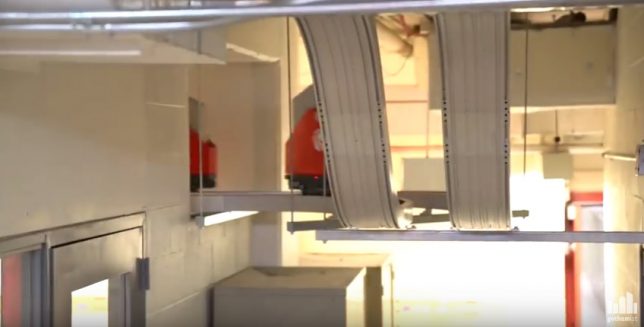
A crafty reading railroad, this conveyor system helps bring up books from a series of research stacks and storage spaces hidden beneath Bryant Park, making the volumes available via a system of miniature trains.

This particular branch of the New York Public Library in the Stephen A. Schwarzman Building houses millions of volumes, many of which are stored below the ground but now accessible at speed thanks to this new layer of internal technology.

book-train-in-motion

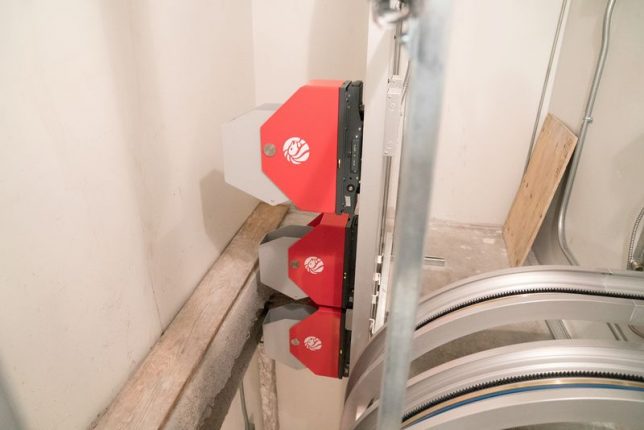
This book train system looks a bit like a tiny roller coaster and is used to transfer materials seamlessly, quickly and automatically along the vertical-and-horizontal track system, carrying requested books directly to places like the Rose Main Reading Room.

vertical-book-delivery

Each cart (of which there are 24) can hold 30 pounds of reading materials and can climb 11 stories within the building to service various floors.

reading-room-library-train

A pivot joint between the book-carrying basket and the main body of the cart allows the former to remain upright without spilling its contents while the latter tilts up to 90 degrees, carrying books straight up between levels.

Big Free Library: Public Pavilion Built of 50,000 Stacked Books

Stacked books form the structural columns of this remarkable structure while support beams in between serve as shelves for even more volumes that can be borrowed, all scanned and donated by the ...

Book City: Retail Space for Reading Mimics the Look of Urban Spaces

The appearance of the city outside - complete with crosswalks and grids resembling aerial views of urban blocks - acts as a transition space between the entrance of a bookstore and the quiet, ...

Book Mountain: MVRDV Designs Glass Pyramid Library

Reading enthusiasts in Spijkenisse, the Netherlands can climb spiraling towers of terraced bookcases beneath a shimmering glass pyramid to find new printed treasures. Architecture firm MVRDV has ...

Share on Facebook

[ By WebUrbanist in Design & Fixtures & Interiors. ]

[ WebUrbanist | Archives | Galleries | Privacy | TOS ]


30 Sep 21:45

Club announces latest financial results

Club announces latest financial results
29 Sep 22:27

After the NCAA (and later the ACC) announced that all...


After the NCAA (and later the ACC) announced that all college/university championships that would normally take place in North Carolina would be relocated due to House Bill 2, the anti-LGBTQ piece of legislation, this is the North Carolina Republican Party’s response.

29 Sep 20:32

World’s First Non-Rectangular Soccer Fields Activate Asymmetrical Spaces

by Kurt
Timmy the Tooth

I have dreams of playing on fields that are oddly shaped or go up and down hills!

[ By WebUrbanist in Architecture & Cities & Urbanism. ]

assymmetrical-soccer-field

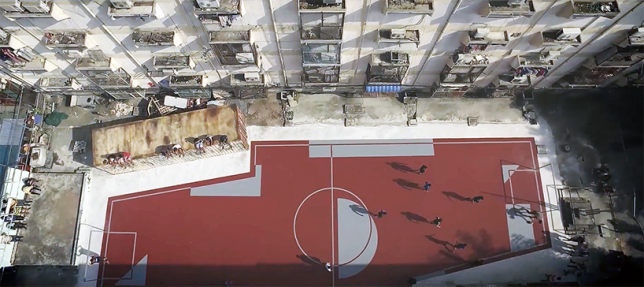
Turning disused spaces in Bangkok into odd-shaped soccer (or: football) fields, this project provides much-needed places to play in dense cities where conventional lots are hard to find. It also serves as a potential model for creatively rethinking leftover urban land more broadly.

non-rectangular-football-field

Developed in partnership with the Khlong Toei community, The Unusual Football Field project takes advantaged of abnormally shaped sites scattered around the district. Once areas of opportunity were identified and sides outlined, permission was sought, trash was cleared, land was leveled and fields were fit into each location.

non-conventional-field-shape

Kids who might not otherwise have access to normal 105-by-68-meter fields can kick balls around these unusual courts, overcoming (or working with) the unique challenges of each variant. Sides can of course be switched mid-game as well to make sure things stay fair even on fields where one half could be seen as having an advantage.

shaped-soccer-playing-fields

Developed by AP Thailand, these creative fields represents an outside-the-box approach to working with urban density, rethinking possibilities and opportunities for irregular land configurations.

These soccer-playing zones may be unconventional but are nonetheless popular, catering as they do to Thailand’s most popular sport. On the flip side, they can also be re-purposed again with equal ease if demand shifts.

adaptied-fields-design

The hope, in part, is that other developers and community activists might see potential in this model, adapting it to other dense cities where large regular spaces are hard to come by. Indeed, other sports and athletic activities could adopt similar models as well – though given the tight confines a baseball-oriented version may be out of the question.

PlantLab: Urban Farms 40 Times More Productive than Open Fields

A Dutch firm on the cutting edge of indoor agriculture estimates that producing food for the entire world could take place in a space far smaller than the area occupied by Holland, using just ...

Sporting Colors: 10 Crazy Colorful Football Fields

Want some artificial color with your synthetic stadium turf? Be careful what you wish for: Turf the color of surf is now a reality at many U.S. schools and the possibilities are mind-boggling... or ...

Desert Cities: Modular Nodal Network Idea for the Middle East

A combination of contemporary regionalism and sustainable urbanism, this design strategy proposed by an Italian architecture firm involves a series of modules for living, working and ...

Share on Facebook

[ By WebUrbanist in Architecture & Cities & Urbanism. ]

[ WebUrbanist | Archives | Galleries | Privacy | TOS ]


28 Sep 19:41

Ten Signs You Might Be a Libertarian

by Caitlin Pierce
Gary Johnson

Libertarian Party candidate Gary Johnson thinks most Americans would identify with his party if they only knew their political stances on the issues. (Photo: Scott Olson)

Season 6, Episode 3

Gary Johnson, the Libertarian Party’s presidential candidate, likes to say that most Americans are libertarians but don’t know it yet. So why can’t Libertarians (and other third parties) gain more political traction?

To find out more, check out the podcast from which this hour was drawn: “Ten Signs You Might Be a Libertarian.”


You can subscribe to the Freakonomics Radio podcast at iTunes or elsewhere, or get the RSS feed.

The post Ten Signs You Might Be a Libertarian appeared first on Freakonomics.

19 Sep 23:21

Joey Barton: ‘If someone is looking for conflict I won’t shy away from it – ever’ | Donald McRae

by Donald McRae
Timmy the Tooth

He's such an unredeemable asshole.

A pantomime villain again – at Rangers – the midfielder says ‘some of my issues are because I care, I am trying to offer solutions and people are hit with the truth’

After a week in which he has been reported as missing, banished from his club and smeared all over the internet in another overheated football story, Joey Barton should look miserable. He has also just written a book in which he confronts his brutal past with an unflinching gaze. Over the years Barton has been imprisoned, banned, deported and mocked for his attempts to educate and improve himself.

The latest vortex unfurls in Glasgow where Barton, surprisingly, is calm and amiable. But he retains his old verbal swagger. “The tallest trees catch the most wind,” he says with a little smile. “That comes with the territory of being me.”

Continue reading...
19 Sep 13:55

Step Aside, McRib Sandwich: The Food Lab's Ribby McRibface Just Stole Your Glory

by J. Kenji López-Alt

McDonald's McRib is the rarely available pork-and-barbecue-sauce sandwich with a cultlike following. My goal? Take everything we love about the McRib and turn it up to 11, by starting from scratch with a few high-quality ingredients and a lot of good technique. It's a project, but it is oh-so-worth it. Read More
17 Sep 03:02

The Secret To Tracking And Mapping Bears

by Jody Avirgan
Timmy the Tooth

Today in Bear Stats.


Subscribe: iTunes |ESPN App |Download |RSS |New to podcasts?

A bear-proof garbage can is a pretty simple device. It’s sturdy, it’s metal and its latch is protected by a cover that makes it difficult for a paw to access it. (On my recent trip to Alaska, I found these trash cans to also be somewhat Jody-proof. I eventually got the hang of it.) These bins don’t just appear out of nowhere — the arrival of a bear-proof trash can in a town or backyard may be the end result of a pretty complicated process that involved some serious data.

On this week’s What’s The Point, Rae Wynn-Grant, a conservation researcher at the American Museum of Natural History, discusses her work with black bears in the American West. Her goal is to understand their population changes, movements and habitats — and how those come into conflict with human behavior. To do so, she uses a combination of GPS information to track movement and geographic data (GIS) to map habitats, landscape, roads and more. Her work leads to recommendations about which areas to preserve, which land to develop and — yes — where to install bear-proof trash cans.

A partial transcript of the conversation is below, and here a few links to articles on Wynn-Grant’s work, including her efforts to increase diversity in conservation and science:

Where the bears aren’t

Jody Avirgan: Has there been a moment where you’ve been surprised by where bears are located?

Rae Wynn-Grant: I think more often I’m not finding animals in places I would expect them to be. That’s always interesting. If I have a habitat that has lots of what we call hard and soft “mast,” meaning resources that trees produce that animals can eat, I would expect to find a bear there — a place with lots of berries and fruit and deer having calves and birds laying eggs, all these natural resources. … But it’s possible that I won’t be able to trap a bear there. And that’s really interesting.

What my modeling has told me is that often those areas have a certain level of human influence that actually deters black bears. So in the area where I work (in Nevada), there’s a lot of human recreation in the back-country. A lot of people use these mountains and forested areas for hiking and camping and fishing and hunting. And if you have a single hiker who’s walking around the forest, you wouldn’t think that would be a huge problem for a bear. You wouldn’t think that would keep them kilometers and kilometers away. But I’m finding that it really does repel them.

Avirgan: And I’m assuming these are people who probably think of themselves as nature lovers and conservationists, too.

Wynn-Grant: Exactly. So we’re finding from this research that humans have a much bigger impact to animal communities, and in particular large carnivore communities, than we’d previously thought.

How development attracts and repels bear populations

Wynn-Grant: In a lot of ways, if there’s a big road or a ski resort, bears are avoiding it. But I’m also finding that some places, which I call recreation sites and which are essentially campsites — bears are actually more attracted to those areas.

Avirgan: Because there’s food there?

Wynn-Grant: Because there’s easy food there.

Avirgan: You also see this in the suburbs of New Jersey. Is that the same [problem], people are leaving garbage cans open?

Wynn-Grant: It is — it’s exactly the same. I’ll back up and say that bear populations are growing throughout the United States. It’s a conservation success story. So there used to just not be that many bears in New Jersey. But now the bear populations are doing very well, and we’re experiencing lots of human-bear conflict. Bears used to have the entire state of New Jersey to themselves, it was all forest, and now there are suburbs that were built in bear habitat.

The bears are essentially confused. On the one hand, there are all these resources — trash — for them to eat, and on the other hand, there’s all these people, and the bears have to make a decision: What’s more important: access the trash or avoid these people? And because bears experience hibernation for much of the year, they actually are more attracted to the resources that will allow them to be fatter during hibernation than avoiding what might be a big danger.

Avirgan: Meaning that from the bear’s perspective, they are just trying to be as efficient as possible in their window to eat as much as possible. And if that involves opening a trash can, they’ll do it.

Wynn-Grant: Exactly! You just hit on what we call Optimal Foraging Theory.

Avirgan: Yeah, I knew that, but I didn’t want to drop that term.

Wynn-Grant: You didn’t want to brag. But, yes, that’s what it’s called. For all wildlife species, their inherent goal is to consume as many calories as possible by expending the least amount of energy possible. And people do that too. It’s way easier for us to go to the grocery store than it is to grow and harvest our own food. Bears are doing that.

Avirgan: I can’t wait for the back-to-the-land bear movement.

Wynn-Grant: Like a farm-to-table bear movement. It’s coming.


If you’re a fan of What’s The Point, subscribe on iTunes, and please leave a rating/review — that helps spread the word to other listeners. And be sure to check out our sports show Hot Takedown as well. Have something to say about this episode, or have an idea for a future show? Get in touch by email, on Twitter, or in the comments.

What’s The Point’s music was composed by Hrishikesh Hirway, host of the “Song Exploder” podcast. Download our theme music.

17 Sep 01:10

Should Kids Pay Back Their Parents for Raising Them?

by Freakonomics
Timmy the Tooth

Yes! It's called visiting them when they are old and taking care of them. This is why it's important that parents are good to their kids.

1135985044_6cdd187987_o

(photo: Bibu Raj)

Season 6, Episode 2

This week on Freakonomics Radio: When one athlete turned pro, his mom asked him for $1 million. Our modern sensibilities tell us she doesn’t have a case. But does she?

Plus, Steve Levitt talks about what he learned from his dad, good and bad. Next, Stephen Dubner shares one of the best lessons he ever learned, over a diner meal with his dad, who taught him to play a game called Powers of Observation. Finally, we hear from Joshua Gans, the Australian economist and author of Parentonomics: An Economist Dad Looks at Parenting.

To learn more, check out the podcasts from which this hour was drawn: “Should Kids Pay Back Their Parents for Raising Them?” and “Things Our Fathers Gave Us.”

You can subscribe to the Freakonomics Radio podcast at iTunes or elsewhere, or get the RSS feed.

The post Should Kids Pay Back Their Parents for Raising Them? appeared first on Freakonomics.

16 Sep 01:31

How to Make Quick Dill Pickles to Top Burgers and Sandwiches

by J. Kenji López-Alt
Timmy the Tooth

tl;dr - 1 cup each of water and vinegar, 1 tbs salt, whatever spices you want, bring to a boil, pour over vegetables. 30 minutes later you have pickles.


I know that making real-deal, lacto-fermented pickles the old-fashioned way, with nothing but vegetables, salt, a few microscopic critters, and time, is all the rage these days, but I feel like the humble quick pickle is unfairly maligned. I've made my share of sauerkraut, kimchi, and naturally fermented cucumber pickles, and they're delicious, but frankly, none of them are a substitute for the crisp, clean, straightforward acidic bite you get from a simple, vinegar-based quick pickle. Read More
15 Sep 00:55

styro: whatblogidonthaveablog: mapsontheweb: The weirdest...

Timmy the Tooth

Washington has weirder names than "Big Bottom".

We have a town called Vader


styro:

whatblogidonthaveablog:

mapsontheweb:

The weirdest town names in all 50 US states.

Related: Places in Norway named after Hell

1. I used to drive past What Cheer on my way to (or from) Chicago, where my Dad lived, from (or to) Kirksville, where I did my undergrad.

2. I humbly submit that “Pig, Kentucky” is not nearly as weird a placename as “Monkey’s Eyebrow, Kentucky.”  Likewise, “Knob Lick, Missouri” is weirder than “Frankenstein.”

3. I need to visit Pie Town, NM.

I submit: 

Bumpass Virginia

 Rough & Ready CA

May I suggest the entire Commonwealth of Pennsylvania:

Bath Addition
Big Beaver
Black Lick
Blue Ball
Climax
Clyde No. 3
Drain Lick
Eighty Four
Fear Not
Glen Campbell
Gravel Lick
Intercourse
Jim Thorpe
King of Prussia
Log Pile
Mars
Nanty Glo
North East (which is in the northwest corner of the state)
Option
Panic
Pigs Ear
Pillow
Porkey
Red Hot
Red Lion
Scalp Level
Virginville

07 Sep 17:44

Industrial Rehab: Ruins Provide Framework for Expansive Beach House

by Kurt
Timmy the Tooth

"Can you build me a $300m home and make it look like a shack?"

[ By WebUrbanist in Architecture & Houses & Residential. ]

bay house

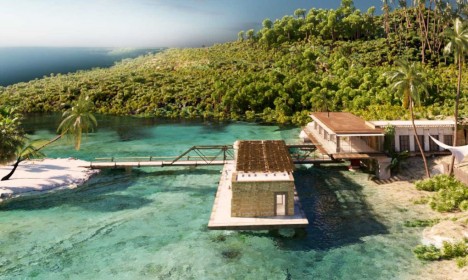
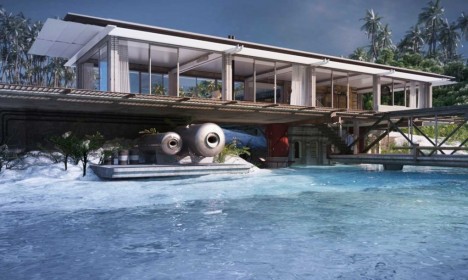
A stunning blend of old and new, this lovely oceanfront home is intertwined with remnants of an industrial ruin; the two are combined while differentiating existing from added architecture.

beach floating home

The house seems to grow out of the deserted walls of the former structure, resting above and pushing beyond them. Designed by Razvan Barsan + Partners of Romania, the program of this seaside California home consists of a series of residential buildings and outdoor decks leading out to a private island.

reused architecture industrial site

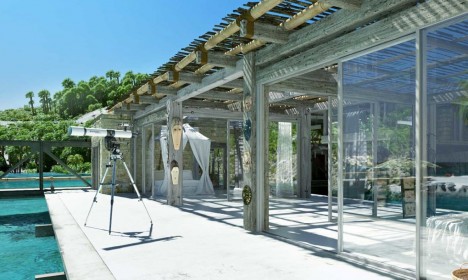
Local materials like wood, reed and bamboo along with modern lines and copious amounts of glass set the additions apart from the existing remains of both functional and ornate masonry.

industrial containers

Miscellaneous metal cylinders and barrels were also left, the primary home space floating above them on the shore.

beach front home

private home aerial

private island

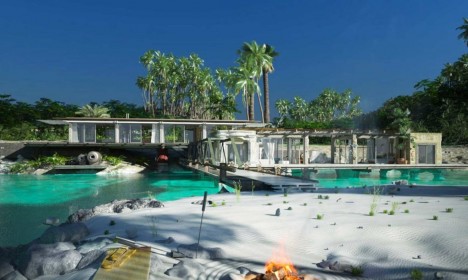
The island, bridged by a minimal walkway, features trees, seating and a fire pit for gatherings, all balanced against the secondary structure between it and the mainland..

Contemporary House Inserted into Crumbling Castle Ruins

A ruined 12th-century castle serves as a stunning historic shell for a contemporary residence in a renovation by Witherford Watson Mann architects. The medieval Astley Castle has been in ruins ...

Tiny Frank Lloyd Wright-Inspired House Atop Miner’s Ruins

Gleaming glass, oxidized steel and matte black wood contrast with the rough concrete ruins of an old miner's shelter found in the desert near Scottsdale, Arizona. 'Miner's Shelter' was designed and ...

Rustic Ruins to Modern Residences: 3 Barn Renovations

Aging barns are often left to simply deteriorate, the stone crumbling, weathered wooden siding falling to the ground.  But in their dramatic A-frame silhouettes and wide-open simplicity, some ...

Share on Facebook

[ By WebUrbanist in Architecture & Houses & Residential. ]

[ WebUrbanist | Archives | Galleries | Privacy | TOS ]


06 Sep 13:40

David Squires on … Sam Allardyce and England beating Slovakia

by David Squires
Timmy the Tooth

Disturbing Nirvana/Allardyce cover.

As a new era begins, David Squires takes a look at the formative days of England’s age of Sam Allardyce. You can find David’s archive of cartoons here and he’s also got a book out soon. Pre-order it here

Continue reading...
06 Sep 00:09

Spellbinding Visuals: Magical Book Artwork Tells Surrealistic Stories

by Kurt
[ By WebUrbanist in Art & Drawing & Digital. ]

book cover art

A series of book-centric illustrations (now collected into one big ‘book of books’) by Seoul artist Jungho Lee explores realms of impossibility through the deconstruction and re-imagining of bound volumes. Each surrealistic piece pushes the limits of plausibility in different ways, challenging the viewer to read complex stories into deceptively simple-looking drawings.

book architecture

book bending warped

book fishing

Winner of the World Illustration Awards for 2016, Lee is a Korean artist whose dreamlike work is often featured both on the covers of and within books for children or adults. The illustrations shown here are some of the 21 submitted for the competition and also included in the book Promenade, a collection published by Sang Publishing early this year.

book door

book image

book memory

Lee’s mixed-media approach includes “charcoal, water colour, gouache, hot-pressed papers and computer” graphics. He cites surrealist René Magritte and German artist Quint Buchholz as sources of inspiration for composition, messaging, lighting and angle of observation choices.

book plane wing

book pie

book surrealism

Lee starts with a basic image or rough sketch on large-format paper, usually using graphite or charcoal. Then he scans in the work and begins digital manipulations. Sometimes he goes back and forth, printing to paper to add more layers manually.

book lighthouse

book hike

book deconstructed

While his pictures span a variety of types, styles and subjects, much of his recent work specifically revolves around the manipulation of book-related imagery, expressing the contents of volumes without any use of text. If the series continues, he may create a followup volume to Promenade featuring further works of bookish art.

Stories Jump Out of the Pages with 3D Book Sculptures

Fiction favorites, from Gone with the Wind to Treasure Island, literally leap off the pages in three dimensions in Jodi Harvey-Brown's imaginative book paper sculptures. Harvey-Brown illustrates ...

Encyclopedic Landscape: Artist Carves 24-Volume Book Set

In his most voluminous undertaking to date, this book artist bids farewell to the long legacy of printed Encyclopedia Britannica sets with a mountainous tribute to their 244 years of ...

Fantastic Cities: 48-Page Urban Coloring Book Made for Adults

Coloring books are no longer just for kids, as this one designed for adult colorists illustrates in beautiful black and white. Showing urban scenes both real and imagined, these fictional, actual ...

Share on Facebook

[ By WebUrbanist in Art & Drawing & Digital. ]

[ WebUrbanist | Archives | Galleries | Privacy | TOS ]


30 Aug 20:46

List: 6 New Additions to Goop, Gwyneth Paltrow’s Luxury Lifestyle Store

Timmy the Tooth

Goop..

Just the name alone makes me laugh.

Revitalizing Seaweed Cream, $47

Locally sourced seaweed from the Gulf of Tonkin. Harvested by fishmongers who were deloused and scrubbed clean beforehand. Each strand of seaweed is happily chewed and spit out by Gwyneth’s daughter Apple while she enjoys a glass of hemp milk, resulting in a wonderful emulsion. The perfect moisturizing agent for your pets, be it a Tibetan Mastiff or a Burmese python – this cream is a dream.

Budget Cooking, $120

Just because you’re cooking on a shoestring budget doesn’t mean you have to sacrifice health and taste. This cookbook outlines how you can still have your personal chef cook world-class meals by only spending $1500 a week (for a two-person household) on groceries. You’d be surprised at what can be done with such a trivial amount of money.

Blessing Diary, $399

Single-source paper harvested from 213 year-old bonsai trees. Bound in supple, cage-free Tasmanian tiger leather. The perfect notebook for reminding yourself to be grateful for everything you have that you did nothing to earn. Also works well as a space to list all the ways in which you are a down-to-earth multimillionaire. Comes with fair-trade ivory quill that writes in invisible lemon ink.

Positive Affirmation Jar, $1,001

Carefully crafted positive affirmations are nestled inside this otherwise empty, glass-blown jar shipped from Asheville, NC by a river heron. Each saying is softly murmured by Gwyneth into the jar before being hermetically sealed. Previous mantras have included, “Go goop. Do goop. Be goop,” “Being a mother IS a form of social activism,” and “Diamonds.”

Pantsuit for left-half of your body, $2899

Cotton cured in oat’s milk. Hand sewn by a family on food stamps. Fits a woman with a half-waist size of 9". Sleek, stylish, and sexy – a pantsuit for the left-half of your body for all seasons. Once you try it on you’ll quickly discover this is the only pantsuit for the left-half of your body you’ll ever need. Right-half not currently, or ever, for sale. Expected delivery date: when your heart chakra aligns with your sacral chakra.

Selfie-Scepter, $21,000

A spear made of solid painite infused with truffle shavings. Emits a constant neon glow for maximum peacocking, thanks to a tritium lining. Equipped to holster any LL Bean Edition iPhone 10s. Great for taking pics. Can also be used to physically distance yourself from reality.

29 Aug 18:47

Open-Air Hotel: Infinite-Star Accommodations on the Swiss Alps

by Kurt
Timmy the Tooth

Would you?

[ By WebUrbanist in Boutique & Art Hotels & Travel. ]

open air hotel

Above and beyond your typical five-star hotel, this open-air room sits at nearly 6,500 feet in the mountains of Switzerland with panoramic views of the Alps.

wall free bedroom

A bed, side tables and lamps are not quite all visitors need to enjoy their stay at Null Stern (translated: Zero Star), but bathrooms are just a few minutes down the slope and meals are delivered by a butler. The name is a little misleading, since in most hotels one would have greatly reduced access to the infinite stars in the night sky.

boutique mountain hotel

At around $250 per night, the space and its amenities are a steal and reservations are refunded in case of inclement weather. The wall-and-ceiling-free room is available in spring and fall but closed during the winter.

wall free hotel

The Null Stern is part art experiment and part boutique hotel, using the sky as a ceiling and mountains as walls.

alps panoramic view

“Even though this version is radically different from the first one in the nuclear bunker,” a previous project by the same creators, “the essence and the spirit of the concept remains the same,” said one of the artists behind Null Stern “To put the guest at the centre of the experience and to focus on the intangible by reducing everything else to the minimum.”

Street-Chic Boutique: Stunning Half-Graffitied Hotel Room

Dubbed "The Panic Room" nonetheless, this daring overnight dwelling space is not for those seeking visual peace or artistic quite, more likely to cause than curb panicky impulse (quite the ...

Extreme Camping: 16 Out-There & Open-Air Accommodations

Dangle thousands of feet above the bottom of a canyon, take in the Pacific Ocean from a human nest, view the Northern Lights from a transparent igloo or spend the night in a giant purple sperm. ...

Botel: Floating Hotel with Modular Detachable Room Boats

You may have to move rooms when you arrive at your hotel, but has your room ever had to move you? Instead of static spaces, the sleeping areas in this hotel are dynamic vehicles you can use to ...

Share on Facebook

[ By WebUrbanist in Boutique & Art Hotels & Travel. ]

[ WebUrbanist | Archives | Galleries | Privacy | TOS ]


29 Aug 18:42

Yes! The Berkeley soda tax is doing what it is supposed to

by Marion
Timmy the Tooth

Now if we can just get people to stop drinking bottled water...

Jennifer Falbe and other investigators from Kristin Madson’s group at UC Berkeley have just produced an analysis of the effects of the Berkeley soda tax on consumption patterns.

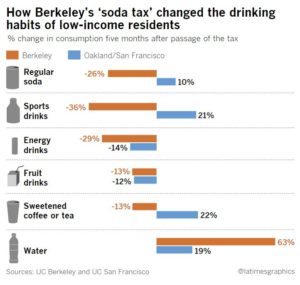
They surveyed people in low-income communities before and after the tax went into effect.  The result: an overall 21% decline in reported soda consumption in low-income Berkeley neighborhoods versus a 4% increase in equivalent neighborhoods in Oakland and San Francisco.

The Los Angeles Times breaks out these figures: 

In Oakland and San Francisco, which have not yet passed a tax, sales of regular sodas went up by 10%.

Other findings, as reported by Healthy Food America:

  • During one of the hottest summers on record, Berkeley residents reported drinking 63 percent more bottled water, while comparison cities saw increases of just 19 percent.
  • Only 2 percent of those surveyed reported crossing city lines to avoid the tax.
  • The biggest drops came in consumption of soda (26%) and sports drinks (36%).

Agricultural economist Parke Wilde at Tufts views this study as empirical evidence for the benefits of taxes.  He writes on his US Food Policy blog that it’s time for his ag econ colleagues to take the benefits of taxes seriously:

There is a long tradition in my profession of doubting the potential impact of such taxes…Oklahoma State University economist Jayson Lusk, who also is president of the Agricultural and Applied Economics Association (AAEA), has blogged several times about soda taxes, agreeing with most of the Tamar Haspel column  in the Washington Post, and concluding stridently: “I’m sorry, but if my choice is between nothing and a policy that is paternalistic, regressive, will create economic distortions and deadweight loss, and is unlikely to have any significant effects on public health, I choose nothing” (emphasis added).

Wilde points out that Lusk has now modified those comments in a blog post.

All that said, I’m more than willing to accept the finding that the Berkeley city soda tax caused soda consumption to fall. The much more difficult question is: are Berkeley residents better off?

Yes, they are.

The Berkeley study is good news and a cheery start to the week.  Have a good one.

Addition

Politico adds up the “piles of cash” being spent on the soda tax votes in San Francisco, Oakland, and Alameda and analyzes the soda industry’s framing of the tax as a “grocery tax.”

19 Aug 01:44

LEGO-Like Architecture: $5,000 Homes from Recycled Plastic Blocks

by Kurt Kohlstedt
[ By WebUrbanist in Architecture & Houses & Residential. ]

block house

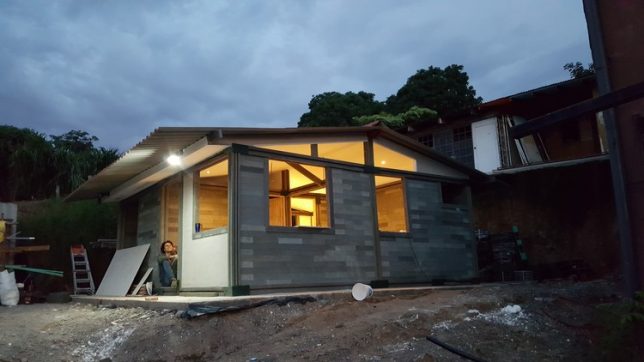
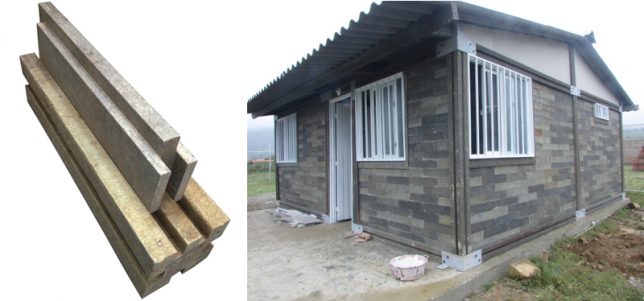
A company in Colombia is tackling plastic waste issues and affordable housing with a single ingenious solution: interlocking LEGO-like bricks that can be used to build houses for a few thousand dollars per structure. Walls are formed using a slim slotted brick then framed using a thicker module used for beams and columns, locking the smaller units into place and providing rigid vertical and lateral support.

durable plastic lego blocks

Conceptos Plásticos is addressing their technology to rising populations of urban poor, families with the time but not financial means or materials to construct their own dwellings. The company works with locals to source plastic and create all kinds of spaces, including emergency shelters, community and educational buildings.

modular stacked block houses

The upcycled plastic blocks are easy to use and require no construction experience. They are durable, fire- and earthquake-resistant and much cheaper than other available materials. The company estimates the lifespan of the blocks at 500 years.

plastic block homes

“We hope to create a movement where more and more people get involved,” say the company founders. “We want to develop new products that make better use of the thousands and thousands of tons of plastic that is discarded.”

“There will soon be more plastic in the sea than fish, so we really need to do something big.” Recent projects using this novel material include a hostel for displaced victims of violence in the Colombian countryside.

Smart Bricks: Life-Size LEGO-Style Blocks for Human Habitats

Aiming to revolutionize the most basic material units of construction, these building blocks snap together like LEGO bricks while leaving space for insulation and infrastructure inside and ...

Road Blocks: LEGO-Like Modular Roads & Paths Snap Into Place

New roads could be quickly and easily slotted into place, piece by piece, with a new Lego-like modular plastic system that makes the building process feel more like playtime. Prototypes of the ...

LEGO Brooklyn: Artist Recreates Borough with Plastic Blocks

Familiar scenes from Brooklyn, from the local flower shop to the train station, are lovingly rendered in pixelated plastic by local resident and artist Jonathan Lopes. Lopes loves BK so much, he ...

Share on Facebook

[ By WebUrbanist in Architecture & Houses & Residential. ]

[ WebUrbanist | Archives | Galleries | Privacy | TOS ]


18 Aug 16:25

You Won’t Believe It’s Not Photoshop: 36 Fake-Looking Photos

by SA Rogers
[ By SA Rogers in Art & Photography & Video. ]

not shopped main

The very existence of Photoshop has made it easy to immediately dismiss impossible-looking images as digitally altered, but some bizarre scenes are more real than they appear. Anything from a particularly alien-like landscape to a rare cloud formation can provoke cries of ‘Photoshop!,’ but it’s particularly impressive when these illusions are created through art, with the help of mirrors, acrobatic models, trick perspective and serendipitous timing.

Coincidence Project by Denis Cherim

not shopped cherim 8

not shopped cherim 9

not shopped cherim 10

not shopped cherim 11

not shopped cherim 12

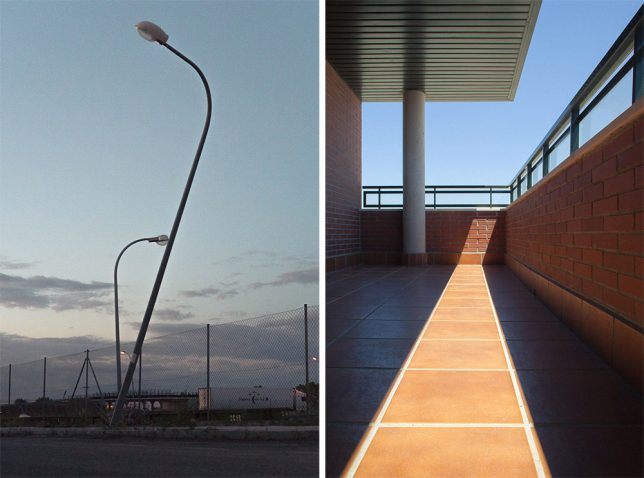
The almost too-coincidental-to-be-real photography of Denis Cherim relies on the patience to wait for exactly the right moment, when various elements of a scene come together in just the right way. His series ‘The Coincidence Project’ sees ordinary scenes from new perspectives, moving to particular vantage points to encourage serendipitous alignments.

Gravity-Defying Performances by Li Wei
not shopped li wei 20

not shopped li wei 21

not shopped li wei 22

not shopped li wei 23

not shopped li wei 24
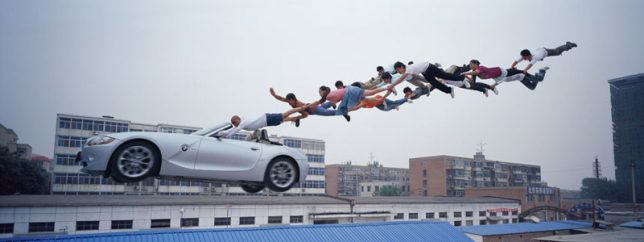
How can there possibly not be any photo manipulation going on in images where people are floating in mid-air? Li Wei’s particular blend of photography and performance art uses the strength of his subjects – including no small amount of acrobatics – along with invisible props and mirrors to create scenes that aren’t exactly as they appear.

Surreal Scenes by Sandy Skoglund

not shopped skoglund 1

not shopped skoglund 2

not shopped skoglund 3

not shopped skoglund 4

not shopped skoglund 5

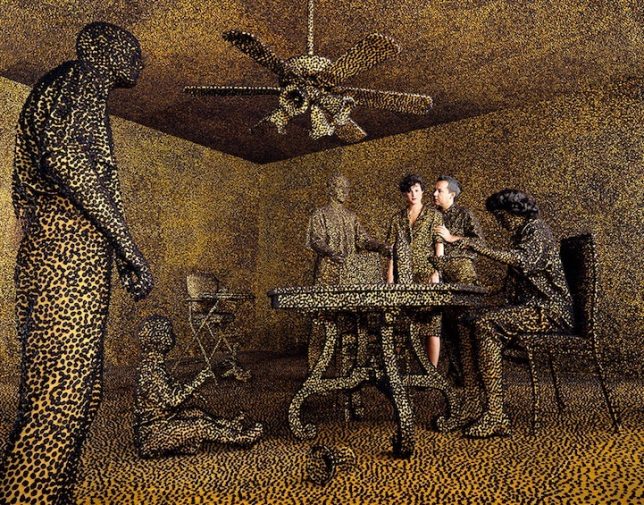
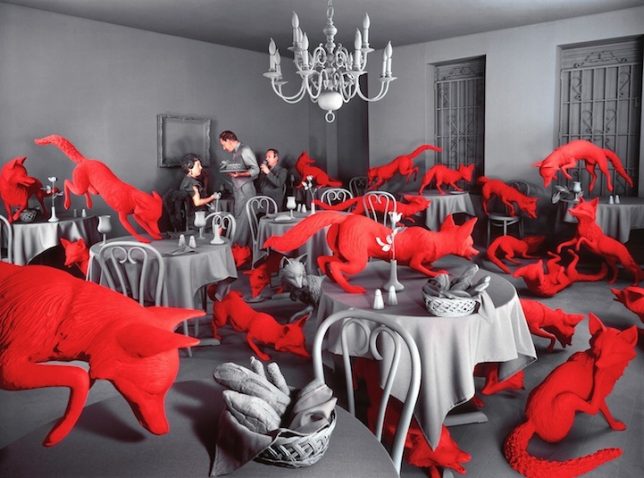
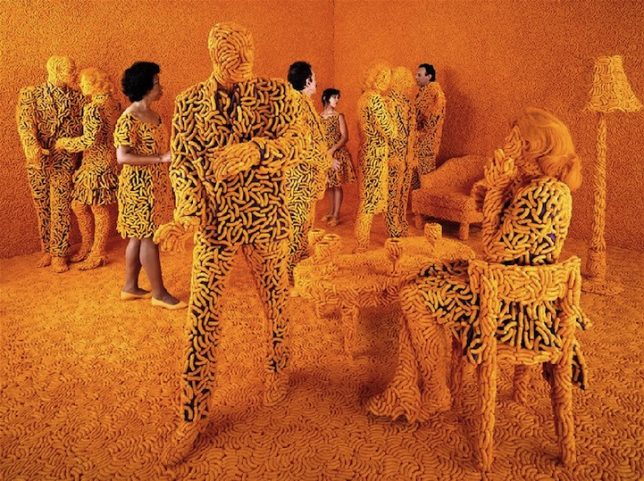
Fish fly through blue-toned bedrooms, foxes take over dining rooms and people hang from ceilings in dreamlike scenes by artist Sandy Skoglund, who spends months building each elaborate set. Favoring vivid color schemes, Skoglund mixes her hand-made sets and inanimate figures with live human models and takes photographs of the resulting contrasts.

Toy Dinosaur Travel Shots by Jorge Saenz

What look like screenshots from an old stop-motion animation dinosaur movie are actually just toy dinosaurs artfully placed within landscapes by photographer Jorge Saenz. His ‘#dinodinaseries’ project makes the figurines appear larger than life, sometimes looking surprisingly real in their incongruous modern-day settings.

Mirror Landscapes by Guillame Amat

not shopped amat 13

not shopped amat 14

not shopped amat 16

not shopped amat 18

Mirrors seem to offer portals into a slightly different reality in Guillaume Amat’s ‘Open Fields’ project, which carefully places a reflective stand in various landscapes. The reflections almost blend into the scene, but not quite – leading to images that are inaccurate renderings of the setting, but in such a subtle way it can take a moment to realize what’s wrong with the picture.

Next Page - Click Below to Read More:
You Wont Believe Its Not Photoshop 36 Fake Looking Photos

Reflections from Above: Mirrored Skyscraper Illusion Photos

Illuminated cityscapes multiply and divide in unexpected ways when their nighttime reflections hit the mirrored facades of the skyscrapers found within them. Photographer Donna Dotan, known for her ...

Not ‘Shopped: Colorfully Surreal Scenes by Sandy Skoglund

These days, just about anyone can alter and collage various elements into a scene using digital technology like Photoshop. But artist Sandy Skoglund has been producing surreal imagery for decades ...

Cleverly Flipped: 21 Mirrored Images & Reflected Photos

Photographers know countless methods to add interest to to their images through tricks of light, angle, color and more.  One of the oldest ones in the book is to double the image with a ...

Share on Facebook

[ By SA Rogers in Art & Photography & Video. ]

[ WebUrbanist | Archives | Galleries | Privacy | TOS ]


18 Aug 13:48

Dramatic ‘Elastica’ Residence: The House of the Future is Here

by SA Rogers
[ By SA Rogers in Architecture & Houses & Residential. ]

elastica house 1

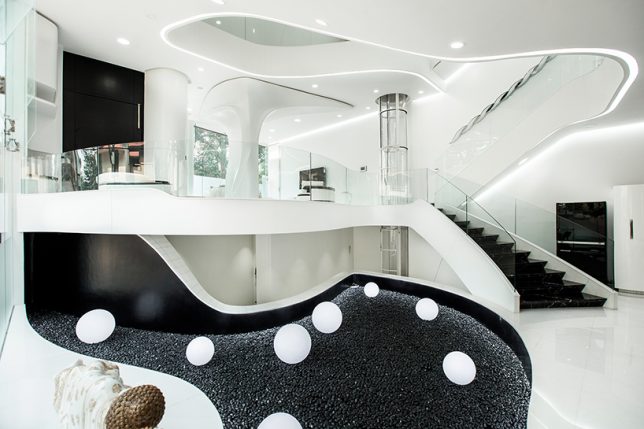
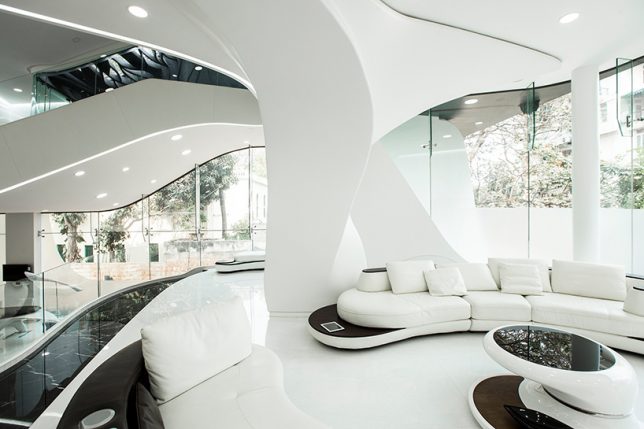
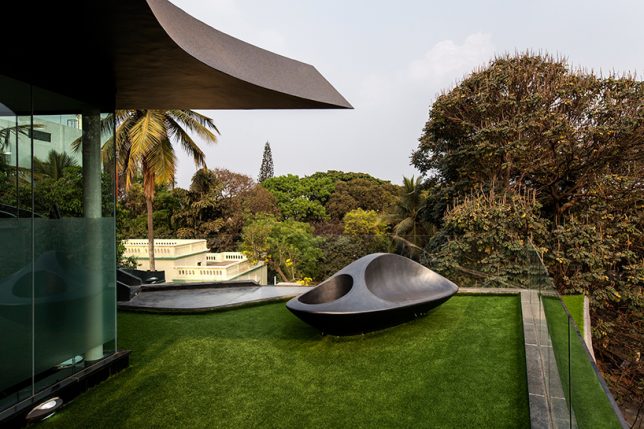
Looking like the set of a sci-fi film, the ultramodern ‘Elastica’ residence in Bangalore, India is pretty much what we all imagined our houses would look like by the time we became adults. It’s a little bit Jetsons, a little bit rock n’ roll, and a whole lot different from the decidedly unfuturistic houses most of us still occupy in the year 2016. Inside, there are virtually no straight walls, with undulating white surfaces stretching around the space, and what looks like a translucent cylindrical elevator reminiscent of the ‘Orgasmatron’ machine in the 1973 film Sleeper standing at its center.

elastica house 2

elastica house 3

elastica house 11

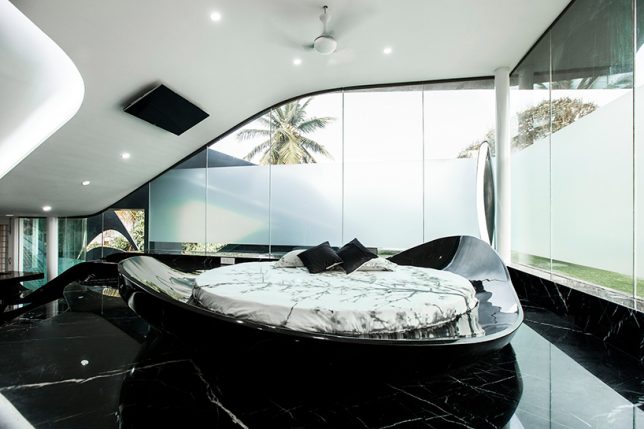
Cadence Architects conceived the house as a continuous loop rising from the ground, with large open spaces providing sight lines from the upper floors to the living space on the lowest level. Made of acrylic and ferroconcrete, the walls and floors flow like liquid in sculptural curves, occasionally stretching out to become built-in furniture like a cantilevered kitchen island. In the bedroom, a black acrylic base cradles a circular mattress like a gigantic soap dish, matching the marbled floor.

elastica house 4

elastica house 10

elastica house 7

elastica house 8

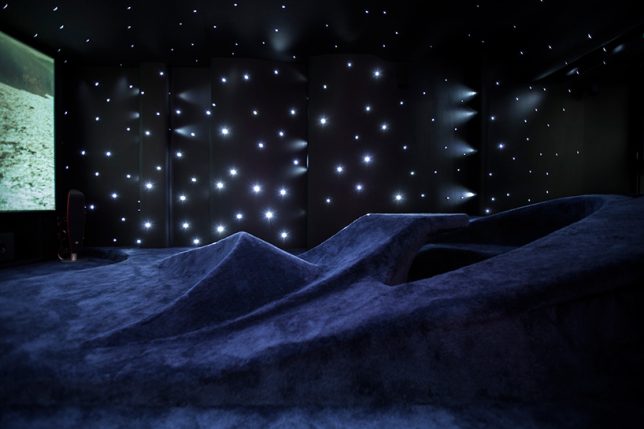
A minimalist black and white palette keeps all the attention on those curves and gives the interiors the air of a spaceship, accented with strips of LED lighting and furniture that appears to have been custom-made to match the scheme. A pod-like children’s bed looks like something you might wake up in after traveling for light years on an intergalactic journey, and a home cinema amplifies the outer space effect with starry lighting and a molded, carpeted floor shaped like a landscape with comfy hills and planes to lay on.

elastica house 6

elastica house 5

elastica house 9

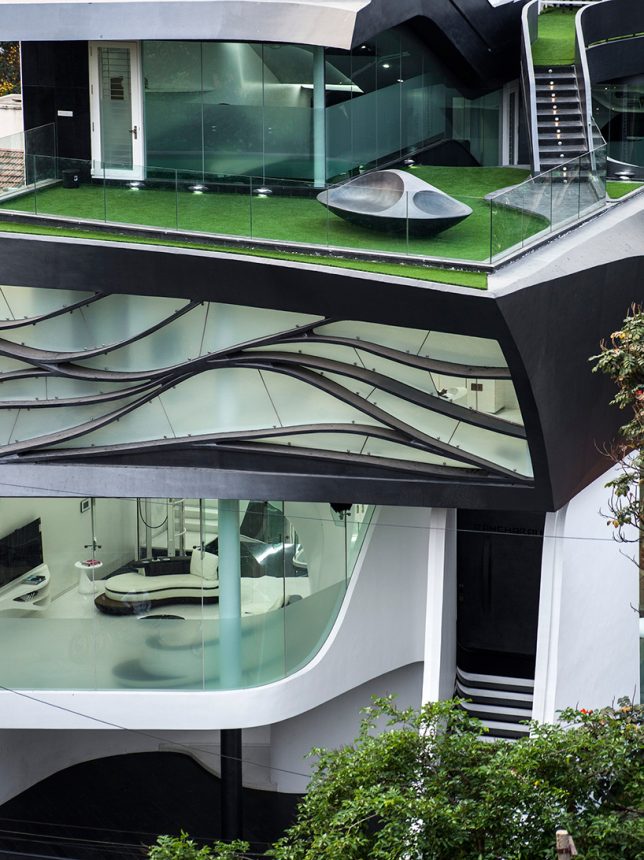
The facade of the home is glazed on every level except the middle one, which is sheltered by a modern interpretation of the traditional brise-soleil, a perforated screen that filters direct sunlight. The ground and top floors feature Astroturfed terraces, the highest of which looks out onto the more conventional architecture of the neighborhood. Some of the design touches throughout are strange in an otherworldly sort of way, and certainly not everyone’s cup of tea, but it’s a cool example of architects getting creative with residential designs.

Herringbone House: Tiny Tokyo Residence Split into 7 Levels

Measuring just 280 square feet, this tiny house in Tokyo by architecture firm Flathouse includes a public biscuit shop on the first level and manages to fit a lot of function into an irregularly ...

House of the Future: 12 Ultra-Modern Home Designs

What will our homes look like in the future? Packed with electronic controls and highly efficient gadgets, will they rapidly grow into strange, abstracted structures that bear little resemblance ...

Center of Infinity: 360-Degree House Defies Dimensionality

Forget floors, get over familiar geometries and start really thinking in three dimensions if you want to understand this futuristic and multifaceted home concept. Levels are secondary - the focus ...

Share on Facebook

[ By SA Rogers in Architecture & Houses & Residential. ]

[ WebUrbanist | Archives | Galleries | Privacy | TOS ]


18 Aug 12:20

No One is Sadder Than I Am About the Most Recent Celebrity Death

Let me just say that I am shocked by the news about the famous celebrity who recently died. The world lost an icon today. I am sad, you are sad, everyone is very sad. Sad, sad. But as sad as all of you surely are in the face of this tragic loss, please allow yourselves to take comfort in the knowledge that there is no possible way that you are sadder than I am about the recent celebrity death.

To repeat: I am the saddest of all.

This is not the first celebrity death that has profoundly affected me on a personal level. I was crushed when Art Linkletter died. Heartbroken when Etta James died. Impaled with a flaming grief-javelin when Robin Williams died. When Dennis Farina died, I writhed on the ground for months. It was awful on my joints, but not as awful as having to tell my joints that Mark Ruffalo died. Luckily, that was a hoax.

Just in case you were wondering how I might be impacted in the face of future celebrity deaths, here is a list of some other currently alive celebrities whose eventual deaths will level me with public despair because of the personal connections I have with them. Dean Stockwell and I share a birth-month. Queen Latifah is from New Jersey, like my old fake ID. I can’t recall not knowing who LeVar Burton is. Gerardo and I flew on an airplane together, possibly. You probably know him as Henry Kissinger, but he’ll always be Hank to me. I once saw Lita Ford at a car wash. She was actually working there, so it probably wasn’t her, now that I think about it. Clyde Drexler ruined my 14th birthday party. Ate the whole cake. I’ll miss him terribly. I know what a trumpet is, and so does Yo Yo Ma. I realize Yo Yo Ma plays the cello, but you’re crazy if you don’t think he also knows what a trumpet is, like me, which is why I’ll tweet about how much he meant to me for several days after he dies. Things don’t look good for George Clooney over the long term. That’s going to be a tough one for me. I lost my virginity during Buster Poindexter’s “Hot Hot Hot.” Don’t you die on me, Buster. Not now. Not so soon after Harambe.

Mark Wahlberg and I share a dentist, so I’ll be absolutely destroyed when he dies. Not a specific dentist, mind you, but like, dentists in general. Do I know that for a fact? No, I do not. I have never seen Mark Wahlberg at the dentist, but with teeth like that, it’s basically a lock that he regularly sees a dentist, and also very sad that I’ll never see those pearly whites up on the silver screen again after he dies, unless I catch Pain & Gain on Netflix or watch the “Good Vibrations” music video on YouTube or see his picture up on the wall at our shared dentist’s office.

I was very sad when I read Walden and then afterward learned that Hank David Thoreau died.

Do not even get me started on the potential death of that one guy with the beard from Color Me Badd unless you are prepared for a tidal wave of public grieving about that time I left the Time and Chance cassette at my buddy Chad’s apartment. Chad never gave it back, and now he’s dead. Dead to me, I mean, like we’re no longer speaking. Also, another reason we’re not speaking is because he’s dead.

I try not to think about how Wolf Blitzer will die, but my guess is: poisoned by his enemies. I’ll be crushed. I’ll also be very sad when Goldie Hawn, Nicholas Sparks, and Wesley Snipes die. I hope they don’t all die on the same day, because Snipes deserves his own Facebook post. Good ol’ Hank Snipes.

The bottom line is that bravely forging ahead in the wake of celebrity deaths has made me who I am: a person whose personal connections to celebrities inspire very deep and public mourning when those celebrities die and the building I am in has free Wi-Fi.

Oh god, now I can’t stop thinking about how Alfonso Ribeiro is dying a little bit every day, and it makes me so, so sad.

16 Aug 20:52

obviousplant: #MondayMotivation


obviousplant:

#MondayMotivation

15 Aug 23:52

Hosting The Olympics Is A Terrible Investment

by Clay Dillow
Timmy the Tooth

The Olympics are just terrible

When Rio de Janeiro won its bid to host the 2016 Summer Olympics back in 2009, the Brazilian government estimated that costs directly related to hosting the games would run just shy of $3 billion. But by the time Vanderlei de Lima lit the Olympic torch at last week’s opening ceremonies, the country had already spent some $4.6 billion on venues, administration, transportation and the like, putting the games roughly 50 percent over budget. By the time the games close on Aug. 21, the tally for the games will likely be higher still.

But it could be much worse. The 2014 Winter Games in Sochi blew their budget by 289 percent. The 1980 Winter Games in Lake Placid overtopped projections by 324 percent. And the 1976 Games in Montreal ran a staggering 720 percent over projections; the city spent three decades paying down the bill. While outliers such as these distort the average cost overruns somewhat (176 percent for Summer Games, 142 percent for Winter Games), the median cost overrun for all games for which we have data is 90 percent, making Rio’s cost overrun somewhat lower than the historical norm, at least so far.

The modern Olympic Games, in other words, are wildly expensive — and wildly more so than host cities expect when they make their bids. The Olympics have a well-deserved reputation for accelerated construction schedules and poor oversight, as well as for the cost overruns associated with them. Since the 1960 games in Rome, every single edition of the Olympics for which data is available has been more expensive than originally projected. But until recently it was unclear exactly how those cost overruns stack up next to each other, as well as next to other major civic megaprojects.

The numbers above come from a new study led by Bent Flyvbjerg at the University of Oxford’s Saïd Business School, who looked at six decades of Olympic budgets. It wasn’t easy — detailed cost overrun data is only available for 19 of the 30 games taking place since 1960, a paucity which Flyvbjerg and his colleagues found galling. “It means — incredible as it may sound — that for more than a third of the games between 1960 and 2016 no one seems to know what the cost overrun was,” they wrote. (Flyvbjerg said he suspects the 11 other games also ran over budget, but the lack of available data makes it impossible to know for sure. The Oxford researchers excluded those games from their analysis.)

To tabulate the costs, Flyvbjerg and his colleagues looked only at the costs of staging the games themselves — direct capital costs such as the building of the Olympic village and competition venues, transportation, administration and workforce and so on. Indirect capital costs such as upgrades to local public transit (which can add significantly to a host city’s total investment in the games) are not included in the totals. The researchers also accounted for inflation and currency valuation according to international standards to provide cost comparisons in real terms.

To put those cost overruns into perspective, Flyvbjerg and his colleagues compared the Olympics to other megaprojects such as bridges, dams, highways, railway lines and major IT projects. The Olympic Games average 156 percent cost overruns, outdistancing all other types of megaprojects. For comparison, road projects average overruns of 20 percent; bridges and tunnels 34 percent; energy projects 36 percent; rail projects 45 percent; dams 90 percent and IT projects 107 percent. Even road, bridge and rail projects come in under budget 10 percent of the time. Of all the types of projects compared, only the Olympics has a flawless record for going over budget, making the games a particularly risky undertaking for governments unprepared to absorb those additional costs.

“For a city and nation to decide to stage the Olympics Games is to decide to take on one of the most costly and financially most risky type of megaproject[s] that exists,” Flyvbjerg and company wrote, “something that many cities and nations have learned to their peril.”

Given that one city or another hosts the Olympics every couple of years, why do governments and organizing committees continue to have such a hard time projecting and containing costs? Part of the problem is baked right into the International Olympic Committee bidding process, said David Goldblatt, author of “The Games: A Global History of the Olympics.” Writing for Time magazine in July, Goldblatt estimated that the price tag of the Rio Games (including both direct games-related costs and other infrastructure and ancillary expenditures) could reach $20 billion, meaning the cost of hosting the games has multiplied as much as 2,000 times since the first modern games were held in Athens in 1896. While much of that growing cost has to do with the expansion of the games to include more of everything — more events, more athletes, more venues, more staff, more spectators — it also has to do with the proliferation of prestige projects and engineering one-upmanship. Grandiose architecture combined with a can’t-miss deadline leads to costly accelerated construction schedules, the costs of which are not reflected in the original bids.

“There’s this kind of relentless underestimation of costs, because if anyone knew the real bill at the beginning they would never sign up,” Goldblatt said in an interview. In other words, in an effort to win their bids, organizing committees are under intense pressure to present a low-cost budget — even if it doesn’t necessarily reflect reality. “If a realistic estimate was made in the first place, then the scale of overruns wouldn’t be quite as vast as they are.”

For instance, when London first began preparing its bid for the 2012 Summer Games in the early 2000s, organizers floated a total cost of around £2.3 billion (about $3.37 billion USD at the time). “It turned out to be nearer 11 [billion pounds], and 2.3 was just farcical,” Goldblatt said. “But who’s looking?” The sports media has become more skeptical over time, Goldblatt said, due to repeated cost overruns, but even so, “people have been getting away with a sort of statistical and accounting murder.”

In the 1990s, the IOC instituted Olympic Games Knowledge Management Program, an initiative meant to help organizing committees from future host cities learn from the experiences of previous Olympic hosts, with an eye toward curbing costs. Flyvbjerg and company suggest it seems to be working to some degree. For games before 1999, the median cost overrun was 166 percent. Post-1999, it fell to 51 percent.

Potential host cities increasingly view the Olympics with skepticism. In 2014, Stockholm, Lviv, Krakow and Oslo all bowed out of their bids for the 2022 Winter Games, citing ballooning costs as a primary concern. The IOC eventually loosened the rules for the bidding process and the games went to Beijing (again), despite the fact that it doesn’t typically snow on the mountain that will host downhill skiing events.

For its part, Rio is on track to come away from the 2016 Games more or less in line with what’s become the normal amount of additional expense on its books. But the implication of Flyvbjerg’s research is that Rio still may have been better off building $3 billion in roads and bridges (which likely would have ended up costing $3.6 billion to $4 billion because of their own overruns) than hosting the Olympics (which will end up costing at least $4.6 billion, and likely quite a bit more).

At the very least, the return on investment would have likely been greater. While most major infrastructure projects go over budget, megaprojects such as bridges, dams and railway lines tend to yield economic benefits for longer than the few weeks that many Olympic facilities are used. Host cities almost invariably fail to cover Olympics costs with associated revenues (for instance, in 2012 London took in $3.5 billion in revenues and shelled out something like $18 billion to host the games), leaving them with piles of debt and various useless venues. Research has repeatedly shown that in most cases the Olympics are a money loser for cities, particularly those in developing nations where the cost-benefit proposition tends to skew even worse.

For its part, Rio is on track to reverse the trend toward more expensive games established by the Beijing, London and Sochi Games. But even these comparatively frugal games don’t look like much of a bargain. That’s because the dollar value of cost overruns is often less important than a given country’s ability to absorb them, a lesson Brazil is learning the hard way. When countries bid for the games seven years out, it’s impossible to account for shifting political and economic circumstances, said Kevin Wamsley, academic vice president and provost at St. Francis Xavier University in Antigonish, Nova Scotia, and an expert on Olympic politics. Brazil is hosting the Summer Games while dealing with presidential impeachment proceedings and its worst economic crisis since the 1930s. While the Olympics didn’t cause Brazil’s current problems, they are a multibillion-dollar burden on a country already struggling to cover basic expenses.

“Look where Brazil finds itself,” Wamsley said. “They’re not paying their police officers and other public service workers, they’re not paying their professors, they’re in all kinds of trouble. That’s just an unbelievably horrible context in which to host an Olympic Games.”


15 Aug 17:45

Simply Creative Use of Space: 14 Modern Japanese House Designs

by SA Rogers
Timmy the Tooth

I am completely in love with Japanese architecture.

[ By SA Rogers in Architecture & Houses & Residential. ]

garage home

High-density neighborhoods with heavy foot traffic and tiny plots of land in Japan force architects to come up with some clever space-saving, privacy-protecting residential layouts. Strategically placed windows, curving floors, translucent panels and hidden terraces are among the innovative tricks in play to maximize daylight and views of the sky while dissuading peeping toms and making the most of every inch of available space.

Compact House by Takuro Yamamoto

compact house 1

compact house 2

compact house 3

compact house 4

compact house 5

For a client who wanted plenty of outdoor space in a dense Tokyo neighborhood without sacrificing privacy or building a big wall around the property, architect Takuro Yamamoto faced every window in this three-story home toward the wall of an open-ended, box-shaped terrace. “Through the process of designing this house, we tried to prove that having a rich private external space was important for making a crucial difference in the quality of life inside the house, as well as obtaining various possibilities of external activity. Considering that the client’s original request was having a big terrace for doing yoga freely under the sun, connecting the terrace to the living room and the bedroom with big windows was the best way to offer fresh air and daylight to the internal spaces – like having respiratory organ to let the house breathe.”

Re-Slope House by Tomohiro Hata

re-slope house 1

re-slope house 2

re-slope house 3

re-slope house 4

The massive windows on either side of this house on a slope by Tomohiro Hata are strategically located to direct views to the sky and a small back garden, encouraging cross-breezes and bringing slanted rays of light straight through the home. A wooden insert delineates the interior spaces, creating platforms, stairs and small rooms, so the residents can enjoy varying degrees of daylight and privacy.

Daylight Catcher House by La Riviére Frank Architects

daylight catcher house

daylight catcher house 2

daylight catcher house 3

daylight catcher house 4

Four ‘ears’ sticking out of the roof of this house act as daylight catchers for the interior, keeping it from becoming too dark for a client who wanted maximum privacy. The home is set up to be wheelchair-accessible with space for gardens and parking spots for two cars while staying at a single story for earthquake protection, all on a small budget. The four vertical windows allow daylight to diagonally penetrate the home, blocking views of the interior from outside while enabling views of the sky from within.

Boko Deko Curved Floor House by Mitsuharu Kojima Architects

boko deko house 1

boko deko house 2

boko deko house 3

boko deko house 4

Soundproof walls and one big window facing the sky protect this home from noisy neighbors and a busy street. Mitsuharu Kojima Architects came up with the highly unusual solution of a curving, green carpet-covered floor that gently slopes toward the wall of windows. The residents can choose to move their furniture around this space freely, lounging in the sun or staying in the shade. Storage is built into two walls full of cabinets and hidden rooms on either side, including loft-like lounge spaces.

Light Grain House by Yoshiaki Yamashita

light grain house

light grain house 2

light grain house 3

light grain house 4

A perforated steel facade lets little dots of light into the otherwise windowless front of this home in Osaka by Yoshiaki Yamashita. The clients, a young couple with a child, wanted natural light and ventilation as well as a high level of privacy. Two external terraces hidden within the outer envelope of the house act as giant skylights for the middle level, where the living space is located.

Next Page - Click Below to Read More:
Simply Creative Use Of Space 14 Modern Japanese House Designs

Modern Japanese Architecture: Sunny Minimalism by Tomohiro Hata

Expertly blending the minimalist aesthetics of traditional Japanese architecture with modern sensibilities to meet the needs of contemporary residents, architect Tomohiro Hata graces each of his ...

Smart Space Solutions: 14 Innovative Japanese Home Interiors

Extremely narrow lots and busy urban locations are no big deal for ingenious Japanese architects creating comfortable, daylight-filled residential interiors with a few crucial design tricks, like ...

Modern Design Meets Tradition in 12 Japanese Homes

Modern architects preserve the traditions of Japanese residential architecture while meeting 21st century needs in these 12 strikingly well-balanced homes. Adaptable rooms that can change size or ...

Share on Facebook

[ By SA Rogers in Architecture & Houses & Residential. ]

[ WebUrbanist | Archives | Galleries | Privacy | TOS ]


10 Aug 23:59

Video: How to Make Cacio e Pepe (Roman-Style Pasta With Cheese and Pepper)

by J. Kenji López-Alt
Timmy the Tooth

Damn, that's a lot of oil/butter


Spaghetti with cacio e pepe (Pecorino Romano and black pepper) is a classic Roman dish, and one of the simplest pasta dishes around. But it can be a little confounding until you get the hang of it—that Pecorino has a nasty habit of clumping up if you don't do it right! Our video will show you how to get perfectly creamy, cheesy results every time. Read More
10 Aug 14:17

José Mourinho: United’s jealous rivals could never have done Paul Pogba deal

by Press Association
Timmy the Tooth

Jose Mourinho is the Trump of world football: a megalomaniacal thin-skinned wankasaur.

• Mourinho criticises Arsène Wenger and Jürgen Klopp once again
• Pogba may ‘need protection’ as he becomes accustomed to life at Old Trafford

José Mourinho has had another dig at Arsène Wenger and Jürgen Klopp, suggesting they are not at clubs big enough to make a signing like Manchester United’s world-record £89m capture of Paul Pogba.

Last Friday the United manager branded his counterparts from Arsenal and Liverpool “not ethical” after they questioned the fee his club were reportedly set to spend on bringing Pogba back from Juventus.

Continue reading...
08 Aug 20:30

Make a Splash With Bukkake Udon (Japanese Cold Noodles With Broth)

by Daniel Gritzer
Timmy the Tooth

Is this April fools?


Bukkake udon—Japanese chilled udon noodles, served with a cold soy-based broth and topped with your choice of condiments, like grated fresh ginger, a soft-cooked egg, and scallions—is all you need to keep cool and fed in the summertime. Read More
05 Aug 18:16

July’s Strong Job Numbers Still Don’t Match Trump’s Claims

by Ben Casselman
Timmy the Tooth

America is already great. THANKS OBAMA

Donald Trump is running for president on the idea that the American economy is stuck in a deep hole, and only he can get it out. The job-market data keeps saying otherwise.

U.S. employers added 255,000 jobs in July — significantly more than economists had forecast — and job growth in May and June was stronger than initially reported, the Bureau of Labor Statistics said Friday. Wage growth accelerated, drawing more Americans back into the job market, and the unemployment rate held steady at 4.9 percent.

Last month, I wrote that the economy will probably look pretty good on Election Day. Friday’s report makes that a near-certainty, at least as far as the job market is concerned. With just three more reports to go until voters head to the polls — October’s jobs numbers will be released four days before Election Day — it would require a historic collapse for the unemployment rate to be much above 5 percent in November.

“Pretty good” is relative, of course. The job-market recovery has been long — employers have added jobs for a record 70 consecutive months — but it hasn’t been particularly strong by historical standards. Wage growth has been weak. The share of Americans in the labor force is near a four-decade low. Millions of people are working part-time because they can’t find full-time jobs. All those measures have improved a bit in recent months, but they show an economy that is still recovering from the recession that officially ended more than seven years ago.

casselman-AugustJobs-1

But Friday’s report suggests the recovery is beginning to reach some of the groups that have struggled most in recent years. The unemployment rate for workers without a high school diploma fell sharply to 6.3 percent in July, lower than it was when the recession began. (Their unemployment rate topped 15 percent in the recession.) For workers with only a high school diploma, the unemployment rate is down to 5 percent from more than 10 percent during the recession.

None of that is likely to stop Trump from talking about the weak economy — or from outright claiming the numbers are manipulated. And there is plenty of reason to worry about the path of the economy, starting with this week’s weak estimate of second-quarter economic growth. But the job market, at least, appears to be on firm footing.

Back on track: The BLS revised up its estimate of May job growth to 24,000 from 11,000. That’s still pretty lousy, even factoring in the roughly 35,000 Verizon workers who were on strike that month and therefore weren’t counted in the payroll numbers. But May increasingly looks like a one-time blip rather than a more serious slowdown. Employers have added an average of 190,000 jobs per month over the past three months, a somewhat slower pace than late last year but still generally healthy. The longer-run rate of job growth has also been slowing gradually; over the past year, the U.S. has added 2.4 million jobs.

casselman-AugustJobs-2

A growing labor force: More than 400,000 Americans joined or re-joined the labor force in July, and the participation rate — the share of adults either working or actively looking for work — rose for the second month in a row. The participation rate has bounced around lately, rising late last year and early this year, then dropping in the spring before rebounding in the past two months. But beneath the month-to-month volatility, it looks like the improving job market is gradually beginning to draw more Americans off the economy’s sidelines.

casselman-AugustJobs-3

Good jobs: The fastest-growing sector in July was professional and business services — a generally high-paying category that includes lawyers, architects and many office workers. And while retailers, restaurants and other low-wage industries also added jobs, the U.S. has in recent months seen solid growth in “good jobs” — full-time jobs that offer a decent wage. Average hourly earnings rose 8 cents an hour in July and are up 2.6 percent over the past year, significantly ahead of inflation. And the number of Americans working part-time because they can’t find full-time work is falling again after an unexpected spike in the spring. (The number of such so-called involuntary part-time workers ticked up slightly in July, however.)

casselman-AugustJobs-4
05 Aug 13:08

Should The Grizzly Bear Eat The Salmon?

by Edited by Oliver Roeder
Timmy the Tooth

Today in bear games

Welcome to The Riddler. Every week, I offer up a problem related to the things we hold dear around here: math, logic and probability. These problems, puzzles and riddles come from lots of top-notch puzzle folks around the world — including you! You’ll find this week’s puzzle below.

Mull it over on your commute, dissect it on your lunch break and argue about it with your friends and lovers. When you’re ready, submit your answer using the link below. I’ll reveal the solution next week, and a correct submission (chosen at random) will earn a shoutout in this column. Important small print: To be eligible, I need to receive your correct answer before 11:59 p.m. EDT on Sunday. Have a great weekend!

Before we get to the new puzzle, let’s return to last week’s. Congratulations to 👏 Chen Yin 👏 of Hong Kong, our big winner. You can find a solution to the previous Riddler at the bottom of this post.

Now here’s this week’s Riddler, a grizzly bear puzzle that I wrenched from my heretofore repressed memories of econ grad school problem sets.


A grizzly bear stands in the shallows of a river during salmon spawning season. Precisely once every hour, a fish swims within its reach. The bear can either catch the fish and eat it, or let it swim past to safety. This grizzly is, as many grizzlies are, persnickety. It’ll only eat fish that are at least as big as every fish it ate before.

Each fish weighs some amount, randomly and uniformly distributed between 0 and 1 kilogram. (Each fish’s weight is independent of the others, and the skilled bear can tell how much each weighs just by looking at it.) The bear wants to maximize its intake of salmon, as measured in kilograms. Suppose the bear’s fishing expedition is two hours long. Under what circumstances should it eat the first fish within its reach? What if the expedition is three hours long?

Extra credit: It’s been a while, so let’s offer up a 🏆 Coolest Riddler Extension Award 🏆. Lengthen the expedition, change the bear’s preferences, alter the fish population, or something even more creative. Submit your extension and its solution via the form below. The winner gets a shiny emoji trophy next week.


To submit your answer, click here.

Need a hint? You can try asking me nicely. Want to submit a new puzzle or problem? Email me. I’m especially on the hunt for Riddler Jr. problems — puzzles that can stoke the curiosity and critical thinking of Riddler Nation’s younger compatriots.


And here’s the solution to last week’s Riddler, concerning the emperor of Byzantium and some traitorous generals. You, the emperor, were meant to confidently identify a loyal general by asking the smallest number of questions of the generals. The loyalists among them always tell you the truth, while the traitors answer any way they please.

If you start with N generals, you can identify a loyal general in at most N-1 questions. Here’s the solution from the puzzle’s submitter, Django Wexler:

The algorithm goes like this: Place all the generals in a pool, and start a counter, K, at N/2 rounded down (that’s the maximum number of traitors). Pick two generals at random, A and B. Ask B about A.

If B says “traitor,” then remove both A and B from the pool and reduce the counter by one. Either B is a traitor and lying, or A is a traitor and B is telling the truth, or both are traitors. Regardless, we have removed at least one traitor from the pool. Start over.

If B says “loyal,” we now know that either A is loyal or B is a traitor. So A can be a traitor if and only if B is also a traitor.

Pick another general from the pool, C. Ask him about B. If he says “traitor,” throw B and C out as above. If he says “loyal,” we know that for A to be traitor, B must be, and for B to be, C must be. Then grab D, and so on.

Eventually, either

  • K will reach zero because you’ve thrown out N/2 pairs. Since you started with more than half of your generals being loyal, there will be some generals left in the pool, and they are guaranteed to be loyal, or
  • the “chain” of generals that must all be traitors in order for A to be a traitor will be longer than the counter K. Since K represents the maximum number of traitors left in the pool, at that point A is guaranteed to be loyal.

The most pessimistic case will be a chain that almost reaches K, then gets a series of false answers, then builds up again, and so on. You never end up asking a question of the guy you find to be loyal, and you ask each other guy a maximum of once, so the worst-case number of questions is N-1.

Elsewhere in the puzzling world:

Have a fantastic weekend!

05 Aug 13:08

Election Update: Trump’s Slump Deepens In The Polls

by Nate Silver
Timmy the Tooth

Really hoping Trump's hubris holds out and he stays the candidate.

There’s no longer any doubt that the party conventions have shifted the presidential election substantially toward Hillary Clinton. She received a larger bounce from her convention than Donald Trump got from his, but Trump has continued to poll so poorly in state and national surveys over the past two days that his problems may be getting worse.

The recent Fox News, Marist College and NBC News/Wall Street Journal national polls show Trump trailing Clinton by 9 to 14 percentage points, margins that would make for the largest general election blowout since 1984 if they held. Clinton’s numbers in those polls are on the high end of what we’ve seen lately — Marist, for instance, has generally had a Clinton-leaning house effect in its polls this year. By contrast, a series of polls released earlier in the week generally put Clinton’s advantage at 5 to 8 percentage points.

The new polls are noteworthy, however, because they postdate the earlier surveys — Marist’s poll was conducted Monday through Wednesday, for instance. That opens up the possibility that the spiral of negative stories for Trump, such as his criticism of the family of a Muslim-American soldier killed in action and his renewed feud with GOP leadership, are deepening his problems above and beyond Clinton’s convention bounce. Not only have Clinton’s numbers risen since the Democratic National Convention, but Trump’s numbers have fallen back into the mid- to high 30s in polls that include third-party candidates. And Trump’s favorability ratings, following modest improvement after his convention, are now about as bad as they’ve ever been.

Meanwhile, polls of Michigan, Pennsylvania and New Hampshire — three swing states with demographics that, in theory, could be friendly to Trump — showed Clinton with leads of 9 percentage points, 11 points and 15 points, respectively. Those are big leads for Clinton, but they shouldn’t be all that surprising: The margins look a lot like the ones by which Barack Obama defeated John McCain in those states in 2008, an election he won by 7.3 percentage points overall. According to our now-cast, Clinton would defeat Trump by a similar margin nationally, 7.9 percentage points, in a hypothetical election held today. Compared with that new, higher baseline for Clinton, a Suffolk poll showing her “only” 4 points ahead of Trump in Florida, which would have looked like an excellent result for her a week ago, is middling.

Overall, the now-cast estimates that Clinton’s electoral vote total, in an election held today, would be similar to the 365 electoral votes that Obama won in 2008. Although she’d be unlikely to carry Indiana, which Obama surprisingly won in 2008, she could make up for it by winning Arizona or Georgia, states that the now-cast has as tossups. Utah might even be competitive in an election held today — and the now-cast thinks that Texas would produce a closer finish than Pennsylvania.

But the real election is still just more than 94 days away. And our forward-looking models, which project the Nov. 8 result instead of evaluating what the polls look like now, are more conservative.

Our polls-plus forecast projects Clinton to win by about 4 percentage points on Nov. 8, meaning a margin more like Obama in 2012 than Obama in 2008. And given the wide uncertainty in forecasting an election three months out, it has Trump with a 26 percent chance of winning. Clinton has nothing to complain about — her 74 percent chance is her highest mark in the polls-plus forecast all year. But the model tweaks her numbers downward for two reasons.

First, it adjusts for potential convention bounces. Although the bounce following the second convention is historically not as misleading as the one following the first convention,26 Clinton’s numbers may still be elevated by a couple of percentage points from the convention afterglow.

Second, polls-plus combines the polls with a “fundamentals” forecast based on an economic index, and the economy is average, suggesting that the election ought to be close. Obviously, there’s a big assumption embedded in there — that Trump is a normal candidate who can take advantage of macroeconomic conditions in the same way that (for instance) John Kasich or Marco Rubio might. Still, American presidential elections have tended to tighten down the stretch run more often than not.

Our polls-only forecast also discounts the recent polls to some degree, projecting Clinton to win by 6 percentage points on Nov. 8 and giving her an 80 percent chance of winning the Electoral College. Polls-only doesn’t use the economic index, nor does it lower Clinton’s numbers because of a potential convention bounce. But it does weight polls taken during the conventions less. Furthermore, it’s deliberately a bit sluggish to update its forecasts because presidential polls are mildly mean-reverting, meaning that gains in the polls are more likely to reverse themselves than to continue unabated.

A model can be too stubborn to update its forecast. Clinton, after blowing a 7-point lead in July, is now in the midst of one of the bigger convention bounces in recent years. This election has produced large swings by historical standards, and the odds ought to have shifted back and forth, in the same way they would if an NFL team forfeited a two-touchdown lead before halftime and then regained it in the third quarter. But you shouldn’t rush to judgment based on two days of polling (admittedly excellent though they were for Clinton) when there are still about 94 days to go. A poll showing Clinton with a 9-point lead three weeks from now would be more meaningful than three more such polls taken tomorrow.


VIDEO: What’s happening to the Republican Party?