Shared posts

28 Jan 18:40

Ukraine Prime Minister and Cabinet resign

by Cory Doctorow

The Prime Minister of the Ukraine has tendered his resignationbrutal anti-protest law. Demonstrators in Independence Square applauded the announcement. The cabinet will remain in place for 60 days while a new government is formed.

Parliament adjourned after the vote on the protest law and is due to discuss the issue of granting an amnesty to convicted protesters.

Mr Yanukovych offered an amnesty only if protesters cleared barricades and stopped attacking government buildings.

In his resignation statement, Prime Minister Azarov said: "To create additional opportunities for social and political compromise and for a peaceful solution to the conflict, I made a personal decision to ask the president of Ukraine to accept my resignation as prime minister of Ukraine."

The government had "done everything to ensure the peaceful resolution of the conflict" and would do "everything possible to prevent bloodshed, an escalation of violence, and violation of citizen's rights", he said.

Ukraine's PM Azarov and government resign


28 Jan 17:34

Dutch court unblocks The Pirate Bay

by Cory Doctorow

A Dutch court has ruled that the country's ISPs need no longer block The Pirate Bay. The court ruled that the block was disproportionate and ineffective, and ordered (notoriously corrupt) rightsholder group BREIN to pay restitution to ISPs, including XS4ALL, an ISP with a long tradition of fighting for free speech and the open net.

In its ruling the court states that the Pirate Bay blockade was disproportionate not effective, citing the Baywatch report of the University of Amsterdam. In addition, the blockade was found to hurt the free entrepreneurship of the Internet providers.

As a result, the appeal court overturned the blocking order and ordered the Hollywood-funded anti-piracy to pay 326,000 euro ($445,000) in legal fees.

Commenting on the ruling, XS4ALL says that the verdict allows them to keep the Internet free of censorship, and the ISP will disable the blockade effective immediately.

“We are very pleased the court’s verdict. This guarantees freedom of access to information. That is good for Dutch citizens, good for the Internet and good for ISPs who can continue to fulfill their important role neutrally,” the company states.

ISPs No Longer Have to Block The Pirate Bay, Dutch Court Rules [Ernesto/Torrentfreak]

(Thanks, Pluto!)


28 Jan 05:34

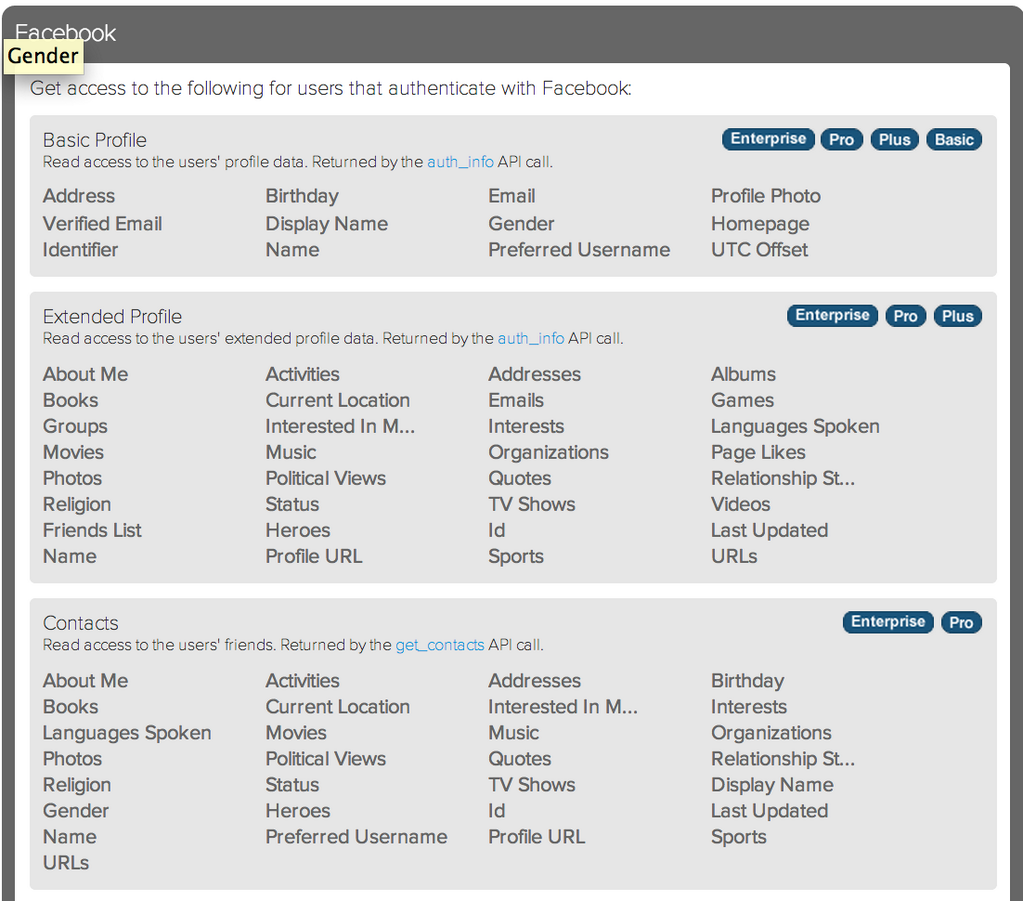
What is exposed about you and your friends when you login with Facebook

by Cory Doctorow


(click to embiggen)

When you log in to a service with Facebook, the company exposes an enormous amount of sensitive personal information to the service's operator -- everything from your political views to your relationship status. What's more, logging into a service with Facebook also exposes your contacts' personal information to the service: their locations, political views, organizations, religion, and more.

...and here's what a brand knows when you login via facebook (via Dan Hon)


28 Jan 05:33

CIA whistleblower Kiriakou’s letters from prison on Firedoglake blog "dangerous," says Bureau of Prisons

by Xeni Jardin


John Kiriakou

Kevin Gosztola at Firedoglake: "The Bureau of Prisons, with a little assistance from the Central Intelligence Agency, have been engaging in a ham-handed attempt to stop former CIA officer John Kiriakou from sending letters from prison, according to a recent letter from prison." [The Dissenter]


28 Jan 05:32

890 word Daily Mail immigrant panic story contains 13 vile lies

by Cory Doctorow


The Daily Mail is an awful, racist, hard-right UK newspaper, notorious for scare stories (see, for example, this exhaustive index of things that the Fail claims will give you cancer) and generally terrible reporting.

But even in amidst all that notorious history of deceit and hate, the Mail attained something of a new low recently, with its "reporting" on the supposed wave of Bulgarian and Romanian immigrants. According to the Mail, these people were poised to invade the UK on January 1, 2014, when those countries' EU membership would entitle their citizens travel throughout the EU and seek work without visas.

Jon Danzig, an investigative BBC journalist, plucked one of the many such stories out of the paper's pages, a mere 890 words' worth, and, with the help of a colleague in Romania, found 13 lies. He pressed the Mail to substantiate its story, and, failing to receive a satisfactory reply, he filed a formal complaint with the Press Complaints Commission.

The Mail's xenophobic campaign against Bulgarians and Romanians has been instrumental in shifting both Labour and the Tories to adopting inhumane policies, in order to pander to people who've been terrorised into a false belief that somehow migrants are coming to both take away British jobs and collect benefits (that is, to work and not work simultaneously).

Claim 5: When controls imposed in 2005 are lifted tomorrow, 29 million from the two countries will gain the right to work in Britain

Apart from the fact that it simply isn’t possible, let alone likely, that the entire populations of Bulgaria and Romania would all move to the UK, the Daily Mail’s claim that 29 million from both countries have ‘the right to work in Britain’ from 1 January cannot be correct. Romania has 3.5 million children under the age of 15; many of them are babies. Is the Mail claiming they have ‘the right to work in Britain’? There are also almost 1.2 million children in Bulgaria, and a combined elderly population of Bulgaria and Romania of over 4.5 million. Are they all coming to work in the UK too?

Also, the Daily Mail was incorrect to state that ‘controls’ were imposed on Romanians and Bulgarians in 2005. The ‘transitional controls’ were imposed by some EU member states – including the UK – in 2007 when Romania and Bulgaria first joined the European Union. During the transitional period, Romanians and Bulgarians could only work in the UK with a work permit, although students could work for 20 hours a week during term time and full time during holidays. From 1 January 2014, Romanians and Bulgarians are able to come to work in the UK, or to look for work, on the same basis as other European Union nationals.

Claim 6: One user of a popular website wrote: “My husband and I want to have a child in the UK. We want to know what kind of benefits we can apply for. We are interested in receiving a council house.”

The Daily Mail claimed that messages on internet forums in Bulgaria and Romania asked how to claim benefits in the UK. No details of the website forums were given in The Mail story. The Mail declined to let me have the addresses of the websites they referred to, so that I could check them. Of course that doesn’t mean such forums don’t exist; but it does seem odd, and not best journalistic practice, for the Mail not be open about this.

13 reasons why I am taking the Daily Mail to the Press Complaints Commission [Jon Danzig/British Influence]

(via Metafilter)


28 Jan 02:26

HSBC settlement approved: no criminal charges, 5 weeks' profit in fines, deferred bonuses for laundering billions for narco-terrorists

by Cory Doctorow


Remember when HSBC got caught laundering billions for Mexican narco-terror cartels? Remember how they offered to pay five weeks' profits in fines and to defer their executive bonuses to escape criminal charges?

The crime-fighting legal eagles at the Department of Justice approved the settlement last week. Remember, though, if you are suspected of laundering money or selling drugs, the DoJ will take your house away and put you in jail for the rest of your life. Nice to be "too big to jail." Still, deferring multimillion-dollar bonuses has gotta hurt, huh?

HSBC's struggles with its correspondent banking controls have been a long-standing issue for the bank. A 2010 OCC order flagged the issue as the bank's primary anti-money laundering problem and said HSBC had failed to properly police some high-risk cash transactions of its affiliates.

HSBC operates hundreds of affiliates around the world and its US arm acts as the gateway into the U.S. financial system for this network by processing US dollar-denominated payments.

A US Senate report released in mid-2012 said HSBC failed to assess the money laundering risks associated with affiliates before opening correspondent accounts for them.

The interaction between HSBC's US arm and HSBC affiliates around the world continues to be a concern for the OCC, the sources said. In response, the bank has begun advising units that those that fail to implement full anti-money laundering regimes could have their correspondent accounts closed, one of the sources said.

HSBC is paying $2 billion, or 5 weeks' worth of its profit, to avoid criminal charges in drug cartel laundering case [Brett Wolf and Aruna Viswanatha/Thomson Reuters]

(via Reddit)

(Image: HSBC_valentinesdemo_DSC_0163, a Creative Commons Attribution Share-Alike (2.0) image from fleshmanpix's photostream)


28 Jan 02:24

This Is Not a Conspiracy Theory, Part One of a New Web Series by Kirby Ferguson

by Mark Frauenfelder

Kirby Ferguson, creator of Everything Is a Remix, has launched the first installment of his serial documentary project about "the forces that that shape us." In this first entertaining episode, Ferguson explains why people fall for conspiracy theories.

He says: "To see future episodes you will need to subscribe. Launch price is $12; the price will rise to $15 later. This project has been my labor of love for the past couple years and I hope you will you enjoy it."

This is Not a Conspiracy Theory (Part 1) (Via Laughing Squid)


27 Jan 21:25

Candy Quest: a text-adventure in defiance of the stupid Candy Crush trademark

by Cory Doctorow

Inspired by the news that King.com -- creators of the game "Candy Crush" -- had received a trademark on the use of the words "candy" and "saga" in connection with video games (and other things) and were using it to censor its competition, Michael Brough's created a fun -- and trenchant -- text-adventure called Candy Quest 3: Edge of Sweetness. It's part of The Candy Jam, an indie game-jam created entirely to troll the butthead corporate overlords at King.com.

Congratulations! You are now a level 1 Lollipop Witch.

The twilit streets of the doom-beset village lie before you. The candy school is open for lessons. The general store is closed. To the south a path leads into the woods. A mountain hovers overhead.

You have 3 candollars. Doom is 0% averted.

Learn at the candy school.
Wander into the woods.
Climb the mountain.

Candy Quest 3: Edge of Sweetness (via Waxy)


27 Jan 18:13

Sky Broadband parental filter blocks jquery

by Cory Doctorow

The parental filter on Sky Broadband, one of the largest ISPs in the UK, blocked jquery, the widely used Javascript library, without which many websites cease to operate. While the block was in place, Sky advised customers that they could get the Web back by disabling the filter, or switching off the "phishing/malware" category.

UK Prime Minister David Cameron has unilaterally decreed that these parental filters will soon be switched on by default for all broadband customers in the UK. But don't worry, the Great Firewall of Cameron won't make any mistakes, because the PM has decreed that Web companies must:

a) Censor all the bad things, but;

b) Don't censor the good things.

Whew, that's a relief.

code.jquery.com may not sound like a mainstream website, as it is really aimed at web and javascript developers but it is pretty common for websites to link to the released javascript (.js) files for jquery and a host of other tools on jquery.com as the site is a CDN for these files, the result being that it is possible many sites may not be performing as expected today.

The advice appears to be for Sky customers to log into their web account, and in the Sky Broadband Shield section turn off the Phishing/Malware filter, or alternatively disable the shield completely.

Sky parental controls break jquery website [Andrew Ferguson/Think Broadband]

(Thanks, Dave!)


27 Jan 18:11

John Lennon/Van Halen mashup: "Imagine a Jump"

by Cory Doctorow

Might Mike's Imagine/Jump mashup has a lot of precision in its execution, a great tempo/pitch match. I can't say as it's the catchiest tune I've yet heard, but I can really appreciate the execution.

Mighty Mike - Imagine a jump (John Lennon vs. Van Halen)


27 Jan 18:10

DDP Wants To Teach You How To Do Yoga Like A Pro Wrestler

by Zeon Santos

(Video Link)

A professional wrestler seems like the last guy you’d want teaching you how to do something calming and low impact like Yoga, but that hasn’t stopped former WCW star Diamond Dallas Page from living out his downward dog dreams by hitting a different kind of mat in the name of inner peace.

DDP has been sharing the physical benefits of yoga with fellow wrestlers for years, and he has his own DDP Yoga program you can purchase on DVD, but here we see what happens when Nerdist asks him to make a promo their way. It’s an all out brawl for your inner chakras, with Page shouting out the most relaxing catchphrase ever- "Bang!" (NSFW due to language)

Via Topless Robot

27 Jan 17:05

European companies cut off US supply of death penalty drugs

by Maggie Koerth-Baker
Over the last decade, the drugs used in lethal injection executions in the United States have fallen into short supply, as the mostly European companies that manufacture those drugs cut off their availability in protest of the death penalty. States are beginning to run out of stockpiles of pentobarbital and sodium thiopental. Instead, they're turning to combinations of what drugs are still available. The results could change the case on whether lethal injection represents cruel and unusual punishment. In Ohio last week, a prisoner took 25 minutes to die, struggling and gasping for breath all the while.


26 Jan 23:57

Why the hyper-rich turn into crybabies when "one percent" is invoked

by Cory Doctorow

Yesterday, the Wall Street Journal published a letter by Tom Perkins (the "Perkins" in the venture capital firm "Kleiner Perkins") in which he compared rhetoric about the unjust riches of the "1 percent" to the events of Kristallnacht, the overture to the Holocaust. In a terrific editorial, Josh Marshall explains why the hyper-rich turn into such crybabies when it's pointed out that they've gamed the system so that they grow richer and richer while everyone else gets poorer:

One is the simple but massive run up in the concentration of wealth itself over the past two generations. There's a slice of the population, whether it's the top 1% or .01% or whatever, that doesn't just have more stuff and money. The sheer scale of the difference means they live what is simply a qualitatively different kind of existence. That gulf creates estrangement and alienation, and one of a particular sort in a democracy where such a minuscule sliver of the population can't hope to protect itself alone at the ballot box.

Let's call this socioeconomic acrophobia.

A second is tied specifically to the 2008 financial crisis. The last 35 years or so have seen a period in which the celebration of wealth and the wealthy has been near the extreme end of the pendulum swing that has moved back and forth over the course of American history. Let's not distract ourselves, for the moment, with whether this view is right or wrong. It's a pendulum swing as old as America. In this view, the super rich, the founders and most successful entrepreneurs, not only wow us by their genius and success but are also seen as the people driving forward the society and economy and prosperity for everyone. That's a nice climate to be wealthy in.

That all changed very abruptly at the end of 2008.

Suddenly, there was vast public animus at "Wall Street" and the Big Banks, exacerbated massively by the politics of the bailout. And not just from the left but from the right too, though in a different form. Pretty deserved on many levels: the financial sector, the figurative "Wall Street", had come close to crashing the global economic system by a mix of irresponsible risk taking and gaming the political system to permit this high-risk, wealth-juicing leverage. But if we're to understand the psychology of the individuals involved we must appreciate the whipsaw nature of that experience.

The Brittle Grip, Part 2 [Josh Marshall/TPM] (via MeFi)


26 Jan 20:58

Word games with the "make your own Coke label" promo

by Cory Doctorow


Robbo sez, "Coke has set up a web site where you can design and share your own branded can of Coke. The idea, of course, was to have people slap their own name on the iconic can image and send it flying around the net to further embellish the Coke brand. But many are making use of the web page to insert a myriad of unintended messages. Everything from 'Boycott Coke' to 'Puck Futin' - that one is because the web app doesn't allow you to use the words 'Fuck' or 'Putin'. But the English language is a remarkably wonderful and versatile thing - and it's only a matter of time before Coke realizes they've opened the door very wide for a lot of very angry people to reach their foot in and kick 'em hard in the nads. Enjoy it, and share it, while you can."


Share a Coke


25 Jan 16:15

Study: French three-strikes law did not deter or reduce piracy

by Cory Doctorow

In Graduated Response Policy and the Behavior of Digital Pirates: Evidence from the French Three-Strike (Hadopi) Law a team of business-school researchers from the University of Delaware and Université de Rennes I examine the impact of the French "three-strikes" rule on the behavior of downloaders. Under the three-strikes law, called "Hadopi," people accused of downloading would be sent a series of threatening letters, and culminating with disconnection from the Internet for a period of a year for everyone in the household. Hadopi is the entertainment industry's model for global legislation, and versions of it have been passed in the UK and New Zealand, and it has also been proposed for inclusion in the global Trans-Pacific Partnership treaty.

The researchers carefully surveyed French Internet users to discover what effect, if any, the Hadopi law had had on their behavior -- specifically, whether they were encouraged to download more from legitimate sites and pay more for music as a result of the threat of Hadopi. Their conclusion: [Hadopi] has not deterred individuals from engaging in digital piracy and that it did not reduce the intensity of illegal activity of those who did engage in piracy.

The study found some evidence that determined pirates who are more well-informed about the law may have shifted away from using P2P networks and towards other methods of illegally sharing content, like "direct downloading" sites and newsgroups.

The study is based on self-reported data, coming from a survey of 2,000 French Internet users. The respondents were asked about their views on and knowledge of the Hadopi law.

More than a third—37.6 percent—admitted to illegal downloading, with 22 percent using P2P networks and 30 percent using "alternative channels." About 16.4 percent of those who had engaged in the downloads received a warning from Hadopi, the government agency with the same name as the law it enforces.

Users who were more aware of the monitoring done by the Hadopi regime weren't any less likely to pirate copyrighted material, although there was a slight affect on the "intensity" of downloading. (The researchers asked whether users were likely to use illegal downloading techniques more than once a month or less than once a month.) The overall effect on file-sharing intensity was "negative but insignificant," researchers wrote.

Graduated Response Policy and the Behavior of Digital Pirates: Evidence from the French Three-Strike (Hadopi) Law [SSRN]

Study of French “three strikes” piracy law finds no deterrent effect [Joe Mullin/Ars Technica]

(Image: HADOPI, a Creative Commons Attribution (2.0) image from goodvibez's photostream)


25 Jan 16:15

Making Classic Novel Titles Upworthy

by Zeon Santos
spriteleigh

Upworthiness is becoming a trend all over the internet

In the world of click-to-read online content it's all about the views- how many people view your article, how many people link to your article, and how those numbers compare with the rest. Writing content for the online world is a hit-or-miss affair, and sometimes the numbers just don't add up- sometimes people use sneaky tactics to falsely inflate those numbers, gathering views like Smaug gathers gold coins.

But what if novels were subject to the same criteria for success? Nick Moran and Janet Potter of The Millions wondered- what would happen to book titles if the creativity was stripped away and replaced with upworthy titles that conned people into taking a closer look?

Via 22 Words

24 Jan 22:44

You won't believe how sweet this anti-hyperbole plugin is

by Cory Doctorow


Downworthy is a Chrome plugin that converts hyperbolic headlines from viral mills into sarcastic -- and much more realistic -- semantic equivalents. For example, the word "literally" is replaced with "figuratively"; while "go viral" is translated to "be overused so much that you'll silently pray for the sweet release of death to make it stop."

* "Literally" becomes "Figuratively"
* "Will Blow Your Mind" becomes "Might Perhaps Mildly Entertain You For a Moment"
* "One Weird Trick" becomes "One Piece of Completely Anecdotal Horseshit"
* "Go Viral" becomes "Be Overused So Much That You'll Silently Pray for the Sweet Release of Death to Make it Stop"
* "Can't Even Handle" becomes "Can Totally Handle Without Any Significant Issue"
* "Incredible" becomes "Painfully Ordinary"
* "You Won't Believe" becomes "In All Likelihood, You'll Believe"
* ... and so on.

Downworthy (via Waxy)


24 Jan 16:47

Hunter Moore arrested

by Rob Beschizza
Revenge porn "pioneer" Hunter Moore was arrested and charged with conspiracy, identity theft and unauthorized computer access, reports Time. Moore, according to prosecutors, directed associates to hack into people's email accounts in search of material for his website, which specialized in publishing compromising photos of women and charging hundreds of dollars to remove them.


24 Jan 16:46

The Genesis of Planet Hillary

by Rob Beschizza

Megan Garber reports on how the NYT Mag created its freaky "Planet Hillary" cover.]

'I asked Duplessis whether he and his team considered the image's meme potential as they designed the magazine's cosmic cover. "Social media is something we always think about," he replied, "but the concept for this particular cover was more of a gut reaction to the working language." The addition of the universe-y copy ("The Chelsea Quasar," etc.) took the cover, Duplessis notes, "to new heights."'


24 Jan 16:44

The Simpsons Are Upworthy

by John Farrier

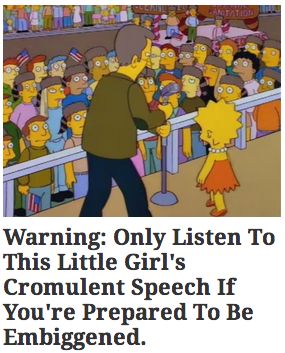
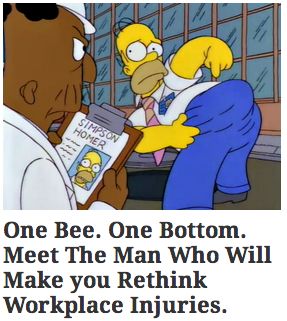
Virgil Texas decided to mock Upworthy. You won't believe what he did next. Upworthy: Sprinfield is his parody of Upworthy's enticing but predictable headlines. The residents of that town become the stars of explosive news stories and inspiring videos.

-via Jeremy Barker

P.S. Be sure to check out Science Fiction & Fantasy Upworthy.

23 Jan 23:20

No More Road Trips? American road-trip movie made with found home-movie footage

by Cory Doctorow

Rogue archivist Rick Prelinger writes, "Last year I finished my archival road movie, No More Road Trips? It's a composite road trip made from my archives of over 10,000 home movies, hoping to ask the question: have we come to the end of the open road? You can read about all that online, but I wanted to point to my 'trailer,' which is 798 high-definition images from the film shown at 12 frames per second. I hope it expresses some of my fascination with the American roadscape, especially as it looked during the down-at-the-heels 1930s and optimistic 1950s-1960s."

(Thanks, Rick!)


23 Jan 21:44

Citizen Lab calls on Canada's telcos to publish transparency report

by Cory Doctorow

As American telcoms operators take up the practice of publishing transparency reports showing how many law-enforcement requests they receive, Canadian activists are wondering why Canada's telcoms sector hasn't followed suit. Citizen Lab, whose excellent work at the University of Toronto is documented in lab leader Rob Diebert's must-read book Black Code, has issued public letters addressed to the nation's phone companies and ISPs, formally requesting that they publish aggregate statistics on law-enforcement requests.

Our call for telecommunications transparency is in line with actions taken in the United States, where politicians such as Representative Markey have successfully asked telecommunications service providers to explain the types of requests made by American state agencies for telecommunications data, the regularity of such requests, and the amounts of data disclosed.[2] Moreover, American companies are developing more and more robust ‘transparency reports’ to clarify to their subscribers how often, and on what grounds, the companies disclose subscriber information to American state authorities. There is no reason why similar good practices cannot be instantiated in Canada as well.

Over the past decade, Canadians have repeatedly heard that law enforcement professionals and state security agents need enhanced access to telecommunications data in order to go about their jobs.[3] And Canadians have read about how our own signals intelligence service, the Communications Security Establishment Canada, has been and continues to be involved in surveillance operations that ‘incidentally’ capture Canadians’ personal information.[4] Despite these developments in Canada, there is not a substantially greater degree of actual transparency into how and why Canadian telecommunications service providers disclose information to agents of the Canadian government.

It is in light of this ongoing lack of transparency surrounding telecommunications providers’ disclosure of information to state authorities that we, a series of academics and civil rights groups, have issued public letters to many of Canada’s largest or most significant Internet and mobile communications providers. We hope that Canada’s telecommunications community will welcome these letters in the spirit they are intended: to make clearer to Canadians the specific conditions under which the Canadian government can and does access telecommunications information pertaining to Canadians, the regularity at which such access is granted, and the conditions under which telecommunications companies disclose information to state agencies.

Towards Transparency in Canadian Telecommunications


23 Jan 21:43

Three Hour Long Supercut Of Every NES Title Screen Ever Made

by Zeon Santos

(Video Link)

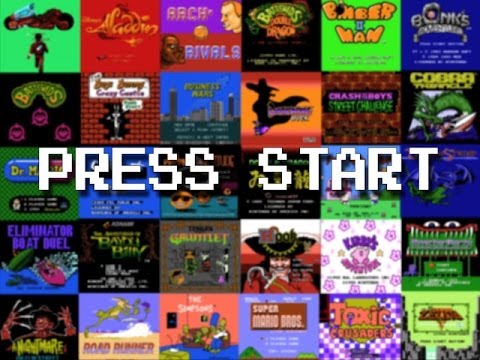
Old school gamers with no new games to play and nothing better to do might want to set aside some time, approximately three hours or so, and watch this compilation of every single NES title screen ever made in alphabetical order.

Press Start was made by YouTube user NicksplosionFX, and it's sure to bring back fond memories of waiting for your game to start, waiting for player two to get back from the bathroom, or waiting until you've finished your Hot Pocket before hitting the start button.

Some screens are a bit mundane, others are totally epic and exciting with full color pixelated visuals, and watching them all is the ultimate exercise in time wasting! Can you bear the full three hours of excruciatingly monotonous nostalgia?

Via Gamma Squad

23 Jan 21:42

Story Surgeon: An App For Copyright Infringement

by Victoria Strauss
Posted by Victoria Strauss for Writer Beware

Here at Writer Beware, we love the weird stuff--the nutty, fring-y, even, dare I say, totally freaking insane things that are always cropping up at the boundaries of the publishing world, often spawned by people who haven't really taken the time to think things through.

Or maybe they're just idiots. Hard to tell sometimes.

So...playing now on Kickstarter, a project called Story Surgeon (I've embedded a screenshot at the bottom of this post to immortalize the concept). Created by aspiring author Ryan Hancock, Story Surgeon is:
An eBook notation app that saves your personal edits as a separate file, and can be shared with anyone who owns the original eBook.
In other words, Story Surgeon is an app that enables anyone to alter a published book in any way they like, and spread the alterations around at will.
Although it will be a complicated app to develop, the idea is simple. Buy an eBook in ePub format and download it to your iPad. Download the Story Surgeon app. (It will be free on release day and probably many days thereafter.) Then you can use the app to read the original eBook (booooring) or make your own person [sic] changes to the text. (OH YEAH!)

Use the "find and replace" tool to substitute bad words, cut out whole portions of the book you thought were lame, or completely rewrite the novel with you as the main character.

Once your filter is perfect, you have the option to upload it into Drop Box and post your link on the Story Surgeon General Blog. (As we grow we'll get our own servers and streamline the sharing process.)

The filter is kept separate from the eBook and no copyrights will be infringed upon. Anyone who uses your link and downloads the free filter will have to have purchased the original eBook. Filters will always be free.
As an author, I'm so very relieved to know that even if random people use an app to create altered versions of my books and post links to them on the Internet, my copyright won't be infringed upon. I'm also thrilled to know that there's a new promotional tool at my fingertips:
For authors, making fun filters of your already published book is a great way to generate buzz and get more people purchasing the eBook.
As yet, Story Surgeon exists only in Ryan Hancock's imagination--which is why he's trying to raise $15,000 on Kickstarter, offering backer rewards that are, if possible, even loonier than the app itself. For instance, if you donate $10, you can "submit the titles of TWO books that you would like to seen [sic] "PG-ified"---OR---If you're not interested in having books cleaned up, you may instead submit a filter idea. (Such as Hunger Games rewritten with Harry Potter characters, etc.)"

Or, for big spenders who are willing to cough up $200, "the app creator will completely rewrite a book of your choice (up to 600 pages), making major changes such as genre switches, adding you as a completely new main character, or adding your boss as the villain's simpering sidekick. You will also receive a signed copy of his YA novel when it is published."

Hancock explains the genesis of his misguided idea on his blog (apparently it's all Patrick Rothfuss's fault). He has also issued a press release, in which he reiterates his woefully inaccurate view of what constitutes copyright infringement, launched a Facebook page, and is promoting his project on Twitter (which is how I heard about it, thanks to a tip from a literary agent. Moral of story: if you're planning on promoting copyright infringement, don't follow publishing people).

Story Surgeon's Kickstarter has been live for about a week, and as of this writing has raised $170.

ADDENDUM: I really didn't expect this post to generate so much discussion (see below for links to some of it, and see also the comments section). I’ll admit that when I wrote it, I was only peripherally aware of apps and software for re-editing/re-mixing video. If I'd been more familiar with these, I might not have been quite so hard on Mr. Hancock’s concept.

A number of responses to this post have argued that Mr. Hancock's app isn't infringing, since all it does is allow readers to create a series of edits for private use. However, that doesn’t diminish my concern about what people may do with those altered versions. Whatever Mr. Hancock’s intentions for his app, he can’t control the actions of his users–and while it may not be infringement for people to privately create filters to change the books they read and how they read them, it _is_ infringement if they then find a way to circulate those altered versions.

I’m going to quote here from one of the comments on this post, because I think it states the problem very precisely:

“But there’s a further wrinkle, and this is where I suspect matters become more dangerous. The kinds of substitutional texts Story Surgeon will generate strike me as scarily similar to texts that have been labeled as plagiarism by both fannish and professional observers. Let me give you three names: Cassie Claire (Harry Potter fanfic and a Pamela Dean novel); Kaavya Viswanathan (teen author who sold a novel to Little, Brown that was pulled shortly after its release); and Cassie Edwards (a now-notorious name among pro romance authors).

Which invokes a Catch-22 situation. If a Story Surgeon alt-text is circulated with the original author’s byline, that byline misrepresents the alt-text as the work of the original author, which is arguably fraud. But if that same text is circulated with the byline of the alt-text creator, I think the original author can call that plagiarism. And that’s what they called a “no-win scenario” in the Star Trek movies….”

So to my mind, even if Mr. Hancock’s app and the filters it generates are legal and non-infringing, they present major potential for infringing use.


EDITED TO ADD: Thanks to one of the comments on this post, an interesting article on how--maybe--pastiche-creating software might skirt copyright laws.

EDITED AGAIN TO ADD: This post has led to several additional posts about Story Surgeon. Chris Meadows points out its similarities to programmed re-editing software, and suggests that Story Surgeon may constitute fair use. "Even if making fan edits of books was illegal, template or not, the app would seem to have plenty of non-infringing uses." Nate Hoffelder argues flatly that I'm wrong, and that Story Surgeon "is not copyright infringement any more than taking a pair of scissors to a paper book and then explaining online how to duplicate your efforts." Mick Rooney delves into the moral ambiguities, questioning whether Ryan Hancock has missed a crucial point: "We buy what we like, what we identify with—not what we want to peer over the garden wall at, tease ourselves with, and then decide how we can best sanitise it for the joy and pleasure of others."

EDITED YET AGAIN TO ADD: Here is Ryan Hancock's response to my blog post. "Despite the heated opposition, I believe this app to be legal and what's more, to be of benefit to authors and families in particular."
23 Jan 21:40

UK Prime Minister's special advisor wants prison for people who watch TV programmes the wrong way

by Cory Doctorow


The UK Conservative MP Mike Weatherley spoke at a second reading of the Intellectual Property Bill in Parliament and called for prison sentences for "persistent" downloaders. Mr Weatherley is a former entertainment industry executive and is Prime Minister Cameron's Intellectual Property advisor. He also defended the idea of disconnecting families from the Internet if their router is implicated in accused acts of copyright infringement.

In Weatherley's view, "piracy" is the same as "theft." He's saying that if you listen to a song the wrong way -- by torrenting it, rather than listening to it on Spotify -- you should go to jail. He's saying that if you watch a TV programme using Bittorrent instead of Iplayer, that the state should pay to imprison you and you should be deprived of your liberty; but if you watch that same program in the same window on the same screen in the same place, but you get it from Iplayer, you're in the clear.

Prison for watching TV the wrong way -- no wonder they're called the Nasty Party.

Weatherley, who we should not forget is the Prime Minister’s advisor on such matters, continued by revealing just how far he feels the government should go in dealing with the problem, starting with Internet disconnections and ending in a much darker place.

“Ultimately, we need to consider withdrawing internet rights from lawbreakers, along with imposing fines and, as a last resort, custodial sentences,” he told the debate.

Helen Goodman MP countered by stating that a line needs to be drawn between punishing the occasional downloader and those who run pirate sites.

“It is important that we distinguish between 14-year-olds in their bedrooms downloading two or three Justin Bieber tracks on to an iPod and people who make multi-billion pound businesses out of providing illegal material. It is not right to treat the two groups in the same way,” she said.

Clarifying his stance, Weatherley underlined that he did indeed mean prison should be an option not only for those running sites, but those who keep on downloading despite the warnings.

UK Considers Throwing Persistent Internet Pirates in Jail [Andy/Torrentfreak]

(Image: Old broken TV, a Creative Commons Attribution (2.0) image from schmilblick's photostream)


23 Jan 21:31

All library audiobooks going to DRM-free MP3s

by Cory Doctorow

Ben writes, "Overdrive, which is one of the main suppliers of downloadable audiobooks to public libraries, announced that it is retiring its DRM-encrusted .WMA formats and pushing everything to DRM-free .mp3s."

This is a big deal. Audiobooks are the last holdouts for DRM in audio, and one company, Audible, controls the vast majority of the market and insists upon DRM in all of its catalog (even when authors and publishers object). Itunes, Audible's major sales channel, also insists on DRM in audiobooks (even where Audible can be convinced to drop it). Audiobooks can cost a lot of money, and are very cumbersome to convert to free/open formats without using illegal circumvention tools. To stay on the right side of the law, you have to burn your audiobooks to many discs (sometimes dozens), then re-rip them, enduring breaks that come mid-word; or you have to play the audio out of your computer's analog audio outputs and redigitize them, which can take days (literally) and results in sound-quality loss.

Overdrive going DRM-free for libraries is a massive shift in this market, and marks a turning point in the relationship between the publishers/creators and the technology companies that act as conduits and retail channels for their work. It's especially great that libraries are getting a break, as they have been royally screwed on electronic books and audiobooks up until now.

This is in response to user preferences, widespread compatibility of MP3 across all listening devices and the fact that the vast majority of our extensive audiobook collection is already in MP3 format. This includes the audiobook collections from Hachette, Penguin Group, Random House (Books on Tape and Listening Library), HarperCollins, AudioGo, Blackstone, Tantor Media and dozens of others. Our publisher relations team is working closely with the very few remaining publishers who require WMA to seek permission to sell their titles in MP3 for library and school lending.

We will soon be communicating the discontinuance of WMA sales, and then at a future date, we will announce when MP3 files will be the only supported format through OverDrive platforms. For libraries and schools that currently have WMA audiobook files in their collection, we will be working with the publishers of those titles to gain permissions to update your inventory to MP3. In the event that some titles are unavailable, an alternate solution will be offered to make up for the lost titles. Be on the lookout for announcements on our blog and from your Collection Development Specialist for a timeline of this process.

OverDrive announces plan for audiobooks to be solely available in MP3 format [Heather Tunstall/Overdrive]

(Thanks, Ben!)

(Image: DRM PNG 900 2, a Creative Commons Attribution Share-Alike (2.0) image from listentomyvoice's photostream)


23 Jan 21:27

Leaked US independent surveillance watchdog report concludes NSA program is illegal and recommends shut-down

by Cory Doctorow

The forthcoming report of the Privacy and Civil Liberties Oversight Board, the arm's-length body established by the Congress to investigate NSA spying, has leaked, with details appearing in The New York Times and The Washington Post.

From its pages, we learn that the board views the NSA's metadata collection program -- which was revealed by Edward Snowden -- as illegal, without "a viable legal foundation under Section 215, implicates constitutional concerns under the First and Fourth Amendments, raises serious threats to privacy and civil liberties as a policy matter, and has shown only limited value…As a result, the board recommends that the government end the program."

The report goes farther than the President's Review Group on Intelligence and Communications Technologies (whose recommendations Obama ignored) and even farther than the policies announced by the President himself.

The Board also found that NSA metadata collection didn't stop any terrorist attacks, and would not have been useful in preventing the 9/11 attacks.

The report, according to the Times, also acknowledges for the first time that the Foreign Intelligence Surveillance Court "produced no judicial opinion detailing its legal rationale for the program until last August, even though it had been issuing orders to phone companies for the records and to the N.S.A. for how it could handle them since May 2006."

"The Board believes that the Section 215 program has contributed only minimal value in combating terrorism beyond what the government already achieves through these and other alternative means," the report said, according to the Post. "Cessation of the program would eliminate the privacy and civil liberties concerns associated with bulk collection without unduly hampering the government’s efforts, while ensuring that any governmental requests for telephone calling records are tailored to the needs of specific investigations."

According to the Times, the report also agrees with outside analysis, concluding that "no instance in which the [metadata] program directly contributed to the discovery of a previously unknown terrorist plot or the disruption of a terrorist attack."

The Post also quoted from a section of the report that specifically rejected an argument frequently made by President Barack Obama and members of his administration, that the metadata program would have been useful had it available prior to the September 11, 2001 attacks, as it may have ensnared Khalid al-Mihdhar, a known terrorism suspect. Mihdhar was calling a Yemen-based safehouse, but what the NSA did not realize at the time, was that he was doing so from San Diego, California.

Surveillance watchdog concludes metadata program is illegal, “should end” [Cyrus Farivar/Ars Technica]


23 Jan 21:17

Breaking the Facts of Life

by Miss Cellania

(YouTube link)

Last night we saw a list of actors who didn't know what their finished movie would be like. How could that happen? Here's how: editing, editing, editing, and music. Bryan Cranston, Aaron Paul, and Anna Gunn had no idea they'd spent all that time filming an upbeat family sitcom when they did their lines for Breaking Bad.

The clips chosen for this mashup of Breaking Bad and The Facts of Life are perfect. I'd watch it! Edited by Robert Jones, who also brought us We Can Neutron Dance. -via Metafilter    

23 Jan 21:16

13-year-old filmmaker's documentary on NSA spying

by Cory Doctorow

Dave from the Electronic Frontier Foundation writes, "I escort a lot of TV crews in and out of the building at EFF. Few have been as efficient and polite as Ben Blum, a 13-year-old San Francisco independent YouTube producer who interviewed EFF's Parker Higgins for this short documentary. Pitched to us as an entry in a C-Span competition about what issues Congress should deal with in 2014, Data Obsession breaks down the controversy over domestic surveillance with help from AT&T whistleblower Mark Klein.

Data Obsession - A Look Inside Government Surveillance (Thanks, Dave!)


23 Jan 21:15

'The Big Lebowski' as an 8-bit video game (video)

by Xeni Jardin

Video Link. By Cinefix.