Shared posts

23 Jan 21:15

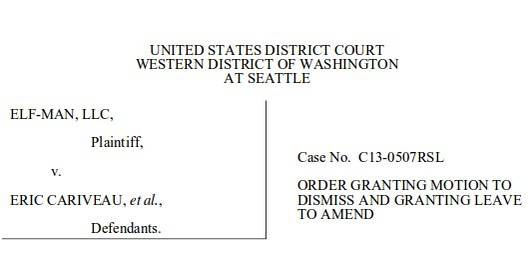
Fed judge rules that a downloader's IP address is not proof of identity

by Cory Doctorow

In a surprisingly sane ruling Washington District Judge Robert Lasnik found that an IP address is not sufficient evidence of the identity of a copyright infringer. The case involved the B-movie Elf-Man, whose production company have gained notoriety through trollish attacks on people alleged to have downloaded the movie over bittorrent.

Ruling on a motion to dismiss filed on behalf of one of the defendants, Judge Lasnik notes that part (b) is not a valid claim.

“[The movie studio] has actually alleged no more than that the named defendants purchased Internet access and failed to ensure that others did not use that access to download copyrighted material,” Lasnik states.

In other words, the complaint itself states that the account holder may not be the person who downloaded the movie, which isn’t enough to pursue the case.

“Simply identifying the account holder associated with an IP address tells us very little about who actually downloaded ‘Elf-Man’ using that IP address,” Judge Lasnik writes.

“While it is possible that the subscriber is the one who participated in the BitTorrent swarm, it is also possible that a family member, guest, or freeloader engaged in the infringing conduct,” he adds.

As a result, the defendant’s motion to dismiss was granted because the movie studio failed to state a claim for direct copyright infringement, contributory infringement and indirect infringement. The copyright holder is allowed to file an updated complaint, but doubts that the movie studio will be able to make a valid claim.

Judge: IP-Address Does Not Prove Copyright Infringement [Ernesto/Torrentfreak]


22 Jan 21:30

Toronto Mayor Rob Ford curses in a jafaican accent when he's loaded

by Cory Doctorow
spriteleigh

Read to the end; there's a remix

A video of Toronto Mayor Rob "Laughable Bumblefuck" Ford drunk and bellowing obscenities in a jafaican accent has surfaced. Ford, a luminously white and privileged man who was born into millions in a quiet suburb of Toronto, affects an embarrassing West Indian accent as he thunders to a captive audience at a west-end steak joint.

The subject of his rant was Toronto police chief Bill Blair, who instigated the long-running investigation into Ford's association with drug-dealers and gangsters, and which surfaced evidence that the mayor had smoked crack, driven drunk, and lied to the public and to council. In the video, Ford calls Blair "Cocksucking fucking Chief Blair."

He also says "bumbaclot." A lot.

When the scandal broke, Ford admitted to his drug use and swore he'd gone sober. But he told reporters who questioned him about this video that he was drunk, and that the events depicted in it were his "my personal life, with my personal friends, that's up to me. This really has nothing to do with you guys."

“I was with some friends and what I do in my personal life, with my personal friends, that’s up to me. This really has nothing to do with you guys,” Ford told reporters Tuesday afternoon.

The mayor wouldn’t address questions about his past claims that he quit drinking.

...The video could be damaging to Ford’s campaign for re-election, as he has staked his reputation to being clean and sober since November.

Ford “guaranteed” he has stopped drinking in interviews last year and told the CBC he had a “come to Jesus” moment about his drinking.

Oh, and there's a dancehall remix (Thanks, Andy!)

Rob Ford video shows ‘drunk’ mayor rambling and swearing in Toronto restaurant [Josh Visser and Natalie Alcoba]

(via Joey Devilla)


22 Jan 20:16

Fighting homelessness by giving homeless people houses

by Cory Doctorow


A program in Salt Lake City decided that it would be smarter -- and more humane -- to spend $11K/year each to house 17 chronically homeless people and provide them with social workers than it would be to waste the average of $16,670/year per person to imprison them and treat them at emergency rooms. As Nation of Change points out, this commonsense, humane and economically sound way of dealing with homelessness works, unlike the savage approaches taken by other cities (like the Waikiki rep Tom Bowker who smashed homeless peoples' carts with a sledgehammer, or cities like Tampa, which banned feeding homeless people).

Here's more on Utah's Housing First program.

Utah started a pilot program that took 17 people in Salt Lake City who had spent an average of 25 years on the street and put them in apartments. Caseworkers were assigned to help them become self-sufficient, but there were no strings attached – if they failed, the participants still had a place to live.

The “Housing First” program’s goal was to end chronic homelessness in Utah within 10 years. Through 2012, it had helped reduce the 2,000 people in that category when it began by 74 percent. Lloyd Pendleton, director of Utah’s Homeless Task Force, said the state is on track to meet its goal by 2015, and become the first state in the nation to do so.

...There’s no question that providing housing for the homeless is the right thing to do, for humanitarian reasons. But it also makes economic sense, so cities can spend less money and still help more people. In 2005, Utah did a study that found the average annual cost for emergency services and jail time for each chronically homeless person was $16,670. The cost to house them and provide case management services was only $11,000 per person.

Wyoming can give homeless a place to live, and save money [Kerry Drake/Wyofile]

(Image: Homeless Encampment, a Creative Commons Attribution (2.0) image from editor's photostream)


22 Jan 20:14

Canadian Recording Industry Association of America demands Internet censorship and control of search-results

by Cory Doctorow
Graham Henderson, the chief spokesjerk for Music Canada -- the voice in Canada for the big US labels represented by the RIAA -- wants Parliament to regulate the Internet, creating a regime of censorship and surveillance in the name of protecting Canadian musicians (whose worst enemy, it must be noted, are the labels who pay Henderson's handsome wages, and not the fans he wants to attack). Henderson wants to control search-engine rankings because, he claims, the first seven pages' of results for Canadian musicians are pirate sites. Only one problem: he's lying. (via /.)


22 Jan 20:11

Crowdfunding a global version of the zombpocalpse disaster-preparedness game

by Cory Doctorow

Jenny writes, "A few years ago I created a Zombie Apocalypse Training Game in San Francisco as a way to teach urban disaster preparedness skills through play. We armed players with smartphones and nerfguns, and they ran around the city completing challenges like "light a bbq without matches" or "bandage a burn wound" all while being chased by zombies. It was a huge success, and led to other local zombie disaster preparedness games. Now I'm working to develop this game nation-wide."

In the past 3 years, I have produced over 300 games around the world with The Go Game. I know how to design games for leadership development, teambuilding, skill training, marketing and just pure ridiculous fun. But my passion? Empowering communities through games.

I decided to apply for the Millennial Trains Project. If I get accepted onto the train in March, I can spend 10 days traveling across the country collecting data to design games that will address tornados, wildfires, floods and hurricanes.

Disaster Preparedness Gaming (Thanks, Jenny!)


22 Jan 20:10

On fanboys

by Rob Beschizza
That word, fanboys, is a thought-terminating cliché deployed to instantly drown and toxify good discussion. But there are certain areas of discussion where the presence of, um, irrationally loyal and hostile interlocutors warrants a good hard look at the psychology. Why do people get so mad about phones? At The Verge, Lessley Anderson dives in:
Anytime anybody in the universe says something negative about Microsoft, Brad Thorne* loses it. He fires up Twitter: “You’re fucking pathetic!... You have your head so far up your ass!... I can’t wait until you eat your smug words!” Thorne, a fortyish IT manager with a preppy wardrobe and shy grin, is actually a nice guy in person. He plays golf and enjoys spending time with his wife and step kids. He works as an IT director at a nonprofit charity organization in the South that’s run by nuns. He is not religious — unless you count his relationship with Microsoft, of course. “I’m a missionary,” says Thorne. “For me, it’s about being super passionate and super knowledgeable about their products, and not leaving that passion at the door when you leave work. You preach it all the time.”

Just as an aside: can we kill all the "Snowfall-style Feature" fanboys? Quickly, too.


22 Jan 19:59

Ukraine slides into full-blown dictatorship with brutal new law

by Cory Doctorow


(click for full)

Despite the valiant efforts of the motley opposition in Ukraine, the tame Ukrainian Parliament has passed a brutal law that slides the country into full-on dictatorship. Forbidden under the new law on penalty of high fines and imprisonment: driving cars in columns that are more than five vehicles long; setting up an unauthorized sound system; distribution of "extremist opinion"; "mass disruptions" (10-15 years imprisonment!); collecting information on police or judges; and more.

The new law also demolishes the trappings of democracy: you can be convicted in absentia based on unsubstantiated hearsay; MPs can be arrested during plenary sessions; the state can order arbitrary Internet censorship; and legal service of documents now consists of signatures or "any other data."


(click to embiggen)

(Thanks, Bob!)


22 Jan 01:46

JB Hi-Fi's Video Game Reviews Are Better Than Published Reviews

reviews,list,JB Hi-Fi,video games

Australian consumer electronics store JB Hi-Fi has some hilarious staff who love to give video games refreshingly honest reviews.

Submitted by: Unknown

22 Jan 00:32

Conan the Moderator

by Miss Cellania

Arnold Schwarzenegger is doing a reddit AMA (Ask Me Anything) this afternoon. This in itself is not all that shocking. Since the Governator did his first AMA, he's been fairly active in the fitness forums at reddit. But this time, the reddit admins offered him a job, a full-time position on their community team. I found this because they referenced our post on the banhammer.

And guess what? He accepted! Which inspired me to do this down-and-dirty image of the new reddit admin wielding the new banhammer. Yeah, I know it's crude, but I don't even have a graphics program anymore, so take it as the joke it is.   

(YouTube link)

Schwarzenegger recently went undercover at Gold's Gym to encourage people in their fitness regimen. As if he could fool anyone!


22 Jan 00:31

Aaron Swartz's family talk with documentarian Brian Knappenberger about "The Internet's Own Boy" on Democracy Now

by Cory Doctorow

The Internet's Own Boy is a documentary about the life and death of Aaron Swartz, and it just premiered at Sundance. Director Brian Knappenberger sat down with Democracy Now's Amy Goodman, as well as Aaron's father Robert and his brother Noah for a wide-ranging interview on Aaron and his work.

The Internet’s Own Boy: Film on Aaron Swartz Captures Late Activist’s Struggle for Online Freedom (Thanks, Noah!)


21 Jan 18:29

Interview: Allie Brosh

by The Geek’s Guide to the Galaxy
Allie Brosh is the creator of the popular webcomic Hyperbole and a Half. The comic, which mostly deals with funny stories from the author’s childhood as well as touching on more serious subjects, like her ongoing battle with depression, is intentionally drawn to look like something a child would create using Microsoft Paint, and has a devoted following with almost 400,000 likes on Facebook. A print version entitled Hyperbole and a Half: Unfortunate Situations, Flawed Coping Mechanisms, Mayhem, and Other Stuff that Happened is out now.
21 Jan 17:28

Neatolinks: Toy Story, Star Wars VII, Her and Game of Thrones

by Jill Harness
21 Jan 17:26

Dogecoin for Jamaican Bobsled Team

by Miss Cellania

On Sunday, the two-man bobsled team of Winston Watt and Marvin Dixon, representing Jamaica, qualified for the Olympics. That's all well and good, but being good enough doesn't mean they can afford the trip. But a group of internet supporters stepped in to help.

One of them was Liam Butler, who runs the Dogecoin foundation along with the currency's initial creators Jackson Palmer and Billy Markus. Dogecoin is a crypto-currency, based on a combination of bitcoin, the popular digital money, and Doge, the internet meme that superimposes broken English written in Comic Sans onto pictures of Shiba Inu dogs.

"As someone who grew up in the 90's, Cool Runnings was the ultimate feel good movie about underdogs out of their element achieving their dreams," Butler told the Guardian. "When I was about 7 years old, my best friend and I had a billy-cart that his dad built. When we would start our run down his driveway, we would shout out the catchphrase from the movie: 'Feel the rhythm, feel the rhyme, get on up, it's bobsled time!'"

On Monday in Sydney, where he lives, Butler launched Dogesled, aiming to raise some of the money required to send Watt and Dixon to Sochi. "We started without a concrete plan in mind," Butler says. "I sent a few emails out… but that was the extent of it."

The campaign raised 26 million Dogecoins. Trading was so heavy that the currency actually rose in value during the fundraiser! The result is that the foundation has the equivalent of $25,000 for the bobsled team, which should get them to Sochi.  -via Daily of the Day

(Image credit: Shitty Watercolour)

21 Jan 04:30

Internet Archive looking for software to extract political ads from TV archives

by Cory Doctorow


With election season coming up, the Internet Archive is looking to publish collections of political ads from earlier US campaigns. They have a massive archive of digitized US TV footage, along with searchable full-text closed captions. Now they're hoping someone can point them to some software to auto-extract the political ads from the corpus.

Volunteers needed: We have a fabulous TV collection, and the US is going into an election period. We would like to pull out the TV Commercials, including the political ads, and match them with the other occurrences, and then put names on them. Then we and others can datamine and surface this information.

We hope we could find all ads so we can know when and were they ran. We would like to not just limit this to political ads because sometimes the ads are the best parts of shows, and many ads are stealthy-political.

To help in this process, we have closed caption transcripts of what is said in US TV as well as full resolution TV recordings. We also often have a rebroadcast of the same program which would likely then have different commercials. We do have to be careful with this data so, we would like to run this locally in our virtual machine “virtual reading room“.

Software Wanted: Political TV Commercial Detection and Naming [Brewster Kahle/Internet Archive]


21 Jan 00:24

Hand-painted murals as animated GIFs

by David Pescovitz

Street artist INSA paints and photographs multiple variations of his murals and then creates mind-bending animated GIFs from the photos. More examples below! "INSA's GIF-ITI" (via Hi-Fructose)


20 Jan 17:24

Dr. V's suicide and journalistic ethics

by Rob Beschizza

Last week, Caleb Hannan wrote an article about a clever new golf club and its inventor, Dr. Essay Vanderbilt. Starting out as a profile, it briefly covers the scientific claims behind the design and Dr. V's eccentricities and pretensions. We learn, ultimately, that Dr. V defrauded investors, though none of those quoted seem terribly bothered about it. We also learn that she was a trans person. Finally, at the end, we learn she killed herself, shortly after Hannan notified her of her imminent outing in the press.

Initially achieving some praise, Hannan's story was soon criticized. Critics noticed how anxiously and quietly V's suicide was footnoted away, and how Hannan weaved discussion of her trans status into discussion of her fraudulent business activity. Slate's Josh Levin says that it privileged fact-finding over compassion. At The New Republic, Marc Tracy identifies more problems. Here's Bronwen Clune, at The Guardian:

It’s not right to say that Hannan is responsible for Vanderbilt’s suicide, as many are now doing – the issues around suicide and mental health are too complex for that. However, the pursuit of the subject in the way Hannan did was misguided and lacking in compassion or understanding of his subject. As a result, the piece reads like the ego trip of someone who does not understand his role, nevermind his power, as a journalist. ...

Hannan employed transparency in his detailed, first person writing style as a journalistic device employed to make him seem accountable. But here’s the thing: as journalism moves to a more commendable open format, transparency does not absolve responsibility. There needs to be some deeper thinking on what constitutes ethically responsible journalism in the age of transparency. We cannot hide behind it as a defence when our actions are wrong – they are wrong whether behind closed doors or out in the open. Hannan’s piece should never have been published; there was no obvious news interest outweighing Vanderbilt's right not to be outed.

A common suggestion is that you could just point out that Dr. V changed her name, and that this stymied efforts to research her past. But that still exposes her trans status (because the old name was masculine) or demands the writer be clever about hiding it. In any case, the writer would know that publishing a news article about possibly-criminal activity would generate intense further scrutiny of his subject. Whether or not anything about Dr. V was legitimately newsworthy, any mainstream story about Dr. V was likely to end in her exposure, even if it did not expose her.

Another thing: critics keep saying that Hannan's article was great storytelling, hiding terrible ethics. No. It's a lurid mess. It's written and paced like a 90's-era daytime TV thriller, copying the structural and sensational qualities of other works without caring for how and why they work.

Take, for example, how he waits until the end of the story to inform the reader of Dr. V's suicide, her life's final and most tragic fact. He puts it in "Act 3" in an attempt at epic climax and denouement, but it comes over as an anxious footnote. Why? Because the author has made himself the protagonist, but can't take responsibility for his personal involvement in Dr. V's life and death, as the story he's trying to write would demand of him.

In this imaginary TV movie, we wouldn't see Dr. V's final moments. We'd see his face instead, the intrepid reporter, deflated and shocked by the tragic news that he's listening to on the phone. The sad, heartwrenching, awful, Pulitzer-winning truth. Bad movie, right? Notwithstanding his ethics, Hannan's storytelling here is bad in exactly the same way: because the readers don't care about Caleb Hannan's Quest for Truth.

They care about golf clubs. And people.


19 Jan 21:00

Copyright must accomodate free expression

by Cory Doctorow

Here's another great post from the Electronic Frontier Foundation in honor of Copyright Week, explaining the relationship between copyright and free expression. Copyright is a monopoly on speech -- the right to decide, within limits, who can express themselves with certain words, tunes, and images -- so it's important that the law be structured so that monopoly doesn't jeopardize free debate and artistic expression.

Arts groups often have a blind spot here, staunchly defending free speech right up until it conflicts with copyright, and then stopping dead. But if you support free speech except where it conflicts with copyright, then your free speech movement is practically irrelevant to the age of the Internet, since all expression on the Internet involves making copies, and thus interacting with copyright.

Or as EFF's legal director Cindy Cohn likes to say, "We know you love the First Amendment, but we want you to share."

It's hard to look in the mirror and see what you fear. It's easier to deny it or try to explain it away. That's why many supporters of ever-more-restrictive copyright law insist so emphatically that copyright never suppresses speech. Copyright rewards and enables speech, they say, therefore it cannot be a tool of censorship.

This is a little like saying that because X-rays are used to treat cancer, they can never cause cancer. Of course, X-rays can both treat cancer and cause it, depending on the dose and accurate targeting. Copyright is likewise: well-crafted, appropriately limited, it may reward and strengthen creativity. Applied carelessly and indiscriminately, it punishes and suppresses creativity.

In the American legal tradition, there are only a few narrow categories of self-expression that are not protected by the First Amendment's guarantee of free speech, and those categories are not permitted to grow. Yet when the mouthpieces of Big Media insist that our guarantees of free speech do not limit the scope of copyright law, they are inviting the creep of censorship that so many creative people have fought against. It's dangerous to treat copyright as a special exception to free speech, no matter how passionate and heartfelt the cries of "piracy!" Those who would use the law to silence speech that they call libel, sedition, blasphemy, hateful, hurtful, disquieting all make passionate cases for why they need special treatment. They argue that suppressing "bad" speech promotes harmony, order, happiness, and even prevents violence, arguably the most important function of any government (not that censorship actually prevents violence, but that's the argument and it's appealing to many). Copyright is no different. The Russian government has used claims of copyright infringement to silence the independent press. People the world over misuse the U.S. Digital Millennium Copyright Act to make others' political viewpoints disappear.

EFF has six principles for copyright week that you can sign onto.

Copyright Shouldn't Be Free Speech's Blind Spot


18 Jan 19:21

Tim Wu on FCC's net neutrality disaster

by Cory Doctorow

Tim Wu is the law professor and activist who coined the term "net neutrality" -- the principle that ISPs should get you the data you request, as efficiently as they know how, without deliberately slowing down some sites unless they've paid bribes for "preferred carriage." The FCC had made a halfhearted and legally doomed rule to protect American net neutrality, refusing to use its full regulatory power for fear of offending the powerful telcoms corporations it is meant to regulate.

A recent court decision struck down the FCC's rule, confirming critics' fears about the weakness of the FCC's legal position. Now, in a Washington Post interview, Wu explains what a blunder the FCC made (he calls it "a FEMA-level fail") and sets out the next steps the Commission should take if it is to ameliorate the consequences of its timidity and deference to the telcos:

They blew it on the legal strategy. It's a big fail. It's like, FEMA-level fail. Every legal expert told the FCC they're going to lose this case, and they did. It reminds me of the Bush administration, where everyone said the problem in Iraq isn't going to be the invasion — it's going to be in the aftermath.

Think of it this way: The FCC is like a battleship, and it has these enormous guns. But it decided to use a water pistol for this particular issue. Or, put differently: The FCC is like a car with a massive engine, and they decided not to use the engine but rather the bicycle that was attached to the car.

What could the FCC have done differently?

The obvious alternative would have been to do what the FCC should have done and — in the future tense — now should do, which is to reclassify broadband under Title II authority.

‘A FEMA-level fail’: The law professor who coined ‘net neutrality’ lashes out at the FCC’s legal strategy [Brian Fung/Washington Post]

(via Interesting People)


18 Jan 19:20

Glenn Greenwald appears on Bill Maher (who calls Edward Snowden "totally batsh*t")

by Xeni Jardin
On last night's episode of Bill Maher's returning HBO program, this interview with Glenn Greenwald was almost upstaged by an intoxicated Mary Matalin. Maher admitted that he doesn’t like how every time Edward Snowden speaks, he comes out saying “something completely nuts.”


18 Jan 19:07

Random NSA program generator, with denials

by Cory Doctorow

The NSA-O-Matic generates eerily plausible leaked NSA programs at the click of a mouse, including non-denial denials from NSA shills and spokesjerks. For example "STUMPVIEW, a searchable database that bugs conversations within earshot of laptop microphones. Senator Dianne Feinstein assured the public that the program discards information as soon it is determined to be irrelevant." It's hosted on Github and ready for your forking and contributions.

Recently released NSA documents revealed the existence of BEACHCROSS, a searchable database that spies on social networking profiles. General Keith Alexander, Director of the National Security Agency, assured the public that the program was approved by the House and Senate Intelligence Committees.

Recently released NSA documents revealed the existence of MADCAPFINDER, a surveillance program that cracks certificate authority keys. An anonymous administration source assured the public that the program discards information as soon it is determined to be irrelevant.

Recently released NSA documents revealed the existence of FACEPUZZLE, a massive database that does a man-in-the-middle attack on traffic from major internet exchanges. James Clapper, the Director of National Intelligence, assured the public that the program discards information as soon it is determined to be irrelevant.

NSA-O-Matic (via Schneier)


18 Jan 18:34

Spirited Away Sets Re-Created In Minecraft

by Zeon Santos

(Video Link)

Hayao Miyazaki has become a household name because his animated features are some of the best in the biz, and fans particularly enjoyed Spirited Away, the story of a young girl who encounters mythological creatures and spirits out of Japanese folklore as she tries to find a way to save her family.

One such fan is animator Alan Becker, who is showing his love of Miyazaki by re-creating the world of Spirited Away in Minecraft. His designs are spot on and just as colorful as the originals, and even though he claims to be only 80% done with his virtual sets they already look 100% awesome!

Via Geek Tyrant

18 Jan 18:23

Famous Movie Quotes as Charts

by Miss Cellania

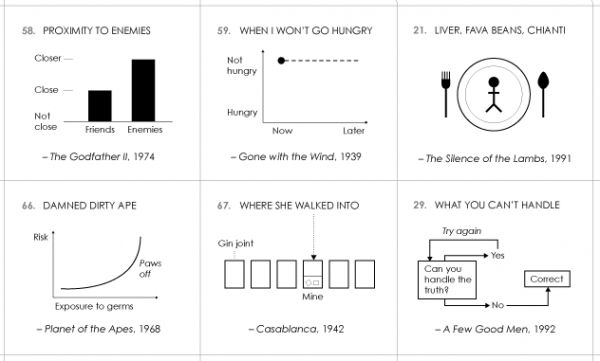
A few years ago, we showed you some charts that Dr. Nathan Yau of Flowing Data made out of movie quotes. He made eight of them, but he meant to chart all 100 of the American Film Institute's 100 most memorable movie quotes. He finally revisited the project and now has completed all 100! The thing is, you won't exactly find the quote in the chart …in words. But you won't have any trouble figuring them out. See the full-size chart of charts here. -via Geeks Are Sexy

18 Jan 05:18

Congress requires publicly funded research to be publicly available

by Cory Doctorow

The new Omnibus Appropriations Bill, which Congress passed yesterday, contains an important -- and fantastic -- provision: it requires that scientific research funded by the Departments of Labor, Health and Human Services, and Education be placed in a free online repository within 12 months of their publication in a peer-reviewed journal.

There are some caveats (this only covers research from agencies with budgets of $100M or more) and it could have been better (immediate publication and all work placed in the pubic domain), but this is still a major stride forward. To be frank, it's well beyond what I'd hoped we'd get from Congress, who are traditionally more than willing to let private firms wall away pubic access from the research that tax-payers fund.

Here's the inside dirt from the Electronic Frontier Foundation's Adi Kamdar:

This is big. Previously, the National Institutes of Health was the only government agency with a statutory public access mandate. Last year, the White House Office of Science and Technology Policy (OSTP) made moves in this direction by requiring agencies with similar research budgets to formulate, and eventually implement, their own public access policies. While the OSTP memorandum was a heartening step in the right direction, ultimately these crucial practices must be set down in the law, so they cannot be decimated at the whim of a future presidential administration.

Having another public access law on the books is surely cause for celebration—and hats off to all of those who have been fighting the open access fight—but we shouldn't stop here. Ultimately, we want to make sure that the public has full access to taxpayer funded research.

The Fair Access to Science and Technology Research Act (FASTR) would go beyond the provisions laid out in the Omnibus bill by mandating a six-month embargo until research funded by a larger number of departments and agencies is made publicly available online.

Contact your members of Congress today and tell them to support FASTR.

Newly Passed Appropriations Bill Makes Even More Publicly Funded Research Available Online


18 Jan 00:58

Bitcloud: Bitcoin-like "distributed autonomous corporations" that replace Youtube, Facebook, etc

by Cory Doctorow


Some Bitcoin enthusiasts have announced a new project called Bitcloud. The idea is something like the old Mojo Nation P2P architecture, in which individual Internet users perform tasks for each other -- routing, storage, lookups, computation -- in exchange for very small payments.

The Bitcloud protocol uses Bitcoin-style accounting to allocate those microtransfers, along with Bitcoin-style proof-of-work (they call it "proof-of-bandwidth") and the authors suggest that the potential for profit by individual members will create enough capacity to replace a large number of centralized commercial services ("Youtube, Dropbox, Facebook, Spotify, ISPs") with "distributed autonomous corporations," that obviate the need for centralized control in order to supply anonymous, robust, free services to the public.

The idea is an interesting thought-experiment, at least. The idea of "agorics" -- using market forces to allocate resources on the Internet -- is an old one, and I remain skeptical that this produces optimal outcomes. That's because its proponents seem to treat market efficiency as axiomatic ("everyone knows markets work, and that's why we should make them the basis of network resource allocation") and their proposals are substantially weakened if you don't accept the efficient market hypothesis.

The Bitcloud protocol is a decentralized application that provides the services of cloud storage and bandwidth sharing. Users will interact with this service in a variety of different ways, but the main idea behind the protocol is that people will be able to store data in the cloud in a way that limits censorship, surveillance, and centralization. Moderators and nodes are providing a service to their users, and they need to be paid to cover their costs. Cloudcoins are the currency of the Bitcloud protocol, much like bitcoins are the currency of the Bitcoin protocol. You need bitcoins to use the Bitcoin payment system, and you need cloudcoins to use Bitcloud in certain ways. For example, someone who wants to advertise on a public video that is streamed from a Bitcloud node will have to pay for that advertisement in cloudcoins. Another example would be someone who wants to pay for personal cloud storage on the Bitcloud network. By monetizing the system, nodes can get paid for their willingness to share bandwidth, provide cloud storage, and allow for direct streaming to stored content. Adding the profit motive to the equation gives this project a chance to succeed where many others have failed in the past. Donations can only take you so far when you are trying to create something of this magnitude.

We want to replace YouTube, Dropbox, Facebook, Spotify, ISPs, and more with decentralized apps based on proof of bandwidth. We need developers. Welcome to Bitcloud. (self.Bitcoin) (Thanks, Freemore!)

(Image: Clouds, a Creative Commons Attribution (2.0) image from nirak's photostream)


17 Jan 22:00

You bought it, you own it, right?

by Cory Doctorow

In the latest Electronic Frontier Foundation post for Copyright Week, Corynne McSherry tackles one of the most troubling aspects of modern copyright law: the idea that even though you've bought a device or a copyrighted work to play on it, they're not really your property. Because of the anti-circumvention rules (which are supposed to backstop "copy protection"), it's illegal to discover how your technology works, to tell other people how their technology works, to add otherwise lawful features to your technology, and to make otherwise lawful uses of your media.

You bought it, you own it, right? Not always. Over the past decade, we have been quietly shifting to a world in which both digital goods (like mp3s, video files, and ebooks) and physical goods that contain software (like cars, microwaves, and phones) are never truly owned, but only rented.

Not to worry, say big copyright holders; people don’t want to be owners, because all they really care about is “access,” and more and more content is being made “accessible” in more and more ways. Sure, you might have to pay a premium for the “privilege” of, say, watching the movie you “bought” on more than one device, but no one’s forcing you to do it. Besides, they tell policymakers, just give us more tools to punish unauthorized uses and we promise to build more “authorized” channels – as long as users are willing to pay for them.

There are a lot of reasons they are wrong. Here's just a few:

First, most people have no idea that all they bought was a license. After all, the button they clicked on the Amazon site said "Buy," not "Rent." Little do they know that Amazon has the right to (for example) remotely delete books from their library, without notice, at Amazon’s whim. Or that the holiday special they were planning to see might suddently become "unavailable."

The Copyright Week campaign comes with six principles for you to sign up to.

You Bought It, You Own It! Time to Reclaim the Right to Use/Tinker/Repair/Make/Sell/Lend Your Stuff


17 Jan 19:13

This Battle Between LEGO Thor and Loki is Better Than Half of the Marvel Movies

Submitted by: Unknown

17 Jan 18:50

Dojo of Death is an addictive, ultraviolent browser game

by Rob Beschizza

Dojo of Death, by Nico Tuason, is an addictive browser game you can pick up in ten seconds. Your man walks toward the mouse pointer; click to launch a lunging attack in that direction. Enemies spawn in the single-room game, and will overwhelm all but the best of us in a minute or two. I managed to get to 74 -- can you beat it? As Nathan Grayson writes at RPS, the feel of the game is so good that one hopes for a more fully-featured, roguelike sequel. [Kongregate via RPS]


17 Jan 18:33

NSA harvests 200M of SMSes every day with untargeted, global "Dishfire" program

by Cory Doctorow

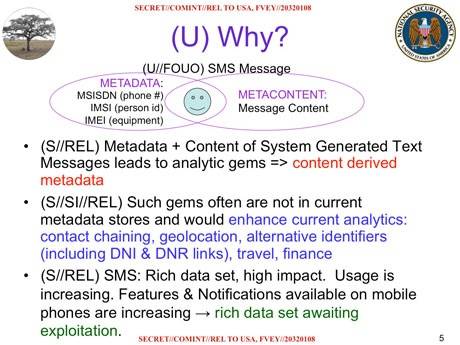
The latest Snowden leak details DISHFIRE, a joint NSA/GCHQ program to slurp up hundreds of millions of SMS messages from global mobile phone users. Included in the program are text messages to and from Americans, though these are apparently subsequently purged. The UK spy agency GCHQ also makes extensive use of the database. Text messages are stored for long terms, so that spies can do historic lookups on people they target. The DISHFIRE database allows for full-text search.

Vodaphone expressed shock and outrage at the news that its customers' private messages were being harvested without a warrant or due process, characterising the program as outside the law.


“In contrast to [most] GCHQ equivalents, DISHFIRE contains a large volume of unselected SMS traffic,” it states (emphasis original). “This makes it particularly useful for the development of new targets, since it is possible to examine the content of messages sent months or even years before the target was known to be of interest.”

It later explains in plain terms how useful this capability can be. Comparing Dishfire favourably to a GCHQ counterpart which only collects against phone numbers that have specifically been targeted, it states “Dishfire collects pretty much everything it can, so you can see SMS from a selector which is not targeted”.

The document also states the database allows for broad, bulk searches of keywords which could result in a high number of hits, rather than just narrow searches against particular phone numbers: “It is also possible to search against the content in bulk (e.g. for a name or home telephone number) if the target’s mobile phone number is not known.”

Analysts are warned to be careful when searching content for terms relating to UK citizens or people currently residing in the UK, as these searches could be successful but would not be legal without a warrant or similar targeting authority.

However, a note from GCHQ’s operational legalities team, dated May 2008, states agents can search Dishfire for “events” data relating to UK numbers – who is contacting who, and when.

NSA collects millions of text messages daily in 'untargeted' global sweep [James Ball/The Guardian]

(Thanks, Sergei!)


17 Jan 06:30

Copyright troll dodging disbarment by resigning from the bar?

by Cory Doctorow

John Steele is the colorful copyright troll whose work in shaking down people by threatening to link their names to gay porn with spurious lawsuits has been augmented by a series of bizarre legal maneuvers, including allegedly stealing his caretaker's identity in order to create a disposable buffer between Steele and his operation.

But he's got a new wheeze that takes the cake: He's voluntarily given up his Illinois bar card, seemingly in order to avoid disbarment -- at least, that's Fight Copyright Troll's theory. It's a kind of auto-disbarment that seeks to avoid the special consequences that befall officers of the court who play games with the law.

How to avoid disbarment? Disbar yourself!


17 Jan 06:30

"This really was an extraordinary thing."

by Patrick Nielsen Hayden
Bruce Schneier, "Today I Briefed Congress on the NSA": This morning I spent an hour in a closed room with...