Shared posts

28 Sep 12:03

[Vídeo] Robot resuelve el Cubo de Rubik en un segundo

by Sergio Parra

kHasta ahora, un autómata llamado Ruby, fabricado por estudiantes de la Universidad de Tecnología Swinburne (Australia), conseguía resolver el cubo de Rubik en menos de 10,69 segundos. Sin embargo, todavía no había alcanzado a los humanos: Feliks Zemdegs lo consiguió en 6,24 segundos en el Kubaroo Open en 2011.

Hasta ahora: un robot consigue rebajar el tiempo a poco menos de un segundo. Para lograr esta proeza, sólo necesita escanear durante unos segundos el cubo hasta determinar qué posición exacta ocupan cada una de las pegatinas de colores.

Vía | AbadíaDigital

-
La noticia [Vídeo] Robot resuelve el Cubo de Rubik en un segundo fue publicada originalmente en Xatakaciencia por Sergio Parra.

25 Sep 07:21

Bot & Dolly: Box

by Justin Cone

“Box,” a new short film/performance from design and engineering studio Bot & Dolly produced in association with The Creators Project, takes projection mapping, well — out of the box.

Just to make sure you understand what you’re seeing: The above video is documentation of a live performance. I’ve been assured there was no compositing in post-production. It’s all live.

Bot & Dolly calls their combination of robotic arms and projection mapping a “kinematic projection platform.”

Tarik Abdel-Gawad, Creative Director at Bot & Dolly explains the setup: “Through large-scale robotics, projection mapping and software engineering, audiences will witness the trompe l’oeil effect pushed to new boundaries.”

For the animated content, Bot & Dolly brought on none other than Bradley G Munkowitz, no stranger to Motionographer. His trademark attention to detail is on full display in every frame of the project.

Update: I neglected to give props to the outstanding work on the music and sound design from Keith Ruggiero/Sounds Red. Without audio, there’d be little motivation for the performance.

Interview coming soon…


Production Company: BOT & DOLLY
Executive Producers: Bill Galusha, Nick Read
Executive Creative Director: Jeff Linnell
Creative & Technical Director: Tarik Abdel-Gawad
Design Director: Bradley G Munkowitz
Lead Graphic Designers: Bradley G Munkowitz, Jason English Kerr
3D Artists: Scott Pagano, Bradley G Munkowitz, Jason English Kerr, Conor Grebel
2D Artists: Conor Grebel, Ben Hawkins, Pedro Figuera
Director of Photography: Joe Picard
Lighting Designers: Joe Picard, Phil Reyneri
Projection / Touch Designer: Phil Reyneri
Robotics Animation: Tarik Abdel-Gawad, Brandon Kruysman, George Banks, Michael Beardsworth
Robotics Operator: Michael Beardsworth, Brandon Kruysman
Prop Fabrication: Matt Bitterman, Ethan Dale
Script Supervisor: Ian Colon
Sound Engineers: Joe Picard, Michael Beardsworth
PAs: Sean Servis, Dakota Smith, Nico Mizono, Eric Wendel, Patrick Walsh
Editors: Ashley Rodholm, Ian Colon
Music / Sound Design: Keith Ruggiero
Sound Mix: Joel Raabe
Performers: Tarik Abdel-Gawad, Iris, Scout

=

Posted on Motionographer

16 Sep 09:04

Crean minicerebros de laboratorio a partir de células madre humanas

by Kanijo

Artículo publicado el 28 de agosto en SINC

Un equipo de científicos europeos ha desarrollado un sistema para producir ‘organoides cerebrales’ a partir de cultivos de células madre. El resultado es un tejido en 3D similar a las primeras etapas del cerebro humano, lo que permite estudiar su evolución y las enfermedades asociadas, como la microcefalia.

El desarrollo del cerebro humano es uno de los grandes misterios de la biología, pero un grupo de investigadores austriacos y británicos presentan esta semana en Nature una técnica para generar tejido cerebral que ayudará a avanzar en su estudio.

Sección de un 'organoide cerebral'

Sección de un ‘organoide cerebral’ con regiones diferenciadas. En rojo se observan células madre neuronales y en verde, neuronas. Crédito: Madeline A. Lancaster


El equipo, liderado desde el Instituto de Biotecnología Molecular (IMBA) de la Academia Austriaca de Ciencias, ha conseguido crear ‘organoides cerebrales’ partiendo de un cultivo de células madre pluripotentes. Estas se pueden obtener de embriones humanos o reprogramarse a partir de células adultas.

“Hemos generado un ‘neuroectodermo’, una capa de células de la que se deriva el sistema nervioso”, destaca el autor principal, Jürgen Knoblich, del IMBA. “Luego, los fragmentos de este tejido se mantienen en un cultivo tridimensional y se embeben en gotas de un gel que actúa de andamiaje para que pueda crecer”.

“Para favorecer la absorción de los nutrientes –continúa–, transferimos después las gotas de gel a un biorreactor giratorio, y en unas tres o cuatro semanas ya están formadas y definidas las regiones cerebrales”.

Regiones cerebrales diferenciadas

En los ‘organoides cerebrales’ resultantes se pueden diferenciar regiones como corteza cerebral, retina, meninges o el plexo coroideo (porción del encéfalo que forma el líquido cefalorraquídeo).

Después de dos meses de desarrollo, los minicerebros alcanzan su tamaño máximo, aunque pueden sobrevivir indefinidamente –en la actualidad hasta 10 meses– en el biorreactor giratorio.

Según los investigadores, probablemente, y de momento, no crecen más debido a la falta de un sistema de circulación eficaz que lleve los nutrientes y el oxígeno al interior del organoide.

En cualquier caso, estos tejidos cerebrales en 3D se asemejan a las primeras etapas de formación del cerebro humano, por lo que facilitan los estudios sobre la evolución de este órgano esencial.

Además, el método permite estudiar algunas enfermedades neurológicas humanas de una forma que no lo hacen los modelos con ratas u otros animales de laboratorio, cuyo cerebro es menos complejo.

En concreto, los investigadores han logrado identificar y modelar con su técnica un trastorno que afecta el desarrollo normal del cerebro: la microcefalia, que conduce a tener un cerebro más pequeño en las personas que lo padecen.

Los autores sugieren que las células defectuosas que aparecen en los pacientes no experimentan el mismo crecimiento en los ratones, lo que podría explicar por qué los modelos en animales han sido incapaces de recoger la gravedad de este trastorno como se observa en los seres humanos.

“Me parece una técnica muy creativa e interesante, y mi predicción es que este nuevo enfoque tendrá un impacto importante en el futuro”, concluye para SINC el neurobiólogo español Rafael Yuste, de la Universidad de Columbia (EEUU), que colidera el proyecto BAM/BRAIN para crear un mapa detallado de la actividad cerebral, financiado por la administración Obama con 100 millones de dólares.


Referencia bibliográfica: Madeline A. Lancaster, Magdalena Renner, Carol-Anne Martin, Daniel Wenzel, Louise S. Bicknell, Matthew E. Hurles, Tessa Homfray, Josef M. Penninger, Andrew P. Jackson, Juergen A. Knoblich. “Cerebral organoids model human brain development and microcephaly”. Nature 500: 7464, 29 de agosto de 2013. Doi:10.1038/nature12517.

Fecha Original: 28 de agosto de 2013
Enlace Original

Comparte:PrintDiggStumbleUpondel.icio.usFacebookTwitterGoogle BookmarksBitacoras.comIdenti.caLinkedInMeneameNetvibesOrkutPDFRedditTumblrWikio

This page is wiki editable click here to edit this page.
10 Sep 09:58

You Haven't Seen Hang-Gliding Like This Before

Submitted by: Unknown

Tagged: hang gliding , sports , whee , funny , Video , g rated , win
10 Sep 09:28

Visual Studio 2013 RC Now Available

by Eric Battalio

A few minutes ago, Soma announced the Release Candidate of Visual Studio 2013, .NET Framework 4.5.1 and Team Foundation Server 2013. Also announced was the Virtual Launch date – November 13th, 2013:

The RC release is the next big step toward the release of Visual Studio 2013. Today I am also excited to announce that Visual Studio 2013 will RTM at Windows 8.1 GA and the Visual Studio 2013 Virtual Launch will be held on November 13th, 2013! Available online around the world, more details can be found on the virtual launch event on the events page.

If you missed the preview, here are some of the cool things in this release for C++ developers:

  • Support for the C++11 =default, =delete, NSDMI and alias templates
  • Supports ISO C11 language features including _Bool, compound literals, designated initializers, and mixing declarations with code.
  • C++ AMP Texture support is enhanced.
  • Auto-Vectorizer now recognizes and optimizes more C++ patterns to make your code run faster.
  • New Profile Guided Optimization for Windows Store app development.
  • Support for native/JavaScript interop debugging, Windows Runtime exception diagnosis, and async code debugging (both Windows Runtime and PPL).
  • Graphics and GPU Debugging Improvements.
  • Defaulted functions.
  • Enhanced code formatting.

For a complete list of what is in Visual Studio 2013 RC for C++ developers, visit the MSDN library (or watch this video). For a peek into the future of C++, see Herb Sutter's BUILD talk. He and others also spoke at Going Native 2013 – swing by the site later this week and catch the video!

Your feedback is important. Download Visual Studio 2013 RC, kick the tires for a bit, then send us your thoughts through the usual channels.

Feedback can also be sent from within Visual Studio using the menu in the top-right corner of the IDE (send a smile, send a frown, or report a bug).

Thanks!


09 Sep 07:40

Grid 2 trailer shows the twisted metal of Demolition Derby

by Phil Savage

It’s Friday afternoon and, while that’s no guarantee of where (or when) you’ll be reading this from, as far as I’m concerned, it’s a time for relaxing. And what better way to enjoy the end of the work week than with a bunch of cars smashing all up into each other?

Alternatively, what better way to take out your still-working frustration, than with a bunch of cars smashing all up into each other? That’s what you’ll get with Grid 2′s Demolition Derby update, which has now been trailerated.

The Demolition Derby update, which you can read about here, is out now.

It’s far from the only “cars smashing up into cars” action we’ve had recently, either. Bugbear’s crunchy Next Car Game is still crowdfunding, and alpha physics thing BeamNG still looks gorgeous (and deadly). Seriously, look at it:

Physics!

The post Grid 2 trailer shows the twisted metal of Demolition Derby appeared first on PC Gamer.


05 Sep 09:16

Going Native 2013 - Day 1

by Eric Battalio

Going Native kicks off today!

If you made it to Redmond to attend, I look forward to meeting you. If you could not make it this year, you still have a front via Channel 9.

Here is day one content:

To see the entire schedule, visit the Going Native 2013 page on Channel 9.

Cheers!

02 Sep 12:11

Proyecto Humano Visible: la primera referencia visual detallada del interior humano está basado en un criminal

by Sergio Parra

dEn 1998 se llevó a cabo una tarea titánica por parte de la Biblioteca Nacional de Medicina de Estados Unidos. Es pocas palabras: tomaría un cadáver humano, lo cortaría a rebanadas muy finas y finalmente lo fotografiaría para ensamblar la primera referencia visual detallada del interior humano basado en un cuerpo real.

Antes de iniciar este proyecto, sin embargo, debía escogerse el cuerpo. Y el escogido fue un criminal convicto.

asCondenado a muerte por robo con allanamiento y asesinato, Joseph Paul Jernigan, de Waco, Texas, fue ejecutado en 1993 mediante la inyección de una dosis letal de cloruro potásico. Días antes de su muerte, sin embargo, incitado por el capellán de la prisión, se le sugirió que firmara un formulario para donar su cuerpo a la ciencia.

Jernigan lo hizo. Sin embargo, donar sus órganos no era útil porque estarían envenenados por el cloruro potásico, de modo que donó todo su cuerpo sin saber que se convertiría en el primer modelo representativo para la medicina.

A pesar de que su conducta moral era cuestionable, lo cierto es que el cuerpo de Jernigan era perfecto en tanto en cuanto no padecía ninguna enfermedad desfiguradora ni había estado sometido a cirugía mayor. Con todo, no era un cuerpo tan perfecto como se creía (aunque se hizo un poco la vista gorda): había padecido una apendicectomía y le faltaba un diente.

Las imágenes del cuerpo Jernigan fueron colgados en una página web en 1994, por parte de la Biblioteca Nacional de Medicina, tras haber sometido aquel cuerpo al proceso que detalla Hugh Aldersey-Williams en su libro Anatomías:

registrado como una serie de imágenes de resonancia magnética como referencia. Después fue congelado y escaneado de nuevo. Una vez solidificado, el cuerpo fue cortado secuencialmente en planos paralelos a los usados en los registros de MRI, separados por un milímetro entre ellos, y las secciones expuestas se fotografiaron. El tejido que se rebanaba cada vez se reducía a “serrín”.

Aquel mapa detallado del cuerpo humano correspondía a un hombre. ¿Dónde estaba la representante femenina? Se añadió un año más tarde. Permanece anónima, y es conocida simplemente como un “ama de casa de Maryland” que falleció de un ataque cardíaco a los 59 años de edad. Adán y Eva a nivel anatómico.

La Biblioteca Nacional de Medicina preveía que el Proyecto Humano Visible beneficiaría principalmente a los estudiantes de medicina, pero las descargas han sido mucho más amplias, siendo otras muchas personas las que han encontrado la idea de la visualización demasiado potente para resistirse, y que producen sus propias imágenes de exploración a lo largo de los vasos sanguíneos, o atlas de partes relevantes para sus especialidades concretas.

Al igual que el Proyecto del Genoma Humano, el Proyecto Humano Visible aspira a ser, en comunión con el primero, un “archivo exhaustivo de información humana”, en palabras de la científica social australiana Catherine Waldby. Un criminal y una ama de casa. Adán y Eva a nivel anatómico.

-
La noticia Proyecto Humano Visible: la primera referencia visual detallada del interior humano está basado en un criminal fue publicada originalmente en Xatakaciencia por Sergio Parra.

31 Aug 09:53

C++ IDE Improvements in Visual Studio 2013

by Jennifer Leaf [MSFT]

When we considered what features to add to the C++ IDE in Visual Studio 2013, we decided to focus on improving the C++ code editing experience. We've added a number of features that will help you write and format your code more quickly, and will give you more useful information in IntelliSense. You can configure the behavior of most of these new features using the Options dialog from the Tools menu.

Code Formatting

One of my biggest frustrations with the C++ editor in Visual Studio over the past several years has been the lack of formatting when I pasted code into the editor. Combined with the lack of many common code formatting settings, this meant I spent quite a bit of time making my code look how I wanted, rather than actually writing new code.

In Visual Studio 2013 we added over 40 settings to help you control when and how your C/C++ code is formatted. We realize that there are many common formatting conventions for C/C++ code, so rather than dictate a single style of code formatting, we aim to give you the flexibility to adapt the settings to match your existing coding standards.

In some cases, we know that none of the options provided might be what you want. One particular example of this is controlling the exact position of opening curly braces for various block types. For these settings, we added an option to not apply a particular formatting rule so that you can control a particular aspect of your code formatting without needing to turn off formatting globally.

It's also possible to take advantage of code formatting without applying it automatically – simply go to the Text Editor -> C/C++ -> Formatting -> General page in the Options dialog, and uncheck all the boxes to turn off the auto-formatting behavior. You can then manually format your code using the Format Document and Format Selection commands from the Edit -> Advanced menu. This can be helpful if different areas of your codebase use different formatting standards, or if you need to make changes to 3rd party library code in your solution.

IntelliSense Improvements

We made some changes to Member List and Parameter Help so they provide more relevant information.

The Member List window now hides private members of types, except when you're editing code that defines the type.

The Parameter Help tooltip that appears when typing parameters of an overloaded function will now automatically switch to the best matching overload based on the number of parameters you've typed thus far. And it properly handles nested function calls – when you start typing a nested function call, Parameter Help will display results relevant to the nested call, then restore the contents of the tooltip to the outer function call when you close the argument list.

Small Changes that make a Big Difference

Have you ever used the "Go To Header File" command from the editor context menu? Now you can toggle back and forth between a header and its corresponding code file. There's even a default keyboard shortcut – Ctrl + K, Ctrl + O.

The editor can auto-generate event handlers in C++/CX and C++/CLI code files. You can choose to auto-generate just the delegate instance, or both the delegate instance and event handler function (both definition and declaration).

You may remember that In Visual Studio 2010, we changed Find All References to show just textual matches by default. You could have opted to have the compiler verify whether the textual results were actual matches.

We've changed Find All References to automatically resolve matches incrementally in the background after the textual matches are displayed – you don't have to resolve the references in order to get the information from the compiler.

We also added a toolbar to the Find Symbol Results window so it's easier to navigate the results and to stop resolution if desired.

And the Project Properties window is (finally) resizable.

Other Features

C++ developers can also take advantage of the improvements made to the common Visual Studio code editor, such as Peek Definition, Brace Completion, Enhanced Scrollbar, and updated Navigate To. You can learn more about these features in the Visual Studio blog post "Visual Studio 2013 New Editor Features".

Your Feedback Matters

One of the main reasons we ship preview releases of Visual Studio is to get your feedback and bug reports on new features and functionality, so we can fix the main issues before the RTM release. We regularly review bugs and other feedback reported via Connect and through the Visual Studio Send a Smile feature. As of this writing, the Visual Studio 2013 Preview has been available for about two months. Since that time we've fixed 14 bugs that you've reported (and several others we've found internally). Please keep on sending your feedback and reporting bugs. Even though we may not be able to fix every issue or respond to each piece of feedback, please know that we do read and consider all feedback we receive.

Wrap-up

For the complete list of Visual C++ IDE features in Visual Studio 2013, check out the What's New for Visual C++ in Visual Studio 2013 Preview page. And if there are features you'd like to see us add to the C++ IDE in future versions of Visual Studio, please vote for them on our UserVoice site.

14 Aug 10:15

Real-time path tracing: 4968 daftly dancing dudes on Stanford Bunny

by noreply@blogger.com (Sam Lapere)
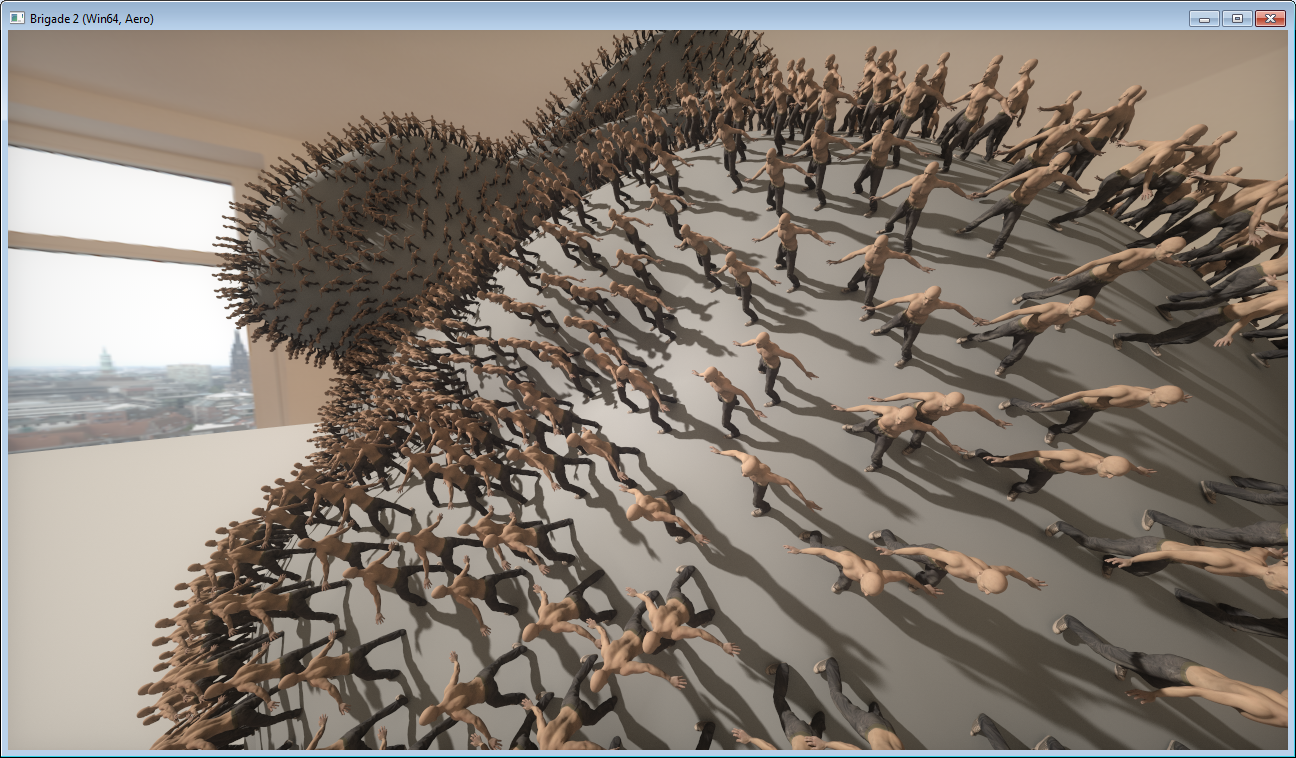
Another real-time path traced test of Brigade with HDR environment lighting, featuring the Stanford bunny and the dancing dude from one of the previous posts. Jeroen van Schijndel (Brigade's lead dev), had the outrageous idea to create an animated instance for every triangle of the Stanford bunny, resulting in 4968 instances. Each jolly dancer contains over 60k triangles, totalling over 300 million dynamic triangles in real-time. 

720p video: http://www.youtube.com/watch?v=huvbQuQnlq8


Some screenshots below, notice the real-time color bleeding, reflections, soft shadows and soft realistic lighting from the HDR environment.


Soft shadows coming only from the HDR environment (no additional lights used):

11 Aug 14:28

[Vídeo] Descomposición de la fruta en Time-lapsed

by Capitan Tomate

piña

Hoy os traigo un vídeo que me ha resultado bastante curioso, la descomposición de una piña en dos meses con Time-lapsed. La descomposición de la fruta es un proceso natural en el que intervienen multitud de agentes, los más importantes son los microorganismos y los enzimas de los propios alimentos.

Además de la piña, TEMP0NAUT hizo otros vídeos de más frutas que resultan igual de interesantes. Desde luego la mejor manera de comprobar el paso del tiempo en la naturaleza.

Vía | Youtube

01 Aug 10:21

mathimage #22: a thin layer of snow

by admin

over a bridge that i mathematically modeled a couple of years ago. This was a fast improvised image again. The interesting bit is probably in the smooth blending of the terrain and the bridge, which serves perfectly as a natural transition between the bridge and the recently fallen thin layer of snow. Everything else is uber simplified. The “trees” are dark cones, the bridge is a few boxes, and the lighting is pretty simple and non realistic as well. I pushed the saturation of the sky a lot in order to make sure this wasn’t perceived as an attempt to photorealism. Not that I wouldn’t have wanted to, I won’t lie, but I failed to nail the lighting in the very short time I gave myself for this image, so I decided to not even try to hide it.

What I like the most is that I wasn’t expecting to make a snowy scene at all. I love these math jam sessions.

If you are curious about the maths or code, or want to see it move in realtime (it’s sort of a time lapse thing), go here: https://www.shadertoy.com/view/Mds3z2

30 Jul 06:42

[Vídeo] Disparando bajo el agua a cámara superlenta

by Sergio Parra

pistolaEl otro día os hablábamos de Armas que no funcionaron demasiado bien: una pistola que se llevaba descargada por miedo, gatos acústicos, bazookas nucleares… Hoy vamos a deleitarnos con un vídeo que recoge, a cámara superlenta, lo que sucede cuando disparamos bajo el agua.

27.000 fotogramas por segundo. Una bala de pistola de 9 mm empieza a causar pocos daños a partir de los 2 o 2,5 metros de distancia si acaso llega a alcanzar y a acertar su objetivo, debido a que el agua es mil veces más densa que el aire.

Vía | Microsiervos

29 Jul 06:32

¿Ya no confías en ningún partido político? Bienvenido a la democracia líquida (II)

by Sergio Parra

lEn la anterior entrega de este artículo poníamos de manifiesto la falta de fe de la ciudadanía en las formaciones políticas que se presentan a las elecciones, así como los defectos de la democracia pura. Ahora vamos a buscar una alternativa que, gracias a Internet, podría tener más sentido que nunca.

Democracia líquida: delega tu voto en quien confíes

Una alternativa que cada vez resulta más plausible a la democracia directa y la democracia representativa, sobre todo a raíz de la excepcional habilidad de Internet a la hora de conectar a la gente en redes, es la democracia líquida. ¿Habéis visto lo milagrosa que parece Wikipedia? Una enciclopedia siempre en movimiento creada por aficionados o por expertos que no ganan dinero editándola. Sin embargo, Wikipedia es equiparable, sobre todo en inglés y en las entradas de ciencia, al epítome de las enciclopedias realizadas por expertos remunerados: la enciclopedia Británica.

Pues bien, la democracia líquida consiste en extrapolar el poder de las redes de pares que genera Internet, materializándose en proyectos como Wikipedia, para preguntar al conjunto de la ciudadanía sobre cada una de las decisiones que deben tomarse. Con un añadido: si ignoras algo sobre un tema y crees conocer a alguien que sabe más que tú sobre ello, en ese tema en particular puedes cederle tu voto (que a su vez, si él lo considera oportuno, podrá ceder a alguien que sepa más que él).

Imaginemos que debemos votar si las políticas para combatir la piratería digital son las adecuadas o no. Si le pregunto a mi abuela, no tendrá ni idea. Yo conozco bastante sobre el tema, he leído una docena de libros, pero se me escapan muchos matices jurídicos. ¿Qué hacer? Como llevo tantos años leyendo y escuchando los razonamientos del abogado experto en derecho intelectual David Bravo (por ejemplo), finalmente le prestaré mi voto a David Bravo. Sé que él sabe del tema mucho más que yo, y además confío bastante en su integridad intelectual.

Otros pensarán como yo. Hasta el punto de que David Bravo, tal vez, acabará con unos cuantos miles de votos de ciudadanos que confían en él. Cuando David Bravo sea interpelado por las urnas, su voto valdrá miles de veces más de lo que vale ahora. Y ese poder solo podrá usarlo para votar sobre esa interpelación en concreto. Para el resto de asuntos, David Bravo tendrá tanta relevancia como cualquiera de nosotros.

dSé que estáis pensando que esto parece un caos. Que habrá muchos embaucadores o demagogos que lograrán obtener el voto de buenas gentes. Que habrá individuos que, mediante grandes sumas de dinero (probablemente procedentes de empresas involucradas en el engranaje de la política que debe someterse a votación), financiará campañas para incrementar la reputación de los sujetos que consideren adecuados. Que mucha gente ignorante será tan ignorante que ni siquiera sabrá detectar quién es un poco menos ignorante que ella. Que habrá ciudadanos tan ingenuos que no advertirán que están siendo engañados por canallas profesionales.

Pero… oh, wait¿no es eso exactamente lo que está ocurriendo ahora, punto por punto? La diferencia estribará en que la democracia líquida repartirá tanto el poder, y lo hará tantas veces, cada día, en cada nueva decisión, que los “acaparadores” de poder apenas podrán subsistir. Si uno nos engaña, no le cederemos el voto mañana, o la siguiente semana. Por supuesto, muchos seguirán votando a señores que hablan bien o son guapos, aunque tengan el cerebro vacío, o incluso confiarán en políticos como Rajoy o Rubalcaba, pero su representatividad en las urnas descenderá de un modo tan acusado que uno no se levantará cada mañana pensando que no puede hacer nada de nada por cambiar lo establecido.

Tal y como añade Steven Johnson en Futuro Perfecto:

Los individuos comprometidos seguirán teniendo la posibilidad de apoyar económicamente a sus candidatos, solo que con una cantidad de dinero limitada. Los vales democracia descentralizarían y diversificarían las fuentes de financiación de las campañas, creando un mercado verdadero para la financiación del electorado.

Obviamente lo he simplicado todo mucho. Sin embargo, conceptualmente, la democracia líquida, siempre cambiante, consistente en vigilarnos unos a otros como sucede en Wikipedia, evitará los dos embudos democráticos anteriormente expuestos, que resume así Johnson:

El mundo es demasiado complejo como para comprimirlo en un paquete comprensible para el votante medio, lo que hace que la democracia directa sea un sueño imposible. Pero los propios votantes tienen unos valores políticos también complejos, que no pueden expresarse en votos individuales por candidatos o partidos.

Un ejemplo germinal de una suerte de democracia líquida lo podéis encontrar en Porto Alegre: la ciudad que dejó de ser un caos para convertirse en un lugar seguro (sin intervención política).

Pero ¿cómo empezó todo esto? ¿Cómo podría evolucionar? En la próxima entrega de este artículo responderemos a estas preguntas.

27 Jul 16:43

Real-time path tracing: ultra high detailed dynamic character test

by noreply@blogger.com (Sam Lapere)
To celebrate Siggraph, here's a new video of Brigade for your enjoyment, showing an animated character mesh consisting of 125k dynamic triangles rendered in real-time at 35 fps with path tracing (the static background contains 600k triangles).

To give some background: one of the main reasons why ray tracing has not been considered a viable alternative for rasterization as a rendering technique for  games is because ray tracing requires an acceleration structure to achieve real-time performance and dynamic scene support requires that acceleration structure to be rebuilt or updated every frame which has been a long standing and often revisited problem in the ray tracing research community.

Until a few weeks ago, Brigade was capable of handling about 50k (non-instanced) dynamic triangles at 30 frames per second. Recently however, the dynamic triangle budget was tripled and we can now do around 150k triangles at 30 frames per second (and this will soon increase further to a dazzling 1 milllion dynamic triangles at 30 fps), which allows for some extremely detailed deformable meshes like characters. VFX houses doing previs of real-time motion captured characters will love this.

UPDATE: Updated the post with a fresh batch of screenshots to show the extreme texture detail on the LightStage model.

HD video (rendered at 720p): http://www.youtube.com/watch?&v=EgMy5dqAl_U


Note the huge difference diffuse color bleeding makes on the character's body when the floor is matte in the next two screenshots: 

The entire movie industry is going down the physically based rendering path with path tracers like Arnold. Recently even Pixar/Disney went with full path tracing for Monsters University and completely reworked their old Renderman renderer by adding a path tracing mode. The benefits of progressive rendering with physically based global illumination and materials without having to rely on time consuming point cloud baking has entirely revolutionized the way artists work as it's a game changer for the creative process. Games will eventually follow this path as well as game developers keep striving for cinema quality graphics as they've been doing since the introduction of the first OpenGL accelerator boards. And if you're still not convinced of the undeniable superiority of path tracing after all this fluff, you can talk to this nicely textured hand:


Btw, in case you haven't noticed yet, we dramatically improved the lighting quality and sky model in Brigade over the past months and it's now almost up to Octane standards.

More tests to come soon.
27 Jul 16:24

Chromecast vs AppleTV: la batalla está servida

by Miguel López

chromecast

Esta tarde Google ha celebrado un evento donde ha presentado novedades que ya esperábamos: una nueva versión de Android, el nuevo Nexus 7… pero al final nos hemos topado con una sorpresa con el nombre de Chromecast, y que claramente quiere competir con el AppleTV. Y a primera vista tiene muy buena pinta.

El Chromecast es más pequeño que el AppleTV, mucho más barato (35 dólares, no tenemos precio oficial en euros ni fecha de lanzamiento en España) y es capaz de hacer gran parte de lo que podemos hacer ahora mismo con el AppleTV en España teniendo en cuenta de que no tenemos acceso a ninguno de los servicios integrados como Netflix. Básicamente es un “Pendrive HDMI” que se conecta a nuestros televisores y simplificar la reproducción de cntenido multimedia.

Pongamos en una lista las características más interesantes del Chromecast, para tener una imagen clara del dispositivo con el que Apple va a tener que competir:

  • Conexión HDMI directa al televisor.
  • Hay todo un nuevo protocolo detrás, llamado cast, que cumple las mismas funciones que AirPlay y lo supera con la habilidad de no tener que depender del smartphone al reproducir contenido. Es decir: mientras AirPlay mantiene una conexión con el dispositivo emisor, Chromecast “recoge el recado” y reproduce lo que le hayamos indicado independientemente. Eso hace que la persona que haya puesto la reproducción pueda bloquear su móvil o incluso marcharse.
  • Uso del smartphone como mando a distancia: el Chromecast es capaz de encender el televisor y seleccionar la fuente de entrada adecuada para que no tengamos que tocar el mando tradicional.
  • Sí, funciona perfectamente con iOS.
  • Reproducción de vídeos de YouTube, Netflix y Google Play.
  • Reproducción de canciones de Google Play.
  • Al basarse en Chrome OS, Chromecast es capaz de mostrar una de las pestañas de navegación de nuestro ordenador (con OS X o Windows) en el televisor.
  • API abierta, para que las aplicaciones vayan apuntándose al servicio y haciéndose compatibles. Esto lo pueden aprovechar muchos servicios como Spotify, el mismo iTunes o similares.

Falla en algunos puntos, pero el Chromecast puede ser una amenaza para el AppleTV
Por 35 dólares, es difícil resistirse. Sobretodo por algunas ventajas sobre el AppleTV como la mencionada independencia respecto al dispositivo que usemos para “emitir” el contenido. Pero ojo, porque también hay puntos críticos:
  • Google es muy hábil mostrando en sus vídeos promocionales cómo se enchufa el Chromecast, pero por ningún sitio se ve que necesita de un cable de corriente o un USB enchufado a la misma TV para funcionar. Y eso no es tan atractivo como prometen las fotografías promocionales donde se sugiere que Chromecast es sencillamente un “pendrive” con una conexión HDMI.
  • Tuits como éste no son descabellados, aunque recordemos también que el AppleTV será capaz de crear una pantalla adicional de nuestro Mac mientras que Chromecast se limita sólo a una pestaña del navegador. Este dispositivo va a ser un rival más duro para Apple allá donde menos servicios tengamos activados.
  • No hay posibilidad de reproducir archivos locales, y habrá que ver hasta dónde pueden solucionar eso los desarrolladores.

Pero como siempre, y más con esta crisis, aquí el principal atractivo va a ser el precio. Estamos ante un pequeño artilugio que convierte cualquier televisor con HDMI en un SmartTV y facilita la reproducción de vídeos en un hogar con la misma facilidad que un AppleTV. Incluso con ventajas adicionales.

Sitio oficial | Chromecast
En Genbeta | Chromecast, la apuesta de Google para llevar el contenido a la televisión


09 Jul 16:48

mathimage #20: volcanic landscape

by admin

This one was, again, a completely improvised one.

It all started with a sphere, but after 30 minutes of exploration of a couple of random ideas, I had settled in some sort of a flat landscape full of caves (or, “empty with caves”?). From there I focused for two hours on adding a rocky feel to it, find some nice color/material distributions for the depths (yellow and browns) and the aerial bits in the top (grey and greens), through three lights (sun, sky, and bounce), add volumetric smoke and oranges for the lava, and call it a day. A very successful day! Cause, despite all the fakery involved here (which would make any computer graphics professional scream in pain, for these methodology and tools are exactly the opposite of how you are supposed to do things), the image is compelling and definitely complex for what it is: 300 lines of code/maths!

The realtime version with source code is here:

And a prerendered video (for those with slow computers) and with extra cinematic look, here:

08 Jul 14:44

[Vídeo] TimeLapse del crecimiento de las plantas

by Sergio Parra

floresVer crecer las plantas, en ocasiones, es mucho más entretenido que ver determinadas películas de arte y ensayo, máxime si el crecimiento lo observamos a través de este timelapse rodado por el realizador alemán Daniel Csobot.

En el vídeo podremos observar el crecimiento de distintas plantas y flores. Csobot ha utilizado una Canon 7D con dos objetivos, uno macro de 100 mm, y el otro un sencillo 18-55 mm. Después ha condensado las imágenes utilizando Adobe After Effects. La música, por su parte, corre a cargo de Daniel Gautreau y Digital Heartbeat.

Vía | Gizmodo

15 May 09:51

RC Helicopters WIN

Submitted by: Unknown

Tagged: RC , helicopters , Video , g rated , win
09 May 10:53

Dvein: The Vein/Magma

by Fabricio Lima


Dvein is back with this brilliant liquid inspired music video for The Vein’s new single: Magma.

And here you can see the process behind this incredible piece!

Posted on Motionographer

21 Mar 20:49

Anatomy of dynamic stack allocations

by geidav
Allocating memory on the heap is expensive. Especially, in functions that are called frequently it should be avoided for performance reasons. However, there are cases where it is not possible to get rid of all heap allocations. In such situations, dynamically allocating memory on the stack can be a solution.