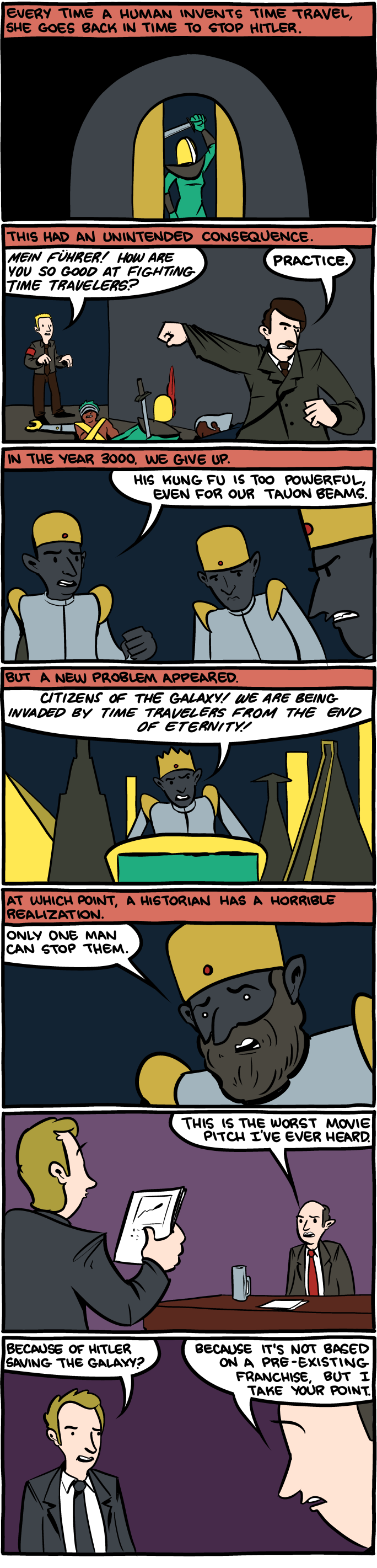
Lunch atop a skyscraper:

Times Square, V-J Day:


Tank Guy:


That one needs a lot more legos if you want to do it justice:

Lots more iconic recreations at the link.
Wickemtfacebook is bullshit and this guy can prove it
A month ago we explained in gory detail the growth of "click farms" where nothing is what it seems, and where social networking participants spend millions of dollars to appear more important, followed, prestigious, cool, or generally "liked" than they really are. The following excellent walk-through of just how the fraud works is concerning when the entire US stock market appears propped up by an ever-shrinking layer of "social media" and "cloud" faith that this time it's different and no Friendster or MySpace.
As we noted previously,
...
Social networking has been the "it" thing for a while: for the networks it makes perfect sense because they are merely the aggregators and distributors of terrabytes of free, third party created content affording them multi-billion dollar valuations without generating a cent in profits (just think of the upside potential in having 10 times the world's population on any given publicly-traded network), while for users it provides the opportunity to be seen, to be evaluated or "liked" on one's objective, impartial merits and to maybe go "viral", potentially making money in the process.
Of course, the biggest draws of social networks also quickly became their biggest weaknesses, and it didn't take long to game the weakest link: that apparent popularity based on the size of one's following or the number of likes, which usually translates into power and/or money, is artificial and can be purchased for a price.
...
And once the prevailing users of social networks grasp that one of the main driving features of the current social networking fad du jour is nothing but a big cash scam operating out of a basement in the far east, expect both Facebook and shortly thereafter, Twitter, to go the way of 6 Degrees, Friendster and MySpace, only this time the bagholders will be the public. Because "it is never different this time." The only certain thing: someone will promptly step in to replace any social network that quietly fades into the sunset.

    
|
The connection between America’s wars in the Middle East—and its wars more generally—with the more fundamentalist forms of Christianity in the United States is striking. Opinion polls suggest that the more religiously conservative one is, the more one will support overseas wars or even what many might describe as war crimes. Fully 60 percent of self-described evangelicals supported torturing suspected terrorists in 2009, for example. That is somewhat puzzling, as Christianity is, if anything, a religion of peace that only reluctantly embraced a “just war” concept that was deliberately and cautiously evolved to permit Christians—under very limited circumstances of imminent threat—to fight to defend themselves.
To be sure, some Christian conservatives who might be described as Armageddonists regard America’s Asian wars as part and parcel of the precursor events that will lead to the Second Coming of Christ, which they eagerly look forward to. Also, a non-interventionist friend of mine who comes from a religiously conservative background explained to me how the contradiction partly derives from the fact that many evangelical Christians hardly relate to the New Testament at all. While they can recite scripture and verse coming from the Old Testament, they are frequently only marginally conversant with the numerous episodes in the New Testament that attest to Jesus’s extolling the virtues of peacemaking and loving one’s neighbor. If true, that means that many evangelicals are much more imbued with the values of an eye-for-an-eye or smiting Philistines than they are with the Sermon on the Mount.
There has undeniably been pushback coming from some evangelical leaders as well as from many younger religious conservatives against America’s constant diet of God-anointed warfare, but given that those who describe themselves as evangelical Christians tend to disproportionately support America’s wars, it is perhaps no surprise to learn that fundamentalist viewpoints prevail in certain quarters in the military. There has indeed been considerable media reporting on the impact of evangelical Christians on the armed services, to include a bizarre account of US military sniper sights being inscribed with citations from the Bible, leading one critic to suggest that the soldiers were being issued “Jesus rifles.”
A prominent General, William Boykin, was until recently the best known Christian fundamentalist in the U.S. military. Boykin held prayer breakfasts when he commanded Delta Force and, when Deputy Undersecretary of Defense for Intelligence under George W. Bush, was widely criticized for appearing in churches and other public gatherings in his uniform. He would describe his personal war against Islam, claiming that “My God is bigger than yours,” possibly suggesting that size really does matter, at least in theological circles. He also called the Islamic God an “idol.” At some church gatherings Boykin would produce a photo taken in Mogadishu which, he claimed, included a mysterious dark shadow that he described as a “demonic presence,” adding that “spiritual enemies will only be defeated if we come against them in the name of Jesus.” Boykin, who advocates “No Mosques in America,” is currently Executive Vice President of the Family Research Council, which lobbies the Pentagon to complain that there is a “war on Christianity” within the military.
Boykin was not unique. Several other generals and a number of additional senior officers have appeared at church sponsored events or made videos while in uniform, frequently extolling the religious nature of America’s wars in the Middle East. They were perhaps encouraged from the top, by born-again President George W. Bush’s overt religiosity and his description of Jesus Christ as his “favorite philosopher.” Be that as it may, the shock of 9/11 let the evangelical genie out of the bottle in anticipation of the conflict of civilizations that some Armageddonists were welcoming, with the Pentagon even livening up its daily Worldwide Intelligence Update by using biblical verses as captions for war images. Bush had himself initially described the global war on terror as a “crusade,” though he quickly regretted using the expression after being educated to the fact that many of Washington’s potential allies against terrorism were, in fact, Muslims.
The U.S. military, aware of the constitutional restraints on promoting any religion, generally attempts to rein in outward expressions of religiosity on the part of its officers, but the open defiance of those efforts has been increasing as fundamentalists become both more assertive and better represented at senior levels in the officer corps. Fully one-third of military chaplains are currently evangelicals and the percentage is increasing. Many fundamentalists assert that a good officer has to be “moral,” by which they mean “religious,” in the belief that it is impossible to be ethical without a relationship to God. As many of the evangelicals also believe they possess the absolute truth in terms of their own definitions of religiosity, there is little room for alternative viewpoints.
The soldiers who promote their faith dodge the military’s restrictions on their actions by claiming that they are only “evangelizing the unchurched,” not proselytizing. When they hand out bibles to Afghans they describe it as providing “gifts.” General David Petraeus, when head of the Central Command was well known for his strong commitment to “spiritual fitness” as a sine qua non for his officers, providing a top level sanction for including religion in one’s professional development. In 2007 Petraeus endorsed Christian rock concerts on military bases. A year later, senior Army chaplain William McCoy took the argument for spirituality one step further, explaining how the non-religious soldier, having no protection against sin, might cause the failure of his unit. Petraeus blurbed McCoy’s book Under Orders: A Spiritual Handbook for Military Personnel, recommending that it be in every backpack for those times when a soldier needs “spiritual energy.” A senior chaplain in Afghanistan also enthused about how leading by example produces positive results, with 85 percent of the 22 officers reporting to Petraeus engaging in “dynamic Bible study,” though one has to wonder if they might have been doing so to enhance their promotion prospects.
A notorious, long running dispute at the United States Air Force Academy over the proper role of “spirituality” has generally resulted in little or no change in the promotion of evangelical Christianity at many levels, a process aided and abetted by a series of Superintendents who were themselves fundamentalists. Even the Air Force football team was not immune, with a large banner in the locker room proclaiming “I am a Member of Team Jesus Christ.” Captain MeLinda Morton, an Air Force Lutheran chaplain who actually complained about the over the top proselytizing was initially ignored and then reassigned.
Why should all this be important, since it is surely up to the individual to decide what he or she does or does not believe? It matters for a number of reasons. Believers who do not create a firewall between their faith and their professional responsibilities, which for a soldier should include all Americans and not just the ones that think the same way he or she does, will inevitably favor coreligionists, particularly if it is being argued that religiosity is an essential ingredient for soldiering. Many Christian fundamentalists understandably believe that their first duty is to God, not necessarily to their country or to their fellow citizens, but they fail to see how such a view might be considered unacceptable in someone who chooses to work for the government.
Just how God before country works in the military context might best be illustrated by one aspect of the Air Force Academy’s struggle with proselytizing on campus. Groups of cadets had been gathering in commons rooms in dorms and libraries to have Bible study sessions. An understanding that public spaces at the academy were just that and the ad hoc use of a room by a group would discourage or prevent others from using it appeared to carry the day until the academy’s second in command, an evangelical Christian named Johnny Weida who had previously advised cadets that they were “accountable first to your God,” stated flatly that the practice would continue: “You wanna have a Bible study in a cadet TV room? No problem.”
The increase in highly visible religiosity among U.S. soldiers also has real life consequences by becoming a propaganda tool for groups like al-Qaeda and strengthening the widespread belief that Washington is actually mounting a new crusade against Muslim regimes. Efforts to have soldiers distribute Bibles in Afghanistan’s languages, encouraged by some military chaplains, have been noted by both the local and international media, a practice that runs counter to both military regulations and specific general orders for the Afghan theater of operations.
And then there is the strange tale of Pat Tillman, the National Football League player who volunteered for the Army after 9/11. Tillman, an Army ranger, was shot dead by his own comrades on a patrol in Afghanistan in April 2004, resulting in an elaborate military cover-up relating to his death. Tillman was apparently an outspoken non-believer and there is some evidence that he also had turned against the wars in Iraq and Afghanistan. Credible speculation by both the Tillman family and also by former General Wesley Clark suggests that he was murdered, three bullet holes in his forehead indicating that he might have been shot by an M-16 at close range. His fellow soldiers also uncharacteristically burned his clothing and his body armor after he died, and Tillman’s personal diary went missing. A criminal investigation was requested but turned down by Army brass. When the family complained, the leading investigating officer Lt. Col. Ralph Kauzlarich commented that they were venting because the Tillmans were all non-believers, saying “…if you are an atheist and you don’t believe in anything, if you die, what is there to go to? Nothing. You are worm dirt.”
There is a cliché about soldiers, atheism, and fox holes which is probably as true or untrue as most clichés. That the United States military appears to be increasingly a professional force that has few links to the general population is by itself disturbing. That it also might be developing a warrior class ethos that includes a certain kind of evangelical religiosity as a key element only serves to increase the distance between soldiers and most civilians, apart from the constitutional issues that it raises.
My own exposure to holy war courtesy of the U.S. Army was somewhat different, but it was a draftee experience, long ago. In basic training back during Vietnam a chaplain who was, as I recall, both a Colonel and an unmistakable Irish Catholic came storming through our barracks spewing fire and brimstone. He delivered a pretty good impression of Pat O’Brien playing Father Francis Duffy of the Fighting 69th before he disappeared followed by a cloud of cigar smoke, growling something about “killing commies.” A couple of kids from Chicago followed in his wake crying out “Fatha, Fatha,” evidently in need of spiritual solace of some kind, but his pastoral visit was apparently over. Mission Accomplished.
Philip Giraldi, a former CIA officer, is executive director of the Council for the National Interest.
SOCHI, RUSSIAN FEDERATION – Just hours before the opening ceremony for the Sochi Winter Olympics, Russia has put out an alert for two potential terror suspects, referred to by security officials as “moose” and “squirrel.”Damn Canadians. Jeez.
An outpouring of fear swept the tiny coastal town on the Black Sea as details emerged of the possible terrorist attack by the unlikely combination of two Americans, identified as Mr. Bullwinkle J. Moose and Rocket J. Squirrel. The two suspects are reportedly from Frostbite Falls, Minnesota, which Russian officials believe may indicate a connection to Canadian separatists.
“We thinking this is classic lone-wolf, err– lone-moose type suicide bomber, world’s greatest no-goodnik,” said Boris Badenov, a Russian expert on security and espionage who announced heightened security measures to catch the pair. He was joined by Colonel Natasha Fatale of the FSB.Yeah, I'll bet. Security always goes well until you see Moose and Squirrel.
“Security is going so well darling,” Ms. Fatale told reporters, before adding, “until we get word of confounded moose and squirrel!”

Comedian Ryuichi Kosugi demonstrates the "ideal" burger-eating technique [Images: kotaku.com]
Eating burgers is a messy business; that's something I've come to accept, but if the "ideal" method revealed on Japanese variety show Honmadekka!? TV is as effective as reported, patty slippage and ingredient drippage could be a thing of the past.
The improved burger-eating technique was supposedly determined after a four-month study by experts in experts in fluid mechanics, engineering, and dentistry that used a 3D scan of a hamburger to understand how the particles in it interact when held.

"Ideal" burger holding technique
Using the traditional method—gripping the burger with your thumbs underneath and your fingers on top—causes ingredients to spill out the front and back, while the new method, which involves holding the burger with thumbs and pinkies on the bottom and your remaining three fingers on top (illustrated above), was said to avoid this problem.
The animation below is supposed to illustrate the effectiveness of the so-called ideal method, but it looks like all it succeeds at is spraying lettuce particles up your nose.

"Ideal" burger eating technique animation
I'm not convinced, but I'll probably give the method a shot. In the meantime, have any AHT'ers experimented with this technique? Tell us about it in the comments.
[Via: kotaku.com]
About the author: Erin Jackson is a food writer and photographer who is obsessed with discovering the best eats in San Diego. You can find all of her discoveries on her San Diego food blog EJeats.com. On Twitter, she's @ErinJax
Love hamburgers? Then you'll Like AHT on Facebook! And go follow us on Twitter while you're at it!

Early that morning, a tiny, not terribly bright idea got lodged in Frank’s head. It happens quite often to the soft-headed. And, unfortunately, Frank was feeling ambitious.
“Hi Bill,” Frank said. Bill stood in his bathrobe, shivering at the front door of his house. The sun was barely up, and it was quite cold. Inside, the kids were having breakfast.
“What’s going on?” asked Bill. “Do you want to come in?” Frank did.
“This may sound strange,” said Frank, “but do you read Salon?”
“Sometimes,” said Bill. “Why do you ask?”
“Did you read this one?” Frank held up a printed article.
“Oh,” said Bill. “That one. About communism. He made some good points, I guess. But it seemed kind of lame. I mean, didn’t we already try communism?”
“We did,” said Frank, “but I’m not interested in communism.”
“Well what do you want?” asked Bill, clearly annoyed. “Can you make it quick? The kids need to get to school.”
“Sure,” said Frank. “I’ll be quick. I just want your television.”
“You want to borrow it?”
“No,” said Frank. “I want to claim it. Make it mine.”
“What?”
“See right here,” said Frank, and he read, slowly and emphatically. His finger stabbed the words he thought were important:
But state violence… is inherent in every set of property rights a government can conceivably adopt…
In capitalism, competing ownership claims are settled by the state’s willingness to use violence to exclude all but one claimant. If I lay claim to one of David Koch’s mansions, libertarian that he is, he’s going to rely on big government and its guns to set me right. He owns that mansion because the state says he does and threatens to imprison anyone who disagrees. Where there isn’t a state, whoever has the most violent power determines who gets the stuff, be that a warlord, a knight, the mafia or a gang of cowboys in the Wild West. Either by vigilantes or the state, property rights rely on violence.
Bill looked him in the eye and chuckled, nervously. “Frank,” he said, “you’re not the government.”
“I am the government,” said Frank. “Remember? I’m a government agent.” Frank held up his ID badge.
“You’re an inspector. For the Department of Agriculture.”
“Why so I am,” said Frank. “And my TV isn’t nearly as nice as yours.”
“Is this some kind of a joke?”
“No, Bill. It’s no joke. It’s just how property is made. You want to deny it?”
“Welll…”
“With what? With the state? Hah! And if you want to enjoy the rest of your property, I think – as a government agent – that I’ll be nice enough to let you. As long as I can have your TV.”
Bill grinned. “Why don’t you go pick on the Koch brothers, like the nice communist says?”
“I think they’re probably better armed than I am,” said Frank. He drew a small pistol from his pocket. “But you’re not.”
“Okay, okay,” said Bill. “Right over here, and don’t scare the kids.” He pointed Frank toward the living room. Blessedly, Sheila looked out from the kitchen. Bill pantomimed: He’s crazy. Call the cops!
“What’s going on, daddy?” asked Olivia from the kitchen.
“Never mind,” said Bill. “Just eat your breakfast.” He turned to Frank. “Did your boss tell you to do this?”
“No,” said Frank. “I’m doing it all by myself.” He unplugged the TV and began wrapping up the cables. “Do you have some kind of, I dunno, cart or something. To carry it out?”
“I do — I mean — what the fuck?”
“State violence,” said Frank. “Remember?”
“Is there any kind of law says you can do this?”
“Oh no, not at all,” said Frank. “But I’ll be taking the cart too. I expect I might… need it. You know, for the rest of the neighborhood.” He reached meaningfully into his coat pocket. Bill went to get a dolly. When he returned, Frank was looking around the room.
“Say, where’s the remote?” he asked.
“It’s not funny anymore, Frank. I mean, sooner or later you’ll meet up with the cops.” Sooner, Bill said to himself. Let’s make it sooner.
“I’ll just read them that article,” said Frank with a grin. “It’ll set them free.”
“But that’s — ”
“Violence?” asked Frank. “You bet it’s violence. We’re the state. Violence is… us.”
“Well,” said Bill under his breath. “I think that’s bullshit. These are people’s lives you’re messing with.”
“Not at all,” said Frank. “Only their possessions, which they don’t even rightfully own. I mean, if I wanted, I really should be taking your land, too.”
“Oh no you shouldn’t,” said Bill.
“I’m one-eighth Native American,” said Frank.
“And I’m black,” said Bill. “What do you think the system owes me?”
“Eh, well, whatever,” said Frank. “In the end it’s all the same, isn’t it? All states rely on violence. Restitution, slavery, it’s all the same. All just… violence. Might as well get when the getting’s good.”
Bill tried desperately to stall. “The getting,” he said “isn’t good. I mean, stop and think for a minute. What if someone came along and did that to you?”
“I’d have to ask myself,” said Frank. “…are they from the state?”
“What if they’re not?”
“That,” said Frank, “Would be very, very bad. That’s not how property works! Property comes from the state!”
“And if they are from the state?” asked Bill.
“Eh, okay, I guess.”
“Then,” said Bill, “what if someone else took your stuff from them? Or what if you came and took it back? Or what if they took it back again from you after that? Back and forth, back and forth — killing here, killing there, no one ever safe… you really want to live like that?”
“It’s just a TV,” said Frank. “Chill.”
“Hey look,” said Bill. “What if you do read the cops that article. And they join up. Then what?”
“Then we take the very best houses. We recruit the rest of the PD. We set up as warlords.”
“Ah,” said Bill. “What about the FBI? What about the army?”
“What about them?” asked Frank.
“You think they’re all going to stand by,” said Bill. “You think they’ll just watch you take whatever you like?”
“I’ll tell them what I know. And they’ll just grab what they can,” said Frank. “I mean, it’s basically good news, from where they sit. Nobody’s ever mad at the bearer of good news. I figure they’ll like me.”
“You’re crazy,” said Bill.
“You’re jealous,” said Frank.
“Fine, fine,” said Bill. “Maybe I am. But who says they’re gonna make you the king? You’re just some bullshit bureaucrat from the Ag department.”
“Well…”
“It’ll be some state of nature, then.” said Bill. “Why do you think you’ll come out on top?” He paused. “And not, say, the Koch brothers?”
Frank was silent.
“They’ll win, won’t they?” said Bill. “You know I’m right. There’s really just two choices — we either fight forever, like you want, or we all join up, and don’t fight.”
Just then the front door burst open. There was a flurry of badges and guns, tasers and handcuffs.
“Violence!” said Frank. “It’s all just state violence!”
“This nut’s trying to steal my TV,” said Bill.
“Hands where we can see them,” said an officer. Both men complied. In the kitchen, the children were screaming.
“Officers,” said Frank. “What you’re doing is violence! But think about it for a moment, please! What I’m doing is violence too! We’re like, a team!” The handcuffs snapped closed.
“You and me!” Frank yelled over his Miranda rights. “We’re brothers!”
“Thanks officers,” said Bill. “I mean, maybe it is violence, but it’s just violence to keep the other violence in check, you know? So it’s all good. And I’m so glad we can get on with our lives.”
Then a second set of handcuffs snapped closed, and the words died in his mouth.
One of the officers held up a baggie full of an herb. “You have the right to remain silent…”

 Oh man. I was halfway through writing a nice, technical, do-it-yourself article about Radiant Heat for you, when the night sky over Longmont lit up with the giant ‘Stache Symbol*. It seems that our national network of Antimustachian Media Drivel detection volunteers sounded the alert based on this incredible doozy of an article about retirement in the US version of the Guardian. We need to make fun of it before we can go on with our regular lives.
The article is crippled by a few financial errors, but much more important is the hopelessly self-defeating tone of the thing. It manages to advocate shitting your own financial pants for the entire course of a lifetime, while simultaneously being sassy and witty about it so that you think the advice is perfectly reasonable. Just take a look at this early paragraph:
Yes, that is all you need to do. If you make $150,000 per year, not only is it easy to amass 2.2 million dollars, but you should soon find chunks of that size floating all around you. You might have this much just sitting in your sock drawer waiting until you next get to the ATM machine to deposit it.
But wait.. this is necessary so you can retire on $100,000 per year!?! Are we planning to retire to the president’s suite of the Hyatt Regency? Or live in a Monaco Dynasty RV which we park on a 75MPH treadmill during vacations in order to maintain maximum fuel consumption? Who the hell needs $100,000 per year to retire?
So the article bakes ridiculousness right into its opening argument. Not a good start for a publication which supposedly has a reputation as “an organ of the middle-class.” But let’s read on.
“It’s simply a math problem. Let’s say you are in your 40s, making $150,000 a year, a generous salary in almost any city in the country. The taxman cometh, does he not? That $150,000, after taxes, becomes the slightly less dazzling sum of $100,000 a year.”
Okay.. except let’s assume you’re not a total idiot and that you contribute to your 401(k) plan, which shields the first $17,500 from taxes, or more likely $35,000 since most people in this age and income demographic are part of a couple filing jointly and sharing the $150k income. After all, we can at least assume that the $100,000 retirement budget mentioned earlier was not for a single person, right?
“Now you have to save that money as well as living on it. How much can you save? A standard and sensible budget, advocated by LearnVest and others, is to use a simple formula called 50/20/30. This means that you spend 50% of your salary on expenses. Another 30% goes to lifestyle expenses – the things that make life liveable unless you prefer living in a hut: cable and phone plans, clothes, books, gym fees, childcare and pets, restaurants and entertainment. “
Wait a minute here. You say I am spending 50% of my salary on expenses, and I make $150,000 per year, which is much more than average. So that’s $75,000. But then how do other people who make $25,000 live while spending only $12,500 on expenses? And what about $1.5M earners – do their expenses automatically rise to $750,000? Something is fishy here.
Then the final 20% goes to saving for retirement. This is a reasonable budget. If you save more than 20% of your salary for retirement, you’re giving up enjoying your present life: you’re dedicating yourself to living in holy denial of all worldly pleasures like a monk or a nun, in the hopes of a lavish, or at least an exceedingly comfortable, life when you’re over 60-years-old. Twenty percent for retirement is, by the way, an aggressive goal. Most people save much less.
OK, this is getting ridiculous. I would define “Living like a Monk” as somewhere around $3,000 per year in the US. That is more than enough for food and a place to stay where you do some of the upkeep in exchange for a bed. And monks don’t need to budget for leather coats, dogs, children, or iPhones. At $25-30k, you are living like the Mustache family. Beyond that, it gets even crazier. What level of insanely plush luxury is required to achieve a meaningful human life? According to the Guardian and the standard “Waah, Waah, the Middle Class have it so hard!” script, the higher the better. No need for exceptions and no need to think for yourself.
The article goes on to rightfully make fun of the study from which it quotes, advocating investing your money instead of putting it into a “riskless” savings-account mattress and hey, look at that, they even mention Mr. Money Mustache in a paragraph near the end**, although I see the word “retire” is in quotes, suggesting affiliation with the Internet Retirement Police.
But here comes the conclusion:“The other major issue: the retirement issue in this country is less due to personal failure than structural failures. Saving enough is not the primary problem with our retirement system. The primary problem is that wages have been dropping for decades, leaving people with much less to save - especially people who live on far, far less than $150,000 a year. That’s largely because corporations are hoarding profits, raising CEO salaries and skimping on what they pay employees.”
No! Cover your ears!
Let’s be clear about this,: The retirement issue in this country is because people are buying way too much shit they don’t need, pampering themselves with ridiculous lattes, restaurants, shoes and massages, and riding around constantly in huge bullshit bank-financed trucks for no reason.
And many, many more closely related factors. Our problem is with our spending, so of course it can not be solved with additional income.
If you believe that the middle class has it even remotely hard in this country, you need to print out a picture of me, make it punch you in the face for 30 minutes and then reconsider the issue.
It’s not the CEOs and the pension plans that are giving you the shaft. If this were true, I would have had to become a CEO in order to become financially independent. (And even then, if that’s what it takes, nobody is stopping you from becoming the CEO!)
Sure, the pension system was a nice pleasant artifact of the olden days when the economy was a stable and slow-moving thing and people worked at the same company for decades. But those days are gone, and I say good riddance. Who wants to work at the same auto factory for 30 years? This is complacency.
If you put a human in a permanently comfortable situation, he will adapt to it and live a stagnant, boring life. Given enough comfort and convenience, we become huge water balloons with lazy grinning faces, expanding and becoming more delicate until the first sign of trouble, at which point we squeal and spray whiny fluids all over ourselves and our politicians. What kind of life is this?
In this much better new world, everything is in your control.
Your spending rate is not a percentage of your income. It’s whatever you want it to be, and your happiness grows right alongside the Badassity you develop every time you chop another thousand from what you thought was your “cost of living”.
Your city does not impose a cost of living upon you. You get to choose both the city in which you live, and how much you spend once you get there.
Your health and belt size are not determined by your age, being a parent, or “the terrible food they make for us these days”. For most of us, those things depend on what you choose to eat and how often you use your barbells and your bike.
Your retirement date is not “65″ or “Never”. It is the day you have 25 times your spending invested, or sooner if you develop other sources of side income. For a motivated 18-year-old, this could easily mean age 25.
An unfortunate part of the standard liberal argument is that the middle class is in decline and it’s all the fault of the greedy rich people. The argument of this blog is that it’s better to adapt to the system than to complain about it. The Internet has made education and opportunity much more widely available. Knowledge about how to live efficiently and invest the proceeds productively is staring you in the face.
It is thus much easier to leave the middle class, become one of the rich, and then change the system to your liking from that position of strength, rather than to hold yourself down in that class, paying for cable TV even as it indoctrinates you to spend away your ticket out of the self-imposed prison. Or reading articles that tell you that you’ll never be able to retire. Or writing them.
*yes, just like Batman! Thanks to Mr. Frugal Toque and the others who have emailed me with this concept.
**My apologies to Guardian writer Heidi Moore who will probably see this article and not be pleased with me. But come on! Why not write an upbeat retirement article instead of just copying all the rest of the mainstream media, making money by sympathizing with people instead of telling them to shape up? People like feeling empowered, not defeated, and feeling empowered is the only way to get anything done around here.
Wickemtif you are fond of Holmes' rhetorical flourishes, you ought to know he was the sort of statist asshole who said things like "three generations of imbeciles are enough" whilst upholding the right of the government forcibly to sterilize people deemed undesirable.
In other words, when you throw around the "shout fire in a crowded theater" quote, you're echoing the rhetoric of a tyranny-cheerleader whose logic was later abandoned by everyone, including himself.
There's a traditional column you see repeated two or three times per year. The author and publication may vary, but the basic structure never changes: the column asserts that the First Amendment is not absolute, and that other countries prohibit various types of speech that offend or wound feelings, so Americans ought to as well.
This time the venue for the column is the Daily Beast, and the author is Fordham University Professor Thane Rosenbaum. Professor Rosenbaum wants us to follow the example of France and Israel and suppress more ugly speech, and argues we should rely on unspecified studies that show that speech can hurt.
There is nothing new under the sun. Professor Rosenbaum's argument resembles that of Anthea Butler or Eric Posner. In my series "A Year of Blasphemy," I have examined worldwide blasphemy prosecutions over two years to demonstrate that the norms these academics wold have us adopt are typically used to oppress religious minorities and the powerless under the thin guise of solicitude for feelings.
Scott Greenfield has already cheerfully demolished Professor Rosenbaum's very silly column. I will only address it to discuss just two of the common legal tropes Professor Rosenbaum clumsily deploys in support of an apologia for broad censorship.
First, there's the shoutout to Oliver Wendell Holmes, Jr.:
There is no freedom to shout “fire” in a crowded theater.
Back in 2012 I wrote at length about the context for that Holmes quote. First of all, Professor Rosenbaum — like most Holmes fans — truncates the quote to render it vague. What Holmes actually said was "[t]he most stringent protection of free speech would not protect a man in falsely shouting fire in a theatre and causing a panic."
But more importantly, Professor Rosenbaum — like most who misquote Holmes — ignores the context. To summarize rather than make you read my lengthy post: (1) Holmes made the analogy in deciding a shockingly brutal and censorious series of cases that are no longer good law, in which the Supreme Court gave the government free reign to jail people who criticized or agitated against American participation in World War I; (2) Holmes later repented of that position, undermined that line of cases through decisions he wrote or joined, and articulated a far more speech-protective line of authority that remains the law today, and (3) if you are fond of Holmes' rhetorical flourishes, you ought to know he was the sort of statist asshole who said things like "three generations of imbeciles are enough" whilst upholding the right of the government forcibly to sterilize people deemed undesirable.
In other words, when you throw around the "shout fire in a crowded theater" quote, you're echoing the rhetoric of a tyranny-cheerleader whose logic was later abandoned by everyone, including himself.
Next, Professor Rosenbaum invokes another favorite trope, "fighting words":
Certain proscribed categories have always existed—libel, slander and defamation, obscenity, “fighting words,” and the “incitement of imminent lawlessness”—where the First Amendment does not protect the speaker, where the right to speak is curtailed for reasons of general welfare and public safety.
The "fighting words" doctrine gets thrown around a lot to justify broad speech restrictions. The people who invoke it rarely tell you — and may not know themselves — how narrow it is, and how the courts have refused to extend it.
The "fighting words" doctrine comes from the Supreme Court's decision in Chaplinsky v. New Hampshire in 1942. Fans of censorship like to quote the broader language of the opinion:
There are certain well defined and narrowly limited classes of speech, the prevention and punishment of which have never been thought to raise any Constitutional problem. These include the lewd and obscene, the profane, the libelous, and the insulting or "fighting" words — those which, by their very utterance, inflict injury or tend to incite an immediate breach of the peace.
But censors generally don't quote the later language of the opinion narrowing the First Amendment exception:
It is a statute narrowly drawn and limited to define and punish specific conduct lying within the domain of state power, the use in a public place of words likely to cause a breach of the peace. . . . A statute punishing verbal acts, carefully drawn so as not unduly to impair liberty of expression, is not too vague for a criminal law. . . . .
Nor can we say that the application of the statute to the facts disclosed by the record substantially or unreasonably impinges upon the privilege of free speech. Argument is unnecessary to demonstrate that the appellations "damned racketeer" and "damned Fascist" are epithets likely to provoke the average person to retaliation, and thereby cause a breach of the peace.
This is the heart of the "fighting words" doctrine — a prohibition on face-to-face insults likely to cause a brawl. In that sense, it's entirely consistent with the Supreme Court's subsequent clear and present danger doctrine, in which advocacy can only be punished when it is "directed to inciting or producing imminent lawless action and is likely to incite or produce such action."
People who cite the "fighting words" doctrine never tell you how it has been treated in the courts for the last half-century. The Supreme Court has refused every opportunity to rely upon it to uphold censorship, and in fact has consistently narrowed it. It was already narrowed by 1970 in Cohen v. California, when the Court refused to use it to justify punishment of a man who wore a jacket bearing the words "Fuck the Draft." The Court made it clear that the "fighting words" doctrine was narrowed to direct confrontations likely to provoke violence:
This Court has also held that the States are free to ban the simple use, without a demonstration of additional justifying circumstances, of so-called "fighting words," those personally abusive epithets which, when addressed to the ordinary citizen, are, as a matter of common knowledge, inherently likely to provoke violent reaction. Chaplinsky v. New Hampshire, 315 U. S. 568 (1942). While the four-letter word displayed by Cohen in relation to the draft is not uncommonly employed in a personally provocative fashion, in this instance it was clearly not "directed to the person of the hearer." Cantwell v. Connecticut, 310 U. S. 296, 310 U. S. 309 (1940). No individual actually or likely to be present could reasonably have regarded the words on appellant's jacket as a direct personal insult. Nor do we have here an instance of the exercise of the State's police power to prevent a speaker from intentionally provoking a given group to hostile reaction. Cf. Feiner v. New York, 340 U. S. 315 (1951); Termniello v. Chicago, 337 U. S. 1 (1949). There is, as noted above, no showing that anyone who saw Cohen was, in fact, violently aroused, or that appellant intended such a result.
Later, in Texas v. Johnson, the Supreme Court refused to use the "fighting words" doctrine to justify a ban on flag burning:
Nor does Johnson's expressive conduct fall within that small class of "fighting words" that are "likely to provoke the average person to retaliation, and thereby cause a breach of the peace." Chaplinsky v. New Hampshire, 315 U.S. 568, 574 (1942). No reasonable onlooker would have regarded Johnson's generalized expression of dissatisfaction with the policies of the Federal Government as a direct personal insult or an invitation to exchange fisticuffs.
These cases reveal a common thread running through Professor Rosenbaum's familiar defense of censorship. The line of Holmes decisions he references upheld the government's right to suppress draft resistors and war critics. The cases narrowing the fighting words doctrine — Cohen and Johnson — involved government attempts to suppress criticism of its policies. Professor Rosenbaum and his ilk may attempt to convince you that their project is to defend the feelings of religious and ethnic minorities and the dispossessed. But the most charitable interpretation is that they are the useful idiots of tyranny. Just as the blasphemy norms they endorse are employed to abuse minorities and the powerless, the justifications for censorship they tout have been used to suppress criticism of the state and its power. Read Professor Rosenbaum's closing, and contemplate how his approach to speech would be used by any government we have ever known:
Free speech should not stand in the way of common decency.
Professor Thane Rosenbaum Deceptively Carries On The Tradition of Censorship-Cheerleading © 2007-2013 by the authors of Popehat. This feed is for personal, non-commercial use only. Using this feed on any other site is a copyright violation. No scraping.
The Economist ran an article recently, in its “Johnson” column (the language column, now on its “Prospero” arts and culture blog), about English purism and Dorset-dialect poet William Barnes (1801-1886). Barnes wanted to purge English of its “foreign” influences (well, you can keep the fifth-century foreign invaders, but… gotta draw the line somewhere!), so that “photograph” would become “sun-print”, “botany” would become “wortlore”, “meteor” would become “welkinfire”, and “forceps” would become “nipperlings”.
But mainly the article is interesting for linking to an essay called “Uncleftish Beholding” by Poul Anderson, where he undertakes to explain atomic theory using (almost) exclusively words of Germanic origin. Here goes (but you can read the whole thing here):
For most of its being, mankind did not know what things are made of, but could only guess. With the growth of worldken, we began to learn, and today we have a beholding of stuff and work that watching bears out, both in the workstead and in daily life.
The underlying kinds of stuff are the firststuffs, which link together in sundry ways to give rise to the rest. Formerly we knew of ninety-two firststuffs, from waterstuff, the lightest and barest, to ymirstuff, the heaviest. Now we have made more, such as aegirstuff and helstuff.
The firststuffs have their being as motes called unclefts. These are mightly small; one seedweight of waterstuff holds a tale of them like unto two followed by twenty-two naughts. Most unclefts link together to make what are called bulkbits. Thus, the waterstuff bulkbit bestands of two waterstuff unclefts, the sourstuff bulkbit of two sourstuff unclefts, and so on. (Some kinds, such as sunstuff, keep alone; others, such as iron, cling together in ices when in the fast standing; and there are yet more yokeways.) When unlike clefts link in a bulkbit, they make bindings. Thus, water is a binding of two waterstuff unclefts with one sourstuff uncleft, while a bulkbit of one of the forestuffs making up flesh may have a thousand thousand or more unclefts of these two firststuffs together with coalstuff and chokestuff.
This is like Up Goer Five (see also the related text editor), but for linguists.


Not quite – though as this recent article points out, there do appear to be increasing numbers of staplers converted into fairly advanced zip guns being confiscated worldwide. The common double action stapler is highly modular, regularly seen trivially adapted to fire .38 spl, 12 gauge shotgun shells and even 40mm grenades.

A crude but highly refined .38 ‘pepperbox’ recently confiscated from youths in Brazil:

Practical break barrel shotguns much like the one shown in this video:



Laughably simple. Perfect for a film plot involving a disgruntled would-be assassin posing as a political poster campaign worker…



The Jamaican Revolver:

A tactical rapid fire unit fitted with aftermarket laser sighting system:

Screw-off barrel type – a highly effective arrangement if utilizing a suppressor :
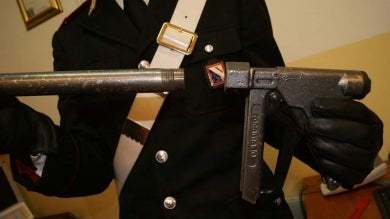
A recent seizure from dissident groups in Bahrain:

7.62 x 38mm Nagant Stapler:

Now, back to being scared over 3D printers.

For the past 15 years, islanders have watched Lake Michigan slowly disappear.
If there was any confusion where the funding for what little shopping spree Americans engaged in during December, it should all go away now. While the street was expecting a 0.2% increase in both personal income and personal spending in the month of December, what it got instead was a flat print in income (i.e. unchanged from November) while spending (mostly for non-durable goods) spiked by 0.4% meaning there was a 0.4% funding hold that had to be filled somehow. That somehow we now know is personal savings, which tumbled from a revised 4.3% to 3.9% - the lowest since January 2013, only back then incomes would rise for the rest of the year driven by the 30% increase in the S&P "wealth effect." This time, with the Fed now tapering QE, the only way is down for both the "wealth effect" and Personal Incomes... and thus Personal spending, that majority component of US GDP.
Finally, this data means that according to the BEA in December US consumers funded some $46 billion in spending through burning down their savings. As of December 31, 2013 total personal savings left are down to $495 billion.

Source: BEA

|
|

Much of my scholarship over the last two decades has focused on gun issues. Some find this an odd specialty for someone like me. Negroes and the Gun is a sort of answer to people who wonder and often have asked, how is it that a black law professor at a New York City law school comes to write sympathetically about the Second Amendment and gun rights. But Negroes and the Gun also demands its own preliminary explanation.
No one really uses the word Negro anymore. I haven’t said it out loud in decades. So the title of this book is odd in that sense. But in other more important ways the title is entirely apt. Some will recognize the title as a variation on Robert Williams’ memoir, Negroes with Guns (readers will become acquainted with Williams in the first chapter and again in Chapter Seven as he provokes a conflict with the NAACP that captures the central theme of the black tradition of arms). Negroes is also evocative of the deep roots of the black tradition of arms which emerged at a time in the American story when most black people had the legal status of mules and would have been gratified to be called Negroes.
The book chronicles a tradition of church folk, merchants, and strivers, the very best people in the community, armed and committed to the principle of individual self-defense. This black tradition of arms takes root early and ranges fully into the modern era. It is demonstrated in Frederick Douglass’s nineteenth century advice of a good revolver as the best response to slave catchers. It is evident in mature form in 1963, when Hartman Turnbow of Mississippi fought off a Klan attack with rifle fire. Turnbow considered this fully consistent with the principles of the freedom movement, explaining, “I wasn’t being non-nonviolent, I was just protectin’ my family.”
The black tradition of arms has been submerged because it seems hard to reconcile with the dominant narrative of nonviolence in the modern civil-rights movement. But that superficial tension is resolved by the long-standing distinction that was vividly evoked by movement stalwart Fannie Lou Hamer. Hamer’s approach to segregationists who dominated Mississippi politics was, “Baby you just got to love ’em. Hating just makes you sick and weak.” But, asked how she survived the threats from midnight terrorists, Hamer responded, “I’ll tell you why. I keep a shotgun in every corner of my bedroom and the first cracker even look like he wants to throw some dynamite on my porch won’t write his mama again.”
Like Hartman Turnbow, Fannie Lou Hamer embraced private self-defense and political nonviolence without any sense of contradiction. In this she channeled a more-than-century-old practice and philosophy that evolved through every generation, sharpened by icons like Ida B. Wells, W. E. B. Du Bois and Daisy Bates, pressed by the burgeoning NAACP, and crystalized by Martin Luther King Jr., who articulated it this way:
Violence exercised merely in self-defense, all societies, from the most primitive to the most cultured and civilized, accept as moral and legal. The principle of self defense,even involving weapons and bloodshed, has never been condemned, even by Gandhi…. When the Negro uses force in self-defense, he does not forfeit support — he may even win it, by the courage and self-respect it reflects…. But violence as a tool of advancement, involving organization as in warfare … poses incalculable perils.
In practice and in policy, from the leadership to the grass roots, this view prevailed into the 1960s — right up to the point where the civil-rights movement boiled over into violent protests and black radicals openly defied the traditional boundary against political violence. That violent and radical turn was the catalyst for a dramatic transition, as the movement ushered in a new black political class. Rising within a progressive political coalition that included the newly minted national gun-control movement, the bourgeoning black political class embraced gun bans and lesser supply controls as one answer to violent crime in their new domains. By the mid-1970s, these influences had supplanted the generations-old black tradition of arms with a modern orthodoxy of stringent gun control. The first seven chapters of the book chronicle the rise and evolution of black tradition of arms. Chapter 8 details the pivot from that tradition into the modern orthodoxy of stringent gun control.
The secondary theme of the book, distilled in the last chapter, addresses an intriguing tension. On one side is the tragic plague of violent young black men with guns and the toll that this violence takes on many black communities. On the other is the fact that recent momentous affirmations of the constitutional right to keep and bear arms were led by black plaintiffs, Shelly Parker and Otis McDonald, who complained that stringent gun laws in Washington, DC, and Chicago left them disarmed against the criminals who plagued their neighborhoods. The modern orthodoxy would cast Parker and McDonald as dupes or fools. But the black tradition of arms places them in a more complex light and raises critical unexamined questions about the modern orthodoxy. Chapter 9 engages those questions, highlights the diversity of interests and views about the gun question, and assesses the current implications of the black tradition of arms.
In the several years that I have been working on this project, people have asked what broadly did I hope to achieve? My goal here is to answer a longing that I have observed in a variety of contexts. It is evident when people, especially young people of color, probing the narrative of the civil-rights movement, wonder plaintively whether anyone ever fought back. There is a palpable yearning for something more than the images of Negroes in church clothes assaulted at lunch counters, attacked by dogs and flattened by baton charges. The freedom movement is filled with these sorts of non-violent heroes. But they were also victims, and that leaves us unfulfilled, grateful for their sacrifice, but still not fully proud. The question lingers, where is our Leonidas? Where is our classic champion who meets force with force even in the face of long odds? Some will find an answer in the black tradition of arms.
Of course, many episodes chronicled in the book end badly for Negroes with guns. And any worry about over-glorifying violence is further diminished by accounts of prosaic black-on-black violence and desperate, failed efforts that are more pathetic than heroic. But other episodes, like Hartman Turnbow’s defiant stand, leave us wondering how different is this, really, from the tale of gallant young cavalrymen charging artillery placements with sabers?
The book tracks the black tradition of arms through every generation, through the words and deeds of black men and women from the leadership to the grass roots. Over the next four days I will give a sampling of this, beginning tomorrow with detail including the generally unacknowledged planning and practice of armed fugitive slaves and freemen who embraced Fredrick Douglass’s advice that a good revolver was the best answer to the Fugitive Slave laws.

WickemtTactical Raptor

Booth babes are employed by companies to tempt people (and by people I mean men) to visit their SHOT Show booth. If you want to guarantee that people will visit your booth you bring along a Tactical Velociraptor wearing panoramic night vision goggles and camo, which is exactly what Blue Force Gear did. The Blue Force Tactical Dino is named Terry Clausen and even has his own website.

Photo © Bryan Jones




This is how I always want to picture a Velociraptor. Part of my childhood died when I discovered Velociraptors were actually just large meat-eating chickens.
Perhaps about fifteen years ago, Americans rediscovered that they could run barefoot. Some found that it helped with certain recurring injuries of theirs. You might think this would be terrible for shoe companies, but you underestimate the resourcefulness of the modern corporation. Shoe companies merely figured out how to market shoes for a person to run barefoot in. They look like this.

Now, it is hard to find shoes that aren’t “minimalist” in some way. (Separated toes are not necessary.) Stop for a moment and appreciate the significance of this. Shoe companies appropriated a trend to stop using their product to sell even more shoes. And the minimalist versions often need to be replaced more frequently. This is a huge business story that escaped notice, but it is not exactly a surprising story. Companies always seek to invent things to sell to people, even when what people are clamouring for is to be freed of companies.
Remember the Tom Hanks bit from You’ve Got Mail about how the variety of choices at Starbucks allows a person to assert their identity through their beverage choice?
Your car isn’t the subject of a bit. It actually does assert your identity.
Luckily, there is no one best identity available. Some people will guffaw at a Ferrari in favor of the Ram Laramie Longhorn Edition. Others will gravitate towards the Mercedes S-class.

But those are the things you are supposed to want. There is a large and growing segment of the population who want something different than would be considered traditionally best. They seek to go beyond the game by not buying what they think companies think they are supposed to buy.
That’s why Julia Roberts drives a Prius.
If you want to consume, companies will happily sell you things to consume. If you want to not consume, companies will invent things to sell you to support that desire. That doesn’t make you or them bad. That’s just a description of what happens. And, yes, your 1995 Mazda 323 functions the same way as the used t-shirt from the thrift store. And that’s OK.
You don’t get to pick whether you play the game. Society will do it for you. Your consent was never requested. You are the kid with his arms firmly crossed in the middle of the playground who has been tagged “It” yelling out that you’re not playing.
Sorry. You’re still It. And doubly so if you have consciously decided against having a car.
It is possible that you simply happen to not have a car, particularly if you are young. But perhaps you go further and aggressively disown a car. Not owning a car is the pinnacle of your selected game. You one-upped Julia Roberts.
Minimalists might not own a lot of stuff, but they sure do own minimalism as an identity. Becoming Minimalist has over 250,000 monthly readers.
You ought to know how this song ends. Companies will sell minimalism to you.
At $13,270 the Smart sounds like a great idea. Until you look at the price and discover a Nissan Versa sedan is 10% cheaper, seats 150% more people, carries more stuff, gets better fuel economy and has a transmission that doesn’t shift like a drunk 14 year old learning to drive a stick.
Alex misses the point of the Smart. That it seats fewer people, carries less stuff, and has a crappy transmission are all features. Those are key selling points. The Smart allows the buyer to aggressively not have extra seats. Taking out those seats is the same as Gap fading its jeans: a reason to charge more. To Alex’s traditionalist sensibilities, more and newer is better, but less is more in a way that matters to customers of Smart.

The Smart car is for people who want their vehicle’s cheapness to be pitched as a status symbol. A Versa might actually be a cheaper, better car, but it doesn’t communicate that you have chosen cheapness as a virtue rather than simply having bought a cheap car.
Photo credits: Wikimedia Commons
So reports the Washington Post (thanks to Prof. Howard (Friedman) Religion Clause for the pointer):
A Germantown mother and another woman accused of killing two toddlers and trying to kill two other children believed that they were releasing demonic spirits that had possessed the siblings, Montgomery County police said Saturday.
The two dead children — a boy, Norell Harris, 1, and a girl, Zyana Harris, 2 — were found Friday morning on their mother’s bed in a Germantown townhouse. Both had been stabbed repeatedly, police said. A sister, Taniya Harris, 5, and a brother, Martello Harris, 8, were seriously injured but are expected to survive.
Police said the women thought that they were performing an exorcism, although it did not appear they had followed any ritual….
Police identified the women as Zakieya L. Avery, 28, the mother, and Monifa Sanford, 21, who lived with the family. Each has been charged with two counts of first-degree murder and two counts of attempted first-degree murder….
Avery, who has received mental health counseling, moved twice in recent years — from Western Maryland to Ohio and then to Montgomery, according to a minister whose church she attended. A relative said she had separated from her husband. Writings on her Facebook page suggest that she believes in God and fears Satan….
In the townhouse community where Avery lived … at least one neighbor saw signs of possible trouble Thursday night. He spotted a child alone in a parked car and called 911, police said. As officers were on the way, two women came out of Avery’s townhouse, told the neighbor to mind his own business, took the child and went back into the home, police said.
When officers arrived, they knocked on Avery’s door but got no response. They didn’t hear or see anything suspicious and — after calling the county’s child welfare agency, where someone said the agency would follow up on Friday — they eventually left.
Monopoly was more than a game for many World War II POWs, who used tools hidden in the boxed sets to help them escape. The story's been told before, but Christian Donland at Eurogamer looks deeply into the life of a high-strung, eccentric British intelligence officer named Clayton Hutton, who designed the escape tools and had them shipped to POWs in Monopoly games. The boxes arrived from phony charities with clues in their letterhead, like the Biblical lines, "Ask and it shall be given you; seek and ye shall find; knock and it shall be opened unto you." POWs could also spot them by the red dot on the Free Parking space, notes the Atlantic. Inside, they found shears, metal files, a silk escape map, mini-compass, and money in the local currency.Nobody knows just how many escaped using these, but it's a very cool story.

WickemtProductive Hobbies
I am perhaps not alone at least among people with a depressive tendency, in finding myself in certain situations (not as much now, frankly, but a lot when I was a kid) thinking I am useless and the world would be better off without me.
This was exacerbated, when I got pneumonia, at 33 – I was then a relatively young, unpublished (though working really hard at writing) mother of two, one just five years old, the other just past one – and the doctors told me this over and over in more or less explicit terms.
To make things clear, they wanted to do a biopsy (I had atypical intercellular pneumonia, but it was pneumonia and it reacted well to IV antibiotics the first two days, but then the doctors got fascinated with the fact that it was unusual. I don’t honestly know if this was made worse by my having an accent) not to euthanize me. However, as weakened as I was, my sister in law in Portugal (who is a medical doctor and whom my husband was speaking to on the phone sometimes three times a day) thought there was a good chance even a biopsy would kill me. And the doctors weren’t reinstating the antibiotic, even though I’d reacted well to it the first two days. Instead, as I refused the biopsy, they tried to convince me by pointing out even if I died it would be better for my family. After all, what was I doing for them? I didn’t even make any money, and my husband was missing days of work to be with me in the hospital.
When they convinced me to sign the authorization, while I was groggy from a laparoscopy (I think. Whatever it is when they put a tube down your throat) which had caused a heart episode (I told them that if I was tachycardic it would be a really stupid idea give me atropine, but they told me not to worry my pretty head about it), my husband came back in time to revoke it and tell them he would sue them if they carried it on under the circumstances. And then he told me to get up and get dressed, we were going to the other hospital in town, where they might give me the antibiotic and stop the nonsense.
This is where the fact that, by choice, I promised to obey him in my wedding vows comes in. (I did this because we’re both very hard headed and every association needs an ultimate boss. Since we were moving to his country, where he knew the rules better, he was better suited to be the ultimate boss. Oh, and you should have heard the hush that fell on the wedding guests when they heard me promise that.) I thought he was out of his mind, and I was hooked to oxygen and IV feeding, and the last thing I thought I could do was get up. But I’d promised to obey my husband, and he was giving me a direct order, for the first (and last, he knows better than to abuse it) time. So I sat up, removed the stuff I was attached to, got up and went towards the locker with my clothes. At which point the doctor screamed “Stop, we’ll give her antibiotics.”
They did, and I walked out of there under my own power a week later and was fully recovered save for exhaustion about a month later. (I want to emphasize here that Dan wasn’t making these decisions on his own, but he was faxing my process, page by page to my sister in law who is a respected pathologist and also that because I was being treated by a team of six where no one was in charge, the mix up in doctor’s orders had already got me to stop breathing twice.)
I’m relating this not to illustrate how awful my care was at the time (it was pretty bad) but to illustrate that third parties, from the outside, bring their own biases to what other people are worth.
The bias might be “earning power” which seemed to be big with those doctors, as illustrated by the fact that they kept telling me I was doing nothing for my family. (I still don’t understand how their families ran, but I presume they had nannies or something? When I first came in and I told them I’d mostly been lying down for the last week – I was very ill, and we’d got a babysitter/friend to help – they did an ultrasound of my legs, because they were convinced my sedentary lifestyle had led to a blod clot in my lungs. Again, I had a five and a one year old, with the one year old just starting to walk. And I had a 2k square foot home that I cleaned myself (I still clean my home myself.) And I did all the cooking and yard care, and most of the shopping for the family. How they imagined that I had been lying down long enough and immobile enough to develop a blood clot is beyond me.) But the other part of it was also “you’ll never be able to do anything for them. You’re just a housewife.”
This was a value judgment. And back then, when I was really ill, it was a terrible judgment, that made me feel that I shouldn’t be alive, and that I was a millstone around my family’s necks.
My husband told me it was nonsense, but of course I couldn’t believe it.
This echoes all the times in adolescence when I thought I was useless.
Now, some of this feeling of “born owing something” seems to be a brokenness inherent in everyone who achieves something. Why, yes, we have something to prove.
Maybe if you could cure us completely of it, we would not ever achieve anything. It was after that episode in the hospital that I started working hard enough to sell and eventually to make a modest living from it.
But at the same time, there are two caveats, one particularly important right now in the time of Obamacare when doctors and indifferent bureaucrats might decide you’re not worth the trouble of keeping alive: first, you have inherent value, and you should always advocate for yourself and your right to treatment and to stay alive; second, they don’t have a right to think you’re worthless – and you are worth far more than your economic contributions.
Looking back, if I’d died then, my younger son would probably have dropped out of sixth grade and left school – with who knows what future. My older son would probably be different too. And Dan would have been much lonelier not to mention harassed with the two boys to raise. But also, I would never have been published. Perhaps I flatter myself that my stories have helped or at least amused some of you. If I’d died then, Athena would never have been written, or Kyrie, or Luce. I like to believe it’s good I lived to write them.
The same applies to my depressive episodes in adolescence. If I’d died then – and I often wanted to – I’d never have met Dan or got to have my boys. I’d never have come to America. I’d never have known my friends or read all the books I’ve read since. I’d have missed the pleasurable moments in the last thirty some years – and I’d have missed what I’ve done that other people enjoyed since.
Since Dan and I are quite happily married – thank you – I think his life would have been sadder if I’d died at twelve or fifteen.
But even if I’d done nothing but exist, the very fact of existing makes an impact in the world, and if I don’t go out of my way to be nasty, (I try not to) that impact is mostly positive.
You are worth it. You deserve to be alive.
Look, I’m not going to talk of lilies in the field who don’t toil – I’m not that good at flowers – but Dan and I have had – so far – ten cats.
I don’t know what use cats are. They are not particularly productive from an economic point of view. (What they are productive of explains my obsession with litter boxes.) But they are loveable, and we have loved them. Just by being themselves, with their clown antics and their purring and the occasional cuddle on a cold night, they were worth more than the price of their food, and the occasional disasters caused by claws and marking.
You are worth at least as much as a cat, and perhaps more. Even if you feel all you are is a burden on others, that’s unlikely to be true. It takes a very barren mind and heart to be nothing but a burden. Even if all you can give is a smile now and then, that might be the smile someone else needs to keep going. And sometimes, even just the fact that you need help, is enough to give structure and meaning to someone else’s life. We all know people who were caretakers for other people and who became better for it.
You are not useless. You are never valueless.
The problem with our ever-more top-down and bureaucracy-controlled world is that people make decisions for/about other people’s lives based on economic value or other external markers.
But no measure can truly capture the value of a life (even a cat life.) And if you’re alive and thinking and capable of even smiling, you are not valueless. And you should never believe anyone who tells you that you are.
Tell the bureaucrats to take a hike. And tell the internal voices telling you that you’re valueless to take a hike too.
And you, keep going with what you’re supposed to do. You don’t know how wonderful things might be in the future – or what you might accomplish that you can’t even dream of.


A New Mexico trial court in today’s Morris v. Brandenberg (N.M. Dist. Ct. Jan. 13, 2014) holds that the New Mexico Constitution protects such an unenumerated right, though the U.S. Constitution does not. Not clear what the New Mexico appellate courts will do with this, though.
Submitted by Michael Krieger of Liberty Blitzkrieg blog,
The following article from the New York Times is extraordinarily important as it perfectly highlights the incredible hypocrisy of the U.S. government when it comes to overseas slave labor and human rights. While the Obama Administration (and the ones that came before it) publicly espouse self-important platitudes about our dedication to humanitarianism, when it comes down to practicing what we preach, our government fails miserably and is directly responsible for immense human suffering.
Let’s get down to some facts. The U.S. government is one of the largest buyers of clothing from overseas factories at over $1.5 billion per year. To start, considering our so-called “leaders” are supposedly so concerned about the state of the U.S. economy, why aren’t we spending the money here at home at U.S. factories? If we don’t have the capacity, why don’t we build the capacity? After all, if we need the uniforms anyway, and it is at the taxpayers expense, wouldn’t it make sense to at least ensure production at home and create some jobs? If a private business wants to produce overseas that’s fine, but you’d think the government would be a little more interested in boosting domestic industry.
However, the above is just a minor issue. Not only does the U.S. government spend most of its money for clothing at overseas factories, but it employs some of the most egregious human rights abusers in the process. Child labor, beatings, restrictions on bathroom brakes, padlocked exits and much more is routine practice at these factories. Even worse, in the few instances in which the government is required to actually use U.S. labor, they just contract with prisons for less than $2 per hour using domestic slave labor. Then, when questions start to get asked, government agencies actually go out of their way to keep the factory lists out of the public’s eye, even going so far as denying requests when pressed for information by members of Congress.
Sadly, as usual, at the end of the day this is all about profits and money. Money government officials will claim is being saved by the taxpayer, but in reality is just being funneled to well connected bureaucrats.
From the New York Times:
WASHINGTON — One of the world’s biggest clothing buyers, the United States government spends more than $1.5 billion a year at factories overseas, acquiring everything from the royal blue shirts worn by airport security workers to the olive button-downs required for forest rangers and the camouflage pants sold to troops on military bases.
But even though the Obama administration has called on Western buyers to use their purchasing power to push for improved industry working conditions after several workplace disasters over the last 14 months, the American government has done little to adjust its own shopping habits.
Labor Department officials say that federal agencies have “zero tolerance” for using overseas plants that break local laws, but American government suppliers in countries including Bangladesh, the Dominican Republic, Haiti, Mexico, Pakistan and Vietnam show a pattern of legal violations and harsh working conditions, according to audits and interviews at factories. Among them: padlocked fire exits, buildings at risk of collapse, falsified wage records and repeated hand punctures from sewing needles when workers were pushed to hurry up.
In Bangladesh, shirts with Marine Corps logos sold in military stores were made at DK Knitwear, where child laborers made up a third of the work force, according to a 2010 audit that led some vendors to cut ties with the plant. Managers punched workers for missed production quotas, and the plant had no functioning alarm system despite previous fires, auditors said. Many of the problems remain, according to another audit this year and recent interviews with workers.
At Zongtex Garment Manufacturing in Phnom Penh, Cambodia, which makes clothes sold by the Army and Air Force, an audit conducted this year found nearly two dozen under-age workers, some as young as 15. Several of them described in interviews with The New York Times how they were instructed to hide from inspectors.
“Sometimes people soil themselves at their sewing machines,” one worker said, because of restrictions on bathroom breaks.
And there is no law prohibiting the federal government from buying clothes produced overseas under unsafe or abusive conditions.
Why am I not surprised…
“It doesn’t exist for the exact same reason that American consumers still buy from sweatshops,” said Daniel Gordon, a former top federal procurement official who now works at George Washington University Law School. “The government cares most about getting the best price.”
Labor and State Department officials have encouraged retailers to participate in strengthening rules on factory conditions in Bangladesh — home to one of the largest and most dangerous garment industries. But defense officials this month helped kill a legislative measure that would have required military stores, which last year made more than $485 million in profit, to comply with such rules because they said the $500,000 annual cost was too expensive.
As usual, it is all about the money. You think average Americans are seeing any of that massive profit? Believe me, someone is and it’s not you.
At Manta Apparels, for example, which makes uniforms for the General Services Administration, employees said beatings are common and fire exits are kept chained except when auditors visit. The local press has described Manta as one of the most repressive factories in the country. A top labor advocate, Aminul Islam, was organizing there in 2010 when he was first arrested by the police and tortured. In April 2012, he was found dead, a hole drilled below his right knee and his ankles crushed.
Conditions like those are possible partly because American government agencies usually do not know which factories supply their goods or are reluctant to reveal them. Soon after a fire killed at least 112 people at the Tazreen Fashions factory in Bangladesh in November 2012, several members of Congress asked various agencies for factory addresses. Of the seven agencies her office contacted, Representative Carolyn Maloney, Democrat of New York, said only the Department of the Interior turned over its list.
Federal officials still have to navigate a tangle of rules. Defense officials, for instance, who spend roughly $2 billion annually on military uniforms, are required by a World War II-era rule called the Berry Amendment to have most of them made in the United States. In recent years, Congress has pressured defense officials to cut costs on uniforms. Increasingly, the department has turned to federal prisons, where wages are under $2 per hour. Federal inmates this year stitched more than $100 million worth of military uniforms.
The Marine Corps and Navy still do not require audits of these factories. The Air Force and Army exchanges do, but the audits can come from retailers, and defense officials fail to do routine spot checks to confirm their accuracy.
The Marine Corps and Navy still do not require audits of these factories. The Air Force and Army exchanges do, but the audits can come from retailers, and defense officials fail to do routine spot checks to confirm their accuracy.
For now, Bangladesh’s garment sector continues to grow, as do purchases from one of its bulk buyers. In the year since Tazreen burned down, American military stores have shipped even more clothes from Bangladesh.
This is the human equivalent of factory farming and every decent American citizen should be appalled that this is happening on multiple levels. Please share this post to raise awareness.
Full article here.

|
|
WickemtBecause real estate in this city is a joke, indeed.
With Russian, Chinese, and Argentinian (with a record low in the blue dollar today) money washing ashore (in USD or Bitcoin) under the Status of Liberty, the 'prices' of upscale apartments in New York City have simply exploded. We thought some context for this apparent 'price' vs 'value' discrepancy was useful... presenting 6 castles that cost less than an apartment in NYC (and given the number of bedrooms, not to mention moats, dungeons, vineyards, ramparts and drawbridges - dramatically less in terms of per-capita spend).


|
|
Four pictures are worth four thousand words:

The St. Joseph Lighthouse on North Pier, Lake Michigan, on Jan. 6, 2014; Photographer: HotSpot/Landov

Ice builds up along Lake Michigan at North Avenue Beach as temperatures dipped well below zero in Chicago on Jan. 6, 2014; Photographer: Scott Olson/Getty Images

A pedestrian covers her face to keep warm in New York; Photographer: Jin Lee/Bloomberg

A man uses a snow blower to clear snow in New York on Jan. 3, 2014, Photographer: Jin Lee/Bloomberg
* * *
And now, some stories, via Bloomberg:
Yesterday’s low in Chicago reached a record for the date of minus 16 degrees Fahrenheit (minus 27 Celsius), beating the mark of minus 14 set in 1884 and 1988, according to the National Weather Service. Today, New York’s high will struggle to reach 10 degrees, a day after Central Park reached 50. As of 7 a.m., it was 5 degrees in New York and 13 in Boston.
“It is a pretty ferocious air mass coming down,” said Tom Kines, a meteorologist with AccuWeather Inc. in State College, Pennsylvania. “Across the upper Midwest it stayed below zero and will stay below zero and that air is coming eastward.”
The frigid weather strangled transportation routes around the country including interstate highways, airlines and rails. It also led to a surge in energy demand that pushed power in Texas to more than $5,000 a megawatt-hour for the first time and caused disruptions at oil refineries in Tennessee and Illinois.
The natural gas-weighted heating degree days value is expected to be 46.5 today, according to Commodity Weather Group LLC in Bethesda, Maryland, beating the century’s previous high of 45.1 set on Jan. 16, 2009. Natural gas-weighted heating degrees subtract the daily average temperatures in cities nationwide from 65, then weight the totals based on population and use of the fuel for heating.
* * *
The cold air blowing across the Great Lakes may bring 24 inches of snow to parts of western New York by tonight, according to the weather service. The region is expected to be whipped by wind chills of minus 30.
“The lake snow belts are going to get walloped,” said James Aman, a senior meteorologist with Earth Networks, Inc. in Germantown, Maryland.
* * *
Valero Corp.’s Memphis refinery in Tennessee had a system shutdown because of low temperatures in the area, according to a filing with the U.S. National Response Center. Exxon Mobil Corp. had some “problems” with unidentified process units at its Joliet, Illinois, refinery because of extreme cold weather, according to a separate filing. U.S. companies must notify the center if they release hazardous substances. Bloomberg couldn’t immediately verify the information.
Record lows for the date were set or tied across the northern tier of the country. The low of minus 13 in Fort Wayne, Indiana, beat the old mark of minus 12 set in 1970, according to the weather service. In Burlington, Iowa, the mercury fell to minus 14, which was also recorded in 1970.
The lowest temperature of the day was minus 40 in Brimson, Minnesota, according to the U.S. Weather Prediction Center in College Park, Maryland.
Among today’s forecast highs are 5 in Chicago, 17 in Washington and 26 in Atlanta.
* * *
While the heart of the cold is shifting east, it will still maintain its grip on the central U.S., Aman said. He said the weather will start to warm in a couple of days.
“By Wednesday morning a lot of your big cities will be in single digits and during the day Wednesday we start to come out of it,” Aman said. “Things will be much more tolerable by Wednesday afternoon and we see some continued warming by Thursday.”
Temperatures in New York are expected to bounce back to 39 by the end of the week, according to the weather service. On Jan. 13 it may reach 53, according to MDA Weather Services in Gaithersburg, Maryland. Chicago’s high may reach 39 by Jan. 12 and Washington 57 by Jan. 13, according to MDA.

|
|
A North Carolina family is demanding answers.
North Carolina prosecutors promised Monday to get to the truth — “wherever the truth leads”— in the death of a mentally ill teenager whose family claims police shot him in cold blood over the weekend.
Keith Vidal, 18, of Boiling Springs Lakes, was shot and killed Sunday afternoon, authorities said.
At least three law enforcement agencies responded after the family called for help just after noon, saying Vidal was in the midst of a schizophrenic episode.
Vidal was declared dead of a gunshot wound at a hospital.
Jerry Dove, chief of the Southport police, one of the responding agencies, said at a news conference that Detective Byron Vassey, a nine-year veteran of the department, had been placed on administrative leave. He wouldn’t say whether Vassey was believed to be the officer who fired the shot.
[ ... ]
Mark Wilsey, the young man’s stepfather, told reporters that the family called police to help subdue Vidal because he was holding a small screwdriver and threatening to fight his mother during a schizophrenic episode.
But the situation appeared to be under control, with two officers restraining the 90-pound Vidal, when the third officer arrived and shot Vidal point-blank, Wilsey contended.
“Then all of a sudden, this Southport cop came, walked in the house [and said]: ‘I don’t have time for this. Tase him. Let’s get him out of here,’” Wilsey said.
An officer used a stun gun on Vidal, “he hit the ground [and] this guy shot him,” Wilsey said.
Wilsey said that when he demanded to know why his stepson had been shot, the officer replied, “‘Well, I’m protecting my officers.’”
According to a report at The Daily Caller, Vidal was pinned on the ground by two officers when the third said “we don’t have time for this,” and shot him. There was never any report to dispatchers of a problem.
The first unit on scene reported a confrontation in the hallway, but told Brunswick County Dispatchers several times that everything was OK. Unit 104 from Southport arrived on the scene at 12:48:41, fourteen minutes after the first officer had already been on scene. Seventy seconds later, Unit 104 radioed out that he had to fire shots at the subject in order to defend himself.
The event report mirrors what family members told the media. Wilsey said his family called the police to help with his schizophrenic son Keith Vidal who had a small screwdriver in his hand. Officers used at Taser on Vidal and then shot him, according to Wilsey.
Wilsey said officers came into their home after they called for backup help when Vidal was having a schizophrenic incident.
Wilsey said officers had his son down on the ground after the teen was tased a few times and an officer said, “we don’t have time for this.” That’s when Wilsey says the officer shot in between the officers holding the teen down, killing his son.
This report is even more detailed. Two officers had him down on the floor, and the third officer, despite his claiming to think of the safety of “his” officers, shot in between the two officers who were holding Vidal down. And just as a reminder, Vidal was a mere 90 pounds, only ten more than my dog. The only person I ever knew who was 90 pounds had anorexia.
This has all the marks of cold blooded murder (at least second degree murder). Yet I expect the blue wall to close in behind the officer who fired the shot, the flow of information to dry up, and no charges ever filed even if the officers lose their jobs.
We’ll see and I will continue to track this. But this is the sort of thing people are coming to expect from police. We already know never to talk to the police. People generally learn the hard way, but learn they will. Do not call the police even when you need help. You just might die or get some innocent person shot.
At least, that’s the message being sent by law enforcement all over America.