R.P. Aditya
Shared posts
Urban Studies: What’s Your Ideal Community? The Answer Is Political
Safeway to buy, rebrand Andronico’s Markets

Andronico’s on Shattuck Avenue in Berkeley: Andronico’s Community Markets’ five stores will become Safeway Community Markets by year-end. Photo: Tracey Taylor
Eighty-seven years after founding its first grocery store in Berkeley, the Andronico’s name will disappear for good by the end of 2016, after being acquired by Safeway.
Safeway is buying Andronico’s Community Markets, according to both companies, and Andronico’s five stores will be renamed Safeway Community Markets. Andronico’s two stores in Berkeley, and its other three — in San Francisco, San Anselmo and Los Altos — are slated to undergo the transition in December and each store will be closed for a short period of time during the changeover.
No jobs will be lost as a result of the purchase, said Andronico’s CEO Suzy Monford, who told Berkeleyside that the union that represents both Safeway and Andronico’s staff “wholeheartedly supports” the move, and that she herself is delighted with the development. Monford said there were around 350-400 employees in total across the five stores, with 35 in the group’s corporate office.
Read more about Andronico’s Community Markets on Berkeleyside.
In a statement released to Berkeleyside by Safeway, the grocery giant said Andronico’s approached Safeway earlier this year about purchasing their stores “with the goal of preserving union jobs and keeping the stores operating in the same friendly, local way their customers have come to enjoy.”
Andronico’s, which was founded in Berkeley in 1929 — and at its peak had 14 stores in the Bay Area — declared bankruptcy in August 2011 and was bought by Renovo Capital, along with A.G. Ferrari, another local food group.
Wednesday morning, representatives from Safeway, along with Monford, were on the grocery market floor in Berkeley’s two stores talking to staff about the news and its implications.(...)
Read the rest of Safeway to buy, rebrand Andronico’s Markets (774 words)
By Tracey Taylor. |
Permalink |
51 comments |
Post tags: Andronico's Community Markets, Safeway
Strategy: How to Deal With Digital Distractions
Ten things to do to have have a healthy home
 How to improve air quality, and keep the bad stuff out.
What Daily Life Looks Like at Different Income Levels
In Vietnam, a family living on $266 a month locks the front door of their three-bedroom home with a rusty padlock. It’s not unlike the one that shutters the entrance to the house of an Indian family living on $245 a month, or a Nepalese family with $201.
Locks are just one type of household object that the new website Dollar Street is documenting to create a snapshot of global wealth stratification. Anna Rosling Rönnlund, the cofounder of the Sweden-based Gapminder Foundation, developed the project in 2014; since then, her team of photographers has traveled to 200 homes in 50 countries. They spend at least a day in each home, interviewing the family and taking pictures of household objects—from stoves to toothbrushes to toilets to telephones—that fall into the 135 categories that Dollar Street uses as points of comparison.

In a 2015 TEDxStockholm talk, Rosling Rönnlund described how photos and snapshots are often used to create “fairytale” images of other countries, capturing stereotypical scenes of poverty and wealth, and ignoring the vast array of incomes and lifestyles in between the two extremes. People in other countries, Rosling Rönnlund says, are often portrayed as exotic or unknowable. “This has to change,” she says. “We want to show how people really live.”
On Dollar Street, Rosling Rönnlund imagines all the households in the world arranged by income level along a single residential road. Rather than relying on geographic boundaries to inform our understanding of other countries, she says, we need “a visual framework that we can use to understand the socioeconomic reality of the world.” Each family’s monthly income serves as their “address”; the block spanning the global median of $250 to $390 a month contains households from Rwanda, Vietnam, Cambodia, Bolivia, Indonesia, Thailand, and India.

Speaking to Fast Company, Fernanda Drumond, a project manager for the Gapminder Foundation, says Dollar Street breaks down stereotypes by showing myriad similarities across countries. “If you look at wealthy families in the United States and compare [them] to wealthy families in Mexico, and wealthy families in China or India, you’re going to see that they’re very similar,” she said. While the similarities are striking, they also display a decidedly western preference: A wealthy Ukranian family displays the latest iPhone; the TV of a Chinese family earning over $10,000 a month broadcasts an NBA game.

Through Dollar Street, Rosling Rönnlund hopes to humanize the differences often understood only through statistics. During her TEDxStockholm talk, Rosling Rönnlund plays a video of families at all income levels brushing their teeth. It’s an activity that everyone does, but a motorized toothbrush in Sweden, at the higher end of the income spectrum, looks very different than a woman in Malawi, who brushes her teeth with her fingers.
Differences between cultures and income brackets run much deeper than can be fully expressed through a collection of photos, even the vast array that Dollar Street currently contains. But Rosling Rönnlund emphasizes that Dollar Street is still a work in progress. She has over 30,000 images to sort through, and envisions the site growing even larger into a collaborative platform, where families can submit their own household photos. “We want it to be possible for you to compare all nations, all cities, and all suburbs to see the diversity within the world,” she says. “It’s when we can start comparing across country borders that we start to see interesting patterns.”
H/t Fast Company
Indian-born mothers are the most educated and highest earning migrant mothers in the US

When it comes to education and family income, Indian-born mothers are the most well off compared to migrant mothers from other countries and territories in the US.
A recent study by the Pew Research Center found that migrant mothers in the US from Asia were much more likely to have college degrees and earn more than those from central and Latin America. Indian mothers, who gave birth to the third-highest number of babies among foreign-born mothers in 2014, were by far the best educated and belonged to families with the highest median income.
Nearly nine in 10 Indian-born women with newborns in the US in 2014 held a bachelor’s degree. China was second on the list, with 60% of new mothers residing in the US holding a bachelor’s degree.
“The Indian case is particularly extreme–none of the other top-sending countries come close in terms of the share of new moms with a bachelor’s degree,” the report noted.

The study clearly showed the value of higher education among these groups. The annual median family income for Indian-born mothers was $104,500—about 40% higher than the next top earning migrant group, and more than double the median family income of US-born mothers. People coming from America’s neighboring countries—Mexico, Puerto Rico, Honduras, and others—are not crossing the borders with the same high levels of education, and, in turn, are earning far less.

Predictably, these less educated and lower earnings groups also face more extreme cases of poverty. For instance, 49% of the mothers who hail from Honduras were living in poverty, while only 4% of Indian-born mothers faced the same adversity—the least among all surveyed countries.
Aside from being more highly educated, Indian-born mothers tend to belong to steadier family structures. Single mothers are more likely to be in poverty than families with married couples, and less than 1% of Indian-born mothers in the US were unmarried. By comparison, 66% of women native to Honduras with newborns were single mothers.





At just $5, this solar lamp is the most affordable in the world
 When is the last time that a $5 gadget literally changed your life?
The overlooked story of Diwali is actually about respecting women’s dignity

Hindus around the world are celebrating Diwali this weekend. The holiday falls less than two weeks before the US presidential elections, making it a good time to remind ourselves of the lesser-told story of the Ramayana: that of a woman standing up for herself.
The Ramayana, the great Hindu epic at the heart of the Diwali celebrations, is actually an all-too-modern tale about a woman who refuses to suffer any more indignities after years of having her character questioned. As Republican presidential nominee Donald Trump, who was recently caught on tape making lewd remarks about women and is currently battling multiple allegations of sexual assault, is trying to woo Hindus in the US, perhaps he should acquaint himself with the full story of the Ramayana if he wants to win Hindus over.
Trump has been working hard to court the Hindu vote of late. Two weeks ago, at a Bollywood-themed event, Trump proclaimed, “I am a big fan of Hindu.” He also recently released an ad aimed at Indian-American audiences. “Ab ki baar, Trump Sarkar:” “This time, a Trump government,” Trump says in accented Hindi, unabashedly using Indian prime minister Narendra Modi’s 2014 campaign slogan.
The Republican presidential nominee is clearly seeking to bond with Indian Americans, more specifically with Hindus. It’s a rare moment in the political spotlight for a community that accounts for less than 1% of the US population, but is growing at an exponential rate. Hinduism is now the fourth-largest religious community in America, according to a 2015 Pew Research Center report. And Diwali is our biggest festival.
During the Diwali celebrations, Hindus retell the Ramayana as the story of Prince Rama, the Hindu god Vishnu in human form, who obeyed his father and left his kingdom to live in exile for 14 years. While in exile, Rama’s wife, Sita, is kidnapped by a fearsome king named Ravana. (The Ramayana is also the cautionary tale of a leader who caused the destruction of his kingdom because he refused to accept that he was wrong—something that may also sound familiar to Republicans in America today). Rama fights for Sita courageously, defeats Ravana, and rescues his wife.
Diwali marks the day that Prince Rama triumphantly returns to his kingdom of Ayodhya with his wife. It is said that Ayodhya’s citizens welcomed their prince home with thousands of glowing oil lamps on a moonless night. The lamps symbolize the victory of good over evil, and Hindus celebrate this story every year by lighting millions of them all over the world.
But what we don’t commonly share or celebrate is the continuation of the story.
Sita had to publicly prove she was untouched by her kidnapper Ravana by literally walking through a fire. After returning to Ayodhya, Sita had to publicly prove she was untouched by her kidnapper Ravana by literally walking through a fire. She was not burnt, and therefore declared pure. Soon after returning, however, Rama is told that one of his subjects has been publicly questioning Sita’s virtue. Instead of defending his wife or discussing his concerns with her, Rama ordered his brother Laxmana to abandon a pregnant Sita alone in the forest. Rama’s twin sons, born in a hermitage, grow up hearing stories about their father, but do not meet him for several years.
Ravana, meanwhile, forces his allies and soldiers to follow him into battle, even though fighting over a princess has little strategic value to the kingdom and would only bring mass suffering. Vibhishana, the lone brother who questions Ravana and refuses to fight for him, is exiled. “Toe the party line or face being cast out,” Ravana essentially tells his allies and subjects, much as a modern-day Trump tells his party leaders to support him or face the consequences.
Up to this point, the Ramayana’s message of obedience is cloaked in a religious story that supports those with power, not those who question hierarchies. What we so often lose in the retelling is something much more powerful.
In the little-celebrated final chapters of the Ramayana, Sita is reunited with Rama after several years. Rama, though happy to see her, once again asks Sita to prove her virtue by passing a trial by fire. If she emerges unscathed, Sita will be welcome back to the palace. Sita, obedient as ever, enters the flames. They do not touch her.
After years of exile and the humiliation of repeatedly being asked to prove her innocence, Sita decides she has had enough. Then comes the twist: After years of exile and the humiliation of repeatedly being asked to prove her innocence, Sita decides she has had enough. In an astonishingly bold move for a tale that stresses obedience, Sita chooses not to return to her husband. The earth then parts to embrace Sita, supporting her decision.
In the Hindu tradition, Mother Earth is the embodiment of endurance. In the Ramayana, the parting of the ground symbolizes the cracking of Sita’s patience. In this age-old epic, it is made very clear that even the most patient of women have their limits.
The stories Hindus tell our children are sprawling sagas of gods and goddesses who become mortals to fight demons—their power, their grace, their fights, their mistakes, and their mischief. Our deities are not always perfect, but good always triumphs over evil, just as the warm glow of the oil lamps pierce through the dark night. We tell comfortably familiar stories—but we don’t talk about the long years of silence that Sita endured.
The Ramayana is no fairy tale that ends with a prince rescuing a princess to live happily after. With Mr. Trump trying to win over American’s Hindu audience, this may be the time to reframe the Ramayana as not just a tale of masculine courage, but also as a story that emphasizes our very contemporary need to respect a woman’s dignity. At a time when Hillary Clinton is the first female candidate to be nominated for the presidency by a major political party, we must remember that the Ramayana is Sita’s story too.
Diwali, Mr. Trump, is not where this story ends.
We welcome your comments at ideas@qz.com.

From blue-collar workers to curry kings, chronicling the stories of Indians in Europe

In a time of rising anti-immigrant rhetoric across Europe, it’s stories of people such as the Sikhs who make Parmigiano Reggiano cheese in Italy, for instance, that act as a reminder that diaspora communities do wonderful things for their adopted homes.
Settled in cities and towns across the globe, Indians make up the second-largest community of migrants in the European Union, bringing a unique touch to the societies they live and work in, and not just through art and culture, music and dance. It’s the stories of these individuals that the Delegation of the European Union to India wanted to uncover so they sent three photographers—Kounteya Sinha, Paroma Mukherjee and Shome Basu—to travel the length and breadth of Europe, meeting members of the diaspora in Italy and France, Slovakia and Slovenia.
Their photographs are now on display in New Delhi in an exhibition titled New Homelands: The Indian Diaspora in the European Union.
“In the post-war era, Indians have journeyed forth to many different states of Europe. There are Roman Catholics as well as Punjabi farmers in Italy; Goans in Portugal; blue collar workers, and doctors in the UK, academics and artists in the Netherlands, France and Germany, bankers and jewelers in Belgium, and so on,” Alka Pande, curator of the exhibition, writes in a statement.
Here are some of the people and stories the photographers discovered across Europe:

Sajjad came to Slovakia in 1998 while he was working for Slovak Airlines, which was operating from New Delhi. Later, he settled in Bratislava as a cook at a local restaurant. Thanks to his fluency in Arabic, he also worked as an interpreter with the embassy of Saudi Arabia there. Sajjad speaks fluent Slovak and his signature butter chicken is famous among Slovakians in Bratislava.

The Central Mosque of Lisbon was inaugurated in 1985. The initiative to build this mosque was taken by an Indian, Abdool Magid Vakil, an economist by profession who felt the need of a mosque in Lisbon when he came to study there.

Curry king Micky Sehgal arrived in Italy in June 1980 with $500 in his pocket. Today, Micky owns three of Rome’s most famous Indian restaurants by the name Maharajah and has an annual turnover of over 1.5 million euros. Sehgal’s first home was 65 square metres but now he lives in a 1600 square metre villa. Maharajah’s clientele includes Anthony Hopkins, Tom Cruise, Clint Eastwood, Sachin Tendulkar, Shah Rukh Khan, Aishwarya Rai and Rajinikanth.

Every night, after 8 pm, Sardar Singh from Jammu sits by the Colosseum to sell his paintings. With four flash lights lit up, he sits for three hours every day. He says, “I love the way they celebrate in Italy. Without fear. Embracing openly.” Rome has been his home for the past 26 years.

Mandeep Singh from Amritsar has lived in Europe for 15 years. Singh just launched Slovenia’s first recording company, called Virsa Records. His dream is to get Indian films and songs to shoot in Slovenia. Singh just finished shooting the videos of six Punjabi songs with Miss Universe Slovenia, Lucija Potocnik. Singh’s family is truly global – he is Indian, his wife Lithuanian, his elder son Arun was born in Belgium and his younger son Sharun was born in Slovenia.

Krishna Dutt came to Stockholm about 26 years ago with her husband and never left. A popular figure in Stockholm’s cultural circuit, she has written a book about her time in the city and even teaches Swedish. She has hosted artists such as Zakir Hussain in this very home and even though age has caught up with her, she still visits her sisters in India twice a year.

Ambi Venkataraman and his wife have been living in Luxembourg for nearly thirty years. He arrived there as an employee of a rubber company. At that time, to move in and around Europe, he needed different visas and currencies. Venkataraman used to carry maps and guides of different European countries that used to fill his room, recalls his wife. Today, he represents the Indian community in Luxembourg and Brussels. He has been conferred the title of Honorary Consul General of India to Luxembourg.

Sruti Bala sets up her tabla in her study as she gets ready for her daily practice session. She has been learning the instrument for the past decade and is quite good at it. At the University of Amsterdam, she teaches in the department of theatre studies. Bala studied in Mumbai and her home is in Coimbatore, where her parents still live.

In just a few weeks, the sun will be scarce. But locals know exactly where to go to sweat it out—Manivannan Ramaswamy’s Ayurveda centre in Ljubljana. Ramaswamy’s steam chamber—an ancient Indian object named Vashpaswedana—has a temperature of 45 degrees. Ramaswamy is also using Ayurveda to help Slovenia’s World War II veterans overcome depression and anxiety.

Asker, the head chef at the India Club Bar and Restaurant came to London 20 years ago from Kerala. Along with his colleague and friend Khaled, he never thought of working anywhere else other than the historic India Club. The menu offers a range of home-cooked Indian dishes, and his version of mango lassi is a favourite with customers.

On the Environment: India’s Air-Conditioning and Climate Change Quandary
Music Theory: An Education from First Principles
Article URL: http://www.lightnote.co/
Comments URL: https://news.ycombinator.com/item?id=12792063
Points: 930
# Comments: 146
When an investment banker and an MIT graduate lived like India’s poor on $0.39 a day

Tushar, the son of a police officer in Haryana, studied at the University of Pennsylvania and worked for three years as an investment banker in the United States and Singapore. Matt migrated as a teenager to the United States with his parents, and studied at MIT.
At different points, both of them decided to return to India and joined the UID Project in Bangalore. They came to share a flat, and became close friends.
The idea suddenly struck them one day. They had returned to India in the vague hope that they could be of use to their country. But they knew the people of this land so little.
Tushar suggested one evening, “Let us try to understand an ‘average Indian’, by living on an ‘average income’.”
Matt was immediately captured by the idea. They began a journey which would change them forever.
To begin with, what was the average income of an Indian? They calculated that India’s Mean National Income was Rs4,500 a month, or Rs150 a day. Globally, people spend about a third of their incomes on rent. Excluding rent, they decided to spend Rs100 each a day. They realised that this did not make them poor, only average. Seventy per cent of Indians live on less than this average.
The young men moved into the tiny apartment of their domestic help, much to her bemusement.
Many things changed for them.
They spent a large part of their day planning and organising their food. Eating out was out of the question; even dhabas were too expensive. Milk and yogurt were expensive and therefore used sparingly; meat was out of bounds, as was processed food, like bread. No ghee or butter, only a little refined oil. Both are passionate cooks with healthy appetites. They found soy nuggets a wonder food—affordable and high on proteins, and worked with many recipes. Parle G biscuits again were cheap: twenty-five paise for twenty-seven calories! They innovated a dessert of fried banana on biscuits. It was their treat each day.
Living on Rs100 made the circle of their life much smaller. They found that they could not afford to travel more than five kilometres in a day by bus. If they needed to go further, they could only walk.
They could afford electricity only five to six hours a day, therefore sparingly used lights and fans. They needed also to charge their mobiles and computers.
They used one Lifebuoy soap cut into two. They passed by shops gazing at things they could not buy. They could not afford the movies, and hoped they would not fall ill.
However, the bigger challenge remained. Could they live on Rs32, the official poverty line?
The figure had become controversial after India’s Planning Commission informed the Supreme Court that this was the poverty line for cities. For villages, it was even lower, at Rs26 per person per day.
They decided to go to Matt’s ancestral village, Karucachal in Kerala, and live on Rs26 or $0.39. They ate parboiled rice, tubers and bananas, and drank black tea: a balanced diet was impossible on the Rs18 a day which their briefly-adopted “poverty” permitted.
They found themselves thinking of food the whole day. They walked long distances, and saved money even on soap to wash their clothes. They could not afford communication by mobiles and internet. It would have been a disaster if they fell ill. For the two twenty-six-year-olds, the experience of “official poverty” was harrowing.
Yet, when their experiment ended, they wrote to their friends:
“Wish we could tell you that we are happy to have our ‘normal’ lives back. Wish we could say that our sumptuous celebratory feast two nights ago was as satisfying as we had been hoping for throughout our experiment. It probably was one of the best meals we’ve ever had, packed with massive amounts of love from our hosts. However, each bite was a sad reminder of the harsh reality that there are 400 million people in our country for whom such a meal will remain a dream for quite some time. That we can move on to our comfortable life, but they remain in the battlefield of survival—a life of tough choices and tall constraints. A life where freedom means little and hunger is plenty…
It disturbs us to spend money on most of the things that we now consider excesses. Do we really need that hair product or that branded cologne? Is dining out at expensive restaurants necessary for a happy weekend? At a larger level, do we deserve all the riches we have around us? Is it just plain luck that we were born into circumstances that allowed us to build a life of comfort? What makes the other half any less deserving of many of these material possessions (which many of us consider essential) or, more importantly, tools for self-development (education) or self-preservation (healthcare)?
We don’t know the answers to these questions. But we do know the feeling of guilt that is with us now. Guilt that is compounded by the love and generosity we got from people who live on the other side, despite their tough lives. We may have treated them as strangers all our lives, but they surely didn’t treat us that way…”
So what did these two friends learn from their brief encounter with poverty? That hunger can make you angry. That a food law which guarantees adequate nutrition to all is essential. That poverty does not allow you to realise even modest dreams. And above all—in Matt’s words—that empathy is essential for democracy.
Excerpted with permission from Invisible People: Stories of Courage and Hope, Harsh Mander, Duckbill Books. This post first appeared on Scroll.in. We welcome your comments at ideas.india@qz.com.

Air India flew 1,400 kilometres extra to shave hours off its Delhi-San Francisco flight

India’s national carrier just raised the stakes in the long-haul flights game.
Last week, Air India reportedly set a record with its flight from Delhi to San Francisco. Instead of traveling West over the Atlantic, it flew East over the Pacific on an over 15,000-kilometre, 14-and-a-half-hour journey. In March, the record for the world’s longest non-stop flight was held by Emirates with its Dubai-Auckland route that covered 14,200 km in around 16-and-a-half hours.
Air India’s unconventional flight traveled 1,400 km more than usual, but it took two hours less to complete, thanks to helpful tailwinds. By flying over China and the North Pacific Ocean, instead of the Atlantic, flight AI173 was able to take advantage of jet streams flowing in that direction, boosting its ground speed and allowing it to travel a longer distance in a shorter time, according to flight tracking service Flightradar24. Flying westwards would have meant facing these winds head-on, slowing down the speed and adding to the time taken for the journey.
In a video posted by Air India’s Twitter account, Captain Rajneesh Sharma, who flew the Boeing 777-200 long range plane, said this route saved around 13 tons of fuel.
#AI covers the longest distance from DEL to SFO in a record time. Watch what Capt Rajneesh Sharma has to say on this https://t.co/epHNGAt3eN
— Air India (@airindiain) October 23, 2016
Air India currently runs flights on the Delhi-San Francisco route three times a week but its growing popularity has prompted the airline to double this from November, flying east each time for the next six months. The success of the route is great news for the beleaguered airline which has struggled with losses and bad press for nearly a decade.
Air India’s record comes as airlines around the world try to one-up each other to cover longer distances. Qatar Airways had plans to top Emirates’ earlier record with its own ultra long-haul flights from Doha to Auckland and to Santiago. And Singapore Airlines has said it plans to re-launch its Singapore-New York route in 2018, which would cover around 15,300 km.
But it looks like Air India got there first.

Air India Taking Advantage of Tailwinds
Article URL: https://blog.flightradar24.com/blog/air-india-taking-advantage-of-tailwinds/
Comments URL: https://news.ycombinator.com/item?id=12738077
Points: 358
# Comments: 130
Your Money: How Taking a Gap Year Can Shape Your Life
The March of Second-Generation Immigrants
The children of immigrants face enormous challenges, especially these days. Almost 60 percent have a parent with limited English capabilities, so the kids assume the burden of serving as the translators between their families and the outside world. This can have serious academic and economic consequences. More than 40 percent also have a parent who’s not a citizen, which, in the current anti-immigrant environment, can be emotionally stressful.
In a new research brief, the Urban Institute dives deep into the geographical and demographic characteristics of this segment of the U.S. population. “Schools and other institutions within cities are better prepared to serve immigrant families when they have an understanding of who they are and where they live,” Devlin Hanson, lead researcher of the brief, tells CityLab.
But why should they—or we—care about serving them? Well, investing in children of immigrants bears big returns—not just for them, but for the American society as a whole. These kids “are among the strongest economic and fiscal contributors in the population,” according to a recent analysis of the fiscal and economic impact of immigration by the National Academy of Sciences. They’re poised to be the future of the American workforce—which means today’s adults will be depending on them to fund their Social Security, among many other things.
Between 2006 and 2014, the number of children who have at least one foreign-born parent grew by 12 percent, the UI researchers found. Overall, they make up 24 percent of children in the U.S.; The vast majority—90 percent—are U.S. citizens themselves. And here’s the really significant bit: These kids have driven the entire growth in the under-18 population in the 8-year period analyzed. (The number of kids born to U.S-born parents actually fell by 1.3 million in this time.)
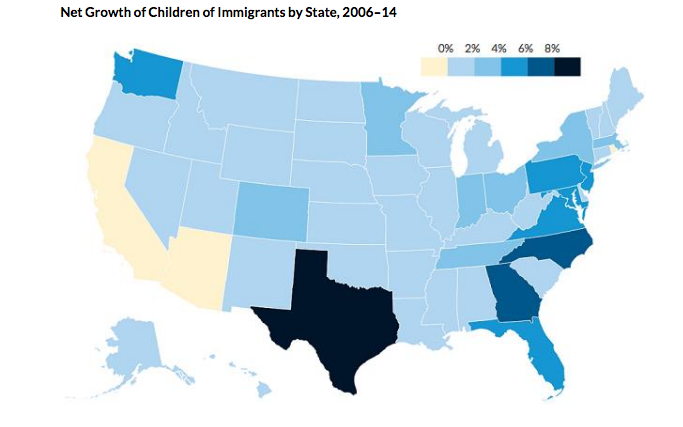
So where do these kids live? UI’s interactive map breaks that down by state and metro area. Of the areas that have seen the highest growth in numbers of second-generation immigrant children between 2006 and 2014, Texas stands head and shoulders above the rest. The state, which has always been a prime destination for immigrants, accounted for 21 percent of net growth. But this increase is not just limited to traditional immigrant destinations: Georgia has seen 8 percent of total growth and North Carolina accounted for 7 percent, for example. California, Rhode Island, and Arizona, on the other hand, saw declines (although the first two also saw an overall decline in the below-18 population). Here’s a still map showing that distribution, from the brief:
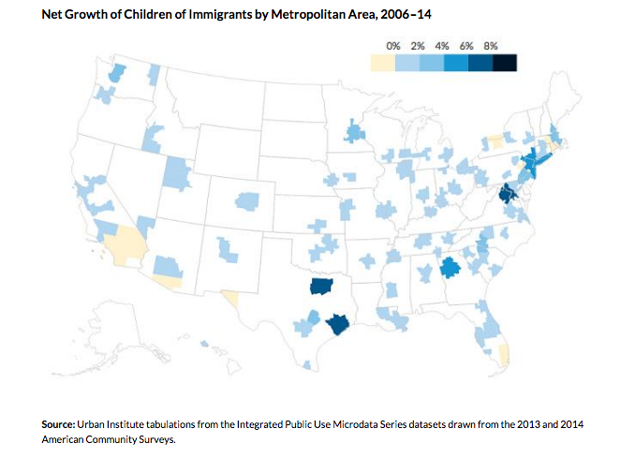
This is a distinctly urban group: Kids of foreign-born parents much more likely to live in the top 100 U.S. metros (83 percent) compared to children of U.S.-born parents (62 percent), and almost half in live in the 10 major metros, 8 of which are traditional immigrant gateways like Houston and Dallas. Washington D.C. and Atlanta are exceptions:
What these and other maps in the UI visualization prove is that no matter what side of the political aisle you’re on, these kids matter. And education, healthcare, and welfare policy needs to catch up to that fact.
Flood Death Valley
Flood Death Valley
Since Death Valley is below sea level could we dig a hole to the ocean and fill it up with water?
—Nick Traeden
Yes! We can do anything we want. We shouldn't do this, though, because it would be gross.

Death Valley is an endorheic basin[1]"Big hole" in California. The floor of the valley is about 80 meters below sea level. It contains the lowest point on land in North America[2]Excluding artificial points like mines. and is the hottest place on Earth.[3]If you're about to say "Wait, what about Liby—," then don't worry, I'm with you. Just hang on and read a few more words ahead!
Now, if you're the sort of person who's into world records, you might have heard that the hottest place on Earth was Al Azizia, Libya. Al Azizia recorded a temperature of 58.0°C (136.4°F) in 1922, a mark Death Valley has never come close to. So what gives?

It turns out Al Azizia has recently been stripped of its record. In 2010, an exhaustive—and definitely a little obsessive—investigation led by Christopher C. Burt convinced the World Meteorological Organization that the Libyan measurement was probably a mistake. This left Death Valley with the record of 56.7°C (134°F), set in 1913. Case closed!

Except it's not quite settled. Burt has raised questions about the 1913 record as well, and has gone so far as to catalog a number of historical extremes along with a credibility score for each. The "real" record is probably 53.9°C (129°F). This temperature has been recorded four times, in 1960, 1998, 2005, and 2007—every time in Death Valley.
These records were recorded with modern instruments and are considered reliable. They also make sense from a theoretical point of view. Geographers have calculated[4]This Army Corps of Engineers publication cites a couple of sources for this, including a 1963 paper by G. Hoffman. Unfortunately, that paper is in German, which I can't read, so I've just decided to trust that the Army Corps of Engineers writers Dr. Paul F. Krause and Kathleen L. Flood aren't pulling a fast one on me. that the highest possible temperature in ideal spots (in desert basins like Death Valley) during the 20th century is 55°-56°C, so 54°C sounds like a reasonable world record.
Now, back to Nick's question.[5]This is nowhere NEAR the record for "most boring digression into world record trivia." That record was recently challenged by IBM computer capable of producing millions of boring pieces of trivia per second, but the machine narrowly lost to reigning human champion Ken Jennings.

Since Death Valley is below sea level, we could, as Nick suggests, flood it with seawater. It would take a lot of digging, since there's a lot of Earth in the way. The lowest route to Death Valley is probably by traveling up the Colorado River watershed, along the Arizona border past Quartzsite,[6]Trivia: If you want to reach Quartzsite, Arizona from my school, Christopher Newport University, you just step out onto Warwick Blvd (Rt. 60) and turn left. That's it—Route 60 runs across the country, from the CNU campus in Virginia to I-10 just outside Quartzsite. then northwest[7]Possibly following one of the routes shown on page G34 in this report. past Zzyzx, which is a real place.

If you did all that digging, you could create a channel from the Gulf of California to Death Valley, and water would flow in. We can use this handy stream-flow calculator to figure out how wide we'd need to make the channel. A channel 20 meters deep and 100 meters wide should be able to fill it in a few months. A really wide channel—like the kind carved by glacial floods—could fill it in hours.
We know it's possible to create this kind of inland sea because we've done it before—by accident. In 1905, irrigation engineers working on the Colorado River made some mistakes. During a flood, the entire Colorado river broke through into the Alamo Canal and flowed directly into the Salton basin to the north. By the time they repaired the canal, two years later, the Salton basin had become the Salton Sea—one of the larger human-caused changes to the world map.
The Salton Sea is fed mainly by agricultural runoff, so it's become saline[8]"Salty" and hypereutrophic.[9]"Gross" Large numbers of dead fish, combined with algal decay and unusual chemistry, have created a smell that the US Geological Survey describes as "objectionable," "noxious," "unique," and "pervasive." The sea is a birdwatching hot spot, but also the site of a lot of mass bird die-offs, so kind of a mixed bag if you're into birds. In recent years, the water has been evaporating quickly, leaving behind dried toxic residue which is swept up into dust storms. Work to clean up and rehabilitate the region is ongoing.
All in all, the Salton Sea is a mess—and Nick wants to make another one.

Nick's Death Valley project would start off connected to the ocean, but without a source of flowing water at the Death Valley end,[10](It's a desert.) the channel would gradually silt up. The link to the ocean would eventually be broken, the sea would start to evaporate, the water would become saline, algae would bloom, and eventually the US Geological Survey would start complaining about the smell.
There would be one more consequence to all this. Thanks to the flood of cold ocean water burying the whole region, Death Valley would stop setting temperature records, and someone else would eventually claim to have broken their 129°F record. The Death Valley records would have to be compared to the newer candidates, which would probably use slightly different methods ... and that means one thing:
A World Meteorological Organization expert panel!

Sketch Guy: Big Adventures Will Be Hard. Did You Expect Something Else?
The most influential ethicist alive says the world is actually becoming a better place

The philosopher Peter Singer, who regularly tops lists of the most influential people worldwide, is known for his controversial, yet highly convincing, utilitarian outlook. Utilitarian ethicists believe that the consequences of an action determine whether or not it’s moral. Grounded in this discipline, Singer has argued, among other things, that:
- Failing to donate excess wealth to those in need is morally equivalent to walking past a fallen child in a pond and allowing them to drown.
- It’s acceptable to kill newborn babies with severe disabilities.
- Bestiality that involves cruelty to animals is immoral, but perfectly ok where it involves “mutually satisfying activities.”
- Refusing to treat animal rights as morally significant to human rights is “speciesism.”
Singer has been hugely influential in shaping the effective altruism movement, which advocates donating 10% of your salary to specific charities that have significant practical impact. He’s also had a major impact in debates around factory farming, veganism, and climate change. He’s recently published a book, Ethics in the Real World, which consists of 82 brief essays written for a non-academic audience. The essays cover whether people who weigh more should pay more on planes, whether adult incest should be illegal, and why donating to batkid was a poor use of money.
Singer is a realist who grapples with some of the most challenging questions facing humanity. He’s also very much an optimist. Though he says political discourse in the US has reached “a new low,” Brexit was a disappointing win for xenophobia, and far-right governments have growing influence, Singer simply doesn’t believe that we’re in a worse situation today than 10, 20, or 40 years ago.
“I’ve always had a reasonably optimistic view of where we’re going, and I’ve tended to look at the positive, in terms of progress that we’re making,” he says. “Globally, the world’s in a much better situation than it’s been in past periods, despite the headlines on the war in Syria and other places where bad things are happening. There have been fewer people killed in wars, or genocides, or other forms of violence in the last decade or two than there have been in any other decade. We ought to take consolation in that.”
Though it’s understandable to be concerned about terrorism, Singer points out that it’s not much of a practical threat—after all, the number of people killed by terrorists is “small compared to the numbers of people killed in car accidents.”
And while the current refugee crisis is the worst since the Second World War, Singer points out that the tens of millions of people currently displaced worldwide are outweighed by the hundreds of millions who have been lifted out of extreme poverty over the past 50 years. On balance, he says, the world is getting better.
That’s not to say he’s unconcerned about the current refugee crisis. But Singer suggests that there may now be more refugees in part because it’s become easier to flee disaster and, in previous decades “those who were not displaced were suffering more by staying put.” Though the civil war in Syria is an undeniably terrible humanitarian crisis, Singer says it should not obscure the fact that the world is slowly improving overall.
This doesn’t absolve us of our moral responsibility, of course. Singer believes we have as much of a duty to those overseas as we do to those within our own country. But he recognizes that xenophobia is prevalent, including on the left (he’s disappointed, he adds, that Bernie Sanders “appealed in a somewhat similar way to Trump” to concerns that American jobs are going overseas). And so, given that accepting large numbers of refugees tends to result in surges in harmful far-right sentiment, Singer believes that the most practical solution is to fund the largest refugee camps in less-affluent nations closest to the conflict.
The humanitarian crises worldwide are not only a concern for governments. Singer calls on individuals to gradually increase the amount they give to charity every year (he donated 40% of his salary last year). Similarly, he believes everyone has a moral responsibility to avoid eating meat products or, at the very least, factory-farmed animals.
On the animal rights cause, too, Singer sees reasons for optimism. “Over the last 15 years or so, there’s been legislation that’s really changed the way animals can legally be kept in factory farms in Europe,” he says. “When I started out thinking about animals in the early 1970s, people laughed and said you’ll never change that, you’re trying to fight a huge industry. But actually the animal movement has changed it.”
And, as a leading figure in the animal rights movement, Singer has been a major force behind that change. Given the positive effects Singer’s achieved throughout his own life, it’s not hard to understand his optimistic insistence that we’ll continue to grow and improve in the future. True, there are many tragic events unfolding today, but from a global historical perspective, says Singer, “we can easily get things out of proportion.”

Google's “Director of Engineering” Hiring Test
Article URL: http://www.gwan.com/blog/20160405.html
Comments URL: https://news.ycombinator.com/item?id=12701272
Points: 1734
# Comments: 915
The New Health Care: I’m a Doctor. If I Drop Food on the Kitchen Floor, I Still Eat It.
Beautiful two-bedroom for sale!
One-story, handicap accessible, 2 bedroom condo, with a full unfinished basement with bathroom hook-ups, for sale. Includes a garage, an enclosed back yard and owner has access to many Common House amenities, just steps away. Can be seen at the end of the weekly Sunday co-housing tour: 2:00 pm to around 4:00 pm (call 734-274-9110 for information) or can be shown by appointment by owner (734-913-0288).
Sketch Guy: One of the Smartest Money Strategies Is Asking When You Don’t Know
How Cities Impact Future Incomes
Source: Visual Capitalist
The post How Cities Impact Future Incomes appeared first on The Big Picture.
The desperation of Indian housewives in the United States of America

There are many reasons why educated Indian women are not working.
Some hit a wall due to conservative in-laws and unsupportive husbands. For others, a sexist workplace is usually the final straw. Many are just not conditioned to be ambitious.
And then there’s the huge cohort of Indian women whose careers are unravelling far away from home—in the United States of America. In the world’s biggest economy, these women are unencumbered by many of the social challenges those in India often face. Yet, their professional lives are being cut short. The culprit is a class of visa that is almost Victorian in its restrictions.
Unwilling housewives
India might be the world’s fastest-growing big economy, but living in the US remains one of the biggest aspirations of its middle-class. Indian men with white-collar jobs in the US, hence, are some of the most eligible bachelors in the country, often attracting women who are highly educated themselves.
Many of these men are in the US on a temporary work visa called the H1B—Indians receive nearly 70% of all H1B visas issued worldwide—and their spouses emigrate as H4 visa holders. The latter is a dependent visa and prohibits holders from working or starting a business in the US. They can’t obtain a social security number either.
“When a wife enters the United States on a dependent spouse visa, she enters at the wish of her husband. Her dependent immigration status allows her husband to control her ability to live in the United States and all rights that stem from that status,” Sabrina Balgamwalla, an assistant law professor at the University of North Dakota, writes in a paper on spousal visa holders titled Bride and Prejudice.
In other words, H4 visa holders, 90% of whom are women, are often reduced to childlike helplessness in a foreign country, completely dependent on their partners for everything, from their social to economic needs.
According to some estimates, almost 80% of the 125,000 H4 visas in 2015 were granted to Indian passport holders. I spoke to over a dozen women who are either current or former H4 wives to understand the financial and psychological toll this forced career break takes.
Honeymoons don’t last forever
For Meghna Damani, the first few months in northeastern US were absolutely joyful. “The town was beautiful. I picked up some hobbies like painting and did things I had never got a chance to do while I was working in India,” the now 40-year-old says. She had moved to Pennsylvania in 2002 after marrying her boyfriend, who, like many H1B visa holders, worked in the information technology sector.
But the honeymoon did not last long. “I could not work and I realized I did not have a sense of purpose. I realized life is not all about walking, exploring, or painting,” she says. Before her marriage, Damani was working at an advertising firm in Mumbai. “I could not even apply for an internship on this visa. I was a housewife, (and could) just do cooking and cleaning.”
The former model and business school graduate went on to make a documentary about her life on the H4, which can be found on YouTube. It begins with this heartbreaking line: “Independence—the very first thing I lost when I set foot in the land of the free.”
In the riverfront Newport area of Jersey City, New Jersey, where Damani lives now, it is easy to spot Indian couples who have “made it” in America. With their apartments overlooking the Hudson river and progeny stamped with an American passport, they seem to be living the dream.
But scratch the surface, and the dream often seems to have been built on dashed ambitions—those of young wives. Many of them could find only one way to fill their long, lonely days. “If I can’t work, I would feel less useless if I become pregnant now,” a 30-year old H4 wife tells me.
There are few other alternatives during this forced sabbatical. Some start volunteering and those who can afford it go back to school.
“My dream was to get into investment banking in the US,” says Sarika Kadam, 40, who moved to the US after her arranged marriage to an IT professional in 2002. She enrolled for a certificate course in investment banking at New York University but she couldn’t find a prospective employer who would agree to sponsor her work visa.
“It is just paperwork to convert from H4 to H1B, but what people don’t realize is how hard it is. It is easy to get a job, very hard to get sponsorship. They (employers) really have to love you so much more than any other candidate,” immigration attorney Shivali Shah explains in Damani’s documentary.
Full-time master’s courses enhance the chances of picking up skills that are in demand in the US and finding an employer who would sponsor an H1B visa. But these courses are often unaffordable for young immigrant couples when only one partner is working. “My husband was just out of college and I did not want him to pay for another course. I had also spent all my money on my wedding,” says Damani, who after five years of unemployment in the US decided to invest in a course at a film school.
Depression visa
“H-4 visa—a curse” is a Facebook page with nearly 15,000 members. It documents the horror stories of women on dependent visas. The page was started in 2011 by Rashi Bhatnagar who moved to the US with her husband seven years ago.
Bhatnagar used to be a journalist in India but now feels that the “huge gap” in her career history would make it hard for her to get back into the news business at age 33. “Right now I am happy because I have a baby,” she told me. “But sometimes I feel a lot of time in my life has been wasted.” In her early days in the US, she used to attend three classes a day at the gym to keep herself busy.
On her Facebook group, and her blog by the same name, hundreds of women talk in painful detail about the H-4 visa-related problems they’ve faced. The least terrifying ones are the accounts of loneliness, of spending several hours at home in a new country with nobody to talk to. It gets progressively darker—depression, marital problems stemming from financial insecurities in a single-income household, and even domestic abuse.
“There are so many husbands who do not let their wives drive a car. And these are highly educated men,” says Bhatnagar.
Damani, who says she has a supportive husband, battled depression. She even called a suicide helpline. “I wanted to just die. To no longer feel this guilt, this wastefulness. To no longer feel like a burden,” she says in her film. “I did not know how I could get the lost time back.”
In 2015, the US government allowed partners of certain H1B visa holders to seek employment authorization. The H1B workers should already have initiated the process to seek permanent residency, also known as a Green Card, through their employers. While Bhatnagar was among those to receive a job permit under the new rules, she feels the regulation is too little, too late for most others. Moreover, they have no control over the speed of the process. “You are dependent on your husband’s credentials and relationship with the employer,” says Muzaffar Chishti, a lawyer and director of the New York office of Migration Policy Institute. According to him, a lot of H1B tech workers in the US are “garden variety computer programmers,” and “it can typically take three-to-four years,” for them to be in line for the Green Card application.
Even after the H4 spouses receive employment permits, they may have to contend with non-career jobs. “Unlike their husbands—whose engineering skills mark them out as highly desirable global migrants—many (of the wives) have less-immediately transferrable skills, and so continue to struggle to find employment,” says a Guardian article on Silicon Valley’s reluctant housewives.
Coming home
The H4 wives might consider returning to India which—with one of the lowest number of women in the workforce among G20 economies—needs them sorely.
But most women that I spoke to prefer not to. A chance at becoming middle-class American citizens, and the prestige it commands back home, is enough to make them stay back. Money, social freedom, and the needs of their husbands’ careers usually override their own desires.
“I did not want to deal with the social pressures that come with being married in India,” says Damani who carved out a happier life for herself by going to The New School in New York City and becoming a filmmaker. “Also, in the long run, it would help if my husband was here. He would make a lot more money.”
Others are more resigned. “On social media, Indians judge me for being greedy and wanting to live in the US,” says Bhatnagar. “I would love to come back to India, but now my life is here.”

State solar incentive program still going strong
Two years in, I have reached a point, amazingly enough, where I consider my solar panels a routine part of my world. They quietly warm and accelerate their profusion of electrons, and I can go for days now without thinking of them at all.
But then something happens that, shall we say, jolts me out of my inattention. Recently it was the deposit of some $738.64 from Puget Sound Energy into my bank account, representing its annual solar production payout for the array on my roof. The money actually originates in a state of Washington fund to incentivize the adoption of renewable energy (including solar, wind, and even anaerobic digestion applications).
All the buzz over the last few months has been how dramatically an individual’s payout would be reduced this year, due to the fact that the amount in the overall fund remains constant, while the number of people participating in the renewable economy in the state is increasing substantially. But the cuts were less than anticipated: my own system, which is categorized as “solar manufactured out of state”, now pays at a rate of 14 cents per kilowatt hour produced, down only a penny from the previous year. Other categories were comparable in their marginal reductions.
This is not to suggest that the future of such a fund is secure. A former mayor of Seattle, who had gone solar at approximately the same time that I did, recently decried the possibility of payout reductions from their original incentive rates as a kind of “bait-and-switch” deception of consumers. Indeed, it is commonplace to calculate a prospective solar customer’s ROI before the customer commits to the installation. Calculating incentives, tax breaks, and electricity produced, the installer can at least give you a ballpark estimate: your system will pay for itself in 15 years, say, or 10, or even 5! But if a major piece of the calculation is subject to change at each legislative session, that ROI becomes much less predictable.
We’ll see how it plays out. But in the meantime, all this got me to thinking more about the economics of going solar. Next post I will go through some of the interesting data that is now accumulating from two years’ worth of having a solar array.


Amtrak Security Awareness
I like this Amtrak security awareness campaign. Especially the use of my term "security theater."
When you lose another service during a major outage

by Mr. White
Why our cities should be wood, walkable, resilient and sort of dense
 Notes from a lecture at Sustainable Buildings Canada