Shared posts

08 Apr 01:00

Why a dashboard on its own won’t improve performance

by Nick Desbarats

If you’ve attended one of my recent Practical Dashboards workshops, you’ve heard me mention Louise Watson. Louise’s name comes up when we discuss performance dashboards, specifically, when I underscore the fact that dashboards on their own won’t improve organizational performance and that a host of broader strategic skills and tools are required to even know whether an organization is actually improving or not. Louise teaches those strategic skills and tools to organizations using Stacey Barr’s globally recognized PUMP Blueprint and Evidence-Based Leadership Program. While I haven’t evaluated every such program out there, this is certainly the best one I’ve come across.

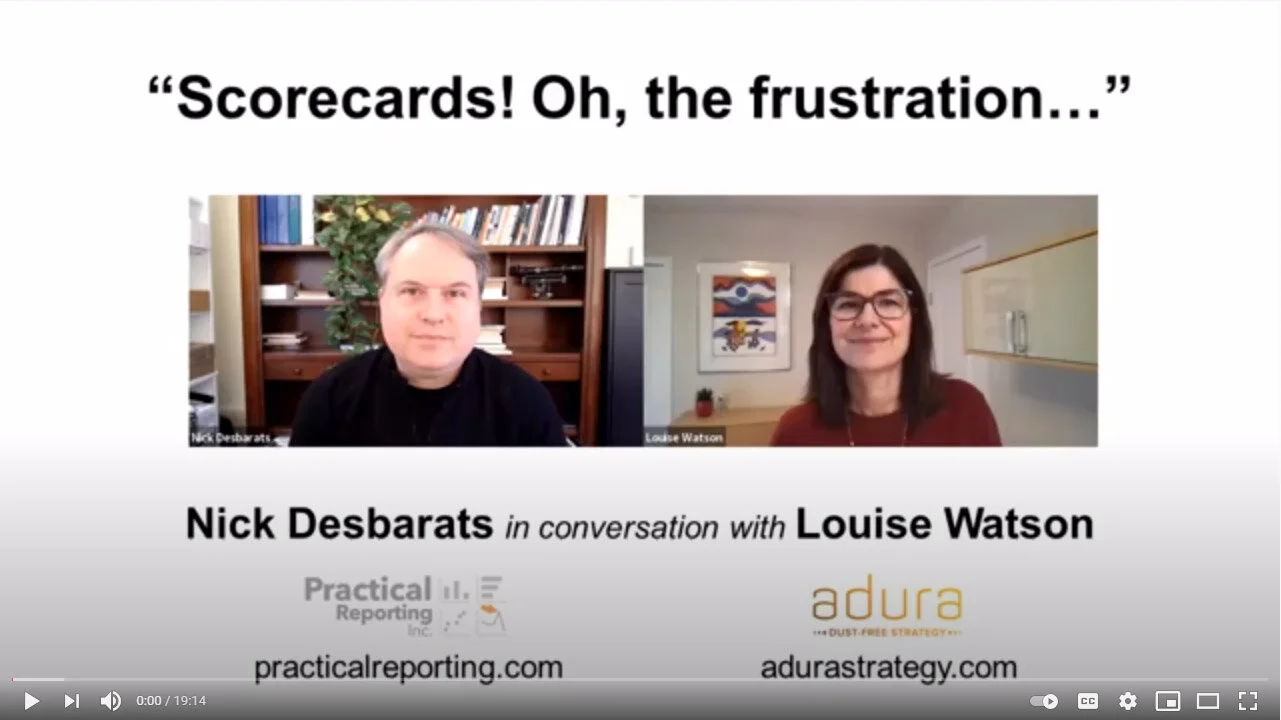
I was lucky enough to be able to interview Louise recently and have posted a video of that short (19 min) interview below. If you’ve struggled with performance dashboards or choosing KPIs in the past, I’m pretty confident that you’ll get lots of answers from our discussion.

A few gems:

  • Why a dashboard on its own won’t improve performance (despite the fact that many people assume that it will).

  • Why the “evidence gap” is the real pain point underlying many leaders’ demands for a performance dashboard.

  • Why quick fixes, such as choosing KPIs from a standard KPI library, can actually do more harm than good.

  • Some KPI bad habits that often torpedo performance improvement initiatives.

  • Key elements that need to be in place for a performance improvement initiative to be successful, beyond just developing a dashboard.

Enjoy!

By the way…

If you’re interested in attending my Practical Charts or Practical Dashboards course, here’s a list of my upcoming open-registration workshops.

30 Dec 06:16

The goal of the first CS course should be to promote confidence if we’re going to increase diversity in CS: Paying off on a bet

by Mark Guzdial

This should be a thing: If you make a public bet on Twitter, and lose, you should have to write a blog post explaining how you got it wrong.

Let me set the stage for the bet. There are studies suggesting that the Advanced Placement (AP) Computer Science A exam has a significantly different impact on students’ majors than other AP exams. (For non-US readers: AP tests provide an opportunity for secondary school students to earn post-secondary school credit.) AP CS A exam-takers are more likely to go on to take more CS courses or become a CS major — more likely than, say, students taking AP Calculus or AP US History exams to become mathematics or history majors. But does that extend to the newer AP CS exam, AP CS Principles? AP CS Principles was designed to be less about the kinds of programming that CS majors do in their first year, and more about a broader understanding of computing and its effects (see College Board site here). There were several of us talking about this in the Spring. On April 1, 2019, I tweeted to Jeff Forbes (see link): “I bet that AP CS Principles has no impact on CS or STEM majors. It’s such a different course (eg doesn’t map to CS courses on most campuses).” He took that bet, and he was right. A study released by the College Board shows that there is a causal relationship between taking AP CS Principles and majoring in CS in undergraduate (see report link here). The impact is large. Overall, students who take AP CS Principles are three times more likely to major in computer science in college. AP CSP students who are female are twice as likely to major in CS.

I wasn’t crazy for expecting that AP CS Principles would not have such a big impact on recruitment and retention. At SIGCSE 2020, Joanna Goode and co-authors published a paper showing that (see blog post link here) AP CS Principles is effectively recruiting much more diverse students than the AP CS A course (which is mostly focused on Java programming). But, AP CS A students end up with more confidence in computing and much more interest in computing majors and tech careers. ACM TOCE in 2019 published a paper using NCWIT Aspirations award winners (see blog post link here) showing that taking the CS Advanced Placement A exam was one of the best predictors of persistence three years after the high school survey in both CS and other technology-related majors. The TOCE paper authors made a particular emphasis on the importance of programming: “It seems that involvement in general tech-related fields other than programming in high school does not transfer to entering and persisting in computer science in college for the girls in our sample.”

So I had good reason to believe that non-programming-intensive courses might not have a big impact on recruitment into the CS major and retention. But I accept the evidence that I was wrong. What else is going on?

Here’s another recent piece of evidence that supports Jeff’s belief that AP CS Principles (and classes like that) could be having a big impact. Philip Boda and Steve McGee have a paper coming out in SIGCSE 2021 showing that the Exploring CS course (see website here) is having a significant impact in driving up AP CS A participation and diversity (see paper here), which continues to have a large impact on majoring in CS. Exploring CS, like AP CS Principles, is de-emphasizes programming in favor of a broader understanding of computing and helping students to see themselves as successful at CS.

Neither of these papers offers an explanation for why AP CSP or ECS is having this positive impact. They’re both large scale quantitative stories. You’d think that I might have learned my lesson from this last failed bet. Nah. I’ve got guesses. My guesses might be wrong, as they were in this case. I’m a post-positivist. I don’t think we’ll ever get to the place where we know the complete truth, but we should keep trying, keeping making hypotheses, and we can keep getting closer.

Here’s my hypothesis for what’s going on, stated as a prediction:

A first course will be successful at promoting recruitment into CS as a major or career and at retaining students in CS if it increases students self-efficacy about programming tasks.

The critical part is for students to increase their confidence that they can be successful at programming tasks. AP CS A easily does this, which is why it has such great results in recruitment and retention. Not all classes or experiences do, as the NCWIT study suggests. AP CS Principles and ExploringCS are all about increasing student confidence, helping them to see themselves as successful at computing. I don’t know how little programming a student needs to do to increase their self-efficacy. Maybe it’s enough to see programs and what programming is about.

Recent research in computing education has been focusing on self-efficacy as one of the most important variables predicting student recruitment and retention in CS. Alex Lishinski and his co-authors showed that self-efficacy had different relationships for female and male CS students (see paper link here) and that programming projects influenced students’ sense of self-efficacy, which in turn influenced performance in the CS class (see paper link here). Jamie Gorson and Nell O’Rourke found (in an ICER 2020 paper that I blogged about here) that CS students had deflated self-efficacy, in part, because they had unreasonable expectations of what real programmers do. Dr. Katie Cunningham, soon to be a post-doc joining Nell’s lab, showed in her dissertation how students simply give up on programming tasks that they don’t think that they’ll be successful at (see blog post on Katie’s dissertation defense). Self-efficacy is likely an important variable in recruitment and retention, particularly of female students, and it’s one that we can manipulate with better designed education.

I’m not the first person to to suggest this relationship. In a study with over 5 million participants, Peter Kemp and colleagues suggest that female participation in secondary school computer science in England is being negatively impacted because of female students’ low self-efficacy in CS — and that this is because of the CS classes (see paper link here). In England, curriculum in Information and Communications Technology is being faded out in favor of a Computer Science focus. They write in their paper “Female Performance and Participation in Computer Science: A National Picture”:

The move to introduce CS into the English curriculum and the removal of the ICT qualifications look to be having a negative impact on female participation and attainment in computing. Using the theory of self-efficacy, we argue that the shift towards CS might decrease the number of girls choosing further computing qualifications or pursuing computing as a career. Computing curriculum designers and teachers need to carefully consider the inclusive nature of their computing courses.

I made my bet because I thought that the programming-light focus of AP CS Principles (or even ExploringCS) would have less of an impact on CS recruitment and retention than the programming-intensive focus of AP CS A. I now believe I was wrong. I would now bet that the amount of programming probably isn’t the critical variable at all. It’s whether students come out of these courses saying, “I can do this. I can program.” That’s the critical variable for recruitment and retention that I believe AP CS Principles and Exploring CS are influencing successfully.

30 Dec 06:07

2021 is when lockdown will stop mattering

Over lockdown, one concept that has stuck in my head is short and long-term adjustments. (Here in the UK, we’ve been in one form of lockdown or another since mid March. With the new variant, that’s not ending any time soon.)

It’s from a post applying ideas from economics to epidemiology:

long-run elasticities of adjustment are more powerful than short-run elasticities. In the short run you socially distance, but in the long run you learn which methods of social distance protect you the most. Or you move from doing “half home delivery of food” to “full home delivery of food” once you get that extra credit card or learn the best sites.

– Marginal Revolution, What does this economist think of epidemiologists?

Personally: Short-term adjustments mean working from my sofa using Zoom, and pausing the usual round of coffees and chatting (that’s how I find new ideas and also new work).

Long-term means moving the house around and setting up a desk; sorting out the lighting; opening my calendar on Wednesdays for Unoffice Hours… but also domestic things like using the time freed up from the commute to get into baking. All to the point that if somehow I could magically go back to the old way, I’m not sure I would.

You can see this happening with restaurants. Short-term means staff are furloughed and orders go to pick-up only. Long-term: well, we’re beginning to see hints of it. Yes, some restaurants are closing, but others are offering part-cooked meals for delivery and building a customer base that way, amazing food that you could never get at home before.


We’ll be in lockdown deep into next year. Even then, how long will it take before we stop wearing masks, or no longer require negative covid tests before flying?

The long-term adjustments will kick in way before then.

What I wonder about mundane business activities.

I can imagine that something like, say, the employee onboarding process has been ad hoc, time consuming, and error prone for the last few months. But in 2021, someone in HR will get round to making it streamlined and efficient – totally optimised for remote working.

At which point, will there ever be an incentive to switch back?


Here’s how I think about it. First you cope and then you adapt. The kicker: once you adapt, you may not want to go back.


We’ll get a PS5 with the cash we save from not going to the pub, and set up a sweet home office instead of commuting, and organise home deliveries instead of a weekend visit to the supermarket.

And then we’ll realise that we have a new group of friends on PlayStation, and working from home means that we’ve gotten to know the folks in the local takeaway for lunch, and grocery deliveries means we have time for a run on Sundays instead.

Maybe my phone gets good at automatically monitoring my social distancing budget, better than counting steps or calories even, and it turns out that, with this new lifestyle, I have more than enough for friends and family.

And gradually lockdown stops impeding any of the activities we actually want to do, and even if it ends, we wouldn’t go back.

Lockdown will end not because the restrictions lift, but because they stop mattering.

So I think 2021 is the year that long-term adjustments really gather pace, and it’ll be interesting to see, personally and for the economy at large, what that means. How will travelling change? What kinds of new companies will thrive? Like I said in May, there is no After.

30 Dec 06:07

Wenn ihr übrigens mal gucken wollt, wie das aussieht, ...

mkalus shared this story from Fefes Blog.

Wenn ihr übrigens mal gucken wollt, wie das aussieht, wenn ein Geheimdienst euer Smartphone verwanzt: Andys Vortrag hat Folien mit Fotos.
29 Dec 06:24

It's better to be naive than jaded

by Tom MacWright

Truisms

Photo of Jenny Holzer offset prints from Ground Impressions

Jenny Holzer’s “truisms” series has a durable place in my mind. In name alone they are contradictory; so many of the statements aren’t obviously true, but are instead slogans or inflammatory rhetoric. The phrases aren’t copyrighted by the artist. The typography, layout, format are recognizable but basic.

I like a lot of the truisms that draw a contrast. This one, for example: “It’s better to be naive than jaded.” Are these things even in opposition? Can one be both, or neither? It’s better for who?

It rumbles around like a koan in my mind.

I’m not old, but I’m old enough to have done a lot of things a few times: jobs, relationships, places. I’ve started to be tempted to draw conclusions from these experiences. Some things work, others don’t. By avoiding the improbable paths and going with what works, what fits the patterns in history, I’ll learn from history.

We have a saying for that, from George Santayana: “Those who cannot remember the past are condemned to repeat it.” But our memory is post-Gutenberg and post-Internet, and I think we can say that a lot of history is cyclical by nature, not just because of our carelessness.

I am struck by how many big, intimidating things I did when I was younger, simply because I didn’t know to be intimidated by them and I had time and privilege. How many of those projects would I embark on now, knowing that to really finish might be impossible?

Conversely, I look back on ideas and projects that seemed infeasible a few years ago or that have been tried a hundred times without success. But then someone, unaware of history, tries for the hundred and first time, and it works. If they were scholars of history, they’d know about the failures, how people more talented and resourced than them had tried. They would avoid the idea altogether.

But ideas don’t live in a vacuum - they exist in a changing world, in which culture, technology, and trends change how well they’ll work. How much do those things matter? At least a bit. At the extreme of that opinion lies Ray Kurzweil:

I quickly realized that timing is the critical factor in the success of inventions. Most technology projects fail not because the technology doesn’t work, but because the timing is wrong – not all of the enabling factors are at play where they are needed.

When I work now, when I write or create, I often feel like I know more of the map than I knew before. Failure dims some paths, success lights up others, leading me one way or another. Failure is jadedness, success might be knowledge.

But I think we need to make a conscious effort to realize: every time is different. Even if you put the same effort in and make the same decisions, the world, the people in it, and you, have all changed. What worked before, might not work now. The idea that failed before, well - maybe its day has come.

29 Dec 06:22

Buying a M1 MacBook may be premature

by Volker Weber

5ec3da4b814c1f09ff812f7409020718

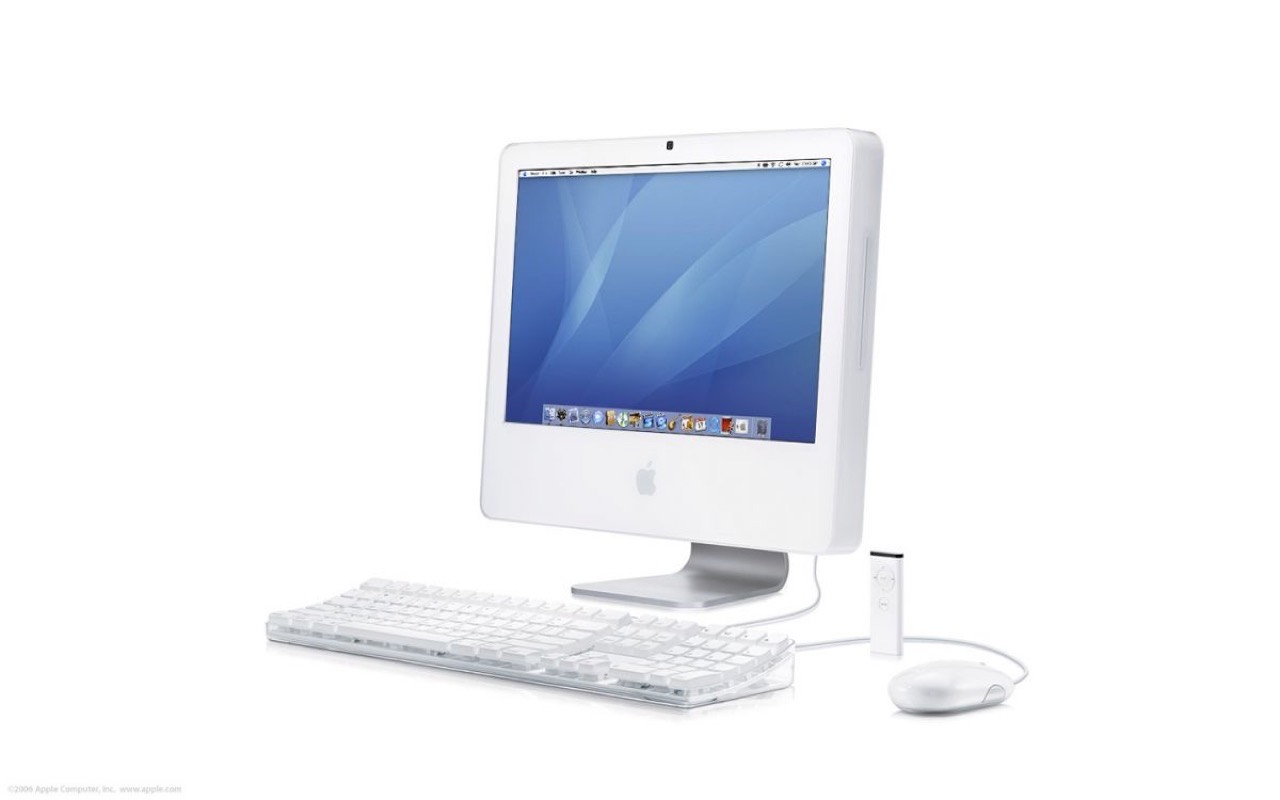
This in an iMac G5. Or is it an iMac Intel? When Apple switched from PowerPC to Intel, it retained the old design with the new chip. The next refresh changed everything. And my hunch is that the same is going to happen to the MacBook. It looks extremely old-fashioned with the large bezels around the screen and the tapered edges.

What if the real M1 Macbook looks like an iPad Pro?

29 Dec 06:22

Climate change in 2020

by Nathan Yau

It used to be that climate changed seemed like something far off in the future, like something that would only affect future generations. But it’s looking more urgent these days. For Reuters, Chris Canipe, Matthew Green and Sam Hart show the “fingerprints of climate change” we saw this year.

Tags: climate change, Reuters

29 Dec 06:21

S14:E9 - How to build tech for social justice (Alex Qin)

In this episode, we talk about how to build tech for social justice, with Alex Qin, co-founder and CEO of Emergent Works. Alex talks about the challenges she had to face being a woman in tech, how shaving her head caused people to treat her with more respect and launched her on a path toward social justice, and her company’s first in-house app, Not 911.

Show Links

Alex Qin

Alex Qin is the founder of Emergent Works, a nonprofit software company that trains and employs formerly incarcerated coders. She is a reformed software engineer who has been working in the space of prison reentry and criminal justice reform since 2018. She spent most of her career before that writing code and advocating for a more diverse and equitable tech industry. She is also an international public speaker and some of you may have seen her talk about how shaving her head made her a better programmer. And she is a performance and visual artist. Her first solo show, Losing Things, premiered in New York in December 2019.

29 Dec 06:19

Analyzing Trump’s bill-signing tantrum

by Josh Bernoff

Donald Trump reluctantly signed the bill that provides Coronavirus relief payments and funds the government for the next nine months — but released a petulant statement along with it. The statement’s a little confusing, so I’ll provide a translation. First, some context. Democrat and Republican congressional leaders negotiated the bill with Steven Mnuchin, Trump’s Treasury … Continued

The post Analyzing Trump’s bill-signing tantrum appeared first on without bullshit.

29 Dec 06:19

RT @sxraxs: I’m in a bad place rn, not mentally I just live in the Uk.

by S🦋 (sxraxs)
mkalus shared this story from iandunt on Twitter.

I’m in a bad place rn, not mentally I just live in the Uk.


Retweeted by Ian Dunt (IanDunt) on Monday, December 28th, 2020 3:21pm


22935 likes, 3723 retweets
29 Dec 06:18

What I’ve been reading in 2020

I would recommend these 5 non-fiction books, all of which I read over 2020:

Links are to Bookshop.org (UK site; tap the flag for different regions). Dates are date finished.

Viruses, Plagues, and History is simultaneously a social history (each chapter covers one plague: polio, measles, etc) but also a scientific education and a scientific history. Oldstone covers virology and how different vaccines work, in decent detail, and the stories of the teams that discovered the cures.

Eye-opening to read about how wars and politics have pivoted dramatically and throughout history on disease outbreaks, and the sheer complexity of the biology. One image that stuck in my head: when the polio vaccine was announced in 1955, church bells were rung across the whole of the United States. Imagine that.

Extraterrestrial Languages is another scientific history, this time of the efforts to send messages into space. What language do we speak to aliens, who may or may not be there, and with whom we share not a tongue nor a cultural context nor even our biology? And when messages are sent, are they meant for the ETs, or are they really intended as a unifying message to all us humans here on Earth? Good anecdotes – plus a throwaway comment which took me on a dive into John Lily and his weird dolphin experiments back in July.

Astounding is four intertwined biographies. John Campbell was editor of the science fiction magazine Astounding from 1937 till 1971, and bullied into the world what we now think of as “traditional” sci-fi pretty much by force of will. All those tropes about square-jawed capable men (specifically men…), scientifically and logically conquering the galaxy in their spaceships, and sci-fi being a vehicle to predict and bring about the future: that’s Campbell. He was also deeply racist alongside other troubling views, with a side interest in pseudo science – including co-developing Dianetics (which became Scientology) with L. Ron Hubbard. Fascinating stories about big personalities, and good colour on 20th century America.

Economic Science Fictions is a collection of pieces running from critical theory to experimental fiction, all ostensibly taking a run at how science fiction can inform today’s understanding of economics. But sci-fi is neither here nor there – there are many perspectives on economics, and speculation on what is fixed and what is contingent, and that’s what I found most educational. The result is a kind of disentangling or unpicking of the knot of capitalism that I have for so long taken for granted.

I found the collection influential while I was writing my essay for ThingsCon, The hard work of imagining, on utopias and dystopias and the irresistable “logics” of interconnected systems – clearly thinking about economic imperitives there.

Finally, The Institutional Revolution (recommended by Bryan Boyer) is a fourth history and a second book about economics. The premise: the modern economic world comes from the ability to reliably measure – and the institutional patterns of the modern world cover everything from wages to factories; from public provision of roads to social norms about what we now call bribes. Before reliable measurement, there was uncertainty about the wind, about time, about plagues and trust… and the result was institutions that were none-the-less extremely effective, but had a very different form. This is a history of Britain in the pre-modern era: of the aristocracy, and duels, and the private ownership of lighthouses, courts, and positions in the army.

It’s a simple question: pre-modern Britain had institutions that were almost unchanged for 300 years, in forms that we would now say were inefficient and corrupt. But taking the counterfactual that this was the most rational way to organise the economy, why did these particular institutions win? Allen takes a strongly Coasean approach of figuring out how mechanisms like aristocracy and patronage would minimise economic transaction costs, and as someone who has been previously inspired by Ronald Coase, it’s a provocative take.

Also, as a Brit, I feel like I understand the old aristocracy - a kind of mafia really - all the better for it being described by an outsider. One of those books where I was stopping every few pages to read anecdotes out loud.


2020 has been an odd year for reading. I’ve not read much that’s new. Mostly, because of lockdown and therefore self care reasons, I’ve been comfort reading old favourites.

So here are two.

Anathem (Neal Stephensen) is a story of monks on a planet not quite like Earth where philosophy and the scientific method have followed a parallel track all the way from their equivalent of the ancient Greeks. Technology comes and goes, society comes and goes. The monks take the long view. It’s terrifically well told, and somehow manages to go deep on big ideas while still galloping along. Tremendous.

Stars in My Pocket Like Grains of Sand (Samuel R Delany) is set in a vast, multi-species, culturally rich galaxy, and it plays games with linguistics and subjectivity. It’s also a love story, and highly erotic – suddenly and explicitly so. I find it haunting that Delany intended Stars to be the first of two books but, after separating from his partner, never wrote the second.

Both books range wildly between the macro and micro, and at all levels there is both precision detail and room for the imagination to breath. The result, which they share, is that they give me a breathless feeling of vastness – and yet for all that backdrop, they’re focused on people. They’re both novels that, when I’m halfway through, I slow down because I don’t want to leave.

29 Dec 06:16

Where Are You Now, Mr. Big Balls?

Where Are You Now, Mr. Big Balls?

The last batch of drawings of Mr. Big Balls were posted over a year ago. We still haven't seen him around the neighbourhood since then. Lately I have started to wonder whether Mr. Big Balls was a kind of Greek metamorphoses, like when the goddess Athena shows up in stories in the form of an eagle.

29 Dec 06:15

Reconstructing the killing of Breonna Taylor

by Nathan Yau

The New York Times reconstructed the night. Based on a collection of court documents, ballistics reports, body camera footage, and interviews, they built a 3-D model of the scene depicting what appears to be an unorganized and unexpected raid.

Tags: Breonna Taylor, New York Times, reconstruction

29 Dec 05:42

Replicating SQLite with rqlite

Replicating SQLite with rqlite

I've been trying out rqlite, a "lightweight, distributed relational database, which uses SQLite as its storage engine". It's written in Go and uses the Raft consensus algorithm to allow a cluster of nodes to elect a leader and replicate SQLite statements between them. By default it uses in-memory SQLite databases with an on-disk Raft replication log - here are my notes on running it in "on disk" mode as a way to run multiple Datasette processes against replicated SQLite database files.

Via @simonw

29 Dec 05:40

RT @chrischirp: There are now more people in hospital in England with Covid-19 than at any point in the pandemic. Where is the government…

by Christina Pagel (chrischirp)
mkalus shared this story from iandunt on Twitter:
Busy congratulating themselves about fish.

There are now more people in hospital in England with Covid-19 than at any point in the pandemic.

Where is the government? pic.twitter.com/O1flqhDWfQ


Retweeted by Ian Dunt (IanDunt) on Monday, December 28th, 2020 7:47pm


6925 likes, 3019 retweets
29 Dec 05:40

DNA Lounge: Wherein Brexit's going really well, too.

by jwz
mkalus shared this story from jwz:
I don’t think the EU will be quite that bad. The EU / Europe as a whole seems to value art a lot more than the US does.

It looks like musicians in the UK have finally noticed that the ongoing Brexit foot-gun disaster has turned "Europe" into a distant, foreign land that requires work visas. In other words, it will now be as difficult for a British band to play Paris or Berlin as it is for them to play San Francisco.

Welcome to The Colonies, you guys! We've been dealing with this shit forever. You have our sympathy.

Brexit will be "catastrophic" for British touring artists, music industry warns:

On fears that the state of play could become similar to that with the US, which recently increased visa costs by 50% with another potential 24% rise looming, Pritchard added: "The American touring model is interesting because it shows us just how costly touring can be for just wanting to play in one country.

"If you want to play a 10-date tour in five different countries across the continent and the costs are anything like what they are in the States, then you're looking at costs of £7,500 per person before you've even left the country. For a minimum touring party of four of you in the band and three in the crew, you're looking at about £45,000. You aren't going to cover that in fees and t-shirt sales." [...]

"If you take t-shirts to sell, then you'd be importing them into the EU and have to report what sold and what hasn't. There were tales from the pre-EU days where you'd take out four pairs of drumsticks, bring back three and they'd charge you for the pair that you'd broken at your gig in Belgium."

But they have a petition, so uh, good luck with that.

For those of you who don't realize what a nightmare it is for small, non-US bands to tour here, here's how it works... Or used to work. In the Before Times, when tours were a thing that still existed.

Option 1:

  • Show up on a tourist visa, without instruments. Tell customs you are "visiting friends". Don't even think about bringing a box of t-shirts to sell. Borrow gear, rent a van.

  • Hope that every venue and/or promoter is willing to commit tax fraud by paying you in cash and not asking for your IRS form W9 or O-1B Visa.

  • Hope that no one at Customs googles your name, because if they do, you get deported and can't enter the US again for any reason for (I think) a minimum of 5 years.

Option 2:

  • Apply for a work visa. But that's easy! All you need is to show that you have "extraordinary abilities", and that you "have received or been nominated for a significant national award in the field, or prove [you] meet three out of six criteria, including national or international recognition as shown by critical reviews in major newspapers or magazines, evidence of substantial remuneration as shown by contracts, and testimonials from recognized experts in the field in which [you] are engaged."

    It costs several hundred dollars, and you have to schedule an in-person interview at your nearest US Embassy.

    Oh, also this requires you to know the dates and details of every stop on your tour, a year ahead of time. "But," you say, "nobody books tours that far out." You are correct. Also, dates can't be modified after submitting.

  • You won't get a response from the State Department until long after it's time to buy your plane tickets.

  • Still no response. Panic. There's nothing you can do, so go ahead and keep panicking.

  • Oh, they might deny you because they don't like your t-shirt art. Your tour is cancelled.

  • You might not get a response at all before your flight leaves. Oops, now you're not getting on that plane. Your tour is cancelled.

  • This is probably where you start getting hate-emails from your fans assuming that you're idiots who fucked up their simple, simple visa paperwork. You probably just sat around getting high instead of filling out a form, you jerks.

Sing it with me, ♬♬ "Everyyyyyyything is terrrrrrible!!"♬♬

29 Dec 03:36

Twitter Favorites: [ArielTroster] Can’t tear myself away from @theloudlady’s latest book, queer dystopian fiction set in Toronto. The landmarks all f… https://t.co/sE9ShQKXKg

ArielTroster @ArielTroster
Can’t tear myself away from @theloudlady’s latest book, queer dystopian fiction set in Toronto. The landmarks all f… twitter.com/i/web/status/1…
28 Dec 06:58

Taking the Drudgery Out of Content Production, Viewing

Andy Marken, Content Insider, Dec 28, 2020
Icon

The title of this latest edition of Andy Marken's newsletter makes me think of AIs creating content and AIs viewing that content in a cycle of production that gets weirder and weirder over time. It's not quite that bad, but he does describe a movie called “Sunspring,” produced in 2016, that was written, directed, and even given a musical interlude by an AI. "If you’re kind," he writes, "you call it an incoherent sci-fi B-movie that had all of the elements – intrigue, romance, murder, a dark future world – but fell short … far short." Maybe, but it doesn't follow that quality content won't be produced by AI, only that it hasn't been yet. I would expect more and more of the job to be handled by automated systems in the near future. And even if not, this post shows a number of ways AI is already influencing content production, from constructing compelling reasons to to diversity your content to showing that it's cheaper to crash a real 747 than it is to do it by CGI.

Web: [Direct Link] [This Post]
28 Dec 06:55

Public API for Public APIs

Dave Machado, Dec 28, 2020
Icon

An application programming interface (API) is a source of third-party data web applications can access. A good example is a weather API; your dashboard application could connect to the API and input real-time weather information, which you can then display however you want. This specific service is an API that lists public APIs. You can see it at work in the Public APIs web page, which helps you search for APIs (or just browse through the entire list). The potential set of applications for education and development applications is limited only by your imagination. Some more examples: a job board aggregator, Associated Press, the laws of British Columbia, CORE database of open access research papers, GMail, and so on and on. Here's the GitHub for it, in case you want to build your own.

Web: [Direct Link] [This Post]
28 Dec 06:55

RedwoodJS

Tom Preston-Werner, Dec 28, 2020
Icon

RedwoodJS is a router used to support serverless web applications. It has two parts, a 'frontend' which is the web interface users use to enter commands and view results, and a 'backend', with is the API interface it uses to route these commands to requests to cloud services such as databases or file storage applications. Last week I explored Redwood in some detail, following an article on CSS-Tricks and producing a three-hour-video installing and configuring Redwood to produce a simple serverless web site. The video isn't a set of instructions - it is a documentation of my efforts to understand follow the instructions, showing me 'working out loud', and giving you a glimpse into my thought processes as I reason my way through what was often incomplete and sometimes incorrect instructions.

Web: [Direct Link] [This Post]
28 Dec 06:54

Standing Presenting Set-Up

Bonni Stachowiak, Teaching in Higher Ed, Dec 28, 2020
Icon

This is a short post with some useful photos demonstrating a standing set-up for remote teaching. Why would you stand? Well, it provides more flexibility in using other tools, for example, the whiteboard behind you. For myself, I tend to stay seated, but then I never use a whiteboard.

Web: [Direct Link] [This Post]
28 Dec 06:49

2020 in a Difficult Lens

I’ve said this before in passing, but I’m becoming passionate about it. Increasingly, I believe that if you go out for a walk with a camera, you should consider attaching a difficult, opinionated lens and just leaving it on. Herewith a gallery of ten 2020 photos taken with such a lens, interspersed with preaching on the subject.

A windy winter day on English Bay

A windy March 15th on English Bay, the part of the Pacific closest to Vancouver and what you find yourself in when your boat goes under the bridge and out of protection. It is frequently the subject of grumpy remarks from boaters concerning its tendency to nasty crosscutting waves.

The opinionated lens in all these pictures is the Samyang 135m f/2 (actually 148mm on a Fuji X-cam), without doubt my most rewarding camera purchase in recent years. Follow that link for lots more on the lens.

That picture above shows how an unreasonably long lens can layer mid-range and distant objects in a composition that ordinary lenses can’t but your eyes think they can — they can’t actually, but they switch focus fast enough to fool you.

Purple behind poppies Weathered fence behind purple

Purple behind poppies, and purple in front of a weathered fence. May 10th and 19th respectively.

And of course the big bright f/2.0 does that sharp-focus/soft-field thing that makes your subject stand out and your background background-y. I can’t even remember what the purple behind the orange was, but if you’d been able to see the individual blossoms they would have got in the way of appreciating the poppies. And the weathered grey cedar fence with a diamond lattice behind the pink flower is nothing special to look at when it’s in focus.

When I’m out walking with the big Fuji/Samyang combo, that’s not the only camera I have with me, because the phone’s always there. And given the right subject, it can take pictures that are just as beautiful as the “real” camera.

In fact, the distinguishing feature of the big fat prime is that every single one of the photos it takes is something that couldn’t have been captured with any phone.

Distant mountainside

Of course, another reason to wield big glass is to capture things that are long away away. Those trees are at least ten kilometers across Howe Sound.

Party boat!

Party boat! Maybe 500m away.

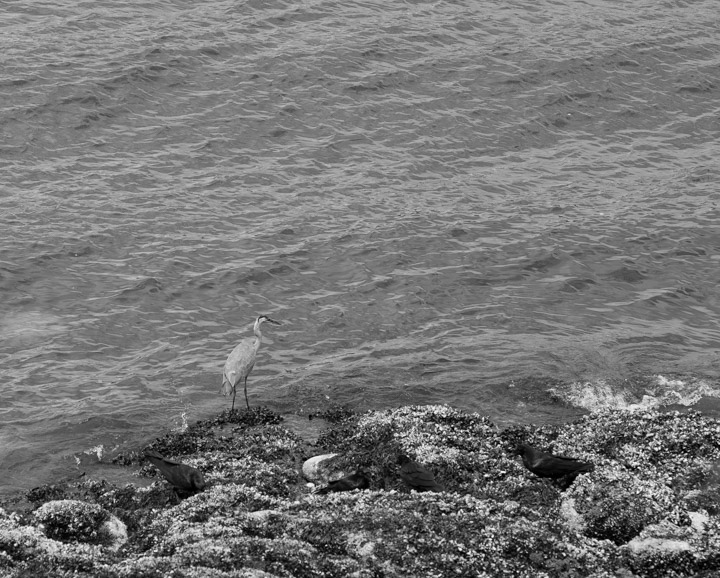
Heron

The heron just far enough away that it doesn’t mind my presence.

The last three pictures were captured on the first and second of August. They’re all pretty heavily processed in Lightroom, especially the mountainside. Lightroom’s “dehaze” control is super helpful on almost any photo of something that’s far away, because it’s specifically designed to counteract the effect of a whole lot of air between you and your target.

purple berries

Late-season berries, November 21st.

Once again with the shallow depth of field. And now, once again with the layering, which in this case gracefully collapses a city’s texture and topography into a little rectangle.

Downtown from across Jonathan Rogers Park Dog in Jonathan Rogers Park

From 8th Avenue in Mount Pleasant by Jonathan Rogers Park, downtown across False Creek and a dog playing fetch, both on December 26th.

The big bright glass lets you capture something that’s moving fast on a dull day while still usefully blurring the background.

Now, there are downsides. This is big and heavy and ridiculously out of proportion with the Fujifilm X-T30 it’s screwed onto, unsurprising and sort of OK since I bought the camera to carry along while climbing up and down the Great Wall of China.

And of course it’s manual focus, which makes everything more difficult.

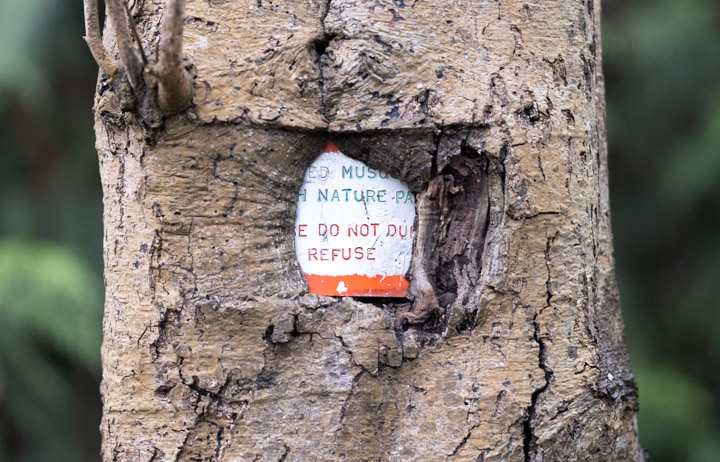
Do Not Refuse

December 27th in Musqueam Park. You can figure out what the sign originally said.

Indeed, I wouldn’t normally take this thing along on an adventure hike. But it seems I never regret setting out with it when I do. Like the sign now says, DO NOT REFUSE.

28 Dec 06:19

Android Fast Pair feature gets new interface for first-time connections

by Jonathan Lamont
Pixel buds

Google reportedly rolled out a new interface for Android’s ‘Fast Pair’ capability that more closely resembles how AirPods connect to iPhones.

Fast Pair, for those unfamiliar, was first launched in 2017. The software makes it easier for users to connect support Bluetooth devices to their Android smartphones. Typically, when you open the lid of supported Bluetooth earbuds, or turn on wireless headphones, a Fast Pair notification will appear on your smartphone. With a tap, users can initiate the pairing process.

9to5Google reports that Google has replaced the notification with a new card that pops-up from the bottom of the screen. The pop-up covers roughly half of the display and shows the Bluetooth device the user is trying to connect. It also features a large, blue ‘Connect’ button. Once paired, users can hop into ‘Setup’ or close the pop-up.

For anyone who’s connected AirPods to an iPhone before, the new Fast Pair interface will look awfully familiar. The card pop-up is nearly identical to the one shown when you connect AirPods to an iPhone for the first time.

Although Google added the new revamped interface, not all of Fast Pair has changed. The new card appears when users connect a support Fast Pair device for the first time. Beyond that, Fast Pair still displays the typical notification for battery status and subsequent pairings.

It’s worth noting that since Fast Pair can link paired earbuds to your Google Account, connecting a Fast Pair device to other Android phones will display the smaller card as well.

If you got a new set of Fast Pair-capable earbuds over the holidays, you may notice the new interface when you connect them to your Android phone for the first time.

Image credit: 9to5Google

Source: 9to5Google

The post Android Fast Pair feature gets new interface for first-time connections appeared first on MobileSyrup.

28 Dec 06:06

Source code discovery, skipping over the legal complications

by Derek Jones

The 2020 US elections introduced the issue of source code discovery, in legal cases, to a wider audience. People wanted to (and still do) check that the software used to register and count votes works as intended, but the companies who wrote the software wouldn’t make it available and the courts did not compel them to do so.

I was surprised to see that there is even a section on “Transfer of or access to source code” in the EU-UK trade and cooperation agreement, agreed on Christmas Eve.

I have many years of experience in discovering problems in the source code of programs I did not write. This experience derives from my time as a compiler implementer (e.g., a big customer is being held up by a serious issue in their application, and the compiler is being blamed), and as a static analysis tool vendor (e.g., managers want to know about what serious mistakes may exist in the code of their products). In all cases those involved wanted me there, I could talk to some of those involved in developing the code, and there were known problems with the code. In court cases, the defence does not want the prosecution looking at the code, and I assume that all conversations with the people who wrote the code goes via the lawyers. I have intentionally stayed away from this kind of work, so my practical experience of working on legal discovery is zero.

The most common reason companies give for not wanting to make their source code available is that it contains trade-secrets (they can hardly say that it’s because they don’t want any mistakes in the code to be discovered).

What kind of trade-secrets might source code contain? Most code is very dull, and for some programs the only trade-secret is that if you put in the implementation effort, the obvious way of doing things works, i.e., the secret sauce promoted by the marketing department is all smoke and mirrors (I have had senior management, who have probably never seen the code, tell me about the wondrous properties of their code, which I had seen and knew that nothing special was present).

Comments may detail embarrassing facts, aka trade-secrets. Sometimes the code interfaces to a proprietary interface format that the company wants to keep secret, or uses some formula that required a lot of R&D (management gets very upset when told that ‘secret’ formula can be reverse engineered from the executable code).

Why does a legal team want access to source code?

If the purpose is to check specific functionality, then reading the source code is probably the fastest technique. For instance, checking whether a particular set of input values can cause a specific behavior to occur, or tracing through the logic to understand the circumstances under which a particular behavior occurs, or in software patent litigation checking what algorithms or formula are being used (this is where trade-secret claims appear to be valid).

If the purpose is a fishing expedition looking for possible incorrect behaviors, having the source code is probably not that useful. The quantity of source contained in modern applications can be huge, e.g., tens to hundreds of thousands of lines.

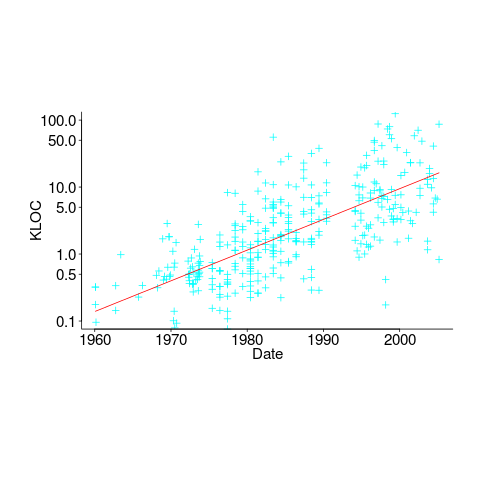
In ancient times (i.e., the 1970s and 1980s) programs were short (because most computers had tiny amounts of memory, compared to post-2000), and it was practical to read the source to understand a program. Customer demand for more features, and the fact that greater storage capacity removed the need to spend time reducing code size, means that source code ballooned. The following plot shows the lines of code contained in the collected algorithms of the Transactions on Mathematical Software, the red line is a fitted regression model of the form: LOC approx e^{0.0003Day}(code+data):

Lines of code contained in the collected algorithms of the Transactions on Mathematical Software, over time.

How, by reading the source code, does anybody find mistakes in a 10+ thousand line program? If the program only occasionally misbehaves, finding a coding mistake by reading the source is likely to be very very time-consuming, i.e, months. Work it out yourself: 10K lines of code is around 200 pages. How long would it take you to remember all the details and their interdependencies of a detailed 200-page technical discussion well enough to spot an inconsistency likely to cause a fault experience? And, yes, the source may very well be provided as a printout, or as a pdf on a protected memory stick.

From my limited reading of accounts of software discovery, the time available to study the code may be just days or maybe a week or two.

Reading large quantities of code, to discover possible coding mistakes, are an inefficient use of human time resources. Some form of analysis tool might help. Static analysis tools are one option; these cost money and might not be available for the language or dialect in which the source is written (there are some good tools for C because it has been around so long and is widely used).

Character assassination, or guilt by innuendo is another approach; the code just cannot be trusted to behave in a reasonable manner (this approach is regularly used in the software business). Software metrics are deployed to give the impression that it is likely that mistakes exist, without specifying specific mistakes in the code, e.g., this metric is much higher than is considered reasonable. Where did these reasonable values come from? Someone, somewhere said something, the Moon aligned with Mars and these values became accepted ‘wisdom’ (no, reality is not allowed to intrude; the case is made by arguing from authority). McCabe’s complexity metric is a favorite, and I have written how use of this metric is essentially accounting fraud (I have had emails from several people who are very unhappy about me saying this). Halstead’s metrics are another favorite, and at least Halstead and others at the time did some empirical analysis (the results showed how ineffective the metrics were; the metrics don’t calculate the quantities claimed).

The software development process used to create software is another popular means of character assassination. People seem to take comfort in the idea that software was created using a defined process, and use of ad-hoc methods provides an easy target for ridicule. Some processes work because they include lots of testing, and doing lots of testing will of course improve reliability. I have seen development groups use a process and fail to produce reliable software, and I have seen ad-hoc methods produce reliable software.

From what I can tell, some expert witnesses are chosen for their ability to project an air of authority and having impressive sounding credentials, not for their hands-on ability to dissect code. In other words, just the kind of person needed for a legal strategy based on character assassination, or guilt by innuendo.

What is the most cost-effective way of finding reliability problems in software built from 10k+ lines of code? My money is on fuzz testing, a term that should send shivers down the spine of a defense team. Source code is not required, and the output is a list of real fault experiences. There are a few catches: 1) the software probably to be run in the cloud (perhaps the only cost/time effective way of running the many thousands of tests), and the defense is going to object over licensing issues (they don’t want the code fuzzed), 2) having lots of test harnesses interacting with a central database is likely to be problematic, 3) support for emulating embedded cpus, even commonly used ones like the Z80, is currently poor (this is a rapidly evolving area, so check current status).

Fuzzing can also be used to estimate the numbers of so-far undetected coding mistakes.
28 Dec 06:05

It's All Blues (Whales)

NYTimes: A New Population of Blue Whales Was Discovered Hiding in the Indian Ocean

The covert cadre of whales, described in a paper published last week in the journal Endangered Species Research, has its own signature anthem: a slow, bellowing ballad that’s distinct from any other whale song ever described. It joins only a dozen or so other blue whale songs that have been documented, each the calling card of a unique population.

“It’s like hearing different songs within a genre — Stevie Ray Vaughan versus B. B. King,” said Salvatore Cerchio, a marine mammal biologist at the African Aquatic Conservation Fund in Massachusetts and the study’s lead author. “It’s all blues, but you know the different styles.”

How could I not link to this?

28 Dec 06:05

Twitter Favorites: [davewiner] 1/2 When you write an outline on paper, if you feel the need to reorganize, you have to write the whole thing over.… https://t.co/lWlvvtB4Y4

dave@scripting.com @davewiner
1/2 When you write an outline on paper, if you feel the need to reorganize, you have to write the whole thing over.… twitter.com/i/web/status/1…
28 Dec 06:05

Twitter Favorites: [davewiner] 2/2 Doing an outline on a computer is different. Since you have commands to reorganize the outline, you can use any… https://t.co/RPrL7wUEb9

dave@scripting.com @davewiner
2/2 Doing an outline on a computer is different. Since you have commands to reorganize the outline, you can use any… twitter.com/i/web/status/1…
28 Dec 06:05

From Taking Notes to Making Notes

by Jim

I’ve recently been spending time in the online community at Ness Labs, launched by Anne-Laure Le Cunff. She’s been writing about topics that sync up with my interests in knowledge work effectiveness and has collected a really interesting collection of fellow travelers. Recently, she piloted a short online course called “Collector to Creator.” Way above the average online course both in terms of content and community. You should keep an eye out for future iterations. 

This was part of my ongoing efforts to reexamine and retool my knowledge work practices. Much of that has focused on what happens between a germ of an idea and a worthy finished product. And rethinking the role of notes has been both a central focus and a central struggle as I work at designing and then grooving in new habits and practices. Some wayposts in that journey include:

During one of the sessions Anne-Laure introduced a one-letter distinction that has opened up a new line of thinking and development. She differentiated “note-making” from “note-taking.”

The most obvious aspect is a shift from a passive to an active perspective. I hadn’t actually thought much about the passive nature of “taking” until I had “making” as a contrast.With it, I can see how much of my note-taking habits and practices were intellectually passive; I was taking notes to capture someone else’s words or thoughts. This was certainly the case in most of the settings where I was in a student role. 

Now that I have the distinction, I can revisit and reinterpret some of my practices. I never acquired the habit of working with index cards, so I never got the sense of ideas as discrete chunks of text to be manipulated. I did use hand-drawn mindmaps (that being the only option at the time) to work out structural connections and relationships. But my focus was generally on the big picture of whatever deliverable I was working on. Even when I was immersed in the literature of a field, I tended to think of ideas as being embedded in and tightly integrated with the journal articles and books I was reading. I thought of ideas from others as something to be transferred (taken) more than as something to be transformed (made). That’s to the extent that I thought about this level of thinking explicitly at all. 

The transformation, connecting, and reconnecting of ideas into a new deliverable was something that took place either in my head or in the multiple iterations of creating a specific deliverable. I struggle with advice about how to work at the level of ideas that haven’t found a home yet. This distinction of making a note promises to be a path into making more sense, more systematically, of that middle space and time before I know what the destination might be. 

This one-letter distinction may not be a full 80-IQ point change in perspective, but it’s clearly worth enough to be a keeper.

The post From Taking Notes to Making Notes appeared first on McGee's Musings.

28 Dec 06:02

We’ve seen this movie before

by Doc Searls

When some big outfit with a vested interest in violating your privacy says they are only trying to save small business, grab your wallet. Because the game they’re playing is misdirection away from what they really want.

The most recent case in point is Facebook, which ironically holds the world’s largest database on individual human interests while also failing to understand jack shit about personal boundaries.

This became clear when Facebook placed the ad above and others like it in major publications recently, and mostly made bad news for itself. We saw the same kind of thing in early 2014, when the IAB ran a similar campaign against Mozilla, using ads like this:

That one was to oppose Mozilla’s decision to turn on Do Not Track by default in its Firefox browser. Never mind that Do Not Track was never more than a polite request for websites to not be infected with a beacon, like those worn by marked animals, so one can be tracked away from the website. Had the advertising industry and its dependents in publishing simply listened to that signal, and respected it, we might never have had the GDPR or the CCPA, both of which are still failing at the same mission. (But, credit where due: the GDPR and the CCPA have at least forced websites to put up insincere and misleading opt-out popovers in front of every website whose lawyers are scared of violating the letter—but never the spirit—of those and other privacy laws.)

The IAB succeeded in its campaign against Mozilla and Do Not Track; but the the victory was Pyrrhic, because users decided to install ad blockers instead, which by 2015 was the largest boycott in human history. Plus a raft of privacy laws, with more in the pipeline.

We also got Apple on our side. That’s good, but not good enough.

What we need are working tools of our own. Examples: Global Privacy Control (and all the browsers and add-ons mentioned there), Customer Commons#NoStalking term, the IEEE’s P7012 – Standard for Machine Readable Personal Privacy Terms, and other approaches to solving business problems from the our side—rather than always from the corporate one.

In those movies, we’ll win.

Because if only Apple wins, we still lose.

Dammit, it’s still about what The Cluetrain Manifesto said in the first place, in this “one clue” published almost 21 years ago:

we are not seats or eyeballs or end users or consumers.
we are human beings — and out reach exceeds your grasp.
deal with it.

We have to make them deal. All of them. Not just Apple. We need code, protocols and standards, and not just regulations.

All the projects linked to above can use some help, plus others I’ll list here too if you write to me with them. (Comments here only work for Harvard email addresses, alas. I’m doc at searls dot com.)

28 Dec 06:01

State of the Word 2020

by Matt

This tumultuous year, two things really helped me get through it: my colleagues at Automattic and the community of WordPress.

At the end of the year I usually deliver a speech to the WP community we call the State of the Word, that celebrates what we accomplished the previous year and shines a light on what we could focus on in the coming year. There’s always a great energy in the room and I love mixing with the audience before and after the talk. This year we did it online, which meant we could produce the talk a little more, and we made extra time for the Q&A afterward with answers not just from me but folks across the community.

One thing I’ll call out WordPress 5.6 had an all women and non-binary release squad of over 50 people, a first for WordPress and probably any large open source project. Also the market share of WordPress grew more in 2020 than it has in any year since it started being tracked!

If you’re curious about what’s next for WordPress, check it out: