|
mkalus
shared this story
from  OldHacker.org. OldHacker.org.
|

Audio is missing, but pretty sure he pities the fool who doesn’t have an Atari 800.
|
mkalus
shared this story
from OldHacker.org.
|
Audio is missing, but pretty sure he pities the fool who doesn’t have an Atari 800.
|
mkalus
shared this story
from  mrjamesob on Twitter. mrjamesob on Twitter.
|
G7 country, over 126 million people & the third largest economy in the world. To date, they have suffered 3,062 Covid-19 deaths compared to our 70,405. Just one reason why the UK government & client journalists are so desperate to remove international comparisons from the debate twitter.com/Reuters/status…
Japan banned non-resident foreign nationals from entering the country following the detection of a new, highly infectious variant of the coronavirus which has also been detected in Canada and Sweden. Follow our coverage here: reut.rs/3mZu8u5 pic.twitter.com/2uGtaqG59r
722 likes, 479 retweets
|
mkalus
shared this story
from  ottocrat on Twitter. ottocrat on Twitter.
|
I think this accurately reflects the ‘glass half full’ view in Brussels theguardian.com/politics/2020/… pic.twitter.com/sFzTZkORKc


The AirPods Max ‘Smart Case’ is one of the most disappointing and strangest products Apple has ever released.
It’s thin, flimsy and doesn’t provide much protection to the pricey $779 headphones. Unfortunately, if you’re hoping to ensure the AirPods Max battery lasts anywhere near 20 hours, you’ll need to use the case to turn the headphones off immediately after you’re done using them.
Thankfully, as many predicted, third-party manufacturers are already working to fill the AirPods Max case void. WaterField Designs has announced a new AirPods Max ‘Shield Case’ case that looks similar to what Beats headphones and pretty much any mid-range to high-end headphones come with. It features a compact, professional-looking design that actually covers the AirPods Max entirely, unlike the Apple’s official Smart Case.
The case features a dual zipper so you can charge the AirPods Max while it’s closed, and a plush-lined interior designed to prevent scuffs and scratches.

Further, the case is even capable of putting the headphones into low-power mode thanks to a magnetic leather butterfly inside it, just like the AirPods Max’s official case. Other features include a stretch mesh pocket capable of fitting a 5w to 20w Apple power adaptor, or 3.5mm-to-Lightning headphone cord.
WakeField Design’s AirPods Pro case is currently available to pre-order for $99 USD (about $127 CAD) and doesn’t start shipping until February 12th.
Via 9to5Mac
The post WaterField Designs launches AirPods Max case with more durable design appeared first on MobileSyrup.

Here are all the maximum spec USB4 cables certified by USB-IF as of 2020/12/27. These ~0.8-1m cables support all Thunderbolt 4 (TB4) features including backwards compatibility with USB 3.x USB-C, 8K support, etc., at potentially lower cost than Intel-certified cables. Yeah that’s right, maximum-spec USB4 == TB4. Perhaps some of these cables will be Intel-certified in the future so they can get in on Intel’s marketing programs…
| Manufacturer | Model Number | Certification description | Length (m) | Color | USB-IF TID | Certification date |
|---|---|---|---|---|---|---|
| ACON, Advanced-Connectek, Inc. | CBAUB-H40-080A | USB4 GEN 3 USB Type-C TO USB Type-C Cable 0.8M HF | 0.8 | 4634 | 12/4/2020 | |
| ACON, Advanced-Connectek, Inc. | CBAUB-H40-070A | USB4 GEN 3 USB Type-C TO USB Type-C Cable 0.72m HF | 0.72 | 4464 | 11/17/2020 | |
| Amphenol AssembleTech (Xiamen) Co., Ltd. | RUBCC-0155 | USB4 Type-C Passive Cable Assembly | 0.8 | Black | 4266 | 10/14/2020 |
| Bizlink Technology, Inc. | 117G0-074935-R1 | USB-C to USB-C Cable/USB4/Gen3/5A/1m/E-marker | 1.0 | Black | 4561 | 11/18/2020 |
| Bizlink Technology, Inc. | 117G0-068550-R1 | USB-C to USB-C Cable/USB4/Gen3/5A/0.8m/E-marker | 0.8 | Black | 4261 | 10/8/2020 |
| CE LINK LIMITED | U4-CC-5A0.8M | USB4, USB Type-C To USB Type-C Cable Assembly Gen3 0.8M 5A With E-Mark | 0.8 | 4295 | 10/22/2020 | |
| Club 3D BV | CAC-1571 | USB4 USB Type-C Gen3x2 Bi-Directional Cable 40Gbps 100W Power Delivery M/M 0.8m / 2.6ft | 0.8 | Black | 4543 | 11/10/2020 |
| Elecom Co., Ltd. | USB4-CC5P08WH | USB4 Gen3 5A L=0.8M WH | 0.8 | White | 4459 | 10/19/2020 |
| Elecom Co., Ltd. | USB4-CC5P08BK | USB4 Gen3 5A L=0.8M BK | 0.8 | Black | 4303 | 10/8/2020 |
| Foxconn / Hon Hai | CUDT01T-ZZ400-DH | USB4 Gen3 Cable Assembly | 0.8 | 4403 | 11/16/2020 | |
| GOOGFIT TECH LIMITED | CC1052-G | USB4, USB Type-C To USB Type-C Cable (With E-Mark/GEN3/5A), 0.8M Black | 0.8 | Black | 4645 | 11/30/2020 |
| GOOGFIT TECH LIMITED | CC1052 | USB4, USB Type-C To USB Type-C Cable (With E-Mark/GEN3/5A), 0.8M Black | 0.8 | Black | 4644 | 11/30/2020 |
| Goppa, LLC | GP-CCU408M/W | USB Type-C to USB Type-C Cable ( USB4/Gen3/PD5A/Alt mode) 80cm | 0.8 | White | 4488 | 11/4/2020 |
| Goppa, LLC | GP-CCU408M/B | USB Type-C to USB Type-C Cable ( USB4/Gen3/PD5A/Alt mode) 80cm | 0.8 | Black | 4487 | 11/4/2020 |
| iFory Limited | LUNU4001-CS-R | iFory USB4 Gen3 5A L=0.8M White | 0.8 | White | 4542 | 11/10/2020 |
| Japan Aviation Electronics Industry Ltd. (JAE) | DX07880B08 | USB4 Gen3 Cable Assembly | 0.8 | Black | 4636 | 12/4/2020 |
| Joinsoon Electronics Mfg. Co., Ltd. | ENG-20003-0A | USB4 TYPE-C GEN3 WITH EMIC 5A | 4264 | 10/19/2020 | ||
| Joinsoon Electronics Mfg. Co., Ltd. | ENG-20002-0A | USB4 TYPE-C GEN3 WITH EMIC 5A | 4263 | 10/19/2020 | ||
| Lintes Technology Co., Ltd. | CPC080-EC1 / CPCLLL-EC1 | USB4 Gen3 USB Type-C to USB Type-C,5A,0.8M,40G | 0.8 | Black | 4317 | 10/22/2020 |
| Luxshare-ICT | LA0U4003-CS-H | USB4, USB PD, USB Type-C (Plug)-to- USB Type-C (Plug), 5A, Black, TPE | Black | 4192 | 10/8/2020 | |
| Luxshare-ICT | LA0U4002-CS-H | USB4, USB PD, USB Type-C (Plug)-to- USB Type-C (Plug), 5A, Black, TPE | Black | 4186 | 9/23/2020 | |
| Luxshare-ICT | LA0U4005-CS-H | USB4, PD, USB Type-C (Plug)-to-USB Type-C (Plug), 5A, White, TPE | White | 4360 | 10/19/2020 |

If you were trying to set up your new iPad, Apple Watch or iPhone yesterday and couldn’t get it up and running, you’re not alone.
Likely due to the influx of people trying to set up new devices on Christmas and Boxing Day, reports that iCloud is down started to appear. Apple eventually confirmed the issues through an @AppleSupport tweet and on its ‘System Status‘ page.
We know your mom is eager to have everything working and appreciate you helping to set them up. We are experiencing a high capacity at this time which is impacting your ability to set up iCloud, please try back in a couple of hours. https://t.co/waNYZdXpJm
— Apple Support (@AppleSupport) December 25, 2020
Though the outage was poorly timed, it looks like the issue has now been solved roughly 36 hours after reports of problems first started to appear.
Interestingly, there are not many reported iCloud issues on Downdetector in the last 24 hours. That said, there’s a possibility many people didn’t realize the new device activation outage was related to Apple’s iCloud platform.
Either way, the issue seems to be solved, so if you’ve been unable to get your new iPad Air (2020) to activate, you likely can now.
Source: @AppleSupport, Apple
The post Apple’s iCloud activation issue has been fixed appeared first on MobileSyrup.

If you’re a little confused about how to watch Wonder Woman 1984 in Canada, you aren’t alone.
While it initially seemed like the only way to watch the film would be in theatres and then eventually on Bell-owned Crave following its theatrical run, Warner Bros. recently announced that the movie would also stream on premium video on-demand (PVOD) services.
Currently, you can watch Wonder Woman 1984 on iTunes, Google Play and the Cineplex Store for $29.99 for a 48-hour rental. The movie is also playing in regions across Canada where theatres are still open. However, in Ontario, for example, where the province is under a provincewide lockdown until January 23rd in an effort to curb COVID-19 infection rates, movie theatres are closed.
Across iTunes, Google Play and the Cineplex store, Wonder Woman 1984 streams in 4K with Dolby Vision and HDR10 compatibility. However, it seems like Dolby Atmos surround sound is only supported on iTunes.
The sequel to 2017’s Wonder Woman was originally set to release last year, but was first delayed to June 5th, 2020, and then, COVID-19 pushed the film’s release back again to August 14th and then August 22nd, and finally, Christmas Day.
It’s unclear when the movie will make its way to Crave. That said, to watch Wonder Woman 1984, you’ll need to subscribe to the base level of Crave that costs $9.99 per month and then the HBO tier that costs an additional $9.99 per month, bringing the total cost to $19.98 per month.
PVOD windows for movies typically run anywhere from two weeks and 30-days, so it’s likely we won’t see Wonder Woman 1984 on Crave until at least late January or early February at the earliest.
Wonder Woman 1984 currently has a 65 percent score on Rotten Tomatoes based on 286 critic reviews. The movie was directed by Patty Jenkins and stars Gal Gadot and Chris Pine as Diana and Steve, with Pedro Pascal and Kristen Wiig also joining the cast.
The movie, set during the Cold War, has Wonder Woman reuniting with an old flame, Steve Trevor, to face off against shady businessman Maxwell Lord and Cheetah.
If you’re looking for a TV show or movie to stream this holiday season, check out Brad Shankar’s round-up of some of the top 2020 Canadian content on Amazon Prime, Netflix, Crave and Disney+.
Image credit: Warner Bros.
The post How to watch Wonder Woman 1984 in Canada appeared first on MobileSyrup.
I keep seeing people anxious for the end of 2020, as if January 1st was a Rubicon that the shit-storm of 2020 won’t follow us across.
Let me disabuse you of any such notion.
Really, what do you expect to change in 2021?
I do hope you said “No” to each of the above, because that’s the only rational answer.
We might make incremental progress on each of them over 2021, but that won’t mean much in the short term. Well except for the GOP, they’re a lost cause and will only sink deeper and deeper into conspiracy theories and violence.
Don’t believe me? Let’s take a quick tour of what made 2020 such a shit-storm.
Yes, we have, at this moment, two vaccines for Covid, and more on the way. But we are still months away from returning to anything representing normal. You can look at the 600,000 people that got the Pfizer vaccine in the first week it was available, which is a tremendous accomplishment, but at that rate it would take over 8 years to inoculate 250 million Americans, never mind the rest of the world. I fully expect the rate of vaccination to increase, but it could be a while before enough people are vaccinated to trigger herd immunity. So we can expect Covid to be with us for a while longer, and even if we do get it under control, there’s always a chance we could see it mutate, or a new virus could emerge.
Also, we have no idea the long term personal and economic costs of long haulers, people who have symptoms from Covid that linger for months or longer. Since the condition is so new we don’t know if it may be a lifetime affliction for some of the people suffering from it. As of today there are 19 million total cases of Covid in the US, and around 10% of those will become long-haulers, so were looking at close to two million people suffering for months, if not for the rest of their lives, and the number will only grow until we get the virus under control.
Finally, we don’t know the true economic damage Covid has wrought, we can hope that once we are past the virus that the economy will spring back quickly, but if the number of restaurants that have gone under is any indication, it will take time to fully recover.
Global warming won’t get any better in 2021. Yes, with the election of Joe Biden we can hopefully move beyond the denial of its existence as the policy of the executive branch of the federal government, but no matter how swiftly we act today, temperatures will continue to rise for decades. So as bad as 2020 was, just consider the fires in Australia and California as one example, we know that 2021 will only be worse.
Remember: 2020 was the coldest year on record for the next 100 years.
The same will be true for 2021.
I fully expect Trump, unconstrained by the people that surround him in the White House today, to become even more unhinged and try to inspire even more violent acts of terrorism. But even if Trump’s influence withers, his base won’t take the current sea change in the US lying down. The country has obviously started to tilt back to the left; Democrats control the House and the White House (The Senate is still up for grabs as I write this), neo-liberalism is dead, monopolies are finally coming back under scrutiny, gay marriage is legal in all 50 states, and a vast majority of people believe Black Lives Matter.
They waged a culture war and lost.
But why do I think this will turn to violence? History.
Here’s a little bit of history that a lot of people seem to have forgotten, how many bombings were there in the 70s?
It turns out, a lot:
In a single eighteen-month period during 1971 and 1972 the FBI counted an amazing 2,500 bombings on American soil, almost five a day.
Time: The Bombings of America That We Forgot
And the majority of these were from leftist groups, in an age when the country had started to take a turn to the right. My theory is that the political violence is a reaction from people that know the popular opinion has turned against them; it was leftists during the 70s and it will be right-wingers, nee Trumpists, in the 2020s.
Now don’t get me wrong, there’s a lot to be unhappy about, middle class wages have stagnated for fifty years, and the poor have actually gotten poorer in that time. The grand neo-liberal experiment was to let markets run wild, a light hand on regulation and unconstrained free trade with other countries and that was supposed to magically fix all of our woes from poverty to racial discrimination.
It was all just wishful thinking and we now need to backtrack: get monopolies and oligopolies under control, move back to a more protectionist stance on global trade, undo 50 years of tax cuts for the rich, and go back to protecting workers rights. But those changes take time to enact, and will take even longer to reach Main Street, so don’t hold your breath that popular immiseration will go away in 2021, and thus there’ll be more than enough fuel for the fire of violence.
So, yeah, in summary, 2021 probably won’t be better than 2020, and in fact there’s good reason to expect things to be worse for next four or five years.
Happy New Year!
As we use any kind of tool over time, we naturally want the tool to work better for us, to fit our workflows and our use cases. The more we use a tool as a part of our day to day work, the more important it is that the tool work exactly the way we want to work with it.
Sometimes, we have the luxury of designing and building a tool that’s tailor-made for exactly the workflows and use cases we need. When we can, it’s usually the best option. Large companies that can afford internal engineering teams invest heavily into building business tools that nobody outside of the company would ever use, because having that perfect fit between your tools and workflows matters. For a hobby developer like me, this is also sometimes a good solution – most of my tools I use day to day to get things done are home-brew, and built to fit exactly around how I work.
Most people and teams don’t have this luxury of building a tool just for one use case, though. Instead, someone else makes the tool for lots of people, and you get one copy of the tool. But even then, individual tool-users might have their own use cases they want the tool to fit better. The simplest, most conventional solution to this problem of a single tool-maker serving many different workflows is simple customization: the tool comes built-in with a bunch of levers, dials, and switches you can control, and each user gets to tune these controls to get the tool to behave exactly how they want it. These can be simple and intuitive, like the volume dial of any speaker system, or complicated, like the multi-page settings pane of a professional audio workstation or video editing program.
Customization is one solution to bringing our tools closer to our use cases, but it has a few problems.
All of these problems become worse as a tool becomes more powerful and flexible. When a tool is designed to be simply customizable with an abundance of settings and options, adding power means adding complexity and steepening the learning curve. If great tools are about multiplying our creativity, customization gets in the way of this mission, because it limits how flexible our tools can be, and how easily we can learn to use them. We need a better way to build tools that wrap around our workflows than simply adding levers and dials for every new option.
When a tool is monolithic, with one way to work and little to customize, people who use the tool end up growing around the tool. They learn the tool’s various quirks and sharp edges, and learn to avoid and work around them. Because the tool itself is so rigid, the human has to change to bend their workflows around how the tool works. This is the worst of all worlds.
More charitable designers will let a tool be customized to the liking of those who wield its power. As I noted before, this allows the people who use a tool to change the tool to fit their needs. Rather than the human growing workflows around the tool, they bend the tool around how they work by tweaking the dials and options that came with the tool. This works, but we saw the ways it falls short.
In either case, we try to develop a relationship between a tool and the people who use it by holding one fixed, and trying to bend the other to fit. But the best relationships between a tool and its users, as in any good relationship, is about growing and changing together. I think we need tools that grow naturally alongside their users through use.
Here, I mean “grow” in the way that an ivy grows, by exploring its surroundings and intertwining itself with the world around it, not “grow” as in scale. Humans and tools form a symbiosis in the best cases, and that relationship works best when tools can change over time as their users explore their craft through the tools.

My favorite example of a growable tool is the pair of canonical terminal-based text editors, Emacs and Vim. Different as they are in the small, at a high level, the popularity and longevity of these text editors in the software industry come from the same core idea: both text editors are built around the idea of building “scripts” or repeatable sequences of action that can be live-programmed in the editor, saved, and played back later. In Emacs with Emacs Lisp and in Vim with macros, a programmer can call commands and run through actions in the text editor, and if it’s useful, they can save it as a program or a macro to run again later. Over time, expert Emacs and Vim users accumulate a collection of handy functions and macros that becomes a part of the way they work with the text editor. These small programs that collect over time are neither a part of the editor, nor purely a part of the user. It’s the result of a collaboration between the tool and the tool-user. Over time, I’ve grown alongside my Vim editor’s configuration, and as much as Vim has changed how I edit programs, I’ve also contributed to my version of Vim lots of shortcuts and macros I use every week that has changed how Vim works for me.
To guide our thinking about other growable tools, let’s understand what goes into a tool that can grow with its users.
There are three critical pieces to building a tool that can grow around its users over time.
Design around play. Sometimes I call this design around experimentation. Using the tool for day-to-day work should involve playing and experimenting with what’s possible with the tool. Whether that’s writing small programs to edit text more quickly in Emacs, or discovering a new chord progression you want to use later, experimenting with features should be a core part of the way the tool is designed to be used.
Make it easy to save experiments to re-use later. Whenever we discover an interesting chord progression or a useful editor shortcut in the course of our daily play with the tool, we should be able to save it to invoke it later. The easiest way to do this is to offer some text representation of an action, so the string of text can be saved and re-run later. The power of a growable tool really comes from the seamless flow from experimentation to collection of neat tricks and small workflows. You need both parts.
A web browser is a great example of a tool that’s heavily customizable, but falls short of growing with users because of the lack of this seamless flow between play and save. Modern browsers all admit extensions that we can use to customize how the browser works in deep ways, but these extensions are too complex for us to write while using the browser day-to-day. It’s impossible to go from “let me try to do this” to “this is useful, let’s save it for later” with a browser extension. Writing an extension is a fundamentally different job than using the browser, and the browser fails to grow with users because of this disconnect. Imagine if you could write small 2-3 line programs while browsing the web that changed how the browser worked for that particular page, and then save those snippets to pull up and re-use later. Wouldn’t it completely change how you interact with your web browser?
Add power by combining simple parts that work together, not adding options. This is better known as the UNIX philosophy, which states:
Write programs that do one thing and do it well.
Write programs to work together.
Write programs to handle text streams, because that is a universal interface.
In other words, make big tools by combining smaller tools with small focuses that work together well and understand each other. When we build a tool as a system of smaller tools that work together, it becomes much easier for users to play and experiment with new workflows during their everyday use. “Scripting” within the tool becomes natural, as we’ll see below.
A tool built with these principles in mind can offer just as much flexibility as the most configuration-saturated tools in the world, without succumbing to the same pitfalls. Because users tweak and change the tool by experimenting over time, customization happens constantly, not just at the beginning. Because the customization happens by mixing and matching small patterns that work together, users only need to learn that small set of primitives to get started using the tool like a power user. Growable tools scale with power in a way customizable tools don’t.
I recently built a Twitter reader and client, Lucerne, as a Twitter reader that could grow with me. Twitter’s default experience is far from a collaboration between me and the app. Despite the wealth of information that floats through the ether of the Twittersphere, the app feeds me a small sliver it wants to deliver, and I passively scroll. Lucerne is built around the idea of channels, or saved searches. As I use Lucerne, I can explore Twitter by searching for keywords, ideas, and users through threads on Twitter with an array of filters. If any filter seems particular useful, I save that filter as a “channel” pinned to the sidebar that I can come back to later. The more I use Lucerne to browse Twitter, the better channels I’ll collect. Eventually, Lucerne will grow a long list of channels that define how I use Lucerne, more than simply how the tool works.
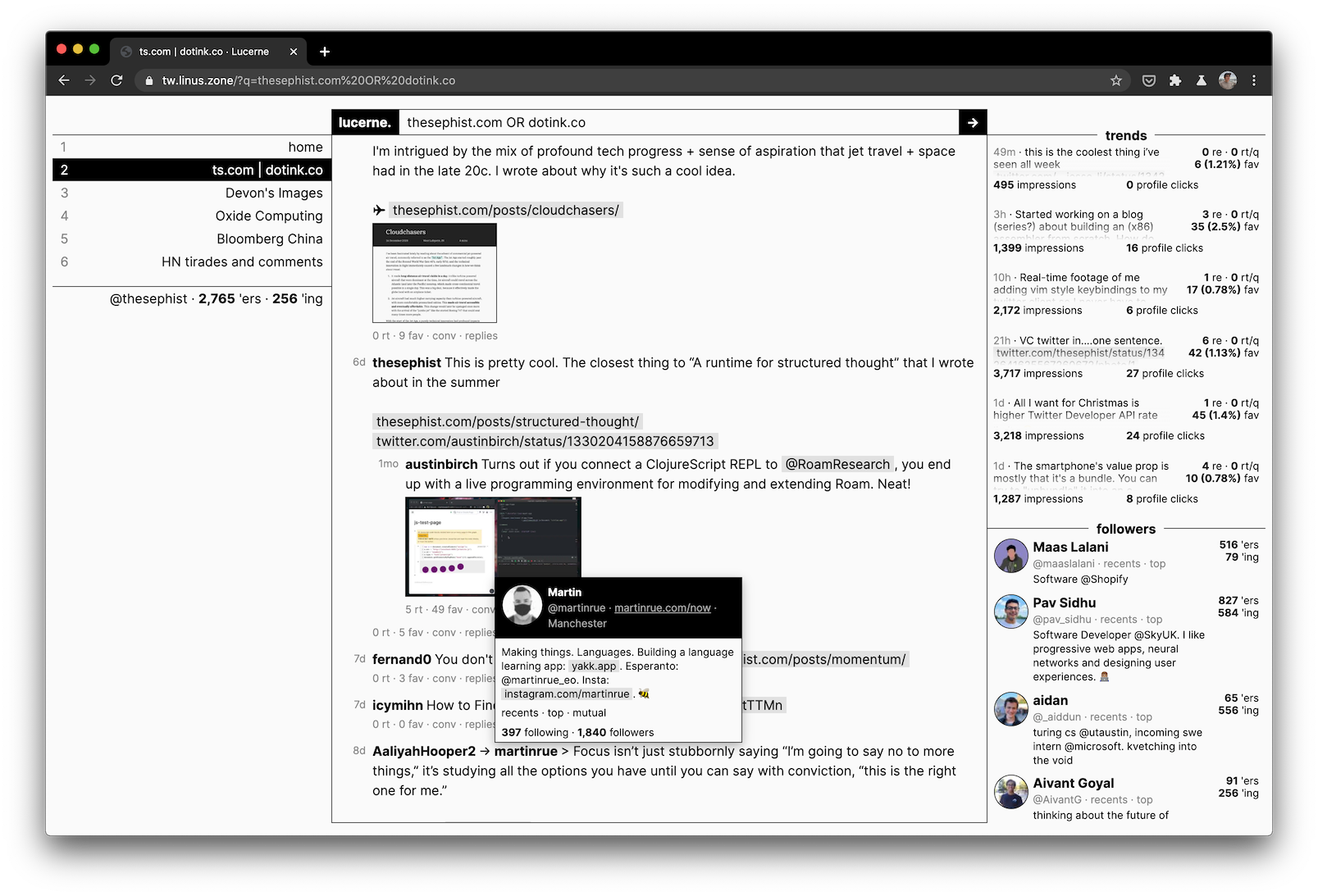
Within Lucerne, each search query is a combination of small filters, like filter:retweets to see only retweets, re:123456789 to see a reply to a tweet, or from:thesephist to see a tweet by a particular account. These can combine to build more complex queries like “most popular tweets by X account on Y topic” (sort:top from:thesephist #topic). Rather than having a built-in feature, building up this search system from small parts that work together leaves open many more possibilities for experimentation and play. I’ve started curating a small collection of channels I check every day through Lucerne, and I’m looking forward to using it more.
There are still so many areas of work filled with tools that are merely customizable, but don’t grow with use. Web browsers, video editors, word processors, digital instruments… these are all huge categories of tools where the tools offer a dizzying array of configuration options at best. Expert video editors or instrumentalists spend years dialing in the tools to work the way they’d like, and the tools rarely reciprocate by growing around their users. If we want these crafts to truly be powerful amplifiers of human creativity, we need them to be more learnable and more flexible than they are today, while becoming even more powerful. We can only get there by building tools that grow around us as we use them to explore what’s possible, towards an ever-changing symbiosis between people and the tools that bring their ideas to life.
Many ideas in this post have been explored in a million different directions by some of the best designers and tool-builders through history, on whose shoulders I hope this idea stands. If you’re also interested in building better tools, my thoughts are inspired by
… and many others.

Since the Pixel 4 arrived, Google’s smartphone line has offered an ‘astrophotography‘ feature that leverages machine learning techniques and computational photography to take pictures of the night sky. With the launch of the Pixel 5 and 4a 5G in 2020, the new ultra-wide camera hardware enabled Pixel owners to take wider images of the night sky. However, it appears Google has since removed that capability.
As spotted by 9to5Google, Pixel 5 and 4a 5G owners can no longer access astrophotography when using the ultra-wide camera on their devices. As of the Camera 8.1 update, a small bubble appears on-screen noting users must “Zoom to 1x for astrophotography.”
Despite the change, the ultra-wide camera still works with Night Sight, Google’s software-based low-light photography feature.
Further, Google updated a support document about the feature to note that it “only works on zoom settings equal or greater than 1x” on the Pixel 4a 5G and Pixel 5.
It remains unclear why Google chose to restrict the feature, especially given that it was available and worked before. Perhaps there was some kind of issue with the feature and this is a temporary measure while Google fixes it. However, given the updated support documents, I think this may be more than just a temporary measure.
9to5 also points out that those who want the feature back may have some issues sideloading an older version of Google Camera. However, you can uninstall updates to the app to revert to the version that came pre-installed on the phone. Doing so will take you back to version 7.6, which still has astrophotography for the ultra-wide lens as well as a slightly different UI since Google pushed a new look in version 8.0.
Source: 9to5Google
The post Google Camera update removes astrophotography on ultra-wide cameras appeared first on MobileSyrup.
|
mkalus
shared this story
from  Michael Kalus.ca. Michael Kalus.ca.
|

From Sixty-Four Reasons to Celebrate Paul McCartney, this bit of wisdom that will sound familiar to programmers:
On one of the tapes of studio chatter at Abbey Road you can hear McCartney saying, of something they're working on, "It's complicated now. If we can get it simpler, and then complicate it where it needs to be complicated..."
People talk a lot about making software as simple as possible. The truth is, software sometimes has to be complicated. Some programs perform complex tasks. More importantly, programs these days often interact in complex environments with a lot of dissimilar, distributed components. We cannot avoid complexity.
As McCartney knows about music, the key is to make things as simple as can be and introduce complexity only where it is essential. Programmers face three challenges in this regard:
On an unrelated note, another passage in this article spoke to me personally as a programmer. While discussing McCartney's propensity to try new things and to release everything, good and bad, it refers to some of the songs on his most recent album (at that time) as enthusiastically executed misjudgments. I empathize with McCartney. My hard drive is littered with enthusiastically executed misjudgments. And I've never written the software equivalent of "Hey Jude".
McCartney just released a new album this month at the age of 78. The third album in a trilogy conceived and begun in 1970, it has already gone to #1 in three countries. He continues to write, record, and release, and collaborates frequently with today's artists. I can only hope to be enthusiastically producing software, and in tune with the modern tech world, when I am his age.
What a fucking year, huh? A global pandemic, social unrest sparked by the continued murders of black men and women at the hands of those sworn to protect, and another heated election cycle between a qualified candidate and a petulant narcissist. I feel like I aged a thousand years while being imprisoned in a never-ending limbo within the walls of my house. I’m sure to different degrees we all have felt something similar and, if there’s one silver lining, at least we have some shared experiences after all this.
Last year I made a set of “SMART” goals and I’m happy to report that I failed on every single goal. Like literally achieved none of them.
A monumental shift in priorities happened in March. In one week it went from focusing on “How am I going to grow personally and professionally this year?” to “How am I going to safely get groceries this week?” Naively, I thought if we all took precautions and abstained from large groups for a couple months, it’d be over… but no.
I turned 40 in late April which is a big milestone as far as birthdays go. I got a new Pete Seeger style longneck banjo that I adore and waste hours on it playing the small catalog of clawhammer songs I know. We also stress bought a piano at the beginning of the pandemic because our son was showing interest in musical notation and we wanted to nurture that while school transitioned to virtual learning. The piano sits ignored most days but from time to time I’ll sit down and mash out some Christmas songs or old gospel standards.
My wife and I picked up a solitaire habit. She started doing it and then I got jealous watching her play, and she got sick of my over-the-shoulder “helping”, so I picked it up too. It’s a relaxing way to spend time. We’ve kept our in-person relationships limited throughout the pandemic, but with one couple that comes over we sit at our dining room table with the kids in the other room and play cards like it’s the 1920s or something. We even bought a new table to improve the experience.
The dining room table is also a virtual school as well. Hard to talk about 2020 without mentioning the extreme shift in lifestyle brought about by school closures. Virtual school is like having an obnoxious house guest over; even if you’re in an adjacent room wearing the perfect pair of headphones, you are still aware of its presence. My condolences to all parents (and statistically moms forced to leave the workforce in droves), it’s been a tough year being constantly concerned, not only about your well-being, but the well-being of your children at the cost of their socialization. It’s been a hard, awful experience.
We lost two friends this year. My friend Christopher and our neighbor Greg. Christopher was a gentle giant and a true friend. Greg was a ballet dancer and left everyone charmed with his perfect posture and southern charm. This was a hard season and we miss them dearly. Yet, as society has been on pause, their absence will not truly be felt until the next conference or block party rolls around.
Over the pandemic I more or less quit drinking alcohol and Diet Coke. This was unexpected, but alcoholic drinks are down to once or twice per week as opposed to per day. The pandemic revealed that alcohol is largely a social experience for me, so that disappeared. And without unnecessary sneak aways to the convenience store, Diet Coke disappeared too. Occasionally I’ll order a “honker” of Diet Coke from the drive thru, but even that is unnecessary. You’re supposed to get skinny when you eliminate these vices from your life, but I have not seen the miracle weight loss yet.
I walked a lot. Or maybe less. Hard to say without the school commute dictating my day-to-day. Walking is a nice refuge even if I never leave the square mile around my house. I must have walked a lot because I picked up 80 different books this year!

Books are good, what else can I say. I think the volume of books I’ve read is starting to become noticeable to me. On the positive side, I’ve started taking unexpected pathways and picking up books mentioned in other books. On the negative side, most of the political biographies, pop-sci, and productivity self-help books I enjoy are starting to repeat each other. I guess there’s a limited number of zeitgeist topics and consumable academic studies to cite. Weirdly, across all these genres, there’s almost always a mention or reference to the Stanford marshmallow experiment. Maybe the universe is telling me something about my lack of patience (no doubt caused by my restless leg syndrome).
Somewhere in the midst of this blurry year I wrote 40 blog posts, spoke at 2 online conferences, did 2 live shows, recorded 51 episodes of Shoptalk, and released 13 episodes of Aside Quest. I’ll celebrate that win given the circumstances, but also, those hobbies fit well with sitting inside my home.
I forget where I heard this, maybe on Twitter, but the idea of trying to “crush it” on anything other than “exist safely” seems foolish. Why add more pressure to perform in an already stressful situation? Hopefully in the next 6 to 9 months society gets back on track with the vaccine, so I’m going to focus on getting through that.
If I do have personal goals they’re random and abstract like: Get my teeth YouTuber white or Buy more braided cables. Again, focusing on vibes in my personal life. There may be landscaping projects or a new camper in the future, but I’m taking it one step at a time.
There are two big ticket items on my professional agenda for 2021:
<tabs> element might look like and part of that process is building prototypes with Web Components. I’ll also be speaking about Web Components at An Event Apart in the spring, which is exciting for me.Other changes afoot that will impact my 2021 are that after five years on Windows I switched back to Mac and after two years, I’ve finally started on my backyard office shed. In a couple weeks I should have an entirely new workspace a dozen steps away from the virtual schoolhouse. Those two changes combined will be a significant change for me personally and professionally. I’m anxious to see how it all plays out and I’m not even sure I can quantify the quality of life upgrade it will bring.
I’ll wrap this up. What a terrible year. If you got sick, are still sick, or lost a loved one I’m sorry and I hope next year bring good tidings and not constant sorrow. If you need to vent or scream at someone rather than scream into the endless void, my DMs are open.
|
mkalus
shared this story
from  Myles Power. Myles Power.
|
I am not going to tell you that you should get the new Pfizer COVID-19 vaccine because it is not my place. Only you can make that decision for yourself and a loved one in your care. However what I can do is explain how the vaccine works and counter some of the prevalent misinformation out there so you can make a more informed decision.
The Sars-CoV-2 virus causes Coronavirus disease 2019 (COVID-19), which like all viruses needs a way of penetrating its target cell. To do this, it is studded with spike proteins, which bind to an enzyme attached to the cell membranes found in its host. In the case of novel coronavirus it binds to an enzyme called ACE-2 (angiotensin converting enzyme 2) which can be found on the surface of cells found in our lungs, arteries, heart, kidney, and intestines. The virus then penetrates the host cell turning it into a mini factor for producing copies of itself. So what does this have to do with the new Pfizer vaccine, and why is it imported to know about the spike proteins which cover this virus? To understand why you must first understand the central dogma of molecular biology which explains the flow of genetic information within a biological system.
The very basic, to the point of being incorrect, version of this is that DNA goes to RNA which goes to protein. DNA is the blueprints of life that contains the instructions for, among other things, making proteins. It does this in two key stages – transcription and translation. In transcription the information in the DNA is coverted into a small, portable RNA messages or messenger RNA (mRNA). This mRNA then travels from where the DNA is in the cell to where it can be translated into specific proteins. An analogy of this process would be asking a friend for their spaghetti bolognese recipe. You call your friend on the phone who represents DNA and write down their instructions, which represent the mRNA. This is like transcription, where DNA is transcribed into mRNA. You then cook the food based on these copied instructions, translating your copied instruction into a lovely meal that represents the proteins being synthesised.
The Pfizer vaccine is mRNA based and is different from conventional vaccines, which are produced using weakend forms of the virus you are trying to immunise against. It works by having the genetic information in mRNA form for the coronavirus spike protein. When it enters a cell, the cells own molecule machinery reads this mRNA code and translates it into coronavirus spike protein. The mRNA from the vaccine is eventually destroyed by the cell, leaving no trace. The vaccine is engineered to have a special tag that tells the cell to migrate the protein to the cell’s surface and stick into very special immune recognition tools. The immune system then recognises these protruding spikes and spike protein fragments and you body starts producing antibodies and even start killing infected cells. What is important to note is that the vaccine does not contain the full instruction for creating a fully formed coronavirus particle. It only contains the information required to produce the spike protein which on its own is useless other than provoking an immune response. I find some irony in the sense that the mechanisms that virus used to highjack cells are the same used by the vaccine to help end this pandemic.
This new mRNA vaccine has some benefits and some drawbacks. As anyone who has worked in an RNA lab before will tell you, RNA is ripped to shreds by enzymes found practically…well everywhere. As a result, the scientists working at Pfizer had to think of a way of protecting their mRNA-based vaccine. Their solution was to wrap it in a bubble of the same oily substance which makes up our own cells. However, the downside to this is that their bubble is extremely fragile and will quickly fall apart at room temperature, which is why these vaccines are kept at extremely low temperatures. The benefit of mRNA vaccine is the speed at which they can be produced. Unlike conventional vaccines, which are produced using weakened forms of the virus, RNA vaccines can be construed quickly using only the pathogen’s genetic code, we can literally print mRNA in the lab. What once took between years to accomplish now can be down in as little as a week.
The new vaccine was developed and approved in less than a year which naturally has cause a fair amount of mistrust in a population who are already skeptical of vaccines due to the bogus MMS vaccine scare of the late 90s. After all, traditional vaccine development is a slow and laborious process taking on average 10 years. So how has it been possible to develop a vaccine from scratch in such a short amount of time? The answer is a combination of urgency and money.
Both public and private cash have been poured into the race for a Sars-CoV-2 vaccine, allowing pharmaceutical companies to take greater risks at the early stage of development. Rather than performing clinical trials in sequence they had them overlapping making the process much faster. They also began manufacturing the vaccine in parallel with the clinical trials, gambling that they would show the vaccine to be safe and effective. They also changed the way they presented their data to get their vaccine approved. Normally companies wait until all the date is in before submitting in one go for approval due to it being an expensive and risky process. However, with the Pfizer COVID-19 vaccine, they accelerated the process by releasing information to the regulators as it was acquired.
In total over 44,000 people in over 150 clinical trials have shown that the Pfizer vaccine is 95% effective at preventing disease when measured a week after participants are given a second dose. The trials also revealed that some recipients experienced pain at the injection site, along with fever, fatigue, sore muscles, and headaches – although these symptoms usually lasted for only a few days and were generally not considered serious. Such symptoms are good evidence that your immune system is reacting to something, which is the point of vaccines and is required to work.
At this moment in time, there is no quick way to determine how long immunity to the virus will last, and the researcher will be monitoring this closely in the coming months and years. There is also no data yet on how the vaccine will fare in children and pregnant women.
As I said at the beginning, it is not my place to tell you to get the new Pfizer COVID-19 vaccine, but what I will say is that when it is offered to me I accept it. I want things to go back to normal and the harsh reality is that we need a large number of the population to be immune before that can happen, and that can only occur in one of two ways.


|
mkalus
shared this story
from  moodvintage on Twitter. moodvintage on Twitter.
|

Trees in Mauerpark
🎄 It was a super quiet, and very different Christmas here for Team Davidson, but we still managed to have good food, lots of presents, and enjoy each other’s company. I enjoyed the quiet. I hope you had a good day as well.
Books are amazing, but the options we have to buy books and track our reading are terrible. A lot of us are locked into the Amazon ecosystem - buying books on Amazon.com, reading them on Kindles. Sites like AbeBooks and Goodreads were quietly acquired by Amazon. Even LibraryThing is now part-owned by Amazon.
Amazon embodies the idea that companies are legally required to “maximize shareholder value” - a total falsehood invented in the 1970s by Milton Friedman but nevertheless a guiding principle for a lot of American corporations. The company started with books because they made business sense, and they acquired Goodreads for the reading data, and are now killing its ecosystem out of boredom or malice. Amazon has never cared about books.
Other companies can’t operate out of goodwill alone, but there are plenty of companies with more actual interest in reading, and with a less ruthless set of business practices.
I have my own bespoke system for tracking my reads, but crafting a Jekyll/YAML setup for books isn’t everyone’s cup of tea. And there are many social features I’ll never get on my own in this little website.
Thankfully, there are a lot of interesting new places for readers.

Indiebound stiches together data from lots of local bookstores to figure out where you can get a book locally. From there on, you’ll use the bookstore’s site - whether they support ordering online or picking it up.

Bookshop is the latest company to try and create a seamless and fun experience for buying from local bookstores, and they’re doing a pretty great job of it. Walking through the aisles of a quaint bookstore can turn you on to unexpected new books, sure, but for getting one particular book, Amazon has had an edge in convenience.
Bookshop lets you avoid Amazon and support bookstores – though it’s a bit indirect. You select a local bookstore and the receive a portion of the sale, but aren’t actually the ones supplying the books. Some bookstores have pushed back on the model, saying that it cuts into their in-person sales.
I think it’s a net positive: it does divert online sales from Amazon, and it supports local bookstores. Indiebound is a better option if your local bookstore delivers or you’d like to pick things up, but isn’t a direct replacement for Amazon - which I think Bookshop can be. Some book stores seem to like it - my local shop Dog Eared Books, links to their Bookshop page eagerly.

Book Marks is sort of like Metacritic for books - an aggregator of trusted book reviewers that you can reference to quickly get a gauge of a book’s reception.
One thing that’s really cool with Book Marks & Bookshop both is that they eagerly support other sites embedding their review content - so you can see ratings of books on Bookshop that come from Book Marks. I could add a Book Marks (or Bookshop) widget to my reviews, if I wanted to. It’s a level of openness and sharing that’s uncommon in today’s web.

Italic Type is a relative newcomer: replacing Goodreads with a focus on book clubs. I’ve chatted a bit with folks behind it - and I think it’s a cool idea.
There are a quite a few projects trying to fill the void that Goodreads is leaving. Italic Type, I think, might be the future of social reading, in which the social group is simply a book club. Social interaction on the internet is a notoriously fraught area, but keeping groups both small and piggy-backing on real-life relationships seems like a really smart way of avoiding context collapse.
Other projects are trying to cater to more solo readers - readng, for example, is one project in that direction. They’re all very early on and it’s hard to say which if any will emerge as the standard.

Most book-related websites rely heavily on third-party data sources and pre-existing companies. OpenLibrary, a project of the Internet Archive, is aiming for a lot more than that: OpenLibrary is a datasource, a reference for what books exist. It’s a place where you can actually read books, on the website, or listen to them. You can download eBooks. They have an API to access data about authors and publishers. Photos of book covers.
If OpenLibrary succeeds, the world of reading will be totally different: you would be able to build creative projects in the vein of Goodreads without nervously relying on data from some corporation or from WorldCat. You’d be able to read a lot of books by checking them out of OpenLibrary, regardless of where in the world you are.
Achieving OpenLibrary’s goal is going to be hard: books are one of the most complex, scarce, and specific datasets I’ve ever seen. The raw data can be hard to get, and there’s a tremendous amount of de-duplication required to associate different book identifiers with the same work. For my book cross-referencing now, I use WorldCat and OpenLibrary when OL has it - and unfortunately, a lot of times OpenLibrary doesn’t.
But this is one of the most interesting projects out there, and as an open source project, it’s one that anyone can help with.
Here’s what I think is still missing from the reading ecosystem:
The Bandcamp of books
Bookshop & Indiebound are solving the problem of buying paperback & hardcover books. But there’s something more that I want: a good place for eBooks. It could be:
This doesn’t exist yet. It seems like the conditions that make Bandcamp possible aren’t present in the world of books: there are fewer authors who can make quality books without a publisher, and book publishers are more hesitant (or less able) to sell through new channels.
For some books, OpenLibrary gives this experience. But for new releases and books that my local library can’t lend me through the Libby app, I want to pay for them. I pay for my music - mostly on Bandcamp, and would be happy to pay for books, knowing that the authors are being fairly rewarded for their years of effort.

Es ist Weihnachten und wie jedes Jahr kehrt bei uns wieder Ruhe ein. Zeit, das Jahr noch einmal zu komprimieren auf das, was bleibt.
Den größten Eindruck hat natürlich die Corona-Pandemie hinterlassen. Ich kann mich noch erinnern, wie ich anfangs mit Staunen hörte, dass Italien die Lombardei abriegeln wollte. Das schien mir unvorstellbar. Aber nachdem ich am 25.2. anfing, die Entwicklung in Zahlen festzuhalten, wurde mir schnell klar, dass diese Krankheit alles ändern würde.
Zwei Wochen später war die Scheffin bereits im Home-Office und aus einmal wöchentlich tanken wurde einmal alle vier Monate. Und da wir uns gegenüber sitzen, habe ich neue Interessen entwickelt. Ich brauche nur einen 13 Zoll-Bildschirm und AirPods, aber nun hatte ich jemandem im selben Raum, der den ganzen Tag telefoniert. Ihr versteht jetzt, warum ich mich auf einmal sehr für Kopfhörer interessierte, mit denen man gut telefonieren kann und zugleich die anderen nicht hört. :-)
Die ersten technischen Überraschungen dabei waren, wie gut sich ein Bose NC700 zum Telefonieren eignet und wie schlecht ein Sony 1000XM3. Enttäuscht war ich von Sennheiser/EPOS und Logitech, sehr positiv überrascht von Jabra. Plantronics war durch die Poly-Fusion abgelenkt und kommt erst langsam wieder in die Puschen. Zwei Geräte haben sich bei uns durchgesetzt: Jabra Evolve2 65 (Bluetooth) bei mir und Jabra Engage 65 (DECT) bei ihr.
Aus Telefonaten wurden schnell Videokonferenzen. Für die Scheffin sowieso, aber auch für mich. Und dabei wurde schnell klar, dass eine Laptop-Webcam nicht gut genug ist. Das war mir nicht bewusst, solange ich das so wenig genutzt hatte. Ich habe verschiedene Gerätschaften ausprobiert und bin am Ende dann bei einem bereits Jahre alten Gerät gelandet: Logitech BRIO.
Product Briefings und Neuvorstellungen wurden auf einmal remote. Und das hat mir eine wesentliche Verbesserung gebracht. Statt stundenlang durch die Gegend zu reisen, kam die Welt zu mir. Alle haben dabei gelernt und sich mächtig entspannt. Zweimal hat die Scheffin den Kleiderschrank von Winter auf Sommer und zurück umgeräumt und dann doch nichts davon gebraucht.
Die Arbeit von zu Hause hat uns positive Veränderungen gebracht. Die Scheffin macht erstmal seit 25 Jahren eine Mittagspause, die wir vor allem laufend verbringen. Das macht zufriedener und weniger gegen den Strich gebürstet.
Bei mir gingen und kamen die Computer, aber zwei sind geblieben, die sich überraschend ähnlich sind: 13 Zoll, hauchdünn, zwei USB-C Ports, abnehmbare Tastatur. Das Surface Pro X mit Windows on ARM brachte mir einen Windows-Rechner, der niemals faucht. Da ich auf dem Developer Release bin, laufen mittlerweile auch die 64bit Intel-Apps. Und natürlich der iPad Pro 12.9, den ich bereits seit 2018 stets parallel betrieben habe. Den vollen Durchbruch zum meistgenutzten Computer schaffte er dieses Jahr durch das Magic Keyboard mit Trackpad. Ich habe nicht damit gerechnet, dass das so einen großen Unterschied machen würde.
Dennoch schrabbt das Magic Keyboard ganz knapp am ersten Preis vorbei. Der gehört eindeutig dem besten Produkt 2020: AirPods Max. Mal ganz abgesehen davon wie er sich anfühlt und wie er klingt: Er bringt mir Frieden. Entweder ist er so zu, dass mich nichts um mich herum stört, oder ist so offen, als ob ich gar keinen trage.
Meine musikalische Entdeckung 2020 war Billie Eilish und ihr Bruder Finneas. Was für wunderbare Aufnahmen. Und die Entdeckung im TV war The Queens Gambit.
Und Ihr so?
Deutsche Welle: Meinung: Brexit bleibt auch mit Abkommen falsch. “Die Briten verabschieden sich nicht ganz so hart von Europa wie befürchtet. Dennoch bleibt der Schritt ein großer historischer Fehler, meint Bernd Riegert.”
“Der britische Brexit-Premier und die EU-Unterhändler lieben offenbar das Drama, um dem inzwischen recht genervten Publikum vor allem in Großbritannien zu beweisen, dass man bis zuletzt gekämpft hat, um die eigenen Interessen durchzusetzen. Den Deal, der kurz vor der Heiligen Nacht besiegelt wurde, hätte man genauso gut bereits vor drei oder gar sechs Monaten haben können. Bis auf ein paar marginale Änderungen bei den Fischquoten entspricht er dem, was die EU Großbritannien schon im Sommer angeboten hatte.
Mit einer Mischung aus Chuzpe und naivem Populismus verkauft der lausbübisch wirkende Premier seinen Landsleuten das Abkommen jetzt als großen Erfolg. Die Versprechen aus dem Brexit-Wahlkampf 2016 würden alle umgesetzt, tönt Johnson. Das ist falsch. Das Abkommen ist ein klassischer Kompromiss wie alle Handelsabkommen. Keine einzige Regelung ist besser als das, was die Briten als Mitglieder der Europäischen Union bereits hatten.
[…]
Unterm Strich ist und bleibt der Brexit eine Mogelpackung. Mit der EU würde es den Briten besser gehen. Ohne den Blender Boris Johnson erst recht.”
 Oppo has already announced a rollable smartphone in the form of Oppo X 2021 concept. LetsGoDigital has managed to get their hands on pictures that show off smartphones with expanding screens in full glory. The expanding screen smartphone seems very different from the rollable concept we saw earlier.
Continue reading →
Oppo has already announced a rollable smartphone in the form of Oppo X 2021 concept. LetsGoDigital has managed to get their hands on pictures that show off smartphones with expanding screens in full glory. The expanding screen smartphone seems very different from the rollable concept we saw earlier.
Continue reading →
|
mkalus
shared this story
from  wtyppod on Twitter. wtyppod on Twitter.
|
our great-granddads could travel all-electric, but this technology is now obsolete while mass adoption of electric cars is perpetually 5 years away pic.twitter.com/X1voVFD5kh


|
mkalus
shared this story
from ottocrat on Twitter.
|
BREAKING: Erasmus to be replaced with the Turnip Scheme, where students will have the opportunity to work on a turnip farm in Shropshire.
 Let The Bells Ring Out For Chris Kendall (ottocrat)
on Friday, December 25th, 2020 3:39pm
Let The Bells Ring Out For Chris Kendall (ottocrat)
on Friday, December 25th, 2020 3:39pm |
mkalus
shared this story
from ottocrat on Twitter.
|
If you're curious how other countries are presenting the UK-EU deal, this is the verdict from a French left-wing paper:
It is "packed with regulatory brakes stopping London from undertaking social, ecological or fiscal dumping" liberation.fr/planete/2020/1…
Let The Bells Ring Out For Chris Kendall (ottocrat)
on Friday, December 25th, 2020 7:33pm
Apple says it’s working to fix the resolution issue with ultrawide displays on M1 Macs with a future macOS update.
The tech giant has acknowledged the issue in a new support document, which was first discovered by MacWorld.
“If you connect an ultrawide or super-ultrawide monitor to your Mac with Apple M1 chip, some resolutions supported by your display may not be available. Apple is aware of this issue and resolution is planned for a future macOS update,” the document states.
Apple notes that to see the additional resolutions for your external display, open ‘System Preferences,’ click ‘Displays,’ then press and hold the ‘Option’ key while you click ‘Scaled.’
It seems that Apple is suggesting that users may be able to enable a more appropriate resolution via the scaled options, but it’s unknown if that includes the native resolution.
Apple has not specified when a fix will roll out, but it’s reassuring that the tech giant is working on a solution.
The post Apple to fix resolution issue with ultrawide displays on M1 Macs appeared first on MobileSyrup.

my own photo, searching for the others in Belize, 2008
The exhortation to “Find the Others” was coined by Timothy Leary back in the 70s. Timothy was a psychology researcher at Harvard University, known for his experiments with psilocybin and LSD. He ended up being fired, and spent much of his life in prison.
He said the slogan “Turn on, tune in, drop out” was “given to him” by his friend, the Toronto professor of media studies Marshall McLuhan, during a lunch in New York City. “Turn on”, he said, meant go within to activate your neural and genetic equipment — to become sensitive to the many and various levels of consciousness and the specific triggers engaging them. Drugs were just one way to accomplish this end.
“Tune in”, he said, meant to interact harmoniously with the world around you —externalize, materialize, express your new internal perspectives. “Drop out” referred to the active, judicious process of detachment from involuntary or unconscious commitments, to self-reliance, a discovery of one’s independence, freedom of mobility, choice, and change. He insisted he did not mean that we should “get stoned and abandon all constructive activity”.
He said that his slogan was mostly to provoke, to get people worked up to escape from conformist thinking. He often used the term “attentional revolt,” a term that especially resonates today in our bewildering, distracted world of massive attentional deficit. Only once you’d done this inner work, he said, could you move effectively to action. We need to recapture our autonomy and our authenticity, he insisted, so we can cease being principally reactive creatures.
And then he added: “Trust your instincts. Do the unexpected. Find the others.”
By “Trust your instincts” he said that once you’ve become self-aware, you have to learn to challenge propaganda, no matter who it comes from. He remarked: “No one knows what’s going on better than you do.” By “Do the unexpected”, he noted that everyone is trying to get you to do what they think is right; you should do what makes sense to you instead.
Nothing terribly new or challenging in any of this. It was the final phrase — “Find the others” — that is perhaps the most ambiguous and enduring of Timothy’s “mantras”.
“Finding the others” is the process of dropping out of the anonymous, homogenized culture of modern urban life in favour of a re-tribalized culture.
Daniel Quinn’s Beyond Civilization defines tribalism, and argues that tribal cultures have always been the natural means of humans’ (and many other creatures’) social self-organization. Tribal cultures have been supplanted, uncomfortably, by ceding our authority and responsibility to anonymous, disconnected, top-down-managed entities — political units, organizations, “communities” of practice and interest etc — that require no commitment, and no deep knowledge of members’ needs, values, and capacities. If they don’t serve their superficial purpose, we just disengage from them and search for other groups with which we find greater affinity. Easy come, easy go.
Real community, as Joe Bageant famously said, is born of necessity. Your “tribe” necessarily consists of people who need you, and who you in turn need. In this world where nuclear family is somehow supposed to fulfil that function, the idea of also belonging to a tribe that has enormous, reciprocal obligations attached to it, is not a popular one.
But suppose you do want to find your tribe. How do you go about “finding the others”?
It’s pretty clear what is not helpful in this search. Finding the others is not an analytical, linear process. You can’t sit down and methodically create a process and criteria and then identify those who meet them. So regardless of what kind of tribe you are seeking, you likely won’t find the others at business “meet and greet” lunches, bars or online dating sites. It’s questionable whether you can find them online at all, our new Zoom expertise notwithstanding.
Past generations of North American youths went to Europe or Asia to “find themselves”. Since we identify (find) ourselves in apposition to others, this might have been an indirect attempt to “find the others”, or at least to learn more about ourselves and the world, in order to make the task more achievable.
Recognizing “the others” is essentially a co-creational process. We “find the others” in our (personal or work) lives when there is a mutual recognition of affinity and affection. Love that only goes one way can never be workable. So to some extent, you (singular) can’t find the others; a group (plural) self-organizationally and mostly intuitively finds “itself” and hence its members. That is, unless it is incapacitated by lack of self-knowledge and self-management competencies, distracting crises, or cultural fragmentation, acedia and anomie. It is hard to make new things work when everything around you is burning.
Most recent writing on tribal behaviours is focused on the negatives and dangers of such affiliations — mob mentality, lack of critical thinking, discrimination, and a focus on identity and inclusion/exclusion. Some of the well-intentioned “spiritual” and highly idealistic communes and other experiments in re-tribalization failed because of poor and unequal power dynamics, poor appreciation of the demands that such affiliations place on us, especially in our hyper-individualistic western culture, and because of unreasonable expectations and impatience.
Tribalism is arguably the evolutionary outcome of the need for humans to collaborate socially — we are maladapted to solitary existence. That evolutionary drive is manifested chemically: we get a dopamine rush from belonging, from approval and attention and reassurance, and from kinship. It’s parallel to the chemical rush we get from falling in love: finding and bonding with a life partner. In some respects it defies logic.
So how might we begin, however late in life we come to realize the need to “find the others”? Marshall McLuhan might have suggested that if we want to “find the others” after following Timothy’s other advice, we need to invent new, non-analytical ways of re-tribalizing. We might start by doing some of these things:
Douglas Rushkoff has recently been telling people that “finding the others” is perhaps the most important thing we can do right now. Douglas used to hang out with Timothy, and, as with Timothy, it’s not always clear what he means when he says things like this. He says it is the means to overcome the “disenfranchisement and shame” that prevents us from realizing our potential, and that part of the goal is breaking down the polarized silos that politics and social media have manufactured by reaching across until those we see as opponents are understood, and are no longer “others”. I’m not sure that’s what Timothy was getting at, but then no one really knew what he was getting at!
I had the good fortune a number of years ago (at Joe Bageant’s invitation) to witness a community (a village in Belize) that, at least in those days, actually functioned as a “modern” tribal culture. They made peace with, lived with, and loved, some people they really didn’t like, because they had no choice. They did so effectively for over two centuries. It was astonishing to witness. They looked after each other. Their entire self-managed community (1500 people) are their “others” — the people they were “meant” to live with and make a living with. It was hard. And they were brilliant at it. They were a tribe.
Part of our challenge is that, unlike them, we do, seemingly, have a choice. And we have barriers (like the cost of property, and many laws and regulations designed to protect us from our socially broken, industrial culture’s excesses) that, for now, prevent most of us from living in a truly tribal culture with “the others” we have found. Once our civilization’s collapse reaches a more advanced stage, not only will this be much easier, it will be necessary. All the more reason to “find the others” sooner rather than later, and start to re-learn how to live in a tribal culture.
There is already evidence that within a decade (if we’re serious about tackling climate change) or two (when we will start to run seriously short of affordable energy), airline travel will have largely ceased. If you are dependent on flying to meet with loved ones, or to travel to places you prefer to your home town, it’s not too early to be thinking seriously about moving, and/or moving your loved ones. That alone may jump-start your thinking about who “the others” might be. Once civilization is in its advanced state of collapse, you will likely find that your immediate local community will be, of necessity, your tribe, and you’ll have no further choice in the matter.
So if I were to start looking to “find the others”, I would probably start by deciding where — what one place — I would be most content living out the rest of my life. I have never found that place (though several times I thought I had), but if I did, it would have to be a place that was both beautiful and sustainable (ie with the potential to be independent of the need to import stuff), and which had people already living there whose company I overwhelmingly enjoyed.
Then I would learn the local customs, local history and livelihoods, and the local culture. I would study place-making, and decide what kinds of places would best benefit the people in my adopted community, and strive to bring them to fruition. And then I would invite the people, openly and generously and without exclusion, to gather in our community, in our places, to do the things together that bring us joy, and to start to plan together for the advanced stages of civilization’s collapse. I would help us learn essential skills like consensus, conflict resolution, facilitation, mentoring and self-management. And then together we would, I think, inevitably and of necessity “find the others”, our true tribe.
I haven’t started, and at my age it’s possible I never will, but if I did, I think that is how I would do it.

This is much less of a win than Boris is heralding, and is going to make a lot of things significantly harder for everyone, but I won’t get into that tonight.