Riccardo Sapienza
Shared posts
[Report] Efficient hot-electron transfer by a plasmon-induced interfacial charge-transfer transition
Nanoscale optical positioning of single quantum dots for bright and pure single-photon emission
Article
Self-assembled quantum dots are good emitters, but lack emission control prior to device fabrication. Here a photoluminescence imaging technique to characterize position and emission properties of such quantum dots is demonstrated, enabling the realization of high-performance single-photon sources.
Nature Communications doi: 10.1038/ncomms8833
Authors: Luca Sapienza, Marcelo Davanço, Antonio Badolato, Kartik Srinivasan
Foerster resonance energy transfer rate and local density of optical states are uncorrelated in any dielectric nanophotonic medium. (arXiv:1507.06212v1 [physics.optics])
Motivated by the ongoing debate about nanophotonic control of Foerster resonance energy transfer (FRET), notably by the local density of optical states (LDOS), we study an analytic model system wherein a pair of ideal dipole emitters - donor and acceptor - exhibit energy transfer in the vicinity of an ideal mirror. The FRET rate is controlled by the mirror up to distances comparable to the donor-acceptor distance, that is, the few-nanometer range. For vanishing distance, we find a complete inhibition or a four-fold enhancement, depending on dipole orientation. For mirror distances on the wavelength scale, where the well-known `Drexhage' modification of the spontaneous-emission rate occurs, the FRET rate is constant. Hence there is no correlation between the Foerster (or total) energy transfer rate and the LDOS. At any distance to the mirror, the total energy transfer between a closely-spaced donor and acceptor is dominated by Foerster transfer, i.e., by the static dipole-dipole interaction that yields the characteristic inverse-sixth-power donor-acceptor distance dependence in homogeneous media. Generalizing to arbitrary inhomogeneous media with weak dispersion and weak absorption in the frequency overlap range of donor and acceptor, we derive two main theoretical results. Firstly, the spatially dependent Foerster energy transfer rate does not depend on frequency, hence not on the LDOS. Secondly the FRET rate is expressed as a frequency integral of the imaginary part of the Green function. This leads to an approximate FRET rate in terms of the LDOS integrated over a huge bandwidth from zero frequency to about 10 times the donor emission frequency, corresponding to the vacuum-ultraviolet. Even then, the broadband LDOS hardly contributes to the energy transfer rates. We discuss practical consequences including quantum information processing.
Why the laser linewidth is so narrow: A modern perspective. (arXiv:1507.06973v1 [physics.optics])
We review and interpret a modern approach to laser theory, steady-state ab initio laser theory (SALT), which treats lasing and amplification in a unified manner as a non-unitary scattering problem described by a non-linear scattering matrix. Within the semiclassical version of the theory the laser line has zero width as the lasing mode corresponds to the existence of an eigenvector of the S-matrix with diverging eigenvalue due to the occurrence of a pole of the scattering matrix on the real axis. In this approach the system is infinite from the outset and no distinction is made between cavity modes and modes of the universe; lasing modes exist both in the cavity and in the external region as solutions satisfying Sommerfeld radiation boundary conditions. We discuss how such solutions can be obtained by a limiting procedure in a finite box with damping according to the limiting absorption principle. When the electromagnetic and matter fields are treated as operators, quantum fluctuations enter the relevant correlation functions and a finite linewidth is obtained, via a generalization of SALT to include noise (N-SALT). N-SALT leads to an analytic formula for the linewidth that is more general than all previous corrected versions of the Schawlow-Townes formula, and can be evaluated simply from knowledge of the semiclassical SALT modes. We derive a simpler version of this formula which emphasizes that the noise is dominated by the fluctuations in the polarization of the gain medium and is controlled by the rate of spontaneous emission.
Control of mesoscopic transport by modifying transmission channels in opaque media. (arXiv:1507.07861v2 [physics.optics] UPDATED)
While controlling particle diffusion in a confined geometry is a popular approach taken by both natural and artificial systems, it has not been widely adopted for controlling light transport in random media, where wave interference effects play a critical role. The transmission eigenchannels determine not only light propagation through the disordered system but also the energy concentrated inside. Here we propose and demonstrate an effective approach to modify these channels, whose structures are considered to be universal in conventional diffusive waveguides. By adjusting the waveguide geometry, we are able to alter the spatial profiles of the transmission eigenchannels significantly and deterministically from the universal ones. In addition, propagating channels may be converted to evanescent channels or vice versa by tapering the waveguide cross-section. Our approach allows to control not only the transmitted and reflected light, but also the depth profile of energy density inside the scattering system. In particular geometries perfect reflection channels are created, and their large penetration depth into the turbid medium as well as the complete return of probe light to the input end would greatly benefit sensing and imaging applications. Absorption along with geometry can be further employed for tuning the decay length of energy flux inside the random system, which cannot be achieved in a common waveguide with uniform cross-section. Our approach relies solely on confined geometry and does not require any modification of intrinsic disorder, thus it is applicable to a variety of systems and also to other types of waves.
Distillation of photon entanglement using a plasmonic metamaterial. (arXiv:1507.07948v1 [quant-ph])
Plasmonics is a rapidly emerging platform for quantum state engineering with the potential for building ultra-compact and hybrid optoelectronic devices. Recent experiments have shown that despite the presence of decoherence and loss, photon statistics and entanglement can be preserved in single plasmonic systems. This preserving ability should carry over to plasmonic metamaterials, whose properties are the result of many individual plasmonic systems acting collectively, and can be used to engineer optical states of light. Here, we report an experimental demonstration of quantum state filtering, also known as entanglement distillation, using a metamaterial. We show that the metamaterial can be used to distill highly entangled states from less entangled states. As the metamaterial can be integrated with other optical components this work opens up the intriguing possibility of incorporating plasmonic metamaterials in on-chip quantum state engineering tasks.
Spectral method for efficient computation of time-dependent phenomena in complex lasers. (arXiv:1507.08820v1 [physics.optics])
Studying time-dependent behavior in lasers is analytically difficult due to the saturating non-linearity inherent in the Maxwell-Bloch equations and numerically demanding because of the computational resources needed to discretize both time and space in conventional FDTD approaches. We describe here an efficient spectral method to overcome these shortcomings in complex lasers of arbitrary shape, gain medium distribution, and pumping profile. We apply this approach to a quasi-degenerate two-mode laser in different dynamical regimes and compare the results in the long-time limit to the Steady State Ab Initio Laser Theory (SALT), which is also built on a spectral method but makes a more specific ansatz about the long-time dynamical evolution of the semiclassical laser equations. Analyzing a parameter regime outside the known domain of validity of the stationary inversion approximation, we find that for only a narrow regime of pump powers the inversion is not stationary, and that this, as pump power is further increased, triggers a synchronization transition upon which the inversion becomes stationary again. We provide a detailed analysis of mode synchronization (aka cooperative frequency locking), revealing interesting dynamical features of such a laser system in the vicinity of the synchronization threshold.
[Perspective] Plasmons at the interface
Direct Plasmon-Driven Photoelectrocatalysis

Superradiance for Atoms Trapped along a Photonic Crystal Waveguide
Author(s): A. Goban, C.-L. Hung, J. D. Hood, S.-P. Yu, J. A. Muniz, O. Painter, and H. J. Kimble
Trapping atoms near a photonic crystal waveguide produces strong atom-photon coupling that results in enhanced atomic emission of light.

[Phys. Rev. Lett. 115, 063601] Published Wed Aug 05, 2015
Bright visible light emission from graphene
Nature Nanotechnology 10, 676 (2015). doi:10.1038/nnano.2015.118
Authors: Young Duck Kim, Hakseong Kim, Yujin Cho, Ji Hoon Ryoo, Cheol-Hwan Park, Pilkwang Kim, Yong Seung Kim, Sunwoo Lee, Yilei Li, Seung-Nam Park, Yong Shim Yoo, Duhee Yoon, Vincent E. Dorgan, Eric Pop, Tony F. Heinz, James Hone, Seung-Hyun Chun, Hyeonsik Cheong, Sang Wook Lee, Myung-Ho Bae & Yun Daniel Park
Graphene and related two-dimensional materials are promising candidates for atomically thin, flexible and transparent optoelectronics. In particular, the strong light–matter interaction in graphene has allowed for the development of state-of-the-art photodetectors, optical modulators and plasmonic devices. In addition, electrically biased graphene on SiO2 substrates can be used as a low-efficiency emitter in the mid-infrared range. However, emission in the visible range has remained elusive. Here, we report the observation of bright visible light emission from electrically biased suspended graphene devices. In these devices, heat transport is greatly reduced. Hot electrons (∼2,800 K) therefore become spatially localized at the centre of the graphene layer, resulting in a 1,000-fold enhancement in thermal radiation efficiency. Moreover, strong optical interference between the suspended graphene and substrate can be used to tune the emission spectrum. We also demonstrate the scalability of this technique by realizing arrays of chemical-vapour-deposited graphene light emitters. These results pave the way towards the realization of commercially viable large-scale, atomically thin, flexible and transparent light emitters and displays with low operation voltage and graphene-based on-chip ultrafast optical communications.
Plasmonic Metasurface for Directional and Frequency-Selective Thermal Emission
Author(s): D. Costantini, A. Lefebvre, A.-L. Coutrot, I. Moldovan-Doyen, J.-P. Hugonin, S. Boutami, F. Marquier, H. Benisty, and J.-J. Greffet
Incandescent sources typically emit broadband light in all directions. Most of this radiation is lost for applications in the infrared region, such as spectroscopy or compositional analysis. Here the authors control both the spatial and temporal coherence of blackbody radiation with a plasmonic metasurface that emits a narrow band of frequencies in a small solid angle. This system operates reliably at 600 °C using CMOS-compatible materials, inviting the development of compact, efficient, and cheap infrared sources and gas detectors.

[Phys. Rev. Applied 4, 014023] Published Thu Jul 30, 2015
Spontaneous Hot-Electron Light Emission from Electron-Fed Optical Antennas

Matching Nanoantenna Field Confinement to FRET Distances Enhances Förster Energy Transfer Rates

Integrating Substrateless Electrospinning with Textile Technology for Creating Biodegradable Three-Dimensional Structures

Translation correlations in anisotropically scattering media
Nature Physics 11, 684 (2015). doi:10.1038/nphys3373
Authors: Benjamin Judkewitz, Roarke Horstmeyer, Ivo M. Vellekoop, Ioannis N. Papadopoulos & Changhuei Yang
Multiple scattering: Unravelling the tangle
Nature Physics 11, 622 (2015). doi:10.1038/nphys3389
Author: Jacopo Bertolotti
The discovery of a new correlation between the incident field and the laser speckle created by multiple scattering takes us a step closer to imaging in turbid media.
Reusable Inorganic Templates for Electrostatic Self-Assembly of Individual Quantum Dots, Nanodiamonds, and Lanthanide-Doped Nanoparticles

Echo Laboratories launches the Revolve Microscope
Over 450 years have seen the compound microscope evolve into an incredible instrument. From simple contrast viewing, we’ve moved to super resolution systems capable of sub-diffraction accuracy. But for all this advancement, we’ve been stuck with the architecture of the microscope platform. Over 70% of labs end up buying both inverted and upright microscopes….until today!
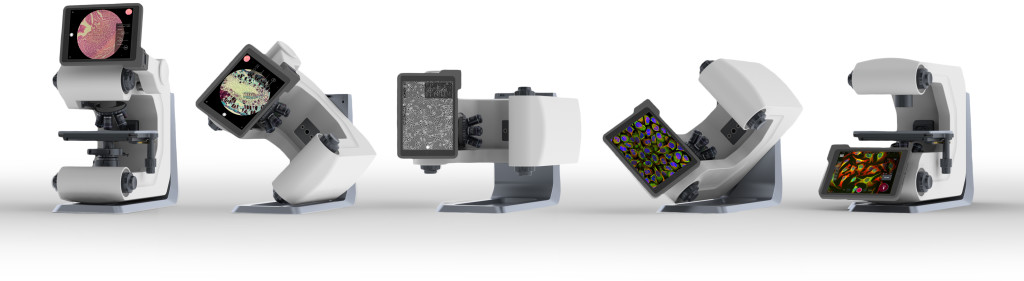 I’m happy to introduce the Revolve Hybrid Microscope! A scope that combines both inverted and upright observation into one instrument. I’ve worked in this industry for over a decade, and this is by far the biggest evolution in the idea of a scope I’ve ever seen! I’m so excited to share this with the research community, and I hope you’ll enjoy learning more about it!
The Concept
We all know that uprights and inverts use similar objectives, illuminators, position systems and cameras. Why duplicate all of these expensive components? Can’t we find a way to merge these two systems into one unified instrument? Echo Labs has done just that, with the Revolve.
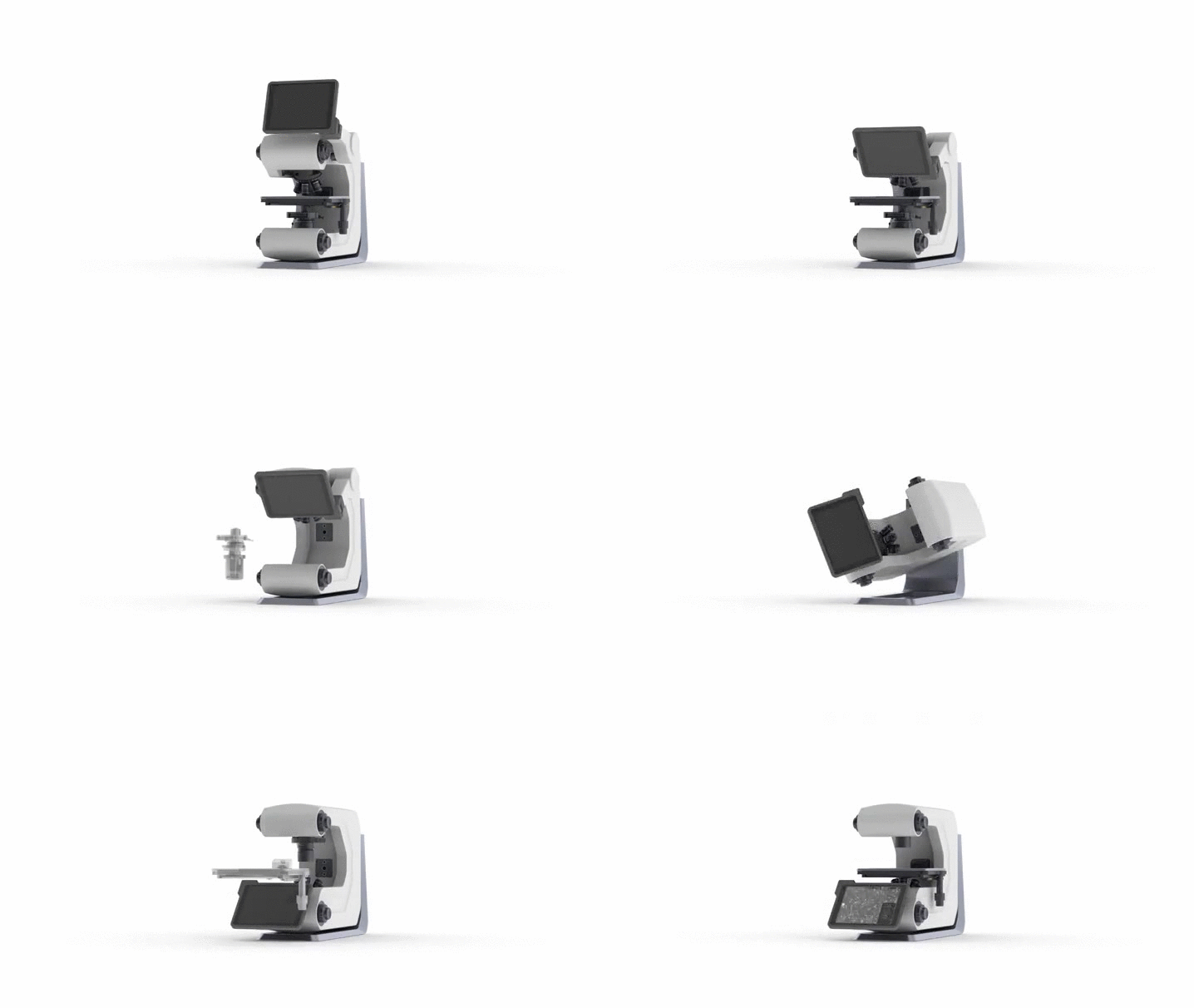
As you can see above, this a completely new way of approaching what a microscope should be! The revolve is two microscopes in one. It provides a fully capable inverted research instrument, AND a fully capable upright microscope, into one device. So the revolve is 2x the microscope at 1x the price, size and maintenance. While the revolve brings so much more capability, it’s also less, in all the ways less can be good. You’ll note the lack of a tower computer. It’s gone! The integrated iPad drives everything inside the scope. No more rat’s nest of wires on your lab bench. Of course, with the iPad, training isn’t required for new users. Both my boys (6 & 7yrs old) got a chance to use the fluorescent side of the app, and were capturing multichannel fluorescence with a few seconds. Using the touchscreen is simple and an easy extension to the other controls on the scope, so the keyboard and mouse won’t be missed. You may also note a lack of wires. In normal marketing pictures microscope manufactures won’t connect all the boxes, so things “look clean”, but the revolve IS clean. Only 1 power wire is required for operation, and all of the other brightfield, and fluorescent components are placed inside the body of the scope! To see these functions live, Echo Labs has produced a great website which includes demonstration videos, at www.echo-labs.com
The Revolve Microscope
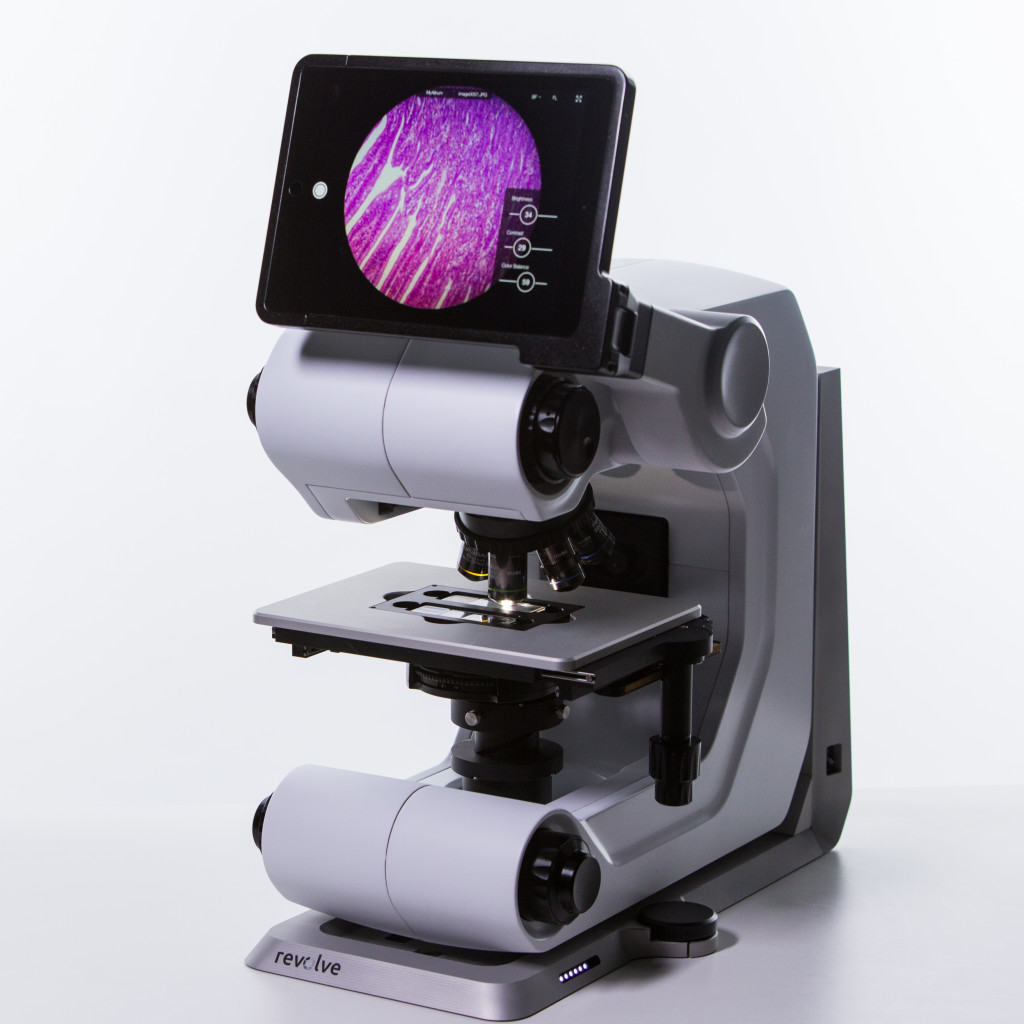
Let’s get right to the specs. This is a compound, infinity-path microscope. Current glass selection includes the entire line of Olympus objectives, with everything from long working distance phase to high NA oil immersion lenses. Both a high NA and long working distance transmitted light condenser are available to support phase and brightfield. The instrument uses the Apple iPad for control, interface, storage and display of images. The body and chassis are designed to be compact, fitting inside a fume hood or a lab bench with shelving installed. A single power supply runs all internal components, so there is only a single power connection required, and aside from that, no other cables need to be connected.
Brightfield
In brightfield mode the iPad camera is optically coupled to the lightpath, providing sharp, color balanced, auto exposed images. Optical coupling is set to provide the full objective field within the iPad camera FOV, with pinch+zoom available should the user want a traditional square view. On-screen controls are provided for color balance, brightness and contrast.
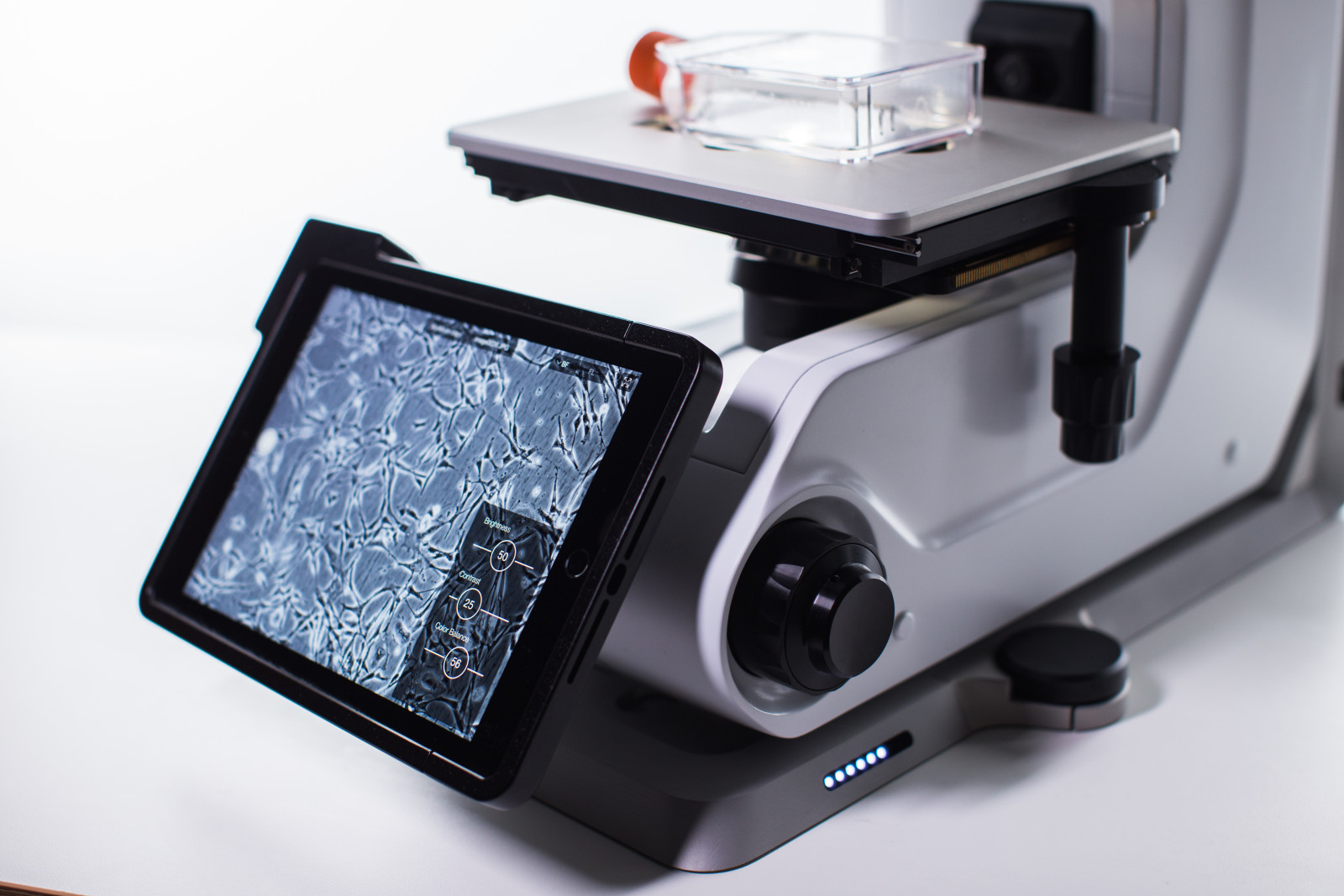
Due to the unique nature of the upright/inverted combination, both high res close working condensers as well as long working distance phase condensers are available. A high accuracy locking mechanism is used to securely hold the condenser assembly in place, while still allowing for easy removal by a single lever.
Fluorescence
In fluorescent mode the Revolve uses a high sensitivity quantitative monochrome camera, which is wirelessly connected to the iPad display, providing a no-latency view when scanning a fluorescent plate or slide. High power discrete LED’s provide fluorescence excitation. Fluorescent wavelengths are specified by “light cube”, with a cube and filter block set provided for popular fluorescent excitation/emission spectra.
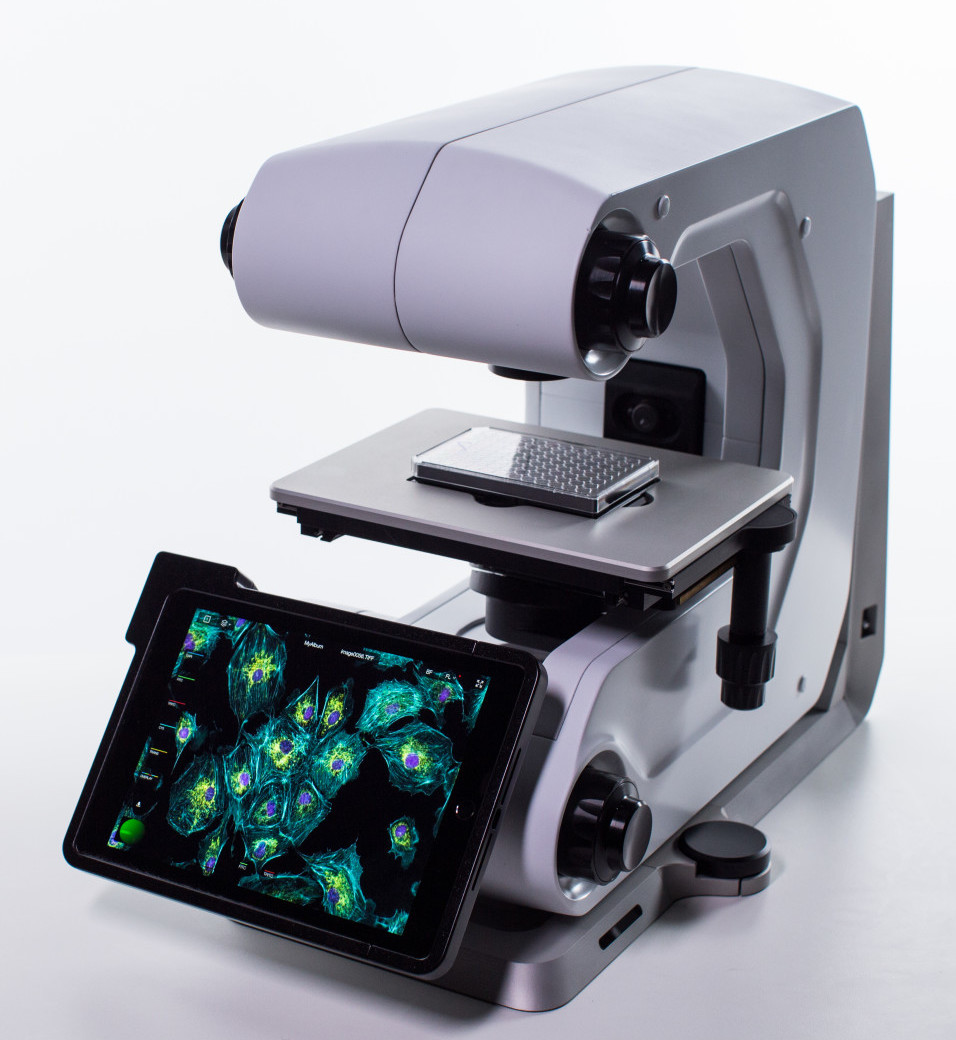
The user interface for fluorescence includes enough control to be useful, but avoids the excessive detail usually found on older imaging programs. You won’t have to worry about parallel shift voltage settings, or pre/post sensor clearing options just to snap an image! On-image display scaling, a simple high/low gain selection, and attenuation control are easily controlled. The physical knob on the right side of the microscope controls the current fluorescent channel in parallel with the app, providing a bidirectional link for the user’s preferred mode of operation.
Mechanical
The body includes a USB hub which can accept common memory sticks, allowing for quick USB transfer of images obtained by the iPad app. The engineers spent an extensive amount of time working on the question of “what do we do with the images on the iPad?”. This is an important question for every microscope, yet it never seems to be completely addressed. How many times have you realized images you captured simply were lost, because someone deleted them from your scope’s hard drive! With the Revolve you can save your images almost anywhere: USB, AirDrop, DropBox, with more cloud options coming soon. Or, just take your iPad….and walk away!
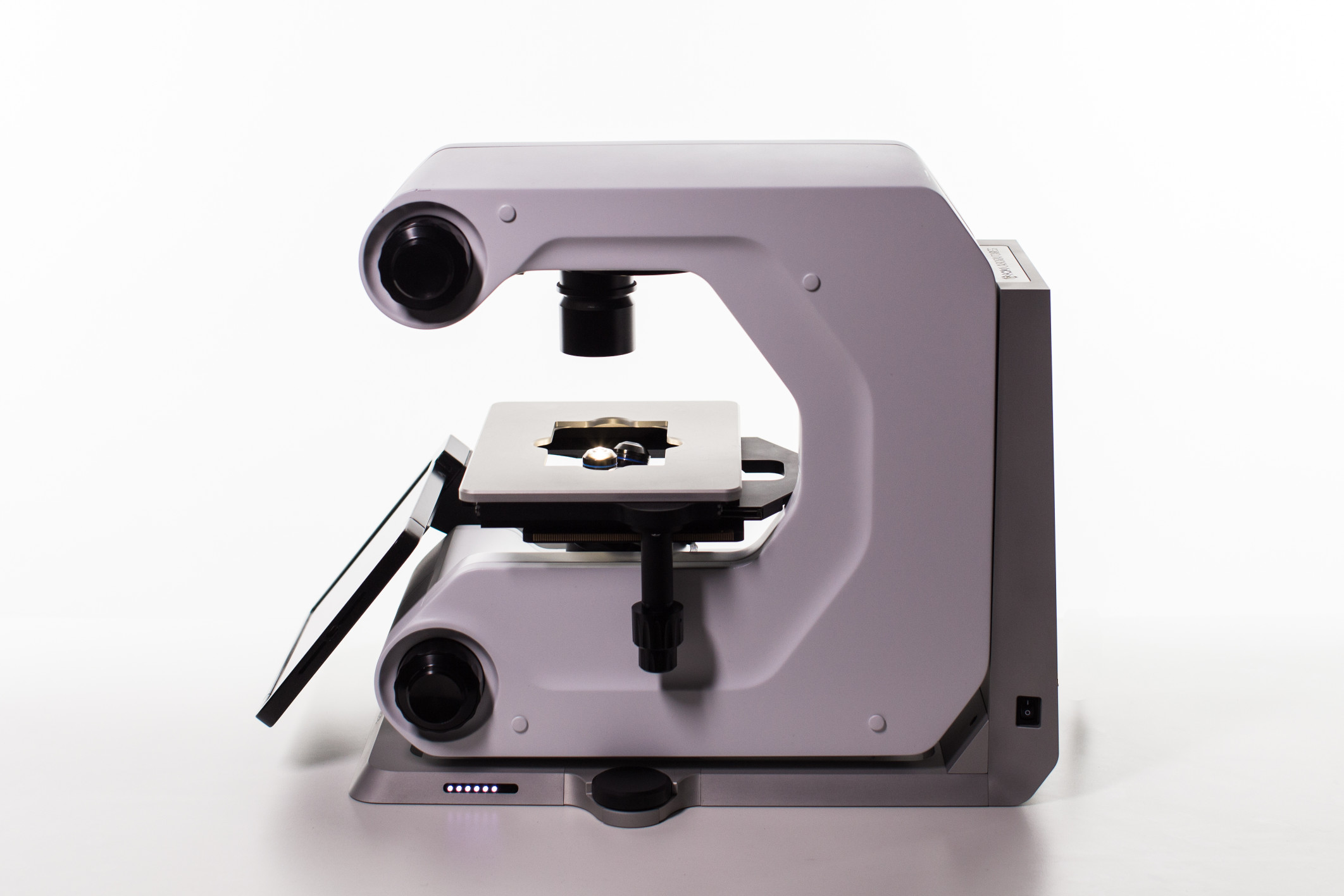
The focus mechanism is duplicated for easy access in either upright or inverted configuration, providing a common coarse/fine knob adjustment. X/Y adjustment is provided by dual knob control placed close to the user’s hand. The stage is locked into the microscope with a secure, but easily removable cam lock and alignment pins. This makes removal of the stage easy for revolving the scope, but keeps the stage securely in place when in use. Check out this video for an example of each of the above functions!
Conclusion
During my time working with the Echo Labs team, I’ve seen the attention to detail put into the user-focused features of this microscope. My previous posts have hopefully allowed a sense of understanding as to why I am so excited to work with this team! This company is a completely new approach to an old industry. The management team consists of veterans in the microscopy industry with a passion for high end imaging. The engineers are an amazing cadre with broad experience in the music, medical, defense, and research industries. Watching this team put the combined skill and experience into this microscope has been simply incredible. I hope you get a chance to experience using this microscope, as you’ll never look at scopes the same way again! Of course, in keeping with the idea of a new-generation company, you don’t need to talk with anyone just to check out pricing, an online and interactive quote configurator is available, which allows you to easily build the revolve for your work.
I believe Echo labs is well on the way to completely changing the microscopy industry. The Revolve is only the first step in bringing easy to use, fair price research instruments into the lab. Welcome to the Revolution.
-Austin Blanco
Hybridization in Three Dimensions: A Novel Route toward Plasmonic Metamolecules

Commercializing plasmonics
Nature Photonics 9, 477 (2015). doi:10.1038/nphoton.2015.149
Bringing plasmonics out of the lab is important. University support and communication between researchers and industry play a vital role.
Countdown to a Revolution in Microscopy – Day 5
One of the first known microscopes by Zacharias Jansen.
The foundational design of the compound microscope has, in many ways, remained locked in place for the 450 years of it’s existence. Combining an objective, eyepiece, and illuminator to provide a magnified view of a specimen has drastically improved. The illumination, staging, detection, optical design, and contrast methods have all evolved by leaps and bounds today. Super resolution will likely become the new normal in the next 10 years. But for all of this improvement, some of the basic limitations of the microscope remain locked in place. A further limitation is placed on development by the same names in the industry. Big name instrument manufacturers, with entrenched, slow, and top-heavy R&D divisions aren’t really set up to upset things, but instead to make small improvements over time. Sometimes it takes fresh eyes, a new way of seeing things, a new generation of builders, to break free of this incremental development cycle, to find a different way of solving the age old limitations we find in todays’ instruments.

Guess what this is :-)
Over the past year, I’ve been privileged to find an amazing group of young entrepreneurs, who have tirelessly worked to bring a new microscope to life. I’ve been even more honored to play a small part along the way. I’ve been chomping at the bit to share the story of this group. I’ve watched as they struggled to solve extremely difficult problems. I’ve looked into eyes not seen since I was a young grunt in the infantry, the eyes of a man who hasn’t slept in days, fighting to figure out the answer to a seemingly unanswerable question. I’ve watched as we walked through success, through failure, through disappointment, watching as one man’s imagination was brought into reality, watching as each person contributed to make something bigger, better, than any of us could imagine.
On August 1, the company will announce it’s product, and I’ll be able to tell more of the story. For today, I just want to ask a series of questions, which I plan to further explore in the days leading up to release.
- What can’t your microscope do?
- Does the instrument you use today reflect an embodiment of available consumer-grade technology?
- What is “ease of use”, how can such a phrase be quantified?
- Is faster, bigger, heavier, stronger, always better?
- Asking a tough question on mature markets and the voice of the customer.
I hope you’ll stay with me for the week. All I can promise is that will be worth the wait. I hope to at least provide an explanation on why I believe this group is on the right track, and why it’ll turn the microscopy industry on it’s head…..literally.
-Austin
Progress toward high-Q perfect absorption: A Fano antilaser. (arXiv:1507.05712v1 [physics.optics])
Here we propose a route to the high-Q perfect absorption of light by introducing the concept of a Fano anti-laser. Based on the drastic spectral variation of the optical phase in a Fano-resonant system, a spectral singularity for scatter-free perfect absorption can be achieved with an order of magnitude smaller material loss. By applying temporal coupled mode theory to a Fano-resonant waveguide platform, we reveal that the required material loss and following absorption Q-factor are ultimately determined by the degree of Fano spectral asymmetry. The feasibility of the Fano anti-laser is confirmed using a photonic crystal platform, to demonstrate spatio-spectrally selective heating. Our results utilizing the phase-dependent control of device bandwidths derive a counterintuitive realization of high-Q perfect conversion of light into internal energy, and thus pave the way for a new regime of absorption-based devices, including switches, sensors, thermal imaging, and opto-thermal emitters.
Vendesi pianeta abitabile (forse)
 |
| Venere. Bello è bello, ma non ci vivrei. |
Il fatto che sia dello stesso ordine di grandezza della Terra e di Venere (in realtà è il 60% più grosso), e più o meno alla stessa distanza dal suo Sole che hanno la Terra e Venere, ci fa pensare che possa essere un luogo simile alla Terra. Ma non c'è motivo per cui non pensare che sia invece più simile a Venere. E questo alla Nasa ovviamente lo sanno.
E allora perché tanta enfasi su una scoperta appena un po' più interessante di altre che passano sotto silenzio? L'anno scorso sono stati scoperti un migliaio di esoplaneti (pianeti che girano intorno ad altre stelle). A questo punto la notizia è che tra i più di 4000 che conosciamo non si fosse trovato ancora un pianeta vagamente simile alla Terra per raggio e distanza dal suo sole. Anche Kepler non è poi così simile, ma fin qui è il meglio che abbiamo trovato. A 1400 anni luce di distanza. La gente poi guarda i tg, legge Focus, vede le rappresentazioni artistiche con isole e oceani e si convince che noi possiamo sul serio dare un'occhiata a com'è fatto - noi che siamo appena riusciti a fare una foto a Plutone, con una sonda partita nove anni fa. C'è questa idea popolare per cui gli scienziati possono scoprire tutto, se si impegnano.
E invece le tecnologie necessarie per assicurarsi che Keplero sia non dico abitato, ma un po' più simile alla Terra che Venere potrebbero essere fuori della nostra portata. Quello che abbiamo scoperto di Keplero potrebbe essere tutto quello sapremo mai su Keplero. E allora perché la Nasa ha voluto creare un evento (riuscendoci benissimo)?
Perché ci conosce.
Molto più di quanto conoscerà mai Keplero.

Io sono convinto che la NASA sia una delle cose più incredibili mai esistite sul pianeta Terra, un orgoglio per gli americani e per l'umanità. Ma è pur sempre una cosa umana, che va avanti grazie alla sua capacità di convincere altri umani a interessarsi di lei e finanziarla. I generali fanno quel che possono per convincerci che siamo minacciati da forze esterne e interne; gli astronauti ci mostrano immagini artistiche di pianeti che sembrano foto e ci fanno venir voglia di saperne di più. È marketing, nessuno ne è immune (su questo sistema solare, almeno).

A settembre molti studenti (e studentesse!) mi domanderanno quando sarà possibile trasferirsi su Keplero; se i nativi saranno simpatici e il clima un po' più fresco. Pazientemente dovrò spiegare che il Keplero percepito dagli strumenti della Nasa è appena un punticino, una variazioncina minima nelle misurazioni della sua stella, che un immenso cannocchiale ha percepito 1400 anni dopo che la stella le ha emesse. Ammesso che non sia un pianeta tossico come Venere; che abbia qualche forma di vita simile alla nostra (con muscoli più robusti, vista la gravità maggiore), se volessimo comunicare qualcosa di molto semplice (PUNTO-PUNTO-PUNTO-PUNTO), la risposta ci arriverebbe tra 2800 anni (LA-VOLETE-PIANTARE-DI-ACCENDERE-E-SPEGNERE-LA-LUCE? È-FASTIDIOSO). Riuscire a conservare una civiltà organizzata per tutto questo tempo è un'altra impresa forse al di sopra delle nostre forze - benché sia necessario tentare.

Coherent backscattering reveals the Anderson transition
S. Ghosh, D. Delande, C. Miniatura, N. Cherroret
arXiv 1506.08116 (2015)
Cooperative emission of a pulse train in an optically thick scattering medium
C.C. Kwong, T. Yang, D. Delande, R. Pierrat, D. Wilkowski
arXiv 1504.05077 (2015)
Lasing within Live Cells Containing Intracellular Optical Microresonators for Barcode-Type Cell Tagging and Tracking

Mode Profiling of Semiconductor Nanowire Lasers

Scalable Integration of Long-Lived Quantum Memories into a Photonic Circuit
Author(s): Sara L. Mouradian, Tim Schröder, Carl B. Poitras, Luozhou Li, Jordan Goldstein, Edward H. Chen, Michael Walsh, Jaime Cardenas, Matthew L. Markham, Daniel J. Twitchen, Michal Lipson, and Dirk Englund
Quantum networks built out of distinct quantum bits (qubits) connected via photons may enable quantum computation and long-distance communication. The high yield integration of high-quality solid-state qubits into an on-chip photonic circuit could provide a stable and scalable architecture to build such a network.

[Phys. Rev. X 5, 031009] Published Tue Jul 21, 2015