Shared posts

17 Jul 22:12

The Sociology of Jack Vance III: Robust Action Among the Breakness Wizards

by Henry

The Languages of Pao is occasionally discussed as an example (along with 1984) of the Sapir-Whorf hypothesis in fiction. The imagination of the people of Pao is limited by their language, which enforces a culture of passivity and fatalism under all except the most extraordinary of circumstances. When their Panarch (under the tutelage of the Breakness ‘wizards,’ none of whose powers are supernatural) introduces new, artificially crafted languages to selected groups within this population, he is able to create new dynamic warrior, mercantile and technocratic elites, to his ultimate undoing. None of this need detain us; the philosophical discussion is no more and no less than one might expect of a highly intelligent pulp writer in the 1950s. Far more interesting is the guiding wisdom of the Breakness wizards themselves.

The wizard Palafox’s characteristic tactic is of “subtle diversion, the channeling of opposing energy into complicated paths.” He never speaks as to his final goals, in part because he has no fixed objectives, in part because clearly outlining them might commit him to a definitive course of action, to his ultimate disadvantage. Instead, he maneuvers others to take actions for which they are liable to suffer the consequences should matters not dispose of themselves as anticipated. When the frustrated hero of the book presses him to reveal his motivations, his answers are telling.

“What are your interests, then?” cried Beran. “What do you hope to achieve?”

“On Breakness,” said Palafox softly, those are questions which one never asks.”

Beran was silent for a moment. Then he turned away, exclaiming bitterly, “Why did you bring me here? Why did you sponsor me at the Institute?”

Palafox, the basic conflict now defined, relaxed and sat at his ease. “Where is the mystery? The able strategist provides himself with as many tools and procedures as possible. Your function was to serve as a lever against Bustamonte, if the need should arise.”

“And now I am no further use to you?”

Palafox shrugged. “I am no seer – I cannot read the future.”

There is a startling resemblance between Palafox’s particular approach to strategy, and Cosimo de Medici’s “robust action,” as described in John Padgett and Christopher Ansell’s classic article. In Padgett and Ansell’s description.

We use the term “robust action” to refer to Cosimo’s style of control. The key to understanding Cosimo’s sphinxlike character … is multivocality – the fact that single actions can be interpreted coherently from multiple perspectives simultaneously, the fact that single actions can be moves in many games at once, and the fact that public and private motivations cannot be parsed. … The “only” point of this, from the perspective of ego, is flexible opportunism – maintaining discretionary options across unforseeable futures in the face of hostile attempts by others to narrow those options.

Crucial for maintaining discretion is not to pursue any specific goals. For in nasty strategic games, like Florence or like chess, positional play is the maneuvering of opponents into the forced clarification of their (but not your) tactical lines of action. Locked in commitment to lines of action, and thence to goals, is the product not of individual choice but at least as much of thers’ successful “ecological control” over you. Victory, in Florence, in chess, or in go means locking in others, but not yourself, to goal-oriented sequences of strategic play that become predictable thereby.

Compare this with how another Breakness wizard, Palafox’s son Finisterle, justifies his decision not to reveal that Beran is creating a hidden second identity so as to return to Pao.

“You must know I am here as a ward of Lord Palafox.”

“Oh indeed. But I have no mandate to guard his interests. Even,” he added delicately, “if I desired to do so.”

Beran looked his surprise. Finisterle went on in a soft voice. “You are Paonese; you do not understand us of Breakness. We are total individuals – each has his own private goal. The Paonese word “cooperation” has no counterpart on Breakness. How would I advance myself by monitoring your case to Sire Palafox? Such an act is irreversible. I commit myself without perceptible advantage. If I say nothing, I have alternate channels always open.

It is worth noting that the particular egoism of the Breakness wizards cannot be maintained indefinitely. At a certain point they become ‘emeritus’ – they are no longer able to perceive the difference between their own schemes, and the world that they hope to impose those schemes upon, and are plunged into insanity.

Even so, there are societies that resemble the world of the Medicis and of the Breakness wizards. The Sicilian mafia (which is arguably a relict of once-common feudal social relations) provides several very nice illustrations (I draw here from the relevant chapter of my book on trust ). Just as among the Breakness wizards, one does not ask direct questions about goals and motivations. In the words of the prominent mafioso Tomasso Buscetta (my translation):

The family head informs, when he does it [at all], only those members of the family whom he considers worthy of receiving his confidences, and only to the extent that it seems appropriate. To give you an example, it is necessary to point out that one never asks questions of one’s interlocutor in relationships between men of honor because this is seen as the sign of a regrettable curiosity and can be interpreted in unfortunate ways.

As pentito Salvatore Contorno puts it (also my translation):

This is neither an obligation to speak, nor to answer anything except questions from one’s own bosses; on the other hand, it is necessary not to be curious, or to ask about things where one doesn’t have an interest.

Here too, these are “questions one never asks” – information about individuals’ goals can be used to trap them. The result is that the world of the mafioso is one, where as Diego Gambetta puts it, “mafiosi scrutinize every sentence uttered by other mafiosi, searching for potential ambiguities, oblique messages, or subtle traps.”

Contorno, when he describes a funeral enconium by the Corleonesi boss Riina to Contorno’s brother, whom Riina had ordered murdered, describes the consequences of all this simulation and dissimulation for those caught up in it.

It was difficult to tell whether … his elevated and noble words were coming from sincere grief … or from the base satisfaction of a victor who has just eliminated a dangerous enemy … It was useless to try to dissect, understand, make sense of it. It’s always like that in the Cosa Nostra: no fact ever has only one meaning.

“Mafia” (the cosa nostra se stesso rather than the occasional pastime of conference going tech-geeks), is considerably nastier than chess, than go, and even than Medici Florence. It is thus unsurprising that its players are particularly disinclined to forgo strategic advantage through any unseemly and unwise garrulity regarding their actual motivations.

Finally, it is worth noting that Padgett and Ansell’s article was published in 1993. Vance’s book first appeared in 1958. This appears, then, to be an example of Vance anticipating later developments in sociological thinking, rather than vice versa.

17 Jul 20:04

You’ve Got Time | Regina Spektor I just started watching...


You’ve Got Time | Regina Spektor

I just started watching Orange is the New Black on Netflix and wow I kinda love it already and I especially love Regina Spektor’s song for the title sequence!!

16 Jul 22:02

Photo


16 Jul 22:01

"Half of jury" wanted to convict Zimmerman, were talked out of it by others

by Rob Beschizza
From The Telegraph: "The juror, who appeared on CNN in silhouette to maintain her anonymity, disclosed how the three were talked out of convicting Mr Zimmerman for killing Trayvon Martin, an unarmed black teenager, during more than 16 hours of deliberations. Her comments will stoke further controversy after she described how jurors found the laws "very confusing" and struggled to follow the judge's instructions."


16 Jul 18:12

In A Rush To Get Killed

by Andrew Sullivan

Researchers studying evacuation strategies presented participants with a computer simulation depicting “a zombie-filled room with two available doorways on opposite sides”:

[T]heir task was to exit the room as fast as possible back to the corridor. During this evacuation phase, the zombies in the room were also attempting to get back out into the corridor. In a baseline condition, the participants showed no preference for either of the exits. However, when stress levels were ratcheted up with a prominent challenge to beat the current fastest time … participants were more likely than in the baseline condition to try to exit via the route they used to enter the room, even though this was the most crowded exit favoured by the majority of the zombies.

The result fits with anecdotal observations from real life emergencies. For instance when the Lowenbrauskeller building in Munich was evacuated in 1973, two people were killed in a crush at the main exit as fleeing occupants ignored eight other signposted exits on route.

“Our approach has revealed what can only be described as nonrational human decision making under the influence of the motivational, potentially stress-inducing, treatment,” said Bode and Codling. “We suggest that in evacuations with higher stress levels evacuees will be more likely to use known exit routes and less able or willing to adapt their route choices, even if this results in longer evacuation times.”


16 Jul 17:54

Surprise!

by Charles Mudede

Daily Mail:

White people who kill black people in 'Stand Your Ground' states are 354 per cent more likely to be found justified in their killing than a white person who kills another white person, according to research.

On Saturday George Zimmerman, 29, was acquitted of second-degree murder and manslaughter in the shooting death of 17-year old-Trayvon Benjamin Martin.

But he was not arrested for 44 days after the February 26, 2012, shooting as police in Sanford insisted that Florida's Stand Your Ground law on self-defence prohibited them from bringing charges - Florida gives people wide latitude to use deadly force if they fear death or bodily harm.

John Roman, an analyst at Urban Institute’s Justice Policy Center, used FBI data for this study.

[ Subscribe to the comments on this story ]

15 Jul 21:47

Broodhollow Book 1 KICKSTARTER!

by Kris

Huge announcement! The Kickstarter for the first Broodhollow book is live right now!

UPDATE (July 16, 2013): You guys are blowing me away right now. I can’t believe we funded so fast and are already knocking out stretch goals. AAAAAA!

I have been working on this for a long time! My objective is to deliver a book to every reward tier – whether it’s a digital copy, a softcover or a limited-edition hardcover. And if we start to hit stretch goals, the better the physical books will look, the more extra content will be included in the books, and the greater the rewards for certain tiers and up!

Real talk: if you have followed my work for the last thirteen years, you know what a huge struggle it’s been for me to find “my baby” — the one project I could pour my heart into. I’ve provided so many varied kinds of entertainment, almost all of them completely free to my audience: comics, stories, music, podcasts, and webseries. It’s been hard for me to look at any one of them and say “this one is really me.” But Broodhollow really does feel like my baby. There’s so much of my thinking in the story, and it’s been so gratifying to see how you’ve taken to it and been so supportive of it — more so than anything I’ve ever been involved with.

Every dollar you back the Kickstarter at not only nets you the promised rewards, but helps me deliver you more Broodhollow, and more of what I do overall. I am so deeply thankful for your readership and your support thus far. Believe me, I know that if it wasn’t for each of you, I wouldn’t be able to do any of this. So back at whatever level you’re ready to, and share the Kickstarter (and of course the story!) with people who you think might enjoy it.

Broodhollow has a long, long way to go before it’s done. This first story is just the beginning.

Thanks for coming with me.

StumbleUponShare

15 Jul 16:13

epicluna: I love passionate people that light that enters their eyes when they start talking about...

epicluna:

I love passionate people

that light that enters their eyes when they start talking about something they love

the little arm gestures they make

the massive smile that slips onto their face when they realise someone’s listening

I just love passionate, enthusiastic people and I wish more people could have something to be passionate about or to express it

14 Jul 16:57

Photo


13 Jul 17:36

snailchimera: alyssabethancourt: toughtink: leupagus: shelike...


snailchimera:

alyssabethancourt:

toughtink:

leupagus:

shelikestowakeupandjustfakeit:

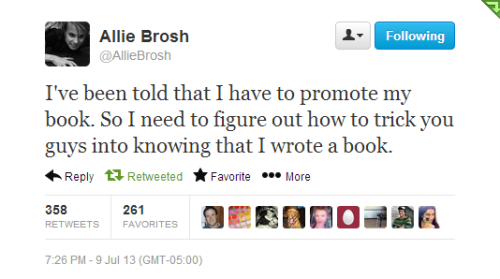
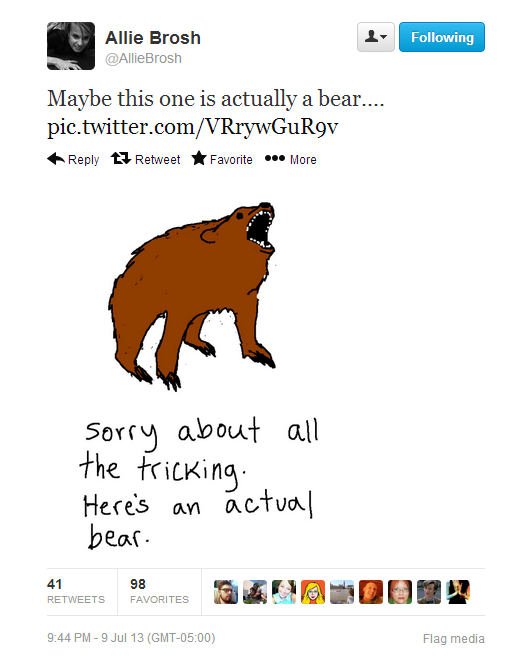
Allie Brosh: actual national treasure

ALLIE BROSH HAS A BOOK COMING OUT???? »>HERE IS A LINK TO PREORDER IT«

Can I just hug her? Please?

13 Jul 17:30

Bebbington, schmebbington: Evangelicals’ politicized animosity to gays and women is not a media invention

by Fred Clark

At the Christian Century, Dennis Sanders echoes Skye Jethani’s contention that evangelical hostility to LGBT people is an exaggeration — a media creation resulting from disproportionate attention given to the loud voices of “politically rabid evangelicals” who “fit the narrative advanced by the news and entertainment media.”

It’s certainly true that we’re not all like that — that all of us white evangelicals are not “politically rabid” right-wingers obsessed with anti-feminist and anti-gay activism. But Jethani’s claim that such evangelical rabidity is nothing more than a “myth” simply doesn’t hold water.

Because some of us are like that. And white evangelicals who are like that are completely secure in their place within the subculture. They get speaking gigs, tenure, book deals and constant affirmation from throughout the larger white evangelical community. Their standing within the tribe is unquestioned, unchallenged and  not “controversial.” But those of us who aren’t like that are, at best, treated as “controversial” and only semi-legitimate members of the tribe. We aren’t usually even allowed to say that we’re part of us.

Just look at the lines drawn here at Patheos. Owen Strachan — a rabidly anti-feminist and anti-gay, politicized culture-warrior — is comfortably welcomed into the evangelical channel. So are David and Nancy French and that poor kid who blogs for the Manhattan Declaration. But John Shore isn’t allowed in that club. Tony Jones keeps getting kicked out and fighting to be reinstated. And even St. Francis Schaeffer’s own kid doesn’t make the cut.

The tribe draws its own boundaries. That’s done by the gatekeepers within the tribe — not by some conspiratorial “narrative advanced by the news and entertainment media.”

Those rabidly political types who claim to represent all of white evangelicalism are allowed to do so. The tribal gatekeepers never refer to Tony Perkins or James Dobson or Pat Robertson as “post-evangelical” conservatives. Yet folks like Brian McLaren or Jay Bakker are routinely classified as no longer legitimate members of the tribe.

The message there is clear: Rabidly political evangelicals who revile LGBT people in the most vicious terms remain welcome in the tribe. Bible-quoting, Jesus-loving evangelicals who refuse to condemn LGBT people have crossed a boundary and are no longer welcome. The news and entertainment media did not create that boundary, the tribal gatekeepers did.

Sure, there are plenty of white evangelicals who aren’t rabidly anti-gay — millions of Very Nice People like those described by Dennis Sanders and Skye Jethani. If folks like that encounter an LGBT person, they will be personable and kind. Very Nice evangelicals like that would happily welcome LGBT people to their table and offer them the shirt off their backs. And as long as those folks — like Ned Flanders, or Ed Stetzer, or Ron Sider, or Skye Jethani — don’t go any further than such Very Niceness, they will be permitted to remain as members of the evangelical tribe in good standing.

But if any of them took another step — arguing that niceness isn’t the same as justice, and that LGBT people ought to be recognized as fully equal members of society and of the church — then they would quickly be branded “controversial,” and be cast into the outer darkness with McLaren, Bakker, Rob Bell and the wretched mainline Protestants.

Jethani’s “it’s a myth” spin can’t account for the aspects of evangelicalism that exist independent of, unnoticed by and unreported on by any of the “news and entertainment media” he wants to blame for them. Consider the angrily anti-gay Defenders of the Authority of Scripture who troll the comment sections of blogs like this one or who fire off hate-mail when Rachel Held Evans endorses unconditional love for gay children. Or consider the casual cruelty that Registered Runaway writes about here, or stories like this one, or experiences like this and like this and like this, or the continuing “mainstream” respectability of venomously hateful publications like Charisma magazine.

Those are all organic aspects of the white evangelical subculture. They are not creations of some outside media narrative.

Or, to put it another way: Here is Jason Micheli’s response to the Supreme Court rulings on marriage equality. Here is James Dobson’s response. One of those men is an evangelical icon, was the subject of a hagiographic Christianity Today cover story, and his books can be found in the homes of millions of white evangelicals. The other is not regarded as an evangelical at all, even though he’d fit any Bebbington-style theological definition anyone would care to use.

Such theological definitions don’t matter. You will never be branded as “controversial” or banished from the evangelical tribe for insufficient biblicism. Or because your enthusiasm for crucicentrism, conversionism or missional activism is regarded as suspect. But if you’re feminist or pro-gay, you’re out. Do not pass Go, do not collect $200.

Bebbington, schmebbington. The tribe defines itself: An evangelical is a white Protestant who opposes legal abortion and homosexuality. Period.

13 Jul 17:17

clitoracy: team-joebama: jadeite-nephrite: mysmorgasboard: ww...


clitoracy:

team-joebama:

jadeite-nephrite:

mysmorgasboard:

www.mysmorgasboard.com

Since my mom literally goes out of her way to not buy organic fruit

The point about strawberries is true as hell. I’ve been doing this for years to prevent mold and it works.

Never knew this. Doing that from now on!

13 Jul 17:07

loscomicos: Even if I had seen ROTG as of now (I’m planning...


loscomicos:

image

Even if I had seen ROTG as of now (I’m planning to!) I would hardly miss the opportunity to draw Walking Dead AU Rocky and Calvin~

image

Maybe cats would be a natural fit for the zombie apocalypse too. =)

13 Jul 16:46

transgalacticwanderer: clitstitsandkittens: boku-no-poltergeist...


transgalacticwanderer:

clitstitsandkittens:

boku-no-poltergeist:

can we stop referring to all sex that could possibly result in pregnancy as “heterosexual reproduction" now

SO TRUE.
And cute.

Yes, true and cute!

13 Jul 16:45

"We must admit that capital has been very successful in hiding our work. It has created a true..."

“We must admit that capital has been very successful in hiding our work. It has created a true masterpiece at the expense of women. By denying housework a wage and transforming it into an act of love, capital has killed many birds with one stone. First of all, it has got a hell of a lot of work for free, and it has made sure that women, far from struggling against it, would seek that work as the best thing in life. At the same time it has disciplined the male worker also, by making his woman dependent on his work and his wage, and trapped him in this discipline by giving him a servant after he himself has done so much serving at the factory, at the office.”

- Silvia Federici - ‘Wages Against Housework’.                (via bustakay)
13 Jul 16:28

When space weather attacks!

by Brad Plumer

On a cool September night in 1859, campers out in Colorado were roused from sleep by a "light so bright that one could easily read common print," as one newspaper described it. Some of them, confused, got up and began making breakfast.

Farther east, thousands of New Yorkers ran out onto their sidewalks to watch the sky glow, ribboned in yellow, white and crimson. Few people had ever seen an aurora that far south — and this one lit up the whole city.

At the time, it was a dazzling display of nature. Yet if the same thing happened today, it would be an utter catastrophe.

The auroras of 1859, known as the "Carrington Event," came after the sun unleashed a large coronal mass ejection, a burst of charged plasma aimed directly at the Earth. When the particles hit our magnetosphere, they triggered an especially fierce geomagnetic storm that lit up the sky and frazzled communication wires around the world. Telegraphs in Philadelphia were spitting out "fantastical and unreadable messages," one paper reported, with some systems unusable for hours.

Today, electric utilities and the insurance industry are grappling with a scary possibility. A solar storm on the scale of that in 1859 would wreak havoc on power grids, pipelines and satellites. In the worst case, it could leave 20 million to 40 million people in the Northeast without power — possibly for years — as utilities struggled to replace thousands of fried transformers stretching from Washington to Boston. Chaos and riots might ensue.

That's not a lurid sci-fi fantasy. It's a sober new assessment by Lloyd's of London, the world's oldest insurance market. The report notes that even a much smaller solar-induced geomagnetic storm in 1989 left 6 million people in Quebec without power for nine hours.

"We're much more dependent on electricity now than we were in 1859," explains Neil Smith, an emerging-risks researcher at Lloyd's and co-author of the report. "The same event today could have a huge financial impact" — which the insurer pegs at up to $2.6 trillion for an especially severe storm. (To put that in context, Hurricane Sandy caused about $68 billion in damage.)

The possibility of apocalypse has piqued scientific interest in solar storms for many years. But researchers are now realizing that periodic space weather can cause all sorts of lesser mischief all the time, such as disorienting GPS satellites or severing contact between polar flights and air-traffic control.

So, in recent years, scores of businesses and government agencies have started to take space weather more seriously. Electric-grid operators are devising plans to reroute currents through their systems to brace for solar storms. Airlines such as Delta have developed plans to reroute flights in the case of emergency. The U.S. military has begun to realize that space-weather blips can disrupt communication in the heat of battle.

But preparing for disruptions isn't easy. Just as interest in space weather is surging, the United States is facing the loss of key monitoring satellites in the coming years, as budget cuts mean that aging systems aren't being replaced. And scientists are rushing to plug worrisome gaps in their knowledge about these storms.

The problem is far from theoretical. Last month, at a conference on space weather held by the National Oceanic and Atmospheric Administration, Daniel N. Baker of the University of Colorado told the audience that the sun had unleashed another large coronal mass ejection in July 2012 that traveled at speeds comparable to the Carrington Event of 1859. It missed the Earth by a week.

"Had that storm occurred a week earlier, it would have been a direct hit," Baker said. "And we'd probably be having a very different conversation about this today."

A year without power?

When it comes to space weather, the foremost concern is what a solar-induced geomagnetic storm might do to electric grids around the world.

At certain points in the sun's cycle, as sunspots appear and flares erupt, the sun will eject part of its outer atmosphere, a cloud of fast-moving charged particles. If one of these coronal mass ejections hits the Earth's magnetic field in just the right way, it can induce strong ground currents that travel through power lines, oil pipelines and telecom cables.

A truly severe geomagnetic storm could create currents powerful enough to overload electric grids and damage a significant number of high-voltage transformers, which can take a long time to repair or replace. That could leave millions without power for months or years.

"That's a key vulnerability," Smith says. "If you had a really big solar event, there just aren't enough replacement transformers available. It can take up to 12 months to build new ones."

As it turns out, most utilities don't keep lots of spares around. The largest transformers, which convert the electricity in high-voltage lines to lower voltages, are custom-built, can cost millions of dollars and weigh up to 400 tons. Procuring a new one is a complex process that involves lining up the necessary copper and steel supplies, working with a long chain of manufacturers and arranging specialized transport. So, the Lloyd's report notes, if even 20 transformers in the Northeast were knocked out, the logistical challenges would be "extremely concerning."

Smith notes that the Northeast, with its aging power grid and peculiar geologic features, is especially at risk. Suffice it to say, it's not fun to think about what would happen to the region if 40 million people had to go without power indefinitely.

Take Pittsburgh: One 2004 study by Carnegie Mellon University found that a large number of the city's services were simply unprepared for an extended blackout. Half the city would lose water after three days if the city's electrical pumps couldn't be revived. Grocery stores, gas stations and cellphone networks would be knocked out. Police stations would go dark. Traffic lights would blink out. Most hospitals have backup systems in place, but emergency rooms would be strained if, say, the air conditioning went out during a hot summer.

"The absence of such fundamental services could lead to major and widespread social unrest, riots and theft," the Lloyd's report warns.

In theory, power utilities could try to take precautions if they had advance notice of a major solar storm headed our way. Using existing satellites, the National Weather Service's Space Weather Prediction Center in Boulder, Colo., can detect an incoming event that's about 30 minutes away.

Grid operators would have to react quickly. For example, PJM Interconnection operates a huge swath of the U.S. power grid from Illinois to the District, serving 60 million people. After receiving a warning, human operators could re-dispatch electricity to reduce the flow of current from west to east. That would minimize the grid's vulnerability to ground currents, Frank Koza, the executive director of operations support at PJM, said at the June space weather conference in Silver Spring.

For a modest solar storm, Koza said, PJM's operators could respond if voltages started to drop anywhere in the system. (Pepco, which delivers electricity to 778,000 homes and businesses in the District and Maryland, is a member of PJM.)

But there's a limit to how much these strategies can help. "The one we're really concerned about is extreme space weather, a Carrington-level event," Koza said. "What would happen in that scenario? I would have to tell you we don't really know."

For bigger storms, there are technologies that could harden the grid, such as capacitors that can help block the flow of ground currents induced by a geomagnetic event. In Quebec, the Canadian government has spent about $1.2 billion on these technologies since the 1989 blackout.

One problem, says Chris Beck of the Electric Infrastructure Security Council, is that many of these technologies are expensive and could make the current grid slightly less efficient in its day-to-day operations.

"We've designed our power lines to work efficiently under perfect conditions — long transmission lines, high voltages," Beck says. Unfortunately, those characteristics make the grid particularly vulnerable to a solar storm. So there's a trade-off.

Recently, the federal government decided to take a more serious look at the issue. Last fall, the Federal Energy Regulatory Commission issued an order that will eventually require grid operators to prepare both operational and technological responses to a space weather event.

Koza said he expects most grid operators to have response plans in the next year or two, but "engineered mitigation" could be another two to four years away.

Insurance companies, meanwhile, are trying to figure out how to get a handle on the risk from a solar storm. Will a major one come around once every 150 years? More often than that? "We're hoping we might one day be able to cover these risks," says Smith of Lloyd's, "but we'll need to be able to quantify them more accurately."

Policymakers have also started getting involved. For a long time, conservatives such as Newt Gingrich were mostly interested in the risks to electric grids posed by a nuclear weapon that exploded in the atmosphere and induced ground currents. In June, Gingrich spoke to members of the Electromagnetic Pulse Caucus in the House, a group of 16 Republicans and two Democrats, about this possibility. "This could be the kind of catastrophe that ends civilization," Gingrich said, "and that's not an exaggeration."

Now that the Cold War has ended, however, many of these Cassandras have switched over to warning about solar storms, which can have a similar effect, albeit on a smaller scale. Rep. Trent Franks (R-Ariz.), a founder of the EMP Caucus, has pushed a bill to protect against both "natural and man-made EMP events." And in public, he tends to put more emphasis on solar storms.

"We're starting to see more awareness there," Beck says, "although we're not quite to the point where we're actually putting solutions in place."

Unknown risks

Setting aside apocalyptic blackouts, solar storms and space weather can create all sorts of hiccups in the global economy that scientists are only beginning to understand.

Case in point: During the Battle of Takur Ghar in Afghanistan in 2002, a U.S. helicopter team was sent in to pick up a team of Navy SEALs. The SEALs sent a message to the helicopter warning the team not to land, but for some reason, it was never received. The helicopter landed under intense fire and four Americans were killed — an event dramatized in Sean Naylor's bestselling account of Operation Anaconda, Not a Good Day to Die .

Some scientists now suspect that space weather could have been to blame for the incident.

At the space weather conference in June, Michael Kelly of the Johns Hopkins University Applied Physics Laboratory presented early evidence that a form of space weather known as "scintillation" can cause disturbances in the ionosphere and disrupt local radio communications. Researchers are working to model this phenomenon more accurately.

Airlines, too, have to take even lesser outbursts from the sun into account. Delta runs a number of commercial flights over the poles, such as routes between Detroit and Beijing and between Atlanta and Tokyo. But if they get a last-minute warning from the Space Weather Prediction Center of a geomagnetic storm, the planes often have to divert their routes away from the poles or risk losing radio contact with the ground. These diversions can cost thousands of dollars, Delta officials noted, so better predictions would help a great deal.

And those concerns only scratch the surface.

Joseph Kunches, a scientist at the Space Weather Prediction Center, says we're still learning about activities that could be disrupted by solar weather. Satellite communications can go astray. Pipelines can corrode from ground currents. Even human space travel faces a threat.

"Radiation is a big issue for space travel — particularly once you get away from the Earth's magnetic field," he says. Astronauts working outside the Earth's protective shield can be particularly vulnerable to bursts of solar radiation, which can have harmful health effects. That means that if we ever want to wander around in space, it would be helpful to have a better grasp of space weather.

"In 1972, there was actually a huge eruption that fortuitously fell between two of the Apollo flights, so the radiation didn't hurt anybody," Kunches says. "But it's a problem."

And there are still plenty of unknowns. Kunches and other experts pointed to the potential impact of solar eruptions on GPS technology. Certain storms could degrade the signal as it makes its way from the satellite to the ground. GPS is built into so much of the modern economy — from navigation to geophysical exploration by oil and gas companies — that any interference with GPS signals could be quite costly.

"I call it the cyber-electric cocoon we've built around the Earth," says Baker, who heads the Laboratory for Atmospheric and Space Physics at the University of Colorado. "There are all these relationships that most people don't even have a clue are there, and we're still trying to understand everything that's at risk."

Satellite fleet may shrink

One big problem that businesses are having in preparing for a space weather attack is that they're still not sure, exactly, what to prepare for. Minor impacts occur fairly often. But when might we expect a Carrington event? Or even something like the Quebec storm in 1989?

"Until we know that, the industry will be limited in its response," said Koza of PJM Interconnection.

And there's plenty more that space scientists are still trying to grasp. It's difficult to predict, for instance, whether a solar outburst will actually create a storm when it hits Earth. A great deal depends on how a coronal mass ejection interacts with other solar winds as it moves toward us. Kunches likens it to knowing that a hurricane is coming, but not being able to measure its barometric pressure.

It would also be helpful to have more spacecraft studying the sun and giving us advance warning of storms. But, if anything, the Earth's alert systems are about to get worse, not better.

Right now, NASA operates four space satellites situated between the Earth and the sun, which together can provide roughly 30 minutes' warning of a major solar eruption. But these satellites are all reaching the end of their planned lives (and fuel tanks), and there's only one replacement satellite scheduled to launch in 2014.

At the space conference in June, various speakers discussed ways to improve our ability to watch the sun. One engineer described fantastical plans for a satellite with a 100-square-meter "solar sail" that would use be steered and pushed by the sun's photons in order to get closer and closer to the star without getting sucked in by gravity. A solar-sail satellite could, in theory, give us twice as much warning to prepare for a space storm.

But so far, these plans are all theoretical. "There's a real need for a truly operational, 24-hour-a-day, seven-day-a-week space weather observatory," Baker says. "But right now, we don't see that coming from policymakers or the agencies that would have to step up."

That means we may have to hope for a bit of luck in the years ahead. Solar activity tends to follow an 11-year cycle, with the most intense events often occurring near the peaks of the solar maximum — which, NASA says, could well arrive in late 2013 and again in 2015, although it's difficult to predict for sure.

That doesn't mean the big one will hit then. For one thing, sunspot activity has been rather muted of late, and the current maximum has been surprisingly weak. But for many experts, it's a good reason to keep the sun in mind.

"We're really on an unknown timeline here," Beck says. "One of these could happen at any time."


13 Jul 16:21

“What If Superheroes Were Psychotic?”

by Andrew Sullivan

That’s the question Amber Frost thinks is posed by the short film above:

In this beautiful, unsettling short film, “The Flying Man,” a powerful Übermensch actually takes it upon himself to be judge, jury, and executioner. Unlike the usual underdog superheroes of comics, where the audience is meant to casually rationalize their operation outside the rule of law, we are left completely chilled as he drops people from dizzying heights to their terrifying deaths with a sadistic resolve. He is in no way the protagonist, or even an anti-hero: he’s a terrorist.


13 Jul 16:20

ninihoho: ninihoho: why did the blond fail her calculus test she had a biology test on the...

ninihoho:

ninihoho:

why did the blond fail her calculus test

she had a biology test on the same day and being that she is a bio major she felt it would be to her interest to put more emphasis on the bio test because she is only taking calc as an advanced elective credit which would not effect her major gpa

13 Jul 16:19

Chosen Family Open Thread

by JenniferP

Yesterday I celebrated WifeDay, a roving holiday where my friend T. and I go to lunch and otherwise love on each other. (Commander Logic and I also have this holiday, we just refer to it in text messages as “Doug’s?” “Doug’s!” until such time as I can create a powerful sausage-shaped beacon to flash in the sky.)

The “Wife” designation comes from when T. and I were roommates during her divorce and my last year of grad school/Darth Vader detox. We were broke and miserable –  ”Ok, we have potatoes, onions, oil and $3.50 in loose change between us. Should we go soup or latkes this time?” – but we took fierce care of each other while respecting the other person’s space and autonomy in a way that I’d really never experienced before in any kind of relationship. One of my funniest memories of that year is the two of us commuting downtown, standing on the Belmont platform and realizing that we were both dressed in black turtlenecks/olive/khaki pants/cat-eye glasses/dark hair in ponytails and carrying camera equipment. When did we turn into cartoon copies of each other? We were both in the sort of “DUDES, UGH” headspace that made the prospect of signing up for “domestic partners” health insurance from her job at the S*bucks and registering for nice dishes seem like a good idea, and somewhere in there we started referring to each other as “Wife.”

Last time my folks came to visit we hung out with Logic and Wife, and my mom expressed marvel that I had such good friends. She isn’t someone who has a lot of close friendships or does much socializing, though she is very close to her sisters, so I said: “I didn’t grow up with sisters, but that doesn’t mean I don’t have sisters. They are to me what Aunt B. and Aunt M. are to you” and the lightbulb went on.

I know many of us are strongly drawn to “chosen family” narratives (I just mainlined a shitload of Fringe* on Netflix for just this reason), and I also know many of us have felt the power of re-defining family in a way that supports and nurtures us as adults or are looking to do that. So I’d love to hear – Who is or would be in your chosen family, if it were yours to choose? Real-life people, fictional characters, qualities you admire and desire and search for = all are welcome.

Moderation Note: I am going to ask very specifically that people keep stories of rape & abuse out of this thread. I don’t want to silence victims, but I also cannot read about these topics right now. To clarify, “my actual family is/was abusive, so I look outside them for love and support…” = TOTALLY OKAY. That is factual and gives context. Elaborating on and describing details of that abusive experience = I really can’t. This is not the thread where we bond over the horrors we’ve survived; this is the thread where we’ve survived them, or soon will have, or believe we’re going to.

Mad love and happy weekend to all of you.

*Totally enjoyable if you just repeat to yourself that “on this show, science is the same thing as magic.”


12 Jul 23:00

Sharknado shows how out of touch Washington really is

by Ezra Klein

Last night, while Syfy's Sharknado was dominating my Twitter feed, I wondered whether the overwhelming online interest would translate into an actual ratings bump for the film. Well, the ratings are in. Sharknado was a bust:

The movie blew up on Twitter last night, giving the impression that everyone with a TV was watching it. "Omg omg OMG #sharknado," Mia Farrow tweeted last night, while Washington Post political reporter Chris Cillizza joked that he was writing an article about how Sharknado would affect the 2016 elections. But were all these people actually watching? According to the Los Angeles Times, Sharknado was watched by only 1 million people, which makes it a bust, even by Syfy standards. Most Syfy originals have an average viewership of 1.5 million people, with some getting twice that.

Dave Weigel draws exactly the right lesson: "Twitter, as read by the pundit/journo class, is a skewed and friendly field of public opinion. What happens on there doesn't necessarily happen anywhere else."

But it's not just Twitter. It's political media in general, of which journo-Twitter is only a particularly virulent subvirus. Stories that obsess Washington for days often fail to leave even the slightest dent in the electorate. And that's a bit of a problem because the reason the political press typically gives for swarming some gaffe or conflict is that it's going to matter in the election. We need that justification. Otherwise, what are we all doing writing article after article about some poor schmo who just phrased a banal point poorly? If it's just a misstatement, it's not a news story. But if it'll move votes, then it is a news story.

In theory, this kind of coverage can become a self-fulfilling prophecy: We say it will move voters, and then we give it a bunch of coverage, and so it moves voters. But actually, that doesn't really happen. Even when we try to get the public to care about some gaffe or conflict, they mostly ignore us. Remember "I like being able to fire people"? Or "Etch a Sketch"? Or "You didn't build that"? None of them moved the polls.

Sharknado is particularly clear example of our short reach. After all, for the public to clearly respond to our coverage of gaffes, they typically have to change opinions they already hold -- some Obama voters need to flip to Romney, or vice versa. That's a high bar to clear. But in this, all they needed to do was turn on SyFy and watch something fun. And they didn't even do that!

As I've written before, the first rule of being a political junkie is to always remember that you are a very weird person, and most people are not like you.

Related, kinda: 28 possible sequels to Sharknado.


12 Jul 22:59

i saw Pacific Rim I spent most of the movie with my feet up on...


i saw Pacific Rim

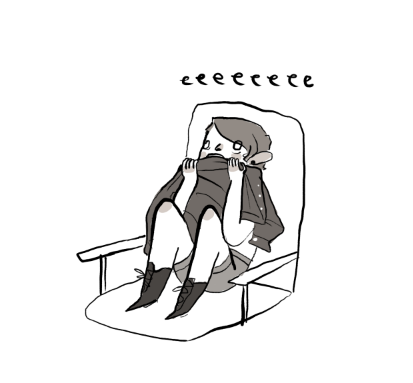
I spent most of the movie with my feet up on the seat, screaming into my jacket

in a good way

like it’s been a while since I’ve been sucked facefirst into a movie and it beat me into a pulp with awesomeness

go see this movie is what I’m saying here

12 Jul 22:51

Good Afternoon, Sharknado News!

by Wm.™ Steven Humphrey

Sharknado inspires more tweets than Game of Thrones' "Red Wedding"—because... DUH.

Behold! Some of Sharknado's best GIFs and Vines!

Sharknado star Ian Ziering shocked by Sharknado success... but not enough to skip his gig at Chippendale's.

Damon Lindelof offers to write Sharknado sequel, Syfy offers to pay him "very little."

Here are some of the best celebrity Sharknado tweets.

Sharknado director Anthony C. Ferrante talks about how Sharknado was made, Sharknado's success, and a Sharknado sequel:

“I mean, what do you do after Sharknado? You’ve got to up the ante. I don’t want to compare this to Star Wars, but if this is Star Wars, then you’ve got to make Empire Strikes Back — whatever version of that Empire Strikes Back is of a Sharknado sequel. Number twos are usually pretty damn good.”

And finally, a senior scientist at NOAA's National Severe Storms Laboratory insists that an actual "Sharknado" is physically impossible. SHUT... UP, STUPID SENIOR SCIENTIST!!

[ Subscribe to the comments on this story ]

12 Jul 20:37

Chromebook a low-end hit

by Rob Beschizza

Just when you thought netbooks were dead, Google's Chromebook has become the "fastest-growing part of the PC industry" in its price range, reports Bloomberg News, quoting market research firm NPD.

Chromebooks have in just the past eight months snagged 20 percent to 25 percent of the U.S. market for laptops that cost less than $300 ... The surge marks Chromebooks as one of the few types of computers able to attract consumers while Dell Inc. and other traditional PC makers undergo a shakeout. The industry has already seen notebook-PC sales eroded by the popularity of smartphones and tablets such as Apple Inc. iPad.

As a fan of tiny computers, I've owned so many terrible netbooks that it isn't even funny. If you're spending in the $300 price range, skip Windows models and instead get a Chromebook or a tablet with a keyboard case. Unless you enjoy tinkering, little else at the low end of personal computing is worth bothering with. [via Daring Fireball, where proprietor John Gruber reports that 0.07% of visits appear to run Chrome OS—at BB, the figure's roaring along at 0.18%]


12 Jul 20:36

Soccer player fatally stabbed, ref decapitated

by David Pescovitz
Happy cartoon soccer ball sticker p217812712319460819z85xz 400During a recent soccer match in Maranhao, Brazil, a referee stabbed and killed a player during a fight after the player refused to leave the field. Continuing this stunning example of good sportsmanship, the spectators proceeded to stone the referee before decapitating him. "One crime will never justify another," said the local police chief. (BBC News)


11 Jul 03:59

crestfallenreaper: damnnlyssa: mericanfootball: This is a...


crestfallenreaper:

damnnlyssa:

mericanfootball:

This is a valuable lesson

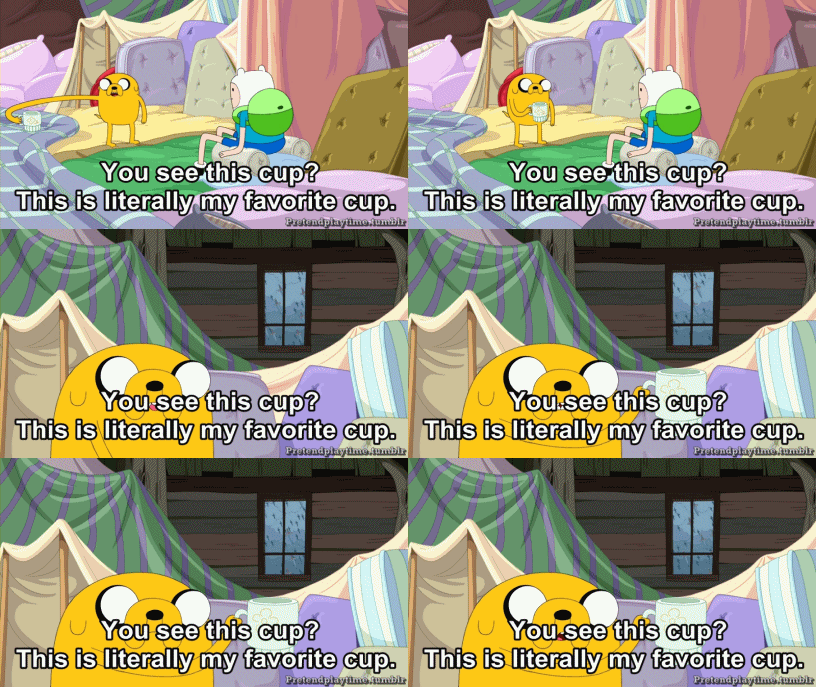
adeventute time helped me get over my last breakup no fuckin joke i shit u not

wise words from jake are very helpful

11 Jul 03:56

‘I sit on a man’s back, choking him …’

by Fred Clark

Here’s Leo Tolstoy describing the difference between nice and good:

I sit on a man’s back, choking him and making him carry me, and yet assure myself and others that I am sorry for him and wish to lighten his load by all means possible … except by getting off his back.

Tolstoy reveals the hypocrisy  – the impossibility — of trying to exert power over someone else while still regarding oneself as a good person. To become a good person — a just or a loving person — in the scenario he describes requires one thing above all else: getting off the man’s back. None of that other business about assuring everyone “that I am sorry for him and wish to lighten his load” matters in the slightest.

But I think Tolstoy also shows us here part of why this is so difficult for the powerful to do. It’s partly that being carried by the labor of others is easier than carrying ourselves, but it’s also the fear that getting off of the man’s back will allow the man to retaliate. Justice demands, before and above anything else, that I get off the man’s back. But I’ve been riding this man and choking him for too long to think of justice as my friend.

I sit on a man’s back, choking him and making him carry me, and therefore justice is to me a terrifying threat. If the world suddenly became a just place, I’d be the first one up against the wall.

In other words, part of the reason that any form of oppression continues is that the oppressor comes to fear the oppressed. That fear, like the guilt the oppressor dimly still feels (“I am sorry for him”) is in some ways quite reasonable. But both of those also, perversely, tend to reinforce the oppressor’s resolve because we humans tend to resent anyone who makes us feel frightened or guilty — to hate those we fear and to hate those we know we have wronged. And that hate makes it easier to continue sitting on the man’s back, choking him and making him carry me.

This fear is related to the inability to imagine any kind of world in which someone isn’t sitting on top of someone else. If I get off this man’s back, then, it must mean that he will get on my back, choking me and making me carry him. It’s a bit of a chicken-and-egg question as to whether the fear comes from this failure of imagination or if the failure of imagination comes from the fear. A bit of both, probably, and either way the end result is the same: a firmer determination never to get off the man’s back.

David Shelton sees this chicken-and-egg problem and tries to address both the fear and the failure of imagination straight-on. This is Shelton’s 10th point in a long, helpful post on “How to Not Be Viewed as a Bigot“:

10) Understand that we’re not you.

What does this mean? Simple. We are not interested in squelching your rights like you have done to us for decades. We’re not interested in preventing you from getting married. We’re not going to pass a law that makes it legal for someone to fire you because you’re Christian. We’re certainly not going to make Christianity illegal. Our agenda is, and always has been for you to stop doing these things to us.

Frankly, you’ve been punching us on the face for years. It’s not an infringement on your rights to say “stop punching them in the face.” Never has been, never will be.

“We’re not you” has to be said, but I’m not confident that the people Shelton is addressing will be capable of believing him. “We’re not interested in squelching your rights like you have done to us,” he writes — identifying precisely the thing they fear. He’s trying to reassure them that retaliation isn’t his goal. He doesn’t want to sit on their back, he just wants them to get off of his.

But the problem with the message of “we’re not you,” is that it’s addressed to people who are, in fact, “you” — to people who can only imagine what they would do if they were in his shoes and thus what he would do in their shoes. It’s projection — the shriveled, diseased remnant of the empathy that none of us can ever be wholly rid of.

“Understand that we’re not you.”

So in their stunted imagination, somebody always has to be sitting on someone else’s back — somebody always has to be punching someone else in the face and somebody always has to be getting punched. The overwrought fears Shelton aims to dissuade — hysterical fears of impending “persecution” in which fundamentalist Christians will be fired or jailed — reveal these folks’ inability to imagine a world without such persecution. They have a zero-sum understanding that says if they stop punching someone else’s face, their face will become the target.

They can’t believe Shelton when he says “We’re not interested in squelching your rights,” because in their view he’s doing exactly that. He’s trying to squelch their “right” to sit on his back, their right to choke him and to make him carry them. (Or, as Sarah Moon says in a metaphor that parallels both Tolstoy and Shelton, to squelch their “right” to stomp on his foot.)

Here’s where I’d love to be able to conclude this post by explaining the magic solution to all of this — sharing my dazzling epiphany as to how to convince such people to overcome their fear and expand their imagination to allow the possibility of a world in which no one needs to be choked and ridden, punched or stomped. But I’m afraid that epiphany still eludes me.

All that I can think to recommend is that we keep saying what David Shelton and Sarah Moon are saying — keep insisting that no one has the right to sit on another’s back and that everyone has the right not to be ridden, not to be punched in the face or stomped on the foot. And perhaps to find some ways, some gestures, to reinforce what we are saying and to demonstrate that liberation can mean something more and something better than what they fear — a mere rearrangement of who sits on whose back.

That latter point is at the heart of the film Invictus, which tells the remarkable story of Nelson Mandela’s shrewd and saintly decision to embrace the Springbok rugby team beloved by white South Africans. In Anthony Peckham’s screenplay, based on the actual events, Mandela notes that his former jailers “treasure” their Springboks:

If we take that away, we lose them. We prove that we are what they feared we would be.

He was looking for ways to affirm the passions and the culture of his former oppressors, and thereby to demonstrate, in some small way, that they could believe him when he said, in effect, “Understand that we’re not you.” It was one small way of demonstrating that power need not always mean power over.

11 Jul 03:55

squidtree: Heather Hudson-Sawtooth Loon


squidtree:

Heather Hudson-Sawtooth Loon

11 Jul 03:55

gotosweep: bugbucket: EBBITS COLLECTION | READ...


gotosweep:

bugbucket:

EBBITS COLLECTION | READ IT (EBBITS)

follow the ebbits man

Wow what a nice selection of strips! Thank u
10 Jul 22:20

kylaiajmaa: I made traditional gender rolls.


kylaiajmaa:

I made traditional gender rolls.

10 Jul 18:09

CNN's ratings-led switch to bad tabloid TV

by Rob Beschizza

As the world burns—massacres in Egypt, civil war in Syria, a train disaster in Canada—CNN occupies itself with inane human interest fluff and wall-to-wall trial coverage delivered by the migrainous Nancy Grace.

Thing is, it's a ratings hit. Jay Rosen says he used to criticize CNN because he cares, but no longer cares at all. Sid Bedingfield puts it more succinctly: is it time to just give up on them?

Next on CNN: Anthony Bourdain shows you how to make Cairo-style coupcakes!

Previously: CNN fakes satellite interview with two anchors in same car lot