Shared posts

21 Jul 19:49

Tumblr, who knows.  How to follow (choose one or more): a) close your eyes, inhale deeply and zero...

Tumblr, who knows. 

How to follow (choose one or more):

a) close your eyes, inhale deeply and zero in on the mingled scent of whale oil, sulphur and chagrin. Once you have identified my distinctive musk, you’ll never lose me. 

b) wear nondescript clothing, stay a block and a half or two cars behind, and don’t draw attention to yourself.

c) place your hands firmly but tenderly on my waist, I will lead you safely hence, my hips don’t lie.

d) stay close to the other Mudokons, we’re getting off this godforsaken farm.

e) shh, kitten, shh, it’s okay, it doesn’t matter, nothing matters. 

11 Jul 04:12

Teach for America's Civil War

Teach for America's Civil War:

"The optimism that singular change agents can overcome poverty" is quite possibly the single most detrimental and dearly held obfuscation of our time and must be challenged with politically informed collective action, like you’re seeing here.

10 Jul 21:09

The Last Cupcake

by Sterling

Had I saved the last cupcake until this very moment
it would be stale,
abused by time, and unable to fulfill
its promise of the softest cream and a quiet explosion melting the tongue like
a kiss.

Lips meeting lips…

Had I saved the last cupcake,the sprinkles would have faded, or fallen
to the floor to be swept up with cocktail straws and losing lottery tickets.

I would not have known the particular scent of vanilla cake as it mingled with that of his neck,
slightly warm.

A sigh , a toast to no one at all…

The last cupcake was all that remained from an anonymous, machine-produced batch.

Feigning innocence, the sweet didn’t mean anything at all–just another piece of indigestible trash–before she picked it up.
She animated it with her smile, with her suggestive walk and a gesture to
follow me.

It took on a life of its own in the moments remaining. The light began to bend
and all the thoughts flashed between them, wishes for parallel worlds and new names and genius and enlightenment and coffee and then there was a half-second of Despair as she raised it to her lips.
But –help them!– they ate cake, and chased it down with vodka
and giggles and the certainty they had done something a little wrong, and brilliant.

She carries a book of poems, and steps on summer cherries on sparkling concrete, remembering…

The last cupcake exists now as a clear
and imperfect piece of my imagination.
At best, it is a memory and no longer precise or unstained by subsequent inspirations and missed assignments,

92.5 % pure.

At worst, a metaphor.

Those are dangerous.

10 Jul 19:38

Apple guilty of ebook price fixing

by Rob Beschizza

From the BBC:

Apple conspired with publishers to fix the price of electronic books, a US judge has ruled. Manhattan Judge Denise Cote said the iPad maker "conspired to restrain trade".

Mat Honan remarks: "Stabbing Apple to stop it from punching Amazon while your local bookstore bleeds out on the pavement."


10 Jul 19:37

Tampa - twisted novel of a sociopathic middle-school teacher [excerpt]

by Mark Frauenfelder
Here's a excerpt of Alissa Nutting's new novel, Tampa.

In Alissa Nutting’s novel Tampa, Celeste Price, a smoldering 26-year-old middle-school teacher in Florida, unrepentantly recounts her elaborate and sociopathically determined seduction of a 14-year-old student.

Celeste has chosen and lured the charmingly modest Jack Patrick into her web. Jack is enthralled and in awe of his eighth-grade teacher, and, most importantly, willing to accept Celeste’s terms for a secret relationship—car rides after dark, rendezvous at Jack’s house while his single father works the late shift, and body-slamming erotic encounters in Celeste’s empty classroom. In slaking her sexual thirst, Celeste Price is remorseless and deviously free of hesitation, a monstress of pure motivation. She deceives everyone, is close to no one, and cares little for anything but her pleasure.

Tampa is a sexually explicit, virtuosically satirical, American Psycho–esque rendering of a monstrously misplaced but undeterrable desire. Laced with black humor and crackling sexualized prose, Alissa Nutting’s Tampa is a grand, seriocomic examination of the want behind student / teacher affairs and a scorching literary debut.

Chapter One

I spent the night before my first day of teaching in an excited loop of hushed masturbation on my side of the mattress, never fallingasleep. To bed I’d worn, in secret, a silk chemise and sheer panties,beneath my robe of course, so that my husband, Ford, wouldn’tpillage me. He always wants to ruin the landscape. I find it hilariousthat peoplethink Ford and I are the perfect couplebased solely onour looks. During his best man’s speech at our wedding reception,Ford’s brother said, “You two are like the his-and-herswinners ofthe genetic lottery.” His voice slurring with noticeable envy, he thenadded that our faces looked Photoshopped. Rather than concludingwith any sort of toast, he simply laid the microphone back down onthe table after this last line and returned to his seat. His date had alazy eye we all politely pretended not to notice.

I should find Ford needlessly attractive; everyone else does. “He’s too good-looking,”

one of my sorority sisters groaned the night after our first double date back in college. “I can’t even look at him without feeling like I’m being punched between my legs.” My real

problem with Ford is actually his age. Ford, like the husbands of most women who marry for money, is far too old. Since I’m twenty-six myself, it’s true that he and I are close peers. But thirty-one is roughly seventeen years past my window of sexual interest.

I suppose in some ways marrying Ford was worth it for the ring alone—it slowed the frenetic pace at which idiot men would hit on me during daily errands. And of course it was a very nice ring. Ford himself is a cop, though his family has a great deal of money. I hoped his wealth might provide me with a distraction, but this backfired—it left me with no unfulfilled urges except the sexual. Just weeks after our wedding, I could feel my screaming libido clawing at the ornately papered walls of our gated suburban home. At dinner I began to sit with my legs clenched painfully together for fear that if I opened them even the slightest bit, it might unleash a shrill wail that would shatter the crystal wineglasses. This didn’t strike me as an irrational belief. The thrum of desire had indeed grown so loud inside me—its electric network toured a constant circuit between my temples, breasts, and thighs—that a moment when lust might be able to operate my labia as a ventriloquist’s dummy and speak aloud seemed inevitable.

All I could think about were the boys I’d soon be teaching. Whether or not it’s the cause, I blame my very first time at fourteen years old in Evan Keller’s basement for imprinting me with a fixed map of arousal—my memory of the event still flows through

my mind in animated Technicolor. I was slightly taller than Evan in a way that made me feel half-god to his mortal: every time we made out I had to bend down to reach his lips. Since he was smaller, he was on top, performing with the determined athleticism of a triple-crown

jockey until his body was covered in sweat. Afterward I’d gone to the bathroom and then called him in; with an expression of melancholy curiosity, as though transfixed at an aquarium, he’d watched the ruins of my hymen drifting in the blue toilet bowl water like it was the last remaining survivor of a once-plentiful species. I’d felt only an elevating aliveness: it seemed like I’d just given birth to the first day of my actual life.

When Evan had a growth spurt a few months later our sexual dynamic changed—I

broke up with him and embarked on a string of repulsive dates with older boys throughout high school before realizing my true attractions lagged several years behind. At university I began throwing myself into classics studies, finding brief solace from my sexual frustrations in texts depicting ancient battles of fervent bloodshed. But my junior year after meeting

Ford, I switched my major to education, and now I was finally set with a job that would allow me to go back to eighth grade permanently.

No, it wouldn’t do to have Ford dipping his fingers in the pie on the eve before my years of student and substitute teaching were about to pay off. That night I’d taken such pains to set myself up perfectly, inside and out, like a model home ready for viewing. My legs, underarms, and pubis had been shaved and then creamed; every lotion applied bore the scent of strawberries. I wanted my body to seem made of readily edible fruit. Instead of having the flavor of something nearly three decades aged, my goal was for the slippery organs of my sex to taste like the near-transparent pink shaving gelée applied to them, for the sandy rouge of my nipples to have the flavor of peach cream complexion scrub. In the hopes that the fragrance would absorb, I covered each of my breasts with a layer of whipped mask and let it sit for ten minutes as I shaved; it hardened like the frosting of a confection and cast my excitement beneath a crisp, thin shell. After I’d razored every inch of body hair, I marveled at the buoyant lake of foam and stubble left in the sink. It made me think of the ice cream punch served at junior high school dances.

Imagine the fun I could soon have chaperoning one! Perhaps I’d even get to waltz with one or two of the more outgoing male students under the guise of fun and frivolity—the

boys who would confidently grab my hand and lead me to the center of the floor, not

realizing until our bodies were pressed that they could smell the pulsing, fragrant wetness just one layer of fabric away beneath my dress. I could subtly push against them, blow their circuitry with the confusion of blithe laughter and small talk funneled into their ear by my moist lips. Of course before I’d say it, I’d look off to the side with an idle stare that suggested nothing was happening, that I hadn’t noticed my pelvic bone ironing across the erect heat inside their rented tuxedo pants. It would require the boy to be an upstanding

sort—the type who wouldn’t be able to convey such a sentence to his mother or father, who would second-guess and recall the moment only in the dark, liquored sleep of his loneliest adult moments: post–business dinner while traveling at some Midwestern Comfort Inn, after he’d called his wife and spoken to his children on the phone and then unwrapped the plastic skin of three or four airplane bottles of bourbon, set his alarm, and allowed himself to sit

upright in bed with one hand squeezing against the growing thickness of his organ and the memory haunting him—had I really said what he thought he heard? Inside the school’s walls no less, amidst the thundering electronic notes of that year’s favorite pop song, a song he’d listened to at his very first job in the mall as he folded display shirts and greeted mothers and children who entered the store—had I really breathed that sentence into his ear? But I felt it,

he’d remind himself, felt my words form in warm air, one sentence whose breathy shape dissipated in seconds, prior to the arrival of understanding or memory. For the rest of his life, part of him would always be on that dance floor, unsure and hungry for clarity. So much so that as an adult in that hotel, he might likely be willing to give up a great deal in exchange for the sense of order that I’d stolen from him, or even to have someone to say to him, It did happen. And I would always know, and he would always be sure, but not certain, that I had drawn the ledge of my pubic bone against the head of his penis, pressed it there like a photograph beneath the plastic velum of an album page cover and whispered that phrase: I want to smell you come in your pants.

The early start time of Jefferson Junior High was one of its main allures: seven thirty a.m. The boys would practically be asleep, their bodies still in various stages of lingering nocturnal arousal. From my desk, I’d be able to watch their exposed hands rubbing across

their pants beneath the tables, their shame and their half-inflated genitals arm-wrestling for control.

A second boon was that I was able to get an extension classroom. These were basically trailers behind the school, but they had doors that locked, and, particularly if the loud window AC unit was running, it was impossible to hear what was going on inside. At

our July faculty meeting in the cafeteria, none of the teachers had wanted to volunteer to take a mobile unit—it meant a farther walk each morning, having to trek inside the school to use the bathroom, running beneath an umbrella to go unlock the door in the rain. But I’d raised my hand, playing star pupil myself, and requested one. “I’m happy to be a team player,” I’d announced, flashing my teeth in a wide grin. A red flush had covered Assistant Principal Rosen’s neck; I’d lowered my face so that the trajectory of my eyes was unmistakably

upon his crotch, then I pressed my lips together, met his gaze, and smiled a knowing smile. Of course the phrase “team player” made you imagine me having group sex, my eyes tried to tell him reassuringly. That isn’t your fault.

“Very kind of you, Celeste,” he’d said, nodding, attempting to write and then dropping his pen, picking it up and nervously clearing his throat.

“It’s like I said,” Janet Feinlog had piped up behind me. Janet, a world history teacher, was balding prematurely; the dark home-dye job she gave her thinning locks only served to more starkly contrast the white expanses of scalp that shone through. Like most

pronounced physical flaws, it did not live in isolation. The compression hose she wore for edema gave her calves and ankles the rippled texture of warped cardboard. “Classrooms should be assigned based on seniority.”

“I agree,” I’d said. “I’m the new kid on the block. It’s only fair.” Then I’d given Janet a practiced smile that she hadn’t returned. Instead she’d taken a yellowed handkerchief out of her purse and coughed in it while looking at me, as though I were a nightmarish figment that would go away if she could simply expel enough phlegm from her lungs.

Having a mobile classroom meant that I could truly make it my own. I’d put up opaque curtains, brought in my favorite perfume and spritzed it onto them, as well as onto the cloth seat of my rolling desk chair. Though I didn’t yet know which of my male eighth-grade English students would be my favorites, I guessed based on name and performed a small act of voodoo, reaching up my dress to the clear ink pad between my legs, wetting my fingertip, and writing their names upon the desks in the first row, hoping by some magic they’d be conjured directly to those seats, their hormones reading the invisible script their eyes couldn’t see. I played with myself behind the desk until I was sore, the chair moistened,

hoping the air had been painted with pheromones that would tell the right pupils everything I wasn’t allowed to verbalize. Straddling the desk’s edge, I allowed my outer lips to hover dangerously close to the sharp wooden corner of its surface before sliding forward and sitting down, the hot bareness between my legs pressing against its cold layer of varnish. Those corners. If I wasn’t careful getting up, they would easily scratch into the flesh of my thigh.

The rectangular desk, which was a heartland expanse of flat wood long enough for me to lie down on, felt somehow symbolic, being entirely smooth yet framed within four sharp points of danger—a reminder not to go out of bounds. Each time I’d visited the classroom in the days preceding the school’s start, I’d lain down upon it and pressed my spine into its wood as I stared up at the unfinished fabrication of the ceiling and opened and closed my legs; from the waist down I moved like I was making a snow angel. When I finally sat up, I intentionally scooted off the edge at an angle so the corner would knick my asshole and give me just a little pain to carry around like a consolation prize as I waited for classes to begin. Each time I’d shut down the chugging window AC unit and go to leave, it felt like I was unplugging the engine powering my fantasies. In the silence that followed, the room reconfigured itself: The imagined tang of pubescent sweat became engulfed by the laminate odor of faux-wood walls. The chalk dust floating inside a beam of sun fell stagnant, its particles petrified bugs in the amber of the light. With the air conditioner on, these flecks had been frantic with motion, racing against the vent like lost cells of skin scouring the room for a host—before leaving I’d always stuck my wet tongue out into that light’s honey, fishing it around in circles, hoping to feel satisfied I’d caught something upon it, even if it was too small to feel.

By five a.m. the morning of our first day at school, anticipation was making me feverish. Running the water for a shower, I lifted one foot up onto the countertop to look between my legs, inspecting my sex until the mirror fogged up and censored it from view. My nails, painted cherry squares that gleamed like red vinyl, scratched one last glimpse from the condensation, five thin streaks I could gaze into like open blinds that gave me a final vista on the damage I’d done throughout the night; my genitals were puffy and swollen. Spread open between my fingers, my labia looked like a splitting heart. I tilted my pelvis and hoisted up on the grounded foot’s tiptoes to get a better view. It was impossible not to feel a sullen panic as their folds closed and tasted only themselves—no fresh, squirming insect of thin adolescent fingers against their cheek. I tried to take relief in the shower’s warm surge of water. Thinking about the boys I was hours away from meeting, the fruity syrup of body wash I slathered across my breasts seemed to ferment to an intoxicating alcohol in the air. I smiled imagining them breathing the fragrance of the green apple shampoo I worked into my blond locks; despite the chemical bitters its scented foam belied, when one frothing swath of hair slid down against my face I had to force it into my mouth and suck. Soon I felt so dizzy that I had to kneel down on the shower floor; I clumsily extracted the showerhead from its holder and guided it between my legs, the same way one would put on an oxygen mask that dropped from the plane’s ceiling due to an ominous change in cabin pressure, feeling nothing

but a frightened hope for survival.

My heart sank when I checked the weather channel before leaving the house: we were due for record-high humidity. I cringed thinking of my makeup feathered and my hair frizzed by the end of the day. As I cursed, Ford sauntered out of the bedroom with a half erection and gave a large, stretching yawn in front of the window facing the sunrise. “Good luck, babe,” he called. “What a beautiful morning!” I slammed the front door on my way out.

Not surprisingly, the temperature inside the faculty lounge was nearly unbearable. We’d gathered at the behest of Principal Deegan, who wasted no time launching into a tepid pep talk. Like all of his public speeches, it heavily relied on the rhetorical device of repeatedly asking Am I right? after every sentence. “Gosh,” Mr. Sellers, the wiry chemistry teacher next to me, muttered, fanning himself. “Like the kids don’t have enough ammo already. Now I have to walk into class with wet armpits.” Janet continued making loud

crunching noises; I assumed she kept eating handfuls of granola, but after a few investigative glances I realized it was actually aspirin.

I wanted to run from the room to my class; the earliest pupils would be gathering there now. There was a vague burning at the spot where my spine connected my neck and head; my whole body yearned with the tincture of possibility. I felt like an optimistic bride the morning of her arranged marriage: I was feasibly about to meet someone who would come to know me in every intimate way. “They are not the enemy,” Principal Deegan stressed; the rest of the teachers erupted in pithy laughter.

“Could’ve fooled me,” Janet barked. A knowing nod of sympathy made Mr. Sellers’s hunched neck begin a series of short, conciliatory parakeet head bobs.

Suddenly, Janet’s eyes were pinning me to the wall. The polite laughter of agreement in the room had softened to background static between Janet’s ears and she’d heard my silence in response to her joke echo forth like a scream; worse yet, she’d picked up my expression—a snide look of unmistakable contempt. Years of teaching junior high had likely bestowed the derision sensor in her hearing with supernatural powers. Upon seeing her stare at me I immediately melted my face into a grin, but she didn’t return it. “Bathroom cigarette monitoring cannot just be an occasional afterthought,” Deegan continued. I watched the clock and pretended to think on his words with contemplation. After thirty seconds I looked back and Janet was still staring at me. When the bell rang she dropped several more aspirins into her mouth like cocktail peanuts but didn’t blink.

Tampa


10 Jul 03:26

kforkoala: What a familiar, friendly logo, right? Truth is,...


kforkoala:

What a familiar, friendly logo, right? Truth is, it’s NOT. This is a warning to artists, freelancers, online sellers, and EVERYONE who uses Paypal at all.

Recently a family member who has been doing freelancing work for several years moved from Finland to Canada. All of his freelancing payments were made through Paypal. At the time when he moved, there were several thousands of dollars left in his Paypal account. To our astonishment, his account was frozen as soon as he tried to transfer money from his new location.  

Paypal explains this simply as: ‘he looked suspicious because he was logging in, and acting from a new location.’ Which is fine, really, we understand that. But how do we un-freeze the money? Short answer: we don’t.

Long answer: due to the fact that his account was connected with a Finnish bank, which was deactivated when he left Finland (for obvious reasons), and his action of attempting to transfer money from a new IP address, all of the money in his Paypal account are now frozen and cannot be accessed. That’s it. The money’s stuck in his account, we can’t transfer it, we can’t withdraw it, we can’t use it.

But what happens to the money, then? Well, since Paypal has terrible custom service (don’t send e-mails, they won’t reply you for weeks, and even then you won’t get anything sorted), I guess whoever owns Paypal will just hope that you give up on the money eventually so they can take it.

The thing is, Paypal doesn’t tell you this is going to happen. Their prime objective, as I understand, is to gain profit. And frankly, they do it through despicable means sometimes. Our family is by no means rich, and who knows when might we need those few thousand dollars frozen in that godforsaken service? Right now, the only thing we can do is to either a) re-open a new bank account in Finland b) go to America and open a bank account there. Either way, things are looking pretty grim.

I know there are a lot of artists and freelancers and people who do business via internet and Paypal here on Tumblr. And I just want to get the word out: IF YOU ARE PLANNING ON MOVING TO ANOTHER COUNTRY IN THE FUTURE, CLOSE YOUR PAYPAL BEFORE YOU GO. And PLEASE, for the love of god, transfer your money out into your bank or something. Whether it’s university, or actually changing citizenship, once you’re settled in another country, your chances of getting to your money in Paypal is slim, it could be frozen, it will be lost.

You CANNOT change your location on your Paypal account. This means if your current location is in Finland, but you are planning on moving to Italy or some other place, you MUST apply for an new account. And PLEASE remember it’s best to deactivate your old account, or at least transfer all the money out before you move.

Remember that Paypal can freeze or block you if they ‘think’, or ‘consider’ you to be suspicious. Since nobody really knows what qualifies as suspicious, Paypal can pretty much freeze anyone. Once that happens, you can kiss goodbye to your hard earned money.

Also, Paypal actually has the following written on their webpage concerning changes in their policies (in this case privacy policies): 

You do not need to do anything to accept the changes as they will automatically come into effect on the above date. Should you decide you do not wish to accept them you can notify us before the above date to close your account(https://www.paypal.com/fi/cgi-bin/?&cmd=_close-account) immediately without incurring any additional charges.

What it basically means is that they can change their policies at any time, and your account will automatically accept them, whether you like it or not, no matter how ridiculous the changes are.

There are many more problems and potential risks when dealing with Paypal, but I won’t cover them since I neither have the experience (thank god), nor the time. But there’s some further reading at the bottom of this post.

I’m sorry this turned out to be such a long rant, but honestly, I am terrified and furious at this ridiculous service. I hope that I made some sense in this rant, and hopefully it will help someone to not fall into the Paypal trap. (Once you’re in, though, nobody can help you). Please reblog and signalboost this. Having someone’s blood money lost like this is the last thing I ever want to see. It’s despicable of Paypal and more people should be aware of this fact.

TL;DR: if you are planning on moving to another country in the future, please transfer your money in Paypal OUT BEFORE YOU LEAVE. If you don’t, that money is as good as dead. Also maybe re-read their terms and conditions and be cautious of Paypal in general.

Further reading: 

http://elliotjaystocks.com/blog/good-riddance-paypal/

http://www.aboutpaypal.org/

10 Jul 03:24

Yes Is The Answer -- essays about progressive rock

by Mark Frauenfelder

My friend Marc Weingarten co-edited a book with Tyson Cornell called Yes Is The Answer (and Other Prog Rock Tales). I haven't read it yet but it sounds excellent:

Progressive rock is maligned and misunderstood. Critics hate it, hipsters scoff at it. Yes Is The Answer is a pointed rebuke to the prog-haters, the first literary anthology devoted to the sub genre. Featuring acclaimed novelists, Rick Moody, Wesley Stace, Seth Greenland, Charles Bock, and Joe Meno, as well as musicians Nathan Larson, and Peter Case, Yes Is The Answer is the first book that dares to thoughtfully reclaim prog-rock as a subject worthy of serious consideration.

Yes Is The Answer (and Other Prog Rock Tales)


09 Jul 23:10

All About the Freedom

by Josh Marshall

It's weird how often the folks with a "passion for freedom" end up being involved in neo-Confederate and white supremacist politics.


09 Jul 23:08

"The Walking Dead meets Breaking Bad" - exclusive excerpt of a Fiend, a new zombie novel

by Mark Frauenfelder
Here an excerpt from Peter Stenson's new zombie novel, Fiend, which was selected as an Amazon Best Book of the Month, for July.

When Chase Daniels first sees the little girl in umbrella socks tearing open the Rottweiler, he's not too concerned. As a longtime meth addict, he’s no stranger to horrifying, drug-fueled hallucinations.

But as he and his fellow junkies soon discover, the little girl is no illusion. The end of the world really has arrived.

The funny thing is, Chase’s life was over long before the apocalypse got here, his existence already reduced to a stinking basement apartment and a filthy mattress and an endless grind of buying and selling and using. He’s lied and cheated and stolen and broken his parents’ hearts a thousand times. And he threw away his only shot at sobriety a long time ago, when he chose the embrace of the drug over the woman he still loves.

And if your life’s already shattered beyond any normal hopes of redemption…well, maybe the end of the world is an opportunity.

Fiend

TUESDAY

1:11 am

Typewriter tells me to make a wish. His voice startles me, our drive nothing but silence after the gas station.

Huh?

He points to the clock. He says, All the same digits.

How can he be making idle talk after what just happened? Make a wish, he says again. I look out of the car and it's so dark and I think about a TV show I saw about what will happen to our world after man dies. How the shrines we've built to money and security and happiness and love will be reduced to rubble in the blink of a geological eye. I know I'm at the precipice of the most important moment of mankind's history -- fuck the invention of the wheel, the happy accident of penicillin, the fungus over Hiroshima, the Internet -- because what's happening right now, it's biblical in scope, the end of fucking days.

I glance at Typewriter. His lips are moving but I can't hear him. Maybe he's making a wish, or praying, same thing really. That the Albino is still alive? That this is all a dream? He mouths the words with a sincerity I haven't seen in him before. And then I think of him as John, not Typewriter, a person, a son, and that's probably it, he's focused on his mother, because that was his moment, her passing, the moment he can't recover from, the moment that puts his lips to glass stem.

Pretty soon 1:11 is going to become 1:12 and it feels important that I make a wish because I'm pretty much out of other options. What comes to mind is KK -- her being alive, holed up in a fortress, with enough food to last years and books to pass the days.

The first time I ever saw her was in the psych ward in the Somali neighborhood of the South Minneapolis ghetto. I wound up in the ward because I'd dropped out of college to smoke scante and finally my parents came to the apartment they paid for after I'd quit answering their calls. They knocked and knocked while I sat in my room with all the shades drawn, trying not to breathe. They called the cops, who didn't think an arrest was in order, just a nice trip to the nuthouse. So there I sat in my scrubs and socks with little treads. I doodled during arts and crafts. That's when KK walked in. Just a wisp of a girl, nothing but sharp angles and a big nose and chopped blond hair, her arms pulled in tight across what little chest she had.

I'm not sure if I believe in love at first sight or any of that shit. But I know that sitting there in a room with half-retarded motherfuckers drooling from their lithium and trazodone, whatever I felt, it was close. Like I had this need to hold her, protect her bones from her parents or drugs or whatever wouldn't let her sleep at night, and I wanted her to think I was funny and sexy and smart and beautiful, just fucking beautiful. Sitting there while the tech introduced us to her, I wanted to be better than I was, not just to fuck this girl, but to be better for her. Guess that's a good enough definition of love.

Her waving really did me in. She kind of brought up her right hand all timid like. Her fingers didn't even move. She looked around the room and then brought her face back down, her bangs shielding her from our predatory stares. But she still looked at me -- two dots of topaz, not precious, but semiprecious.

That night, I started doing pushups. I quit masturbating to visions of the sluts from my recent past. I wanted to be better and I would be for her.

We hit it off, at least as well as any two people connecting in the psych ward can. We laughed sometimes. We rolled our eyes at stupid people. She told me she loved shooting speed and I felt like a fucking loser because I just smoked mine.

Then one day, toward the end of my stay, we stood at the garbage can scraping off our untouched beef Stroganoff, and she told me to meet her in the janitor's closet in ten minutes. I walked down the hall, excited because things were going to work out. I thought about rhyme and reason and about the universe putting me in the position to get to her, KK, my savior, the girl made of birdlike bones with swathes of gauze along her wrists.

I knocked.

She opened the door and there she was among the trash bags and wet mops and bottles of industrial cleaning supplies. She smiled a genuine smile, little kid and bashful. It was hard to do sober, bridge the gap between indecision and decision, but she met me halfway, our lips touching.

I made love until she told me to fuck her.

Afterward, she sat between my legs, her head resting on my raised knee. I was thinking about us working out in the long run. She could go into treatment and we could be sober and together. I was also thinking about my sperm finding a suitable home in her tiny tubes and about the different guys she'd fucked and I told myself to stop, that every dick she'd sucked was only to get her to me.

I buried my face in her hair. It was grapefruit and sleep. My hand was around her arm and she moved it to her wrist. I felt the thick gauze. I wanted to protest, to tell her this made me feel weird inside. She wrapped her fingers around my index finger. My face was buried in her hair and I was huffing her, greedily wanting to remember this moment, and she guided my finger under her gauze bandage. It was the strangest feeling, how tender and moist her fresh wound still was, how much it was raised above the rest of her forearm, and I thought about telling her no, that I could get it dirty, infect it. Then she moaned a little, maybe a gasp, and the warmth and intimacy of touching her most vulnerable moment are what books are written about.

I didn't mean to tell her I loved her.

My finger was still touching her gash when she said, I love you too.

So with the digital clock still reading 1:11, I wish for KK to be safe. But that's not all. I wish for her to be thinking of me, praying that I am safe, needing me, wanting me. I wish that KK and I can live the rest of our lives together, whatever that might mean, just together, to feel the tickle of her nose against my neck.

1:38 am

We park at the end of the dirt drive. I rush out to open up the gate. There's nothing but pine trees. I sprint back to the car and we drive into the Albino's compound. The little log cabin is pitch black inside. This doesn't necessarily mean anything. The Albino is a sort of minimalist, no phone, a woodstove, that kind of thing. But still, I'm not trying to fight his reanimated corpse.

Just hope he cooked a big ol' batch, Typewriter says. For real, I say.

Neither of us cares if he's dead or alive, just that our ounce is there, shrink-wrapped like a package of ground beef.


09 Jul 23:08

Bug-A-Salt: shoot pesky flies with a pinch of table salt

by Cool Tools

[Video Link] I ordered and received my Bug-A-Salt gun late last fall, pretty late in the fly season to really get to put it to serious use. Well, early spring in Western Washington and they are coming back. Over the years I became very proficient with rubber bands, hunting flies and yellow jackets – this takes it to a whole new level.

The Bug-A-Salt doesn’t “cream” the flies, leaves them pretty well intact, but it is quite effective. Non-toxic, environmentally friendly, it is spring powered and doesn’t eat batteries. Just table salt.

The gun has sights, but due to the shot pattern and the height of the sights above the bore for me it is a “point and shoot” proposition. A sheet of aluminum foil taped to the wall works well to pattern the shot, like a patterning board for a shotgun. It lets you see the spread of the salt, and calculate your effective range. I am definitely getting better. It is possible to shoot flies out of the air. There is nothing else like it.

The invention and marketing of this product are a story unto itself. I ordered mine early, when they were setting up for manufacture and was able to follow the trials and tribulations of getting this to market. The exportation to some of the countries they had orders from were amazingly complicated.

This year I switched to Morton Kosher salt and find it works better on flies than the table salt. Last year’s tests on yellow jackets were exciting, but not effective. Maybe with the kosher salt… -- Norm Bolser

Bug-a-Salt $35


09 Jul 23:07

Guns Are Dangerous

by Josh Marshall

Texas man tries to shoot ex-girlfriend, accidentally shoots current girlfriend.


09 Jul 22:58

How We Process Medical Problems

by Andrew Sullivan

Lisa Rosenbaum considers how doctors and patients approach medical decisions, examining the influence of the “affect heuristic,” which is defined as “the role that emotions play in our perceptions of benefit and risk”:

When affect guides our decisions, we are far more sensitive to possibility than to probability. In one experiment, some subjects were asked how much they were willing to pay to avoid a potential loss of twenty dollars; others were asked how much they would pay to avoid a potential electric shock. The people asked about the shock paid about the same amount of money, regardless of whether the probability of receiving it was one per cent or ninety-nine per cent. The responses of people asked about the monetary loss, however, tracked more closely to the associated probabilities. The mere possibility of risk, no matter how small, drives our behavior.

How might this tendency play out in medicine? Take, for instance, the increasing rate of women with breast cancer pursuing prophylactic double mastectomy—most famously, Angelina Jolie. For most women with breast cancer, the risk of later developing breast cancer in the other breast is low, meaning the risks of mastectomy outweigh the benefits. Indeed, a recent survey of women who had undergone prophylactic mastectomy found that some seventy per cent would derive little survival benefit. Nevertheless, ninety per cent of those women reported that they were “very worried” about breast-cancer recurrence. In other words, in the setting of fear, the possibility of recurrence, rather than its actual probability, fuels decisions that, over all, likely cause more harm than good.


09 Jul 17:57

Abusive debt collector hit with record fine

by Rob Beschizza

Intimidation, abuse, deception: everyone knows what debt collectors will do to get paid. But Expert Global Solutions, the world's largest debt collection outfit, somehow managed to earn the biggest fine ever--$3.2m--for harassing and victimizing Americans. From the FTC blog:

In its complaint, the FTC charged that the companies violated the Fair Debt Collection Practices Act and the FTC Act by using tactics such as calling consumers multiple times per day, calling even after being asked to stop, calling early in the morning or late at night, calling consumers’ workplaces despite knowing that the employers prohibited such calls, and leaving phone messages that disclosed the debtor’s name, and the existence of the debt, to third parties. According to the FTC’s complaint, the companies also continued collection efforts without verifying the debt, even after consumers said they did not owe it.


09 Jul 17:14

Blame It On Obamacare

by Andrew Sullivan

Sarah Kliff answers the questions posed by the anti-Obamacare ad above. Waldman sees the ad as evidence that, over the next couple years, Obamacare will be blamed for any and all healthcare problems:

The ad mentions not being able to choose your doctor, which would be bad. If you chose an insurance plan in an exchange established by Obamacare, that plan will probably have a network of doctors from which you have to choose if you want your care paid for, and if your doctor isn’t on it, then you’ve been prevented from choosing your own doctor.

Of course, that isn’t because of Obamacare, it’s because of the way insurance works in America; it’s how it worked before Obamacare, and it’s how it’ll work after Obamacare. But it’s a lot simpler to say, “Now that we’re under Obamacare, I didn’t get to choose my doctor!” And did you know that under Obamacare, medications could come with dangerous side effects? Or that under Obamacare, kids who get shots will cry? Not only that, under Obamacare, you could get cancer and die—even if your doctor wanted to save you. In fact, under Obamacare, we’re all going to die one day. Thanks for all the misery, pain, and death, Obama.


09 Jul 17:10

Narnia: Silenced Stories and Child Activists

by Ana Mardoll
[Content Note: Body Transformation, Genocide, Racism]

Narnia Recap: In which Eustace is turned back into a boy.

Voyage of the Dawn Treader, Chapter 7: How The Adventure Ended

It's Friday as I write this, and I want to thank everyone again for being so schedule-flexible as I deal with stuff. After my food poisoning last week, I took a long rest and also re-watched the Disney version of Voyage of the Dawn Treader and was struck with SO MANY THINGS to say about it, so that was energizing. I'm very much looking forward to finishing out this book if only because then I can talk about Disney for pages.

I've also spent fully 70 hours and 70 dollars trying to pull the Senate filibuster feed into something that can be transcripted and posted on the blog, but I don't have anything to show for that yet, either, and I deeply appreciate everyone being patient with me. Thank you. (Maybe this paragraph will be inaccurate by the time this posts on Tuesday! How wonderful would that be?!)

So where were we? Oh, yes: Eustace is a dragon, and he's wearing Octesian's armlet. Nobody is quite sure what to do with this information yet, but they have decided that Octesian is either dead or the dragon, since a Telmarine lord would sooner part with his homeland than he would with his shiny bling. Remember kids, that riches are fleeting but privilege is forever!

   “Are you the Lord Octesian?” said Lucy to the dragon, and then, when it sadly shook its head, “Are you someone enchanted—someone human, I mean?”
   It nodded violently.
   And then someone said—people disputed afterward whether Lucy or Edmund said it first—"You’re not—not Eustace by any chance?”

Possibly the most disturbing aspect of this entire extended scene is how deeply Eustace comes across as an afterthought to his cousins and crewmates. It's easy to forget this, but the dragon didn't just now show up; he's been on the beach for at least a couple of hours. We know this because Lucy was sleeping when Caspian woke her to tell that a dragon had showed up on the beach, and then "the rest of the night was dreadful" and then they tromped up and started asking the dragon to swear friendship and examining his arm for gold jewelry and probing the jewelry for Telmarine royal crests and asking about various Lost Lords.

Everyone in this scene has had several hours and more than a few lines of dialogue to ask if the FLYING DRAGON has seen and/or eaten Eustace, but no one does. They're more interested in ascertaining the fate of a Lost Lord who, by all probability, could have washed up dead from a shipwreck or starved to death on this island and his armband could have been scavenged years later by this dragon. Remember: the Lost Lords have been gone for almost the full length of Caspian's life -- Wikipedia says that Miraz exiled the lords immediately after killing Caspian IX, and the unofficial Narnia timeline puts that at a little over 15 years ago.

That means that everyone in this scene is more focused on a man who disappeared 15 years ago than they are on a young boy who disappeared 15 hours ago. Whether Lewis or his editors noticed this or not, it's still a pretty major problem, and this throws in sharp relief the various narrative claims that Caspian et. al. would never forget about and/or leave Eustace behind when they're pretty clearly doing precisely that.

Nor does this fact jive with Lewis' little world-building detail that "people disputed afterward" which cousin asked the question first. This doesn't work because the later text will indicate that Lucy was a direct source for the narrator, and you'd think she might remember whether or not she asked this crucial question. But it also doesn't work because it indicates that "people" -- who? not Eustace or the cousins, surely, which would indicate that the crew of the Dawn Treader are supposedly direct sources for the narrator -- talked about this moment. Talked about it enough to dispute who said what. That doesn't work. It can't work.

No one has cared enough about Eustace to talk about his disappearance in the whispered wee morning hours while they worked out what to do about the dragon. No one cared enough about Eustace to ask the dragon about him, about whether the dragon had seen him from the sky or if the dragon would help them look for their missing crewmate so that they could clear off the dragon's island sharpish and get out of his scales forever. So it doesn't stand to any kind of reason that people would care enough about Eustace after this moment to turn The Moment When We All Heard Eustace Was A Dragon into a legendary moment with minor details held in passionate dispute. That only works when the person who is the subject of the Terrible Secret is someone that people cared about beforehand.

And no one on this ship or involved in the creation of this story cared about Eustace, because someone would have brought him up beforehand as more than just an afterthought.

   And Eustace nodded his terrible dragon head and thumped his tail in the sea and everyone skipped back (some of the sailors with ejaculations I will not put down in writing) to avoid the enormous and boiling tears which flowed from his eyes.
   Lucy tried hard to console him and even screwed up her courage to kiss the scaly face, and nearly everyone said “Hard luck” and several assured Eustace that they would all stand by him and many said there was sure to be some way of disenchanting him and they’d have him as right as rain in a day or two. And of course they were all very anxious to hear his story, but he couldn’t speak. More than once in the days that followed he attempted to write it for them on the sand. But this never succeeded. In the first place Eustace (never having read the right books) had no idea how to tell a story straight. And for another thing, the muscles and nerves of the dragon-claws that he had to use had never learned to write and were not built for writing anyway. [...]
   I WNET TO SLEE … RGOS AGRONS I MEAN DRANGONS CAVE CAUSE ITWAS DEAD AND AINING SO HAR … WOKE UP AND COU … GET OFFF MI ARM OH BOTHER …

(If you can, I'd like you to press your ear up against your computer monitor and tell me if you can hear me still screaming FUCK YOUR 'RIGHT BOOKS', C.S. FUCKING LEWIS, because I'm curious as to what kind of distance I'm getting.)

Sometimes I really wonder how someone could be imaginative enough to come up with something like Narnia and yet be so devoid of any kind of real empathy or imagination to wonder what a person or people would do when placed in these situations. The "dragon cave" where Eustace was turned is still there. It didn't vanish into the mists, and it wasn't an illusion that only Eustace saw. (Remember that Caspian et. al. gazed down into the valley and observed the dead dragon from afar.) It's stated the next paragraph down that Eustace has sufficient mastery over his limbs and wings that he can fly all over the island and carry sheep and goats back for the crew to slaughter and store in the ship, so why can he not fly Edmund or Caspian or Lucy down into the valley to examine the dragon cave where his unfortunate transformation took place?

The longer I read Narnia, the more I realize there there's something terribly rotten underlying the whole series, a sort of existential malaise that takes place when living in a world where hardships are explicitly something you're just supposed to endure until Aslan shows up to set it right. Caspian and crew are interested to "hear" Eustace's story, but they have no real thought towards understanding his transformation, nor do they consider ways to fix it. Just as there's no real effort to take off the bracelet and see if that affects Eustace's form, there's similarly no real effort to visit the cave and see if something there can shed light on his predicament. Everyone just takes it as read that being a dragon is just something that Eustace is going to have to endure Because Moral Instruction until Aslan decides he's had enough.

We see this chronic resignation and informational malaise over and over in the series. No one makes a serious attempt (that we know of) to stop the White Witch; even the little underground rebellion (which, for all we know, may have been composed solely of Mr. Tumnus, the Beavers, and that one Robin) is so deeply resigned to their fate that they blithely let one of the Four Children of Prophecy slip out the front door and into the Witch's clutches despite ostensibly being aware that the child had eaten the Witch's enchanted food. The Beavers pretty much outright state that these things happen and that Aslan will just have to sort it out.

Then, too, we see this in Prince Caspian when we see that the Animals implicitly need young Prince Caspian as a rallying point and god-appointed leader, despite the fact that he explicitly adds very little material aid to their cause. He's the child of their enemy and a complete novice at warfare; despite the expected literary conventions, his presence doesn't lend political legitimacy (from the Telmarine point-of-view) to the movement nor does it bring in Telmarine allies to fight alongside the Animals. And since Caspian does not help in the "uniting of two people into one army" sense, the reason for his narratively vital importance becomes problematic: apparently the Animals were just never really serious enough to do something about their genocide until someone showed up to lead them. Caspian comes across like a second-hand Aslan in this situation; not quite the son of god, but close enough to be a valued prophet.

Now we have Eustace, who has been turned into a dragon. Why has he been turned into a dragon? The narrative mumbled something about sleeping on dragon's gold while thinking dragony thoughts, but that doesn't tell us whether anyone else in the crew would have been dragonized in that situation or if Eustace was somehow especially bad or susceptible. How he has been turned into a dragon is equally uncertain: was the bracelet related directly to the transformation, or is it just an unfortunate coincidence slash metaphor-for-sin? The narrative teases us, saying that the crew would like to "hear" Eustace's story (just as we already have!) but can't, yet despite us having heard his story, we have no greater insight into what happened and why. Eustace just is a dragon, afflicted with pain in much the same way that everyone in Narnia is afflicted until Aslan shows up to fix it all.

And truly I worry whether or not this total resignation to the Will of Aslan isn't detrimental to the Narnian practice of empathy in these tales. When one lives in a world where Shit Just Happens, magically or through processes that cannot be described or intellectually penetrated, and when cures and solutions are ultimately-and-always dispensed by the local deity who just shows up when he can be arsed to deal with things, then is there any real point in agitating for change or seeking to understand the plight of others?

When Eustace is a dragon precisely because Aslan wants him to be a dragon, and when he will remain a dragon precisely until Aslan wants him to be a boy again, is empathy anything more than an exercise in pain? No matter how sorry we feel for Eustace, we cannot change his situation because we are not Aslan and we have no sway over Aslan's actions. Similarly, when Edmund is sentenced to ritual murder precisely because Aslan wants him to be sentenced to ritual murder, and when he will remain under the sentence of ritual murder precisely until Aslan decides that he shouldn't be under sentence of ritual murder anymore, can sorrow pierce through the veil of resignation that Narnians have been trained to wear from birth?

In another, better story, the English Children would be agitators for change in this world not because their humanness marks them as true owners over the religious dominion of Narnia, but rather because they came from a world where life isn't dictated by religious fiat, and because they have been cultivated with a spark of defiance against the harmful resignation and passive malaise in these books. In this world, Peter et. al. wouldn't be sent to Aslan by the Beavers, but would instead be urging the Narnians to RISE UP AND DO SOMETHING. "She can't stone us all!" they'd insist to the Narnians. "You can't let your people suffer like this any longer," they'd tell Aslan. And they'd push that god-lion, kicking and mewling, to the gates of the White Witch and tell him to FUCKING RESCUE OUR BROTHER AND SAVE THE WORLD, DAMMIT.

In this story, Eustace wouldn't be silenced by the loss of his vocal cords, because he'd have allies who would fight for his story to be told regardless. Lucy and Edmund would push back against Caspian's religious resignation, would demand that they break out the ropes and rappelling gear and investigate that cave. They'd turn the ship inside out looking for the tools to liberate Eustace's arm from Octesian's brand, and to liberate Eustace's body from the unwelcome transformation that has overtaken him. And Caspian and his men would learn the value of active empathy, of caring SO MUCH about the misfortunes of others that you do what you can to help them. They'd learn that religion isn't the abdication of responsibility or interest, and they'd learn how to become the heroes of their story rather than passive observers of others'.

That still wouldn't make Narnia a perfect story, or even a problem-free one. But I'd much prefer a story about active empathy than one of quiet resignation to the cruel and ineffable will of unknowable gods.

09 Jul 05:30

College degrees

raceandeconomics:

What the fuck is with these ridiculous business specializations for college degrees now?

I’ve been seeing job ads asking for bachelor degrees in Real Estate, Hospitality, Marketing, Tourism (what the fuck?), and a bunch of other bullshit.

It used to be that you would get a basic degree in some Liberal Arts (English, History, etc) or the natural sciences or Business or Econ/Sociology/Psych or something and then you go find a job that suits you. Nigga, what the fuck are kids going to school for MAJORING IN HOSPITALITY. WHAT THE FUCK IS THAT!?

"Welcome to Hotels 101! Today we’re going to talk about tiny shampoo bottles. Should you give your customers 1 or 2 per tenant??"

This is some fuckin on the job training shit, common sense stuff, this isn’t something you fuckin get a DEGREE in. What the honest FUCK!? I really can’t even get behind the general “Business degree". Finance, accounting, economics, those are actual fields. Business is common “I learn this as I go." Financial engineering, financial math, you need a degree for those. What the fuck is Sports Management?? Jimmy Johnson didn’t have a degree in Sports Management

This makes me fucking furious. People need to be going to school and learning science, history, language, art, basic shit to develop your mind so you can go out into society and not be a bag of shit.

so under capitalism this makes a ton of sense — if you read into it with marxist insights

within our system we try to push as much of the production inputs outside of the constant capital as possible in order to increase margins

here is another way of saying that, in less marxy terms

training people on the job costs money, and involves long-term planning (consistent access to capital, which costs money)

so it makes more sense for employers to want to hire employees already specialized into their industry, because essentially they can make a profit off the knowledge brought in by the worker, rather than losing anything to giving it to the worker via training (or investment generally)

this is not actually necessarily efficient, but the market is not efficient, so this does not matter

what matters within the capital system is that someone is making money on the production input (for profit education) and making money on the hiring and working of their employee

edit: one other thing that is critical that i forgot to add is that this puts the pressure on individuals to have access to capital and as we know, counted individually people have very unequal access to capital and this ultimately serves the interests of the capitalist class

so students are put into debt, which forcibly individuates them, whereas a socialist system would collectivize the production input of education giving everyone equal and more efficient access to the capital necessary to be part of the economy

09 Jul 01:21

Photo


09 Jul 01:20

Defining Dopamine

by Andrew Sullivan

Bethany Brookshire gets technical about the neurotransmitter:

[M]any people like to describe a spike in dopamine as “motivation” or “pleasure.” But that’s not quite it. Really, dopamine is signaling feedback for predicted rewards. If you, say, have learned to associate a cue (like a crack pipe) with a hit of crack, you will start getting increases in dopamine in the nucleus accumbens in response to the sight of the pipe, as your brain predicts the reward. But if you then don’t get your hit, well, then dopamine can decrease, and that’s not a good feeling. So you’d think that maybe dopamine predicts reward. But again, it gets more complex. For example, dopamine can increase in the nucleus accumbens in people with post-traumatic stress disorder when they are experiencing heightened vigilance and paranoia. So you might say, in this brain area at least, dopamine isn’t addiction or reward or fear. Instead, it’s what we call salience. Salience is more than attention: It’s a sign of something that needs to be paid attention to, something that stands out. This may be part of the mesolimbic role in attention deficit hyperactivity disorder and also a part of its role in addiction.

But dopamine itself?

It’s not salience. It has far more roles in the brain to play. For example, dopamine plays a big role in starting movement, and the destruction of dopamine neurons in an area of the brain called the substantia nigra is what produces the symptoms of Parkinson’s disease. Dopamine also plays an important role as a hormone, inhibiting prolactin to stop the release of breast milk. Back in the mesolimbic pathway, dopamine can play a role in psychosis, and many antipsychotics for treatment of schizophrenia target dopamine. Dopamine is involved in the frontal cortex in executive functions like attention. In the rest of the body, dopamine is involved in nausea, in kidney function, and in heart function. With all of these wonderful, interesting things that dopamine does, it gets my goat to see dopamine simplified to things like “attention” or “addiction.”

The above trailer is from Awakenings, a film based on the true story of Oliver Sacks’ breakthrough with L-DOPA, a chemical used to increase dopamine concentrations in the treatment of ailments such as Parkinson’s disease and encephalitis lethargica – from which Sacks’ patients “awoke”. Watch the entire film below:


08 Jul 21:14

Oregon just launched the world's most twee Obamacare marketplace

by Sarah Kliff

When Massachusetts launched its health reform efforts in 2006, it turned to one of the state's most venerable institutions: the Red Sox.

It's only fitting, then, that Oregon, a state replete with artists and hipsters, will have local songwriters promote its new health marketplace, Cover Oregon. The first ads, which go live on television Tuesday, seriously could have been pulled straight out of Portlandia:

"We chose to build a strategy to make sure people became aware of the name and to start the conversation," says Mark Ray, creative director at North, the Portland-based ad agency which produced the spots. "We want to help people understand this program is about Oregonians taking care of Oregonians, so that people understand this is a celebration of something that will benefit a lot of people.

Cover Oregon is spending $2.9 million on outreach work between now and October, much of which will go toward airing television spots like this one. Of its paid media budget, 45 percent is earmarked for television and cable spots.


Another television ad, which also launched today, promises to get the word out to "each logger and lawyer and stay-at-home dad."

Cover Oregon is currently weighing whether to advertise on coffee sleeves.


08 Jul 21:04

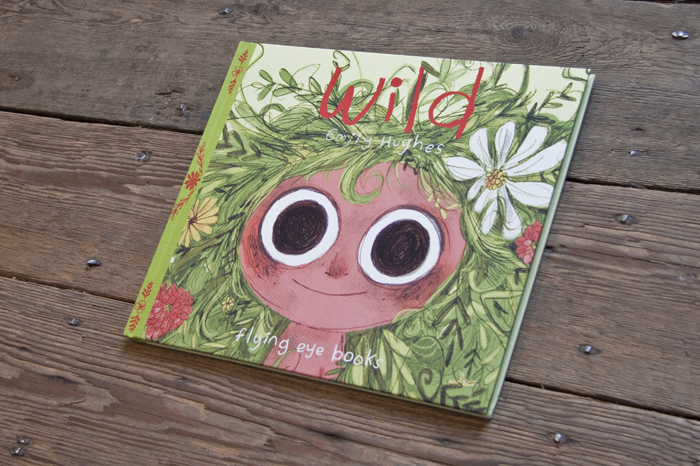
WILD: sweet picture book about a feral child who won't be tamed

by Cory Doctorow


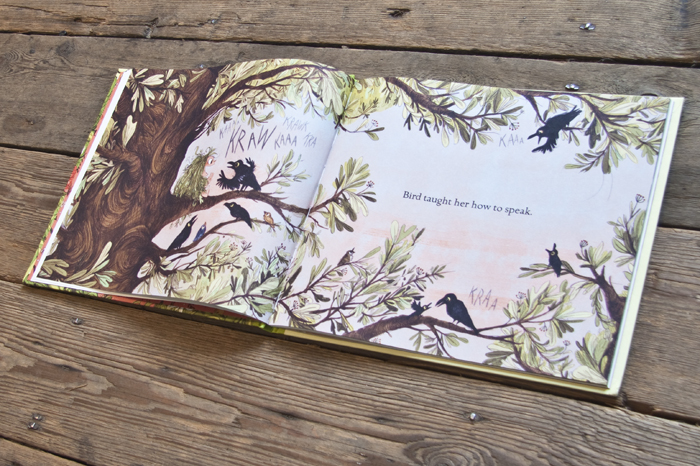
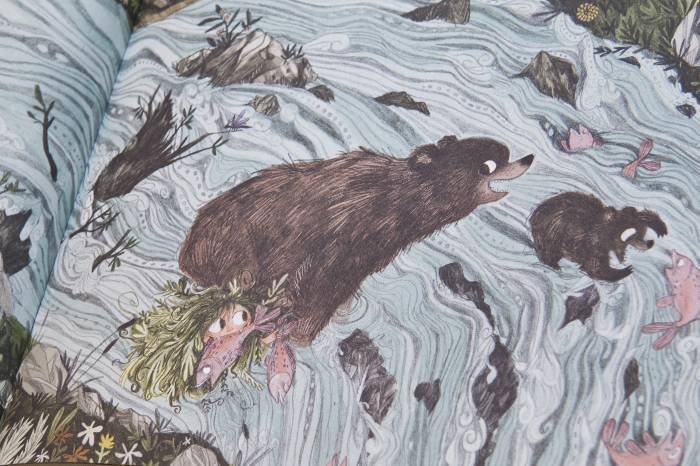
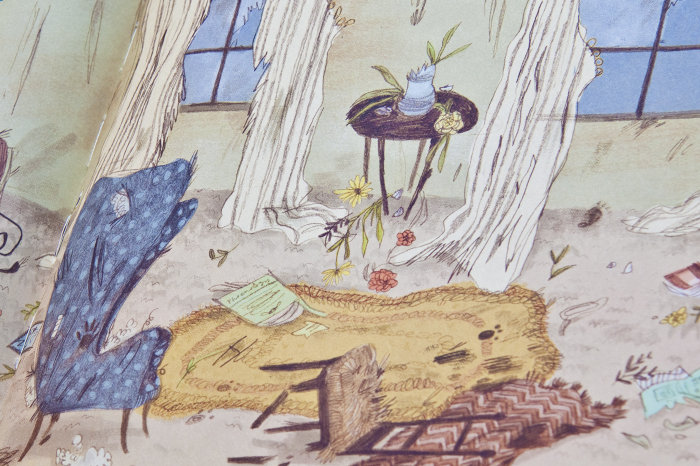
Emily Hughes's Wild is the latest children's picture book from Flying Eye Books, the kids' imprint of London's NoBrow, who are fast becoming my favorite kids' publisher, and are seemingly incapable of publishing a dud. Wild is Hughes's debut book, and it tells the story of a nameless feral girl who is reared by the creatures of the woods. The bird teaches her to talk, the bear teaches her to eat, the fox teaches her to play. She is perfectly happy. But then she is discovered by the family of an eminent psychologist, who brings her home to tame and civilize her. This is a lost cause, and makes everyone -- especially the girl -- miserable. But the story has a happy ending: the girl absolutely destroys her adoptive family's home and escapes back into the woods on the family dog's back, naked as a jaybird and grinning like a fool. Everyone agrees this is for the best.

There's almost no words in this book -- the story is told with lush, expressive, hilarious paintings, often in two-page spreads. My daughter loved every one of them, especially the insane, action-packed ones, like where the girl learned to play from the fox, or where she trashed the civilized house. For all the cheerful anarchy in this, there's no real menace or darkness -- it's as sweetly beautiful and wild as its protagonist.

Wild is out in the UK now, and comes out in the USA on September 10. Visit the Flying Eye site for more art previews.

Wild


08 Jul 21:03

thehammerismyblog: euphrasiefauchelevent: fun fact did you know that extroverts cannot read they...

thehammerismyblog:

euphrasiefauchelevent:

fun fact did you know that extroverts cannot read they can only party. and annoy intelligent and deep introverts with their shallow party talk. this is a true fact. i am a scientist. science.

as extrovert i confirm this.  but only because i was read this by my introvert friend who is also typing for me while i dictate my words over the phone from this hella wild party

08 Jul 21:01

Are You Addicted to Learning?

by Bev Webb

I’ve just taken on some new work, and not surprisingly for a multipotentialite, it’s going to take me off on a bit of a career tangent.

There I was, brimming with excitement as I chatted to a friend about all the juicy details.

“Oooh, I don’t know how you do it,” she exclaimed. “I couldn’t face the idea of having to retrain, especially at our age!”

I have to admit I was totally flabbergasted by her comment, and once I’d had time to pick my jaw up off the floor, I re-ran the conversation in my head. I couldn’t imagine not wanting to change career every few years, and I certainly couldn’t imagine not wanting to keep on learning my whole life.

She’d made it sound as though learning was a chore, something to be avoided unless absolutely necessary, almost as though it was a punishment. Whereas I’ve always thought learning was fun. In fact, I’d so far as to list it as one of my top five, all time favourite activities.

Learning is not just a means to an end

I guess our approach to learning is one of the main differentiators between multipotentialites and specialists.

For many specialists, learning is something they need to do in order to demonstrate their expertise. By studying for a certificate, diploma or degree, they’re able to evidence their competence to undertake tasks within their specialism. The learning is just something they have to do along the way.

We multipotentialites on the other hand, often crave learning and unlike the specialist, it’s rarely for the piece of paper we receive at the end.

Is it the learning experience itself, not the certificate, we’re after?

You’re probably familiar with the heady rush that comes from signing up for a new course and the sense of excitement at what is to come. With eager anticipation each summer, I look forward to the launch of the new course prospectus from my local college. I scour their website in search of new classes to take. Will it be Spanish or Italian this year? Or maybe yoga? Horticulture? Metalwork?

In addition to perusing the evening classes, I probably spend the equivalent of several weeks each year, surfing university websites and pondering whether to sign up for another undergraduate or postgraduate degree.

It’s just for fun you understand, my learning desire’s not part of some grand career plan.

It all stems from a deep rooted desire to learn, and it’s a desire that ignites an internal battle within me: part of me eager to enroll now, whilst another part attempts to rationalise that burning desire. I try to remember I’m in learning “crave” mode, and not to part with my cash until I’ve slept on any decision for at least a few nights.

But these days temptation is everywhere. Have you seen the online, open access courses being offered by the Massive Open Online Courses (MOOCs)?

Where once we were limited by geographic location, a lack of finance, or even social class, now it’s possible to study with some of the world’s greatest universities, and all from the comfort of your very own sofa. You can choose to take modules with US universities such as MIT, Princeton, Stanford and Harvard. With the best part being, it’s totally free! Who’d have thought that’d ever be possible?

As someone based outside the US, I certainly didn’t. I can barely hide my delightment that this educational model has caught on and is going global. Following hot on the heels of the US-based MOOCs, an Australian version has already launched and a new partnership of UK universities (Futurelearn) begins in autumn 2013.

I really feel like I’m a kid in a candy store. I just don’t know which course to choose first

I’m fascinated too, by the wealth of opportunities that this online learning revolution can provide, not just for me, but for people worldwide. Maybe we really are entering a new age of enlightenment, a 21st century learning Renaissance.

If this truly is the age of knowledge, where better for us multipotentialites (or Renaissance Souls as we’re sometimes called) to find ourselves, but at the very heart of a new era of learning?

Now all we’ve got left to do is work out how to balance those intense cravings for learning, with the number of spare hours we have in a day. (And that, as they say, could take some time.)

Over to you!

Do you get learning “cravings”? Have you found a way of managing them, or do you enjoy giving in to them?

bevBev is an artist, creativity coach and founder of Kickass Creatives, a website offering practical support to frustrated creatives. She’s over 20 years of working in the arts: experimenting with everything from performing in a fire circus and managing a hiphop dance company, through to web consultancy and jewellery design. Bev is passionate about using her experience to enable others to fully develop (rather than hide) their multitude of talents too. Connect with her on Twitter @creativekickass.

08 Jul 20:44

Vonnegut, del Toro, and Kaufman Assemble

by Erik Henriksen

It's kind of a running joke how many projects Guillermo del Toro is always attached to—so it goes, he is very excitable—but, uh, via FilmDrunk comes this post on the Playlist about oh, no big deal, just Guillermo del Toro teaming up with Charlie Kaufman to make a new film version of Kurt Vonnegut's Slaughterhouse-Five.

JESUS. That would be... man. Holy shit. Okay. Del Toro!

"Charlie [Kaufman] and I talked for about an hour-and-a-half and came up with a perfect way of doing the book," he told the Daily Telegraph. "I love the idea of the Trafalmadorians [the aliens of Slaughterhouse-Five]—to be 'unstuck in time,' where everything is happening at the same time. And that's what I want to do."

Yeah! Okay! Del Toro, Kaufman, and the Spirit of Vonnegut all coming together to make something awesome is as close to a real-life Avengers team as I can imagine. I've never even bothered seeing the all-but-forgotten 1972 film version—I always just knew in my gut it didn't have a chance of standing next to the book. Something made by del Toro and Kaufman, though? Yeah. Something like that might.

[ Subscribe to the comments on this story ]

08 Jul 03:25

When you meet someone who’s been told they don’t matter, give them a chance to matter

by Fred Clark

I’ve been thinking about this post from Richard Beck since he posted it on Friday.

Beck is a professor of psychology, and he starts off with an unremarkable psychological observation: “We all want to matter. To be the focus of respect, esteem and interest.”

True enough, but not exactly revelatory. But Beck, as he often does, explores what this means and teases out pastoral and prophetic implications.

He doesn’t use those words — “pastoral” and “prophetic.” That’s seminary-speak for the same idea conveyed in the unofficial motto of journalists, preachers and stand-up comedians: Comfort the afflicted and afflict the comfortable. The former is what we mean by pastoral. The latter is prophetic. Richard Beck’s discussion of “Mattering” pulls off the tricky feat of doing both at the same time. I think this is a significant post about significance, an important post about importance, etc.

Let’s consider the pastoral side first, because Beck starts there:

What if it is hard to matter? What if you have nothing in your life that commends you to others? What if you aren’t successful, don’t have a job, don’t have kids, or a spouse, or money for the Instragram-worthy vacation?

How do you matter when you have to take a bus, have your electricity turned off, or need to ask others for food?

Well, you find other ways to matter.

Beck describes a couple of men like that who attend his church. They’re lonely and powerless and seeking a sense of significance in a world that regards people like them as insignificant. One has become a “confabulator,” using tall tales to find a sense of importance. The other seems to be perpetually injured. Beck says of these Eleanor Rigbies:

Though his stories don’t jibe with reality, you listen attentively and express interest and concern. Because he wants to matter.

And:

When you see him you inquire about his most recent injury. And he tells you the story of the accident. And you listen because this is how he matters.

Note the use of the second person in those sentences. I’m sure students of rhetoric and grammar have a name for that, but I don’t know what it is — something like “second-person normative” maybe. That’s another little trick used by both preachers and comics. And mothers. It’s sort of aspirationally presumptuous — a way of sneaking in an “ought” without triggering our defenses against moralistic language. Whether or not it is an accurate description of what “you” actually do when encountering such people, it challenges us to make it accurate, to be or to become the kind of “you” for whom it is accurate.

To be honest, in my case, it’s not always accurate. I often look for any chance I can find to escape from people like those Beck describes, to avoid having to listen to their stories, which tend to be frustratingly long and time-consuming, and I haven’t got a lot of time to spare. I have other things I have to do — important things, things that matter, and …

Uh-oh.

Beck’s next example hit even closer to home for me:

Occasionally I drive a van for our church Freedom Fellowship on Wednesday. Driving that route has taught me that sometimes we matter because of what we know. And even the smallest, thinnest epistemological edge can give you this sense of mattering. At the start, being new to the route the regular passengers knew the locations and best routes to get everyone that needed to be picked up. The first few times I drove I needed help about where to go next. People helped me and it made them feel like they mattered. They knew something that I didn’t. Their knowledge allowed them to help me, placed them in a superior position.

But as I’ve driven more and more, I need directions less and less. But still the directions come. I know I need to turn left, they know I know that I need to turn left, but I’m still told to turn left. Why? Because telling me how to go helps them matter. And they are going to hold on to that mattering for as long as possible. And I’m not going to rush them. Sometimes I ask for directions when I don’t need them.

I know this situation. I’ve been there — precisely. The very same thing happened to me this morning, driving my co-worker home from the night-shift at the big-box warehouse-store. And it will happen again tomorrow morning. I know where he lives and how to get there from the store, but every time he gives me directions.

The person in this picture is very important.

That was really starting to bug me, until I noticed that it was really starting to bug me.

I noticed, specifically, that I found it disproportionately irritating in the same way that it’s so easy to be irked or rankled or infuriated by the perpetual advice given us by the various managers and assistant managers and department managers at the store. Annoyance with this advice is a perennial topic of conversation among the crew at lunch breaks and coffee breaks. It took about a month on the job before I figured out why.

See, what we do there is we re-stock shelves. We take pallets of merchandise off of trucks and break them down and sort them and then, with cages, carts and pallet-jacks, we haul them to the various parts of the sprawling store where we slice open boxes and ensure that the shelves are filled with their bounty of offerings the following morning. It’s not complicated — all of the merchandise and all of the shelves are coded, and matching those codes isn’t particularly tricky. It may be a kind of menial drudge work, but like all such work it can be done with care, and the guys in the crew are good at it. They do it fast and they do it well. They’ve been at this a long time and they know what they’re doing.

And I think that is why all that unbidden, unnecessary advice from the various managers gets under their skin. It’s an implicit suggestion that they don’t know what they’re doing. It’s a kind of refusal to give them the respect they’ve earned as people who know what they’re doing.

That bugs the guys on the crew. It bugged me, too, enough to make me start trying to figure out exactly how and why. And once I started exploring that, I came to see that all those manager-types were wrestling with the same thing. They, too, were just struggling to find some source of respect or of self-respect in a job that doesn’t offer as many sources of that as we all might like or want or need.

In Richard Beck’s terms, “We all want to matter.” We all require some sense of “respect, esteem and interest.” Once I realized that cheerfully accepting the superfluous instructions or inaccurate advice of one of those various bosses was an opportunity to allow them that, I was able to take the focus off myself — and thus off of my reflexive resentment over being denied even that slight source of mattering. I began, instead, repeating the mantra: This is water. This is water.

That’s from David Foster Wallace’s 2005 commencement speech at Kenyon College. Please read the whole thing, but here’s the core of it:

The really important kind of freedom involves attention and awareness and discipline, and being able truly to care about other people and to sacrifice for them over and over in myriad petty, unsexy ways every day.

That is real freedom. That is being educated, and understanding how to think. The alternative is unconsciousness, the default setting, the rat race, the constant gnawing sense of having had, and lost, some infinite thing.

When you meet someone who maybe feels like they don’t matter — or who has been told they don’t matter, or who has been assigned a lot in life that the world says doesn’t matter — you have the chance to choose consciousness over unconsciousness. You have the chance to regain a piece of some infinite thing.

You have a chance, in other words, to show that person that they do matter — to reassure them that they are deserving of respect, esteem and interest. Even if you don’t need directions, sometimes you should ask for them because the other person needs to give them.

That’s a way of comforting the afflicted. That’s a kind of pastoral ministry.

But this matter of mattering also has prophetic implications. Richard Beck discusses those as well, and so will we here, but let me save that for a part 2 and a follow-up because right now I’ve gotta go. Those shelves won’t re-stock themselves you know.


07 Jul 19:05

INTP Confession #244

Background noise is an easy way to drive me up the walls very quickly. It disrupts everything I try to do, and if I can’t escape it (for example trying to read something, even simple things, at the computer while the radio is on and playing dull music or worse yet, broadcasting discussion programs), I just sit there with shattered concentration and wait for the person who turned on the radio to turn it off (for who am I to demand silence if they want to listen to it?). And raging silently in my mind. Other people’s advice of “not listening to it" naturally doesn’t work for me very well. But I also don’t want to isolate myself from the world. I want to be aware of the things going on in my immediate surroundings, thus plugging my ears is not an option, either.

07 Jul 18:59

3 years ago: The Indignant Household Budget

by Fred Clark

July 7, 2010, on this blog: The Indignant Household Budget

Anybody complaining about deficits who isn’t suggesting, first and foremost, that the unemployed need to be re-employed, is either a fool or a villain or both. If you’re going to be tut-tutting about deficits, then you had better also be screaming bloody murder about unemployment. If you do the former without doing the latter, you supply proof that you don’t understand or care about either one.

The problem is unemployment. The Indignant Politicians and the Deficit Tsk-tsk-forces refuse to acknowledge that because it doesn’t fit neatly into the “We’re righteous, they’re immoral spendthrifts” template of the standard household-budget analogy.

When your household budget is out of balance due to unemployment, then no amount of cost-cutting is going to allow your family to live within its means. When your means is an income of $0 you don’t need austerity or discipline or smug self-righteousness. You need a job.

07 Jul 18:56

Photo


07 Jul 18:53

socialismartnature: The 147 Companies That Control Everything...


socialismartnature:

The 147 Companies That Control Everything - Forbes

Three systems theorists at the Swiss Federal Institute of Technology in Zurich have taken a database listing 37 million companies and investors worldwide and analyzed all 43,060 transnational corporations and share ownerships linking them. They built a model of who owns what and what their revenues are and mapped the whole edifice of economic power.

They discovered that global corporate control has a distinct bow-tie shape, with a dominant core of 147 firms radiating out from the middle. Each of these 147 own interlocking stakes of one another and together they control 40% of the wealth in the network. A total of 737 control 80% of it all. The top 20 are at the bottom of the post. This is, say the paper’s authors, the first map of the structure of global corporate control.

07 Jul 18:53

Is “Jewish Atheist” An Oxymoron?

by Andrew Sullivan

Herb Silverman doesn’t think so:

Within traditional Judaism, there is little interest in what one believes compared to what one does. Fixed prayers are standardized and required for the entire Jewish community, regardless of God belief. Saying these community prayers is not assumed to be an individual declaration of faith. There are 613 Torah commandments, and Orthodox Jews try to follow as many as possible. Some, like performing a ritual animal sacrifice at a temple in Jerusalem that no longer exists, are impossible. A commandment to believe in God is also impossible because people can’t will themselves to believe something they have solid reasons for not believing.

Judaism’s view about Jewish atheists is akin to “don’t ask, don’t tell.” When a rabbi from a Reform synagogue spoke to my local secular humanist group (Secular Humanists of the Lowcountry), he was asked how many in his congregation were atheists. He said, “I don’t know. We don’t ask such embarrassing questions.” When someone else asked which answer would be more embarrassing, he just laughed.

Some even pray, which Silverman believes is akin to “focusing or meditating,” and find meaning in worship beyond doctrinal niceties:

Many churchgoers, religious or not, are more interested in experiencing love and support within a community than in defining God or finding evidence for God’s existence. They can feel joy in religious fellowship and tradition even if they believe their official church doctrine is silly. Fred Edwords, Executive Director of the United Coalition of Reason, phrased it succinctly: “How many put up with nonsense for the smell of incense?”


07 Jul 18:52

Photo