Shared posts

18 May 23:02

Bowie's takedown of Hadfield's ISS "Space Oddity" highlights copyright's absurdity

by Cory Doctorow

Canadian astronaut Chris Hadfield's cover of Bowie's Space Oddity was a worldwide hit, and now it has been disappeared from the Internet, thanks to a copyright claim from David Bowie. Ironically, if Hadfield had recorded the song and sold it on CD or as an MP3, there would have been no need for him to get a license from Bowie, and no way for Bowie to remove it, because there's a compulsory license for cover songs that sets out how much the performer has to pay the songwriter for each copy sold, but does not give the songwriter the power to veto individual covers (that's why Sid Vicious was able to record "My Way").

As Blayne Haggart's Ottawa Citizen editorial points out, it's hard to make a utilitarian argument for copyright that lets musicians determine who can make Youtube videos from their songs, given that covers are such an accepted part of musical practice. As Haggart writes, "Is the world a better place now that this piece of art has officially been scrubbed from existence?" Read the rest

18 May 19:11

Loving what I used to hate

From now on, when I say I hate something, remind me to add “… today” to the sentence.

Here's why:

Tom Waits

The first time I heard Tom Waits was this performance on David Letterman.

I hated it. I hated it passionately. I complained to my friend that it was the worst thing I'd ever heard, and it must be some kind of joke.

The second time I heard Tom Waits was a year later, when my roommate played me “Singapore”, and I hated it just as much. I still thought it must be some kind of in-joke. Maybe it's a dare, like hákarl? Someone wouldn't actually listen to this for pleasure, would they?

The third time I heard Tom Waits was “It's All Right With Me”, and suddenly I got it. Maybe it's because it's a cover, or maybe I was sick of all normal music that day, but his American exotic theatrical junkyard sound was just what I needed.

Then I bought the great Rain Dogs album, and it's one of my favorite albums of all time. (Especially “Tango Till They're Sore”, which I hated before, and now love the most.)

Indonesia

The best TEDx Conference I've ever been to was in Jakarta, Indonesia.

From the cross-gender dancer to a leader of games, I got such an overwhelming dose of Indonesian talent, culture, and pride that day, that a part of me will forever feel Indonesian, or at least a big fan.

A week later, I had to laugh when I suddenly remembered that I used to hate Indonesia! Why?

Because at my old company, CD Baby, whenever we'd get a big order from Indonesia, and ship the CDs across the world, the credit card company would contact me months later to tell me that order was placed with a stolen credit card. Every time, it was Indonesia. Small orders, big orders, every one of them was always credit card fraud. I lost thousands of dollars before I finally had to block all Indonesian visitors to cdbaby.com, and silently delete any orders with an Indonesia shipping address. I remember cursing that “nation of thieves” and its horrible inhabitants. I'm sure at the time you couldn't have paid me to go to that awful place.

Oops. Wrong. Once I got to know it, I loved it.

Weight lifting

Ever since high school, when I was solidly in the “freaks” category, I've made fun of people who spend a lot of time at the gym, lifting weights. Stupid jocks, mindlessly lifting pieces of metal.

A few years ago, some people I know all recommended old-fashioned barbell training as a great all-around fitness habit.

I tried it, and they were right. I love it. Three times a week, I'm in the gym (for only 30 minutes), doing squats and deadlifts, as described here.

I have to smile, thinking what my former self would say.

But the former self is not always right

We don't need to preserve our first opinions as if they are our pure, untarnished, true nature. They're often just ignorance or inexperience.

Now when I catch myself saying that I hate (or love!) something, I try to remember to add “… today” to the end of the sentence.

Opinions are likely to change at any time, but are much harder to change if you've carved out your self-identity, declaring “This is what I love! That is what I hate!”

Though I'm happy to say this is what I hate or love today.

cocoon
(Photo by aussiegal.)
18 May 00:21

Interview [Written]: Richard Ayoade (“The Double”)

by Scott

From The Dissolve:

Whatever you do, don’t ask Richard Ayoade whether his new film, The Double, was inspired by Terry Gilliam’s Brazil. He’s heard it before. In fact, the comparison has proven so reflexive that, by the close of the festival where the film premièred, the soft-spoken but exceedingly eloquent British TV star turned indie director was already a bit too familiar with the question. In a Film.com interview from TIFF, Ayoade graciously explained that the reference “just feels inaccurate in some respect, and more to do with production design ultimately, and even then I don’t think it’s particularly analogous.” Ayoade’s response wasn’t petulant, and he was quick to acknowledge that it’s something of an honor to be mentioned in the same breath as Brazil. But he’s right to observe that his film is its own beast.

Perhaps The Double—which Ayoade co-wrote with Avi Korine and directed as a follow-up to his well-liked Submarine—has been inviting incessant comparisons to Gilliam’s classic because Ayoade’s film about a young man forced to confront his shadow-self feels like the dark shade of a softer story from another time. Adapted from the Dostoyevsky novella of the same name, the film is more of a Kafka-esque spin on Billy Wilder’s The Apartment. (Comparisons may be futile, but they’re irresistible.)

Set in a bureaucratic dystopia with the foggy borders of a nightmare and the look of a steampunk Pyongyang, Ayoade’s confident second feature follows a meek office clerk named Simon James (Jesse Eisenberg) who is shocked when his company’s newest hire is his shamelessly confident doppelgänger, James Simon (also Jesse Eisenberg). Most horrifying of all, nobody in Simon’s office seems to notice that James is his carbon copy. The strange arrival seamlessly squirrels his way into Simon’s life, taking credit for his work and romancing Hannah (Mia Wasikowska), the cute co-worker Simon is obsessed with. Simon is challenged to assert his value as an individual and own the side of himself he’s suppressed his whole miserable life. With a surgeon’s precision and a hangman’s humor, Ayoade peels apart the male psyche. The Dissolve sat down with the director in Magnolia Pictures’ Manhattan office, where he spoke about his new movie, the perils of three-dimensional supporting characters, and why Michael Bay is contemporary cinema’s most influential filmmaker.

The Dissolve: In the world of your film, everyone is miserable, and no one is doing anything about it, including the protagonist. Simon meeting his doppelgänger is maddening for him, but is it also the best thing that’s ever happened to him?

Richard Ayoade: It was important for Avi and me in the writing for the doppelgänger not to feel like an event. There’s a version of this where you have someone who’s slightly apart from everything, and doesn’t fit in. Or, conversely, everything is going just fine for him, and then one day something happens that upsets the balance. But really, the doppelgänger is an indication of a psychological state.

So rather than being an inciting incident, as Robert McKee would put it, it’s a materialization of something that’s occurring to him. In a way, I feel that the Dostoyevsky book prefigures the idea of the shadow—the idea that there are things you can’t accept about yourself, that you have a side to yourself that is not completely altruistic and caring, and if you can’t accept that you have these base and destructive urges, you’ll have a crack-up. That’s really what the doppelgänger is.

The Dissolve: Essayist Victor Terras said about the novella, “The human will, in search for total freedom of expression, becomes a self-destructive impulse.” Watching your film, I felt the opposite, that denying freedom of expression can be destructive as well. Simon seems caught in a very uncomfortable middle ground between the two.

Ayoade: Well, he’s unable to get over himself, and he’s unable to connect to other people, and that’s partially a function of the world and the norms of it. No one is interested in having a relationship with anyone else, which is an extreme form of city life. It’s impolite to look at people in a city, and in a way, you dedicate yourself to not engaging with people, because it’s dangerous, because you feel like “What if I can’t get rid of this person?” And people are terrified of that, because there’s no way of controlling that. It feels like it’s too big to govern, and it’s just not rounded. But also he’s overly concerned with himself and his own place in it, and he’s brooding quite a bit, so I don’t think he’s a blameless character.

Here is a trailer for the movie:

For the rest of the interview, go here.

16 May 05:31

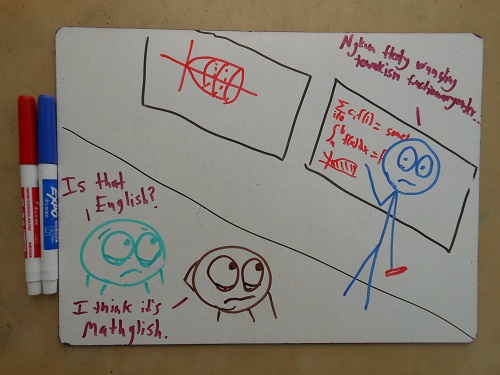
The Mathematical Dialect Quiz

by Ben Orlin

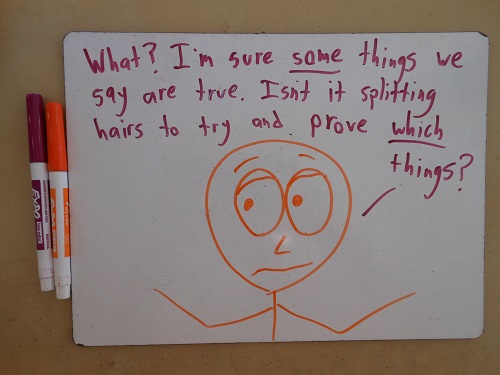
  1. What do you call a rigorous demonstration that a statement is true?
    1. If “proof,” then you’re a mathematician
    2. If “experiment,” then you’re a physicist
    3. If you have no word for this concept, then you’re an economist

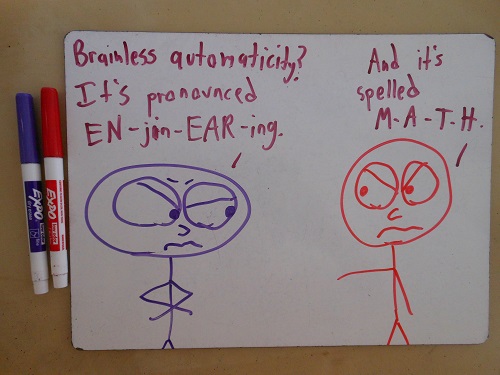
  1. What do you call a slow, painful, computationally intense method of solving a problem?
    1. If “engineering,” then you’re a mathematician
    2. If “mathematics,” then you’re an engineer

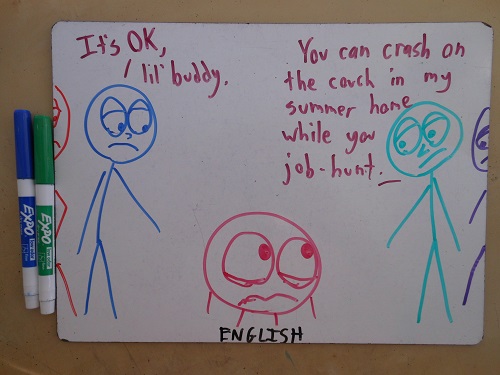
  1. What do you call a person who is in their first job after a PhD?
    1. If “postdoc,” then you’re a mathematician or physicist
    2. If “assistant professor,” then you’re an economist
    3. If “wealthy,” then you’re a computer scientist
    4. If you have no word for a job after a PhD, then you’re in the humanities, and you have our condolences

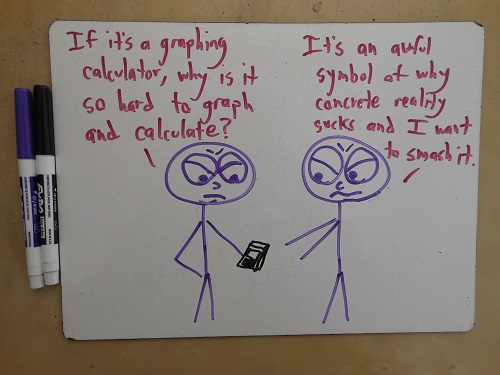
  1. What do you call a calculator with graphing capabilities?
    1. If “an antique,” then you’re a computer scientist
    2. If “my precious,” then you’re an engineer
    3. If “the poor man’s Wolfram Alpha,” then you’re a mathematician
    4. If “kinda hard to use,” then you’re an honest mathematician

  1. How do you pronounce “Pythagorean”?
    1. If you pronounce it “pithAGorEan,” then you’re a mathematician
    2. If you pronounce it “PITHaGORean,” then you’re a physicist
    3. If you just mumble the word and hope no one notices, then you’re a TA

  1. What name do you use for the person who invented calculus?
    1. If “Leibniz,” then you’re a mathematician
    2. If “Newton,” then you’re a physicist
    3. If “magical wizard,” then you’re probably not ready for grad school

  1. What do you say after successfully proving your point beyond all doubt?
    1. If “QED,” then you’re a mathematician
    2. If “the prosecution rests,” then you’re a mathematician with a flair for drama
    3. If you do not believe proof beyond all doubt is possible, then you’re a scientist

  1. What do you call a simplified representation of reality, such as imagining a physical system with no friction or air resistance?
    1. If “a model,” then you’re a computer scientist
    2. If “an approximation,” then you’re an engineer
    3. If you call this “reality,” then you’re an economist

  1. How do you refer to a piece of work that suffers from one small but visible mistake?
    1. If “rough,” then you’re an engineer
    2. If “as good as it’s going to get,” then you’re a computer scientist
    3. If “worthless,” then you’re a mathematician

  1. What do you call a formal gathering of professionals from your field?
    1. If “a conference,” then you’re a physicist
    2. If “a start-up,” then you’re a computer scientist
    3. If “an advisory panel to the president,” then you’re an economist
    4. If “a game of D&D,” then you’re a mathematician

Thanks for reading! If you prefer bad gifs to bad drawings, you might also check out The Math Aficionado’s Guide to High Fives.


16 May 05:22

A Dialogue On Doublethink

Submitted by BrienneStrohl • 49 votes • 104 comments

Followup to: Against Doublethink (sequence), Dark Arts of Rationality, Your Strength as a Rationalist


Doublethink

It is obvious that the same thing will not be willing to do or undergo opposites in the same part of itself, in relation to the same thing, at the same time. --Book IV of Plato's Republic

Can you simultaneously want sex and not want it? Can you believe in God and not believe in Him at the same time? Can you be fearless while frightened?

To be fair to Plato, this was meant not as an assertion that such contradictions are impossible, but as an argument that the soul has multiple parts. It seems we can, in fact, want something while also not wanting it. This is awfully strange, and it led Plato to conclude the soul must have multiple parts, for surely no one part could contain both sides of the contradiction.

Often, when we attempt to accept contradictory statements as correct, it causes cognitive dissonance--that nagging, itchy feeling in your brain that won't leave you alone until you admit that something is wrong. Like when you try to convince yourself that staying up just a little longer playing 2048 won't have adverse effects on the presentation you're giving tomorrow, when you know full well that's exactly what's going to happen.

But it may be that cognitive dissonance is the exception in the face of contradictions, rather than the rule. How would you know? If it doesn't cause any emotional friction, the two propositions will just sit quietly together in your brain, never mentioning that it's logically impossible for both of them to be true. When we accept a contradiction wholesale without cognitive dissonance, it's what Orwell called "doublethink".

When you're a mere mortal trying to get by in a complex universe, doublethink may be adaptive. If you want to be completely free of contradictory beliefs without spending your whole life alone in a cave, you'll likely waste a lot of your precious time working through conundrums, which will often produce even more conundrums.

Suppose I believe that my husband is faithful, and I also believe that the unfamiliar perfume on his collar indicates he's sleeping with other women without my permission. I could let that pesky little contradiction turn into an extended investigation that may ultimately ruin my marriage. Or I could get on with my day and leave my marriage intact.

It's better to just leave those kinds of thoughts alone, isn't it? It probably makes for a happier life.

Against Doublethink

Suppose you believe that driving is dangerous, and also that, while you are driving, you're completely safe. As established in Doublethink, there may be some benefits to letting that mental configuration be.

There are also some life-shattering downsides. One of the things you believe is false, you see, by the law of the excluded middle. In point of fact, it's the one that goes "I'm completely safe while driving". Believing false things has consequences.

Be irrationally optimistic about your driving skills, and you will be happily unconcerned where others sweat and fear. You won't have to put up with the inconvenience of a seatbelt. You will be happily unconcerned for a day, a week, a year. Then CRASH, and spend the rest of your life wishing you could scratch the itch in your phantom limb. Or paralyzed from the neck down. Or dead. It's not inevitable, but it's possible; how probable is it? You can't make that tradeoff rationally unless you know your real driving skills, so you can figure out how much danger you're placing yourself in. --Eliezer Yudkowsky, Doublethink (Choosing to be Biased)

What are beliefs for? Please pause for ten seconds and come up with your own answer.

Ultimately, I think beliefs are inputs for predictions. We're basically very complicated simulators that try to guess which actions will cause desired outcomes, like survival or reproduction or chocolate. We input beliefs about how the world behaves, make inferences from them to which experiences we should anticipate given various changes we might make to the world, and output behaviors that get us what we want, provided our simulations are good enough.

My car is making a mysterious ticking sound. I have many beliefs about cars, and one of them is that if my car makes noises it shouldn't, it will probably stop working eventually, and possibly explode. I can use this input to simulate the future. Since I've observed my car making a noise it shouldn't, I predict that my car will stop working. I also believe that there is something causing the ticking. So I predict that if I intervene and stop the ticking (in non-ridiculous ways), my car will keep working. My belief has thus led to the action of researching the ticking noise, planning some simple tests, and will probably lead to cleaning the sticky lifters.

If it's true that solving the ticking noise will keep my car running, then my beliefs will cash out in correctly anticipated experiences, and my actions will cause desired outcomes. If it's false, perhaps because the ticking can be solved without addressing a larger underlying problem, then the experiences I anticipate will not occur, and my actions may lead to my car exploding.

Doublethink guarantees that you believe falsehoods. Some of the time you'll call upon the true belief ("driving is dangerous"), anticipate future experiences accurately, and get the results you want from your chosen actions ("don't drive three times the speed limit at night while it's raining"). But some of the time, if you actually believe the false thing as well, you'll call upon the opposite belief, anticipate inaccurately, and choose the last action you'll ever take.

Without any principled algorithm determining which of the contradictory propositions to use as an input for the simulation at hand, you'll fail as often as you succeed. So it makes no sense to anticipate more positive outcomes from believing contradictions.

Contradictions may keep you happy as long as you never need to use them. Should you call upon them, though, to guide your actions, the debt on false beliefs will come due. You will drive too fast at night in the rain, you will crash, you will fly out of the car with no seat belt to restrain you, you will die, and it will be your fault.

Against Against Doublethink

What if Plato was pretty much right, and we sometimes believe contradictions because we're sort of not actually one single person?

It is not literally true that Systems 1 and 2 are separate individuals the way you and I are. But the idea of Systems 1 and 2 suggests to me something quite interesting with respect to the relationship between beliefs and their role in decision making, and modeling them as separate people with very different personalities seems to work pretty darn well when I test my suspicions.

I read Atlas Shrugged probably about a decade ago. I was impressed with its defense of capitalism, which really hammers home the reasons it’s good and important on a gut level. But I was equally turned off by its promotion of selfishness as a moral ideal. I thought that was *basically* just being a jerk. After all, if there’s one thing the world doesn’t need (I thought) it’s more selfishness.

Then I talked to a friend who told me Atlas Shrugged had changed his life. That he’d been raised in a really strict family that had told him that ever enjoying himself was selfish and made him a bad person, that he had to be working at every moment to make his family and other people happy or else let them shame him to pieces. And the revelation that it was sometimes okay to consider your own happiness gave him the strength to stand up to them and turn his life around, while still keeping the basic human instinct of helping others when he wanted to and he felt they deserved it (as, indeed, do Rand characters). --Scott of Slate Star Codex in All Debates Are Bravery Debates

If you're generous to a fault, "I should be more selfish" is probably a belief that will pay off in positive outcomes should you install it for future use. If you're selfish to a fault, the same belief will be harmful. So what if you were too generous half of the time and too selfish the other half? Well, then you would want to believe "I should be more selfish" with only the generous half, while disbelieving it with the selfish half.

Systems 1 and 2 need to hear different things. System 2 might be able to understand the reality of biases and make appropriate adjustments that would work if System 1 were on board, but System 1 isn't so great at being reasonable. And it's not System 2 that's in charge of most of your actions. If you want your beliefs to positively influence your actions (which is the point of beliefs, after all), you need to tailor your beliefs to System 1's needs.

For example: The planning fallacy is nearly ubiquitous. I know this because for the past three years or so, I've gotten everywhere five to fifteen minutes early. Almost every single person I meet with arrives five to fifteen minutes late. It is very rare for someone to be on time, and only twice in three years have I encountered the (rather awkward) circumstance of meeting with someone who also arrived early.

Before three years ago, I was also usually late, and I far underestimated how long my projects would take. I knew, abstractly and intellectually, about the planning fallacy, but that didn't stop System 1 from thinking things would go implausibly quickly. System 1's just optimistic like that. It responds to, "Dude, that is not going to work, and I have a twelve point argument supporting my position and suggesting alternative plans," with "Naaaaw, it'll be fine! We can totally make that deadline."

At some point (I don't remember when or exactly how), I gained the ability to look at the true due date, shift my System 1 beliefs to make up for the planning fallacy, and then hide my memory that I'd ever seen the original due date. I would see that my flight left at 2:30, and be surprised to discover on travel day that I was not late for my 2:00 flight, but a little early for my 2:30 one. I consistently finished projects on time, and only disasters caused me to be late for meetings. It took me about three months before I noticed the pattern and realized what must be going on.

I got a little worried I might make a mistake, such as leaving a meeting thinking the other person just wasn't going to show when the actual meeting time hadn't arrived. I did have a couple close calls along those lines. But it was easy enough to fix; in important cases, I started receiving Boomeranged notes from past-me around the time present-me expected things to start that said, "Surprise! You've still got ten minutes!"

This unquestionably improved my life. You don't realize just how inconvenient the planning fallacy is until you've left it behind. Clearly, considered in isolation, the action of believing falsely in this domain was instrumentally rational.

Doublethink, and the Dark Arts generally, applied to carefully chosen domains is a powerful tool. It's dumb to believe false things about really dangerous stuff like driving, obviously. But you don't have to doublethink indiscriminately. As long as you're careful, as long as you suspend epistemic rationality only when it's clearly beneficial to do so, employing doublethink at will is a great idea.

Instrumental rationality is what really matters. Epistemic rationality is useful, but what use is holding accurate beliefs in situations where that won't get you what you want?

Against Against Against Doublethink

There are indeed epistemically irrational actions that are instrumentally rational, and instrumental rationality is what really matters. It is pointless to believing true things if it doesn't get you what you want. This has always been very obvious to me, and it remains so.

There is a bigger picture.

Certain epistemic rationality techniques are not compatible with dark side epistemology. Most importantly, the Dark Arts do not play nicely with "notice your confusion", which is essentially your strength as a rationalist. If you use doublethink on purpose, confusion doesn't always indicate that you need to find out what false thing you believe so you can fix it. Sometimes you have to bury your confusion. There's an itsy bitsy pause where you try to predict whether it's useful to bury.

As soon as I finally decided to abandon the Dark Arts, I began to sweep out corners I'd allowed myself to neglect before. They were mainly corners I didn't know I'd neglected.

The first one I noticed was the way I responded to requests from my boyfriend. He'd mentioned before that I often seemed resentful when he made requests of me, and I'd insisted that he was wrong, that I was actually happy all the while. (Notice that in the short term, since I was probably going to do as he asked anyway, attending to the resentment would probably have made things more difficult for me.) This self-deception went on for months.

Shortly after I gave up doublethink, he made a request, and I felt a little stab of dissonance. Something I might have swept away before, because it seemed more immediately useful to bury the confusion than to notice it. But I thought (wordlessly and with my emotions), "No, look at it. This is exactly what I've decided to watch for. I have noticed confusion, and I will attend to it."

It was very upsetting at first to learn that he'd been right. I feared the implications for our relationship. But that fear didn't last, because we both knew the only problems you can solve are the ones you acknowledge, so it is a comfort to know the truth.

I was far more shaken by the realization that I really, truly was ignorant that this had been happening. Not because the consequences of this one bit of ignorance were so important, but because who knows what other epistemic curses have hidden themselves in the shadows? I realized that I had not been in control of my doublethink, that I couldn't have been.

Pinning down that one tiny little stab of dissonance took great preparation and effort, and there's no way I'd been working fast enough before. "How often," I wondered, "does this kind of thing happen?"

Very often, it turns out. I began noticing and acting on confusion several times a day, where before I'd been doing it a couple times a week. I wasn't just noticing things that I'd have ignored on purpose before; I was noticing things that would have slipped by because my reflexes slowed as I weighed the benefit of paying attention. "Ignore it" was not an available action in the face of confusion anymore, and that was a dramatic change. Because there are no disruptions, acting on confusion is becoming automatic.

I can't know for sure which bits of confusion I've noticed since the change would otherwise have slipped by unseen. But here's a plausible instance. Tonight I was having dinner with a friend I've met very recently. I was feeling s little bit tired and nervous, so I wasn't putting as much effort as usual into directing the conversation. At one point I realized we had stopped making making any progress toward my goals, since it was clear we were drifting toward small talk. In a tired and slightly nervous state, I imagine that I might have buried that bit of information and abdicated responsibility for the conversation--not by means of considering whether allowing small talk to happen was actually a good idea, but by not pouncing on the dissonance aggressively, and thereby letting it get away. Instead, I directed my attention at the feeling (without effort this time!), inquired of myself what precisely was causing it, identified the prediction that the current course of conversation was leading away from my goals, listed potential interventions, weighed their costs and benefits against my simulation of small talk, and said, "What are your terminal values?"

(I know that sounds like a lot of work, but it took at most three seconds. The hard part was building the pouncing reflex.)

When you know that some of your beliefs are false, and you know that leaving them be is instrumentally rational, you do not develop the automatic reflex of interrogating every suspicion of confusion. You might think you can do this selectively, but if you do, I strongly suspect you're wrong in exactly the way I was.

I have long been more viscerally motivated by things that are interesting or beautiful than by things that correspond to the territory. So it's not too surprising that toward the beginning of my rationality training, I went through a long period of being so enamored with a-veridical instrumental techniques--things like willful doublethink--that I double-thought myself into believing accuracy was not so great.

But I was wrong. And that mattered. Having accurate beliefs is a ridiculously convergent incentive. Every utility function that involves interaction with the territory--interaction of just about any kind!--benefits from a sound map. Even if "beauty" is a terminal value, "being viscerally motivated to increase your ability to make predictions that lead to greater beauty" increases your odds of success.

Dark side epistemology prevents total dedication to continuous improvement in epistemic rationality. Though individual dark side actions may be instrumentally rational, the patterns of thought required to allow them are not. Though instrumental rationality is ultimately the goal, your instrumental rationality will always be limited by your epistemic rationality.

That was important enough to say again: Your instrumental rationality will always be limited by your epistemic rationality.

It only takes a fraction of a second to sweep an observation into the corner. You don't have time to decide whether looking at it might prove problematic. If you take the time to protect your compartments, false beliefs you don't endorse will slide in from everywhere through those split-second cracks in your art. You must attend to your confusion the very moment you notice it. You must be relentless an unmerciful toward your own beliefs.

Excellent epistemology is not the natural state of a human brain. Rationality is hard. Without extreme dedication and advanced training, without reliable automatic reflexes of rational thought, your belief structure will be a mess. You can't have totally automatic anti-rationalization reflexes if you use doublethink as a technique of instrumental rationality.

This has been a difficult lesson for me. I have lost some benefits I'd gained from the Dark Arts. I'm late now, sometimes. And painful truths are painful, though now they are sharp and fast instead of dull and damaging.

And it is so worth it! I have much more work to do before I can move on to the next thing. But whatever the next thing is, I'll tackle it with far more predictive power than I otherwise would have--though I doubt I'd have noticed the difference.

So when I say that I'm against against against doublethink--that dark side epistemology is bad--I mean that there is more potential on the light side, not that the dark side has no redeeming features. Its fruits hang low, and they are delicious.

But the fruits of the light side are worth the climb. You'll never even know they're there if you gorge yourself in the dark forever.

104 comments
16 May 04:16

katrosenfield: braiker: EB White declines an invitation. I am...


katrosenfield:

braiker:

EB White declines an invitation. I am absolutely going to steal this. (via)

Every time I say no to anything, from now on, forever.
13 May 02:09

Animals growing up: 'before and after' photos

by Xeni Jardin
Animals-Before-and-After-20-685x393

Jason's post about his Great Pyrenees pup Nemo growing up reminded me of this wonderful image gallery of side-by-side photos of pets as babies, next to photos of those same pets in the same position all grown up.

Read the rest

10 May 00:01

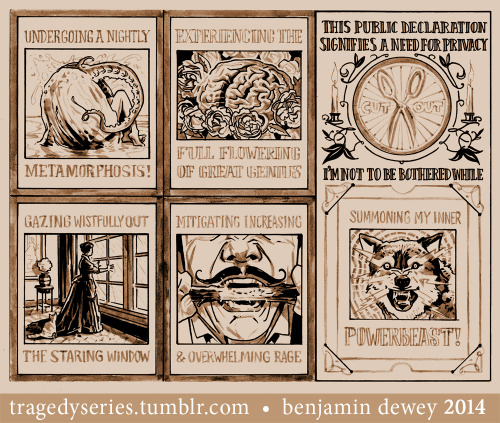
When the shouts of the fishmonger, bootblack and hansom cabbies...


When the shouts of the fishmonger, bootblack and hansom cabbies ring too loudly, you need time to finish your symphony celebrating the cetaceans or simply mean to pine for halcyon days as they fade fast into the oblivion of memory… retire to your chambers and post this helpful tag around the entry mechanism; in this way, your fellow hominids will know that you’ve grown grim about the mouth and/or require solitude to improve this maddening orb.

Follow these simple instructions and make your needs plain: 

1. Print out on sturdy stock at a scale of 11 X 8.5 inches
2. Separate the tag (seen on the right) from the inserts be means of common shears, sever the cards from each other.
3. Cut out the central circle and make small incisions on the black corner frame lines by means of a razor.  
4. set in whichever miniature placard best describes your private task.

09 May 19:03

Time for Some Consequences

by Josh Marshall

Here where I live, if you pull a gun on a law enforcement officer, things go down hill pretty fast. But out in Bundystan, as long as you're a far right militia member and/or white supremacist, apparently it's not a problem. At least until now. Apparently the FBI is starting to investigate the Bundy outlaws as part of "formal investigation into alleged death threats, intimidation and possible weapons violations."

09 May 19:02

Still Looking for Some Blood

by Josh Marshall

On the outs with mainstream pundits over "the Negro", Cliven Bundy and his band of armed extremists are still hoping to spark a violent confrontation with the Feds that will go nationwide.

08 May 16:48

The Sexual Politics of Veganism

by Corey Wrenn MS

2Carol Adams has written extensively on the sexual politics of meat, arguing that women and other animals are both sexualized and commodified to facilitate their consumption (both figuratively and literally) by those in power. One result has been the feminization of veganism and vegetarianism. This has the effect of delegitimizing, devaluing, and defanging veganism as a social movement.

This process works within the vegan movement as well, with an open embracing of veganism as inherently feminized and sexualized. This works to undermine a movement (that is comprised mostly of women) and repackage it for a patriarchal society. Instead of strong, political collective of women, we have yet another demographic of sexually available individual women who exist for male consumption.

Take a browse through vegan cookbooks on Amazon, for instance, and the theme of “sexy veganism” that emerges is unmistakable:

1

Oftentimes, veganism is presented as a means of achieving idealized body types.  These books are mostly geared to a female audience, as society values women primarily as sexual resources for men and women have internalized these gender norms.  Many of these books bank on the power of thin privilege, sizism, and stereotypes about female competition for male attention to shame women into purchasing.

1a

To reach a male audience, authors have to draw on a notion of “authentic masculinity” to make a highly feminized concept palatable to a patriarchal society where all that is feminine is scorned.  Some have referred to this trend as “heganism.”  The idea is to protect male superiority by unnecessarily gendering veganism into veganism for girls and veganism for boys.  For the boys, we have to appeal to “real” manhood.

Meat Is For Pussies (A How-to Guide for Dudes Who Want to Get Fit, Kick Ass and Take Names) appears to be out of print, but there are others:

1b

Then there is the popular tactic of turning women into consumable objects in the exact same way that meat industries do.  Animal rights groups recruit “lettuce ladies” or “cabbage chicks” dressed as vegetables to interact with the public.  PETA routinely has nude women pose in and among vegetables to convey the idea that women are sexy food.  Vegan pinup sites and strip joints also feed into this notion.  Essentially, it is the co-optation and erosion of a women’s movement.  Instead of empowering women on behalf of animals, these approaches disempower women on behalf of men.

2

In sum, vegan feminism argues that women and non-human animals are commodified and sexualized objects offered up for the pleasurable consumption of those in power. In this way, both women and other animals are oppressed under capitalist patriarchy. When the vegan movement sexualizes and feminizes vegan food, or replicates the woman-as-food trope, it fails to acknowledge this important connection and ultimately serves to repackage potentially threatening feminist collective action in a way that is palatable to patriarchy.

Corey Lee Wrenn is a Council Member for the American Sociological Association’s Animals & Society section.  This section facilitates improved sociological inquiry into issues concerning nonhuman animals and is currently seeking members. Membership is $5-$10; you must be a member of the ASA to join.

Cross-posted at the Vegan Feminist Network and Pacific Standard.

(View original at http://thesocietypages.org/socimages)

07 May 05:39

i dont write about my life much anymore, i guess i havent done that for maybe 4+ years. i stopped...

i dont write about my life much anymore, i guess i havent done that for maybe 4+ years. i stopped writing because i dated someone who basically co-opted my writing about myself as me writing to them and about them? not the best situation.

anyway, given where my life is at now i figure i should give it another go.

most of my life is taken up by work. for folks that don’t know me as well “irl” the context of my professional life is this. i clawed my way into the boston startup scene, learned how to program, and fought and connived to get a job in software engineering at a legit company. a company pretty much anyone in the world would have heard of, at least, if they lived in a city.

i took this direction both because i knew my family needed money help, but also because of all the things that ever earned me money, this is the one i found actively least alienating (though it is still alienating). so over the span of 3 years, having never really programmed before, i got myself an enviable job getting paid a (to me) lot of money typing very, very carefully on a computer about 40 hours a week.

the organization i’m at is a strange one. while a household name, they were acquired last year by an even bigger and older company. i’ve been through an acquire before. for those that don’t know, generally the reason to acquire as an older company is because you don’t want to invest in new technology, so you just buy someone else’s investment in it. one of the big things that’s of value there is that while older companies are hamstrung by a history of stronger labor movements (thus, unionized workforces) younger companies have no such baggage.

but likewise, many younger companies actually don’t have great technology. they just have market share, because their technology is the oldest. such is the case with my company, which is still scooping up millions of dollars with an application that is basically stored database procedures, many of which make http requests. (other engineers will understand how alarming that is. idk what to compare it to. it would be like using your prep table to count money, or a backhoe to deliver an order. just, wrong.)

so the engineering department is by no means committed to excellence, and while that allowed me (a relatively untested engineer) to get hired, the uneven hiring can be frustrating. out of all our QAs, maybe 1 or 2 are actually at the QE level. my team’s QA is basically incompetent, which sucks. there’s nothing more grinding to me than being on a team with someone i am not really empowered to help learn, but am accountable to covering for when he fucks up. he is paralyzed by fear most of the time. fear of asking us for help, fear of doing anything but the set of steps he knows how to do, fear of analyzing his situation to learn from it. it’s depressing. he’s also maybe 15 years my senior.

i’ve committed to staying at the company at least until january 2015 so that i have a full year on my resume there. but past that, i will probably leave. on the bright side, this means i have really been freed up emotionally to be quite frank and push for changes. i’ve started a group to actually get the department disciplined in best practices with ruby and rails, and contributing to the software ecosystem, too. i’ve also been pushing the QEs to meet as a group and form their own pride of craft.

my feeling right now is that i’m trying to just stop the bleeding, because we’ve been continuously losing engineers i respect and can actually learn from at the rate of maybe 2 a month. (that is BAD.) i am by no means the most qualified person in my department, but i am the most motivated to get something out of it. so that’s where i’m coming from.

my therapist gave me a very helpful heuristic for putting my effort into shit without stressing myself out. rather than form expectations, i try to form intentions. i intend to be the best engineer i possibly can wherever i am, and i am here right now. i don’t expect the department will shape up, i don’t expect everyone else will give a shit about doing good work, i don’t expect the people i respect will stick around because of my actions.

05 May 17:16

What Not Dying Looks Like

It’s always odd to hear people say RSS is dead. The fact is, RSS is easily the most successful stealth, insurgent technology on the web. It is pervasive and is the engine for much of the Internet.

Apple uses it to syndicate computer updates. Your podcast subscriptions rely on RSS. Every Wordpress blog is RSS enabled and every major news site is broadcasting via RSS. They’re all syndicated. They all have an RSS feed. It’s the background hum of the Internet.

There are millions of feeds out there, continually connecting users to their favorite content. Just about everything online except Facebook and Twitter is available via RSS.

Even more importantly, RSS has proven to be resilient and durable regardless of what corporate interests want to do with it. Netscape invented the underlying code in the late 90’s, and then took away all documentation and support in 2001 after AOL bought them out. But even that didn’t slow the dissemination. 

And then last year, the biggest player on the Internet took its ball and went home when Google killed its Reader. Despite the fact that Google retired the most popular RSS application on the Net, it did not affect RSS in any appreciable way. All of those feeds are still available and users are still getting their content delivered exactly as they want it. What greater proof is there of the resiliency of RSS?

In fact, what might have seemed like a disaster at first is perhaps the best thing that could happen to the technology. Remember, RSS is a technology and a service; it is not a product. AOL thought they could squash this great idea, but a community of developers took the idea and ran. Then Google thought they could abandon the technology and assumed everyone would gravitate to their social networks instead.

In fact, any number of companies can go out of business, but nobody can stop anybody from publishing and reading RSS feeds. 

However, just because a technology is widely available does not guarantee success. What makes RSS truly powerful is that users still have the control. The beauty of the system is it that no one can force you to be tracked and no one can force you to watch ads. There are no security issues I am aware of and no one ever has to know what feeds you subscribe to. This may be the last area of the Internet that you can still say things like this.

Google Reader was a monopolist product built on an anti-monopolist technology. Now that they’re gone, RSS is once again anyone’s game. You’re going to see a lot more innovation and new stuff for RSS. I never know if its supposed to be a blessing or a curse to live in interesting times. But I have to believe this RSS is entering maybe the most interesting time in its long history.

05 May 02:36

kikinickmc: mechanicbird: eroticmirotic: timemachineyeah:   ...


kikinickmc:

mechanicbird:

eroticmirotic:

timemachineyeah:


I’ve said this before and I’ll point it out again - 

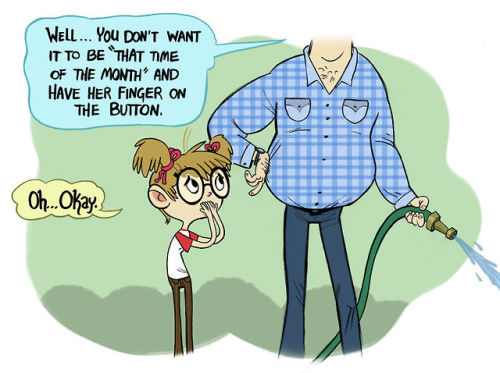
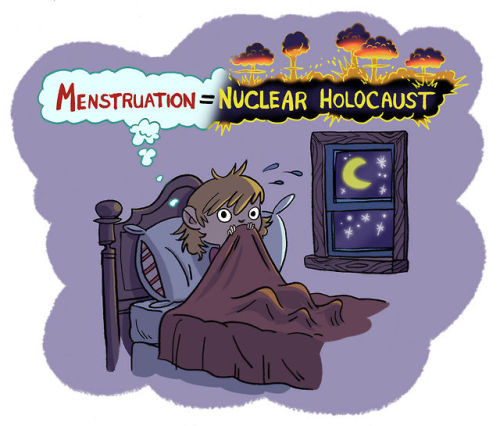
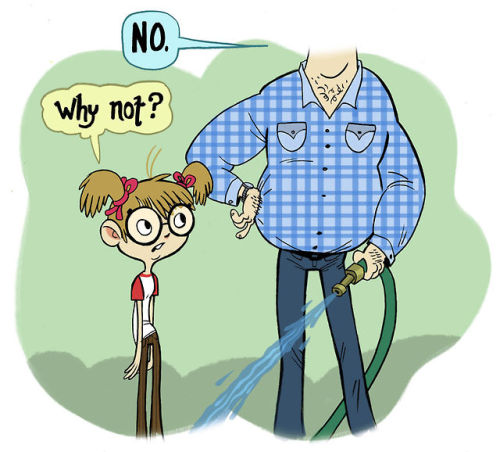
Menstruation is caused by change in hormonal levels to stop the creation of a uterine lining and encourage the body to flush the lining out. The body does this by lowering estrogen levels and raising testosterone. 

Or, to put it more plainly “That time of the month” is when female hormones most closely resemble male hormones. So if (cis) women aren’t suited to office at “That time of the month” then (cis) men are NEVER suited to office.

If you are a dude and don’t dig the ladies around you at their time of the month, just think! That is you all of the time. 

And, on a final note, post-menopausal (cis) women are the most hormonally stable of all human demographics. They have fewer hormonal fluctuations of anyone, meaning older women like Hilary Clinton and Elizabeth Warren would theoretically be among the least likely candidates to make an irrational decision due to hormonal fluctuations, and if we were basing our leadership decisions on hormone levels, then only women over fifty should ever be allowed to hold office. 

Reblogging hard for that last comment.

I WANTED TO SAY THIS BUT THEN SOMEONE ELSE DID and I’m damn proud.

!!!!!!!!!!!

I WANT TO PRINT THIS OUT AND POST IT FUCKING EVERYWHERE

03 May 02:11

ENTJ Confessions #28

"I love to imagine and create — my creativity is one of my favorite traits. Just become I’m not effusively emotional or a scatterbrained flower-child doesn’t mean I’m not an artist too! Of course, if it’s art that involves directing other people, all the better."

03 May 02:04

I feel like I have no perception of time, like an hour can feel like fifteen minutes or fifteen minutes can feel like an hour and it's reeeaaaalllly inconsistent. Like sometimes an hour-long class will feel like ten minutes and other times five minutes on the computer will feel like a half hour. Why does this happen?

Executive dysfunction! Basically we have no sense of time because that’s an executive function. Time isn’t a concrete concept, so it’s really fluid for us and it’s always changing. I remember when I took the TOVA the first time, the psychologist said it would take 15 minutes and there was a question at the end that asked how it felt, and I said it felt like the longest 15 minutes of my life. That was part of the test, because it took less than 15 minutes to complete. (Mean, but part of the test because it measures how you experience time.)

And no, I have no way to really mitigate this one. You can try a time timer, which is a really cool visual timer that’s mostly sold for use with autistic people, but I haven’t heard whether it really helps give time a more concrete feeling.

I set alarms and timers because if I don’t then I have literally no idea how long I’m spending on things.

-J

03 May 02:00

This Virus Makes Crickets Have More Sex Imagine if there were a...


This Virus Makes Crickets Have More Sex

Imagine if there were a virus that could get inside you and dial up your libido, so that you all of a sudden start mating more (more frequently and with more partners), so that the virus — the tricky, tricky, clever, little virus — could transmit itself through your lovemaking to somebody else, then somebody else, and somebody else after that.

That would be genius, and troubling, and most of all, sci-fi, right? Well, it turns out, Shelley Adamo, and her team at Dalhousie University in Halifax, have just discovered a virus that seems to have an effect kind of like that … in crickets. It’s called iridovirus and she stumbled across its aphrodisiac qualities accidentally.

Hear the full story from Lulu Miller.

03 May 01:51

toughtink: oddpicturesoddpeople: dorkly: These 8 Characters...


toughtink:

oddpicturesoddpeople:

dorkly:

These 8 Characters Are Definitely Going To Die

[see the other tropes marked for death at Dorkly.com]

Because the ghosts of our Puritan forbearers still haunt us.

my favorite:

Accurate post is accurate.

03 May 01:41

No Surprise

by Josh Marshall

TPM Reader JG on Scalia ...

Scalia's "mistake" is really indicative of the broader point and more significant point: Scalia has no regard for precedent. Probably 20 years ago Scalia appeared at USC law school, and a friend of mine asked him about precedent and how he could reconcile his decision in a case with an existing precedent. Scalia laughed at the question and told the law student that he was naive to think that cases were decided by precedent. Do we need any further proof?
28 Apr 18:16

When Marketing to Gamers Backfires

by Jamie Madigan

Marketing towards gamers is often awkward and ham-handed. In late 2012, for example, the image below caused some frothing in the gaming community.

doritos

That’s video game personality, journalist, and show host Geoff Keighley sitting next to a pile of Doritos (“nacho cheese” flavored), Mountain Dew (“red” flavored), and a co-branded poster for Halo 4. Some people used the image to call Keighley’s journalistic integrity into question 1 but what bugged me about it was how the PepsiCo people were going about marketing this stuff. By taking a gaming celebrity –supposedly the epitome of a “true” gamer who is an expert on the hobby– and surrounding him with Mountain Dew and Doritos, the idea was that this is the kind of food you should like if you’re a gamer.

Maybe we shouldn’t be surprised. There has been a lot of consumer psychology research in the last couple of decades showing that tying a product to a person’s identity can be very effective.2 You can easily argue that Apple has made a killing in marketing an identity to go with their products. Most of their recent advertising campaigns don’t even mention hardware specifications; they just talk about what kind of person you can be if you own their little doo-dad. Apple’s famous “Think Different” ad from 1997 lauded the crazy “square pegs in round holes” characters like Albert Einstein, Bob Dylan, Martin Luther King Jr., and Pablo Picasso. In a way, this is very similar to Keighley’s ad for Doritos and Mountain Dew except in Apple’s case there’s not even a product in sight –just a bunch of people and the Apple logo. But the message is clear: buy our stuff and you will be a misunderstood genius, too. I’m reminded of this every time I see someone sporting an iPhone case with a conspicuous hole in it that serves no other purpose than letting the Apple logo on the back of the phone show through.

Some companies, though, are so bold as to define what it means to be a gamer and tie it to using their product. Gamefly, the rent-by-mail service for game disks, had the claim that “You call yourself a gamer? You HAVE to have this service” as the tagline for one of its commercials. Here, see for yourself:

Even worse is “Gamer Grub.” Their website pitches plastic pouches of Pizza and PB&J flavored …Goo? Kibbles? I’m not sure, but their aim is to relieve gamers of the decidedly non-radical process of chewing. The marketing makes it clear that if you’re a gamer, this is what you should eat: “the first performance snack formulated especially for gamers” 3

Some recent research by Amit Bhattacharjee, Jonah Berger, and Geeta Menon published in an upcoming issue of the Journal of Consumer Research4 shows how this kind of marketing can backfire, as in the case of Gamefly’s “You have to have this or you’re not a real gamer” message. The researchers argue that while we do prefer products that reinforce parts our identities –especially when that identity is somehow made more salient– we have to feel like it’s us deciding that the product reinforces our identity, not the marketing. In fact, if the advertising or marketing message tries too hard to explicitly link our group identity to the act of buying or using the product, it can backfire and we are less likely to buy it.

I think this is the "BBQ" flavor according to Gamer Grub's website.

I think this is the “BBQ” flavor according to Gamer Grub’s website.

Bhattacharjee and his colleagues did a series of experiments where they manipulated whether or not the marketing language explicitly tied the product to an identity or membership in a group. For example, consider the following pairs of messages used in ads for DirectTV’s sports packages and Charlie’s All Purpose Soap, an environmentally friendly cleanser:

  1. “If you call yourself a sports fan, you gotta have DirectTV!”
  2. “DirectTV. All the sports you love, all in one place.”
  1. “Charlie’s: The only good choice for green consumers.”
  2. “Charlie’s: A good choice for green consumers.”

The first statement in each pair explicitly ties the use of the product to membership in an identity-defining group. The second simply references that identity.

The results were consistent across five experiments: if you highlight the influence of external factors (like the marketing) on brand/identity relationships, people will reject them more often than if you allow them to make those associations under their own agency. In the case of the Charlie’s soap messages, those who saw the second pitch were, on average, a full point higher on a 5-point “Purchase Likelihood” scale: 2.74 vs. 3.78. That’s huge when you’re talking about thousands of potential customers.

We need to feel that WE are deciding that a certain product –a soft drink, a snack chip, or a video game console– is placing us in a group that defines our identity. Don’t try to shove us into an identity-defining group. Only we can shove ourselves into an identity-defining group. I suspect this has implications beyond marketing, too. Other appeals to tribalism like “you’re only a true gamer if you play on the PC” or “You’re not a real gamer if you you’ve never been to PAX” or even “Only casuals play that character in DOTA” are likely to fall flat for the same reasons.

Besides, I prefer Cool Ranch Doritos.

Follow me on Twitter, Facebook, or RSS.

28 Apr 04:38

When moral codes codify immorality

by Fred Clark

Mallory Ortberg offers a terrific guide to “Pre-code Movies Worth Watching,” wherein she solidifies her status as one of my favorite people on the Internets with her take on I Am a Fugitive From a Chain-Gang:

My absolute favorite film of all time, bar none. You have to see it. YOU HAVE TO SEE IT. Oh, God, I want to give away the ending so bad, but I won’t, even though it’s been over 80 years. It’s one of the most absolutely harrowing endings in film history, and completely unthinkable for a studio film to end on that kind of a note at the time. There’s a hiss and a whisper and footsteps in the dark and an admission of something that’s impossible to believe. Oh, God, watch it yesterday and call me when you’re done so we can talk about it for hours.

The code of “pre-code” was the Motion Picture Production Code, a long, “touch not, taste not, handle not” list of guidelines and taboos from the Hollywood studio censors outlining what topics and depictions were off-limits.

Ortberg’s survey offers some helpful (and funny) categories, starting with “Worth Watching For Any Reasons” and then descending into others such as “Less Well-Known Remakes,” “If You Want to Get Into Pre-Civil-Rights-Era Racial Dynamics,” “Ugh, If You Must, They’re ‘Important’ But I Hate Them,” “If You Want to Take a Deeply Uncomfortable Journey to Another Time,” and ”Worth It for the Titles Alone.”

Oh, those titles. Here’s Wikipedia’s long list of pre-code movies — a list that could easily provide all the band names we’ll ever need for the next decade.  A small selection, just from those released in 1933:

  • A Shriek in the Night
  • Air Hostess
  • Ann Carver’s Profession
  • Beauty for Sale
  • Broadway Through a Keyhole
  • Ecstasy
  • Ex-Lady
  • Girl Without a Room
  • The Mayor of Hell
  • Midnight Mary
  • The Past of Mary Holmes
  • Roman Scandals
  • She Done Him Wrong
  • She Had to Say Yes
  • Should Ladies Behave
  • The Sin of Nora Moran
  • The Secret of Madame Blanche
  • The Song of Songs
  • When Ladies Meet
  • The White Sister
  • Wild Boys of the Road
  • The Woman Accused

Those titles seem to have functioned the way the movie rating system functions today. They may not have had such a thing as an “R-rating” in 1934, but I think audiences knew what they could expect from movies with titles like Fugitive Lovers, Massacre, or The Road to Ruin.

A survey of pre-code movies is an excellent antidote to much of the nonsense we sometimes hear about “old-fashioned morality.” Our grandparents’ generation is sometimes said to have lived in a more innocent time, before America went to Hell in a handbasket and began abandoning traditional morality. But it turns out our grandparents were lining up at the box office to see movies like She Couldn’t Say No or The Unholy Three.

Those pre-code movies are a good reminder that much of what gets glibly described as “traditional morality” was actually really, really immoral. I don’t just mean that people back then were titillated by stories they regarded as immoral. That’s always been true and probably always will be true. That’s the transgressive allure of the lurid, and there’s a sense in which it does as much to reinforce the prevailing morality as any moral code.

But the larger problem isn’t that people back then often transgressed against their “traditional morality.” The larger problem was that traditional morality itself was, in many ways, deeply perverse — it celebrated evil and injustice as exemplary rectitude while condemning and forbidding much that was good and beautiful and true.

Here’s Mallory Ortberg, again, describing an example of this, from the 1930 extravaganza Golden Dawn:

Fortify your spirit before giving this one a chance. It’s about a white woman kidnapped and raised by “African natives” (the setting never gets more specific than “colonial Africa”) who falls in love with an Englishman but can’t marry him until she’s able to decisively prove that she’s not biracial. Most of the “natives” are played by English actors in blackface, and the happy ending comes about when the lead character is released from a sacrificial ceremony for being “pure white,” so gird your loins if you decide to watch it. OH. And it’s a musical. So.

But then the film industry came up with the Hays Office and the Motion Picture Production Code to enforce moral standards.

Take a look at that code, particularly at it’s lists of “Don’ts” and “Be Carefuls,” and you’ll see that it simply codified that same traditional immorality. Here, to get specific, are items No. 6 and No. 11 from the “Don’ts” — things that “shall not appear in pictures produced by the members of this Association, irrespective of the manner in which they are treated”:

6. Miscegenation (sex relationships between the white and black races)

11. Willful offense to any nation, race or creed

No. 6 tells you all you need to know about No. 11 — what was meant by it and how it was applied. That 11th Don’t conveys an admirable sentiment of respect for every “nation, race or creed,” but it was constricted by the unstated, unexamined, almost unconscious assumptions that put that prohibition against any depiction of “miscegenation” five slots higher on the list. Thus the bad parts of “traditional morality” prevented even the good parts from being any good.

But before we congratulate ourselves for our relative enlightenment, we should remember that the dangerous tricky thing about unstated, unexamined, and (almost) unconscious assumptions is that they are all of those things. We don’t fully know we’re making them when we’re making them.

And we’re making just as many of them as Hays or Breen or Comstock or any other notoriously myopic moral censor of the past.

We have overcome and corrected some of the immoral blindnesses of “traditional morality” — 84 percent of white Americans no longer think there should be a law against interracial marriage, and that has been the majority view since way back in 1996 (!). But there are plenty of other blindnesses and unstated assumptions from traditional morality that we continue to suffer from — as well as some new ones we’ve come up with to add to the list, probably. For me, personally, for example, there’s the obvious moral blind-spot regarding …

I can’t finish that sentence yet, but I’ve no doubt that a generation from now others will have no trouble doing so. It may turn out to be a very long sentence.

The Motion Picture Production Code has not aged well because no moral code ages well. Every attempt to codify morality that goes beyond “love is the fulfillment of the law” or “God damn it, you’ve got to be kind” is bound to be shaped by all of the blindnesses and the assumptions of the people and the age that produced it. So every moral code will therefore have omissions and oversights, and will also include horrors that have no business being included. And just like in the MPPC’s list of “Don’ts,” those omissions and horrible admissions will wind up skewing even the good bits that might seem unrelated to them.

Whenever you question the “traditional morality” of any moral code that’s not aging well, you’ll be accused of lawless anarchy and antinomianism. “So you think anything goes” they say. They don’t mean it as a question, so they won’t wait for, or allow, an answer. And thus they’ll never understand the point.

The point isn’t that we should once and for all destroy all moral codes. The point is that we should perpetually be destroying them so that we can perpetually replace them.

Moral codes are things that perish with use. They have an appearance of wisdom in promoting self-imposed piety and severity, but they don’t age well. Test everything, hold onto the good.

27 Apr 23:36

Welcome to Comcast Country

by John Gruber

Daniel Denvir, in an op-ed for the NYT:

Starting in Philadelphia, Comcast built a hometown political machine and turned it into a national juggernaut. In 2013, the company spent $18.8 million on federal lobbying, according to the Center for Responsive Politics. That’s more than all but six other corporations. The company is also a major donor, making nearly $5.5 million in federal political contributions during the 2012 cycle. […]

The effort to sideline concerns about consumer protection was pioneered in Philadelphia in 1999, when Comcast was aided by City Hall in keeping a rival company, RCN, out of the local cable market.

“Good God!” Mr. Rendell recalled telling RCN, according to The Philadelphia Inquirer. “We have to tear up the streets so you can come in here and compete against one of our best corporate citizens?”

Forget it, Jake. It’s Kabletown.

27 Apr 23:36

Comcast Response to Netflix

by John Gruber

Jennifer Khoury, Comcast senior vice president:

Netflix’s argument is a House of Cards.

High fives all around the Comcast PR department for that sick burn.

As at least one independent commentator has pointed out, it was not Comcast that was creating viewability issues for Netflix customers, it was Netflix’s commercial transit decisions that created these issues. No ISP in the country has been a stronger supporter of the Open Internet than Comcast – and we remain committed both to providing our customers with a free and open Internet and to supporting appropriate FCC rules to ensure that consumers’ access to the Internet is protected in a legally enforceable way.

As Peter Kafka translates, Comcast is arguing that Netflix sabotaged its own streams:

Now it’s out there, and it’s kind of amazing: If the accusation is true, it means that Netflix shortchanged some of its customers, for reasons that aren’t quite clear. If it’s not, it means that Comcast, which has to be on its best behavior as it tries to get the federal government to bless its Time Warner Cable deal, has made a damning charge in public that it can’t back up.

(I love too how the legal disclaimer at the end of Comcast’s blog post is three times longer than the post itself.)

27 Apr 06:06

How We Do Intellectual History at the New York Times

by Corey Robin

You see, says Sam Tanenhaus, it’s not just that Thomas Piketty may be right, or that he’s been doing this research for years, or even that he’s tapping into widespread concerns about inequality. No, it’s that every decade, America needs an icon of ideas, who embodies in her person (rather than merely her arguments), the dream life of the nation. In the 1960s, it was Susan Sontag. In the 1970s, it was Christopher Lasch. In the 1980s, it was Allan Bloom. In the 1990s, it was Francis Fukuyama (who wrote his essay in 1989, but decades will be decades). In the 2000s, it was Samantha Power. Yes, Robert Putnam was a “gifted thinker,” but remember the Rule of Decades: you can only have one every ten years. And, sure, Tanenhaus says you can have two or three, but you definitely can’t have two whose last names start with P. And Power has a “flowing red mane”—like Sontag had a flowing black mane, and then a flowing black mane with a silver streak—so she was the better choice. And now there’s Piketty. And he’s French, you see, which means he’s kind of like Sontag. And he’s good-looking like Sontag and Power. And he has hair too. And on Twitter they’re debating whether he’s hot or not. Which they would have done with Sontag back in the Sixties, but there was no Twitter then. And, oh shucks, let the man speak for himself:

All of which is to say that however original Mr. Piketty’s economic argument may be, he is the newest version of a familiar, if not exactly common specimen: the overnight intellectual sensation whose stardom reflects the fashions and feelings of the moment.


And that, my friends, is how we do intellectual history—no, sorry, “cultural studies” (they really use that phrase, right above the headline, which is “Hey, Big Thinker”; where is Dwight Macdonald when you need him?)—at the New York Times.
27 Apr 06:03

How do you deal with normal levels of disappointment making it hard for you to set or maintain boundaries? I don't mean genuinely abusive stuff like being screamed at or badgered until you give in to what someone else wants. I mean stuff like someone having disappointed body language or seeming less happy than they did before you said no to something they wanted. I do think having ppl disappointed in you sometimes is normal but I don't know how to cope with it. Any advice?

This is something I still struggle with, but basically what it comes down to is letting go of the idea that you have to (or can) make everything okay.

Sometimes there are situations where two people’s wants or needs are just incompatible.  Their position is “I will be happy if you do X,” your position is “I will be unhappy if I do X,” and neither of you is being manipulative or dishonest or anything.  You just can’t create a situation where both of you are happy.

And that’s okay.  It doesn’t mean you should have made yourself unhappy for their sake, because no, your happiness matters too.  Considering your own wants and needs isn’t selfish or mean.  It’s exactly the same as what they were doing when they asked you for X.

Also, and even more importantly: good people wouldn’t want you to make yourself unhappy on their behalf.  Good people may look disappointed because they’re sad that there isn’t a “we both like X! yay!” scenario, but that’s being disappointed with a fact of life, not with you, because they’re not sad that you didn’t force yourself to X.

23 Apr 19:02

April 23, 2014


Another favorite comic up up over at The Nib:

23 Apr 18:58

'Emotion'

by Kay Steiger

Conservatives are not pleased with Justice Sonia Sotomayor's dissent in yesterday's affirmative action case, even if they reaffirmed the right to ban it. Instead, Sahil Kapur reports they're complaining that she's "legally illiterate" and writing about "emotion." If those aren't codes for her race and gender, I don't know if I know what is.

22 Apr 22:00

The Calculus of History

by Ben Orlin

the paper I’d assign to a calculus class if everyone shared my slightly skewed sense of intellectual fun and my excessive fondness for mathematical metaphors

1

Forget the history of calculus. Write me a paper on the calculus of history.

You won’t be the first. In War and Peace, Tolstoy compared civilization to a vast integral. Only by summing all “the individual tendencies of men,” Tolstoy wrote, “can we hope to arrive at the laws of history.” His was a true people’s history. Each peasant and prince gets the same weight in Tolstoy’s great Riemann sum. To give the monarchs disproportionate weight (thereby silencing the masses) would be a perversity, a paradox. No delta functions in Tolstoy’s mathematics.

2

History as an integral. That’s one way to see it.

Or imagine history as an infinite series. Each day adds a new term to the massive sum that precedes it. The question arises: Does history converge? Are we inching, year by year, towards some fixed destination? Will history roll slowly to a stop? Or will it diverge—oscillating between two extremes, or perhaps cascading slowly out of control, millennium after millennium? Will the decades ultimately add up to something unrecognizable?

3

Or perhaps the sum is finite, and the human story will end abruptly.

Another approach would take history as a solution to a vast set of partial differential equations. First, distill civilization to a set of variables—aesthetic trends, political wills, technological breakthroughs. Second, chart the ways the variables change, their dependences on one another. Third, summarize these interactions with a complex system of relations. The history of the world must be a solution to this system.

4

But is this solution unique? Or could it be merely a particular solution, one of many?

In other words, was our timeline inevitable, or could some other arrangement have satisfied the forces of history? Are we missing out on an entirely different version of human civilization, with alternative institutions, powers, and lifestyles?

Or tell me about limits. Are there discontinuities in the human experience? Does life advance from one moment to the next in smooth and fluid motion, offering no true surprises, every aspect of the future buried somewhere in the derivatives of the present? Or does it occasionally jump, like a historical step function, the next moment completely unlike the last?

5

The history of calculus? Heck, anyone can tell me about how humans discovered the mathematics of continual change. It’s right there on Wikipedia.

I want you to make something new. Tell me about the calculus of history.


22 Apr 21:00

Trapped by linkbait

by Seth Godin

After reading a magazine article by a freelancer, I clicked over to his blog. It was part of a bigger media site, and it contained more than a hundred articles.

Every single one of them was formulaic. The standard linkbait headline:

([Integer between 5 and 10] WAYS to [action verb like avoid or stumble or demolish] [juicy adjective like stupid or embarrassing or proven] [noun].)

Every article was edited to exactly the length thought to maximize page views and every single article was boring. Sometimes he got to end his headlines with a question mark, but that was the extent of the humanity involved.

Daily, this talented writer trades in his art for what feels like a job writing. But he's not writing, he's not building a following, he's not doing work that matters. He doesn't actually have a voice, he's doing piecework, work that will be replaced by someone else's output as soon as his boss can find someone cheaper.

He'd be way better off doing highly-paid work as a plumber for a few hours a day, and then doing real writing in his spare time.

Practice doesn't make perfect. Meaningful practice makes perfect, even if you don't get paid for it.

       
22 Apr 20:49

Narnia: Not At All Interested

by Ana Mardoll
[Narnia Content Note: Genocide, Religious Abuse, Chivalry, Racism, Slavery]
Extra Content Note: "Noble Savage" Stereotypes]

Narnia Recap: Our heroes meet Sea People and start drinking sea water.

Voyage of the Dawn Treader, Chapter 15: The Wonders of the Last Sea

We're getting close to the end here; we only have two more chapters to go. This week we'll meet one of the few cultures in this book who don't need to be saved by the traveling human circus, but unfortunately they will be entirely caricatured by our heroes (and by our narrator) as Noble Savages with an emphasis on the savage part. So that's gonna suck.

   VERY SOON AFTER THEY HAD LEFT Ramandu’s country they began to feel that they had already sailed beyond the world. All was different. For one thing they all found that they were needing less sleep. One did not want to go to bed nor to eat much, nor even to talk except in low voices. Another thing was the light. There was too much of it. The sun when it came up each morning looked twice, if not three times, its usual size. [...]
   “How beautifully clear the water is!” said Lucy to herself, as she leaned over the port side early in the afternoon of the second day.

There's then a lot, a lot, of info-dump about how Lucy can see all the way to the bottom. And she sees water-forests and water-hills and water... roads, which seems a touch odd because I'm not sure I understand the value of roads when the people who live in the water-country don't (apparently) walk on the water-ground. And there's also a lot of stuff about how it is so strange and weird that the water-people would build water-castles on their water-mountains instead of in their water-valleys, only it makes sense because water-mountains are comforting and warm like our earth-valleys, whereas water-valleys are cold and dark and dangerous like our earth-mountains.

And absolutely none of this made sense to me as a kid--nor does it now--because you can't call water-valleys deep, cold, dangerous, unknown places when you've already said that Lucy can see clear down to the bottoms, fathoms below. So, what, she can see through to this huge depth of X, but a slightly bigger depth of X+1 is not only impossible for her eyes to penetrate, it would also be a major impediment keeping the locals from building down there. Huh? Additionally, building castles on hills and mountains is a thing people do; mountains are more defensibly than valleys and are additionally less likely to flood. So there's this weird, very weird, justification for things that would seem to assume that reality isn't what it is and the whole thing ends up feeling (to me) like this is something Lewis recycled out of an earlier fanfic.

What is depressing to me about all this is that so much of this book has indefensibly vague parts in it, where just a little more detail would have perhaps fixed things--like, for example, an explanation of why they couldn't be arsed to at least try to help the golden statue--but here we get pages and pages of bizarre scenery porn that isn't and doesn't (imho) work.

   And then—Lucy nearly squealed aloud with excitement—she had seen People.
   There were between fifteen and twenty of them, and all mounted on sea-horses—not the tiny little sea-horses which you may have seen in museums but horses rather bigger than themselves. They must be noble and lordly people, Lucy thought, for she could catch the gleam of gold on some of their foreheads and streamers of emerald-or orange-colored stuff fluttered from their shoulders in the current. 

I realize that Lewis is writing in an Arthurian mindset at all times, but if you read this passage in the book that comes with illustrations, it's sort of hilarious that Lucy is still wearing the simple pink dress she came over from in England. (On the one hand, you'd think it would be ratty by now; on the other hand, she's had one shopping trip only, there's no one else her size on the ship, and I can't imagine they stocked up enough, so god help this poor girl.) She's a queen of Narnia and a noble lady, but she's judging the nobility and lordliness of others based on whether they're wearing clothes that she herself does not wear.

There's possibly a subtext in this that Lucy doesn't view herself as lordly, despite literally lording over an entire kingdom for a decade or two, but it's kind of worrisome that someone with as much experience as she is still so taken with the trappings of royalty, here represented as Shiny and Colorful. I mean, I fully acknowledge that court pageantry has its uses, but it's still ultimately a form of decoration, communication, and (potentially positive) manipulation that would expect someone with Lucy's history to recognize as a useful tool, rather than something inherently impressive.

Caspian is, after all, a king but I think one could easily argue against him being "noble" and from a "lordly people", given that his ancestors were pirates and then genocidal conquerors. Throwing on a green cape isn't going to change those facts.

Anyway, it turns out the party of people are a "hawking party", but with fish rather than hawks, and Lucy muses on how she and her siblings used to love to ride out with their falcons and hunt birds, and I am speeding past that little detail very, very quickly in a world where half the birds are Talking Birds and the other half exist to clear away the Emperor's dinner table at the edge of the world or whatever it's called. 

   She stopped suddenly because the scene was changing. The Sea People had noticed the Dawn Treader. [...] The King in the center (no one could mistake him for anything but the King) looked proudly and fiercely into Lucy’s face and shook a spear in his hand. His knights did the same. The faces of the ladies were filled with astonishment.

And here's more of this really astonishing (to me) worship of kingly trappings. It's not entirely clear from the passage how it was that "no one could mistake him for anything but the King", but a part of me is fully prepared to argue this point until nothing makes sense anymore. Kings are not inherently better looking or more striking than their contemporaries, nor do we usually select Kings based on their appearance. Kings are not always the best dressed (not that these people are dressed, unless you count the capes) people in the room, and especially not while hunting; there are numerous historical examples to the contrary. Nor can Kings always be identified by the deference of their courtiers, and that's assuming that the courtiers in question are remembering to be deferential while gazing up at a concept--a ship omfgwtfbbq--that the text explicitly notes they've never encountered before.

And this spear-shaking thing is not going to be handled well in text. Edmund is going to call them "fierce" on the basis of this single gesture of defiance, and Reepicheep will throw himself overboard in a bound-and-determined-to-get-Caspian-in-some-kind-of-war-and-time-is-running-out kind of way, fully intending to fight the Sea People king. And all this is being written in the context of a book where the author forgot that one of the first things we saw Caspian doing was dressing up in full armor and rattling a sword around in order to bluff his way through a potentially dangerous situation. A book where Edmund's reaction to a noise on the beach (i.e., undragoned Eustace) is to draw his swords. A book where Reepicheep just ran at full pelt towards the "giants" he thought he saw on Ramandu's island, intending to challenge them.

I've been saying, this whole book through, that Caspian and company aren't acting like explorers, that they're acting like conquerors. And now, in this brief moment, that someone else is doing the spear-shaking and sword-rattling, Lewis immediately agrees: Edmund will argue that if these people could breathe air, they'd have left their watery confines and invaded the shit out of Narnia because they're obviously just so savage and barbaric:

  “They could live in the air as well as under water. I rather think these can’t. By the look of them they’d have surfaced and started attacking us long ago if they could. They seem very fierce.”

Okay? This is racist dreck. Which I realize (sigh) is par for the course in this book, but still. Based on an extremely quick visual assessment by Lucy and a handful of shiny rocks and nice cloths, the protagonists have decided that these people are definitely Noble; and based on the fact that they carry weapons with them in an explicitly dangerous sea and they're not afraid to show those weapons when/if they see an unidentified threat, they are also clearly Savage. And we all know what you get when you add those two things together. And this is all so much extra bullshit when you add in the fact that "wears shinyies" and "blusters aggressively" isn't just the usual option for the Caspian crew--it's the only option.

   “Turn round at once, your Majesties—that’s right, with our backs to the sea. And don’t look as if we were talking about anything important.” [...]
   “It’ll never do for the sailors to see all that,” said Drinian. “We’ll have men falling in love with a sea-woman, or falling in love with the under-sea country itself, and jumping overboard. I’ve heard of that kind of thing happening before in strange seas. It’s always unlucky to see these people.”

And then there's this.

Once again, we see that Lewis subscribes to the idea that the sailors are stupid. It is literally not possible for the sailors to not see the Sea People. The ship just passed over cities and castles that looked like cities and castles, and it did so while the sailors are sailing the vessel. Which means that some of them are going to be watching the water, and most of them are going to be in a position to look into the water. There will be people in the sails, or in the lookout up top, or taking soundings, or looking ahead for collisions and sea serpents and dragons, or any number of another million things that involve being near and looking at the water. Whereas apparently we are expected to believe that every man on-board is in the galley peeling potatoes.

Except Reepicheep. Of course. Who sees the King shake his spear and jumps overboard to initiate a war with this society Narnia has never before encountered. Of course. Just as he has done in every episode of this book. At this point, you know, you know, he's only going to Aslan's Country in order to pick a fight with someone. Or everyone. 

   “Drat that mouse!” said Drinian. “It’s more trouble than all the rest of the ship’s company put together. If there is any scrape to be got into, in it will get! It ought to be put in irons—keelhauled —marooned—have its whiskers cut off. Can anyone see the little blighter?”
   All this didn’t mean that Drinian really disliked Reepicheep. On the contrary he liked him very much and was therefore frightened about him, and being frightened put him in a bad temper—just as your mother is much angrier with you for running out into the road in front of a car than a stranger would be. No one, of course, was afraid of Reepicheep’s drowning, for he was an excellent swimmer; but the three who knew what was going on below the water were afraid of those long, cruel spears in the hands of the Sea People.

And then there's this passage which is a little off. Or a lot off.

For one, when a man goes overboard, the concern is usually not that he will drown. The concern is that the ship is going very fast and neither stops nor turns on a dime, and therefore there is a good chance that the ship will leave him behind. Lewis knows the ship is going very fast--he talked about it at great length during the underwater scenery porn that I cut earlier--and he even has the sailors rushing up into the rigging to take down the sails. I would guess the implication is that the ship comes to a complete halt when the men take down the sails, then they men hop to the oars in order to get back to Reepicheep, and then when the ship "had come round" to Reepicheep, they must have thrown him a rope to haul him up. And then Drinian pushes forward and was like my rope mine get back in order to keep the sailors from seeing the Sea People.

This plan actually works. The sailors don't see the Sea People because while the text clearly says "everyone could see the black blob in the water which was Reepicheep", they aren't actually looking in the water because none of them are hauling on the rope. Only the rope-hauler is tempted to look into the unnaturally crystal clear water; everyone else has to keep their eyes on the mouse. Apparently.

And despite the fact that this flurry of activity must have taken a reasonable amount of time to enact, the Sea People do nothing to harm the mostly-helpless mouse even though the text asserts that they "were afraid of those long, cruel spears in the hands of the Sea People". And it is definitely great how the narrative has Caspian invading the air-space of the Sea People, and when they make a universal gesture for fuck off, Reepicheep dives in determined to omgwtfbbq kill their king and they hold back and wait for his people to rescue him, and the whole time the narrative is running around going omg omg omg savage killers and yet somehow, impossibly, it's not referring to the people on the Dawn Treader.

But in addition to all that, there is the weird passage about how Drinian doesn't actually dislike Reepicheep, he's just cross and worried about him. Which breaks up the tension of the scene somewhat, but also makes very little sense except as a reassurance to the reader that Reepicheep isn't the horrible crew member that he actually is. This is annoying to me. Drinian should be pissed off at Reepicheep. If this had gone just a little bit differently, they could have all died here and now. Reepicheep could have sparked off a war with a people whose air-space the ship has invaded and those people might have made the decision to strike back. And they might have had the means to accomplish it. Plus I'm guessing that the swords and arrows on the Dawn Treader aren't going to be that useful underwater.

So in light of all that, it's more than a little weird for Drinian to be predominantly cross and frightened because he's worried about Reepicheep when at least a part of him should be cross and frightened about the war that is going to end up with everyone on-board dead. Except that apparently we're not meant to see that as a possibility because it's not like Noble Savages have any real chance of stopping the white invaders in their shiny boat. Ugh.

   But when the dripping Mouse had reached the deck it turned out not to be at all interested in the Sea People.

Because he is silly and stupid and easily distracted. We'll get to what distracted him next time.

But, you know? This sentence is kind of tragic in its own way, because it's not just Reepicheep who isn't interested in the Sea People. The author certainly is not; he's more interested in characterizing their pretty underwater country than he is with characterizing them. The characters aren't; for all that they want to look, there's no indication that they're actually trying to see. They don't see the obvious similarities between themselves and the Sea People, at best Lucy tries to compare them to Narnian subjects who existed to entertain High King Peter back in the day.

And that only lasts long enough for Edmund to insist that, no, nope, these Sea People are weird and other and different. And obviously, of course, savage and fierce. And after that, they don't even try. They don't try to communicate and we're expected to assume that they just can't because all the sailors would leap overboard to live in a country they can't live in with women they can't exist with. Sure, that seems like a totally valid reason and not an excuse for the same day-in-day-out selfish disinterest these characters have for everyone not themselves.