Shared posts

27 Jun 16:02

Some Herb

by noreply@blogger.com (Jaypeg)
UandLC-01

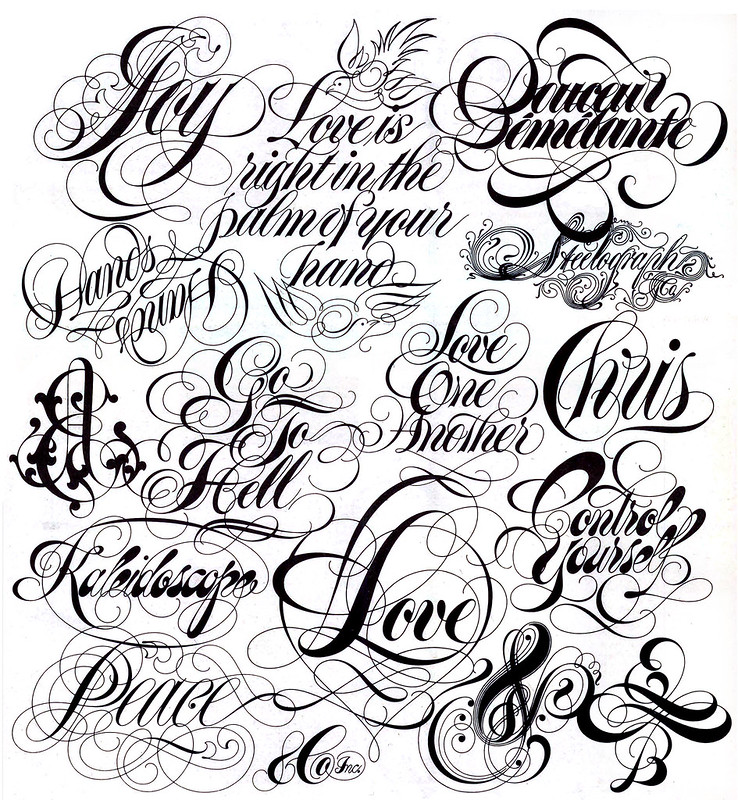
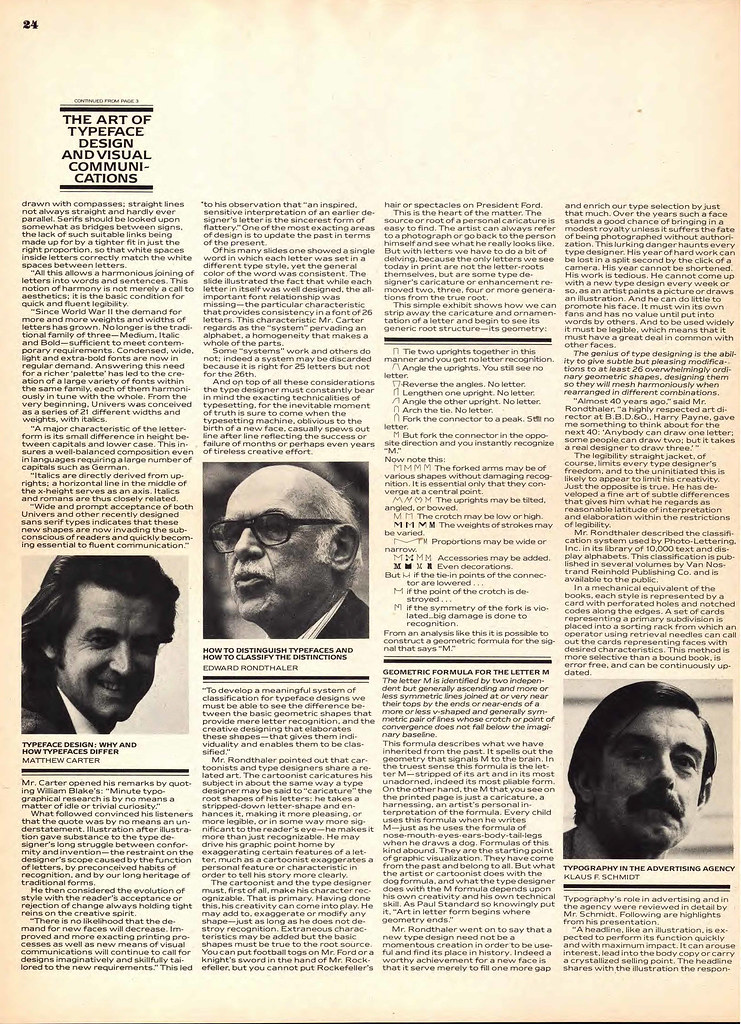
Upper & Lowercase magazine
Art director: Herb Lubalin

This website is a brilliant resource where you can download entire issues.

http://blog.fonts.com/category/u&lc/

It's a great magazine. Even the simple text pages are elegant.
Upper & Lowercase
Upper & Lowercase
Upper & Lowercase
24 Jul 13:51

Artists in Action #868

by WillyC

Dizzy teaches
24 Jul 13:50

When Legends Gather #860

by WillyC

Chuck Berry and Carl Sagan
22 Jul 14:36

The New York Review of Video Games 2015.

by noreply@blogger.com (Celyn)

  • The New York Review of Video Games asked me about my favourite childhood computer game. Alien-8 of course. It was a close call between that and Elite. Turned out weird I think.


  • 21 May 13:35

    design-is-fine: G.W. Gene, cover illustration for The Invisible...


    design-is-fine:

    G.W. Gene, cover illustration for The Invisible Host by Gwen Bristow & Bruce Manning, 1930. The Mystery league, New York. Via SwannGalleries

    21 May 13:34

    Photo


    21 May 13:34

    japaneseaesthetics: Votive mask of the god of stoves...


    japaneseaesthetics:

    Votive mask of the god of stoves (Kamadomen), Japan, Tohoku region, wood, 60 x 39 x 19 cm, Edo period, 18th to early 19th century, Japan

    28 Apr 12:15

    Everything is Architecture

    by Geoff Manaugh
    [Image: An "unofficial illustration" of the idea by Huntington Ingalls, via gCaptain].

    A Washington state legislator has channeled his inner Hans Hollein, proposing the radical adaptive urban reuse of discarded military equipment: turning old aircraft carriers into a new toll bridge for Seattle.

    From gCaptain:
    A Washington state lawmaker looking to ease traffic congestion for several Puget Sound-area communities near Seattle has proposed building an eye-catching new toll bridge made from retired Navy aircraft carriers.
    It would involve at least two—although possibly many more—aircraft carriers laid "end to end" to cross a local stretch of water known as the Sinclair Inlet.

    "This would definitely be a unique way to tackle some of those problems," the representative stated to the AP, "but at the same time it would serve as a floating memorial to veterans and the sacrifice they have given to our country."

    [Image: "Aircraft Carrier City in Landscape, project, Exterior perspective," by Hans Hollein (1064); via MoMA].

    Just think of the epic possibilities here for pedestrian paths, interstitial business opportunities, weird spaces for physical fitness, peripheral plazas and decks available for private events, and new public park space.

    Perhaps even, deep in the labyrinth of the old ships' underbellies, you could open a restaurant, a bookstore, a cinema. A SCUBA academy. An architecture school.

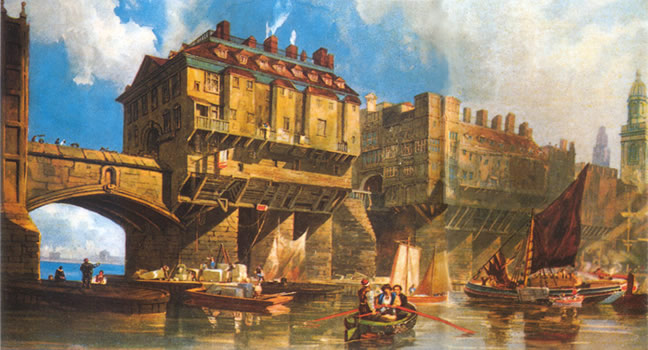
    It would be like a return to the inhabited bridges of an earlier age —

    [Images: (top) Old London Bridge; (bottom) Old London Bridge painted by Peter Jackson.

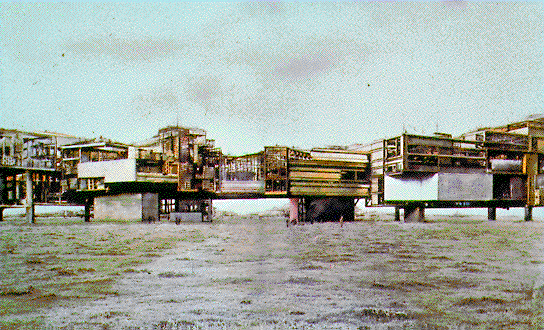
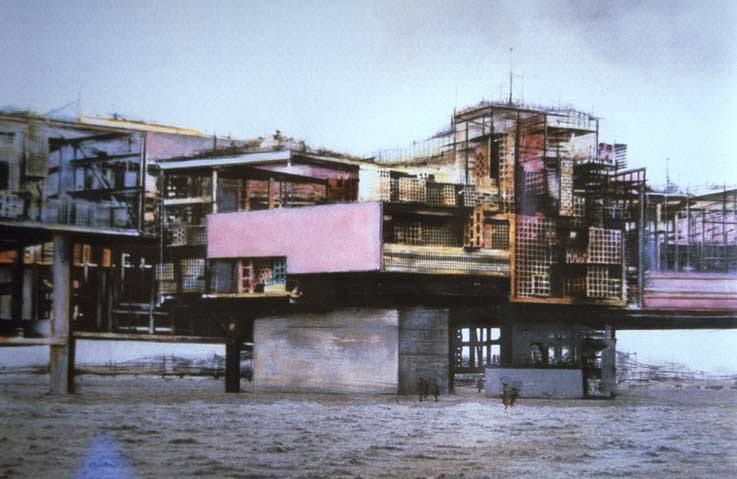
    —only gunmetal grey and prickly with artillery, like a surreal hybridization of Constant's New Babylon and the U.S. Navy.

    [Images: Constant's New Babylon].

    Of course, this isn't exactly a real plan—it's more of a casual remark by a state politician. No feasible studies, environmental reviews, or financial plans have yet been put in place, for example (although apparently one is in the works), and I personally doubt that such a thing could ever see the light of day.

    But here's to weird architectural visions popping up in unexpected contexts—and to the future civilian reuse of discarded military equipment, even (or especially) in spectacular urban ways such as this.

    (Spotted via Todd Lappin. Those images of Old London Bridge and Constant's New Babylon also appeared in an earlier post on BLDGBLOG called We'd all be living in dams).
    28 Apr 12:14

    Box Kites, Planes, and Super-Ceilings

    by Geoff Manaugh
    Here are some interesting houses by Greek architect Takis Zenetos, whose work we first looked at way back in 2009.

    [Image: House by Takis Zenetos (1961) from Takis Ch. Zenetos (1926-1977)].

    I will confess to knowing almost nothing about these projects, but I wanted to post the images anyway; they're from a book called Takis Ch. Zenetos (1926-1977), which was originally pointed out to me in the comments of that earlier post.

    [Image: House by Takis Zenetos (1961) from Takis Ch. Zenetos (1926-1977)].

    The designs draw heavily on cantilevers and porches, presumably in response to some difficult hillside sites, but incorporating the planes, glass, and open views typical of domestic Modernism.

    [Image: House by Takis Zenetos (1961) from Takis Ch. Zenetos (1926-1977)].

    As such, these could just as well be found in the hills of Los Angeles or even San Francisco.

    This next home is a variation on the same basic vocabulary, from the same year (1961), this time apparently in a vineyard or other semi-rural setting.

    [Images: Another home by Takis Zenetos (1961) from Takis Ch. Zenetos (1926-1977)].

    As you can see in that last sketch (bottom right), his houses are almost like Corbusian airplanes—Modernist box kites the size of houses—trying to lift off from the earth.

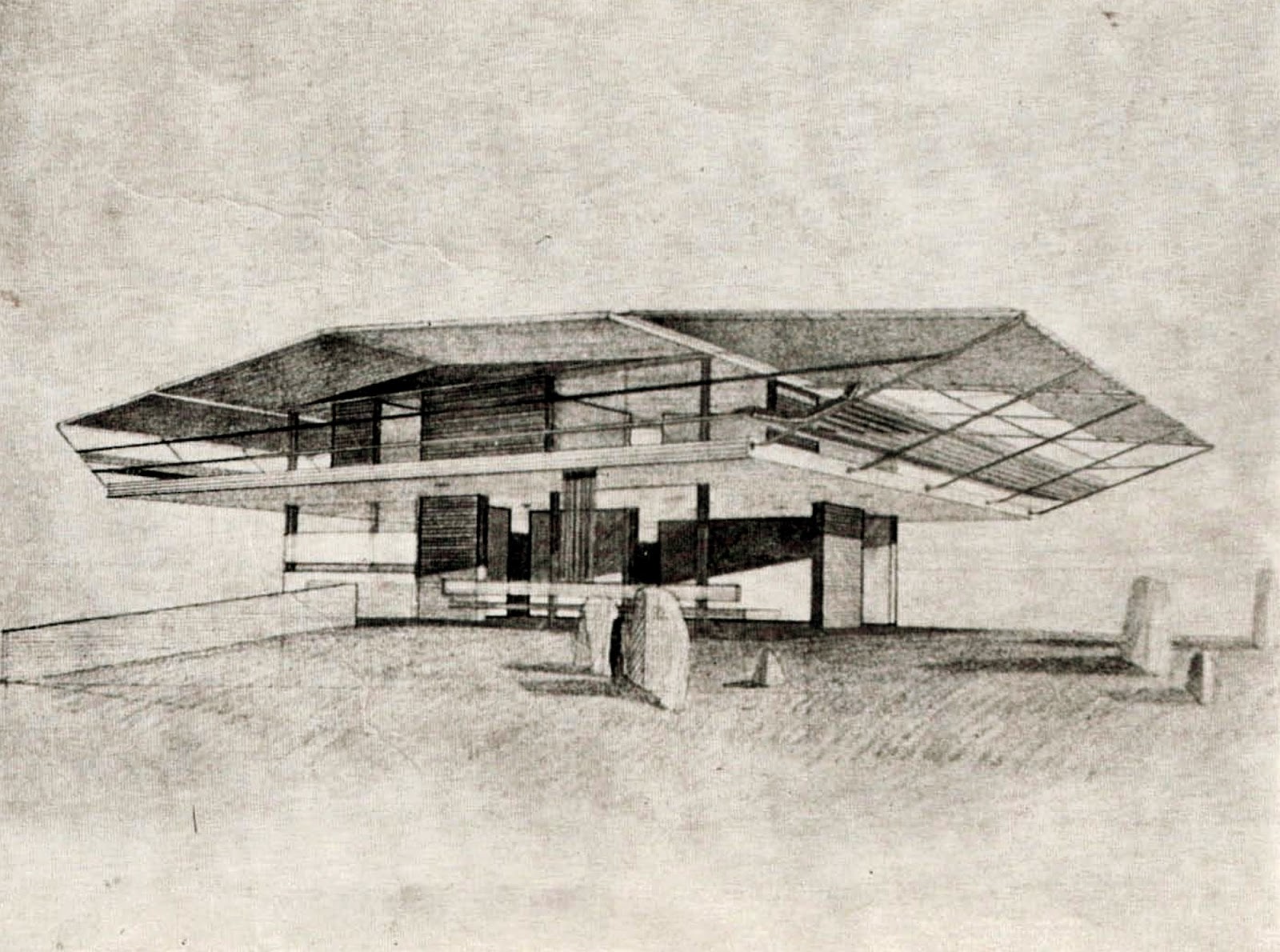
    Then a sketch from 1962 really abstracts all this to a pure assemblage of planes in space, just rooftops and cantilevers hanging over the landscape.

    It's the home as super-ceiling.

    [Image: A sketch from 1962 by Takis Zenetos, from Takis Ch. Zenetos (1926-1977)].

    It basically distills the structure of this next project, another hillside house from 1959.

    [Images: House by Takis Zenetos (1959) from Takis Ch. Zenetos (1926-1977)].

    This one really could be in Los Angeles, for its aggressive cantilever out over the canyon or gorge below.

    But now check out this next project, a stunning proposal from 1954 for some kind of amphitheater hewn directly into the landscape, then framed by monolithic blocks of Modernist rock.

    [Image: A proposal from 1954 by Takis Zenetos, from Takis Ch. Zenetos (1926-1977)].

    It's as much a quarry as it is a building, as much a building as it is just an inspired reorganization of the site's geology.

    It also seems like a set designer's dream—a craggy, otherworldly gathering place like something from the Greek myths (or a level in a future computer game).

    [Image: Alas, I don't have this in higher res; a proposal from 1954 by Takis Zenetos, from Takis Ch. Zenetos (1926-1977)].

    Finally, purely for its eye candy, here is a project that is either part of a hotel, a restaurant, or a club, from 1956.

    [Image: A proposal from 1956 by Takis Zenetos, from Takis Ch. Zenetos (1926-1977)].

    For more Zenetos, check out the earlier post here on BLDGBLOG and follow some of the many links in the comment thread. And, of course, if you read Greek and have some insight into what these projects actually are, by all means, let us all know!
    28 Apr 12:13

    An Evening's Diversion in the Neon Wilderness #2

    by Tom Sutpen
    28 Apr 12:12

    Photographer Jessica Fulford-Dobson Captures the Joy of Young Afghan Skateboarders

    by Kate Sierzputowski

    Jessica-Fulford-Dobson_03-700
    All images © Jessica Fulford-Dobson

    All images © Jessica Fulford-Dobson

    Skateistan_135-(1)-700

    Skateistan_097-700

    Skateistan_149-700

    140511-161554-Skateistan-Kabul-AFG

    Australian skateboarder Oliver Percovich created the non-profit Skateistan in 2007, a grassroots project that connects youth and education through skateboarding in Afghanistan. The organization, which has since grown to an award-winning international NGO, caught the attention of London-based photographer Jessica Fulford-Dobson and inspired her to visit the program in Kabul in 2012—especially after learning 45% of the students were female.

    In Afghanistan skateboarding has spread to become the number one sport for women, as they are forbidden to ride bicycles. Soon after arriving and entering the girl’s world, Fulford-Dobson was accepted by the young Afghan skateboarders. She photographed the girls with natural light, helping to expose their personalities through simple portraits. Within the images you can see the girls’ natural confidence, images that capture the subjects both posed and candidly skating through the indoor facility.

    “I met so many impressive women and girls in Afghanistan: a teacher as tough and determined as any man; young Afghans in their early twenties who were volunteering at an orphanage and were passionate about being seen as strong and willing to fight for themselves, rather than as victims of circumstance; and girls who were being educated to be leaders in their communities and who were already thinking carefully about their own and their country’s future,” said Fulford-Dobson.

    Fulford-Dobson won 2nd prize in the 2014 Taylor Wessing Photographic Portrait Prize with Skate Girl, 2014 (one of the photographs taken while on location in Kabul) and her exhibition Jessica Fulford-Dobson: Skate Girls of Kabul opens at Saatchi Gallery in London on April 15 and runs until April 28, 2015. You can donate to Skateistan’s program in Kabul as well as other cities here. (via feature shoot)

    28 Apr 12:11

    Designer Sylvain Viau Imagines the Hover Cars We Were Promised

    by Christopher Jobson

    hover-1

    For his ongoing series Flying Cars, French designer Sylvain Viau digitally edits photographs of cars into sleek, wheel-less hover cars that appear to float just above the ground. Viau not only uses his own photography to create these sci-fi cars, but is fortunate to claim many of the actual cars among his own collection. He originally worked only with 80s Citroën vehicles because of their classic space-age design, but has continued to branch out over the last few months to include cars from Peugeot, Toyota, and Renault. You can see many more here. (via Designboom)

    Update: Photographer Renaud Marion created a similar series of works in 2013.

    hover-2

    hover-3

    hover-4

    hover-5

    hover-6

    hover-7

    hover-8

    hover-9

    28 Apr 12:10

    Visually Stunning Nature Footage Edit Set to “Hello Tomorrow” by Karen O

    by Christopher Jobson

    Hey, Happy Earth Day! What better way to celebrate than watching remarkable footage of wildly random creepy crawly things in slow motion set to Hello Tomorrow by Karen O. You definitely need sound for this so turn up the volume for full effect. After a week of asking around I’ve learned only that the clip was edited together by Roen Horn using footage from somewhere I can’t identify.

    nature-1

    nature-2

    nature-3

    Update: Well that was quick. Almost all of these appear to be various BBC and National Geographic clips including BBC’s Life, World’s Weirdest, and BBC Weird Nature. (thnx, Tyler & Patricia)

    28 Apr 12:07

    The Inverted Architecture and Gravity-Defying Worlds of Cinta Vidal

    by Christopher Jobson

    cupula-cintapinta-1-large

    In her latest series of paintings, Barcelona-based artist and illustrator Cinta Vidal Agulló defies gravity and architectural conventions to create encapsulated scenes of intersecting perspectives. Painted with acrylic on wood panels, Vidal refers to the paintings as “un-gravity constructions” and says that each piece examines how a person’s internal perspective of life may not match up with the reality around them. The intersecting planes on many of her paintings are somewhat reminiscent of drawings by M.C. Escher, where every angle and available surface is inhabited by colorful characters going about their daily lives. She shares in a new interview with Hi-Fructose:

    With these un-gravity constructions, I want to show that we live in one world, but we live in it in very different ways – playing with everyday objects and spaces, placed in impossible ways to express that many times, the inner dimension of each one of us does not match the mental structures of those around us. The architectural spaces and day-to-day objects are part of a metaphor of how difficult it is to fit everything that shapes our daily space: our relationships, work, ambitions, and dreams.

    Vidal just opened a new exhibition of work at Miscelanea BCN in Barcelona and you can read an in-depth conversation with the artist on Hi-Fructose.

    cupula-cintapinta-1

    cupula-cintapinta-3

    cupula-cintapinta-stairs

    cupula-cintapinta-5

    cupula-cintapinta-6

    cupula-cintapinta-7

    10 Apr 22:59

    The Gunslinger Guide to Natalie Wood #39

    by Tom Sutpen
    10 Feb 03:35

    An Evening's Diversion in the Neon Wilderness #1

    by Tom Sutpen
    28 Nov 15:04

    First of the last Space Shuttle launches - The Big Picture - Boston.com

    by pocra
    18 Nov 13:56

    People Blocks 2

    by andy

    PB2_GROUP_1

    PB2_PIERRE_BOX

    PB2_JACQUES_1

    PB2_MIX_2

    PB2_GROUP2

    PB2_MIX_1

    PB2_LUC_BOX

    People Blocks 2 is a limited edition artist sculpture series.
    Designed by Andy Rementer and produced by Case Studyo.

    Available at casestudyo.com

    Watch the teaser animation

    18 Nov 11:12

    rocketslime: nubbsgalore: photos by lassi rautiainen, susan...


    lassi rautiainen


    lassi rautiainen


    staffan widstrand


    staffan widstrand


    lassi rautiainen


    susan brookes


    lassi rautiainen

    rocketslime:

    nubbsgalore:

    photos by lassi rautiainen, susan brookes and staffan widstrand of a rare friendship that developed between a female grey wolf and a male brown bear in northern finland.

    notes lassi, “no one can know exactly why or how the young wolf and bear became friends, but i think that perhaps they were both alone when they were young and a bit unsure of how to survive alone. it seems to me that they feel safe being together.”

    the photographers also note that the two share every meal together, bringing each other their kills (as seen in the third and fifth photos).

    earbackwards armlessbear
    17 Nov 17:23

    same same but different, hi-mi-zu: Yamikin Ushijima-kun

    by joenagle
    17 Nov 17:23

    MAGNETIC

    by comkee
    17 Nov 17:23

    OTAKU GANGSTA

    by researchinstitute
    17 Nov 16:57

    Some Herb

    by noreply@blogger.com (Jaypeg)
    UandLC-01

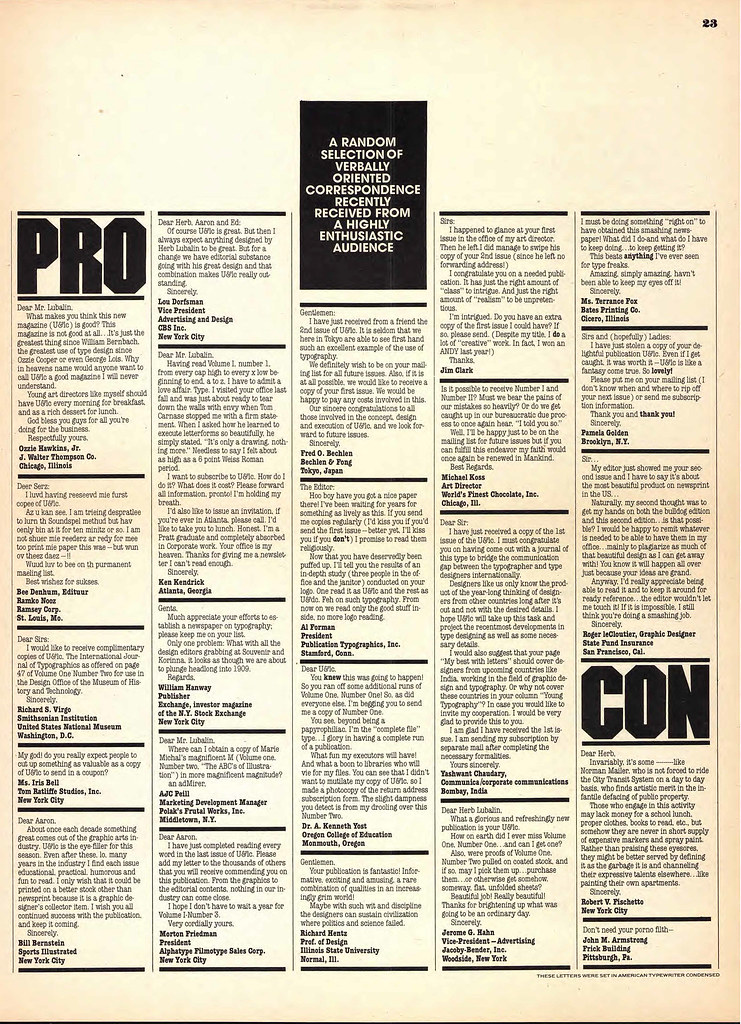
    Upper & Lowercase magazine
    Art director: Herb Lubalin

    This website is a brilliant resource where you can download entire issues.

    http://blog.fonts.com/category/u&lc/

    It's a great magazine. Even the simple text pages are elegant.
    Upper & Lowercase
    Upper & Lowercase
    Upper & Lowercase
    13 Nov 16:01

    Photo


    13 Nov 16:00

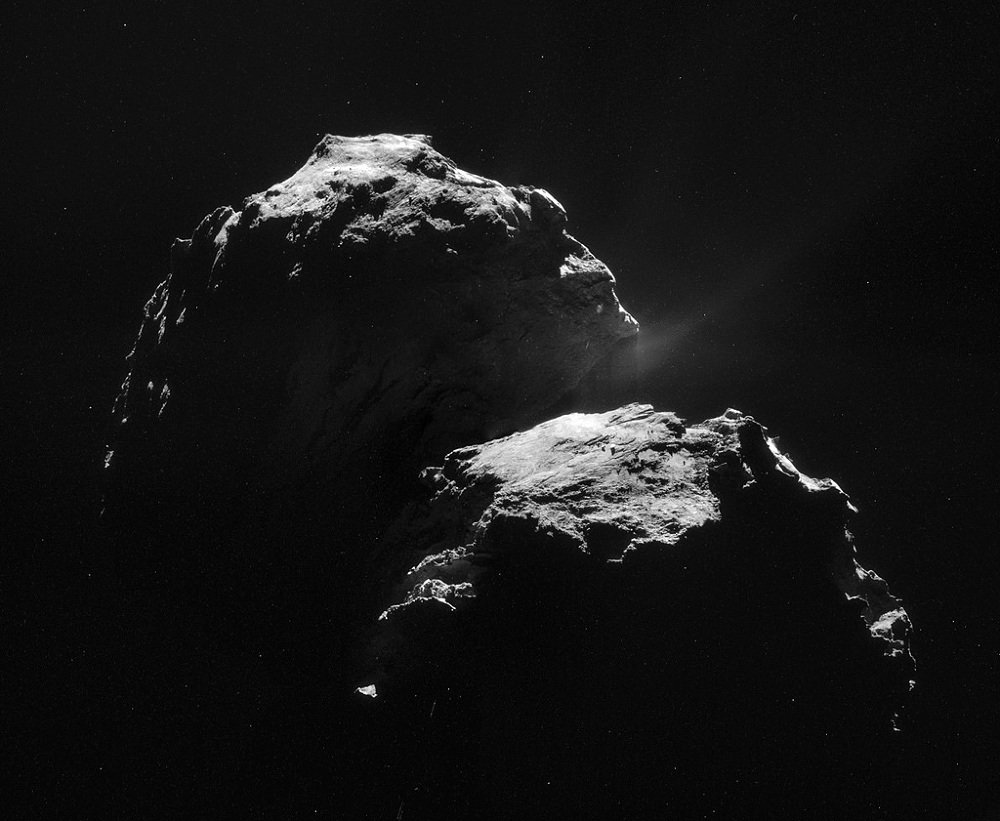
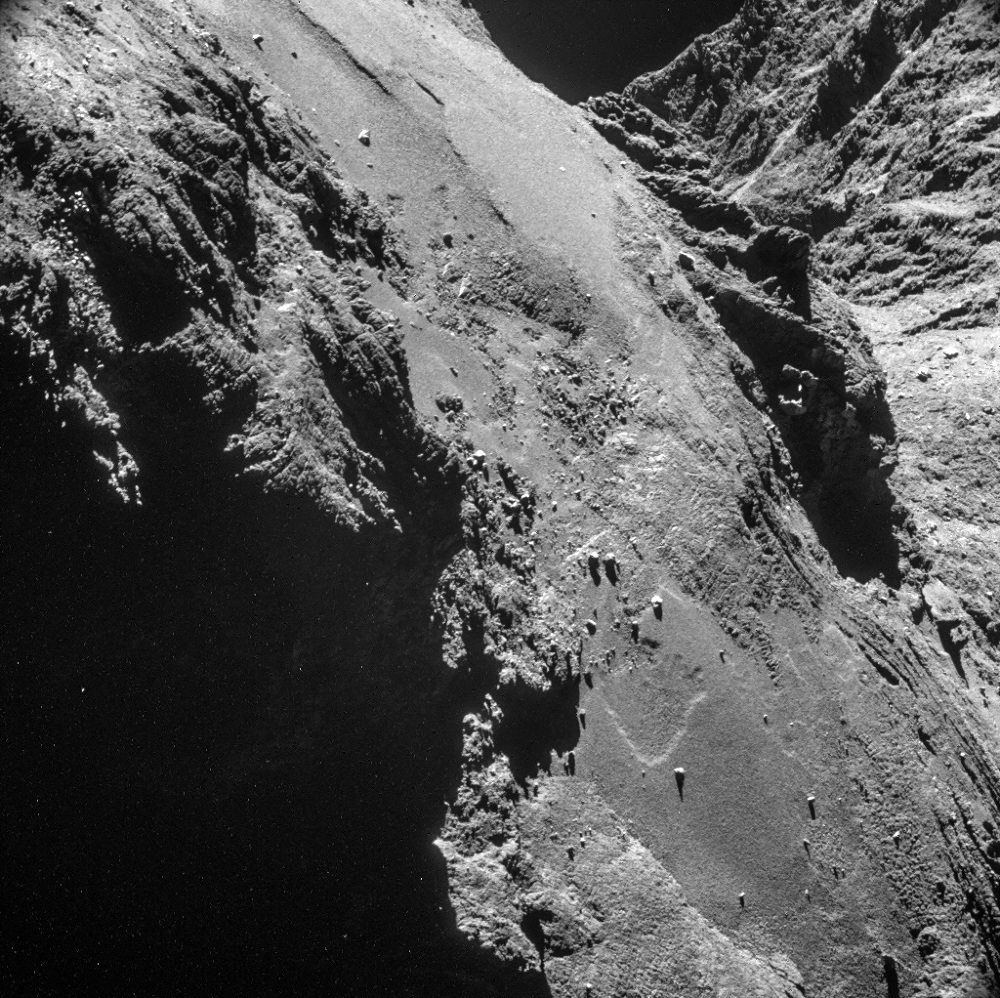
    If one could know whether among that glittering host there were here and there other spirit-inhabited grains of rock and metal, whether man’s blundering search for wisdom and for love was a sole and insignificant tremor, or part of a universal movement!

    by but does it float
    Photos of the comet 67P/Churyumov–Gerasimenko by the Rosetta spacecraft Title: Olaf Stapledon, Star Maker Also: The Singing Comet Folkert
    13 Nov 16:00

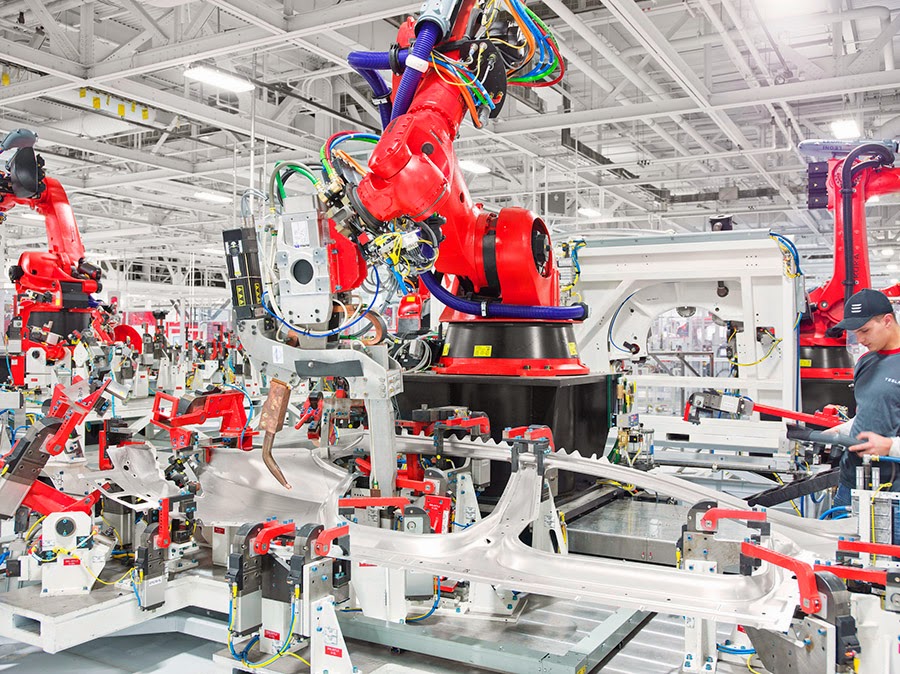
    Amongst the Machines: A Visit to the Tesla Factory

    by Geoff Manaugh
    [Image: Outside the Tesla factory; Instagram by BLDGBLOG].

    The coolest thing about a tour of the Tesla factory out in Fremont, California, is the huge metal-stamping machine—a behemoth piece of equipment that applies more than five thousand tons of pressure in order to mold metal parts in an instant. In fact, it was not even the company's largest stamping machine, which was offline the afternoon I went through.

    You hear this thing long before you see it: a thundering and resonant split-second blast that sounds more like a minor-key chord being sledgehammered out into the cavernous factory. Then the machine cycle repeats itself: parts are removed, dragged, and rattled into place, followed by the preliminary crash of a new metal sheet being lowered into the bay. Then bam, that weird sound again, equal parts dark ambient soundscape and sci-fi howl.

    Strangely, though, there is an air of melancholy to the sound—a kind of unexpected pathos—as if the machine had accidentally been tuned to some minor and wistful harmonic. The instantaneous hydraulic detonation of what sounds like an organ chord thus rings out, augmented by the foot-shuddering bass of the stamp itself, which sends small earthquakes rolling through the floor. (In fact, this reminded me that the factory is more or less directly above the Hayward Fault and I began to wonder what seismic effects such a colossal machine might actually be having.)

    The machine only got louder and louder as we wound our way through a complicated back-turning maze of welding walls and robot arms. Finally visible, it seemed to be made entirely of gates: a giant red portal through which shaped metal could pass.

    [Image: The red gates of metal-stamping machine; photo courtesy of Tesla].

    As we stopped to watch, the slow rhythm of its sounds matched up with processional movements now visible deep inside the cathedral-sized device, and the overall process began to make more sense.

    Two men in full ear protection stood there, silhouetted against the mouth of the machine, presumably hypnotized by its otherworldly, repetitive soundtrack—or maybe that was just me, perhaps overly willing to hear, in the looped noise of this exotic machine, music that wasn't really there.

    In any case, I was on the tour as part of a workshop run last week at the UC Berkeley College of Environmental Design, with students from Nicholas de Monchaux's course at Berkeley and a small group visiting from Smout Allen's & Kyle Buchanan's Unit 11 over at the Bartlett School of Architecture in London.

    [Image: Photo courtesy of Tesla].

    The idea behind the tour was not only to see robots at work but to experience the spatial logic of a factory, its interior the size of 80 football fields broken down into sequential functions and clusters, with color-coded circulation diagrams painted directly onto the concrete floor.

    At least those were the paths meant for humans. For self-driving robots, long curving whirls of magnetic tape had been applied to the floor, forming cursive, counter-directional arabesques that only made sense when you considered the aggressive turning radii of those bulky machines.

    It was the robot-readable world firsthand, or an indoor landscape architecture for machines.

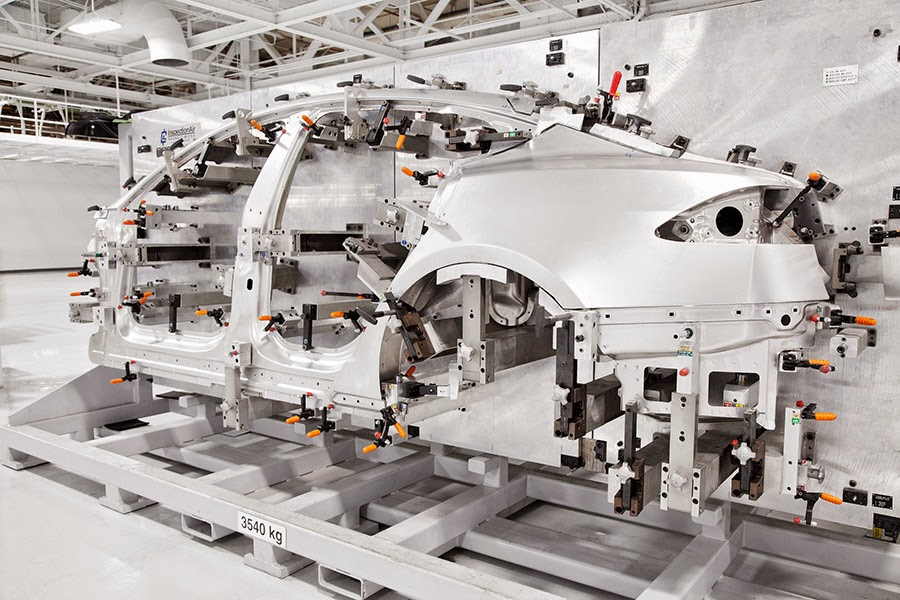
    There is a strict no-photo policy in place, unfortunately, and you are obliged to sign a non-disclosure agreement prior to entering the facility, so the only interior photos I have to show are from Wikipedia and Tesla's own press page.

    [Image: Photo by Steve Jurvetson, via Wikipedia].
    The actual tour is very much in the vein of a corporate sales pitch, and it is delivered with true American gusto (and at very high volume), but it's worth taking. Technically, by entering the factory you step into a foreign free-trade zone, which, for anyone else reading Keller Easterling's new book, is an interesting thing to do in person, like entering a corporate eruv.

    Once inside, you see things like aluminum rapid-injection molds, laser-cutting stations, and emergency "light curtains" dividing humans from the machines they steward. You see "laser-calibration trees," or knobby poles branching with small geometric ornaments; they are used by laser-scanners for re-booting themselves after measuring the frames of new cars.

    At the very end of the process, you see massive, Japanese-made robots lifting entire finished Teslas overhead as if they're feathers. Each machine has been named by Elon Musk after X-Men characters: there is Thunderbird and Cyclops, Storm and Colossus, Xavier, Changeling, Ice Man, Wolverine, and Angel.

    [Image: Photo courtesy of Tesla].

    And, perhaps best of all, you might be lucky enough to see engineers training new robots for eventual roles in the assembly process.

    Our tram slowed down for just a few seconds so we could watch a woman, less than two-thirds the size of the mechanical arm lurching back and forth in front of her, patiently coding new movements into the gyroscopes and actuators inside the machine.

    Uncertain of what we were seeing, we tried to make sense of the drunken movements on display, which looked more like a snake hypnotized by its master, swaying side to side like a cobra being woken up from a dream.

    At one point, our tour guide gestured out at literally dozens—perhaps hundreds—of new robots still under plastic wrap, all awaiting training and installation. The factory is expanding dramatically as Tesla gears up for the release of their new SUV.

    We have "an army of robots under plastic," the guide said enthusiastically, and he laughed. If there's ever a robot uprising, he joked, this is probably not the best place to be.

    [Image: Photo courtesy of Tesla].

    It seems that our group's educational affiliation made getting a tour much easier, but you can try your own luck using Tesla's Contact page.
    29 Oct 16:22

    Mangeurs d'âmes

    by Filo Loco
    Pierre Fromentin. André Bonne Editeur. 1958.
    Filo Loco
    29 Oct 14:00

    The Parisianer

    by admin

    Parisianer-page-E-Ponzi

    The Parisianer

    The Parisianer est né de l’envie de deux illustrateurs parisiens de réunir un grand nombre d’artistes autour d’un projet : réaliser la Une d’un magazine imaginaire qui exprimerait sa vision subjective de Paris.
    En hommage au couvertures du New Yorker, cet exercice de style présenterait un panel d’interprétations poétiques, éclectiques et surprenantes de la capitale.
    Read more here
    28 Oct 16:52

    The Civic Minimum

    by Geoff Manaugh
    [Image: From Gravesend—The Death of Community by Chris Clarke].

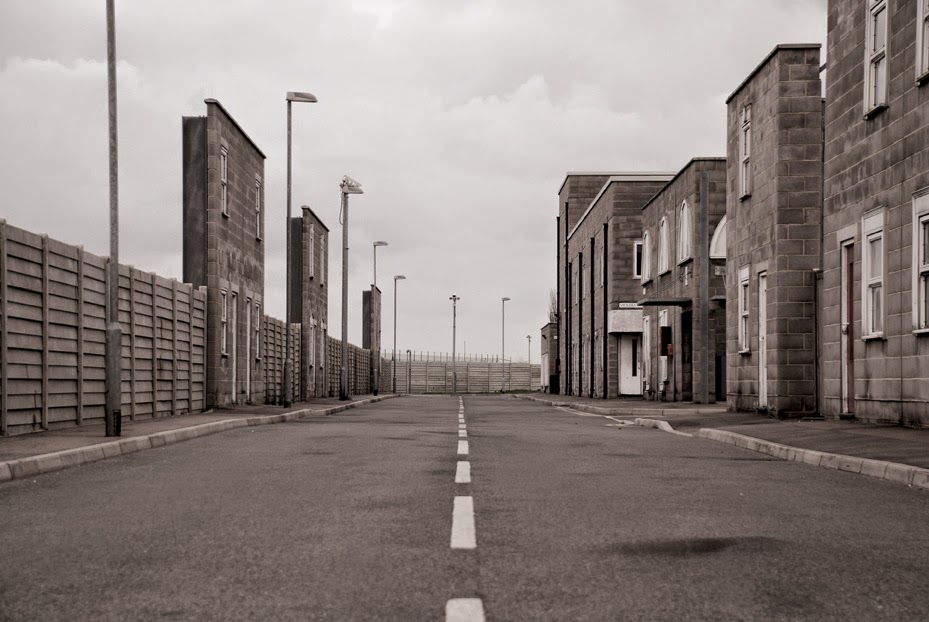
    Gravesend is a suburb east of London, hosting on its own eastern edge something of a secondary suburb: a mysterious town on the edge of town that turns out not to be a town at all.

    It is a simulated English village built in 2003 by the Metropolitan Police working with Equion Facilities Management and a firm called Advanced Interactive Systems (AIS).

    The barren streets and hollow buildings of this militarized non-place were designed for use as an immersive staging ground for police-training exercises, fighting staged riots, burglaries, bank robberies, and other crimes.

    [Image: From Gravesend—The Death of Community by Chris Clarke].

    Facades with no buildings behind them line the empty streets; in some cases, it is only through the aerial views afforded by a service like Google Maps that this reality is made clear.

    Imitation bus stops, make-believe banks, and an oddly whimsical Pizzaland—like an end-times chain restaurant from Shaun of the Dead—sustain the illusion on the ground.

    [Image: From Gravesend—The Death of Community by Chris Clarke].

    Somewhat incongruously, an airplane fuselage also now rests beside a chainlink fence near the roadway, giving officers an opportunity to prepare for airplane hijackings.

    There are even empty Tube carriages parked outside town for improvisatory police raids.

    [Image: From Gravesend—The Death of Community by Chris Clarke].
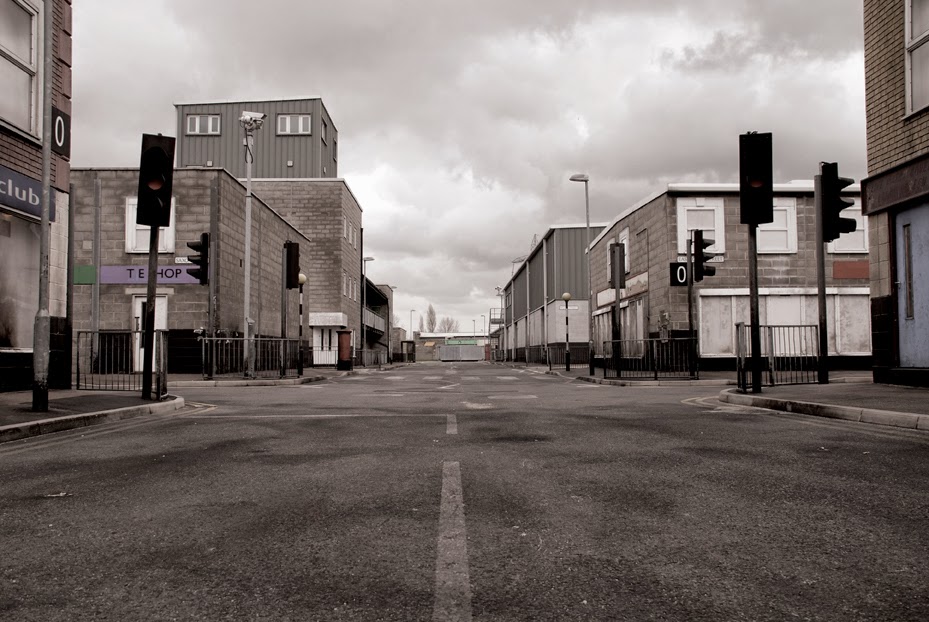
    According to AIS, their consultant-designers kitted out the site's "live-fire ranges with internal ballistic and anti-ricochet finishes, simulation and targetry equipment, and range sound systems," a complete multimedia package that would soon also include HD video projectors and even "laser-based 3D virtual training environments."

    Architectural simulations embedded with high-tech, upgradeable media technology thus supply the necessary level of detail for repeating crimes, on demand, like strange social rituals.

    [Image: From Gravesend—The Death of Community by Chris Clarke].
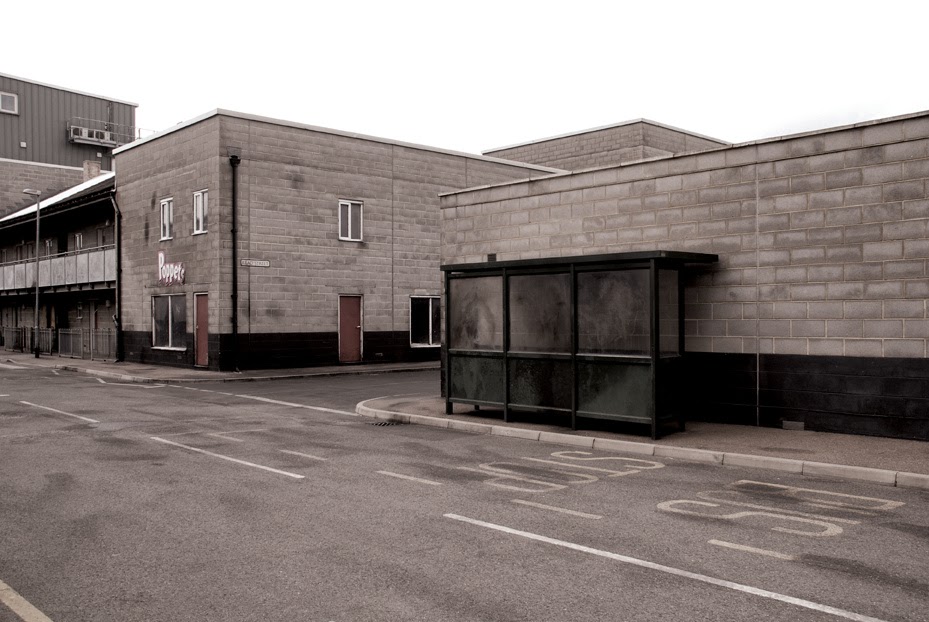
    The photos seen here were all take by designer and photographer Chris Clarke, whose Flickr set of the series, including a dozen or so further images, is worth a look.

    [Image: From Gravesend—The Death of Community by Chris Clarke].
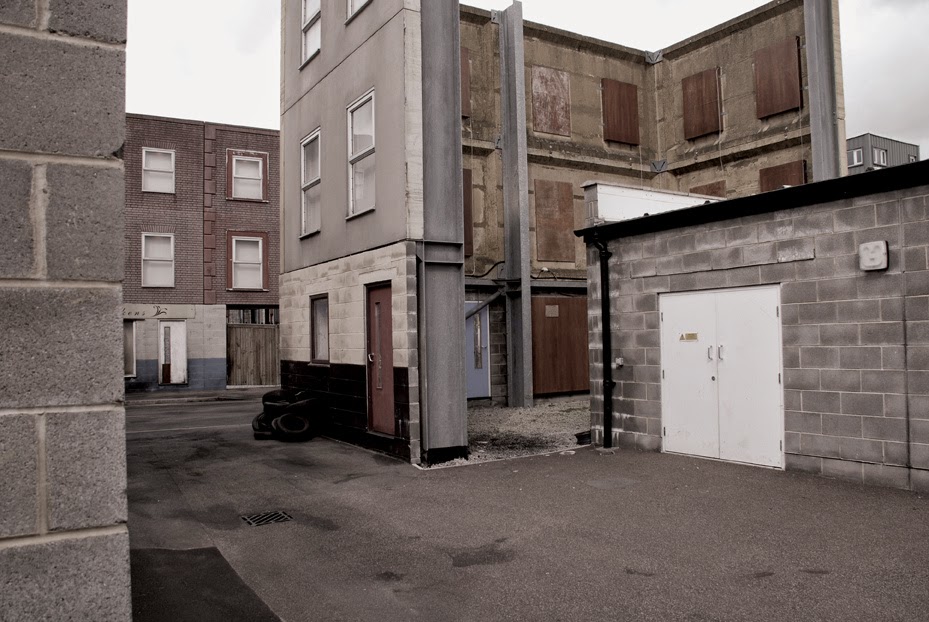
    For Clarke, the "facsimile" urbanism of this site at the end of Gravesend is actually something of "a warning—a prophecy of society's potential to alienate itself from itself." He suggests that these surreal scenes threaten to become indistinguishable from everyday life, our cities and streets stripped down to the civic minimum, used as nothing more than bleak stomping grounds for futuristic security forces armed with military-grade tools.

    "We have estates, parks, nightclubs, tube stations," Clarke writes, "but is the community missing from Gravesend significantly more present in our inhabited cities and towns?" His own answer remains unspoken but obvious.

    [Images: From Gravesend—The Death of Community by Chris Clarke].

    Writing about this same site back in 2008, Brian Finoki of Subtopia called it a "new theater of the absurd."

    It is, he wrote, "a city standing on the planet for one purpose: to be rioted, hijacked, trashed, held hostage, sacked, and overrun by thousands of chaotic scenarios, only so that it can be reclaimed, retaken, re-propped in circuitous loops of more dazzling proto-militant exercise, stormed by a thousand coordinated boots for eternity, targeted by hundreds of synchronized crosshairs of both lethal and non-lethal weapons."

    [Image: From Gravesend—The Death of Community by Chris Clarke].

    Check out more photos at Chris Clarke's Flickr page.

    (Related: In the Box: A Tour Through the Simulated Battlefields of the U.S. National Training Center).
    06 Oct 17:23

    Señor Gif - Page 17 - Funny Animated GIFs - Cheezburger

    by gatito
    patrick

    woahh !