Shared posts
Scientists observe coherent propagation of single spin impurity in a chain of ultracold atoms
graveyarddust: Urban Druid performing spirit sorcery in park,...
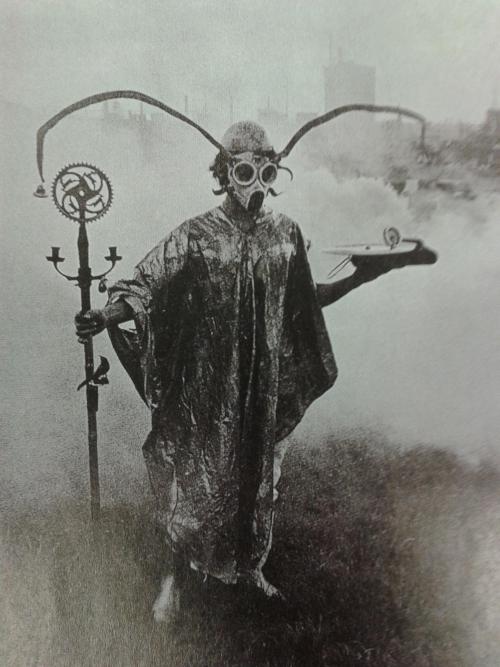
Urban Druid performing spirit sorcery in park, around year 1900. Well that’s just fucking cool.
Being an Android user is a lot like being a Mac user in the 90's.
- You must wait for applications everyone is talking about to get ported over.
- All the good games are on the other platform.
- People at work wonder why you’re using something different than everyone else.
- You can use themes just like Kaleidoscope for Mac OS 8.5 (your elders will remember).
These are just a few observations. We all know how Apple turned out in the 2000’s. I wonder what’s next for Android…
Note: I’ve switched to Android from iPhone for the time being to learn about “that other platform”. I know: We just released Basecamp on iOS. I love the app. You should download it now!!!
DRM is coming to HTML
Das W3C-Konsortium arbeitet an einem DRM-Mechanismus für HTML. <Ironie Mode>Oh, yes please!</Ironie Mode>
The W3C’s HTML Working Group recently decided that a proposal to add DRM to HTML media elements — formally known as the Encrypted Media Extensions proposal — is indeed within its purview and the group will be working on it.
That doesn’t mean that the Encrypted Media Extensions proposal will become a standard as is, but it does up the chances that some sort of DRM system will make its way into HTML.
The Encrypted Media Extensions proposal — which is backed by the likes of Google, Microsoft, Netflix and dozens of other media giants — technically does not add DRM to HTML. Instead it defines a framework for bringing a DRM system, or “protected media content” as the current draft puts it, to the web.
DRM for the Web? Say It Ain’t So
Mathematical breakthrough sets out rules for more effective teleportation
Schmidt, Daughter Talk About North Korea Trip


Read more of this story at Slashdot.

Owning vs. renting
You don't own attention or trust or shelf space. You don't even own tomorrow's plans.
It's all for rent, with a cancellation clause that can kick in at any time.
The moment you start treating the rental like a right, it disappears.
New study furthers Einstein's 'theory of everything'
Could Camels Cure Cancer? [Life Lines]

Image of camel from ukmedix news.
Researchers from King Abdulaziz University (Jeddah) have tested the effectiveness of micro and nanoshells for delivering a substance from camel urine, PMF701, thought to be a cure for cancer. These findings will be presented at the 2nd Biotechnology World Congress (Feb 18-21).
PMF701, not yet approved by the Saudi Food and Drug Authority, is currently in clinical trials. In a quote published by SciDev.net, the head of the university’s tissue culture unit and the principal investigator of the project Faten Abdel-Rahman Khorshid stated, “We made a natural product medicine, proved its safety and efficiency in vitro [in test tubes] and in vivo on animal models, and finished phase I clinical trials on healthy volunteers with no side effects”.
More research is needed to test the ability of this controversial therapy at treating cancer. In another quote from SciDev.Net, Dr. Edzard Ernst, Emeritus Professor in Complementary Medicine from the University of Exeter (UK) stated, “There is no evidence here that this new treatment does anything to the natural history of human cancers. Even if there were positive results, it would be wise to wait for independent replications.”
It will be interesting to watch the progress of this research.
Sources:
2nd Biotechnology World Congress
F. Khorshid, H. Alshazly, A. Al Jefery and Abdel-Moneim M. Osman, 2010. Dose Escalation Phase I Study in Healthy Volunteers to Evaluate the Safety of a Natural Product PM701. Journal of Pharmacology and Toxicology, 5: 91-97.
World's First Digital Laser Designed and Built in Africa
African physicists build the first laser with a beam that can be controlled and shaped digitally.
Lasers are one of the emblematic technologies of the modern world. The chances are that most readers will be less than a metre away from a laser of some kind as they read this. Lasers fill our world.
Wow. So Google Street View is now available for the Grand Canyon.
 Google strapped backpack-mounted cameras onto members of their team and sent them trekking through the Grand Canyon. The end result? Google Street View for Arizona's great gorge, though a more accurate description would probably be "Trail View"; according to the official Google Blog, the company's newly released interactive panoramas cover more than 75 miles of the Canyon's footpaths and surrounding roads — and holy crap, are they breathtaking. More »
This Tyke Could Knock You Out
Submitted by: Unknown
Tagged: Kickass Kid , parenting , boxing , BAMF , Video , g rated , win Share on FacebookMinecraft’s Notch on earning $101M in 2012: ‘It’s weird as f—’

In 2012, Minecraft creator Markus “Notch” Persson made $101 million.
That money came from sales of the building-block game on PC, mobile phones, and Xbox 360. Minecraft developer Mojang brought in a total of nearly $240 million.
“It’s weird as fuck,” Persson wrote in a post on content-aggregation website Reddit. “I grew up in a relatively poor family, but once I got a decent job, I never really had to worry about money. My hobbies were playing games and programming, so there wasn’t any real drain. I could eat out when I wanted to, and go to the movies without having to save up for it. I still had to save up for trips and to be able to buy computers or consoles, but that just felt normal.”
Naturally, that all changed when his simple indie game became a breakout hit over the last few years.
Minecraft is a phenomenon. The game surpassed 1 million purchases in 2011 and continues to gain momentum. Most million-selling games do the majority of their sales in the first few weeks of release. It’s a testament to the appeal of Minecraft that the game sold a bulk of its 20 million total in 2012.
“Now, all of the sudden, as a result of how modern society works, I managed to somehow earn a shit-ton of money,” said Persson. “I still like playing games and programming, and once I had the latest computer and consoles, there really isn’t much more to spend the money on than traveling. I might eventually get a driver’s license so I can buy a car.”
Persson lives in Stockholm, Sweden. That’s where he grew up, and it is the location of Mojang’s headquarters.
He hasn’t worked on the day-to-day programming and designing of Minecraft since December 2011. Persson is currently working on a new game obtusely titled 0X10c.
Not much is known about 0x10c. It is a sandbox space game where players make their own fun. Although, the developer did reveal how to pronounce the game: Ten-to-the-see.
If you say so, Notch.
Now that Notch has more money than he knows what to do with, he’s also trying to figure out what to do with it.
“I think the right way to use money like this is to set a decent portion aside to make sure my family is comfortable, spend some on living out your dreams, and then try to put the rest toward making society a better place,” he wrote. “For me, this includes charities that help children, and charities that help promote freedoms I think are vital in the coming dozens of years, such as the Electronic Frontier Foundation.”
And since he has all the games he could want, what is he trying to play right now?
“Actually, I’m trying to play Ni No Kuni,” he wrote.
Filed under: Games, VentureBeat

Le samedi à Bamako, c'est le jour des discours ...
REM's "Losing My Religion" shifted into a major scale
Michael sez, "Someone has gone to the trouble (I don't know how but would suspect using Melodyne DNA or somesuch) of processing REM's minor-scale downer hit 'Losing My Religion' so that all the minor notes are now major. When I followed the link I thought it'd be a cover, but no, it's the original, processed. It's uncanny - the song is just as familiar as always but the impact is utterly different. Kind of like finding a colour print of a film you'd only known in black and white, or seeing Garfield minus Garfield for the first time. I like it."
Major Scaled #2 : REM - "Recovering My Religion"
(Thanks, Michael!)
Social Media: Pulse of the Planet?
In 2010, Hillary Clinton described social media as a new nervous system for our planet (1). So can the pulse of the planet be captured with social media? There are many who are skeptical not least because of the digital divide. “You mean the pulse of the Data Have’s? The pulse of the affluent?” These rhetorical questions are perfectly justified, which is why social media alone should not be the sole source of information that feeds into decision-making for policy purposes. But millions are joining the social media ecosystem everyday. So the selection bias is not increasing but decreasing. We may not be able to capture the pulse of the planet comprehensively and at a very high resolution yet, but the pulse of the majority world is certainly growing louder by the day.

This map of the world at night (based on 2011 data) reveals areas powered by electricity. Yes, Africa has far less electricity consumption. This is not misleading, it is an accurate proxy for industrial development (amongst other indexes). Does this data suffer from selection bias? Yes, the data is biased towards larger cities rather than the long tail. Does this render the data and map useless? Hardly. It all depends on what the question is.

What if our world was lit up by information instead of lightbulbs? The map above from TweetPing does just that. The website displays tweets in real-time as they’re posted across the world. Strictly speaking, the platform displays 10% of the ~340 million tweets posted each day (i.e., the “Decahose” rather than the “Firehose”). But the volume and velocity of the pulsing ten percent is already breathtaking.

One may think this picture depicts electricity use in Europe. Instead, this is a map of geo-located tweets (blue dots) and Flickr pictures (red dots). “White dots are locations that have been posted to both” (2). The number of active Twitter users grew an astounding 40% in 2012, making Twitter the fastest growing social network on the planet. Over 20% of the world’s internet population is now on Twitter (3). The Sightsmap below is a heat map based on the number of photographs submitted to Panoramio at different locations.

The map below depicts friendship ties on Facebook. This was generated using data when there were “only” 500 million users compared to today’s 1 billion+.

The following map does not depict electricity use in the US or the distribution of the population based on the most recent census data. Instead, this is a map of check-in’s on Foursquare. What makes this map so powerful is not only that it was generated using 500 million check-in’s but that “all those check-ins you see aren’t just single points—they’re links between all the other places people have been.”

TwitterBeat takes the (emotional) pulse of the planet by visualizing the Twitter Decahose in real-time using sentiment analysis. The crisis map in the YouTube video below comprises all tweets about Hurricane Sandy over time. “[Y]ou can see how the whole country lights up and how tweets don’t just move linearly up the coast as the storm progresses, capturing the advance impact of such a large storm and its peripheral effects across the country” (4).

These social media maps don’t only “work” at the country level or for Western industrialized states. Take the following map of Jakarta made almost exclusively from geo-tagged tweets. You can see the individual roads and arteries (nervous system). Granted, this map works so well because of the horrendous traffic but nevertheless a pattern emerges, one that is strongly correlated to the Jakarta’s road network. And unlike the map of the world at night, we can capture this pulse in real time and at a fraction of the cost.

Like any young nervous system, our social media system is still growing and evolving. But it is already adding value. The analysis of tweets predicts the flu better than the crunching of traditional data used by public health institutions, for example. And the analysis of tweets from Indonesia also revealed that Twitter data can be used to monitor food security in real-time.
The main problem I see about all this has much less to do with issues of selection bias and unrepresentative samples, etc. Far more problematic is the central-ization of this data and the fact that it is closed data. Yes, the above maps are public, but don’t be fooled, the underlying data is not. In their new study, “The Politics of Twitter Data,” Cornelius Puschmann and Jean Burgess argue that the “owners” of social media data are the platform providers, not the end users. Yes, access to Twitter.com and Twitter’s API is free but end users are limited to downloading just a few thousand tweets per day. (For comparative purposes, more than 20 million tweets were posted during Hurricane Sandy). Getting access to more data can cost hundreds of thousands of dollars. In other words, as Puschmann and Burgess note, “only corporate actors and regulators—who possess both the intellectual and financial resources to succeed in this race—can afford to participate,” which means “that the emerging data market will be shaped according to their interests.”
“Social Media: Pulse of the Planet?” Getting there, but only a few elite Doctors can take the full pulse in real-time.




The Rise of the Permanent Temp Economy - NYTimes.com
A quarter of jobs in America pay below the federal poverty line for a family of four ($23,050). Not only are many jobs low-wage, they are also temporary and insecure. Over the last three years, the temp industry added more jobs in the United States than any other, according to the American Staffing Association, the trade group representing temp recruitment agencies, outsourcing specialists and the like.
Low-wage, temporary jobs have become so widespread that they threaten to become the norm. But for some reason this isn’t causing a scandal. At least in the business press, we are more likely to hear plaudits for “lean and mean” companies than angst about the changing nature of work for ordinary Americans.
How did we arrive at this state of affairs? Many argue that it was the inevitable result of macroeconomic forces — globalization, deindustrialization and technological change — beyond our political control. Yet employers had (and have) choices. Rather than squeezing workers, they could have invested in workers and boosted product quality, taking what economists call the high road toward more advanced manufacturing and skilled service work. But this hasn’t happened. Instead, American employers have generally taken the low road: lowering wages and cutting benefits, converting permanent employees into part-time and contingent workers, busting unions and subcontracting and outsourcing jobs. They have done so, in part, because of the extraordinary evangelizing of the temp industry, which rose from humble origins to become a global behemoth.
The story begins in the years after World War II, when a handful of temp agencies were started, largely in the Midwest. In 1947, William Russell Kelly founded Russell Kelly Office Service (later known as Kelly Girl Services) in Detroit, with three employees, 12 customers and $848 in sales. A year later, two lawyers, Aaron Scheinfeld and Elmer Winter, founded a similarly small outfit, Manpower Inc., in Milwaukee. At the time, the future of these fledgling agencies was no foregone conclusion. Unions were at the peak of their power, and the protections that they had fought so hard to achieve — workers’ compensation, pensions, health benefits and more — had been adopted by union and nonunion employers alike.
But temp leaders were creating a new category of work (and workers) that would be exempt from such protections.
Wauquiez persiste et signe dans le bobard

Articles en rapport
- David Cameron accuse les travaillistes d'avoir fait fuir les riches
- Ces députés en première ligne autour du mariage pour tous
- L'obstruction parlementaire, une vieille pratique
- Mairie de Paris : Borloo décline l'offre
- Fromantin, Neuilly-son-maire
 |
 |
Stop Calling Illegal Downloading “Piracy” [Comic]

Le Forfait 24/24 de B&YOU reste
Le 6 novembre dernier, B&YOU lançait son Forfait 24/24 qui devait disparaître le 28 janvier. Fort de son succès, l’opérateur a décidé de définitivement l’intégrer dans sa gamme !
Pour rappel, le Forfait 24/24 propose pour 9,99€ / mois : les appels 24/24 vers fixes et mobiles en France ainsi que les SMS / MMS en illimité. Et en plus, 20 Mo sont inclus pour les petites mises à jour des applis (météo par exemple).

mihaip open sourced mihaip/google-reader-touch

40 Photos Of Celebrities Before They Hit The Big Time
Having random paparazzi leap out of bushes and attack you with a dazzling array of camera flashes & yelling countless questions into order to get a soundbyte is part and parcel of being famous. But it wasn’t always that way for some of the world’s best recognised celebrities.
Take their humble and trusty year book photos for example, often embarrassing and rarely worth celebrating, the highschool yearbook paints a definitive picture of who were the jocks, the nerds & the cheerleaders during those formative years. Nobody could predict what the future had in store for our collection of 40 celebrities, but it’s safe to say a few amount has changed since these shots we’re taken!
Some you will barebly be able to recognise, some just look mini versions of themselves – but all of them have one thing in common, this was just the start of many many photos to be taken of them in their lifetimes.
If you enjoy these, don’t forget to view our previous feature ‘Rare Photographs Of Iconic Celebrities Hanging Out Together’
1. George W. Bush Jnr

2. Matt LeBlanc

3. Lindsey Lohan

4. Bill Clinton

5. Matt Damon

6. Farrah Fawcett

7. Mila Kunis

8. Robert Downey Jr.

9. Owen Wilson

10. Rachel Zoe

11. Amy Poehler

12. Jason Alexander

13. Alec Baldwin

14. Steve Buscemi

15. Charlie Sheen

16. Jennifer Garner

17. Rooney Mara

18. Stanley Tucci

19. Madonna

20. Amy Adams

21. Joe Biden

22. John Mayer

23. Hilary Clinton

24. Jesse Eisenberg

25. Zooey Deschanel

26. Sarah Palin

27. Eva Mendes

28. Natalie Portman

29. Louis CK

30. Gwen Stefani

31. Anne Hathaway

32. Zachary Quinto

33. Claire Danes

34. Oprah

35. Channing Tatum

36. Zac Efron

37. Elizabeth Banks

38. Emma Stone

39. Blake Lively

40. Pamela Anderson

ENJOYED IT? SHARE IT!
Viol collectif en Inde: "La société indienne paie très cher la modernisation à marche forcée"

Après Depardieu, Brigitte Bardot menace de demander la nationalité russe


Rumour: 3DS Cartridge Could Allow Handheld to Function as Wii U Controller

A bucket of salt is needed for this one
Poutine signe un décret accordant la citoyenneté russe à Depardieu, qui est ravi
EXIL FISCAL - Poutine a signé un décret accordant la citoyenneté russe à Gérard Depardieu. Le président russe avait déclaré être prêt à accorder un passeport russe à l'acteur français Gérard Depardieu si celui-ci le souhaitait. "Si Gérard veut avoir un permis de séjour ou un passeport russe, c'est une affaire réglée, et de manière positive", a déclaré Poutine, interrogé lors d'une conférence de presse en décembre dernier sur des propos prêtés en France à l'acteur, qui a annoncé qu'il quittait le pays pour des raisons fiscales.
LIRE AUSSI : La décision russe change la donne pour la Belgique
"Poutine m'a déjà envoyé un passeport", avait déclaré l'acteur, selon des amis cités par le site du quotidien français Le Monde. Se sentant "injurié" par Jean-Marc Ayrault qui avait jugé "assez minable" son exil fiscal en Belgique, Gérard Depardieu a annoncé vouloir "rendre" son passeport français et envisager de prendre la nationalité belge.
Ledit décret russe :
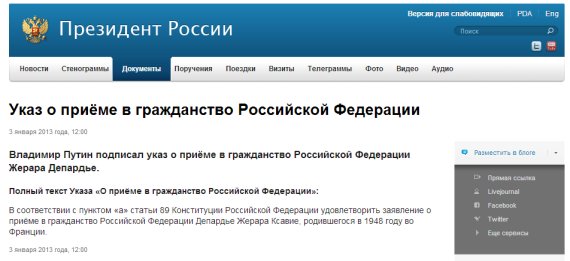
La traduction par Google translate :
Décret relatif à l'octroi de la citoyenneté de la Fédération de Russie3 janvier 2013, 12:00
Vladimir Poutine a signé un décret accordant la citoyenneté de la Fédération de Russie, Gérard Depardieu.
Le texte intégral de l'arrêté "Lors de son admission à la citoyenneté de la Fédération de Russie"
Conformément à l'alinéa "a" de l'article 89 de la Constitution pour satisfaire une demande de citoyenneté de la Fédération de Russie, Gérard Depardieu, Xavier, qui est né en 1948 en France.
Dans une lettre, Depardieu clame son amour à la Russie
Dans la soirée jeudi, la chaîne russe Piervyi Kanal a diffusé sur son antenne une lettre de l'acteur français destinée aux médias russes. Une missive d'amour à la Russie, dans laquelle Depardieu se montre ravi que sa demande de passeport ait été acceptée, tout en remettant un taquet à Jean-Marc Ayrault et son fameux "minable":
"Oui, j'ai fait cette demande de passeport et j'ai le plaisir qu'elle ait été acceptée. J'adore votre pays la Russie, ses hommes, son histoire, ses écrivains. J'aime y faire des films où j'aime tourner avec vos acteurs comme Vladimir Mashkov. J'adore votre culture, votre intelligence.Mon père était un communiste de l'époque, il écoutait Radio Moscou! C'est aussi cela, ma culture. En Russie, il y fait bon vivre. Pas forcément à Moscou, qui est une mégapole trop grande pour moi. Je préfère la campagne, et je connais des endroits merveilleux en Russie.
Par exemple, il y a un endroit que j'aime, où se trouve le Gosfilmofond dirigé par mon ami Nikolai Borodachev. Au bord des forêts de bouleaux, je m'y sens bien. Et je vais apprendre le russe.
J'en ai même parlé à mon Président, François Hollande. Je lui ai dit tout cela. Il sait que j'aime beaucoup votre Président Vladimir Poutine et que c'est réciproque. Et je lui ai dit que la Russie était une grande démocratie, et que ce n'était pas un pays où un premier ministre traitait un citoyen de minable.
J'aime bien la presse, mais c'est aussi très ennuyeux, car il y a trop souvent une pensée unique. Par respect pour votre président, et pour votre grand pays, je n'ai donc rien à ajouter. Si je veux ajouter encore sur la Russie, une prose qui me vient à l'esprit...
Que dans un pays aussi grand on n'est jamais seul, car chaque arbre, chaque paysage portent en nous un espoir. Il n'y a pas de mesquinerie en Russie, il n'y a que des grands sentiments. Et derrière ces sentiments beaucoup de pudeur. Dans votre immensité, je ne me sens jamais seul.
Slava Rossii!! (Gloire à la Russie!!, ndlr)
Spasibo!" (Merci!, ndlr)
Bienvenu en Tchétchénie
En octobre dernier, il avait participé à des célébrations officielles à Grozny, capitale de la Tchétchénie, au cours desquelles il avait lancé "Gloire à la Tchétchénie, gloire à Kadyrov", en s'affichant aux côtés de Ramzan Kadyrov, numéro un de cette république, accusé de multiples exactions par les ONG de défense des droits de l'homme. Ce dernier s'est dit mercredi prêt à accueillir l'acteur. "Gérard Depardieu a renoncé à la citoyenneté française. Il a ses raisons, autrement il ne l'aurait pas fait. Je n'ai pas l'intention de juger cet acte mais je peux déclarer sans aucun doute que nous sommes prêts à accueillir ce grand acteur", a-t-il déclaré, cité par l'agence Ria Novosti.
"C'est un homme avec un grand H, un humaniste. Et n'importe quel pays, à mon avis, lui ouvrirait ses portes sans hésiter", a-t-il ajouté.
Célèbre en Russie, Depardieu apparaît régulièrement dans diverses publicités. En novembre dernier il en a tourné plusieurs pour la banque Sovietski, pour une marque de ketchup ou encore pour un magasin d'alimentation.
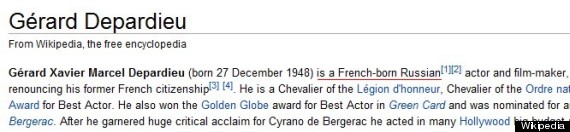
Enfin, à noter que la page Wikipedia anglaise de l'acteur a déjà été modifiée en conséquence sur le Web. Jugez par vous-même...
À LIRE AUSSI :
» Le billet de Jean-François Kahn
» Le billet de Guy Birenbaum
» Il rend son passeport
» Les pires tirades de Depardieu (dans la vraie vie)
» Copé, Lelouch et Barbelivien défendent Depardieu » BLOG - Les grands oubliés de l'affaire Depardieu sont les Belges
Facebook at its best

Submitted by: begotin
Posted at: 2012-10-16 23:27:29
See full post and comment: http://9gag.com/gag/5620228