18 Mar 13:49
by Ruyan Zhao, Chuandong Dou, Zhiyuan Xie, Jun Liu, Lixiang Wang
06 Mar 10:59
by Sergej Tamke, Zheng-Wang Qu, Nikolai A. Sitte, Ulrich Flörke, Stefan Grimme, Jan Paradies
Abstract
The first frustrated Lewis pair-catalyzed cycloisomerization of a series of 1,5-enynes was developed. The reaction proceeds via the π-activation of the alkyne and subsequent 5-endo-dig cyclization with the adjacent alkene. The presence of PPh3 was of utmost importance on the one hand to prevent side reactions (for example, 1,1-carboboration) and on the other hand for the efficient protodeborylation to achieve the catalytic turnover. The mechanism is explained on the basis of quantum-chemical calculations, which are in full agreement with the experimental observations.

Cycloisomerization without a metal: The first FLP-catalyzed C−C bond forming reaction is described as proceeding through a cycloisomerization/protodeborylation sequence. The reaction mechanism is supported by X-ray crystal structure analysis of intermediates, kinetic experiments, and by quantum-mechanical calculations.
09 Feb 13:58
by Elijah E. Gordon, Ke Xu, Hongjun Xiang, Annette Bussmann-Holder, Reinhard K. Kremer, Arndt Simon, Jürgen Köhler, Myung-Hwan Whangbo
Abstract

Under ultrahigh pressure (>110 GPa), H2S is converted into a metallic phase that becomes superconducting with a record Tc of approximately 200 K. It is proposed that in this phase a dissociation of 2 H2S into H3S+ and SH− is present, leading to the perovskite structure (SH−)(H3S+). This phase consists of corner-sharing SH6 octahedra with SH− ions at the center of each S8 cube.
09 Feb 12:46
by Andrew Shamp, Tyson Terpstra, Tiange Bi, Zackary Falls, Patrick Avery and Eva Zurek

Journal of the American Chemical Society
DOI: 10.1021/jacs.5b10180

31 Jan 12:30
Chem. Soc. Rev., 2016, 45,1129-1144
DOI: 10.1039/C5CS00815H, Review Article
Gernot Frenking, Markus Hermann, Diego M. Andrada, Nicole Holzmann
Donor-acceptor complexes of one, two or three atoms E = B, Si-Sn which are stabilized by [sigma]-donor ligands L are discussed.
The content of this RSS Feed (c) The Royal Society of Chemistry

28 Jan 14:46
by Dylan C. Gary, Sarah E. Flowers, Werner Kaminsky, Alessio Petrone, Xiaosong Li and Brandi M. Cossairt

Journal of the American Chemical Society
DOI: 10.1021/jacs.5b13214

27 Jan 10:19
by Manuel M. Bentlohner, Markus Waibel, Patrick Zeller, Kuhu Sarkar, Peter Müller-Buschbaum, Dina Fattakhova-Rohlfing, Thomas F. Fässler

Nanostructured Group 14 semiconductors attract significant attention because of a broad range of potential applications. In their Communication on page 2441 ff., T. Fässler, D. Fattakhova-Rohlfing et al. describe a general and controllable fabrication method for Ge nanomorphologies with tunable composition using the controlled reaction of [Ge9]4− Zintl clusters to a solid germanium phase. The image was designed by Christoph Hohmann, Nanosystems Initiative Munich.
12 Jan 22:12
by Nicole Arnold, Holger Braunschweig, Rian D. Dewhurst and William C. Ewing

Journal of the American Chemical Society
DOI: 10.1021/jacs.5b11315

11 Jan 15:41
by Jiaye Jin, Guanjun Wang, Mingfei Zhou, Diego M. Andrada, Markus Hermann, Gernot Frenking
Abstract
We report the spectroscopic identification of the [B3(NN)3]+ and [B3(CO)3]+ complexes, which feature the smallest π-aromatic system B3+. A quantum chemical bonding analysis shows that the adducts are mainly stabilized by L![[RIGHTWARDS ARROW]](http://onlinelibrarystatic.wiley.com/undisplayable_characters/002192.gif) [B3L2]+ σ-donation.
[B3L2]+ σ-donation.

Minimal π systems: The [B3(NN)3]+ and [B3(CO)3]+ complexes are identified through infrared photodissociation spectroscopy. The complexes feature the smallest π-aromatic system B3+. Quantum chemical bonding analysis reveals that the adducts are stabilized by L[B3L2]+ σ-donation.
07 Jan 13:54
by Alex Kalinauckas
Nigel Mansell says he is “delighted, flattered and proud” that the organisers of the Mexican Grand Prix have named a corner of the redesigned Autodromo Hermanos Rodriguez circuit after him. The British driver won the most recent Mexican Grand Prix, in 1992, on his way to winning the world title. Mexico returns to the F1 […]
29 Oct 12:09
Chem. Commun., 2015, Advance Article
DOI: 10.1039/C5CC08665E, Communication
Bochao Su, Rakesh Ganguly, Yongxin Li, Rei Kinjo
The reaction of germylone (L)Ge (1) [L = 3-Ad-1-{C(tBu) = N(Mes)}C3H4N2] with 1 equivalent of MeOTf afforded a germyliumylidene ion [(L)GeMe]+OTf- (2), while reactions with M(CO)5(thf) (M = Cr, Mo, W) gave the corresponding germylone-metal complexes [(L)Ge]M(CO)5 (3-5).
To cite this article before page numbers are assigned, use the DOI form of citation above.
The content of this RSS Feed (c) The Royal Society of Chemistry

30 Sep 16:50
by Christian Marquardt, Titel Jurca, Karl-Christian Schwan, Andreas Stauber, Alexander V. Virovets, George R. Whittell, Ian Manners, Manfred Scheer

High-molar-mass poly(alkylphosphinoboranes) are currently not accessible by conventional metal-catalyzed dehydropolymerization. However, the mild thermolysis of a Lewis base stabilized phosphinoborane is an alternative metal-free approach. In their Communication on page 13782 ff., M. Scheer, I. Manners, and co-workers describe their successful synthesis of poly(tert-butylphosphinoborane) by this promising strategy.
11 Sep 15:26
by Rüdiger Bertermann, Holger Braunschweig, Philipp Constantinidis, Theresa Dellermann, Rian D. Dewhurst, William C. Ewing, Ingo Fischer, Thomas Kramer, Jan Mies, Ashwini K. Phukan, Alfredo Vargas
Abstract
Cation–π interactions are one of the most important classes of noncovalent bonding, and are seen throughout biology, chemistry, and materials science. However, in almost every documented case, these interactions play only a supporting role to much stronger covalent or dative bonds, thus making examples of exclusive cation–π bonding exceedingly rare. In this study, a neutral diboryne molecule is found to encapsulate the light alkali metal cations Li+ and Na+ in the absence of a net charge, covalent bonds, or lone-pair donor groups. The resulting encapsulation complexes are, to our knowledge, the first structurally authenticated species in which a neutral molecule binds the light alkali metals exclusively through cation–π interactions.

No help required: Cation–π interactions are one of the most important classes of noncovalent bonding; however, examples of exclusive cation–π bonding are exceedingly rare. A neutral diboryne molecule has been found to encapsulate Li+ and Na+ in the absence of a net charge, covalent bonds, or lone-pair donor groups. In the resulting encapsulation complexes, a neutral molecule binds the light alkali metals exclusively through cation–π interactions.
28 Aug 21:21
by Jonathan H. Barnard, Paul A. Brown, Kevin L. Shuford, Caleb D. Martin
Abstract

Jamming PB into benzene: 1,2-Phosphaborines were synthesized by the ring expansion reaction of boroles with the cyclic phosphine [PPh]5 under UV irradiation. The products were structurally characterized revealing a planar central ring. The nature of the bonding was analyzed computationally and indicated that the heterocycle had appreciable aromatic character.
21 Aug 13:58
by Michael M. Linden, Hans Peter Reisenauer, Dennis Gerbig, Miriam Karni, Annemarie Schäfer, Thomas Müller, Yitzhak Apeloig, Peter R. Schreiner
Abstract
We report the evaporation of a stable cyclic silylene and its oxidation (with ozone or N2O) through oxygen atom transfer to form the corresponding silanone under matrix isolation conditions. As uncomplexed silanones are rare owing to their very high reactivity, this method provides an alternative route to these sought-after molecules. The silanone, as well as a novel bicyclic silane with a bridgehead silicon atom derived from an intramolecular silylene C![[BOND]](http://onlinelibrarystatic.wiley.com/undisplayable_characters/00f8ff.gif) H bond insertion, were characterized by comparison of high-resolution infrared spectra with density functional theory (DFT) computations at the M06-2X/cc-pVDZ level of theory.
H bond insertion, were characterized by comparison of high-resolution infrared spectra with density functional theory (DFT) computations at the M06-2X/cc-pVDZ level of theory.

One atom at a time: Oxygen atom transfer from ozone to a stable silylene provides access to a new cyclic silanone. This bimolecular atom transfer reaction was achieved under matrix isolation conditions through co-deposition of the silylene and ozone. Conclusive evidence for the silanone is provided by comparison of experimental and computed IR spectra, including isotopological 16O/18O replacements. Atom colors: Si=purple, C=black, O=red, H=blue.
21 Aug 13:57
by Arseni Kostenko, Boris Tumanskii, Miriam Karni, Shigeyoshi Inoue, Masaaki Ichinohe, Akira Sekiguchi, Yitzhak Apeloig
Abstract
We report the first direct spectroscopic observation by electron paramagnetic resonance (EPR) spectroscopy of a triplet diradical that is formed in a thermally induced rotation around a main-group π bond, that is, the Si![[DOUBLE BOND]](http://onlinelibrarystatic.wiley.com/undisplayable_characters/00f8fe.gif) Si double bond of tetrakis(di-tert-butylmethylsilyl)disilene (1). The highly twisted ground-state geometry of singlet 1 allows access to the perpendicular triplet diradical 2 at moderate temperatures of 350–410 K. DFT-calculated zero-field splitting (ZFS) parameters of 2 accurately reproduce the experimentally observed half-field transition. Experiment and theory suggest a thermal equilibrium between 1 and 2 with a very low singlet–triplet energy gap of only 7.3 kcal mol−1.
Si double bond of tetrakis(di-tert-butylmethylsilyl)disilene (1). The highly twisted ground-state geometry of singlet 1 allows access to the perpendicular triplet diradical 2 at moderate temperatures of 350–410 K. DFT-calculated zero-field splitting (ZFS) parameters of 2 accurately reproduce the experimentally observed half-field transition. Experiment and theory suggest a thermal equilibrium between 1 and 2 with a very low singlet–triplet energy gap of only 7.3 kcal mol−1.

A triplet diradical that is formed in a thermally induced rotation around a main-group π bond, that is the SiSi double bond of 1, was directly observed by EPR spectroscopy. Both experiment and theory support a thermal equilibrium between singlet 1 and the perpendicular triplet diradical 2.
19 Aug 13:29
by Brooke L. Small

Accounts of Chemical Research
DOI: 10.1021/acs.accounts.5b00252

04 Aug 16:13
by Andrew W. Baggett, Fang Guo, Bo Li, Shih-Yuan Liu, Frieder Jäkle
Abstract
The regioregular synthesis of the first azaborine oligomers and a corresponding conjugated polymer was accomplished by Suzuki–Miyaura coupling methods. An almost perfectly coplanar syn arrangement of the heterocycles was deduced from an X-ray crystal structure of the dimer, which also suggested that NH⋅⋅⋅π interactions play an important role. Computational studies further supported these experimental observations and indicated that the electronic structure of the longer azaborine oligomers and polymer resembles that of poly(cyclohexadiene) more than poly(p-phenylene). A comparison of the absorption and emission properties of the polymer with those of the oligomers revealed dramatic bathochromic shifts upon chain elongation, thus suggesting highly effective extension of conjugation.

A BN serial: A regioregular conjugated polymer and short model oligomers constructed solely from 1,2-azaborine units by Suzuki–Miyaura cross-coupling have been synthesized and found to adopt an unusual syn conformation stabilized by NH⋅⋅⋅π interactions. The optoelectronic properties of the polymer more closely resemble the computationally predicted properties of poly(cyclohexadiene) rather than those of poly(p-phenylene). pin=pinacol.
23 Jul 15:05
Dalton Trans., 2015, 44,14842-14853
DOI: 10.1039/C5DT02504D, Paper
Tobias Bottcher, Cameron Jones
The synthesis of a series of extremely bulky secondary amines with a phosphine function, Ar[dagger](PR2)NH (Ar[dagger] = C6H2{C(H)Ph2}2Pri-2,6,4; R = Ph, NEt2, NPri2) is described. Deprotonation with either n-BuLi or KH yields the respective alkali metal amides. Reactions with a series of chlorosilanes allows access to monomeric molecular compounds bearing the extremely bulky amino substituents via salt elimination.
The content of this RSS Feed (c) The Royal Society of Chemistry

12 Jul 19:18
by Oleksandr Kysliak, Claudio Schrenk and Andreas Schnepf

Inorganic Chemistry
DOI: 10.1021/acs.inorgchem.5b01130

03 Jul 21:11
Chem. Sci., 2015, 6,5526-5530
DOI: 10.1039/C5SC01266J, Edge Article

Open Access
Takahiro Sasamori, Tomohiro Sugahara, Tomohiro Agou, Koh Sugamata, Jing-Dong Guo, Shigeru Nagase, Norihiro Tokitoh
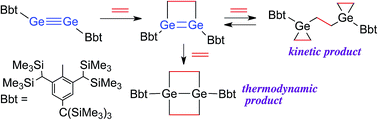
Reaction of a stable digermyne with ethylene afforded the corresponding 1,2-digermacyclobutene. Depending on the reaction conditions applied, further reaction of this 1,2-digermacyclobutene with ethylene furnished two different reaction products: a 1,4-digerma-bicyclo[2.2.0]hexane or a bis(germiranyl)ethane.
The content of this RSS Feed (c) The Royal Society of Chemistry

11 Jun 20:25
by Klara Edel, Sarah A. Brough, Ashley N. Lamm, Shih-Yuan Liu, Holger F. Bettinger
Abstract
The BN analogue of ortho-benzyne, 1,2-azaborine, is generated by flash vacuum pyrolysis, trapped under cryogenic conditions, and studied by direct spectroscopic techniques. The parent BN aryne spontaneously binds N2 and CO2, thus demonstrating its highly reactive nature. The interaction with N2 is photochemically reversible. The CO2 adduct of 1,2-azaborine is a cyclic carbamate which undergoes photocleavage, thus resulting in overall CO2 splitting.

Azaborine in a flash: The boron–nitrogen derivative of ortho-benzyne, 1,2-azaborine, can be synthesized by flash vacuum pyrolysis (FVP) and trapped under cryogenic conditions to form a Lewis acid/base complex with nitrogen. Irradiation generates the free 1,2-azaborine which readily reacts with dinitrogen at slightly elevated temperatures.
27 May 07:44
by Kyohei Otsuka, Naozumi Matsumoto, Shintaro Ishida, Soichiro Kyushin
24 Apr 09:07
by Kyle D. Reichl, Nicole L. Dunn, Nicholas J. Fastuca and Alexander T. Radosevich

Journal of the American Chemical Society
DOI: 10.1021/jacs.5b01899

14 Mar 21:40
by Vladimir Ya. Lee, Yuki Ito, Olga A. Gapurenko, Akira Sekiguchi, Vladimir I. Minkin, Ruslan M. Minyaev, Heinz Gornitzka
Abstract
The first example of the homonuclear pyramidanes, pentagermapyramidane, was synthesized, fully characterized, and computationally studied to reveal its peculiar structural features and the nature of its apex-to-base bonding interactions. Both solid-state and solution structures of pentagermapyramidane are discussed based on the computed stabilities of its square-pyramidal and distorted forms.

Germanium pyramids: The homonuclear pentagermapyramidane Ge[Ge4(SiMetBu2)4] (1) was synthesized and characterized. Crystal structures of two structural variations of 1 are reported: the distorted pyramidal structure 1 a, corresponding to the energy minima on the Ge5R4 potential energy surface (PES), and the square-planar pyramidal 1 b, representing a transition state on the PES.
05 Mar 22:01
by Jan Tillmann, Josef Heinrich Wender, Ute Bahr, Michael Bolte, Hans-Wolfram Lerner, Max C. Holthausen, Matthias Wagner
Abstract
Silicon analogues of the most prominent carbon nanostructures, namely, hollow spheroidals such as C60 and the fullerene family, have been unknown to date. Herein we show that discrete Si20 dodecahedra, stabilized by an endohedral guest and valence saturation, are accessible in preparative yields through a chloride-induced disproportionation reaction of hexachlorodisilane in the presence of tri(n-butyl)amine. X-ray crystallography revealed that each silicon dodecahedron contains an endohedral chloride ion that imparts a net negative charge. Eight chloro substituents and twelve trichlorosilyl groups are attached to the surface of each cluster in a strictly regioregular arrangement, a thermodynamically preferred substitution pattern according to quantum-chemical assessment. Our results demonstrate that the wet-chemical self-assembly of a complex, monodisperse Si nanostructure is possible under mild conditions starting from simple Si2 building blocks.

As simple as this: A stable, crystalline [20]silafullerane forms in preparatively useful yields through wet-chemical self-assembly from Si2Cl6 and chloride ions in the presence of an amine. Each silicon dodecahedron contains an endohedral chloride ion that imparts a net negative charge. Eight chloro substituents and twelve trichlorosilyl groups are attached to the surface of each cluster in a strictly regioregular arrangement.
11 Feb 17:50
by Andrey V. Protchenko, Matthew P. Blake, Andrew D. Schwarz, Cameron Jones, Philip Mountford and Simon Aldridge

Organometallics
DOI: 10.1021/om501252m

06 Feb 21:25
by Christian P. Sindlinger, Sebastian Weiß, Hartmut Schubert, Lars Wesemann
Abstract
NHC adducts of the stannylene Trip2Sn (Trip=2,4,6-triisopropylphenyl) were reacted with zero-valent Ni, Pd, and Pt precursor complexes to cleanly yield the respective metal complexes featuring a three-membered ring moiety Sn-Sn-M along with carbene transfer onto the metal and complete substitution of the starting ligands. Thus the easily accessible NHC adducts to stannylenes are shown to be valuable precursors for transition-metal complexes with an unexpected SnSn bond. The complexes have been studied by X-ray diffraction and NMR spectroscopy as well as DFT calculations. The compounds featuring the structural motif of a distannametallacycle comprised of a [(NHC)2M0] fragment and Sn2Trip4 represent rare higher congeners of the well-known olefin complexes. DFT calculations indicate the presence of a π-type Sn–Sn interaction in these first examples for acyclic distannenes symmetrically coordinating to a zero-valent transition metal.

Differing analogues: On reacting the carbene adduct of the stannylene [Trip2Sn] (Trip=2,4,6-triisopropylphenyl) with zero-valent Group 10 complexes, symmetrically coordinating complexes of the distannene [Sn2Trip4] to Ni, Pd, and Pt have been obtained. Their structural and spectroscopic properties are presented and discussed.
31 Jan 13:28
by Petra Vasko, Shuai Wang, Heikki M. Tuononen, Philip P. Power
Abstract

Tinned small molecules: Reactions of the tin cluster Sn8(Ar )4 under mild conditions yields two new insertion compounds from incorporation of ethylene (see picture; left) or H2 (right; Sn blue, C gray). To our knowledge, these are the first reactions between a stable main-group cluster and small molecules.
31 Jan 13:27
by Gabriele Stevanato, Joseph T. Hill-Cousins, Pär Håkansson, Soumya Singha Roy, Lynda J. Brown, Richard C. D. Brown, Giuseppe Pileio, Malcolm H. Levitt
Abstract
Nuclear magnetic resonance (NMR) and magnetic resonance imaging (MRI) are supremely important techniques with numerous applications in almost all branches of science. However, until recently, NMR methodology was limited by the time constant T1 for the decay of nuclear spin magnetization through contact with the thermal molecular environment. Long-lived states, which are correlated quantum states of multiple nuclei, have decay time constants that may exceed T1 by large factors. Here we demonstrate a nuclear long-lived state comprising two 13C nuclei with a lifetime exceeding one hour in room-temperature solution, which is around 50 times longer than T1. This behavior is well-predicted by a combination of quantum theory, molecular dynamics, and quantum chemistry. Such ultra-long-lived states are expected to be useful for the transport and application of nuclear hyperpolarization, which leads to NMR and MRI signals enhanced by up to five orders of magnitude.

A long-lived nuclear singlet: A molecular system based on a 13C2-labelled naphthalene core has been designed to support long-lived nuclear singlet order in solution. A nuclear singlet lifetime exceeding one hour has been achieved in room-temperature solution.
![[LEFTWARDS ARROW]](http://onlinelibrarystatic.wiley.com/undisplayable_characters/002190.gif) N units. By alleviating the steric hindrance effect of the bulky pendant moieties on the conjugated polymers that contain B
N units. By alleviating the steric hindrance effect of the bulky pendant moieties on the conjugated polymers that contain B

 m, a=3.089 Å) resulting from the decomposition reaction 3 H2S
 m structure of H3S, and suggest that the A site hydrogen atoms are most likely fluxional even at Tc .




 )4 (Ar
 =C6H2-2,6-(C6H3-2,4,6-Me3)2) with excess ethylene or dihydrogen at 25 °C/1 atmosphere yielded two new clusters that incorporated ethylene or hydrogen. The reaction with ethylene yielded Sn4(Ar
 )4(C2H2)5 that contained five ethylene moieties bridging four aryl substituted tin atoms and one tin–tin bond. Reaction with H2 produced a cyclic tin species of formula (Sn(H)Ar
 )4, which could also be synthesized by the reaction of {(Ar
 )Sn(μ-Cl)}2 with DIBAL-H. These reactions represent the first instances of direct reactions of isolable main-group clusters with ethylene or hydrogen under mild conditions. The products were characterized in the solid state by X-ray diffraction and IR spectroscopy and in solution by multinuclear NMR and UV/Vis spectroscopies. Density functional theory calculations were performed to explain the reactivity of the cluster.
