Shared posts

16 Jul 07:04

[ASAP] High Lewis Acidity at Planar, Trivalent, and Neutral Bismuth Centers

by Katherine M. Marczenko, Samantha Jee, and Saurabh S. Chitnis*

TOC Graphic

Organometallics
DOI: 10.1021/acs.organomet.0c00378
22 Jan 14:11

Single‐Crystal X‐Ray Diffraction Study of Pressure and Temperature‐Induced Spin Trapping in a Bistable Iron(II) Hofmann Framework

by Gemma F. Turner, Fallyn Campbell, Stephen A. Moggach, Simon Parsons, Andrés E. Goeta, M. Carmen Muñoz, José A. Real
Angewandte Chemie International Edition Single‐Crystal X‐Ray Diffraction Study of Pressure and Temperature‐Induced Spin Trapping in a Bistable Iron(II) Hofmann Framework

LS–HS switch: High‐pressure single‐crystal X‐ray diffraction has been used to trap both the low‐spin (LS) and high‐spin (HS) states of the iron(II) Hofmann spin crossover framework, [FeII(pdm)(H2O)[Ag(CN)2]2⋅H2O, under identical experimental conditions, allowing the structural changes arising from the spin‐transition to be deconvoluted from previously reported thermal effects.


Abstract

High‐pressure single‐crystal X‐ray diffraction has been used to trap both the low‐spin (LS) and high‐spin (HS) states of the iron(II) Hofmann spin crossover framework, [FeII(pdm)(H2O)[Ag(CN)2]2⋅H2O, under identical experimental conditions, allowing the structural changes arising from the spin‐transition to be deconvoluted from previously reported thermal effects.

14 Jan 13:25

Reactions of carbene-stabilized borenium cations

Dalton Trans., 2020, 49,1839-1846
DOI: 10.1039/C9DT04731J, Paper
Jolie Lam, Levy L. Cao, Jeffrey M. Farrell, Douglas. W. Stephan
A borenium cation containing BH bond is shown to react with olefins, alkynes vinyl-pyridine and phosphinoalkene. Related reactivity of C3-borenium cations with the FLP, PtBu3/B(C6F5)3 is shown to give the zwitterionic borenium-borate species.
The content of this RSS Feed (c) The Royal Society of Chemistry
17 Dec 12:27

Twenty-five years of bis-pentafluorophenyl borane: a versatile reagent for catalyst and materials synthesis

Chem. Commun., 2020, 56,841-853
DOI: 10.1039/C9CC08338C, Feature Article
Evan A. Patrick, Warren E. Piers
Highlights of the extensive chemistry and applications of bis-pentafluorophenyl borane (“Piers’ borane”) from the 25 years since its first appearance are featured.
The content of this RSS Feed (c) The Royal Society of Chemistry
10 Dec 08:23

Phosphanylalanes and Phosphanylgallanes Stabilized only by a Lewis Base

by Manfred Scheer, Michael Weinhart, Alexey Timoshkin
Phosphanylalanes and Phosphanylgallanes Stabilized only by a Lewis Base

Back to bases: The first parent phosphanylalanes and ‐gallanes stabilized only by a Lewis base were synthesized. These compounds are accessible via a salt metathesis reaction of LB⋅E′H2Cl and LiPH2⋅DME and a H2 elimination reaction between LB⋅E′H3 and PH3, respectively.


Abstract

The synthesis and characterization of the first parent phosphanylalane and phosphanylgallane stabilized only by a Lewis base (LB) are reported. The corresponding substituted compounds, such as IDipp⋅GaH2PCy2 (1) (IDipp=1,3‐bis(2,6‐diisopropylphenyl)‐imidazolin‐2‐ylidene) were obtained by the reaction of LiPCy2 with IDipp⋅GaH2Cl. However, the LB‐stabilized parent compounds IDipp⋅GaH2PH2 (3) and IDipp⋅AlH2PH2 (4) were prepared via a salt metathesis of LiPH2⋅DME with IDipp⋅E′H2Cl (E′=Ga, Al) or by H2‐elimination reactions of IDipp⋅E′H3 (E′=Ga, Al) and PH3, respectively. The compounds could be isolated as crystalline solids and completely characterized. Supporting DFT computations gave insight into the reaction pathways as well as into the stability of these compounds with respect to their decomposition behavior.

10 Dec 08:18

Reduction of a dihydroboryl cation to a boryl anion and its air-stable, neutral hydroboryl radical through hydrogen shuttling

Chem. Sci., 2019, Accepted Manuscript
DOI: 10.1039/C9SC05026D, Edge Article
Open Access Open Access
Creative Commons Licence&nbsp This article is licensed under a Creative Commons Attribution 3.0 Unported Licence.
Holger Braunschweig, Stephan Hagspiel, Merle Arrowsmith, Felipe Fantuzzi, Alexander Hermann, Valerie Paprocki, Regina Drescher, Ivo Krummenacher
The addition of Lewis bases to a cyclic (alkyl)(amino)carbene (CAAC)-supported dihydroboron triflate yields the mixed doubly base-stabilised dihydroboryl cations [(CAAC)BH2L]+. Of these, [(CAAC)2BH2]OTf (OTf = triflate) underwent facile two-electron reduction...
The content of this RSS Feed (c) The Royal Society of Chemistry
26 Nov 13:56

An alkyl-substituted aluminium anion with strong basicity and nucleophilicity

by Satoshi Kurumada

Nature Chemistry, Published online: 25 November 2019; doi:10.1038/s41557-019-0365-z

Owing to the electropositive character of aluminium it is difficult to prepare Al anions; the few that exist are supported by nitrogen ligands. Now, a dialkyl-alumanyl anion has been synthesized that features a polar Al–K bond. This anion reacts as a very strong base that deprotonates benzene, and undergoes nucleophilic substitution reactions.
18 Nov 13:20

[ASAP] Dinuclear Aluminum Halide Complexes Based on Bis(ß-diketiminate) Ligands: Synthesis, Structures, and Electrochemical Characterization

by Marcella E. Desat† and Robert Kretschmer*†‡

TOC Graphic

Inorganic Chemistry
DOI: 10.1021/acs.inorgchem.9b02868
06 Nov 07:58

[ASAP] Calix[4]pyrrole Aluminate: A Planar Tetracoordinate Aluminum(III) Anion and Its Unusual Lewis Acidity

by Fabian Ebner, Hubert Wadepohl, and Lutz Greb*

TOC Graphic

Journal of the American Chemical Society
DOI: 10.1021/jacs.9b10628
22 Jun 10:08

An Isolable Silicon Analogue of a Ketone that Contains an Unperturbed Si=O Double Bond

by Ryo Kobayashi, Shintaro Ishida, Takeaki Iwamoto
Angewandte Chemie International Edition An Isolable Silicon Analogue of a Ketone that Contains an Unperturbed Si=O Double Bond

Good to Si you: The first example of a genuine silanone, that is, an isolable silicon analogue of a ketone that contains an unperturbed Si=O bond, was synthesized. The structure and properties of this silanone were examined by a single‐crystal XRD analysis, NMR spectroscopy, and theoretical calculations. Bimolecular reactions revealed high electrophilicity on the Si atom and high nucleophilicity on the O atom of the Si=O bond.


Abstract

Despite tremendous efforts to synthesize isolable compounds with an Si=O bond, silicon analogues of ketones that contain an unperturbed Si=O bond have remained elusive for more than 100 years. Herein, we report the synthesis of an isolable silicon analogue of a ketone that exhibits a three‐coordinate silicon center and an unperturbed Si=O bond, thus representing the first example of a genuine silanone. Most importantly, this silanone does not require coordination by Lewis bases and acids and/or the introduction of electron‐donating groups to stabilize the Si=O bond. The structure and properties of this unperturbed Si=O bond were examined by a single‐crystal X‐ray diffraction analysis, NMR spectroscopy, and theoretical calculations. Bimolecular reactions revealed high electrophilicity on the Si atom and high nucleophilicity on the O atom of this genuine Si=O bond.

11 Dec 16:07

Reduction vs. Addition: The Reaction of an Aluminyl Anion with 1,3,5,7‐Cyclooctatetraene

by Ryan Schwamm, Mathew Anker, Matthias Lein, Martyn P Coles
Angewandte Chemie International Edition Reduction vs. Addition: The Reaction of an Aluminyl Anion with 1,3,5,7‐Cyclooctatetraene

Uneasy lies the head that wears a crown: The initial product from the reaction of a two‐coordinate aluminyl anion with 1,3,5,7‐cyclooctatetraene (COT) contains the reduced COT‐ligand with pronounced aromatic character. Addition of 18‐crown‐6 to K[Al(NONAr)(COT)] promotes isomerization of the carbocycle to afford the 9‐aluminabicyclo[4.2.1]nona‐2,4,7‐triene anion.


Abstract

The potassium aluminyl complex K[Al(NONAr)] (NON=NONAr=[O(SiMe2NAr)2]2−, Ar=2,6‐iPr2C6H3) reacts with 1,3,5,7‐cyclooctatetraene (COT) to give K[Al(NONAr)(COT)]. The COT‐ligand is present in the asymmetric unit as a planar μ2‐η28‐bridge between Al and K, with additional K⋅⋅⋅π‐aryl interactions to neighboring molecules that generate a helical chain. DFT calculations indicate significant aromatic character, consistent with reduction to [COT]2−. Addition of 18‐crown‐6 causes a rearrangement of the C8‐carbocycle to form the isomeric 9‐aluminabicyclo[4.2.1]nona‐2,4,7‐triene anion.

11 Dec 16:05

Bulky cationic ß-diketiminate magnesium complexes

Dalton Trans., 2018, Accepted Manuscript
DOI: 10.1039/C8DT03576H, Paper
Alexander Friedrich, Juergen Pahl, Holger Elsen, Sjoerd Harder
Cationic ß-diketiminate Mg complexes with the bulky tBuBDI ligand and the non-coordinating anion B(C6F5)4– have been prepared by reaction of (tBuBDI)MgnBu with [Ph3C+][B(C6F5)4–]; tBuBDI = CH[C(tBu)N-Dipp]2 and Dipp = 2,6-diisopropylphenyl....
The content of this RSS Feed (c) The Royal Society of Chemistry
19 Sep 10:54

[ASAP] Unravelling the Dramatic Electrostructural Differences Between N-Heterocyclic Carbene- and Cyclic (Alkyl)(amino)carbene-Stabilized Low-Valent Main Group Species

by Eileen Welz, Julian Böhnke, Rian D. Dewhurst, Holger Braunschweig, Bernd Engels

TOC Graphic

Journal of the American Chemical Society
DOI: 10.1021/jacs.8b07644
10 Sep 14:24

[ASAP] Exploring the Reactivity of Donor-Stabilized Phosphenium Cations: Lewis Acid-Catalyzed Reduction of Chlorophosphanes by Silanes

by Kyle G. Pearce, Andryj M. Borys, Ewan R. Clark, Helena J. Shepherd

TOC Graphic

Inorganic Chemistry
DOI: 10.1021/acs.inorgchem.8b01578
25 May 09:26

Stable Boron Dithiolene Radicals

by Dr. Yuzhong Wang , Dr. Yaoming Xie , Dr. Pingrong Wei , Soshawn A. Blair , Dr. Dongtao Cui , Prof. Dr. Michael K. Johnson , Prof. Dr. Henry F. Schaefer III , Prof. Dr. Gregory H. Robinson
Angewandte Chemie International Edition, EarlyView.
17 May 10:39

[ASAP] Boraphosphaalkene Synthesis via Phosphaalkyne Insertion into 9-Borafluorene

by Sam Yruegas, Jonathan H. Barnard, Khalidah Al-Furaiji, Jason L. Dutton, David J. D. Wilson, Caleb D. Martin

TOC Graphic

Organometallics
DOI: 10.1021/acs.organomet.8b00248
15 May 09:22

Cleavage of Two Hydrogen Molecules by Boryldisilenes

by Dr. Tomoyuki Kosai , Prof. Dr. Takeaki Iwamoto
Chemistry – A European Journal, EarlyView.
08 Feb 10:35

A Coupling Approach for the Generation of α,α-Bis(enolate) Equivalents: Regioselective Synthesis of gem-Difunctionalized Ketones

by Carmelo E. Iacono, Thomas C. Stephens, Teena S. Rajan and Graham Pattison
Martin Stanford

It's a bit nipB outside

TOC Graphic

Journal of the American Chemical Society
DOI: 10.1021/jacs.7b12941
09 Jan 09:29

Dialumination of unsaturated species with a reactive bis(cyclopentadienyl) dialane

Chem. Commun., 2018, 54,1639-1642
DOI: 10.1039/C7CC09596A, Communication
Alexander Hofmann, Anna Lamprecht, Oscar F. Gonzalez-Belman, Rian D. Dewhurst, J. Oscar C. Jimenez-Halla, Stephanie Kachel, Holger Braunschweig
A new cyclopentadienyl-containing dialane is prepared and found to undergo dialumination reactions with unsaturated species.
The content of this RSS Feed (c) The Royal Society of Chemistry
09 Jan 09:25

Half-Sandwich Complexes of an Extremely Electron-Donating, Redox-Active η6-Diborabenzene Ligand

by Julian Böhnke, Holger Braunschweig, J. Oscar C. Jiménez-Halla, Ivo Krummenacher and Tom E. Stennett

TOC Graphic

Journal of the American Chemical Society
DOI: 10.1021/jacs.7b12394
08 Jan 15:34

An Isolable Phosphaethynolatoborane and Its Reactivity

by Daniel Wilson, Alexander Hinz, Jose Manuel Goicoechea

Abstract

The synthesis and characterization of a stable phosphaethynolatoborane, [B]OCP (1, [B]=N,N′-bis(2,6-diisopropylphenyl)-2,3-dihydro-1H-1,3,2-diazaboryl), is described. The increased triple bond character of the P−C bond in 1 relative to the free ion (PCO) is probed in a series of reactivity studies. Compound 1 readily dimerises in donor solvents to afford a cyclic five-membered 6π-aromatic compound, cyclo-P2{C[B]}O{CO[B]} (2), which decarbonylates on UV irradiation. By contrast the nickel-mediated dimerisation of 1 affords the isomeric diphosphacyclobutene [P(CO[B])]2. When 1 is reacted with organolithium reagents such as MesLi (Mes=2,4,6-trimethylphenyl), the boryl moiety shifts and the formation of the lithoxy-boryl-phosphaalkene [LiOC[B]P(Mes)]2 was observed. The reactivity of this species towards electrophiles is also described.

Thumbnail image of graphical abstract

BOCParty: The synthesis, characterization, and reactivity of a stable phosphaethynolatoborane, [B]OCP (1, [B]=N,N′-bis(2,6-diisopropylphenyl)-2,3-dihydro-1H-1,3,2-diazaboryl), is described.

08 Jan 09:56

Metal-Free Regio- and Chemoselective Hydroboration of Pyridines Catalyzed by 1,3,2-Diazaphosphenium Triflate

by Bin Rao, Che Chang Chong and Rei Kinjo

TOC Graphic

Journal of the American Chemical Society
DOI: 10.1021/jacs.7b09754
08 Jan 09:54

Reversible Coordination of H2 by a Distannyne

by Shuai Wang, Tobias J. Sherbow, Louise A. Berben and Philip P. Power

TOC Graphic

Journal of the American Chemical Society
DOI: 10.1021/jacs.7b11798
08 Jan 09:54

Synthesis and Functionalization of a 1,4-Bis(trimethylsilyl)tetrasila-1,3-diene through the Selective Cleavage of Si(sp2)–Si(sp3) Bonds under Mild Reaction Conditions

by Naohiko Akasaka, Kentaro Fujieda, Eleonora Garoni, Kenji Kamada, Hiroshi Matsui, Masayoshi Nakano and Takeaki Iwamoto

TOC Graphic

Organometallics
DOI: 10.1021/acs.organomet.7b00864
04 Jan 14:09

Reagent for Introducing Base-Stabilized Phosphorus Atoms into Organic and Inorganic Compounds

by Subrata Kundu, Soumen Sinhababu, Anna V. Luebben, Totan Mondal, Debasis Koley, Birger Dittrich and Herbert W. Roesky

TOC Graphic

Journal of the American Chemical Society
DOI: 10.1021/jacs.7b11977
04 Jan 14:04

A Transient Vinylphosphinidene via a Phosphirene–Phosphinidene Rearrangement

by Liu Leo Liu, Jiliang Zhou, Levy L. Cao, Ryan Andrews, Rosalyn L. Falconer, Christopher A. Russell and Douglas W. Stephan

TOC Graphic

Journal of the American Chemical Society
DOI: 10.1021/jacs.7b11791
14 Dec 09:52

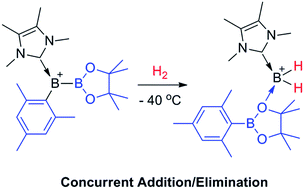
Addition of dihydrogen to a borylborenium center

Chem. Sci., 2018, 9,1433-1438
DOI: 10.1039/C7SC04987K, Edge Article
Open Access Open Access
Junhao Zheng, Zhen Hua Li, Huadong Wang
The reaction of a borylborenium cation with dihydrogen leads to the insertion of the borenium center to the H-H bond.
The content of this RSS Feed (c) The Royal Society of Chemistry
12 Dec 10:06

Reversible Addition of Terminal Alkenes to Digermynes

Chem. Commun., 2017, Accepted Manuscript
DOI: 10.1039/C7CC08555A, Communication
Tomohiro Sugahara, Jing-Dong Guo, Takahiro Sasamori, Shigeru Nagase, Norihiro Tokitoh
Stable digermynes with sterically demanding Bbt (Bbt = 2,6-[CH(SiMe3)2]2-4-[C(SiMe3)3]-C6H2) or Tbb (Tbb = 4-tBu-2,6-[CH(SiMe3)2]2-C6H2) groups underwent [2+2] cycloadditions with terminal alkenes to give the corresponding 1,2-digermacyclobutenes. In the case of...
The content of this RSS Feed (c) The Royal Society of Chemistry
20 Nov 10:38

The Weakly Coordinating Tris(trichlorosilyl)silyl Anion

by Marian Olaru, Maxie F. Hesse, Elena Rychagova, Sergey Ketkov, Stefan Mebs, Jens Beckmann

Abstract

Closely following the procedure for the preparation of the base-stabilized dichlorosilylene complex NHCDipp⋅SiCl2 reported by Roesky, Stalke, and co-workers (Angew. Chem. Int. Ed. 2009, 48, 5683–5686), a few crystals of the salt [NHCDipp−H⋅⋅⋅Cl⋅⋅⋅H−NHCDipp]Si(SiCl3)3 were isolated, aside from the reported byproduct [NHCDipp−H+⋅⋅⋅Cl], and characterized by X-ray crystallography (NHCDipp=N,N-di(2,6-diisopropylphenyl)imidazo-2-ylidene). They contain the weakly coordinating anion Si(SiCl3)3, which was also obtained in high yields upon deprotonation of the conjugate Brønsted acid HSi(SiCl3)3 with NHCDipp or PMP (PMP=1,2,2,6,6-pentamethylpiperidine). The acidity of HSi(SiCl3)3 was estimated by DFT calculations to be substantially higher than those of other H-silanes. Further DFT studies on the electronic structure of Si(SiCl3)3, including the electrostatic potential and the electron localizability, confirmed its low basicity and nucleophilicity compared with other silyl anions.

Thumbnail image of graphical abstract

The Brønsted acidity of the H-silane HSi(SiCl3)3 is extremely high, namely more than 43 orders of magnitude higher than that of HSiMe3 and even slightly higher than that of HCl in MeCN. Its deprotonation with an N-heterocyclic carbene provides the conjugate base Si(SiCl3)3, a weakly coordinating anion.

16 Nov 16:18

1,3,2-Diazaborole-Derived Carbene Complexes of Boron

Dalton Trans., 2017, Accepted Manuscript
DOI: 10.1039/C7DT04079B, Communication
Hunter P. Hickox, Yuzhong Wang, Kaitlin Mary Luedecke, Yaoming Xie, Pingrong Wei, Deidrah Carrillo, Nathan H. Dominique, Dongtao Cui, Henry F. Schaefer, Gregory Robinson
Reaction of 2-bromo-1,3,2-diazaborole (1) with excess BBr3 induces 1,2-hydrogen migration, giving 1,3,2-diazaborole-derived carbene complexes of boron bromide (2). Compound 2 exists in a dynamic solution equilibrium with 1. The 1H...
The content of this RSS Feed (c) The Royal Society of Chemistry